Tag: Motley Fool

  • The under-the-radar ASX All Ords share that could ‘grow at high rates for long periods of time’

    A young man sits at his desk working on his laptop with a big smile on his face due to his ASX shares going up and in particular the Computershare share price

    A young man sits at his desk working on his laptop with a big smile on his face due to his ASX shares going up and in particular the Computershare share priceThere is an ASX All Ords share flying under-the-radar that one portfolio manager is getting very excited about right now.

    That share is the little known IPD Group Ltd (ASX: IPG), which currently has a market capitalisation of approximately $320 million.

    IPD is a national distributor and service provider to the Australian electrical market. Think of it as the Dicker Data Ltd (ASX: DDR) of electrical infrastructure products.

    Its core focus in the products division is the sale of electrical infrastructure products to customers including switchboard manufacturers, electrical wholesalers, electrical contractors, power utilities, OEMs and system integrators.

    The company also provides a range of value-added services. This includes custom assembly, sourcing, engineering design, technical compliance, procurement, transport, storage, regulatory management, technical support, packaging, labelling, inventory management and delivery.

    Who is bullish on this ASX All Ords share?

    The portfolio manager that has been raving about this ASX All Ords share is Josh Clark from QVG Capital’s long-short fund.

    While Clark may be going short on some stocks, he is well and truly going long on this one.

    According to the AFR, the portfolio manager believes IPD is well-placed to grow strongly for a long period of time. He explains:

    IPD is a distributor to the electrical industry providing products not unlike the circuit breakers in your home but on an industrial scale. Think hospitals, data centres, engineering applications, utilities etc. We like it because they have the ingredients to dramatically increase their market share over the next decade.

    They compete against a large, foreign-owned incumbent and a small handful of independents, all of whom are in maintenance mode. We’ve seen this movie before with companies like Dicker Data, which have been more agile and customer-focused than their foreign competition, allowing them to grow at high rates for long periods of time.

    All in all, this could make IPD an ASX All Ords share to keep a very close eye on.

    The post The under-the-radar ASX All Ords share that could ‘grow at high rates for long periods of time’ appeared first on The Motley Fool Australia.

    Should you invest $1,000 in Ipd Group Limited right now?

    Before you consider Ipd Group Limited, you’ll want to hear this.

    Motley Fool Investing expert Scott Phillips just revealed what he believes are the 5 best stocks for investors to buy right now… and Ipd Group Limited wasn’t one of them.

    The online investing service he’s run for over a decade, Motley Fool Share Advisor, has provided thousands of paying members with stock picks that have doubled, tripled or even more.* And right now, Scott thinks there are 5 stocks that are better buys.

    See The 5 Stocks
    *Returns as of April 3 2023

    (function() {
    function setButtonColorDefaults(param, property, defaultValue) {
    if( !param || !param.includes(‘#’)) {
    var button = document.getElementsByClassName(“pitch-snippet”)[0].getElementsByClassName(“pitch-button”)[0];
    button.style[property] = defaultValue;
    }
    }

    setButtonColorDefaults(“#0095C8”, ‘background’, ‘#5FA85D’);
    setButtonColorDefaults(“#0095C8”, ‘border-color’, ‘#43A24A’);
    setButtonColorDefaults(“#fff”, ‘color’, ‘#fff’);
    })()

    More reading

    Motley Fool contributor James Mickleboro has no position in any of the stocks mentioned. The Motley Fool Australia’s parent company Motley Fool Holdings Inc. has positions in and has recommended Dicker Data and Ipd Group. The Motley Fool Australia has positions in and has recommended Dicker Data. The Motley Fool Australia has recommended Ipd Group. The Motley Fool has a disclosure policy. This article contains general investment advice only (under AFSL 400691). Authorised by Scott Phillips.

    from The Motley Fool Australia https://ift.tt/K39o6Ym

  • How did the Flight Centre share price manage to flog the ASX 200 in April?

    Kid with arm spread out on a luggage bag, riding a skateboard.Kid with arm spread out on a luggage bag, riding a skateboard.

    The Flight Centre Travel Group Ltd (ASX: FLT) share price gained 6.4% in April.

    Shares in the S&P/ASX 200 Index (ASX: XJO) travel stock closed on 31 March trading for $18.48. At the closing bell on 28 April shares were swapping hands for $19.67 apiece.

    That 6.4% boost in the Flight Centre share price is more than three and a half times the 1.8% gain posted by the ASX 200 in April.

    So, what went right for the ASX 200 travel share last month?

    Why did the ASX 200 travel share outperform in April?

    The strong outperformance of the Flight Centre share price in April will come as good news for shareholders. But certainly not so good for the sizeable number of short sellers who’ve been betting against the travel stock.

    In the first week of April, Flight Centre was the most shorted stock on the ASX, with a whopping short interest of 11.7%. That short interest rose to 11.9% the next week.

    Which is right about when the Flight Centre share price began to lift off. Shares gained 6.6% from the closing bell on 12 April through to the end of the month.

    With no price-sensitive news released by the company in April, we can only speculate on what spurred investors to hit the buy button.

    Some positives for FLT are the potential for further increases in international travellers. International travel numbers are ramping up but remain below pre-pandemic levels.

    However, Flight Centre expects international capacity will reach 85% of those levels in June.

    The company could also be finding support from its strong balance sheet, with a $465 million net cash position as at 31 December.

    And many ASX 200 investors may be eyeing the bigger picture.

    Despite some sizeable gains in 2023, Flight Centre shares remain down 48% from early January 2020. That was less than two months before COVID knocked the stuffing out of most shares, with travel stocks especially hard hit.

    Flight Centre share price snapshot

    The Flight Centre share price has gained an impressive 45% since the opening bell on 3 January. Though that’s not quite enough to make up for the heavy losses in the latter half of 2022.

    Over the past 12 months, the ASX 200 travel share remains down 1.5%.

    The post How did the Flight Centre share price manage to flog the ASX 200 in April? appeared first on The Motley Fool Australia.

    Should you invest $1,000 in Flight Centre Travel Group Limited right now?

    Before you consider Flight Centre Travel Group Limited, you’ll want to hear this.

    Motley Fool Investing expert Scott Phillips just revealed what he believes are the 5 best stocks for investors to buy right now… and Flight Centre Travel Group Limited wasn’t one of them.

    The online investing service he’s run for over a decade, Motley Fool Share Advisor, has provided thousands of paying members with stock picks that have doubled, tripled or even more.* And right now, Scott thinks there are 5 stocks that are better buys.

    See The 5 Stocks
    *Returns as of April 3 2023

    (function() {
    function setButtonColorDefaults(param, property, defaultValue) {
    if( !param || !param.includes(‘#’)) {
    var button = document.getElementsByClassName(“pitch-snippet”)[0].getElementsByClassName(“pitch-button”)[0];
    button.style[property] = defaultValue;
    }
    }

    setButtonColorDefaults(“#43B02A”, ‘background’, ‘#5FA85D’);
    setButtonColorDefaults(“#43B02A”, ‘border-color’, ‘#43A24A’);
    setButtonColorDefaults(“#fff”, ‘color’, ‘#fff’);
    })()

    More reading

    Motley Fool contributor Bernd Struben has no position in any of the stocks mentioned. The Motley Fool Australia’s parent company Motley Fool Holdings Inc. has no position in any of the stocks mentioned. The Motley Fool Australia has recommended Flight Centre Travel Group. The Motley Fool has a disclosure policy. This article contains general investment advice only (under AFSL 400691). Authorised by Scott Phillips.

    from The Motley Fool Australia https://ift.tt/PpTWntN

  • Why the iron ore price is ‘not out of the danger zone’

    A group of three men in hard hats and high visibility vests stand together at a mine site while one points and the others look on with piles of dirt and mining equipment in the background.A group of three men in hard hats and high visibility vests stand together at a mine site while one points and the others look on with piles of dirt and mining equipment in the background.

    The iron ore price has dropped from above US$120 a few weeks ago to less than US$110. The price an ASX iron ore share gets for its production can have a key impact on profitability, which is why there has been pressure on the BHP Group Ltd (ASX: BHP) share price, Rio Tinto Ltd (ASX: RIO) share price and the Fortescue Metals Group Ltd (ASX: FMG) share price.

    Over the past month, the Fortescue share price is down 7%, the BHP share price is down 4% and the Rio Tinto share price is down 5.6%.

    The investment bank Morgan Stanley thinks that the iron ore price could fall even further, according to reporting by The Australian.

    Oversupply?

    Morgan Stanley is suggesting that there is going to be an oversupply of iron in the coming months.

    That’s because China’s steel production is “catching up with the reality of sluggish underlying demand”, according to Morgan Stanley’s commodity analysts. We have seen reports of China’s economy not rebounding strongly after COVID-19 lockdowns ended in the country.

    One of the issues for iron is that China’s peak steel output ‘season’ ended about a month earlier than it did during the last two years.

    Morgan Stanley reportedly noted that “relatively stable” iron ore port inventories imply that the market isn’t significantly oversupplied as of yet, but this could be about to change and hurt the iron ore price.

    The suggestion by the investment bank is that more steel production cuts are needed on top of what has already occurred in China, while the iron ore supply is ramping up, which could lead to a surplus.

    The Australian reported on analyst comments regarding the danger zone:

    At $US106/t, the iron ore price remains above cost support and is not out of the danger zone yet. Last year, the price kept trending lower from April to October, a dynamic we could well see this year again.

    What could this mean for iron ore miners?

    BHP, Rio Tinto and Fortescue are three of the iron ore miners with the lowest production costs globally, so even at US$100 per tonne or US$90 per tonne, they can make decent money.

    But, if the iron ore price falls it would likely mean that those three ASX mining shares would make less profit because they would get less revenue for the same amount of production.

    However, if the iron ore price does fall it could make some other high-cost iron ore miners decide to lower their production, which would help the global supply and demand relationship, and hopefully boost the iron ore price.

    I think the iron ore price has proven to be very cyclical over the past five years. If it does keep falling, I believe that could end up being a medium-term buying opportunity for investors because of the cyclical nature of iron ore demand. However, there’s no certainty at all that the iron ore price will recover back to its former heights this year.

    The post Why the iron ore price is ‘not out of the danger zone’ appeared first on The Motley Fool Australia.

    Wondering where you should invest $1,000 right now?

    When investing expert Scott Phillips has a stock tip, it can pay to listen. After all, the flagship Motley Fool Share Advisor newsletter he has run for over ten years has provided thousands of paying members with stock picks that have doubled, tripled or even more.*

    Scott just revealed what he believes could be the ‘five best ASX stocks’ for investors to buy right now. These stocks are trading at near dirt-cheap prices and Scott thinks they could be great buys right now…

    See The 5 Stocks
    *Returns as of April 3 2023

    (function() {
    function setButtonColorDefaults(param, property, defaultValue) {
    if( !param || !param.includes(‘#’)) {
    var button = document.getElementsByClassName(“pitch-snippet”)[0].getElementsByClassName(“pitch-button”)[0];
    button.style[property] = defaultValue;
    }
    }

    setButtonColorDefaults(“#0095C8”, ‘background’, ‘#5FA85D’);
    setButtonColorDefaults(“#0095C8”, ‘border-color’, ‘#43A24A’);
    setButtonColorDefaults(“#fff”, ‘color’, ‘#fff’);
    })()

    More reading

    Motley Fool contributor Tristan Harrison has positions in Fortescue Metals Group. The Motley Fool Australia’s parent company Motley Fool Holdings Inc. has no position in any of the stocks mentioned. The Motley Fool Australia has no position in any of the stocks mentioned. The Motley Fool has a disclosure policy. This article contains general investment advice only (under AFSL 400691). Authorised by Scott Phillips.

    from The Motley Fool Australia https://ift.tt/mRBJibg

  • Everything you need to know about the NAB dividend

    Man holding different Australian dollar notes.

    Man holding different Australian dollar notes.The National Australia Bank Ltd (ASX: NAB) share price is having a day to forget on Thursday.

    The banking giant’s shares were down as much as 8% after posting a half-year result that fell short of expectations for a number of metrics such as earnings and its dividend.

    As a reminder, NAB reported a 17% increase in cash earnings to $4,070 million for the six months ended 31 March. While this is certainly strong growth, it was still short of consensus estimates. For example, the market was expecting cash earnings of $4,151 million and Goldman Sachs was forecasting even higher cash profits at $4,227 million.

    These softer earnings unfortunately meant that the NAB dividend also fell short of expectations.

    The NAB dividend

    For the first half of FY 2023, NAB declared a fully franked interim dividend of 83 cents per share.

    Once again, while this was up strongly (13.7%) from the prior corresponding period, it was a touch short of expectations. Goldman was forecasting the NAB interim dividend to come in at 84 cents per share for the half.

    Though, it is worth noting that with the NAB share price currently trading at $26.92, the bank’s interim dividend still offers a juicy yield of approximately 3.1%.

    Want to receive this payout?

    If you want to receive the NAB dividend, you will need to ensure that you own the bank’s shares when they trade ex-dividend next week on 10 May.

    You will then be able to look forward to receiving the cash payout in two months on 5 July. Unless of course you opt to take part in the bank’s dividend reinvestment plan. The company explains:

    The dividend is paid in cash or as part of a dividend plan. Cash dividends are paid by way of direct credit or cash equivalents. The dividend plans in operation are the Dividend Reinvestment Plan and the Bonus Share Plan (closed to new participants). The last date for receipt of election notices for the Dividend Reinvestment Plan and the Bonus Share Plan is 12 May 2023 at 5pm (Australian Eastern Standard time).

    The post Everything you need to know about the NAB dividend appeared first on The Motley Fool Australia.

    Should you invest $1,000 in National Australia Bank Limited right now?

    Before you consider National Australia Bank Limited, you’ll want to hear this.

    Motley Fool Investing expert Scott Phillips just revealed what he believes are the 5 best stocks for investors to buy right now… and National Australia Bank Limited wasn’t one of them.

    The online investing service he’s run for over a decade, Motley Fool Share Advisor, has provided thousands of paying members with stock picks that have doubled, tripled or even more.* And right now, Scott thinks there are 5 stocks that are better buys.

    See The 5 Stocks
    *Returns as of April 3 2023

    (function() {
    function setButtonColorDefaults(param, property, defaultValue) {
    if( !param || !param.includes(‘#’)) {
    var button = document.getElementsByClassName(“pitch-snippet”)[0].getElementsByClassName(“pitch-button”)[0];
    button.style[property] = defaultValue;
    }
    }

    setButtonColorDefaults(“#0095C8”, ‘background’, ‘#5FA85D’);
    setButtonColorDefaults(“#0095C8”, ‘border-color’, ‘#43A24A’);
    setButtonColorDefaults(“#fff”, ‘color’, ‘#fff’);
    })()

    More reading

    Motley Fool contributor James Mickleboro has no position in any of the stocks mentioned. The Motley Fool Australia’s parent company Motley Fool Holdings Inc. has no position in any of the stocks mentioned. The Motley Fool Australia has no position in any of the stocks mentioned. The Motley Fool has a disclosure policy. This article contains general investment advice only (under AFSL 400691). Authorised by Scott Phillips.

    from The Motley Fool Australia https://ift.tt/WuhzmGj

  • On my ASX watchlist: Is Resmed borrowing Apple’s multi-billion-dollar playbook?

    A male investor sits at his desk looking at his laptop screen with his hand to his chin pondering whether to buy Origin sharesA male investor sits at his desk looking at his laptop screen with his hand to his chin pondering whether to buy Origin shares

    On my hunt for serial compounders, Resmed CDI (ASX: RMD) shares have made their way onto my watchlist. The company’s share price has flown 16.4% higher since the beginning of the year, but that’s not why the respiratory medical device maker is on my radar.

    The real eye-catching aspect of Resmed is its push into a potentially lucrative revenue stream. While there are notable differences, Resmed appears to be executing a play that’s arguably been instrumental in the success of Apple Inc (NASDAQ: AAPL) over the past decade.

    So, do I think this growth ingredient is enough to justify the 40 times earnings multiple Resmed shares are fetching?

    What is the money-making Apple move?

    Most of us know the American tech giant for its sleek and intuitive devices — iPhones, iPads, Macs, etc. These innovative and stylish products have formed the backbone of Apple’s sticky ecosystem as we know it today.

    Over time, Apple has embedded itself in the daily lives of its customers, selling products that many of us use day in and day out. In doing so, the company has built up enormous switching costs, which is a type of moat. Financially, it’s hard to justify swapping to a non-iPhone when it means also shelling out for a new smartwatch, wireless headphones, etc.

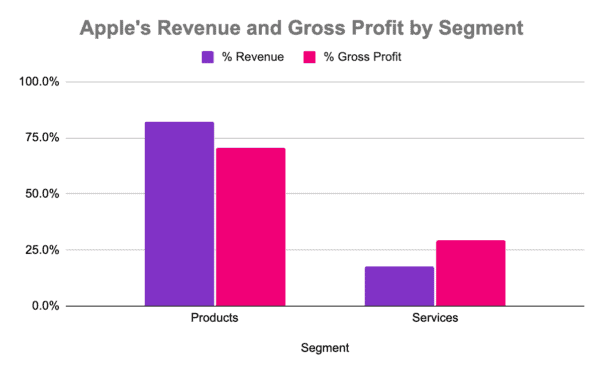
    While the company’s, almost luxury-like, devices generate solid profits, it is the services segment that takes full advantage of the high switching cost.

    This segment extracts extremely high-margin revenue from the Apple customer base by monetising the limited number of alternatives (of which there are none at times) to iCloud, the App Store, and Apple Pay among others.

    Source: Apple Inc Q1FY2023 report, three months ending 31 December 2022

    The chart above illustrates how the services segment delivers an outsized boost to gross profits compared to its share of revenue. Simply put, the near-zero cost of providing services — which are mostly just a bit of software — makes this avenue a lucrative one.

    Could SaaS revenue make Resmed an ASX 200 outperformer?

    Like Apple, Resmed is best known for its physical products. For many, the company’s medical equipment is essential for getting a good night’s sleep — combating sleep apnea and insomnia with their continuous positive airway pressure (CPAP) machines.

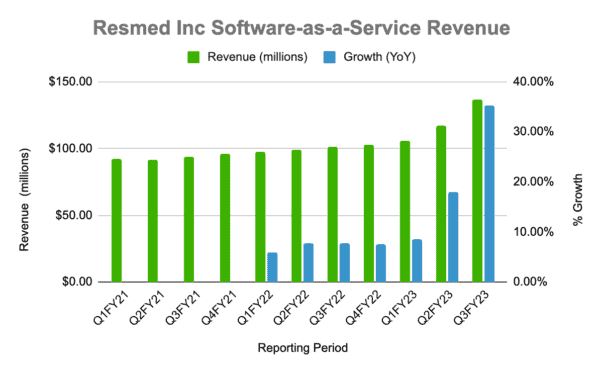
    However, Resmed has been quietly building another source of revenue… Software as a Service (SaaS). What is noticeably different from Apple is that it appears most of this revenue is derived from clinical-facing software rather than consumer-facing.

    At present, ASX-listed Resmed’s solutions encompass Brightree, MatrixCare, Healthcarefirst, CitusHealth, and Medifox Dan. Generally, these solutions are geared towards streamlining processes for healthcare workers.

    Source: Resmed quarterly reports between Q1FY23 and Q3FY23

    Nevertheless, the segment has grown rapidly in recent years. Between Q3FY21 and Q3FY23, SaaS revenue increased 45.8% to $136.8 million. Still, this fast-growing division only represents roughly 12% of total revenue.

    Where Resmed possibly departs from Apple’s storyline is its relationship between the software/services and its key products.

    Personally, I’d be more excited if Resmed leveraged its SaaS expertise to derive higher revenue from its medical device customers. Perhaps that is the endgame of the Resmed team. From my perspective, that would make use of the high switching cost of its products, implementing the Apple strategy.

    Until then, Resmed will probably stay on my ASX watchlist.

    The post On my ASX watchlist: Is Resmed borrowing Apple’s multi-billion-dollar playbook? appeared first on The Motley Fool Australia.

    Wondering where you should invest $1,000 right now?

    When investing expert Scott Phillips has a stock tip, it can pay to listen. After all, the flagship Motley Fool Share Advisor newsletter he has run for over ten years has provided thousands of paying members with stock picks that have doubled, tripled or even more.*

    Scott just revealed what he believes could be the ‘five best ASX stocks’ for investors to buy right now. These stocks are trading at near dirt-cheap prices and Scott thinks they could be great buys right now…

    See The 5 Stocks
    *Returns as of April 3 2023

    (function() {
    function setButtonColorDefaults(param, property, defaultValue) {
    if( !param || !param.includes(‘#’)) {
    var button = document.getElementsByClassName(“pitch-snippet”)[0].getElementsByClassName(“pitch-button”)[0];
    button.style[property] = defaultValue;
    }
    }

    setButtonColorDefaults(“#0095C8”, ‘background’, ‘#5FA85D’);
    setButtonColorDefaults(“#0095C8”, ‘border-color’, ‘#43A24A’);
    setButtonColorDefaults(“#fff”, ‘color’, ‘#fff’);
    })()

    More reading

    Motley Fool contributor Mitchell Lawler has positions in Apple. The Motley Fool Australia’s parent company Motley Fool Holdings Inc. has positions in and has recommended Apple and ResMed. The Motley Fool Australia has positions in and has recommended ResMed. The Motley Fool Australia has recommended Apple. The Motley Fool has a disclosure policy. This article contains general investment advice only (under AFSL 400691). Authorised by Scott Phillips.

    from The Motley Fool Australia https://ift.tt/vep2Hgk

  • Better investment: Vanguard Australian Shares ETF (VAS) or a term deposit?

    A casually dressed woman at home on her couch looks at index fund charts on her laptop

    A casually dressed woman at home on her couch looks at index fund charts on her laptopOn Tuesday this week, the Reserve Bank of Australia (RBA) raised interest rates yet again. It was the 11th rise in the past 12 months. With rates now well and truly above the near-zero levels we had become used to, cash investments like term deposits are a lot more appealing today than they were a year ago. So let’s check out whether investors in the Vanguard Australian Shares Index ETF (ASX: VAS) might be better off switching to cash. 

    The Vanguard Australian Shares ETF is the most popular index fund on the ASX. This exchange-traded fund (ETF) allows investors to gain exposure to the S&P/ASX 300 Index (ASX: XKO). In essence, it is an investment in the largest 300 public companies listed on the Australian share market.

    Thus, an investment in the VAS ETF can be thought of as an investment in the ASX itself.

    This was a very appealing investment when interest rates were near-zero across 2020 and 2021. You got exposure to the compounding capital growth of shares, as well as the dividends and franking credits that this ETF passes through to its investors. In contrast, a term deposit would get you a 1% yield on your money, if you were lucky.

    But today, the tables have turned. A term deposit can get you as much as a 5% annual return on your money right now. And that’s before the latest interest rate rise has filtered through.

    And a term deposit comes with none of the volatility that the share market brings. If you lock your money up for 12 months at a 5% interest rate, it’s guaranteed to be there when you come back for it.

    In contrast, a sharemarket-based index fund like the Vanguard Australian Shares ETF comes with no guarantees. There’s no guarantee that you’re capital will be safe. And there’s no promise that last year’s dividends will match this year’s.

    With all that in mind, does a term deposit make for a better investment than the VAS ETF today?

    Should investors just choose a term deposit over Vanguard’s VAS ETF?

    Well, it depends. If you’re a retiree, where preservation of capital is more important than anything else, then perhaps a term deposit would suit your goals better. 5% isn’t a bad yield, exceeding what many ASX dividend shares offer. It certainly has the potential to offer some meaningful cash flow.

    But for other investors who might have a higher tolerance for risk and share market volatility, the Vanguard Australian Shares ETF might still be a better option for one simple reason: the potential returns.

    The Vanguard Australian Shares ETF has a long history of delivering returns that well exceed 5% per annum. As of 31 March, the VAS ETF has returned an average of 8.06% per annum over the past decade, and 8.88% per annum since its inception in 2009. Those returns include dividends.

    Now, past performance is no guarantee of future success, of course. But a general rule of investing is that lower risk equates to lower returns. ASX-based ETFs have always outperformed cash investments over long periods of time, as we have discussed here at the Fool on many occasions.

    So if I had the choice between putting the majority of my wealth in term deposits or ASX shares, I would choose ASX shares every time. Cash is great for emergencies and for funding living expenses. But not much else.


    The post Better investment: Vanguard Australian Shares ETF (VAS) or a term deposit? appeared first on The Motley Fool Australia.

    Should you invest $1,000 in Vanguard Australian Shares Index Etf right now?

    Before you consider Vanguard Australian Shares Index Etf, you’ll want to hear this.

    Motley Fool Investing expert Scott Phillips just revealed what he believes are the 5 best stocks for investors to buy right now… and Vanguard Australian Shares Index Etf wasn’t one of them.

    The online investing service he’s run for over a decade, Motley Fool Share Advisor, has provided thousands of paying members with stock picks that have doubled, tripled or even more.* And right now, Scott thinks there are 5 stocks that are better buys.

    See The 5 Stocks
    *Returns as of April 3 2023

    (function() {
    function setButtonColorDefaults(param, property, defaultValue) {
    if( !param || !param.includes(‘#’)) {
    var button = document.getElementsByClassName(“pitch-snippet”)[0].getElementsByClassName(“pitch-button”)[0];
    button.style[property] = defaultValue;
    }
    }

    setButtonColorDefaults(“#43B02A”, ‘background’, ‘#5FA85D’);
    setButtonColorDefaults(“#43B02A”, ‘border-color’, ‘#43A24A’);
    setButtonColorDefaults(“#fff”, ‘color’, ‘#fff’);
    })()

    More reading

    Motley Fool contributor Sebastian Bowen has positions in Vanguard Australian Shares Index ETF. The Motley Fool Australia’s parent company Motley Fool Holdings Inc. has no position in any of the stocks mentioned. The Motley Fool Australia has no position in any of the stocks mentioned. The Motley Fool has a disclosure policy. This article contains general investment advice only (under AFSL 400691). Authorised by Scott Phillips.

    from The Motley Fool Australia https://ift.tt/jKSXhpQ

  • Should I buy up CSL shares right now while they’re under $300?

    A man in his 30s holds his laptop and operates it with his other hand as he has a look of pleasant surprise on his face as though he is learning something new or finding hidden value in something on the screen.A man in his 30s holds his laptop and operates it with his other hand as he has a look of pleasant surprise on his face as though he is learning something new or finding hidden value in something on the screen.

    CSL Limited (ASX: CSL) shares have dipped beneath the $300 watermark over the past two days.

    The CSL share price is currently $299.51, down 0.03% for the day so far.

    The ASX 200 blue chip share has recorded large fluctuations in price over the past 12 months.

    Its lowest trading price over the period is $254.30, recorded in June last year.

    Its 52-week high is $314.28, recorded in February.

    Is it time to buy?

    Are CSL shares a buy under $300?

    The analysts at Citi certainly think so. They currently have a buy rating on CSL shares and a 12-month price target of $350. That implies a potential 17% upside from here.

    Macquarie has an outperform rating on CSL shares with a 12-month price target of $344.

    CSL shares once again feature on Morgans’ best ideas list this month.

    The broker has given the ASX 200 biotech share an add rating and a $337 share price target.

    The broker says CSL is a buy due to its significantly improved outlook and attractive valuation.

    Morgans says:

    A key portfolio holding and key sector pick, we believe CSL is poised to break-out this year, a COVID exit trade, offering double-digit recovery in earnings growth as plasma collections increase, new products get approved and influenza vaccine uptake increases around ongoing concerns about respiratory viruses, with shares offering good value trading around its long-term forward multiple of ~30x.

    Analysts impressed by company’s European tour

    CSL shares outperformed the ASX 200 in April, rising 4.3%. The ASX 200 rose by 1.8%.

    As my Fool colleague James reported, CSL conducted a European investor site tour at the end of March.

    Morgan Stanley responded to the tour by reiterating its overweight rating and $339 price target.

    Goldman Sachs was also at the event and said:

    … CSL is now well positioned for a medium-term period of less capital-intensive growth (supporting our views that the current ROIC [return on invested capital] trough should markedly improve from here).

    What about dividends?

    Another Fool writer, Sebastian suggests CSL shares are a ‘sleeping dividend giant‘.

    He points out that the annual dividend has risen by a cumulative 96.5% between 2014 and 2022.

    The biotech has just paid investors an interim dividend of US$1.07 per share. That’s up from US$1.04 per share in 2022.

    If the company continues increasing its dividends at the same pace as the 2014 to 2022 period, shareholders stand to receive US$4.36 per share by the year 2030.

    That’s $6.52 per share in Australian dollars at today’s exchange rate.

    The post Should I buy up CSL shares right now while they’re under $300? appeared first on The Motley Fool Australia.

    FREE Investing Guide for Beginners

    Despite what some people may say – we believe investing in shares doesn’t have to be overwhelming or complicated…

    For over a decade, we’ve been helping everyday Aussies get started on their journey.

    And to help even more people cut through some of the confusion “experts’” seem to want to perpetuate – we’ve created a brand-new “how to” guide.

    Yes, Claim my FREE copy!
    *Returns as of April 3 2023

    (function() {
    function setButtonColorDefaults(param, property, defaultValue) {
    if( !param || !param.includes(‘#’)) {
    var button = document.getElementsByClassName(“pitch-snippet”)[0].getElementsByClassName(“pitch-button”)[0];
    button.style[property] = defaultValue;
    }
    }

    setButtonColorDefaults(“#0095C8”, ‘background’, ‘#5FA85D’);
    setButtonColorDefaults(“#0095C8”, ‘border-color’, ‘#43A24A’);
    setButtonColorDefaults(“#fff”, ‘color’, ‘#fff’);
    })()

    More reading

    Citigroup is an advertising partner of The Ascent, a Motley Fool company. Motley Fool contributor Bronwyn Allen has positions in CSL and Macquarie Group. The Motley Fool Australia’s parent company Motley Fool Holdings Inc. has positions in and has recommended CSL and Goldman Sachs Group. The Motley Fool Australia has positions in and has recommended Macquarie Group. The Motley Fool has a disclosure policy. This article contains general investment advice only (under AFSL 400691). Authorised by Scott Phillips.

    from The Motley Fool Australia https://ift.tt/k2ReoOF

  • Guess which ASX mining stock is rocketing 27% on a ‘ground breaking rare earth discovery’

    A happy miner pointing.A happy miner pointing.

    The S&P/ASX 200 Materials Index (ASX: XMJ) is rising 1.29% today, but this ASX mining stock is charging far higher.

    The Caspin Resources Ltd (ASX: CPN) share price gained 61% to hit an intraday high of 47.5 cents. It’s currently settled at 37.5 cents a share, up 27.1%.

    Let’s take a look at what this ASX mining stock has discovered.

    What’s going on?

    Caspin advised the market today it has made a “ground breaking” rare earths discovery at the Mount Squires Project in Western Australia.

    The company observed significant rare earth element mineralisation at the project, located in the West Musgrave region of the state.

    Assay results showed:

    • 46m at 0.71% TREO (total rare earth oxides) from 32m including 1.25% TREO from 48 metres at hole MSAC0141
    • 19m at 0.41% TREO from surface including 4m at 0.80% TREO from 8m at drill hole MSAC0224
    • 7m at 0.32% TREO from surface including 2m at 0.57% TREO from 5m to EOH at drill hole MSAC0130
    • 10m at 0.14% TREO from 36m at drill hole MSAC0139

    The company noted a high proportion of heavy (dysprosium and terbium) and light rare earth elements (neodymium and praseodymium).

    This may be the first discovery of “significant rare earth element” mineralisation in the West Musgrave region, according to Caspin.

    Commenting on the news, CEO Greg Miles said:

    This is a sensational discovery given the tiny scale of the assay program. The Company has long recognised the conceptual potential for rare earth mineralisation at the Mount Squires Project, but given the more obvious prospectivity for nickel, copper and gold this potential had not been investigated until now.

    We’ve now made a significant rare earth discovery, of a relatively unique style in Australia, in a province with no previous systematic exploration for rare earths

    The company has so far assayed 37 samples from four holes and there are further results pending. The next drill program will test extensions and enable the company to gather samples for metallurgical test work.

    Share price snapshot

    Today’s news is a welcome boost. The Caspin Resources share price has shed 49% in the last year.

    This ASX mining stock has a market capitalisation of about $34.9 million based on the latest share price.

    The post Guess which ASX mining stock is rocketing 27% on a ‘ground breaking rare earth discovery’ appeared first on The Motley Fool Australia.

    Should you invest $1,000 in Caspin Resources Limited right now?

    Before you consider Caspin Resources Limited, you’ll want to hear this.

    Motley Fool Investing expert Scott Phillips just revealed what he believes are the 5 best stocks for investors to buy right now… and Caspin Resources Limited wasn’t one of them.

    The online investing service he’s run for over a decade, Motley Fool Share Advisor, has provided thousands of paying members with stock picks that have doubled, tripled or even more.* And right now, Scott thinks there are 5 stocks that are better buys.

    See The 5 Stocks
    *Returns as of April 3 2023

    (function() {
    function setButtonColorDefaults(param, property, defaultValue) {
    if( !param || !param.includes(‘#’)) {
    var button = document.getElementsByClassName(“pitch-snippet”)[0].getElementsByClassName(“pitch-button”)[0];
    button.style[property] = defaultValue;
    }
    }

    setButtonColorDefaults(“#43B02A”, ‘background’, ‘#5FA85D’);
    setButtonColorDefaults(“#43B02A”, ‘border-color’, ‘#43A24A’);
    setButtonColorDefaults(“#fff”, ‘color’, ‘#fff’);
    })()

    More reading

    Motley Fool contributor Monica O’Shea has no position in any of the stocks mentioned. The Motley Fool Australia’s parent company Motley Fool Holdings Inc. has no position in any of the stocks mentioned. The Motley Fool Australia has no position in any of the stocks mentioned. The Motley Fool has a disclosure policy. This article contains general investment advice only (under AFSL 400691). Authorised by Scott Phillips.

    from The Motley Fool Australia https://ift.tt/NVSMphE

  • ‘Additional growth options’: Why the Northern Star share price is flying today

    A cool older woman wearing sunglasses celebrates at her party with a gold balloon.A cool older woman wearing sunglasses celebrates at her party with a gold balloon.

    The Northern Star Resources Ltd (ASX: NST) share price is up 2.88% in afternoon trade.

    Shares in the S&P/ASX 200 Index (ASX: XJO) gold stock closed yesterday trading for $13.55. Shares are currently changing hands for $13.94 apiece.

    This comes despite a 0.16% intraday decline in the ASX 200, with some stocks feeling the pinch following the latest interest rate hike from the US Fed.

    The Northern Star share price, however, looks to be getting a boost on two fronts today.

    First, the gold price is on a tear.

    On Monday, bullion was trading for US$1,982.56, according to data from Bloomberg.

    After another overnight boost, today that same ounce is trading for US$2,042.15, a gain of more than 3%.

    And the Northern Star isn’t the only gold stock rising alongside the yellow metal.

    The S&P/ASX All Ordinaries Gold Index (ASX: XGD) is up 2.1% today.

    What else are ASX 200 investors considering?

    The second tailwind for the Northern Star share price today looks to be related to the miner’s Annual Mineral Resource and Ore Reserve update for the 12 months ending 31 March.

    The company’s gold mines are located in Western Australia and the US state of Alaska.

    Likely piquing investor interest, the ASX 200 gold stock reported a 3.5 million ounce increase in its mineral resource to 57.4 million ounces.

    The miner said this growth underscores the value of the investments in its sustained exploration program.

    The increased mineral resource offset mine depletion and divestments over the year, leaving the total ore reserve stable at 20.2 million ounces.

    Northern Star said it had also slightly increased its “conservative long-term gold price assumptions” to reflect increased costs across the sector.

    Commenting on the results helping drive the Northern Star share price higher today, managing director Stuart Tonkin said:

    Northern Star’s three production centres – Kalgoorlie, Yandal and Pogo – come with incredible and genuine world-class mineral endowments that provide us with the confidence to plan organic and profitable growth of the company’s production footprint.

    Tonkin highlighted the Kalgoorlie district, where he said the Hercules discovery provides “a good example of this type of new find that will provide us with additional growth options”.

    Northern Star share price snapshot

    The Northern Star share price has been a strong outperformer over the past 12 months, up 48%. So far in 2023, the ASX 200 gold stock has gained 26%.

    The post ‘Additional growth options’: Why the Northern Star share price is flying today appeared first on The Motley Fool Australia.

    Should you invest $1,000 in Northern Star Resources Limited right now?

    Before you consider Northern Star Resources Limited, you’ll want to hear this.

    Motley Fool Investing expert Scott Phillips just revealed what he believes are the 5 best stocks for investors to buy right now… and Northern Star Resources Limited wasn’t one of them.

    The online investing service he’s run for over a decade, Motley Fool Share Advisor, has provided thousands of paying members with stock picks that have doubled, tripled or even more.* And right now, Scott thinks there are 5 stocks that are better buys.

    See The 5 Stocks
    *Returns as of April 3 2023

    (function() {
    function setButtonColorDefaults(param, property, defaultValue) {
    if( !param || !param.includes(‘#’)) {
    var button = document.getElementsByClassName(“pitch-snippet”)[0].getElementsByClassName(“pitch-button”)[0];
    button.style[property] = defaultValue;
    }
    }

    setButtonColorDefaults(“#0095C8”, ‘background’, ‘#5FA85D’);
    setButtonColorDefaults(“#0095C8”, ‘border-color’, ‘#43A24A’);
    setButtonColorDefaults(“#fff”, ‘color’, ‘#fff’);
    })()

    More reading

    Motley Fool contributor Bernd Struben has no position in any of the stocks mentioned. The Motley Fool Australia’s parent company Motley Fool Holdings Inc. has no position in any of the stocks mentioned. The Motley Fool Australia has no position in any of the stocks mentioned. The Motley Fool has a disclosure policy. This article contains general investment advice only (under AFSL 400691). Authorised by Scott Phillips.

    from The Motley Fool Australia https://ift.tt/EcOkxi8

  • 3 ASX ETFs cracking new 52-week highs on Thursday

    A man wearing glasses sits back in his desk chair with his hands behind his head staring smiling at his computer screens as the ASX share prices keep risingA man wearing glasses sits back in his desk chair with his hands behind his head staring smiling at his computer screens as the ASX share prices keep rising

    It’s a good day to be invested in these three ASX exchange traded funds (ETFs) as they surge to trade at their highest prices in more than a year.

    Eagle-eyed investors might notice a common theme between them.

    3 ASX ETFs posting 52-week highs today

    The Global X Physical Gold (ASX: GOLD) unit price soared 2.2% earlier today to peak at a record high of $28.65.

    Meanwhile, that of Betashares Gold Bullion ETF – Currency Hedged (ASX: QAU) jumped 2.1% to reach $17.61 – the highest it’s been in nearly two years.

    Simultaneously, the unit price of Global X Physical Silver (ASX: ETPMAG) soared 2.5% to a near-12-year high of $36.17 this morning.

    As the name suggests, the three ETFs are backed by physical holdings of precious metals. They seek to provide returns correlated to the prices of either gold or silver bullion.  

    What’s driving the funds sky high?

    The value of the two metals has been soaring lately amid what appears to be continued concerns of inflation and rising interest rates. Not to mention, worries of broader economic stability.

    Such concerns are likely turning investors towards traditional inflation hedges and safe haven assets like gold and silver.

    The United States Federal Reserve hiked interest rates in the globe’s largest economy by 0.25% overnight. Its offical rate now sits in the range of 5% to 5.25%. It follows the broadly surprising 0.25% hike instigated by the Reserve Bank of Australia earlier this week. That brought our official cash rate to 3.85%.

    Additionally, the banking crisis that took the world by storm in March has reared its head once more.

    Shares in PacWest Bancorp (NASDAQ: PACW) are down more than 50% in after-hours trade after Bloomberg reported the bank is weighing its options, including a sale, following the collapse of rival lenders. That may have made gold and silver more attractive to risk-averse investors, as it did earlier this year.

    The going rate of silver hit a 12-month high of US$26.16 an ounce overnight, according to CNBC. It’s a similar story for gold, which is nearing its April high, peaking at around US$2,085 an ounce.

    Of course, that’s good news for the unit price of the three ASX ETFs and those invested in them.

    The post 3 ASX ETFs cracking new 52-week highs on Thursday appeared first on The Motley Fool Australia.

    “Cornerstone” ETFs for building long term wealth…

    Scott Phillips says plenty of people who hear the ‘ETFs are great’ story don’t realise one important thing. Not all ETFs are the same — or as good as you may think.

    To help investors navigate this often misunderstood area of the market, he’s released research revealing the “cornerstone” ETFs he thinks everyone should be looking at right now. (Plus which ones to avoid.)

    Click here to get all the details
    *Returns as of April 3 2023

    (function() {
    function setButtonColorDefaults(param, property, defaultValue) {
    if( !param || !param.includes(‘#’)) {
    var button = document.getElementsByClassName(“pitch-snippet”)[0].getElementsByClassName(“pitch-button”)[0];
    button.style[property] = defaultValue;
    }
    }

    setButtonColorDefaults(“#0095C8”, ‘background’, ‘#5FA85D’);
    setButtonColorDefaults(“#0095C8”, ‘border-color’, ‘#43A24A’);
    setButtonColorDefaults(“#fff”, ‘color’, ‘#fff’);
    })()

    More reading

    Motley Fool contributor Brooke Cooper has no position in any of the stocks mentioned. The Motley Fool Australia’s parent company Motley Fool Holdings Inc. has no position in any of the stocks mentioned. The Motley Fool Australia has no position in any of the stocks mentioned. The Motley Fool has a disclosure policy. This article contains general investment advice only (under AFSL 400691). Authorised by Scott Phillips.

    from The Motley Fool Australia https://ift.tt/MVi3W0w