Tag: Motley Fool

  • The AMP (ASX:AMP) share price is trading on a forecast 9.4% dividend yield

    man with his hand on his chin wondering about the share price

    The AMP Ltd (ASX: AMP) share price will be one to watch when the company reports its full-year results this Thursday. This comes as the financial services company is currently trading on a big forecast dividend yield of 9.4%.

    At the time of writing, AMP shares are swapping hands for $1.065, unchanged from yesterday’s close.

    What’s happened recently?

    It has been a few years to forget for AMP shareholders, watching their wealth dwindle since 2018. The company’s share price has been hit heavily over time, but it appears its last worrying update pushed away investors.

    In late May, AMP acknowledged that the ASIC had commenced proceedings against the company in the Federal Court. This is in relation to breaches in deducting life insurance premiums and advice service fees from superannuation accounts of deceased customers.

    What’s worse is that AMP allegedly knew about the issue in the past. However, the company said it has taken action to change its policies and processes. The matter was covered in the financial services royal commission.

    The news sent shockwaves through the investing world with shareholders deciding to pull their money away from the company. This, in turn, led to AMP shares further falling to an all-time record low of $1.038 last month.

    How much is AMP forecasted to pay in dividends?

    AMP paid a fully franked dividend of 10 cents per share to shareholders last October. While its shares continued to tumble, its dividend yield soared. It’s worth noting though that the company decided against paying a dividend during February’s earnings season.

    When factoring in the current share price along with its last dividend payment, this gives AMP a dividend yield of 9.4%. However, with no news on the dividend front, it’s unlikely AMP will pay 10 cents per share in the near term. This is especially given the impact of the company repaying $5.3 million back to customer accounts in May 2020.

    About the AMP share price

    Over the last 12 months, AMP shares have fallen more than 23% and are down 31% year-to-date. The company’s share price has lost about 80% of its wealth from early 2018, reflecting negative investor sentiment.

    Based on today’s price, AMP presides a market capitalisation of roughly $3.4 billion, with approximately 3.2 billion shares on issue.

    The post The AMP (ASX:AMP) share price is trading on a forecast 9.4% dividend yield appeared first on The Motley Fool Australia.

    Should you invest $1,000 in AMP right now?

    Before you consider AMP, you’ll want to hear this.

    Motley Fool Investing expert Scott Phillips just revealed what he believes are the 5 best stocks for investors to buy right now… and AMP wasn’t one of them.

    The online investing service he’s run for nearly a decade, Motley Fool Share Advisor, has provided thousands of paying members with stock picks that have doubled, tripled or even more.* And right now, Scott thinks there are 5 stocks that are better buys.

    *Returns as of May 24th 2021

    More reading

    Motley Fool contributor Aaron Teboneras has no position in any of the stocks mentioned. The Motley Fool Australia’s parent company Motley Fool Holdings Inc. has no position in any of the stocks mentioned. The Motley Fool Australia has no position in any of the stocks mentioned. The Motley Fool has a disclosure policy. This article contains general investment advice only (under AFSL 400691). Authorised by Bruce Jackson.

    from The Motley Fool Australia https://ift.tt/3fNLHME

  • Up 8%, the BlueBet (ASX:BBT) share price is booming on Tuesday. Here’s why

    man looking at mobile phone and cheering representing surging asx share price

    BlueBet Holdings Ltd (ASX: BBT) shares are running higher in early trade after the company announced an agreement to pursue an online sports betting licence in Arizona. At the time of writing, the BlueBet share price is up 7.61% to $2.05.

    BlueBet eyes second US sports betting agreement

    The BlueBet share price is off to a bumper start on Tuesday morning. This comes after the company advised it has signed an exclusive agreement with the Colorado River Indian Tribes (CRIT) and its wholly-owned subsidiary, BlueWater Resort and Casino, to pursue online sports betting market access in Arizona.

    The outcome of its licence application is expected within four weeks.

    According to the announcement, online sports betting in Arizona was legalised in April 2021, with an expected launch date of 9 September 9 2021.

    If the licence application is successful, BlueBet will offer an online sportsbook through its mobile app and website platform.

    Under the terms of the agreement, BlueBet will pay CRIT a market access fee as well as a portion of its net gaming revenues.

    In addition, BlueBet will also incur any licencing and regulatory costs associated with operating the online sportsbook.

    BlueBet is an emerging player in the USA sports betting scene, taking its first steps last month after signing an agreement to conduct its online sportsbook in Iowa.

    The Iowa agreement on 14 July drove the BlueBet share price 5.78% higher to $1.740 on the day of the announcement.

    Management commentary

    BlueBet chief executive officer Bill Richmond commented on the milestone:

    We’re very excited to be announcing this agreement within two months of BlueBet’s IPO. We see Arizona as a fantastic next step for BlueBet in the US. The opportunity is particularly advantageous because Arizona is such an unpenetrated market, with no existing operators despite it being a state of sports fanatics.

    Richmond also highlighted Arizona as a “unique green field prospect” to drive the company’s US growth story.

    Arizona’s population is twice that of Iowa, where we have our first US skin and where the sports betting market is estimated to have gaming revenue worth more than a billion US dollars¹ per year, so this agreement represents a significant escalation in our push into the US.

    About the BlueBet share price

    BlueBet successfully made its ASX debut on 2 July at a listing price of $1.14, closing 55% higher at $1.775.

    The BlueBet share price has performed strongly on the back of the company’s US market update and recent advances in Iowa and Arizona.

    The company’s shares briefly rallied to a record high of $2.63 on 26 July, 130% higher than their listing price and almost 50% higher than where they closed on their ASX debut.

    The post Up 8%, the BlueBet (ASX:BBT) share price is booming on Tuesday. Here’s why appeared first on The Motley Fool Australia.

    Should you invest $1,000 in BlueBet right now?

    Before you consider BlueBet, you’ll want to hear this.

    Motley Fool Investing expert Scott Phillips just revealed what he believes are the 5 best stocks for investors to buy right now… and BlueBet wasn’t one of them.

    The online investing service he’s run for nearly a decade, Motley Fool Share Advisor, has provided thousands of paying members with stock picks that have doubled, tripled or even more.* And right now, Scott thinks there are 5 stocks that are better buys.

    *Returns as of May 24th 2021

    More reading

    Motley Fool contributor Kerry Sun has no position in any of the stocks mentioned. The Motley Fool Australia’s parent company Motley Fool Holdings Inc. has no position in any of the stocks mentioned. The Motley Fool Australia has no position in any of the stocks mentioned. The Motley Fool has a disclosure policy. This article contains general investment advice only (under AFSL 400691). Authorised by Bruce Jackson.

    from The Motley Fool Australia https://ift.tt/3fQpLk3

  • The Beach Energy (ASX:BPT) share price is down 6% this last month. Here’s why

    Man in mining or construction uniform sits on the floor with worried look on face

    The Beach Energy Ltd (ASX: BPT) share price hasn’t been doing well this last month. It’s been seesawing over the past 30 days but has ultimately fallen 6.3%.

    Right now, the Beach Energy share price is $1.19, 0.42% lower than its closing price yesterday.

    This time last month, shares in the oil and gas explorer and producer were trading for $1.27 apiece.

    In that time, the market’s only heard one piece of price sensitive news out of Beach Energy. Let’s take a look to see if that’s been driving the Beach Energy share price lower.

    What’s up with Beach Energy?

    The Beach Energy share price isn’t having a great run despite releasing seemingly positive quarterly results last month.

    The company’s results for the fourth quarter of financial year 2021 were released on 21 July.

    Within them, Beach Energy reported its sales revenue had increased 7% quarter-on-quarter. It brought in $421 million in sales as its realised oil price gained 10%.

    It came in just under its forecasted oil production for the financial year, well below its expected capital expenditure, and at the top end of its predicted underlying earnings before interest, taxes, depreciation, and amortisation (EBITDA).

    However, the apparently good results didn’t inspire a positive reaction from the market. The Beach Energy share price fell 3.2% on the day it released its quarterly results. Although, it did bounce 4.9% higher the following day.

    Another factor likely playing into Beach Energy’s woes is the declining oil price.

    Oil prices have recently fallen in response to an increase in US inventories. However, that’s only one piece of a complex puzzle.

    According to reporting by Reuters, oil prices have fallen to their lowest point since May today as surging COVID-19 cases in Asia have resulted in a forecasted drop in demand. The strengthening US dollar is also pushing prices down as it makes purchasing oil more expensive for those trading in other currencies.

    Beach Energy, and its fellow oil shares, are on watch today as a result.

    Beach Energy share price snapshot

    It’s been a tough year on the ASX for Beach Energy.

    Its shares are currently trading for 35% less than they were at the start of 2021. They’ve also slipped 17% since this time last year.

    The post The Beach Energy (ASX:BPT) share price is down 6% this last month. Here’s why appeared first on The Motley Fool Australia.

    Should you invest $1,000 in Beach Energy right now?

    Before you consider Beach Energy, you’ll want to hear this.

    Motley Fool Investing expert Scott Phillips just revealed what he believes are the 5 best stocks for investors to buy right now… and Beach Energy wasn’t one of them.

    The online investing service he’s run for nearly a decade, Motley Fool Share Advisor, has provided thousands of paying members with stock picks that have doubled, tripled or even more.* And right now, Scott thinks there are 5 stocks that are better buys.

    *Returns as of May 24th 2021

    More reading

    Motley Fool contributor Brooke Cooper has no position in any of the stocks mentioned. The Motley Fool Australia’s parent company Motley Fool Holdings Inc. has no position in any of the stocks mentioned. The Motley Fool Australia has no position in any of the stocks mentioned. The Motley Fool has a disclosure policy. This article contains general investment advice only (under AFSL 400691). Authorised by Bruce Jackson.

    from The Motley Fool Australia https://ift.tt/3lVzp8K

  • Why is the Pushpay (ASX:PPH) share price 30% off its 52-week high?

    a man sits with hands in prayer at a desk with books and a computer.

    Shares in digital payments company Pushpay Holdings Ltd (ASX: PPH) have struggled so far in 2021.

    They’re down more than 13% year-to-date and 30% short of the 52-week high of $2.25 they reached in October last year. Yet, the fall in the Pushpay share price has come despite the company continuing to report strong financial results.

    Company Background

    Pushpay is an up-and-coming technology company headquartered in New Zealand. It develops digital payment and social media platforms targeted at the church sector, with a particular focus on the US market.

    Pushpay’s software platforms allow church leaders to communicate with their congregation online, boosting engagement and creating a sense of connection. But the application’s real selling point is its ability to facilitate online donations.  

    Pushpay gives church leaders the ability to monitor levels of giving amongst their congregation and it can even provide insightful analysis and reporting. Church leaders can use these tools to run more targeted and successful money-raising campaigns.

    The Financials

    In Pushpay’s most recent financial report – covering the year ended 31 March 2021 – the company reported revenue growth of 39% (to US$181.1 million). Gross margin improved by a solid 3 percentage points over the course of the financial year, from 65% to 68%.

    The improved margins, combined with diligent cost management, meant Pushpay was able to grow its bottom line much faster than its top-line revenues. The company’s net profit after tax jumped an eye-watering 95% to US$31.2 million.

    And despite all this good news, the Pushpay share price has continued to edge lower. Its current price of $1.56 isn’t much better than the 52-week low of $1.40 it hit back in January.

    What has happened to the Pushpay share price?

    Considering the company’s strong financial performance, it’s difficult to gauge why investors have been so turned off by Pushpay recently. However, It is important to remember that Pushpay is coming off an incredible 2020, in which its share price surged 80% higher.

    For its part, Pushpay is sending bullish signals to the market. The company’s outlook for FY22 is for earnings before interest, tax, depreciation, amortisation, foreign currency gains or losses and impairments (a kind of obscure accounting measure abbreviated to EBITDAFI) to be in the range of US$64 million to US$69 million.

    This would imply year-on-year growth of somewhere between 9% and 17%, based on the company’s FY21 EBITDAF (there were no reported impairments) of US$58.9 million.

    This would fall well short of the roughly 134% uplift in EDBITDAF Pushpay reported in FY21 – implying a potential slowdown in the company’s high rate of growth. Add continued COVID-19 and economic uncertainty into the mix and it’s possible to see why some investors might be spooked.

    However, as Pushpay went some way to point out in its FY22 results announcement, since its inception in 2014, the company has always delivered or exceeded its own earnings guidance.

    If the company can repeat that feat again in FY22 it may go some way to reassuring investors and drive further growth in the Pushpay share price.

    The post Why is the Pushpay (ASX:PPH) share price 30% off its 52-week high? appeared first on The Motley Fool Australia.

    Wondering where you should invest $1,000 right now?

    When investing expert Scott Phillips has a stock tip, it can pay to listen. After all, the flagship Motley Fool Share Advisor newsletter he has run for more than eight years has provided thousands of paying members with stock picks that have doubled, tripled or even more.*

    Scott just revealed what he believes could be the five best ASX stocks for investors to buy right now. These stocks are trading at near dirt-cheap prices and Scott thinks they could be great buys right now.

    *Returns as of May 24th 2021

    More reading

    Motley Fool contributor Rhys Brock owns shares of PUSHPAY FPO NZX. The Motley Fool Australia’s parent company Motley Fool Holdings Inc. owns shares of and has recommended PUSHPAY FPO NZX. The Motley Fool Australia owns shares of and has recommended PUSHPAY FPO NZX. The Motley Fool has a disclosure policy. This article contains general investment advice only (under AFSL 400691). Authorised by Bruce Jackson.

    from The Motley Fool Australia https://ift.tt/3xAKD50

  • 4 real risks of investing (and what to do about them)

    This article was originally published on Fool.com. All figures quoted in US dollars unless otherwise stated.

    woman holding a sticky note with the word risk

    This article was originally published on Fool.com. All figures quoted in US dollars unless otherwise stated.

    If you want to invest without any risk, then the stock market isn’t for you. Despite the market’s inherent risks, it’s still an important piece of the best financial plans. You just need to understand the most important threats involved with investing and set yourself up to safely avoid them. These four risks aren’t the only ones that you’ll encounter, but they are important considerations for building a sound investment plan.

    1. Company risk

    Company-specific risk is probably the most prevalent threat to investors who purchase individual stocks. You can lose money if you own shares in a company that fails to produce enough revenue or profits.

    Poor operational performance can cause a company’s value to drop in the market. In some cases, a company can report great sales and profit figures, but its growth or outlook isn’t strong enough to meet overly optimistic investor expectations. In the most extreme circumstances, companies can completely collapse, resulting in the total loss of any capital invested. Enron investors can attest to this.

    You can reduce company risk by doing your homework. Analyze quarterly earnings results, listen to management commentary on those results, and measure performance with different financial ratios. Read commentary from analysts, competitors, suppliers, customers, and other investors. Make sure that a stock’s valuation makes sense based on its potential profits.

    Unfortunately, all the homework in the world won’t turn you into a psychic. You can’t know what the future holds. Diversification is the only way to effectively eliminate company-specific risk. Consider buying other stocks in the industry — or stocks across a number of industries — just in case things don’t go to plan. The more your own, the more you dilute the risk posed by any single stock. Mutual funds and ETFs are great tools for this purpose.

    2. Volatility and market risk

    No matter how well a company performs, its stock is still subject to volatility and market risk. Stock prices are determined by supply and demand, like anything else. If people are pulling capital out of the stock market in general, then stock prices are going to fall.

    Market crashes are bound to strike on occasion, but history tells us that they’re only temporary. The key here is to prepare yourself emotionally and position your portfolio to avoid the biggest drops. If you avoid selling when the market is down, then you’ll never realize the losses. Holding on through a downturn keeps you in a position to reap returns when the market returns to growth. Make sure that you have a source of cash outside of your investment portfolio to cover unexpected expenses or opportunities.

    You can also build a portfolio to limit volatility. Once again, diversifying the types of stocks you own can help. Defensive stocks and dividend payers tend to experience less volatility than growth stocks. Investors with short time horizons should also keep some of their assets in bonds, cash, CDs, or money market accounts. These aren’t as volatile as stocks.

    3. Opportunity cost

    We can think about this as the risk of missing out. Opportunity cost refers to gains you could have attained by choosing a different investment. If I buy stock A, and it grows 10%, but stock B grew 15% in the same time frame, then my net opportunity cost was that 5% difference.

    If you don’t put yourself in a position to achieve responsible investment growth, then you risk leaving money on the table. As we covered above, you can’t just go all-out for investment growth, especially if you’re approaching retirement. Still, you’ll want to minimize the risks associated with opportunity cost by allocating at least some of your portfolio to growth stocks. This is especially relevant for young investors saving for retirement with 401(k) or Roth IRA accounts. To determine how much of your portfolio should be allocated for growth, use a risk tolerance questionnaire.

    4. Liquidity risk

    Liquidity risk doesn’t get a lot of attention, but it’s important and intuitive. Liquidity refers to the ease with which an asset can be exchanged for another (usually how fast it can be sold for cash). Cash is the most liquid asset. Stocks and bonds are also usually considered highly liquid. Real estate and private business ownership are on the other end of the spectrum. It can take months or years to sell those assets. Illiquid assets are difficult to unload to realize gains or cover unexpected cash needs.

    While most stocks and ETFs are highly liquid, they aren’t all equal. Thinly traded equities, such as penny stocks, unpopular ETFs, or certain small-cap stocks can present some issues. You might incur higher costs to trade these securities, with high bid-ask spreads, for example. You should also consider functional liquidity across different account types. Assets held in qualified retirement accounts, such as a 401(k), might only be available to you after paying an early withdrawal penalty.

    To manage liquidity risk, research daily trading volumes and the bid-ask spread for any stocks you want to buy. If you are going to hold illiquid investments, make sure you have enough liquidity elsewhere in your plan to meet your potential needs.

    This article was originally published on Fool.com. All figures quoted in US dollars unless otherwise stated.

    The post 4 real risks of investing (and what to do about them) appeared first on The Motley Fool Australia.

    Wondering where you should invest $1,000 right now?

    When investing expert Scott Phillips has a stock tip, it can pay to listen. After all, the flagship Motley Fool Share Advisor newsletter he has run for more than eight years has provided thousands of paying members with stock picks that have doubled, tripled or even more.*

    Scott just revealed what he believes could be the five best ASX stocks for investors to buy right now. These stocks are trading at near dirt-cheap prices and Scott thinks they could be great buys right now.

    *Returns as of May 24th 2021

    More reading

    The Motley Fool Australia’s parent company Motley Fool Holdings Inc. has no position in any of the stocks mentioned. The Motley Fool Australia has no position in any of the stocks mentioned. The Motley Fool has a disclosure policy. This article contains general investment advice only (under AFSL 400691). Authorised by Bruce Jackson.

    This article was originally published on Fool.com. All figures quoted in US dollars unless otherwise stated.

    from The Motley Fool Australia https://ift.tt/3yEkT9g

  • How does the Rio Tinto (ASX:RIO) dividend compare to the materials sector?

    A woman holds a lightbulb in one hand and a wad of cash in the other

    The Rio Tinto Limited (ASX: RIO) share price certainly has been a strong performer over the last 12 months.

    Since this time in 2020, the mining giant’s shares have risen an impressive 26%.

    Despite this, Rio Tinto shares are still expected to provide investors with double digit dividend yields in the near term. This makes it one of the more generous dividend payers in the materials sector.

    What dividends are expected from Rio Tinto in the near term?

    According to a recent note out of Goldman Sachs, its analysts are forecasting some big fully franked dividends in the near term.

    Goldman is expecting dividends per share of US$13.40 in FY 2021, US$12.50 in FY 2022, and then US$10.90 in FY 2023.

    Based on current exchange rates and the latest Rio Tinto share price of $128.26, this will mean yields of 14.2%, 13.3%, and 11.6%, respectively.

    In addition, Goldman Sachs has a buy rating and $147.50 price target on Rio Tinto’s shares. This represents potential upside of 15% over the next 12 months before dividends.

    How does the Rio Tinto dividend compare to its peers?

    The Rio Tinto dividend compares reasonably favourably to what’s on offer from its peers.

    For example, Goldman Sachs is forecasting BHP Group Ltd (ASX: BHP) to pay fully franked dividends per share of US$2.89 in FY 2021, US$4.46 in FY 2022, and US$4.00 in FY 2023.

    Based on the current BHP share price of $52.04, this implies yields of 7.5%, 11.6%, and then 10.5%, respectively, over the three-year period.

    Goldman Sachs also has a buy rating on BHP shares. Its price target currently stands at $57.70, representing potential upside of almost 11%.

    What about others?

    Finally, another popular option in the sector for dividends is Fortescue Metals Group Limited (ASX: FMG).

    Goldman is forecasting dividends per share of US$2.70 in FY 2021, US$2.64 in FY 2022, and then US$1.48 in FY 2023. This will mean yields of 16.2%, 15.9%, and 8.9%, respectively.

    However, Goldman isn’t anywhere near as positive on Fortescue’s shares and actually has a sell rating and $19.90 price target on them.

    Based on this, the Rio Tinto dividend is arguably the best option out of the three. Particularly when you factor in the potential share price gains as well.

    The post How does the Rio Tinto (ASX:RIO) dividend compare to the materials sector? appeared first on The Motley Fool Australia.

    Should you invest $1,000 in Rio Tinto right now?

    Before you consider Rio Tinto, you’ll want to hear this.

    Motley Fool Investing expert Scott Phillips just revealed what he believes are the 5 best stocks for investors to buy right now… and Rio Tinto wasn’t one of them.

    The online investing service he’s run for nearly a decade, Motley Fool Share Advisor, has provided thousands of paying members with stock picks that have doubled, tripled or even more.* And right now, Scott thinks there are 5 stocks that are better buys.

    *Returns as of May 24th 2021

    More reading

    Motley Fool contributor James Mickleboro has no position in any of the stocks mentioned. The Motley Fool Australia’s parent company Motley Fool Holdings Inc. has no position in any of the stocks mentioned. The Motley Fool Australia has no position in any of the stocks mentioned. The Motley Fool has a disclosure policy. This article contains general investment advice only (under AFSL 400691). Authorised by Bruce Jackson.

    from The Motley Fool Australia https://ift.tt/3yAr523

  • ASX 200 shares could get boost on prediction that A$ will crash to US68c

    Australian dollar ASX 200 shares sinking paper boat with dollar sign flag taking in water

    Valuation fears are rocking the S&P/ASX 200 Index (Index:^AXJO), but the forecast collapse in the Aussie dollar could give larger ASX shares a reprieve.

    ASX 200 shares are hitting new highs even as our largest cities are stuck in lockdowns due to the COVID-19 delta-strain.

    This profit reporting season may be tipped to be one of the best we’ve seen, but markets are forward looking.

    It’s not FY21 numbers that will keep ASX shares running ahead but the outlook for this financial year.

    ASX 200 shares outlook could be bolstered by A$ weakness

    On that front, earnings growth is unlikely to match that of the previous year. Talk about central banks removing excess liquidity in the financial system will also weigh on sentiment.

    But the waning Australian dollar could offset some of the headwinds. The Aussie battler has been on the retreat since hitting a high of around US80 cents in February this year. It’s currently trading around US73.3 cents.

    Australian dollar tipped to crash to US68 cents this year

    The Aussie is likely to fall further, according to Exchange Traded Fund (ETF) provider Betashares.

    “We are also entering the local earnings season which should confirm an impressive rebound in corporate profits last financial year,” said Betashares chief economist David Bassanese.

    “One concern, however, is this year’s overall Australian earnings growth appears relatively subdued compared to the global outlook, not helped by an anticipated slump in resource sector earnings due to an expected weakening in iron-ore prices.

    “What might boost the local earnings outlook, however, is a weaker $A. Indeed, with Australia now lagging in the global COVID recovery and iron-ore prices finally coming back down to earth, one potential vulnerability in the next few months is the $A.”

    How the A$ will impact on ASX 200 shares

    Betashares was forecasting the Aussie to fall to US73 cents by year-end, but it’s already hit that level.

    Bassanese is now expecting our dollar to break below US70 cents in the next few months, before reaching US68 cents by the end of 2021.

    This will make a big difference to ASX 200 shares as most of them have material exposure to US dollar earnings.

    Currency tailwinds for some

    When they translate their profits back into the Australian dollar, the exchange rate will give earnings a nice boost.

    From this perspective, even our iron ore miners like the Rio Tinto Limited (ASX: RIO) share price and Fortescue Metals Group Limited (ASX: FMG) share price could get some relief.

    While the iron ore price is retreating from record highs, the softer Aussie helps with translated profits and dividends.

    Further, their cost base is largely in Australian dollar, and that could provide an extra buffer for margins.

    On the flipside, ASX small caps tend to be net importers. So, the weakening Aussie will put pressure on profits for those who pay for goods in US dollars but sell in Australian dollars.

    The post ASX 200 shares could get boost on prediction that A$ will crash to US68c appeared first on The Motley Fool Australia.

    Wondering where you should invest $1,000 right now?

    When investing expert Scott Phillips has a stock tip, it can pay to listen. After all, the flagship Motley Fool Share Advisor newsletter he has run for more than eight years has provided thousands of paying members with stock picks that have doubled, tripled or even more.*

    Scott just revealed what he believes could be the five best ASX stocks for investors to buy right now. These stocks are trading at near dirt-cheap prices and Scott thinks they could be great buys right now.

    *Returns as of May 24th 2021

    More reading

    Motley Fool contributor Brendon Lau owns shares of Fortescue Metals Group Limited and Rio Tinto Ltd. The Motley Fool Australia’s parent company Motley Fool Holdings Inc. has no position in any of the stocks mentioned. The Motley Fool Australia has no position in any of the stocks mentioned. The Motley Fool has a disclosure policy. This article contains general investment advice only (under AFSL 400691). Authorised by Bruce Jackson.

    from The Motley Fool Australia https://ift.tt/3s2TxHl

  • Suncorp share price surges. Transurban falls. Scott Phillips on Nine’s Late News

    Motley Fool Chife Investment Officer Scott Phillips on nine news

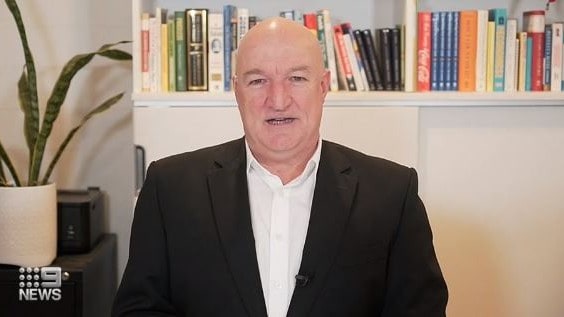
    Motley Fool Australia Chief Investment Officer Scott Phillips joined Nine’s Late News on Monday night to discuss the earnings boost for the Suncorp Group Ltd (ASX: SUN) share price, the dividend hike for Transurban Group (ASX: TCL), and News Corporation (ASX: NWS)’s return to earth.

    The post Suncorp share price surges. Transurban falls. Scott Phillips on Nine’s Late News appeared first on The Motley Fool Australia.

    Wondering where you should invest $1,000 right now?

    When investing expert Scott Phillips has a stock tip, it can pay to listen. After all, the flagship Motley Fool Share Advisor newsletter he has run for more than eight years has provided thousands of paying members with stock picks that have doubled, tripled or even more.*

    Scott just revealed what he believes could be the five best ASX stocks for investors to buy right now. These stocks are trading at near dirt-cheap prices and Scott thinks they could be great buys right now.

    *Returns as of May 24th 2021

    More reading

    Motley Fool contributor Scott Phillips has no position in any of the stocks mentioned. The Motley Fool Australia’s parent company Motley Fool Holdings Inc. has no position in any of the stocks mentioned. The Motley Fool Australia has no position in any of the stocks mentioned. The Motley Fool has a disclosure policy. This article contains general investment advice only (under AFSL 400691). Authorised by Bruce Jackson.

    from The Motley Fool Australia https://ift.tt/3fNQQVf

  • If you invested $1,000 in Macquarie (ASX:MQG) shares a decade ago, here’s what it would be worth now

    happy investors, happy business people counting money, cash, dividends, returns

    The Macquarie Group Ltd (ASX: MQG) share price has been a major performer on the ASX and delivered outsized returns over the past decade.

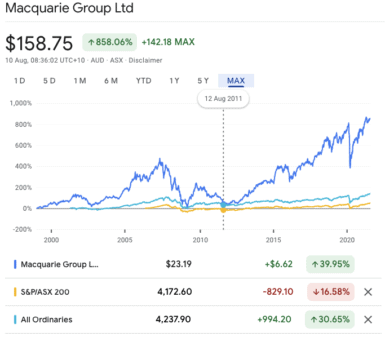
    Whereas the S&P/ASX 200 Index (ASX: XJO) has climbed around 80% over the last 10 years, Macquarie shareholders have enjoyed far healthier returns over this same time.

    We’ve done the math to illustrate how the Macquarie share price has performed over the past decade.

    Investing with a long-term horizon

    Investment bank Macquarie Group first listed on the ASX in 2007, and since this time, its shares have exhibited significant capital appreciation.

    Imagine if, 10 years ago, we were a prudent investor and allocated $1,000 to purchasing Macquarie shares at the closing price of $23.19 on 12 August 2011. That’s about 43 shares on our book.

    Macquarie share price vs ASX broad indexes

    Source: Google Finance

    The first way we need to consider our return is to calculate our capital gains over that time period. In doing so we realise a return on our initial investment of 584%, well above each of the broad indexes’ returns.

    That implies our original position is now worth $5,840. However, that ignores one half of the equation. We need to factor in the impact of Macquarie’s dividend, to capture our total return.

    The impact of Macquarie’s dividend

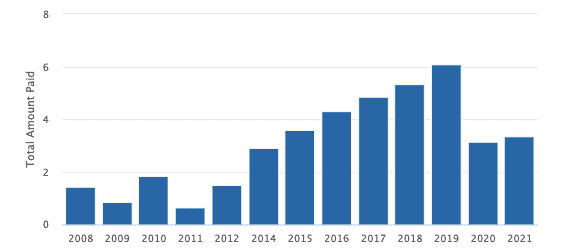
    Over the course of our examination period, Macquarie has returned $35.75 per share to shareholders by way of dividend payments.

    Macquarie has grown its dividend at a compound annual growth rate (CAGR) of 17.8% since 2011. Prior to the haircut of 2020, it had grown dividends at a CAGR of around 25%.

    Macquarie dividend schedule, 2008 – 2021 (current)

    Source: The Motley Fool Australia

    Therefore, factoring in Macquarie’s dividend schedule, our total return balloons to more than 738%. Consequently, this implies our position is worth $7,380.

    Moreover, some very interesting outcomes occur when we make some minor tweaks to our calculations. Let’s assume we reinvested each of the dividends received over the previous decade, to buy more Macquarie shares.

    Drawing on the power of this dividend reinvestment plan (DRIP) we yield a total return of 1,091% on our original investment. That implies our position is now worth $10,910.

    As such, our prudence in maintaining a long-term horizon in our investment reasoning paid off in this hypothetical scenario.

    Foolish takeaway

    This case example suggests that long-term investing can potentially pay off if done correctly.

    A DRIP is an interesting way to harness the power of compounding, which has been dubbed the “8th wonder of the world”.

    Macquarie shareholders have enjoyed a return that has significantly outpaced both broad indexes over the past decade.

    The post If you invested $1,000 in Macquarie (ASX:MQG) shares a decade ago, here’s what it would be worth now appeared first on The Motley Fool Australia.

    Wondering where you should invest $1,000 right now?

    When investing expert Scott Phillips has a stock tip, it can pay to listen. After all, the flagship Motley Fool Share Advisor newsletter he has run for more than eight years has provided thousands of paying members with stock picks that have doubled, tripled or even more.*

    Scott just revealed what he believes could be the five best ASX stocks for investors to buy right now. These stocks are trading at near dirt-cheap prices and Scott thinks they could be great buys right now.

    *Returns as of May 24th 2021

    More reading

    The author Zach Bristow has no positions in any of the stocks mentioned. The Motley Fool Australia’s parent company Motley Fool Holdings Inc. has no position in any of the stocks mentioned. The Motley Fool Australia owns shares of and has recommended Macquarie Group Limited. The Motley Fool has a disclosure policy. This article contains general investment advice only (under AFSL 400691). Authorised by Bruce Jackson.

    from The Motley Fool Australia https://ift.tt/3lP60NO

  • The City Chic (ASX:CCX) share price is up over 30% in 2021

    a fashionable young woman poses with a shopping bag.

    The share price of ASX women’s clothing retailer City Chic Collective Ltd (ASX: CCX) has rocketed higher this year – shrugging off the impacts of ongoing lockdowns in Australia’s most populous cities.

    City Chic shares have surged more than 30% higher this year – to $5.26 at the time of writing. And just last month they set a new 52-week high of $5.97.

    What has driven the City Chic share price higher?

    The short answer is the strength of the company’s online sales channels.

    Just before the pandemic, in October 2019, City Chic acquired the eCommerce assets of Avenue, a plus-size women’s clothing retailer based in the US.

    This move had the twin benefits of both increasing City Chic’s presence in the US market and also expanding its online sales channels just as cities across America were being plunged into lockdowns.  

    The success of this acquisition was evident in City Chic’s interim FY21 results. Despite the impacts of lockdowns in Australia and New Zealand, the company still managed to grow its revenues by 13.5% (versus the first-half FY20) to $119 million.

    This was due in large part to the increased proportion of the company’s sales that had come in from overseas. The northern hemisphere made up 45% of global sales during the first half of FY21 (up from just 29% the year before).

    But City Chic’s sales mix hadn’t just shifted geographically. Online sales grew by 42% to make up 73% of total sales for the half (versus 53% of first-half FY20 sales).

    The relative success of its lower cost online sales channels meant that City Chic was able to expand its margins and grow its bottom line at a faster rate than top-line revenues. Net profit after tax jumped almost 25% higher to $13.1 million.  

    More recent news

    Last month, City Chic announced that it had acquired European plus-size women’s eCommerce retailer Navabi for €6 million.

    In 2020, Navabi websites generated €10.4 million in sales (around $16.6 million) from approximately 5.8 million customer visits. However, the business actually performed better prior to the pandemic when site traffic would regularly exceed 10 million customer visits per year.

    City Chic sees the acquisition as an opportunity to further expand into the European plus-size clothing market – a market it values at approximately €40 billion.

    At the same time as it announced the acquisition, City Chic also provided an FY21 trading update. The company stated that full-year FY21 unaudited revenues were $258 million, a year-on-year increase of almost 33%.

    Earnings before interest, tax, depreciation and amortisation expenses (EBITDA) were expected to land between $42 million and $42.5 million, representing annual growth of up to 60%.

    It also stated that FY22 performance had also so far exceeded expectations, with “strong US and UK performance outweighing the impact of temporary store closures due to lockdowns in Australia”.

    Recent movements in the City Chic share price

    The City Chic share price has pulled back a little more recently, sliding 12% from its 52-week high of $5.97.

    Shareholders will be hoping for some more upside surprises from the company’s full audited financial results when they are released to the market on 26 August.

    The post The City Chic (ASX:CCX) share price is up over 30% in 2021 appeared first on The Motley Fool Australia.

    Should you invest $1,000 in City Chic Collective right now?

    Before you consider City Chic Collective, you’ll want to hear this.

    Motley Fool Investing expert Scott Phillips just revealed what he believes are the 5 best stocks for investors to buy right now… and City Chic Collective wasn’t one of them.

    The online investing service he’s run for nearly a decade, Motley Fool Share Advisor, has provided thousands of paying members with stock picks that have doubled, tripled or even more.* And right now, Scott thinks there are 5 stocks that are better buys.

    *Returns as of May 24th 2021

    More reading

    Motley Fool contributor Rhys Brock has no position in any of the stocks mentioned. The Motley Fool Australia’s parent company Motley Fool Holdings Inc. has no position in any of the stocks mentioned. The Motley Fool Australia has no position in any of the stocks mentioned. The Motley Fool has a disclosure policy. This article contains general investment advice only (under AFSL 400691). Authorised by Bruce Jackson.

    from The Motley Fool Australia https://ift.tt/3AxgntH