Tag: Motley Fool

  • Pricing-power shares like Wesfarmers (ASX:WES) help fight inflation: expert

    A smiling man at a shop counter takes payment from a female customer, with racks of plants in the background.

    Inflation can be a persistent and pervasive problem. It tends to erode the value of hard-earned cash by steadily reducing its purchasing power. To maintain that all-important spending power, ASX investors need to find stocks that will provide returns that exceed the rate of inflation. An expert considers Wesfarmers Ltd (ASX: WES) to be one such company.

    One Australian fund manager has shared a characteristic that makes companies potentially more capable of defending against corrosive inflation.

    Defeating the effects of inflation

    Inflation is when prices for goods and services increase over time. This means that it costs more to buy groceries or fill up your fuel tank than it did before.

    However, consumers are often not alone in their inflation woes. Companies can also feel the pinch of rising costs due to inflation, whether this is in the form of increased material costs or labour expenses.

    Portfolio Manager and Head of Research at Airlie Funds Emma Fisher shared her insights on combating inflammatory inflation. In an interview, Fisher highlighted pricing power as an important trait of companies able to ward off the impact of inflation.

    Ultimately when we look across the portfolio, I think the key thing to worry about is that the businesses that you’re invested in have pricing power. Inflation is going up in the near term. The unanimous feedback from corporates is that they are seeing raw material and increasingly labour market inflation coming through. Their hope is that they are going to be able to pass that through to the end consumer in the form of higher prices.

    In addition to this, Fisher suggested examples of these inflation-fighting shares include Wesfarmers, James Hardie Industries PLC (ASX: JHX), Woolworths Group Ltd (ASX: WOW), and Reece Ltd (ASX: REH).

    Back in May, Wesfarmers CEO Rob Scott confessed that the whole market is facing cost pressures. However, the leader of the $72 billion business suggested they weren’t simply looking at increasing prices to offset inflationary costs. Instead, the company is attempting to use its scale to negotiate lower costs with its suppliers.

    Wesfarmers’ plan is to capture a greater market share while other companies pass on increased costs to customers.

    When will Wesfarmers report to the ASX?

    Being one of the largest companies on the ASX, the Wesfarmers FY21 annual report is highly anticipated. The diversified business conglomerate expects to release its annual results on Friday 27 August.

    Shareholders of Wesfarmers are also likely on the lookout for a renewed bid for Australian Pharmaceutical Industries Ltd (ASX: API). This follows the company’s initial $1.38 per share bid for the pharmacy chain operator which was rejected.

    The post Pricing-power shares like Wesfarmers (ASX:WES) help fight inflation: expert appeared first on The Motley Fool Australia.

    Should you invest $1,000 in Wesfarmers right now?

    Before you consider Wesfarmers, you’ll want to hear this.

    Motley Fool Investing expert Scott Phillips just revealed what he believes are the 5 best stocks for investors to buy right now… and Wesfarmers wasn’t one of them.

    The online investing service he’s run for nearly a decade, Motley Fool Share Advisor, has provided thousands of paying members with stock picks that have doubled, tripled or even more.* And right now, Scott thinks there are 5 stocks that are better buys.

    *Returns as of May 24th 2021

    More reading

    Motley Fool contributor Mitchell Lawler has no position in any of the stocks mentioned. The Motley Fool Australia’s parent company Motley Fool Holdings Inc. has no position in any of the stocks mentioned. The Motley Fool Australia owns shares of and has recommended Wesfarmers Limited. The Motley Fool has a disclosure policy. This article contains general investment advice only (under AFSL 400691). Authorised by Bruce Jackson.

    from The Motley Fool Australia https://ift.tt/2WYdlQv

  • Appen (ASX:APX) share price drops after a fantastic week

    white arrow pointing down

    The Appen Ltd (ASX: APX) share price is dropping during early afternoon trade on Monday. This comes despite no new news being released by the artificial intelligence data services company.

    At the time of writing, Appen shares are fetching for $12.24, down 2.47%. In comparison, the S&P/ASX 200 Index (ASX: XJO) touched an all-time high of 7,549 points, up 0.1%.

    What’s going on with the Appen share price?

    It appears investors are taking some profit off the table after Appen shares bounced 8% higher last week.

    The company’s share price has been hit hard by the onslaught of COVID-19, falling 67% since this time last year.

    In May, Appen delivered a trading update and announced a restructure to focus on its core business interests. Instead of reporting the usual double-digit growth however, the company is expecting a mid-to-high single-digit increase for FY21.

    In addition, Appen shares were kicked out of the ASX 100 Index as its market capitalisation sank, making way for Harvey Norman Holdings Limited (ASX: HVN).

    The United States dollar is also weighing in on Appen’s bottom line. The company traditionally reports in US dollars as most of its revenue is derived from there. However, with the Australian currency rising against the greenback, this will deflate Appen’s potential earnings. Currently, US$1 buys A$1.36.

    Appen is scheduled to report its financial results for FY21 on 26 August 2021.

    Is Appen shares a buy?

    The most recent broker note came from Bell Potter in mid-June. The investment firm cut its 12-month price target by 5.3% to $13.50 for Appen shares. Based on the current share price, this implies an upside of around 9%.

    The post Appen (ASX:APX) share price drops after a fantastic week appeared first on The Motley Fool Australia.

    Should you invest $1,000 in Appen right now?

    Before you consider Appen, you’ll want to hear this.

    Motley Fool Investing expert Scott Phillips just revealed what he believes are the 5 best stocks for investors to buy right now… and Appen wasn’t one of them.

    The online investing service he’s run for nearly a decade, Motley Fool Share Advisor, has provided thousands of paying members with stock picks that have doubled, tripled or even more.* And right now, Scott thinks there are 5 stocks that are better buys.

    *Returns as of May 24th 2021

    More reading

    Motley Fool contributor Aaron Teboneras owns shares of Appen Ltd. The Motley Fool Australia’s parent company Motley Fool Holdings Inc. owns shares of and has recommended Appen Ltd. The Motley Fool Australia owns shares of and has recommended Appen Ltd. The Motley Fool has a disclosure policy. This article contains general investment advice only (under AFSL 400691). Authorised by Bruce Jackson.

    from The Motley Fool Australia https://ift.tt/3fKghqz

  • Telstra (ASX:TLS) share price rises after regional frequency win

    farmer on telephone enjoying telecommunications in rural area

    The Telstra Corporation Ltd (ASX: TLS) share price is in the green. It comes amid news the company has secured a “win” over new regional radio frequency limits set by the Federal Government.

    Telstra shares are trading for $3.82 as of writing – up 0.39%. The S&P/ASX 200 Index, meanwhile, is 0.19% higher.

    Let’s a closer look at today’s news.

    Telstra share price on the rise

    According to a report in the Sydney Morning Herald (SMH), Communications Minister Paul Fletcher has agreed to a 45% purchase limit of low-band frequency for telcos in regional areas. It exceeds the ACCC’s recommendation of 40% and even the 43% that Telstra had asked for.

    Telstra is already the leading telco, ahead of competitors like Optus and TPG Telecom Ltd (ASX: TPG), in regional areas – at least according to consumer website Finder.

    The government will auction off the rights to the low-band spectrum later this year. The lease will last for 20 years.

    Investors appear to have welcomed today’s news, judging by the Telstra share price movement.

    Defending his decision to go above the competition watch dog’s recommendation, Fletcher said (as quoted in the SMH):

    We very carefully configured this so that we don’t end up with an auction outcome that leaves the customers of Optus or TPG worse off.

    Let’s be clear, [Optus and TPG] will be able to get significant additional spectrum should they want it in both regional and metro under these limits.

    Telstra CEO Andy Penn welcomed the decision, saying:

    It will mean we can bid for enough spectrum to maintain our leading mobile network.

    Recent Telstra and government dealings

    As Motley Fool has previously reported, the Federal Government and Telstra are working on a deal to buy Pacific mobile provider Digicel for approximately $2 billion.

    Apparently, the Government’s interest in the Pacific telco relates to national security concerns.

    “…Beijing could use the [Digicel] networks to spy on political elites and neighbouring island nations”, according to the Australian Financial Review.

    The Commonwealth will provide “significant debt financing” to Telstra to finance the acquisition.

    The Telstra share price lifted on the news.

    Telstra share price snapshot

    Over the past 12 months, the Telstra share price has underperformed the ASX 200 by about 11 percentage points. It’s increased about 12% in that time to the index’s 23%. Year-to-date, however, it has overperformed the benchmark 27% to 13%.

    Telstra Corporation has a market capitalisation of $45.2 billion.

    The post Telstra (ASX:TLS) share price rises after regional frequency win appeared first on The Motley Fool Australia.

    Should you invest $1,000 in Telstra right now?

    Before you consider Telstra, you’ll want to hear this.

    Motley Fool Investing expert Scott Phillips just revealed what he believes are the 5 best stocks for investors to buy right now… and Telstra wasn’t one of them.

    The online investing service he’s run for nearly a decade, Motley Fool Share Advisor, has provided thousands of paying members with stock picks that have doubled, tripled or even more.* And right now, Scott thinks there are 5 stocks that are better buys.

    *Returns as of May 24th 2021

    More reading

    Motley Fool contributor Marc Sidarous has no position in any of the stocks mentioned. The Motley Fool Australia’s parent company Motley Fool Holdings Inc. has no position in any of the stocks mentioned. The Motley Fool Australia owns shares of and has recommended Telstra Corporation Limited. The Motley Fool has a disclosure policy. This article contains general investment advice only (under AFSL 400691). Authorised by Bruce Jackson.

    from The Motley Fool Australia https://ift.tt/3xC39Ka

  • Amazon stock: Investors expect too much

    This article was originally published on Fool.com. All figures quoted in US dollars unless otherwise stated.

    amazon prime plane 16:9

    This article was originally published on Fool.com. All figures quoted in US dollars unless otherwise stated.

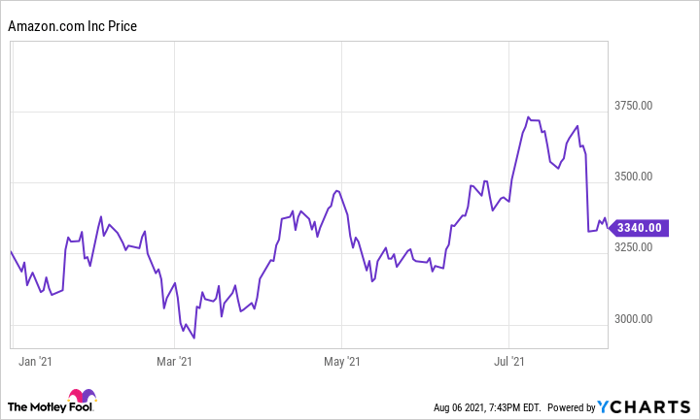
    Just a few weeks ago, shares of Amazon.com (NASDAQ: AMZN) touched a new all-time high above $3,700. This pushed the retail and technology giant’s fully diluted market cap to just shy of $2 trillion.

    However, Amazon stock pulled back 8% after its late-July earnings report, as second-quarter revenue fell short of the analyst consensus and the company issued a weaker-than-expected forecast for the third quarter. While Amazon continues to produce very strong results by ordinary standards, these disappointments suggest that investors may have unrealistic expectations for the e-commerce titan.

    AMZN Chart

    Amazon.com stock performance, data by YCharts.

    Failing to meet high expectations

    Amazon generated $113.1 billion of revenue last quarter: up 27% year over year. Holding currency exchange rates constant, sales would have increased 24%. All three of Amazon’s business segments posted solid gains. On a constant-currency basis, revenue rose 21% in the North America division, 26% in the international segment, and 37% for Amazon Web Services.

    Most companies would love to achieve that kind of growth under any circumstances. Still, analysts had (on average) expected revenue to come in $2 billion higher.

    Interestingly, Amazon’s growth rate in North America trailed the broader retail industry. U.S. retail sales surged 27.8% year over year last quarter, as consumers flocked back to stores as the COVID-19 pandemic eased. Moreover, Amazon’s Q2 revenue benefited from Prime Day shifting into June this year. The two-day event brought in about $7.5 billion of revenue, according to estimates from Piper Sandler analysts. (For comparison, Amazon’s retail business has been generating about $1 billion of revenue on a typical day recently.)

    Operating income jumped 32% year over year to $7.7 billion: near the top of Amazon’s $4.5 billion to $8 billion guidance range. Nevertheless, this probably missed many investors’ expectations, as the company often beats the high end of its operating income guidance by a wide margin.

    More of the same ahead

    Amazon’s third-quarter forecast also disappointed many investors. The company projects that revenue will increase 10% to 16% year over year to a range of $106 billion to $112 billion. Meanwhile, Amazon estimates that operating income will decline from $6.2 billion a year ago to between $2.5 billion and $6 billion. The analyst consensus had called for revenue of $118.7 billion and operating income of $8.1 billion.

    With Prime Day falling in the second quarter this year, investors had to be prepared for slower growth in the third quarter. Furthermore, Amazon faces tough year-over-year comparisons after revenue surged 37% in Q3 2020.

    That said, it also appears that many consumers — particularly in the U.S. — have started to return to their pre-pandemic shopping habits due to the widespread availability of COVID-19 vaccines. During Amazon’s earnings call, CFO Brian Olsavsky noted that growth had slowed to a mid-teens pace beginning in mid-May, excluding the impact of the Prime Day calendar shift.

    Why investors should expect slowing growth

    Prior to the COVID-19 pandemic, Amazon’s growth rate had already started to moderate. On a constant-currency basis, revenue rose 22% in 2019, down from 30% in 2018 and 31% in 2017.

    The pandemic drove a huge increase in e-commerce sales, reversing this trend of slowing growth. As a result, Amazon posted a 37% revenue gain in constant currency last year. However, to some extent, this just pulled forward growth that would have come in 2021 and future years. That has led to the sharp deceleration Amazon is experiencing now — and which will likely continue in the near term.

    Indeed, while Amazon’s growth rate for 2020 and 2021 combined looks quite strong, U.S. retail sales have grown at an incredible pace over this period. As the tailwind from stimulus checks and reduced spending on experiences (like travel and dining out) fades, it will pressure Amazon’s top-line growth. Additionally, Amazon has already crushed most of its weak competitors, which will make it harder to gain market share in the future.

    Amazon stock could still potentially be a worthwhile long-term investment depending on the company’s ability to expand its profit margin. However, investors will need to recalibrate their expectations for top-line growth. The low- to mid-teens growth Amazon is projecting for the third quarter could prove to be the new normal over the next several years.

    This article was originally published on Fool.com. All figures quoted in US dollars unless otherwise stated.

    The post Amazon stock: Investors expect too much appeared first on The Motley Fool Australia.

    Should you invest $1,000 in Amazon right now?

    Before you consider Amazon, you’ll want to hear this.

    Motley Fool Investing expert Scott Phillips just revealed what he believes are the 5 best stocks for investors to buy right now… and Amazon wasn’t one of them.

    The online investing service he’s run for nearly a decade, Motley Fool Share Advisor, has provided thousands of paying members with stock picks that have doubled, tripled or even more.* And right now, Scott thinks there are 5 stocks that are better buys.

    *Returns as of May 24th 2021

    More reading

    Adam Levine-Weinberg has no position in any of the stocks mentioned. John Mackey, CEO of Whole Foods Market, an Amazon subsidiary, is a member of The Motley Fool’s board of directors. The Motley Fool Australia’s parent company Motley Fool Holdings Inc. owns shares of and has recommended Amazon. The Motley Fool Australia’s parent company Motley Fool Holdings Inc. has recommended the following options: long January 2022 $1,920 calls on Amazon and short January 2022 $1,940 calls on Amazon. The Motley Fool Australia has recommended Amazon. The Motley Fool has a disclosure policy. This article contains general investment advice only (under AFSL 400691). Authorised by Bruce Jackson.

    This article was originally published on Fool.com. All figures quoted in US dollars unless otherwise stated.

    from The Motley Fool Australia https://ift.tt/3yx89kI

  • Brickworks (ASX: BKW) share price down 5% as operations curtailed

    a man peers through a broken brick wall to see grey clouds gathering beyond it

    The Brickworks Ltd (ASX: BKW) share price is under heavy selling pressure on Monday after the company was forced to cut back operations at facilities in New South Wales and Queensland.

    Investors were quick to react to the negative news, with the Brickworks share price sliding 5.38% to $23.74 within the first 10 minutes of trade.

    At the time of writing, shares in the building products and property developer are down 3.26% to $24.35.

    Why the Brickworks share price is tumbling on Monday

    The recent outbreak of COVID-19 across NSW and Queensland and consequent lockdowns has seen a significant decline in building product sales.

    Management said that brick sales in NSW were in line with local production capacity during June and in early July.

    However, “dispatches abruptly reduced by 80% during the pause in construction activity across Sydney in late July. These were the most severe restrictions that our business has faced since the onset of the pandemic …”

    The company said the partial recommencement of construction activity in August resulted in some degree of improvement for brick sales. However, it only represents 50% of pre-lockdown levels.

    With the company’s production outstripping demand, a number of storage yards were quick to reach full capacity.

    “As such, we have been forced to temporarily curtail production at two of our five brick kilns across the state, representing 30% of total production capacity.”

    Encouragingly, management said that it has no intention of laying off any workers and has committed to working with its staff to “preserve their employment throughout this period of uncertainty”.

    Impact on earnings

    Given the timing of restrictions in NSW, just two weeks prior to the end of Brickworks’ financial year, management does not expect a material impact on its FY21 performance.

    However, the company flagged the NSW restrictions are having a material impact on current building products earnings.

    Management added that “with the situation remaining highly volatile and unpredictable, it is difficult to quantify the ongoing impact and we have no confidence in being able to accurately forecast business performance until there is a full reopening of construction activity across the state”.

    Brickworks share price snapshot

    Despite today’s sharp selloff, the Brickworks share price is still up 27% year-to-date.

    The company’s upbeat trading update on 9 June was a major catalyst behind its solid performance this year.

    The post Brickworks (ASX: BKW) share price down 5% as operations curtailed appeared first on The Motley Fool Australia.

    Should you invest $1,000 in Brickworks right now?

    Before you consider Brickworks, you’ll want to hear this.

    Motley Fool Investing expert Scott Phillips just revealed what he believes are the 5 best stocks for investors to buy right now… and Brickworks wasn’t one of them.

    The online investing service he’s run for nearly a decade, Motley Fool Share Advisor, has provided thousands of paying members with stock picks that have doubled, tripled or even more.* And right now, Scott thinks there are 5 stocks that are better buys.

    *Returns as of May 24th 2021

    More reading

    Motley Fool contributor Kerry Sun has no position in any of the stocks mentioned. The Motley Fool Australia’s parent company Motley Fool Holdings Inc. has no position in any of the stocks mentioned. The Motley Fool Australia owns shares of and has recommended Brickworks. The Motley Fool has a disclosure policy. This article contains general investment advice only (under AFSL 400691). Authorised by Bruce Jackson.

    from The Motley Fool Australia https://ift.tt/3CupE7G

  • IAG (ASX:IAG) share price lifts following major board reshuffle

    A line of people sitting at a long desk in a meeting

    The Insurance Australia Group Ltd (ASX: IAG) share price is rising after the insurer revealed a major board reshuffle.

    IAG is the parent business of a number of insurance companies across Australia and New Zealand such as NRMA Insurance, CGU, SGIO, SGIC, Swann Insurance, WFI, NZI, State, AMI and Lumley. It also has an interest in a general insurance joint venture in Malaysia.

    IAG’s board retirements

    The IAG Chair, Elizabeth Bryan, will retire from the company at the annual general meeting (AGM) on 22 October 2021 after six years leading the business.

    To replace her, the new chair will be Tom Pockett. Mr Pockett has been a director of the business since 2015 and chair of the audit committee. He is also the chair of both Stockland Corporation Ltd (ASX: SGP) and Autosports Group Ltd (ASX: ASG).

    Ms Bryan said:

    The IAG board under Mr Pockett’s chairmanship will be a strong one that will combine a deep understanding of IAG and its Australian and New Zealand business with its new members’ deep insight into the developments taking place in the international general insurance market.

    A second director, Duncan Boyle, will also retire from IAG’s board on 22 October 2021. Mr Boyle has served on the board for five years, including three years as the chair of the risk committee.

    Chair Ms Bryan acknowledged the contribution that Mr Boyle had made to the board’s deliberations with its long experience of the global insurance industry.

    With the impacts of COVID-19 still being felt, the IAG share price is down 5% over the last five years.

    New directors

    IAG also announced that three new directors will join as part of the process to renew the board to ensure it has the right mix of skills and experience to support the company.

    The company said that the new directors “bring deep insurance and public company governance experience to their roles, and their skills will supplement those of the existing directors.”

    The three new directors are: David Armstrong, George Sartorel and Scott Pickering.

    Mr Armstrong will become the new chair of the audit committee, at the end of the 2021 AGM. IAG said he is a well-known and highly respected company director. The insurer also said that he’s a former partner with PwC specialising in financial services. He has a “deep knowledge” of audit and risk control, and experience with Australian public companies.

    Mr Sartorel has had a long career with Allianz Group and was most recently the regional chief executive of the Asia Pacific division. IAG said that he had returned home to Australia and brings with him experience in creating and leading large, innovative insurance companies with digital business models.

    The company noted that Mr Pickering has also had a successful international career as a global insurance executive. He has had senior leadership positions with Royal Sun Alliance and Willis Towers Watson. Mr Pickering has recently retired from the role of CEO of the NZ Accident Compensation Corporation.

    IAG share price

    The IAG share price is up 4% at the time of writing. That brings the market capitalisation to $12.3 billion according to the ASX.

    The post IAG (ASX:IAG) share price lifts following major board reshuffle appeared first on The Motley Fool Australia.

    Should you invest $1,000 in IAG right now?

    Before you consider IAG, you’ll want to hear this.

    Motley Fool Investing expert Scott Phillips just revealed what he believes are the 5 best stocks for investors to buy right now… and IAG wasn’t one of them.

    The online investing service he’s run for nearly a decade, Motley Fool Share Advisor, has provided thousands of paying members with stock picks that have doubled, tripled or even more.* And right now, Scott thinks there are 5 stocks that are better buys.

    *Returns as of May 24th 2021

    More reading

    Motley Fool contributor Tristan Harrison has no position in any of the stocks mentioned. The Motley Fool Australia’s parent company Motley Fool Holdings Inc. has no position in any of the stocks mentioned. The Motley Fool Australia owns shares of and has recommended Insurance Australia Group Limited. The Motley Fool has a disclosure policy. This article contains general investment advice only (under AFSL 400691). Authorised by Bruce Jackson.

    from The Motley Fool Australia https://ift.tt/3iv3LNf

  • What’s going on with the Race Oncology (ASX:RAC) share price today?

    women in a lab carrying out a medical experiment

    The Race Oncology Ltd (ASX: RAC) share price is swinging from losses to gains to losses again. At time of writing, shares in the ASX healthcare company have slipped below yesterday’s closing price, trading down 0.29% at $3.38.

    We take a look at Race Oncology’s Leukemia clinical trial update below.

    What did Race announce?

    The Race Oncology share price is seeking direction after the company reported the first patient has been dosed in its “Phase 1b/2 trial in relapsed/refractory Acute Myeloid Leukaemia” trial.

    The trial will use the company’s Zantrene in a 3-drug combination. According to the release, this combination has demonstrated “compelling efficacy” in earlier pre-clinical studies. (See here for more.)

    Professor Arnon Nagler of the Chaim Sheba Medical Center in Israel is leading the study. Nagler previously conducted the Phase 2 single agent Zantrene R/R AML trial, which demonstrated a 40% clinical response.

    Acute Myeloid Leukemia (AML) remains difficult to effectively treat. According to the release, approximately “30% of adults with newly diagnosed AML fail to achieve complete remission (CR) after 2 courses of intensive chemotherapy”. For patients who do achieve CR following chemotherapy, 50% of younger and 80% of older patients relapse.

    Even when CR is achieved through intense chemotherapy, approximately half of the younger and 80% of the older patients, relapse.

    Race Oncology commentary

    Commenting on the progress, Race’s chief medical officer David Fuller said:

    We are delighted to see the start of this important clinical project which uses a novel combination approach for relapsed or refractory Acute Myleoid Leukaemia. This study is also an important step in our journey towards approval of Zantrene in this area of high unmet medical need.

    Race’s CEO Phillip Lynch added, “We hope to see improved patient outcomes in what has been historically a difficult to treat disease. We plan on using our trademarked name, Zantrene, in referring to bisantrene dihydrochloride.”

    The trial in Israel will run in parallel with an Australian Phase 2 trial in patients with extramedullary AML.

    Race Oncology share price snapshot

    Over the past 12 months the Race Oncology share price has gained 304%, well outpacing the 25% gains posted by the All Ordinaries Index (ASX: XAO) in that same time.

    Year-to-date Race Oncology’s share price has continued to surge, up 82% in 2021.

    The post What’s going on with the Race Oncology (ASX:RAC) share price today? appeared first on The Motley Fool Australia.

    Should you invest $1,000 in Race Oncology right now?

    Before you consider Race Oncology, you’ll want to hear this.

    Motley Fool Investing expert Scott Phillips just revealed what he believes are the 5 best stocks for investors to buy right now… and Race Oncology wasn’t one of them.

    The online investing service he’s run for nearly a decade, Motley Fool Share Advisor, has provided thousands of paying members with stock picks that have doubled, tripled or even more.* And right now, Scott thinks there are 5 stocks that are better buys.

    *Returns as of May 24th 2021

    More reading

    The Motley Fool Australia’s parent company Motley Fool Holdings Inc. has no position in any of the stocks mentioned. The Motley Fool Australia has no position in any of the stocks mentioned. The Motley Fool has a disclosure policy. This article contains general investment advice only (under AFSL 400691). Authorised by Bruce Jackson.

    from The Motley Fool Australia https://ift.tt/3iyjLyo

  • The CBA (ASX:CBA) share price is edging higher. Here’s why

    Australian dollar $100 notes fall out of the sky, indicaticating a windfall from ASX bank shares

    The Commonwealth Bank of Australia (ASX: CBA) share price has started the week off in positive territory on Monday morning. This follows a media report that Australia’s largest bank may tap into its war chest to launch a buyback program.

    At the time of writing, CBA shares are swapping hands for $105.58, up 1.52%. In comparison, the S&P/ASX 200 Index (ASX: XJO) is sitting at 7,563 points, up 0.34%.

    What buyback plan?

    According to the Australian Financial Review, CBA may unlock $5.5 billion to buy back its shares through a series of off-market trades. This is a massive turnaround from when the bank approved loan repayments to be deferred during COVID-19 last year.

    In a broker note released on 3 August, Goldman Sachs forecast that CBA would report cash earnings of $8.34 billion in its full-year results on Wednesday. This represents a 15.5% increase when compared to the prior corresponding period. The robust performance is likely to be attributed to the company’s improved retail banking division and business banking branch.

    In addition, CET1 capital ratio is forecasted to come in at 12.9%, an increase of 134 basis points against FY20.

    Previously both National Australia Bank Ltd (ASX: NAB) and Australia and New Zealand Banking Group Ltd (ASX: ANZ) announced on-market buy-backs comprising $2.5 billion and $1.5 billion, respectively.

    However, due to the evolving COVID-19 situation, there may be some risk to the timing and magnitude of capital management.

    The buyback could be set at the maximum discount allowed by the Australian Taxation Office – at 14%. Effectively, this would place CBA shares at a buyback price of around $90 per share.

    Goldman Sachs rated CBA shares as a sell, with a 12-month price target of $81.87. Based on the current share price, this implies a downside of roughly 21.8%.

    CBA share price snapshot

    Over the last 12 months, CBA shares have gained 45% for shareholders, with year-to-date above 25%. It’s worth noting that the company’s share price is nearing its all-time high of $106.57 reached in mid-June.

    CBA commands a market capitalisation of approximately $184 billion, making it the biggest company on the ASX.

    The post The CBA (ASX:CBA) share price is edging higher. Here’s why appeared first on The Motley Fool Australia.

    Should you invest $1,000 in CBA right now?

    Before you consider CBA, you’ll want to hear this.

    Motley Fool Investing expert Scott Phillips just revealed what he believes are the 5 best stocks for investors to buy right now… and CBA wasn’t one of them.

    The online investing service he’s run for nearly a decade, Motley Fool Share Advisor, has provided thousands of paying members with stock picks that have doubled, tripled or even more.* And right now, Scott thinks there are 5 stocks that are better buys.

    *Returns as of May 24th 2021

    More reading

    Motley Fool contributor Aaron Teboneras has no position in any of the stocks mentioned. The Motley Fool Australia’s parent company Motley Fool Holdings Inc. has no position in any of the stocks mentioned. The Motley Fool Australia has no position in any of the stocks mentioned. The Motley Fool has a disclosure policy. This article contains general investment advice only (under AFSL 400691). Authorised by Bruce Jackson.

    from The Motley Fool Australia https://ift.tt/3jE9y2n

  • Why is the Flight Centre (ASX:FLT) share price slipping 2% today?

    a sad woman sits leaning on her suitcase in a deserted airport lounge

    The Flight Centre Travel Group Ltd (ASX: FLT) share price is slipping this morning despite no news being released by the company.

    The fall comes as Victoria starts its first working week in lockdown while the Sydney COVID-19 outbreak continues despite shutdowns and lockdowns begin in Queensland’s north.

    In addition, concerns are building in Tasmania after a taxi driver was exposed to the virus. Meanwhile, southeast Queensland enjoys its first morning out of its 8-day lockdown.

    Right now, Flight Centre shares are down 2.42%, swapping hands for $14.90 apiece.

    Let’s take a closer look at the latest news on Flight Centre.

    What’s up with Flight Centre today?

    While the market seems to be dubious about the travel sector – and the Flight Centre share price – today, the company’s CEO has been optimistic about its future.

    Flight Centre’s CEO Graham Turner spoke about vaccine passports on Friday, saying it’s only a matter of time until they bring a semblance of normalcy back to international travel. At least, for those travellers fully inoculated against COVID-19.

    Despite Turner’s recent positivity, market watchers seem to be wary of the travel sector today.

    The Webjet Limited (ASX: WEB) share price is also falling. Webjet shares are currently trading for 1.15% less than they were at Friday’s close.

    Sydney Airport Holdings (ASX: SYD) shares are also slipping 0.26%.

    Perhaps oddly, the Qantas Airways Limited share price is in the green today. Though it’s had a rougher trot than most recently and may just be rebounding.

    Flight Centre share price snapshot

    Today’s falls have added to the woes of the Flight Centre share price.

    It has fallen 5.5% since the start of 2021. However, it is 40% higher than it was this time last year.

    The company has a market capitalisation of around $3 billion, with approximately 199 million shares outstanding.

    The post Why is the Flight Centre (ASX:FLT) share price slipping 2% today? appeared first on The Motley Fool Australia.

    Should you invest $1,000 in Flight Centre right now?

    Before you consider Flight Centre, you’ll want to hear this.

    Motley Fool Investing expert Scott Phillips just revealed what he believes are the 5 best stocks for investors to buy right now… and Flight Centre wasn’t one of them.

    The online investing service he’s run for nearly a decade, Motley Fool Share Advisor, has provided thousands of paying members with stock picks that have doubled, tripled or even more.* And right now, Scott thinks there are 5 stocks that are better buys.

    *Returns as of May 24th 2021

    More reading

    Motley Fool contributor Brooke Cooper has no position in any of the stocks mentioned. 

    The Motley Fool Australia’s parent company Motley Fool Holdings Inc. has no position in any of the stocks mentioned. The Motley Fool Australia owns shares of and has recommended Webjet Ltd. The Motley Fool Australia has recommended Flight Centre Travel Group Limited. The Motley Fool has a disclosure policy. This article contains general investment advice only (under AFSL 400691). Authorised by Bruce Jackson.

    from The Motley Fool Australia https://ift.tt/3AqiuPK

  • Is the cryptocurrency bear market over?

    This article was originally published on Fool.com. All figures quoted in US dollars unless otherwise stated.

    many investing in stocks online

    This article was originally published on Fool.com. All figures quoted in US dollars unless otherwise stated.

    Even after showings signs of a recovery in recent weeks, the price of two leading digital coins, Bitcoin (CRYPTO: BTC) and Ethereum (CRYPTO: ETH), have fallen almost 30% since May. Meanwhile, trading volume for all cryptocurrencies plunged more than 40% in June, and it hit year-to-date lows last month.

    But be warned, even as cryptocurrencies seem to be building positive momentum again, the fundamentals still look troubling, and it could get worse in the near future. As a result, Bitcoin, Ethereum, and other cryptocurrencies all face mounting risks looking ahead.

    The end of the line for cryptocurrencies in China 

    For years, Chinese investors had been some of the biggest drivers of the cryptocurrency bull market. This is because of stringent capital outflow controls enforced by the central government. In fact, citizens are only allowed to purchase $50,000 worth of foreign currencies every year, so shifting hard-earned money abroad through cryptocurrencies became a no-brainer.

    This has inflated the value of some coins due to limited supply. For example, let’s say Chinese tech billionaire Chen wishes to transfer $48 million to the Cayman Islands via a cryptocurrency known as the send-me-now (SMN) coin. However, there are only 100 SMN coins available, so Chen must first bid up the price of each coin to $480,000 to make it a one-time transaction. One can see how the price of cryptocurrencies could go up frequently and suddenly this way.

    But the Chinese government doesn’t seem to like this loophole. Recently, the ruling Communist Party barred financial institutions and corporate entities from doing business with cryptocurrency investors. In addition, provinces are beginning to outlaw cryptocurrency mining operations, citing environmental concerns (which we’ll get to later). It’s hard for any asset to rebound in price when its major buyers have been barred from the market, and the recent volatility for non-fungible tokens (NFTs) has only added fuel to the flames.

    NFTs are not what they seem

    The logic behind the NFT hype is simple: authentic, physical art is expensive. NFTs are authentic, digital art. Therefore, NFTs should be expensive as well (corollary: NFT coins go to the moon). Unfortunately, that is far from the case. Physical artwork isn’t just expensive, because people who buy it are connoisseurs who like drinking red wine while viewing their collections. Much of the demand in that world is also driven by tax avoidance (that is, the reduction of taxes through legal means).

    The setup works like this. Let’s say a high-net-worth individual (HNWI) named Sarah purchases a $5 million piece of artwork from an auction and ships it directly to a free port — a designated economic zone where customs duties and taxes do not apply until an asset leaves the zone — to legally avoid the sales tax. Five years later, the artwork appreciates to $25 million. Sarah then hires an appraiser, who usually has a financial incentive to inflate the piece’s value, to certify the painting. She then donates it to a non-profit and can claim the full market value of the piece at certification ($25 million) as a deduction against her income, usually over a few years. Because HNWIs do this, the value of artwork can also become grossly inflated.

    But the demand is not replicable when it comes to NFTs. First of all, most non-profits don’t even accept cryptocurrency. What’s more, there is a lot of confusion as to NFTs’ classification. Suppose the Internal Revenue Service determines Sarah’s NFT was a collectible instead of an intangible capital asset, then tough luck. In that case, she could only deduct her cost basis ($5 million) for her donation — resulting in a redundant transaction. Until there is greater clarity about how they are classified under the tax code, there is little inherent value to NFTs based on the Ethereum blockchain. On a side note, it’s probably in the best interest of Uncle Sam that it stays this way.

    Meanwhile, their utility for digital art collectors is very controversial. Buyers are getting exclusive rights to an item but often at a very high price for something that one can find all over the internet (i.e., a video from a professional basketball player). As a result, it’s unlikely the market could attract significant capital from investors long term. Regulations haven’t caught up with other possible uses like in real estate, so while NFTs are an innovative way to store something like a land deed, the practice needs greater industry and regulatory approval before taking off. 

    Staggering environmental concerns 

    Moving back to Bitcoin, the energy cost of mining it has gotten out of hand. Because Bitcoin’s reward keeps on halving, miners need to keep upgrading their equipment to stay profitable. For example, the latest Bitcoin mining machine, the Antminer S19, has a power consumption of 3,250 watts, equivalent to a central air conditioning system. At current coin and energy prices, miners typically spend close to $2,000 on their electricity bills per year, per machine. Bitcoin mining now consumes 0.55% of global electricity production, and it’s simply not sustainable. To put it into perspective, one Bitcoin transaction consumes about the same amount of energy as 1.2 million Visa card transactions. 

    Bitcoin and Ethereum are two of the biggest flag-bearers for the overall cryptocurrency market, and as of this writing, they have severe utility and network issues that are unaddressed. Investors should understand that prices will continue to be extremely volatile as well. For those reasons, I believe the cryptocurrency bear market is far from over.

    This article was originally published on Fool.com. All figures quoted in US dollars unless otherwise stated.

    The post Is the cryptocurrency bear market over? appeared first on The Motley Fool Australia.

    Wondering where you should invest $1,000 right now?

    When investing expert Scott Phillips has a stock tip, it can pay to listen. After all, the flagship Motley Fool Share Advisor newsletter he has run for more than eight years has provided thousands of paying members with stock picks that have doubled, tripled or even more.*

    Scott just revealed what he believes could be the five best ASX stocks for investors to buy right now. These stocks are trading at near dirt-cheap prices and Scott thinks they could be great buys right now.

    *Returns as of May 24th 2021

    More reading

    Zhiyuan Sun has no position in any of the stocks mentioned. The Motley Fool Australia’s parent company Motley Fool Holdings Inc. owns shares of and has recommended Bitcoin, Ethereum, and Visa. The Motley Fool Australia has no position in any of the stocks mentioned. The Motley Fool has a disclosure policy. This article contains general investment advice only (under AFSL 400691). Authorised by Bruce Jackson.

    This article was originally published on Fool.com. All figures quoted in US dollars unless otherwise stated.

    from The Motley Fool Australia https://ift.tt/3s2611O