Tag: Motley Fool

  • Buffett, rates and cigarettes

    Percentage symbol in white with a black rising arrow.

    Percentage symbol in white with a black rising arrow.

    So, the RBA put interest rates up.

    Again.

    Which seemed to have surprised the markets, and many economists.

    For what it’s worth, I don’t do predictions. In part because no-one knows for sure (and the times everyone ‘knows’ aren’t very useful anyway), and in part because they don’t really help me invest any differently.

    Unless you trade currencies (and if you do, good luck with that) making interest rate predictions is just a parlour game.

    So, when I’m asked what the RBA will do, I usually just give my stock line – ‘I don’t do predictions’ – then give a view on what they should do, instead.

    And this time around, the RBA did what I thought they should do – raise the rate.

    But also, and this is why I’m surprised the market was caught out, it was what they’d foreshadowed last month.

    I’m sorry if you’re struggling under an enormous mortgage repayment.

    I wish the RBA had another option.

    But, realistically, with inflation at 7%, they don’t.

    If you have your foot on the proverbial throat of your opponent (the opponent is inflation, for the record!), we all know the worst thing to do is to let them off the mat.

    So while the RBA risks going a little too far, it would be much worse to not go far enough.

    Inflation in the UK is 10.1%.

    We really, really don’t want to end up there.

    Sure, there are differences, but that’s a glimpse of one potential future if the inflation genie, half-way back into the bottle, is allowed to escape.

    If it did?

    If it did, we’d probably see another round of rate hikes in a few months’ time, to a higher level than if the RBA kills inflation, now, once and for all.

    Which, I assume, was their thinking.

    And which, I think, is the right approach.

    Of course, it needn’t be the only weapon in the fight against inflation.

    Thanks to – how do I put this delicately – ‘less ambitious’ government policy, the RBA is doing all the heavy lifting right now.

    Not only is it trying to slow an overheating economy, it’s also trying to fill the hole created by the government (and the last government – this is a bipartisan shortcoming) running a budget deficit.

    Yes, the government is stimulating the economy while the RBA is trying to cool it.

    Just let that sink in for a second.

    And before you put the boot into the current Treasurer, remember that the last Treasurer also left behind a budget that was also in structural deficit.

    Which is why the RBA has to be the adult in the room.

    It’s a thankless task, of course – everyone is blaming the RBA for raising rates – but it feels it has little in the way of options.

    And I think it’s right.

    Meanwhile, the government is raising a little extra revenue by whacking smokers with another 5% increase in the tobacco excise.

    Not a bad thing, overall (though if you’re not quitting already, I’m not sure this makes a big difference, but it probably makes those poor smokers, well, poorer).

    Would it be too cynical for me to assume that taxing smokers a little more isn’t going to draw much in the way of popular ire, while actually doing something about the deficit might be unpopular, and so, politically challenging?

    I’ll let you be the judge.

    And for investors?

    Well, other than a lesson in realpolitik, a couple of thoughts:

    First, on smokes, there’s a lesson here in pricing power and what my economics teacher called the ‘elasticity of demand’. If you can raise the price of something and not deter too much consumption, you can make some serious money.

    (In case you missed high school economics, if demand changes with price, the product is called ‘elastic’. If you can raise the price without impacting demand, that’s known as ‘inelastic’. It’s a continuum, of course, but you get the idea.)

    It’s why companies with ‘pricing power’ are so attractive for investors. If you can raise prices and not see much of a fall in your sales volume, most of that extra revenue falls straight to the bottom line as extra profit.

    That is a very, very good thing.

    It’s also relatively rare, as you’d expect. But if you can find it (and if you pay a decent price) it should make for a good investment.

    And on rates, a reminder that a temporary increase in the cost of money (i.e. interest rates) is a far, far better thing than a permanent increase in prices (i.e. inflation), even if it doesn’t feel like it at the time.

    And it often doesn’t feel like it, because inflation feels disembodied – it’s a general ‘thing’ that just happens. But interest rates? They’re controlled by a board (and usually represented by one man, Governor Phil Lowe).

    And so while inflation feels unavoidable, rates feel (and are) deliberate choices. And that means we have someone to blame!

    It’s yet another example of the psychological forces that are at play for all humans, and which we need to recognise, and hopefully control, as investors.

    Yes, you need a basic understanding of accounting.

    You absolutely need to know business models, and understand what makes companies tick.

    But more than that?

    Well, tell ‘em what you said, Warren Buffett:

    “Investing is not a game where the guy with the 160 IQ beats the guy with the 130 IQ. Once you have ordinary intelligence, what you need is the temperament to control the urges that get other people into trouble in investing.”

    The urge to over-trade. To chase last year’s winners. To believe complexity is better than simplicity.

    The urge to take on too much risk. To try to ‘get rich quick’. To do what the cool kids are doing.

    We’ve seen those in spades, in recent years.

    We saw them in 2007.

    And in 1999.

    The answer?

    Keep a cool head. Don’t over-complicate things.

    Focus on the long term.

    Luckily for me, I’m not a footy player. Not just because I don’t have the required talent, but also because their careers are short, and over by 35.

    Fortunately, I’m an investor. A game where compounding not only applies to money, but to experience and knowledge, if you let it.

    Don’t get me wrong – age alone isn’t enough. I know some wise 26 year olds and some, well, less-than-wise retirees.

    But if you are committed to understanding the basics, doing the simple things well, and learning from both history and experience?

    I think there’s a very, very good chance that you’ll be very happy with the outcome.

    As for politics? Well, that’s a whole other problem!

    Fool on!

    The post Buffett, rates and cigarettes appeared first on The Motley Fool Australia.

    Should you invest $1,000 in S&P/ASX 200 right now?

    Before you consider S&P/ASX 200, you’ll want to hear this.

    Motley Fool Investing expert Scott Phillips just revealed what he believes are the 5 best stocks for investors to buy right now… and S&P/ASX 200 wasn’t one of them.

    The online investing service he’s run for over a decade, Motley Fool Share Advisor, has provided thousands of paying members with stock picks that have doubled, tripled or even more.* And right now, Scott thinks there are 5 stocks that are better buys.

    See The 5 Stocks
    *Returns as of April 3 2023

    (function() {
    function setButtonColorDefaults(param, property, defaultValue) {
    if( !param || !param.includes(‘#’)) {
    var button = document.getElementsByClassName(“pitch-snippet”)[0].getElementsByClassName(“pitch-button”)[0];
    button.style[property] = defaultValue;
    }
    }

    setButtonColorDefaults(“#43B02A”, ‘background’, ‘#5FA85D’);
    setButtonColorDefaults(“#43B02A”, ‘border-color’, ‘#43A24A’);
    setButtonColorDefaults(“#fff”, ‘color’, ‘#fff’);
    })()

    More reading

    Motley Fool contributor Scott Phillips has no position in any of the stocks mentioned. The Motley Fool Australia’s parent company Motley Fool Holdings Inc. has no position in any of the stocks mentioned. The Motley Fool Australia has no position in any of the stocks mentioned. The Motley Fool has a disclosure policy. This article contains general investment advice only (under AFSL 400691). Authorised by Scott Phillips.

    from The Motley Fool Australia https://ift.tt/F2xmpQf

  • My 5-step plan to achieving $500 in monthly passive income

    A woman has a quizzical look on her face as though she is deciding something in the foreground of a backdrop featuring five stars, like the Australian five star energy rating system.

    A woman has a quizzical look on her face as though she is deciding something in the foreground of a backdrop featuring five stars, like the Australian five star energy rating system.

    Wouldn’t an extra $500 a month in passive income be nice? Unfortunately, there are no easy solutions to the problem of gaining a stream of secondary income of this size. But fortunately, ASX shares can provide a clear pathway to this goal, if not a short one.

    So today, I’ll walk you through my five-step plan to secure a $500 per month stream of passive, dividend income from ASX shares.

    A 5-step plan to building $500 a month in passive income from ASX shares

    Step 1: Knowledge is power

    The first step in this journey is understanding exactly how ASX shares can help you build a source of passive income. It is common to hear shares spoken about in terms of ticker codes, charts, and ‘picks’. But a better way to view a share is as a piece of a business.

    Buying shares is really investing in the fortunes of a company. Buy the right company, and you share in its prosperity. Buy the wrong one, and well… we know what can happen.

    The vast majority of ASX shares pay their shareholders dividends regularly. A dividend is a cash payment made to shareholders by the company as a way of encouraging ownership and rewarding investors.

    Most companies’ dividends fluctuate from year to year, but the best ones tend to raise them consistently over long periods of time. Accumulating more and more of the best dividend shares should lead to more and more passive dividend income.

    Step 2: Getting your house in order

    Understanding dividend investing is one thing, but preparing your finances to be able to build up a stream of passive income is another. Everyone’s personal financial circumstances are different of course.

    But as a good rule of thumb, you should not be investing until you have cleared any personal debts you may have (such as credit cards or personal loans), and you are in a position to save more of your income than you spend.

    Only once you have your personal budget ‘in surplus’, and you have enough money stashed away for a rainy day, you should be thinking about deploying additional funds into building a secondary income.

    Step 3: Choosing your ASX dividend shares

    This is probably the hardest step of them all. Investors in dividend-paying shares should probably follow the same ‘best practice’ rules as any other investor, especially building a diversified portfolio of different shares. Just investing in the big banks, for example, exposes you to any issues that might only affect the banking sector.

    So most investors should aim for a diverse grouping of the best businesses across different sectors. Those might include high-quality names like Washington H. Soul Pattinson and Co Ltd (ASX: SOL), Brickworks Ltd (ASX: BKW), Coles Group Ltd (ASX: COL), and Telstra Group Ltd (ASX: TLS).

    If that all sounds overwhelming, an alternative path is to pursue index exchange-traded funds (ETFs) like the Vanguard Australian Shares Index ETF (ASX: VAS). ASX index funds hold the largest 200 or 300 shares on our markets, giving you automatic diversification.

    These funds have to pass on any dividend income they receive too, so you will get what could be called an average of all the dividends that the Australian share market is paying out every year.

    Step 4: Build your passive income snowball

    Once you have found your ideal dividend-paying shares, it’s time to get buying. Remember, the dividend yield you can expect from a company will rise as its share price falls. So it’s usually better to buy your favourite companies at the cheapest price you can.

    Then, it’s just a case of rinse and repeat. When one starts out investing, it can be a little discouraging seeing your first dividends come in when you are getting a few dollars at a time. But if you relentlessly plough any surplus capital into buying ever more dividend shares, it should snowball. Make sure you reinvest your dividends back into buying more shares every time too – that will make a huge difference as the years tick by.

    Step Five: Patience, grasshopper

    The final step is both the easiest and hardest: waiting. Building up a dividend income stream takes even the best investors many years. To get to $500 a month, you will need to have a total of $150,000 in invested capital if you are getting an average yield from your shares of 4%.

    But, although this is a tough ask, it is doable. If one invests $500 every month, reinvests dividends, and can get an average return of 7% per annum, then getting to $150,000 will take just over 15 years. If you can manage $1,000 a month, then this timespan drops to under a decade.

    The post My 5-step plan to achieving $500 in monthly passive income appeared first on The Motley Fool Australia.

    Where should you invest $1,000 right now? 3 dividend stocks to help beat inflation

    This FREE report reveals 3 stocks not only boasting sustainable dividends but that also have strong potential for massive long term returns…

    See the 3 stocks
    *Returns as of April 3 2023

    (function() {
    function setButtonColorDefaults(param, property, defaultValue) {
    if( !param || !param.includes(‘#’)) {
    var button = document.getElementsByClassName(“pitch-snippet”)[0].getElementsByClassName(“pitch-button”)[0];
    button.style[property] = defaultValue;
    }
    }

    setButtonColorDefaults(“#0095C8”, ‘background’, ‘#5FA85D’);
    setButtonColorDefaults(“#0095C8”, ‘border-color’, ‘#43A24A’);
    setButtonColorDefaults(“#fff”, ‘color’, ‘#fff’);
    })()

    More reading

    Motley Fool contributor Sebastian Bowen has positions in Telstra Group, Vanguard Australian Shares Index ETF, and Washington H. Soul Pattinson and Company Limited. The Motley Fool Australia’s parent company Motley Fool Holdings Inc. has positions in and has recommended Brickworks and Washington H. Soul Pattinson and Company Limited. The Motley Fool Australia has positions in and has recommended Brickworks, Coles Group, Telstra Group, and Washington H. Soul Pattinson and Company Limited. The Motley Fool has a disclosure policy. This article contains general investment advice only (under AFSL 400691). Authorised by Scott Phillips.

    from The Motley Fool Australia https://ift.tt/8Mh0rGv

  • Here’s what this broker is saying about the Qantas share price

    Man sitting in a plane seat works on his laptop.

    Man sitting in a plane seat works on his laptop.

    The Qantas Airways Limited (ASX: QAN) share price hit a spot of turbulence on Tuesday.

    The airline operator’s shares dropped 3% to end the day at $6.54.

    This followed the announcement that Qantas’ long-serving CEO, Alan Joyce, would be retiring from the role later this year. Joyce will be replaced by the company’s current chief financial officer, Vanessa Hudson.

    When Joyce finally departs in November, he will have been at the helm for approximately 15 years. Investors appear concerned what this change could mean for the company and ultimately their investment.

    Well, the good news is that one leading broker appears to believe it will be business as usual for Qantas. As a result, it has retained its buy rating on Qantas’ shares.

    What is being said about the Qantas share price?

    According to a note out of Goldman Sachs, its analysts have retained their buy rating and $8.30 price target on its shares.

    Based on the current Qantas share price, this implies potential upside of 27% for investors over the next 12 months. Goldman commented:

    QAN has announced that Vanessa Hudson will succeed Alan Joyce as CEO of QAN from November 2023. Ms. Hudson is QAN’s current CFO and has held a number of roles (commercial, customer and finance) at the company since 1994. QAN highlighted that Ms. Hudson has been directly involved in shaping/executing the current strategy, including the fleet selection process for the renewal of the domestic aircraft fleet.

    We are Buy-rated on QAN, and the shares are on our Conviction List. Our 12-month target price of A$8.30 is based on a 50%/50% weighted blend of our DCF and EV/EBITDA (QAN’s pre-COVID multiple and is discounted at QAN group WACC for a 12m fwd valuation) valuations. […] Our estimated FY24e EPS sits 65% above pre-COVID levels. Despite this, QAN’s market capitalisation is only 10% above pre-COVID levels (EV 8% lower).

    The post Here’s what this broker is saying about the Qantas share price appeared first on The Motley Fool Australia.

    Should you invest $1,000 in Qantas Airways Limited right now?

    Before you consider Qantas Airways Limited, you’ll want to hear this.

    Motley Fool Investing expert Scott Phillips just revealed what he believes are the 5 best stocks for investors to buy right now… and Qantas Airways Limited wasn’t one of them.

    The online investing service he’s run for over a decade, Motley Fool Share Advisor, has provided thousands of paying members with stock picks that have doubled, tripled or even more.* And right now, Scott thinks there are 5 stocks that are better buys.

    See The 5 Stocks
    *Returns as of April 3 2023

    (function() {
    function setButtonColorDefaults(param, property, defaultValue) {
    if( !param || !param.includes(‘#’)) {
    var button = document.getElementsByClassName(“pitch-snippet”)[0].getElementsByClassName(“pitch-button”)[0];
    button.style[property] = defaultValue;
    }
    }

    setButtonColorDefaults(“#0095C8”, ‘background’, ‘#5FA85D’);
    setButtonColorDefaults(“#0095C8”, ‘border-color’, ‘#43A24A’);
    setButtonColorDefaults(“#fff”, ‘color’, ‘#fff’);
    })()

    More reading

    Motley Fool contributor James Mickleboro has no position in any of the stocks mentioned. The Motley Fool Australia’s parent company Motley Fool Holdings Inc. has no position in any of the stocks mentioned. The Motley Fool Australia has no position in any of the stocks mentioned. The Motley Fool has a disclosure policy. This article contains general investment advice only (under AFSL 400691). Authorised by Scott Phillips.

    from The Motley Fool Australia https://ift.tt/OTzFZEC

  • Directors are still buying the dip in New Hope shares. Should you?

    A young investor working on his ASX shares portfolio on his laptopA young investor working on his ASX shares portfolio on his laptop

    New Hope Corporation Limited (ASX: NHC) shares have dropped 12% in the last month as market sentiment about the ASX coal share wanes.

    Coal prices shot up enormously after the Russian invasion of Ukraine triggered countries to look for alternative sources of energy.

    Higher coal prices led to enormous profit generation for New Hope. Indeed, the business is still making considerable profit and directors have been buying up New Hope shares. So is this a good time to be considering the ASX mining share?

    Director buying

    New Hope chair Rob Millner and his son have been buying a lot of shares in the coal miner.

    Another investment was made by the Millners in late April 2023.

    T G Millner Holdings Pty Limited bought another 100,000 New Hope shares at a price of $5.542 for a total cost of $554,200. This was an on-market trade, so ordinary investors like you and I would be able to copy this move — if we wanted to.

    The New Hope share price has dropped another 4% since that investment, so people can grab a slice of New Hope today at a cheaper price.

    Indeed, the Millners have significant money invested in New Hope shares. According to the latest ASX announcement, Rob Millner has direct interests in 279,559 shares and indirect interest in another 5,743,215 New Hope shares. That means that the total exposure is now $32 million.

    Of course, the Millners have even more exposure to New Hope through their holding of Washington H. Soul Pattinson and Co. Ltd (ASX: SOL) shares. Soul Pattinson is a substantial shareholder of New Hope shares.

    Is the New Hope share price a buy?

    A couple of months ago, we got to see New Hope’s FY23 half-year result for the six months to 31 January 2023.

    It saw net profit after tax (NPAT) rise by 102.4% to $668.6 million while operating cash flow improved by 117.3% to $983.5 million.

    The business declared an ordinary dividend of 30 cents per share and a special dividend per share of 10 cents. The total payout of 40 cents per share represented an increase of 33% year over year.

    Using the current estimates on Commsec, New Hope is valued at just 4x FY23’s estimated earnings. The annual payout could be 75 cents per share, which equates to a grossed-up dividend yield of 20%.

    For almost any business, those would be attractive metrics. But the coal price may not stay as high as it is. New Hope earnings are expected to fall in FY24 and then FY25, according to Commsec forecasts. The ASX coal share is valued at 5x FY25’s estimated earnings, which is still very low.

    The Millners think the current New Hope share price is good value. If New Hope can continue to generate good earnings then it may well be cheap, and the dividends could continue to be rewarding. It may also be some time before enough alternative energy is available to replace coal.

    However, I’d rather invest in a business where earnings are more likely grow over the longer term. As well, coal is certainly not a popular investment when it comes to investing with ESG considerations in mind.

    The post Directors are still buying the dip in New Hope shares. Should you? appeared first on The Motley Fool Australia.

    Should you invest $1,000 in New Hope Corporation Limited right now?

    Before you consider New Hope Corporation Limited, you’ll want to hear this.

    Motley Fool Investing expert Scott Phillips just revealed what he believes are the 5 best stocks for investors to buy right now… and New Hope Corporation Limited wasn’t one of them.

    The online investing service he’s run for over a decade, Motley Fool Share Advisor, has provided thousands of paying members with stock picks that have doubled, tripled or even more.* And right now, Scott thinks there are 5 stocks that are better buys.

    See The 5 Stocks
    *Returns as of April 3 2023

    (function() {
    function setButtonColorDefaults(param, property, defaultValue) {
    if( !param || !param.includes(‘#’)) {
    var button = document.getElementsByClassName(“pitch-snippet”)[0].getElementsByClassName(“pitch-button”)[0];
    button.style[property] = defaultValue;
    }
    }

    setButtonColorDefaults(“#0095C8”, ‘background’, ‘#5FA85D’);
    setButtonColorDefaults(“#0095C8”, ‘border-color’, ‘#43A24A’);
    setButtonColorDefaults(“#fff”, ‘color’, ‘#fff’);
    })()

    More reading

    Motley Fool contributor Tristan Harrison has no position in any of the stocks mentioned. The Motley Fool Australia’s parent company Motley Fool Holdings Inc. has no position in any of the stocks mentioned. The Motley Fool Australia has no position in any of the stocks mentioned. The Motley Fool has a disclosure policy. This article contains general investment advice only (under AFSL 400691). Authorised by Scott Phillips.

    from The Motley Fool Australia https://ift.tt/r2gfhJ5

  • 3 ASX 200 stocks I’ll be watching like a hawk in May

    ASX share price on watch represented by man peering closely at computer screen

    ASX share price on watch represented by man peering closely at computer screen

    It looks like it’s going to be another busy month for investors and the ASX 200 index.

    Three ASX 200 stocks that I will be watching like a hawk this month are named below. Here’s why they could be worth keeping a close eye on in May:

    Brainchip Holdings Ltd (ASX: BRN)

    This struggling semiconductor company will be an ASX 200 stock to watch this month (before it is likely kicked out of the index in June). I’ve been warning people off this meme stock for some time, and with its shares down 60% over the last 12 months, I’m feeling somewhat vindicated. Though, it still appears wildly overvalued, but that’s a story for another day.

    On 23 May, BrainChip will be holding its annual general meeting. I will be watching very closely at the shareholder votes on the remuneration report and the proposed issue of stock to its executives and directors.

    In respect to the latter, despite its share price decline, the company’s admittance that its Akida platform was not good enough, and its pitiful cash receipts (US$40k in Q1), the $700 million company wants shareholders to approve the issue of 2,264,493 restricted stock units to its CEO, Sean Hehir, for nil cost. I’m interested to see if disgruntled shareholders will approve this and other generous share issues.

    REA Group Ltd (ASX: REA)

    Another ASX 200 stock that I will be watching closely is realestate.com.au owner and operator REA Group.

    There’s no disputing the fact that the cash rate hikes have put pressure on the housing market. However, REA has managed to overcome this so far in FY 2023 and delivered solid top line growth during the first half.

    On 12 May, we will be able to see if this positive form has continued for the ASX 200 stock. That’s because REA is scheduled to release its quarter results before the market open on that day.

    Westpac Banking Corp (ASX: WBC)

    Australia’s oldest bank will be an ASX 200 stock to watch this month. That’s because it is one of three big four banks that will be releasing their half-year results in May.

    Westpac will be the third of the three to report, but arguably has more to look out for than its peers.

    For example, the market will be looking for an update on its cost reductions plans. There are a lot of doubts that it will be able to cut costs as much as hoped in the current inflationary environment. If it can prove the doubters wrong, it could be a big boost to its share price.

    In addition, its margins will be a key focus for investors. Goldman Sachs recently revealed what it is watching out for. It said:

    WBC’s 2H22 NIM was up 5 bp hoh to 1.90% (ex Treasury & Markets at 1.80%) and we note that WBC’s exit NIM (ex Treasury & Markets) for the month of Sep-22 was 1.85%. WBC expects the 1H23 NIM (ex-Treasury and Markets) to be higher than the Sep-22 exit and higher again in 2H23 albeit with a moderating hoh increase.

    With deposit competition currently being a key area of focus, we will be keen to get an update on how current levels of deposit repricing have impacted mix shifts, and what WBC’s expectations are around competition going into 2H23. We currently forecast 1H23E NIMs to increase +13 bp hoh to 2.03%

    The post 3 ASX 200 stocks I’ll be watching like a hawk in May appeared first on The Motley Fool Australia.

    Wondering where you should invest $1,000 right now?

    When investing expert Scott Phillips has a stock tip, it can pay to listen. After all, the flagship Motley Fool Share Advisor newsletter he has run for over ten years has provided thousands of paying members with stock picks that have doubled, tripled or even more.*

    Scott just revealed what he believes could be the ‘five best ASX stocks’ for investors to buy right now. These stocks are trading at near dirt-cheap prices and Scott thinks they could be great buys right now…

    See The 5 Stocks
    *Returns as of April 3 2023

    (function() {
    function setButtonColorDefaults(param, property, defaultValue) {
    if( !param || !param.includes(‘#’)) {
    var button = document.getElementsByClassName(“pitch-snippet”)[0].getElementsByClassName(“pitch-button”)[0];
    button.style[property] = defaultValue;
    }
    }

    setButtonColorDefaults(“#0095C8”, ‘background’, ‘#5FA85D’);
    setButtonColorDefaults(“#0095C8”, ‘border-color’, ‘#43A24A’);
    setButtonColorDefaults(“#fff”, ‘color’, ‘#fff’);
    })()

    More reading

    Motley Fool contributor James Mickleboro has positions in Westpac Banking Corporation. The Motley Fool Australia’s parent company Motley Fool Holdings Inc. has no position in any of the stocks mentioned. The Motley Fool Australia has recommended REA Group and Westpac Banking Corporation. The Motley Fool has a disclosure policy. This article contains general investment advice only (under AFSL 400691). Authorised by Scott Phillips.

    from The Motley Fool Australia https://ift.tt/XRybkF4

  • Buy NAB and this ASX dividend share: analysts

    Man looking amazed holding $50 Australian notes, representing ASX dividends.

    Man looking amazed holding $50 Australian notes, representing ASX dividends.

    Are you looking for some ASX dividend shares to buy for your income portfolio? If you are, then the two listed below could be worth considering.

    Both have been named as buys and tipped to provide investors with good yields. Here’s what you need to know about them:

    HomeCo Daily Needs REIT (ASX: HDN)

    The first ASX dividend share that has been named as a buy is HomeCo Daily Needs.

    As its name implies, this is a property company with a focus on properties that serve daily needs. These are convenience-based assets found in metro locations such as large format retail and health and services.

    Morgans is very positive on the company. This is due to its exposure to daily needs assets and “large development pipeline.”

    The broker also expects some very big dividend yields in the near term. It is forecasting dividends per share of 8.3 cents in FY 2023 and 8.4 cents in FY 2024. Based on the current HomeCo Daily Needs share price of $1.18, this will mean dividend yields of 7% and 7.1%, respectively.

    Morgans has an add rating and $1.50 price target on HomeCo Daily Needs’ shares.

    National Australia Bank Ltd (ASX: NAB)

    Another ASX dividend share that has been named as a buy is NAB. It is of course one of Australia’s big four banks.

    Goldman Sachs is positive on the bank and has named it one of only two to buy right now. This is due largely to the bank’s exposure to commercial lending, which it believes will fare better than home lending in the near term and its belief that NAB “provides the best exposure to this thematic.”

    In respect to dividends, Goldman is expecting this to support fully franked dividends of $1.68 per share both FY 2023 and FY 2024. Based on the current NAB share price of $29.09, this implies yields of 5.8% for income investors.

    Goldman Sachs has a buy rating and $33.06 price target on its shares.

    The post Buy NAB and this ASX dividend share: analysts appeared first on The Motley Fool Australia.

    Looking to buy dividend shares to help fight inflation?

    If you’re looking to buy dividend shares to help fight inflation then you’ll need to get your hands on this… Our FREE report revealing 3 stocks not only boasting inflation-fighting dividends…

    They also have strong potential for massive long-term returns…

    See the 3 stocks
    *Returns as of April 3 2023

    (function() {
    function setButtonColorDefaults(param, property, defaultValue) {
    if( !param || !param.includes(‘#’)) {
    var button = document.getElementsByClassName(“pitch-snippet”)[0].getElementsByClassName(“pitch-button”)[0];
    button.style[property] = defaultValue;
    }
    }

    setButtonColorDefaults(“#0095C8”, ‘background’, ‘#5FA85D’);
    setButtonColorDefaults(“#0095C8”, ‘border-color’, ‘#43A24A’);
    setButtonColorDefaults(“#fff”, ‘color’, ‘#fff’);
    })()

    More reading

    Motley Fool contributor James Mickleboro has no position in any of the stocks mentioned. The Motley Fool Australia’s parent company Motley Fool Holdings Inc. has no position in any of the stocks mentioned. The Motley Fool Australia has no position in any of the stocks mentioned. The Motley Fool has a disclosure policy. This article contains general investment advice only (under AFSL 400691). Authorised by Scott Phillips.

    from The Motley Fool Australia https://ift.tt/zHfULEJ

  • TPG shares showdown: To buy, or not to buy?

    mixed opinions on asx share price represented by two hands, one with thumb up and the other with thumb down.mixed opinions on asx share price represented by two hands, one with thumb up and the other with thumb down.

    TPG Telecom Ltd (ASX: TPG) landed on the ASX in July 2020 as a result of the merger between Vodafone Australia and TPG. 

    The combined business instantly became the third-largest telecommunications provider in Australia.

    So after three years of public trading, are TPG shares now worth buying into?

    Why TPG shares could be a good buy

    By Tristan Harrison: The TPG share price has been on a solid run over the past month, rising by around 10%. That compares favourably to the S&P/ASX 200 Index (ASX: XJO) which has only gone up by 1%. I think its total returns can keep outperforming over the next few years.

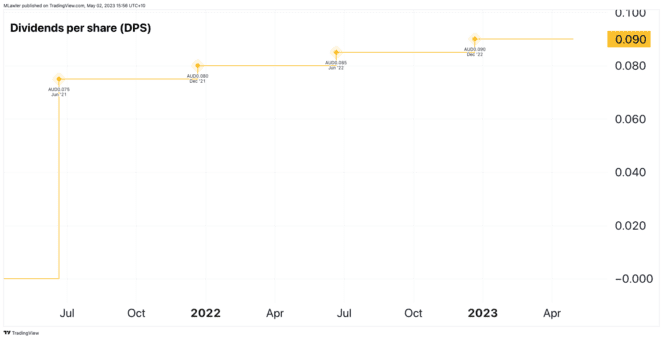
    The ASX telco share has steadily grown its dividend each year since it was listed a few years ago and is expected (according to Commsec numbers) to keep growing the dividend to FY25. That FY25 payment could be 21 cents per share, which would be a grossed-up dividend yield of 5.5%. 

    TPG semi-annual dividends since June 2021. Data by Trading View

    The earnings per share (EPS) is also predicted to increase in FY24 and FY25, which could be a positive factor for the TPG share price.

    A lot of the smaller competitors have been acquired, or merged, with the larger players in recent years. This may be why Telstra Corporation Ltd (ASX: TLS) is willing to increase prices significantly. If rivals are increasing prices, TPG may be able to attract customers with better value. Or TPG could keep increasing prices to improve its profit margins. 

    TPG is seeing an increase in subscribers, gaining 300,000 subscribers in the 2023 financial year. It’s also working on reducing costs as part of the synergies between the merger of TPG and Vodafone Australia.

    While it may not be the strongest performer in the next 12 months, I think it can beat the returns of the ASX 200 thanks to its growing subscribers and defensive earnings. 

    Motley Fool contributor Tristan Harrison does not own shares in TPG Telecom Ltd.

    Heading down while rivals are heading up

    By Tony Yoo: TPG Telecom shares have, unfortunately, been nothing but a disappointment since they listed on the ASX.

    The stock price is down more than 36% since its first-day closing price, even though industry conditions have become more favourable.

    The telco sector has consolidated over the past few years, meaning the days of loss-leading sales are largely over. Many of the smaller players have been bought out by the bigger fish, such as when Optus acquired Amaysim.

    The merger between Vodafone and TPG itself was part of this trend.

    Don’t get me wrong – mobile phone and broadband retailing are still very commoditised. The services are almost a utility these days, similar to water and electricity.

    But it’s a far more rational market now than it was a few years ago, when telcos went broke to sign up customers.

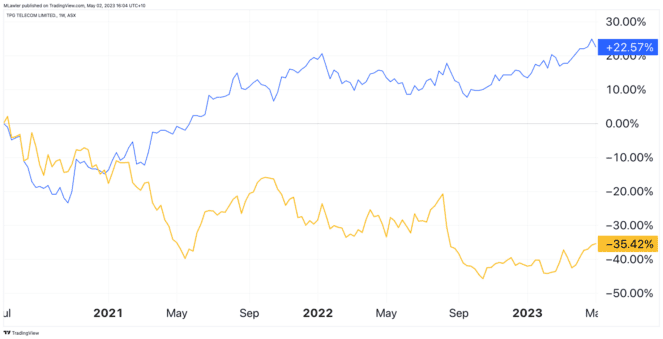
    Telstra (blue) share price performance against TPG (yellow) since July 2020. Data by Trading View

    TPG Telecom, however, has failed to take advantage of the better business environment, losing market cap while the Telstra share price has rocketed more than 30%.

    Speaking of Telstra, investors must take note that the telco industry is one that is capital-intensive.

    This places smaller players at a more pronounced disadvantage than other sectors. Telstra and Optus simply have deeper pockets than TPG to invest in and maintain infrastructure.

    Finally, the man who founded TPG and grew it from a small computer shop to a telco giant, David Teoh, exited the merged entity in 2021. An executive with that type of growth experience is not easy to replace, and the company is no longer a “founder-led business”.

    Hence I would not buy TPG shares right now.

    Motley Fool contributor Tony Yoo does not own shares in TPG Telecom Ltd.

    The post TPG shares showdown: To buy, or not to buy? appeared first on The Motley Fool Australia.

    Should you invest $1,000 in Tpg Telecom Limited right now?

    Before you consider Tpg Telecom Limited, you’ll want to hear this.

    Motley Fool Investing expert Scott Phillips just revealed what he believes are the 5 best stocks for investors to buy right now… and Tpg Telecom Limited wasn’t one of them.

    The online investing service he’s run for over a decade, Motley Fool Share Advisor, has provided thousands of paying members with stock picks that have doubled, tripled or even more.* And right now, Scott thinks there are 5 stocks that are better buys.

    See The 5 Stocks
    *Returns as of April 3 2023

    (function() {
    function setButtonColorDefaults(param, property, defaultValue) {
    if( !param || !param.includes(‘#’)) {
    var button = document.getElementsByClassName(“pitch-snippet”)[0].getElementsByClassName(“pitch-button”)[0];
    button.style[property] = defaultValue;
    }
    }

    setButtonColorDefaults(“#43B02A”, ‘background’, ‘#5FA85D’);
    setButtonColorDefaults(“#43B02A”, ‘border-color’, ‘#43A24A’);
    setButtonColorDefaults(“#fff”, ‘color’, ‘#fff’);
    })()

    More reading

    The Motley Fool Australia’s parent company Motley Fool Holdings Inc. has no position in any of the stocks mentioned. The Motley Fool Australia has positions in and has recommended Telstra Group. The Motley Fool Australia has recommended TPG Telecom. The Motley Fool has a disclosure policy. This article contains general investment advice only (under AFSL 400691). Authorised by Scott Phillips.

    from The Motley Fool Australia https://ift.tt/ro8v0ae

  • 79% upside: The ‘frustrating’ ASX share waiting to take off

    A kid wearing a pilot helmet holds a paper plane up to the sky.A kid wearing a pilot helmet holds a paper plane up to the sky.

    The efficient market hypothesis says share prices always reflect all available information about the businesses.

    However, veteran ASX investors would know that in reality that’s not necessarily true.

    Sometimes the market just fails to fully appreciate the merits or the cons of a company and the stock becomes under- or overpriced.

    Shrewd investors can take advantage of this “inefficiency”, assuming that eventually the rest of the market wakes up and the stock price will “catch up”.

    ‘A lot more value’ in business than the current valuation

    One such candidate is diagnostic imaging provider ​​Capitol Health Ltd (ASX: CAJ).

    The share price has fallen almost 17% over the past 12 months, and is actually trading at 21% below what it was in the middle of 2018.

    However, Sequoia Wealth senior wealth manager Peter Day noted last month that Capitol Health reported pleasing results.

    “First half 2023 revenue of $98.1 million was up 3.4% on the prior corresponding period,” said Day.

    “In the near term, we forecast a recovery in face-to-face general practitioner consultations as a catalyst for improving imaging volumes.”

    Shaw and Partners portfolio manager James Gerrish acknowledged that life as a Capitol Health investor hasn’t been easy.

    “I know Capitol Health has been a frustrating position,” he said on a Market Matters Q&A.

    “However, we do think there is a lot more value in their business than is being ascribed by the market, something more like 45, 50 cents.”

    Compared to the Tuesday trading price of 28 cents, a rise to 50 cents would represent a whopping 78.5% upside.

    “For that reason, we are remaining patient — pardon the pun!”

    The stock pays out a dividend yield of 3.64%, which could soothe the pain while you wait for the share price to climb.

    Day also thinks the stock is a prudent buy.

    “We believe Capitol Health is well positioned relative to peers given strong specialist recruitment and exposure to recovery locations in Victoria.”

    The post 79% upside: The ‘frustrating’ ASX share waiting to take off appeared first on The Motley Fool Australia.

    Should you invest $1,000 in Capitol Health Limited right now?

    Before you consider Capitol Health Limited, you’ll want to hear this.

    Motley Fool Investing expert Scott Phillips just revealed what he believes are the 5 best stocks for investors to buy right now… and Capitol Health Limited wasn’t one of them.

    The online investing service he’s run for over a decade, Motley Fool Share Advisor, has provided thousands of paying members with stock picks that have doubled, tripled or even more.* And right now, Scott thinks there are 5 stocks that are better buys.

    See The 5 Stocks
    *Returns as of April 3 2023

    (function() {
    function setButtonColorDefaults(param, property, defaultValue) {
    if( !param || !param.includes(‘#’)) {
    var button = document.getElementsByClassName(“pitch-snippet”)[0].getElementsByClassName(“pitch-button”)[0];
    button.style[property] = defaultValue;
    }
    }

    setButtonColorDefaults(“#43B02A”, ‘background’, ‘#5FA85D’);
    setButtonColorDefaults(“#43B02A”, ‘border-color’, ‘#43A24A’);
    setButtonColorDefaults(“#fff”, ‘color’, ‘#fff’);
    })()

    More reading

    Motley Fool contributor Tony Yoo has no position in any of the stocks mentioned. The Motley Fool Australia’s parent company Motley Fool Holdings Inc. has no position in any of the stocks mentioned. The Motley Fool Australia has no position in any of the stocks mentioned. The Motley Fool has a disclosure policy. This article contains general investment advice only (under AFSL 400691). Authorised by Scott Phillips.

    from The Motley Fool Australia https://ift.tt/XQNRUET

  • What’s the forecast for the lithium price in May?

    A man sits in contemplation on his sofa looking at his phone as though he has just heard some serious or interesting news.A man sits in contemplation on his sofa looking at his phone as though he has just heard some serious or interesting news.

    The lithium price has declined from the glory days of 2022, but could it recover in the future?

    ASX shares impacted by the price of lithium include Pilbara Minerals Ltd (ASX: PLS), Core Lithium Ltd (ASX: CXO), Allkem Ltd (ASX: AKE), and Lake Resources (ASX: LKE).

    Let’s check the outlook for the lithium price.

    What could happen?

    Lithium prices are in the spotlight again amid Chile’s plan to nationalise its lithium industry. This could certainly impact lithium supply globally.

    China-based research company Antaike is forecasting lithium carbonate prices to average 220,000 yuan (US$33,828) a tonne this year. That’s 54% less than 2022, Asia Financial reported. However, this is still higher than the current lithium carbonate price.

    Battery-grade lithium carbonate is currently up 0.81% to US$27,065.28 a tonne on the Shanghai Metals market.

    Commenting on the outlook for the lithium price, CRU head of battery rare materials Martin Jackson said:

    Demand was showing softness early in the year, but we’re still expecting a relatively tight market for the year on average and that’s because of much stronger demand from EV sales later in the year.

    Meanwhile, ANZ commodity strategists Daniel Hynes and Soni Kumari are optimistic about the lithium price amid supply risks from resource nationalism. The strategists highlighted lithium prices are down nearly 75% from a recent record high.

    Hynes and Kumari noted Chile’s policy will require state involvement for “all new lithium projects” and the use of environmentally friendly processing that is “still unproven on a commercial scale”. In a research report released Thursday, they added:

    This could delay the delivery of its pipeline of projects. Other producers also have their issues. Increasing resource nationalism, particularly in Africa could limit growth in supply.

    The outlook for the EV sector remains strong. We expect these latest supply side issues to reignite supply concerns, leading to a rebound in prices.

    Share price snapshot

    It’s been a mixed bag for the ASX’s major lithium shares. Pilbara shares have returned 54% in the last year.

    Core Lithium shares have lost 28% in the past 52 weeks.

    Allkem shares have shed 2% in the past year.

    Meanwhile, Lake Resources shares have descended 74% in the last 12 months.

    The post What’s the forecast for the lithium price in May? appeared first on The Motley Fool Australia.

    FREE Guide for New Investors

    Despite what some people may say – we believe investing in shares doesn’t have to be overwhelming or complicated…

    For over a decade, we’ve been helping everyday Aussies get started on their journey.

    And to help even more people cut through some of the confusion “experts’” seem to want to perpetuate – we’ve created a brand-new “how to” guide.

    Yes, Claim my FREE copy!
    *Returns as of April 3 2023

    (function() {
    function setButtonColorDefaults(param, property, defaultValue) {
    if( !param || !param.includes(‘#’)) {
    var button = document.getElementsByClassName(“pitch-snippet”)[0].getElementsByClassName(“pitch-button”)[0];
    button.style[property] = defaultValue;
    }
    }

    setButtonColorDefaults(“#0095C8”, ‘background’, ‘#5FA85D’);
    setButtonColorDefaults(“#0095C8”, ‘border-color’, ‘#43A24A’);
    setButtonColorDefaults(“#fff”, ‘color’, ‘#fff’);
    })()

    More reading

    Motley Fool contributor Monica O’Shea has no position in any of the stocks mentioned. The Motley Fool Australia’s parent company Motley Fool Holdings Inc. has no position in any of the stocks mentioned. The Motley Fool Australia has no position in any of the stocks mentioned. The Motley Fool has a disclosure policy. This article contains general investment advice only (under AFSL 400691). Authorised by Scott Phillips.

    from The Motley Fool Australia https://ift.tt/Uz0T1oq

  • Should I buy Westpac shares ahead of next week’s half-year results?

    A woman looks nonplussed as she holds up a handful of Australian $50 notes.

    A woman looks nonplussed as she holds up a handful of Australian $50 notes.

    Westpac Banking Corp (ASX: WBC) shares have had a tough time over the last 12 months.

    During this time, the banking giant’s shares have lost 6.5% of their value, as you can see on the chart below.

    In light of this weakness, some investors may be tempted to pick up Westpac shares before it releases its results next week. But should they wait?

    Should you buy Westpac shares ahead of its results?

    Buying shares before they release their results is a risky move. A strong result could see a share rocket higher, but a weak result could see the opposite happen.

    In light of this, it may make sense to buy a share in two stages. Half before the results and half after the release. This limits your downside if things go awry and also allows you to benefit from any gains if things go well.

    But is Westpac a buy? Well, it is according to Goldman Sachs. It is expecting a strong result from Australia’s oldest bank and is recommending investors snap up its shares.

    Goldman recently reiterated its conviction buy rating and $25.86 price target on the bank’s shares. Based on the current Westpac share price of $22.55, this implies potential upside of 15% for investors over the next 12 months.

    And with the broker forecasting a $1.44 per share fully franked dividend in FY 2023, which represents a 6.5% yield, the total potential return on offer here is approximately 21%.

    What is Goldman expecting from the half-year result?

    If you are planning to buy Westpac shares, you will no doubt want to keep an eye on its results.

    Goldman Sachs is expecting Westpac to report cash earnings (before one-offs) of $3,781 million, which is just a touch short of the consensus estimate of $3,788 million. It also represents a sizeable 22.2% increase on the prior corresponding period.

    This is expected to be supported by a net interest margin of 2.03% and underpin a fully franked interim dividend of 72 cents per share. The latter will be an 18% increase from FY 2022’s interim dividend of 61 cents per share.

    The post Should I buy Westpac shares ahead of next week’s half-year results? appeared first on The Motley Fool Australia.

    Should you invest $1,000 in Westpac Banking Corporation right now?

    Before you consider Westpac Banking Corporation, you’ll want to hear this.

    Motley Fool Investing expert Scott Phillips just revealed what he believes are the 5 best stocks for investors to buy right now… and Westpac Banking Corporation wasn’t one of them.

    The online investing service he’s run for over a decade, Motley Fool Share Advisor, has provided thousands of paying members with stock picks that have doubled, tripled or even more.* And right now, Scott thinks there are 5 stocks that are better buys.

    See The 5 Stocks
    *Returns as of April 3 2023

    (function() {
    function setButtonColorDefaults(param, property, defaultValue) {
    if( !param || !param.includes(‘#’)) {
    var button = document.getElementsByClassName(“pitch-snippet”)[0].getElementsByClassName(“pitch-button”)[0];
    button.style[property] = defaultValue;
    }
    }

    setButtonColorDefaults(“#43B02A”, ‘background’, ‘#5FA85D’);
    setButtonColorDefaults(“#43B02A”, ‘border-color’, ‘#43A24A’);
    setButtonColorDefaults(“#fff”, ‘color’, ‘#fff’);
    })()

    More reading

    Motley Fool contributor James Mickleboro has positions in Westpac Banking Corporation. The Motley Fool Australia’s parent company Motley Fool Holdings Inc. has no position in any of the stocks mentioned. The Motley Fool Australia has recommended Westpac Banking Corporation. The Motley Fool has a disclosure policy. This article contains general investment advice only (under AFSL 400691). Authorised by Scott Phillips.

    from The Motley Fool Australia https://ift.tt/8Y9E5Ky