Tag: Motley Fool

  • Is the Medibank share price a buy following the ASX 200 insurer’s latest update?

    Two healthcare workers, a male doctor in the background with a woman in scrubs in the foreground,, smile towards the camera against a plain backdrop.

    Two healthcare workers, a male doctor in the background with a woman in scrubs in the foreground,, smile towards the camera against a plain backdrop.

    The Medibank Private Ltd (ASX: MP1) share price is edging lower on Tuesday.

    In afternoon trade, the private health insurer’s shares are down slightly to $3.50.

    What’s going on with the Medibank share price?

    The Medibank share price is edging lower today after investors gave a lukewarm response to the company’s market update.

    According to the release, industry growth remains strong with a continuation of factors supporting participation.

    However, Medibank has only reported financial year to date private health insurance policyholder growth of 0.4k policyholders or 0.02% as of 31 March. This compares to its previous guidance of 0.5% to 0.75% growth in FY 2023. Though, it does expect a strong fourth quarter and positive momentum leading into FY 2024.

    The company also expects to announce a further customer give back before the end of the quarter, which is great for policyholders but perhaps not for its bottom line and dividends.

    In addition, the company advised that it no longer expects its non-resident business gross profit “to be higher” than the first half, where it reported growth of 106.7%. It now expects gross profit to be “approximately double from FY22.”

    Should you buy shares?

    While the broker community hasn’t had chance to respond to this latest update, as things stand, they aren’t urging investors to buy the company’s shares.

    For example, the likes of Citi, Macquarie, Morgan Stanley, and Morgans all have the equivalent of hold ratings and price targets a touch lower than where the Medibank share price currently trades.

    Citi explained why it is sitting on the fence with this one:

    Medibank’s return to policyholder growth in February and its confidence that the initial cybercrime impacts on its business have started to subside suggest that the previous allowance we had in our forecasts for continued p/h losses over the next 18 months is too conservative. So, we adjust our growth forecasts accordingly.

    There will, however, likely be ongoing cyberattack impacts suggesting the stock is still not without risk. These include potential class actions, etc. Our EPS changes which also allow for higher investment yields are FY23E: +7%; FY24E: +11%; FY25E: +13%. We retain our Neutral call lifting our TP to A$3.45, with this now set at a ~5% (was ~8%) discount to our valuation to account for the continued, but lower, cyberattack risk.

    The post Is the Medibank share price a buy following the ASX 200 insurer’s latest update? appeared first on The Motley Fool Australia.

    Should you invest $1,000 in Medibank Private Limited right now?

    Before you consider Medibank Private Limited, you’ll want to hear this.

    Motley Fool Investing expert Scott Phillips just revealed what he believes are the 5 best stocks for investors to buy right now… and Medibank Private Limited wasn’t one of them.

    The online investing service he’s run for over a decade, Motley Fool Share Advisor, has provided thousands of paying members with stock picks that have doubled, tripled or even more.* And right now, Scott thinks there are 5 stocks that are better buys.

    See The 5 Stocks
    *Returns as of April 3 2023

    (function() {
    function setButtonColorDefaults(param, property, defaultValue) {
    if( !param || !param.includes(‘#’)) {
    var button = document.getElementsByClassName(“pitch-snippet”)[0].getElementsByClassName(“pitch-button”)[0];
    button.style[property] = defaultValue;
    }
    }

    setButtonColorDefaults(“#43B02A”, ‘background’, ‘#5FA85D’);
    setButtonColorDefaults(“#43B02A”, ‘border-color’, ‘#43A24A’);
    setButtonColorDefaults(“#fff”, ‘color’, ‘#fff’);
    })()

    More reading

    Motley Fool contributor James Mickleboro has no position in any of the stocks mentioned. The Motley Fool Australia’s parent company Motley Fool Holdings Inc. has no position in any of the stocks mentioned. The Motley Fool Australia has no position in any of the stocks mentioned. The Motley Fool has a disclosure policy. This article contains general investment advice only (under AFSL 400691). Authorised by Scott Phillips.

    from The Motley Fool Australia https://ift.tt/0nrmfhL

  • Top broker upgrades Flight Centre share price

    A smiling travel agent sitting at her desk working for Corporate Travel ManagementA smiling travel agent sitting at her desk working for Corporate Travel Management

    The Flight Centre Travel Group Ltd (ASX: FLT) share price has received a broker upgrade.

    Flight Centre shares are rising 1.09% today and are currently priced at $20.38. For perspective, the S&P/ASX 200 Index (ASX: XJO) is up 0.2% today.

    Let’s take a look at what is going on with the Flight Centre share price.

    What’s the outlook?

    JP Morgan has placed an “overweight” price target on Flight Centre shares of $22.60, The Australian reported. This implies an upside of about 11% based on the company’s current share price.

    Flight Centre was among the top ten most shorted shares on the ASX yesterday.

    Flight Centre delivered $95 million in underlying earnings before interest, tax, depreciation and amortisation (EBITDA) in the first half of FY23, ahead of its target of between $70 and $90 million

    The result was a $280 million turnaround from the company’s loss in the first half of FY22. Total transaction volume (TTV) soared 203% to $9.9 billion.

    The company is forecasting an underlying EBITDA of between $250 and $280 million in FY23.

    Looking to the future, the company said in its FY23 half-year presentation:

    While costs will increase as the post-COVID recovery continues, FLT expects to be able to service pre-COVID levels of TTV and revenue with a significantly lower cost base after making structural changes to increase productivity, increase scalability & rapidly grow labour-light leisure models during the pandemic

    Flight Centre does not currently pay a dividend, although some analysts are tipping it could start paying out by the 2024 financial year.

    Data released by Flight Centre recently shows Australia, the United Kingdom, the United States, Indonesia and Fiji, New Zealand, Thailand, Singapore, Italy and the Philippines were the top 10 popular destinations for Australian family travellers in the last year.

    Last week, Flight Centre revealed during a Sydney presentation online bookings are growing three times faster than in-store clients. One-quarter of the company’s sales are now conducted online, compared to 15% before COVID-19. Females are spending 31% more than men in store, the data reported by Traveltalk shows.

    Flight Centre share price snapshot

    Flight Centre shares have shed 11.35% in the last year.

    This ASX 200 travel share has a market cap of about $4.44 billion based on the latest share price.

    The post Top broker upgrades Flight Centre share price appeared first on The Motley Fool Australia.

    Should you invest $1,000 in Flight Centre Travel Group Limited right now?

    Before you consider Flight Centre Travel Group Limited, you’ll want to hear this.

    Motley Fool Investing expert Scott Phillips just revealed what he believes are the 5 best stocks for investors to buy right now… and Flight Centre Travel Group Limited wasn’t one of them.

    The online investing service he’s run for over a decade, Motley Fool Share Advisor, has provided thousands of paying members with stock picks that have doubled, tripled or even more.* And right now, Scott thinks there are 5 stocks that are better buys.

    See The 5 Stocks
    *Returns as of April 3 2023

    (function() {
    function setButtonColorDefaults(param, property, defaultValue) {
    if( !param || !param.includes(‘#’)) {
    var button = document.getElementsByClassName(“pitch-snippet”)[0].getElementsByClassName(“pitch-button”)[0];
    button.style[property] = defaultValue;
    }
    }

    setButtonColorDefaults(“#43B02A”, ‘background’, ‘#5FA85D’);
    setButtonColorDefaults(“#43B02A”, ‘border-color’, ‘#43A24A’);
    setButtonColorDefaults(“#fff”, ‘color’, ‘#fff’);
    })()

    More reading

    Motley Fool contributor Monica O’Shea has no position in any of the stocks mentioned. The Motley Fool Australia’s parent company Motley Fool Holdings Inc. has no position in any of the stocks mentioned. The Motley Fool Australia has recommended Flight Centre Travel Group. The Motley Fool has a disclosure policy. This article contains general investment advice only (under AFSL 400691). Authorised by Scott Phillips.

    from The Motley Fool Australia https://ift.tt/rze40QV

  • PolyNovo share price soars 12% amid ‘exciting times ahead’

    Two scientists in a Rhythm Biosciences lab cheer while looking at results on a computer.Two scientists in a Rhythm Biosciences lab cheer while looking at results on a computer.

    The PolyNovo Ltd (ASX: PNV) share price has galloped out of its trading halt after the company announced its first sales of a new product and bumper revenue in March.

    The PolyNovo share price hit a high of $1.82 shortly after trading resumed, up 11.65% on yesterday’s closing price.

    The ASX healthcare share has since pulled back a little to $1.76, up 7.98%.

    Let’s take a look at the details.

    What’s the news pushing the PolyNovo share price higher?

    The medical device company’s new product is an advanced wound care treatment called NovoSorb MTX.

    It received approval from the United States Food and Drug Administration in September 2022.

    PolyNovo announced it has sold the new treatment to two hospitals in the US. It said its first sales had “occurred faster than expected”.

    PolyNovo is an Australian company that designs, develops, and manufactures dermal regeneration
    solutions (NovoSorb BTM) using its patented NovoSorb biodegradable polymer technology.

    It created NovoSorb MTX in response to feedback from clinicians, who told them some wounds don’t require the sealing membrane contained in the primary product, NovoSorb BTM.

    NovoSorb MTX simplifies wound management and has wider applications for common wound-healing problems.

    PolyNovo now expects to sell both products to clinicians in the future.

    The company says NovoSorb MTX expands its addressable US market by an estimated AU$500 million.

    NovoSorb MTX is indicated for use in partial and full-thickness wounds, pressure ulcers, venous ulcers, chronic and vascular ulcers, diabetic ulcers, and surgical and trauma wounds.

    What did management say?

    PolyNovo Chair David Williams said:

    I often refer to PolyNovo as taking baby steps on an upward evolving sales trajectory responding to the untapped indications that surgeons have found for it and an evolving response to large untapped markets such as India, Japan, and China.

    NovoSorb MTX gives us the opportunity to take a big step forward.

    What else did PolyNovo announce today?

    PolyNovo also announced revenue numbers for the month of March.

    The company revealed unaudited revenue of $6.4 million in March. This is up 48.2% on the March 2022 revenue of $4.3 million.

    During the month, the company achieved record sales of NovoSorb BTM worth $5.45 million.

    Sales revenue (unaudited) for the nine months to 31 March 2023 now totals $41.1 million. This is a 49.8% boost compared to the prior corresponding period.

    Since the start of the year, the company has gained 26 new hospital customers in the US, three in Canada, and three in Hong Kong.

    In India, PolyNovo has trained its sales staff and deployed them to the regions, with the first sale already recorded.

    Williams said:

    Sales will be lumpy for some time, but the trajectory is clear, and we see exciting times ahead in multiple jurisdictions.

    We believe the quick first sales we have had in India, Canada and Hong Kong are a good indicator of early adoption by surgeons.

    PolyNovo share price snapshot

    The PolyNovo share price is up 87% over the past year.

    It has vastly outperformed the S&P/ASX All Ordinaries Index (ASX: XAO), which is down 1.3% over the same period.

    The post PolyNovo share price soars 12% amid ‘exciting times ahead’ appeared first on The Motley Fool Australia.

    FREE Beginners Investing Guide

    Despite what some people may say – we believe investing in shares doesn’t have to be overwhelming or complicated…

    For over a decade, we’ve been helping everyday Aussies get started on their journey.

    And to help even more people cut through some of the confusion “experts’” seem to want to perpetuate – we’ve created a brand-new “how to” guide.

    Yes, Claim my FREE copy!
    *Returns as of April 3 2023

    (function() {
    function setButtonColorDefaults(param, property, defaultValue) {
    if( !param || !param.includes(‘#’)) {
    var button = document.getElementsByClassName(“pitch-snippet”)[0].getElementsByClassName(“pitch-button”)[0];
    button.style[property] = defaultValue;
    }
    }

    setButtonColorDefaults(“#0095C8”, ‘background’, ‘#5FA85D’);
    setButtonColorDefaults(“#0095C8”, ‘border-color’, ‘#43A24A’);
    setButtonColorDefaults(“#fff”, ‘color’, ‘#fff’);
    })()

    More reading

    Motley Fool contributor Bronwyn Allen has no position in any of the stocks mentioned. The Motley Fool Australia’s parent company Motley Fool Holdings Inc. has positions in and has recommended PolyNovo. The Motley Fool Australia has no position in any of the stocks mentioned. The Motley Fool has a disclosure policy. This article contains general investment advice only (under AFSL 400691). Authorised by Scott Phillips.

    from The Motley Fool Australia https://ift.tt/jShrCwz

  • Can the CSL share price crack a new, all-time high in 2023?

    a climber scales a sheer rock cliff face reaching out for a handhold with foreboding grey clouds gathering in the sky above him.a climber scales a sheer rock cliff face reaching out for a handhold with foreboding grey clouds gathering in the sky above him.

    It’s starting to seem like a long time since the CSL Ltd (ASX: CSL) share price cracked a new, all-time record high. Today, this ASX 200 healthcare share is trading at $304.17 (at the time of writing). That is a share price CSL first hit way back in January 2020.

    At the time, CSL hitting $300 was big news But it has crossed this proverbial Rubicon so many times since that it is now a non-event. In fact, CSL’s last all-time high came in early 2020 as well. On 20 February, the healthcare giant hit an intra-day high of $342.75 a share – what seemed like the latest in a long string of new record highs for the company.

    But when it comes to that high watermark, CSL has barely come close in the three-and-a-bit years since:

    So is it possible for CSL to regain its former mojo and exceed $342.75 per share in 2023 to a new all-time high?

    Is a new all-time high coming for this ASX 200 healthcare share?

    Well, at least one ASX broker certainly thinks so. As my Fool colleague James covered late last month, broker Morgans currently has an add rating on the CSL share price. Although acknowledging CSL had some significant issues during the worst throes of the COVID pandemic, Morgans now anticipates these difficulties are behind the company.

    The broker points to increased plasma collections, higher interest in influenza vaccines, and new product development as factors that it sees leading to “double-digit recovery in earnings growth”.

    Share price wise, Morgans points to CSL’s valuation, stating that the “shares [are] offering good value trading around its long-term forward multiple of ~30x”.

    But Morgans has a 12-month share price target of $337.92 for CSL right now. Although that would represent a pleasing bounce from the current share price, it still falls short of CSL’s reining record high.

    As such, perhaps investors might be more inclined to follow the projections of another ASX broker in Citi. Citi also rates CSL shares as a buy today. But this broker has an improved share price target of $350 a share. That would of course be a new all-time high for the ASX 200 healthcare veteran.

    If we accept these brokers’ views, it does seem possible that CSL will close out 2023 with a new record share price under its belt (or at least close to it). But we’ll just have to wait and see if Morgans and Citi are on the money, or if CSL spends another year meandering around the $300 a share mark.

    CSL share price snapshot

    The CSL share price has been a solid performer in 2023 so far, gaining more than 7.8% since the start of the year. The company is also up around 12.4% over both the past 12 and 24 months.

    At the current CSL share price, this ASX 200 healthcare giant has a market capitalisation of $145.88 billion, with a dividend yield of 0.95%.


    The post Can the CSL share price crack a new, all-time high in 2023? appeared first on The Motley Fool Australia.

    Should you invest $1,000 in CSL right now?

    Before you consider CSL , you’ll want to hear this.

    Motley Fool Investing expert Scott Phillips just revealed what he believes are the 5 best stocks for investors to buy right now… and CSL wasn’t one of them.

    The online investing service he’s run for over a decade, Motley Fool Share Advisor, has provided thousands of paying members with stock picks that have doubled, tripled or even more.* And right now, Scott thinks there are 5 stocks that are better buys.

    See The 5 Stocks
    *Returns as of April 3 2023

    (function() {
    function setButtonColorDefaults(param, property, defaultValue) {
    if( !param || !param.includes(‘#’)) {
    var button = document.getElementsByClassName(“pitch-snippet”)[0].getElementsByClassName(“pitch-button”)[0];
    button.style[property] = defaultValue;
    }
    }

    setButtonColorDefaults(“#0095C8”, ‘background’, ‘#5FA85D’);
    setButtonColorDefaults(“#0095C8”, ‘border-color’, ‘#43A24A’);
    setButtonColorDefaults(“#fff”, ‘color’, ‘#fff’);
    })()

    More reading

    Motley Fool contributor Sebastian Bowen has no position in any of the stocks mentioned. The Motley Fool Australia’s parent company Motley Fool Holdings Inc. has positions in and has recommended CSL. The Motley Fool Australia has no position in any of the stocks mentioned. The Motley Fool has a disclosure policy. This article contains general investment advice only (under AFSL 400691). Authorised by Scott Phillips.

    from The Motley Fool Australia https://ift.tt/lxVGbtQ

  • Short sellers reveal 4 ways to spot dud ASX shares

    A woman with a magnifying glass adjusts her glasses as she holds the glass to her computer screen and peers closely at it.A woman with a magnifying glass adjusts her glasses as she holds the glass to her computer screen and peers closely at it.

    Keeping an eye on which ASX shares have the most short seller interest is a useful strategy for ordinary investors.

    It’s useful because it indicates that something is wrong with the company you hold. That doesn’t necessarily mean you should sell that particular stock. It just raises a red flag for your attention.

    As we explain over in our Education Centre, short selling is a strategy employed by professional traders and investors. It’s typically not available to ordinary ASX shares investors.

    A short seller will short a stock when they reckon it’s going to fall in value. They essentially place a bet that the share price will fall, and if it does, they make money.

    How the short sellers determine which stocks to short

    At the Australian Financial Review Alpha Live conference this week, some of Australia’s highest-profile short sellers revealed four common red flags that typically can lead to them shorting a stock.

    They are:

    • Insider selling (i.e., directors selling a portion of their shares, which has to be disclosed to the ASX)
    • Management exits from the business
    • Frequent strategic reviews within the business
    • Macro or structural headwinds, like inflation.

    Perpetual’s deputy head of equities Anthony Aboud said:

    It’s a combination of a couple of them plus a bit of debt. And the headwinds, whether macro or structural, and you’ve got a good probability.

    Aboud said inflation was a significant pressure on some companies today.

    And with interest rates rising, capital has become a much bigger expense for companies with a lot of debt.

    As an example, Aboud said Downer EDI Ltd (ASX: DOW) caught his eye at the end of last year due to its weak share price, several management exits, and its debt levels.

    Why monitor the short positioning on your ASX shares?

    It’s worth monitoring the percentage of short positioning on your ASX shares because it can give you early clues that share prices are going to fall.

    Remember, the pros spend all day researching this stuff, and they only place trades when they’re confident they’re right.

    One reason a short seller may target an ASX share is a recent history of tremendous share price growth that goes above and beyond a stock’s intrinsic worth.

    This can often happen with speculative ASX small-cap shares, which tend to ride waves of growth and decline as the companies grow and develop.

    Holding these stocks when they’re on the rise can be great fun, but if you want to take early profits, it’s a good move to watch the short seller action on that stock.

    When the pros begin to short sell a stock you hold, it may indicate it’s time to take your capital gains. If you’re considering buying the stock, it may indicate you should hold off.

    Useful information, right?

    Of course, it’s worth remembering that short sellers are trying to make money in the short term. If you’re invested in a stock for the long term, then short positioning may have less relevance for you.

    As Aboud says:

    You don’t want to talk yourself out of good opportunities on the long side because you’re so focused on what can go wrong.

    It’s really important you make sure you balance that.

    It’s also interesting to note whether short seller positions on a stock are rising or falling.

    If they’re falling, this usually indicates the ASX share has also fallen in price to a more reasonable level, and thus, the pros are closing their short sell positions.

    Let’s look at some examples of ASX stocks with significant short positions at the moment.

    Which ASX shares have the most short-seller interest?

    Every week, my Fool colleague James covers the 10 most shorted ASX shares.

    As you can see in his latest report, the top 10 most shorted shares have about 8% to 12% of their capital (shares on issue) shorted. So, use this as a guide. This is a concerning level of short interest.

    You’ll also see there are varying reasons for short-seller interest in each of these ASX shares.

    For example, short sellers have been targeting ASX lithium share Core Lithium Ltd (ASX: CXO) for some time now. The short positioning is currently 8.9%.

    One key reason is that Core Lithium shares had astronomical growth in 2021 and 2022. In fact, the stock became a 10-bagger in this short time frame.

    Several brokers say Core Lithium is trading at a significant premium to its peers, indicating it’s overvalued at today’s share price levels and other ASX lithium shares offer better buying.

    Zip Co Ltd (ASX: ZIP) shares have also been shorted for some time. The short seller interest is 10.3%.

    The issue here is that the buy now, pay later company has gone through a major restructuring.

    Instead of going for massive global growth as it did for many years, Zip management has scaled back the business. They are now focused on making a profit in just a few key national markets.

    The pros aren’t convinced the company can reach its current goals, so they’re shorting the stock.

    Fool takeaway

    You can look up the short positioning on any ASX share you are interested in via ASIC’s short position reports page.

    The post Short sellers reveal 4 ways to spot dud ASX shares appeared first on The Motley Fool Australia.

    Despite what the ‘experts’ may say…

    You may have heard some ‘experts’ tell you stock picking is best left to the ‘big boys’. That everyday investors should stay away if we know what’s good for us.

    However, for anyone who loves the idea of proving these ‘experts’ dead wrong, then you may want to check this out… In fact…

    I think 5 years from now, you’ll probably wish you’d grabbed these stocks.

    Get all the details here.

    See The 5 Stocks
    *Returns as of April 3 2023

    (function() {
    function setButtonColorDefaults(param, property, defaultValue) {
    if( !param || !param.includes(‘#’)) {
    var button = document.getElementsByClassName(“pitch-snippet”)[0].getElementsByClassName(“pitch-button”)[0];
    button.style[property] = defaultValue;
    }
    }

    setButtonColorDefaults(“#0095C8”, ‘background’, ‘#5FA85D’);
    setButtonColorDefaults(“#0095C8”, ‘border-color’, ‘#43A24A’);
    setButtonColorDefaults(“#fff”, ‘color’, ‘#fff’);
    })()

    More reading

    Motley Fool contributor Bronwyn Allen has positions in Core Lithium and Zip Co. The Motley Fool Australia’s parent company Motley Fool Holdings Inc. has positions in and has recommended Zip Co. The Motley Fool Australia has no position in any of the stocks mentioned. The Motley Fool has a disclosure policy. This article contains general investment advice only (under AFSL 400691). Authorised by Scott Phillips.

    from The Motley Fool Australia https://ift.tt/mqzMjWZ

  • How the government’s franking credit shakeup could impact ASX dividend shares

    man and woman analyse financial report and share price

    man and woman analyse financial report and share price

    ASX dividend shares provide a valuable source of passive income to millions of Australians.

    Even if you’re not yet investing in shares directly, your superannuation fund most likely benefits from holding income stocks.

    Retirees are often especially dependent on the second income they get from regular dividend payments.

    You’ll also find a preference among many investors, old and young alike, for ASX dividend shares that come with franking credits.

    When you receive a fully franked dividend, you get credit for the 30% in tax the company has already paid on the profits it’s sharing out with investors. That can significantly lower your tax burden. And some investors, particularly retirees, can claim a refund if their own tax rate is below 30%.

    The idea is to avoid double taxation. And it can make a big difference in the passive income you get to keep in your pocket at the end of each financial year.

    But the Albanese government is concerned about the potential misuse of franking credits when it comes to company share buybacks and capital raisings.

    Labor has proposed two significant measures that could negate many of the franking credits paid by ASX dividend shares to investors. Labor estimates those measures could add $600 million to the budget over four years.

    But the proposals aren’t sitting well with many companies and investors.

    Reduced incentive for ASX dividend shares to create franking credits

    The Australian Shareholders Association (ASA) is among the organisations that are expressing alarm over the government’s proposed changes.

    According to the ASA:

    Many Australian shareholders and ASA members rely on refunds of excess franking credits to support their retirement and fund their daily living expenses.

    Our members are concerned the government could break their election promise not to make major changes to superannuation and franking credits in this term.

    The ASA also cited concerns over the potential impact on investors in exchange-traded funds (ETFs), “especially retail shareholders, and on the companies themselves”.

    The ASA said the legislation would “reduce the incentive for companies to create franking credits if they are likely to be unable to be distributed”.

    Smaller companies could take a bigger hit

    Smaller companies that might be tomorrow’s go-to ASX dividend shares could also be unfairly impacted by the government’s proposed franking credit shakeup.

    As The Australian Financial Review reports, Naos Asset Management’s managing director Sebastian Evans noted that smaller companies are often reinvesting in their growth rather than distributing profits to shareholders via dividends. But he said any franking credits attached to their future dividend payouts could be at risk, even if linked to legitimate capital raisings.

    “Small to mid-cap Australian companies… are likely to be unfairly impacted,” he said.

    According to Evans:

    These companies are less likely to have an ‘established practice’ of paying regular dividends, and the current wording is so broad that any capital raising, at any point in time, could potentially prevent the payment of future franked distributions.

    A likely impact will be that companies turn to debt instead of equity issuance as part of their capital management strategy. This will significantly increase balance sheet risk across a large cohort of smaller companies.

    The Australian Banking Association (quoted by the AFR) highlighted the uncertainty that the proposed legislation creates for ASX dividend shares and their investors.

    “The current scope of this bill creates some uncertainty whether certain capital raisings could be deemed unfrankable despite those capital raisings not being intended to fund any dividend or distribution,” ABA head of economic policy Emma Penzo said.

    The strongest words we’ve yet heard against the proposed changes to the franking credits paid out by ASX dividend shares come from New South Wales Liberal senator Andrew Bragg.

    Pulling no punches, Bragg said (courtesy of The Australian):

    Today’s reporting on Labor’s endless attack on franking credits highlights their desperate commitment to kill the system of dividend imputation in Australia… If legislated, Labor’s warped changes will destroy dividend imputation and investment in Australia.

    A range of tax professionals, investors, and businesses are addressing the Senate economics committee on the proposed changes today.

    The post How the government’s franking credit shakeup could impact ASX dividend shares appeared first on The Motley Fool Australia.

    Should you invest $1,000 in right now?

    Before you consider , you’ll want to hear this.

    Motley Fool Investing expert Scott Phillips just revealed what he believes are the 5 best stocks for investors to buy right now… and wasn’t one of them.

    The online investing service he’s run for over a decade, Motley Fool Share Advisor, has provided thousands of paying members with stock picks that have doubled, tripled or even more.* And right now, Scott thinks there are 5 stocks that are better buys.

    See The 5 Stocks
    *Returns as of April 3 2023

    (function() {
    function setButtonColorDefaults(param, property, defaultValue) {
    if( !param || !param.includes(‘#’)) {
    var button = document.getElementsByClassName(“pitch-snippet”)[0].getElementsByClassName(“pitch-button”)[0];
    button.style[property] = defaultValue;
    }
    }

    setButtonColorDefaults(“#0095C8”, ‘background’, ‘#5FA85D’);
    setButtonColorDefaults(“#0095C8”, ‘border-color’, ‘#43A24A’);
    setButtonColorDefaults(“#fff”, ‘color’, ‘#fff’);
    })()

    More reading

    Motley Fool contributor Bernd Struben has no position in any of the stocks mentioned. The Motley Fool Australia’s parent company Motley Fool Holdings Inc. has no position in any of the stocks mentioned. The Motley Fool Australia has no position in any of the stocks mentioned. The Motley Fool has a disclosure policy. This article contains general investment advice only (under AFSL 400691). Authorised by Scott Phillips.

    from The Motley Fool Australia https://ift.tt/Jx0HlNL

  • Could Wesfarmers shares get a boost from further acquisitions?

    a man sits in unhappy contemplation staring at his computer on his desk in a home environment, propping his chin on his hand.a man sits in unhappy contemplation staring at his computer on his desk in a home environment, propping his chin on his hand.

    Wesfarmers Ltd (ASX: WES) shares could be driven higher by the S&P/ASX 200 Index (ASX: XJO) stock’s plan for acquisitions to grow its business.

    There are a number of businesses within the Wesfarmers portfolio including Bunnings, Kmart, Target, and Officeworks. In recent years, it has added multiple others including Catch, Beaumont Tiles, and Priceline.

    Wesfarmers managing director Rob Scott outline the company’s broad strategy in a presentation at the Macquarie Group Ltd (ASX: MQG) investment conference today.

    He wasn’t there to talk in detail about the performance or strategies of individual businesses, but about Wesfarmers’ overall positioning in the market.

    A focus on its strongest businesses

    The Wesfarmers boss reminded investors the company’s primary objective is to “provide a satisfactory return” to shareholders. That’s defined as “top quartile total shareholder return (TSR) over the long-term”. In other words, produce better returns than the returns generated by at least 75% of other businesses.

    Scott said, in recent years, it has been allocating the majority of incremental investment towards businesses that deliver a higher return on capital. Those businesses are Bunnings, Kmart, and Wesfarmers chemicals, energy, and fertilisers (WesCEF).

    The company has been investing in the WesCEF business through the development of the Mt Holland lithium project and it’s also considering “a number of expansion options”. This sounds promising for Wesfarmers shares in the future.

    With Kmart, it’s opening new stores, investing in new products, and the significant store conversion program that led to a reallocation of capital from Target to Kmart which, Scott says, “is already delivering stronger returns for shareholders”.

    Acquisition strategy

    Scott said Wesfarmers only pursues opportunities where it can add value or provide capabilities to enhance the value of the acquisition.

    The ASX 200 stock’s boss said the business favours investments where it can “deploy incremental capital over time such that the business would be materially more valuable in five to ten years’ time”.

    It noted two recent examples. One was the joint venture between WesCEF and mining company SQM that “provides access to the attractive critical minerals space”.

    The second was the Australian Pharmaceutical Industries (API) acquisition. This formed the foundational asset for the company’s new health division and “provides exposure to structural growth in the health, wellbeing and beauty sectors”.

    Both of these acquisitions provide “valuable options for incremental investment”, according to Scott. With Mt Holland, Wesfarmers is assessing the opportunity to expand the project’s mine and concentrator, and it’s also considering an expansion of the refinery.

    For Wesfarmers Health, the company sees “potential for incremental bolt-on acquisitions to support growth”.

    Last month, the business made a proposal to buy Silk Laser Australia Ltd (ASX: SLA), the largest non-surgical aesthetics clinic operator in Australia and New Zealand. Scott said this will complement the Clear Skincare Clinics business it already owns.

    Wesfarmers also noted its divisions consider “bolt-on acquisitions where they complement divisional growth strategies and add new capabilities”. Catch, Beaumont Tiles, and Adelaide Tools were some of the examples provided.

    Are these strategies working?

    In the Macquarie presentation, Wesfarmers pointed out that its TSR [total shareholder return] has outperformed the All Ordinaries Accumulation Index (ASX: XAOA) over the last ten years and five years. The TSR is the return of the Wesfarmers share price combined with dividends.

    Over the last ten years to April 2023, the Wesfarmers TSR has been an average of 10.8% per annum, compared to 8.1% for the index. However, past performance is not a guarantee of future performance.

    But I’d guess management will be hoping that ongoing investment in its businesses (and new ones) will help that long-term outperformance continue.

    The post Could Wesfarmers shares get a boost from further acquisitions? appeared first on The Motley Fool Australia.

    Should you invest $1,000 in Wesfarmers Limited right now?

    Before you consider Wesfarmers Limited, you’ll want to hear this.

    Motley Fool Investing expert Scott Phillips just revealed what he believes are the 5 best stocks for investors to buy right now… and Wesfarmers Limited wasn’t one of them.

    The online investing service he’s run for over a decade, Motley Fool Share Advisor, has provided thousands of paying members with stock picks that have doubled, tripled or even more.* And right now, Scott thinks there are 5 stocks that are better buys.

    See The 5 Stocks
    *Returns as of April 3 2023

    (function() {
    function setButtonColorDefaults(param, property, defaultValue) {
    if( !param || !param.includes(‘#’)) {
    var button = document.getElementsByClassName(“pitch-snippet”)[0].getElementsByClassName(“pitch-button”)[0];
    button.style[property] = defaultValue;
    }
    }

    setButtonColorDefaults(“#0095C8”, ‘background’, ‘#5FA85D’);
    setButtonColorDefaults(“#0095C8”, ‘border-color’, ‘#43A24A’);
    setButtonColorDefaults(“#fff”, ‘color’, ‘#fff’);
    })()

    More reading

    Motley Fool contributor Tristan Harrison has no position in any of the stocks mentioned. The Motley Fool Australia’s parent company Motley Fool Holdings Inc. has no position in any of the stocks mentioned. The Motley Fool Australia has positions in and has recommended Macquarie Group and Wesfarmers. The Motley Fool Australia has recommended Silk Laser Australia. The Motley Fool has a disclosure policy. This article contains general investment advice only (under AFSL 400691). Authorised by Scott Phillips.

    from The Motley Fool Australia https://ift.tt/pAjEo98

  • Woolworths or Coles shares: Which ASX grocery giant would I buy right now?

    Coles Woolworths supermarket warA man and a woman line up to race through a supermaket, indicating rivalry between the mangorsupermarket sharesColes Woolworths supermarket warA man and a woman line up to race through a supermaket, indicating rivalry between the mangorsupermarket shares

    Ah, Woolworths Group Ltd (ASX: WOW) shares versus Coles Group Ltd (ASX: COL) shares. The age-old ASX 200 battle. Many Australians struggle with the choice between these two supermarket giants when deciding where to do their weekly grocery shopping. 

    But today, we’re asking which would be the better buy right now.

    Woolworths and Coles are two of the most similar businesses on the ASX. Both have large and established presences in the Australian grocery and liquor sectors, forming two halves of a relatively cosy duopoly. Both have been around for decades (although Coles has only been listed on the ASX since 2018).

    And both ASX 200 shares are rolled-gold consumer staples blue chips, with solid, fully-franked dividend payouts. But going forward, there is going to be a winner or a loser. So how do we figure out which is which?

    Which ASX 200 grocery store has been the better past performer?

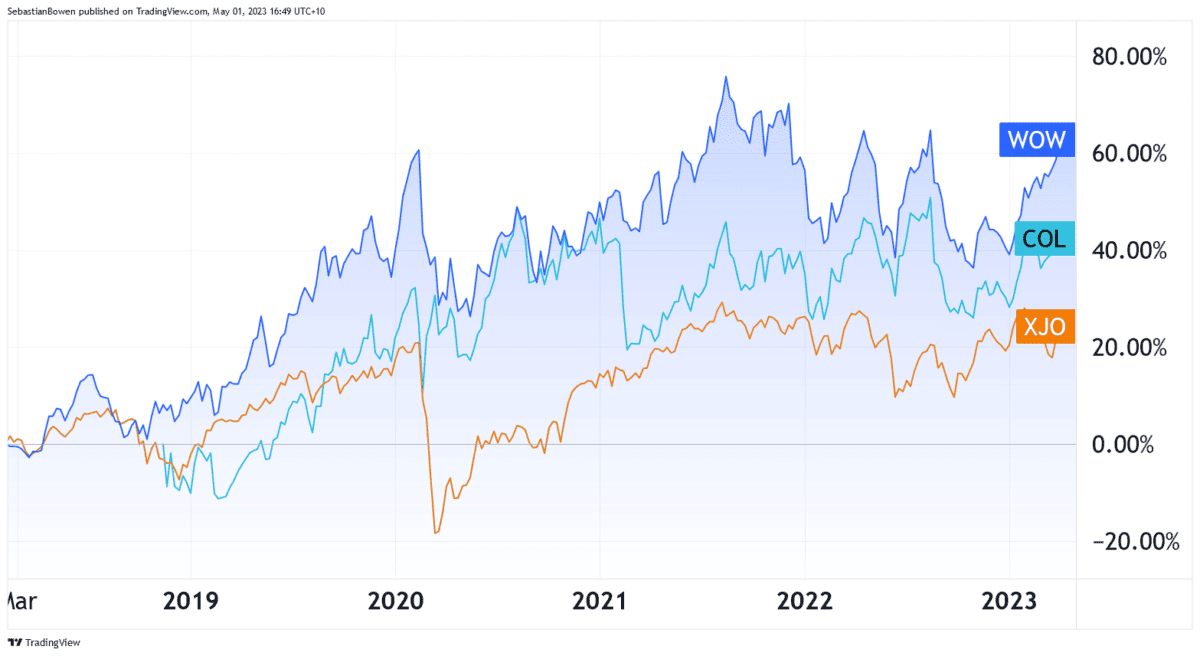
    Well, let’s start at the bottom. Both the Woolworths share price and the Coles share price have been market-beating performers over the past five years. Woolies and Coles’ shares have both outperformed the S&P/ASX 200 Index (ASX: XJO) as you can see below:

    Woolworths vs. Coles shares
    Woolworths and Coles share price against the ASX 200, over five years

    Woolies is the clear winner, but Coles’ performance has been nothing to turn one’s nose up against either.

    But, as we all know, past performance is no guarantee of future success. So let’s look at some fundamentals for both companies:

    Woolworths Coles
    Share price (at the time of writing) $38.68 $18.22
    Market capitalisation $47.4 billion $24.49 billion
    Price-to-earnings (P/E) ratio 28.33 21.74
    Trailing dividend yield 2.56% 3.62%
    Revenue (FY22) $60.85 billion $39.4 billion

    As we can see, Woolworths is by far the larger company here. In fact, Coles is close to half the size of Woolies.

    In some ways, this makes sense. Woolies turned over more than $60 billion in revenues in FY2022, while Coles did two-thirds of that, with just under $40 billion. This translates into Woolies being the clear market leader when it comes to the share of the Australian grocery pie.

    Woolworths shares have a lot going for them

    According to Statista, Woolworths commanded 37.1% of the Australian grocery market in FY2022, with Coles grabbing a 27.9% share.

    Both companies’ German arch-rival Aldi has a 9.5% stake, while the Metcash Ltd (ASX: MTS)-supplied IGA chain held onto 6.9%. The remaining 18.6% came from other, smaller grocery retailers.

    So Woolworths definitely deserves to trade at a larger size than Coles, by virtue of its higher market share, and greater revenues.

    But what the fundamentals also tell us is that the market is placing a higher premium on Woolworths shares compared to Coles. This is evident in Woolworths’ higher P/E ratio of 28.33, against Coles’ 21.74. This tells us that investors are prepared to pay $28.33 for every dollar of earnings Woolworths makes, but only $21.74 for every $1 that Coles rings up.

    This is one of the reasons why the Coles dividend yield is so much larger than that of Woolworths.

    Woolworths vs. Coles shares: Which is the better buy?

    So we as investors have to decide if this premium for Woolies shares that the market is asking is justified. In my opinion, Woolworths is the superior business. It has a clear market lead, which it has been able to maintain for years now.

    While I would personally like to see both companies trade at a cheaper share price to justify a buy, gun to my head, it would be Woolworths. I think this company has more potential to compound its earnings over a long period of time than Coles.

    However, if I were a retiree and depended on dividend payments to fund my expenses, the higher dividends from Coles would probably sway me over to the other side.


    The post Woolworths or Coles shares: Which ASX grocery giant would I buy right now? appeared first on The Motley Fool Australia.

    One “Under the Radar” Pick for the “Digital Entertainment Boom”

    Streaming TV Shocker: One stock we think could be set to profit as people ditch free-to-air for streaming TV (Hint It’s not Netflix, Disney+, or even Amazon Prime.)

    Learn more about our Tripledown report
    *Returns as of April 3 2023

    (function() {
    function setButtonColorDefaults(param, property, defaultValue) {
    if( !param || !param.includes(‘#’)) {
    var button = document.getElementsByClassName(“pitch-snippet”)[0].getElementsByClassName(“pitch-button”)[0];
    button.style[property] = defaultValue;
    }
    }

    setButtonColorDefaults(“#0095C8”, ‘background’, ‘#5FA85D’);
    setButtonColorDefaults(“#0095C8”, ‘border-color’, ‘#43A24A’);
    setButtonColorDefaults(“#fff”, ‘color’, ‘#fff’);
    })()

    More reading

    Motley Fool contributor Sebastian Bowen has no position in any of the stocks mentioned. The Motley Fool Australia’s parent company Motley Fool Holdings Inc. has no position in any of the stocks mentioned. The Motley Fool Australia has positions in and has recommended Coles Group. The Motley Fool Australia has recommended Metcash. The Motley Fool has a disclosure policy. This article contains general investment advice only (under AFSL 400691). Authorised by Scott Phillips.

    from The Motley Fool Australia https://ift.tt/Obtr7ML

  • Own Fortescue shares? You may have missed this week’s ‘game changer’ moment

    A man and a woman sit in front of a laptop looking fascinated and captivated.A man and a woman sit in front of a laptop looking fascinated and captivated.

    Fortescue Metals Group Limited (ASX: FMG) has commenced production at the Iron Bridge Magnetite Project, 145km south of Port Hedland in Western Australia.

    Fortescue shares are rising 0.14% today and are fetching $20.98 at the time of writing. For perspective, the S&P/ASX 200 Materials Index (ASX: XMJ) is sliding 0.39% today.

    Let’s take a look at what Fortescue announced to the market in more detail.

    What’s happening?

    Fortescue has produced maiden magnetite at Iron Bridge at a first run grade of more than 68% Fe (iron).

    The high grade magnetite product is now ready for shipping and suitable for steelmaking after being transported through a 135km slurry pipeline.

    Iron Bridge will produce 22 million tonnes of high grade magnetite concentrate per year.

    The project has involved nearly 20 years of planning and included more than 20 million hours of work.

    Commenting on the news, Fortescue executive chairman Dr Andrew Forrest AO said:

    Iron Bridge will lead the way for a successful magnetite industry in Western Australia and is a
    game changer for not only Fortescue, but the wider iron ore industry.

    More than 20,000 jobs were created for the Iron Bridge project and $3.6 billion worth of goods and services were sourced within Western Australia.

    Commenting further on the project, Fortescue CEO Fiona Hick said:

    The construction of Iron Bridge, Fortescue’s first magnetite operation, was complex particularly while managing the added challenges resulting from COVID-19 and border closures.

    I’m particularly proud that the team was able to deliver this project while maintaining strong safety performance.

    Our focus is now on achieving safe and efficient ramp up.

    Increased iron ore production could have a positive impact on Fortescue’s net profit after tax (NPAT).

    Iron ore futures are currently up 0.09% to US$102.05 a tonne on the Singapore Exchange.

    Fortescue share price snapshot

    Fortescue shares have lost 3.09% in the last year.

    The company has a market cap of about $64.6 billion based on the latest share price.

    The post Own Fortescue shares? You may have missed this week’s ‘game changer’ moment appeared first on The Motley Fool Australia.

    Should you invest $1,000 in Fortescue Metals Group Limited right now?

    Before you consider Fortescue Metals Group Limited, you’ll want to hear this.

    Motley Fool Investing expert Scott Phillips just revealed what he believes are the 5 best stocks for investors to buy right now… and Fortescue Metals Group Limited wasn’t one of them.

    The online investing service he’s run for over a decade, Motley Fool Share Advisor, has provided thousands of paying members with stock picks that have doubled, tripled or even more.* And right now, Scott thinks there are 5 stocks that are better buys.

    See The 5 Stocks
    *Returns as of April 3 2023

    (function() {
    function setButtonColorDefaults(param, property, defaultValue) {
    if( !param || !param.includes(‘#’)) {
    var button = document.getElementsByClassName(“pitch-snippet”)[0].getElementsByClassName(“pitch-button”)[0];
    button.style[property] = defaultValue;
    }
    }

    setButtonColorDefaults(“#0095C8”, ‘background’, ‘#5FA85D’);
    setButtonColorDefaults(“#0095C8”, ‘border-color’, ‘#43A24A’);
    setButtonColorDefaults(“#fff”, ‘color’, ‘#fff’);
    })()

    More reading

    Motley Fool contributor Monica O’Shea has no position in any of the stocks mentioned. The Motley Fool Australia’s parent company Motley Fool Holdings Inc. has no position in any of the stocks mentioned. The Motley Fool Australia has no position in any of the stocks mentioned. The Motley Fool has a disclosure policy. This article contains general investment advice only (under AFSL 400691). Authorised by Scott Phillips.

    from The Motley Fool Australia https://ift.tt/iBQ0Dwm

  • Liontown share price climbs on response to takeover rumours

    ASX share price rise represented by investor riding atop leaping lionASX share price rise represented by investor riding atop leaping lion

    The Liontown Resources Ltd (ASX: LTR) share price has exited a short-lived trading halt, responding to a report that it had fielded a new takeover offer.

    In what might be disappointing news for merger and acquisition (M&A) fans, the S&P/ASX 200 Index (ASX: XJO) lithium hopeful dismissed the rumours.

    It said it hasn’t been approached by any suitor since New York-listed lithium giant Albemarle’s recent $2.50 per share bid, rejected in March.

    The Liontown share price was frozen at $2.71 for much of this morning. It has since leapt 1.66% on its return to trade. Right now, the stock is swapping hands for $2.755 apiece.

    Let’s take a closer look at what’s been going on with the ASX 200 lithium developer today.

    Liontown share price lifts on response to takeover rumours

    Plenty of eyes were on the Liontown share price this morning as rumours Albemarle’s highest offer could have been bested by 10% were shot down.

    The Australian Financial Review reported yesterday evening that a second suitor was on the scene, facing up against Albemarle for control of the lithium hopeful.

    But the report was rebuffed by Liontown this morning, with the company saying:

    Liontown advises that it has not received any takeover proposals, including any non-binding indicative proposal, since the rejection of the Albemarle proposal on 28 March 2023.

    Of course, many market watchers were likely excited by the prospect of a new takeover offer.

    Particularly due to the calibre of “logical bidders” named by the publication. They included South32 Ltd (ASX: S32), Fortescue Metals Group Limited (ASX: FMG), and Wesfarmers Ltd (ASX: WES).

    The rumoured bid was said to have been priced at around $2.75 per share. Such an offer would have represented a 1% premium on the stock’s current price. It would also have been 3% lower than the record high of $2.835 the stock reached last month.

    Bell Potter, for one, appears to believe a successful offer would need to be priced higher. 

    It slapped Liontown shares with a $3.35 price target following Albemarle’s highest offer, my Fool colleague James reported. The broker said Albemarle’s bid was “reasonable, but not full”.

    The post Liontown share price climbs on response to takeover rumours appeared first on The Motley Fool Australia.

    Should you invest $1,000 in Liontown Resources right now?

    Before you consider Liontown Resources, you’ll want to hear this.

    Motley Fool Investing expert Scott Phillips just revealed what he believes are the 5 best stocks for investors to buy right now… and Liontown Resources wasn’t one of them.

    The online investing service he’s run for over a decade, Motley Fool Share Advisor, has provided thousands of paying members with stock picks that have doubled, tripled or even more.* And right now, Scott thinks there are 5 stocks that are better buys.

    See The 5 Stocks
    *Returns as of April 3 2023

    (function() {
    function setButtonColorDefaults(param, property, defaultValue) {
    if( !param || !param.includes(‘#’)) {
    var button = document.getElementsByClassName(“pitch-snippet”)[0].getElementsByClassName(“pitch-button”)[0];
    button.style[property] = defaultValue;
    }
    }

    setButtonColorDefaults(“#43B02A”, ‘background’, ‘#5FA85D’);
    setButtonColorDefaults(“#43B02A”, ‘border-color’, ‘#43A24A’);
    setButtonColorDefaults(“#fff”, ‘color’, ‘#fff’);
    })()

    More reading

    Motley Fool contributor Brooke Cooper has no position in any of the stocks mentioned. The Motley Fool Australia’s parent company Motley Fool Holdings Inc. has no position in any of the stocks mentioned. The Motley Fool Australia has positions in and has recommended Wesfarmers. The Motley Fool has a disclosure policy. This article contains general investment advice only (under AFSL 400691). Authorised by Scott Phillips.

    from The Motley Fool Australia https://ift.tt/SflYKkT