Tag: Motley Fool

  • SkyCity (ASX:SKC) share price sinks 9% on AUSTRAC news

    gambling asx share price fall represented by woman in soccer had looking frustrated at tablet screen

    The SkyCity Entertainment Group Limited (ASX: SKC) share price is under pressure on Monday morning.

    At the time of writing, the casino and resorts operator’s shares are down 9% to $3.08.

    Why is the SKyCity share price under pressure?

    Investors have been selling the company’s shares this morning after it revealed that AUSTRAC has identified potential serious non-compliance by SkyCity Adelaide.

    This non-compliance relates to the Australian Anti-Money Laundering and Counter-Terrorism Financing (AML/CTF) Act 2006 and the Anti-Money Laundering and Counter-Terrorism Financing Rules Instrument 2007.

    According to the release, the potential serious non-compliance includes concerns relating to ongoing customer due diligence, adopting and maintaining an AML/CTF Program, and compliance with Part A of an AML/CTF Program.

    These concerns were identified during the course of a compliance assessment which was commenced by AUSTRAC back in September 2019. It was focusing on SkyCity Adelaide’s management of customers identified as high risk and politically exposed persons.

    What now?

    The matter has been referred to AUSTRAC’s Enforcement Team, which has now initiated a formal enforcement investigation into the compliance of the casino.

    At this stage, AUSTRAC has made it clear that it hasn’t yet made a decision regarding what the appropriate regulatory response may apply to SkyCity Adelaide. This includes whether any enforcement action will be taken.

    SkyCity has advised that it will fully cooperate with AUSTRAC and stressed that it takes its anti-money laundering responsibilities and obligations very seriously. It also notes that it has processes and practices in place in its business to detect and prevent money laundering and continually reviews these to ensure it meets all anti-money laundering requirements.

    Crown hit by investigation

    In other news, the Crown Resorts Ltd (ASX: CWN) share price is trading lower today after revealing an AUSTRAC investigation of its own.

    For the same reasons as above, the regulator has initiated a formal enforcement investigation into the compliance of Crown Perth.

    The post SkyCity (ASX:SKC) share price sinks 9% on AUSTRAC news appeared first on The Motley Fool Australia.

    Wondering where you should invest $1,000 right now?

    When investing expert Scott Phillips has a stock tip, it can pay to listen. After all, the flagship Motley Fool Share Advisor newsletter he has run for more than eight years has provided thousands of paying members with stock picks that have doubled, tripled or even more.*

    Scott just revealed what he believes could be the five best ASX stocks for investors to buy right now. These stocks are trading at near dirt-cheap prices and Scott thinks they could be great buys right now.

    *Returns as of May 24th 2021

    More reading

    James Mickleboro does not own any shares mentioned. The Motley Fool Australia’s parent company Motley Fool Holdings Inc. has no position in any of the stocks mentioned. The Motley Fool Australia has no position in any of the stocks mentioned. The Motley Fool has a disclosure policy. This article contains general investment advice only (under AFSL 400691). Authorised by Bruce Jackson.

    from The Motley Fool Australia https://ift.tt/2TBh9FF

  • How has the Telstra (ASX:TLS) share price jumped to a 52-week high

    person on phone celebrating share price rise

    The Telstra Corporation Ltd (ASX: TLS) share price has been having a tough time of late. Shares in the Aussie telco have slid a long way from their $5.80 per share valuation of July 2016.

    5 years on, investors are starting to see some positive signs again. In fact, while the S&P/ASX 200 Index (ASX: XJO) was breaking records on Friday, there was one ASX 200 share also quietly climbing higher.

    Why is the Telstra share price at a 52-week high?

    One of the big issues plaguing Telstra in recent years has been the rollout of the NBN across Australia. The NBN has created intense competition given the significant government support it’s received. Its rollout forced a strategy rethink at Telstra.

    Falling profitability and a need for change have weighed on the Telstra share price. Shares in the Aussie telco slumped to just $2.66 per share in October 2020 as investors feared further dividend cuts from the historically blue-chip income share.

    But the recent market rebound has helped lift the Telstra share price higher over the last month. Telstra shares closed up 1.7% at $3.58 per share on Friday afternoon, with a $42.6 billion market capitalisation.

    The gains have come despite Telstra making no market announcements since 23 April. Shares in rival telco TPG Telecom Ltd (ASX: TPG) also jumped 1.6% on Friday despite no announcements on its end.

    There’s no doubt the telecommunications sector has performed strongly in recent times. That momentum could be a factor in the latest Telstra share price gains we’re seeing.

    There’s also increasing concern from some investors about the impacts of inflation. Rising inflation would in theory devalue tomorrow’s dollar relative to today’s. In effect, this decreases the real value of future profits from market darlings that promise future earnings but deliver little today in the way of income (or dividends).

    As a result, some investors are starting to think about a value rotation strategy. That’s where a portfolio is tilted more towards value stocks that pay dividends today in line with the ‘bird in the hand’ theory. That’s to say: a dollar in the bank today is worth more than potential future profits tomorrow.

    Foolish takeaway

    Whatever the reasons at the moment, the Telstra share price is certainly a beneficiary. Shares in the telco closed at a 52-week high on Friday as the benchmark ASX 200 index continued to push higher.

    The post How has the Telstra (ASX:TLS) share price jumped to a 52-week high appeared first on The Motley Fool Australia.

    Wondering where you should invest $1,000 right now?

    When investing expert Scott Phillips has a stock tip, it can pay to listen. After all, the flagship Motley Fool Share Advisor newsletter he has run for more than eight years has provided thousands of paying members with stock picks that have doubled, tripled or even more.*

    Scott just revealed what he believes could be the five best ASX stocks for investors to buy right now. These stocks are trading at near dirt-cheap prices and Scott thinks they could be great buys right now.

    *Returns as of May 24th 2021

    More reading

    The Motley Fool Australia’s parent company Motley Fool Holdings Inc. has no position in any of the stocks mentioned. The Motley Fool Australia owns shares of and has recommended Telstra Corporation Limited. The Motley Fool has a disclosure policy. This article contains general investment advice only (under AFSL 400691). Authorised by Bruce Jackson.

    from The Motley Fool Australia https://ift.tt/3ij13el

  • Why the Reliance (ASX:RWC) share price hit a 52-week high

    A plumber gives the thumbs up

    The Reliance Worldwide Corporation Ltd (ASX: RWC) share price had an absolute blinder on Friday. Shares in the plumbing product manufacturer hit $5.46 before slightly retreating to close at $5.40. That was still up an impressive 4.05%. By comparison, the S&P/ASX 200 Index (ASX: XJO) finished the day 0.49% higher.

    While there have not been any major market announcements out of the company since late April, there have been several external factors at play that may have been impacting Reliance shares.

    Let’s take a look at some of these.

    Why the construction industry is booming

    Booming property market

    As any first home buyer can tell you, the property market in Australia’s capital cities is surging. A recent article published by Domain Holdings Australia Ltd (ASX: DHG) claimed the price of housing in the nation could rise at 10x the rate of wages in 2021! Through a combination of record-low interest rates and high economic growth, the Australian property market has been fuelled to feverish levels.

    One reason investors may have been becoming increasingly attracted to Reliance shares could be because they believe the company stands to benefit from the housing boom – as lots of activity in the property market could translate into a surge in property renovations and repairs.

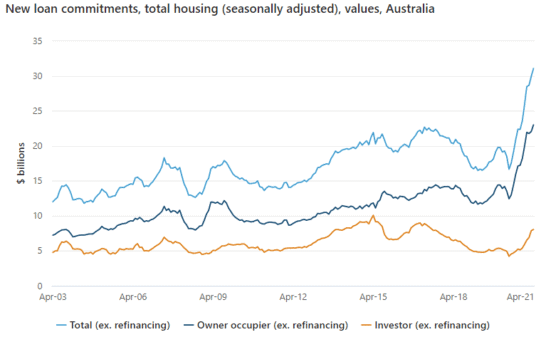
    In fact, on Friday the Australian Bureau of Statistics (ABS) confirmed new loan commitments for owner-occupied homes were up 4.3% in April to a record $23 billion. Investor loans increased 2.1% to $8.1 billion – a level not seen since mid-2017. By state, the biggest rises in new loan commitments were in New South Wales and Victoria – up 8.6% and 8.4% respectively. Sydney and Melbourne in particular have seen housing prices soar in recent months.

    Construction industry coming up tops

    As reported by Thursday’s Australian Financial Review (AFR), the construction industry is also experiencing a highly robust period at the moment. The selling prices of construction services are at their highest on record, and so are input prices and the pace of employment in the industry.

    Judging by the new 52-week high for Reliance shares, it seems investors may believe suppliers like it stand to materially benefit from this record-setting period for the industry.

    However, the AFR article did also report on fears this ‘era of good-feelings’ could be followed by a sharp bust period.

    HomeBuilder second chance

    While the federal government’s HomeBuilder program has wrapped up, 9News reported at the start of this month “thousands” of applicants who missed out due to a technical issue with their application will get a second chance to access the scheme that provided grants of up to $25,000 for the construction or renovation of a home.

    Shane Oliver, senior economist at AMP Capital, said in April HomeBuilder was likely one reason why the housing industry not only survived but thrived during the pandemic.

    This temporary extension of the construction stimulus could also possibly be exciting Reliance investors.

    Reliance share price snapshot

    Over the past 12 months, the Reliance share price has increased by around 66%. In March, the company paid a dividend of 6 cents per share – its largest in at least 4 years.

    Based on the current share price, Reliance has a market capitalisation of around $4.27 billion.

    The post Why the Reliance (ASX:RWC) share price hit a 52-week high appeared first on The Motley Fool Australia.

    Wondering where you should invest $1,000 right now?

    When investing expert Scott Phillips has a stock tip, it can pay to listen. After all, the flagship Motley Fool Share Advisor newsletter he has run for more than eight years has provided thousands of paying members with stock picks that have doubled, tripled or even more.*

    Scott just revealed what he believes could be the five best ASX stocks for investors to buy right now. These stocks are trading at near dirt-cheap prices and Scott thinks they could be great buys right now.

    *Returns as of May 24th 2021

    More reading

    The Motley Fool Australia’s parent company Motley Fool Holdings Inc. owns shares of and has recommended Reliance Worldwide Corporation Limited. The Motley Fool Australia has recommended Reliance Worldwide Corporation Limited. The Motley Fool has a disclosure policy. This article contains general investment advice only (under AFSL 400691). Authorised by Bruce Jackson.

    from The Motley Fool Australia https://ift.tt/3iqcHnA

  • China losing the war against these ASX shares

    China war ASX shares iron ore price record asx share price rise represented by a rising arrow on green chart

    There are signs that China’s punishing campaign against Australian commodity exports is backfiring as the country is taught a tough lesson in economics 101.

    Two dozen cities across China’s heartland are forced to ration electricity, reported News.com.au.

    This is due to a much hotter than usual summer and lack of coal to fire-up their power stations.

    Surging commodity prices haunting China

    Further, the price of thermal coal is surging. The commodity is up more than 90% over the past year and is trading at its highest level since 2018 at around US$121 a tonne.

    While coal prices surge, energy demand has jumped 24% over the same time last year. It isn’t only the unseasonably hot weather that’s to blame.

    Power demand from factories is soaring as the Chinese industrial machinery goes to full speed to meet pent-up demand as the world emerges from COVID-19.

    Burning cash

    It’s also reported that 16 or 18 power plants owned by one of China’s largest power utilities, Guangdong Energy Group Co, is running at a loss in the first quarter of 2021, according to News.com.au.

    The Chinese government is prioritising home cooling over industrial production. This is forcing factory owners to operate at night and panic buy portable power generators. This reminds me of the toilet paper frenzy that hit our supermarkets.

    In case you forgot, China banned the import of Australian coal as it seeks to punish the Morrison Government.

    ASX shares beating Beijing

    ASX coal miners finally have a reason to feel more upbeat. The Whitehaven Coal Ltd (ASX: WHC) share price and New Hope Corporation Limited (ASX: NHC) share price have rallied recently.

    The Chinese government isn’t one for admitting defeat. It said that the problem isn’t linked to the Australian coal ban and that domestic supply of coal is sufficient to meet demand.

    I am not sure who believes that but China is pointing to similar issues in Japan and Taiwan.

    Hot weather playing havoc

    However, Japan has little reliance on coal for power and it’s also suffering from an extremely hot summer.

    Meanwhile, the lack of rain in Taiwan is holding back the county’s hydroelectric power generation.

    Ask any economists that isn’t employed by China and they will tell you that China’s ban on our coal has curtailed supply to that market and is contributing to the problem.

    China at war with several ASX shares

    Let’s also not forget that Beijing has slapped prohibitive duties on other Australian goods, including barley, wine and seafood.

    Coincidentally, global food prices have surged to a decade high too. Droughts in countries like Brazil and other supply chain disruptions caused by COVID-19 are to be blamed.

    There’s less evidence that these bully-boy tactics are coming back to bite the Asian giant in the posterior. But it’s never a good idea to cut off a major supplier at a time of rising prices.

    The post China losing the war against these ASX shares appeared first on The Motley Fool Australia.

    Wondering where you should invest $1,000 right now?

    When investing expert Scott Phillips has a stock tip, it can pay to listen. After all, the flagship Motley Fool Share Advisor newsletter he has run for more than eight years has provided thousands of paying members with stock picks that have doubled, tripled or even more.*

    Scott just revealed what he believes could be the five best ASX stocks for investors to buy right now. These stocks are trading at near dirt-cheap prices and Scott thinks they could be great buys right now.

    *Returns as of May 24th 2021

    More reading

    from The Motley Fool Australia https://ift.tt/2SZvR9g

  • The CBA (ASX:CBA) share price made another record high last week

    excited man reaching new record high on mountain side

    The Commonwealth Bank of Australia (ASX: CBA) share price continued to set new record highs last week. On Friday CBA shares hit an intraday, all-time high of $102.64 before closing the session at $102.52.

    Last week, the Australian Bureau of Statistics (ABS) reported key lending indicators for new borrower-accepted finance commitments for housing, personal and business loans. The data could point to a continued recovery in consumer and business confidence, and for the broader Australian economy.

    ABS lending indicators surge to record highs

    The ABS reported that the value of new loan commitments for housing, owner-occupiers and investors increased 3.7%, 4.3% and 2.1% respectively in seasonally adjusted terms, in April 2021.

    ABS head of finance and wealth Katherine Keenan said:

    The value of new loan commitments for owner occupier housing reached another all-time high in April 2021, up 4.3 per cent to $23.0 billion. New loan commitments for investors rose 2.1 per cent to $8.1 billion, which was the highest level since mid-2017

    The rise in owner occupier lending was driven by increased loan commitments for existing dwellings, which rose 9.2 per cent. Loan commitments to owner occupiers for the construction of new dwellings fell by 11.4 per cent, following a fall of 14.8 per cent in March. These were the first monthly declines since the Homebuilder grant was introduced in June 2020. However, the value of construction commitments remained at a high level.

    From a year-on-year perspective, new borrower-accepted loan commitments for housing, owner occupier and investor increased 68.2%, 70.1% and 63.0% respectively in April.

    Source: Australian Bureau of Statistics

    In terms of business finance in April, the value of new loan commitments for construction fell 10.5% while loans for purchase of property rose 27.8%.

    CBA share price at all-time highs

    May was a breakthrough month for the CBA share price, closing above the iconic $100 mark for the first time ever. The move to record highs was supported by the bank’s continued momentum in earnings, evidenced by its third-quarter results.

    In the March quarter, CommBank delivered a cash net profit after tax of $2.4 billion, almost doubling the weak $1.3 billion from a year ago, and also topping the $1.70 billion in 2019 and $2.35 billion in 2018. The results release pointed to the following aspects driving the bank’s solid earnings.

    The Bank’s franchise strength was again evident with above system growth in home loans supported by strong funding volumes and continued focus on credit decisioning turnaround times. Domestic business lending continued to grow at more than three times system, with diversified growth across sectors. Household deposits growth was also above system, growing by $4bn in the quarter

    The post The CBA (ASX:CBA) share price made another record high last week appeared first on The Motley Fool Australia.

    Wondering where you should invest $1,000 right now?

    When investing expert Scott Phillips has a stock tip, it can pay to listen. After all, the flagship Motley Fool Share Advisor newsletter he has run for more than eight years has provided thousands of paying members with stock picks that have doubled, tripled or even more.*

    Scott just revealed what he believes could be the five best ASX stocks for investors to buy right now. These stocks are trading at near dirt-cheap prices and Scott thinks they could be great buys right now.

    *Returns as of May 24th 2021

    More reading

    Motley Fool contributor Kerry Sun has no position in any of the stocks mentioned.  The Motley Fool Australia’s parent company Motley Fool Holdings Inc. has no position in any of the stocks mentioned. The Motley Fool Australia has no position in any of the stocks mentioned. The Motley Fool has a disclosure policy. This article contains general investment advice only (under AFSL 400691). Authorised by Bruce Jackson.

    from The Motley Fool Australia https://ift.tt/34VDuQF

  • Why AMC Entertainment skyrocketed 160.4% in May

    This article was originally published on Fool.com. All figures quoted in US dollars unless otherwise stated.

    father and son eating popcorn and enjoying a movie in a cinema

    This article was originally published on Fool.com. All figures quoted in US dollars unless otherwise stated.

    What happened

    Shares of AMC Entertainment (NYSE: AMC) skyrocketed 160.4% in May, according to data from S&P Global Market Intelligence. The largest movie theater company in the world became the latest poster child of meme stock mania, as Reddit message board WallStreetBets fueled a massive spike in this beaten-down, highly shorted stock as the economy inched closer to a full reopening.

    The massive move came in spite of a first quarter earnings report showing a huge cash burn of $325 million, more dilutive equity sales to keep itself afloat, and the company’s largest shareholder for the past nine years selling its entire stake.

    With all of that going on, you might have expected the stock to go down. But of course, this is 2021, the year of the meme stock! So what the heck is going on?

    AMC stock has become the latest meme-stock to spike, as the economy nears full reopening.

    So what

    While AMC did report substantial first quarter cash burn at the beginning of the month, its U.S. theaters were only operating at 15% to 60% capacity in the March quarter, and only 27% of international theaters were open, also at limited capacity. With vaccinations accelerating faster than thought since March, reopening optimism apparently reignited the WallStreetBets message board on Reddit, because AMC’s stock began appreciating shortly after earnings.

    On May 13, a few days after earnings, AMC sold another 43 million shares for $428 million, at nearly $10 per share. Given that the company had sold shares in the low-single digits last fall and winter, selling shares at $10 may have seemed like a great deal… if only management knew what was coming!

    In the wake of the equity raise, sell-side analysts at B. Riley upgraded the stock, saying the raise likely lessened the need for more capital ahead of an industry recovery. While that bullish call bolstered the stock further, B. Riley only raised its price target from $13 to $16 — less than half of where shares trade now.

    Then, as the stock climbed toward $12, Dalian Wanda, the Chinese group that had originally purchased AMC in 2012, sold all of its remaining shares on May 21. While most would take that as a hugely bearish sign, the stock inexplicably went on an enormous tear immediately thereafter, more than doubling to $26 per share by the end of the month.

    Why did that happen? It’s hard to say. On May 26, sell-side firm CFRA upgraded AMC, but only from “Sell” to “Neutral” and giving an $18 price target. That coincided with the hashtag “#AMCSTRONG” trending on Twitter. The stock rallied about 20% that day and continued to rise through the end of the month. A short squeeze likely played into things, as nearly 20% of shares outstanding were sold short heading into May.

    Now what

    The stock’s rise has continued into June, along with more capital raises. On June 1, the company raised $230.5 million at $27.12 per share from hedge fund Murdick Capital. The stock surged 20% on the news, and Murdick sold all of its stake that same day, telling clients shares were “massively overvalued,” according to Bloomberg.

    Murdick had also owned AMC’s debt, likely at distressed prices, so the equity raise may have been a ploy to increase the value of its debt by increasing AMC’s creditworthiness. Although a savvy trade by Murdick, it apparently sold too early as well, as AMC’s shares skyrocketed over 100% the next day, reaching a high of $72.62, and prompting trading halts. Incredibly, AMC was allowed to sell another 11.5 million more shares to the public the following day at $50.85 per share, raising a whopping $587.4 million while only minimally diluting shareholders. Shares ended last week at $47.91.

    All in all, AMC has raised $1.246 billion this quarter, adding to the $813.1 million in cash it had at the end of the first quarter. The company is still likely burning through cash, so it likely has a little less than $2 billion in cash against a still-high $5.46 billion in debt — and some of that at very high interest rates. The company’s share count has also nearly quintupled from pre-pandemic levels to 502 million shares outstanding.

    Ironically, with investors bidding up the stock and the company selling shares, likely well above intrinsic value, AMC has likely fended off bankruptcy for the foreseeable future and actually increased the intrinsic value of the company. For instance, if a company is really worth $1, but is able to sell shares at $10, let’s say, doubling its share count, it increases the company’s intrinsic value from $1 to $6 ($1 plus $5 per share in cash).

    The problem? It’s still worth $6 — less than the $10 price at which investors bought shares. Ironically, the more shares the company sells above intrinsic value, the closer intrinsic value will move toward the sale price, but it will never exceed that value.

    The big exception to that rule is if the company can use that cash to make high-return investments that will increase intrinsic value going forward. That is also possible, as CEO Adam Aron said on the Murdick capital announcement that “it was time for AMC to go on offense again,” saying AMC is pursuing the high-end deluxe theater chain Arclight Cinemas in California, which went bankrupt this year as a result of the pandemic, as well as other “highly attractive theater opportunities.”

    So if AMC sold shares at high prices, and can then buy high-quality theaters at bargain prices, and if movie-going bounces back in a big way, it could in fact create value above where the company sold shares.

    However, that still seems like a long shot. In 2019, before the pandemic, AMC reported “adjusted” free cash flow of $358 million — and that figure incorporated some generous adjustments. Still, assuming AMC can get back to its prior free cash flow on the new quintupled share count, that’s only about $0.71 per share. So, at the current stock price, shares are valued at 67.5 times 2019 adjusted free cash flow per share.

    Of course, movie theaters weren’t exactly a growth industry prior to COVID, and could very well struggle to fully bounce back. Studios are shortening the window for theater exclusivity, and some may even begin releasing titles directly to streaming services in conjunction with theater releases.

    While accretive theater acquisitions could add value, I doubt any acquisitions would materially increase AMC’s free cash flow, since AMC already has massive scale as the largest theater chain in the world.

    Basically, shares seem massively overvalued from a fundamental point of view, and the stock is extremely risky at these levels. That doesn’t mean investors can’t make money on technical buying bursts like we’ve seen over the past month, but that’s not really investing; it’s subscribing to the greater fool theory.

    This article was originally published on Fool.com. All figures quoted in US dollars unless otherwise stated.

    The post Why AMC Entertainment skyrocketed 160.4% in May appeared first on The Motley Fool Australia.

    Wondering where you should invest $1,000 right now?

    When investing expert Scott Phillips has a stock tip, it can pay to listen. After all, the flagship Motley Fool Share Advisor newsletter he has run for more than eight years has provided thousands of paying members with stock picks that have doubled, tripled or even more.*

    Scott just revealed what he believes could be the five best ASX stocks for investors to buy right now. These stocks are trading at near dirt-cheap prices and Scott thinks they could be great buys right now.

    *Returns as of May 24th 2021

    More reading

    Billy Duberstein has the following options: short January 2022 $3 puts on AMC Entertainment Holdings. The Motley Fool Australia’s parent company Motley Fool Holdings Inc. owns shares of and has recommended Twitter. The Motley Fool Australia has no position in any of the stocks mentioned. The Motley Fool has a disclosure policy. This article contains general investment advice only (under AFSL 400691). Authorised by Bruce Jackson.

    This article was originally published on Fool.com. All figures quoted in US dollars unless otherwise stated.


    from The Motley Fool Australia https://ift.tt/3ghWcas

  • 2 ASX tech shares to boom when inflation rises: analyst

    Man looking excitedly at ASX share price gains on computer screen against backdrop of streamers

    Technology shares have been pummelled over the last 4 months.

    Dominated by growth stocks that rely on low-interest rates for future earnings, inflation fears have seen investors abandon the darling sector of last year.

    The S&P ASX All Technology Index (ASX: XTX), in fact, has lost about 15% since February. Yikes.

    But ECP Asset Management analyst Damon Callaghan argued this week there are ASX tech shares that will actually benefit from higher inflation.

    “We believe concerns of rising discount rates impacting present day valuations need to be weighed in conjunction with potential changes to business profitability,” he said on the company blog.

    “It’s important to appreciate how changing macroeconomic environments can affect the profitability of individual businesses.”

    Two examples Callaghan cited of tech companies that will benefit from rising inflation are Hub24 Ltd (ASX: HUB) and Netwealth Group Ltd (ASX: NWL).

    How Hub24 and Netwealth make money

    Both companies provide wealth management software platforms.

    Callaghan said Hub24 and Netwealth are clear leaders in their field, holding 2% and 4% of the market respectively.

    “Each business is increasingly taking market share, aided by a structural adviser shift to independence and general incumbent platform dissatisfaction across the industry.”

    But unlike many other technology companies, the near-zero interest rates in the past couple of years have depressed their business.

    This is because a core source of profitability for both is the ‘cash spread’ generated from the money they hold from investors.

    “The platforms pay clients interest on uninvested cash, typically with reference to the RBA cash rate (i.e. RBA less 0.50%),” said Callaghan.

    “Platforms then utilise their scale, pooling tens of thousands of client accounts, and provide this cash at a wholesale rate to tier-1 banks. For example, Netwealth recently disclosed its standing contract with Australia and New Zealand Banking Group Ltd (ASX: ANZ) pays it RBA plus 0.95%.”

    The difference between the interest received from the banks and the interest it pays investors is all sweet profit for Hub24 and Netwealth.

    How Hub24 and Netwealth benefit from higher inflation

    But since the arrival of COVID-19, the Reserve Bank slashed its cash rate to below 0.5%. This means the margin for Hub24 and Netwealth has disappeared.

    “Every basis point below 0.50% ate into the spread earned by both Hub24 and Netwealth,” said Callaghan.

    “In the Netwealth example, the running cash spread was cut from 1.45% down to 1.05%.”

    This is why if the RBA rate spikes up, both these platform providers will be cheering.

    “With economic normalisation, extreme liquidity support and record low rates will no longer be a necessary monetary policy setting — and potentially sooner than expected,” Callaghan said.

    “When this period of heightened stimulus passes, we see scope for Hub24 and Netwealth cash spreads to normalise back to pre-COVID levels.”

    Using forecasts for the 2023 financial year, ECP Asset Management estimates both software providers will see a 40% boost in profit expectations if “historic” cash spreads returned. 

    “The consensus earnings headwinds caused by excess liquidity are now behind the wealth platforms, and are set to accelerate profit growth when this economic recovery matures.”

    Hub24 shares were down 1.61% at Friday’s close to trade at $27.58. They started the year at $21.73.

    Netwealth stocks were up 1.76% on Friday to change hands at $15.05. They began 2021 at $16.35.

    The post 2 ASX tech shares to boom when inflation rises: analyst appeared first on The Motley Fool Australia.

    Wondering where you should invest $1,000 right now?

    When investing expert Scott Phillips has a stock tip, it can pay to listen. After all, the flagship Motley Fool Share Advisor newsletter he has run for more than eight years has provided thousands of paying members with stock picks that have doubled, tripled or even more.*

    Scott just revealed what he believes could be the five best ASX stocks for investors to buy right now. These stocks are trading at near dirt-cheap prices and Scott thinks they could be great buys right now.

    *Returns as of May 24th 2021

    More reading

    The Motley Fool Australia’s parent company Motley Fool Holdings Inc. owns shares of and has recommended Hub24 Ltd and Netwealth. The Motley Fool Australia owns shares of and has recommended Netwealth. The Motley Fool Australia has recommended Hub24 Ltd. The Motley Fool has a disclosure policy. This article contains general investment advice only (under AFSL 400691). Authorised by Bruce Jackson.

    from The Motley Fool Australia https://ift.tt/3cmbgmy

  • This ASX share makes money for doing nothing

    Man sitting back inna chair next to a large tap flowing with money.

    There is an ASX-listed business that generates returns while hardly spending a cent.

    Two fund managers this week pointed out how the remarkable revenue model of Deterra Royalties Ltd (ASX: DRR) is worth considering as a long-term investment.

    Although the ASX has always been very resources-heavy, it has surprisingly not encountered many mining royalties companies like Deterra.

    In fact, according to TMS Capital portfolio manager Ben Clark, it is “the first pure play mining royalties company” to trade in Australia.

    “Deterra’s cornerstone asset is 80% of a royalty stream owned since 1994 over Mining Area C (MAC) — an enormous block of land in WA that contains the MAC iron ore mine being mined by BHP Group Ltd (ASX: BHP),” he posted on Livewire.

    Clark said Deterra earns money from two sources: 1.232% of revenue from the royalty area and a one-off $1 million payment for each 1 million tonne increase in annual production.

    BHP is set to expand production at this site in the next few years, which would appear to bode well for Deterra.

    Perpetual head of equities Paul Skamvougeras reckons it’s “the best royalty that you can own globally and one of the highest quality“.

    “Reasons being, its mine life is probably 50 years — if not more,” he told a Livewire video.

    “In terms of counterparty risk — your counterparty is BHP, that’s who you’re hoping will pay you. We think that they can meet those obligations.”

    But here’s the extraordinary thing. Deterra doesn’t need to put in any capital to keep receiving this recurring revenue.

    ‘This is unheard of’: 500% return on equity

    Deterra’s financials are “unique”, according to Clark.

    “In the first half of the financial year, the company reported underlying EBITDA of $47.8m at a phenomenal EBITDA margin of 97%,” he said.

    “This is unheard of and reflects the fact that there is virtually no cost to the company in earning this revenue, BHP takes on all the risk and capital spend required. The company’s ROE is over 500%.”

    In Skamvougeras’ opinion, the money would keep flowing in regardless of the iron ore price.

    “It doesn’t matter whether iron ore is US$220 or US$25, the production from BHP is going to keep coming out because they’re very, very low on the cost curve,” he said.

    “And there’s no capital to spend, so the royalty owner doesn’t have to spend any capital, increasing production.”

    After analysing other royalty companies around the world, Clark’s convinced Deterra is one of the best.

    “Using a relatively conservative 2023 iron ore price assumption, the company could pay a dividend well in excess of 10%,” he said.

    “Quality royalty streams are tightly held, and few come to market.”

    The Deterra share price has actually sunk by around 10% since the start of the year. It lost 4.64% on Friday to stop trade at $4.32.

    The post This ASX share makes money for doing nothing appeared first on The Motley Fool Australia.

    Wondering where you should invest $1,000 right now?

    When investing expert Scott Phillips has a stock tip, it can pay to listen. After all, the flagship Motley Fool Share Advisor newsletter he has run for more than eight years has provided thousands of paying members with stock picks that have doubled, tripled or even more.*

    Scott just revealed what he believes could be the five best ASX stocks for investors to buy right now. These stocks are trading at near dirt-cheap prices and Scott thinks they could be great buys right now.

    *Returns as of May 24th 2021

    More reading

    Tony Yoo as no position in any of the stocks mentioned. The Motley Fool Australia’s parent company Motley Fool Holdings Inc. has no position in any of the stocks mentioned. The Motley Fool Australia has no position in any of the stocks mentioned. The Motley Fool has a disclosure policy. This article contains general investment advice only (under AFSL 400691). Authorised by Bruce Jackson.

    from The Motley Fool Australia https://ift.tt/3wYWwle

  • LIVE COVERAGE: ASX expected to rise; Gold rebounds

    A vortex of ASX shares on the boards gets sucked into an Australian flag, indicating trading on the ASX sharemarket

    The post LIVE COVERAGE: ASX expected to rise; Gold rebounds appeared first on The Motley Fool Australia.

    Wondering where you should invest $1,000 right now?

    When investing expert Scott Phillips has a stock tip, it can pay to listen. After all, the flagship Motley Fool Share Advisor newsletter he has run for more than eight years has provided thousands of paying members with stock picks that have doubled, tripled or even more.*

    Scott just revealed what he believes could be the five best ASX stocks for investors to buy right now. These stocks are trading at near dirt-cheap prices and Scott thinks they could be great buys right now.

    *Returns as of May 24th 2021

    More reading

    Suzanne Frey, an executive at Alphabet, is a member of The Motley Fool’s board of directors. Kate O’Brien owns shares of Apple and Rio Tinto Ltd. The Motley Fool Australia’s parent company Motley Fool Holdings Inc. owns shares of and recommends Alphabet (A shares), Alphabet (C shares), and Apple. The Motley Fool Australia has recommended Alphabet (A shares), Alphabet (C shares), and Apple. The Motley Fool has a disclosure policy. This article contains general investment advice only (under AFSL 400691). Authorised by Bruce Jackson.

    from The Motley Fool Australia https://ift.tt/2Arppiz

  • ASX 200 Weekly Wrap: ASX hits 7,300 points for the first time

    Golden retriever dog holding a newspaper in its mouth

    The S&P/ASX 200 Index (ASX: XJO) has just delivered investors an additional week of gains to record yet another new all-time high. After May gave the ASX 200 a total of three new high watermarks, June is off to a flying start, with the ASX 200 hitting 7,300 points during intra-day trading for the first time ever on Friday.

    The index also closed at a record high of 7,295.4 points on Friday afternoon. So another week, another record high. Let’s talk about what pushed the ASX 200 up last week.

    Well, for starters, we got a few economic announcements last week that was conducive to higher shares. Firstly, the Reserve Bank of Australia (RBA) kept the cash rate at the record low of 0.1% when the RBA’s board held its monthly meeting on Tuesday. While this move probably surprised no one given the RBA’s comments on what needs to happen in the economy to see higher rates, it still reaffirms that the share market is one of the few places a substantial yield is available in this current climate. 

    Secondly, we got some data from the Australian Bureau of Statistics (ABS) on Wednesday that should be universally celebrated. The Australian economy is now 0.8% larger than where it was prior to the pandemic. The ABS’ GDP figures showed that the economy grew 1.8% in the quarter ending 31 March 2021, as well as 1.1% annually.

    Strong economic growth is obviously a good sign for ASX companies. As such, this news would probably have given investors a confidence boost. We can see this in the healthy show the ASX 200 put on on Wednesday (more on that in a minute).

    Banks and miners push ASX 200 higher

    But the ASX 200 can’t rise without the major blue-chip shares within it rising as well. And that’s exactly what we saw last week. The ASX banks and big miners led the ASX 200’s gains. Commonwealth Bank of Australia (ASX: CBA) continued to build on its recent momentum and pushed well past the $100 per share threshold it broke just a few weeks ago. It managed to put on another 1.9% last week to push above $102 per share. The other 3 major banks also had top weeks, with Westpac Banking Corp (ASX: WBC) making a new 52-week high.

    A once-again rising iron ore price (which pushed back over US$200 per tonne over the week) also gave a big boost to BHP Group Ltd (ASX: BHP), Rio Tinto Limited (ASX: RIO) and Fortescue Metals Group Limited (ASX: FMG). Fortescue shares shone especially brightly with a 3.84% gain for the week. Rising oil prices also helped push the ASX energy sector much higher, with Woodside Petroleum Limited (ASX: WPL) pushing nearly 9% higher over the week.

    As seems to be the case these days, the only ASX sectors showing significant losses in the face of this rising ASX 200 tide were tech shares and gold miners. On the latter, ASX gold shares went backwards over the week, after a couple of strong weeks of performance thanks to a rising gold price. Last week, gold prices got somewhat stuck in the mud, and investors subsequently seemed to lose their zeal for the sector (more on this later).

    Likewise, investors may still be getting jitters over the tech sector’s exposure to higher interest rates down the road, and backed out of shares like Zip Co Ltd (ASX: Z1P) and Appen Ltd (ASX: APX). This follows a similar pattern to what happened on the US markets over the week.

    How did the markets end the week?

    The ASX 200 started the week at 7,179.5 points and ended up at 7,295.4 points for a healthy week-to-week gain of 1.61%. Mondy and Tuesday started things off on the wrong foot with back-to-back losses of 0.25% and 0.27% respectively. But Wednesday’s strong economic figures changed a few hearts and minds out there it seems since the ASX 200 put on a healthy 1.05% gain that day. This was backed up on both Thursday and Friday with gains of 0.59% and 0.49% respectively.

    Meanwhile, the All Ordinaries Index (ASX: XAO) also fared very well. The All Ords started out at 7,424 points and finished up at 7,543.3 points for a congruent gain of 1.61%.

    Which ASX 200 shares were the biggest winners and losers?

    Put the coffee on, because it’s time for our Foolish gossip pages where we look at the ASX 200’s best winners and poorest losers of the week. So, as always, let’s start with the losers:

    Worst ASX 200 losers % loss for the week
    Nuix Ltd (ASX: NXL) (23.2%)
    Silver Lake Resources Limited (ASX: SLR) (12.6%)
    Mesoblast Limited (ASX: MSB) (8.9%)
    Appen Ltd (ASX: APX) (8.9%)

    Nuix was the ASX 200 wooden spooner last week, with a hefty loss of 23.2%. This ASX newcomer has been a disappointing investment since its initial public offering (IPO) last year, and things got a lot worse for investors last week. Nuix nit a new low on Friday of $2.57 per share and closed just above that at $2.59. The catalyst for this move was yet another earnings guidance downgrade from the company.

    Silver Lake Resources was also a poor performer last week. This ASX gold miner led the losses in its sector with a 12.6% fall. As mentioned above, falling gold prices and a risk-on market at record highs left gold miners unloved last week. 

    Health care company Mesoblast was also in the firing line last week. A third-quarter update had investors hitting the sell button after the company reported that its losses were widening.

    And finally, tech company Appen was also left in the cold. The tech sector was having a rough time of it anyway last week. But when the markets found out Appen CEO Mark Bryan had recently sold a large parcel of shares, it evidently wasn’t in a forgiving mood.

    Now with the losers out of the way, let’s have a look at last week’s winning ASX 200 shares:

    Best ASX 200 gainers % gain for the week
    Origin Energy Ltd (ASX: ORG) 15.7%
    Worley Ltd (ASX: WOR) 15.6%
    Inghams Group Ltd (ASX: ING) 12.3%
    Santos Ltd (ASX: STO) 12.2%

    Energy generator and retailer Origin was the ASX 200’s best performing share last week, putting on an extra 15.7%. That was despite no major news out of the company. It’s possible investors were responding to some love from brokers last week. Or otherwise, the news that rival AGL Energy Limited (ASX: AGL) may need to pursue a capital raise to fund its demerger ambitions might be increasing Origin’s appeal.

    Engineering company Worley was also feeling the love last week. This move upward seems to have been sparked by an investor day event Worley held last week. 

    Poultry company Inghams was also sharing the sunshine. Inghams shares are now up close to 22% since 27 May, when the company released a well-received trading update. Last week’s moves appear to be an extension of that momentum.

    And finally, ASX energy share Santos was also in demand last week. As we discussed above, energy prices had a strong week, with Brent crude now back above US$70 per barrel for the first time since the pandemic started. This has benefitted Santos shares the most in their sector and the company is now up more than 20% year to date.

    A wrap of the ASX 200 blue-chip shares

    Before we go, here is a look at the major ASX 200 blue-chip shares as we commence yet another week on the ASX boards:

    ASX 200 company Trailing P/E ratio Last share price 52-week high 52-week low
    CSL Limited (ASX: CSL) 38.72 $291.37 $320.42 $242
    Commonwealth Bank of Australia (ASX: CBA) 22.8 $102.52 $102.64 $62.64
    Westpac Banking Corp (ASX: WBC) 22.99 $26.87 $26.88 $16
    Australia and New Zealand Banking Group Ltd (ASX: ANZ) 17.69 $29.20 $29.55 $16.40
    National Australia Bank Ltd (ASX: NAB) 21.11 $27.51 $27.84 $16.56
    Fortescue Metals Group Limited (ASX: FMG) 8.64 $22.97 $26.40 $13.56
    Woolworths Group Ltd (ASX: WOW) 38.69 $43.35 $43.46 $35.37
    Wesfarmers Ltd (ASX: WES) 33.31 $55.24 $56.44 $40.80
    BHP Group Ltd (ASX: BHP) 27.51 $48.75 $51.82 $33.73
    Rio Tinto Limited (ASX: RIO) 16.11 $124.62 $132.94 $90.04
    Coles Group Ltd (ASX: COL) 21.67 $17.04 $19.26 $15.15
    Transurban Group (ASX: TCL) $14.27 $15.64 $12.36
    Sydney Airport Holdings Pty Ltd (ASX: SYD) $6.12 $7.49 $4.99
    Newcrest Mining Ltd (ASX: NCM) 17.77 $27.45 $38.15 $23.08
    Woodside Petroleum Limited (ASX: WPL) $24.07 $27.60 $16.80
    Macquarie Group Ltd (ASX: MQG) 18.68 $154 $162.06 $111.25
    Afterpay Ltd (ASX: APT) $94.48 $160.05 $47.09

    And finally, here is the lay of the land for some leading market indicators:

    • S&P/ASX 200 Index (XJO) at 7,295.4 points.
    • All Ordinaries Index (XAO) at 7,543.3 points.
    • Dow Jones Industrial Average (DJX: .DJI) at 34,756 points after rising 0.52% on Friday night (our time).
    • Bitcoin (CRYPTO: BTC) going for US$35,815 per coin.
    • Gold (spot) swapping hands for US$1,891 per troy ounce.
    • Iron ore asking US$205.62 per tonne.
    • Crude oil (Brent) trading at US$71.89 per barrel.
    • Australian dollar buying 77.41 US cents.
    • 10-year Australian Government bonds yielding 1.69% per annum.

    That’s all folks. See you next week!

    The post ASX 200 Weekly Wrap: ASX hits 7,300 points for the first time appeared first on The Motley Fool Australia.

    Wondering where you should invest $1,000 right now?

    When investing expert Scott Phillips has a stock tip, it can pay to listen. After all, the flagship Motley Fool Share Advisor newsletter he has run for more than eight years has provided thousands of paying members with stock picks that have doubled, tripled or even more.*

    Scott just revealed what he believes could be the five best ASX stocks for investors to buy right now. These stocks are trading at near dirt-cheap prices and Scott thinks they could be great buys right now.

    *Returns as of May 24th 2021

    More reading

    Motley Fool contributor Sebastian Bowen owns shares of National Australia Bank Limited, Bitcoin and Newcrest Mining Limited. The Motley Fool Australia’s parent company Motley Fool Holdings Inc. owns shares of and has recommended AFTERPAY T FPO, Appen Ltd, Bitcoin, CSL Ltd., and ZIPCOLTD FPO. The Motley Fool Australia’s parent company Motley Fool Holdings Inc. has recommended Nuix Pty Ltd. The Motley Fool Australia owns shares of and has recommended AFTERPAY T FPO, Appen Ltd, COLESGROUP DEF SET, Macquarie Group Limited, Transurban Group, Wesfarmers Limited, and Woolworths Limited. The Motley Fool Australia has recommended Nuix Pty Ltd. The Motley Fool has a disclosure policy. This article contains general investment advice only (under AFSL 400691). Authorised by Bruce Jackson.

    from The Motley Fool Australia https://ift.tt/2SefbuG