Tag: Motley Fool

  • 2 outstanding tech ETFs for ASX investors

    Monadelphous share price rio tinto A small rocket take off from a laptop, indicating a share price surge

    If you’re wanting to invest in the tech sector but aren’t sure which shares to buy, then you might want to consider exchange traded funds (ETFs).

    There are a number of ETFs out there that allow investors to buy a slice of some of the world’s biggest and brightest tech companies. Two such ETFs that will allow you to achieve this are listed below:

    BetaShares Asia Technology Tigers ETF (ASX: ASIA)

    If you already have exposure to the US tech sector, then you might want to consider the BetaShares Asia Technology Tigers ETF. As its name implies, this ETF gives investors exposure to some of the largest tech companies in the Asian market.

    BetaShares believes this is a good place to invest, noting that technological adoption in Asia is surpassing the West. Furthermore, this trend is expected to continue in the future, underpinning strong growth over the next decade.

    At present there are a total of 50 companies included in the fund. Among its largest holdings you’ll find Alibaba, Infosys, JD.com, Meituan, Pinduoduo, Samsung, and Tencent.

    In respect to the latter, Tencent is a multinational technology conglomerate and one of the largest companies in the world. It is best known for its communication and social platforms, Weixin (WeChat) and QQ, which connect over a billion users with each other.

    Betashares Nasdaq 100 ETF (ASX: NDQ)

    If you don’t have exposure to the US tech sector, then one of the best ways to achieve this could be with the Betashares Nasdaq 100 ETF. It aims to track the performance of the famous NASDAQ-100 Index, which is home to 100 of the largest non-financial companies listed on the NASDAQ stock exchange.

    This includes many companies that are at the forefront of the new economy, such as Amazon, Apple, Facebook, Netflix, and Tesla.

    As a whole, these companies have collectively been outperforming the Australian share market by some distance over the last five years. And thanks to their positive long term outlooks, they look well-placed to potentially continue this outperformance over the next five.

    Where to invest $1,000 right now

    When investing expert Scott Phillips has a stock tip, it can pay to listen. After all, the flagship Motley Fool Share Advisor newsletter he has run for more than eight years has provided thousands of paying members with stock picks that have doubled, tripled or even more.*

    Scott just revealed what he believes are the five best ASX stocks for investors to buy right now. These stocks are trading at dirt-cheap prices and Scott thinks they are great buys right now.

    *Returns as of February 15th 2021

    More reading

    The post 2 outstanding tech ETFs for ASX investors appeared first on The Motley Fool Australia.

    from The Motley Fool Australia https://ift.tt/3vbI74S

  • Encounter (ASX:ENR) share price rockets 30% on BHP copper joint-project

    Rising mining ASX share price represented by man in hard hat making excited fists

    The Encounter Resources Ltd (ASX: ENR) share price is surging today. At the time of writing, shares in the mineral exploration company are trading for 17.5 cents each – up 29.63%.

    The massive price rise comes after the company announced BHP Group Ltd (ASX: BHP) agreed to enter into a joint-venture agreement to develop a copper project in the Northern Territory.

    Let’s take a closer look at today’s news.

    Why the Encounter share price is rising

    In a statement to the ASX, Encounter Resources said BHP has exercised an option under a previous agreement to jointly develop the Elliot Copper Project in the NT. BHP will own three-quarters of the endeavour while Encounter will own the remaining portion. This is providing BHP spends $22 million over 10 years on the site. The mining giant will also manage the site.

    Investors are clearly loving the prospects for this joint-venture copper project with BHP, judging by today’s Encounter share price action.

    Management commentary

    Encounter managing director Will Robinson said:

    Copper sourced from sedimentary-hosted deposits is one of the fastest growing sources of high-grade copper in the world.

    The potential for this region to host large sedimentary-hosted copper deposits is rapidly emerging and we are delighted to be teaming up with BHP to apply leading edge technologies in the search for Tier 1 copper deposits at Elliott. The outcomes of the jointly designed validation program at Elliott have been illuminating and bolstered the potential for the discovery of large sedimentary-hosted copper deposits under shallow cover in the NT.

    Copper commodity price

    Copper is currently trading for US$4.54 per pound on the commodities market according to the website Trading Economics. While it’s down 2.7% this week, the metal’s value has increased 6.1% this month and 29.0% since the beginning of the year. It should be noted copper was at an all-time high price of US$4.90 per pound two weeks ago and a near-record US$4.79 last week.

    The increasing copper price could also be positively affecting Encounter shares today.

    As Motley Fool has previously reported, copper demand has been surging recently due to a rebounding global economy and increasing demand for green technologies. Copper is an essential metal in the production of renewable energy technologies.

    As also reported, supply of the reddish-brown metal is also down due to a lack of investment in copper production by large mining corporations, as well as tax hikes in Chile. One-quarter of all copper is mined in the South American nation. A mix of increasing demand and decreasing supply will generally increase the price of a good or service.

    Encounter share price snapshot

    Over the past 12-months, the Encounter share price has increased by 45.83% – the majority of which occurred today. However, since hitting a 9-year high of 33.5 cents per share in October last year, the company’s value has fallen by almost 48%. Encounter Resources has a market capitalisation of $51.7 million.

    Where to invest $1,000 right now

    When investing expert Scott Phillips has a stock tip, it can pay to listen. After all, the flagship Motley Fool Share Advisor newsletter he has run for more than eight years has provided thousands of paying members with stock picks that have doubled, tripled or even more.*

    Scott just revealed what he believes are the five best ASX stocks for investors to buy right now. These stocks are trading at dirt-cheap prices and Scott thinks they are great buys right now.

    *Returns as of February 15th 2021

    More reading

    The post Encounter (ASX:ENR) share price rockets 30% on BHP copper joint-project appeared first on The Motley Fool Australia.

    from The Motley Fool Australia https://ift.tt/3yrxPj0

  • Here’s 1 stock this fundie prefers over Commonwealth Bank (ASX:CBA) shares

    Woman in mustard yellow blouse on laptop holds both hands out to either side with graphic illustration of question marks above them

    Commonwealth Bank of Australia (ASX: CBA) shares have gained plenty of attention lately, as the bank approaches the $100 mark. Big profits, translating into big dividends, ignited the recent run-up in bank shares. A rotation out of growth no doubt has also helped.

    However, managing director and chief investment officer at Allan Gray, Simon Mawhinney, believes there are other opportunities out there for investors.

    CBA shares fall outside sweet spot

    In its first national investment forum for the year, Alan Gray kicked things off in Brisbane on Wednesday. Mawhinney shared the Allan Gray approach to investing of long-term, contrarian, and fundamental to a loaded room of eager attendees.

    https://platform.twitter.com/widgets.js

    Sticking to the Allan Gray values, Mawhinney suggested that the Commonwealth Bank is now sitting outside the fund’s ‘sweet spot’. Which is to say, the bank now trades at too high of a price-to-earnings (P/E) ratio for its liking.

    For comparison, the rising Commonwealth Bank share price has seen its earnings multiple expand from 11.96 times nearly 10 years ago, to 25.91 times. The industry average is around 15.6 times.

    Commenting on Australia’s biggest bank, Mawhinney said:

    I believe its earnings and returns on equity are likely to mirror the average of the other banks and suspect that investors would be better off choosing another bank to invest in rather than CBA. But I am not advocating investing in the banks either. There are a lot of other opportunities available to investors.

    A potential ASX challenger to Commonwealth Bank

    If the banks are not looking favourable, then what are the alternatives? Well, Simon Mawhinney offered a potential contrarian opportunity in the form of Challenger Ltd (ASX: CGF).

    The fund has been adding to its position in Challenger recently, with its weighting growing to nearly 2% as of 11 May 2021. Allan Gray added heavily following the annuities company’s third-quarter results, which was met with a 10% selloff.  

    Mawhinney provided the following commentary on why Challenger looks attractive:

    Its annuity distribution network is disrupted and rates it can afford to pay its annuitants has been negatively impacted by the low returns it is able to achieve from its investment portfolio. This is all true but viewed in isolation, is only one side of the coin.

    The other side, the price you pay for Challenger, can’t be ignored. In my opinion, some if not a lot of these headwinds are factored into the current share price

    Mawhinney doesn’t foresee an imminent reversal in the share price of the ASX’s biggest bank. Though, Challenger might have less upside currently priced in, compared to the Commonwealth Bank.

    Where to invest $1,000 right now

    When investing expert Scott Phillips has a stock tip, it can pay to listen. After all, the flagship Motley Fool Share Advisor newsletter he has run for more than eight years has provided thousands of paying members with stock picks that have doubled, tripled or even more.*

    Scott just revealed what he believes are the five best ASX stocks for investors to buy right now. These stocks are trading at dirt-cheap prices and Scott thinks they are great buys right now.

    *Returns as of February 15th 2021

    More reading

    The post Here’s 1 stock this fundie prefers over Commonwealth Bank (ASX:CBA) shares appeared first on The Motley Fool Australia.

    from The Motley Fool Australia https://ift.tt/3f4e0q7

  • 2 quality ASX healthcare shares this leading broker rates highly

    healthcare asx share price rise represented by happy doctor

    Thanks to a number of favourable long term tailwinds, the healthcare sector looks like it could be a great place to make buy and hold investments.

    But which ASX healthcare shares should you be focusing on? Two that are highly rated are listed below. Here’s what you need to know about them:

    Healius Ltd (ASX: HLS)

    The first healthcare share to look at is Healius. It is one of Australia’s largest pathology and diagnostic imaging providers. It offers pathology and imaging services via various brands including Dorevitch Pathology, QML Pathology, Laverty Pathology, and Healthcare Imaging Services. The company also has a network of day hospitals and IVF clinics.

    It has been performing very strongly in FY 2021. For example, during the first half it reported a 16% increase in revenue to $953.5 million and a 190% jump in net profit to $75.6 million. This was driven largely by its key pathology business, which reported a 22% increase in revenue to $711.4 million and significantly wider margins.

    Pleasingly, its solid form has continued since the end of the first half, with Healius reporting solid growth during the third quarter.

    Analysts at Goldman Sachs are positive on the company. They currently have a buy rating and $4.40 price target on its shares.

    Pro Medicus Limited (ASX: PME)

    Another healthcare share that is highly rated is Pro Medicus. It provides software that facilitates the clinical assessment of medical images. It has been growing at a very strong rate in recent years thanks to the rapidly growing demand for solutions that can process, transfer and store this type of data efficiently. This is particularly the case given that speed and accuracy is fundamentally linked to both treatment success and commercial incentives.

    In light of this, it will come as no surprise to learn that Pro Medicus has been winning a number of major contracts over the last 12 months. One of which came earlier this month with the University of Vermont for its Visage platform. This contract is worth $18 million over a total of eight years.

    Goldman Sachs is also bullish on the Pro Medicus. They currently have a buy rating and $53.80 price target on its shares. Commenting on recent contract wins, it said: “We believe the heightened rate of uptake underlines the increased value being ascribed by hospitals towards solutions that can provide additional flexibility/resilience; a theme we expect to persist.”

    Where to invest $1,000 right now

    When investing expert Scott Phillips has a stock tip, it can pay to listen. After all, the flagship Motley Fool Share Advisor newsletter he has run for more than eight years has provided thousands of paying members with stock picks that have doubled, tripled or even more.*

    Scott just revealed what he believes are the five best ASX stocks for investors to buy right now. These stocks are trading at dirt-cheap prices and Scott thinks they are great buys right now.

    *Returns as of February 15th 2021

    More reading

    The post 2 quality ASX healthcare shares this leading broker rates highly appeared first on The Motley Fool Australia.

    from The Motley Fool Australia https://ift.tt/3hIHrjA

  • Are ASX dividend ETFs worth investing in for income?

    Exchange-traded funds (ETFs) are a very popular choice for investors today, especially for younger investors. The ETFs that tend to be the most popular investments are index funds, such as the iShares Core S&P/ASX 200 ETF (ASX: IOZ). These funds blindly follow indexes like the S&P ASX 200 Index (ASX: XJO), which cover almost every company on the market. The good, the bad and the ugly, as it were.

    But these broad, simple ETFs have been complemented in recent years by far more specific funds. As the ETF industry has grown, funds have popped up that cover almost any industry imaginable. There are ETFs that only hold gold miners, ETFs that hold healthcare companies, or ETFs that hold just silver bullion, for example.

    Among the more popular ‘thematic’ ETFs out there are ones that focus on dividends income. Or at least companies that are supposed to pay high dividends.

    So are these dividend ETFs a good investment? Let’s take a look.

    On the surface, an ETF that focuses on dividend income might sound like a great idea. After all, who doesn’t love a good dividend? It represents ‘free’, passive income. And getting paid to just own something is a beautiful thing. Many investors, especially retirees, invest purely for dividend income too.

    But unlike, say, an ASX 200 fund, which would basically be the same investment, no matter who provides it, not all dividend ETFs are equal.

    A range of ASX dividend ETFs

    Take the Vanguard Australian Shares High Yield ETF (ASX: VHY). This fund follows a benchmark index called the FTSE Australia High Dividend Yield Index. This ETF holds 64 ASX shares that, according to Vanguard, “have higher forecast dividends relative to other ASX-listed companies”. The largest of these shares are currently BHP Group Ltd (ASX: BHP), Commonwealth Bank of Australia (ASX: CBA), Wesfarmers Ltd (ASX: WES), and the other 3 big four banks.

    The iShares S&P/ASX Dividend Opportunities ETF (ASX: IHD) is another ASX dividend-focused ETF. But instead of the FTSE index, this fund uses the S&P/ASX Dividend Opportunities Index as its benchmark. Its objective is to invest in shares “that offer high dividend yields while meeting diversification, stability and tradability requirements”. The largest of its 51 holdings are BHP, Wesfarmers, Woolworths Group Ltd (ASX: WOW), Fortescue Metals Group Limited (ASX: FMG) and Coles Group Ltd (ASX: COL).

    Another, newer, income-focused fund available is the Vaneck Vectors Morningstar Australian Moat Income ETF (ASX: DVDY). This ETF tracks a new index again, this time the Morningstar Australia Dividend Yield Focus Index.

    DVDY holds far fewer shares, with just 25 holdings. These holdings are selected as the “highest dividend paying ASX-listed securities (excluding Australian real estate investment trusts) that meet Morningstar’s required criteria which combines its Economic Moat and Distance to Default measures”. Wesfarmers is this fund’s largest holding, followed by Transurban Group (ASX: TCL), Woolworths, Telstra Corporation Ltd (ASX: TLS) and APA Group (ASX: APA).

    Same but different

    All of these funds share something in common. They all offer higher trailing yields than what you could expect from a broad-market index fund such as the IOZ ETF mentioned earlier. However, they also share another, far less enviable trait.

    The IOZ ASX 200 ETF has returned a cumulative performance (including both dividend returns and fees) of 10.13% per annum over the past 5 years. However, the Vanguard VHY ETF has returned an average of 8.52% per annum over the same period. The iShares IHD ETF has averaged 6.14% over the same time frame.

    The Vaneck DVDY ETF has only been operating for less than a year. But it has delivered a return of 12.76% over the past 6 months. That normally isn’t a great time frame to use, but that’s what we’ve got. The IOZ ASX 200 ETF has returned 20.29% over that time period.

    Foolish takeaway

    The conclusion we can draw from this? ASX dividend-focused ETFs seem to come with a performance trade-off for the higher levels of income they produce. As the old saying goes, there’s no such thing as a free lunch. It seems that principle applies for income investors too. So if you’ve been enchanted by the idea of an ASX ETF dedicated to passive dividend income, remember, there might be something you’re giving up in return.

    These Dividend Stocks Could Be Your Next Cash Kings (FREE REPORT)

    Motley Fool Australia’s Dividend experts recently released a brand-new FREE report revealing 3 dividend stocks with JUICY franked dividends that could keep paying you meaty dividends for years to come.

    Our team of investors think these 3 dividend stocks should be a ‘must consider’ for any savvy dividend investor. But more importantly, could potentially make Australian investors a heap of passive income.

    Don’t miss out! Simply click the link below to grab your free copy and discover these 3 high conviction stocks now.

    Returns As of 15th February 2021

    More reading

    The post Are ASX dividend ETFs worth investing in for income? appeared first on The Motley Fool Australia.

    from The Motley Fool Australia https://ift.tt/3wlW93V

  • The Redbubble (ASX:RBL) share price has halved from its all-time highs

    ASX share price slide represented by investor slipping on banana skin

    The Redbubble Ltd (ASX: RBL) share price has continued to tumble in May. After recording a disappointing performance in April, shares in Redbubble are down more than 15% this month.

    The company’s shares started the year strong, hitting an all-time high of $7.35 in January.  Since then, they have more than halved, trading at $3.47 apiece at the time of writing.

    What’s been impacting the Redbubble share price?

    The initial catalyst that sent Redbubble shares tumbling can be traced back to February. Shares in the company took a dive after the company released its half-year results for 2021.

    For the 6 months ending 31 December, Redbubble reported a 96% increase in marketplace revenue of $352.8 million. Its gross profit also increased 118% for the period to $144 million. In addition, the company reported strong customer demand with 572,000 artists making sales.

    Despite the promising results, Redbubble noted that customer orders were significantly affected by COVID-19 constraints during the Christmas period. With 69% of Redbubble’s business coming from the United States, the company attributed order delays to temporary issues with its shipping partners.

    The falls continue

    In April, the Redbubble share price continued to fall after the company released its update for the third quarter.

    For the nine months ending 31 March, Redbubble reported gross transaction value of $576 million and marketplace revenue of $456 million. Respectively, these figures were up 85% and 82%, from the prior corresponding period.

    However, investors were left disappointed after Redbubble reported shrinking margins. For the first half, the e-tailer reported an earnings before interest, tax, depreciation and amortisation (EBITDA) margin of 13.8% compared to 2.1% for the third quarter. According to Redbubble’s management, smaller margins are the result of the company chasing revenue growth and increasing operating expenses.

    What’s next?

    Redbubble is an ASX-listed online marketplace connecting independent artists with consumers or businesses that want to buy their products. Shares in Redbubble were flying in 2020 as the company benefitted from the consumer shift to e-commerce.

    The company announced an ambitious revenue target of $1.25 billion by 2024. As a result, Redbubble’s management informed investors that temporary sacrifices in profit margins must be made. The company noted that there is a huge opportunity in meeting the demand of e-commerce consumers.

    Some analysts have highlighted that Redbubble’s business model and growth profile is still appealing despite the falling share price.

    Where to invest $1,000 right now

    When investing expert Scott Phillips has a stock tip, it can pay to listen. After all, the flagship Motley Fool Share Advisor newsletter he has run for more than eight years has provided thousands of paying members with stock picks that have doubled, tripled or even more.*

    Scott just revealed what he believes are the five best ASX stocks for investors to buy right now. These stocks are trading at dirt-cheap prices and Scott thinks they are great buys right now.

    *Returns as of February 15th 2021

    More reading

    The post The Redbubble (ASX:RBL) share price has halved from its all-time highs appeared first on The Motley Fool Australia.

    from The Motley Fool Australia https://ift.tt/3oBUxjP

  • 3 top-performing ASX shares this week

    speedometer depicting high performance ASX miners outperform

    The S&P/ASX 200 Index (ASX: XJO) is down 0.13% this afternoon so the chances of finishing the week with four out of five days in positive territory are narrowing. However, Wednesday’s sharp selloff has pretty much put us back to square one anyway.

    Despite the whipsaw like action from the broader market, here are 3 ASX shares that managed to top the market.

    Appen Ltd (ASX: APX)

    The Appen business is looking to turn a new leaf following its business and trading update on Wednesday. Alongside a restructuring of its business divisions, the company reaffirmed its FY21 underlying earnings before interest, tax, depreciation and amortisation (EBITDA) of US$83 million to US$90 million. The Appen share price has surged 20% this week to $13.18 at the time of writing.

    Despite Appen shares making it onto the top-performing ASX 200 shares list, its shares are still sitting at multi-year lows, down 47% year-to-date and more than 60% lower than its all-time record highs. While the company has impressed the market this week and reaffirmed its near-term earnings, this is arguably the first step in Appen’s road to recovery.

    Aristocrat Leisure Ltd (ASX: ALL)

    The jump in the Aristocrat Leisure share price was another announcement-driven catalyst. Its shares jumped as much as 9.40% to an all-time record high of $40.86 on Monday after announcing a half-year earnings upgrade.

    The company announced an exceptional product performance and customer engagement for its casino gaming business, coupled with stronger than expected customer sentiment and economic conditions in key US and ANZ markets.

    While investors might expect Aristocrat shares to take a breather after such a significant move on Monday, its shares have steadily moved higher, and are currently trading at $40.50 or a weekly gain of 8.70%.

    Perseus Mining Ltd (ASX: PRU)

    Perseus Mining is a less-known gold miner compared to household names such as Evolution Mining Ltd (ASX: EVN)Northern Star Resources Ltd (ASX: NST) and Newcrest Mining Ltd (ASX: NCM). Its shares have rallied 8.50% this week, despite no market-sensitive updates.

    This week, gold rallied to a 4-month high of US$1,870, likely propping up both the Perseus share price and its gold mining peers. Factors including rising inflation expectations, easing treasury yields and the recent Bitcoin selloff could be drivers behind the higher gold price.

    Where to invest $1,000 right now

    When investing expert Scott Phillips has a stock tip, it can pay to listen. After all, the flagship Motley Fool Share Advisor newsletter he has run for more than eight years has provided thousands of paying members with stock picks that have doubled, tripled or even more.*

    Scott just revealed what he believes are the five best ASX stocks for investors to buy right now. These stocks are trading at dirt-cheap prices and Scott thinks they are great buys right now.

    *Returns as of February 15th 2021

    More reading

    The post 3 top-performing ASX shares this week appeared first on The Motley Fool Australia.

    from The Motley Fool Australia https://ift.tt/3oIKeL2

  • Make up for lost time…

    Sydney airport share price represented by hand placing a clock into a piggy bank

    I got a message from a colleague on Slack the other day:

    “Just read this and instantly thought of you…”

    You just know at that point, either it’s going to be good news or, well, it won’t be flattering.

    In this case, thankfully, the message was followed by:

    “The fact that it struck a chord must mean I’m learning from all that Foolish wisdom!!”

    Bullet. Dodged.

    And gave me a great opportunity to share the following with you.

    See, the line he highlighted came from a story in The Australian:

    “McKell Institute executive director Michael Buckland said using the early super access scheme to get quick money when the pandemic hit was “worse than using a payday lender”.”

    Buckland isn’t wrong.

    And he went on to explain:

    “$4.7 billion dollars that could have been invested in the retirement savings of thousands of Australians has gone missing,” Mr Buckland said.

    “If you took out the maximum $20,000 you were allowed to, then that’s cost you $3600 so far. Of course that loss only compounds over time.

    “Of all the many ways the government could have helped people get through 2020, this had to be among the most costly.

    “Instead of using its own borrowing capacity to help people, the government forced desperate citizens to miss out on an investment windfall they would otherwise be enjoying now.”

    I hope, dear reader, those sentiments sound familiar.

    It was the very same argument I was running during the worst of the pandemic, when the government encouraged us to raid our retirement savings.

    First: It’s terrible financial advice. Unless you really, really need it, stopping compounding dead in its tracks will cost you a small fortune in retirement.

    And the younger you are, the more it’ll cost you, because you had longer to compound the money if you’d left it alone.

    Second, as Buckland points out, it was remarkably irresponsible from a government that was already spending more than $100 billion anyway, and could borrow at a tiny interest rate to help out those who genuinely needed it.

    It was, in a word, atrocious.

    And, because politics is notoriously short term and retirement savings the ultimate in long-term thinking, by the time those chickens come home to roost, the current Parliament will be a distant memory.

    I called it #retirementwrecker.

    I railed against it in my articles, emails and on social media.

    I railed against it on television.

    I hope you saw.

    I hope you paid attention.

    I hope you held the line.

    I heard from some of you who did.

    I heard from one bloke who, as a caring employer, took the time to let his staff know just what the cost might be. It wasn’t financial advice, of course, but he’s done those employees a greater favour than they’ll realise, perhaps for decades.

    One of my favourite quotes is an old Greek proverb:

    “A society grows great when old men [and women] plant trees in whose shade they know they shall never sit.”

    Perhaps it is also true that a society grows weaker when old men and women encourage you to cut down young trees and use them for firewood, when better, cheaper sources were otherwise available.

    No, that won’t fit on a t-shirt, but you know it’s true.

    (As an analogy it fits more than just this example, too, by the way. But that’s for another day. Or over a beer.)

    The lesson from Michael Buckland, and from me, is simple.

    Compounding works.

    And it is summarised beautifully by no less than Warren Buffett’s right hand man, Charlie Munger:

    “The first rule of compounding: Never interrupt it unnecessarily.”

    Was it necessary for some people, given the circumstances?

    Unfortunately, because the government chose not to support them, yes.

    Was it necessary for many, many others?

    Nope. Not even close.

    Some did it because they didn’t know the implications. Or couldn’t resist the temptation.

    Or because a bird in the hand might be worth two in the bush.

    But Super was potentially offering 3, 5, or 10 birds in future, depending how old you are.

    That’s compounding.

    And that’s the tragedy of the whole thing.


    A quick public service announcement: We’ve just unveiled a new weekly video series on YouTube. It’s called — accurately, if somewhat unimaginatively — Stock Of The Week.

    Hosted by yours truly, and featuring some of The Motley Fool’s crack investing team, each week we’ll cover a current Buy recommendation from one (or more) of our services.

    The aim is to give you a look at a company we like, while also helping you learn a little more about how we invest.

    Click here to watch the very first one, released yesterday.

    And don’t forget to like the video, subscribe to our channel, and hit the ‘notification’ bell to be alerted when we publish more content to the channel!

    Okay, back to my email…


    Now, if you avoided the temptation and/or didn’t end up in dire circumstances, congratulations on both your discipline and knowledge, and your luck.

    If you didn’t, I want to create a sense of urgency for you.

    You have potentially, by choice or necessity, significantly dented your retirement nest egg.

    But what’s done is done.

    What matters is what happens from here.

    And this is where it starts to apply to all of us — whether you used the Super Early Access program, or not.

    Because a dollar saved today has the same potential future yearly gain for all of us.

    We don’t all have the same number of years to retirement. Or in retirement.

    But money saved, and invested, today, is likely, if history is any guide, to be worth more in a few years’ time. 

    And potentially more a few years after that.

    And more again, after more years.

    Yes, you could spend that dollar today.

    Or you could save and invest it, and have potentially many more dollars in the future.

    Yes, I know you know that.

    But — and this is the tough love part — most people reading this aren’t doing enough about it.

    Some are doing nothing at all.

    So, let me ask you:

    Do you really need that shiny new toy?

    The new threads?

    The night out?

    Am I being a killjoy?

    You bet I am. And I’m not even sorry.

    But not entirely.

    All work and no play makes Scott a dull boy.

    It’s probably the same for you, too.

    I’m not saying live a life of poverty.

    You don’t have to join a convent or a monastery.

    Just make sure you’re putting enough away for tomorrow. And that goes doubly if you’ve raided your Super, savings or both over the last 15 months.

    I hope, at a societal level, we have lots of old people planting trees for future generations.

    But in the meantime, don’t end up relying on the kindness of strangers. 

    Make sure you’re planting enough trees of your own.

    Fool on!

    Where to invest $1,000 right now

    When investing expert Scott Phillips has a stock tip, it can pay to listen. After all, the flagship Motley Fool Share Advisor newsletter he has run for more than eight years has provided thousands of paying members with stock picks that have doubled, tripled or even more.*

    Scott just revealed what he believes are the five best ASX stocks for investors to buy right now. These stocks are trading at dirt-cheap prices and Scott thinks they are great buys right now.

    *Returns as of February 15th 2021

    More reading

    The post Make up for lost time… appeared first on The Motley Fool Australia.

    from The Motley Fool Australia https://ift.tt/3v7C0ym

  • Ethereum vs. Bitcoin: Which is the better buy?

    This article was originally published on Fool.com. All figures quoted in US dollars unless otherwise stated.

    US 100 dollar note with a usb plug-in

    This article was originally published on Fool.com. All figures quoted in US dollars unless otherwise stated.

    Beyond the incredible run in technology stocks and the head-scratching success of meme stocks, the appreciation of cryptocurrencies will be one of the signature stories when market historians look back on the pandemic. With opinions polarized about the concept itself, debating it doesn’t often change minds. 

    Instead, let’s take a look at Bitcoin (CRYPTO: BTC) and Ethereum (CRYPTO: ETH), the two most prominent digital assets, to determine which is the better buy right now. Despite the similarities, some key differences set one apart.

    Serving different purposes

    The first thing to note when comparing Bitcoin and Ethereum is that they aren’t actually both cryptocurrencies. At this point, most people are familiar with Bitcoin, which was launched in 2009 by the mysterious person or group called Satoshi Nakamoto. Its purpose was to make transactions anonymous and eliminate the need for a trusted third party to secure payments across a network.

    Although Ethereum is referred to as a cryptocurrency, it is actually the network itself. Ether is the actual currency used to purchase goods and services on the Ethereum network. Although the names are used interchangeably, the difference is important. The network lets users create their own applications and establish “smart” contracts that automatically enforce the terms. More on that in a bit.

    To the moon

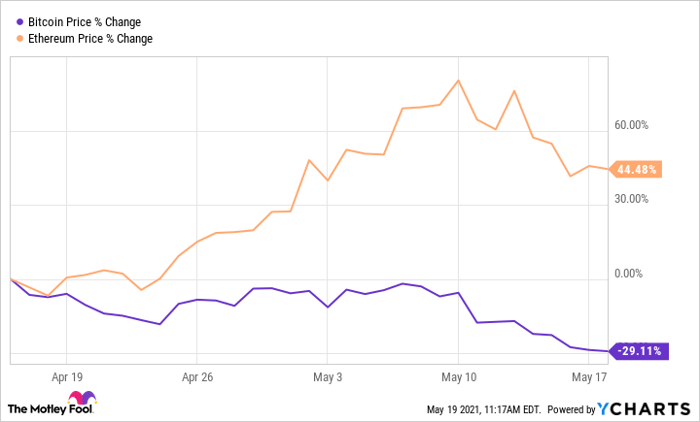
    The price of both Bitcoin and Ether have leapt over the past year, up 335% and 1,460%, respectively. Over the last month, they’ve gone in opposite directions.

    Bitcoin Price Chart

    Bitcoin Price data by YCharts

    Most are familiar with Elon Musk and Jack Dorsey’s support of Bitcoin, but some well-known figures like Gweneth Paltrow and Snoop Dogg are also longtime fans. Unfortunately, celebrity endorsements aren’t always what they seem. In 2017, the Securities Exchange Commission (SEC) ruled that many promoting cryptocurrencies may be doing so illegally, failing to disclose the fact they are being paid for it. That mostly applied to obscure coins trying to gain traction, but it does raise an important issue.

    Ethereum lacks both celebrity endorsements and the mysterious beginnings of Bitcoin. Instead, it has a relatively transparent history. Vitalik Buterin was born in Russia and raised in Toronto. In 2004, at the age of 20, he was awarded the Thiel Fellowship. Named after Peter Thiel of Paypal and Palantir Technologies fame, the award goes to young people to enable them to pursue interests other than attending college. A year later he co-founded what morphed into the Ethereum network. Earlier this month he became the world’s youngest crypto billionaire.

    Imagining the future

    Aside from the hype and speculation, there are legitimate reasons some decentralized digital currency could take hold in the future. Cryptocurrencies offer networks for transactions that could eliminate the friction of financial middlemen. In the simplest example, getting rid of brokerage fees and commissions in large transactions provides a strong incentive for an alternative payment system. 

    Further, programmable contracts would also cut out layers of complexity and uncertainty. Imagine purchasing a ticket to an outdoor event that automatically issues a refund when weather data shows the event will be cancelled. Of course, Ethereum’s vision is broader. The ultimate goal is to create a decentralized internet, running on many small computers around the globe, rather than relying on third parties like Microsoft and Alphabet‘s Google.

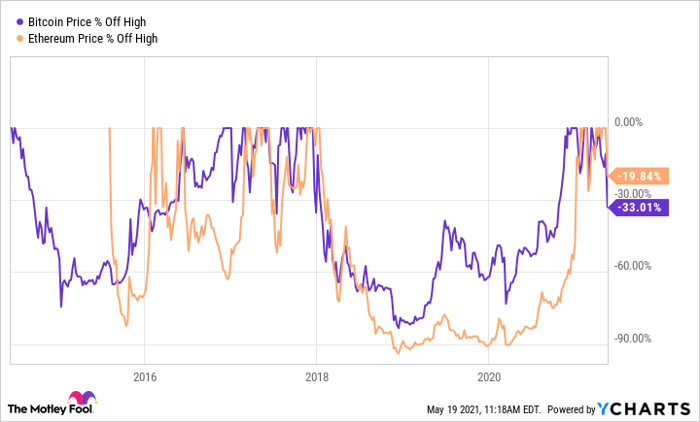
    One problem with the adoption of either asset is price volatility. Although Ether has outperformed recently, historically it has had longer and steeper drawdowns when sentiment turns on the crypto market. 

    Bitcoin Price Chart

    Bitcoin Price data by YCharts

    Although proponents often tout anonymity and security as features, the truth is more complicated. Both currencies offer pseudonymity. That means all transactions are stored on the blockchain with a crypto address of the transacting party, not a name. It’s similar to writing a book under a different name. As long as no one knows who owns the address, the transaction is in effect anonymous. However, if the owner of the address does become known, the entire financial history of that person is available to everyone on the network.

    To avoid this risk, the original Bitcoin white paper suggests using a different address for every transaction. As far as security, the Bitcoin protocol itself may be secure, but the online wallets that store keys, as well as various sites and services, may offer no such protection. There have been numerous breaches related to both Bitcoin and Ether in the past few years: See here and here.

    Choosing one

    It’s hard to choose a potential replacement for government-backed currency, but as with investing in biotech stocks or trying to cure cancer, it’s probably best to diversify across a few that seem to have potential. That said, there are three characteristics that have me leaning toward Ethereum.

    The first is the support of developers. A recent report showed that in the third quarter of 2020, an average of nearly 2,300 developers per month was working on Ethereum. That number was slightly less than 400 for Bitcoin. Second, the interest (and promotion) of celebrities makes it difficult to determine which incentives are really driving activity around the largest cryptocurrency. In other words, are people actually using Bitcoin, or are they just getting paid to talk about it? Finally, price appreciation. Although the recent drop in prices has affected all crypto assets, this is clearly a market driven by speculation. In such cases, choosing the asset with the most momentum always seems like the better bet. In this case, that’s Ethereum.

    This article was originally published on Fool.com. All figures quoted in US dollars unless otherwise stated.

    Where to invest $1,000 right now

    When investing expert Scott Phillips has a stock tip, it can pay to listen. After all, the flagship Motley Fool Share Advisor newsletter he has run for more than eight years has provided thousands of paying members with stock picks that have doubled, tripled or even more.*

    Scott just revealed what he believes are the five best ASX stocks for investors to buy right now. These stocks are trading at dirt-cheap prices and Scott thinks they are great buys right now.

    *Returns as of February 15th 2021

    More reading

    The post Ethereum vs. Bitcoin: Which is the better buy? appeared first on The Motley Fool Australia.

    This article was originally published on Fool.com. All figures quoted in US dollars unless otherwise stated.


    from The Motley Fool Australia https://ift.tt/2T9LcEj
  • The Freedom Foods (ASX:FNP) share price is frozen. Here’s why

    A man on a phone call points his finger, indicating a halt in trading on the ASX share market

    Shares in Freedom Foods Group Ltd (ASX: FNP) are in a trading halt as the company prepares to announce news of its capital raise. The battered Freedom Foods share price is paused at 43 cents, which is 2.38% higher than yesterday’s close.

    Today’s pause in trading comes months after news from Freedom Foods that is undergoing what it hopes will be a $265 million recapitalisation to pay off its debts.

    The capital raise will consist of subordinated secured convertible notes priced at $1 apiece.

    The company hopes the capital raise will include a $200 million leg up from the Perich family, the company’s largest shareholder.

    To make it up to $265 million, the company will also offer up to $130 million worth of notes to wholesale investors. Priority will be given to the company’s existing shareholders.

    Let’s take a closer look at what the food distributer has been up to lately.

    Fresh capital

    The question on many investors’ lips today is likely to be whether the Perich family will make the offered $200 million investment.

    According to the Australian Financial Review, today’s trading halt will be followed by news of whether the family’s investment vehicle, Arrovest, will fork out the entire sum.

    By purchasing $200 million worth of notes, Arrovest could hold an 80% stake in the company by 2024. That’s a significant increase from its current 51.5% stake.

    Freedom Foods is planning to use between $183 million and $233 million of the raised capital to pay off its debts. The rest will go towards corporate costs and fees from the capital raise.

    Freedom Foods returned to trading on the ASX after a 9-month suspension due to significant accounting issues in March 2021.

    On their return, Freedom Foods shares fell a whopping 84% to 53 cents each. On the day of its suspension, the Freedom Foods share price was trading at $3.01.

    While its share price was in suspension, Freedom Foods faced a number of class actions, which are still ongoing. It also entered into a dispute with one of its suppliers.

    Furthermore, the company offloaded its cereal and snacks business to The Arnott’s Group for $20 million.

    Freedom Foods share price snapshot

    Since the Freedom Foods share price resumed trading on the ASX in March, it has plummeted a further 18.87%. It’s also down 89.76% over the last 12 months – 9 months of which, it was in suspension.

    The company has a market capitalisation of around $116 million, with approximately 277 million shares outstanding.

    Where to invest $1,000 right now

    When investing expert Scott Phillips has a stock tip, it can pay to listen. After all, the flagship Motley Fool Share Advisor newsletter he has run for more than eight years has provided thousands of paying members with stock picks that have doubled, tripled or even more.*

    Scott just revealed what he believes are the five best ASX stocks for investors to buy right now. These stocks are trading at dirt-cheap prices and Scott thinks they are great buys right now.

    *Returns as of February 15th 2021

    More reading

    The post The Freedom Foods (ASX:FNP) share price is frozen. Here’s why appeared first on The Motley Fool Australia.

    from The Motley Fool Australia https://ift.tt/3yr8hCw