Tag: Motley Fool

  • Super Retail (ASX:SUL) share price surges 5% higher on strong sales update

    A happy shopper lifts her bags high, indicating a rising share price in ASX retail companies

    The Super Retail Group Ltd (ASX: SUL) share price has been a strong performer in morning trade on Tuesday.

    At time of writing, the retail conglomerate’s shares are up 5% to $12.20.

    Why is the Super Retail share price surging higher?

    Investors have been buying the company’s shares following the release of a trading update ahead of its appearance at the Macquarie Group Ltd (ASX: MQG) Australia Conference 2021.

    According to the release, Super Retail’s strong form has continued since the end of the first half.

    For the first 44 weeks of FY 2021, Super Retail delivered group like-for-like sales growth of 28%. This is an increase on the like-for-like sales growth rate of 24% that it achieved during the first half and was driven by growth across the business.

    The release explains that like-for-like sales are up 21% for Supercheap Auto, 20% for Rebel, 59% for BCF, and 17% for Macpac.

    Strong margins continue

    Super Retail’s Managing Director and CEO, Anthony Heraghty, was very pleased with the company’s second half performance and notes that its margin improvements have been maintained. This is also likely to have given the Super Retail share price a boost today.

    He said: “I am pleased to report that the Group has delivered strong Easter trading across all brands, particularly BCF and Macpac. Given the continued strength of customer demand, the Group has maintained relatively subdued levels of promotional activity in the second half. As a result, the gross margin improvement which the Group delivered in the first half has been maintained in the second half.”

    “The Group is in a well-stocked inventory position, which has benefitted from the arrival of orders made in the first half. Higher shipping costs in the second half have impacted inventory costs but these have been partly offset by favourable currency movements.”

    “As previously advised, second half operating expenses will reflect catch-up on projects deferred during COVID-19 and increased reinvestment in the business. Given the impact of COVID-19 on FY20 sales, the Group will now report FY21 like-for-like sales against both FY20 and FY19 trading, to enable a comparison with non-COVID trading conditions,” he concluded.

    The Super Retail share price is now up over 100% since this time last year.

    Where to invest $1,000 right now

    When investing expert Scott Phillips has a stock tip, it can pay to listen. After all, the flagship Motley Fool Share Advisor newsletter he has run for more than eight years has provided thousands of paying members with stock picks that have doubled, tripled or even more.*

    Scott just revealed what he believes are the five best ASX stocks for investors to buy right now. These stocks are trading at dirt-cheap prices and Scott thinks they are great buys right now.

    *Returns as of February 15th 2021

    More reading

    Motley Fool contributor James Mickleboro has no position in any of the stocks mentioned. The Motley Fool Australia owns shares of and has recommended Macquarie Group Limited and Super Retail Group Limited. The Motley Fool has a disclosure policy. This article contains general investment advice only (under AFSL 400691). Authorised by Bruce Jackson.

    The post Super Retail (ASX:SUL) share price surges 5% higher on strong sales update appeared first on The Motley Fool Australia.

    from The Motley Fool Australia https://ift.tt/3tfIglO

  • Flight Centre (ASX:FLT) share price lower following Q3 update

    Sad family sit on the couch surrounded by bags, indicating travel restrictions hitting the share price of ASX travel companies

    The Flight Centre Travel Group Ltd (ASX: FLT) share price is under pressure on Tuesday morning.

    In early trade, the travel agent’s shares are down 1% to $16.70.

    Why is the Flight Centre share price trading lower?

    Investors have been selling the company’s shares following the release of a presentation ahead of its appearance at the Macquarie Group Ltd (ASX: MQG) Australia 2021 Conference.

    That presentation included an update on its performance during the third quarter of FY 2021.

    According to the release, after a subdued sales period in January and February, Flight Centre delivered record COVID-period sales revenue in the month of March.

    The release explains that March turnover was more than $100 million higher than February, up 32.7% month-on-month. This took gross quarterly total transaction value (TTV) back above $1 billion for first time since COVID-19.

    Positively, management advised that it is expecting to report further growth in April, though no actual figures were provided.

    Balance sheet

    At the end of the third quarter, the company’s strong balance sheet was maintained. It has $1.5 billion in cash and $1.1 billion in total liquidity.

    Furthermore, the company has repaid $100 million in short-term bank debt during the second half following its $400 million convertible note issue.

    However, Flight Centre is still operating at a loss. During the third quarter, its monthly operating cash outflows were steady at $30 million to $40 million per month. This reflects the heavy restrictions that are still in place, which are preventing more rapid revenue growth, and reduced JobKeeper subsidies.

    In light of this, it is expecting its second half underlying loss to be broadly in line with its first half loss in FY 2021. This could be what is weighing on the Flight Centre share price today.

    Positively, management does believe that a return to profitability is coming. It continues to target a return to profit in FY 2022 on a month-to-month basis in both the corporate and leisure segments.

    This will be supported by a potential Trans-Atlantic corridor opening between the UK and North America and pent-up demand in leisure and corporate markets.

    Current trading levels

    Flight Centre provided an update on current trading levels compared to pre-COVID times.

    In respect to corporate business, it was tracking at 29% of historic TTV levels at the end of the third quarter. Based on this, management believes it is winning market share.

    As for global leisure TTV, that was tracking at 14% of historic levels at the end of the third quarter. Management notes that this is recovering slower than the corporate market due to its heavy weighting towards international travel. Though it sees significant uplift opportunities as travel corridors/bubbles open and restrictions ease for vaccinated travellers.

    Following today’s decline, the Flight Centre share price is down 10.5% since this time last month.

    Where to invest $1,000 right now

    When investing expert Scott Phillips has a stock tip, it can pay to listen. After all, the flagship Motley Fool Share Advisor newsletter he has run for more than eight years has provided thousands of paying members with stock picks that have doubled, tripled or even more.*

    Scott just revealed what he believes are the five best ASX stocks for investors to buy right now. These stocks are trading at dirt-cheap prices and Scott thinks they are great buys right now.

    *Returns as of February 15th 2021

    More reading

    Motley Fool contributor James Mickleboro has no position in any of the stocks mentioned. The Motley Fool Australia owns shares of and has recommended Macquarie Group Limited. The Motley Fool Australia has recommended Flight Centre Travel Group Limited. The Motley Fool has a disclosure policy. This article contains general investment advice only (under AFSL 400691). Authorised by Bruce Jackson.

    The post Flight Centre (ASX:FLT) share price lower following Q3 update appeared first on The Motley Fool Australia.

    from The Motley Fool Australia https://ift.tt/2QIYgQl

  • Young investors OK with ASX shares peddling gambling, tobacco, porn

    Man in suit considering the devil on his shoulder

    A new ‘ethics calculator’ has found younger investors don’t find gambling, tobacco, pornography or alcohol a major problem when it comes to selecting stocks. 

    Melbourne investment firm Nucleus Wealth surveyed 1,450 actual and potential investors on their morals during stock selection.

    One question was whether the person would put money into a company that made money from a “vice” — named as gambling, tobacco, pornography, alcohol or cannabis.

    “Only a third (31%) of Gen Ys chose to exclude at least one vice,” said Nucleus chief executive Damien Klassen.

    “The majority of Baby Boomers (51%) chose to exclude at least one vice.”

    The result reflects the more tolerant attitude towards the vices in recent years in general society. For example, betting companies such as Pointsbet Holdings Ltd (ASX: PBH) and Betmakers Technology Group Ltd (ASX: BET) are doing well, with many US states now legalising wagering on sport.

    Another example is the proliferation of cannabis companies, with decriminalisation occurring in many US states and potential liberalisation in Australia.

    The study also found women were 70% more likely to be put off by companies dealing in vice.

    Anyone can now take the survey yourself, as Nucleus has posted the ethics calculator online. Your answers can be instantly compared to the attitudes of other investors in the different generations.

    Everyone’s united on climate change though

    The different generations all came together when it came to companies that are dubious on climate change action.

    Millennials (53%) and Baby Boomers (49%) led the way on how likely they were to avoid investing in such stocks.

    “I think you could extrapolate a message to politicians that climate change is so important that around half of investors will not invest in companies contributing to climate change,” said Klassen.

    Human rights were also a unifying force, except for what the survey called the Silent Generation, which were people born before 1946.

    “More than 50% of two groups made an exclusion because of human rights concerns. Human rights issues include the lack of women on boards and in senior management positions,” Klassen said.

    “The one anomaly was the silent generation’s views, of whom only 26% said they wished to avoid investing in those companies linked to poor human rights practices.”

    Investors are anti-war but don’t care about religion

    All generations reacted strongly to businesses that contribute to war, according to Klassen.

    “Boycotting investing in companies directly associated with war — such as munitions and armaments producers — was another prominent finding,” he said.

    “The strongest feeling was amongst Baby Boomers, with 53% indicating they would not invest in war-related industries.”

    Women were far more likely to exclude a stock for war than men, the study found.

    Animal welfare was another issue where all generations showed empathy, except for the Silent Generation, with only 21% of that group concerned.

    The survey also asked investors if they cared if they would avoid putting money into a business because of their religious leanings. 

    Most respondents didn’t care.

    “This category includes companies typically excluded by investors with Islamic or Catholic values. All generation groups registered only low single digits, and the average across the whole sample is just 2%,” the study stated.

    Klassen said that Nucleus allowed its clients to exclude certain companies based on their moral convictions.

    “In our experience, there is clearly interest among investors in enacting their moral outlook through the investment process,” he said.

    Where to invest $1,000 right now

    When investing expert Scott Phillips has a stock tip, it can pay to listen. After all, the flagship Motley Fool Share Advisor newsletter he has run for more than eight years has provided thousands of paying members with stock picks that have doubled, tripled or even more.*

    Scott just revealed what he believes are the five best ASX stocks for investors to buy right now. These stocks are trading at dirt-cheap prices and Scott thinks they are great buys right now.

    *Returns as of February 15th 2021

    More reading

    Tony Yoo has no position in any of the stocks mentioned. The Motley Fool Australia’s parent company Motley Fool Holdings Inc. owns shares of and recommends Pointsbet Holdings Ltd. The Motley Fool Australia’s parent company Motley Fool Holdings Inc. owns shares of Betmakers Technology Group Ltd. The Motley Fool Australia has recommended Betmakers Technology Group Ltd and Pointsbet Holdings Ltd. The Motley Fool has a disclosure policy. This article contains general investment advice only (under AFSL 400691). Authorised by Bruce Jackson.

    The post Young investors OK with ASX shares peddling gambling, tobacco, porn appeared first on The Motley Fool Australia.

    from The Motley Fool Australia https://ift.tt/3vJDmiN

  • Why Facebook stock jumped 10% last month

    This article was originally published on Fool.com. All figures quoted in US dollars unless otherwise stated.

    thumbs up facebook sign

    This article was originally published on Fool.com. All figures quoted in US dollars unless otherwise stated.

    What happened

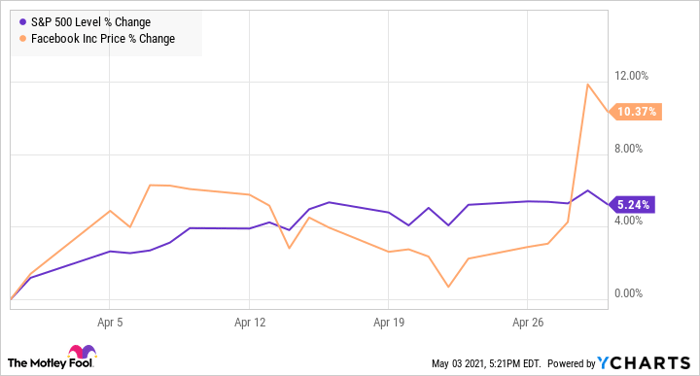
    Shares of Facebook (NASDAQ: FB) were climbing last month after the social media giant delivered a blowout earnings report at the end of the month. The stock also rose in early April along with the broader market in response to a number of bullish news reports.

    According to data from S&P Global Market Intelligence, the stock finished the month up 10%. As you can see from the chart below, shares spiked on April 29 after the earnings report came out.

    ^SPX Chart

    ^SPX data by YCharts

    So what

    Facebook gained early in the month on news of Biden’s infrastructure bill, a better-than-expected March jobs reports, and an accelerating vaccine rollout, before giving back much of those gains in the middle of the month.

    On April 29, the stock jumped 7.3% in response to a strong earnings report.

    Robust advertising demand drove revenue up 48% to $26.2 billion, well ahead of analyst estimates at $23.7 billion, and profits surged as the company lapped a weak performance in the quarter a year ago when lockdowns first hit. Operating income nearly doubled to $11.4 billion, and earnings per share came in at $3.30, easily beating expectations at $2.37.

    The company is benefiting from a boom in digital advertising that drove a 30% increase in ad prices and has also seen solid growth in users thanks to the pandemic. Additionally, CEO Mark Zuckerberg said the company’s Oculus AR/VR platform was reaching an inflection point as revenue in the “other” category, which is mostly made up of Oculus, jumped 146% to $732 million. 

    Now what

    Facebook did not give specific guidance but called for second-quarter revenue growth to modestly accelerate from the first quarter as it laps the nadir of its performance a year ago. In the second half of the year, it sees revenue growth decelerating as comparisons will become more difficult and it faces headwinds related to changes in Apple‘s ad targeting policy, though the company said those wouldn’t be as severe as once expected.

    The stock now trades at a trailing price-to-earnings ratio of just 28, making the tech stock look significantly undervalued after the kind of quarter it just delivered.

    This article was originally published on Fool.com. All figures quoted in US dollars unless otherwise stated.

    Where to invest $1,000 right now

    When investing expert Scott Phillips has a stock tip, it can pay to listen. After all, the flagship Motley Fool Share Advisor newsletter he has run for more than eight years has provided thousands of paying members with stock picks that have doubled, tripled or even more.*

    Scott just revealed what he believes are the five best ASX stocks for investors to buy right now. These stocks are trading at dirt-cheap prices and Scott thinks they are great buys right now.

    *Returns as of February 15th 2021

    More reading

    Jeremy Bowman owns shares of Facebook. Randi Zuckerberg, a former director of market development and spokeswoman for Facebook and sister to its CEO, Mark Zuckerberg, is a member of The Motley Fool’s board of directors. The Motley Fool Australia’s parent company Motley Fool Holdings Inc. owns shares of and recommends Apple and Facebook and recommends the following options: short March 2023 $130 calls on Apple and long March 2023 $120 calls on Apple. The Motley Fool Australia has recommended Apple and Facebook. The Motley Fool has a disclosure policy. This article contains general investment advice only (under AFSL 400691). Authorised by Bruce Jackson.

    The post Why Facebook stock jumped 10% last month appeared first on The Motley Fool Australia.

    This article was originally published on Fool.com. All figures quoted in US dollars unless otherwise stated.

    from The Motley Fool Australia https://ift.tt/3aWWLVy

  • Here’s where brokers think the Westpac (ASX:WBC) share price will go next

    investor looking at asx share price online with cash pouring from computer screen

    The Westpac Banking Corp (ASX: WBC) share price was a very positive performer on Monday.

    The banking giant’s shares finished the day 5% higher at $26.23.

    This means the Westpac share price is now up an impressive 33.5% since the turn of the year.

    Why did the Westpac share price race higher?

    Investors were scrambling to buy the company’s shares following the release of a strong half year result.

    For the six months ended 31 March, Westpac reported first half cash earnings of $3,537 million. This was a 256% increase over the prior corresponding period and a 119% lift over the second half of FY 2020.

    This strong form allowed the Westpac board to declare a fully franked interim dividend of 58 cents per share. If you annualise this, it works out to be an attractive fully franked 4.4% dividend yield.

    Another very big positive from the update was the announcement of a major cost cutting plan.  

    Westpac is targeting an $8 billion cost base by FY 2024 in order to materially improve its efficiency. This will be a 21.5% reduction on FY 2020’s cost base of ~$10.2 billion.

    Is it too late to invest?

    According to a note out of Goldman Sachs, its analysts still see a lot of value in the Westpac share price.

    This morning the broker retained its buy rating and lifted its price target to $29.03. This represents potential upside of 10.5% over the next 12 month excluding dividends.

    Goldman commented: “We maintain our Buy rating on the stock on improving fundamentals and supportive valuations. To this end, we note that i) the balance of risk to our earnings remains skewed to the upside, with our FY24E cost forecast about 10% above management’s FY24E target of A$8 bn (on a like-for-like basis), which, if achieved, would drive our FY24E cash earnings up by c. 7%; ii) volume momentum appears to have been reinvigorated during the half, while containing NIM pressures; iii) the stock is trading more than one standard deviation cheap versus the sector on PPOP multiples (10% discount vs. 1% long-run average discount); and iv) our revised TP offers c. 15% TSR.”

    What about other brokers?

    A number of other brokers have responded to Westpac’s update.

    One of those is Credit Suisse. This is morning it retained its outperform rating and lifted its price target to $28.00.

    Elsewhere, Morgans has held firm with its add rating and increased its price target to $29.50 and Morgan Stanley has retained its overweight rating and lifted its price target to $29.20.

    All these price targets indicate that the Westpac share price can still climb higher from where it currently trades.

    Where to invest $1,000 right now

    When investing expert Scott Phillips has a stock tip, it can pay to listen. After all, the flagship Motley Fool Share Advisor newsletter he has run for more than eight years has provided thousands of paying members with stock picks that have doubled, tripled or even more.*

    Scott just revealed what he believes are the five best ASX stocks for investors to buy right now. These stocks are trading at dirt-cheap prices and Scott thinks they are great buys right now.

    *Returns as of February 15th 2021

    More reading

    Motley Fool contributor James Mickleboro owns shares of Westpac Banking. The Motley Fool Australia has no position in any of the stocks mentioned. The Motley Fool has a disclosure policy. This article contains general investment advice only (under AFSL 400691). Authorised by Bruce Jackson.

    The post Here’s where brokers think the Westpac (ASX:WBC) share price will go next appeared first on The Motley Fool Australia.

    from The Motley Fool Australia https://ift.tt/3ebDeCB

  • Vicinity (ASX:VCX) sees improvements as it struggles back to COVID-normal

    Vicinity share price retail asx share price represented by lots of bright orange shopping bags jumping around

    The Vicinity Centres (ASX: VCX) share price is in focus this morning on the back of its latest quarterly update.

    The property group was quick to point out early signs of improvements. But investors will still struggle to fully understand what COVID-normal means for the retail and office sector.

    At least Vicinity’s shopping centres are showing signs of growth again in the March quarter.

    Signs of life post COVID

    Management said that portfolio retail sales in the month of March was only down 2.3% compared to the same month last year.

    It also reported that average centre utilisation in the quarter was 77% of the previous corresponding period.

    If you ignored CBD properties as these are harder hit by the pandemic, utilisation was 83% of 3QFY19.

    Vicinity share price finds solace in improving retail spend

    “Importantly, while centre visitation is growing, the rate of retail sales improvement is greater, highlighting that consumers are spending more per visit (average spend increased 23% in March 2021),” said Vicinity.

    “Strong spend per visit in conjunction with increasing centre visitation may be a positive lead indicator for continued recovery.”

    Retail rents remain under pressure

    The supermarkets located in the centres, like Woolworths Group Ltd (ASX: WOW) and Coles Group Ltd (ASX: COL) are doing well. But the smaller specialty retailers are still struggling.

    This probably explains the -13.5% leasing spread recorded in the March quarter compared to the -12.6% average for 1HFY21.

    Leasing spread between the new rent and the previous rent for the same retail space.

    New normal hard to define

    While it’s really no surprise that things are improving given how our economy is rebounding, experts are still debating what the new normal is for shopping centre properties post COVID-19.

    The lockdowns have eroded the near monopolistic powers for the major shopping centre owners like the Vicinity share price and Scentre Group (ASX: SCG) share price.

    The latest update from Vicinity won’t add much clarity on this front.

    Foolish takeaway

    Further, the same questions are clouding over the office property space as companies adjust to accommodate more remote workers.

    Governments and major corporations are starting to encourage or mandate their employees return to the office. But office occupancy may not return to pre-COVID levels, at least not for a long time.

    This again is a threat to ASX property shares that own A-grade properties, which always commands a rental premium.

    Their bottom lines may stay under pressure for longer than most other ASX sectors.

    Where to invest $1,000 right now

    When investing expert Scott Phillips has a stock tip, it can pay to listen. After all, the flagship Motley Fool Share Advisor newsletter he has run for more than eight years has provided thousands of paying members with stock picks that have doubled, tripled or even more.*

    Scott just revealed what he believes are the five best ASX stocks for investors to buy right now. These stocks are trading at dirt-cheap prices and Scott thinks they are great buys right now.

    *Returns as of February 15th 2021

    More reading

    Motley Fool contributor Brendon Lau owns shares of Woolworths Limited. Connect with me on Twitter @brenlau.

    The Motley Fool Australia owns shares of COLESGROUP DEF SET and Woolworths Limited. The Motley Fool has a disclosure policy. This article contains general investment advice only (under AFSL 400691). Authorised by Bruce Jackson.

    The post Vicinity (ASX:VCX) sees improvements as it struggles back to COVID-normal appeared first on The Motley Fool Australia.

    from The Motley Fool Australia https://ift.tt/3tkcofU

  • Why the Nick Scali (ASX:NCK) share price will be on watch today

    asx share price on watch represented by lady looking through pair of binoculars

    The Nick Scali Limited (ASX: NCK) share price will be in focus this morning. This comes after the company announced a trading update and profit guidance to the ASX.

    At Monday’s market wrap, the furniture retailer’s shares finished the day at $10.70.

    How is Nick Scali performing?

    Nick Scali shares could be on the move today as the company reported to have continued its positive trading momentum.

    According to this morning’s release, Nick Scali delivered growth in written sales orders of 50% through Q3 FY21. Same-store written sales orders also increased by 41% over the prior corresponding period (pcp).

    In April (the first month of Q4 FY21), written sales orders jumped 242% when compared against this time last year. Nick Scali attributed the performance to its stores being opened for trading, unlike the widespread closures experienced in early 2020. However, when not factoring in the impact of COVID-19, written sales orders lifted 37% from April 2019.

    The company further provided an update on revenue, revealing FY21 year-to-date sales revenue growth is roughly 44% to 30 April. This does not include the container availability issues that have affected Nick Scali’s supply chain. It’s expected that the sales revenue achievement will run throughout Q4 to finish the FY21 strongly.

    As a result, earnings before interest, tax, depreciation and amortization (EBITDA) for FY21 is projected to be $120 million. Net profit after tax (NPAT) is forecasted to be between $78 million and $80 million. This represents a surge of 85% to 90% on the previous comparable year.

    Nick Scali lastly noted that its order bank remains at elevated levels, setting up the groundwork for revenue growth for FY22.

    Nick Scali share price summary

    Over the last 12 months, the Nick Scali share price has been on an upwards trajectory, rising close to 150%. The company’s shares reached an all-time high of $11.95 in February after releasing its half-year results.

    At today’s prices, Nick Scali has a market capitalisation of approximately $866 million, with 81 million shares on issue.

    Where to invest $1,000 right now

    When investing expert Scott Phillips has a stock tip, it can pay to listen. After all, the flagship Motley Fool Share Advisor newsletter he has run for more than eight years has provided thousands of paying members with stock picks that have doubled, tripled or even more.*

    Scott just revealed what he believes are the five best ASX stocks for investors to buy right now. These stocks are trading at dirt-cheap prices and Scott thinks they are great buys right now.

    *Returns as of February 15th 2021

    More reading

    Motley Fool contributor Aaron Teboneras has no position in any of the stocks mentioned. The Motley Fool Australia has no position in any of the stocks mentioned. The Motley Fool has a disclosure policy. This article contains general investment advice only (under AFSL 400691). Authorised by Bruce Jackson.

    The post Why the Nick Scali (ASX:NCK) share price will be on watch today appeared first on The Motley Fool Australia.

    from The Motley Fool Australia https://ift.tt/3utxCJT

  • What Warren Buffett learned from investing during a global pandemic

    asx share price secret represented by woman holing hands up to ear through hole in wall

    Warren Buffett may not have had the best of years.

    But with the COVID-19 pandemic moving across the world at lightning speed, and government and central banks responding almost as quickly, the Oracle of Omaha could be forgiven for erring on the side of caution.

    On Saturday 1 May, Buffett and his long-time business partner Charlie Munger hosted Berkshire Hathaway Inc (NYSE: BRK.A) (NYSE: BRK.B)‘s annual general meeting (AGM). With a nod to the continuing impact of coronavirus, the AGM was held virtually.

    Why Buffett sold out of the US airlines

    One of the questions that came up during the AGM was Berkshire Hathaway’s decision to sell its holdings in four United States airline shares during the early months of the pandemic.

    While most every travel share plummeted during those first months, massive government stimulus, near-zero interest rates, and the rapid rollout of vaccines have seen most airline shares rebound strongly.

    For example, Delta Air Lines Inc (NYSE: DAL), which Berkshire sold, has rebounded 145% from its 15 May 2020 lows.

    Warren Buffett, however, said that the airline’s share price recovery may have been significantly more muted if Berkshire hadn’t sold its holdings. This, he said, was owing to the fact the airlines may not have been the beneficiary of as much government largesse had Berkshire still been invested.

    He said (quoted by Bloomberg), “They might have very well had a very, very, very, very different result if they had a very, very, very rich shareholder that owned 8 or 9%.”

    The billionaire investor conceded that over the past year, overall:

    The economic recovery has gone far better than you could say with any assurance, so we didn’t like having as much money as we had in banks at that time. I do not consider it a great moment in Berkshire’s history, but also we’ve got more net worth than any company in the United States under accounting principles.

    As for Berkshire’s growing mountain of cash, currently somewhere in the range of US$145 billion (AU$188 billion)?

    Vice chair Charlie Munger stepped in to answer why the company didn’t splurge more near the market lows.

    Munger said no one (not even money managers!) can call the market bottom with any accuracy. “There always is some person who does that by accident, but that’s too tough a standard. Anybody who expects that out of Berkshire Hathaway is out of his mind.”

    Why Warren Buffett likes Apple shares

    At the current Apple Inc (NASDAQ: AAPL) share price of US$131.46, the company has a mind boggling market capitalisation just north of US$2.2 trillion. That’s thanks to the share price gaining 467% over the past 5 years, with shares up 79% in the past year alone.

    And Warren Buffett, once known for avoiding tech shares because he didn’t understand them, is a big fan.

    Citing the current ultra-low interest rate environment as supporting the big technology shares, Buffett said, (also quoted by Bloomberg) “The Googles and Apples are incredible in terms of what they earn on capital. They don’t require a lot of capital, and they gush out more money.”

    According to Bloomberg, Berkshire owns a little more than 5% of all Apple shares. And Buffett no longer feels put off by its technological nature, instead focusing on the company’s quality management and relationship with its customers.

    I feel that I understand Apple and its future with consumers around the world. Apple has fantastic management — Tim Cook was under appreciated for a long time, and he has a product that people absolutely love. There’s an installed base of people and they get satisfaction rates of like 99%.

    This brings us to 3 of Warren Buffett’s mantras that arguably every investor should keep in mind. Namely, and in no particular order, they are something along the lines of:

    • Look for companies with great brands and the ability to control prices.
    • A great manager is as important as a great business.
    • And, the best investments provide real-world value, not just market value.

    Happy investing!

    Where to invest $1,000 right now

    When investing expert Scott Phillips has a stock tip, it can pay to listen. After all, the flagship Motley Fool Share Advisor newsletter he has run for more than eight years has provided thousands of paying members with stock picks that have doubled, tripled or even more.*

    Scott just revealed what he believes are the five best ASX stocks for investors to buy right now. These stocks are trading at dirt-cheap prices and Scott thinks they are great buys right now.

    *Returns as of February 15th 2021

    More reading

    Suzanne Frey, an executive at Alphabet, is a member of The Motley Fool’s board of directors. Bernd Struben has no position in any of the stocks mentioned. The Motley Fool Australia’s parent company Motley Fool Holdings Inc. owns shares of and recommends Alphabet (A shares), Alphabet (C shares), Apple, and Berkshire Hathaway (B shares). The Motley Fool Australia’s parent company Motley Fool Holdings Inc. recommends Delta Air Lines and recommends the following options: short January 2023 $200 puts on Berkshire Hathaway (B shares), short March 2023 $130 calls on Apple, short June 2021 $240 calls on Berkshire Hathaway (B shares), long March 2023 $120 calls on Apple, and long January 2023 $200 calls on Berkshire Hathaway (B shares). The Motley Fool Australia has recommended Alphabet (A shares), Alphabet (C shares), Apple, and Berkshire Hathaway (B shares). The Motley Fool has a disclosure policy. This article contains general investment advice only (under AFSL 400691). Authorised by Bruce Jackson.

    The post What Warren Buffett learned from investing during a global pandemic appeared first on The Motley Fool Australia.

    from The Motley Fool Australia https://ift.tt/3taokRm

  • How high can Microsoft’s and Alphabet’s margins go?

    rising asx share price represented by man drawing growth chart on blackboard

    On Tuesday 27 April, large-cap tech giants Microsoft Corporation (NASDAQ: MSFT) and Alphabet Inc (NASDAQ: GOOG) (NASDAQ: GOOGL) each reported first-quarter earnings. While Alphabet stock surged and Microsoft shares fell slightly after the release, both companies posted impressive growth metrics.

    As companies become larger, it often becomes harder for them to grow as fast as they did in the past. Yet Alphabet and Microsoft, helped along by their cloud computing divisions, managed to post eye-opening 34% and 19% revenue growth rates, respectively.

    Despite both companies being well-known entities among investors, it’s quite possible they are actually still being underrated. That’s due to another factor besides mere revenue growth — and that factor is margin expansion.

    Revenue growth is nice, but operating leverage is a magical combination

    What investors may not fully appreciate is each company’s ability to expand its operating margin into the future. Last quarter, Alphabet posted an impressive 29.7% operating margin, while Microsoft posted an even more incredible 40.9%.  

    These are larger than typical, owing to the strong competitive advantages, or “moats,” each company has. Yet with such already-large operating margins, investors may still be underestimating how much further each company’s margin can grow in the future.

    Microsoft is on a steady upward trajectory

    Microsoft should be able to expand its operating margin because, well, its margin has been ticking up consistently over the past five years. In 2016, the company-level operating margin was 28.6%, but it consistently increased to 37% in 2020 before reaching nearly 41% last quarter.

    How has Microsoft been able to grow its margin so much? Chalk it up the massive scale of its various software platforms, including Office and Dynamics 365 cloud software offerings, as well as its growing Azure infrastructure-as-a-service (IaaS) platform. These core software offerings, along with the asset-light Windows operating system and LinkedIn social media platform (purchased in 2016), are basic enterprise tools used all over the world. Since they’re being delivered via the cloud, each incremental sales dollar requires very little incremental cost since the development that goes into each service is largely fixed.

    Enterprise software is also a really attractive business because it’s pretty sticky. If a company adopts your software, it’s a pain to switch and retrain all of their workers on a new platform. So, enterprise software companies usually don’t drop prices, they can usually increase prices a bit every year or so.

    One other factor is that the 2016 operating margin was likely held back by the company’s large investments in Azure. Microsoft doesn’t break out Azure revenue or margin specifically, only growth rate (Azure grew 50% last quarter). Five years ago, Azure was likely a drag as Microsoft invested in data centers and personnel to get it up and running to compete with leader Amazon.com Inc (NASDAQ: AMZN) Web Services. Now that Azure is achieving greater scale as the No. 2 IaaS platform in the world, its margin is likely expanding toward AWS’ 30% margin and boosting the company’s overall bottom line.

    Alphabet’s core and cloud businesses are getting more profitable, too

    Unlike Microsoft, Alphabet recently began breaking out its revenues and margins across various segments, including the breakout of cloud profitability. As the up-and-coming third-place cloud platform, Google Cloud Platform (GCP) is still losing money. In fact, GCP reported increasing losses each of the last three years, chalking up a $5.6 billion operating loss in 2020.

    At the same time, Alphabet’s core Google services (search, ad networks, YouTube, Android) segment has made a fairly steady operating margin of 32% to 33% each of the past three years. However, last year was affected by the pandemic, depressing the margin at the beginning of the year. Google services’ operating margin had jumped to 36% by the fourth quarter as the company recovered, showing core Google is actually getting more profitable.

    Yet last quarter, both Google services and cloud got a big margin boost. Google services’ operating margin jumped to 38.2%. Meanwhile, GCP still produced losses, but the operating loss margin fell from -62.3% to -24.1%.

    Both companies did receive some benefit from lower travel expenses during the pandemic, as well as lower depreciation costs as it was determined both companies’ cloud servers should have a longer useful life than previously thought. Still, those server savings, while different from the past, should be a permanent cost reduction going forward. And it’s likely business travel won’t quite return to normal once the pandemic is over as companies have discovered some meetings can easily take place over videoconferencing.

    How big could margins get? Three examples provide optimism

    Last quarter proved there is still strong double-digit growth to be had for Microsoft’s software platforms as well as Google search and YouTube, even though these dominant services have been around for quite a while. As long as both companies can grow these wide-moat products and services by double-digits, I don’t see why operating margins can’t continue to expand with scale.

    How big could margins get? There are a few examples of other global technology networks that have higher margins than Microsoft or Google. For instance, Visa Inc (NYSE: V) and Mastercard Inc (NYSE: MA), which operate global credit and debit card networks worldwide and benefit from increasing swipe fees over a fixed network, have operating margins of 67.2% and 53.4%, respectively, even in the pandemic-affected 2020. Another tech monopoly, VeriSign Inc (NASDAQ: VRSN), the domain registry for the .com and .net domain names, has an operating margin of 64.9%.

    Meanwhile, Microsoft’s dominant software platform and Google’s search and YouTube platforms have similar characteristics to Visa, Mastercard, and VeriSign. That is, a dominant fixed-technology platform, which achieves global scale without much in the way of incremental costs.

    While Amazon Web Services’ operating margin is around 30%, Google’s and likely Microsoft’s cloud margins are lower and a current drag on overall company margins. Yet as the cloud market matures, both should grow their cloud margins toward AWS. And who’s to say AWS and the other cloud IaaS players can’t eventually make margins even higher than that, as cloud computing grows over the next decade?

    While both companies’ operating margins may not reach quite the heights of a Visa or VeriSign any time soon, it’s not out of the question that they could consistently move toward that 60% region over time. That’s why I still think both stocks could continue to surprise to the upside and benefit shareholders over the next decade.

    Where to invest $1,000 right now

    When investing expert Scott Phillips has a stock tip, it can pay to listen. After all, the flagship Motley Fool Share Advisor newsletter he has run for more than eight years has provided thousands of paying members with stock picks that have doubled, tripled or even more.*

    Scott just revealed what he believes are the five best ASX stocks for investors to buy right now. These stocks are trading at dirt-cheap prices and Scott thinks they are great buys right now.

    *Returns as of February 15th 2021

    More reading

    Billy Duberstein owns shares of Alphabet (C shares), Amazon, and Microsoft and has the following options: short June 2021 $1320.0 puts on Alphabet (C shares). His clients may own shares of the companies mentioned. John Mackey, CEO of Whole Foods Market, an Amazon subsidiary, is a member of The Motley Fool’s board of directors. Suzanne Frey, an executive at Alphabet, is a member of The Motley Fool’s board of directors. Teresa Kersten, an employee of LinkedIn, a Microsoft subsidiary, is a member of The Motley Fool’s board of directors. The Motley Fool Australia’s parent company Motley Fool Holdings Inc. owns shares of and recommends Alphabet (A shares), Alphabet (C shares), Amazon, Mastercard, Microsoft, and Visa and recommends the following options: long January 2022 $1920 calls on Amazon and short January 2022 $1940 calls on Amazon. The Motley Fool Australia has recommended Alphabet (A shares), Alphabet (C shares), Amazon, and Mastercard. The Motley Fool has a disclosure policy. This article contains general investment advice only (under AFSL 400691). Authorised by Bruce Jackson.

    The post How high can Microsoft’s and Alphabet’s margins go? appeared first on The Motley Fool Australia.

    from The Motley Fool Australia https://ift.tt/3xGpVBU

  • Pssst, I’m a value investor who makes money from growth shares: fundie

    Perennial portfolio ASX value share investor Stephen Bruce

    Ask A Fund Manager

    In part 1 of our interview, Perennial portfolio management director Stephen Bruce explained how value stocks are roaring. Now in part 2, he tells us which ASX share will go gangbusters as the UK economy enjoys a renaissance this year.

    Overrated and underrated shares

    The Motley Fool: What’s your most underrated stock at the moment?

    Stephen Bruce: I quite like Virgin Money UK CDI (ASX: VUK)

    We’re positive on the Aussie financials, but the dynamics are very similar in the UK. If you look at the UK economy, the government’s brought in almost identical stimulus and support measures to what we have here.

    One key difference though is that the UK is — after getting off to a bit of a disastrous start with COVID — they’re absolutely racing ahead with a vaccination program. They’re more than halfway there. Probably by June, everyone will be done. 

    The furlough scheme, which is their equivalent of JobKeeper, has been extended out until September. And summer is coming. 

    So you have to think that the UK economy is really going to come roaring back to life over the next 6 months and Virgin Money, being a UK bank, will be exposed positively to that.

    But then stepping back from the macro, it’s a pretty interesting company being the biggest challenger bank in the UK and having recently merged with… Yorkshire and Clydesdale Bank, which gave increased scale and national presence, a super-strong brand and obviously opportunity for revenue and cost synergy. We think it’s got good macro exposure, an interesting market position, and then some good stock-specific drivers there. 

    And it’s actually trading on a very cheap valuation. It was around 0.6, 0.7 times its book value. So it doesn’t take too much of a stretch to see that getting a decent re-rating over time as the clouds lift. 

    MF: What do you think is the most overrated stock at the moment?

    SB: I’m probably not the only person who thinks about Afterpay Ltd (ASX: APT) when you ask questions like that now.

    Who knows how it will pan out. Full credit to people for having created a phenomenon. As we stand today, you have no profits, an unproven business model, you’ve been exploiting a regulatory arbitrage, you know competition’s coming for you, it’s only a matter of time until the regulators come for you. The insiders are selling stock as fast as they possibly can. 

    I have a sneaking suspicion that once the revenue line stops going [up], that the margin line will [plunge] and the bad debts line will [soar]. The losses will go [up]. 

    Who knows, but I’d say for that stock to be a $30 billion market cap and in the top 20 [of the ASX], it’s a sign of the times maybe.

    That’s what growth managers exist for, to have that in their portfolio.

    MF: Some growth managers argue that, back in March last year when it was $8, Afterpay was also a value stock.

    SB: I know. I think it even got to $6.

    There’s probably a lesson, that you should buy a little bit of those things when they get to that level. Unfortunately, I didn’t.

    MF: Is there also a lesson that people shouldn’t think that value and growth are mutually exclusive? There can be overlaps occasionally, can’t there?

    SB: Absolutely. Knowing when to take the opportunities with stocks, which generally fall into one bucket, is really important. When we look at where we’ve made money over time, it’s often been the opportunities that you’ve had to buy what are high-quality growth stocks, which have just temporarily fallen out of favour. That’s been some of the best money-making opportunities that we’ve had over time.

    MF: If the market closed tomorrow for 5 years, which ASX share would you want to hold?

    SB: I think Macquarie Group Ltd (ASX: MQG). The reason I say that is, looking at Macquarie today, it seems probably a fairly valued stock. It doesn’t look super cheap or super expensive.

    A lot can change in 5 years in the market. We all have our view of how the world will be in 5 years, it could be very different. When you think about Macquarie and its outlook now for the next 5 years, based on how we probably all assume the world will be, it’s pretty good — but that can change. 

    One thing we know about Macquarie is they’ve been able to change their spots, or their stripes, as required, over a long period of time. Even though they’ve gotten very large, they don’t seem to have lost that ability to build new businesses and identify opportunities. 

    I think, as long as the culture remains intact and more importantly, the remuneration structures remain intact, then it’s a business that you can rely on. You come back in 5 years’ time and the business will probably look very different, but it will probably still be doing well.

    Looking back

    MF: Which stock are you most proud of from a past purchase?

    SB: This gets back to the point I made before, or you made actually, about knowing when to buy growth-y stocks. 

    James Hardie Industries plc (ASX: JHX) has been a very good contributor to our fund. If you think about it over the long-term, it’s generally sat pretty squarely in the reasonably expensive growth-y part of the market. Occasionally you do get an opportunity to buy these things.

    I think it was back in 2019, I can’t really exactly remember what the issues [were], but people were starting to doubt its growth outlook in the US and the stock had been sold off pretty aggressively. That provided an opportunity, if you’d formed a view that the long-term outlook… hadn’t really changed. That was an opportunity to buy a high-quality growth stock at a value price. 

    We bought that. It did really well. We sold it around early 2020, and then we got a second opportunity again, in the COVID sell off, when everything got hit really hard, to buy it again.

    We bought it and sold it twice. We’ve had two bites of the cherry in the last 2 years on that stock, and it’s been a really good contributor to performance.

    MF: Do you remember how much you bought and sold for on both occasions?

    SB: If I just look at the timeline, I probably would have been buying it around $20 and then selling it at closer to $30. And then buying it again at probably around $20 and selling it probably closer to $30. 

    $20 to $30 twice, I would estimate.

    MF: Is there a move that you regret from the past? For example, a missed opportunity or buying a share at the wrong timing or price.

    SB: Yes… Probably not buying CSL Limited (ASX: CSL) back in 2002 was my biggest mistake. 

    It was just after they’d merged with ZLB or acquired ZLB — this was a base fractionator. It was quite a difficult period in the industry, you had [the] currency going the wrong way and a few other factors, but it was the one time that you could have bought CSL really cheaply. 

    Obviously, CSL has gone on to be probably one of the best, if not the best, amongst the absolute best companies that Australia has produced. 

    MF: Anything to add?

    SB: The last 5 years have been pretty tough for value. The last year has been great. When we look at the setup going forward, we’re pretty confident that value is going to continue to do quite well for a time yet. 

    Investors have had a great run out of growth, momentum, tech and all that stuff. They probably all underweight value and it’s been a good call. But maybe it’s time to take some profits in some of those things, in your Afterpays, and then think about reinvesting in the value end of the market.

    Where to invest $1,000 right now

    When investing expert Scott Phillips has a stock tip, it can pay to listen. After all, the flagship Motley Fool Share Advisor newsletter he has run for more than eight years has provided thousands of paying members with stock picks that have doubled, tripled or even more.*

    Scott just revealed what he believes are the five best ASX stocks for investors to buy right now. These stocks are trading at dirt-cheap prices and Scott thinks they are great buys right now.

    *Returns as of February 15th 2021

    More reading

    Tony Yoo owns shares of AFTERPAY T FPO, CSL Ltd., and Macquarie Group Limited. The Motley Fool Australia’s parent company Motley Fool Holdings Inc. owns shares of CSL Ltd. The Motley Fool Australia owns shares of and has recommended Macquarie Group Limited. The Motley Fool Australia owns shares of AFTERPAY T FPO. The Motley Fool has a disclosure policy. This article contains general investment advice only (under AFSL 400691). Authorised by Bruce Jackson.

    The post Pssst, I’m a value investor who makes money from growth shares: fundie appeared first on The Motley Fool Australia.

    from The Motley Fool Australia https://ift.tt/3xM9XGe