Tag: Motley Fool

  • Oneview (ASX:ONE) share price jumps 15% today. Here’s why

    The Oneview Healthcare PLC (ASX: ONE) share price has continued to surge today, more than a week after announcing its world-first cloud-computing healthcare software.

    At the close of trade today, the Oneview share price is up 15.2% at 42 cents per share.

    Oneview provides patient engagement and clinical workflow technology solutions to healthcare facilities and had a major windfall when it launched its Cloud Care Experience Platform, a platform that allows health systems to quickly adopt technology for engaging patients.

    The company provides various inpatient, outpatient and clinical pathway solutions. It generates its revenue in the form of software usage and content revenue, support services, and license fees.

    Geographically, Oneview operates in Ireland, the United States, Australia, and the Middle East and North Africa. It generates the majority of its revenue from the USA.

    Why is Oneview’s Cloud Care Experience Platform useful?

    Oneview says that implementing a cloud-based platform for managing patients reduces non-clinical demands on care teams and optimises clinical and operational effectiveness.

    The fact that Oneview’s platform has had strong support from Microsoft and runs on its platform, Azure, has proven to be a key breakthrough for the company in ensuring an easy rollout into hospitals.

    The strong investor response to Oneview’s share price has also been due to the product’s world-first nature and its release during a time of increased stress on public and private healthcare systems.

    Developed with a medical centre

    The CXP Cloud Enterprise platform was developed in partnership with NYU Langone Health, a leading academic medical centre in New York, which rapidly rolled out the virtual engagement platform across its facilities during the coronavirus pandemic.

    NYU Langone CIO Nader Mherabi said it had arrived at a pivotal time for the healthcare industry.

    COVID-19 strained resources and challenged most hospitals to examine how virtual pathways can enhance patient care.

    Oneview helped us build an in-patient virtual care platform, which has been instrumental during the pandemic and will continue to be key as we deliver a new level of patient engagement.

    Oneview share price snapshot

    The Oneview share price has been in the red for 9 of the past 14 days, but today has seen a rapid increase in investment. On the days that the share price has jumped, it’s often increased by between 15 and 30%, while declines have been far more moderate.

    The Oneview share price is up more than 480% this month and 875% over the past 12 months. 

    Where to invest $1,000 right now

    When investing expert Scott Phillips has a stock tip, it can pay to listen. After all, the flagship Motley Fool Share Advisor newsletter he has run for more than eight years has provided thousands of paying members with stock picks that have doubled, tripled or even more.*

    Scott just revealed what he believes are the five best ASX stocks for investors to buy right now. These stocks are trading at dirt-cheap prices and Scott thinks they are great buys right now.

    *Returns as of February 15th 2021

    More reading

    Motley Fool contributor Lucas Radbourne-Pugh has no position in any of the stocks mentioned. The Motley Fool Australia has no position in any of the stocks mentioned. The Motley Fool has a disclosure policy. This article contains general investment advice only (under AFSL 400691). Authorised by Bruce Jackson.

    The post Oneview (ASX:ONE) share price jumps 15% today. Here’s why appeared first on The Motley Fool Australia.

    from The Motley Fool Australia https://ift.tt/3uyziRK

  • ASX 200 flat, Flight Centre drops, Air New Zealand rises

    ASX shares represented by gold letters spelling ASX sitting atop a line graph

    The S&P/ASX 200 Index (ASX: XJO) was essentially flat, falling 0.05% to 6,995 points.

    One of the declines on the ASX was the Flight Centre Travel Group Ltd (ASX: FLT) share price which fell 2.6% in reaction to the news that the Australian vaccination rollout was going to be delayed.

    Here are some of the other highlights from the ASX today:

    Air New Zealand Limited (ASX: AIZ)

    The Air New Zealand share price went up 1.5% in reaction to the airline’s update.

    Air New Zealand is still looking to complete a capital raising.

    The work continues to be informed by the evolving circumstances related to the global impact of the COVID-19 pandemic, including the government’s announcement of the maintaining international air connectivity scheme, the March 2021 public announcements on vaccination programme timing, the potential implications for broader border re-openings, and the announcement of the quarantine-free travel bubble to commence on 19 April. All of these are fundamental to Air New Zealand’s financial performance.

    The company has changed its proposed capital raising target to be before 30 September 2021, not before 30 June 2021.

    Air New Zealand has also renegotiated its existing lending facility with the government to ensure it has sufficient liquidity. It will increase the facility by up to $600 million in additional liquidity. This brings the total facility to $1.5 billion. The facility has been extended by another 16 months.

    The company wasn’t able to provide an updated cash burn update.

    Perenti Global Ltd (ASX: PRN)

    The Perenti Global share price went up today after confirming it received $80 million to date from the sale associated with the early exit of the Yanfolila Mine in Mali and Boungou contract in Burkina Faso.

    From an operational perspective, the completion of the asset sale represents the successful exit from both projects.

    As previously reported, the company expects to “liberate” $80 million to $90 million in cash from the sale of the mines, plus the remaining in-country plant, property and equipment and the settlement of outstanding working capital balances associated with the final close out of these two contracts.

    Perenti managing director and CEO Mark Norwell said:

    With the receipt of these funds, as outlined when we presented our 2021 half year results we will redeploy this capital across our business into our most value accretive opportunities as we seek to generate and maximise value for our shareholders.

    Eroad Ltd (ASX: ERD)

    The Eroad share price rose over 7% after announcing that it had signed its largest Australian customer, Ventia.

    Ventia has entered into a five-year agreement for a monthly subscription of Eroad’s software as a service (SaaS) products and intends to install approximately 2,500 Ehubo 2 devices in their Australian fleet with a further 1,500 in their New Zealand fleet. The agreement does not specify any minimum unit commitment. It is anticipated that these Ehubo units will be installed throughout the 2021 calendar year.

    Eroad CEO Steven Newman said:

    EROAD is pleased to announce that Ventia, an existing New Zealand customer for a number of years, has chosen to come on board as an Australian enterprise customer as well as significantly increasing the size of its New Zealand fleet utilising EROAD services. EROAD is looking forward to working in partnership with Ventia to deliver best safety outcomes.

    Where to invest $1,000 right now

    When investing expert Scott Phillips has a stock tip, it can pay to listen. After all, the flagship Motley Fool Share Advisor newsletter he has run for more than eight years has provided thousands of paying members with stock picks that have doubled, tripled or even more.*

    Scott just revealed what he believes are the five best ASX stocks for investors to buy right now. These stocks are trading at dirt-cheap prices and Scott thinks they are great buys right now.

    *Returns as of February 15th 2021

    More reading

    Motley Fool contributor Tristan Harrison has no position in any of the stocks mentioned. The Motley Fool Australia has recommended Flight Centre Travel Group Limited. The Motley Fool has a disclosure policy. This article contains general investment advice only (under AFSL 400691). Authorised by Bruce Jackson.

    The post ASX 200 flat, Flight Centre drops, Air New Zealand rises appeared first on The Motley Fool Australia.

    from The Motley Fool Australia https://ift.tt/3dQ9b1N

  • Retail smackdown: Few winners, many losers

    Sorry we're closed sign hanging in a shop window

    If you want to see a couple of industry sectors that are scared, threatened, and desperately trying to secure their own futures, check out the current stoush between shopping centre landlords and their retail tenants.

    As the Financial Review captioned its story:

    “Base rates for new leases have fallen by up to 20 per cent but big chains are pushing for turnover-based rents and resisting landlords’ claims for online sales.”

    Now, I’m not going to pretend that either side is a homogenous group, or that there aren’t a decent number of ambit claims trying to take advantage of uncertainty and economic weakness…

    … but let’s just say there’s a heck of a land-grab going on.

    Retailers, according to the article, want to link rents to turnover.

    Now, I’ve gotta say, that feels pretty strange if you expect your business to grow.

    I mean, why would you lock in a higher rental charge if you’re successful?

    Instead, it feels like companies are happily giving away some upside, just in case the worst happens again.

    Landlords, also fighting the last war, are imagining their rents ebbing away next time there’s a downturn, and want to make sure they don’t get left holding the baby.

    Again, a little strange, if you think your retail emporium is set for growth, no?

    You can take your pick on motivations:

    Generals fighting the last war: Businesses suddenly realising their downsides are not as protected as they’d like?

    Retailers and retail landlords worried that, despite the bravado, the online threat is a clear and present danger?

    Both sides trying to shift risk to the other guy?

    It’s probably some of all of the above.

    But it doesn’t sound like either party is particularly confident, does it?

    I mean, who voluntarily locks in a stepped increase in costs as sales grow?

    And who argues against getting more money if more people visit their establishment?

    Very strange.

    At the same time, retail landlords are also trying to get those retailers to hand over a share of online sales.

    Which… is also curious.

    I mean, hey, if retailers want to hand out free money, I’ll take some, too.

    But can you imagine Woolies demanding that Heinz pay it a share of baked beans sales in Coles?

    Or the Bunnings landlord in Geelong asking for a cut of sales made by the Bunnings in Wollongong?

    I’ll admit I already have a view, here.

    I think online is the future.

    I think retail landlords – particularly those that own B-grade and C-grade shopping centres – are on a hiding to nothing.

    I think retailers who can’t effectively compete online are in more trouble than Speed Gordon.

    So it’s no wonder that retailers want rent relief if – when – they start to suffer in the face of online competition.

    And it’s no wonder that landlords are trying the Hail Mary pass of trying to get a cut of online sales.

    But if I’m right?

    If I’m right, both are a case of trying to manage a decline.

    And that’s a tough ask.

    Meanwhile?

    Meanwhile, I’d be taking my investing cues from these companies’ tactics.

    Now, to be clear, I’m not predicting the end of physical retail.

    But I am predicting the end of many B- and C-grade shopping centres.

    I am predicting the end of many marginal retailers, who simply can’t absorb the lost revenue, as more of us continue to shop online.

    It is, in no small part, analogous to Australia’s carmakers, swamped by competition with better products, better scale and more desirable brands.

    For a while, they managed to prop themselves up… to pretend it wasn’t happening (and with their hands well and truly out for government support).

    But it was always an exercise in delaying the inevitable.

    Yes, there are some retailers who are doing a wonderful job of combining online and offline sales.

    They’re better placed than most.

    But even those guys are going to face a future in which they simply don’t need as many stores.

    As JB Hi-Fi Limited (ASX: JBH) sells more and more online, do you really reckon they really need the 300-plus stores they have today?

    More to the point, do you think their future sales will mean each of those 300 stores pay their own way?

    I doubt it.

    At least JB can pivot.

    (And it’s not just JB, of course. I’m using them here as an example, but there are many, many more.)

    The bad retailers? The shopping centres?

    Not so much.

    Westfield centres are calling themselves ‘living centres’, now, as they desperately prepare for a different future.

    I admire the effort. They might even succeed, if they can become true ‘destinations’ for people to meet, eat and be entertained (plus, sometimes, to shop).

    But the others?

    I doubt it.

    I don’t know how long it takes to play out. 

    It might even be decades.

    But I doubt that, too.

    Either way, as I wrote earlier this week, it’s incumbent on the investor to put their money to work in places it’ll thrive, not just battle to keep its head above water.

    The current skirmish might be giving us a sense of what those retail tenants and landlords are thinking. 

    Invest (or not) accordingly…

    Fool on!

    Where to invest $1,000 right now

    When investing expert Scott Phillips has a stock tip, it can pay to listen. After all, the flagship Motley Fool Share Advisor newsletter he has run for more than eight years has provided thousands of paying members with stock picks that have doubled, tripled or even more.*

    Scott just revealed what he believes are the five best ASX stocks for investors to buy right now. These stocks are trading at dirt-cheap prices and Scott thinks they are great buys right now.

    *Returns as of February 15th 2021

    More reading

    Motley Fool contributor Scott Phillips has no position in any of the stocks mentioned. The Motley Fool Australia has no position in any of the stocks mentioned. The Motley Fool has a disclosure policy. This article contains general investment advice only (under AFSL 400691). Authorised by Bruce Jackson.

    The post Retail smackdown: Few winners, many losers appeared first on The Motley Fool Australia.

    from The Motley Fool Australia https://ift.tt/3d4U0my

  • 2 excellent ASX shares to buy in April

    A man with a yellow background makes an annoncement, indicating share price changes on the ASX

    Are you looking to make a few additions to your portfolio? If you are, then the ASX shares listed below could be worth considering.

    Here’s why they have been given buy ratings:

    Lendlease Group (ASX: LLC)

    Lendlease is a global property and infrastructure company which is going through a major transformation.

    Following the divestment of its struggling engineering business, the company revealed a new strategy that went down well with the market.

    This strategy is aiming to shift its earnings mix and business model to be more like Goodman Group (ASX: GMG). And given Goodman’s impressive form over the last decade and its positive outlook, this can only be good news for shareholders.

    One broker that is a fan of the new strategy is Goldman Sachs. It currently has a buy rating and $16.54 price target on the company’s shares.

    Goldman has previously stated its belief that its shares will re-rate to higher multiples once it starts to successfully execute its new strategy.

    Pro Medicus Limited (ASX: PME)

    Pro Medicus is a healthcare technology company that provides a full range of radiology IT software and services to hospitals, imaging centres, and healthcare groups globally.

    Arguably the key product in its portfolio is the Visage 7 platform. It delivers fast, multi-dimensional images streamed via an intelligent thin-client viewer. This makes it vastly superior to cumbersome legacy systems and has a proven return on investment for users.

    Thanks to the quality of its technology, the company has won a large number of key contracts over the last few years, which is underpinning strong earnings growth. For example, for the six months ended 31 December, Pro Medicus delivered a 7.8% increase in revenue to $31.6 million and a 25.9% jump in underlying profit before tax to $18.76 million.

    Positively, it still has a large pipeline of opportunities and a sizeable market opportunity to grow into in the future.

    Goldman Sachs is also a fan of Pro Medicus. It recently upgraded Pro Medicus’ shares to a buy rating with a $53.80 price target. The broker believes the company is well-positioned to grow its earnings at a strong rate over the coming years.

    Where to invest $1,000 right now

    When investing expert Scott Phillips has a stock tip, it can pay to listen. After all, the flagship Motley Fool Share Advisor newsletter he has run for more than eight years has provided thousands of paying members with stock picks that have doubled, tripled or even more.*

    Scott just revealed what he believes are the five best ASX stocks for investors to buy right now. These stocks are trading at dirt-cheap prices and Scott thinks they are great buys right now.

    *Returns as of February 15th 2021

    More reading

    James Mickleboro has no position in any of the stocks mentioned. The Motley Fool Australia’s parent company Motley Fool Holdings Inc. owns shares of and recommends Pro Medicus Ltd. The Motley Fool Australia has recommended Pro Medicus Ltd. The Motley Fool has a disclosure policy. This article contains general investment advice only (under AFSL 400691). Authorised by Bruce Jackson.

    The post 2 excellent ASX shares to buy in April appeared first on The Motley Fool Australia.

    from The Motley Fool Australia https://ift.tt/3d2x3jV

  • WPP Aunz (ASX:WPP) reports quarterly sales drop but reaffirms guidance

    Person analyzing a financial dashboard with key performance indicators (KPI) and business intelligence (BI) charts with a business district cityscape in background

    The WPP Aunz Ltd (ASX: WPP) share price remains unchanged today despite the company announcing a trading update on its financial performance. At the time of writing, the marketing company’s shares are swapping hands for 65 cents apiece.

    How did WPP Aunz perform for Q1 FY21?

    WPP Aunz shares are going nowhere during late-afternoon trade as investors appear mixed on the Q1 FY21 trading update.

    For the quarter ending March 31, WPP Aunz reported net sales of $144 million, a decline of 5.2% on the prior corresponding period. Management stated that the result reflected a continued impact from COVID-19. Net sales margin also dipped to a negative 2.5% as opposed to a gain of 7.1% recorded in Q1 FY20.

    Although the above metrics fell, a number of transformative initiatives and associated reduction in cost base led to improved earnings. Headline earnings before interest and tax (EBIT) came to $10.2 million for the quarter. This compares to a $3.8 million loss in EBIT over the Q1 FY20 period. Headline earnings refers to only the profits (or losses) generated by core day-to-day operations and investment activities and does not include other ancillary transactions.

    Net debt stood at $116.2 million, a significantly increase from the $17.2 million recorded at the end of the calendar year. WPP Aunz reaffirmed that cash collection remains strong, and that the increase in net debt is from a partial unwind of net working capital.

    Outlook for remainder of FY21

    Looking ahead, WPP Aunz confirmed that it is on track to meet its previously stated guidance. It believes there will be a material improvement in profitability as the economic environment strengths from the COVID-19 fallout.

    For the remainder of FY21, WPP Aunz is forecasting net sales to reach between $630 million to $650 million. Headline EBITDA is expected to hit around $100 million and $110 million, with headline EBIT achieving $85 million to $95 million.

    WPP Aunz managing director and CEO Jens Monsees hailed the company’s progress, saying:

    We are pleased with our results for the quarter which were very much on track with our expectations and reflect the benefits of the transformation of our business in the last 12 months. The results are a credit to our whole team who have embraced change in our business while also working through a global pandemic.

    WPP Aunz share price snapshot

    Over the past 12 months, the WPP Aunz share price has gained more than 200%, but has slipped 6% year-to-date. The company’s shares recorded a 52-week high of 74 cents in the middle of last month.

    Based on the current share price, WPP Aunz has a market capitalisation of roughly $553.9 million.

    Where to invest $1,000 right now

    When investing expert Scott Phillips has a stock tip, it can pay to listen. After all, the flagship Motley Fool Share Advisor newsletter he has run for more than eight years has provided thousands of paying members with stock picks that have doubled, tripled or even more.*

    Scott just revealed what he believes are the five best ASX stocks for investors to buy right now. These stocks are trading at dirt-cheap prices and Scott thinks they are great buys right now.

    *Returns as of February 15th 2021

    More reading

    Motley Fool contributor Aaron Teboneras has no position in any of the stocks mentioned. The Motley Fool Australia has no position in any of the stocks mentioned. The Motley Fool has a disclosure policy. This article contains general investment advice only (under AFSL 400691). Authorised by Bruce Jackson.

    The post WPP Aunz (ASX:WPP) reports quarterly sales drop but reaffirms guidance appeared first on The Motley Fool Australia.

    from The Motley Fool Australia https://ift.tt/2Rh7Cm1

  • Is it riskier NOT owning Tesla (NASDAQ:TSLA)?

    tesla stock represented by interior of Tesla vehicle

    Tesla Inc (NASDAQ: TSLA) has long been a company that divides opinions. And that’s putting it politely. Rewind two years and every investor with an opinion on this company seemed to be in one of two camps. One camp espoused that Tesla would be a company that would one day dwarf Amazon.com Inc (NASDAQ: AMZN) with the real-life Iron Man CEO Elon Musk at the helm. The other fervently believed that Tesla was the world’s biggest scam, Musk a conman and that the company was going to zero.

    Well, back in the present, the debate still isn’t too different. Yes, Tesla has proven itself to be able to consistently grow while becoming profitable. But for many people in the second camp, the US$656 billion market capitalisation that this company now commands (more than Toyota, Volkswagen, General Motors and Ford combined) is the new problem.

    But the performance of the Tesla stock price over the past year or so has kept delighting its fans, and confounding its critics. Tesla shares are now up close to 500% over the past 12 months. And up more than 1,100% over the past two years.

    It’s been a bandwagon many investors have been sorely tempted to jump on – and many have. But jumping on the said bandwagon after 1,100% gains in two years is not for the faint of heart in any investment. And Tesla shares, despite their success, remain highly volatile.

    Driving Tesla home

    But one investment bank is now going out on a limb with Tesla. According to Bloomberg, Morgan Stanley is now telling investors that it is now more risky not to own Tesla than to own it. 

    Why? Well, Morgan Stanley believes that the Biden administration’s proposed infrastructure spending plan is the gamechanger. This plan, in its proposed form, reportedly includes US$174 billion to develop electric vehicle infrastructure across the United States. The broker thinks this would give Tesla a further advantage over other carmakers in the US. Its conclusion is that “auto investors face greater risk not owning Tesla shares in their portfolio than owning Tesla shares in their portfolio”. And that’s despite “a labyrinth of national and local laws that will present advantages and disadvantages to various automakers”. 

    It’s worth pointing out that the Biden administration’s infrastructure plan has yet to pass through a narrowly divided US congress. It could be significantly amended before passage. Even so, it’s worth pointing out that it’s a big call to say owning a stock like Tesla is less risky than not owning it. We’ll have to wait for some hindsight here to see if Morgan Stanley is right.

    Where to invest $1,000 right now

    When investing expert Scott Phillips has a stock tip, it can pay to listen. After all, the flagship Motley Fool Share Advisor newsletter he has run for more than eight years has provided thousands of paying members with stock picks that have doubled, tripled or even more.*

    Scott just revealed what he believes are the five best ASX stocks for investors to buy right now. These stocks are trading at dirt-cheap prices and Scott thinks they are great buys right now.

    *Returns as of February 15th 2021

    More reading

    John Mackey, CEO of Whole Foods Market, an Amazon subsidiary, is a member of The Motley Fool’s board of directors. Sebastian Bowen owns shares of Ford and Tesla. The Motley Fool Australia’s parent company Motley Fool Holdings Inc. owns shares of and recommends Amazon and Tesla and recommends the following options: long January 2022 $1920 calls on Amazon and short January 2022 $1940 calls on Amazon. The Motley Fool Australia has recommended Amazon. The Motley Fool has a disclosure policy. This article contains general investment advice only (under AFSL 400691). Authorised by Bruce Jackson.

    The post Is it riskier NOT owning Tesla (NASDAQ:TSLA)? appeared first on The Motley Fool Australia.

    from The Motley Fool Australia https://ift.tt/3d2Wce1

  • Here’s why the New Century Resources (ASX:NCZ) share price has rocketed 12% today

    investor looking excited at rising asx 200 share price on laptop

    The New Century Resources Ltd (ASX: NCZ) share price is rising rapidly today after the company revealed the benchmark treatment charge for zinc concentrate has been significantly lowered this year.

    The New Century Resources share price is up 12.12% to 18.5 cents per share today.

    New Century Resources Ltd is an Australian-based mineral exploration and development company spread across Australia and the United States of America. Its assets include the Kodiak Coking Coal Project and Century Mine project. 

    New Century Resources zinc pricing

    The New Century Resources share price is jumping on news that the company will benefit from a lowered 2021 zinc concentrate benchmark treatment charge at US$159/t. 

    The current price is a 47% reduction from the 2020 benchmark of US$299.75/t and New Century Resources says the reduction will “provide significant economic tailwinds for the operations in 2021”. 

    Zinc is used in a huge variety of medical products, in food production, and in the basic materials and rare earth sectors. There is a large amount of current market tightness around zinc, which continues to drive strong price fundamentals.

    The pressure on supply is resulting from prolonged coronavirus related supply interruptions against strong metal demand in China.

    What is the zinc benchmark?

    The zinc concentrate benchmark is a base-level price on the mineral that’s negotiated annually between industry heavyweights Teck Resources Limited and Korea Zinc Co. Ltd.

    It traditionally forms the basis for the pricing of zinc concentrate smelting contracts between other miners and smelters globally. In 2021, approximately 85% of New Resource Century zinc concentrate shipments are anticipated to occur against contracts linked to the annual benchmark TC of US$159/t.

    The reduction in the benchmark has significant positive economic implications for New Century. The benchmark represents the largest overall business cost, at approximately 30% of outgoing expenditure.

    The 2021 benchmark price is retrospectively applied from 1st January 2021, resulting in New Century receiving back-payment for shipments issued at higher prices during 2021.

    New Century Resources share price snapshot

    The New Century Resources share price has been on a wild ride over the past 12 months.

    From a value of 17 cents per share in April 2020, it rose to 24 cents by May 19, fell to 11 cents by September, rose to 26 cents by January 2021 and is now at 18 cents.

    These fluctuations represent a 23% overall gain over the past 12 months, but that’s 20% down against the basic materials sector.

    Where to invest $1,000 right now

    When investing expert Scott Phillips has a stock tip, it can pay to listen. After all, the flagship Motley Fool Share Advisor newsletter he has run for more than eight years has provided thousands of paying members with stock picks that have doubled, tripled or even more.*

    Scott just revealed what he believes are the five best ASX stocks for investors to buy right now. These stocks are trading at dirt-cheap prices and Scott thinks they are great buys right now.

    *Returns as of February 15th 2021

    More reading

    Motley Fool contributor Lucas Radbourne-Pugh has no position in any of the stocks mentioned. The Motley Fool Australia has no position in any of the stocks mentioned. The Motley Fool has a disclosure policy. This article contains general investment advice only (under AFSL 400691). Authorised by Bruce Jackson.

    The post Here’s why the New Century Resources (ASX:NCZ) share price has rocketed 12% today appeared first on The Motley Fool Australia.

    from The Motley Fool Australia https://ift.tt/3rYn0k5

  • Why is the Geopacific (ASX:GPR) share price surging 13% today?

    South32 share price

    The Geopacific Resources Ltd (ASX: GPR) share price is surging higher today as a weak US dollar leads to strong gold prices for the Australian miner. 

    The Geopacific share price is up 13.2% to 39 cents per share today.

    Geopacific’s focus is mineral development and exploration, focusing on gold and copper deposits in Papua New Guinea and Cambodia.

    Geopacific’s Papua New Guinea gold mining

    The key to Geopacific share price increases is its ability to advance its Woodlark Gold Project in Papua New Guinea.

    Last month, it ordered a variety of mining equipment, including ball grinding mills, foundation bolts, heat exchanger plates, condition monitoring systems and special tools, to keep the mine operating.

    Geopacific is attempting to maintain the project schedule’s integrity as the grinding circuit is on the critical path for plant construction.

    Papua New Guinea’s slow response to the COVID-19 outbreak and the toll the pandemic is taking on the country’s economy has also impacted Geopacific’s operations in the country.

    But its measures to keep Woodlark operating, combined with strong gold prices, has seen the Geopacific share price recover in recent weeks.

    What Geopacific management is saying

    Geopacific CEO Tim Richards said the project would continue to be run under strict budgetary controls:

    Despite the current pandemic situation in Papua New Guinea, Geopacific remains confident that the project can be delivered on time and budget.

    Pre-construction activities on Woodlark Island are continuing as per plan and with the grinding mills being the longest lead time component of the plant, orders have been placed consistent with the timing in the overall project schedule.

    This again represents another important milestone for the Woodlark Gold Project, and demonstrates the commitment of the board and management to delivering this project whilst prudently managing risks around the current global health challenges.

    Geopacific share price snapshot

    The Geopacific share price is now up more than 18% this week and 28% over the past 12 months, as it recovers from a coronavirus impacted year, despite the increase in gold prices.

    Its 12-month high was 71 cents in July 2020 – a 30 cent increase on June 2020 – but it’s since fallen back to pre-pandemic values fairly rapidly, losing more than 20 cents between October and December last year.

    Where to invest $1,000 right now

    When investing expert Scott Phillips has a stock tip, it can pay to listen. After all, the flagship Motley Fool Share Advisor newsletter he has run for more than eight years has provided thousands of paying members with stock picks that have doubled, tripled or even more.*

    Scott just revealed what he believes are the five best ASX stocks for investors to buy right now. These stocks are trading at dirt-cheap prices and Scott thinks they are great buys right now.

    *Returns as of February 15th 2021

    More reading

    Motley Fool contributor Lucas Radbourne-Pugh has no position in any of the stocks mentioned. The Motley Fool Australia has no position in any of the stocks mentioned. The Motley Fool has a disclosure policy. This article contains general investment advice only (under AFSL 400691). Authorised by Bruce Jackson.

    The post Why is the Geopacific (ASX:GPR) share price surging 13% today? appeared first on The Motley Fool Australia.

    from The Motley Fool Australia https://ift.tt/39ShSHS

  • 5 things Jamie Dimon said in his annual JPMorgan shareholders letter

    This article was originally published on Fool.com. All figures quoted in US dollars unless otherwise stated.

    lots of piggy banks in a green background

    This article was originally published on Fool.com. All figures quoted in US dollars unless otherwise stated.

    JPMorgan Chase (NYSE: JPM) CEO Jamie Dimon recently released his annual letter to shareholders, a piece of literature widely read by the investing community. The 66-page, 35,000-word letter discussed a broad variety of events, topics, and policies, ranging from the coronavirus pandemic to banking regulation to what to expect from the U.S. economy.

    Having now successfully steered JPMorgan Chase — America’s largest bank by assets — through two recessions, Dimon is viewed as a leader in the banking and finance communities. Here are five important things Dimon said in his letter pertaining to banking and the economy.

    1. The U.S. economy will likely boom

    Like other economists and the Federal Reserve, Dimon expects the U.S. economy to surge as the coronavirus pandemic winds down. “I have little doubt that with excess savings, new stimulus savings, huge deficit spending, more QE [quantitative easing], a new potential infrastructure bill, a successful vaccine and euphoria around the end of the pandemic, the U.S. economy will likely boom,” he wrote.

    While the length of the boom can’t be known at this time, Dimon said it could easily extend into 2023. He also said that a multiyear booming economy could justify current high equity valuations, with investors potentially pricing in big economic growth and excess liquidity finding its way into the market.

    2. Inflation might not be temporary

    Dimon called the possibility of longer-term inflation “not unreasonable.” The statement came after officials from the Federal Reserve appeared to be divided on the outlook for inflation in their recent March meeting. “Rapidly raising rates to offset an overheating economy is a typical cause of a recession,” Dimon wrote.

    Fears of inflation have been driving a lot of market trends this year because inflation often leads to rate hikes, which makes riskier investments like tech stocks less appealing when safer investments like U.S. Treasury bonds are paying a better yield. Dimon said the hope is for a “Goldilocks moment,” which he described as fast and sustained growth during which inflation and rates rise modestly but not too much. But the possibility for sustained inflation and rate hikes is very real, which could drive up the cost of interest on U.S. debt fairly significantly, he said.

    3. Banks are a smaller part of the financial system

    Dimon said that banks have become a smaller part of the overall financial system. Data compiled by JPMorgan shows that U.S. bank market capitalization grew $1 trillion between 2000 and 2020, while the market cap of global systemically important banks (GSIB) grew by $300 billion. U.S. bank loans grew by nearly $7 trillion in that time frame as well. While it might sound like a lot, shadow banking has grown more, with total private direct credit jumping from $7.6 trillion in 2000 to $18.4 trillion in 2020.

    Meanwhile, huge tech companies like Alphabet, Amazon, Facebook, and Apple have seen their size jump from a nonmaterial amount in 2000 to $5.6 trillion at the end of 2020. The size of payments companies has grown to $1.2 trillion, and the size of private and public fintech companies is now $0.8 trillion.

    Dimon views this as a bad trend, considering banks are reliable, less expensive, and consistent lenders through good and bad economic times. He added that transactions made by “well-controlled, well-supervised and well-capitalized banks may be less risky to the system than those transactions that are pushed into the shadows.”

    4. Regulation remains a struggle

    One of the main reasons banks are becoming a smaller part of the financial system can be attributed to regulation, Dimon told shareholders. While Dimon acknowledges that the new Dodd-Frank regulatory framework put into place following the Great Recession succeeded in keeping banks healthy through the brunt of the coronavirus pandemic, he still sees major issues with it. This is not new, of course, as Dimon has long lobbied for regulatory reform.

    One issue he sees is with a Dodd-Frank rule called the liquidity coverage ratio (LCR), which made more stringent rules around liquidity and, according to Dimon, effectively prevents larger banks from lending out all of their deposits. For instance, Dimon points out the fact that prior to the pandemic, banks had $13 trillion in deposits but only $10 trillion in outstanding loans. He believes that the $3 trillion in “lost lending” is directly related to the LCR requirement and may very well have contributed to stagnation in the U.S. over the last decade.

    Dimon also believes fintechs and other nonbanks have several advantages over traditional and more heavily regulated banks. One example he points to is that banks with more than $10 billion in assets are subject to the Durbin Amendment, which limits the portion of debit card interchange fees they can collect on transactions. Dimon said that a bank servicing a checking account that spends $20,000 per year only makes $120 in debit revenue, whereas a small bank or nonbank would make $240. “This difference may determine whether you can even compete in certain customer segments,” he wrote.

    5. Banks are very well capitalized

    Although a very different kind of recession, the pandemic served as the first real test since the dreadful Great Recession. While they certainly had some necessary help from the federal government’s stimulus bills, banks performed very strongly, and JPMorgan is a great example.

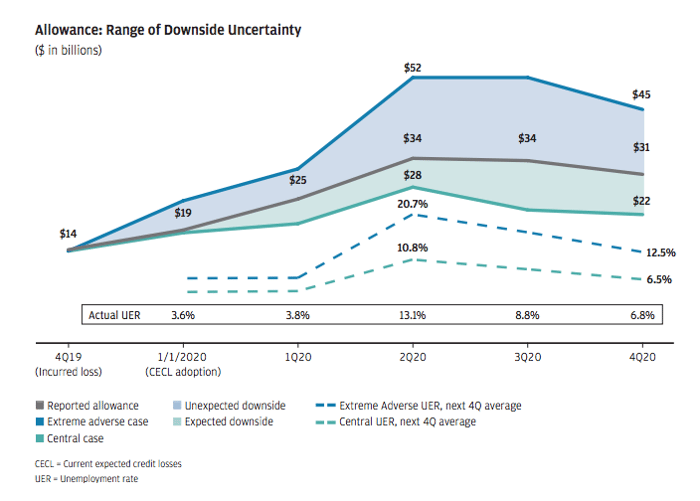
    If you look at the chart below, new accounting rules and the pandemic forced JPMorgan to boost its total reserves for potential loan losses by 143% from the fourth quarter of 2019, all the way to $34 billion at its peak in 2020. That still didn’t stop JPMorgan from generating a 14% return on tangible common equity last year.

    JPMorgan's Loan Loss Allowance Modeling Scenarios.

    Image source: JPMorgan Chase 2021 Letter to Shareholders.

    Perhaps even more impressive is that the bank prepared for a situation in which unemployment over a one-year period would remain at or above 12.5%, a scenario worse than what it was put through in the Federal Reserve’s stress testing last year. And that scenario doesn’t seem to have fazed Dimon. “I also have very little doubt that if the severely adverse scenario played out, JPMorgan Chase would perform far better than the stress test projections,” he wrote.

    JPMorgan Chase is an advertising partner of The Ascent, a Motley Fool company. John Mackey, CEO of Whole Foods Market, an Amazon subsidiary, is a member of The Motley Fool’s board of directors. Suzanne Frey, an executive at Alphabet, is a member of The Motley Fool’s board of directors. Randi Zuckerberg, a former director of market development and spokeswoman for Facebook and sister to its CEO, Mark Zuckerberg, is a member of The Motley Fool’s board of directors. Bram Berkowitz has no position in any of the stocks mentioned. The Motley Fool owns shares of and recommends Alphabet (A shares), Alphabet (C shares), Amazon, Apple, and Facebook. The Motley Fool recommends the following options: long January 2022 $1920.0 calls on Amazon, long March 2023 $120.0 calls on Apple, short January 2022 $1940.0 calls on Amazon, and short March 2023 $130.0 calls on Apple. The Motley Fool has a disclosure policy.

    This article was originally published on Fool.com. All figures quoted in US dollars unless otherwise stated.

    Where to invest $1,000 right now

    When investing expert Scott Phillips has a stock tip, it can pay to listen. After all, the flagship Motley Fool Share Advisor newsletter he has run for more than eight years has provided thousands of paying members with stock picks that have doubled, tripled or even more.*

    Scott just revealed what he believes are the five best ASX stocks for investors to buy right now. These stocks are trading at dirt-cheap prices and Scott thinks they are great buys right now.

    *Returns as of February 15th 2021

    More reading

    Bram Berkowitz has no position in any of the stocks mentioned. The Motley Fool Australia has no position in any of the stocks mentioned. The Motley Fool has a disclosure policy. This article contains general investment advice only (under AFSL 400691). Authorised by Bruce Jackson.

    The post 5 things Jamie Dimon said in his annual JPMorgan shareholders letter appeared first on The Motley Fool Australia.

    This article was originally published on Fool.com. All figures quoted in US dollars unless otherwise stated.

    from The Motley Fool Australia https://ift.tt/2PRmEyq

  • Whats up with the Australian Strategic Materials (ASX:ASM) share price?

    Two boys with cardboard rockets strapped to their backs, indicating two ASX companies with rocketing share prices

    The Australian Strategic Materials Limited (ASX: ASM) share price is rocketing on the ASX as of late.

    After listing on the ASX in late July late year, the company’s share price has since risen an impressive 306%.

    Currently, the emerging critical mineral manufacturer’s shares are trading for $5.14, 2.3% higher than yesterday’s closing price.

    We take a deep dive into what’s been driving the Australian Strategic Materials share price lately.

    What does Australian Strategic Materials do?

    Australian Strategic Materials produces specialty metals and oxides for advanced technologies and owns 100% of its Dubbo Project.

    The Dubbo Project is ready for construction, with all approvals and licences in place. It will process zirconium, rare earths, niobium and hafnium from a long-term resource in the central west of New South Wales.

    The company also has a joint venture with South Korea’s Ziron Tech to pilot the production of hafnium and zirconium by combining Australian Strategic Materials’ process with Ziron Tech’s metallisation technology. The first production run from the joint venture with Ziron Tech was successfully completed in July 2020.

    Since then, it has had a run of successful purity testing of its materials for different uses, including magnets and 3D printing.

    Mad March

    Despite many gains and some important announcements, by the end of the Month, the company’s shares had fallen by 9.9%.

    In early March, the company announced results from an internal scoping study, which found a strong financial rational to build a metals plant in Korea. The plant would produce high-purity neodymium iron boron powder and titanium powder using the company’s patented low-energy technology. The study found the plant would cost between US$35 million and US$45 million to build. It forecasted it would generate between US$180 million and $190 million in revenue each year.

    One week later, Australian Strategic Materials announced it had signed a memorandum of understanding (MoU) with the Korean Government, the Chungbuk provincial government and Cheongju city government. The MoU related to the building of the plant. It also said it would receive a government grant for the plant, but didn’t disclose the value of the grant.

    Finally, on 26 March, the company shared it had received commitments to raise $65 million through the placement of 13.5 million shares. Each share would be issued at $4.80, which was 5.7% lower than the company’s share price at the time.

    That was the last time we saw important news come from Australian Strategic Metals, although its share price has since risen by 3.6%.

    Australian Strategic Materials share price snapshot

    Despite a poor 2021, the Australian Strategic Materials share price has performed well on the ASX so far.

    The company closed its first day of trading at $1.39, and it has now risen to its current price of $5.13, although it has dropped by 21.43%, year to date.

    The company has a market capitalisation of around $676 million, with approximately 142 million shares outstanding.

    Where to invest $1,000 right now

    When investing expert Scott Phillips has a stock tip, it can pay to listen. After all, the flagship Motley Fool Share Advisor newsletter he has run for more than eight years has provided thousands of paying members with stock picks that have doubled, tripled or even more.*

    Scott just revealed what he believes are the five best ASX stocks for investors to buy right now. These stocks are trading at dirt-cheap prices and Scott thinks they are great buys right now.

    *Returns as of February 15th 2021

    More reading

    Motley Fool contributor Brooke Cooper has no position in any of the stocks mentioned.

    The Motley Fool Australia has no position in any of the stocks mentioned. The Motley Fool has a disclosure policy. This article contains general investment advice only (under AFSL 400691). Authorised by Bruce Jackson.

    The post Whats up with the Australian Strategic Materials (ASX:ASM) share price? appeared first on The Motley Fool Australia.

    from The Motley Fool Australia https://ift.tt/3t4LWHY