Tag: Motley Fool

  • Could AstraZeneca double your money despite vaccine woes?

    This article was originally published on Fool.com. All figures quoted in US dollars unless otherwise stated.

    health professional sleeping

    This article was originally published on Fool.com. All figures quoted in US dollars unless otherwise stated.

    Why would someone want to invest in a company that seems to be constantly making headlines for all the wrong reasons? Between manufacturing snags, clinical trial inconsistencies, repeated hiccups with regulators on both sides of the Atlantic, and a global public clamoring for coronavirus vaccination, AstraZeneca‘s (NASDAQ: AZN) reputation is getting a beatdown, and its stock is struggling. What’s more, these issues have played out every few months over nearly a year’s time, making them much easier to integrate into a narrative of a mounting meltdown. 

    As monumental as the company’s stumbles may seem, however, investors need to keep their eyes on the long term. AstraZeneca’s all-important coronavirus vaccine is reaching the public, and its reputation will eventually recover. Even with its recent troubles, its stock may start to grow sooner than one might expect. But could it double the investment of someone who bought it right now?

    Vaccine setbacks abound

    Let’s start with the bear case first. In my view, the bearish argument against AstraZeneca is that the parade of issues with its coronavirus vaccine point to deeper problems in the way the company operates. Specifically, its clinical and regulatory operations — both of which are critical for a company dedicated to making pharmaceuticals — appear to be the source of the most recent fumbles.

    In November, management claimed that the company’s coronavirus vaccine, developed jointly with Oxford University, was 70% effective. Upon closer inspection of the results, however, observers recognized that the claim of 70% efficacy was in fact derived from two separate clinical trials with slightly different parameters.

    Soon after, it became apparent that a manufacturing issue had led to some of the doses in the trial being only half as large as they were intended to be. That cast doubt on the company’s summarization of its data while also making its manufacturing and clinical operations look less than stellar. At the time, I noted that the mishaps had shaken my (previously quite strong) faith in the stock. 

    More recently, one of AstraZeneca’s press releases in the U.S. used older data on vaccine efficacy than what was available. This led Dr. Anthony Fauci, head of the National Institute of Allergy and Infectious Diseases (NIAID), to say earlier this week that the issue with the data was “really what you call an unforced error because the fact is this is very likely a very good vaccine.”

    To say that such criticism from one of the top regulatory leaders in a major market might make investors facepalm is a massive understatement. Once again, AstraZeneca’s communication introduced more problems for itself, except now there’s enough ammunition for naysayers to legitimately chart a trend from crisis to crisis.

    Buckle up for a half-decade-long haul

    As bad as all of this may seem, it’s critical to keep a long-term perspective about the company’s fortunes. Over the past five years, AstraZeneca’s total shareholder return has more than doubled. Presently, its quarterly revenues are growing by 11.2% year over year, and its earnings are expanding even faster at a rate of 223.3%.

    Remember, the coronavirus vaccine is only one revenue-bearing project among countless others in the company’s portfolio. Plus, there are dozens of other medicines currently in development, each of which could catalyze further growth of the stock as they advance through clinical trials. Regardless of how successful the vaccine is commercially — and if worldwide demand is any indication, it’ll be a big hit — shareholders can still look forward to moderate growth.  
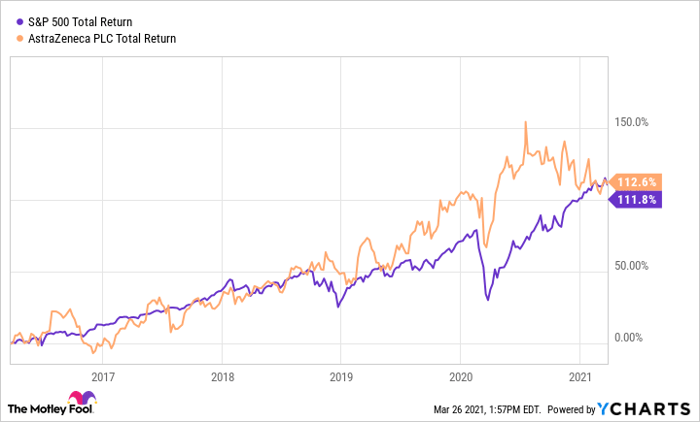
    ^SPX Chart

    ^SPX data by YCharts

    That said, AstraZeneca isn’t about to explode overnight. Its market cap is simply too large for its share price to make big swings, even with the added boon of new vaccine revenue. That shouldn’t dissuade potential buyers who have a long-term approach to the market, however.

    Nor is the share price the only element to consider. The company’s forward dividend yield of 2.82% is a key element of its total shareholder return, and its dividend has inched upward consistently over the last 20 years. So, buying the stock now might mean getting it at a discount, as its share price is still reeling from the effect of the recent slew of bad news.

    Assuming that the vaccine revenue doesn’t change dramatically from management’s expectations and there are no major catastrophes in store (knock on wood), it’s reasonable that AstraZeneca could once again double between now and 2026 or 2027. Don’t wait too long to decide, though: Once the vaccine rollout gets back on track, the stumbles will recede from the market’s memory quite quickly, and the stock might not be much of a bargain thereafter.

    This article was originally published on Fool.com. All figures quoted in US dollars unless otherwise stated.

    Where to invest $1,000 right now

    When investing expert Scott Phillips has a stock tip, it can pay to listen. After all, the flagship Motley Fool Share Advisor newsletter he has run for more than eight years has provided thousands of paying members with stock picks that have doubled, tripled or even more.*

    Scott just revealed what he believes are the five best ASX stocks for investors to buy right now. These stocks are trading at dirt-cheap prices and Scott thinks they are great buys right now.

    *Returns as of February 15th 2021

    More reading

    Alex Carchidi has no position in any of the stocks mentioned. The Motley Fool Australia has no position in any of the stocks mentioned. The Motley Fool has a disclosure policy. This article contains general investment advice only (under AFSL 400691). Authorised by Bruce Jackson.

    The post Could AstraZeneca double your money despite vaccine woes? appeared first on The Motley Fool Australia.

    This article was originally published on Fool.com. All figures quoted in US dollars unless otherwise stated.

    from The Motley Fool Australia https://ift.tt/3fteneN

  • Cann (ASX:CAN) share price lower on cyber attack update

    Young female cybersecurity technician in data centre

    The Cann Group Ltd (ASX: CAN) share price was out of form on Monday.

    The cannabis company’s shares fell 3.5% to 55 cents.

    This latest decline means the Cann share price is now down a disappointing 56% from its 52-week high.

    Why is the Cann share price on the slide today?

    The Cann share price came under pressure despite the release of two announcements.

    This first, covered in more detail here, reveals that the company has signed a partnership with Emyria Ltd (ASX: EMD).

    That partnership will see the two parties work together to accelerate the registration of a unique, low-dose, cannabidiol (CBD) only capsule with Australia’s Therapeutic Goods Administration (TGA).

    What was the second announcement?

    This afternoon Cann also provided the market with an update on the cyberattack it experienced in February.

    In case you missed it, in February the company advised that it had been the victim of a complex and sophisticated cyber fraud perpetrated against it and its overseas contractor.

    This saw Cann make a payment of EUR2.25 million (~$3.5 million) to an overseas contractor, only for it to end up with an unknown third party.

    According to today’s announcement, Cann has commenced a civil proceeding in the High Court of the Hong Kong Special Administrative Region against a third-party defendant, Er Ya Trade, seeking recovery of EUR2.25 million.

    The company also advised that an injunction has now been granted by the Court in favour of Cann to freeze certain assets of the defendant and to compel disclosure of ancillary information relating to assets held by it.

    What next?

    The release explains that the matter will now go through the Court process. Based on current information, Cann has been advised that this is likely to take between four and six months.

    However, management has warned that there is no guarantee that any amount will be awarded to Cann or funds ultimately recovered from the Defendant through this process.

    Cann intends to provide further updates as material events in the proceeding arise.

    Where to invest $1,000 right now

    When investing expert Scott Phillips has a stock tip, it can pay to listen. After all, the flagship Motley Fool Share Advisor newsletter he has run for more than eight years has provided thousands of paying members with stock picks that have doubled, tripled or even more.*

    Scott just revealed what he believes are the five best ASX stocks for investors to buy right now. These stocks are trading at dirt-cheap prices and Scott thinks they are great buys right now.

    *Returns as of February 15th 2021

    More reading

    Motley Fool contributor James Mickleboro has no position in any of the stocks mentioned. The Motley Fool Australia has no position in any of the stocks mentioned. The Motley Fool has a disclosure policy. This article contains general investment advice only (under AFSL 400691). Authorised by Bruce Jackson.

    The post Cann (ASX:CAN) share price lower on cyber attack update appeared first on The Motley Fool Australia.

    from The Motley Fool Australia https://ift.tt/2P7Ablr

  • Imagion (ASX:IBX) share price up 1,166% in a year pursuing ‘radiation-free’ cancer tech

    Red rocket and arrow boosting up a share price chart

    The Imagion Biosystems Ltd (ASX: IBX) share price has rocketed 1,166% over the past 12 months due to a series of promising projects around cancer detection.

    The company’s bio is truly a mouthful: its principal business activities consist of nanotechnology, biotechnology, cancer diagnostics, and – the clincher — superparamagnetic relaxometry. 

    What investors should know is that it develops medical devices focused around cancer screening technology.

    Imagion’s Magsense cancer screening technology

    One of these tech projects, called Magsense, is a diagnostic imaging tool that can potentially increase the accuracy of magnetic resonance imaging scans (MRIs) and PMSA-PET scans. For the record, PMSA-PET scans are prostate cancer scans, which work by using radioactive dye to light up areas of the body.

    What’s more, the company’s long term goal is to fully develop a cancer screening technology that’s not only more accurate, but entirely radiation free. Scientific Advisory Board member Professor Lisa Horvarth explained Imagion’s technology in slightly more detail.

    MRI and PSMA-PET have limits of detection, so small cancer foci in lymph nodes may not be detected,” she said. “Imagion’s new imaging technology would allow precision mapping of the lymph nodes, identifying smaller foci of cancer that current imaging modalities are unable to identify. This would guide the treatment of the lymph nodes either by surgery or radiotherapy.

    What’s happening to Imagion’s share price?

    The Imagion share price has surged 1,166.67% over the past 12 months, from 0.012 cents per share to over 15 cents today. However, it’s down 15% this month and 5% this week.

    It’s down nearly 2% today, despite a positive report to its shareholders regarding its expansion into breast cancer screening trials. The effects of COVID-19 on the healthcare sector are still hard to shake off: cancer diagnostic procedures dropped by 30% throughout the pandemic and still haven’t recovered.

    It revealed this month that the CSIRO have granted it $50,000 for a prostate cancer screening project related to its Magsense technology.

    While the executive chair of Imagion Biosystems, Bob Proulx, was thankful for the government support.

    “This collaboration with Monash, assisted by funding from CSIRO, helps jump start our prostate cancer project by leveraging the expertise at Monash University and provides a key opportunity to advance our MagSense technology for another important cancer indication,” Proulx said.

    “We’re grateful for the support from the Australian Government through the Entrepreneurs’ Programme and their recognition of the medical need for improved methods of prostate cancer detection.”

    Imagion “excited for what lies ahead”

    It’s worth noting that Imagion is still small cap and Magsense is still in its relative infancy. Its current market capitalisation is $157 million, ranking it 66th in the healthcare sector and 790th on the ASX All Ordinaries Index (ASX: XAO)

    But its team clearly believe they’re making progress.

    “After much diligence and hard work, we are delighted to have finished the year with our first inhuman study established and open for enrolment,” Proulx said in Imagion’s 2020 Annual Report, released last month.

    “We are excited for what lies ahead in 2021, particularly as the MagSense HER2 breast cancer phase one study progresses and we explore further development areas including manufacturing scale-up and preparing for a larger pivotal study.”

    Where to invest $1,000 right now

    When investing expert Scott Phillips has a stock tip, it can pay to listen. After all, the flagship Motley Fool Share Advisor newsletter he has run for more than eight years has provided thousands of paying members with stock picks that have doubled, tripled or even more.*

    Scott just revealed what he believes are the five best ASX stocks for investors to buy right now. These stocks are trading at dirt-cheap prices and Scott thinks they are great buys right now.

    *Returns as of February 15th 2021

    More reading

    Motley Fool contributor Lucas Radbourne-Pugh has no position in any of the stocks mentioned. The Motley Fool Australia has no position in any of the stocks mentioned. The Motley Fool has a disclosure policy. This article contains general investment advice only (under AFSL 400691). Authorised by Bruce Jackson.

    The post Imagion (ASX:IBX) share price up 1,166% in a year pursuing ‘radiation-free’ cancer tech appeared first on The Motley Fool Australia.

    from The Motley Fool Australia https://ift.tt/3lZZzFo

  • Is the Clean TeQ (ASX:CLQ) share price really up 927% today?

    A smiling woman holds her hands up showing ten fingers (and thumbs), indicating a a share price split from one into ten

    Some investors may have spotted what looks like an incredibly lucrative ASX share this morning.

    Several sources, including the ASX itself, are today telling investors that the Clean TeQ Holdings Limited (ASX: CLQ) share price is up an incredible 927%. It’s not often we see an ASX share price move triple digits in one day, let alone by close to 1,000%

    So did Clean TeQ really make its investors 927% richer today? The answer is not as simple as it seems…

    So yes, on the surface, it looks as though Clean TeQ shares are up 927%. That’s because when we last saw the Clean TeQ share price on Friday, it was sitting at 26 cents a share. But this morning, it had seemingly had one of the greatest weekends of all time when it opened at $2.65 a share.

    At the time of writing, Clean TeQ shares are trading at $2.67.

    A ‘reverse split’ for Clean TeQ

    If you are a shareholder in Clean TeQ, I hope I’ve caught you before you’ve found a way to the nearest Lamborghini dealer because I’m afraid you’re not suddenly rich.

    The ‘rise’ in the Clean TeQ share price has nothing to do with the company getting any bigger. It’s actually a result of Clean TeQ executing what’s known as a share consolidation, which is sometimes called a ‘reverse split’.

    Put simply, the company has reduced its share count by a factor of 10, making each share 10 times more valuable. That explains why Clean TeQ has seemingly 10Xed over the weekend. But for every 10 CLQ shares a shareholder might have owned on Friday, they now own 1.

    It’s the opposite process to what companies like Pushpay Holding Ltd (ASX: PPH), Apple Inc (NASDAQ: AAPL) and Tesla Inc (NASDAQ: TSLA) have done in recent months. Unfortunately for shareholders, it does not mean any real change in either the company’s market capitalisation, valuation, or any individual shareholders’ wealth.

    Clean TeQ did tell us this was happening last Wednesday. It’s part of the company’s plan to rename itself Sunrise Energy Metals Limited (SRL) come 9 April 2021.

    Where to invest $1,000 right now

    When investing expert Scott Phillips has a stock tip, it can pay to listen. After all, the flagship Motley Fool Share Advisor newsletter he has run for more than eight years has provided thousands of paying members with stock picks that have doubled, tripled or even more.*

    Scott just revealed what he believes are the five best ASX stocks for investors to buy right now. These stocks are trading at dirt-cheap prices and Scott thinks they are great buys right now.

    *Returns as of February 15th 2021

    More reading

    Sebastian Bowen owns shares of Tesla. The Motley Fool Australia’s parent company Motley Fool Holdings Inc. owns shares of and recommends Apple and Tesla. The Motley Fool Australia’s parent company Motley Fool Holdings Inc. owns shares of PUSHPAY FPO NZX and recommends the following options: short March 2023 $130 calls on Apple and long March 2023 $120 calls on Apple. The Motley Fool Australia has recommended Apple and PUSHPAY FPO NZX. The Motley Fool has a disclosure policy. This article contains general investment advice only (under AFSL 400691). Authorised by Bruce Jackson.

    The post Is the Clean TeQ (ASX:CLQ) share price really up 927% today? appeared first on The Motley Fool Australia.

    from The Motley Fool Australia https://ift.tt/39FohX1

  • ‘Remarkable resilience’ in Aussie farmland a tailwind for ASX agriculture shares

    Agricultural ASX share price on watch represented by farmer in field looking at tablet computer

    When you think of ASX resource shares, the likes of S&P/ASX 200 Index (ASX: XJO) mining giants Fortescue Metals Group Ltd (ASX: FMG) and BHP Group Ltd (ASX: BHP) probably spring to mind.

    Or perhaps the host of ASX gold shares trading on the index.

    But Australia is rich not just in hard commodities like iron ore and gold. The lucky country also has a great wealth in its expansive farmlands. With a number of quality ASX agricultural shares investors can consider.

    And, according to the latest report from the ANREV Australian Farmland Index, the fourth quarter 2020 returns for managed investments in Aussie farmlands came in strong, despite the ongoing global pandemic. Which could provide some welcome tailwinds for ASX agriculture shares.

    28% returns from annual farmland

    ANREV’s index tracks some $1.1 billion worth of agricultural assets, including farming assets held by Rural Funds Group (ASX: RFF)

    As Institutional Real Estate Inc reports, the quarterly performance of annual farmland, “which includes broadacre grain and oilseed farming and livestock grazing” had its best returns since ANREV launched the index.

    The annualised returns on the grazing and annual cropland came in at an impressive 28.37%, with 13.34% coming from increased income and 15.03% from capital growth.

    The ANREV report credited rising beef cattle prices and an above-average winter crop harvest in the eastern states for much of the increased returns.

    Amélie Delaunay, director of research and professional standards at ANREV said, “In the face of the unprecedented turmoil of 2020, investments in Australian farmland showed remarkable resilience compared to other asset classes.”

    A leading ASX agricultural share

    As mentioned above there are a number of quality agricultural shares trading on the All Ordinaries Index (ASX: XAO).

    Rural Funds Group, whose assets make up part of the ANREV index, counts among those.

    Rural Funds holds and leases agricultural property and equipment. Its agricultural holdings include cattle, vineyards and cropping. As far as its leases go, the company is well-positioned with an average weighted lease expiry (WALE) of 11.1 years.

    Rural Funds has a market cap of $801 million and is well-known among ASX dividend investors for a lengthy track record of regular and growing dividends. At the current share price Rural Funds pays an annual dividend yield of just over 4.6%, unfranked.

    The Rural Funds share price, down 2% today, is up 24% over the past 12 months.

    Where to invest $1,000 right now

    When investing expert Scott Phillips has a stock tip, it can pay to listen. After all, the flagship Motley Fool Share Advisor newsletter he has run for more than eight years has provided thousands of paying members with stock picks that have doubled, tripled or even more.*

    Scott just revealed what he believes are the five best ASX stocks for investors to buy right now. These stocks are trading at dirt-cheap prices and Scott thinks they are great buys right now.

    *Returns as of February 15th 2021

    More reading

    Motley Fool contributor Bernd Struben has no position in any of the stocks mentioned. The Motley Fool Australia owns shares of and has recommended RURALFUNDS STAPLED. The Motley Fool has a disclosure policy. This article contains general investment advice only (under AFSL 400691). Authorised by Bruce Jackson.

    The post ‘Remarkable resilience’ in Aussie farmland a tailwind for ASX agriculture shares appeared first on The Motley Fool Australia.

    from The Motley Fool Australia https://ift.tt/3rzjUma

  • 2 ASX dividend shares to buy in April

    asx dividend shares represented by note pad printed with words passive income

    A number of ASX dividend shares could be good ideas to own for income.

    It’s a tough environment for income-focused investors right now with how close to 0% the official interest rate is at the moment.

    But there are still some businesses that could represent good value, growth and offer a solid starting yield:

    Rural Funds Group (ASX: RFF)

    Rural Funds currently has a forward distribution yield of 5% for FY22 after management confirmed that the real estate investment trust (REIT) distribution would rise by 4% again.

    That’s actually the aim of the farmland landlord – to grow the distribution by 4% each year.

    It owns a number of different farm types including almonds, macadamias, vineyards, cattle and cropping (sugar and cotton). However, Rural Funds plans to turn the sugar properties into macadamia to generate more earnings in the future.

    A key part of the growth is the rental indexation that is built into its contracts with tenants like JBS and Olam. The increases are either a fixed 2.5% annual increase, or it’s linked to CPI inflation.

    Rural Funds also has a strategy where it invests some of its retained profit each year into productivity improvements, further increasing the capital value and rental potential of those farms. It has been focusing on cattle farm improvements in recent years.

    It was one of the few REITs to increase the distribution during FY20 despite all of the impacts of COVID-19.

    Rural Funds’ farms are spread across a variety of states and climactic conditions, which means it has a diversified portfolio.

    Kogan.com Ltd (ASX: KGN)

    Kogan.com currently has a trailing grossed-up dividend yield of 3.3%. According to Commsec, Kogan.com could pay an annual dividend per share of $0.49 per share in FY23. This would translate to a grossed-up dividend yield of 5.5% at the current Kogan.com share price.

    The e-commerce business has been growing its dividend for the last few years since it started paying one.

    In the FY21 half-year result, the board grew the interim dividend by 113.3% to 16 cents per share, which is a big increase for an ASX dividend share. That was after an increase of the adjusted earnings per share (EPS) of 211.7% to $0.35 per share, whilst statutory EPS was 135.1% higher to $0.20.

    That means that the Kogan.com interim dividend represented a dividend payout ratio of 80%, leaving plenty of profit for re-investment back into more growth for the business.

    Kogan.com is growing various parts of its business at a fast rate. Its exclusive brands and marketplace businesses are increasing in size at a very fast pace at the moment.

    One area that Kogan.com is looking to for more growth is New Zealand after its Mighty Ape acquisition. Mighty Ape now has 719,000 active customers and December 2020 trading showed “strong sales” with revenue of $20 million and gross profit of $5.4 million.

    The ASX dividend share is continuing to focus on more growth by expanding its exclusive brands and enhancing and developing Kogan Marketplace.

    In January 2021, Kogan.com saw gross sales increase by 45% year on year which included 111.6% growth of Kogan Marketplace, 54.6% growth of exclusive brands, 102% growth of gross profit and 90% growth of adjusted earnings before interest, tax, depreciation and amortisation (EBITDA).

    These Dividend Stocks Could Be Your Next Cash Kings (FREE REPORT)

    Motley Fool Australia’s Dividend experts recently released a brand-new FREE report revealing 3 dividend stocks with JUICY franked dividends that could keep paying you meaty dividends for years to come.

    Our team of investors think these 3 dividend stocks should be a ‘must consider’ for any savvy dividend investor. But more importantly, could potentially make Australian investors a heap of passive income.

    Don’t miss out! Simply click the link below to grab your free copy and discover these 3 high conviction stocks now.

    Returns As of 15th February 2021

    More reading

    Tristan Harrison owns shares of RURALFUNDS STAPLED. The Motley Fool Australia’s parent company Motley Fool Holdings Inc. owns shares of Kogan.com ltd. The Motley Fool Australia owns shares of and has recommended RURALFUNDS STAPLED. The Motley Fool Australia has recommended Kogan.com ltd. The Motley Fool has a disclosure policy. This article contains general investment advice only (under AFSL 400691). Authorised by Bruce Jackson.

    The post 2 ASX dividend shares to buy in April appeared first on The Motley Fool Australia.

    from The Motley Fool Australia https://ift.tt/39qhtwd

  • Afterpay (ASX:APT) share price sinks despite new product launch

    asx buy now pay later shares such as zip and afterpay share price represented by finger pressing pay button on mobile phone

    The Afterpay Ltd (ASX: APT) share price is 3.48% lower today. At the time of writing, shares in the buy now, pay later (BNPL) provider are trading for $102.20.

    Today’s negative movement comes at the same time as the company launches its new offering for in-store purchases – Afterpay Card.

    For comparative purposes the S&P/ASX 200 Index (ASX: XJO) is down 0.24%. BNPL competitor Zip Co Ltd (ASX: Z1P) is down 4.58% to $7.40.

    Let’s take a closer look at the company’s announcement.

    Afterpay Card

    Afterpay Card is a digital offering customers can access using their mobile wallets, much like a credit or debit card.

    Afterpay users will be able to tap the card at merchant terminals to make the purchase. Just like its app, customers will pay for their product over four instalments, interest free. Afterpay estimates around 22% of its Australia and New Zealand total gross merchandise volume (GMV) comes from in-store purchases.

    “Over the past five years we have built a strong in-store offering, with tens of thousands of merchants currently offering Afterpay in-store in Australia,” co-CEO and co-founder Nick Molnar said.

    “The new Afterpay virtual card, which will sit in a customer’s digital wallet, is an evolution of our offering, making it even easier for millions of our Australian customers to split their in-store payments in four instalments without incurring interest — ever.

    “There is enormous opportunity to reach a new customer, who out of habit or preference, opts to shop in-store, to easily and seamlessly utilise Afterpay at the point of checkout.”

    Mr Molnar says the new product will benefit merchants as well as consumers.

    “Merchants will also benefit as a result of the Afterpay Card as it will remove integration effort and costs for their business to support Afterpay in-store, which in turn provides more merchants for customers to shop at, in more verticals, with more merchants on offer.”

    Merchants will be prevented to from surcharging users who use this product, just as with other Afterpay products. The Reserve Bank is, however, looking at ending this practice in Australia for BNPL providers.

    Afterpay’s half-year results

    For the 6-months ending 31 December 2020, Afterpay recorded a 106% increase in operating sales to total $9.8 billion. Earnings before interest, tax, depreciation and amortisation (EBITDA) grew a massive 521% over the prior corresponding period (pcp) to $47.9 million.

    The number of customers grew by 80% on the pcp to 13.1 million. Over 8 million of the company’s customers live in North America (a 127% increase in the region on the pcp).

    Afterpay recorded a loss of $79.2 million, which was in line with expectations.

    Afterpay share price snapshot

    The Afterpay share price hit a 3-month low last week. It’s down 18.67% from 1 month ago and 36.14% from its all-time high. The Afterpay share price is still 435.08% higher than this time 52-weeks ago. The Zip Co share price is similarly 422.7% higher from this time last year.

    Many BNPL providers have seen their share price slide because of rising treasury bond yields. As well, competition in the sector is heating up, with both Commonwealth Bank of Australia (ASX: CBA) and PayPal Holdings Inc (NASDAQ: PYPL) entering the fray.

    Afterpay has a market capitalisation of $29.2 billion.

    Where to invest $1,000 right now

    When investing expert Scott Phillips has a stock tip, it can pay to listen. After all, the flagship Motley Fool Share Advisor newsletter he has run for more than eight years has provided thousands of paying members with stock picks that have doubled, tripled or even more.*

    Scott just revealed what he believes are the five best ASX stocks for investors to buy right now. These stocks are trading at dirt-cheap prices and Scott thinks they are great buys right now.

    *Returns as of February 15th 2021

    More reading

    Marc Sidarous has no position in any of the stocks mentioned. The Motley Fool Australia’s parent company Motley Fool Holdings Inc. owns shares of and recommends PayPal Holdings. The Motley Fool Australia’s parent company Motley Fool Holdings Inc. owns shares of ZIPCOLTD FPO and recommends the following options: long January 2022 $75 calls on PayPal Holdings. The Motley Fool Australia owns shares of AFTERPAY T FPO. The Motley Fool Australia has recommended PayPal Holdings. The Motley Fool has a disclosure policy. This article contains general investment advice only (under AFSL 400691). Authorised by Bruce Jackson.

    The post Afterpay (ASX:APT) share price sinks despite new product launch appeared first on The Motley Fool Australia.

    from The Motley Fool Australia https://ift.tt/39pLCvt

  • 4 reasons the Bubs (ASX:BUB) share price has been crushed and just hit a 52-week low

    bad asx shares broker downgrade represented by woman hiding face under her jumper

    The Bubs Australia Ltd (ASX: BUB) share price is under pressure again on Monday.

    In afternoon trade, the goats milk infant formula and baby food company’s shares are down 1% to a 52-week low of 50 cents.

    This latest decline means the Bubs share price is now down 58% from its 52-week high.

    Why is the Bubs share price at a 52-week low?

    Investors have been selling Bubs shares in recent months due to a number of reasons. One of those is its underwhelming performance in FY 2021 and continued cash burn.

    In respect to its FY 2021 performance, last month Bubs released its half year results and reported a 33% reduction in revenue to $18.3 million.

    This was driven largely by weakness in infant formula sales due to issues in the daigou channel caused partly by COVID-19.

    This weakness offset strong growth in Australian supermarket and pharmacy sales. Though, it is important to note that these sales are coming off a small base.

    Unfortunately, things were even worse for its earnings, with Bubs reporting an operating loss of $14.4 million for the period. This compares to an operating loss of $5.25 million a year earlier.

    This means that for every $1 of revenue Bubs is generating, it is actually losing 78.7 cents.

    One positive is that the company ended the period with a strong cash balance of $40 million. This was thanks to the generosity of shareholders.

    Capital raisings

    The reason that Bubs finished in such a strong capital position was due to its $32.1 million capital raising at at 80 cents in September.

    That capital raising, which which fell short of its $40 million target, was just the latest in a long run of raisings that Bubs has undertaken, diluting long term shareholders.

    Clearly, without this capital raising, Bubs would have been in a precarious position.

    Agreements going nowhere

    Also weighing on the Bubs share price and investor sentiment are the countless announcements of agreements over the last few years which have seemingly gone nowhere.

    One of those is a supply agreement with New Times Asia in 2018. Bubs stated that it “has entered a Supply Agreement with New Times Asia with a total sales commitment for purchase orders valued at $17M in FY19, and increasing to $24M in FY20, and $37M in FY21.”

    It is unclear just how much this ultimately contributed to its sales. Furthermore, there has been no word on whether this deal will continue in FY 2022.

    Bearish brokers

    A fourth reason why the Bubs share price is at a 52-week low is the bearish view of one leading broker.

    According to a note out of Citi last week, its analysts have held firm with their sell rating and 35 cents price target on Bubs’ shares. This price target implies potential downside of 30% for its shares over the next 12 months.

    Citi is concerned over the sustained weakness in the daigou channel and the uncertainty regarding the company’s pathway to achieving profitability. This is particularly the case given the resurgence of domestic infant formula brands in the key China market.

    Where to invest $1,000 right now

    When investing expert Scott Phillips has a stock tip, it can pay to listen. After all, the flagship Motley Fool Share Advisor newsletter he has run for more than eight years has provided thousands of paying members with stock picks that have doubled, tripled or even more.*

    Scott just revealed what he believes are the five best ASX stocks for investors to buy right now. These stocks are trading at dirt-cheap prices and Scott thinks they are great buys right now.

    *Returns as of February 15th 2021

    More reading

    James Mickleboro has no position in any of the stocks mentioned. The Motley Fool Australia’s parent company Motley Fool Holdings Inc. owns shares of BUBS AUST FPO. The Motley Fool Australia has recommended BUBS AUST FPO. The Motley Fool has a disclosure policy. This article contains general investment advice only (under AFSL 400691). Authorised by Bruce Jackson.

    The post 4 reasons the Bubs (ASX:BUB) share price has been crushed and just hit a 52-week low appeared first on The Motley Fool Australia.

    from The Motley Fool Australia https://ift.tt/3u3NbHy

  • Cann (ASX:CAN) share price slides despite collaboration news

    Falling cannabis asx share price represented by cannabis leaves on a declining line graph

    Cann Group Ltd (ASX: CAN) shares opened slightly higher on Monday but have since retreated. This comes after the company announced a partnership with Emyria Ltd (ASX: EMD). At the time of writing, the Cann share price is trading 1.75% lower at 56 cents after having reached as high as 59 cents in earlier trade.

    Let’s take a look at what the company announced.

    Cann and Emyria partnership 

    The Cann share price is failing to ignite today after the company announced a collaboration with Emyria will seek to accelerate the registration of a unique, low-dose, cannabidiol (CBD) only capsule with Australia’s Therapeutic Goods Administration (TGA). 

    Under the agreement, Emyria’s EMD-003 drug development program will use Cann Group’s proprietary Gelpell microsphere technology, as the basis for seeking a Schedule 3 registration for treating unmet needs in mental health. Cann Group previously acquired the rights to the Gelpell technology via its purchase of Europen company Satipharm

    Scheduling is a national classification system that determines how medicines are made available to the public. Schedule 3 registration will result in the product being an over-the-counter, pharmacist only medicine. 

    The collaboration leverages a number of important milestones that have already been met, including phase 1 trials of the Satipharm capsule. 

    Emyria will lead the registration program with its experienced drug development and clinical team. The company has worked with Satipharm in the past, having written more than 400 Satipharm prescriptions to more than 170 patients.

    According to the company, clinical trials have already hit the ground running and are guided by insights from Emyria data which include robust safety, efficacy and patient preference data for more than 3,500 patients treated at Emyria’s Emerald Clinics. 

    Emyria managing director Dr Michael Winlo commented: 

    This partnership greatly accelerates Emyria’s EMD-003 drug development program by combining Emyria’s unique clinical data and drug development expertise with Cann Group’s best in-class CBD delivery technology.

    Satipharm CBD has already completed robust stability testing as well as Phase 1 clinical trials as required by the TGA. This allows us to move straight to pivotal clinical outcomes trials saving significant time and money. An experienced Contract Research Organisation (CRO) has already been engaged to manage these trials.

    Further, at Emyria, we already have deep insights into how the Satipharm product performs clinically, having written over 400 Satipharm prescriptions to more than 170 patients. This de-risks the pivotal clinical outcomes trials required as an important first step towards registration with the TGA.

    Global mental health challenge 

    The collaboration highlights the global challenge of treating increasing mental health concerns, particularly over the last 12 months. 

    A recent internal analysis from Emerald Clinics revealed that more than 50% of its patients were diagnosed with moderate to severe depression, anxiety and/or stress. 

    If the collaboration is successful, the companies will be able to deliver a new, registered medicine for the treatment of psychological distress and symptoms of depression, anxiety and stress. 

    Cann Group CEO Peter Crock commented that: 

    We anticipate there will be a large patient demand for a TGA registered CBD medicine that is convenient to patients and demonstrates the highest standards of quality, safety and efficacy.

    Cann share price snapshot

    Over the past 12 months, the Cann share price has fallen by nearly 12%. Year to date, Cann shares are also down by nearly 6%.

    Based on the current share price, the company has a market capitalisation of around $158 million.

    Where to invest $1,000 right now

    When investing expert Scott Phillips has a stock tip, it can pay to listen. After all, the flagship Motley Fool Share Advisor newsletter he has run for more than eight years has provided thousands of paying members with stock picks that have doubled, tripled or even more.*

    Scott just revealed what he believes are the five best ASX stocks for investors to buy right now. These stocks are trading at dirt-cheap prices and Scott thinks they are great buys right now.

    *Returns as of February 15th 2021

    More reading

    Motley Fool contributor Kerry Sun has no position in any of the stocks mentioned. The Motley Fool Australia has no position in any of the stocks mentioned. The Motley Fool has a disclosure policy. This article contains general investment advice only (under AFSL 400691). Authorised by Bruce Jackson.

    The post Cann (ASX:CAN) share price slides despite collaboration news appeared first on The Motley Fool Australia.

    from The Motley Fool Australia https://ift.tt/3frn4WL

  • Why green bonds are raising the Mercury (ASX:MCY) share price

    Trees and a road shapes a dollar sign of green, indicating the share price movement of ASX eco companies

    The Mercury NZ Ltd (ASX: MCY) share price is on the rise today after the company issued 200 million new green bonds. The gas and electricity company’s share price reached an intraday high of $5.81 this morning, up 3.75%. It has since dropped back and is currently trading at $5.68, up 1.43% for the day so far.

    So, what are green bonds and why have they boosted the Mercury Energy share price?

    Let’s dive deeper into the mystery of green bonds. 

    Could green bonds be the future of environmentally friendly investing?

    Green bonds are pretty much the same as normal bonds. The only difference is that a green bond must be certified by the Climate Bonds Initiative (CBI), with at least 95% of the proceeds going towards climate-friendly projects.

    The major benefit for environmentally conscience investors is that they can be assured their bonds are going towards financing eco-friendly projects, while still having their investment backed by the issuer’s entire balance sheet. It’s a relatively low-risk way of investing ethically (although no investment is ever risk free).

    More about Mercury Energy’s new green bonds

    Mercury announced its intention to issue green bonds before the market opened on 15 March. Over the following two trading days, the company’s share price launched by more than 8%. On 19 March, the company announced the interest rate that would apply to the bonds. The second piece of news was met with another, though much smaller, share price gain of 2%.

    Today’s news is that the company has officially issued the bonds to those who subscribed. 

    The green bonds issued by Mercury have been earmarked to fund the company’s renewable energy projects. Mercury didn’t mention whether these would be new or existing projects.

    Mercury states that 100% of the energy it provides is renewable. Thus, the raised capital has the potential to go towards the company’s hydro, solar, wind or geothermal initiatives. Or, possibly something else entirely.

    Each bond will set back an investor NZ$1. Mercury intends to raise NZ$200 million. 

    Not all willing investors were able to grab themselves a green bond. Mercury reserved them for clients of the Joint Lead Managers, NZX participants and other approved financial intermediaries.

    The bonds are 5.5 year, unsecured, unsubordinated fixed rate green bonds, with an interest rate of 2.16% per annum.

    Mercury share price snapshot

    The Mercury share price is up 42% over the last 12 months, but it has dropped 10.69% year to date.

    Mercury has a market capitalisation of around $7.6 billion, with approximately 1.3 billion shares outstanding.

    Where to invest $1,000 right now

    When investing expert Scott Phillips has a stock tip, it can pay to listen. After all, the flagship Motley Fool Share Advisor newsletter he has run for more than eight years has provided thousands of paying members with stock picks that have doubled, tripled or even more.*

    Scott just revealed what he believes are the five best ASX stocks for investors to buy right now. These stocks are trading at dirt-cheap prices and Scott thinks they are great buys right now.

    *Returns as of February 15th 2021

    More reading

    Motley Fool contributor Brooke Cooper has no position in any of the stocks mentioned. The Motley Fool Australia has no position in any of the stocks mentioned. The Motley Fool has a disclosure policy. This article contains general investment advice only (under AFSL 400691). Authorised by Bruce Jackson.

    The post Why green bonds are raising the Mercury (ASX:MCY) share price appeared first on The Motley Fool Australia.

    from The Motley Fool Australia https://ift.tt/3u1cE4f