Tag: Motley Fool

  • Better Buy: Facebook vs. Twitter

    This article was originally published on Fool.com. All figures quoted in US dollars unless otherwise stated.

    two smiling girls taking a selfie

    This article was originally published on Fool.com. All figures quoted in US dollars unless otherwise stated.

    Social media stocks: Love ’em or hate ’em, it’s where many eyeballs are going these days. While social media stocks are susceptible to government regulation, thorny privacy and safety issues, and not to mention young upstart challengers, most companies did exceptionally well last year in the pandemic. With the continuing shift to digital advertising, these companies could be in for sustained growth in the years ahead, even when the pandemic subsides.

    Social media companies also benefit from powerful network effects, making first-movers hard to displace. So it’s not surprising that two “granddads” of social media, Facebook (NASDAQ: FB) and Twitter (NYSE: TWTR), did well last year. Facebook is up 75% and Twitter is up 140% over the past 12 months, compared with 62% for the S&P 500.
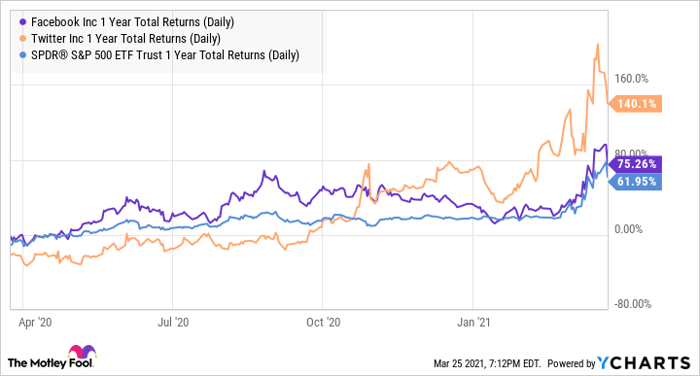
    FB 1 Year Total Returns (Daily) Chart

    FB 1 Year Total Returns (Daily) data by YCharts

    With economies reopening and advertising revenue starting to recover, which is the better stock today?

    Facebook exceeds Twitter on every business metric, but can things change?

    Twitter is up more than Facebook over the past year due to improvements relative to 2019. Still, Facebook clearly has the better overall business as things stand today. During the fourth quarter, here’s how the two social networks stacked up on several key metrics.

    FY 2020 Metric Facebook Twitter

    Year-end MAUs

    2.80 billion

    N/A

    Year-end DAUs

    1.84 billion

    192 million

    DAU growth

    11%

    27%

    Revenue

    $86.0 billion

    $3.7 billion

    Revenue growth

    22%

    7%

    Operating profit

    $32.7 billion

    $26.7 million

    Operating profit growth

    36%

    (93%)

    Data source: Company filings. Table by author.

    There’s no real question as to which is the better business at this moment: Facebook wins hands-down. Thanks to its unmatched scale, intimate knowledge of customers, highly visual format, and precision targeting capabilities, Facebook is becoming the advertising platform of choice for businesses large and small, and is especially key for small online businesses to reach new customers.

    But Twitter is improving

    Despite the massive outperformance of the Facebook business, Twitter has been the better stock over the past year. This is likely due to where both stocks started. Facebook is a nearly $800 billion market cap behemoth, while Twitter, even after its big run, only has a market cap of $49 billion.

    Twitter’s user base also accelerated more than Facebook’s, with mDAUs growing 27% in 2020 versus Facebook’s 11%. That could lead some to believe Twitter will accelerate its top line, even though it actually lagged Facebook on a revenue growth basis last year.

    Twitter has clearly had problems monetizing its platform, but things began to improve throughout 2020. Revenue accelerated throughout the year, exiting Q4 at a 28% revenue growth rate, higher than the 7% it posted for the full year. Within overall revenue, ad revenue growth was an even higher 31%.

    Notably, the company brought in more direct response advertisers, not just big brands. And Twitter also retooled its ad server to better target mobile ads. The new mobile application promotion (MAP) tool generated 50% growth in Q4. Management also hopes to improve its non-existent standing with small businesses going forward.

    But Facebook may be the better stock in a rising rate environment

    With the economy reopening and interest rates going up, things may swing more in favor of more profitable companies in 2021. That bodes well for Facebook, which is still much, much cheaper than Twitter on both a price-to-earnings and price-to-sales basis:
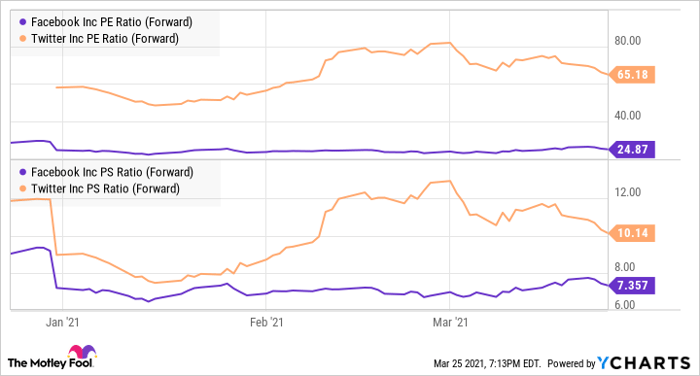
    FB PE Ratio (Forward) Chart

    FB PE Ratio (Forward) data by YCharts

    Twitter may also have a hard time generating near-term profits even if its revenue growth holds up, because it’s still making some heavy investments. Management forecasts 25% growth “or more” in total expenses in 2021, so Twitter will have to accelerate revenue if it hopes to grow profits at all.

    Meanwhile, Facebook should continue to mint profits, which not only affords Facebook the ability to reinvest in its core platform and buy back stock, but also invest in new technologies, setting up its next chapter. For instance, Facebook’s Oculus AR platform could be a future growth driver, and the company just unveiled a new wrist-based wearable that could become an AR-based virtual computing platform of the future.

    Stay with the safer bet

    Whether or not Facebook can make a disruptive breakthrough in augmented reality is still an open question. However, even absent any new business, Facebook’s better value and more solid profits stand to hold up better in the rising rate environment than Twitter’s hoped-for growth. I’d expect the relative performance of these two companies to reverse in 2021. Today, Facebook’s the choice.

    This article was originally published on Fool.com. All figures quoted in US dollars unless otherwise stated.

    Where to invest $1,000 right now

    When investing expert Scott Phillips has a stock tip, it can pay to listen. After all, the flagship Motley Fool Share Advisor newsletter he has run for more than eight years has provided thousands of paying members with stock picks that have doubled, tripled or even more.*

    Scott just revealed what he believes are the five best ASX stocks for investors to buy right now. These stocks are trading at dirt-cheap prices and Scott thinks they are great buys right now.

    *Returns as of February 15th 2021

    More reading

    Billy Duberstein owns shares of Facebook and has the following options: short August 2020 $140.0 puts on Facebook. His clients may own shares of the companies mentioned. Randi Zuckerberg, a former director of market development and spokeswoman for Facebook and sister to its CEO, Mark Zuckerberg, is a member of The Motley Fool’s board of directors. The Motley Fool Australia’s parent company Motley Fool Holdings Inc. owns shares of and recommends Facebook and Twitter. The Motley Fool Australia has recommended Facebook. The Motley Fool has a disclosure policy. This article contains general investment advice only (under AFSL 400691). Authorised by Bruce Jackson.

    The post Better Buy: Facebook vs. Twitter appeared first on The Motley Fool Australia.

    This article was originally published on Fool.com. All figures quoted in US dollars unless otherwise stated.

    from The Motley Fool Australia https://ift.tt/39kTUVC

  • $10,000 invested in the Kogan (ASX:KGN) IPO is worth how much today?

    A young woman smiling and looking happy, indicating a positive share price movement on the ASX market

    Every so often, I like to look to see how successful investments in initial public offerings (IPOs) have been.

    On this occasion, I’m going to look at how a $10,000 investment in Kogan.com Ltd (ASX: KGN) shares would have fared. Here’s what I found:

    The Kogan IPO

    Kogan has now been listed on the Australian share market for just under five years. The ecommerce company’s shares landed on the ASX boards on 30 June 2016 at a listing price of $1.80 per share.

    This means that if you bought $10,000 worth of Kogan shares at its IPO, you would have ended up with approximately 5,556 shares in your portfolio.

    How has Kogan performed?

    Kogan has been a very strong performer since its IPO, delivering stellar sales and earnings growth over the period.

    For example, upon listing, Kogan was generating sales of $200 million and aiming to increase this to $240 million in FY 2017.

    If we fast-forward to today, Kogan has recently released its half year results and revealed that its gross sales came in at $322.9 million for the six months.

    Underpinning this strong growth has been the shift online, acquisitions, the success of Kogan Marketplace, and the launch of countless new verticals such as Kogan Cars.

    Where are its shares today?

    Interestingly, Kogan had a terrible start to life as a listed company. The Kogan share price fell as much as 17% before closing at $1.50 on day one.

    Pleasingly, investors that took part in its IPO and held firm during the day one sell off have been rewarded handsomely thanks to its impressive sales growth.

    This afternoon the Kogan share price is fetching $12.69. This means that the 5,556 shares you would have picked up at its IPO now have a market value of $70,500.

    Where next for the Kogan share price?

    The good news for shareholders is that the gains may not be over, according to one leading broker.

    A recent note out of Credit Suisse reveals that its analysts have an outperform rating and $20.85 price target on its shares.

    If the Kogan share price were to rise to this level, those 5,556 shares would be worth a sizeable ~$116,000.

    Overall, this demonstrates why investing in IPOs can be worth considering as part of a balanced portfolio.

    Where to invest $1,000 right now

    When investing expert Scott Phillips has a stock tip, it can pay to listen. After all, the flagship Motley Fool Share Advisor newsletter he has run for more than eight years has provided thousands of paying members with stock picks that have doubled, tripled or even more.*

    Scott just revealed what he believes are the five best ASX stocks for investors to buy right now. These stocks are trading at dirt-cheap prices and Scott thinks they are great buys right now.

    *Returns as of February 15th 2021

    More reading

    James Mickleboro has no position in any of the stocks mentioned. The Motley Fool Australia’s parent company Motley Fool Holdings Inc. owns shares of Kogan.com ltd. The Motley Fool Australia has recommended Kogan.com ltd. The Motley Fool has a disclosure policy. This article contains general investment advice only (under AFSL 400691). Authorised by Bruce Jackson.

    The post $10,000 invested in the Kogan (ASX:KGN) IPO is worth how much today? appeared first on The Motley Fool Australia.

    from The Motley Fool Australia https://ift.tt/3fmlBkx

  • Golden Mile (ASX:G88) share price rockets 112% on drill results

    miniature rocket breaking out of golden egg representing rocketing share price

    The Golden Mile Resources Ltd (ASX: G88) share price is rocketing in early-afternoon trade. This comes after the company announced exciting gold results from its recent aircore (AC) drilling program. At the time of writing, the Australian-based miner’s shares are fetching 11 cents, up more than 111%.

    What’s driving the Golden Mile share price higher?

    Investors are fighting to pick up Golden Mile shares after the company updated the ASX with its drill results.

    According to its release, Golden Mile has intersected a wide zone of thick, high-grade gold mineralisation at the Wanghi Prospect. The high impact AC drilling program that began in late February reported the following results:

    • 33 meters @ 1.60g/t (grams per tonne) Au (gold) from 48 meters in hole BTAC187 including 16 meters @ 2.95g/t Au from 61 meters.
    • 3 meters @ 2.74g/t Au from 15 meters in hole BTAC 188.
    • 4 meters @ 0.51g/t Au from 36 meters in hole BTAC 189.

    The company stated that BTAC187 is the first of six holes that have received assays from its 2021 drilling campaign. Currently, there are another 75 holes that have been drilled amounting to over 3,000 kilometres of AC drilling.

    Golden Mile noted that it has over 1,000 samples at a laboratory in Perth, Western Australia to analyse the results. It’s expected that the finding will be released within the next few weeks.

    In addition, Golden Mile revealed that geological mapping has identified a previously unrecognised structural trend controlling gold mineralisation. The company plans to commence RC drilling mid-next month targeting the site for further mineralisation.

    What did management say?

    Golden Mile managing director James Merrillees commented:

    These are exciting results for the Company. We intersected further wide zones of strong gold mineralisation in fresh rock at Wanghi, and the recognition of important structures controlling mineralisation provides an important new targeting tool for the follow up RC drilling planned next month.

    The Golden Mile share price has gained 450% in the past 12 months and is up by around 83% year to date, thanks in large part to today’s gains.

    Where to invest $1,000 right now

    When investing expert Scott Phillips has a stock tip, it can pay to listen. After all, the flagship Motley Fool Share Advisor newsletter he has run for more than eight years has provided thousands of paying members with stock picks that have doubled, tripled or even more.*

    Scott just revealed what he believes are the five best ASX stocks for investors to buy right now. These stocks are trading at dirt-cheap prices and Scott thinks they are great buys right now.

    *Returns as of February 15th 2021

    More reading

    Motley Fool contributor Aaron Teboneras has no position in any of the stocks mentioned. The Motley Fool Australia has no position in any of the stocks mentioned. The Motley Fool has a disclosure policy. This article contains general investment advice only (under AFSL 400691). Authorised by Bruce Jackson.

    The post Golden Mile (ASX:G88) share price rockets 112% on drill results appeared first on The Motley Fool Australia.

    from The Motley Fool Australia https://ift.tt/3dd5Idu

  • How New Yorkers could send ASX cannabis shares higher

    marijuana leaf with upward facing arrow

    It wasn’t too long ago that the very idea of ASX cannabis shares was laughable.

    Aside from a few smoky hash bars in the Netherlands, cannabis use was prosecuted vigorously across most countries. While billions of dollars were earned in global black markets, ASX investors had no means to tap into the underground industry.

    But the 21st century has brought a lot of change, albeit slowly.

    Today a growing cadre of nations have legalised medicinal cannabis use, including Australia. While recreational use remains illegal in Australia, the list of nations (and states within the United States) giving the green light for recreational pot smoking also grows inexorably.

    New York’s legal cannabis bill eyes $460 million tax revenue

    In the US, New York looks to become the latest state seeking to capitalise on the tax benefits of legalised cannabis use while lightening the burden on its legal system.

    The state’s Legislature is scheduled to vote on legalising the sale and use of cannabis this week.

    As Bloomberg reports:

    The expansive bill would allow dispensaries to open as soon as next year, and includes special cannabis taxes, permission for home growers to cultivate their own marijuana, and as well as limits on the number of licenses that can go to large corporations.

    According to New York’s governor Andrew Cuomo, legalising the sale of marijuana could bring in US$350 million (AU$460 million) in taxes every year. He also said it might create 30,000–60,000 new jobs.

    The proposed legislation will also see people previously convicted for cannabis crimes that will no longer be illegal have their convictions expunged.

    Two leading ASX cannabis shares

    New York’s move on legal cannabis alone is unlikely to have an immediate, large impact on most ASX cannabis shares.

    But for longer-term investors, the state’s move highlights the continuing trend towards global legalisation. And with that trend, the best-placed ASX cannabis shares could see their share prices run far higher.

    There are a growing number of cannabis shares on the ASX. For the purposes of this article, we’ll look at 2.

    First up, Creso Pharma Ltd (ASX: CPH). The company develops pharmaceutical-grade cannabis treatments for human and animal healthcare.

    Creso Pharma has a market cap of $220 million. The Creso share price is down 10% since Friday after the company announced the intent for an $18 million capital raising at 19 cents per share. Despite that fall, Creso shares are still trading at 22 cents per share at the time of writing.

    Over the past 12 months, the Creso Pharma share price has soared 275%. That dwarfs the 36% gain posted by the All Ordinaries Index (ASX: XAO). So far in 2021, Creso shares are up 25%.

    The second ASX cannabis share we’ll look at today is Althea Group Holdings Ltd (ASX: AGH). With a market cap of $139 million, the company produces and supplies pharmaceutical-grade medicinal cannabis in Australia and the United Kingdom.

    Down 0.96% today, despite announcing additions to its medicinal cannabis product line, the Althea share price has also outperformed over the past 12 months, up 115%.

    Year-to-date, Althea shares have gained 17%, compared to a 1% gain on the All Ords.

    Where to invest $1,000 right now

    When investing expert Scott Phillips has a stock tip, it can pay to listen. After all, the flagship Motley Fool Share Advisor newsletter he has run for more than eight years has provided thousands of paying members with stock picks that have doubled, tripled or even more.*

    Scott just revealed what he believes are the five best ASX stocks for investors to buy right now. These stocks are trading at dirt-cheap prices and Scott thinks they are great buys right now.

    *Returns as of February 15th 2021

    More reading

    Motley Fool contributor Bernd Struben has no position in any of the stocks mentioned. The Motley Fool Australia has no position in any of the stocks mentioned. The Motley Fool has a disclosure policy. This article contains general investment advice only (under AFSL 400691). Authorised by Bruce Jackson.

    The post How New Yorkers could send ASX cannabis shares higher appeared first on The Motley Fool Australia.

    from The Motley Fool Australia https://ift.tt/3wgowBx

  • Evolve (ASX:EVO) share price lifts after centre settlement, CEO retirement

    The Evolve Education Group Ltd (ASX: EVO) share price is up 1.69% today after the company announced its CEO is retiring and that it has settled five of 10 recent child care centre acquisitions.

    Evolve is a dual-listed company that now operates 132 childcare centres across Australia and New Zealand, with an additional five yet to be settled.

    It announced the purchase of 10 Australian child care centres on 5 March, with a total licence capacity of 810 children per day. This resulted in an almost 20 cent jump in the Evolve share price this month, before falling again to its current price of $1.20.

    Evolve Education share price on the rise

    Today’s movement is indicative of a steady recovery for the Evolve share price, which has risen from 71 cents per share at the beginning of November.

    Evolve predicts that earnings before interest, tax, depreciation and amortisation (EBITDA) for these five centres will be $3.6 million per annum, and they will settle the remaining five centres by May. Evolve paid $27 million for the 10 centres. 

    The company’s share price was hit hard by COVID-19 – after a 32% drop in childcare fees throughout the lockdown period – but has also fallen steadily over the past four years.

    In 2017, Evolve’s share price was more than $3.97 per share in 2017, but the company has suffered from unprofitability. These recent acquisitions were made possible by raising $35 million through the sale of notes, some of which went to repaying Australian debt.

    The company has also suffered negative publicity recently. First, for a cancelled contract which would have cut teachers’ full-time hours while requiring them to be on call. Second, for charging clients at its Lollipop childcare centre in New Zealand while it was unable to offer services due to the lockdown.

    Evolve resuming dividends as new CEO search begins

    Evolve recently announced it will resume dividend payments to shareholders this year, although it’s yet to announce what they will be, after it last paid dividends of 2 cents per share in 2019, before halting them due to the COVID economic downturn.

    Evolve also announced that its New Zealand CEO, Tim Cook, is retiring due to family reasons and returning to Australia, resulting from the lack of Trans-Tasman travel due to COVID-19. 

    The company also announced former First Steps General Manager, Craig Presland, will become Evolve’s Chief Operating Officer. 

    Where to invest $1,000 right now

    When investing expert Scott Phillips has a stock tip, it can pay to listen. After all, the flagship Motley Fool Share Advisor newsletter he has run for more than eight years has provided thousands of paying members with stock picks that have doubled, tripled or even more.*

    Scott just revealed what he believes are the five best ASX stocks for investors to buy right now. These stocks are trading at dirt-cheap prices and Scott thinks they are great buys right now.

    *Returns as of February 15th 2021

    More reading

    Motley Fool contributor Lucas Radbourne-Pugh has no position in any of the stocks mentioned. The Motley Fool Australia has no position in any of the stocks mentioned. The Motley Fool has a disclosure policy. This article contains general investment advice only (under AFSL 400691). Authorised by Bruce Jackson.

    The post Evolve (ASX:EVO) share price lifts after centre settlement, CEO retirement appeared first on The Motley Fool Australia.

    from The Motley Fool Australia https://ift.tt/39oHZG3

  • Why is the Inca Minerals (ASX:ICG) share price up 8% today and 430% this year?

    rising asx share price represented by boy dressed in business suit with rocket wings

    The Inca Minerals Ltd (ASX: ICG) share price has risen 8% today and is up 430% this year after the company released its sixth mineral and drilling update this month.

    Inca’s gains today are based on a new report showing that the potential worth of its recent minerals project acquisition in the Northern Territory, titled Frewena Project, have been upgraded.

    Inca share price rises as reports enhance Frewena prospectivity 

    Inca announced today that additional data  from a recent drill program has considerably enhanced the prospectivity of iron oxide copper gold ore (IOCG) deposits in the Northern Territory area fully enclosed by Frewena’s exploration licences. 

    Geological, structural, alteration and mineralisation indicators in one of the holes that Inca operates in the area suggest the presence of IOCG-style mineralisation. Copper mineralisation, (chalcopyrite and bornite), increases from 250 metre depth and is open at the end of one of these holes.

    The recent high-resolution core photography performed in the area further reveals the widespread nature of alteration, structural deformation, veining, haematite and sulphides in the same drill hole. 

    The company outlined why these results, partly exposed due to government logging of the area, are so encouraging from an exploration standpoint.

    The occurrence of hydrothermal alteration and sulphides, especially ore-forming copper sulphides, over a 326.8m down-hole interval is very encouraging. Importantly, the visually government-logged copper mineralisation remains strong at EOH, meaning the mineralisation as it is currently understood is open in all directions,” its ASX announcement read.

    It is also most encouraging seeing bornite in the core and noting that its abundance appears to increase with depth. Bornite is a high-grade copper sulphide and generally forms in the hotter parts of a mineralised system and towards where one would expect to find potential higher grade ore.

    Inca share price gains reflect breakthrough month

    The Inca share price’s 430% rise over the past year has beaten the basic materials sector by 379% and the S&P/ASX 200 Index (ASX: XJO) by 390% after positive developments in its drilling programs in Peru and its acquisition of iron-copper-gold mineralisation project Frewena in the Northern Territory.

    The small-cap company has a current market capitalisation of $41 million and a share price of 10 cents, ranking it 337 in the basic materials sector.

    Its plethora of announcements this month signpost a breakthrough period for the company, which was only valued at 0.019 cents per share in July 2020. Inca’s focus remains the exploration at its flagship Riqueza Project in Peru. 

    Where to invest $1,000 right now

    When investing expert Scott Phillips has a stock tip, it can pay to listen. After all, the flagship Motley Fool Share Advisor newsletter he has run for more than eight years has provided thousands of paying members with stock picks that have doubled, tripled or even more.*

    Scott just revealed what he believes are the five best ASX stocks for investors to buy right now. These stocks are trading at dirt-cheap prices and Scott thinks they are great buys right now.

    *Returns as of February 15th 2021

    More reading

    Motley Fool contributor Lucas Radbourne-Pugh has no position in any of the stocks mentioned. The Motley Fool Australia has no position in any of the stocks mentioned. The Motley Fool has a disclosure policy. This article contains general investment advice only (under AFSL 400691). Authorised by Bruce Jackson.

    The post Why is the Inca Minerals (ASX:ICG) share price up 8% today and 430% this year? appeared first on The Motley Fool Australia.

    from The Motley Fool Australia https://ift.tt/3ddmxoB

  • Could this ASX ETF be in a perfect storm in 2021 and beyond?

    A hand pointing to security lock symbol on computer circuit board, indicating a share price movement for software security companies

    2021 is a year in which the global economy is still experiencing massive change. The coronavirus pandemic last year proved to be an incredibly powerful force for change in this respect.

    We are all familiar with the phenomenon of ‘COVID shares’ getting a boost last year. The likes of Afterpay Ltd (ASX: APT), Kogan.com Ltd (ASX: KGN) and Temple & Webster Group Ltd (ASX: TPW) enjoyed massive share price gains.

    We saw a similar move with companies like Zoom Video Communications Inc (NASDAQ: ZM) and Amazon.com Inc (NASDAQ: AMZN) over in the United States.

    Many of these company share prices have since calmed down. Investors might have come to terms with the fact that 2020 was probably an outlier year. Despite it bringing forward much change.

    But one area that I think all investors could agree is filled with growth prospects is cybersecurity. According to a report in the Australian Financial Review (AFR) yesterday, Nine Entertainment Co Ltd (ASX: NEC) was the subject of a major cybersecurity breach over the weekend. It was a ransomware attack that reportedly left the company unable to broadcast from its Sydney studios.

    According to a separate AFR report, Department of Parliamentary Services systems were taken down over the weekend after “suspicious activity” was noticed.

    This is a big problem in our modern world. Fortunately, the ASX has an exchange-traded fund (ETF) dedicated to investing in the companies that are taking up the fight.

    An ASX HACK?

    The BetaShares Global Cybersecurity ETF (ASX: HACK) is a fund that holds a basket of 40 shares in this space. The vast majority of these holdings are US-listed companies, reflecting this country’s dominance in global cybersecurity. However, other countries like Israel, Britain, France, Japan and South Korea are also represented.

    Some of the top companies in this ETF include Crowdstrike Holdings Inc, ZScaler Inc, Splunk Inc and Cisco Systems Inc.

    Simple logic might dictate that cybersecurity is a growth area. But HACK’s numbers back this thesis up. This fund has returned an average of 21.04% per annum for the past 5 years. That includes a 27.05% return over the past year alone (as of 28 February 2021). Those returns are inclusive of this ETF’s 0.67% per annum management fee.

    Where to invest $1,000 right now

    When investing expert Scott Phillips has a stock tip, it can pay to listen. After all, the flagship Motley Fool Share Advisor newsletter he has run for more than eight years has provided thousands of paying members with stock picks that have doubled, tripled or even more.*

    Scott just revealed what he believes are the five best ASX stocks for investors to buy right now. These stocks are trading at dirt-cheap prices and Scott thinks they are great buys right now.

    *Returns as of February 15th 2021

    More reading

    John Mackey, CEO of Whole Foods Market, an Amazon subsidiary, is a member of The Motley Fool’s board of directors. Sebastian Bowen owns shares of Zoom Video Communications. The Motley Fool Australia’s parent company Motley Fool Holdings Inc. owns shares of and recommends Amazon, CrowdStrike Holdings, Inc., and Zoom Video Communications. The Motley Fool Australia’s parent company Motley Fool Holdings Inc. owns shares of Kogan.com ltd and Temple & Webster Group Ltd and recommends the following options: long January 2022 $1920 calls on Amazon and short January 2022 $1940 calls on Amazon. The Motley Fool Australia owns shares of AFTERPAY T FPO and BETA CYBER ETF UNITS. The Motley Fool Australia has recommended Amazon, Kogan.com ltd, Temple & Webster Group Ltd, and Zoom Video Communications. The Motley Fool has a disclosure policy. This article contains general investment advice only (under AFSL 400691). Authorised by Bruce Jackson.

    The post Could this ASX ETF be in a perfect storm in 2021 and beyond? appeared first on The Motley Fool Australia.

    from The Motley Fool Australia https://ift.tt/3dfojFR

  • Why Immutep, Inghams, REA Group, & Synlait shares are sinking

    Fall in ASX share price represented by white arrow pointing down

    In afternoon trade, the S&P/ASX 200 Index (ASX: XJO) has given back its morning gains and is tumbling lower. At the time of writing, the benchmark index is down 0.2% to 6,812.2 points.

    Four ASX shares that are falling more than most today are listed below. Here’s why they are sinking:

    Immutep Ltd (ASX: IMM)

    The Immutep share price has sunk 12% to 40.5 cents. This decline appears to have been driven by profit taking from investors after a very strong gain last week. Investors were scrambling to buy the biotech company’s shares following positive trial data from a competitor using a similar therapy.

    Inghams Group Ltd (ASX: ING)

    The Inghams share price has dropped 4.5% to $3.44. Investors have been selling the poultry company’s shares following the sudden exit of its CEO, Jim Leighton, this morning. According to the announcement, Mr Leighton is leaving the CEO role to return to the United States due to personal reasons. He will be placed by non-executive director, Andrew Reeves. Mr Reeves was previously the CEO of George Weston Foods.

    REA Group Limited (ASX: REA)

    The REA Group share price has fallen 2% to $137.18. This follows a lukewarm response by the market to the company’s plan to acquire Mortgage Choice Limited (ASX: MOC) for $244 million or $1.94 cash per share. The latter represents a 66% premium to the mortgage broker’s last close price. REA Group’s CEO, Owen Wilson, believes the acquisition of Mortgage Choice represents an exciting opportunity to create a leading broking business. The Mortgage Choice board has voted unanimously in favour of the takeover.

    Synlait Milk Ltd (ASX: SM1)

    The Synlait share price is down 5% to $3.11 following the release of its half year results. Due to weak demand in the infant formula market, the dairy processor reported a disappointing 76% decline in net profit to NZ$6.4 million. Unfortunately, the second half isn’t expected to be any better. In light of this, management is forecasting a breakeven result in FY 2021.

    Where to invest $1,000 right now

    When investing expert Scott Phillips has a stock tip, it can pay to listen. After all, the flagship Motley Fool Share Advisor newsletter he has run for more than eight years has provided thousands of paying members with stock picks that have doubled, tripled or even more.*

    Scott just revealed what he believes are the five best ASX stocks for investors to buy right now. These stocks are trading at dirt-cheap prices and Scott thinks they are great buys right now.

    *Returns as of February 15th 2021

    More reading

    Motley Fool contributor James Mickleboro has no position in any of the stocks mentioned. The Motley Fool Australia has recommended REA Group Limited. The Motley Fool has a disclosure policy. This article contains general investment advice only (under AFSL 400691). Authorised by Bruce Jackson.

    The post Why Immutep, Inghams, REA Group, & Synlait shares are sinking appeared first on The Motley Fool Australia.

    from The Motley Fool Australia https://ift.tt/3cuh2Tf

  • Will the ASX 200’s ‘China problem’ get worse?

    Two flags - one from China, the other Australian - sit together on a desk

    The S&P/ASX 200 Index (ASX: XJO) has started the week slightly down, dropping 0.24% at the time of writing. Earlier this morning, we discussed how Treasury Wine Estates Ltd (ASX: TWE) share price was also taking a tumble this morning. Although Treasury shares have somewhat recovered at the time of writing, they were down as much as 4% in early trade today. The catalyst? China’s Ministry of Commerce confirming there would be a 175.6% tariff on the importation of Australian wine for the next five years. Now officially, this tariff is meant to be an ‘anti-dumping’ measure.

    But it’s regarded as something of an open secret that it is actually a byproduct of the current freeze in Sino-Australian relations. Last year saw Australian exports of barley and other agricultural goods curtailed for similar reasons.

    But is this only the start of the ASX’s ‘China problem’?

    The ASX’s ‘China problem’

    There are many, many ASX companies that would likely suffer if relations between Australia and China get any worse. Companies like A2 Milk Company Ltd (ASX: A2M) and Bubs Australia Ltd (ASX: BUB) have suffered from their daigu markets collapsing. Daigou trade involves customers buying products in bulk in Australia, and shipping them to China to be resold. The coronavirus pandemic was largely to blame for A2 Milk and Bubs’ initial woes in this area. But it is very conceivable that the deteriorating diplomatic relationship would exacerbate the daigou problem.

    The Sino-Australian relationship has now become a pawn in the far larger game of the Sino-US relationship. Earlier this month, Chinese and US officials held a fiery bilateral dialogue. It was the first contact between US and Chinese officials under the new Biden Administration. The US reportedly made re-engagement with Australia a primary condition of any improvement in their own relationship with China. In other words, global geopolitics is now a part of our economic relationship with China.

    Suppose this hinders, rather than helps, Sino-Australian relations.

    Things could get worse before they get better

    Well, the ASX’s China problem could get a lot worse. As most investors would know, the primary trade routes between Australia and China run on iron ore, coal, and other commodity resources.

    If China really decides that it needs to send a message to the US or to us, this might be the next sector to feel the diplomatic heat. In this case, our biggest miners like BHP Group Ltd (ASX: BHP), Rio Tinto Limited (ASX: RIO), and Fortescue Metals Group Limited (ASX: FMG) could have a lot of trouble ahead. Imagine a 175.6% tariff on Australian iron ore… That would get every ASX investors’ attention, I’d wager.

    Even if international relations isn’t your area of expertise, it’s shaping up as a key flashpoint for ASX investors, whether we like it or not. So watch this space.

    Where to invest $1,000 right now

    When investing expert Scott Phillips has a stock tip, it can pay to listen. After all, the flagship Motley Fool Share Advisor newsletter he has run for more than eight years has provided thousands of paying members with stock picks that have doubled, tripled or even more.*

    Scott just revealed what he believes are the five best ASX stocks for investors to buy right now. These stocks are trading at dirt-cheap prices and Scott thinks they are great buys right now.

    *Returns as of February 15th 2021

    More reading

    Sebastian Bowen owns shares of A2 Milk. The Motley Fool Australia’s parent company Motley Fool Holdings Inc. owns shares of BUBS AUST FPO. The Motley Fool Australia owns shares of and has recommended A2 Milk and Treasury Wine Estates Limited. The Motley Fool Australia has recommended BUBS AUST FPO. The Motley Fool has a disclosure policy. This article contains general investment advice only (under AFSL 400691). Authorised by Bruce Jackson.

    The post Will the ASX 200’s ‘China problem’ get worse? appeared first on The Motley Fool Australia.

    from The Motley Fool Australia https://ift.tt/3dd0E8Y

  • Anteris (ASX:AVR) share price drops 7% despite positive announcement

    falling healthcare asx share price Mesoblast capital raising

    The Anteris Technologies Ltd (ASX: AVR) share price is plunging today despite the company declaring “outstanding” results from one of its medical products.

    At the time of writing, shares in the medical technology company are trading at $11.9, down 7.67%. By comparison S&P/ASX All Ordinaries Index (ASX: XAO) is down 0.14%.

    Anteris, formerly known as Admedus Ltd, focuses on designing and manufacturing heart valves. Its next-generation technology re-engineers xenograft tissue into pure collagen scaffold, helping surgeons replace valves for patients during surgery.

    What did Anteris announce today?

    The Anteris share price is not responding well to today’s positive news. In a statement to the ASX, Anteris reported its ADAPT treated tissue has “superior anti-calcification attributes compared with tissues used in competitor valves”.

    ADAPT is an anti-calcification treatment for human heart valves. Up to 20,000 people worldwide live with ADAPT technology inside their bodies.

    According to Anteris, a review conducted by an independent biostatistician showed ADAPT-treated valve tissue had 38% calcium concentration compared to US company Medtronic‘s pig aortic valve. It also had 26% less calcium concentrate than Medtronic’s cow aortic valve tissue. Porcine valve is used most commonly, but bovine valve is also used in valve replacement surgery.

    According to the Mayo Clinic, aortic valve calcification is an early indicator of heart disease.

    Words from the CEO

    Commenting on the findings, Anteris CEO Wayne Paterson said:

    These findings clearly demonstrated the superior performance of the ADAPT tissue engineered process as an anti-calcification technology against some of the top competitors in the marketplace.

    It further supports previous human studies and clinical experience demonstrating ADAPT has a clinically relevant profile in terms of resisting calcification.

    Anteris share price snapshot

    The Anteris share price has shot up 168.53% over the last 12 months and surged an incredible 210.05% this year alone. 

    On 9 March, the company was hit with a price query from the ASX to explain why its share price increased 79.97% over the space of just 10 days with no significant market announcements made during that time.

    Anteris has a market capitalisation of $84.7 million.

    Where to invest $1,000 right now

    When investing expert Scott Phillips has a stock tip, it can pay to listen. After all, the flagship Motley Fool Share Advisor newsletter he has run for more than eight years has provided thousands of paying members with stock picks that have doubled, tripled or even more.*

    Scott just revealed what he believes are the five best ASX stocks for investors to buy right now. These stocks are trading at dirt-cheap prices and Scott thinks they are great buys right now.

    *Returns as of February 15th 2021

    More reading

    Motley Fool contributor Marc Sidarous has no position in any of the stocks mentioned. The Motley Fool Australia has no position in any of the stocks mentioned. The Motley Fool has a disclosure policy. This article contains general investment advice only (under AFSL 400691). Authorised by Bruce Jackson.

    The post Anteris (ASX:AVR) share price drops 7% despite positive announcement appeared first on The Motley Fool Australia.

    from The Motley Fool Australia https://ift.tt/3w7QKhC