Tag: Motley Fool

  • Fortescue (ASX:FMG) shares tumble despite bringing forward carbon neutrality target

    Ideas to save the planet

    The Fortescue Metals Group Limited (ASX: FMG) share price is sinking on Monday morning.

    At the time of writing, the iron ore producer’s shares are down 4% to $20.40.

    Why is the Fortescue share price sinking today?

    Investors have been selling Fortescue shares this morning after a decline in the spot iron ore price offset a positive announcement.

    According to CommSec, the benchmark iron ore price fell by US$5.35 a tonne or 3.1% to US$165.70 a tonne on Friday night. This meant that over the week, the iron ore price fell by a total of US$8.95 or 5.1%.

    The steel-making ingredient came under pressure last week when Chinese authorities curbed steel production in order to tackle rising pollution levels.

    What did Fortescue announce?

    The weakness in the iron ore price has ultimately offset an announcement by Fortescue revealing its plans to be carbon neutral by 2030. This is 10 years earlier than initially planned.

    Fortescue’s Chairman, Dr Andrew Forrest, commented: “We have joined the global battle to defeat climate change. We are trialling and demonstrating green hydrogen technologies in global-scale commercial environments, while also rapidly evolving into a green hydrogen and electricity producer of similar scale.”

    “Our commitment to demonstrate green hydrogen’s economic value in world-scale operations, and become a major energy exporter, while implementing the considerable facilities to support both, means that Fortescue has emerged not simply as a thought-leader and investor, but uniquely as an executor of major green hydrogen projects.”

    How will Fortescue achieve this?

    Dr Forrest revealed that the company is aiming to provide the missing links in the battle against climate change.

    He explained: “Our aim is to provide the two “missing links” in the climate change battle, to create both the demand and the supply of green hydrogen. Due to its high energy performance and environmental neutrality, green hydrogen and direct green electricity has the potential to eliminate fossil fuels from supply chains. Once established, these advances will also substantially reduce Fortescue’s operating costs.”

    Fortescue’s strong focus on green energy and our carbon neutrality targets will sit alongside our continuing excellence in, and commitment to, our iron ore business. While our green energy and industry initiatives may one day significantly outscale our iron ore business due to the global demand for renewable energy, our commitment to iron ore and resources globally remains indefeasible,” Dr Forrest concluded.

    Where to invest $1,000 right now

    When investing expert Scott Phillips has a stock tip, it can pay to listen. After all, the flagship Motley Fool Share Advisor newsletter he has run for more than eight years has provided thousands of paying members with stock picks that have doubled, tripled or even more.*

    Scott just revealed what he believes are the five best ASX stocks for investors to buy right now. These stocks are trading at dirt-cheap prices and Scott thinks they are great buys right now.

    *Returns as of February 15th 2021

    More reading

    Motley Fool contributor James Mickleboro has no position in any of the stocks mentioned. The Motley Fool Australia has no position in any of the stocks mentioned. The Motley Fool has a disclosure policy. This article contains general investment advice only (under AFSL 400691). Authorised by Bruce Jackson.

    The post Fortescue (ASX:FMG) shares tumble despite bringing forward carbon neutrality target appeared first on The Motley Fool Australia.

    from The Motley Fool Australia https://ift.tt/3rP37fM

  • The Altium (ASX:ALU) share price is nearing its 52-week low

    Man thinking and scratching his beard as if asking whether the altium share price is a good buy

    Shareholders of ASX software company Altium Limited (ASX: ALU) may be left frustrated at the company’s performance over the last 12 months.

    Like many ASX growth stocks, the Altium share price was savaged in the broad-based market sell-off that occurred at the height of the COVID-19 panic last March, with its share price plummeting from a high of well over $40 to just $23.11 in a matter of weeks.

    However, over the next few months, Altium shares rallied strongly, reversing most of those coronavirus losses and climbing all the way back up to a 52-week high price of $40.21 by late October.

    But, since then, the company’s shares have again slid lower, and at their current price of just $26.76, they are not far off the COVID-19 lows they posted almost exactly a year ago.

    What’s going on with the Altium share price?

    Altium released a string of market announcements throughout 2020 advising investors that COVID-19 headwinds were putting pressure on sales. In a June announcement, the company tried to reassure shareholders that it was on target to deliver strong revenue growth in challenging conditions but anticipated that its performance would still fall short of analyst expectations for FY20.

    In the end, revenues increased by 10% in FY20 to US$189.1 million, with earnings before interest, tax, depreciation and amortisation expenses (EBITDA) up 13% to US$75.6 million.

    The company’s efforts to brace the market for a potentially disappointing result seemed to have worked, and the Altium share price jumped 7% the week of the results release.

    However, since then, concerns around the continuing impact that the COVID-19 pandemic will have on the company’s full-year FY21 results, coupled with some disappointing first-half revenue numbers, have seen the Altium share price drop precipitously.

    At the same time, Altium has entered into plans with FSN Capital, a European private equity firm, to divest one of its software development divisions, TASKING. Altium has agreed to sell the division in a deal worth up to US$110 million, with US$10 million remaining conditional on Altium hitting certain performance targets throughout FY21.

    TASKING revenue was flat year-on-year for FY20 as its software tools cater mainly to the automotive industry, and the COVID-19 pandemic severely impacted its performance. However, it still contributed US$19.8 million to Altium’s top-line revenue number.

    The financials

    The investor presentation at the company’s annual general meeting in November flagged the possibility for slower revenue growth over FY21. The company stated its expectation was for full-year revenue to increase by between 6% and 12% to between US$200 million and US$212 million. This implied there was the likely possibility that revenue growth could decline year-on-year.

    In reality, it’s panning out worse than that. In mid-January, Altium announced that unaudited revenues for the first half FY21 had actually declined by 3% year-on-year to US$89.6 million. Despite the poor result, Altium decided not to adjust its FY21 outlook at the time, stating that it saw enough “positive signs” to remain confident that it could still hit its full-year target.

    The problem is that this puts an incredible amount of pressure on the company to perform strongly over the second half of the year. And this creates unwanted risk, which investors typically aren’t keen on.  

    More recent updates

    In the investor presentation that accompanied its first-half FY21 results announcement in February, Altium did adjust its full-year outlook. It stated that it now expected full-year revenue (excluding the TASKING division it is in the process of divesting) to be in the range of US$190 million to US$195 million.

    Given TASKING contributed US$19.8 million to Altium’s full-year FY20 revenue result, this would imply an increase in ‘core’ revenue of between 12% and 15%. This is actually higher than the 11% year-on-year revenue growth the company delivered (excluding TASKING) in FY20.

    Only time will tell whether Altium can live up to its optimistic targets over the second half of FY21.

    Where to invest $1,000 right now

    When investing expert Scott Phillips has a stock tip, it can pay to listen. After all, the flagship Motley Fool Share Advisor newsletter he has run for more than eight years has provided thousands of paying members with stock picks that have doubled, tripled or even more.*

    Scott just revealed what he believes are the five best ASX stocks for investors to buy right now. These stocks are trading at dirt-cheap prices and Scott thinks they are great buys right now.

    *Returns as of February 15th 2021

    More reading

    Rhys Brock owns shares of Altium. The Motley Fool Australia’s parent company Motley Fool Holdings Inc. owns shares of and recommends Altium. The Motley Fool Australia has no position in any of the stocks mentioned. The Motley Fool has a disclosure policy. This article contains general investment advice only (under AFSL 400691). Authorised by Bruce Jackson.

    The post The Altium (ASX:ALU) share price is nearing its 52-week low appeared first on The Motley Fool Australia.

    from The Motley Fool Australia https://ift.tt/3le07HB

  • The Eagers (ASX:APE) share price is near all-time highs

    flying asx share price represented by cartoon car rocketing above all other cars on the road

    Eagers Automotive Ltd (ASX: APE) shares are trading not far off their all-time high of $15.34.

    The Eagers share price has managed to shrug off the worldwide disruption of the COVID-19 pandemic. After opening slightly lower today at $15.05, shares in Eagers have surged more than 420% since their March 2020 lows. 

    So what’s been happening for the automotive dealer?

    What’s been driving the Eagers share price?

    Late last month, Eagers released its financial results for FY20

    Despite COVID-19 lockdowns keeping consumers away from showrooms, Eagers declared statutory revenue of $8,749.7 million. The result was a strong improvement compared to $5,817 million in revenue for FY19. In addition, the automotive company reported a 102% increase in underlying profit after tax of $140.4 million. Despite the robust figures, the Eagers share price slumped 10% following the release of the company’s results. 

    Due to the pandemic, Eagers did not pay a half-year dividend nor a final dividend for 2019. As a reward to shareholders, however, the company declared a full-year dividend for 2020 of 25 cents per share, a total of almost $64 million.

    In its report for FY21, Eagers cited solid growth in its share of the new vehicle market as well as a more robust performance in its truck retailing segment. The company also noted a stronger performance in the truck retailing market for the full year.

    Eagers highlighted the company’s pre-owned vehicle strategy, which delivered strong year-on-year growth. In addition, the company noted improved customer offerings including click and collect and online financing. 

    Early momentum for FY21 was also reported by the company, with Eagers noting that orders have continued on a strong trajectory for the new financial year. The company expects supply constraints to ease and global manufacturers to re-open throughout the remainder of FY21.

    Outlook 

    Earlier this month, the Federal Chamber of Automotive Industries (FCAI) released new vehicle sales figures for February 2021. The data highlighted that new-car sales in Australia surged for the fourth month in a row. As a result, automotive companies like Eagers could be poised to benefit as the sector comes back to life.

    In addition, the company also plans to radicalise how customers purchase vehicles. Eagers is Australia’s oldest listed automotive retail group, operating more than 230 showrooms across the country.

    According to reports earlier this year, the automotive conglomerate plans to construct a mega-complex near Brisbane airport. The facility is expected to host a test track and two dozen showrooms. In addition, the company also plans on expanding new-car showrooms to shopping malls from the end of this year.

    The Eagers share price is currently trading nearly 12% higher year to date.

    Where to invest $1,000 right now

    When investing expert Scott Phillips has a stock tip, it can pay to listen. After all, the flagship Motley Fool Share Advisor newsletter he has run for more than eight years has provided thousands of paying members with stock picks that have doubled, tripled or even more.*

    Scott just revealed what he believes are the five best ASX stocks for investors to buy right now. These stocks are trading at dirt-cheap prices and Scott thinks they are great buys right now.

    *Returns as of February 15th 2021

    More reading

    Motley Fool contributor Nikhil Gangaram has no position in any of the stocks mentioned. The Motley Fool Australia has no position in any of the stocks mentioned. The Motley Fool has a disclosure policy. This article contains general investment advice only (under AFSL 400691). Authorised by Bruce Jackson.

    The post The Eagers (ASX:APE) share price is near all-time highs appeared first on The Motley Fool Australia.

    from The Motley Fool Australia https://ift.tt/38G20Yp

  • Openpay (ASX:OPY) share price drops despite positive announcement

    ASX share price movement represented by doctor pressing digitised screen with array of icons including one entitled health insurance

    The Openpay Group Ltd (ASX: OPY) share price is under pressure on Monday despite the release of a positive announcement.

    In morning trade the buy now pay later (BNPL) provider’s shares are down 3% to $2.56. This follows further weakness in the tech sector. 

    What did Openpay announce?

    This morning Openpay announced that it has entered into the Australian hospital segment via a partnership with St John of God Health Care. It is one of Australia’s largest Catholic providers of healthcare services, with hospitals in Victoria, New South Wales and Western Australia.

    The company notes that this makes Openpay the first BNPL provider to enter the hospital segment.

    According to the release, a six-month initial launch has now commenced at three St John of God Health Care hospitals. This allows patients to spread their hospital costs for elective surgery procedures across plans ranging from two to 12 months.

    The hospitals taking part in the initial launch are St John of God Murdoch and Mt Lawley Hospitals in Perth and St John of God Berwick Hospital in south-east Melbourne.

    At the end of the trial period, both parties will decide if a full rollout should then go ahead.

    An alternative to health insurance

    The Chief Operating Officer of St John of God Health Care’s Hospitals, Bryan Pyne, believes people should use private health insurance, but recognises that some individuals choose not to have coverage. He feels this service represents an alternative for these consumers.

    He said: “There has always been a portion of patients who choose to self-fund their health care costs. Research conducted with these patients indicated an appetite for greater flexibility and availability of payment options, including the ability to smooth costs.”

    “This partnership expands choice for these individuals and will provide a flexible alternative to self-funding procedures while minimising the burden of a lump sum payment for the cohort of patients that elect not to take out private health insurance. It provides these patients with more options to access private health care when they want it, allows them to choose their doctor and hospital, and to avoid long delays in accessing specialist care”, he concluded.

    Openpay’s CEO, Michael Eidel, is also positive on the agreement.

    He commented: “This agreement with St John of God Health Care positions Openpay as the first Australian BNPL provider to partner with a major private hospital group – it is a proud moment for us. We have seen in other areas of healthcare how important it is to provide a flexible budgeting tool to enable patients to access the care they need at the time they need it.”

    “This partnership also provides patients the option to pay for elective surgery with the support of Openpay’s flexible plans. It is a natural extension of our work in areas such as optometry, dentistry and audiology, and it demonstrates our growing prominence in the healthcare vertical,” he added.

    Where to invest $1,000 right now

    When investing expert Scott Phillips has a stock tip, it can pay to listen. After all, the flagship Motley Fool Share Advisor newsletter he has run for more than eight years has provided thousands of paying members with stock picks that have doubled, tripled or even more.*

    Scott just revealed what he believes are the five best ASX stocks for investors to buy right now. These stocks are trading at dirt-cheap prices and Scott thinks they are great buys right now.

    *Returns as of February 15th 2021

    More reading

    Motley Fool contributor James Mickleboro has no position in any of the stocks mentioned. The Motley Fool Australia has no position in any of the stocks mentioned. The Motley Fool has a disclosure policy. This article contains general investment advice only (under AFSL 400691). Authorised by Bruce Jackson.

    The post Openpay (ASX:OPY) share price drops despite positive announcement appeared first on The Motley Fool Australia.

    from The Motley Fool Australia https://ift.tt/3tkePja

  • ASX tech shares cowering in shadow of NASDAQ bear market warning

    Run Away from Shadow ASX tech shares bear market

    Investors can take heart following the big bounce in our best-loved ASX technology shares last week, but more dark clouds are hovering on the horizon.

    Some experts believe that bond yields are close to the point that would trigger a bear market collapse in the Nasdaq-100 (INDEXNASDAQ: NDX), reported Bloomberg.

    A bear market is a peak-to-trough fall of at least 20%. And if the tech-ladened US share benchmark slumps, it will likely drag many top performing ASX tech shares into the red.

    Best performing ASX tech shares more at risk

    This ASX sector has delivered the best returns since COVID-19 triggered a market meltdown a year ago. In case you are wondering, there are around 40 ASX tech shares with a market cap of at least $100 million that have at least doubled in price over the period.

    These including pocket rockets like the Ioupay Ltd (ASX: IOU) share price, the Pointerra Ltd (ASX: 3DP) share price and Cirralto Ltd (ASX: CRO) share price. These are the three top performers with gains of between 6,186% and 2,600%!

    Of course, we can’t forget the likes of the Afterpay Ltd (ASX: APT) share price and its other BNPL buddies either.

    Bond yield trigger for tech bear market

    But the stellar returns for tech shares could be undermined if the 10-year US government bond yield rises by as little as half a percentage point.

    That’s the assessment of Ned Davis Research, which was reported in Bloomberg. The research firm’s model predicts that the Nasdaq 100 will fall by at least 20% if the US 10-year Treasury yield climbs to 2% this year.

    The lift in the government bond yield will drive long-term Baa-rated corporate bonds to 4.5%. In such a scenario, the Nasdaq will have to fall 20% or more to stay attractive, all things being equal.

    Venerable to vulnerable

    Don’t be fooled into thinking that the big bounce in share prices of technology shares in the US and Australia are a mitigating force to the bearish prediction.

    Large single-day rallies are more common in a downtrend, according to Bloomberg. The start of the tech crash in 2000 recorded 27 sessions where the NASDAQ surged by at least 4% in a day.

    This compared to just six in 1999 as the tech boom was accelerating.

    Rotation from tech to value shares

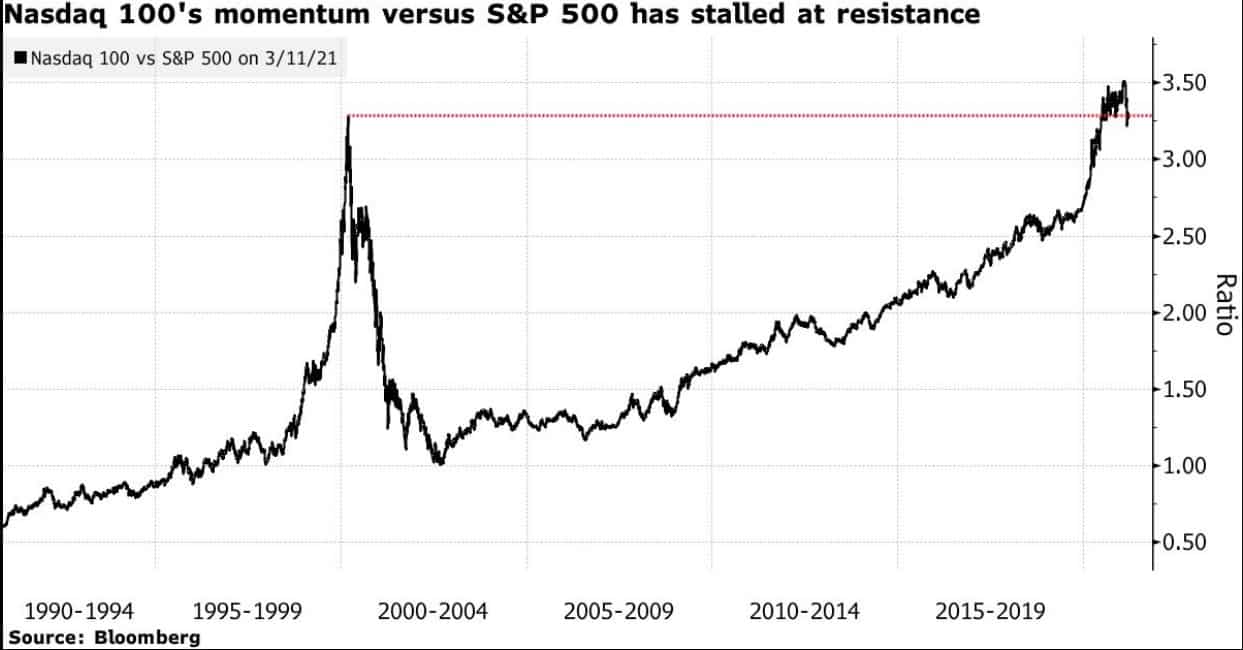
    In another worrying sign, the performance gap between the Nasdaq 100 and the S&P 500 (INDEXSP: .INX) has exceeded that of the tech boom!

    Gap between Nasdaq and S&P500 tech shares

    But what may be bad news for tech shares may be good news for the rest of the market. The S&P 500 didn’t hit its record high until 14 months after the Nasdaq 100 tumbled in March 2000.

    Where to invest $1,000 right now

    When investing expert Scott Phillips has a stock tip, it can pay to listen. After all, the flagship Motley Fool Share Advisor newsletter he has run for more than eight years has provided thousands of paying members with stock picks that have doubled, tripled or even more.*

    Scott just revealed what he believes are the five best ASX stocks for investors to buy right now. These stocks are trading at dirt-cheap prices and Scott thinks they are great buys right now.

    *Returns as of February 15th 2021

    More reading

    Brendon Lau has no position in any of the stocks mentioned. Connect with me on Twitter @brenlau.

    The Motley Fool Australia’s parent company Motley Fool Holdings Inc. owns shares of Pointerra Limited. The Motley Fool Australia has recommended Pointerra Limited. The Motley Fool has a disclosure policy. This article contains general investment advice only (under AFSL 400691). Authorised by Bruce Jackson.

    The post ASX tech shares cowering in shadow of NASDAQ bear market warning appeared first on The Motley Fool Australia.

    from The Motley Fool Australia https://ift.tt/3czqt2y

  • Why the Althea (ASX:AGH) share price is pushing higher today

    marijuana leaf with upward facing arrow

    The Althea Group Holdings Ltd (ASX: AGH) share price is pushing higher on Monday morning.

    At the time of writing, the cannabis company’s shares are up 3% to 53 cents.

    Why is the Althea share price pushing higher?

    Investors have been buying Althea shares this morning after it released a presentation.

    This presentation included details on its European expansion, its growth opportunities, and, unconventionally, a broker recommendation.

    In respect to its European expansion, Althea estimates that it has a 1 billion pound opportunity in the UK market. This is a big positive given that it believes it currently has a 33% market share in the UK.

    In addition, it estimates that the Germany market will be worth 7.7 billion euros by 2028. Positively, last month it made its first shipment into the potentially lucrative market.

    Althea has also been selected to supply the French National Agency for Medicines and Health Products Safety with second-source medicinal cannabis products for its national pilot program. This program is aiming to assess the relevance and feasibility of legalising medicinal cannabis in France.

    If all goes to plan, the company believes the France market could be worth 9.5 billion euros by 2028.

    The rest of the world

    On home soil, management estimates that it has a 25% share of the Australian market. It is forecasting the Oceania market to grow to be worth US$1.55 billion by 2024.

    In Africa, the company is expecting to make its first shipment into the South African market later this year. This market is predicted to be worth US$667 million by 2023.

    Finally, in North America the company’s Peak Processing Solutions business is estimated to have a US$2.7 billion market opportunity.

    Clearly, the company has a lucrative global market opportunity to grow into. However, given the size of the market and the relatively low barriers of entry, competition is likely to grow strongly in the future.

    Nevertheless, that hasn’t stopped analysts at PAC Partners from putting a spec buy and $1.48 price target on the company’s shares.

    According to the presentation, the broker is predicting revenues of $20.5 million in FY 2021 and then $45.1 million in FY 2022.

    Where to invest $1,000 right now

    When investing expert Scott Phillips has a stock tip, it can pay to listen. After all, the flagship Motley Fool Share Advisor newsletter he has run for more than eight years has provided thousands of paying members with stock picks that have doubled, tripled or even more.*

    Scott just revealed what he believes are the five best ASX stocks for investors to buy right now. These stocks are trading at dirt-cheap prices and Scott thinks they are great buys right now.

    *Returns as of February 15th 2021

    More reading

    Motley Fool contributor James Mickleboro has no position in any of the stocks mentioned. The Motley Fool Australia has no position in any of the stocks mentioned. The Motley Fool has a disclosure policy. This article contains general investment advice only (under AFSL 400691). Authorised by Bruce Jackson.

    The post Why the Althea (ASX:AGH) share price is pushing higher today appeared first on The Motley Fool Australia.

    from The Motley Fool Australia https://ift.tt/38ER39w

  • Evolution (ASX:EVN) share price on watch following acquisition

    Mining ASX share price on watch represented by miner making screen with hands

    The Evolution Mining Ltd (ASX: EVN) share price is on watch today after the company announced its acquisition of Battle North Gold Corporation

    What could impact the Evolution share price today?

    The Evolution share price will be in focus this morning after the company advised it is to acquire the Toronto Stock Exchange-listed Battle North Gold Corporation. Battle North is an emerging producer in the renowned Red Lake Gold District in Ontario, Canada. It is focused on developing its Bateman Gold Project which controls the second-largest exploration ground in the district. 

    Evolution has agreed to acquire all of the issued and outstanding shares of Battle North at a price of C$2.65 per common share for a total consideration of approximately C$343 million. 

    Evolution’s executive chairman Jake Klein commented:

    This acquisition provides Evolution with an opportunity to expand our footprint in the region and create value by leveraging the infrastructure of the two operations. The additional processing capacity from the new Bateman mill will also accelerate our ability to achieve our objective of producing in excess of 300,000 ounces of gold per annum from Red Lake…

    This expansion of our footprint will provide us with an opportunity to build on our track record as a safe and sustainable operator for the long term benefit of a broad range of stakeholders including the local workforce, regional communities and our Wabauskang and Lac Seul First Nation Partners.

    The Bateman Gold Project will include a 28,000ha land package that neighbours Evolution’s Red Lake project. It also includes a new 650ktpa mill facility which is currently permitted for 450ktpa of production and expandable to 900ktpa with minimal capital. 

    The feasibility study estimates a mineral reserve of 3.56 million tonnes with grading of 5.54g/t for 635,000 ounces of gold. The project would have an estimated mine life of 8 years with an annual production 74,000 oz at an all-in sustaining costs of US$865 per ounce. 

    Outlook 

    Evolution’s Red Lake project plays a pivotal role in the company’s growth outlook in the short to medium term. On 19 February, Ord Minnett commented that Red Lake was almost entirely responsible for Evolution’s increase in both resources and reserves in its half-year results. The Evolution share price fell by around 8% following the release of the company’s results. 

    Red lake is expected to contribute 125,000 to 135,000 oz to the group’s forecast FY21 guidance of 670,000 to 730,000 oz. The company’s strategic acquisition of the Bateman Gold Project will likely accelerate Evolution’s long-term objective for Red Lake of producing 300,000 to 500,000 ounces per year. 

    Evolution share price snapshot

    Over the past year, the Evolution share price has increased by nearly 18%. However, during the last six months, the company’s shares have fallen by more than 35%. Evolution shares are also down by around 25% year to date.

    Based on the current share price of $3.95, the company has a market capitalisation of around $6.75 billion.

    Where to invest $1,000 right now

    When investing expert Scott Phillips has a stock tip, it can pay to listen. After all, the flagship Motley Fool Share Advisor newsletter he has run for more than eight years has provided thousands of paying members with stock picks that have doubled, tripled or even more.*

    Scott just revealed what he believes are the five best ASX stocks for investors to buy right now. These stocks are trading at dirt-cheap prices and Scott thinks they are great buys right now.

    *Returns as of February 15th 2021

    More reading

    Motley Fool contributor Kerry Sun has no position in any of the stocks mentioned. The Motley Fool Australia has no position in any of the stocks mentioned. The Motley Fool has a disclosure policy. This article contains general investment advice only (under AFSL 400691). Authorised by Bruce Jackson.

    The post Evolution (ASX:EVN) share price on watch following acquisition appeared first on The Motley Fool Australia.

    from The Motley Fool Australia https://ift.tt/3twmdbl

  • ASX quarterly rebalance: HUB24 joins ASX 200, Brainchip into ASX 300

    ASX quarterly rebalance represented by elephant walking a tightrope

    After Friday’s market close, the S&P Dow Jones Indices announced some changes in its quarterly rebalance of the S&P/ASX Indices.

    The updated list could potentially move the prices of some shares as fund managers seek to readjust their portfolios. In addition, exchange-traded funds (EFT’s) will also see changes across the broader indices.

    Here is a brief summary of the most well-known shares on the ASX that were added or removed on the S&P/ASX Indices.

    Australia’s top 100 companies remained stable with no changes to their retrospective benchmark this quarter. However, it was a different story for the remaining indices.

    S&P/ASX 200 Index changes

    The S&P/ASX 200 Index (ASX: XJO) added a few new companies, mostly within the mining sector, as a result of growing consumer confidence. This saw iron ore developer Champion Iron Ltd (ASX: CIA), along with nickel producer Nickel Mines Ltd (ASX: NIC) and lithium miner Pilbara Minerals Ltd (ASX: PLS) added into the benchmark.

    In addition, electronic products company Codan Limited (ASX: CDA) and investment platform provider HUB24 Ltd (ASX: HUB) were also included.

    They replaced Bravura Solutions Ltd (ASX: BVS), Smartgroup Corporation Ltd (ASX: SIQ), Service Stream Limited (ASX: SSM) and Tassal Group Limited (ASX: TGR).

    S&P/ASX 300 Index changes

    There was a number of swaps within the S&P/ASX 300 Index (ASX: XKO), particularly relating to some companies that have taken centre stage recently. The most notable businesses that joined the list were furniture retailer Adairs Ltd (ASX: ADH), artificial intelligence company Brainchip Holdings Ltd (ASX: BRN), and subscription-based meal kit provider Marley Spoon AG (ASX: MMM).

    Leaving the ASX 300 index are ELMO Software Ltd (ASX: ELO), Freedom Foods Group Ltd (ASX: FNP), Kathmandu Holdings Ltd (ASX: KMD), Macmahon Holdings Limited (ASX: MAH), and Superloop Ltd (ASX: SLC) among others.

    What does this mean?

    While the changeover will take place on 22 March 2021, the news could boost or put pressure on the affected shares. Most fund managers are required to adhere to their strict guidelines, which allow them to buy shares only within a certain index. On the other hand, EFTs usually pick up and/or dump the appropriate shares to keep in line with the benchmark.

    Where to invest $1,000 right now

    When investing expert Scott Phillips has a stock tip, it can pay to listen. After all, the flagship Motley Fool Share Advisor newsletter he has run for more than eight years has provided thousands of paying members with stock picks that have doubled, tripled or even more.*

    Scott just revealed what he believes are the five best ASX stocks for investors to buy right now. These stocks are trading at dirt-cheap prices and Scott thinks they are great buys right now.

    *Returns as of February 15th 2021

    More reading

    Aaron Teboneras has no position in any of the stocks mentioned. The Motley Fool Australia’s parent company Motley Fool Holdings Inc. owns shares of and recommends Elmo Software. The Motley Fool Australia’s parent company Motley Fool Holdings Inc. owns shares of Bravura Solutions Ltd, Hub24 Ltd, and SUPERLOOP FPO. The Motley Fool Australia’s parent company Motley Fool Holdings Inc. recommends ADAIRS FPO. The Motley Fool Australia has recommended ADAIRS FPO, Bravura Solutions Ltd, Elmo Software, Freedom Foods Group Limited, Hub24 Ltd, Service Stream Limited, and SMARTGROUP DEF SET. The Motley Fool has a disclosure policy. This article contains general investment advice only (under AFSL 400691). Authorised by Bruce Jackson.

    The post ASX quarterly rebalance: HUB24 joins ASX 200, Brainchip into ASX 300 appeared first on The Motley Fool Australia.

    from The Motley Fool Australia https://ift.tt/38E1avm

  • 2 ASX dividend shares to buy with yields above 4%

    Dividend harvesting

    There are a number of attractive ASX dividend shares that could be worth owning for income in a portfolio that’s looking for dividends.

    One bonus with Australian dividend shares is that the yield can be boosted by franking credits.

    The below two businesses have dividend yields of more than 4%:

    Brickworks Limited (ASX: BKW)

    Brickworks is an ASX dividend share with a grossed-up yield of 4.4%.

    It has a few different divisions that help it generate profit. Brickworks has a large Australian building products division where it’s one of the leading suppliers in the country including bricks and paving, masonry and stone, roofing, specialised building systems and precast.

    Some of the brand names include Austral Bricks, Austral Masonry, Austral Precast, Bristle Roofing and Pronto Panel.

    The Australian building products division is currently going through a recovery period from COVID-19.

    Brickworks also has an emerging US building products division after making a few acquisitions, including Glen Gery. After purchasing these businesses, Brickworks is already the market leader in the north east of the US. It’s looking to make these operations more efficient and profitable.

    The ASX dividend share owns half of an industrial property trust along with Goodman Group (ASX: GMG). The idea is that Brickworks sells excess land into the trust and then Goodman prepares it for an industrial property to be built on it. Getting a high quality tenant is the goal. The trust is building two high-tech warehouses for Amazon and Coles Group Ltd (ASX: COL). On completion, it’s expected to increase the rental profit distributions from the trust to Brickworks by at least 25%.

    The final integral part of Brickworks’ business is the holding of Washington H. Soul Pattinson and Co. Ltd (ASX: SOL) shares. It owns around 40% of the investment conglomerate, which has a diversified portfolio and it’s steadily growing the dividend to Brickworks.

    Brickworks only needs the cashflow from the property trust and Soul Patts to fund its own dividend, which hasn’t been cut in more than four decades.

    Pacific Current Group Ltd (ASX: PAC)

    Broker Ord Minnett likes Pacific Current – it rates it as a buy and has a share price target of $7.60.

    In FY21 the broker is expecting Pacific Current to generate 55.2 cents of earnings per share (EPS), which means it’s valued at 10x FY21’s estimated earnings. It also expects an annual dividend of 40 cents per share, which translates to a grossed-up dividend yield of 10.5%.

    This ASX dividend share invests in fund managers around the world – it helps them grow and benefits from the increase in funds under management (FUM) and management fees.

    Pacific Current’s FY21 half-year result saw management fee revenues grow 10% and operating expenses decline 24%. There was widespread growth, led by fund manager GQG, resulting in a 23.9% FUM increase to $112.8 billion – this represents the total FUM of all boutiques as if they were 100% owned by Pacific Current. The non-Australian dollar denominated FUM saw a 40% increase from June to December.

    It is strategic when adding investments and divesting poor-performing ones. It recently announced an agreement to buy a stake in Astarte, which is a London-based investment manager focused on private markets real asset strategies.

    The half-year dividend of $0.10 per share represented a payout ratio of only 44% from the ASX dividend share, with a target payout ratio of 60% to 80% for the full year.

    These Dividend Stocks Could Be Your Next Cash Kings (FREE REPORT)

    Motley Fool Australia’s Dividend experts recently released a brand-new FREE report revealing 3 dividend stocks with JUICY franked dividends that could keep paying you meaty dividends for years to come.

    Our team of investors think these 3 dividend stocks should be a ‘must consider’ for any savvy dividend investor. But more importantly, could potentially make Australian investors a heap of passive income.

    Don’t miss out! Simply click the link below to grab your free copy and discover these 3 high conviction stocks now.

    Returns As of 15th February 2021

    More reading

    Motley Fool contributor Tristan Harrison owns shares of PACCURRENT FPO and Washington H. Soul Pattinson and Company Limited. The Motley Fool Australia owns shares of and has recommended Washington H. Soul Pattinson and Company Limited. The Motley Fool Australia owns shares of COLESGROUP DEF SET. The Motley Fool has a disclosure policy. This article contains general investment advice only (under AFSL 400691). Authorised by Bruce Jackson.

    The post 2 ASX dividend shares to buy with yields above 4% appeared first on The Motley Fool Australia.

    from The Motley Fool Australia https://ift.tt/3lfWbpG

  • This fundie refuses to invest in gambling and fossil fuels

    Ethical investor and fund manager Jon Fernie

    Ask A Fund Manager

    The Motley Fool chats with fund managers so that you can get an insight into how the professionals think. In this edition, U Ethical portfolio manager Jon Fernie tells how you can make good money while not wrecking the environment or putting up with unethical executives.

    Investment style

    The Motley Fool: What’s your fund’s philosophy?

    Jon Fernie: We’re an ethical fund so we negatively screen out activities that we view as harmful to society or the environment such as gambling or fossil fuels. We also actively look for higher exposure to companies that have a positive impact so that includes healthcare or education. 

    From an investment philosophy perspective, we recognise that equity markets are cyclical and believe that the fundamentals will ultimately drive the performance of stocks. We also aim to deliver non-financial benefits so there’s a focus there on active ownership and engagement with companies on key ethical and ESG [environmental, social and governance] issues.

    From a style perspective, we definitely have a bias more towards quality and large-cap stocks and we aren’t fixated in terms of value versus growth. We’re a long-term focus and have relatively low turnover in the fund as well.

    MF: What’s the typical investment horizon?

    JF: We’re looking at 3 to 5 years as the typical investment horizon.

    MF: A question some people might have about ethically driven funds is: Where do you get your morals from? Because there are grey areas where some parts of the population might think something’s a bit off, and some parts of the population might think it’s okay? 

    JF: It’s a good question. We have an ethical investment policy and that really drives our ethical approach. And everyone will have different values, but it’s becoming more commonly accepted that a lot of funds in the responsible investment space will screen out areas such as armaments, tobacco, et cetera. 

    We have a more stringent policy where we look at things that we deem as harmful to society or the environment. And that is a subjective notion, but we’ve got an investment committee which oversees these decisions, which is part of a subcommittee of our board. And we’re also getting external experts to get their opinions as well.

    MF: How has the fund performed in the past year?

    JF: We’ve been really pleased with the performance over 2020. We were fortunate to be relatively defensively positioned coming into the pandemic and we didn’t own any energy stocks due to our ethical exclusions. As a result, we performed better than the broader market on the initial sell-off. 

    The recovery was pretty rapid and we slightly lagged at the end, but overall we delivered a 5% total return for the year. And that was around about 3% ahead of our benchmark, which is the S&P/ASX 300 Index (ASX: XKO). We were really happy with that outcome, given the volatile conditions.

    MF: Did you manage to free up some cash before everything went downwards in March last year? 

    JF: Yeah, we had slightly higher levels of cash coming into the sell-off. 

    And as I said, some of the stocks that we were holding were reasonably defensive in nature. I mean, we didn’t anticipate the extent of what was going to happen clearly, but I think we were well positioned overall.

    MF: Typically how much cash do you have in hand?

    JF: It varies depending on our view of the market and what we see as the opportunities out there and also how we see valuations in the market. We’ve got a range of 0% to 10%, so it’s not that large.

    MF: What is it at the moment?

    JF: At the moment we’re around about 5%, so we’re fairly neutral in terms of that allocation.

    Buying and selling 

    MF: What do you look at closely when considering buying a stock?

    JF: We look at a range of factors when looking at stocks. 

    Firstly from the ethical perspective, we have a negative screen and that is down to our investable universe. We also look at minimum ESG thresholds as well. 

    From there, we look at a range of financial metrics, including things like return on capital, earnings growth, cash flow, and also balance sheet strength. And then when we look in more detail at companies, we look at qualitative factors like the broader industry growth, macroeconomic conditions, and competitive position. Also, the experience and track record of management teams and boards.

    MF: With the ESG side of things, do you try to give it a numerical score?

    JF: We utilise external providers. So we use MSCI ESG to look at some of the numerical scores, but I guess we also do a qualitative assessment on some of the issues because we realise that you can’t necessarily capture everything in a score. 

    And we do have certain thresholds. So we’re trying to invest in companies that have better and improving ESG ratings. But we’re also looking at issues, which might be a financial or reputational risk to companies, whether that’s around the environment, labour management, or product safety.

    MF: What triggers you to sell a share?

    JF: Yes, similarly, there could be a number of triggers for the selling down holdings. 

    Our exposure in stocks is driven by a combination of the sort of internal rating that we give based on those metrics mentioned before, and also the share price relative to our valuation. 

    So I guess the triggers for selling a share could be a deterioration in the fundamentals of a company that either increases the risk of that stock or leads to us having expectations for lower future earnings cash flow. And/or we might sell down a stock based on valuation grounds — if it’s run too hard, and we think that it’s too expensive. 

    Finally, we may divest holdings based on ethical and ESG factors. If we think that behaviour has been particularly egregious and companies aren’t taking the appropriate actions then we may divest, but generally, we try to engage with companies on these issues to drive better outcomes.

    What’s coming up?

    MF: Where do you think the world is heading at the moment?

    JF: We’re cautiously optimistic on the outlook for markets, but we recognise that there’s a lot of uncertainty given the risks of the economic recovery and the rollout of the vaccine. 

    We had had a really strong reporting season in Australia that was ahead of market expectations, but we’ve also got this fiscal stimulus that’s rolling off in Australia. So we’re cognisant to see what happens on that front. 

    We expect that the Reserve Bank will likely keep interest rates relatively low, but obviously the market’s become more concerned about rising inflation. And I guess that is a risk that you can’t ignore. There are also some risks around the level of debt that has been taken on in the global economy.

    MF: In the past year people have really flocked to ESG-aware companies, like with clean energy and electric car stocks. It’s been a good 12 months, hasn’t it?

    JF: Yeah, I think there have been good flows into ESG and responsible investment funds. I think that we’ve also seen a step up in terms of companies reporting on these issues and engaging with investors on these issues, and I think that we see that performance around a lot of these issues will ultimately be beneficial to stock performance. It often goes hand-in-hand with the good governance of the company and it can give us more faith in the management team.

    Overrated and underrated shares

    MF: What’s your most underrated stock at the moment?

    JF: The stock that we hold that we think looks attractive at the moment is Resmed CDI (ASX: RMD)

    The stock’s pulled back quite a lot over the last 3 months, but they did deliver a very strong half-year result. They continue to gain market share in their device segment. And I think we’ll see improved sales with COVID restrictions easing as well. Longer term they made some large investments in terms of software solutions. That’ll be a good opportunity to grow in earnings in that out-of-hospital care space.

    MF: It would be a growth area, with an aging population?

    JF: Definitely. And I think that they’ve got some good tailwinds and certainly that increase digitalisation of health. I think it’s a longer-term trend as well.

    MF: Has the pullback in the share price just following the general market or has there been a specific reason?

    JF: We see it as unjustified, to the extent, over the last 3 months, it’s down about 15%.

    It’s not a company that necessarily screams out ‘cheap’. But we think that the valuation is justified given the strong growth outlook.

    MF: What do you think is the most overrated stock at the moment?

    JF: We have problems broadly with the buy now, pay later space, which is probably not an uncommon observation. There are some very good companies [in that sector], but there’s going to be increased regulatory focus, we think. 

    There’s also a lot of signs of increased competition, whether that’s from overseas buy now, pay later companies like Klarna, or like Paypal Holdings Inc (NASDAQ: PYPL), [which] has signalled their intent to ramp up in this area.

    MF: Do you have any views on the ESG side of that buy now, pay later sector?

    JF: It’s not an area that we would invest in. I think that we had previously invested in, but we’ve got some concerns over the consumer side and the consumer protections. 

    Looking back

    MF: Which stock are you most proud of from a past purchase?

    JF: We bought A2 Milk Company Ltd (ASX: A2M) back in 2016 at about $2. So that was a stock that we held and returned about 10 times on our initial investment. 

    It’s recently had a large pull back, but we had taken a lot of profits along the way and sold down most of our holdings prior to the large pull backs. 

    MF: Back when it was $2, what sort of signs did you see that made you want to invest into it? Because you mentioned before that predominantly you focused on large cap companies?

    JF: Yeah. Look, we do hold some sort of small and mid cap stocks where we see there are good opportunities. I think that what we liked about A2 Milk was that they had a strong, differentiated brand, they had a good balance sheet, and they were executing well in terms of growing that brand. Also, we saw a fairly strong tailwind, which obviously became more challenging over the last 12 months.

    MF: Is there a move that you regret from the past? For example, a missed opportunity or buying a stock at the wrong timing or price.

    JF: Good question. I think the one stock retreat where we got the timing wrong was investing into Challenger Ltd (ASX: CGF) several years ago when we thought that interest rates were going to move higher. We also thought that there were going to be regulatory changes that would drive underlying demand for annuities. 

    Unfortunately, both those things didn’t happen. And that led to us ultimately exiting the stock at a lower level. So that was probably one investment decision that we regretted.

    MF: You mentioned before you could exit a company because they’ve challenged the ESG side of the equation. Because you filter companies for their ESG values when you’re buying into it, something dramatic must happen for you to exit for that reason — is that right?

    JF: Yeah, generally speaking, it would be something big. 

    [But] as I said, for the most part, we’re not exiting for that reason. We normally try to engage with companies and look to influence change by speaking to management and see that appropriate changes can be made within the company. 

    But I guess if a company bought into a business that we excluded, then that could be a reason. So if someone bought into a large oil and gas business and that hadn’t been their existing business or if there was a major scandal within an organisation, then that might be something that we review. And we want to make sure that, as I said, appropriate changes are made.

    MF: Do you have an example where you had to engage with the company or even exited your holding for an ESG reason?

    JF: We’re regularly engaging with companies. Probably a good example would be that we engaged with Cleanaway Waste Management Ltd (ASX: CWY) by some of the revelations around the CEO’s behaviour. 

    We still hold Cleanaway. There’s obviously been a management change there as well, but we are looking to ensure that they put into place changes around the side of the CEO — certain behaviours that we didn’t like. 

    So we will regularly engage with other companies on issues ranging from environmental issues to modern slavery, also looking at climate action and what companies are doing in terms of reducing their emissions.

    MF: Personally, for yourself, what led you into the ethical investment area?

    JF: It’s an area that aligns well with my beliefs and I think that it’s also an exciting growth area. I think more people are looking at investing through the values lens and want to ensure that they’re not only missing spike returns, but also that they’re not having a negative impact on society or the environment when they’re doing that. 

    It’s an exciting space and I’m sure that we’ll grow further over the next few years.

    MF: I gather the ultimate aim would be for people not to use the term ‘ethical investing’ and it would just be ‘investing’.

    JF: Exactly. Yeah. Ultimately that would be great. As we said, people will have different opinions and different values. So it’s always a little bit subjective.

    Our TOP healthcare stock is trading at a 15% discount to its highs

    If there’s one thing for sure, 2020 was the year we embraced sanitisation. Scott Phillips has discovered a little-known Australian healthcare company could be set to reap the rewards of the post-covid world.

    Better yet, this fast-growing company is currently trading at a 15% discount from its highs. Scott believes in this stock so much, he’s staked $209k of our own company money on it. Forget ‘buy now pay later’, this stock could be the next hot stock on the ASX.

    Scott and his team have published a detailed report on this tiny ASX stock. Find out how you can access our TOP healthcare stock today!

    As of 15.02.2021

    More reading

    Tony Yoo owns shares of A2 Milk and PayPal Holdings. The Motley Fool Australia’s parent company Motley Fool Holdings Inc. owns shares of and recommends PayPal Holdings and recommends the following options: long January 2022 $75 calls on PayPal Holdings. The Motley Fool Australia owns shares of and has recommended A2 Milk and Challenger Limited. The Motley Fool Australia has recommended PayPal Holdings and ResMed Inc. The Motley Fool has a disclosure policy. This article contains general investment advice only (under AFSL 400691). Authorised by Bruce Jackson.

    The post This fundie refuses to invest in gambling and fossil fuels appeared first on The Motley Fool Australia.

    from The Motley Fool Australia https://ift.tt/2OOaR3c