Tag: Motley Fool

  • 2 high quality ETFs for ASX investors to buy in March

    growth exchange traded fund represented by letters ETF on slot machine

    If you’re aiming to add some diversification to your portfolio in March, then you might want to look at exchange traded funds (ETFs).

    This is because they are an easy and effective way to achieve diversification as they give investors access to a large and diverse number of shares through a single investment.

    But which ETFs would be good options? Two to consider are listed below:

    BetaShares Global Cybersecurity ETF (ASX: HACK)

    The first ETF to look at is the BetaShares Global Cybersecurity ETF. It aims to track the performance of an index providing investors with exposure to the leading companies in the growing global cybersecurity sector.

    Given how cyber crime is on the rise, just ask Cann Group (ASX: CAN), demand for cyber security services is growing fast.

    This means many leading companies in the industry could be in a position to grow at an above-average rate over the next decade.

    Among the companies you’ll be investing in with this ETF are Accenture, Cisco, Cloudflare, Crowdstrike, and Okta.

    As you may have noticed, there aren’t any Australian companies. This is because this particular niche is under-represented on the ASX. This arguably makes this ETF even more attractive for local investors.

    Vanguard MSCI Index International Shares ETF (ASX: VGS)

    Another ETF for ASX investors to look at is the Vanguard MSCI Index International Shares ETF. This fund gives investors exposure to some of the world’s biggest companies.

    Vanguard notes that the fund gives investors access to a broadly diversified range of shares that allows them to participate in the long-term growth potential of international economies outside Australia. It feels this makes it suitable for buy and hold investors that are seeking long-term capital growth, some income, and international diversification.

    At present, the fund contains a total of 1,528 listed companies globally. Among its largest holdings you’ll find the likes of Apple, Nestle, Johnson & Johnson, Procter & Gamble, Tesla, Visa. It also offers an attractive 1.8% dividend yield.

    Where to invest $1,000 right now

    When investing expert Scott Phillips has a stock tip, it can pay to listen. After all, the flagship Motley Fool Share Advisor newsletter he has run for more than eight years has provided thousands of paying members with stock picks that have doubled, tripled or even more.*

    Scott just revealed what he believes are the five best ASX stocks for investors to buy right now. These stocks are trading at dirt-cheap prices and Scott thinks they are great buys right now.

    *Returns as of February 15th 2021

    More reading

    Motley Fool contributor James Mickleboro has no position in any of the stocks mentioned. The Motley Fool Australia owns shares of BETA CYBER ETF UNITS. The Motley Fool Australia has recommended Vanguard MSCI Index International Shares ETF. The Motley Fool has a disclosure policy. This article contains general investment advice only (under AFSL 400691). Authorised by Bruce Jackson.

    The post 2 high quality ETFs for ASX investors to buy in March appeared first on The Motley Fool Australia.

    from The Motley Fool Australia https://ift.tt/3uWlSQn

  • 3 reasons why the Bapcor (ASX:BAP) share price could be a buy

    There are a few reasons why the Bapcor Ltd (ASX: BAP) share price could be an interesting idea to some investors at the moment.

    What is Bapcor?

    Bapcor is a leading auto parts business across Australia and New Zealand.

    It has a number of different businesses that service various parts of the auto market. The biggest division is Burson Auto Parts, which supplies parts to mechanic customers. Sometimes the parts can be supplied within two hours. Burson has over 190 stores with more than 800 delivery vehicles.

    Other businesses in the trade segment include Precision Automotive Equipment and BNT.

    Next is a whole range of specialist wholesale businesses that supplies the auto market with a large range of products. Bapcor says that many of these businesses are leaders in their product categories. There’s a long list of names including: AAD, Bearing Wholesalers, Baxters, MTQ, Roadsafe, JAS Oceania, HCB, Diesel Distributors, Federal Batteries, Premier Auto Trade and AADi.

    Bapcor has also made acquisitions relating to truck parts, so it’s also in the light and heavy commercial track space. This division could be helpful for the Bapcor share price and profit over the coming years.

    In the retail space, Bapcor owns the large Autobarn business. It also has service businesses including Midas, ABS, Shock Shop and Battery Town.

    Why could the Bapcor share price be attractive?

    1: Strong results

    A key part of delivering strong returns for shareholders is delivering good financial results. As Benjamin Graham once said, the share market is like a weighing machine.

    Bapcor has been delivering growth for many years and the FY21 half-year result was no exception.

    Revenue grew by 25.8% to $883.6 million. Pro forma earnings before interest, tax, depreciation and amortisation (EBITDA) rose by 36.5% to $145.6 million.

    Bapcor revealed that the trade segment, including Burson, grew revenue by 12.3% with same store sales growth of 11%. It added another nine stores to reach 195 stores nationwide.

    The specialist wholesale division saw organic revenue growth of 17% and organic EBITDA growth of 36.2%. Including Truckline and Diesel Drive, specialist wholesale revenue rose 39.5% and EBITDA grew 54.9%.

    Bapcor’s retail and service division also saw a lot of growth, with revenue rising 44% and EBITDA going up 55.8%. Autobarn same store sales went up 37.1%. Bapcor has been giving trading updates over the last nine months, showing strong retail growth and this has boosted the Bapcor share price. 

    Pro forma earnings before interest and tax (EBIT) went up 45% to $106.8 million and pro forma net profit after tax (NPAT) grew 54% to $70.2 million. Pro forma earnings per share (EPS) grew 28.9% to 20.7 cents.  

    2: Growth into Asia

    The populations of Australia and New Zealand are small compared to Asian countries.

    Bapcor is only just getting started in Asia. At the moment it has six Burson outlets in Thailand. It has a target of more than 80 stores for Thailand, with a turnover target of $100 million. At the moment its turnover is $4 million.

    Bapcor talks about “South East Asia”, not just Thailand, when it comes to growth in the region. There could be other countries to expand into down the line. 

    It will take time for Bapcor to grow its network and profit margins there, but over time it could become a much bigger division.

    Having a strong online offering could also really help things in both Asia and domestically. Bapcor is currently working on a new distribution warehouse in Victoria.

    3: Bapcor share price valuation

    The Bapcor share price has fallen by 14% since 8 February 2021, which is a reasonably large drop over just one month.

    Considering all of the different growth plans that the company has, a lower price could make it more attractive to investors.

    At the current Bapcor share price, it’s valued at 20x FY21’s estimated earnings. It also has a current grossed-up dividend yield of 3.7%.

    Where to invest $1,000 right now

    When investing expert Scott Phillips has a stock tip, it can pay to listen. After all, the flagship Motley Fool Share Advisor newsletter he has run for more than eight years has provided thousands of paying members with stock picks that have doubled, tripled or even more.*

    Scott just revealed what he believes are the five best ASX stocks for investors to buy right now. These stocks are trading at dirt-cheap prices and Scott thinks they are great buys right now.

    *Returns as of February 15th 2021

    More reading

    Motley Fool contributor Tristan Harrison has no position in any of the stocks mentioned. The Motley Fool Australia owns shares of and has recommended Bapcor. The Motley Fool has a disclosure policy. This article contains general investment advice only (under AFSL 400691). Authorised by Bruce Jackson.

    The post 3 reasons why the Bapcor (ASX:BAP) share price could be a buy appeared first on The Motley Fool Australia.

    from The Motley Fool Australia https://ift.tt/3uTEwIM

  • What does the Zip (ASX:Z1P) share price have in store for 2021?

    asx share price to shine in 2021 represented by the numbers 2021 lit up against night sky

    Zip Co Ltd (ASX: Z1P) shares have tumbled 25% from their record all-time high of $14.53 set on 16 February.

    While both the Zip share price and the broader tech sector have taken a beating in recent weeks, here’s what investors can look forward to, according to the company’s half-year results.

    What could impact the Zip share price in 2021?

    Continued momentum in the US 

    According to Zip, its Quadpay acquisition has cemented the company as one of the fastest-growing buy now, pay later (BNPL) players in the United States. The Zip share price surged higher on the day it announced the deal in August last year.

    After the completion of the Quadpay acquisition in August 2020, Zip managed to grow its total transaction volume (TTV) by more than 130% since the completion. The US is also contributing to an increasing share of Zip’s overall performance, from 35% of the group’s TTV in its 1Q21 update to more than 40% of TTV in December. 

    ANZ to continue its strong performance 

    The Australia/New Zealand segment continues to represent a core and reliable region for the company. Zip was able to emerge as Australia’s most downloaded BNPL app in December and January, surpassing its rival Afterpay Ltd (ASX: APT). The company noted that 85% of its customers since September 2019 still have the Zip app. 

    From an engagement perspective, Zip is seeing a continuous year-on-year improvement with new cohorts transacting more frequently, translating to higher revenues per customer. 

    Zip business as an emerging revenue stream 

    While Afterpay might be making an attempt to launch its own banking app, Zip is targeting small businesses with the launch of Zip Trade.

    Zip Trade provides small businesses with enhanced liquidity for everyday purchases and supplies of up to $3,000. The product launched in December with a strong initial uptake providing momentum into the second half. Zip intends to launch Zip Trade+ in 2H, providing SMEs (small to medium enterprises) solutions of up to $150,000. 

    The company is leveraging its partnership with Facebook for access to thousands of SMEs which can choose to advertise now and pay later. 

    UK to scale meaningful revenues 

    Zip officially launched in the United Kingdom in December. According to the company, it hit the ground running with a new mobile app that mirrors Quadpay’s functionality. 

    The UK represents an important growth market that Zip believes has the potential to scale into meaningful revenues for the business. 

    Afterpay, for example, was operational in the UK in late 2018 with its Clearpay app. Its recent 1H FY21 report highlighted the UK’s $800 million, or 8.2% contribution, to group sales, up from $200 million, or 4.2% in 1H FY20. 

    Evaluating strategic expansion options 

    Zip has taken aim at pro-actively exploring the best entry paths into target jurisdictions. The company is currently focusing on the launch of Quadpay in Canada, having mobilised a team to enable a soft launch. 

    Other endeavours include a minority investment in two separate BNPL players in Eastern Europe (Czechia and Poland) and the United Arab Emirates. 

    Foolish takeaway

    According to Zip, it aims to “…do things differently. With a laser focus on relentless product innovation…”. How this strategy, along with the company’s expansion endeavours, will shape the Zip share price moving forward remains to be seen. 

    Where to invest $1,000 right now

    When investing expert Scott Phillips has a stock tip, it can pay to listen. After all, the flagship Motley Fool Share Advisor newsletter he has run for more than eight years has provided thousands of paying members with stock picks that have doubled, tripled or even more.*

    Scott just revealed what he believes are the five best ASX stocks for investors to buy right now. These stocks are trading at dirt-cheap prices and Scott thinks they are great buys right now.

    *Returns as of February 15th 2021

    More reading

    Randi Zuckerberg, a former director of market development and spokeswoman for Facebook and sister to its CEO, Mark Zuckerberg, is a member of The Motley Fool’s board of directors. Kerry Sun has no position in any of the stocks mentioned. The Motley Fool Australia’s parent company Motley Fool Holdings Inc. owns shares of and recommends Facebook. The Motley Fool Australia’s parent company Motley Fool Holdings Inc. owns shares of ZIPCOLTD FPO. The Motley Fool Australia owns shares of AFTERPAY T FPO. The Motley Fool Australia has recommended Facebook. The Motley Fool has a disclosure policy. This article contains general investment advice only (under AFSL 400691). Authorised by Bruce Jackson.

    The post What does the Zip (ASX:Z1P) share price have in store for 2021? appeared first on The Motley Fool Australia.

    from The Motley Fool Australia https://ift.tt/3rjCpfg

  • How to invest in inflation

    A piggy bank attached a bicycle pump floats up, indicating rising inflation

    One of the biggest current threats to the share market seems to be the prospect of rising inflation.

    Investors are nervous because soaring inflation could provoke central banks to raise interest rates.

    Many ASX shares are priced as if rates will stay at the current historic lows, so it’s understandable why some people might be anxious.

    “We’re pretty certain about this. But we’re not absolutely certain about the timing of the inflation,” Nucleus Wealth head of investments Damien Klassen said last week.

    “We are pretty certain that there’ll be inflationary shock where people are going to be pricing in inflation. Over the last few days even, we’ve seen this – it’s gone a bit exponential.”

    Speaking on a on a Nucleus webinar, Klassen and chief strategist David Llewellyn Smith picked out some places to invest in anticipation of inflation:

    Value vs growth shares

    Growth shares benefit the most from low interest rates, as their valuations depend on how cheap future money is. 

    So the most obvious way to invest for inflation is to shift into value stocks

    But once inflation hits the fan, Klassen said keen investors should still keep an eye on growth bargains.

    “You’re going to get these opportunities to buy growth stocks over the next few months or a year or two at a much cheaper price,” he said.

    “Because if we do return to deflation, those growth stocks are once again going to be in demand.”

    The transition away from growth stocks has already happened somewhat in the past couple of weeks. And Klassen expects this to continue for “a few months”.

    He did emphasise that this didn’t mean buying up growth shares indiscriminately when the market is depressed. Purchases still need to be made at a prudent price.

    “Note the Cisco Systems Inc (NASDAQ: CSCO) example I keep trotting out. The last 20 years, they’ve increased their earnings 6 times and their share price has halved,” said Klassen.

    “Because the price was so high to start with in the [1990s] tech boom. So it’s a matter of getting that price right.”

    The Nucleus team, therefore, is buying into value shares now then plan to flip over to growth later in the year, according to Klassen.

    Buy international shares 

    A by-product of the current environment is that the Australian dollar is trading at a high value.

    It surpassed 80 US cents last week after descending to as low as 59 US cents 12 months ago in the midst of the COVID-19 panic.

    “You’re getting chances to buy international stocks at cheaper prices, over the next 6 to 12 months,” said Klassen.

    “If you can buy these with an Aussie dollar at 80 or 85 [US] cents, here’s your chance to start getting exposure to international assets that are going to be very beneficial over the longer term – at a discount.”

    Exceptions to these rules

    Klassen did note some exceptions to the above strategies.

    “There’s ones where we’re reluctant holders,” he said.

    “We’ve got a lot more banks than we’d like to have.”

    He explained that the current environment of emerging inflation and rising long-term bond interest rates is positive for bank profitability.

    But the danger is that deflation will soon take over again and stick around in the long term.

    “If we’re headed towards the European and Japan experience then the banks are really going to be the ones that suffer.”

    Shares associated with commodities also have short term potential but could plunge at any time after inflation arrives.

    “There is a value trade in there but it’s not an infinite value trade. We are concerned about the downside as well as the upside.”

    Man who said buy Kogan shares at $3.63 says buy these 3 ASX stocks now

    When investing expert Scott Phillips has a stock tip, it can pay to listen. After all, the flagship Motley Fool Share Advisor newsletter he has run for more than eight years has provided thousands of paying members with stock picks that have doubled, tripled or even more.*

    In this FREE STOCK REPORT, Scott just revealed what he believes are the 3 ASX stocks for the post COVID world that investors should buy right now while they still can. These stocks are trading at dirt-cheap prices and Scott thinks these could really go gangbusters as we move into ‘the new normal’.

    *Returns as of 15/2/2021

    More reading

    Motley Fool contributor Tony Yoo has no position in any of the stocks mentioned. The Motley Fool Australia has no position in any of the stocks mentioned. The Motley Fool has a disclosure policy. This article contains general investment advice only (under AFSL 400691). Authorised by Bruce Jackson.

    The post How to invest in inflation appeared first on The Motley Fool Australia.

    from The Motley Fool Australia https://ift.tt/38asuBg

  • What you need to know about the WiseTech (ASX:WTC) dividend

    understanding asx share price represented by wise owl wearing glasses

    One company that has continued to bloom in the face of the COVID-19 pandemic is cargo logistics software company WiseTech Global Ltd (ASX: WTC). The WiseTech Global share price has risen by almost 80% in the last 12 months as sales have continued to grow.

    Last month, WiseTech announced a 16% increase to revenue in the first half of the 2021 financial year, driven by higher user numbers as well as price increases. Pleasingly for investors, the strong result also contributed to a big lift in the interim dividend. Here’s what you need to know about the WiseTech dividend.

    What is the company’s dividend yield?

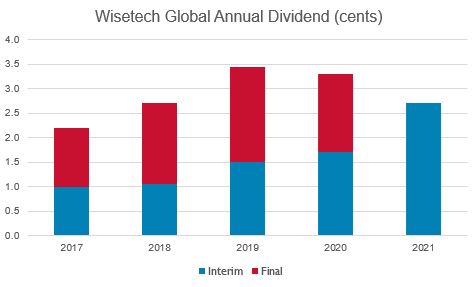
    In its recent half-year results, WiseTech declared an interim dividend of 2.7 cents per share for the six months to 31 December 2020. This was up 59% on the same period in 2019 and gives WiseTech a trailing dividend yield of around 0.15%, fully franked.

    OK, so a 0.15% yield probably isn’t going to send many hearts aflutter. But WiseTech is still in growth mode and is focused on investing most of its earnings back into the business. This has helped to quickly grow earnings over the last few years, which has resulted in a steady lift in the WiseTech share price, as well as its dividend.

    Is the WiseTech dividend growing over time?

    WiseTech only listed on the ASX in 2016, but has been a devout dividend payer since. In the chart below we can see that the company has also been fairly consistent in growing its dividend over time. This is in line with the company’s dividend policy which targets a payout ratio of up to 20% of net profit after tax (NPAT).

    Source: Chart compiled by author using data from WiseTech Global

    A 20% payout ratio leaves the majority of earnings free to be reinvested back into the business. In fact, WiseTech reported spending $159 million on product development in FY20 compared to just $11.1 million on dividends paid to investors.

    When does WiseTech pay its dividend?

    The WiseTech share price will go ex-dividend on Friday 12 March 2021. The ‘ex-date’ is when the shares start selling without the value of their next dividend payment so an investor needs to own the shares before the ex-date to receive the dividend. The dividend will then be paid on Friday 9 April 2021.

    These Dividend Stocks Could Be Your Next Cash Kings (FREE REPORT)

    Motley Fool Australia’s Dividend experts recently released a brand-new FREE report revealing 3 dividend stocks with JUICY franked dividends that could keep paying you meaty dividends for years to come.

    Our team of investors think these 3 dividend stocks should be a ‘must consider’ for any savvy dividend investor. But more importantly, could potentially make Australian investors a heap of passive income.

    Don’t miss out! Simply click the link below to grab your free copy and discover these 3 high conviction stocks now.

    Returns As of 15th February 2021

    More reading

    Motley Fool contributor Regan Pearson has no position in any of the stocks mentioned. You can follow him on Twitter @Regan_Invests. The Motley Fool Australia owns shares of WiseTech Global. The Motley Fool has a disclosure policy. This article contains general investment advice only (under AFSL 400691). Authorised by Bruce Jackson.

    The post What you need to know about the WiseTech (ASX:WTC) dividend appeared first on The Motley Fool Australia.

    from The Motley Fool Australia https://ift.tt/30abgzk

  • 2 high yield and buy-rated ASX dividend shares to snap up

    Happy young man and woman throwing dividend cash into air in front of orange background

    With interest rates and term deposits still at ultra low levels, the share market continues to be the best place to earn a passive income.

    However, with so many dividend shares to choose from, it can be hard to decide which ones to buy. To narrow things down, I’ve picked out two that come highly rated:

    Charter Hall Social Infrastructure REIT (ASX: CQE)

    The Charter Hall Social Infrastructure REIT could be a dividend share to buy. This real estate investment trust has a focus on high quality social infrastructure properties. These are properties with specialist use, limited competition, and low substitution risk. In other words, properties that are likely to remain occupied by their tenants for a very long time.

    In fact, this can be seen in its weighted average lease expiry (WALE). Last month the company released its half year results. As well as reporting a 14.1% increase in operating earnings to $29.1 million, management revealed an occupancy rate of 99.7% and a WALE of 14 years.

    In addition to this, the company increased its FY 2021 distribution guidance to 15.7 cents per unit. Based on the latest Charter Hall Social Infrastructure share price, this represents a 5.25% yield.

    Goldman Sachs was impressed and has put a conviction buy rating and $3.45 price target on its shares.

    Super Retail Group Ltd (ASX: SUL)

    Super Retail is another ASX dividend share that could be in the buy zone. It is the company behind retail store brands BCF, Macpac, Rebel, and the eponymous Super Cheap Auto.

    Like Charter Hall Social Infrastructure, it has been performing positively in FY 2021. Last month Super Retail released its half year results, which revealed a 23% increase in sales to $1.78 billion and a massive 139% increase in underlying net profit after tax to $177.1 million. This was driven by solid growth across the company’s store network and its online businesses.

    This strong performance allowed Super Retail to declare a fully franked dividend of 33 cents per share. 

    Goldman Sachs is also positive on Super Retail and currently has a buy rating and $15.00 price target on its shares. The broker has even suggested that a special dividend could be announced with its full year results, bringing its FY 2021 to a total of 81 cents per share. This represents a fully franked 7.2% yield.

    These Dividend Stocks Could Be Your Next Cash Kings (FREE REPORT)

    Motley Fool Australia’s Dividend experts recently released a brand-new FREE report revealing 3 dividend stocks with JUICY franked dividends that could keep paying you meaty dividends for years to come.

    Our team of investors think these 3 dividend stocks should be a ‘must consider’ for any savvy dividend investor. But more importantly, could potentially make Australian investors a heap of passive income.

    Don’t miss out! Simply click the link below to grab your free copy and discover these 3 high conviction stocks now.

    Returns As of 15th February 2021

    More reading

    Motley Fool contributor James Mickleboro has no position in any of the stocks mentioned. The Motley Fool Australia owns shares of and has recommended Super Retail Group Limited. The Motley Fool has a disclosure policy. This article contains general investment advice only (under AFSL 400691). Authorised by Bruce Jackson.

    The post 2 high yield and buy-rated ASX dividend shares to snap up appeared first on The Motley Fool Australia.

    from The Motley Fool Australia https://ift.tt/2OsjHDK

  • 5 things to watch on the ASX 200 on Friday

    watch broker buy

    On Thursday the S&P/ASX 200 Index (ASX: XJO) was out of form and sank lower again. The benchmark index dropped 0.85% to 6,760.7 points.

    Will the market be able to bounce back from this on Friday? Here are five things to watch:

    ASX 200 to fall again

    It looks set to be a disappointing finish to the week for the ASX 200 on Friday. According to the latest SPI futures, the ASX 200 is poised to open the day 9 points or 0.1% lower. In late trade on Wall Street, all three major indices are deep in the red. The Dow Jones is down 1.5%, the S&P 500 is 1.8% lower, and the Nasdaq index has fallen 2.5%.

    Tech shares on watch

    Australian tech shares such as Afterpay Ltd (ASX: APT) and WiseTech Global Ltd (ASX: WTC) could come under pressure again today. This follows a very poor night of trade for their US counterparts on the tech-focused Nasdaq index. Once again, a rise in bond yields has spooked investors and sent tech stocks plummeting.

    Oil prices jump

    Energy producers such as Oil Search Ltd (ASX: OSH) and Woodside Petroleum Limited (ASX: WPL) could end the week strongly after oil prices jumped. According to Bloomberg, the WTI crude oil price is up 4.1% to US$63.78 a barrel and the Brent crude oil price has stormed 4.1% to US$66.68 a barrel. Traders were buying oil after OPEC+ decided to maintain its production cuts.

    Gold price falls

    Gold miners Northern Star Resources Ltd (ASX: NST) and St Barbara Ltd (ASX: SBM) could tumble today after the gold price continued to weaken. According to CNBC, the spot gold price is down 1.3% to US$1,693.60 an ounce. Rising bond yields are weighing on the safe haven asset.

    Shares going ex-dividend

    Another group of shares are going ex-dividend this morning and are likely to trade lower. In respect to ASX 200 shares, fuel retailer Ampol Ltd (ASX: ALD) and scrap metal company Sims Ltd (ASX: SGM) are going ex-div. Ampol will then be paying its shareholders a 23 cents per share fully franked dividend on 1 April, whereas Sims shareholders will receive its fully franked 12 cents per share dividend on 23 March.

    Where to invest $1,000 right now

    When investing expert Scott Phillips has a stock tip, it can pay to listen. After all, the flagship Motley Fool Share Advisor newsletter he has run for more than eight years has provided thousands of paying members with stock picks that have doubled, tripled or even more.*

    Scott just revealed what he believes are the five best ASX stocks for investors to buy right now. These stocks are trading at dirt-cheap prices and Scott thinks they are great buys right now.

    *Returns as of February 15th 2021

    More reading

    Motley Fool contributor James Mickleboro has no position in any of the stocks mentioned. The Motley Fool Australia owns shares of AFTERPAY T FPO and WiseTech Global. The Motley Fool has a disclosure policy. This article contains general investment advice only (under AFSL 400691). Authorised by Bruce Jackson.

    The post 5 things to watch on the ASX 200 on Friday appeared first on The Motley Fool Australia.

    from The Motley Fool Australia https://ift.tt/3sScaNs

  • This investment is one of Warren Buffett’s favourite share ideas

    australian and american flags on boardroom table

    Warren Buffett is one of the wisest investors that the world has ever seen. He has some good advice for a lot of people when it comes to investing: go for an S&P 500 fund.

    Mr Buffett has said and done a number of things that show he’s a big believer in S&P 500 funds.

    He reportedly said to Jack Bogle, founder of Vanguard:

    A low-cost index fund is the most sensible equity investment for the great majority of investors. By periodically investing in an index fund, the know-nothing investor can actually out-perform most investment professionals.

    My Motley Fool colleague, Keith Speights, also pointed out that over a decade ago Mr Buffett bet $1 million that a S&P 500 fund would outperform a group of hedge funds over a decade. He was right – the S&P 500 fund won by an average of almost 5% per annum to the end of the bet in 2018.

    He has also instructed in his will that 90% of his money should be invested in a S&P 500 fund. Fees is an important reason why the S&P 500 fund can outperform expensive managers.

    What is iShares S&P 500 ETF?

    This investment is an exchange-traded fund (ETF) that tracks the S&P 500 for investors. It’s offered by Blackrock, the company behind iShares.

    The ETF is domiciled in Australia, which means that there’s no need to do US tax forms called W-8BEN forms.

    iShares S&P 500 ETF gives exposure to many of the largest and most profitable businesses in the United States. Whilst these businesses are listed in the US, many of them generate earnings from across the world, making them well diversified.

    Blackrock says that this investment is good to “use to diversify internationally and seek long-term growth opportunities in your portfolio”.

    Looking at the iShares S&P 500 ETF’s largest holdings, its biggest positions are: Apple, Microsoft, Amazon, Alphabet, Facebook, Tesla, Berkshire Hathaway, JPMorgan Chase and Johnson & Johnson.

    As you look further down the list, there are many more recognisable names such as Visa, Walt Disney, Nvidia, Mastercard, PayPal, Procter & Gamble, Home Depot, Bank of America, Intel, Netflix, Exxon Mobil, Adobe and Salesforce. The list of quality names goes on and on.

    For Aussies, this is one of the cheapest ETFs that is available on the ASX. It has an annual management fee of just 0.04% per annum. That means almost all of the gross returns become net returns for investors – not much is eaten away in fees.

    Over the last decade, iShares S&P 500 ETF has delivered an average net return per annum of 16.4%, which is much stronger than what the S&P/ASX 200 Index (ASX: XJO) has generated because the share prices of the big banks and BHP Group Ltd (ASX: BHP) haven’t done much during that time.

    One benefit of thinking about the iShares S&P 500 ETF right now is that the Australian dollar is stronger than it has been over the last couple of years compared to the American dollar. Right now, AU$1 is worth US$0.78. This means it’s cheaper to buy American assets, like a S&P 500 fund.

    Where to invest $1,000 right now

    When investing expert Scott Phillips has a stock tip, it can pay to listen. After all, the flagship Motley Fool Share Advisor newsletter he has run for more than eight years has provided thousands of paying members with stock picks that have doubled, tripled or even more.*

    Scott just revealed what he believes are the five best ASX stocks for investors to buy right now. These stocks are trading at dirt-cheap prices and Scott thinks they are great buys right now.

    *Returns as of February 15th 2021

    More reading

    Motley Fool contributor Tristan Harrison has no position in any of the stocks mentioned. The Motley Fool Australia has recommended iShares Trust – iShares Core S&P 500 ETF. The Motley Fool has a disclosure policy. This article contains general investment advice only (under AFSL 400691). Authorised by Bruce Jackson.

    The post This investment is one of Warren Buffett’s favourite share ideas appeared first on The Motley Fool Australia.

    from The Motley Fool Australia https://ift.tt/2MSOQ2I

  • Get your pitchforks ready…

    cartoon of angry mob charging forward with pitchforks

    As I type these words, I’m mentally preparing for the backlash.

    I know, because my Twitter feed kinda got busy on Monday night and Tuesday, when I expressed the sentiments I’m about to express, below.

    Attacking ‘sacred cows’ is a dangerous business.

    But attacking new sacred cows is just outright asking for it.

    Like the new religious convert or the reformed gambler, none are quite so strident as those with a new cause to believe in.

    It spawned the multi-purpose joke “How do you know someone is a [insert cause here]? Don’t worry, they’ll tell you!”

    It is, of course, a gross generalisation, but it’s also true that my social media accounts get most animated when I dare express a different opinion to those new converts.

    And to be fair, most of them are kind, polite people, expressing a deeply held conviction. A few are a little over the top, but that’s a pretty good ratio on social media these days!

    With that out of the way, and with my stackhat firmly clipped under my chin, let’s get on with it…

    See, there was a time, not too many decades ago, when running a balanced budget, every year, was the done thing.

    Then, some time later (largely as a consequence of the Great Depression and the evolution of economic thinking), the idea of running budget deficits in the bad times and surpluses in the good times was born.

    (For the record, it’s known as  ‘Keynesian economics’, named after famed economist John Maynard Keynes.)

    Which makes sense, right — you collect a surplus of metaphorical nuts in the good times, preparing for the time when nuts will be scarce and you’ll collect less than you need to eat, dipping into your stockpile.

    Over the long term, our metaphorical squirrel collects only as many nuts as she’ll need — but the timing of the collection and the consumption shifts to allow for the reality.

    So, instead of a balanced budget every year, it’s balanced ‘over the cycle’, in boffin-speak.

    And that has remained the orthodoxy ever since.

    An orthodoxy I agree with, by the way — it makes perfect sense for the government to step in, like it has during COVID, to minimise the pain for the economy as a whole, and for individuals in particular.

    Without government support, it seems inevitable that unemployment, which thus far has peaked at 7.5% in July 2020 and has since come down to 6.4%, would have hit maybe 11 or 12% (and some predicted it could end up nearer to 20%!), and would have stayed high a helluva long longer than it has.

    It’s not just in a crisis though. In more normal times, this ‘Keynesian’ budget management usually works in similar, if less extreme ways.

    When the economy is doing it tough, tax revenues (from income tax and company tax, in particular) tend to fall, and welfare payments (unemployment benefits) rise. Less revenue and more payments tend to result in a budget deficit.

    In the better times, tax revenue rises as companies make more, and more people are employed (and paying tax) while unemployment benefits naturally fall.

    For most of you, this is super-obvious, so long has it been part of our economic lives. 

    And… spoiler alert: It works really well.

    (We had that lesson reinforced in the aftermath of the GFC, when some countries went for ‘austerity’ while others opted for ‘stimulus’. The austerity countries are largely still digging themselves out of that hole, more than a decade later.)

    So far, none of this is controversial (other than for a few of you who are already bristling. We’ll get to you in a minute.).

    Now, in 2020, the federal government threw the kitchen sink at the economy, in hopes of either staving off recession (unlikely) or moderating its length and severity.

    The result was an enormous success, as I mentioned earlier. Some of the programs (I’m looking at you, Early Access to Superannuation) were a complete debacle and woefully counterproductive to long-term wealth, but the vast bulk was spot on.

    (We can complain about some of the details of some of the other policies, but the government — correctly — chose ‘fast and ugly’ over ‘glacial and perfect’. The latter would have been a disaster.)

    The problem with throwing a kitchen sink at something is that, even if it’s warranted, someone has to clean up the resulting mess.

    In national debt terms, here’s how the ABC described the likely impact of the stimulus:

    “In December [2019]… Australia’s net debt position … was estimated to be peaking at $392.3 billion in 2019-20, before slowly reducing in size.”

    “Treasury is forecasting Australia’s net debt position will be $703.2 billion for 2020-21 (meaning a net debt-to-GDP ratio of 36.1 per cent).”

    “And that debt will increase to $966.2 billion in 2023-24 (to a net debt-to-GDP ratio of 43.8 per cent).”

    And according to the Canberra Times:

    “…the Parliamentary Budget Office predicted net debt could reach between 14 and 24 per cent of GDP by the end of the decade – up to $800 billion higher than it would have been otherwise.”

    I have no problem, at all, with those numbers.

    In the event, some of the stimulus will turn out to have been too much, and too little in other areas, a post-match review will show us what we can do better next time. But, overall, they got it roughly right, given the speed at which the stimulus was needed, and provided.

    But now, it’s time to clean up the resulting mess.

    Historically, this level of debt is not unprecedented, at least relative to GDP. The most striking example is in the immediate aftermath of World War II. 

    Back then, it hit 120% of GDP.

    The ‘don’t worry’ crowd point to that example and say ‘Who cares about the debt? We’ll just grow fast and/or inflate it away’ (rising prices and incomes make historical ‘fixed’ debt easier to service.)

    They might be right.

    But if they’re not?

    If the Australian economy of the 2020s and 2030s isn’t like that of the 1940s and 1950s?

    Then we’re going to leave our kids with a shedload of debt.

    Given we incurred the debt to save ourselves from a 2020 problem, (and if the ‘growth will fix it’ view is wrong) is it really right to burden future generations with its cost?

    Is it fair to roll those dice on their behalf?

    I am very sure (though never certain — that’s for the ideologues) that the answer should be a firm ‘no’.

    We took the medicine. We benefitted from it. We created the after-effects.

    (And yes, if that also sounds like what we’ve done to the climate, you’re right. But that’s a topic for another day.)

    We owe more to our kids and grandkids, in my opinion than to say:

    ‘Look, hopefully growth and/or inflation will come. If not, sorry. You’re on your own.’

    (There is no small irony that many of the ‘don’t worry’ group are the same people blaming their own forebears for some of today’s problems. I’m not saying it’s hypocritical — after all, they might be right — but there is a decent risk of history repeating itself.)

    I don’t doubt those people’s sincerity. At all.

    I’m just saying that I think it’s a risk that, in all good conscience, we shouldn’t take on our kids’ and grandkids’ behalf.

    We wanted the government to spend up to help us. 

    We should be prepared to pay for it.

    No, not right away. And not in full, too quickly.

    But, as it stands, we’re trying to have our cake and eat it too — deficits in the bad times and, well, deficits in the good times, as well.

    Now, to the objections.

    Yes, governments can run essentially endless debts. Governments aren’t the same as households, after all. But the costs, then, are also endless. Happy inheritance, kids.

    Yes, growth and/or inflation might take care of some, or even much of the debt. But, to torture my metaphor, what happens next time we need to throw the kitchen sink at an economic problem, but we had left it in pieces on the floor? Or, to switch metaphors, if we don’t refill the ammo cupboard, there won’t be anything there next time we need it. 

    The metaphor is imperfect, of course — I have no doubt we could take on more debt if we needed to. But there is a limit, and each time we add to our debt, we reduce the ability of Australians, at some future point, to do the same.

    And then there’s the MMT thing. Modern Monetary Theory. Its adherents are the converts I mentioned at the top.

    Maybe they’re right. Maybe there’s no limit to how much debt we can run. But, like the ‘let’s let growth take care of it’ lot, it’s a helluva risk to take. If they’re wrong (and I think they are, but I remain open to being convinced), we won’t just be replacing the kitchen sink, but probably the whole house. The economic and social impacts of reversing course on that could be awful and long lasting.

    Here’s the bottom line:

    I reckon we, as a society and individuals, owe it to future generations to at the very, VERY least, leave the place no worse than we found it. Ideally, we should be seeking to leave it in a better state.

    That means not playing Russian Roulette with the economy, and with the level of national debt. It means being thankful for the stimulus, but also committed to paying back the good fortune when we’re able.

    No, austerity isn’t the answer. And paying it back with undue haste would risk undoing the very recovery we’re enjoying.

    But, as a decent society, we should make sure that we are the ones paying back the obligations we incurred, as we can afford to, rather than rolling some dice, the result of which won’t be known until it’s too late to make good on the potential mistake.

    It’s just the right thing to do.

    Fool on!

    Where to invest $1,000 right now

    When investing expert Scott Phillips has a stock tip, it can pay to listen. After all, the flagship Motley Fool Share Advisor newsletter he has run for more than eight years has provided thousands of paying members with stock picks that have doubled, tripled or even more.*

    Scott just revealed what he believes are the five best ASX stocks for investors to buy right now. These stocks are trading at dirt-cheap prices and Scott thinks they are great buys right now.

    *Returns as of February 15th 2021

    More reading

    Scott Phillips has no position in any of the stocks mentioned. The Motley Fool Australia’s parent company Motley Fool Holdings Inc. owns shares of and recommends Twitter. The Motley Fool Australia has no position in any of the stocks mentioned. The Motley Fool has a disclosure policy. This article contains general investment advice only (under AFSL 400691). Authorised by Bruce Jackson.

    The post Get your pitchforks ready… appeared first on The Motley Fool Australia.

    from The Motley Fool Australia https://ift.tt/2MLxwN1

  • The simple yet incredibly effective way to generate term-deposit busting income from just one quoted ASX fund

    one asx share represented by a hand holding up one finger

    With the RBA cash rate set at just 0.10%, and according to RBA governor Philip Lowe, staying at that low level until 2024 at the earliest, earning a decent income from bank term deposits is impossible.

    I am routinely asked for alternative investment opportunities to letting your money effectively rot in the bank. 

    I’m a stock market person, so will focus on using shares and funds as an alternative.

    There are other alternatives, including investment properties, although I will note, like shares, they do involve a level of risk, including debt financing, vacant rental periods, rates, insurance, maintenance costs, not forgetting house prices can go down as well as up!

    Back to shares, and some ground rules for this strategy…

    History has shown the odds of a positive capital return from the stock market dramatically increase the longer the holding period. So before even considering moving money from the safety of a term deposit to shares, do so only with money you do not need to touch for at least five years, ideally longer.

    Commit now to not selling stock market investments during periods of extreme volatility, no matter how scary they may be. Similarly, in a rising market, unless you need the money, resist the urge to sell simply to lock in a profit. 

    Diversification is absolutely critical. You can achieve that by investing in 20 to 30 individual stocks, or by investing in a few diversified managed funds and/or exchange-traded funds (ETFs).

    Unlike term deposits, your capital is at risk when invested in shares. But the longer you extend your investing timeline, the better your chances of capital appreciation.

    With all that said, my simple yet incredibly effective way to generate term-deposit busting income from the stock market is to buy one quoted fund, my choice being the Vanguard Australian Shares High Yield ETF (ASX: VHY)

    The ETF invests in many of Australia’s largest quoted companies, its three largest positions being ASX 200 stalwarts BHP Group Ltd (ASX: BHP), Commonwealth Bank of Australia (ASX: CBA) and Wesfarmers Ltd (ASX: WES).

    According to the ASX website, the ETF pays quarterly distributions, and yields, on an annual basis, 2.94%. The level of franking credits will vary, but currently stand at 92%, so its distributions are not far off being fully franked.

    According to the Vanguard website, over the past five years, the EFT has delivered a total return of 8.5% per annum.

    Why the Vanguard Australian Shares High Yield ETF? 

    1. Management fees are low at just 0.25%.

    2. Historically, the fund largely tracks the return of its benchmark. Because it invests in a diversified portfolio of some of Australia’s largest blue-chip stocks, it is less risky and requires less maintenance than investing in individual shares.

    3. For income-focused investors, quarterly franked distributions are attractive.

    4. Pay $0 brokerage when buying ETFs using online broker Superhero.

     A 2.94% yield may not sound overly attractive, especially given the additional risk you are taking investing in shares versus a no-risk term deposit. 

    But, when you take into account the franking credits, the grossed-up yield from the distributions increases to 4.1%, something that compares favourably to “the good old days” when term deposits might have earned 5%, before tax. 

    If all goes to plan, a $100,000 investment would generate around $3,000 income per annum, and in five years time, assuming capital appreciation of say 5% per annum, the initial investment would be worth around $125,000. 

    What could go wrong? 

    1. Capital loss. Even after 5 years, there’s a chance the stock market, and therefore the Vanguard Australian Shares High Yield ETF, could be trading lower than today.

    2. You find you do need the money and have to sell at a time when the stock market has fallen sharply lower, therefore locking in a capital loss that would likely far exceed the income generated.

    3. If you subscribe to the minimum 5-year investment horizon, even though you can sell the ETF at any time, you have locked up your cash for a long period of time.

    One other investment option for income hungry investors would be a Listed Investment Company (LIC) like WAM Capital (ASX: WAM). The LIC trades on a fully franked dividend yield of almost 7%. Dividends are paid twice per year.

    Over the past 5 years, the investment portfolio performance of WAM Capital is almost 11% per annum. WAM Capital invests in a diversified portfolio of smaller companies than the Vanguard Australian Shares High Yield ETF, including Bega Cheese Ltd (ASX: BGA), Seven West Media Ltd (ASX: SWM) and Inghams Group Ltd (ASX: ING). The chief investment officer is industry veteran Geoff Wilson. 

    These Dividend Stocks Could Be Your Next Cash Kings (FREE REPORT)

    Motley Fool Australia’s Dividend experts recently released a brand-new FREE report revealing 3 dividend stocks with JUICY franked dividends that could keep paying you meaty dividends for years to come.

    Our team of investors think these 3 dividend stocks should be a ‘must consider’ for any savvy dividend investor. But more importantly, could potentially make Australian investors a heap of passive income.

    Don’t miss out! Simply click the link below to grab your free copy and discover these 3 high conviction stocks now.

    Returns As of 15th February 2021

    More reading

    The Motley Fool Australia owns shares of Wesfarmers Limited. The Motley Fool has a disclosure policy. This article contains general investment advice only (under AFSL 400691). Authorised by Bruce Jackson.

    The post The simple yet incredibly effective way to generate term-deposit busting income from just one quoted ASX fund appeared first on The Motley Fool Australia.

    from The Motley Fool Australia https://ift.tt/3sOKp8o