Tag: Motley Fool

  • Why the Ioneer (ASX:INR) share price is in limbo today

    A man on a phone call points his finger, indicating a halt in trading on the ASX share market

    The Ioneer Ltd (ASX: INR) share price is in limbo today after the company asked for a trading halt pending an announcement.

    At yesterday’s market close, the Ioneer share price was trading at 44 cents. 

    The trading halt will conclude on Friday 5 March or once the announcement is released to the market.

    Ioneer positions for capital raising

    The mineral exploration company today advised that it is positioning to release a capital raising announcement. 

    This follows its 16 February announcement that it had joined forces with construction giant Caterpillar Inc (NYSE: CAT). 

    Caterpillar is one of the world’s largest construction and mining equipment manufacturers.

    The 2 companies entered a memorandum of understanding (MoU) that Ioneer will use Caterpillar’s Cat® Command for hauling, Autonomous Haul System (AHS). This will improve operator safety, equipment utilisation
    and site productivity.

    The company will use AHS at its Rhyolite Ridge lithium-boron project based in Nevada, US – the first greenfield operation to use the system in North America.

    Starting in 2023, Ioneer will initiate operations with a fleet of Cat® 785 Next Generation trucks equipped with Cat® Command.

    With the truck purchase in sight, Ioneer seems on the move to have the funds in place in order to take the next steps.

    What else is coming up for Ioneer?

    According to Ioneer’s December quarterly update, the company is continuing its engineering efforts at the Rhyolite Ridge project. In addition, negotiations are underway for the first lithium offtake sales.

    The update concluded that looking ahead, Ioneer would be, “further advancing strategic partnering and financing process through continued technical and financial discussions”.

    The forthcoming capital raising announcement will provide more colour to the market about how these activities are being carried out.

    Ioneer share price snapshot

    The Ioneer share price has rocketed 319% over the past 6 months.

    Ioneer has a market capitalisation of $733.4 million, and there are presently 1.7 billion shares outstanding.

    Where to invest $1,000 right now

    When investing expert Scott Phillips has a stock tip, it can pay to listen. After all, the flagship Motley Fool Share Advisor newsletter he has run for more than eight years has provided thousands of paying members with stock picks that have doubled, tripled or even more.*

    Scott just revealed what he believes are the five best ASX stocks for investors to buy right now. These stocks are trading at dirt-cheap prices and Scott thinks they are great buys right now.

    *Returns as of February 15th 2021

    More reading

    Motley Fool contributor Gretchen Kennedy has no position in any of the stocks mentioned. The Motley Fool Australia has no position in any of the stocks mentioned. The Motley Fool has a disclosure policy. This article contains general investment advice only (under AFSL 400691). Authorised by Bruce Jackson.

    The post Why the Ioneer (ASX:INR) share price is in limbo today appeared first on The Motley Fool Australia.

    from The Motley Fool Australia https://ift.tt/385KkoH

  • Better Buy: Netflix vs. AT&T

    This article was originally published on Fool.com. All figures quoted in US dollars unless otherwise stated.

    Globe covered in TV screens

    This article was originally published on Fool.com. All figures quoted in US dollars unless otherwise stated.

    AT&T (NYSE: T) took on Netflix (NASDAQ: NFLX) and other video streaming rivals with the launch of its HBO Max service last year. But any comparison between Netflix and AT&T requires a look into how AT&T’s streaming service fits into its larger telecom business.

    Through this lens, is AT&T a better stock buy than Netflix? Here’s how the telecom titan stacks up against the streaming entertainment pioneer.

    AT&T’s strategy

    Despite HBO Max, AT&T’s key competitors aren’t the likes of Netflix; they’re telecom rivals like Verizon Communications.

    With the U.S. telecommunications market at a saturation point, AT&T and its competitors are forced to snatch customers from one another to grow subscribers. Holding on to its customers is AT&T’s top priority, and as CEO John Stankey said, “HBO Max is the key here.”

    By bundling telecom services with HBO Max, AT&T hopes to retain customers while enabling the company to capture a higher average subscription price. To this end, AT&T shook up the entertainment industry last December by announcing plans to release its WarnerMedia-produced theatrical film slate to HBO Max at the same time it releases them to theaters in 2021.

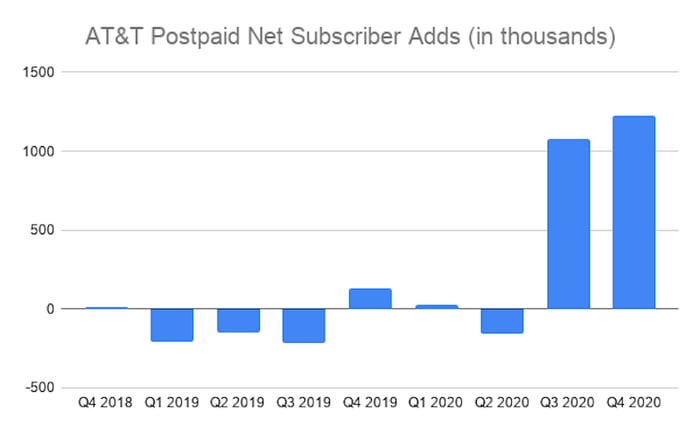
    Its fourth-quarter results suggest the strategy is having an impact. AT&T experienced growth in postpaid subscribers, the telecom industry’s most valued customers, for the second quarter in a row. AT&T added 1.2 million postpaid customers, the highest net adds in some time.

    Chart showing postpaid net subscriber additions over time.


    Data source: AT&T. 

    It combined this growth with the second-lowest quarter of postpaid phone churn in the company’s history. It also doubled the number of fourth-quarter HBO Max subscriptions over the previous quarter.

    But despite these promising trends, AT&T has struggled since the pandemic struck. The company’s 2020 full-year revenue dropped to $171.8 billion from 2019’s $181.2 billion.

    The diminished revenue hurt the company’s efforts to pay down a massive debt load accumulated to acquire Time Warner (which included HBO) and DIRECTV. The latter is like an anchor dragging on AT&T’s operations as the service bleeds subscribers.

    The financial impact was perhaps most apparent when the company failed to raise its dividend in 2020 after 36 consecutive years of dividend increases. Its high-yield dividend is one of the key reasons investors are attracted to the stock.

    Netflix’s success

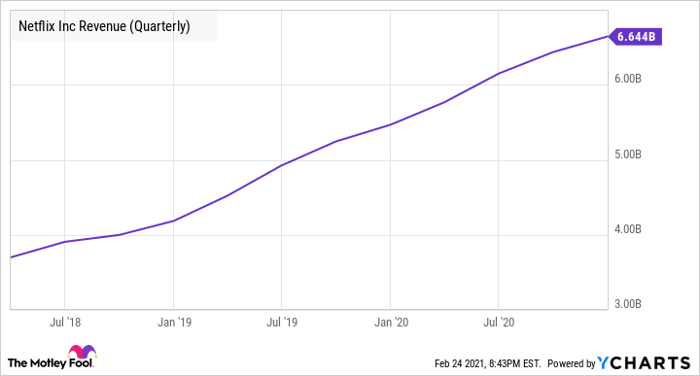
    Netflix helped pioneer streaming video entertainment, allowing it to ride a rocket ship of revenue growth spanning years.

    NFLX Revenue (Quarterly) Chart

    Data by YCharts.

    The trend continued through the company’s most recent quarter. Netflix enjoyed a strong fourth quarter, with paid subscription memberships rising 21.9% year over year.

    The company anticipates continued membership growth in the first quarter, rising to 209.7 million subscribers from the previous quarter’s 203.7 million. Netflix also expects first-quarter revenue to reach $7.1 billion, up 23.6% from last year.

    Membership growth was helped by pandemic-induced stay-at-home restrictions, but when you dig into the numbers, it’s also the result of a successful strategy. Netflix invested in content attractive to an international audience. The company developed original programming in German, Korean, Spanish, and other languages.

    As a result, Netflix’s member growth was powered by international adoption. Of its 2020 net additional memberships, 83% came from markets outside North America. Even better, these local titles also possess global appeal. Its French-language heist series Lupin was a hit around the world, ranking second in Netflix’s top 10 in the U.S.

    This strategy bodes well for its ability to continue capturing subscriber growth and revenue. Moreover, CFO Spencer Neumann indicated the company turned a corner and expects to break even on a cash flow basis this year and be cash flow positive from 2022 onward.

    Despite the successful strategy, Netflix lost market share as more competitors entered the fray. As co-CEO and chief content officer Ted Sarandos says, people have tremendous appetites for great entertainment and are willing to pay for more than one streaming service to get the content they want.

    The final verdict

    At this point, Netflix is the better buy. Its consistent revenue and subscriber growth, steady path toward being cash flow positive next year, and resilience in the face of fierce competition are all factors making it a justified part of the FAANG gang.

    AT&T, meanwhile, must spend years reducing its debt. This and its substantial dividend payouts, totaling nearly $15 billion in 2020, hamper the company’s ability to invest in its business.

    So for now, Netflix is the clear winner in this comparison.

    This article was originally published on Fool.com. All figures quoted in US dollars unless otherwise stated.

    Where to invest $1,000 right now

    When investing expert Scott Phillips has a stock tip, it can pay to listen. After all, the flagship Motley Fool Share Advisor newsletter he has run for more than eight years has provided thousands of paying members with stock picks that have doubled, tripled or even more.*

    Scott just revealed what he believes are the five best ASX stocks for investors to buy right now. These stocks are trading at dirt-cheap prices and Scott thinks they are great buys right now.

    *Returns as of February 15th 2021

    More reading

    Robert Izquierdo owns shares of AT&T. The Motley Fool Australia’s parent company Motley Fool Holdings Inc. owns shares of and recommends Netflix. The Motley Fool Australia has recommended Netflix. The Motley Fool has a disclosure policy. This article contains general investment advice only (under AFSL 400691). Authorised by Bruce Jackson.

    The post Better Buy: Netflix vs. AT&T appeared first on The Motley Fool Australia.

    This article was originally published on Fool.com. All figures quoted in US dollars unless otherwise stated.

    from The Motley Fool Australia https://ift.tt/3kM3a9B

  • These ASX 200 shares are trading at near 52-week highs

    woman throwing arms up in celebration whilst looking at asx share price rise on laptop computer

    Rising bond yields have triggered much of the market’s recent volatility and weakness across tech and growth-related sectors. At the moment it feels like the market’s taking one step forward and one step back. However, these ASX 200 shares are seemingly unphased by potentially higher interest rates and making new highs.

    ASX 200 shares making 52-week highs 

    Australia and New Zealand Banking Group Ltd (ASX: ANZ) 

    The ANZ share price has clawed its way back to pre-COVID levels. The gruelling COVID sell-off saw the ANZ share price lose 48% of its value between 21 February and 23 March last year. To recoup those losses, the ANZ share price has almost doubled in just one year. 

    Bank’s earnings during the February reporting season was solid.  Citi Bank cited that revenue grew positively. This was driven by lower funding costs and higher deposit margins. Meanwhile, a sizable fall in bad debts was occurring earlier than expected. 

    BHP Group Ltd (ASX: BHP) 

    The gravity-defying iron ore spot price has managed to stay near 9-year highs of US$170 per tonne. This has been supported by a resumption in Chinese buying interest after its mid-February Lunar New Year holidays. This has helped the BHP share price not only make 52-week highs but an almost 10-year high of $50.80 last week. 

    Rio Tinto Ltd (ASX: RIO) 

    If the BHP share price is soaring into 10-year highs, then the Rio Tinto share price will follow suit. Rio Tinto briefly hit $130.30 on Tuesday, marking a new all-time record high.

    Despite the outperformance of ASX iron ore miners, sceptics are concerned that iron ore prices could cool down in the short-medium term. 

    The surge in iron ore prices has been supported by supply-side challenges from the world’s largest iron ore producer, Vale. Vale has been fraught with production challenges including a dam disaster in January 2019 and was forced to close multiple mine sites throughout 2020 due to the rapid spread of COVID in Brazil. 

    Brazilian exports are coming back online, with exports increasing by 10.9% in February compared to the corresponding month in 2020. 

    Nine Entertainment Co Holdings Ltd (ASX: NEC) 

    Of all ASX 200 shares, you wouldn’t expect Nine Network to be making 52-week highs. However, the business is reaping rewards of its digital transformation and continued strength within its traditional lines of businesses such as free-to-air television, publishing, and radio.

    The company’s half-year results announced on 24 February highlight its net profit after tax doubling from $87.3 million to $181.9 million. It cited strong audience results across all platforms while its streaming platforms Stan and 9Now delivered strong double-digit growth. 

    Where to invest $1,000 right now

    When investing expert Scott Phillips has a stock tip, it can pay to listen. After all, the flagship Motley Fool Share Advisor newsletter he has run for more than eight years has provided thousands of paying members with stock picks that have doubled, tripled or even more.*

    Scott just revealed what he believes are the five best ASX stocks for investors to buy right now. These stocks are trading at dirt-cheap prices and Scott thinks they are great buys right now.

    *Returns as of February 15th 2021

    More reading

    Motley Fool contributor Kerry Sun has no position in any of the stocks mentioned. The Motley Fool Australia has no position in any of the stocks mentioned. The Motley Fool has a disclosure policy. This article contains general investment advice only (under AFSL 400691). Authorised by Bruce Jackson.

    The post These ASX 200 shares are trading at near 52-week highs appeared first on The Motley Fool Australia.

    from The Motley Fool Australia https://ift.tt/3kFP4Xf

  • Is investing in ASX shares better than property?

    set of scales with a house on one side and coins or asx shares on the other

    At the start of this week, the S&P/ASX 200 Index (ASX: XJO) seemed to take something of a back seat, as it is inclined to do from time to time. In its place, investors were abuzz at news out of the property market.

    According to a report in Monday’s Australian Financial Review (AFR), property values rose at their fastest pace in almost 17 years over the month of February. Home values reportedly rose 2.1% over the month, and investor home loans 9.4% in January to their highest levels in four years.

    According to the report, the gains put the Sydney and Melbourne property market on track to hit record highs. They also make the ASX 200, which has (as at the time of writing) ‘only’ given investors a 1.94% appreciation year to date in 2021, rather boring by comparison.

    But, at risk of stoking that eternal debate, there are still reasons why ASX shares (meaning a diversified portfolio of shares) might be a better asset class to own today. Here are three potential reasons why:

    ASX shares vs. property

    Tax advantages

    Sure, property does offer some tax breaks. While negative gearing and depreciation are certainly welcome benefits of owning property, the tax advantages of owning ASX shares are also significant. Take franking. Rental yields don’t come with a receipt entitling you to a tax refund. Yet for a fully franked dividend, you get exactly that. And if you don’t pay tax, you get that back as a cash refund.

    That’s not something that is available to property investors utilising negative gearing or depreciation. Therefore, investing in shares could be a better move than investing in property from a tax perspective, depending on your personal circumstances.

    Liquidity

    It can take weeks at best, and months or even years at worst, to sell a property. The property market is highly illiquid, and selling can simply be a huge pain in the proverbial. Then, there are other transactional costs to worry about too. Between stamp duty and real estate fees, selling a house ain’t cheap.

    By contrast, buying and selling ASX shares attracts no taxes (apart from capital gains of course), and brokerage costs have never been lower. Without too much research, you can find a broker that will charge you as little as $5 per trade.

    In the case of US shares, it’s often free. And you are free to instantly buy or sell your shares from 10 am to 4 pm, Monday to Friday. So, in terms of liquidity, buying and selling shares is simpler and cheaper than buying and selling property.

    Diversification

    Say an investor is about to buy their first investment property in Sydney. They will be looking at putting down a $100,000 to $200,000 deposit for a median-priced property, which is likely to be a fair chunk of their entire net worth. If they are successful, they will own a $1 million (give or take) asset, in one asset class, on one street, in one city, in one market and in one country. That’s hardly a diversified base of wealth, regardless of the investment quality.

    Contrast this to ASX shares. You can buy a range of exchange-traded funds (ETFs) on the ASX that offer exposure to hundreds or even thousands of different companies with one single investment. These companies could come from dozens of different countries and be priced in a range of different currencies. And you can pick some up for as little as $500 (sometimes less, depending on your broker).

    Say what you want about shares, but you can’t deny that building a diversified portfolio can be cheap and simple. In contrast, building a diversified portfolio of properties can take years, or even decades.

    Volatility

    Volatility is one area where the two asset classes differ dramatically. Because the share market is so liquid, changes in pricing are immediately obvious. Contrast that to property prices, which are often only obvious in hindsight. Unless you have your property professionally valued, it can be hard to know exactly how much it’s worth at any given time. That can be both an advantage and a disadvantage. Equally, the liquidity and volatility that the share market brings can be both a blessing and a curse.

    Some investors simply can’t stomach seeing the value of their assets move around, especially during those dreaded market crashes. In these situations, it’s not uncommon to see 20%, 30% or even 50% of a share’s value wiped out in a matter of weeks (or even days).

    These kinds of moves might even provoke a nervous investor to capitulate and sell out (which, if you remember, is easy due to the liquid nature of the share market). That is often not a prudent move from a long-term perspective. If an investor can’t handle that kind of volatility, then property might be a more suitable investment for them.

    Property prices are relatively stable compared to shares. Prices tend to move in month and year terms, rather than daily swings. Plus, there’s usually very little chance you can make a panic-driven snap sell that you might later regret. On the other hand, some investors enjoy the volatility that the share market brings to the table since it gives them periodic opportunities to buy shares of their favourite companies at a cheap price. The legendary share market investor Warren Buffett is famous for making big deals in the middle of market panics.

    In conclusion, volatility can arguably either complement or detract from your investing efforts, depending on your temperament.

    Foolish takeaway

    At the end of the day, there’s no ‘right’ answer to the question ‘are ASX shares better than property’. If there was, there wouldn’t be such a strong market for both asset classes. Property offers many benefits that shares don’t – and vice versa.

    The right choice for you can probably be worked out with easier questions, such as ‘how much money do I have to invest?’ or ‘am I bothered by high volatility?’. Most wealthy people have a healthy mix of both, which tells you all you need to know!

    Where to invest $1,000 right now

    When investing expert Scott Phillips has a stock tip, it can pay to listen. After all, the flagship Motley Fool Share Advisor newsletter he has run for more than eight years has provided thousands of paying members with stock picks that have doubled, tripled or even more.*

    Scott just revealed what he believes are the five best ASX stocks for investors to buy right now. These stocks are trading at dirt-cheap prices and Scott thinks they are great buys right now.

    *Returns as of February 15th 2021

    More reading

    Motley Fool contributor Sebastian Bowen has no position in any of the stocks mentioned. The Motley Fool Australia has no position in any of the stocks mentioned. The Motley Fool has a disclosure policy. This article contains general investment advice only (under AFSL 400691). Authorised by Bruce Jackson.

    The post Is investing in ASX shares better than property? appeared first on The Motley Fool Australia.

    from The Motley Fool Australia https://ift.tt/3sKxgNG

  • Why the Strandline Resources (ASX:STA) share price is up 11% today

    Two boys with cardboard rockets strapped to their backs, indicating two ASX companies with rocketing share prices

    The Strandline Resources Ltd (ASX: STA) share price is rocketing upwards today.

    The mineral sand producer’s share price opened 9.5% higher than yesterday’s close after announcing it secured the final binding offtake contract for its flagship project.

    At the time of writing, Strandline shares are up more than 11.9% – selling for 24 cents apiece.

    What did Strandline Resources announce?

    In today’s announcement to the ASX, Strandline Resources reported it has signed an agreement to sell all rutile produced at its Coburn project.

    The agreement is with chemical company Venator Materials – a developer of titanium dioxide pigments.

    The deal has secured approximately 17% to 20% of the project’s revenue over the next 5 years.  

    With this final agreement, Strandline Resources has secured more than 90% of the project’s future revenue under binding sales contracts.

    Prior agreements have secured buyers for most of Coburn’s other mineral outputs including, ilmenite, zircon concentrate and premium finished zircon.

    The company plans to reserve the remaining 9% of minerals produced at Coburn for shorter-term spot market contracts.

    Today’s announcement follows Northern Australia Infrastructure Facility’s (NAIF) investment decision to provide the company with a 15-year $150 million loan facility to help fund the development of the Coburn project.

    The NAIF loan accounts for the major share of funding needed, leaving Strandline Resources to finalise the remaining $110 million of capital requirements.

    Commentary from management

    Strandline managing director Luke Graham said the agreement is a testament to the quality of Coburn’s mineral sands products: 

    With over 90 per cent of the project’s revenue now underwritten by binding sales contracts with major customers and a significant portion of the development funding secured via the NAIF loan, Strandline is on track to become Australia’s next world-scale mineral sands producer.

    Strandline share price snapshot

    The Strandline share price has risen by 17% year to date, and by 135% over the past 12 months.

    Aside from the Coburn project, the company has four projects in East Africa in various stages of development.

    Where to invest $1,000 right now

    When investing expert Scott Phillips has a stock tip, it can pay to listen. After all, the flagship Motley Fool Share Advisor newsletter he has run for more than eight years has provided thousands of paying members with stock picks that have doubled, tripled or even more.*

    Scott just revealed what he believes are the five best ASX stocks for investors to buy right now. These stocks are trading at dirt-cheap prices and Scott thinks they are great buys right now.

    *Returns as of February 15th 2021

    More reading

    Motley Fool contributor Brooke Cooper has no position in any of the stocks mentioned. The Motley Fool Australia has no position in any of the stocks mentioned. The Motley Fool has a disclosure policy. This article contains general investment advice only (under AFSL 400691). Authorised by Bruce Jackson.

    The post Why the Strandline Resources (ASX:STA) share price is up 11% today appeared first on The Motley Fool Australia.

    from The Motley Fool Australia https://ift.tt/3b95mEU

  • Why the Orthocell (ASX:OCC) share price is edging higher today

    Tooth and dentist tool on blue background

    The Orthocell Ltd (ASX: OCC) share price is edging higher today following the inclusion of CelGro Dental on the Australian Prostheses List.

    When news broke out, the regenerative medicine company’s shares raced higher to 54 cents, before easing back in late trade. At the time of writing, the Orthocell share price is swapping hands for 51.5 cents apiece, up 0.9%.

    Australian Prostheses List inclusion

    The Orthocell share price is in positive territory as investors seem pleased with the company’s latest update.

    According to its release, Orthocell advised that the Australian Government Department of Health has added CelGro onto the Australian Prostheses List.

    The latest inclusion allows dental practitioners to be reimbursed for CelGro products by private health insurance agencies. This eventually flows onto the patient in which can act as an incentive to keep outgoing costs low.

    CelGro can benefit a variety of orthopaedic, reconstructive, and surgical applications. Dental specialists in particular use the collagen medical device for dental bone and soft tissue regeneration procedures. This includes dental bone repairs, growth around dental implants in extraction sockets, and tissue regeneration in intrabony defects.

    Orthocell estimates that the global market for CelGro is around US$1 billion per year. Recently, the company received United States and Australian regulatory approvals to sell its collagen medical device.

    Orthocell stated that the reimbursement program will help support its pursuit in striking deals with multi-national dental companies. It further noted that with Australia, Europe, and the United States given the green light, the company is well-positioned to grow CelGro.

    Words from the managing director

    Orthocell managing director, Paul Anderson, commented:

    Inclusion of CelGro Dental on the Prostheses List is the culmination of translational research and a regulatory program to bring this product to the Australian market. I am delighted that patients now have access to a premium dental membrane product designed, manufactured and reimbursed in Australia.

    Orthocell share price performance

    The Orthocell share price has gained over 50% in the past 12 months. The company’s shares hit a low of 18 cents last March before storming higher at the start of the year.

    Based on the current share price, Orthocell commands a market capitalisation of more than $97 million.

    Where to invest $1,000 right now

    When investing expert Scott Phillips has a stock tip, it can pay to listen. After all, the flagship Motley Fool Share Advisor newsletter he has run for more than eight years has provided thousands of paying members with stock picks that have doubled, tripled or even more.*

    Scott just revealed what he believes are the five best ASX stocks for investors to buy right now. These stocks are trading at dirt-cheap prices and Scott thinks they are great buys right now.

    *Returns as of February 15th 2021

    More reading

    Motley Fool contributor Aaron Teboneras has no position in any of the stocks mentioned. The Motley Fool Australia has no position in any of the stocks mentioned. The Motley Fool has a disclosure policy. This article contains general investment advice only (under AFSL 400691). Authorised by Bruce Jackson.

    The post Why the Orthocell (ASX:OCC) share price is edging higher today appeared first on The Motley Fool Australia.

    from The Motley Fool Australia https://ift.tt/3r6iujL

  • Here’s why Airbnb is the perfect recovery stock

    This article was originally published on Fool.com. All figures quoted in US dollars unless otherwise stated.

    This article was originally published on Fool.com. All figures quoted in US dollars unless otherwise stated.

    Airbnb (NASDAQ: ABNB) soared on Friday after it turned its first earnings report as a publicly traded company. 

    Shares of the home-sharing giant jumped 13% as fourth quarter revenue blew past Wall Street estimates. The stock is now up 43% since its closing price at $144 on its IPO day in December, but it’s still the best way to play the economic recovery. Here’s why.

    The travel market is going to explode

    Vaccines have only started rolling out around the world, but there are already signs that pent-up demand is set to lift the travel industry to unprecedented levels later this year. 

    Airbnb’s own survey found that leisure travel is the activity that Americans miss most during the pandemic, even more than going to bars and restaurants, and a a Trivago report found that 80% of respondents said that an inability to travel was the worst part of the pandemic. Respondents in both surveys said that thinking about travel lifts people’s spirits and gives something to look forward to during a difficult time.

    There’s also evidence that the travel market is starting to recover. Airbnb said nights booked in North America were essentially flat in the fourth quarter, and that domestic travel on the site is up year over year as guests are traveling where the opportunity is available as cross-border trips are restricted around the world.

    Booking Holdings CEO Glenn Fogel noted that bookings in Israel, which has already vaccinated more than half of its population, were up “solid double digits” in recent weeks as people are clearly anxious to see family and friends and to travel for pleasure once it’s safe to do so.

    Airbnb looks to be the best-positioned company to take advantage of the coming boom as its accommodations span a wide range of options across price, locale, and style, and include long-term stays, which have been popular during the pandemic. Since the model is built on individual hosts, it can also more easily ramp up capacity than competing chains, and homeowners are more likely to start hosting once it’s safe to do so, especially as many are looking for income coming out of the recession.

    Remote work will be a long-term tailwind

    Perhaps the most permanent effect of the pandemic is the shift to remote work. White collar workers around the world have decamped from offices, and most have been able to work from home with similar levels of productivity. A number of companies have already told their employees they can work from home permanently, and such flexible work arrangements will be normal even when it’s safe to return to the office.

    This has significant implications for the travel industry as many young people will take this opportunity to travel and work from remote locations. With Airbnb, they can even rent out their own home to subsidize their trip.

    CEO Brian Chesky had some thoughts about remote work, saying on the call:

    A world with Zoom is a world where more people can work from home. In a world where more people have the flexibility to work from home, we’re seeing more people say they can work from any home on Airbnb. And so we’ve seen a number of new use cases. People are living more nomadically. Some people are taking longer-term stays, one or two months at a time in Airbnb. People are taking extended three-, four-day weekends, like many weekends in a row because they don’t have to be in the physical office.

    Assuming the remote work trend sticks, Airbnb will be one of the biggest winners as the home-sharing platform again benefits from attributes, like having kitchens and accommodating long-term stays, that hotel chains can’t offer.

    The business is turning into a profit machine

    Even as revenue fell 30% in 2020, Airbnb dramatically improved its bottom line, posting adjusted EBITDA of nearly $500 million in the second half of the year, compared to just $38 million in the same period of 2019. The company laid off about a quarter of its staff last May during the height of the lockdowns and has worked to trim expenses in other areas like marketing, focusing on becoming more efficient.

    In its shareholder letter, management said, “We undertook an internal review of our cost structure and rapidly made changes, including material reductions to discretionary spending, suspension of performance marketing, and a reduction in our workforce.”

    The company expects to become more efficient in 2021, saying it plans “to improve our variable costs,
    materially increase our marketing efficiency and tightly manage our fixed expenses,” as it expands its adjusted EBITDA margin.

    Considering the cost cuts and the jolt to revenue it’s set to get from the reopening, Airbnb is likely to be significantly more profitable a year from now with run-rate EBITDA potentially in the billions.

    The company is the clear leader in the home-sharing market and its business model, operating an e-commerce marketplace, affords wide margins at scale as well as competitive advantages like network effects and switching costs for hosts. As the first mover, Airbnb also has the biggest brand by far in the industry. 

    While the stock is pricey, Airbnb is disrupting a massive market, worth more than $1 trillion, and the company has demonstrated its ability to penetrate new markets, adding on businesses like experiences to its platform and offering more curated listings like Airbnb Luxe and Airbnb Plus.

    With momentum building in vaccinations, the combination of Airbnb’s market position and an industry that’s poised to skyrocket with pent-up demand should reward investors handsomely over the next year and beyond.

    This article was originally published on Fool.com. All figures quoted in US dollars unless otherwise stated.

    Where to invest $1,000 right now

    When investing expert Scott Phillips has a stock tip, it can pay to listen. After all, the flagship Motley Fool Share Advisor newsletter he has run for more than eight years has provided thousands of paying members with stock picks that have doubled, tripled or even more.*

    Scott just revealed what he believes are the five best ASX stocks for investors to buy right now. These stocks are trading at dirt-cheap prices and Scott thinks they are great buys right now.

    *Returns as of February 15th 2021

    More reading

    The Motley Fool Australia’s parent company Motley Fool Holdings Inc. recommends Airbnb, Inc. The Motley Fool Australia has no position in any of the stocks mentioned. The Motley Fool has a disclosure policy. This article contains general investment advice only (under AFSL 400691). Authorised by Bruce Jackson.

    Jeremy Bowman owns shares of Airbnb, Inc. The Motley Fool owns shares of and recommends Booking Holdings. The Motley Fool recommends Airbnb, Inc. and Trivago. The Motley Fool has a disclosure policy.

    The post Here’s why Airbnb is the perfect recovery stock appeared first on The Motley Fool Australia.

    This article was originally published on Fool.com. All figures quoted in US dollars unless otherwise stated.

    from The Motley Fool Australia https://ift.tt/3rdwyIa

  • The ANZ (ASX:ANZ) share price just hit a 52-week high

    At climber at the top of a mountain, indicating a share price on the ASX that has hit a record high

    The Australia and New Zealand Banking GrpLtd (ASX: ANZ) share price has hit a new 52-week high today. ANZ shares are up 2.05% at the time of writing, trading at $27.44 a share.

    Now, you might be thinking, ‘sure, it’s a new 52-week high, but this time last year, the market was in freefall, so it doesn’t count’. Well, that’s a good point. But it doesn’t apply to ANZ.

    On 3 March 2020, ANZ shares closed at $24, well below the current share price. But on 21 February 2020, the ANZ share price was trading at only $27.24. You have to go back to October 2019 to find the last time ANZ was at these heights.

    So it’s a good day for this ASX banking share today indeed. But this is only the latest windfall in what has been a few very nice months to own ANZ shares.

    At today’s prices, ANZ shares are up around 66% from 22 September 2020. That’s better than all of the other big four ASX banks. Over the same period, Commonwealth Bank of Australia (ASX: CBA) shares are up ‘just’ 35%. National Australia Bank Ltd (ASX: NAB) shares have returned 54%, and Westpac Banking Corp (ASX: WBC) shares, 52%.

    Of the big four, ANZ is also one of only two to have climbed back to where it was in October 2019 (the other being CBA).

    So why is ANZ a standout banking performer?

    ANZ shares bring home the bacon

    Well, ANZ did not issue a dilutive $3.5 billion capital raise last year. NAB can’t say the same. That would have helped. It also did not face the largest corporate fine in Australian history last year, as Westpac did. That, too, also helped.

    ANZ also managed to pay out 2 dividends last year (again, unlike Westpac). And even though those dividends (60 cents per share) were a pale imitation of what ANZ forked out in 2019 ($1.60 per share), I’m sure its investors appreciated it all the same.

    Finally, investors seemed to have greeted ANZ’s recent quarterly earnings report well. ANZ reported its earnings on 18 February for the quarter ending 31 December 2020. This included a 54% increase in profits against the previous quarter. ANZ CEO Shayne Elliot was bullish on the results, saying, “ANZ is well-positioned heading into the remainder of 2021 with good momentum in our core activities”.

    ANZ shares rose 2% that day, so clearly, investors liked what they saw.

    Today, ANZ appears to have the wind at its back and the support of investors. This seems to be enough to push the ANZ share price to new 52-week highs as we put the earnings season behind us.

    Where to invest $1,000 right now

    When investing expert Scott Phillips has a stock tip, it can pay to listen. After all, the flagship Motley Fool Share Advisor newsletter he has run for more than eight years has provided thousands of paying members with stock picks that have doubled, tripled or even more.*

    Scott just revealed what he believes are the five best ASX stocks for investors to buy right now. These stocks are trading at dirt-cheap prices and Scott thinks they are great buys right now.

    *Returns as of February 15th 2021

    More reading

    Motley Fool contributor Sebastian Bowen owns shares of National Australia Bank Limited. The Motley Fool Australia has no position in any of the stocks mentioned. The Motley Fool has a disclosure policy. This article contains general investment advice only (under AFSL 400691). Authorised by Bruce Jackson.

    The post The ANZ (ASX:ANZ) share price just hit a 52-week high appeared first on The Motley Fool Australia.

    from The Motley Fool Australia https://ift.tt/3uM7gTH

  • Lynas (ASX:LYC) share price jumps 6% to new 52-week high

    Top asx share price represented by paper cutout image of mountain peaks with red flag

    Lynas Rare Earths Ltd (ASX: LYC) shares have surged higher today to set yet another new 52-week high. At the time of writing, the Lynas share price has climbed 6.04% to a five-year high of $6.67. 

    It feels like only a couple of weeks that Lynas shares set a new 52-week high. Probably because it was only weeks ago, as a colleague covered here. Since recovering from its March lows, the Lynas share price has gone from strength to strength.

    So, what is driving this sustained rally?

    Geopolitical tensions remain high

    The United States and China continue to squabble over trade and rare earths are no exception. As a result, the US has been making a concerted effort to reduce its reliance on China’s supply. Lynas has been well-positioned in this regard, being the only major rare earth supplier outside of China.

    Supply is critical due to the large number of use cases for rare earths. These range from electric vehicles to weaponry systems.

    As such, in January this year, Lynas was awarded a contract with $30 million of funding from the US Department of Defence to build a rare earths processing facility in Texas.

    The Lynas share price could also be getting a boost from the recent developments in Myanmar. As The Australian Financial Review reported, Myanmar has been in a state of chaos after a coup erupted on 1 February. Although it is expected that China’s rare earths immediate supply will remain uninterrupted, historically it has been heavily dependent on rare earth ores from Myanmar.

    Increasing demand boosts Lynas share price

    As electric vehicles continue to become more popular, along with more renewable energy sources, the demand for rare earths continues to climb.

    Based on a Refinitiv Datastream extract posted by Reuters, Neodymium Oxide and Yttrium Oxide have both experienced recent surges in demand and price.

    When increasing demand is combined with a suppressed supply, the outcome is increasing prices. The question is whether there will be more suppliers popping up to meet demand.

    Lynas share price snapshot

    Over the past year, the Lynas share price has skyrocketed by 290%. Year to date, Lynas shares are also up by nearly 60%.

    Based on the current share price, the company has a market capitalisation of around $5.67 billion.

    Where to invest $1,000 right now

    When investing expert Scott Phillips has a stock tip, it can pay to listen. After all, the flagship Motley Fool Share Advisor newsletter he has run for more than eight years has provided thousands of paying members with stock picks that have doubled, tripled or even more.*

    Scott just revealed what he believes are the five best ASX stocks for investors to buy right now. These stocks are trading at dirt-cheap prices and Scott thinks they are great buys right now.

    *Returns as of February 15th 2021

    More reading

    Motley Fool contributor Mitchell Lawler owns shares of Lynas Limited. The Motley Fool Australia has no position in any of the stocks mentioned. The Motley Fool has a disclosure policy. This article contains general investment advice only (under AFSL 400691). Authorised by Bruce Jackson.

    The post Lynas (ASX:LYC) share price jumps 6% to new 52-week high appeared first on The Motley Fool Australia.

    from The Motley Fool Australia https://ift.tt/3047OX7

  • Why the Emerge Gaming (ASX:EM1) share price is up 7% today

    Investor touching a screen with a smiley face icon on it, indicating a surging ASX share price

    The Emerge Gaming Ltd (ASX: EM1) share price is firmly in the green today following strong subscriber growth. At the time of writing, the esports and gaming technology company’s shares are up 4.9% to 4.3 cents.

    Strong subscriber growth

    The Emerge Gaming share price is on the move today after providing investors with a positive update.

    According to its release, Emerge Gaming advised that it has registered a record 154,365 subscribers on its MIGGSTER social gaming platform. The company has a presence in over 160 countries and is seeking to further expand in other geographical markets. This will include new eSports and gaming products to support its already impressive global growth.

    Emerge Gaming said that it has sold around $13.03 million worth of subscriptions comprising of monthly, bi-annual, and annual packages. Pleasingly, 79% of its subscribers represent annual subscriptions and is growing daily at a fast pace.

    Expansion plans for MIGGSTER platform

    In order to become the world’s biggest online gaming community with MIGGSTER, Emerge Gaming is focusing on an array of promotional strategies. It will use various marketing channels to drive subscriber community numbers in the hope continue to deliver strong financial results.

    Emerge Gaming CEO, Greg Stevens, will provide a market update sometime next week regarding its operational performance. This will consist of updates on its two eSports gaming platforms, future development plans, and the company’s business strategy.

    About the Emerge Gaming share price

    The Emerge Gaming share price has accelerated in the past 12 months, gaining more than 630%. The company’s shares were trading less than 1 cent for most of the first half of 2020, before gradually increasing. In October, its shares skyrocketed to reach an all-time high of 17 cents.

    Since then, some profit-taking and faded investor hype sent the Emerge Gaming share price to a steady decline.

    Based on the current share price, the company commands a market capitalisation of roughly $36 million.

    Where to invest $1,000 right now

    When investing expert Scott Phillips has a stock tip, it can pay to listen. After all, the flagship Motley Fool Share Advisor newsletter he has run for more than eight years has provided thousands of paying members with stock picks that have doubled, tripled or even more.*

    Scott just revealed what he believes are the five best ASX stocks for investors to buy right now. These stocks are trading at dirt-cheap prices and Scott thinks they are great buys right now.

    *Returns as of February 15th 2021

    More reading

    Motley Fool contributor Aaron Teboneras has no position in any of the stocks mentioned. The Motley Fool Australia has no position in any of the stocks mentioned. The Motley Fool has a disclosure policy. This article contains general investment advice only (under AFSL 400691). Authorised by Bruce Jackson.

    The post Why the Emerge Gaming (ASX:EM1) share price is up 7% today appeared first on The Motley Fool Australia.

    from The Motley Fool Australia https://ift.tt/3sWqF2P