Tag: Motley Fool

  • Cryptocurrency, autonomous vehicles, and energy efficiency are key to NVIDIA’s growth

    This article was originally published on Fool.com. All figures quoted in US dollars unless otherwise stated.

    bitcoin represented by gold coin with letter b sitting atop circuit board

    This article was originally published on Fool.com. All figures quoted in US dollars unless otherwise stated.

    There was plenty to unpack (and a lot to like) from the NVIDIA (NASDAQ: NVDA) fourth-quarter earnings report. The company’s 61% year-over-year revenue growth that was driven by record video gaming and data center sales captured the headlines. But NVIDIA is benefiting from other trends in the economy too, namely cryptocurrencies, autonomous vehicles, and energy efficiency. Here’s why that matters.

    Separating gaming hardware from crypto hardware

    Cryptocurrency prices have soared in the last year, along with a renewed interest in “mining” (simply, when a computer is used to create more of a cryptocurrency). NVIDIA’s graphics processing units (GPUs) are built for high-end video games, but they’re programmable and ideal for handling cryptocurrency work too. Thus, it seems many commercial miners have started picking up NVIDIA’s new RTX 30 series GPUs and have added to the massive demand the company has experienced since the new processors were announced last autumn.

    Demand is good. But the last time there was a boom in digital currency prices like Bitcoin (CRYPTO: BTC) and Ethereum (CRYPTO: ETC) a few years ago, the ensuing downturn in crypto prices dragged NVIDIA’s stock along with it as its GPU sales slowed. Management wants to make sure its RTX 30 series GPUs end up in the hands of gamers, not crypto miners, so it reduced the hash rate (the processing power for a cryptocurrency network) on its RTX 3060 (the cheapest GPU in its 30 series) by half to discourage its use in this fashion. 

    That’s not to say NVIDIA is leaving miners out in the cold, though. It simultaneously released a new chip specific for crypto miners: the CMP, or Cryptocurrency Mining Processor. This will help the millions of gamers around the world waiting in line for an RTX 30 series GPU and fulfill demand for commercial digital currency miners. As CFO Colette Kress explained on the earnings call:  

    Since our GPUs are sold to graphics card manufacturers and then on to distribution, we don’t have the ability to accurately track or quantify their end-use. Analyst estimates suggest that crypto mining contributed $100 million to $300 million to our Q4 revenue, a relatively small portion of our Gaming revenue in Q4.  

    CMPs will start shipping in March and will give NVIDIA some increased clarity on where their hardware is being used. Kress said CMPs could contribute about $50 million in revenue in Q1, a significant sum for a brand new chip launching two-thirds of the way into the new quarter. Digital currency is picking up steam and adoption is growing, so this move bodes well for NVIDIA long term. 

    What gives with the automotive segment?

    NVIDIA hit it out of the park with its Q4 report, but not everything was perfect. Its automotive segment revenue ($145 million, just shy of 3% of total sales) fell 11% compared to a year ago. What happened to NVIDIA, the leader in autonomous vehicles and advanced driver-assist systems?  

    First, it’s important to bear in mind this segment is in decline because the company has chosen to sunset its legacy infotainment business. But its AI cockpit and self-driving software development is building momentum. Kress said on the call that NVIDIA is growing the list of electric vehicle makers that are signing on to its NVIDIA DRIVE platform for autonomous vehicles. Mercedes-Benz also signed a large deal last year to expand its use of AI cockpit tech. Kress explained: “We are in the early innings of a significant opportunity. We have built a multi-billion dollar design win pipeline for our self-driving AI cockpit solutions, which will drive a material inflection in revenue over the next few years.”  

    Given the auto segment hauled in just $536 million in sales last year, that pipeline of new business will be significant. Investor patience will pay off here as electric and autonomous vehicle tech gradually picks up momentum.

    Cloud computing equals energy efficiency

    There has been much talk of the poor condition of the nation’s energy grid. Renewable energy and carbon footprint reduction is gaining traction, and it appears the Biden administration will support these endeavors. NVIDIA could be a beneficiary here.

    Computing power is increasing, but with greater computational power comes greater energy consumption. However, NVIDIA’s data center hardware (which is being implemented at a rapid rate to handle AI and other data-intensive tasks) doesn’t just act as a computing accelerator. Its next-gen cloud computing devices are also energy efficient, and Kress said a growing list of companies are using NVIDIA to adopt cloud computing and meet climate change goals.

    By way of example, Kress said the NVIDIA A100 (the GPU at the heart of its data center business) “performs AI computations with one-twentieth the power consumption of CPUs” — or central processing units, the old industry standard general computing chip. In this new age of cloud computing, the A100 puts NVIDIA at an advantage not just in terms of computing power, but also as an ancillary play on climate change and lower energy consumption. With a new upgrade cycle in data center hardware just getting underway, this division is expected to continue growing for the foreseeable future.

    NVIDIA is quickly emerging as the leader in next-gen semiconductors and compute systems, and the Q4 report reinforces this. The company is helping pioneer tech advances on many fronts as a new era dominated by cloud computing and AI gets underway. The reasons for staying invested for the long haul keep growing.

    This article was originally published on Fool.com. All figures quoted in US dollars unless otherwise stated.

    Where to invest $1,000 right now

    When investing expert Scott Phillips has a stock tip, it can pay to listen. After all, the flagship Motley Fool Share Advisor newsletter he has run for more than eight years has provided thousands of paying members with stock picks that have doubled, tripled or even more.*

    Scott just revealed what he believes are the five best ASX stocks for investors to buy right now. These stocks are trading at dirt-cheap prices and Scott thinks they are great buys right now.

    *Returns as of February 15th 2021

    More reading

    The Motley Fool Australia’s parent company Motley Fool Holdings Inc. owns shares of and recommends NVIDIA. The Motley Fool Australia’s parent company Motley Fool Holdings Inc. recommends Bitcoin. The Motley Fool Australia has recommended NVIDIA. The Motley Fool has a disclosure policy. This article contains general investment advice only (under AFSL 400691). Authorised by Bruce Jackson.

    Nicholas Rossolillo owns shares of NVIDIA. His clients may own shares of the companies or cryptocurrencies mentioned. The Motley Fool owns shares of and recommends NVIDIA. The Motley Fool recommends Bitcoin. The Motley Fool has a disclosure policy.

    The post Cryptocurrency, autonomous vehicles, and energy efficiency are key to NVIDIA’s growth appeared first on The Motley Fool Australia.

    This article was originally published on Fool.com. All figures quoted in US dollars unless otherwise stated.

    from The Motley Fool Australia https://ift.tt/3qa8N2v

  • 2 excellent ASX growth shares to buy in March

    Investor riding a rocket blasting off over a share price chart

    If you’re looking to boost your portfolio with some growth shares, then you might want to look at the ones listed below.

    Here’s why these quality ASX growth shares have been tipped as ones to buy right now:

    IDP Education Ltd (ASX: IEL)

    The first ASX growth share to look at is IDP Education. It is a provider of international student placement and English language testing services.

    Due to the pandemic bringing international student travel to a standstill, IDP Education has been hit very hard. This led to the company reporting sizeable declines in both its revenue and earnings during the first half of FY 2021.

    For the six months ended 31 December, the company posted a 29% decline in revenue to $269 million and a 46% decline in EBIT to $47.3 million.

    While this is disappointing on paper, trading conditions are improving and the company looks well-positioned to win a greater share of the market when the pandemic passes.

    One broker that is positive on the company is Goldman Sachs. Last week it put a buy rating and $29.90 price target on its shares. Goldman expects IDP Education’s revenue to almost double and its earnings per share to almost triple between FY 2021 and FY 2023.

    Kogan.com Ltd (ASX: KGN)

    Another ASX growth share to consider is Kogan. Unlike IDP Education, it has been a big winner from the pandemic. This led to the company reporting very strong growth during the first half of FY 2021.

    For the six months ended 31 December, the leading ecommerce company reported a 97.4% increase in gross sales to $638.2 million and a 250.2% lift in adjusted net profit after tax to $36.5 million.

    Management advised that this strong result was driven by a 76.8% increase in Kogan active customers to 3 million, its acquisition of Mighty Ape, and growth in the Kogan Marketplace and Exclusive Brands segments. The latter segment has higher margins, which helped drive margin expansion.

    This result went down well with analysts at Credit Suisse. In response to it, the broker put an outperform rating and $20.85 price target on its shares.

    Where to invest $1,000 right now

    When investing expert Scott Phillips has a stock tip, it can pay to listen. After all, the flagship Motley Fool Share Advisor newsletter he has run for more than eight years has provided thousands of paying members with stock picks that have doubled, tripled or even more.*

    Scott just revealed what he believes are the five best ASX stocks for investors to buy right now. These stocks are trading at dirt-cheap prices and Scott thinks they are great buys right now.

    *Returns as of February 15th 2021

    More reading

    James Mickleboro has no position in any of the stocks mentioned. The Motley Fool Australia’s parent company Motley Fool Holdings Inc. owns shares of Idp Education Pty Ltd and Kogan.com ltd. The Motley Fool Australia has recommended Kogan.com ltd. The Motley Fool has a disclosure policy. This article contains general investment advice only (under AFSL 400691). Authorised by Bruce Jackson.

    The post 2 excellent ASX growth shares to buy in March appeared first on The Motley Fool Australia.

    from The Motley Fool Australia https://ift.tt/3kGhkZH

  • ‘Deep regret’: Rio Tinto (ASX:RIO) share price climbs as chair quits

    asx share price resignation represented by man kicking miniature man through the air

    Rio Tinto Limited (ASX: RIO) shares are on the rise following news the company’s chair Simon Thompson will leave the board at this year’s annual general meetings. At the time of writing, the Rio Tinto share price has climbed 2.09% to $129.84.

    The mining giant revealed the move before market open on Wednesday, with the senior directors of Rio Tinto Limited and Rio Tinto plc (LON: RIO) to lead a search for a new chair.

    Thompson had faced a torrent of public and shareholder pressure over the past eight months for his handling of the Juukan Gorge disaster.

    Rio Tinto destroyed the historically and culturally significant Western Australia site in May, despite protests from Indigenous groups and archaeologists.

    The company later defended the explosion, citing that it had not acted illegally and was not blaming any individuals for the decision.

    Following shareholder lobbying, the chief executive and two senior executives departed Rio Tinto, albeit with golden handshakes so large they would never need to work again.

    Many shareholders and commentators also called for Thompson’s head, but he had resisted until now.

    The outgoing chair on Wednesday acknowledged the events of the past few months.

    “The tragic events at Juukan Gorge are a source of personal sadness and deep regret, as well as being a clear breach of our values as a company,” Thompson said.

    “Successes were overshadowed by the destruction of the Juukan Gorge rock shelters at the Brockman 4 operations in Australia and, as chairman, I am ultimately accountable for the failings that led to this tragic event.”

    Rio share price has gone gangbusters

    Thanks to rising commodity prices, The ASX Rio Tinto share price has risen by more than 46% in the past year. In London, the stock has gained in excess of 68%.

    Overnight, London Rio shares were up 2.11%.

    The company also announced Wednesday that board member Michael L’Estrange would retire at the AGMs, citing health reasons.

    “I wish [CEO] Jakob and the new executive well for the future as they build on Rio Tinto’s many strengths and continue to implement the critical changes aimed at ensuring that an occurrence such as the destruction of the Juukan Gorge rock shelters never happens again,” he said.

    Where to invest $1,000 right now

    When investing expert Scott Phillips has a stock tip, it can pay to listen. After all, the flagship Motley Fool Share Advisor newsletter he has run for more than eight years has provided thousands of paying members with stock picks that have doubled, tripled or even more.*

    Scott just revealed what he believes are the five best ASX stocks for investors to buy right now. These stocks are trading at dirt-cheap prices and Scott thinks they are great buys right now.

    *Returns as of February 15th 2021

    More reading

    Motley Fool contributor Tony Yoo has no position in any of the stocks mentioned. The Motley Fool Australia has no position in any of the stocks mentioned. The Motley Fool has a disclosure policy. This article contains general investment advice only (under AFSL 400691). Authorised by Bruce Jackson.

    The post ‘Deep regret’: Rio Tinto (ASX:RIO) share price climbs as chair quits appeared first on The Motley Fool Australia.

    from The Motley Fool Australia https://ift.tt/3uMFx5m

  • AMP (ASX:AMP) share price on watch as second buyer for its asset could emerge

    Looking through magnifying glass

    The AMP Ltd (ASX: AMP) share price could find support on rumours that it has attracted another buyer for its assets.

    The AMP share price dipped 0.4% to $1.44 this morning when peers like the Magellan Financial Group Ltd (ASX: MFG) share price and Janus Henderson Group CDI (ASX: JHG) share price tumbled by more than 2% each.

    The word is that Challenger Ltd (ASX: CGF) is sniffing around the assets that Ares Management Corp Class A (NYSE: ARES) doesn’t want, reported the Australian Financial Review.

    Challenger’s interest could support AMP’s share price

    Ares and AMP are looking at striking a $2.25 billion joint venture agreement that would contain AMP Capital’s private markets businesses.

    AMP is looking at options for its public markets businesses, and that’s where Challenger comes in.

    Challenger is speculated to be running the ruler over AMP’s global equities and fixed income units, reported the AFR without citing sources.

    Bolt-on acquisition

    Swallowing these divisions would give Challenger a quick way to bulk up and to cement its industry leadership position.

    Challenger had $96.1 billion in assets under management (AUM) at the end of December last year. AMP public markets businesses reported having $135 billion under management at the same period.

    But AMP’s AUM figure included its ASX shares, fixed interests and multi asset group businesses too.

    Competitive tension could lift AMP’s valuation

    If the rumours are right that Challenger is keen, the AFR believes that Perpetual Limited (ASX: PPT) would also be watching AMP closely.

    Nothing like having a bit of competitive tension to get AMP shareholders’ blood pumping!

    Analysts estimate that AMP’s public markets businesses could be worth between $500 million and $1 billion.

    Patience needed

    However, any bids for AMP’s public markets assets are only likely to emerge after Ares makes a decision on the JV.

    If the marriage is consummated, AMP will get a $1.55 billion cash injection from the US group, which will control 60% of the JV.

    The JV will include AMP’s infrastructure equity and infrastructure debt, real estate and other minority investments.

    Investors will have to wait till end of this month to find out what happens next as both have signed an exclusive 30-day deal to test the waters.

    Foolish takeaway

    Ares has left AMP standing at the alter before when it walked away from a proposal to acquire the entire wealth manager.

    Securing the JV could also help AMP strengthen its position when negotiating the sale of its public market assets.

    Hopefully it will be second time lucky for the embattled AMP share price.

    Where to invest $1,000 right now

    When investing expert Scott Phillips has a stock tip, it can pay to listen. After all, the flagship Motley Fool Share Advisor newsletter he has run for more than eight years has provided thousands of paying members with stock picks that have doubled, tripled or even more.*

    Scott just revealed what he believes are the five best ASX stocks for investors to buy right now. These stocks are trading at dirt-cheap prices and Scott thinks they are great buys right now.

    *Returns as of February 15th 2021

    More reading

    Motley Fool contributor Brendon Lau owns shares of AMP Limited. Connect with me on Twitter @brenlau.

    The Motley Fool Australia owns shares of and has recommended Challenger Limited. The Motley Fool has a disclosure policy. This article contains general investment advice only (under AFSL 400691). Authorised by Bruce Jackson.

    The post AMP (ASX:AMP) share price on watch as second buyer for its asset could emerge appeared first on The Motley Fool Australia.

    from The Motley Fool Australia https://ift.tt/3e9e48h

  • Premier Investments (ASX:PMV) share price slides as JobKeeper investigation launched

    Falling asx retail share price represented by sad shopper sitting in mall

    Premier Investments Limited (ASX: PMV) shares are edging lower as the retailer is investigated over JobKeeper payments. In the opening minutes of trade, the Premier Investments share price has inched 0.37% lower to $21.55.

    Why is Premier Investments being investigated?

    According to a report in yesterday’s The Sydney Morning Herald (SMH), the Fair Work Ombudsmen has launched an investigation into Premier Investments-owned Just Group.

    Just Group’s brands include Just Jeans, Peter Alexander, Portmans, and Smiggle, among others.

    While the regulator’s spokesperson did not advise SMH of the specific purpose of the investigation, it did direct the paper to “online resources covering employers’ obligations when participating in the JobKeeper program.”

    In its final report for FY20, Premier Investments advised that it was eligible to receive $68.7 million in wage subsidies from seven countries. As at 25 July 2020, $49 million of the $68.7 million had been received. For the 2020 financial year, the company’s net profit after tax jumped 29% to $137.75 million – more than double the amount it received in wage subsidies.

    According to the Fair Work website, employees must receive the greater of either the full JobKeeper payment, or the employee’s usual pay, including penalty rates, leave, and public holiday pay per fortnight.

    The JobKeeper wage subsidy constituted $1,500 per fortnight in its first iteration (full-time). The federal government later scaled the payment down to $1,200 by October 2020.

    The Treasury lists penalties for JobKeeper misappropriation as anywhere from a $55,500 fine to up to 10 years imprisonment.

    Motley Fool Australia is not alleging any wrongdoing by Premier Investments.

    Responses

    Motley Fool Australia reached out to Premier Investments for comment and, as at the time of publication, has not received a response. 

    A spokesperson for the Shop, Distributive and Allied (SDA) Employee’s Association confirmed to Motley Fool Australia the union first became aware of the investigation when reached for comment by the SMH. The spokesperson also stated the union did not initiate the complaint to Fair Work Australia.

    In SMH’s report – and confirmed to Motley Fool Australia, the newspaper cites SDA concerns as “the amount paid to stand down workers [on JobKeeper] on public holidays” and “[re-crediting] leave taken by workers in March 2020, after the company closed its stores but prior to the announcement of JobKeeper.”

    In a statement to SMH, Just Group said:

    On 26 March 2020, Just Group made the very difficult decision to close over 1200 of its stores globally and stand down over 9000 team members due to the devastating impact of the COVID-19 health crisis.

    Just Group’s priority has been to support our team members, keep them in jobs and connected to the business during this once in a century health crisis.

    Over and above any obligations, and despite not being eligible for ‘JobKeeper 2’, Just Group has continued to pay over 1,500 of its full time and part-time Australian team members their contracted hours whilst those teams were unable to work due to various state government-enforced temporary store closures in October, November, December 2020, January and February 2021.

    Labor MP Andrew Leigh has been putting constant pressure on Premier Investments chair Solomon Lew to repay the company’s JobKeeper subsidies. In a tweet responding to the SMH report, Mr Leigh stated

    However this investigation turns out, Solomon Lew’s Premier Investments should repay the millions they got in JobKeeper. If they’re profitable enough to afford to pay a $2m CEO bonus & $57m dividend, they don’t need a govt handout.

    Premier Investments share price snapshot

    Over the past twelve months, the Premier Investments share price has increased by more than 30%, During the initial stages of the COVID-19 pandemic, Premier Investments shares crashed to a low of $8.13. Since then, the retailer’s share price has skyrocketed by more than 165%. In January 2021, the Premier share price hit an all-time high of $26.70.

    Based on its current share price, Premier Investments has a market capitalisation of $3.44 billion.

    Where to invest $1,000 right now

    When investing expert Scott Phillips has a stock tip, it can pay to listen. After all, the flagship Motley Fool Share Advisor newsletter he has run for more than eight years has provided thousands of paying members with stock picks that have doubled, tripled or even more.*

    Scott just revealed what he believes are the five best ASX stocks for investors to buy right now. These stocks are trading at dirt-cheap prices and Scott thinks they are great buys right now.

    *Returns as of February 15th 2021

    More reading

    Motley Fool contributor Marc Sidarous has no position in any of the stocks mentioned. The Motley Fool Australia owns shares of and has recommended Premier Investments Limited. The Motley Fool has a disclosure policy. This article contains general investment advice only (under AFSL 400691). Authorised by Bruce Jackson.

    The post Premier Investments (ASX:PMV) share price slides as JobKeeper investigation launched appeared first on The Motley Fool Australia.

    from The Motley Fool Australia https://ift.tt/3sHrjRj

  • Why the St Barbara (ASX:SBM) share price will be on watch today

    ASX share price on watch represented by man looking through magnifying glass

    The St Barbara Ltd (ASX: SBM) share price will be on watch this morning following the appointment of an underground mining services contract. It could be a positive day for the company, especially as the gold spot price rose 0.77% higher overnight to US$1,738.17 an ounce.

    At market close yesterday, the gold miner’s shares finished the day down 2.2% to $1.985. Let’s take a look at the announcement and what it might mean for the St Barbara share price.

    Contractor agreement

    The St Barbara share price could be on the move following the company’s latest announcement.

    According to this morning’s release, St Barbara advised that it has selected Macmahon Holdings Limited(ASX: MAH) as its underground mining contractor at the Gwalia mine at Leonora Operations in Western Australia. This new deal replaces outgoing internationally renowned underground mining specialist, Byrnecut, who ran operations for 7 years.

    St Barbara stated that Macmahon brings a fresh perspective to further develop the Gwalia mine. It is projected that mining performance and productivity will improve. This will be due to operating costs being driven down. St Barbara says that the change fits in with its ‘Building Brilliance’ transformation strategy.

    The initial contract will run for a period of 5 years. An option to renew the agreement for another 3 years will also be available.

    Both St Barbara and Macmahon are expected to formally sign the underground mining deal this month.

    Quick take on the Gwalia mine

    Acquired in 2005, Gwalia is Australia’s deepest gold mine, holding 2.1 million ounces of gold in reserves. So far, St Barbara has extracted more than 4 million tonnes from open cut and underground operations.

    St Barbara Management commentary

    Managing director and CEO Craig Jetson welcomed its new partner, saying:

    St Barbara is delighted to appoint Macmahon as a key partner in our commitment to instill a performance-led-culture at Gwalia.

    This change is indicative of St Barbara’s determination to enliven Gwalia’s future, to safely and sustainably rebuild operational performance and to secure future investment by delivering predictable and strong financial returns.

    We would like to thank Byrnecut for their service over the past seven years and look forward to an orderly and effective transition. During the handover period management will be focused on the well- being of our people and continuity of operations.

    St Barbara share price review

    The St Barbara share price has lost around 20% over the past 12 months. Although most of the fall could be attributed to this year’s steep spot gold price decline. The company’s shares are not too far off from their March 2020 lows of $1.615.

    Based on the current share price, St Barbara has a market capitalisation of roughly $1.4 billion.

    Where to invest $1,000 right now

    When investing expert Scott Phillips has a stock tip, it can pay to listen. After all, the flagship Motley Fool Share Advisor newsletter he has run for more than eight years has provided thousands of paying members with stock picks that have doubled, tripled or even more.*

    Scott just revealed what he believes are the five best ASX stocks for investors to buy right now. These stocks are trading at dirt-cheap prices and Scott thinks they are great buys right now.

    *Returns as of February 15th 2021

    More reading

    Motley Fool contributor Aaron Teboneras has no position in any of the stocks mentioned. The Motley Fool Australia has no position in any of the stocks mentioned. The Motley Fool has a disclosure policy. This article contains general investment advice only (under AFSL 400691). Authorised by Bruce Jackson.

    The post Why the St Barbara (ASX:SBM) share price will be on watch today appeared first on The Motley Fool Australia.

    from The Motley Fool Australia https://ift.tt/3823xaS

  • RBA maintains record low rate while staunchly protecting bond market

    dividend shares

    Yesterday afternoon the Reserve Bank of Australia announced that it will hold the official cash rate (OCR) at 0.1%.  The rate has remained at this record low for 4 consecutive months now.

    RBA’s justification for holding rates

    As outlined in the statement provided by RBA Governor Philip Lowe, the global economy is now in a more promising position than it was a few months ago. The ongoing rollout of vaccines is creating less uncertainty looking forward.

    Governor Lowe also acknowledged the increase in global trade and commodity prices. However, the recovery remains highly contingent on COVID-19 and global monetary support.

    The improving unemployment rate and increased spending also indicate a strengthening economy for Australia. Lowe also expects the recovery to continue, enabling gross domestic product (GDP) to return to pre-COVID levels by the middle of this year.

    On the flip side of the coin, wages and pricing are expected to remain dampened. Governor Lowe provided further comments on wages and the job market:

    Further progress in reducing spare capacity is expected, but it will be some time before the labour market is tight enough to generate wage increases that are consistent with achieving the inflation target. In the central scenario, the unemployment rate will still be around 6% at the end of this year and 5.5% at the end of 2022.

    The continued low rate environment has aided in a booming property market. In February, property values experienced their fastest growth in 17 years, as reported by The Australian Financial Review. This illustrates the tight rope the RBA is attempting to walk. On one side it is trying to provide liquidity to markets to avoid collapse. While on the other hand, it is attempting to hold rates down to postpone an increase in financing costs.

    Buying bonds like it’s going out of fashion

    The RBA clarified it maintains its current $200 billion bond-buying quantitative easing program. This comes after the RBA recently provided additional liquidity to the bond market to assist with proper functioning during a sell-off.  The concern with bonds selling off is the declining price results in a higher yield. As a result, the 10-year bond yield shot up to 1.95%.

    To ensure that the real rates yield conformed to the RBA’s intended low rates, the central bank doubled down on Monday. This resulted in the purchase of $4 billion worth of bonds. 

    Further comments in Governor Lowe’s statement indicated that the bank would be prepared to make further adjustments as needed. Bond yields swiftly jumped following the statement yesterday afternoon.

    https://platform.twitter.com/widgets.js

    Astoundingly, by the end of August, the central bank is expected to hold $221 billion in bonds. This would represent around 25% of the total outstanding bond market.

    Rising rates could hit shares hard

    As we reported earlier this morning, billionaire investor and head of Magellan Global Fund (ASX: MGF), Hamish Douglass, voiced his concerns about rising rates. The gist of Mr Douglass’s concerns centres around the market having priced in record-low rates for a long time. 

    That fact is, with near-zero returns from the cash market, many investors have shovelled their funds into the share market. If rates were to rise, the willingness to pay historically high earnings multiples for shares would likely diminish. In plain terms, it wouldn’t be pretty. Mr Douglass provided cautionary by commenting, “If you raise interest rates to head off a real inflation threat, then hang on to your chairs.”

    However, the RBA remains steadfast that real rates won’t be allowed to rise until 2024.

    Where to invest $1,000 right now

    When investing expert Scott Phillips has a stock tip, it can pay to listen. After all, the flagship Motley Fool Share Advisor newsletter he has run for more than eight years has provided thousands of paying members with stock picks that have doubled, tripled or even more.*

    Scott just revealed what he believes are the five best ASX stocks for investors to buy right now. These stocks are trading at dirt-cheap prices and Scott thinks they are great buys right now.

    *Returns as of February 15th 2021

    More reading

    Motley Fool contributor Mitchell Lawler has no position in any of the stocks mentioned. The Motley Fool Australia has no position in any of the stocks mentioned. The Motley Fool has a disclosure policy. This article contains general investment advice only (under AFSL 400691). Authorised by Bruce Jackson.

    The post RBA maintains record low rate while staunchly protecting bond market appeared first on The Motley Fool Australia.

    from The Motley Fool Australia https://ift.tt/3efPKBJ

  • Could rain cause inflation and interest rates to rise, hurting ASX shares?

    Interest rates

    The Woolworths Group Ltd (ASX: WOW) CEO has warned that there could be higher meat prices because of the rain. Could this be a factor causing interest rates to rise, potentially hurting ASX shares?

    Inflation talk

    There seems to be talk of inflation and interest rates everywhere. Rain is probably not at the top of an economist’s list of things to watch for inflation, but the boss of Woolworths says that the higher levels of rain could lead to higher meat prices.

    According to reporting by News.com.au, farmers are keeping cows on their land for longer to graze on the now-fertile land which can sustain bigger cattle herds at the moment.

    News.com.au quoted the Woolworths CEO Brad Banducci, saying: “We do expect to see continued meat price increases…A lot of cattle are being kept on the land.”

    The media piece also highlighted a couple of key quotes from the Meat and Livestock Australia’s 2021 Industry Projections report:

    Improved seasonal conditions in southern Australia throughout 2020, and above-average summer rain in Northern Australia during the 2020–21 wet season, are expected to produce an abundance of pasture in all major cattle producing regions, with the exception of parts of WA.

    The forecast fall in calf slaughter for 2021 is 7 per cent, reinforcing that the herd is entering a rebuild phase, and indicating producers will hold onto calves that otherwise would have been turn off as vealers.

    What does this have to do with interest rates?

    The Reserve Bank of Australia says that Australia’s inflation target is to keep annual consumer price inflation to between 2% to 3% on average over time. The meat price increases could join other goods and services that are seeing an increase in prices due to COVID-19 impacts, such as low supply and higher shipping charges. 

    The RBA has an inflation target to inform its policy decisions. The target helps achieve its goals of: price stability, full employment and the prosperity and welfare of Australians.

    Our central bank believes that low and stable inflation leads to sustainable economic growth.

    There are a number of reasons why high inflation would be viewed as a bad thing.

    If prices rise faster than wages, then they won’t be able to afford to buy as much as before.

    Spending and investment decisions could be distorted.

    Returns on investment may be lower. Regarding this, the RBA says:

    Inflation influences investment decisions because a higher inflation rate will reduce the real return on the investment. Inflation can also affect the real interest paid by borrowers to lenders. For example, if inflation turns out to be higher than expected when the loan was agreed, the lender will get less than they had planned because inflation reduces the purchasing power of the interest earnings they receive.

    The RBA says that when inflation is above its target, this can be a sign that the economy is overheating. If it is below the target, it may mean there’s spare capacity.

    Then then cash rate can be adjusted to suit the situation. The RBA says:

    The cash rate is then used to dampen or stimulate economic activity so that inflation is consistent with the target. If inflation is expected to be higher than the target for a prolonged period, the Reserve Bank would typically increase the cash rate. If inflation is expected to be lower than the target for a sustained period, the Reserve Bank would typically lower the cash rate. Changes in the cash rate take time to affect the economy. That is why the Reserve Bank looks to what inflation is forecast to be in the future when deciding on the level of the cash rate today.

    Warren Buffett once described the relationship between interest rates and asset prices best when he said that interest rates are like gravity. He said when interest rates are higher, it pulls asset prices lower. When interest rates are lower, it can lead to higher asset prices.

    So there could be an interesting period of time ahead for the ASX share market if inflation is high and interest rates have to go up in response.

    Where to invest $1,000 right now

    When investing expert Scott Phillips has a stock tip, it can pay to listen. After all, the flagship Motley Fool Share Advisor newsletter he has run for more than eight years has provided thousands of paying members with stock picks that have doubled, tripled or even more.*

    Scott just revealed what he believes are the five best ASX stocks for investors to buy right now. These stocks are trading at dirt-cheap prices and Scott thinks they are great buys right now.

    *Returns as of February 15th 2021

    More reading

    Motley Fool contributor Tristan Harrison has no position in any of the stocks mentioned. The Motley Fool Australia owns shares of Woolworths Limited. The Motley Fool has a disclosure policy. This article contains general investment advice only (under AFSL 400691). Authorised by Bruce Jackson.

    The post Could rain cause inflation and interest rates to rise, hurting ASX shares? appeared first on The Motley Fool Australia.

    from The Motley Fool Australia https://ift.tt/3uNAcuD

  • Is Sonic Healthcare (ASX:SHL) a dividend aristocrat?

    Crown sitting on top of a pile of dividend cash

    One of the true stand-out results from last month’s reporting season came from medical diagnostic company Sonic Healthcare Limited (ASX: SHL). The company benefitted from the surge in demand resulting from COVID-19 and, in the six months to 31 December 2021, revenue was up 33% over the comparable period, while net profit after tax (NPAT) rocketed 166%.

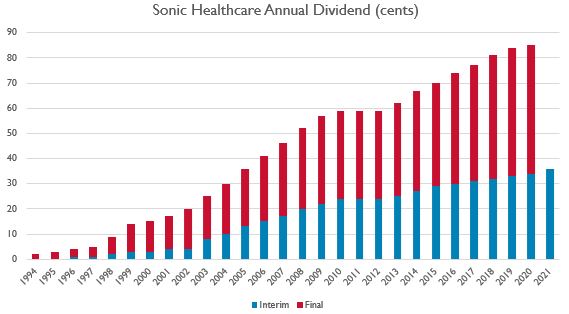
    Importantly for income investors, Sonic Healthcare also announced a 6% increase to its interim dividend, building on a strong history of dividend increases. But is it enough to classify Sonic Healthcare as a ‘dividend aristocrat’?

    What is a dividend aristocrat?

    The term ‘dividend aristocrat’ is used to describe a company that has increased its dividend consecutively for 25 years. It is an auspicious title in the world of dividend investing because it requires a company to unwaveringly defeat the ups and downs of different business cycles.

    Unfortunately, Sonic Healthcare’s distribution history doesn’t quite crack the ‘aristocrat’ criteria, although it does come deliciously close.

    In fact, if it wasn’t for a short period from 2010 to 2012 when the dividend remained flat, Sonic Healthcare would be there. Just have a look at the impressive chart below:

    Source: Chart compiled by author using data from Sonic Healthcare.

    How much of its earnings does the company pay out?

    An important driver of the great chart above is Sonic Healthcare’s progressive dividend policy. This is where dividends are increased over time as earnings grow. However, if earnings fall, the company tries to at least maintain the same dividend level. The approach gradually raises the bar each time the distribution is increased.

    It also means the company’s payout ratio, the percentage of earnings per share (EPS) the company pays out, can fluctuate from year to year, depending on earnings. For example, in 2019 Sonic Healthcare paid out 66.4% of its earnings. However, in 2020 the ratio increased to 76.5% as the dividend increased, but earnings per share dipped. 

    What is Sonic Healthcare’s dividend yield?

    The most recent interim dividend of 36 cents per share for the six months to 31 December 2020 gives the company a trailing dividend yield of 2.7%, based on the current Sonic Healthcare share price. The dividend comes partly franked.

    When does Sonic Healthcare pay its dividend?

    The Sonic Healthcare share price will go ex-dividend on Tuesday 9 March 2021. The ‘ex-date’ is when the shares start selling without the value of its next dividend payment. An investor needs to own the shares before the ex-date to receive the dividend. The dividend will then be paid on Wednesday 24 March 2021.

    These Dividend Stocks Could Be Your Next Cash Kings (FREE REPORT)

    Motley Fool Australia’s Dividend experts recently released a brand-new FREE report revealing 3 dividend stocks with JUICY franked dividends that could keep paying you meaty dividends for years to come.

    Our team of investors think these 3 dividend stocks should be a ‘must consider’ for any savvy dividend investor. But more importantly, could potentially make Australian investors a heap of passive income.

    Don’t miss out! Simply click the link below to grab your free copy and discover these 3 high conviction stocks now.

    Returns As of 15th February 2021

    More reading

    Motley Fool contributor Regan Pearson has no position in any of the stocks mentioned. ou can follow him on Twitter @Regan_InvestsThe Motley Fool Australia has recommended Sonic Healthcare Limited. The Motley Fool has a disclosure policy. This article contains general investment advice only (under AFSL 400691). Authorised by Bruce Jackson.

    The post Is Sonic Healthcare (ASX:SHL) a dividend aristocrat? appeared first on The Motley Fool Australia.

    from The Motley Fool Australia https://ift.tt/3802gBa

  • 5 things to do when the ASX crashes

    woman putting hands to head and grimacing at having missed out on rising asx tech shares OFX

    Share markets have dipped violently in recent weeks as long-term bond yields increased and investors feared inflation would force interest rates up.

    First-time stock investors have had a great time since March, so it might have been a bit of shock to them that share prices can actually depreciate.

    Even for veterans, it can be hard to think of a firm course of action when markets start crumbling.

    Panic can set in, and you can end doing some foolish things.

    So it’s a great time to bone up on a definite 5-pronged strategy, as Marcus Today director Marcus Padley set out earlier this year:

    Sell down to take a break

    Padley told investors in a Marcus Today newsletter in January that he doesn’t mind individual retail investors selling during a market correction.

    “There is nothing wrong with selling,” he said.

    “It can be cathartic and will leave you going to bed tonight hoping the market falls over. Take a break. It has been a good run.”

    Cash is the only true defence for retail investors, according to Padley.

    “Buying… defensive stocks, that go down less savagely in a correction, is for fund managers, not individual investors.”

    Assume sell-off is temporary

    Having said that, Padley would think any sell-off in the coming weeks is “just the herd dropping its pants for a moment”, rather than a structural correction.

    “So if you sell, you are being cute,” he said.

    “If there was a new element — a war, a virus mutation, a trade dispute, it could well develop. But a shorting fiasco in small US stocks, a couple of lazy results in the US…it’s not enough to start an actionable correction.”

    So if you actioned the first step, then it’s more for psychological comfort.

    “At the moment the main reason to sell is short term — for peace of mind, to take a break, to take a profit, to re-assess,” said Padley.

    “Not because there is an earnings risk event developing.”

    Take the profits and run

    If you’ve had a nice run with a stock that could be vulnerable to a market correction, then take the profit and walk out the door.

    “Check your list. Any fliers on infinite PEs?” said Padley.

    “They will be sold down first/hardest if it happens.”

    We all know the stocks in our portfolio that now have astronomical price-to-earnings ratios. If not, it’s time to work out which ones they are.

    Sell to buy

    As a fund manager, Padley’s team would never sell to “take a break”. But they will sell to free up cash to buy bargains.

    “Any short term correction will quickly become a buying opportunity in a vaccine rollout world recovering from a pandemic,” he said.

    “If you’re fully invested, as we are, you need cash. You need to sell something, to exploit buying opportunities in stocks you like. That’s about the only thing that would drive us to sell. Not fear — but opportunity.”

    Play defence

    As previously mentioned, buying defensive shares in times of market distress is a risky move he would not recommend to a retail investor.

    Nevertheless, it is something professionals do, and is an option.

    “The obvious moves for fund managers that are judged on relative performance is to get more defensive. Defensive sectors will presumably outperform in a falling market,” he said.

    “That would include buying gold stocks, healthcare, consumer staples, utilities and sell high PE tech stocks.” 

    Some retail investors who attempt this might go okay, but likely not.

    “You may even make some money in a correction — but it’s a low odds game for individuals, trying to make money in a falling market.”

    Forget what just happened. THIS is the stock we think could rocket next…

    One little-known Australian IPO has tripled in value since January 2020, and renowned Australian Moonshot stock picker Anirban Mahanti sees a potential millionaire-maker in waiting…

    Because ‘Doc’ Mahanti believes this fast-growing company has all the hallmarks of genuine Moonshot potential, forget ‘buy now pay later’, this stock could be the next hot stock on the ASX.

    Returns as of 15th February 2021

    More reading

    Motley Fool contributor Tony Yoo has no position in any of the stocks mentioned. The Motley Fool Australia has no position in any of the stocks mentioned. The Motley Fool has a disclosure policy. This article contains general investment advice only (under AFSL 400691). Authorised by Bruce Jackson.

    The post 5 things to do when the ASX crashes appeared first on The Motley Fool Australia.

    from The Motley Fool Australia https://ift.tt/3rewacv