Tag: Motley Fool

  • Here’s why the Afterpay (ASX:APT) share price fell 11% in February

    mesoblast share price falling represented by cartoon of little business men falling off broken graph arrow

    In perhaps an unusual move for Afterpay Ltd (ASX: APT), the buy now, pay later (BNPL) pioneer had a month in the red. Yes, the Afterpay share price started in February at $135.10 a share and ended it at $120. That represents a fall of 11.18% over the month.

    Of course (as it so often does), these two numbers don’t tell the entire story of Afterpay’s volatile February. Even though the month saw an 11% fall overall, it also saw Afterpay break its all-time high mid-month ($160.05 a share), which saw Afterpay pile on 16.6% between 1-10 February. But it also saw a near-25% drop between 10-26 February.

    But one might say Afterpay shareholders should be used to those kinds of moves by now.

    So why did Afterpay have such a topsy-turvy month?

    Well, seeing as we’ve just taken the exit on the February ASX earnings season, you might be tempted to think that this month’s moves can be put down to Afterpay’s earnings report. You’d be right. Afterpay announced its earnings for the 6 months ending 31 December 2020 on 25 February. The announcement also included a trading halt. Afterpay shares were off the market for the entirety of 25 February as the company announced a convertible notes capital raise. Upon resumption of trade on Friday 26 February, the Afterpay share price opened more than 10% lower.

    Afterpay shares: earnings and notes

    Afterpay hasn’t exactly delivered a car crash of a result. Quite the opposite in fact. It reported that underlying sales over the half-year were up 106% to $9.8 billion. A 531% surge in earnings before interest, tax, depreciation and amortisation (EBITDA) to $47.9 million was also welcomed. Triple digits all round.

    So why the plunge afterwards? It could be that investors didn’t like what they saw with Afterpay’s convertible notes issuance. When trading resulted on 26 February, Afterpay told investors that it had raised $1.5 billion from issuing the notes. These notes expire in 2026 and are convertible into fully paid ordinary Afterpay shares at a price of $194.82. Afterpay also told investors that its two co-founders and co-CEOs, Anthony Eisen and Nicholas Molnar, recently sold 450,000 shares each (worth around $60 million). Even though this move might be understandable from a ‘diversification of wealth’ perspective for the two gentlemen, those kinds of sales are rarely looked at favourably by fellow investors.

    A heavy sell-off in tech shares across the ASX and US markets toward the end of the month also did Afterpay shares no favours either.

    So that was February. After ‘just another month’ of eye-watering volatility, who knows what March will bring for the Afterpay share price!

    Where to invest $1,000 right now

    When investing expert Scott Phillips has a stock tip, it can pay to listen. After all, the flagship Motley Fool Share Advisor newsletter he has run for more than eight years has provided thousands of paying members with stock picks that have doubled, tripled or even more.*

    Scott just revealed what he believes are the five best ASX stocks for investors to buy right now. These stocks are trading at dirt-cheap prices and Scott thinks they are great buys right now.

    *Returns as of February 15th 2021

    More reading

    Motley Fool contributor Sebastian Bowen has no position in any of the stocks mentioned. The Motley Fool Australia owns shares of AFTERPAY T FPO. The Motley Fool has a disclosure policy. This article contains general investment advice only (under AFSL 400691). Authorised by Bruce Jackson.

    The post Here’s why the Afterpay (ASX:APT) share price fell 11% in February appeared first on The Motley Fool Australia.

    from The Motley Fool Australia https://ift.tt/2PfPAQ2

  • What you need to know about the NIB (ASX:NHF) dividend

    medical asx share price represented by doctor giving thumbs up

    Last week health insurance provider NIB Holdings Limited (ASX: NHF) released its first-half results for the 2021 financial year. Investors were certainly pleased to see net profit after tax (NPAT) jump by almost 16% as the NIB share price jumped 2.5% on the day.

    Importantly for income investors, the company also announced details on its interim dividend. Here’s what you need to know.

    What is NIB’s dividend yield?

    In tandem with the half-year results, NIB declared an interim dividend of 10 cents per share for the six months to 31 December 2020. This was in line with the same period last year and means NIB shares have a trailing dividend yield of 2.5%, fully franked, based on the current share price of $5.60.

    When does NIB pay its dividend?

    The NIB share price will go ex-dividend on Thursday 4 March 2021.  The ‘ex-date’ is when the shares start selling without the value of its next dividend payment so an investor needs to own the shares before the ex-date to receive the dividend. The dividend will then be paid on Tuesday 6 April 2021.

    What does NIB’s dividend history look like?

    We can learn a lot by looking back at a company’s dividend history. For example, we can see how consistent or lumpy dividend distributions are. This can help us better understand the nature of the business and whether it is growing (or not!) over time.

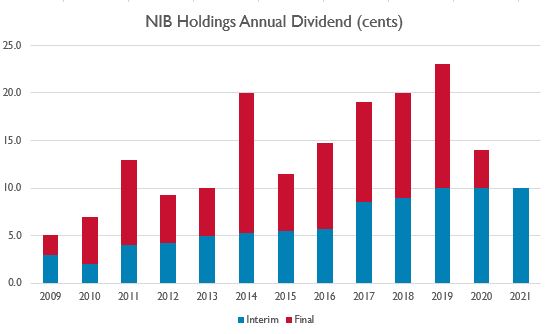
    From the chart below, we can see that the NIB dividend had been rising steadily until 2020, when the impacts of COVID-19 contributed to a big drop in the company’s profit margins and investment income.

    Source: Chart compiled by author using data from NIB.

    Did you spot the big spike in 2014? Nice! As part of NIB’s capital management plans, the final dividend in 2014 was made up of both an ordinary dividend of 5.75 cents per share, plus a one-off special dividend of 9 cents per share to return extra cash to investors. Ka-ching!

    How much of its earnings does NIB pay out?

    NIB has typically aimed for a payout ratio of 60% to 70% of the company’s normalised net profit after tax (NPAT). True to form, this has been the case over the last five years with an average payout ratio hovering right around 70% of NPAT. A payout ratio of 60% to 70% is more likely to be sustainable over the long term than if the company was to pay out 90% or 100% of its profits.

    However, because dividends get paid from cash, not accounting profits, it is also a good idea to check that the company’s cash flows from operations are sufficient to cover the dividend being paid out. If the dividend being paid was more than the cash flow the company earned from operations, this could be a warning sign the dividend may not be sustainable.

    These Dividend Stocks Could Be Your Next Cash Kings (FREE REPORT)

    Motley Fool Australia’s Dividend experts recently released a brand-new FREE report revealing 3 dividend stocks with JUICY franked dividends that could keep paying you meaty dividends for years to come.

    Our team of investors think these 3 dividend stocks should be a ‘must consider’ for any savvy dividend investor. But more importantly, could potentially make Australian investors a heap of passive income.

    Don’t miss out! Simply click the link below to grab your free copy and discover these 3 high conviction stocks now.

    Returns As of 15th February 2021

    More reading

    Motley Fool contributor Regan Pearson has no position in any of the stocks mentioned. You can follow him on Twitter @Regan_Invests. The Motley Fool Australia has recommended NIB Holdings Limited. The Motley Fool has a disclosure policy. This article contains general investment advice only (under AFSL 400691). Authorised by Bruce Jackson.

    The post What you need to know about the NIB (ASX:NHF) dividend appeared first on The Motley Fool Australia.

    from The Motley Fool Australia https://ift.tt/38063hU

  • Why the Appen (ASX:APX) share price sank 25% in February

    An ASX investor looks devastated as he watches his computer screen, indicating bad news

    The Appen Ltd (ASX: APX) share price was among the worst performers on the S&P/ASX 200 Index (ASX: XJO) in February.

    Over the period, the artificial intelligence data services company’s shares lost 25% of their value.

    This means the Appen share price has now fallen a disappointing 62% from its 52-week high.

    Why did the Appen share price crash lower in February?

    There were a few catalysts for the poor performance by the Appen share price in February.

    One of those catalysts was weakness in the tech sector after bond yields widened and spooked investors.

    In addition to this, a broker note out of Macquarie weighed heavily on the Appen share price.

    Macquarie had previously been very bullish on the company but that all changed last month. In one fell swoop, the broker downgraded Appen’s shares from an outperform rating all the way down to underperform.

    It made the move after its industry research pointed to tough trading conditions and increasing competition. Macquarie has concerns the latter could lead to a structural loss of market share.

    Full year results disappoint

    In addition to the above, the Appen share price came under further pressure following the release of its full year results for FY 2020.

    For the 12 months ended 31 December, Appen posted a 12% increase in revenue to $599.9 million and an 8% lift in EBITDA to $108.6 million. This fell short of the market’s expectations.

    It was a similar story with its guidance, with Appen forecasting constant currency EBITDA growth of 18% to 28% in FY 2021.

    However, with Appen’s constant currency figure based on an Australian dollar averaging 69 U.S. cents, its reported growth will be much lower if exchange rates stay the same way. The Australian dollar is currently fetching 78 U.S. cents.

    Where next for the Appen share price?

    Given the uncertainty around the next 12 months, it will come as no surprise to learn that brokers are undecided on where the Appen share price is going next.

    Ord Minnett recently upgraded its shares to a buy rating with a $24.75 price target. It feels its shares are great value after recent weakness. It notes that the company has strong long term growth potential thanks to industry tailwinds.

    Whereas Macquarie has held firm with its underperform rating and cut its price target to $16.00 and Credit Suisse has a neutral rating and $20.00 price target.

    Where to invest $1,000 right now

    When investing expert Scott Phillips has a stock tip, it can pay to listen. After all, the flagship Motley Fool Share Advisor newsletter he has run for more than eight years has provided thousands of paying members with stock picks that have doubled, tripled or even more.*

    Scott just revealed what he believes are the five best ASX stocks for investors to buy right now. These stocks are trading at dirt-cheap prices and Scott thinks they are great buys right now.

    *Returns as of February 15th 2021

    More reading

    James Mickleboro has no position in any of the stocks mentioned. The Motley Fool Australia’s parent company Motley Fool Holdings Inc. owns shares of Appen Ltd. The Motley Fool Australia has no position in any of the stocks mentioned. The Motley Fool has a disclosure policy. This article contains general investment advice only (under AFSL 400691). Authorised by Bruce Jackson.

    The post Why the Appen (ASX:APX) share price sank 25% in February appeared first on The Motley Fool Australia.

    from The Motley Fool Australia https://ift.tt/380hwy2

  • The Nuix (ASX:NXL) share price has a lot of ground to make up in FY21

    asx share price represented by piggy bank at end of winding road

    Last week didn’t end well for Nuix Ltd (ASX: NXL) shareholders. The embattled ASX technology company’s shares plunged almost 30% lower on Friday following the release of its first-half FY21 results. Despite a modest recovery on Monday, the Nuix share price is still only valued at $6.30, well short of the $11.86 high it reached in late January.

    The company only listed on the ASX in December, but this sort of yo-yoing in its share price might already have some investors heading for the hills.

    What does Nuix do?

    Nuix specialises in data analytics. Its software helps corporations, law firms and even government and law enforcement agencies sift through mountains of digital data, including emails and social media posts, to deliver actionable solutions. It claims to already have an impressive customer list including Amazon.com Inc. (NASDAQ: AMZN), Samsung Electronics Co Ltd and Commonwealth Bank of Australia (ASX: CBA).

    Last week’s big falls in the Nuix share price will have caused quite a stir with institutional investors, as the tech company had some big-name backers when it floated in December. Macquarie Group Ltd (ASX: MQG) took a 30% stake in the Nuix initial public offering (IPO) and Washington H. Soul Pattinson and Co. Ltd (ASX: SOL) also invested.

    What drove the Nuix share price lower?

    First-half revenues came in at $85.3 million, down 4% year on year, while pro forma earnings before interest, tax, depreciation and amortisation expenses (EBITDA) increased 3% to $31.6 million. The company posted a statutory net loss for the half of $16.6 million.

    The big concern driving the Nuix share price lower was that the company’s results are already falling behind its own prospectus forecasts. Half-year revenues were only 44% of the FY21 forecast, pro forma net profit after tax was 48% of forecast, and pro forma EBITDA was only just nudging 50%. This leaves a lot for the company to achieve in the second half of the year in order for it to meet its internal targets.

    Commenting on the results, CEO Rod Vawdrey admitted that Nuix had a “softer” first quarter, but he tried to reassure investors that “the stronger weighting towards the second half is in line with expectations given COVID and seasonality.”

    Outlook

    Nuix reaffirmed its original forecasts for FY21. It still expects total revenues to come in at $193.5 million for the year, and pro forma EBITDA to be $63.6 million. Based on its first-half results, these might seem like ambitious targets, but Nuix believes that it has built a strong enough pipeline to get there.

    Whatever happens, these soft first-half results mean there will be a lot of scrutiny on the company over the second half of FY21.

    The Nuix share price has fallen by more than 21% over the past twelve months.

    Where to invest $1,000 right now

    When investing expert Scott Phillips has a stock tip, it can pay to listen. After all, the flagship Motley Fool Share Advisor newsletter he has run for more than eight years has provided thousands of paying members with stock picks that have doubled, tripled or even more.*

    Scott just revealed what he believes are the five best ASX stocks for investors to buy right now. These stocks are trading at dirt-cheap prices and Scott thinks they are great buys right now.

    *Returns as of February 15th 2021

    More reading

    John Mackey, CEO of Whole Foods Market, an Amazon subsidiary, is a member of The Motley Fool’s board of directors. Rhys Brock owns shares of Commonwealth Bank of Australia and Macquarie Group Limited. The Motley Fool Australia’s parent company Motley Fool Holdings Inc. owns shares of and recommends Amazon. The Motley Fool Australia’s parent company Motley Fool Holdings Inc. recommends Nuix Pty Ltd and recommends the following options: long January 2022 $1920 calls on Amazon and short January 2022 $1940 calls on Amazon. The Motley Fool Australia owns shares of and has recommended Macquarie Group Limited and Washington H. Soul Pattinson and Company Limited. The Motley Fool Australia has recommended Amazon and Nuix Pty Ltd. The Motley Fool has a disclosure policy. This article contains general investment advice only (under AFSL 400691). Authorised by Bruce Jackson.

    The post The Nuix (ASX:NXL) share price has a lot of ground to make up in FY21 appeared first on The Motley Fool Australia.

    from The Motley Fool Australia https://ift.tt/2Pkuy2N

  • 3 highest yielding ASX dividend shares

    Hand drawing growing Dividends investment business graph with blue marker on transparent wipe board.

    There are some ASX dividend shares that have very high yields which income investors may be interested in.

    It’s looking tough at the moment for anyone with cash trying to generate interest. But there are some businesses that may be able to boost the level of income.

    These three ASX dividend shares have very high prospective dividend yields for FY21:

    Fortescue Metals Group Ltd (ASX: FMG)

    Fortescue is one of the businesses that has a very high dividend yield, for now. The iron ore miner is benefiting from high iron prices and it also has a low price / earnings ratio with a high dividend payout ratio, so the dividend yield ends up being very high.

    Broker UBS likes Fortescue, though it acknowledges there are risks when it comes to the Iron Bridge project.

    UBS thinks that the FY21 dividend could be as big as $4.035 per share, which would equate to a grossed-up dividend yield of 25.4% at the pre-open Fortescue share price.

    The ASX dividend share increased its interim dividend by 93% to AU$1.47 after a 66% increase in the earnings per share (EPS) to US$1.33. This result came after a 42% increase in the realised price of dry metric tonne (dmt) of iron ore to US$114, which helped grow revenue by 44%.

    UBS has a share price target of $25 for Fortescue Metals.

    Nick Scali Limited (ASX: NCK)

    The furniture business is another company which has a high dividend yield.

    Broker Citi thinks that the Nick Scali share price is a buy and has a price target of $12.05 for the business. Citi thinks that consumers will keep buying things from Nick Scali because there aren’t many other options to spend money with international borders closed. However, it notes that it’ll be hard to beat the FY21 result in FY22.

    Citi also noted that Nick Scali may find a potential acquisition to go after.

    In the FY21 half-year result, the ASX dividend share increased its dividend by 60% to $0.40 per share, off the back of a 99.5% increase of the underlying EPS to $0.50.

    Citi believes that Nick Scali could pay a dividend of $0.80 per share in FY21, which would translate to a grossed-up dividend yield of 10.9%.

    Waypoint REIT Ltd (ASX: WPR)

    Waypoint is a real estate investment trust (REIT) that solely owns service stations and convenience retail properties.

    The business generated a 4.25% increase of its distributable EPS to 15.15 cents in FY20, whilst the net tangible assets (NTA) per security grew by 8.7% to $2.49.

    The ASX dividend share invested $32.5 million across five acquisitions during the year. It also spent $18.8 million across 12 development projects with six completed during the year and six targeted for the first half of FY21.

    Waypoint REIT’s board recently decided to reduce its target gearing range from 30% to 45%, to 30% to 40% to better reflect the board’s view on a sustainable gearing range for the business. It had a gearing ratio of 29.4% at 31 December 2020.

    Broker Morgans likes Waypoint and said the 99.9% collection rate of rent for FY20 showed how resilient the business is.

    In FY21, Morgans has projected a dividend of 15.7 cents per security, which equates to a distribution yield of 6.5%.

    These Dividend Stocks Could Be Your Next Cash Kings (FREE REPORT)

    Motley Fool Australia’s Dividend experts recently released a brand-new FREE report revealing 3 dividend stocks with JUICY franked dividends that could keep paying you meaty dividends for years to come.

    Our team of investors think these 3 dividend stocks should be a ‘must consider’ for any savvy dividend investor. But more importantly, could potentially make Australian investors a heap of passive income.

    Don’t miss out! Simply click the link below to grab your free copy and discover these 3 high conviction stocks now.

    Returns As of 15th February 2021

    More reading

    Motley Fool contributor Tristan Harrison has no position in any of the stocks mentioned. The Motley Fool Australia has no position in any of the stocks mentioned. The Motley Fool has a disclosure policy. This article contains general investment advice only (under AFSL 400691). Authorised by Bruce Jackson.

    The post 3 highest yielding ASX dividend shares appeared first on The Motley Fool Australia.

    from The Motley Fool Australia https://ift.tt/3e215F8

  • Why the Westpac (ASX:WBC) share price jumped 13% in February

    Westpac share price

    The Westpac Banking Corp (ASX: WBC) share price continued its positive run in February.

    The banking giant’s shares rose an impressive 13% during the month. This compares favourably to a 1% gain by the S&P/ASX 200 Index (ASX: XJO).

    This latest gain means the Westpac share price is now up a sizeable 40% over the last six months.

    Why did the Westpac share price outperform in February?

    Investors were buying Westpac shares last month following the release of its first quarter update.

    For the three months ended 31 December, the bank posted a $1.97 billion first quarter cash profit. This was up an enormous 144% over the quarterly average cash earnings of $808 million it achieved in the second half of FY 2020.

    And excluding notable items, Westpac’s cash earnings were up 54% over the second half average.

    Speaking of which, it was these notable items that got investors particularly excited and helped drive the Westpac share price higher.

    What were the notable items?

    Boosting the bank’s profit result was an impairment benefit of $501 million from improved credit quality, stronger economic outcomes, and a better economic outlook.

    Management explained the reason for the impairment reversal. It said:

    “While uncertainty remains around the impact of local COVID outbreaks, there is cause for optimism. The economy is recovering, consumer and business confidence is strong, and the labour market has been much more resilient than expected. At the end of December there were 12.9 million employed Australians compared to 13 million in March 2020.

    We are also beginning to improve momentum in mortgages and while the book was little changed over the half, we have processed a significant increase in applications. Low interest rates, rising house prices, new construction, and high consumer confidence all point to continued recovery in home lending activity in 2021.”

    What else is supporting the Westpac share price?

    Also giving the Westpac share price a lift in February was a broker note out of Goldman Sachs.

    In response to the bank’s first quarter update, Goldman retained its buy rating and lifted its price target by 20% to $25.76.

    Even after February’s strong gain, this price target implies potential upside of 6.5% over the next 12 months excluding dividends. And including the $1.10 per share fully franked dividend that the broker expects Westpac to pay in FY 2021, this potential return stretches to 11%.

    Why is Goldman positive on Westpac?

    Goldman explained why it thinks the Westpac share price is in the buy zone. It said:

    “We reiterate our Buy on WBC given: i) as evidenced by today’s update, we think WBC’s business mix is best placed to benefit from the current NIM environment, ii) momentum appears to be picking up in the business, which should support volumes, iii) details of the three-year cost plan, due to be announced at the time of the 1H21 results, could be a potential catalyst to further support the re-rating, and iv) we also note that on our forecasts, WBC’s surplus capital will stand at c. A$6 bn by 31-Mar-21 (on a pro-forma basis, against a 10.9% CET1 ratio), and with surplus franking credits also on hand, we think that once the market gets more comfort around the recovery in the economy, it will start to focus on WBC’s capital management opportunities.”

    Where to invest $1,000 right now

    When investing expert Scott Phillips has a stock tip, it can pay to listen. After all, the flagship Motley Fool Share Advisor newsletter he has run for more than eight years has provided thousands of paying members with stock picks that have doubled, tripled or even more.*

    Scott just revealed what he believes are the five best ASX stocks for investors to buy right now. These stocks are trading at dirt-cheap prices and Scott thinks they are great buys right now.

    *Returns as of February 15th 2021

    More reading

    Motley Fool contributor James Mickleboro owns shares of Westpac Banking. The Motley Fool Australia has no position in any of the stocks mentioned. The Motley Fool has a disclosure policy. This article contains general investment advice only (under AFSL 400691). Authorised by Bruce Jackson.

    The post Why the Westpac (ASX:WBC) share price jumped 13% in February appeared first on The Motley Fool Australia.

    from The Motley Fool Australia https://ift.tt/37ZAwwJ

  • Here are the best performing ASX 200 tech shares in Februrary

    asx shares represented by bankers approaching finish line in a race

    February proved to be a challenging month for S&P/ASX 200 Index (ASX: XJO) tech shares, impacted by rising yields and a volatile market. The S&P/ASX 200 Info Tech (ASX: XIJ) index found itself down 10% last month, compared to the 1% increase in the ASX 200. 

    While the tech index’s weakness is likely to dampen the performance of ASX 200 tech shares, here are the ones that exceeded expectations to be crowned as the best performing ASX 200 tech shares last month. 

    1. Zip Co Ltd (ASX: Z1P)

    Zip was the best performing ASX 200 tech share in February. From peak to trough, the Zip share price ripped more than 90% to hit a record all-time high of $14.53. 

    Zip’s surging share price was driven partly by its impressive second-quarter update in late January and further boosted by the speculation that its management is considering a potential listing in the United States

    Despite their strength at the start of February, Zip shares were unable to hold onto all their momentum and closed last month at $10.40 for a 40% gain in February. The recent pressure on the Zip share price can be attributed to factors including rising bond yields, weakness in the general tech sector and buy now, pay later (BNPL) shares being sold off

    2. EML Payments Ltd (ASX: EML) 

    In second place, the EML Payments share price finished the month 30% higher thanks to a strong half-year results announcement. The company reported strong gains across all metrics with gross debt volume (GDV), earnings before interest, tax, depreciation and amortisation (EBITDA) and net profit after tax rising 54%, 42% and 30%, respectively. 

    The company also provided a solid outlook for FY21, with full-year revenue forecast to come in at between $180 million and $190 million. This represents a 48% to 56% increase on FY20. 

    This is the first time in the past year the EML Payments share price has made a meaningful move to the upside. Prior to February, its shares had been range-bound between the low $4 and mid $3 mark since the initial COVID-19 sell-off in March 2020.

    3. Tyro Payments Ltd (ASX: TYR)

    The improvement in the Tyro share price comes after weeks and weeks of grinding lower. A technical outage with its EFTPOS terminals combined with a short-seller attack saw its shares fall by more than 40% from late November 2020 to mid-January 2021. 

    On 22 February, the company reported its HY21 results, highlighting a 13% increase in the number of merchants using its payment solutions and a 10% increase in transaction volume. 

    The company also addressed the lingering damage from its terminal connectivity failures, which included providing its merchants with a dongle solution with their standard terminals as an extra level of redundancy. 

    Shareholders breathed a sigh of relief as Tyro shares finished February 20% higher. 

    Where to invest $1,000 right now

    When investing expert Scott Phillips has a stock tip, it can pay to listen. After all, the flagship Motley Fool Share Advisor newsletter he has run for more than eight years has provided thousands of paying members with stock picks that have doubled, tripled or even more.*

    Scott just revealed what he believes are the five best ASX stocks for investors to buy right now. These stocks are trading at dirt-cheap prices and Scott thinks they are great buys right now.

    *Returns as of February 15th 2021

    More reading

    Kerry Sun has no position in any of the stocks mentioned. The Motley Fool Australia’s parent company Motley Fool Holdings Inc. owns shares of and recommends EML Payments. The Motley Fool Australia’s parent company Motley Fool Holdings Inc. owns shares of Tyro Payments and ZIPCOLTD FPO. The Motley Fool Australia has recommended EML Payments. The Motley Fool has a disclosure policy. This article contains general investment advice only (under AFSL 400691). Authorised by Bruce Jackson.

    The post Here are the best performing ASX 200 tech shares in Februrary appeared first on The Motley Fool Australia.

    from The Motley Fool Australia https://ift.tt/3bVrNwJ

  • Warren Buffett just told us to stay away from this asset class

    Investor Warren Buffett

    Warren Buffett – chair and CEO of Berkshire Hathaway Inc (NYSE: BRK.A) (NYSE: BRK.B) – is, without a doubt, one of the most followed investors in the world. And ‘one of’ is probably being conservative.

    There are two events that every Buffett fan in the world has marked on their calendars: the annual general meeting of Berkshire Hathaway (which normally occurs in May). And, of course, the release of Warren Buffett’s annual letter to shareholders, which he has been publishing like clockwork since the 1960s.

    Buffett’s annual letter hits the stands

    One of those events has just happened. And since it’s not May just yet, you can probably guess which one. Yes, Mr Buffett published his annual letter to shareholders over the weekend and, as always, it makes for some interesting reading. Investors hoping for a bold prediction as to where the current share market is headed next might be a little disappointed. But there were plenty of interesting observations (and pithy anecdotes) to go around regardless.

    One of the more pertinent of those is the following. Buffett only devoted a single paragraph to this discussion point, but it was arguably one of the more decisive statements in the letter. It goes like this:

    And bonds are not the place to be these days. Can you believe that the income recently available from a 10-year U.S. Treasury bond – the yield was 0.93% at year end – had fallen 94%from the 15.8% yield available in September 1981? In certain large and important countries, such as Germany and Japan, investors earn a negative return on trillions of dollars of sovereign debt. Fixed-income investors worldwide – whether pension funds, insurance companies or retirees – face a bleak future.

    Why the bond age is set for a whipping?

    Bonds, as you may know, are investments that represent loans. In this case, loans to a government. They are a popular asset class that many investors see as an alternative to shares. That’s because they offer guaranteed income (remember, a dividend is never ‘guaranteed’), and (usually) lower volatility than shares.

    You can access the government bond market on the share market, though exchange-traded funds (ETFs) like the Vanguard Australian Fixed Interest Index ETF (ASX: VAF).

    But why is Buffett so adamant that those investing in bonds “face a bleak future”? Well, the value of bonds is inherently tied to interest rates. If interest rates fall, the value of existing government bonds rise, and vice versa. And interest rates around the world have spent the better part of a decade steadily falling. The official cash rate in Australia is currently 0.1%, the lowest level in history.

    Foolish takeaway

    So even though bonds have been a fantastic investment to have had over the past ten years, according to Buffett, there’s no longer much room for improvement. And if interest rates spend the next decade rising rather than staying flat, those holding bonds face a world of hurt. Put another way, there is arguably little chance bonds can keep rising in value, and a good chance they will fall. That’s why Buffet is so unequivocal in his condemnation of the future prospects of this asset class. 

    Where to invest $1,000 right now

    When investing expert Scott Phillips has a stock tip, it can pay to listen. After all, the flagship Motley Fool Share Advisor newsletter he has run for more than eight years has provided thousands of paying members with stock picks that have doubled, tripled or even more.*

    Scott just revealed what he believes are the five best ASX stocks for investors to buy right now. These stocks are trading at dirt-cheap prices and Scott thinks they are great buys right now.

    *Returns as of February 15th 2021

    More reading

    Sebastian Bowen has no position in any of the stocks mentioned. The Motley Fool Australia’s parent company Motley Fool Holdings Inc. owns shares of and recommends Berkshire Hathaway (B shares) and recommends the following options: short January 2023 $200 puts on Berkshire Hathaway (B shares), short March 2021 $225 calls on Berkshire Hathaway (B shares), and long January 2023 $200 calls on Berkshire Hathaway (B shares). The Motley Fool Australia has recommended Berkshire Hathaway (B shares). The Motley Fool has a disclosure policy. This article contains general investment advice only (under AFSL 400691). Authorised by Bruce Jackson.

    The post Warren Buffett just told us to stay away from this asset class appeared first on The Motley Fool Australia.

    from The Motley Fool Australia https://ift.tt/3rb4iG4

  • 2 of the best ASX tech shares to buy and hold

    Investor with palm up and graphic illustration of asx small cap tech shares charts shooting from his hand

    There are a good number of tech companies on the Australian share market that have been growing at an above-average rate over the last few years.

    And while the pandemic may have put a dampener on the growth of some of these companies, once the pandemic passes they look well-placed to resume their positive form.

    Two ASX tech shares that could be fantastic buy and hold options are listed below. Here’s what you need to know about them:

    Altium Limited (ASX: ALU)

    Altium is the leading provider of printed circuit board (PCB) focused electronic design software. Its platform is the clear leader in the industry and counts many of the world’s largest companies as customers. This includes BAE Systems, Dell, Microsoft, and Tesla.

    The good news for the company and its shareholders is that demand for its platform looks likely to increase materially in the coming decades. This is due to the artificial intelligence and internet of things booms. These are underpinning a proliferation of electronic products globally.

    Analysts at UBS are positive on the company’s future. Last month they upgraded Altium’s shares to a buy rating with a $34.00 price target. This compares to the latest Altium share price of $26.97.

    Xero Limited (ASX: XRO)

    Xero is a provider of a cloud-based business and accounting solution. It is used by small to medium sized businesses around the world to handle a full suite of tasks. This includes accounting, payroll, and invoicing.

    In addition to this, the company has been making bolt-on acquisitions to bolster its offering and looks likely to make more in the future. Late last year Xero raised US$700 million via a convertible notes offering.

    Another big positive is its growing ecosystem of apps that work within its platform. Goldman Sachs believes that the company has a massive opportunity to monetise this and drive strong revenue growth over the coming decades.

    In light of this, the broker has currently got a buy rating and $157.00 price target on its shares. This compares to the latest Xero share price of $122.53.

    Where to invest $1,000 right now

    When investing expert Scott Phillips has a stock tip, it can pay to listen. After all, the flagship Motley Fool Share Advisor newsletter he has run for more than eight years has provided thousands of paying members with stock picks that have doubled, tripled or even more.*

    Scott just revealed what he believes are the five best ASX stocks for investors to buy right now. These stocks are trading at dirt-cheap prices and Scott thinks they are great buys right now.

    *Returns as of February 15th 2021

    More reading

    James Mickleboro has no position in any of the stocks mentioned. The Motley Fool Australia’s parent company Motley Fool Holdings Inc. recommends Altium. The Motley Fool Australia owns shares of Altium and Xero. The Motley Fool has a disclosure policy. This article contains general investment advice only (under AFSL 400691). Authorised by Bruce Jackson.

    The post 2 of the best ASX tech shares to buy and hold appeared first on The Motley Fool Australia.

    from The Motley Fool Australia https://ift.tt/3bPEHfv

  • 2 high quality ASX dividend shares to buy to beat low rates

    A hand moves a building block from green arrow to red, indicating negative interest rates

    As I mentioned here earlier, the RBA will be meeting this afternoon to discuss the cash rate.

    While there’s a chance it could cut rates to zero, Westpac Banking Corp (ASX: WBC) is tipping the central bank to make no changes and then keep rates on hold for some time to come.

    Unfortunately, whichever way things go today, it seems inevitable that rates will be at ultra low levels for the foreseeable future.

    With that in mind, if you’re an income investor, you might want to take a look at the dividend shares below. Here’s why they could be in the buy zone:

    Sonic Healthcare Limited (ASX: SHL)

    The first ASX dividend share to look at is Sonic Healthcare. It is a leading medical diagnostics company with operations across the world.

    Sonic has been a very impressive performer during the pandemic thanks largely to strong demand for COVID-19 testing services. In fact, demand has been so strong, Sonic recently released its half year results and revealed a 33% increase in revenue to $4.4 billion and a whopping 166% increase in first half net profit to $678 million.

    In response to this result, analysts at Citi put a buy rating and $37.50 price target on its shares. The broker is also forecasting dividends of $1.31 per share this year and then $1.40 per share in FY 2022.

    Based on the latest Sonic share price of $31.85, this represents fully franked yields of 4.1% and 4.4%, respectively.

    Wesfarmers Ltd (ASX: WES)

    Another ASX dividend share to look at is Wesfarmers. As with Sonic, this conglomerate recently released its half year results and revealed strong revenue and profit growth.

    For the six months ended 31 December, the company reported a 16.6% increase in revenue to $17,774 million and a 25.5% jump in net profit after tax to $1,414 million.

    While the majority of Wesfarmers’ businesses performed positively during the half, the star of the show was its key Bunnings business. The hardware giant recorded an impressive 24.4% increase in revenue to $9,054 million.

    Goldman Sachs was pleased with the result and appears to believe its growth can continue. The broker has a buy rating and $59.70 price target on its shares. It is also forecasting a fully franked full year dividend of $1.88 per share in FY 2021.

    Based on the latest Wesfarmers share price of $50.73, this equates to a 3.7% yield.

    These Dividend Stocks Could Be Your Next Cash Kings (FREE REPORT)

    Motley Fool Australia’s Dividend experts recently released a brand-new FREE report revealing 3 dividend stocks with JUICY franked dividends that could keep paying you meaty dividends for years to come.

    Our team of investors think these 3 dividend stocks should be a ‘must consider’ for any savvy dividend investor. But more importantly, could potentially make Australian investors a heap of passive income.

    Don’t miss out! Simply click the link below to grab your free copy and discover these 3 high conviction stocks now.

    Returns As of 15th February 2021

    More reading

    Motley Fool contributor James Mickleboro has no position in any of the stocks mentioned. The Motley Fool Australia owns shares of Wesfarmers Limited. The Motley Fool Australia has recommended Sonic Healthcare Limited. The Motley Fool has a disclosure policy. This article contains general investment advice only (under AFSL 400691). Authorised by Bruce Jackson.

    The post 2 high quality ASX dividend shares to buy to beat low rates appeared first on The Motley Fool Australia.

    from The Motley Fool Australia https://ift.tt/3kyNaaO