Tag: Motley Fool

  • Why the OM Holdings (ASX:OMH) share price is rising today

    Illustration of men and women pushing share price graph up

    The OM Holdings Limited (ASX: OMH) share price has lifted 1.39% in early trade this morning. This comes after the manganese producer provided a business and operations update.

    At the time of writing, OM Holdings shares are swapping hands for 73 cents apiece. 

    What’s moving the OM Holdings share price?

    The OM Holdings share price has started in the green today on the back of the company’s latest update.

    According to this morning’s release, OM Holdings advised that during COVID-19, its smelter plant in Qinzhou, China was turned offline. The facility conducts smelting operations and sinter ore production – a process whereby iron ore fines and other fine material enter a blast furnace.

    The company said that while suspended operations continued from March until January this year, major maintenance work was undertaken at the site. This included upgrading one of its furnaces from 16.5 MVA to 25.5 MVA. OM Holdings noted that the new improvements will enable it to maximise production efficiency and increase total capacity at its Qinzhou Plant. Furthermore, the blast furnace can now either produce silicomanganese or high carbon ferromanganese.

    Silicomanganese is used as a strong deoxidizer, which helps to improve the mechanical properties of various steel grades. Ferromanganese counteracts the bad effects of sulphur, thus increase the strength and hardness of stainless-steel products.

    After completing trials, the company restarted its full operations for the upgraded furnace manganese ore sinter plant on 31 January 2021. The other remaining furnace is expected to recommence production sometime in the first-half of the financial year.

    Once the facility is running at full capacity with both furnaces, OM Holdings estimates total production of 80,000 to 95,000 tonnes of manganese alloys, and 300,000 tonnes of sintered ore per annum.

    Management commentary

    OMH executive chair Mr Low Ngee Tong commented on the company’s prospects, saying:

    As China remains the world’s largest producer and consumer of steel, this capacity upgrade of our Qinzhou plant will increase the Company’s smelting capability and create more synergies with our manganese ore distribution activities in China.

    Where to invest $1,000 right now

    When investing expert Scott Phillips has a stock tip, it can pay to listen. After all, the flagship Motley Fool Share Advisor newsletter he has run for more than eight years has provided thousands of paying members with stock picks that have doubled, tripled or even more.*

    Scott just revealed what he believes are the five best ASX stocks for investors to buy right now. These stocks are trading at dirt-cheap prices and Scott thinks they are great buys right now.

    *Returns as of June 30th

    More reading

    Motley Fool contributor Aaron Teboneras has no position in any of the stocks mentioned. The Motley Fool Australia has no position in any of the stocks mentioned. The Motley Fool has a disclosure policy. This article contains general investment advice only (under AFSL 400691). Authorised by Bruce Jackson.

    The post Why the OM Holdings (ASX:OMH) share price is rising today appeared first on The Motley Fool Australia.

    from The Motley Fool Australia https://ift.tt/3pOUYHu

  • Here’s why the AVZ Minerals (ASX:AVZ) share price is surging 8% higher

    man jumps up a chart, indicating share price going up on the ASX bank dividend

    The AVZ Minerals Ltd (ASX: AVZ) share price is on course to end the week on a high.

    At the time of writing, the lithium-focused mineral exploration company’s shares are up 8% to 20 cents.

    Why is the AVZ Minerals share price surging higher?

    Investors have been buying AVZ Minerals shares this morning following the release of an update on drilling activities at the Manono Lithium and Tin Project in the Democratic Republic of Congo.

    According to the release, the company has received further strong results from its Mineral Resource drilling at the project.

    The release explains that these assay results come from the first four of nine planned diamond drill holes in previously undrilled areas beneath the historical pit. These areas were previously inaccessible and under water during the earlier resource drilling programs.

    AVZ’s Managing Director, Mr Nigel Ferguson, explained the significance of these drilling results.

    He said: “These drilling results, combined with the pit floor mapping, confirm the pit floor “wedge” is in fact made up of pegmatitic rock that historically was mined as tin-bearing feedstock.”

    “This area had previously been categorised as waste material in our current mining and financial model due to a lack of drilling data and under our current model, is pre-stripped as waste before ore can be sent to the processing plant.”

    “These positive drill results unequivocally demonstrate this is not the case and this material may be remodelled with increased confidence as revenue generating ore once all of the assay results are returned,” he added.

    What now?

    AVZ Minerals will now collate the data and re-run the models to calculate both geological resources and then mineable reserves to be fed into the optimised feasibility study.

    Management advised that this could potentially lead to increased indicated resources available for conversion to probable mineable reserves. It could also lead to an increase in its discounted cashflow as the previously assigned waste becomes mineable ore.

    And finally, it has the potential to result in an increased mine life with lower operating costs and an increased open pit volume.

    The optimised feasibility study is expected to be released later this year.

    This Tiny ASX Stock Could Be the Next Afterpay

    One little-known Australian IPO has doubled in value since January, and renowned Australian Moonshot stock picker Anirban Mahanti sees a potential millionaire-maker in waiting…

    Because ‘Doc’ Mahanti believes this fast-growing company has all the hallmarks of genuine Moonshot potential, forget ‘buy now pay later’, this stock could be the next hot stock on the ASX.

    Doc and his team have published a detailed report on this tiny ASX stock. Find out how you can access what could be the NEXT Afterpay today!

    Returns as of 6th October 2020

    More reading

    Motley Fool contributor James Mickleboro has no position in any of the stocks mentioned. The Motley Fool Australia has no position in any of the stocks mentioned. The Motley Fool has a disclosure policy. This article contains general investment advice only (under AFSL 400691). Authorised by Bruce Jackson.

    The post Here’s why the AVZ Minerals (ASX:AVZ) share price is surging 8% higher appeared first on The Motley Fool Australia.

    from The Motley Fool Australia https://ift.tt/3pTLIBN

  • Why the REA Group (ASX:REA) share price is pushing higher

    The REA Group Limited (ASX: REA) share price is pushing higher on Friday following the release of its half year results.

    At the time of writing, the property listings company’s shares are up 1.5% to $157.08.

    How did REA Group perform in the first half?

    REA Group’s earnings returned to growth in the first half of FY 2021 thanks to its excellent cost control offsetting softer revenues.

    For the six months ended 31 December, the company reported a 2% decline in revenue to $430.4 million. Operating expenses were reduced by 13% compared to a year earlier to $145.8 million, leading to REA Group reporting a 9% increase in earnings before interest, tax, depreciation and amortisation (EBITDA) to $290.2 million.

    Management advised that the reduction in expenses was driven by COVID-19 related savings and the deferral of some marketing spend into the second half.

    On the bottom line, the company’s net profit after tax increased 13% to $172.1 million or 130.7 cents per share.

    This strong profit growth allowed the REA Group board to declare an interim dividend of 59 cents per share, which was up 7% on last year’s payout.

    Australian listings return to growth

    The Australian residential property market continued its recovery during the first half, with residential listings increasing 4% for the period.

    The key driver of this was the Sydney market, which reported a 19% increase in listings. This offset weakness in the Melbourne market caused by COVID-19 lockdown measures.

    Pleasingly, despite declining 44% during the first quarter, a rebound in the second quarter led to Melbourne listings falling just 11% for the half.

    Things weren’t quite as positive in Asia, with Asia revenue declining by 38% for the half. Management advised that this segment was negatively impacted by renewed COVID-related lockdowns, cancellation of events across all markets, adverse FX movements, and the one-off COVID related reduction in syndicated MyFun listings.

    Finally, the company’s 20% investment in US-based Move, Inc contributed positively to its profit result during the half thanks to a 37% increase in unique users to 80 million.

    Move’s equity accounted result improved from a $1.5 million loss in the prior year to a $9.4 million profit in the first half.

    Management commentary

    REA Group’s Chief Executive Officer, Owen Wilson, was very pleased with the first half result considering the lockdowns in Melbourne.

    He commented: “We have delivered a remarkable first half result, particularly given the Melbourne market came to a virtual standstill during the lockdown. I am proud of the way our teams focused on the things we could control to deliver outstanding customer support and product enhancements to help consumers navigate the disruptions.”

    “Australia’s property market appears to be on the march again, showing signs of a strong recovery in November and December. This was fuelled by the easing of COVID19 restrictions, combined with increasing consumer confidence, record low interest rates and healthy bank liquidity.”

    “Our flagship site realestate.com.au delivered a stand-out performance for the half. In November we set a new record of 13 million people, or 65% of Australia’s adult population on our site. Buyer activity also continued to soar with enquiry volumes up 44%, delivering significantly more high-quality leads to our customers,” added Mr Wilson.

    Outlook

    The company revealed that in January, national residential listings were flat, with an increase in Melbourne of 12% and a decline in Sydney of 1%.

    Nevertheless, management advised that it continues to see strong levels of buyer enquiry, underpinned by low interest rates and healthy bank liquidity. It notes that consumer confidence is also improving.

    Commercial revenues are expected to remain challenged, with listings pressure anticipated to continue in the second half. REA Group also expects Asia revenues to be negatively impacted for the remainder of FY 2021 given the severe COVID-19 restrictions still in place in Malaysia.

    Management is aiming to offset this by prudently manage its cost base, targeting full year positive operating jaws, excluding the impact of acquisitions. However, operating costs will increase in the second half as the benefits of COVID-19 related savings reduce, alongside increases in marketing, staff incentives, and product development.

    “The actions we have taken to successfully manage our business through the pandemic have ensured REA Group remains in an excellent financial position. The key indicators are currently pointing to a continued rebound in the property market. This momentum, coupled with our exciting product roadmap, has REA well positioned for 2021,” concluded Mr Wilson.

    This Tiny ASX Stock Could Be the Next Afterpay

    One little-known Australian IPO has doubled in value since January, and renowned Australian Moonshot stock picker Anirban Mahanti sees a potential millionaire-maker in waiting…

    Because ‘Doc’ Mahanti believes this fast-growing company has all the hallmarks of genuine Moonshot potential, forget ‘buy now pay later’, this stock could be the next hot stock on the ASX.

    Doc and his team have published a detailed report on this tiny ASX stock. Find out how you can access what could be the NEXT Afterpay today!

    Returns as of 6th October 2020

    More reading

    Motley Fool contributor James Mickleboro has no position in any of the stocks mentioned. The Motley Fool Australia has recommended REA Group Limited. The Motley Fool has a disclosure policy. This article contains general investment advice only (under AFSL 400691). Authorised by Bruce Jackson.

    The post Why the REA Group (ASX:REA) share price is pushing higher appeared first on The Motley Fool Australia.

    from The Motley Fool Australia https://ift.tt/2YJz8sK

  • Why the Douugh (ASX:DOU) share price is crashing 18% lower

    asx share price fall represented by investor with head in hands

    The Douugh Limited (ASX: DOU) share price has returned to trade this morning after approximately six weeks in suspension.

    At the time of writing, the embattled mobile app company’s shares are down 18% to 14 cents.

    Why was the Douugh share price suspended?

    The Douugh share price initially went into a trading halt in December as it prepared an announcement for the acquisition of the Goodments wealth management app and its 12,700 app users.

    However, while it was in a trading halt, the ASX investigated the company’s backdoor ASX listing and a recent $16 million placement.

    That investigation found that the parents of one of the company’s directors, Bert Mondello, were issued a significant number of shares in breach of listing rule 10.11 before selling them for a big profit.

    Douugh has now advised that the company intends to hold a general meeting to seek shareholder approval to facilitate a selective capital reduction, for consideration equal to the subscription price of the breached shares. The company has entered into share cancellation deeds with each of the entities that hold these breached shares.

    In addition, Douugh revealed that the profit that was made by Mr Mondello’s parents will now be donated to charity.

    It has also undertaken a review of its corporate governance plan to strengthen its policies and procedures in relation to issues of equity to persons in a position of influence, related party transactions, and its risk management policy.

    Finally, the company has advised that it is “considering” making changes to the composition of the current board.

    Still no user numbers

    One thing the company is still yet to update the market on is the number of users of its Douugh app since its launch in November.

    Douugh talked up its app ahead of launch but has been very quiet on its progress since its release. And based on available app download data, it doesn’t appear to be gaining any traction in the highly competitive US market.

    This Tiny ASX Stock Could Be the Next Afterpay

    One little-known Australian IPO has doubled in value since January, and renowned Australian Moonshot stock picker Anirban Mahanti sees a potential millionaire-maker in waiting…

    Because ‘Doc’ Mahanti believes this fast-growing company has all the hallmarks of genuine Moonshot potential, forget ‘buy now pay later’, this stock could be the next hot stock on the ASX.

    Doc and his team have published a detailed report on this tiny ASX stock. Find out how you can access what could be the NEXT Afterpay today!

    Returns as of 6th October 2020

    More reading

    Motley Fool contributor James Mickleboro has no position in any of the stocks mentioned. The Motley Fool Australia has no position in any of the stocks mentioned. The Motley Fool has a disclosure policy. This article contains general investment advice only (under AFSL 400691). Authorised by Bruce Jackson.

    The post Why the Douugh (ASX:DOU) share price is crashing 18% lower appeared first on The Motley Fool Australia.

    from The Motley Fool Australia https://ift.tt/2MtzIIW

  • Why the Janus Henderson (ASX:JHG) share price is sinking 7% today

    A white arrow point down into the ground against a blue backdrop, indicating an ASX market crash or share price fall

    The Janus Henderson Group CDI (ASX: JHG) share price has come under pressure and is sinking lower today.

    In morning trade, the fund manager’s shares are down 7% to $39.66.

    Why is the Janus Henderson share price sinking?

    Investors have been selling the company’s shares this morning following the release of its fourth quarter update last night.

    According to the release, Janus Henderson achieved fourth quarter operating income of US$227 million. This was up 45% on the third quarter and 47.1% on the prior corresponding period.

    Management advised that the increase in operating income was primarily due to higher average assets under management (AUM), seasonal performance fees, and improved investment gains compared to the prior quarter.

    In respect to its AUM, Janus Henderson’s AUM increased 12% to US$401.6 billion compared to the prior quarter. This reflects positive markets and improved outflows of US$1.1 billion.

    Dai-ichi Life sells stake

    Overshadowing this strong profit growth was news that one of its major shareholders is selling its stake.

    The release explains that Dai-ichi Life intends to exit its equity investment in Janus Henderson to focus capital on its global insurance business. Dai-ichi will be offloading 30,668,922 shares and relinquishing its board seat.

    However, the two companies intend to work closely together for the foreseeable future.

    Seiji Inagaki, President of Dai-ichi Life, commented: “Our relationship with Janus Henderson has benefited both our organizations over the last eight years, and we are pleased that our partnership will continue, even as we strategically reallocate capital investments.”

    “Janus Henderson remains a powerful franchise in the global Asset Management market and we hold their teams in high regard. Janus Henderson has been a great partner for the past 8 years. We are confident in Janus Henderson’s quality and leadership and look forward to continuing our strategic relationship with the firm going forward,” he added.

    Janus Henderson’s CEO, Dick Well, echoed this sentiment.

    Mr Well saidi: “We look forward to continuing the strong relationship with Dai-ichi through the new co-operation agreement, building on eight years of trust. Although we are disappointed to lose Dai-ichi as a shareholder, today’s news does not change the path that Janus Henderson is on to deliver Simple Excellence across our business. We remain committed to delivering strong risk-adjusted returns for all of our clients and long-term value and profit growth for all of our shareholders.”

    This Tiny ASX Stock Could Be the Next Afterpay

    One little-known Australian IPO has doubled in value since January, and renowned Australian Moonshot stock picker Anirban Mahanti sees a potential millionaire-maker in waiting…

    Because ‘Doc’ Mahanti believes this fast-growing company has all the hallmarks of genuine Moonshot potential, forget ‘buy now pay later’, this stock could be the next hot stock on the ASX.

    Doc and his team have published a detailed report on this tiny ASX stock. Find out how you can access what could be the NEXT Afterpay today!

    Returns as of 6th October 2020

    More reading

    Motley Fool contributor James Mickleboro has no position in any of the stocks mentioned. The Motley Fool Australia has no position in any of the stocks mentioned. The Motley Fool has a disclosure policy. This article contains general investment advice only (under AFSL 400691). Authorised by Bruce Jackson.

    The post Why the Janus Henderson (ASX:JHG) share price is sinking 7% today appeared first on The Motley Fool Australia.

    from The Motley Fool Australia https://ift.tt/36LFc8O

  • GameStop has 1 undeniable advantage

    This article was originally published on Fool.com. All figures quoted in US dollars unless otherwise stated.

    gamestop shares represented by neon light saying let's play

    This article was originally published on Fool.com. All figures quoted in US dollars unless otherwise stated.

    GameStop Corp (NYSE: GME) stock is the recipient of an extraordinary amount of attention lately. It is caught up in the middle of a buying frenzy that started on the Reddit forum subgroup r/WallStreetBets. At one point, the price for one share of GameStop stock rose a jaw-dropping 1,063% just in January. That increase was fueled in part by some investors scrambling to cover shares they held short

    Although the reason for the excessive GameStop share purchases and sales is more related to some (potentially lucrative and potentially damaging) quirks of stock trading, fundamentally GameStop as a company does have one undeniable advantage that might make it a worthy stock to own longer-term. 

    Hardcore gaming enthusiasts are the key 

    GameStop is a video game retailer with over 5,000 locations in at least 10 countries. Having so many locations is not ideal when there also happens to be a major shift in the video game market to digital purchases underway. Further, next-gen gaming consoles are now out, and selling well, that allow for digital-only versions of games with the intent of persuading consumers to accelerate their shift to digital purchases. Manufacturers of video games prefer to sell them digitally as it reduces the costs of packaging and shipping the products to customers and it limits the resale of those games by the initial purchaser. That may partly explain why since 2019, GameStop has been forced to close over 800 brick-and-mortar locations, with plans to close 200 more.

    However, some of the most enthusiastic gamers (the ones who play so many hours that they get bored of games quickly) would rather have a physical copy. Why? That’s because when they are finished playing a game they can sell it, or trade with friends — an option not available to them with a digital copy. Catering to this crowd, GameStop offers trade-ins and used games for purchase. This allows hardcore gamers an opportunity to recoup some of their purchase price for video games, and allows others the option to buy used games at prices discounted from the retail versions. 

    At the moment, digital games typically sell for the same retail price as their physical counterparts. For game enthusiasts, the physical copy is still the better option, and therein lies the undeniable advantage that GameStop currently has. Unless game manufacturers are willing to lower prices on digital versions or allow digital games to be used as trade-ins to purchase new games, GameStop will continue to be a destination for game enthusiasts. 

    What this could mean for investors

    At the very least, this continued demand means that GameStop will not be made irrelevant anytime soon. This advantage is certainly not enough to grow sales, but it could be enough to buy GameStop management time to pivot its business model. After all, over the last decade revenue is only declining at a compounded annual rate of 3.3%, which is not catastrophic. Of course, 2020 revenue for the brick-and-mortar retailer was much worse because of temporary store closures required due to the pandemic, but the launch of new gaming consoles from Sony and Microsoft helped comparable store sales increase by 4.8% in the nine-week holiday period.

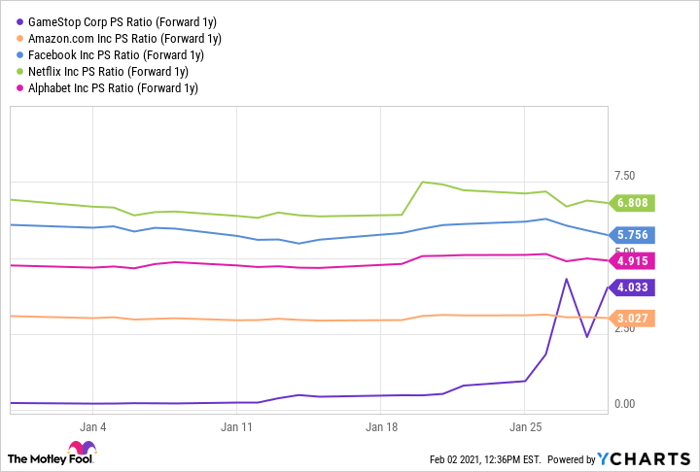
    A chart comparing GameStop to "FAANG" stocks.

    Data source: Ycharts.

    Admittedly, this advantage may not be enough to justify its currently elevated stock price, which is trading at a price to sales ratio similar to that of several FAANG stocks (see chart above). In fact, it is trading at a higher forward P/S ratio than Amazon.

    Unfortunately for GameStop shareholders, the stock is tumbling down from its per-share high of near $350 to $60 as of this writing. Investors wanting to make a prudent decision would be better off putting their money into more proven winners. 

    This article was originally published on Fool.com. All figures quoted in US dollars unless otherwise stated.

    Where to invest $1,000 right now

    When investing expert Scott Phillips has a stock tip, it can pay to listen. After all, the flagship Motley Fool Share Advisor newsletter he has run for more than eight years has provided thousands of paying members with stock picks that have doubled, tripled or even more.*

    Scott just revealed what he believes are the five best ASX stocks for investors to buy right now. These stocks are trading at dirt-cheap prices and Scott thinks they are great buys right now.

    *Returns as of June 30th

    More reading

    Parkev Tatevosian has no position in any of the stocks mentioned. John Mackey, CEO of Whole Foods Market, an Amazon subsidiary, is a member of The Motley Fool’s board of directors. Teresa Kersten, an employee of LinkedIn, a Microsoft subsidiary, is a member of The Motley Fool’s board of directors. The Motley Fool Australia’s parent company Motley Fool Holdings Inc. owns shares of and recommends Amazon and Microsoft and recommends the following options: long January 2022 $1920 calls on Amazon and short January 2022 $1940 calls on Amazon. The Motley Fool Australia has recommended Amazon. The Motley Fool has a disclosure policy. This article contains general investment advice only (under AFSL 400691). Authorised by Bruce Jackson.

    The post GameStop has 1 undeniable advantage appeared first on The Motley Fool Australia.

    This article was originally published on Fool.com. All figures quoted in US dollars unless otherwise stated.

    from The Motley Fool Australia https://ift.tt/2O8SXIb

  • ASX shares to rocket 6% this year

    rocketing asx share price represented by man riding golden dollar sign speeding through clouds

    An economist has revealed some figures that are food for thought for retail investors trying to figure out whether ASX shares are in a bubble.

    Predictions for 2021 have been polarised, to say the least.

    Many experts are optimistic, citing near-zero interest rates, COVID-19 government support and coronavirus vaccines to charge up the economy.

    “I think in 2021 we will see our equity market deliver at least 10% return,” said Tribeca Investment Partners portfolio manager Jun Bei Liu last month at a GSFM briefing.

    “A big part of that will be dividends – however, we should see some of the best growth yet.”

    Commonwealth Bank of Australia (ASX: CBA) chief economist Stephen Halmarick at the end of December said that Australia had done a fantastic job of controlling the virus.

    “We do expect a solid recovery in 2021, with global growth forecasts at 5.2 per cent – led by the US and China.”

    In the opposite camp are wise owls like GMO founder Jeremy Grantham, who is warning of a massive share market bubble about to pop soon.

    “Featuring extreme overvaluation, explosive price increases, frenzied issuance, and hysterically speculative investor behavior, I believe this event will be recorded as one of the great bubbles of financial history – right along with the South Sea bubble, 1929, and 2000,” he said to clients last month.

    “And here we are again, waiting for the last dance and, eventually, for the music to stop.”

    Now BetaShares chief economist David Bassanese has come up with some numbers to support the bull case.

    2021 will see an earnings-driven rally

    Bassanese has seen that in January the S&P/ASX 200 Index (ASX: XJO) only rose by 0.3% even though an impressive 6.4% growth in forward earnings was recorded.

    “This meant the PE ratio edged back further to 19.2, from a recent month-end peak of 21.8 at end-August.”

    He thus predicts the ASX 200 will head up 6% from 31 January to the end of the year, which means hitting the 7,000-point barrier.

    “Current market expectations imply 6% growth in forward earnings by year-end, though there appears scope for further upgrades due to the faster than generally expected turnaround in the economy.”

    Bassanese’s view was supported further this week when the Reserve Bank emphasised that it couldn’t see the cash rate increasing until 2024.

    ASX shares, with a 3.1% loss, had also underperformed compared to other regions over the last 12 months. The S&P 500 Index (SP: .INX)and the Nikkei 225 Index (NIKKEI: NI225) were up 17.2% and 21.5% respectively over the same period. 

    This means the local bourse, heavily dominated by finance and mining, may be ready to ride the recovery train into the sunset.

    “With bond yields only expected to rise modestly further, and the earnings-to-bond yield gap close to recent averages at around 4%, PE valuations may not need to correct back all that much over the coming year.”

    Looking For Bargain Buys? These Cheap Stocks Could Be Just What You’re After (FREE REPORT)

    Scott Phillips has released a FREE stock report revealing 5 stocks that he believes are WAY undervalued by the market at these current prices.

    Scott thinks these 5 stocks are a ‘must consider’ for any savvy investor.

    Don’t miss out! Simply click the link below to grab your free copy and discover Scott’s 5 bargain stocks now.

    Click Here For Your Free Stock Report

    More reading

    Motley Fool contributor Tony Yoo has no position in any of the stocks mentioned. The Motley Fool Australia has no position in any of the stocks mentioned. The Motley Fool has a disclosure policy. This article contains general investment advice only (under AFSL 400691). Authorised by Bruce Jackson.

    The post ASX shares to rocket 6% this year appeared first on The Motley Fool Australia.

    from The Motley Fool Australia https://ift.tt/3tqP41p

  • Here’s how ASX equal-weight ETFs stack up to index funds

    wondering about asx shares represented by woman surrounded by question marks

    Exchange-traded funds (ETFs) are an increasingly popular investment vehicle for investors as we start 2021. In fact, (as we reported at the time), 2020 was one of the best years ever for ETFs, which experienced record inflows.

    The most popular ETFs by far with ASX investors are index funds. Index funds are very simple in nature as they methodically track a major index such as the S&P/ASX 200 Index (SAX: XJO). Indexes like these are usually market capitalisation weighted, meaning that the largest companies in the index account for the largest holdings.

    As an example, the largest constituent of the iShares Core S&P/ASX 200 ETF (ASX: IOZ) is currently Commonwealth Bank of Australia (ASX: CBA) with an 8.13% weighting. Since CBA is currently the largest company by market cap on the ASX, it’s commensurately the largest holding in the index (and IOZ).

    Most index funds work in this way. If a company grows in value over time, its weighting in any index that holds it will also grow. That’s why Afterpay Ltd (ASX: APT) has the 14th largest weighting in the index right now, even though it wouldn’t have been there at all a few years ago.

    Equally, if a company falls on foul fortune and decreases in value, it will progressively be moved down the index to reflect this. Fallen agents like AMP Limited (ASX: AMP) now occupy a far smaller space in the ASX 200 than they did in days of yore.

    However, not all indexes follow this weighting methodology. There is a different breed of ETFs out there that have a following, known as “equal-weighted ETFs”. As the name implies, an equal-weighted ETF does not allocate larger companies a larger piece of the ETF’s weighting. Instead, all companies, regardless of size, are treated equally.

    Some are more equal than others…

    Take the VanEck Vectors Australian Equal Weight ETF (ASX: MVW). Instead of the method described above, this ETF assigns an equal weighting to each constituent. Thus, CBA is equally weighted to Afterpay, or AMP.

    This ETF doesn’t track the ASX 200, instead holding 101 companies at the current time. That essentially means that each company gets slightly below a 1% weighting each. Now, these holdings can (and will) move around their initial allocation over time. But this is all part of the process. If say Afterpay has a particularly strong month, and doubles to 2% of the ETF’s weighting, it will simply be trimmed at the next quarterly rebalancing of the ETF.

    MVW isn’t the only equal-weighted WTF on the ASX either.

    The iShares S&P 500 ETF (ASX: IVV) tracks the US S&P 500 Index (INDEXSP: .INX) in the conventional, market-cap weighted manner. But the BetaShares S&P 500 Equal Weight ETF (ASX: QUS) instead follows an equal-weighting methodology similar to MVW. Ford Motor Company (NYSE: F) will have the same weighting as Apple Inc (NASDAQ: AAPL) and Tesla Inc (NASDAQ: TSLA).

    But is equal weight worth the effort?

    How do equal weight ETFs stack up?

    There are some arguments that carry logic with this one. One for instance, is the common criticism of the ASX 200 has being dominated by ‘banks and miners’. Indeed, the Financials and Materials sectors of the ASX 200 together make up almost 50% of the entire index. In MVW’s case, this is instead around 36%.

    But what of performance?

    Well, MVW has returned an average of 11.49% per annum over the past 5 years. In contrast, IOZ has returned an average of 9.88%.

    Maybe the shoe doesn’t fit every foot. The iShares S&P 500 ETF has returned an average of 14.03% per annum over the past 5 years. In contrast, the BetaShares S&P 500 Equal Weight ETF has returned an average of 9.74% per annum over the same period.

    So clearly equal weight works well in some situations but isn’t anything close to a ‘silver bullet’ of higher returns. Its effectiveness may depend on different market, different companies within those markets, or just pure chance.

    Before you make a decision on whether equal weighted ETFs are something you want to pursue, make sure you keep fees in mind. As they are most costly to run (and less popular), equal weight ETFs often have higher fees than their market cap cousins. Take MVW – it charges a management fee of 0.35% per annum. IOZ on the other hand charges 0.1%.

    It’s a similar story with the US ETFs. IVV charges a fee of 0.04%, whereas QUS asks 0.29%. Those fees can make a difference over time, so keep them in mind.

    Where to invest $1,000 right now

    When investing expert Scott Phillips has a stock tip, it can pay to listen. After all, the flagship Motley Fool Share Advisor newsletter he has run for more than eight years has provided thousands of paying members with stock picks that have doubled, tripled or even more.*

    Scott just revealed what he believes are the five best ASX stocks for investors to buy right now. These stocks are trading at dirt-cheap prices and Scott thinks they are great buys right now.

    *Returns as of June 30th

    More reading

    Sebastian Bowen owns shares of Ford and Tesla. The Motley Fool Australia’s parent company Motley Fool Holdings Inc. owns shares of and recommends Apple and Tesla. The Motley Fool Australia owns shares of AFTERPAY T FPO. The Motley Fool Australia has recommended Apple. The Motley Fool has a disclosure policy. This article contains general investment advice only (under AFSL 400691). Authorised by Bruce Jackson.

    The post Here’s how ASX equal-weight ETFs stack up to index funds appeared first on The Motley Fool Australia.

    from The Motley Fool Australia https://ift.tt/3pQe3Jg

  • This ASX growth share is cheap like a value stock

    woman whispering secret regarding asx share price to a man who looks surprised

    Are you sick of hearing that ASX growth shares are now overvalued?

    Do you feel like you’ve missed the boat?

    One fund manager has picked out a recently floated ASX share that he reckons has outstanding growth potential but is still cheap.

    Datt Capital principal Emanuel Datt wrote in a research memo this week that home fragrance retailer Dusk Group Ltd (ASX: DSK) is in an intriguing situation.

    “Dusk is the largest player in the local market holding approximately 22% market share, whilst running only around 115 physical stores,” he said.

    “The company foresees the potential to grow to around 160 stores throughout Australasia by 2024. Over the last 12 months, the company’s online presence grew significantly making up at least 10% of overall group revenue.”

    Datt added that COVID-19 restrictions last year certainly boosted the company’s fortunes, as Australians spent more money on homewares.

    “Whilst Dusk was forced to close its physical stores for a short period of time, growth was barely dented with like-for-like sales growth of >17% for FY2020.”

    Dusk listed on the ASX in November with an initial public offering (IPO) price of $2 per share. The Dusk share price was trading at $2.55 by market close on Thursday.

    Dusk’s case for growth

    Despite the prospect of coronavirus vaccines liberating Australians from the confines of their homes, Datt still sees expansion opportunities.

    “Dusk intends to penetrate its core Australian market fully and [start] to roll out its stores in New Zealand,” he wrote.

    “It aims to grow outside the ANZ region by establishing online stores in key geographies.”

    The fragrance retailer doesn’t currently sell to the United States and United Kingdom, but it still sees “a significant” 1% of web traffic from those locations.

    “We would expect that Dusk may one day have larger international operations than domestic. The company intends to begin international order fulfilment and to test demand in overseas markets starting from FY2022.”

    WAM Microcap Ltd (ASX: WMI) last month agreed with Datt, naming Dusk as an ASX share it held and had great hopes for.

    How are Dusk shares cheap?

    Datt uses the ‘enterprise value to EBIT’ ratio to support its claim that Dusk shares are considerably cheaper than other discretionary retail businesses:

    ASX-listed discretionary retail businesses
    ASX share Enterprise value EBIT Ratio
    Premier Investments Limited (ASX: PMV) $3.4bn $233m 14.7
    Baby Bunting Group Ltd (ASX: BBN) $628m $33m 19
    Lovisa Holdings Ltd (ASX: LOV) $1.16bn $30.6m 37.9
    City Chic Collective Ltd (ASX: CCX) $850m $22m 38.6
    Nick Scali Limited (ASX: NCK) $860m $88m 9.8
    Kathmandu Holdings Ltd (ASX: KMD) $855m $56m 15.3
    Accent Group Ltd (ASX: AX1) $1.26bn $136m 9.3
    Adairs Ltd (ASX: ADH) $665m $82m 8.1
    Dusk $112m $33m 3.4
    Figures sourced from guidance and actual results
    Source: Datt Capital. Table created by author

    “If we assume as a conservative measure that Dusk can achieve the lowest valuation multiple out of its peers at 8.1x, we could expect to see the company trade at an enterprise value of $267 million or $4.24 per share (84% more than the current price),” he said.

    “Note that this figure excludes the company’s existing significant cash balance. No matter which way we examine the company, it still trades cheaply by any metric.”

    Dusk reminds Datt of jewellery retailer Lovisa, which was also once owned by private equity firm BBRC.

    “Lovisa listed at a market value of around $200 million. It is now valued at around $1.2 billion with normalised EBIT of around $30 million,” he said.

    “This company itself, we consider having lower growth potential than Dusk at this point given the product range and current geographic spread.”

    What’s the downside?

    The investor memo from Datt speculates that the Dusk IPO was “a sell-down” by the private owners rather than a genuine capital raising.

    “It would not have made sense for Dusk to raise fresh capital considering the company was strongly capitalised at the time of the IPO,” Datt said.

    “Accordingly, the IPO allowed the two largest holders, Catalyst and BBRC, to reduce their shareholding in the group.”

    The analyst wasn’t too concerned though, as private equity firms like Catalyst need to have an exit strategy to realise gains for their investors.

    The other uncertainty, of course, is the pandemic.

    “Our thesis is that people are spending more on themselves and their home environment in lieu of travelling overseas and interstate,” said Datt.

    “Whilst we cannot say with certainty when travel will become commonplace, we expect this time of restricted physical movement to last at least another 12 months.”

    This Tiny ASX Stock Could Be the Next Afterpay

    One little-known Australian IPO has doubled in value since January, and renowned Australian Moonshot stock picker Anirban Mahanti sees a potential millionaire-maker in waiting…

    Because ‘Doc’ Mahanti believes this fast-growing company has all the hallmarks of genuine Moonshot potential, forget ‘buy now pay later’, this stock could be the next hot stock on the ASX.

    Doc and his team have published a detailed report on this tiny ASX stock. Find out how you can access what could be the NEXT Afterpay today!

    Returns as of 6th October 2020

    More reading

    Tony Yoo owns shares of Dusk Group Limited. The Motley Fool Australia’s parent company Motley Fool Holdings Inc. recommends ADAIRS FPO. The Motley Fool Australia owns shares of and has recommended Premier Investments Limited. The Motley Fool Australia has recommended Accent Group and ADAIRS FPO. The Motley Fool has a disclosure policy. This article contains general investment advice only (under AFSL 400691). Authorised by Bruce Jackson.

    The post This ASX growth share is cheap like a value stock appeared first on The Motley Fool Australia.

    from The Motley Fool Australia https://ift.tt/2YHASTs

  • 3 fast-growing small cap ASX shares to watch

    tiny asx share price growth represented by little girl looking surprised

    If you’re looking to gain exposure to the small side of the market, then you might want to take a look at the small cap ASX shares listed below. 

    Here’s why these small cap ASX shares could be ones to watch:

    Bigtincan Holdings Ltd (ASX: BTH)

    Bigtincan is a provider of enterprise mobility software to sales and service organisations. It has been designed to allow users to increase sales win rates, reduce expenditures, and improve customer satisfaction through improved mobile worker productivity.

    The company released its second quarter update last week and revealed annualised recurring revenue (ARR) of $48.4 million. This represents growth of 50% on the prior corresponding period and was driven predominantly by organic growth.

    MyDeal.com.au Limited (ASX: MYD)

    MyDeal.com.au is an online retail marketplace with a focus on furniture, homewares, appliances, technology, baby products, and hardware. It has been a big winner from the accelerating shift to online shopping caused by the pandemic.

    The company recently released its half year update and revealed first half gross sales of $126.7 million. This was a 217% increase over the same period last year. Management advised that this was driven by a strong increase in active customers to a record 813,764 and higher levels of repeat use.

    Nitro Software Ltd (ASX: NTO)

    A final small cap to watch is Nitro Software. It is a growing software company aiming to drive digital transformation in organisations around the world across multiple industries. Its key solution is the Nitro Productivity Suite, which provides integrated PDF productivity and electronic signature tools.

    Last week it released its fourth quarter update and revealed that its ARR reached US$27.7 million at the end of December. This was up 64% on the prior corresponding period and ahead of its previously upgraded guidance of US$26 million to US$27 million. Management advised that the company now serves 11,700 business customers, including 68% of the Fortune 500.

    Where to invest $1,000 right now

    When investing expert Scott Phillips has a stock tip, it can pay to listen. After all, the flagship Motley Fool Share Advisor newsletter he has run for more than eight years has provided thousands of paying members with stock picks that have doubled, tripled or even more.*

    Scott just revealed what he believes are the five best ASX stocks for investors to buy right now. These stocks are trading at dirt-cheap prices and Scott thinks they are great buys right now.

    *Returns as of June 30th

    More reading

    James Mickleboro has no position in any of the stocks mentioned. The Motley Fool Australia’s parent company Motley Fool Holdings Inc. owns shares of and recommends BIGTINCAN FPO. The Motley Fool Australia has recommended BIGTINCAN FPO and Nitro Software Limited. The Motley Fool has a disclosure policy. This article contains general investment advice only (under AFSL 400691). Authorised by Bruce Jackson.

    The post 3 fast-growing small cap ASX shares to watch appeared first on The Motley Fool Australia.

    from The Motley Fool Australia https://ift.tt/2LjVXQN