Tag: Motley Fool

  • Here’s why the Austin (ASX:ANG) share price is on watch today

    asx share price on watch represented by young man looking intently through magnifying glass

    The Austin Engineering Ltd (ASX: ANG) share price will be on watch this morning. This comes after the company announced after yesterday’s market close it has received a number of new orders for its products.

    The Austin share price finished Monday’s trading session at 17.5 cents. It will be interesting to see how the company’s shares perform today as investors digest this latest news.

    Strong orders received

    Austin Engineering, a global mining equipment designer and manufacturer, reported last night it has received new customer orders for more than 100 of its products. These include truck bodies, water tanks and buckets for large mining companies.

    The recent order flow is estimated to comprise more than $35 million in revenue for the company. Furthermore, the recent purchases will support Austin’s previous earnings guidance of underlying net profit after tax of above $9 million.

    The company’s order book now accounts for over 70% of expected revenues, which is on par with the same time last year.

    Segment performance

    Management said that while the Asia-Pacific region continues to outperform expectations, its North and South American segments are lagging behind.

    In the United States market, the intensifying COVID-19 situation, and continued federal election noise are negatively impacting Austin’s order flow. Consumer confidence appears to have stunted as businesses refrain from capital expenditure.

    Looking ahead however, Austin is forecasting an improvement post January 2021 with annual budgets usually reset for the new year. Currently, the company has already quoted several works in the region, with final customer commitments anticipated in the third quarter of FY21.

    Similar to its northern neighbour, South America has seen business activity falter amid COVID-19 restrictions. Tender contracts for long-term supply of equipment, repair and maintenance have become delayed in Chile. Austin advised it is well positioned to weather the storm and sees a number of opportunities in the post-pandemic world.

    What did management say?

    Commenting on the company’s performance, Austin managing director Mr Peter Forsyth said:

    The Asia-Pacific region is performing exceptionally well at the moment with a strong line of sight to keeping our two large facilities in Perth and Indonesia close to capacity.

    Offsetting this strength, the Americas are currently facing challenging operating environments, and this is a product of the broader economies in those regions. I am heartened by the scale of opportunities in the US, Canada and Chile and we remain confident that the tide will begin to turn early in the New Year in these regions.

    Austin share price summary

    The Austin share price has had a bumpy road over the past 12 months. Its shares reached a high of 23 cents in January, before falling as low as 10.5 cents in March.

    Based on the current Austin share price, the company has a market capitalisation of $101.5 million and a price-to-earnings (P/E) ratio of 19.4.

    Where to invest $1,000 right now

    When investing expert Scott Phillips has a stock tip, it can pay to listen. After all, the flagship Motley Fool Share Advisor newsletter he has run for more than eight years has provided thousands of paying members with stock picks that have doubled, tripled or even more.*

    Scott just revealed what he believes are the five best ASX stocks for investors to buy right now. These stocks are trading at dirt-cheap prices and Scott thinks they are great buys right now.

    *Returns as of June 30th

    More reading

    Motley Fool contributor Aaron Teboneras has no position in any of the stocks mentioned. The Motley Fool Australia has no position in any of the stocks mentioned. The Motley Fool has a disclosure policy. This article contains general investment advice only (under AFSL 400691). Authorised by Bruce Jackson.

    The post Here’s why the Austin (ASX:ANG) share price is on watch today appeared first on The Motley Fool Australia.

    from The Motley Fool Australia https://ift.tt/2Ksy6NT

  • Wilson Asset Management (WAM) thinks these 2 ASX shares are a buy

    investing

    Respected fund manager Wilson Asset Management (WAM) has recently identified two ASX shares that it owns in its portfolio.

    WAM operates several listed investment companies (LICs). Some focus on larger companies like WAM Leaders Ltd (ASX: WLE) and WAM Research Limited (ASX: WAX).

    There’s also one called WAM Capital Limited (ASX: WAM) which targets “the most compelling undervalued growth opportunities in the Australian market.”

    The WAM Capital portfolio has delivered an investment return of 16.3% per annum since inception in August 1999, before fees, expenses and taxes. This gross return outperformed the S&P/ASX All Ordinaries Accumulation Index return of 8.3% per annum over the same timeframe.

    These are the two ASX shares that WAM Capital outlined in its most recent monthly update:

    Infomedia Limited (ASX: IFM)

    According to the ASX, Infomedia has a market capitalisation of $722 million.

    WAM describes Infomedia as a leading provider of parts, services and data insights to the global automotive industry.

    In November, the ASX share secured a strategic contract with Ford Europe valued at $14 million over five years, to provide the next generation of Ford’s electronic parts catalogue in the European region. The fund manager explained the contract allows Infomedia to continue to focus on the parts and services element of the value chain, expanding usage of its integrated parts selling platform and taking advantage of the trend towards innovative technology solutions in the automotive industry.

    Infomedia management has provided an aspirational target to double revenue over the next five years, and the fund manager is positive about Infomedia’s ability to increase its current 0.5% market share in the global automotive dealership software market going forward.

    Using the current Infomedia share price and Commsec earnings estimated, it’s priced at 25x FY23’s estimated earnings.

    Graincorp Ltd (ASX: GNC)

    According to the ASX, Graincorp has a market capitalisation of $1 billion.

    WAM describes Graincorp as a business that handles, receives and stores agricultural commodities including grain and assists with the transporting, testing, storing and marketing of agricultural products.

    The fund manager said that with a September financial year end, the ASX share issued its FY20 results in November that highlighted a significant lift in financial performance despite the impact of the drought, with underlying earnings before interest, tax, depreciation and amortisation (EBITDA) from continued operations of $108 million and a fully franked full year dividend of 7 cents per share.

    Graincorp also reported that underlying net profit after tax was a loss of $16 million whilst statutory net profit after tax was $343 million.

    At the time, Graincorp chief financial officer Ian Morrison said: “Although ECA grain production was again adversely impacted by drought, the company benefited from the first year of the CPC, receiving a total gross payment of $58 million due to the reduced size of the harvest.

    “Throughout the year, the business continued to import grain from other states to manage east coast grain deficits, although these trans-shipments slowed in the second half as expectations for the 2020/21 crop improved. It is pleasing to see improvements in performance right across the business and the benefits being delivered from our capital investments and operating initiatives.”

    WAM said that the FY21 outlook is strong with a record east coast crop tracking ahead of expectations.

    The WAM thesis about the investment is that Graincorp is leveraged to an increase in crop volumes and the fundie believes that the efficiency gains and cost savings implemented by management over the past years will materialise in financial performance.

    Where to invest $1,000 right now

    When investing expert Scott Phillips has a stock tip, it can pay to listen. After all, the flagship Motley Fool Share Advisor newsletter he has run for more than eight years has provided thousands of paying members with stock picks that have doubled, tripled or even more.*

    Scott just revealed what he believes are the five best ASX stocks for investors to buy right now. These stocks are trading at dirt-cheap prices and Scott thinks they are great buys right now.

    *Returns as of June 30th

    More reading

    Tristan Harrison has no position in any of the stocks mentioned. The Motley Fool Australia’s parent company Motley Fool Holdings Inc. owns shares of Infomedia. The Motley Fool Australia has recommended Infomedia. The Motley Fool has a disclosure policy. This article contains general investment advice only (under AFSL 400691). Authorised by Bruce Jackson.

    The post Wilson Asset Management (WAM) thinks these 2 ASX shares are a buy appeared first on The Motley Fool Australia.

    from The Motley Fool Australia https://ift.tt/2WgwnOs

  • Why the Pushpay (ASX:PPH) share price is in a trading halt

    No deal

    The Pushpay Holdings Ltd (ASX: PPH) share price has been a very strong performer in 2020.

    Since the start of the year the donation and engagement platform provider’s shares have risen a massive 83%

    However, they won’t be building on this today after the company requested a trading halt.

    Why is the Pushpay share price in a trading halt?

    This morning Pushpay requested a trading halt whilst it undertakes a bookbuild process relating to the sale of a significant combined stake in the company by two existing shareholders.

    According to the release, the bookbuild will facilitate the sale of 54.68 million shares in Pushpay, which represents 4.96% of the issued capital. This comprises 41.67 million shares held by interests associated with former CEO Chris Heaslip and 13.01 million shares held by interests associated with Executive Director Chris Fowler.

    Following the transaction, Mr Heaslip’s stake will reduce from 4% to 0.20% (and will be held by Mission 316 Foundation) and Mr Fowler’s stake will reduce from 2.4% to 1.2%.

    The sell down is fully underwritten at a floor price of NZ$1.75 per share, which represents a 7.4% discount to the last closing price of NZ$1.89 on 14 December 2020.

    The bookbuild is expected to commence today and then complete in time for the market open on Wednesday.

    Guidance reaffirmed.

    To reassure shareholders that the two major shareholders are not selling shares because of any underperformance, Pushpay also released an update on its expectations for FY 2021.

    The release explains that the company is on track to achieve its EBITDAF guidance of between US$54 million and US$58 million for the 12 months ending 31 March. This represents a 116% to 132% increase, respectively, on the FY 2020’s operating earnings of US$25.1 million.

    Though, management has warned that there are uncertainties and impacts surrounding COVID-19 and the broader US economic environment that remain.

    Where to invest $1,000 right now

    When investing expert Scott Phillips has a stock tip, it can pay to listen. After all, the flagship Motley Fool Share Advisor newsletter he has run for more than eight years has provided thousands of paying members with stock picks that have doubled, tripled or even more.*

    Scott just revealed what he believes are the five best ASX stocks for investors to buy right now. These stocks are trading at dirt-cheap prices and Scott thinks they are great buys right now.

    *Returns as of June 30th

    More reading

    Motley Fool contributor James Mickleboro has no position in any of the stocks mentioned. The Motley Fool Australia owns shares of and has recommended PUSHPAY FPO NZX. The Motley Fool has a disclosure policy. This article contains general investment advice only (under AFSL 400691). Authorised by Bruce Jackson.

    The post Why the Pushpay (ASX:PPH) share price is in a trading halt appeared first on The Motley Fool Australia.

    from The Motley Fool Australia https://ift.tt/3mitPtT

  • Sell now or hold forever? What to do with shares like Afterpay (ASX:APT)

    Making a decision at a crossroads

    So you were lucky enough to have Afterpay Ltd (ASX: APT) shares this year.

    According to my Fool colleague Sebastian Bowen, the stock has risen 244% so far this year and a spectacular 1,200% since the March COVID-19 trough. The price hit yet another all-time high on Monday.

    Wonderful stuff. 

    But shareholders now have an absolute headache: when do you exit?

    Yes, it’s a great problem to have. But it’s a problem nevertheless.

    Can the buy now, pay later provider continue its rise, or should retail investors cash in their handsome profits before the dream is shattered?

    There is a hint from the professionals on how to handle this.

    Chloe Stokes, research analyst at Forager Australian Shares Fund (ASX: FOR) revealed last week she grappled with a similar situation.

    Farfetch Ltd (NYSE: FTCH) is a digital platform for the luxury industry. They operate on a global scale, including here in Australia,” she told a Forager video.

    “I’ve been interested in the business from a consumers perspective for a couple of years. I’ve ordered from the platform, and so have a lot of people that I know. The stock has been loosely on my radar for a year or two.”

    After watching the volatile share price and doing research on its business model, Stokes’ consumer interest slowly converted to a professional one.

    “It listed in late 2018 in September at US$27 a share – by December that year, it was trading below US$18,” she said.

    “It got down as low as US$7 in March this year. Of course, we wish we bought it back then, but we were looking at other things. In June, when it was trading at around US$20, we started to do some pretty deep research on the stock. And we started to get comfortable around the value that was in the business.”

    Forager ended up buying in the middle of this year for mid-US$20s. 

    Then it took off.

    “Since then the price has run up pretty significantly… it’s up more than 100% on our purchase price,” said Stokes.

    “COVID has been great for them, consumers are forced to shop online. And for somewhere like China, where they did a lot of their luxury spending internationally, they have been forced to find new ways to purchase those luxury goods. Farfetch has been a huge beneficiary of that.”

    Farfetch shares are now trading for US$60.08.

    What to do with a pot of gold?

    So what would Stokes’ team do now that the price has rocketed up? Cash in or hold on?

    Making the decision harder for Forager is that it thinks the company has excellent growth prospects in the future.

    The revenue model for Farfetch has eerie similarities to Afterpay, in that the merchant – not the end customer – pays a fee to the platform.

    How long would suppliers put up with this expense?

    “You might think Farfetch is taking sales from those designer brands. And they’re paying them, say, a 30% take rate for the pleasure,” said Stokes.

    “But if you look at it from another angle, Farfetch… is actually broadening the market for luxury goods, and especially for luxury goods online, because it’s getting rid of a lot of constraints that those retailers would have had in their bricks and mortar stores.” 

    Afterpay enthusiasts say the same – merchants lose margin but the buy now, pay later brings in additional sales that they would not have otherwise had.

    “They are expanding the definition of luxury,” said Stokes.

    “Farfetch has two-thirds of its sales coming from millennials and Gen Z consumers… It’s not just the fancy designer bags on there. There’s expensive streetwear – you’ll see pairs of Nikes on there.”

    Here’s what Forager did

    Stokes said she had many sleepless nights trying to figure out what to do with these now-inflated shares.

    Her team ended up having their cake and eating it.

    “We’ve sold more than half of what we initially bought in Farfetch. I think it’s [now] down at a manageable position,” she said.

    “It is a brilliant business and one I want to own in the portfolio for a long time. I still think there’s a lot of upside from here, although it’s not as obvious as it once was.”

    Forager is an investment house based in Sydney. Its Australian Shares Fund is trading at $1.39 per share, which is 18% up year-to-date.

    This Tiny ASX Stock Could Be the Next Afterpay

    One little-known Australian IPO has doubled in value since January, and renowned Australian Moonshot stock picker Anirban Mahanti sees a potential millionaire-maker in waiting…

    Because ‘Doc’ Mahanti believes this fast-growing company has all the hallmarks of genuine Moonshot potential, forget ‘buy now pay later’, this stock could be the next hot stock on the ASX.

    Doc and his team have published a detailed report on this tiny ASX stock. Find out how you can access what could be the NEXT Afterpay today!

    Returns as of 6th October 2020

    More reading

    Motley Fool contributor Tony Yoo owns shares of AFTERPAY T FPO. The Motley Fool Australia owns shares of AFTERPAY T FPO. The Motley Fool has a disclosure policy. This article contains general investment advice only (under AFSL 400691). Authorised by Bruce Jackson.

    The post Sell now or hold forever? What to do with shares like Afterpay (ASX:APT) appeared first on The Motley Fool Australia.

    from The Motley Fool Australia https://ift.tt/3oStm3b

  • Here’s why Bubs (ASX:BUB) and this ASX share are underperforming in 2020

    The likes of Afterpay Ltd (ASX: APT) and Xero Limited (ASX: XRO) may have just hit record highs, but not all shares are faring as well.

    Two ASX shares that have thoroughly underperformed in 2020 are listed below. Here’s why their shares are down in the dumps:

    Bravura Solutions Ltd (ASX: BVS)

    The Bravura Solutions share price is down 37.5% since the start of 2020. The provider of software products and services to the wealth management and funds administration industries has come under pressure after providing underwhelming guidance for FY 2021. Bravura has warned that the pandemic could lead to flat profits this year.

    While this guidance might not sound overly bad considering the disruption it has faced with COVID-19, investors appear concerned by just how much of this profit is expected to be generated in the second half. Bravura’s chief executive officer, Tony Klim, explained: “…second wave UK lockdowns and stalling Brexit negotiations have increased uncertainty and are slowing the progress of pipeline opportunities in the UK. As a result, Bravura expects FY21 NPAT to be weighted approximately 80% to the second half of FY21.”

    One broker that thinks investors should look beyond this short term headwind and be taking advantage of the weakness in the Bravura share price is Goldman Sachs. It recently reiterated its buy rating and put a $4.50 price target on its shares. It believes the company is well-placed for long term growth once these headwinds ease.

    Bubs Australia Ltd (ASX: BUB)

    The Bubs share price is down a disappointing 37% since the start of the year and 48.7% from the 52-week high it reached in May. Investors have been selling the infant formula, baby food, and vitamins company’s shares after COVID-19 impacted its sales in the first quarter of FY 2021.

    For the three months ended 30 September, Bubs reported gross revenue of $9.4 million. This was down 34% from the $14.21 million it achieved in the prior corresponding period. Management blamed the decline on a COVID-led contraction in the daigou channel.

    But perhaps worst of all was its free cash flow. After becoming cashflow positive late in FY 2020, Bubs suddenly started burning through its cash again. For the quarter, it posted an operating cash outflow of $10.146 million, which was greater than its revenue for the period. This has sparked fears that yet another capital raising will be required next year, further diluting shareholders.

    This Tiny ASX Stock Could Be the Next Afterpay

    One little-known Australian IPO has doubled in value since January, and renowned Australian Moonshot stock picker Anirban Mahanti sees a potential millionaire-maker in waiting…

    Because ‘Doc’ Mahanti believes this fast-growing company has all the hallmarks of genuine Moonshot potential, forget ‘buy now pay later’, this stock could be the next hot stock on the ASX.

    Doc and his team have published a detailed report on this tiny ASX stock. Find out how you can access what could be the NEXT Afterpay today!

    Returns as of 6th October 2020

    More reading

    Motley Fool contributor James Mickleboro has no position in any of the stocks mentioned. The Motley Fool Australia owns shares of and has recommended Bravura Solutions Ltd and BUBS AUST FPO. The Motley Fool has a disclosure policy. This article contains general investment advice only (under AFSL 400691). Authorised by Bruce Jackson.

    The post Here’s why Bubs (ASX:BUB) and this ASX share are underperforming in 2020 appeared first on The Motley Fool Australia.

    from The Motley Fool Australia https://ift.tt/34bQBx7

  • 2 ASX shares with generous dividend yields

    man handing over wad of cash representing microsoft dividend

    Last month the Reserve Bank of Australia opted to cut the cash rate down to a record low of 0.1%.

    This was another blow for income investors, who will have to contend with even lower rates in 2021.

    But don’t worry, the Australian share market is home to countless dividend shares that offer better yields than term deposits and savings accounts.

    Two great examples of this are listed below:

    Aventus Group (ASX: AVN)

    Aventus is the largest fully-integrated owner, manager, and developer of large format retail centres in Australia. At the last count, it had a portfolio of 20 centres valued at $2.2 billion. Its portfolio spans 536,000m2 in gross leasable area and comprises a diverse tenant base of 593 quality tenancies.

    From these, national retailers represent 87% of the total portfolio. This includes retailers such as ALDI, Bunnings, and The Good Guys. Thanks to the quality of its tenancies and its high weighting to everyday needs, Aventus has been a positive performer this year despite the pandemic.

    One broker that has been impressed is Macquarie. Last month its analysts put an outperform rating and $2.93 price target on its shares. The broker is also forecasting a dividend of 16.7 cents per share. Based on the current Aventus share price, this represents a 6% yield.

    National Storage REIT (ASX: NSR)

    National Storage is one of the ANZ region’s leading self-storage operators. Over the last few years, the company has been growing at a solid rate. This has been driven by its strong position in a fragmented market and its successful growth through acquisition strategy. In addition to this, new revenue streams, such as allowing small businesses to run their operations from Wi-Fi-enabled units, has also supported its growth.

    Another solid result is expected in FY 2021. Management recently confirmed that it expects to report underlying earnings per share of 7.7 cents to 8.3 cents. It also advised that it intends to pay 90% to 100% of its earnings to shareholders as distributions. Based on the middle of both guidance ranges and the current National Storage share price, this equates to a 3.8% yield.

    These Dividend Stocks Could Be Your Next Cash Kings (FREE REPORT)

    Motley Fool Australia’s Dividend experts recently released a brand-new FREE report revealing 3 dividend stocks with JUICY franked dividends that could keep paying you meaty dividends for years to come.

    Our team of investors think these 3 dividend stocks should be a ‘must consider’ for any savvy dividend investor. But more importantly, could potentially make Australian investors a heap of passive income.

    Don’t miss out! Simply click the link below to grab your free copy and discover these 3 high conviction stocks now.

    Returns As of 6th October 2020

    More reading

    Motley Fool contributor James Mickleboro has no position in any of the stocks mentioned. The Motley Fool Australia has recommended AVENTUS RE UNIT. The Motley Fool has a disclosure policy. This article contains general investment advice only (under AFSL 400691). Authorised by Bruce Jackson.

    The post 2 ASX shares with generous dividend yields appeared first on The Motley Fool Australia.

    from The Motley Fool Australia https://ift.tt/3mnoPE5

  • 5 things to watch on the ASX 200 on Tuesday

    Worried young male investor watches financial charts on computer screen

    On Monday the S&P/ASX 200 Index (ASX: XJO) started the week in a positive fashion and recorded a small gain. The benchmark index rose 0.25% to 6,660.2 points.

    Will the market be able to build on this on Tuesday? Here are five things to watch:

    ASX 200 expected to edge higher.

    The Australian share market looks set to start the day slightly higher. According to the latest SPI futures, the ASX 200 is poised to open the day 3 points higher this morning. This follows a reasonably mixed start to the week on Wall Street. In late trade the Down Jones is down slightly, the S&P 500 is up 0.1%, and the Nasdaq has risen a solid 0.9%.

    Tech shares on watch.

    It could be a positive day for Australian tech shares such as Afterpay Ltd (ASX: APT) and Nearmap Ltd (ASX: NEA) on Tuesday after their US counterparts stormed higher. The local tech sector has a tendency to follow the lead of the Nasdaq index, which is up a sizeable 0.9% in late trade on Wall Street.

    Oil prices rise.

    Energy producers including Beach Energy Ltd (ASX: BPT) and Woodside Petroleum Limited (ASX: WPL) could push higher today after oil prices rose overnight. According to Bloomberg, the WTI crude oil price is up 0.4% to US$46.75 a barrel and the Brent crude oil price has risen 0.3% to US$50.11 a barrel. Vaccine hopes and a ship explosion in Saudi Arabia were behind the rise.

    Gold price tumbles.

    Gold miners such as Newcrest Mining Limited (ASX: NCM) and St Barbara Ltd (ASX: SBM) could come under pressure after the gold price tumbled lower. According to CNBC, the spot gold price has fallen 0.65% to US$1,831.10 an ounce. Gold prices softened after the rollout of a COVID-19 vaccine in the United States drove optimism of a swift economic recovery.

    Altium rated neutral.

    The Altium Limited (ASX: ALU) share price is fully valued according to analysts at Goldman Sachs. In response to its decision to offload its TASKING business, the broker has retained its neutral rating and $36.35 price target. This compares to the current Altium share price of $36.03.

    Where to invest $1,000 right now

    When investing expert Scott Phillips has a stock tip, it can pay to listen. After all, the flagship Motley Fool Share Advisor newsletter he has run for more than eight years has provided thousands of paying members with stock picks that have doubled, tripled or even more.*

    Scott just revealed what he believes are the five best ASX stocks for investors to buy right now. These stocks are trading at dirt-cheap prices and Scott thinks they are great buys right now.

    *Returns as of June 30th

    More reading

    James Mickleboro has no position in any of the stocks mentioned. The Motley Fool Australia’s parent company Motley Fool Holdings Inc. owns shares of and recommends Altium. The Motley Fool Australia’s parent company Motley Fool Holdings Inc. owns shares of Nearmap Ltd. The Motley Fool Australia owns shares of AFTERPAY T FPO. The Motley Fool Australia has recommended Nearmap Ltd. The Motley Fool has a disclosure policy. This article contains general investment advice only (under AFSL 400691). Authorised by Bruce Jackson.

    The post 5 things to watch on the ASX 200 on Tuesday appeared first on The Motley Fool Australia.

    from The Motley Fool Australia https://ift.tt/2LBJmby

  • Better Buy: Square vs. Visa

    This article was originally published on Fool.com. All figures quoted in US dollars unless otherwise stated.

    Female cafe employee accepting a card as payment

    This article was originally published on Fool.com. All figures quoted in US dollars unless otherwise stated.

    There’s a clear trend toward a cashless society, not only in the United States, but all over the world. While cash isn’t likely to go away entirely, at least not anytime soon, an increasing amount of financial transactions are taking place through credit and debit cards, mobile apps, and other non-cash methods.

    When there’s a clear trend like this, there are often interesting opportunities for long-term investors to take advantage of. And that’s especially true when we’re talking about a $185 trillion market opportunity, which is the current estimated volume of payments flowing around the globe.

    Two particularly interesting companies that investors might want to take a look at are fast-growing fintech company Square (NYSE: SQ) and payment processing leader Visa (NYSE: V). However, while both are great companies, these are two very different investments. So here’s a quick look at each one to help decide which is the better buy for your portfolio.

    Square: A massive disruptor with lots of growth potential

    To call Square a major disruptor would be like calling Amazon.com (NASDAQ: AMZN) a pretty successful retail company. The company has transformed the financial landscape by making it practical for all businesses, regardless of size, to seamlessly accept credit and debit card payments.

    However, Square has evolved dramatically since it started selling those little card readers sticking out of merchants’ smartphones. Its payment processing hardware is used by businesses of all sizes, and there is more than $100 billion in annualized payment volume flowing through its systems. The Square Capital business lending division has originated billions of dollars in small business loans, and the company has created a small business ecosystem.

    The personal finance side of Square’s business is becoming even more impressive. The company’s Cash App now has 30 million active users and in addition to its core person-to-person payment functionality, Cash App now enables users to buy and sell bitcoin, invest in stocks, and much more. But Square isn’t done yet — its vision is to be a one-stop shop for its users financial needs. It could add things like personal loans, high-yield savings, insurance products, and more to the ecosystem over time, just to name a few.

    Visa: The largest payment network in the world

    If you’re reading this, there’s a good chance that there’s at least one credit or debit card in your wallet that bears the Visa logo. The largest payment network in the world, there are nearly 3.5 billion Visa cards in existence and the company has about $9 trillion of annualized payment volume flowing through its network.

    However, don’t think because Visa is such a massive company that it is as big as it’s going to get. For one thing, while most payment transactions in the U.S. are now cashless, that isn’t the case in many parts of the world. Credit card acceptance isn’t nearly as universal in many places, and it is estimated that as many as 80% of payment transactions around the world still take place in cash.

    What’s more, the $185 trillion global payments market includes things like person-to-person and business-to-business transfers, areas where Visa hasn’t really tapped into yet. A few months ago, I wrote that Visa could become a $1 trillion market cap company in the not-too-distant future (currently it’s less than half of that), and my opinion hasn’t changed.

    Don’t think it has to be either-or

    One of the most common questions I’m asked about the fintech world is to the effect of “should Visa be worried about having Square and other disruptors take their business?” And the answer is no. Square provides the systems that facilitate payment transactions and Visa runs the network that processes them. Both are needed for a transaction. And there’s plenty of room for both to benefit from the cashless trend.

    The biggest question you should ask as an investor is how much volatility you’re willing to deal with and what your risk tolerance is. Square has tremendous growth potential, but is also a richly valued stock that is priced for significant growth going forward. On the other hand, Visa essentially dominates payment processing along with Mastercard (NYSE: MA) and is a much better fit for investors who are looking for steady and predictable gains.

    In a nutshell, both are great stocks and you probably won’t go wrong with either. As more of a growth-focused investor, I’d probably go with Square if I had to add one to my portfolio today (In full disclosure, I’ve been a Square shareholder since shortly after the IPO), but there’s a solid argument to be made for both.

    This article was originally published on Fool.com. All figures quoted in US dollars unless otherwise stated.

    Where to invest $1,000 right now

    When investing expert Scott Phillips has a stock tip, it can pay to listen. After all, the flagship Motley Fool Share Advisor newsletter he has run for more than eight years has provided thousands of paying members with stock picks that have doubled, tripled or even more.*

    Scott just revealed what he believes are the five best ASX stocks for investors to buy right now. These stocks are trading at dirt-cheap prices and Scott thinks they are great buys right now.

    *Returns as of June 30th

    More reading

    John Mackey, CEO of Whole Foods Market, an Amazon subsidiary, is a member of The Motley Fool’s board of directors. Matthew Frankel, CFP owns shares of Square and has the following options: short September 2022 $155 calls on Square. The Motley Fool owns shares of and recommends Amazon, Mastercard, Square, and Visa and recommends the following options: short January 2022 $1940 calls on Amazon and long January 2022 $1920 calls on Amazon. The Motley Fool Australia has no position in any of the stocks mentioned. The Motley Fool has a disclosure policy. This article contains general investment advice only (under AFSL 400691). Authorised by Bruce Jackson.

    The post Better Buy: Square vs. Visa appeared first on The Motley Fool Australia.

    This article was originally published on Fool.com. All figures quoted in US dollars unless otherwise stated.

    from The Motley Fool Australia https://ift.tt/3meifzJ

  • Why ASX oil stocks could replace the ASX tech boom in 2021

    boom in technology shares represented by race track strating line printed with the words 'are you ready'

    You might think it’s a bid of a bold call, but some experts believe ASX oil-exposed stocks could be the next ASX tech stars.

    While its tech stocks like the rocketing Afterpay Ltd (ASX: APT) share price and Xero Limited (ASX: XRO) share price that have been soundly beating the S&P/ASX 200 Index (Index:^AXJO), oil stocks may replace the tech rally in 2021.

    ASX energy stocks have underperformed this year as the oil price crashed. Many are also shunning the sector due to environmental concerns.

    ESG investing clashes with ASX energy stocks

    The snub that Prime Minister Scott Morrison had to endure at the UN Climate Summit will motivate even more investors to embrace Environmental, Social, and Corporate Governance (ESG) investing.

    Even the big banks are getting in on the act with Australia and New Zealand Banking GrpLtd (ASX: ANZ) recently promising not to fund any fossil fuel projects. This coming from an industry that isn’t known to have a conscience!

    Meanwhile, several high-profile global fund managers, including BlackRock, Inc. (NYSE: BLK), are moving away from investing in carbon polluting companies.

    Why ASX energy stocks could replace the tech boom

    But some experts believe there are undervalued investments in the energy sector, even for ESG conscious investors, reported the Australian Financial Review.

    “Oil is still a big part of the index, industrials is still a big part, materials, chemicals, steel, all these things,” the AFR quoted Janus Henderson portfolio manager, Tom O’Hara.  

    “You’re going to have to start owning these things in order to protect your portfolio and deliver performance.”

    How to pick the best ASX energy stocks for 2021

    The point he was making is that one shouldn’t paint all energy stocks with the same brush. To do so means missing out on ASX stocks that can deliver outsized returns in 2021.

    So how can ESG investors have their cake and eat it? The key here is to look for stocks that are transitioning to a cleaner future or those that are developing lower carbon projects.

    European oil and gas giants are moving with the times and bolstering their green credentials. Examples are the Royal Dutch Shell Plc (LON: RDSA) share price, the BP plc (LON: BP) share price and Total SE (EPA: FP) share price.

    There are two ASX stocks that also stand out in this regard, reported the AFR. These are the Santos Ltd (ASX: STO) share price and Woodside Petroleum Limited (ASX: WPL) share price.

    Where value investing meets ESG

    Both stocks enjoyed a robust bounce in November as the oil price recovered from the COVID‐19 meltdown. But the WPL share price is still nursing a 33% loss and the STO share price an 18% loss since the start of 2020.

    This leaves them plenty of room to rally. Thrown in the fact that there’s a limited pool of ESG friendly ASX energy stocks to pick from, chief investment officer at Bell Asset Management, Ned Bell, told the AFR he thinks there could be a scramble in 2021 to snap up such stocks.

    Where to invest $1,000 right now

    When investing expert Scott Phillips has a stock tip, it can pay to listen. After all, the flagship Motley Fool Share Advisor newsletter he has run for more than eight years has provided thousands of paying members with stock picks that have doubled, tripled or even more.*

    Scott just revealed what he believes are the five best ASX stocks for investors to buy right now. These stocks are trading at dirt-cheap prices and Scott thinks they are great buys right now.

    *Returns as of June 30th

    More reading

    Brendon Lau owns shares of Australia & New Zealand Banking Group Limited. Connect with me on Twitter @brenlau.

    The Motley Fool Australia’s parent company Motley Fool Holdings Inc. owns shares of Xero. The Motley Fool Australia owns shares of AFTERPAY T FPO. The Motley Fool has a disclosure policy. This article contains general investment advice only (under AFSL 400691). Authorised by Bruce Jackson.

    The post Why ASX oil stocks could replace the ASX tech boom in 2021 appeared first on The Motley Fool Australia.

    from The Motley Fool Australia https://ift.tt/380gdhM

  • Shopify stock’s 166% rally in 2020 isn’t sustainable

    This article was originally published on Fool.com. All figures quoted in US dollars unless otherwise stated.

    Amazon ecommerce package delivery

    This article was originally published on Fool.com. All figures quoted in US dollars unless otherwise stated.

    The COVID-19 pandemic has devastated many businesses around the world. However, it has been a huge positive catalyst for Shopify (NYSE: SHOP). The pandemic forced retailers – including many mom-and-pop stores – to shift their focus to e-commerce. Shopify helped these businesses set up online stores so that they could continue generating revenue, even with little or no traffic to their physical stores.

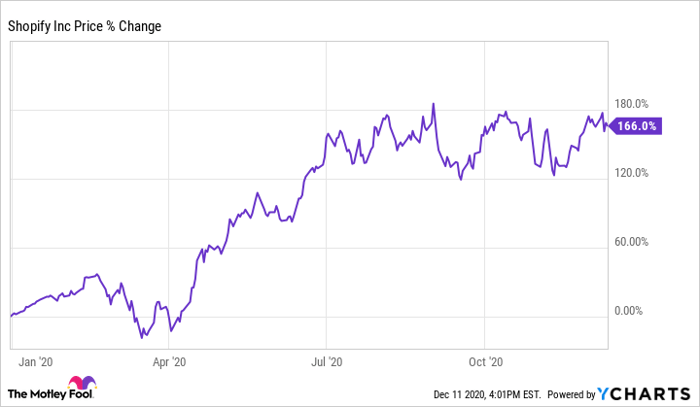
    Shopify stock has responded accordingly. The stock had already surged more than 1,400% between 2016 and 2019, but it has rallied another 166% in 2020. Despite a recent pullback, Shopify stock sits within 10% of its all-time high of $1,146.91.

    SHOP Chart

    Data source: YCharts.

    The pandemic-fuelled rally in Shopify stock isn’t likely to last, though. Shopify bulls appear to be overestimating the company’s long-term growth and earnings prospects.

    Two conflicting megatrends

    One of the biggest megatrends of the century is the transition of much of retail to e-commerce. That transition is still in the early innings. Last quarter, e-commerce accounted for just 14% of U.S. retail sales. It’s not clear what the long-term balance between brick-and-mortar retail and e-commerce will be, but it will clearly involve more e-commerce than today. Shopify will benefit from this megatrend for many years to come.

    However, a cross-cutting megatrend is far more troublesome for Shopify: the growing concentration of the retail industry. The top 10 U.S. retailers are on track to ring up at least $1.5 trillion of gross merchandise volume (GMV) this year. (The total GMV of all retailers with over $10 billion of domestic sales will easily exceed $2 trillion.) For comparison, U.S. retail sales will likely wind up near $4 trillion this year, excluding auto and gasoline sales.

    Amazon.com (NASDAQ: AMZN) is virtually certain to increase its already-high market share significantly over the next decade. Investors are also pricing shares of big-box retail giants like Walmart, Target, Costco Wholesale, and even Best Buy for significant future growth. Based on their low costs, broad store networks, and omnichannel offerings, it seems like a good bet that this expected growth will pan out.

    A lot of Shopify’s 2020 growth has come from helping smaller merchants make the transition to e-commerce. The risk is that in many cases, this may be a last-ditch attempt to stay in business – one that ultimately fails as Amazon and other megaretailers continue steamrolling less efficient competitors.

    Shopify does offer tools to help merchants on its platform sell through Amazon as well. In theory, that means Shopify could participate partially in Amazon’s rapid GMV growth. However, as Amazon becomes increasingly dominant in the U.S. retail landscape, merchants may find that virtually all of their sales come from that channel, reducing the value of Shopify’s services.

    Massive multiple contraction is inevitable

    Shopify has reported incredible results in 2020. Last quarter, revenue surged 96% on a 109% increase in GMV. That helped Shopify swing to a profit after losing money in the prior-year period. Revenue is on track to reach nearly $3 billion this year, and analysts expect Shopify to add almost $1 billion to its top line in 2021. Jefferies analyst Samad Samana thinks revenue could surge to $10 billion by 2025. Yet even if Shopify lives up to that aggressive forecast, it might not lift Shopify stock.

    Right now, Shopify stock trades for an eye-popping 45 times projected 2020 sales. That might make sense for an ultra-high-growth software company. However, lower-margin merchant solutions are driving the bulk of Shopify’s growth. Last quarter, subscription solutions revenue grew 48%, compared to a 132% surge in merchant solutions revenue. Subscription solutions carried a gross margin of 78.7%, compared to 40.6% for merchant solutions.

    Shopify’s investments in areas like robotics and fulfillment make sense. But as lower-margin revenue streams become an even bigger proportion of the business, Shopify’s revenue multiple is likely to shrink significantly. Later on, as the business matures and growth slows, its multiple is bound to contract even further.

    Shopify stock has flown too high

    When Shopify finally reaches maturity, many years down the road, it will probably merit a modest revenue multiple of around three times sales. (Oracle – a mature software company with extremely high margins – trades for less than five times sales.) Even if Shopify were to grow revenue at a 20% compound annual growth rate over the next two decades to around $100 billion by 2040, the company’s market cap would be just $300 billion at that valuation: only 135% above its current level.

    Moreover, I suspect that Shopify’s long-term revenue opportunity is even lower. Over the next decade, the percentage of retail sales going to massive corporations with over $10 billion of annual sales will continue rising. Unless Shopify can convince some of the largest retailers in the world to adopt its platform, it is ultimately playing in a shrinking market: one that isn’t big enough to justify Shopify stock’s lofty valuation.

    This article was originally published on Fool.com. All figures quoted in US dollars unless otherwise stated.

    Where to invest $1,000 right now

    When investing expert Scott Phillips has a stock tip, it can pay to listen. After all, the flagship Motley Fool Share Advisor newsletter he has run for more than eight years has provided thousands of paying members with stock picks that have doubled, tripled or even more.*

    Scott just revealed what he believes are the five best ASX stocks for investors to buy right now. These stocks are trading at dirt-cheap prices and Scott thinks they are great buys right now.

    *Returns as of June 30th

    More reading

    Adam Levine-Weinberg has no position in any of the stocks mentioned. John Mackey, CEO of Whole Foods Market, an Amazon subsidiary, is a member of The Motley Fool’s board of directors. The Motley Fool Australia’s parent company Motley Fool Holdings Inc. owns shares of and recommends Amazon and Shopify and recommends the following options: short January 2022 $1940 calls on Amazon and long January 2022 $1920 calls on Amazon. The Motley Fool Australia has recommended Amazon. The Motley Fool has a disclosure policy. This article contains general investment advice only (under AFSL 400691). Authorised by Bruce Jackson.

    The post Shopify stock’s 166% rally in 2020 isn’t sustainable appeared first on The Motley Fool Australia.

    This article was originally published on Fool.com. All figures quoted in US dollars unless otherwise stated.

    from The Motley Fool Australia https://ift.tt/37fJQwv