Tag: Motley Fool

  • Funtastic (ASX:FUN) share price storms 200% higher following suspension

    child in a superman outfit

    The Funtastic Limited (ASX: FUN) share price was up 207.69% this morning, reaching 20 cents before dropping back to 14 cents at the time of writing. This came after the company’s shares were lifted from a suspension that commenced on 5 October 2020.

    What has Funtastic announced recently?

    On 23 October, Funtastic announced that it would undertake the acquisition of Australian e-commerce websites Toys “R” Us, Babies “R” Us, Hobby Warehouse and Mittoni. The company also announced that it would recapitalise through a fully underwritten placement and a debt for equity swap.

    This morning, the company announced that it had successfully completed a placement worth $29 million. Funtastic will issue 258.9 million shares at an issue price of 11.2 cents. According to the company, the placement was well supported by both existing shareholders and new investors. The company’s major shareholder, Jaszac Investments Pty Ltd, also committed to a conversion of $6 million of debt to equity, also at an issue price of 11.2 cents. 

    The planned acquisition, placement and debt for equity swap are subject to shareholder approval, which will be sought at the company’s annual general meeting on 23 November 2020.

    The issue price of 11.2 cents was a 72% premium to the company’s last trading price of 6.5 cents on 30 September.

    According to Funtastic, capital raised from the company’s placement will fund the growth of the group, develop logistics, warehousing and automation capabilities, marketing and brand development, debt repayment and the development of e-commerce technology and associated intellectual property.  

    Funtastic chair Bernie Brooks commented on the company’s placement:

    With a strengthened balance sheet, Funtastic is well positioned to take advantage of the structural shift towards e-commerce for toys and hobby products while continuing to support and grow our ongoing wholesale agreements with our distribution and retail partners.

    About the Funtastic share price

    Funtastic is a wholesaler and distributor of consumer lifestyle products, which includes its own products and the products of its partners. Funtastic has been listed on the ASX since 2000.

    The Funtastic share price is up 3,400% since its 52-week low of 0.4 cents, and is up 600% since the beginning of the year. The Funtastic share price is up 366.67% since this time last year.

    Man who said buy Kogan shares at $3.63 says buy these 3 ASX stocks now

    When investing expert Scott Phillips has a stock tip, it can pay to listen. After all, the flagship Motley Fool Share Advisor newsletter he has run for more than eight years has provided thousands of paying members with stock picks that have doubled, tripled or even more.*

    In this FREE STOCK REPORT, Scott just revealed what he believes are the 3 ASX stocks for the post COVID world that investors should buy right now while they still can. These stocks are trading at dirt-cheap prices and Scott thinks these could really go gangbusters as we move into ‘the new normal’.

    *Returns as of 6/8/2020

    More reading

    Motley Fool contributor Chris Chitty has no position in any of the stocks mentioned. The Motley Fool Australia has no position in any of the stocks mentioned. We Fools may not all hold the same opinions, but we all believe that considering a diverse range of insights makes us better investors. The Motley Fool has a disclosure policy. This article contains general investment advice only (under AFSL 400691). Authorised by Scott Phillips.

    The post Funtastic (ASX:FUN) share price storms 200% higher following suspension appeared first on Motley Fool Australia.

    from Motley Fool Australia https://ift.tt/3ksWcFu

  • Pointsbet (ASX:PBH) share price continues to excite investors

    excitement surrounding asx share price rise represented by man holding slip of paper and making happy, fist up gesture

    The Pointsbet Holdings Ltd (ASX: PBH) share price has continued a rally that started in August, rising by 2.6% in today’s trading thus far. On 28 August, the company announced a transformational 5 year partnership with NBCUniversal, a subsidiary of Comcast Corporation (NASDAQ: CMCSA). Since that date, the Pointsbet share price has rocketed up by more than 55%, placing it up by 138% in year-to-date trading. 

    What’s driving the Pointsbet share price?

    The Pointsbet share price grew after the company became the official sports betting partner of NBC Sports in the United States. This provided it with access to over 184 million viewers which is the largest sports audience of any US media company. 

    As part of the deal, Pointsbet has committed to a total marketing spend of US$393 million in progressively increasing amounts, as well as incentives payable to NBCUniversal for customer referrals. Commitment to the alignment is also underscored by NBCUniversal receiving a 4.9% shareholding in Pointsbet as well as 66.88 million options maturing in five years, conditional on shareholder approval. Pointsbet only floated on the ASX in 2019.

    Comments on the deal

    JPMorgan analysts believe the deal may have a negative impact on the Pointsbet share price. In a client note, the analysts said:

    Media partnerships require balance sheet, time and expertise. Rarely do these start frictionless, and often they benefit the guaranteed media partner more than the paying operator.

    Nonetheless, investors streamed in for Pointsbet’s $353 million raising on 8 September, with funds intended to be used for marketing and business development. 

    PointsBet Managing Director and Group CEO, Sam Swanell, said at the time;

    NBC Sports, an iconic brand and holder of the largest sports audience in the US, brings significant credibility and trust to PointsBet’s operations. Through the NBC Sports partnership, PointsBet gains access to market-leading broadcast assets which span 184 million viewers and digital assets which span 60 million monthly active users.

    These assets will act as the cornerstone of our marketing strategy and combined with our in-house technology and products, as well as our talented and experienced team, will deliver outstanding client acquisition and retention efficiency as we scale rapidly over the next five years. NBCUniversal’s decision to take an equity stake in PointsBet illustrates the alignment of our strategies, the trust across teams, and our shared belief that the US gaming market is a once in a lifetime opportunity.

    Pointsbet remains a favorite of retail investors, in fact Morgan Stanley has found it is only behind Myer Holdings Ltd (ASX: MYR) and Ardent Leisure Group Ltd (ASX: ALG) with regards to its proportion of retail online trading. Only time will tell whether, as the company starts to report revenues from the US under this arrangement, it continues to have a positive impact on the Pointsbet share price.

    Where to invest $1,000 right now

    When investing expert Scott Phillips has a stock tip, it can pay to listen. After all, the flagship Motley Fool Share Advisor newsletter he has run for more than eight years has provided thousands of paying members with stock picks that have doubled, tripled or even more.*

    Scott just revealed what he believes are the five best ASX stocks for investors to buy right now. These stocks are trading at dirt-cheap prices and Scott thinks they are great buys right now.

    *Returns as of June 30th

    More reading

    Daryl Mather has no position in any of the stocks mentioned. The Motley Fool Australia’s parent company Motley Fool Holdings Inc. owns shares of Pointsbet Holdings Ltd. The Motley Fool Australia’s parent company Motley Fool Holdings Inc. recommends Comcast. The Motley Fool Australia has recommended Pointsbet Holdings Ltd. We Fools may not all hold the same opinions, but we all believe that considering a diverse range of insights makes us better investors. The Motley Fool has a disclosure policy. This article contains general investment advice only (under AFSL 400691). Authorised by Scott Phillips.

    The post Pointsbet (ASX:PBH) share price continues to excite investors appeared first on Motley Fool Australia.

    from Motley Fool Australia https://ift.tt/35ze5fv

  • What to expect from the Coles Q1 update this week

    Coles share price

    On Wednesday all eyes will be on the Coles Group Ltd (ASX: COL) share price when the supermarket giant hands in its highly anticipated first quarter update.

    Ahead of the update, I thought I would take a look to see what was expected from Coles.

    What is expected from Coles in the first quarter?

    According to a note out of Goldman Sachs, its analysts are expecting Coles to deliver a 7% increase in comparable supermarket sales during the first quarter.

    This is expected to result in supermarket sales of $8,263 million. It expects this to be driven partly by the Little Treehouse promotion but largely by the stronger demand environment.

    The company’s Liquor business is expected to have performed very strongly during the quarter. Goldman is forecasting comparable store sales growth of 10% for the quarter, leading to total Liquor sales of $804 million.

    Finally, the broker has pencilled in first quarter Convenience sales of $298 million, up 12.9% on the prior corresponding period.

    Overall, will mean a 7.7% increase in total first quarter sales to $9,365 million.

    What else should you look out for?

    Goldman Sachs believes Coles has been busy opening new stores during the three months.

    It is expecting the company to report 9 net new supermarkets and 15 liquor stores to have been opened during the quarter.

    And while it is unlikely that management will provide guidance for the remainder of the year, Goldman revealed that it has lifted its full year forecasts for FY 2021.

    It now expects revenue of $38,663.9 million and earnings before interest, tax, depreciation and amortisation (EBITDA) of $3,398.3 million. This represents year on year growth of 3.4% and 4.4%, respectively.

    Should you invest?

    Based on Goldman Sachs’ estimates, Coles shares are currently changing hands for just under 29x FY 2021 earnings.

    While this isn’t cheap, I still think it is decent value for a company with such positive long term growth potential, defensive qualities, and a generous dividend yield.

    Incidentally, Goldman has a buy rating and $20.40 price target on the company’s shares.

    Man who said buy Kogan shares at $3.63 says buy these 3 ASX stocks now

    When investing expert Scott Phillips has a stock tip, it can pay to listen. After all, the flagship Motley Fool Share Advisor newsletter he has run for more than eight years has provided thousands of paying members with stock picks that have doubled, tripled or even more.*

    In this FREE STOCK REPORT, Scott just revealed what he believes are the 3 ASX stocks for the post COVID world that investors should buy right now while they still can. These stocks are trading at dirt-cheap prices and Scott thinks these could really go gangbusters as we move into ‘the new normal’.

    *Returns as of 6/8/2020

    More reading

    Motley Fool contributor James Mickleboro has no position in any of the stocks mentioned. The Motley Fool Australia owns shares of COLESGROUP DEF SET. We Fools may not all hold the same opinions, but we all believe that considering a diverse range of insights makes us better investors. The Motley Fool has a disclosure policy. This article contains general investment advice only (under AFSL 400691). Authorised by Scott Phillips.

    The post What to expect from the Coles Q1 update this week appeared first on Motley Fool Australia.

    from Motley Fool Australia https://ift.tt/2HBkP4a

  • Shriro (ASX:SHM) share price pops by 5.7% on update

    The Shriro Holdings Ltd (ASX: SHM) share price is up today after the company reported a 14% sales growth compared to the previous corresponding period. This was driven by the strong demand for household related goods including appliances, BBQs and musical instruments.

    The Shriro share price is up by 13.7% in year to date trading despite falling about 44% during COVID-19 lockdowns.

    At the time of writing, the Shriro share price was trading up 3.85% at 8.1 cents after an early high of 8.3 cents. Let’s take a look at today’s update.

    What’s behind the Shriro share price momentum?

    The company distributes and manufactures home appliances, and distributes consumer electronics, in Australia and New Zealand. Today’s announcement builds on the good news in the company’s half year report to June.

    During this period, sales revenue dropped by 1.8% but the company was able to increase net profit after tax by 74%. This was due to Shriro’s cost control measures during the lockdown. These included rationalising office premises which started last year, postponing planned marketing expenditure and reducing staff working hours by 40%. In addition, there were full and partial stand‐downs of certain roles, and an agreement to reduce director and management pay by 20% and 40% respectively for April to May.

    Casio calculators, keyboards and appliances for the residential renovation market performed well while watches underperformed through the period of retail closures and reduced consumer confidence. Watches have since recovered from May 2020.

    The seasonal products division which includes heating, cooling and BBQs performed in line with the prior year. Although heater sales did not reach their full potential due to COVID‐19 related supply disruption. The Omega Appliances brand and product refresh occurred in the half and were successful in gaining increased in‐store brand presence. Greater investment in digital and ecommerce assets supports the brand refresh. 

    What did management say?

    Shriro’s key trading period is in the months leading up to Christmas. Sales will undoubtedly be impacted by unannounced government directives.  However, despite the economic uncertainty, the company expects sales to remain resilient. Thus allowing continued focus on building brands that succeed into the future.

    CEO Tim Hargreaves said:

    We remain cautiously optimistic that Shriro is positioned for continued growth in Q4. However given the unpredictability of the economic climate and ongoing consumer-related effects stemming from COVID‐19, nothing can be certain.

    Man who said buy Kogan shares at $3.63 says buy these 3 ASX stocks now

    When investing expert Scott Phillips has a stock tip, it can pay to listen. After all, the flagship Motley Fool Share Advisor newsletter he has run for more than eight years has provided thousands of paying members with stock picks that have doubled, tripled or even more.*

    In this FREE STOCK REPORT, Scott just revealed what he believes are the 3 ASX stocks for the post COVID world that investors should buy right now while they still can. These stocks are trading at dirt-cheap prices and Scott thinks these could really go gangbusters as we move into ‘the new normal’.

    *Returns as of 6/8/2020

    More reading

    Motley Fool contributor Daryl Mather has no position in any of the stocks mentioned. The Motley Fool Australia has no position in any of the stocks mentioned. We Fools may not all hold the same opinions, but we all believe that considering a diverse range of insights makes us better investors. The Motley Fool has a disclosure policy. This article contains general investment advice only (under AFSL 400691). Authorised by Scott Phillips.

    The post Shriro (ASX:SHM) share price pops by 5.7% on update appeared first on Motley Fool Australia.

    from Motley Fool Australia https://ift.tt/3onMVRw

  • Here’s why superannuation changes could see an ETF boom

    surging asx share price represented by piggy bank with rocket attached to it

    It’s been a big year for the superannuation industry – Australia’s multi-trillion dollar retirement scheme. In response to the coronavirus pandemic and associated economic recession, the government has already created an unprecedented ‘early access’ scheme. Eligible participants were allowed to withdraw up to $10,000 in FY2020, and a further $10,000 in FY2021 to supplement their income.

    But the disruptions haven’t ended there for super. One of the less-reported changes in last month’s belated federal budget was a raft of changes to the superannuation sector.

    According to reporting in the Australian Financial Review (AFR), chief amongst those changes is a new annual performance test by the regulator. The AFR reports that super funds will now have their investment performance ‘ranked’ on a new website. Additionally, super funds that fail the test twice will be prohibited from accepting new members until they pass.

    However, the methods to test super funds are being called into question, by both some large super funds and some market commentators. The test will involve the super funds being “benchmarked against a basket of 12 indices”.

    Indices and benchmarks for super?

    This benchmarking is expected to lead to many super funds utilising a process called ‘index hugging’. Index hugging involves investing a large percentage of a fund into exchange-traded funds (ETFs) tracking the very indices the funds are benchmarked against and trying to beat. It both decreases the chances of the fund underperforming, and overperforming the benchmark.

    According to the AFR, the Financial Services Council (a superannuation lobby group) has already expressed these concerns to the government.

    But the government is pushing ahead, arguing that lower fees are worth the tradeoff. Index funds typically offer far lower fees than an actively managed portfolio.

    The AFR also quotes Stockspot’s Chris Brycki, who says:

    Simply investing in the right mix of low-fee index funds would reduce high fees while delivering stronger returns than almost all actively-managed super funds over the long run.

    However, Matt Gaden, of investment firm, Janus Henderson Group CDI (ASX: JHG), disagrees:

    If the new regime resulted in funds going 100 per cent passive, it would not be a desirable outcome… you need to understand that an index investment will deliver market returns, good or bad… with no chance for a different outcome if that market heads south.

    Gaden says that a “prudent strategy” might instead involve a dominant “passive core” in a super fund, with actively-managed “satellites” to hedge against downturns.

    Foolish takeaway

    I think both parties here have valid concerns. However, I do think that the prospects of lower fees for Aussie super funds do outweigh any other possible negative consequences of the government’s reforms in this area. History shows that most actively-managed funds struggle to outperform their indices in any given year anyway, yet still charge far higher fees for trying. I think this probably extends to the super sector as well. As such, I believe the government’s reforms are worth giving a chance.

    Man who said buy Kogan shares at $3.63 says buy these 3 ASX stocks now

    When investing expert Scott Phillips has a stock tip, it can pay to listen. After all, the flagship Motley Fool Share Advisor newsletter he has run for more than eight years has provided thousands of paying members with stock picks that have doubled, tripled or even more.*

    In this FREE STOCK REPORT, Scott just revealed what he believes are the 3 ASX stocks for the post COVID world that investors should buy right now while they still can. These stocks are trading at dirt-cheap prices and Scott thinks these could really go gangbusters as we move into ‘the new normal’.

    *Returns as of 6/8/2020

    More reading

    Motley Fool contributor Sebastian Bowen has no position in any of the stocks mentioned. The Motley Fool Australia has no position in any of the stocks mentioned. We Fools may not all hold the same opinions, but we all believe that considering a diverse range of insights makes us better investors. The Motley Fool has a disclosure policy. This article contains general investment advice only (under AFSL 400691). Authorised by Scott Phillips.

    The post Here’s why superannuation changes could see an ETF boom appeared first on Motley Fool Australia.

    from Motley Fool Australia https://ift.tt/3e8FngZ

  • 3 FAANG stocks to buy right now

    This article was originally published on Fool.com. All figures quoted in US dollars unless otherwise stated.

    Investor share chart indicating time to buy

    This article was originally published on Fool.com. All figures quoted in US dollars unless otherwise stated.

    Investing in 2020 hasn’t been easy. The uncertainty created by the coronavirus pandemic ushered in a steep bear market decline during the first quarter, which was followed by a ferocious snap-back rally that took the S&P 500 Index (INDEXSP: .INX) to new highs.

    Yet, while most investors and equities were suffering from volatility-induced whiplash, the FAANG stocks have been kicking butt and taking names.

    These industry leaders have been unstoppable for some time

    By FAANG, I’m referring to:

    On a year-to-date basis, the benchmark S&P 500 is up 6%, through to 21 October. By comparison, Facebook, Amazon, Apple, Netflix, and Alphabet are up a respective 36%, 72%, 59%, 51%, and 19% (rounded to include both Alphabet’s Class A and Class C shares). These industry leaders are running circles around the broader market while, at the same time, propelling it higher. Remember, the FAANGs make up a sizable percentage of the market cap-weighted S&P 500.

    But even with their collective 2020 outperformance, not all FAANG stocks are created equally. In my view, three of the five FAANGs still stand out as particularly attractive right now.

    Facebook employees at the Odense data center.

    Image source: Facebook.

    Facebook

    The first of the no-brainer buys is Facebook. Yes, it’s faced its fair share of bad press in 2020, and it’s seen its ad revenue hurt by the COVID-19 pandemic. But there are three key reasons Facebook’s needle continues to point up.

    First, advertising is a cyclical business – and last I checked, periods of economic expansion last substantially longer than periods of contraction or recession. Even though Facebook’s ad growth has slowed to its lowest level since it became a public company, the long-term expansion of the US and global economy favors its ad revenue continuing to grow.

    Second, advertisers can’t go anywhere else to reach more than 3 billion pairs of eyeballs. In the June-ended quarter, Facebook boasted 2.7 billion monthly active users, along with 3.14 billion family monthly active users, which includes owned sites like Instagram and WhatsApp. Being the go-to social media site affords Facebook top-tier ad-pricing power.

    Third, it’s only monetising half of its assets. Currently, ads on Facebook and Instagram generate the bulk of the company’s sales, with Facebook Messenger and WhatsApp not yet meaningfully monetised. That’s four of the six most-visited social platforms in the world. The fact is, Facebook is still in the early to-middle innings of its growth phase, and that makes it worth buying.

    As an added bonus, what if I told you Facebook was fundamentally cheap? Having averaged a price-to-cash-flow multiple of close to 24 over the past five years, Wall Street’s consensus pegs the company at just over 11 time cash flow by 2023.

    A box with an illuminated cloud that's surrounded by circuitry.

    Image source: Getty Images.

    Alphabet

    Some folks might be a bit concerned with Alphabet considering that revenue actually fell on a year-over-year basis in the second quarter. That’s the first time that’s happened since it became a public company. But just like Facebook, all concerns about Alphabet appear to be overblown.

    For starters, Google is the most dominant internet search platform in the world, and it’s not even close. According to GlobalStats, Google’s share of global search has ranged between 91.9% and 93% over the trailing 12 months.  Just as advertisers are tripping over their feet to get their message in front of Facebook’s huge audience, advertisers are also clamoring for placement on relevant Google search space. With periods of economic expansion lasting a long time, Alphabet’s core business offers plenty of upside.

    Alphabet is also home to two fast-growing operating segments: YouTube and Google Cloud. YouTube is one of the three most-visited social platforms on the web, and has thusly seen a big increase in ad revenue. In the June-ended quarter, YouTube ad revenue accounted for roughly 10% of the company’s total sales. 

    But it’s Google Cloud that could be the most exciting aspect of Alphabet. Cloud revenue surpassed $3 billion for the first time during the second quarter and actually grew 43% from the prior-year period. Remember, this growth comes in spite of the worst economic downturn for the US economy in decades. Since cloud margins are substantially higher than ad-based revenue, Alphabet’s operating margins and cash flow are expected to expand rapidly as Cloud grows into a larger percentage of total sales.

    After averaging a multiple of 18 times cash flow over the past five years, Alphabet is valued at less than 12 times Wall Street’s consensus full-year cash flow for 2023. That’s a bargain you shouldn’t pass up.

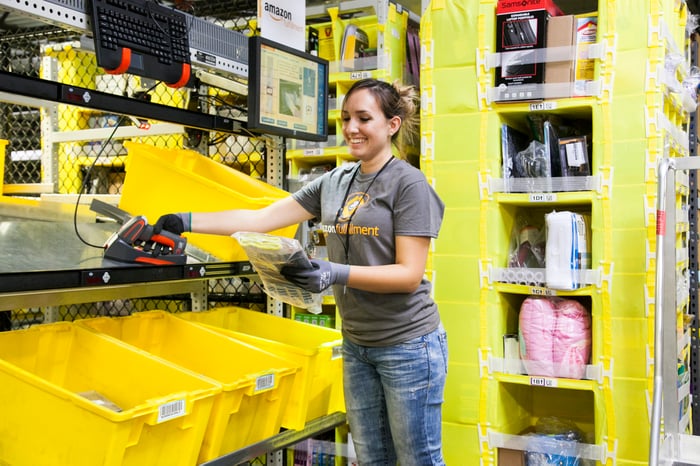
    An Amazon fulfillment employee preparing items for shipment.

    Image source: Amazon.

    Amazon.com

    A third FAANG stock to buy hand over fist is e-commerce giant Amazon.com.

    Unlike Facebook and Alphabet, Amazon has seen its business pick up in a big way since the pandemic hit. With consumers and people with pre-existing medical conditions less willing to leave their homes and shop in brick-and-mortar retail stores during a pandemic, Amazon’s marketplace has become a logical destination. The June-ended quarter saw the company’s net sales (i.e., not just e-commerce) catapult 40% from the prior-year period, with operating cash flow rising 42% to $51.2 billion. 

    Amazon remains, first and foremost, a retail entity. According to estimates from eMarketer in March 2020, Amazon is expected to increase its share of U.S. online sales from 37.3% in 2019 to 38.7% this year. For some context, that’s over 33 percentage points higher than the next-closest competitor. Even with retail margins being razor thin, having this much clout in the online retail space has played a big role in the company signing up more than 150 million Prime members worldwide. 

    Like Alphabet, Amazon is also expected to see significant growth and cash flow expansion from its ancillary cloud infrastructure services business. Amazon Web Services (AWS) generated $10.8 billion in sales during Q2 2020, representing 29% sales growth from the prior-year period. We were already seeing small and medium-sized businesses pushing online prior to the pandemic. COVID-19 has accelerated this shift.

    As AWS grows into a larger percentage of Amazon’s total sales, its operating cash flow should soar. We’re talking a possible tripling in operating cash flow per share between 2019 and 2024. If Amazon is simply valued at the midpoint of its cash flow multiple over the past decade, it should be a $3 trillion company within the next three or four years.

    This article was originally published on Fool.com. All figures quoted in US dollars unless otherwise stated.

    Man who said buy Kogan shares at $3.63 says buy these 3 ASX stocks now

    When investing expert Scott Phillips has a stock tip, it can pay to listen. After all, the flagship Motley Fool Share Advisor newsletter he has run for more than eight years has provided thousands of paying members with stock picks that have doubled, tripled or even more.*

    In this FREE STOCK REPORT, Scott just revealed what he believes are the 3 ASX stocks for the post COVID world that investors should buy right now while they still can. These stocks are trading at dirt-cheap prices and Scott thinks these could really go gangbusters as we move into ‘the new normal’.

    *Returns as of 6/8/2020

    More reading

    John Mackey, CEO of Whole Foods Market, an Amazon subsidiary, is a member of The Motley Fool’s board of directors. Suzanne Frey, an executive at Alphabet, is a member of The Motley Fool’s board of directors. Randi Zuckerberg, a former director of market development and spokeswoman for Facebook and sister to its CEO, Mark Zuckerberg, is a member of The Motley Fool’s board of directors. Sean Williams owns shares of Amazon and Facebook. The Motley Fool Australia’s parent company Motley Fool Holdings Inc. owns shares of and recommends Alphabet (A shares), Alphabet (C shares), Amazon, Apple, Facebook, and Netflix and recommends the following options: long January 2022 $1920 calls on Amazon and short January 2022 $1940 calls on Amazon. The Motley Fool Australia has recommended Alphabet (A shares), Alphabet (C shares), Amazon, Apple, Facebook, and Netflix. We Fools may not all hold the same opinions, but we all believe that considering a diverse range of insights makes us better investors. The Motley Fool has a disclosure policy. This article contains general investment advice only (under AFSL 400691). Authorised by Scott Phillips.

    The post 3 FAANG stocks to buy right now appeared first on Motley Fool Australia.

    This article was originally published on Fool.com. All figures quoted in US dollars unless otherwise stated.

    from Motley Fool Australia https://ift.tt/2J6OumM

  • The Quickstep (ASX:QHL) share price is shooting higher today. Here’s why

    ASX shares rise

    The Quickstep Holdings Limited (ASX: QHL) share price is shooting higher today following the release of its first quarter results.

    In late-morning trade, shares in the aerospace manufacturer are up 4% to 7.8 cents after earlier reaching as high as 8.1 cents.

    Let’s see how the Quickstep share price performed for the first quarter of FY21.

    Trading update

    For the period ending 30 September, Quickstep reported a robust performance while crediting its risk management process for COVID-19.

    Total sales came to $22.6 million, an increase of 16% over the prior corresponding period. This is in line with production efforts at its facilities, which are continuing to meet all contract delivery schedules.

    Operating cash flow was $1.4 million after funding headcount reductions to deliver annual savings of $1.5 million. The cost to implement these changes was $500,000. Quickstep said that inventory management was crucial in mitigating COVID-19 supply chain risks.

    Net bank debt decreased by $800,000 over Q1 FY20 to $5.6 million. Total debt including capitalised interest stood at $8.8 million.

    The company recorded a cash balance of $2.5 million at the end of the quarter, up from $1.7 million on June 30. Furthermore, $700,000 is available in restricted term deposits.

    Operational highlights

    F-35 fighter jet

    Quickstep noted that its F-35 production contract is continuing at full-rate, and is being delivered to plan. The first batch of its components are on track, with the 10 new parts awarded by defence giant, Northrop Grumman. All remaining shipments are due to be delivered by the end of the current calendar year.

    Volume production on the F-35 vertical tails contract with Marand has amplified over the past 12 months.

    MJU-68 decoy flares

    Quickstep has completed testing on the final batch of MJU-68 flare housing. The company is awaiting formal approval from the United States Department of Defence before the end of 2020 and is in discussions to address production requirements.

    The countermeasure program’s objective is to establish a reliable secondary source of income for Quickstep.

    C-130J transport plane

    Demand for the C-130J military aircraft has been consistent, and negotiations are taking place with Lockheed Martin on new product initiatives.

    Micro-X Nano lightweight xray machine

    Production is ongoing, and the machine is being used by medical staff in the fight against COVID-19. Contracted deliveries are running through FY21, including the latest Lockelec train ramp.

    Outlook

    Quickstep said its outlook for the remainder of FY21 was strong. Customer revenues are expected to increase between 5% to 10%, excluding any major contract wins. In addition, commercial aerospace production volumes look to stabilise in the next 12 months, with full recovery anticipated in FY23.

    The company will focus research & development spend on implementing its AeroQure process in the commercial aerospace market. While current volumes are down, the company believes AeroQure’s cost reduction offer over rival firms can win new customers.

    No material guidance was given for the end FY21, but Quickstep foresees further opportunities emerging post COVID-19.

    Man who said buy Kogan shares at $3.63 says buy these 3 ASX stocks now

    When investing expert Scott Phillips has a stock tip, it can pay to listen. After all, the flagship Motley Fool Share Advisor newsletter he has run for more than eight years has provided thousands of paying members with stock picks that have doubled, tripled or even more.*

    In this FREE STOCK REPORT, Scott just revealed what he believes are the 3 ASX stocks for the post COVID world that investors should buy right now while they still can. These stocks are trading at dirt-cheap prices and Scott thinks these could really go gangbusters as we move into ‘the new normal’.

    *Returns as of 6/8/2020

    More reading

    Motley Fool contributor Aaron Teboneras has no position in any of the stocks mentioned. The Motley Fool Australia has no position in any of the stocks mentioned. We Fools may not all hold the same opinions, but we all believe that considering a diverse range of insights makes us better investors. The Motley Fool has a disclosure policy. This article contains general investment advice only (under AFSL 400691). Authorised by Scott Phillips.

    The post The Quickstep (ASX:QHL) share price is shooting higher today. Here’s why appeared first on Motley Fool Australia.

    from Motley Fool Australia https://ift.tt/3otT7r2

  • Leading brokers name 3 ASX shares to buy today

    With so many shares to choose from on the ASX, it can be hard to decide which ones to buy.

    The good news is that brokers across the country are doing a lot of the hard work for you.

    Three top shares that leading brokers have named as buys this week are listed below. Here’s why they are bullish on them:

    National Australia Bank Ltd (ASX: NAB)

    According to a note out of UBS, its analysts have retained their buy rating and $20.50 price target on this banking giant’s shares following its provisions update. UBS remains positive despite NAB revealing that its second half result will be reduced by a net increase in provisions and impairments of $642 million. It likes the bank due to its experienced management team and strong balance sheet. The latter leaves it well-placed to navigate the tough economic environment. I agree with UBS and feel NAB is worth considering.

    Qantas Airways Limited (ASX: QAN)

    Analysts at Goldman Sachs have retained their buy rating and $5.28 price target on this airline operator’s shares following its annual general meeting update. According to the note, the broker is becoming more confident that a re-opening of Australian domestic aviation markets will occur pre-Christmas. This follows low community transmission of COVID-19, recent moves to relax border restrictions, and the introduction of tourism stimulus. It feels Qantas will benefit greatly from this due to its leadership position in the domestic market. I think Goldman Sachs is spot on and Qantas could be a great option.

    Webjet Limited (ASX: WEB)

    A note out of Ord Minnett reveals that its analysts have retained their buy rating and lifted the price target on this online travel agent’s shares to $4.58. This follows the release of its trading update last week. Ord Minnett notes that its cash burn is improving and expects this to continue to be the case as domestic borders open. It also expects Webjet to benefit from pent up demand in the tourism sector. While the broker makes some great points, I feel Webjet’s shares are still expensive and would prefer to invest at a much cheaper price.

    This Tiny ASX Stock Could Be the Next Afterpay

    One little-known Australian IPO has doubled in value since January, and renowned Australian Moonshot stock picker Anirban Mahanti sees a potential millionaire-maker in waiting…

    Because ‘Doc’ Mahanti believes this fast-growing company has all the hallmarks of genuine Moonshot potential, forget ‘buy now pay later’, this stock could be the next hot stock on the ASX.

    Doc and his team have published a detailed report on this tiny ASX stock. Find out how you can access what could be the NEXT Afterpay today!

    Returns as of 6th October 2020

    More reading

    Motley Fool contributor James Mickleboro has no position in any of the stocks mentioned. The Motley Fool Australia owns shares of and has recommended Webjet Ltd. We Fools may not all hold the same opinions, but we all believe that considering a diverse range of insights makes us better investors. The Motley Fool has a disclosure policy. This article contains general investment advice only (under AFSL 400691). Authorised by Scott Phillips.

    The post Leading brokers name 3 ASX shares to buy today appeared first on Motley Fool Australia.

    from Motley Fool Australia https://ift.tt/3juHZGE

  • How did ASX retail shares perform in the latest quarter?

    The Australian retail sector showed some momentum coming into the quarter ended 30 September 2020. Retail turnover increased marginally year on year in each of June and July. But Victorian COVID-19 shutdowns have taken a toll, with turnover falling by 4% in August. The impacts of changing consumer spending patterns are uneven, and ASX retailers are facing a volatile environment. As Deloitte reports, they must cope with monthly swings in spending and gulfs in performance by sector and across states. 

    Demand for recreational goods, electronic and electrical goods, and hardware and garden supplies have surged. According to Deloitte, these categories posted gains of more than 30% in July compared to pre-COVID levels. Retailers with a strong digital presence have also benefitted from the shift to online shopping. But spending levels vary significantly across states. While Western Australia and Queensland have benefitted from eased restrictions, retailers in Victoria are only just looking to reopen physical stores after long closures.

    With that in mind, let’s take a look at how ASX retail shares performed in the last quarter.

    Kogan.com Ltd (ASX: KGN) 

    Kogan has seen sales soar as a result of the pandemic. The online-only retailer saw August sales grow 117%, year-on-year, with profit up 165% over the same period. Active customers grew to 2,461,000 at the end of August. This represents an increase of 152,000 for the month, the largest monthly increase in Kogan’s history. The Kogan share price has likewise climbed, almost doubling during the most recent quarter. 

    Kogan’s August results come on top of an impressive set of full-year numbers. FY20 sales were up 39.3% to $768.9 million. Profits climbed 55.9% to $26.8 million. Repeat orders are rapidly accelerating as customers access loyalty benefits and the breadth of Kogan’s offering. Recently acquired customers are expected to contribute to future sales growth as they become repeat customers. A significant investment in Kogan’s platform and marketing activities has delivered an immediate impact on customer growth, which the company expects to have long-term benefits. 

    Kogan finished the year with a cash balance of $146.7 million and an undrawn bank debt facility. This leaves it well positioned to grow its exclusive brands business and scale Kogan Marketplace (which allows third parties to sell products via Kogan’s platform). Kogan also plans to continue to invest in new verticals including Kogan Internet, Kogan Mobile, Kogan Money, and Kogan Travel. The company will provide its next business update at its annual general meeting on 20 November 2020. 

    JB Hi-Fi Limited (ASX: JBH) 

    Store closures have had little impact on JB Hi-Fi’s sales this year, which soared 11.6% to $7.92 billion in FY20. The electronics retailer had a strong year in the most challenging of times, with profits jumping 33% to $332.7 million. JB Hi-Fi played a vital role in supplying Australians with the tools they needed to work, study, and entertain themselves at home, despite operations being impacted by COVID-19. The JB Hi-Fi share price has followed sales upward, climbing more than 26% over the last quarter. 

    Australian JB Hi-Fi sales were up 12.5% to $5.32 billion in FY20. Sales momentum was strong and increased toward the end of the financial year. Online sales grew 56.6% to $404 million or 7.6% of total sales. Increased sales combined with cost controls more than offset additional operating costs associated with ensuring safety during the pandemic. 

    The Good Guys business grew sales by 11.2% to $2.39 billion, with sales accelerating in the fourth quarter as customers upgraded home appliances and entertainment options. Online sales grew 33% to $174.2 million or 7.3% of total sales. In New Zealand, however, JB Hi-Fi sales were down 5.7% to NZ$222.8 million. Sales in the final quarter were materially impacted by New Zealand government restrictions. Positively, online sales grew 53.3% to NZ$20.4 million, or 9.1% of all sales. A $24 million impairment was recorded against the New Zealand assets in light of past performance and ongoing uncertainty arising from the current economic environment. 

    Temple & Webster Group Ltd (ASX: TPW) 

    Temple & Webster has reported a strong start to FY21, with revenue to 19 October 2020 up 138% on the prior corresponding period. First quarter earnings before interest, taxes, depreciation and amortisation (EBITDA) were $8.6 million – which is greater than the retailer’s full-year FY20 EBITDA. October revenue growth is still in excess of 100% as the retail sector enters its peak trading months. The Temple & Webster share price nearly doubled in the quarter ended 30 September, but took a dive in October with reported growth failing to meet market expectations. 

    The Temple & Webster share price has risen strongly this year as the online-only furniture retailer leverages the accelerated shift to digital. This saw Temple & Webster added to the S&P/ASX 300 (ASX: XKO) in the September quarter rebalance. In July the company, which is the largest in Australia’s e-commerce furniture and homewares market, announced a strong set of full year results driven by a growing online audience. Active customer numbers crossed the 500,000 milestone in that month, meaning some half a million Australian homes contain something from Temple & Webster. 

    In FY20, Temple & Webster increased revenue by 74% to $176 million. EBITDA more than quadrupled, coming in at $8.5 million versus $1.5 million in FY19. This resulted in a profit after tax of $13.9 million (including an income tax benefit of $5.9 million). The retailer ended the financial year with cash of $38.1 million and no debt. This strong balance sheet will protect the company in a down-side scenario, but also allow it to pursue strategic opportunities as they arise.  

    Man who said buy Kogan shares at $3.63 says buy these 3 ASX stocks now

    When investing expert Scott Phillips has a stock tip, it can pay to listen. After all, the flagship Motley Fool Share Advisor newsletter he has run for more than eight years has provided thousands of paying members with stock picks that have doubled, tripled or even more.*

    In this FREE STOCK REPORT, Scott just revealed what he believes are the 3 ASX stocks for the post COVID world that investors should buy right now while they still can. These stocks are trading at dirt-cheap prices and Scott thinks these could really go gangbusters as we move into ‘the new normal’.

    *Returns as of 6/8/2020

    More reading

    Kate O’Brien has no position in any of the stocks mentioned. The Motley Fool Australia’s parent company Motley Fool Holdings Inc. owns shares of Kogan.com ltd and Temple & Webster Group Ltd. The Motley Fool Australia has recommended Kogan.com ltd and Temple & Webster Group Ltd. We Fools may not all hold the same opinions, but we all believe that considering a diverse range of insights makes us better investors. The Motley Fool has a disclosure policy. This article contains general investment advice only (under AFSL 400691). Authorised by Scott Phillips.

    The post How did ASX retail shares perform in the latest quarter? appeared first on Motley Fool Australia.

    from Motley Fool Australia https://ift.tt/37HKdk4

  • Don’t listen to me. Listen to Charlie Munger…

    A greedy woman gloats over a cash incentive

    If you’re not yet acquainted with Charlie Munger, Warren Buffett’s right hand man for decades at Berkshire Hathaway Inc (NYSE:BRK-A)(NYSE:BRK-B), stop reading this, jump online and order a copy of Poor Charlie’s Almanack.

    I’ll wait. (While I’m waiting, a disclosure that I own shares of Berkshire.)

    You’re back? Good. Let’s keep going.

    Munger is perhaps the highest profile high-level polymath I know. (I’m sure there are others, but this isn’t a competition. Suffice it to say the man is bloody smart, incredibly well-read and possesses an uncommon common sense.)

    He also has a sharp wit, and is very funny.

    Munger has said many, many things worth repeating (did I mention you should buy the book?), but in this case I want to highlight one of the things he’s better known for: his view on incentives.

    Tell ’em what you said, Charlie:

    “Show me the incentive and I will show you the outcome.”

    and…

    “Never, ever, think about something else when you should be thinking about the power of incentives.”

    Oh, and:

    “I think I’ve been in the top 5 per cent of my age cohort all my life in understanding the power of incentives, and all my life I’ve underestimated it.”

    It’s worth taking those three, in order.

    First: incentives matter. Sometimes, they’re all that matter.

    Think about a CEO with a good moral compass. Her bonus, performance review and her future employment are being judged against this year’s result.

    Now imagine that CEO is confronted with a choice, 6 weeks out from the end of the financial year: to cut the price to get a deal done, now, or get full price for the same deal in 3 months’ time.

    What do you reckon she does?

    No, she doesn’t say “Screw the future, who cares!”

    But she finds a way to convince herself to do the deal. She rationalises it. “A bird in the hand is worth two in the bush”, is one way. Or, for the more aggressive CEO: “I’ll do the deal now and back myself to find another deal in future to make up for it”.

    It feels rational. It feels acceptable. Hell, she even tells herself it’s a better outcome for the business. And believes it.

    Second, incentives matter, more than almost anything.

    You can put whatever ‘rules’, ‘ethics training’ or ‘policies’ in place (yes, they’re in air quotes for a reason), but if you set up a scheme of payment or advancement that runs counter to those, it’ll be the incentives that win.

    Take the recent Westpac AUSTRAC palava that ended up in a $1.3 billion fine. I ask you: do you think there might have been different outcomes if past board members and previous management were incentivised to do things that made such an outcome all-but impossible?

    How much could compliance really have cost? $10 million? $100 million? 

    Conversely, there were incentives for increasing then-current-year profits, and keeping the ‘cost to income’ ratio down.

    Lastly, Charlie’s warning: Despite incentives being his Mastermind subject, Munger is humble and realistic enough to know that even he has underestimated the power of incentives throughout his life.

    Which suggests, almost by definition, that you and I are doing the same.

    Think about how long it took for the tobacco industry to come clean about the damage of smoking.

    And how long it took for politicians to actually want to accept the same thing.

    And yes, consider how hopelessly conflicted the financial services industry is.

    Think about the kickbacks a planner used to get for recommending certain products.

    Think about the incentives that still exist for the planner’s dealer group or network.

    Think about the fact that a recent ASIC study found that bank-related planners tended to – surprise, surprise! – think their own bank’s products were best for their clients.

    Think about the fact your planner, adviser or fund manager takes money from your portfolio, rather than asking you to hand over the cash or give them your credit card number. Imagine how our behaviour would change if the latter was required rather than the former.

    Think about the fact that your stockbroker makes money not on whether your investments are profitable, but on how many trades you make.

    (Yes, even the online guys. And yes, even the new ones.)

    Think about how ‘free’ brokerage is being paid for (hint: you’re the product in one way or another).

    Now, think about the alternatives.

    Who’s going to create financial products that are genuinely in your interest, given the motivation to instead create products that let them make money from you.

    Who’s going to create a new brokerage that actually encourages you to develop good financial habits?

    Who’s going to create a financial product that – rather than making it easier for you to borrow from the future – encourages you to actually not buy those jeans?

    Which financial products are aiming to lower costs, rather than increase them?

    Which companies, hiding behind slick marketing schemes, are going to come clean about the only-slightly-tangential benefits of ‘ethical’ investing?

    Hint: if they existed, the industry wouldn’t spend millions on marketing – and incentives! – each year!

    A pipe-dream?

    Yep, it is. It’s not going to happen.

    So it’s up to us.

    You and me.

    We need to be alert to the tricks, sleight-of-hand and conveniently opaque information.

    We need to know we’re being sold to, at least as much as we’re being helped.

    We need to remember that the incentives of others usually don’t align with our best interests!

    At The Motley Fool, we charge for our advice. It’s an annual fee.

    If we’re not helping our members, they don’t renew.

    We’re not perfect. We make mistakes.

    But our incentives are aligned with yours. Because if you don’t like us, you just walk away at the end of your term.

    We have no incentive to get you to overtrade. 

    We don’t take our membership fee from your portfolio, and hide it on page 3 of your annual statement.

    We provide our scorecards, in full – every single winner and loser, ever – to members of each of our services.

    To be clear, there are some wonderful stockbrokers, financial advisers, fund managers and bankers.

    And there are some terrible people in the ‘investment newsletter’ industry that we’re part of.

    But it’s important that you keep Charlie Munger’s words front of mind in any and every interaction with the financial services industry.

    Don’t be scared off, but please, be careful.

    Fool on!

    Man who said buy Kogan shares at $3.63 says buy these 3 ASX stocks now

    When investing expert Scott Phillips has a stock tip, it can pay to listen. After all, the flagship Motley Fool Share Advisor newsletter he has run for more than eight years has provided thousands of paying members with stock picks that have doubled, tripled or even more.*

    In this FREE STOCK REPORT, Scott just revealed what he believes are the 3 ASX stocks for the post COVID world that investors should buy right now while they still can. These stocks are trading at dirt-cheap prices and Scott thinks these could really go gangbusters as we move into ‘the new normal’.

    *Returns as of 6/8/2020

    More reading

    Scott Phillips owns shares of Berkshire Hathaway (B shares). The Motley Fool Australia’s parent company Motley Fool Holdings Inc. owns shares of and recommends Berkshire Hathaway (B shares) and recommends the following options: short January 2021 $200 puts on Berkshire Hathaway (B shares), long January 2021 $200 calls on Berkshire Hathaway (B shares), and short December 2020 $210 calls on Berkshire Hathaway (B shares). The Motley Fool Australia has recommended Berkshire Hathaway (B shares). We Fools may not all hold the same opinions, but we all believe that considering a diverse range of insights makes us better investors. The Motley Fool has a disclosure policy. This article contains general investment advice only (under AFSL 400691). Authorised by Scott Phillips.

    The post Don’t listen to me. Listen to Charlie Munger… appeared first on Motley Fool Australia.

    from Motley Fool Australia https://ift.tt/37NUeMi