Tag: Motley Fool

  • Zip share price lower on $243m first-half loss

    a young woman sits with her hands holding up her face as she stares unhappily at a laptop computer screen as if she is disappointed with something she is seeing there.

    a young woman sits with her hands holding up her face as she stares unhappily at a laptop computer screen as if she is disappointed with something she is seeing there.

    The Zip Co Ltd (ASX: ZIP) share price is trading lower on Thursday.

    In morning trade, the buy now pay later (BNPL) provider’s shares are down 2.5% to 55 cents.

    This follows the release of the company’s half-year results today.

    Zip share price lower on big loss

    • Half-year revenue up 19% to a record of $351 million
    • Net transaction margin (NTM) up 20 basis points to 2.5%
    • Group credit losses down 50 basis points to 1.9% of total transaction value (TTV)
    • Cash gross profit up 20% to $121.7 million
    • Core cash EBTDA loss of $33.2 million
    • Loss after tax of $242.5 million
    • Cash and cash equivalents of $153.9 million

    What happened during the half?

    For the six months ended 31 December, Zip reported a 19% increase in revenue to a record of $351 million. This reflects a 10% increase in TTV to $4.9 billion and a 50 basis point increase in its revenue margin to 7.1%.

    Underpinning its TTV growth was a 4% lift in active customer numbers to 7.3 million, a 20% jump in merchant numbers to 97,500, and a 17% increase in transaction numbers to 42.2 million.

    Combined with its cost reductions and improving margins, this ultimately led to a $27.3 million improvement in its core cash EBTDA to a loss of $33.2 million from a loss of $60.5 million a year earlier.

    Finally, on the very bottom line, Zip reported a loss after tax of $242.5 million. This includes a number of items such as merger termination fees, incentive payments, effective interest on convertible notes, and goodwill impairment.

    At the end of the period, Zip had a cash and cash equivalents balance of $153.9 million. It believes this leaves it well funded with sufficient available cash and liquidity to deliver on its target of positive group cash EBTDA during FY 2024.

    Particularly given that Zip US and NZ remain on track to exit FY 2023 with positive cash EBTDA on a sustainable basis, along with Zip’s AU business which has been cash flow positive for four years.

    In addition, the company has completed the strategic review of its rest of world and non-core operations and is now taking action to divest, restructure, or wind down these businesses. This is expected to neutralise cash burn and deliver additional cash inflows during the second half.

    Management commentary

    Zip’s Co-Founder and Global CEO, Larry Diamond, was pleased with the half. He said:

    We are pleased to deliver another strong set of results driven by record transaction volumes and revenue, and improved credit losses and margins. Zip continues to accelerate its path to profitability as we execute on our strategic priorities of sustainable growth, a focus on our core markets and right-sizing our cost base.

    Although topline growth has been tempered by deliberate adjustments to risk settings, our strong net margin performance is a very clear proof point of the successful execution of our strategy to increase revenue margins and reduce credit losses. We continue to streamline our business, with Cash EBTDA used in core markets and corporate costs improving by $27.3m to ($33.2m) for the half. We expect this to improve further again in the second half of FY23 and this very strong result has us well and truly on the path to positive group cash EBTDA during HY24.

    Outlook

    Management provided a short update on its performance so far in the second half.

    It advised that trading was strong in January, with TTV up 9%, revenue up 12%, and its cash NTM at 3.5%.

    It also revealed that its US net bad debts for January was trending at 1.4% of TTV on a cohort basis.

    The post Zip share price lower on $243m first-half loss appeared first on The Motley Fool Australia.

    Should you invest $1,000 in Zip Co right now?

    Before you consider Zip Co, you’ll want to hear this.

    Motley Fool Investing expert Scott Phillips just revealed what he believes are the 5 best stocks for investors to buy right now… and Zip Co wasn’t one of them.

    The online investing service he’s run for over a decade, Motley Fool Share Advisor, has provided thousands of paying members with stock picks that have doubled, tripled or even more.* And right now, Scott thinks there are 5 stocks that are better buys.

    See The 5 Stocks
    *Returns as of February 1 2023

    (function() {
    function setButtonColorDefaults(param, property, defaultValue) {
    if( !param || !param.includes(‘#’)) {
    var button = document.getElementsByClassName(“pitch-snippet”)[0].getElementsByClassName(“pitch-button”)[0];
    button.style[property] = defaultValue;
    }
    }

    setButtonColorDefaults(“#0095C8”, ‘background’, ‘#5FA85D’);
    setButtonColorDefaults(“#0095C8”, ‘border-color’, ‘#43A24A’);
    setButtonColorDefaults(“#fff”, ‘color’, ‘#fff’);
    })()

    More reading

    Motley Fool contributor James Mickleboro has no position in any of the stocks mentioned. The Motley Fool Australia’s parent company Motley Fool Holdings Inc. has positions in and has recommended Zip Co. The Motley Fool Australia has no position in any of the stocks mentioned. The Motley Fool has a disclosure policy. This article contains general investment advice only (under AFSL 400691). Authorised by Scott Phillips.

    from The Motley Fool Australia https://ift.tt/NPFLpay

  • Mineral Resources share price lower despite plan to be a ‘world-leader in lithium mining’

    A man in a hard hat gives a thumbs up as he holds a clipboard in one hand against a blue sky background.

    A man in a hard hat gives a thumbs up as he holds a clipboard in one hand against a blue sky background.

    The Mineral Resources Ltd (ASX: MIN) share price is trading lower on Thursday.

    In morning trade, the mining and mining services company’s shares are down 1.5% to $82.61.

    Why is the Mineral Resources share price falling?

    Investors have been selling down the Mineral Resources share price today after broad market weakness offset the release of an update on the company’s lithium operations.

    According to the release, the company has entered into binding agreements with lithium giant Albemarle Corporation (NYSE: ALB) for two separate transactions.

    The first transaction is for a restructure of its arrangements relating to the existing MARBL Joint Venture, which will see Mineral Resources’ ownership of the Wodgina mine increase from 40% to 50%.

    However, in exchange, Mineral Resources will reduce its ownership of the first two trains of the Kemerton Lithium Hydroxide Plant from 40% to 15%.

    Conversion arrangement

    The two parties have also committed to convert their respective share of Wodgina spodumene concentrate into lithium battery chemicals through Albemarle-owned conversion assets or using third party tollers.

    Each party will fund their proportionate share of the cost of the conversion assets, with conversion cost payments to be made in stages. Mineral Resources will make an initial US$350 million payment immediately following receipt of regulatory approvals for the Wodgina and Kemerton restructure, with other payments to be made as conversion capacity is developed and provided.

    In addition, Albemarle will supply Mineral Resources’ 15% share of spodumene concentrate for use by Kemerton from the Greenbushes mine. The company will pay the benchmark price for its share of Greenbushes spodumene concentrate.

    Downstream Joint Venture

    Finally, Mineral Resources and Albemarle have committed to jointly own lithium conversion assets, which will convert Wodgina spodumene concentrate into lithium hydroxide or lithium carbonate, up to a nominal capacity of 100ktpa. This is subject to receipt of required regulatory approvals.

    If all goes to plan, Mineral Resources will acquire a 50% interest in Albemarle’s 100% owned Qinzhou and Meishan plants in China.

    ‘World-leader in lithium mining’

    Mineral Resources Managing Director, Chris Ellison, was very pleased with the agreement. He said:

    We are delighted to have reached these binding agreements, which cement MinRes’ place as a world-leader in lithium mining and leverage our partner Albemarle’s strong track record in battery chemical production.

    We also continue to study options to invest in capacity for future downstream lithium production in Australia. By growing our battery chemicals business and expanding into global chemical marketing, MinRes will become one of the world’s largest fully integrated lithium chemical suppliers to auto manufacturers, capitalising on the increasing demand for sustainable battery mineral products.

    The post Mineral Resources share price lower despite plan to be a ‘world-leader in lithium mining’ appeared first on The Motley Fool Australia.

    FREE Investing Guide for Beginners

    Despite what some people may say – we believe investing in shares doesn’t have to be overwhelming or complicated…

    For over a decade, we’ve been helping everyday Aussies get started on their journey.

    And to help even more people cut through some of the confusion “experts’” seem to want to perpetuate – we’ve created a brand-new “how to” guide.

    Yes, Claim my FREE copy!
    *Returns as of February 1 2023

    (function() {
    function setButtonColorDefaults(param, property, defaultValue) {
    if( !param || !param.includes(‘#’)) {
    var button = document.getElementsByClassName(“pitch-snippet”)[0].getElementsByClassName(“pitch-button”)[0];
    button.style[property] = defaultValue;
    }
    }

    setButtonColorDefaults(“#0095C8”, ‘background’, ‘#5FA85D’);
    setButtonColorDefaults(“#0095C8”, ‘border-color’, ‘#43A24A’);
    setButtonColorDefaults(“#fff”, ‘color’, ‘#fff’);
    })()

    More reading

    Motley Fool contributor James Mickleboro has no position in any of the stocks mentioned. The Motley Fool Australia’s parent company Motley Fool Holdings Inc. has no position in any of the stocks mentioned. The Motley Fool Australia has no position in any of the stocks mentioned. The Motley Fool has a disclosure policy. This article contains general investment advice only (under AFSL 400691). Authorised by Scott Phillips.

    from The Motley Fool Australia https://ift.tt/SHGqUML

  • Should I buy Woodside shares before the ASX 200 energy giant reports next week?

    A man sits nervously at his computer with his mouth resting against his hands clasped in front of him as he stares at the screen of his computer on a home desk.

    A man sits nervously at his computer with his mouth resting against his hands clasped in front of him as he stares at the screen of his computer on a home desk.

    Woodside Energy Group Ltd (ASX: WDS) shares will soon have their turn in the spotlight once the S&P/ASX 200 Index (ASX: XJO) energy giant announces its result for 2022. Could this be a good time to invest in the business before the company reports?

    Woodside is currently generating enormous profits from the elevated energy prices that have followed the Russian invasion of Ukraine.

    First, we’ll look at how much profit the business is expected to have made in the 12 months in December 2022.

    Profit expectations

    According to Commsec, Bloomberg numbers suggest Woodside is projected to generate a net profit after tax (NPAT) of US$5.5 billion and pay a dividend of 62.7 US cents per share. Taking into account the exchange rate, that dividend could translate into a dividend per share for Aussies of 92 AU cents.

    Considering the dividends have been fully franked, that means the ASX 200 energy share’s dividend could represent a grossed-up dividend yield of 3.8% for just the one payment.

    In earnings per share (EPS) terms, Commsec numbers suggest Woodside shares could generate $3.26 of profit per share. If this forecast is correct, then the Woodside share price is valued at under 11 times FY23’s estimated earnings.

    It wouldn’t be surprising to see that Woodside has generated a lot more profit, particularly thanks to the increased scale the business has after its merger with the petroleum division of BHP Group Ltd (ASX: BHP). Greater scale usually comes with a number of benefits.

    Woodside is working on enacting synergies between the two businesses so that it’s stronger together, rather than just two separate businesses that have been joined.

    Is the Woodside share price a buy?

    The ASX 200 energy share’s earnings have jumped higher. But, when it comes to cyclical businesses, I think it pays to be cautious about buying when resource prices are strong.

    However, I don’t think energy prices are going to be as volatile as the iron ore price has been in the last few years. Unless Russian energy is suddenly accepted back into the global energy system, I can’t see LNG prices sinking over the next few years.

    I think that Woodside is very good at what it does, and its dividend income could be strong to 2025. I’m just not sure where energy prices are headed and, to me, I wouldn’t choose to invest after the business’ strong run.

    I’d rather invest when sentiment is low and the Woodside share price is lower than it is today.

    It might be possible to buy the business at a cheaper price. We don’t have to invest right now, and there are plenty of other ASX shares to choose that could make more sense.

    The post Should I buy Woodside shares before the ASX 200 energy giant reports next week? appeared first on The Motley Fool Australia.

    Should you invest $1,000 in Woodside Petroleum Ltd right now?

    Before you consider Woodside Petroleum Ltd, you’ll want to hear this.

    Motley Fool Investing expert Scott Phillips just revealed what he believes are the 5 best stocks for investors to buy right now… and Woodside Petroleum Ltd wasn’t one of them.

    The online investing service he’s run for over a decade, Motley Fool Share Advisor, has provided thousands of paying members with stock picks that have doubled, tripled or even more.* And right now, Scott thinks there are 5 stocks that are better buys.

    See The 5 Stocks
    *Returns as of February 1 2023

    (function() {
    function setButtonColorDefaults(param, property, defaultValue) {
    if( !param || !param.includes(‘#’)) {
    var button = document.getElementsByClassName(“pitch-snippet”)[0].getElementsByClassName(“pitch-button”)[0];
    button.style[property] = defaultValue;
    }
    }

    setButtonColorDefaults(“#43B02A”, ‘background’, ‘#5FA85D’);
    setButtonColorDefaults(“#43B02A”, ‘border-color’, ‘#43A24A’);
    setButtonColorDefaults(“#fff”, ‘color’, ‘#fff’);
    })()

    More reading

    Motley Fool contributor Tristan Harrison has no position in any of the stocks mentioned. The Motley Fool Australia’s parent company Motley Fool Holdings Inc. has no position in any of the stocks mentioned. The Motley Fool Australia has no position in any of the stocks mentioned. The Motley Fool has a disclosure policy. This article contains general investment advice only (under AFSL 400691). Authorised by Scott Phillips.

    from The Motley Fool Australia https://ift.tt/FpStAVh

  • I’d drip-feed $500 a month into ASX dividend shares to try for a million

    Rich man posing with money bags, gold ingots and dollar bills and sitting on tableRich man posing with money bags, gold ingots and dollar bills and sitting on table

    Do you have your sights on becoming a millionaire? It’s a very possible achievement for those invested in ASX dividend shares.

    Though, it will likely take time. The stock market – like most other investment vehicles – is rarely an overnight millionaire-maker.

    Here’s how I’d aim to build a $1 million portfolio by drip-feeding $500 a month into ASX dividend shares.

    Building wealth over time

    The S&P/ASX All Ordinaries Index (ASX: XAO) has returned 4.6% annually over the last 10 years, according to data from S&P Dow Jones Indices.

    At that rate, it would take around 50 years for a $500 monthly contribution to become a million. Though, past performance isn’t an indication of future performance.

    Of course, that’s likely better than simply putting $500 of cash into a draw each month – in which case it would take more than a lifetime to save $1 million.

    However, I’d like to expedite my path to becoming a millionaire. And I’d use ASX dividend shares to do so.

    I’d aim to speed up the process with ASX dividend shares

    ASX shares at home on the All Ordinaries boasted an indicative dividend yield of 4.32% as of 31 January, according to S&P Dow Jones Indices.

    At that rate, our $500 monthly investment – $6,000 annually – could yield $259.20 of passive income by this time next year.

    But I would shoot a little higher. I also wouldn’t take my dividends as spending money.

    I would aim to build a portfolio of ASX shares capable of providing an average 7% dividend yield and compound any and all payouts. That means using my dividends to buy more shares.

    Buying individual shares rather than, say, an exchange-traded fund (ETF) tracking an ASX index carries more risk. But I personally think the potential rewards could be worth it.

    By reinvesting my dividends, I could turn my $500 a month into $1 million in just 38 years, assuming a consistent 7% dividend yield.

    And that’s before any potential share price gains or tax benefits from franking credits.

    Managing risk

    As I mentioned above, stock picking can house greater risk than other investment styles. A large part of that is due to the instant diversification that comes with buying an index-tracking-ETF, for instance.

    Thus, I would make a point to build a diverse portfolio, incorporating shares of various shapes and sizes, from various sectors.

    Though, I would also focus on buying quality shares.

    What makes a share good quality is subjective. I personally think quality companies boast strong balance sheets, leadership, and competitive advantages, for a start.

    The post I’d drip-feed $500 a month into ASX dividend shares to try for a million appeared first on The Motley Fool Australia.

    Should you invest $1,000 in S&P/ASX 200 right now?

    Before you consider S&P/ASX 200, you’ll want to hear this.

    Motley Fool Investing expert Scott Phillips just revealed what he believes are the 5 best stocks for investors to buy right now… and S&P/ASX 200 wasn’t one of them.

    The online investing service he’s run for over a decade, Motley Fool Share Advisor, has provided thousands of paying members with stock picks that have doubled, tripled or even more.* And right now, Scott thinks there are 5 stocks that are better buys.

    See The 5 Stocks
    *Returns as of February 1 2023

    (function() {
    function setButtonColorDefaults(param, property, defaultValue) {
    if( !param || !param.includes(‘#’)) {
    var button = document.getElementsByClassName(“pitch-snippet”)[0].getElementsByClassName(“pitch-button”)[0];
    button.style[property] = defaultValue;
    }
    }

    setButtonColorDefaults(“#0095C8”, ‘background’, ‘#5FA85D’);
    setButtonColorDefaults(“#0095C8”, ‘border-color’, ‘#43A24A’);
    setButtonColorDefaults(“#fff”, ‘color’, ‘#fff’);
    })()

    More reading

    Motley Fool contributor Brooke Cooper has no position in any of the stocks mentioned. The Motley Fool Australia’s parent company Motley Fool Holdings Inc. has no position in any of the stocks mentioned. The Motley Fool Australia has no position in any of the stocks mentioned. The Motley Fool has a disclosure policy. This article contains general investment advice only (under AFSL 400691). Authorised by Scott Phillips.

    from The Motley Fool Australia https://ift.tt/3SUlP5b

  • Should I buy Woolworths shares following the ASX 200 supermarket giant’s latest results?

    Happy couple doing grocery shopping together.Happy couple doing grocery shopping together.

    One of the blockbuster ASX 200 earnings reports this week came from the blue-chip giant Woolworths Group Ltd (ASX: WOW). Woolworths reported its earnings for the first half of FY2023 (the six months to 31 December) just yesterday. 

    Investors clearly liked what the supermarket kingpin had to say. By the end of yesterday’s trading session, the Woolworths share price had vaulted a solid 1.99% higher to $37.45 a share:

    This was understandable, seeing as Woolworths put up some pretty strong numbers.

    As we went through at the time, the grocer reported a 4% rise in sales to $33.17 billion. Earnings before interest and tax (EBIT) rose 18.4% to $1.64 billion, while net profit after tax (NPAT) spiked 14% to $907 million.

    Income investors would have been especially tickled. Woolies upped its interim dividend substantially. The company is soon set to pay out 46 cents per share, fully franked. That’s a 17.9% lift over last year’s corresponding dividend payment.

    Even better, Woolworths also told investors that in the first seven weeks of the half-year ending 30 June this year, Australian food sales are up 6.5% against last year’s numbers. New Zealand food sales have lifted 6.3% and Big W sales by a pleasing 9.7%.

    So all in all, it was arguably a very solid earnings report from Woolies. As we noted yesterday, the company outperformed most of the market’s expectations, which would have delighted investors even further.

    But this begs the question: is the Woolworths share price a buy, now that these earnings have seen the light of day?

    Is the Woolworths share price a post-earnings buy right now?

    Well, one ASX broker who thinks so is Goldman Sachs. Earlier this month, we looked at Goldman’s buy rating on Woolies shares.  

    And yesterday, the broker argued that these earnings contained nothing to dent its confidence.

    Here’s some of what Goldman said on Woolworths’ half-year results:

    The margin outcome for Australia Supermarket and the better than expected run-rate in 2H23 first 7 weeks is the bright spot…

    Overall we continue to believe that the more advantaged omni-channel execution capability of WOW will continue to drive longer term market share gains and cost efficiencies for EBIT margin expansion. Reiterate Buy.

    Goldman has maintained its buy rating on Woolies shares, together with its 12-month share price target of $41.20. If that target is realised in the next year, investors would enjoy a 10% upside from where the shares are today. That doesn’t include any returns from Woolworths’ fully-franked dividends either.

    So that’s at least one ASX broker who rates Woolworths shares as a post-earnings buy. We’ll have to wait for what the next 12 month has in store to see if Goldman is on the money. But no doubt investors will be pleased as punch with that assessment.

    At the last Woolworths share price, this ASX 200 grocery giant has a market capitalisation of $45.56 billion, with a dividend yield of 2.46%.

    The post Should I buy Woolworths shares following the ASX 200 supermarket giant’s latest results? appeared first on The Motley Fool Australia.

    Should you invest $1,000 in Woolworths Group Limited right now?

    Before you consider Woolworths Group Limited, you’ll want to hear this.

    Motley Fool Investing expert Scott Phillips just revealed what he believes are the 5 best stocks for investors to buy right now… and Woolworths Group Limited wasn’t one of them.

    The online investing service he’s run for over a decade, Motley Fool Share Advisor, has provided thousands of paying members with stock picks that have doubled, tripled or even more.* And right now, Scott thinks there are 5 stocks that are better buys.

    See The 5 Stocks
    *Returns as of February 1 2023

    (function() {
    function setButtonColorDefaults(param, property, defaultValue) {
    if( !param || !param.includes(‘#’)) {
    var button = document.getElementsByClassName(“pitch-snippet”)[0].getElementsByClassName(“pitch-button”)[0];
    button.style[property] = defaultValue;
    }
    }

    setButtonColorDefaults(“#43B02A”, ‘background’, ‘#5FA85D’);
    setButtonColorDefaults(“#43B02A”, ‘border-color’, ‘#43A24A’);
    setButtonColorDefaults(“#fff”, ‘color’, ‘#fff’);
    })()

    More reading

    Motley Fool contributor Sebastian Bowen has no position in any of the stocks mentioned. The Motley Fool Australia’s parent company Motley Fool Holdings Inc. has no position in any of the stocks mentioned. The Motley Fool Australia has no position in any of the stocks mentioned. The Motley Fool has a disclosure policy. This article contains general investment advice only (under AFSL 400691). Authorised by Scott Phillips.

    from The Motley Fool Australia https://ift.tt/zRAQuct

  • Where’s the competition?

    Two couples having fun racing electric dodgem cars around a track

    Two couples having fun racing electric dodgem cars around a track

    How much profit is too much?

    That sounds like a funny thing for a self-confessed capitalist and investor to ask, right?

    To (mis)quote Creedence Clearwater Revival:

    “And when you ask ’em, “How much should we make?”
    Ooh, they only answer, “More, more, more, more!””

    Right?

    Well, kinda.

    More, sure.

    But more… over the long term.

    And that time frame is a distinction that matters.

    This week, Commonwealth Bank of Australia (ASX: CBA), Woolworths Group Ltd (ASX: WOW) and Coles Group Ltd (ASX: COL) announced big jumps in profit.

    Ampol Ltd (ASX: ALD) made a motza.

    While, at the same time, hiking prices for their customers and blaming inflation.

    Now, settle down you lot shouting at the back.

    I completely agree that they should be free to increase prices.

    And there are those who complain when companies make more money but are (not so) strangely silent when they make less.

    They criticise ‘profiteering’, but don’t offer to make up the difference when profits fall.

    Frankly, this ‘one way’ expectation is… silly.

    And, if I can say it politely, kinda exposes the critics’ motivations… and misunderstanding.

    My firmly held view is that a well-functioning system of democratic capitalism needs a decent profit motive.

    If you know you’re going to have profits garnished when you make them, but you’re going to be on your own during the tough times… that doesn’t exactly incentivise growth and risk-taking.

    But, nor do I think companies should have an unfettered ability to raise prices.

    Not (just) because it hurts those least able to afford them.

    But because it signals a market in which competition is, if not broken, at least not operating as well as it should.

    In theory, higher prices from one market participant should mean consumers switch to the others.

    That ebb and flow of supply and demand, in a well-functioning market, will see to it that no one company (or companies) can get away with raising prices meaningfully above a level of economic viability and customer desire (more on that later).

    And so…

    Well, I’ll let you decide.

    If CBA, Ampol and our grocers can increase profits by that much, doesn’t it suggest something isn’t working properly?

    I would say that’s precisely the implication.

    But here’s the thing: it’s not just bad for consumers.

    It’s bad for the whole economy, including those other companies in which we hold shares.

    If prices are too high in some sectors, those companies are capturing excess profits… money that could otherwise be spent in other businesses.

    Writ large, that lowers our overall standards of living and, as a result, the levels of economic activity and success we could otherwise enjoy.

    It’s short term gain for long term pain.

    And – just ask Woolies shareholders who owned shares in the company between 2014 and 2016 – often these higher profit margins become a millstone around the neck of a business.

    They get so addicted to the margins, they stop being competitive… and fixing the latter can come at a serious cost to the former, taking shareholders down with them.

    In Woolies’ case, the company made world–beating grocery margins… for a while.

    And then it all came a cropper.

    Which is, hopefully, a cautionary tale.

    No, I’m not predicting – or even suggesting – that the companies I mentioned above are necessarily headed for a fall.

    I’m just making the point that short term profits, if unsustainable, can actually come at the expense of longer term value creation… when competition works.

    And here’s the kicker – and a point I’ve made before: the best way for capitalism to create maximum value for society – and for shareholders – is when competition works as well as possible.

    That’s when scarce resources are most effectively and efficiently allocated, leading to the greatest creation of value – for all of us; consumers, shareholders… the lot.

    Don’t get me wrong: I love it when companies in which I own shares can flex genuine pricing power. And I can admire it even in companies I don’t own. The price premium for an Apple product defies rationality (in my view, anyway!)… yet it’s earned not because competition doesn’t work, but because Apple has convinced many of us to pay up – big – for its products.

    The same applies to many other businesses in many different categories: Tiffany, Mercedes, Coke and plenty more.

    But – and here’s the key difference – they do it by convincing the customer that they’re worth more (whether you or I disagree with those customers’ assessments is irrelevant, by the way!), not by taking advantage of short term market dislocations or because customers have no other choice.

    As investors, I’d suggest that’s the key question to ask: how much of the pricing power I’m seeing is genuinely ongoing, and how much is because of short-term factors.

    The former is a sight to behold (and, at the right price, a joy to own). The latter might just be skating on very thin ice.

    Fool on!

    The post Where’s the competition? appeared first on The Motley Fool Australia.

    Should you invest $1,000 in right now?

    Before you consider , you’ll want to hear this.

    Motley Fool Investing expert Scott Phillips just revealed what he believes are the 5 best stocks for investors to buy right now… and wasn’t one of them.

    The online investing service he’s run for over a decade, Motley Fool Share Advisor, has provided thousands of paying members with stock picks that have doubled, tripled or even more.* And right now, Scott thinks there are 5 stocks that are better buys.

    See The 5 Stocks
    *Returns as of February 1 2023

    (function() {
    function setButtonColorDefaults(param, property, defaultValue) {
    if( !param || !param.includes(‘#’)) {
    var button = document.getElementsByClassName(“pitch-snippet”)[0].getElementsByClassName(“pitch-button”)[0];
    button.style[property] = defaultValue;
    }
    }

    setButtonColorDefaults(“#43B02A”, ‘background’, ‘#5FA85D’);
    setButtonColorDefaults(“#43B02A”, ‘border-color’, ‘#43A24A’);
    setButtonColorDefaults(“#fff”, ‘color’, ‘#fff’);
    })()

    More reading

    Motley Fool contributor Scott Phillips has no position in any of the stocks mentioned. The Motley Fool Australia’s parent company Motley Fool Holdings Inc. has positions in and has recommended Apple. The Motley Fool Australia’s parent company Motley Fool Holdings Inc. has recommended the following options: long March 2023 $120 calls on Apple and short March 2023 $130 calls on Apple. The Motley Fool Australia has positions in and has recommended Coles Group. The Motley Fool Australia has recommended Apple. The Motley Fool has a disclosure policy. This article contains general investment advice only (under AFSL 400691). Authorised by Scott Phillips.

    from The Motley Fool Australia https://ift.tt/D4pCEyQ

  • Experts name 2 ASX All Ords shares to buy after their excellent results

    A man and a woman sit in front of a laptop looking fascinated and captivated.A man and a woman sit in front of a laptop looking fascinated and captivated.

    With a turbulent world as background, the performance and outlook of ASX companies has never been under more scrutiny than this current reporting season.

    Two particular businesses that revealed their cards this week showed such promise in its reporting that some experts reckon they’re ripe to buy right now:

    Cashing in from ‘click and collect’

    HomeCo Daily Needs REIT (ASX: HDN) is not a household name among investors by any means, but it does have a $2.6 billion market capitalisation.

    The trust is named “daily needs” because it owns commercial real estate to rent out to tenants like large-format retailers, convenience stores and gyms.

    Morgans co-head of research Fiona Buchanan was pleased with how it reconfirmed its previous 2023 financial year guidance.

    “HomeCo Daily Needs’ portfolio remains well positioned with resilient cash flows and continues to be a beneficiary of accelerating click & collect trends,” Buchanan said on the Morgans blog.

    “+80% of tenants are national and 73% of tenants offer click & collect, reinforcing the importance of assets being able to support ‘last mile logistics’.”

    She noted how the assets are in “strategic locations with strong population growth”.

    The HomeCo Daily Needs share price has dipped 8.6% over the past 12 months, but like most real estate trusts it pays out a handsome income.

    “HomeCo Daily offers investors an attractive yield of +6% underpinned by contracted rental income and has a large development pipeline.”

    Buchanan’s team thus has an add rating on the stock.

    Post-pandemic recovery going gangbusters

    Helloworld Travel Ltd (ASX: HLO) was a basket case for investors for many years, but it seems to have cleaned up its act.

    The travel agency sold off its corporate business last year, and the latest results were the first half-year to report since that transaction.

    Morgans senior analyst Belinda Moore liked how its post-pandemic recovery is taking place faster than anticipated.

    “Helloworld’s 1H23 result beat our forecast,” Moore said on the Morgans blog.

    “The strength of its EBITDA margin was the key highlight and is already above pre-COVID levels.”

    She noted how profitability is improving quarter-on-quarter, showing how “travel demand continues to recover in ANZ despite the current macroeconomic uncertainty”.

    And there is further upside to come.

    “Helloworld expects that bookings volumes will continue to increase as airfares normalise in line with the return of airline capacity, tour operators continue to onboard staff to meet demand and confidence levels amongst the travelling public return to pre-COVID levels.”

    The inbound and wholesale business units have also recovered back to pre-pandemic levels.  

    “Helloworld sees further opportunities for these businesses with the China market reopening and expects strong growth into the foreseeable future.”

    The Morgans team has an add rating for the travel agency, although Moore reminded investors to be patient with this one.

    “With a strong balance sheet, Helloworld is well placed to capitalise on the pent-up demand for leisure travel and acquisition opportunities,” she said.

    “Helloworld is materially undervalued trading on a recovery year (FY25) EV/EBITDA multiple of only 3.1x.”

    The Helloworld share price is down 1.7% over the past 12 months, and is half of what it was five years ago.

    The post Experts name 2 ASX All Ords shares to buy after their excellent results appeared first on The Motley Fool Australia.

    Wondering where you should invest $1,000 right now?

    When investing expert Scott Phillips has a stock tip, it can pay to listen. After all, the flagship Motley Fool Share Advisor newsletter he has run for over ten years has provided thousands of paying members with stock picks that have doubled, tripled or even more.*

    Scott just revealed what he believes could be the ‘five best ASX stocks’ for investors to buy right now. These stocks are trading at near dirt-cheap prices and Scott thinks they could be great buys right now…

    See The 5 Stocks
    *Returns as of February 1 2023

    (function() {
    function setButtonColorDefaults(param, property, defaultValue) {
    if( !param || !param.includes(‘#’)) {
    var button = document.getElementsByClassName(“pitch-snippet”)[0].getElementsByClassName(“pitch-button”)[0];
    button.style[property] = defaultValue;
    }
    }

    setButtonColorDefaults(“#0095C8”, ‘background’, ‘#5FA85D’);
    setButtonColorDefaults(“#0095C8”, ‘border-color’, ‘#43A24A’);
    setButtonColorDefaults(“#fff”, ‘color’, ‘#fff’);
    })()

    More reading

    Motley Fool contributor Tony Yoo has no position in any of the stocks mentioned. The Motley Fool Australia’s parent company Motley Fool Holdings Inc. has positions in and has recommended Helloworld Travel. The Motley Fool Australia has positions in and has recommended Helloworld Travel. The Motley Fool has a disclosure policy. This article contains general investment advice only (under AFSL 400691). Authorised by Scott Phillips.

    from The Motley Fool Australia https://ift.tt/kqyFgh1

  • Qantas share price on watch amid $1.4b half-year profit

    A woman reaches her arms to the sky as a plane flies overhead at sunset.

    A woman reaches her arms to the sky as a plane flies overhead at sunset.The Qantas Airways Limited (ASX: QAN) share price will be one to watch on Thursday.

    That’s because the airline operator has just released its half-year results for FY 2023.

    Qantas share price on watch after beating guidance

    • Revenue up 222% over the prior corresponding period to $9.9 billion
    • Underlying profit before tax of $1.43 billion compared to loss of $1.3 billion
    • Statutory profit after tax of $1 billion
    • Net debt reduced to $2.4 billion
    • $500 million on-market share buy-back announced

    What happened during the six months?

    For the six months ended 31 December, the Flying Kangaroo reported a 222% increase in revenue to $9.9 billion. This reflects a 450% increase in net passenger revenue and a 14% increase in other revenue, which offset a 12% decline in net freight revenue.

    The former was driven by the return of domestic and international operations, as well as revenue growth at Qantas Loyalty, whereas the latter was the result of a moderation in record yields as international belly space capacity returned.

    And while Qantas carried approximately 20% fewer passengers than pre-COVID levels, it was generating significantly more revenue per available seat kilometre.

    This ultimately underpinned an underlying profit before tax of $1.43 billion for the first half of FY 2023. This was at the high-end of its upgraded guidance range and represents a $2.73 billion improvement on the loss of $1.3 billion recorded a year earlier.

    And although no dividend has been declared, Qantas will be returning funds to shareholders. It has announced an on-market share buy-back of up to $500 million. This is due to commence in March and follows a $400 million buy-back that completed in December.

    Management commentary

    Qantas CEO, Alan Joyce, was rightfully pleased with the company’s performance during the half. He said:

    This is a huge turnaround considering the massive losses we were facing just 12 months ago. When we restructured the business at the start of COVID, it was to make sure we could bounce back quickly when travel returned. That’s effectively what’s happened, but it’s the strength of the demand that has driven such a strong result.

    The good news for travellers is that airfares could be coming down in the near future as headwinds ease and capacity increases. Joyce added:

    Fares have risen because of higher fuel costs, but also because supply chain and resourcing issues meant capacity hasn’t kept up with demand. Now those challenges are starting to unwind, we can add more capacity and that will put downward pressure on fares. In terms of overheads, we expect the costs we’re carrying from the extra operational buffer will start unwinding from this half and into next financial year.

    Outlook

    Although no guidance has been provided, management appears positive on the company’s outlook in the second half and in FY 2024. It notes that “travel demand expected to remain strong throughout FY23 and into FY24.”

    In light of this, Group Domestic capacity is set to increase from 94% to 103% through the second half of FY 2023, whereas Group International capacity is to increase from 60% to 81%.

    Fares are expected to moderate during the second half as capacity increases but will remain significantly above FY 2019 levels. Qantas also revealed that it expects its fuel cost for FY 2023 to be $4.8 billion, with hedging in place.

    The Qantas share price is up 21% over the last 12 months, as you can see below.

    The post Qantas share price on watch amid $1.4b half-year profit appeared first on The Motley Fool Australia.

    Should you invest $1,000 in Qantas Airways Limited right now?

    Before you consider Qantas Airways Limited, you’ll want to hear this.

    Motley Fool Investing expert Scott Phillips just revealed what he believes are the 5 best stocks for investors to buy right now… and Qantas Airways Limited wasn’t one of them.

    The online investing service he’s run for over a decade, Motley Fool Share Advisor, has provided thousands of paying members with stock picks that have doubled, tripled or even more.* And right now, Scott thinks there are 5 stocks that are better buys.

    See The 5 Stocks
    *Returns as of February 1 2023

    (function() {
    function setButtonColorDefaults(param, property, defaultValue) {
    if( !param || !param.includes(‘#’)) {
    var button = document.getElementsByClassName(“pitch-snippet”)[0].getElementsByClassName(“pitch-button”)[0];
    button.style[property] = defaultValue;
    }
    }

    setButtonColorDefaults(“#43B02A”, ‘background’, ‘#5FA85D’);
    setButtonColorDefaults(“#43B02A”, ‘border-color’, ‘#43A24A’);
    setButtonColorDefaults(“#fff”, ‘color’, ‘#fff’);
    })()

    More reading

    Motley Fool contributor James Mickleboro has no position in any of the stocks mentioned. The Motley Fool Australia’s parent company Motley Fool Holdings Inc. has no position in any of the stocks mentioned. The Motley Fool Australia has no position in any of the stocks mentioned. The Motley Fool has a disclosure policy. This article contains general investment advice only (under AFSL 400691). Authorised by Scott Phillips.

    from The Motley Fool Australia https://ift.tt/XjDatQ1

  • Earnings preview: Here are the ASX shares reporting on Thursday

    The end of the week is drawing near, and with it comes a massive day for ASX shares and their earnings.

    Some of the largest companies across healthcare, industrials, and utilities are reporting their latest figures. Which will be showered with praise and which will be wallowing in disappointment?

    Here are the details to get your day started on the right foot.

    These ASX shares are posting results today

    Ranked in order of market capitalisation (largest to smallest)

    Ramsay Health Care Ltd (ASX: RHC), $15.1 billion

    APA Group (ASX: APA), $12.6 billion

    Qantas Airways Limited (ASX: QAN), $11.8 billion

    Auckland International Airport Limited (ASX: AIA), $11.4 billion

    Atlas Arteria Group (ASX: ALX), $9.6 billion

    IDP Education Ltd (ASX: IEL), $8.5 billion

    Medibank Private Ltd (ASX: MPL), $8.5 billion

    Cleanaway Waste Management Ltd (ASX: CWY), $5.9 billion

    Qube Holdings Ltd (ASX: QUB), $5.3 billion

    Nine Entertainment Co Holdings Ltd (ASX: NEC), $3.5 billion

    Eagers Automotive Ltd (ASX: APE), $3.1 billion

    Perpetual Limited (ASX: PPT), $3.0 billion

    Insignia Financial Ltd (ASX: IFL), $2.3 billion

    Blackmores Ltd (ASX: BKL), $1.7 billion

    HMC Capital Ltd (ASX: HMC), $1.4 billion

    Nanosonics Ltd (ASX: NAN), $1.4 billion

    Star Entertainment Group Ltd (ASX: SGR), $1.4 billion

    Smartgroup Corporation Ltd (ASX: SIQ), $760.6 million

    Australian Clinical Labs Ltd (ASX: ACL), $686.2 million

    Pepper Money Ltd (ASX: PPM), $668.3 million

    Zip Co Ltd (ASX: ZIP), $432.4 million

    Reject Shop Ltd (ASX: TRS), $151.8 million

    Airtasker Ltd (ASX: ART), $125.9 million

    Maggie Beer Holdings Ltd (ASX: MBH), $68.7 million

    What can we expect to see?

    The ‘Flying Kangaroo’ is one ASX share investors will be picking apart today amid its half-year results. A booming period for travel has helped Qantas bounce back from the difficult pandemic lows, but just how good of a result can Alan Joyce and the team deliver today?

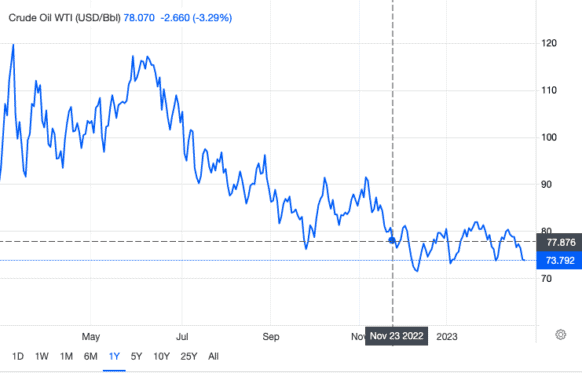
    Source: TradingEconomics

    In its November update, the company guided underlying profit before tax of between $1.35 billion and $1.45 billion. Since then, the price of oil has traded lower at times (pictured above), which could further improve the bottom line.

    Analysts at Morgans are also expecting the airline operator to announce a $400 million share buyback program.

    Shifting gears to an ASX share that is still navigating its path to profitability, buy now pay later provider Zip. The company released its second-quarter updater in late January, which shed ample light on transaction volume and revenue.

    Unless there were any major changes in auditing, Zip should post $351.2 million in revenue for the first half, up 16.2% year on year. What shareholders are still in the dark on is how much has Zip been able to narrow its losses and does it still have sufficient liquidity available in the meantime.

    The Zip share price is down nearly 76% over the past 12 months. In contrast, the S&P/ASX 200 Index (ASX: XJO) has held steady with a 1.5% gain over the same period.

    Don’t forget to check back in throughout the day for our earnings coverage.

    The post Earnings preview: Here are the ASX shares reporting on Thursday appeared first on The Motley Fool Australia.

    Wondering where you should invest $1,000 right now?

    When investing expert Scott Phillips has a stock tip, it can pay to listen. After all, the flagship Motley Fool Share Advisor newsletter he has run for over ten years has provided thousands of paying members with stock picks that have doubled, tripled or even more.*

    Scott just revealed what he believes could be the ‘five best ASX stocks’ for investors to buy right now. These stocks are trading at near dirt-cheap prices and Scott thinks they could be great buys right now…

    See The 5 Stocks
    *Returns as of February 1 2023

    (function() {
    function setButtonColorDefaults(param, property, defaultValue) {
    if( !param || !param.includes(‘#’)) {
    var button = document.getElementsByClassName(“pitch-snippet”)[0].getElementsByClassName(“pitch-button”)[0];
    button.style[property] = defaultValue;
    }
    }

    setButtonColorDefaults(“#0095C8”, ‘background’, ‘#5FA85D’);
    setButtonColorDefaults(“#0095C8”, ‘border-color’, ‘#43A24A’);
    setButtonColorDefaults(“#fff”, ‘color’, ‘#fff’);
    })()

    More reading

    Motley Fool contributor Mitchell Lawler has positions in Smartgroup. The Motley Fool Australia’s parent company Motley Fool Holdings Inc. has positions in and has recommended Idp Education, Nanosonics, and Zip Co. The Motley Fool Australia’s parent company Motley Fool Holdings Inc. has recommended Airtasker. The Motley Fool Australia has positions in and has recommended Apa Group, Nanosonics, and Smartgroup. The Motley Fool Australia has recommended Blackmores, Idp Education, and Nine Entertainment. The Motley Fool has a disclosure policy. This article contains general investment advice only (under AFSL 400691). Authorised by Scott Phillips.

    from The Motley Fool Australia https://ift.tt/UmRMbXk

  • Everything you need to know about the latest Rio Tinto dividend

    Miner holding cash which represents dividends.

    Miner holding cash which represents dividends.After the market close on Wednesday, Rio Tinto Ltd (ASX: RIO) released its full-year results.

    For the 12 months ended 31 December, the mining giant reported a 13% decline in revenue to US$55,554 million and a 41% reduction in net profit after tax to US$12,420 million.

    This reflects the movement in commodity prices, the impact of higher energy and raw materials prices on its operations, and higher rates of inflation on operating costs and closure liabilities.

    As you might have guessed from its significant profit decline, the Rio Tinto dividend has come under pressure.

    Rio Tinto dividend

    In response to its softer earnings, the Rio Tinto board elected to cut its fully franked final dividend by 46% to US$2.25 per share.

    This brought the Rio Tinto dividend to a total of US$4.92 per share in FY 2022, which is a 38% reduction on what was paid a year earlier. It also equates to a total payout of US$8 billion for the year and represents a payout ratio of 60% of underlying earnings.

    The good news for investors is that based on current exchange rates and the latest Rio Tinto share price, this still provides shareholders with a generous fully franked 5.8% dividend yield.

    But if you want to get hold of Rio Tinto’s final dividend of FY 2022, you’ll need to act reasonably fast.

    The mining giant’s shares are scheduled to trade ex-dividend in a couple of weeks on 9 March. After which, the miner is scheduled to pay eligible shareholders this dividend the following month on 20 April.

    Where next for its dividends?

    Unfortunately, another dividend cut is widely expected in FY 2023.

    For example, according to a note out of Goldman Sachs, its analysts expect an 8.5% reduction to US$4.50 per share.

    The good news, though, is that its analysts are then expecting a rebound the following year.

    They have pencilled in an increase to US$5.50 per share in FY 2024. And while it’s not quite FY 2021 levels, it certainly is a step in the right direction.

    The post Everything you need to know about the latest Rio Tinto dividend appeared first on The Motley Fool Australia.

    Should you invest $1,000 in Rio Tinto Limited right now?

    Before you consider Rio Tinto Limited, you’ll want to hear this.

    Motley Fool Investing expert Scott Phillips just revealed what he believes are the 5 best stocks for investors to buy right now… and Rio Tinto Limited wasn’t one of them.

    The online investing service he’s run for over a decade, Motley Fool Share Advisor, has provided thousands of paying members with stock picks that have doubled, tripled or even more.* And right now, Scott thinks there are 5 stocks that are better buys.

    See The 5 Stocks
    *Returns as of February 1 2023

    (function() {
    function setButtonColorDefaults(param, property, defaultValue) {
    if( !param || !param.includes(‘#’)) {
    var button = document.getElementsByClassName(“pitch-snippet”)[0].getElementsByClassName(“pitch-button”)[0];
    button.style[property] = defaultValue;
    }
    }

    setButtonColorDefaults(“#43B02A”, ‘background’, ‘#5FA85D’);
    setButtonColorDefaults(“#43B02A”, ‘border-color’, ‘#43A24A’);
    setButtonColorDefaults(“#fff”, ‘color’, ‘#fff’);
    })()

    More reading

    Motley Fool contributor James Mickleboro has no position in any of the stocks mentioned. The Motley Fool Australia’s parent company Motley Fool Holdings Inc. has no position in any of the stocks mentioned. The Motley Fool Australia has no position in any of the stocks mentioned. The Motley Fool has a disclosure policy. This article contains general investment advice only (under AFSL 400691). Authorised by Scott Phillips.

    from The Motley Fool Australia https://ift.tt/kioHO09