Tag: Motley Fool

  • How a potential demerger could deliver a 10% upside for this ASX 200 stock

    a woman with lots of shopping bags looks upwards towards the sky as if she is pondering something.

    a woman with lots of shopping bags looks upwards towards the sky as if she is pondering something.

    There’s an ASX 200 stock that (unless you’re a shareholder) you might think has had its fair share of upside. After all, this company has given investors a 7.76% gain over 2024 to date, as well as a 17.8% increase in share price over the past 12 months.

    Over five years, those gains stretch to 85.2%, which doesn’t even include the substantial boost from dividends either.

    The ASX 200 stock in question is none other than retail share Premier Investments Limited (ASX: PMV). If you don’t know Premier Investments, chances are you’d be familiar with at least one of this company’s many lucrative retail brands. They include Peter Alexander, Dotti, Jacqui E, Smiggle, Just Jeans and Jay Jays.

    So we’ve already established that this company has been a real winner for ASX 200 stock market investors over a long period of time. But shareholders could be treated to even higher gains in the future, if a report is to be believed.

    Could this ASX 200 stock be heading for a breakup?

    According to The Australian, Jarden analysts believe that a current strategic review of the Premier Investments business structure will either lead to “no change in the current structure, a demerger of the Smiggle and/or Peter Alexander, or a demerger of its core fashion brands”.

    The analysts went on to argue that “the sale or equity swap for the core apparel brands (which include
    Smiggle and Peter Alexander) could deliver the most potential upside, particularly if synergies existed for an appropriate buyer”.

    Jarden was coy on just how much this might be worth to investors. But the report also cited analysis from Unified Capital Partners from 2023. This also found that a demerger could unlock additional value for shareholders of this ASX 200 stock.

    That’s based on the assumption that Smiggle could have a value of more than $1.1 billion on its own, with Peter Alexander being worth another $1.5 billion.

    If these businesses were spun out, Unified Capital Partners estimated that combined, Premier and the demerged company would have a value of around $33.46 per share. Premier was trading at $30.43 at yesterday’s close, so this would imply a further upside of around 10%.

    No doubt Premier shareholders will be salivating at that thought. But we’ll have to see what this ASX 200’s management team decides to do.

    The post How a potential demerger could deliver a 10% upside for this ASX 200 stock appeared first on The Motley Fool Australia.

    Wondering where you should invest $1,000 right now?

    When investing expert Scott Phillips has a stock tip, it can pay to listen. After all, the flagship Motley Fool Share Advisor newsletter he has run for over ten years has provided thousands of paying members with stock picks that have doubled, tripled or even more.*

    Scott just revealed what he believes could be the ‘five best ASX stocks’ for investors to buy right now. We believe these stocks are trading at attractive prices and Scott thinks they could be great buys right now…

    See The 5 Stocks
    *Returns as of 1 February 2024

    (function() {
    function setButtonColorDefaults(param, property, defaultValue) {
    if( !param || !param.includes(‘#’)) {
    var button = document.getElementsByClassName(“pitch-snippet”)[0].getElementsByClassName(“pitch-button”)[0];
    button.style[property] = defaultValue;
    }
    }

    setButtonColorDefaults(“#0095C8”, ‘background’, ‘#5FA85D’);
    setButtonColorDefaults(“#0095C8”, ‘border-color’, ‘#43A24A’);
    setButtonColorDefaults(“#fff”, ‘color’, ‘#fff’);
    })()

    More reading

    Motley Fool contributor Sebastian Bowen has no position in any of the stocks mentioned. The Motley Fool Australia’s parent company Motley Fool Holdings Inc. has no position in any of the stocks mentioned. The Motley Fool Australia has recommended Premier Investments. The Motley Fool has a disclosure policy. This article contains general investment advice only (under AFSL 400691). Authorised by Scott Phillips.

    from The Motley Fool Australia https://ift.tt/nw4H1Uc

  • Here’s the AMP dividend forecast through to 2026

    Frazzled couple sitting out their kitchen table trying to figure out their finances or taxes.Frazzled couple sitting out their kitchen table trying to figure out their finances or taxes.

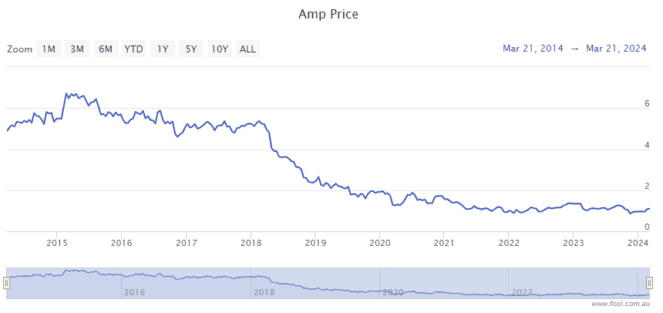
    Geez, this chart looks ugly, doesn’t it?

    This is the AMP Ltd (ASX: AMP) share price over the past 10 years.

    To say it’s been a long road for AMP investors is an understatement. But as you can see from the chart lines, there has been a stabilisation of the share price for a few years now.

    For the record, the AMP share price closed yesterday’s session at $1.12, up 1.36% for the day.

    But down 77% since March 2014.

    However, we have some good news for AMP share investors.

    We’ve got dividend forecasts to share with you, and analysts are optimistic.

    So, let’s check out what the analysts reckon AMP shares will pay in 2024, 2025, and 2026.

    A short history of AMP dividends

    To recap, AMP has only just resumed paying dividends in the past 12 months.

    The company stopped paying dividends in 2019. It paid one final dividend of 4 cents per share that year, with 90% franking, and then nothing until April 2023. It resumed payments then with a final dividend of 2.5 cents per share with just 20% franking.

    In September 2023, AMP paid 2.5 cents again for the interim dividend, also with 20% franking.

    So, all up in 2023, 5 cents per share.

    Then last month, the company announced a final dividend of 2 cents per share amid an earnings boost in FY23.

    The wealth manager reported an underlying NPAT of $196 million, up 6.5% on FY22.

    Forecast dividend in 2024

    Looking ahead, the consensus forecast among analysts on CommSec is for AMP to pay a total annual dividend of 4.7 cents.

    So, with 2 cents already declared last month, they’re betting on a 2.7-cent interim dividend later in the year.

    Based on yesterday’s closing AMP share price of $1.12, a 4.7-cent total annual dividend equates to a yield of 4.2%.

    That’s just above the average dividend yield for S&P/ASX 200 Index (ASX: XJO) stocks of 4%.

    What about future AMP dividends?

    In 2025, the consensus forecast is for the ASX financial share to pay a total annual dividend of 5.9 cents.

    That moves the dividend yield up to 5.27%.

    In 2026, the experts expect a total annual dividend of 6.2 cents, so now we’re talking a yield of 5.5%.

    While that sounds strong, this yield is based on today’s share price.

    If you bought AMP shares 10 years ago when they were trading above $6, a 5.9-cent dividend is barely a 1% yield.

    But at least AMP dividends appear to be on an upward trajectory.

    The post Here’s the AMP dividend forecast through to 2026 appeared first on The Motley Fool Australia.

    Wondering where you should invest $1,000 right now?

    When investing expert Scott Phillips has a stock tip, it can pay to listen. After all, the flagship Motley Fool Share Advisor newsletter he has run for over ten years has provided thousands of paying members with stock picks that have doubled, tripled or even more.*

    Scott just revealed what he believes could be the ‘five best ASX stocks’ for investors to buy right now. We believe these stocks are trading at attractive prices and Scott thinks they could be great buys right now…

    See The 5 Stocks
    *Returns as of 1 February 2024

    (function() {
    function setButtonColorDefaults(param, property, defaultValue) {
    if( !param || !param.includes(‘#’)) {
    var button = document.getElementsByClassName(“pitch-snippet”)[0].getElementsByClassName(“pitch-button”)[0];
    button.style[property] = defaultValue;
    }
    }

    setButtonColorDefaults(“#0095C8”, ‘background’, ‘#5FA85D’);
    setButtonColorDefaults(“#0095C8”, ‘border-color’, ‘#43A24A’);
    setButtonColorDefaults(“#fff”, ‘color’, ‘#fff’);
    })()

    More reading

    Motley Fool contributor Bronwyn Allen has no position in any of the stocks mentioned. The Motley Fool Australia’s parent company Motley Fool Holdings Inc. has no position in any of the stocks mentioned. The Motley Fool Australia has no position in any of the stocks mentioned. The Motley Fool has a disclosure policy. This article contains general investment advice only (under AFSL 400691). Authorised by Scott Phillips.

    from The Motley Fool Australia https://ift.tt/ds9LSt4

  • Forget Fortescue and buy this iron ore share for a 33% return

    Miner and company person analysing results of a mining company.

    Miner and company person analysing results of a mining company.

    Fortescue Ltd (ASX: FMG) shares are a popular option for investors that want iron ore exposure.

    But that doesn’t necessarily mean they are the best way to invest in this side of the market.

    In fact, for some time now, analysts have been warning that Fortescue shares are severely overvalued.

    As a result, it won’t be a surprise for many to see that the mining giant’s shares have fallen 16% since the end of January.

    However, what might be a surprise is that most analysts continue to believe that the miner’s shares remain very expensive despite this pullback.

    For example, earlier this week, the team at Macquarie put an underperform rating and $14.00 price target on its shares, whereas Ord Minnett put a lighten rating and $17.30 price target on them.

    These price targets suggest further downside of 44% and 31%, respectively, from current levels.

    Forget Fortescue shares and buy this iron ore miner

    The team at Goldman Sachs thinks investors should dump Fortescue and buy Champion Iron Ltd (ASX: CIA) shares instead.

    Goldman, which has a sell rating and $19.60 price target on Fortescue, believes that big returns could be on offer from the Canadian iron ore miner.

    According to a note this morning, the broker has retained its buy rating and $9.40 price target on its shares. This implies potential upside of 30% for investors over the next 12 months.

    And with Goldman forecasting a 3.2% dividend yield in FY 2024 and a 4.5% dividend yield in FY 2025, this increases the total potential 12-month return beyond 33%.

    The broker believes that its shares are cheap at the current level. It commented:

    Supportive Valuation: the stock is trading at 0.8x NAV (A$8.7/sh) and ~4.0x EBITDA (NTM). Our NAV is based on a long run Fe price of ~US$105/t (real) for 65% Fe and ~US$75/t premium for DRPF above 62% Fe Index. For every ~US$10/t increase in our long run price, our CIA NAV would increase by ~A$1.5/sh.

    Goldman also highlights that the Bloom Lake operation is performing strongly and looks set to generate significant cash flow next year. It adds:

    Bloom Lake now running above nameplate 15Mtpa, strong OCF in FY25, with de-bottlenecking options to 18Mtpa: CIA has now ramped-up Bloom Lake Phase II to 15Mtpa nameplate, and we expect this to support +50% EBITDA growth and doubling of Operating Cash Flow (OCF) in FY25, which could fund de-bottlenecking of Bloom Lake to 18Mtpa (not included in GSe base case).

    The post Forget Fortescue and buy this iron ore share for a 33% return appeared first on The Motley Fool Australia.

    Wondering where you should invest $1,000 right now?

    When investing expert Scott Phillips has a stock tip, it can pay to listen. After all, the flagship Motley Fool Share Advisor newsletter he has run for over ten years has provided thousands of paying members with stock picks that have doubled, tripled or even more.*

    Scott just revealed what he believes could be the ‘five best ASX stocks’ for investors to buy right now. We believe these stocks are trading at attractive prices and Scott thinks they could be great buys right now…

    See The 5 Stocks
    *Returns as of 1 February 2024

    (function() {
    function setButtonColorDefaults(param, property, defaultValue) {
    if( !param || !param.includes(‘#’)) {
    var button = document.getElementsByClassName(“pitch-snippet”)[0].getElementsByClassName(“pitch-button”)[0];
    button.style[property] = defaultValue;
    }
    }

    setButtonColorDefaults(“#0095C8”, ‘background’, ‘#5FA85D’);
    setButtonColorDefaults(“#0095C8”, ‘border-color’, ‘#43A24A’);
    setButtonColorDefaults(“#fff”, ‘color’, ‘#fff’);
    })()

    More reading

    Motley Fool contributor James Mickleboro has no position in any of the stocks mentioned. The Motley Fool Australia’s parent company Motley Fool Holdings Inc. has positions in and has recommended Goldman Sachs Group and Macquarie Group. The Motley Fool Australia has positions in and has recommended Macquarie Group. The Motley Fool has a disclosure policy. This article contains general investment advice only (under AFSL 400691). Authorised by Scott Phillips.

    from The Motley Fool Australia https://ift.tt/yXiYqnd

  • 5 things to watch on the ASX 200 on Friday

    A man looking at his laptop and thinking.

    A man looking at his laptop and thinking.

    On Thursday, the S&P/ASX 200 Index (ASX: XJO) had a fantastic session. The benchmark index rose 1% to 7,782 points.

    Will the market be able to build on this on Friday and end the week on a high? Here are five things to watch:

    ASX 200 poised to fall

    The Australian share market looks set to end the week in the red despite a good night on Wall Street. According to the latest SPI futures, the ASX 200 is expected to open 14 points or 0.2% lower this morning. In late trade on Wall Street, the Dow Jones is up 0.8%, the S&P 500 is up 0.45%, and the NASDAQ is up 0.35%.

    Oil prices soften

    ASX 200 energy shares Beach Energy Ltd (ASX: BPT) and Karoon Energy Ltd (ASX: KAR) could have a subdued finish to the week after oil prices softened overnight. According to Bloomberg, the WTI crude oil price is down 0.3% to US$81.01 a barrel and the Brent crude oil price is down 0.3% to US$85.71 a barrel. Weaker than expected gasoline demand in the US put pressure on prices.

    Brickworks downgraded

    The Brickworks Limited (ASX: BKW) share price could be fully valued now according to analysts at Bell Potter. In response to the building products company’s half-year results, the broker has downgraded its shares to a hold rating with a $29.00 price target. Bell Potter said: “We remain attracted to BKW’s significant property development pipeline and ~50% short-WALE book in a supply constrained Western Sydney market. That said, with SOL’s premium to NTA having widened to ~8% (BPe) we mark BKW at close to fair value at this time.”

    Gold price storms higher

    ASX 200 gold shares including Evolution Mining Ltd (ASX: EVN) and Northern Star Resources Ltd (ASX: NST) could have a poor session after the gold price dropped overnight. According to CNBC, the spot gold price is up 1.1% to US$2,185.1 an ounce. Rate cut optimism boosted the precious metal.

    Virgin Money UK takeover deal

    Virgin Money UK (ASX: VUK) shares will be on watch on Friday after the UK-based bank released an update on its takeover approach by Nationwide Building Society. According to the release, the two parties have agreed the terms of a recommended cash acquisition of Virgin Money by Nationwide. Under the terms of the acquisition, each Virgin Money shareholder will be entitled to receive 220 pence (~A$4.29) in cash per share.

    The post 5 things to watch on the ASX 200 on Friday appeared first on The Motley Fool Australia.

    Wondering where you should invest $1,000 right now?

    When investing expert Scott Phillips has a stock tip, it can pay to listen. After all, the flagship Motley Fool Share Advisor newsletter he has run for over ten years has provided thousands of paying members with stock picks that have doubled, tripled or even more.*

    Scott just revealed what he believes could be the ‘five best ASX stocks’ for investors to buy right now. We believe these stocks are trading at attractive prices and Scott thinks they could be great buys right now…

    See The 5 Stocks
    *Returns as of 1 February 2024

    (function() {
    function setButtonColorDefaults(param, property, defaultValue) {
    if( !param || !param.includes(‘#’)) {
    var button = document.getElementsByClassName(“pitch-snippet”)[0].getElementsByClassName(“pitch-button”)[0];
    button.style[property] = defaultValue;
    }
    }

    setButtonColorDefaults(“#0095C8”, ‘background’, ‘#5FA85D’);
    setButtonColorDefaults(“#0095C8”, ‘border-color’, ‘#43A24A’);
    setButtonColorDefaults(“#fff”, ‘color’, ‘#fff’);
    })()

    More reading

    Motley Fool contributor James Mickleboro has no position in any of the stocks mentioned. The Motley Fool Australia’s parent company Motley Fool Holdings Inc. has positions in and has recommended Brickworks and Washington H. Soul Pattinson and Company Limited. The Motley Fool Australia has positions in and has recommended Brickworks and Washington H. Soul Pattinson and Company Limited. The Motley Fool has a disclosure policy. This article contains general investment advice only (under AFSL 400691). Authorised by Scott Phillips.

    from The Motley Fool Australia https://ift.tt/UhxTZNF

  • $2.1 million! Who are the highest paid ASX 200 directors?

    a group of 3 faceless business men stand together with one extending his hands dramatically as if protesting his treatment or stating his case passionately.a group of 3 faceless business men stand together with one extending his hands dramatically as if protesting his treatment or stating his case passionately.

    Are S&P/ASX 200 Index (ASX: XJO) board members paid too much?

    It’s a debate that never stops.

    On one hand, directorships are only part-time positions. You meet a few times a year, make some high-level decisions, have a glass of brandy, then go home.

    Board members are usually not involved in the day-to-day running of the company, which is the job of the chief executive.

    And many directors are on the boards of multiple ASX companies, collecting fees like they’re going out of fashion.

    The opposite argument is that these (mostly) men make decisions that affect the welfare of thousands of employees and investors.

    If your judgments affect so many livelihoods, you need to attract the smartest people as directors. Therefore, you need to pay a premium.

    So, who are the ASX 200 directors with the largest pay packets?

    Top 5 highest paid ASX 200 board members

    The Australian Financial Review, using data from OpenDirector and YellowFolder, this week revealed the highest paid ASX 200 board members.

    Here are the top five:

    Director Remuneration Companies
    John Mullen $2.1 million Treasury Wine Estates Ltd (ASX: TWE)

    Brambles Ltd (ASX: BXB)

    Qantas Airways Limited (ASX: QAN)*

    Steven Gregg $1.9 million Westpac Banking Corp (ASX: WBC)

    Ampol Ltd (ASX: ALD)

    Lottery Corporation Ltd (ASX: TLC)**

    Scott Perkins $1.8 million Origin Energy Ltd (ASX: ORG)

    Brambles Ltd 

    Woolworths Group Ltd (ASX: WOW)

    Richard Goyder $1.8 million Woodside Energy Group Ltd (ASX: WDS)

    Qantas**

    Dominic Barton $1.5 million Rio Tinto Ltd (ASX: RIO)
    Source: AFR, * – incoming, ** – outgoing

    The remuneration is calculated just from the base fee for serving on the board, excluding any performance-related options and shares.

    Despite some progress in installing women onto ASX boards, there are still no female directors earning above the $1 million mark.

    The only woman director in the top 20 highest paid ladder is Dr Nora Scheinkestel, who is on the board of Westpac, Origin Energy and Brambles.

    Paid a lot of money to do a job

    On Thursday, Australian Securities and Investments Commission chair Joe Longo responded to complaints from some company directors that the regulatory burden was becoming too much to bear.

    According to The Australian, he acknowledged the “challenges” involved in carrying out board member duties — but told directors that it’s not meant to be an easy job.

    “If it were [easy], anyone could do it,” he said at a AICD event in Melbourne.

    “Good directors run successful, profitable businesses. That’s not going to happen unless every director takes an active stance of curiosity and starts asking the right questions – to understand their business, and how that business makes money.”

    The post $2.1 million! Who are the highest paid ASX 200 directors? appeared first on The Motley Fool Australia.

    Wondering where you should invest $1,000 right now?

    When investing expert Scott Phillips has a stock tip, it can pay to listen. After all, the flagship Motley Fool Share Advisor newsletter he has run for over ten years has provided thousands of paying members with stock picks that have doubled, tripled or even more.*

    Scott just revealed what he believes could be the ‘five best ASX stocks’ for investors to buy right now. We believe these stocks are trading at attractive prices and Scott thinks they could be great buys right now…

    See The 5 Stocks
    *Returns as of 1 February 2024

    (function() {
    function setButtonColorDefaults(param, property, defaultValue) {
    if( !param || !param.includes(‘#’)) {
    var button = document.getElementsByClassName(“pitch-snippet”)[0].getElementsByClassName(“pitch-button”)[0];
    button.style[property] = defaultValue;
    }
    }

    setButtonColorDefaults(“#0095C8”, ‘background’, ‘#5FA85D’);
    setButtonColorDefaults(“#0095C8”, ‘border-color’, ‘#43A24A’);
    setButtonColorDefaults(“#fff”, ‘color’, ‘#fff’);
    })()

    More reading

    Motley Fool contributor Tony Yoo has no position in any of the stocks mentioned. The Motley Fool Australia’s parent company Motley Fool Holdings Inc. has positions in and has recommended Lottery. The Motley Fool Australia has recommended Treasury Wine Estates. The Motley Fool has a disclosure policy. This article contains general investment advice only (under AFSL 400691). Authorised by Scott Phillips.

    from The Motley Fool Australia https://ift.tt/HyVnPLr

  • Why Goldman Sachs expects market-beating returns from Super Retail shares

    A smiling woman sits in a cafe reading a story on her phone about Rio Tinto and drinking a coffee with a laptop open in front of her.

    A smiling woman sits in a cafe reading a story on her phone about Rio Tinto and drinking a coffee with a laptop open in front of her.

    Super Retail Group Ltd (ASX: SUL) shares could be a great option for investors right now.

    That’s the view of analysts at Goldman Sachs, which believe the ASX retail giant is undervalued at current levels.

    What is the broker saying about Super Retail shares?

    Last month, Goldman reiterated its buy rating and $17.80 price target on the company’s shares.

    So, with Super Retail shares currently changing hands for $15.69, this implies potential upside of 13.5% for investors over the next 12 months.

    But the returns won’t stop there. Goldman is forecasting fully franked dividends per share of 67 cents in FY 2024 and then 73 cents in FY 2025.

    This represents dividend yields of 4.3% and 4.65%, respectively, which boosts the total potential 12-month return to approximately 18%.

    Why is the broker bullish?

    Goldman’s bullish view is largely built on its belief that Super Retail is better placed than most in the current environment thanks to the loyalty of its customers.

    In addition, the broker highlights that Super Retail shares are changing hands on multiples that are lower than long-term averages. It explains:

    SUL is an Australian domestic retailer with 4 divisions – Super cheap Auto, Rebel Sport, BCF, and Macpac. We believe SUL will display resilience in a softer economic environment that is built upon its competitive advantage of high loyalty (~11.0m active members accounting for >75% of sales) and this will be further bolstered as the company launches the Rebel loyalty program and continues to build personalisation capabilities. Hence, we are Buy-rated on SUL. SUL is trading below its long run PE valuation average.

    All in all, this could make Super Retail worth considering if you’re looking for exposure to the retail sector for your portfolio or want some new additions for an income portfolio.

    The post Why Goldman Sachs expects market-beating returns from Super Retail shares appeared first on The Motley Fool Australia.

    Wondering where you should invest $1,000 right now?

    When investing expert Scott Phillips has a stock tip, it can pay to listen. After all, the flagship Motley Fool Share Advisor newsletter he has run for over ten years has provided thousands of paying members with stock picks that have doubled, tripled or even more.*

    Scott just revealed what he believes could be the ‘five best ASX stocks’ for investors to buy right now. We believe these stocks are trading at attractive prices and Scott thinks they could be great buys right now…

    See The 5 Stocks
    *Returns as of 1 February 2024

    (function() {
    function setButtonColorDefaults(param, property, defaultValue) {
    if( !param || !param.includes(‘#’)) {
    var button = document.getElementsByClassName(“pitch-snippet”)[0].getElementsByClassName(“pitch-button”)[0];
    button.style[property] = defaultValue;
    }
    }

    setButtonColorDefaults(“#0095C8”, ‘background’, ‘#5FA85D’);
    setButtonColorDefaults(“#0095C8”, ‘border-color’, ‘#43A24A’);
    setButtonColorDefaults(“#fff”, ‘color’, ‘#fff’);
    })()

    More reading

    Motley Fool contributor James Mickleboro has no position in any of the stocks mentioned. The Motley Fool Australia’s parent company Motley Fool Holdings Inc. has positions in and has recommended Goldman Sachs Group. The Motley Fool Australia has positions in and has recommended Super Retail Group. The Motley Fool has a disclosure policy. This article contains general investment advice only (under AFSL 400691). Authorised by Scott Phillips.

    from The Motley Fool Australia https://ift.tt/7nwDNGX

  • 4 ‘overheated’ ASX 200 shares to stay away from

    A man looks at his laptop waiting in anticipation.A man looks at his laptop waiting in anticipation.

    With the market optimistic about the economy and interest rates, there are plenty of excellent buys at the moment on the S&P/ASX 200 Index (ASX: XJO).

    However, there are four specific stocks that one expert is warning investors to cross the street to avoid.

    “The recent bank stock rally looks overdone,” Wilsons equity strategist Rob Crookston said in a memo to clients.

    “Valuation multiples have risen significantly, and are now stretched relative to historical norms.”

    Let’s explore the reasons why these ASX 200 shares seem so expensive now.

    ‘Valuations are disconnected from fundamentals’

    Crookston said that the stock prices for the major banks are now out of sync with their business outlook.

    “Current valuations are disconnected from fundamentals, given the tepid (+2%) earnings growth expected over the next 2 years.”

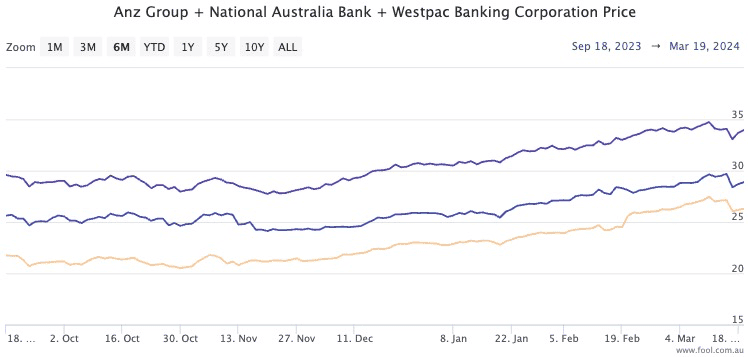
    All four stocks have rocketed over the past six months:

    • Westpac Banking Corp (ASX: WBC) share price up 26%
    • National Australia Bank Ltd (ASX: NAB) up 20%
    • Commonwealth Bank of Australia (ASX: CBA) up 17%
    • ANZ Group Holdings Ltd (ASX: ANZ) up 15%

    Crookston noted that the market seemed to be bidding these upwards because of an expectation that earnings will grow over the next 12 to 24 months.

    But to him, that thesis just does not hold.

    “Our analysis of historical trends and current consensus estimates suggests limited upside to forward earnings, even with the possibility of a soft landing and interest rate cuts in the next 12 to 18 months.”

    All four ASX 200 shares are now flying above where they were just before the COVID-19 crash back in February 2020.

    In a competitive market, Crookston is worried about the long-term trend for the banking industry.

    “Over the past two decades, the return on equity (ROE) of major banks has declined substantially, largely explaining the decrease in the price-to-book ratios.”

    Australian banks also look expensive compared to comparable foreign peers.

    “While CBA has a lower ROE (13.3%) relative to JP Morgan Chase & Co (NYSE: JPM) (14.9%), it trades on a 58% premium on a price-to-book basis. 

    “While the historically resilient Australian economy and the concentrated nature of the domestic banking sector deserves a premium, this is excessive.”

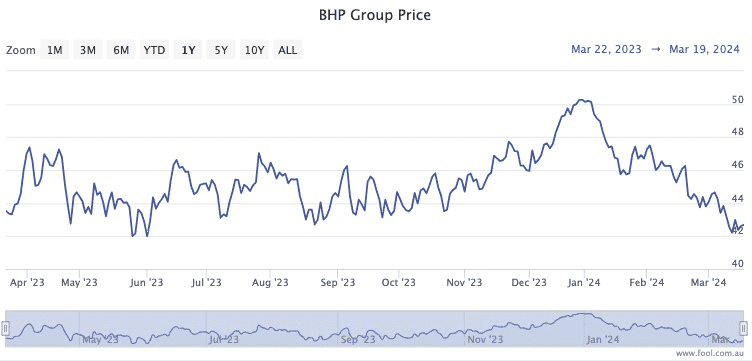
    Crookston’s team has indeed put their money where their mouths are, recently selling their Westpac shares in order to buy into BHP Group Ltd (ASX: BHP).

    “The recent pullback in the iron ore miners presents a good opportunity to lighten our sector underweight by adding to BHP.”

    The post 4 ‘overheated’ ASX 200 shares to stay away from appeared first on The Motley Fool Australia.

    Wondering where you should invest $1,000 right now?

    When investing expert Scott Phillips has a stock tip, it can pay to listen. After all, the flagship Motley Fool Share Advisor newsletter he has run for over ten years has provided thousands of paying members with stock picks that have doubled, tripled or even more.*

    Scott just revealed what he believes could be the ‘five best ASX stocks’ for investors to buy right now. We believe these stocks are trading at attractive prices and Scott thinks they could be great buys right now…

    See The 5 Stocks
    *Returns as of 1 February 2024

    (function() {
    function setButtonColorDefaults(param, property, defaultValue) {
    if( !param || !param.includes(‘#’)) {
    var button = document.getElementsByClassName(“pitch-snippet”)[0].getElementsByClassName(“pitch-button”)[0];
    button.style[property] = defaultValue;
    }
    }

    setButtonColorDefaults(“#0095C8”, ‘background’, ‘#5FA85D’);
    setButtonColorDefaults(“#0095C8”, ‘border-color’, ‘#43A24A’);
    setButtonColorDefaults(“#fff”, ‘color’, ‘#fff’);
    })()

    More reading

    JPMorgan Chase is an advertising partner of The Ascent, a Motley Fool company. Motley Fool contributor Tony Yoo has no position in any of the stocks mentioned. The Motley Fool Australia’s parent company Motley Fool Holdings Inc. has positions in and has recommended JPMorgan Chase. The Motley Fool Australia has no position in any of the stocks mentioned. The Motley Fool has a disclosure policy. This article contains general investment advice only (under AFSL 400691). Authorised by Scott Phillips.

    from The Motley Fool Australia https://ift.tt/3BZ4FlT

  • Financial advisor who owns 3 homes says stocks beat real estate investment for wealth generation

    Smiling man sits in front of a graph on computer while using his mobile phone.Smiling man sits in front of a graph on computer while using his mobile phone.

    Koda Capital financial advisor Sebastian Ferrando owns three real estate investments in Australia, but wishes he’d put the money into US shares instead.

    As reported in the Australian Financial Review (AFR), the finance professional thinks the cost of buying, holding and selling residential real estate makes buying investment property a wealth trap.

    Ferrando laments the growing disparity between the net returns on Australian investment property vs. US shares.

    For example, in 2023, the S&P 500 Index (SP: .INX) rose by 24.2%.

    By comparison, the S&P/ASX 200 Index (ASX: XJO) and Australian property vastly underperformed the US stock benchmark, delivering just 8.1% in capital growth.

    Why is real estate investment a wealth trap?

    Ferrando doesn’t mince words, commenting:

    The truth is you can leverage the crap out of residential real estate and that’s a massive advantage.

    But to buy, hold, maintain, and sell real estate involves large costs.

    If you take the costs out of real estate transactions, the returns [for apartments] are sub 4 per cent a year as costs like maintenance, agent fees, rates, insurance, repairs, stamp duty, and strata are hidden, high, and constant.

    Ferrando estimates that typical property investors in Sydney, Melbourne, or Brisbane buying a $1 million investment property will contribute a 35% deposit and get an investment property loan covering 65%.

    They rent the property out and benefit from negative gearing at tax time.

    Over time, they profit from the leverage as they make investment earnings from rent and capital growth on a $1 million asset after spending only $350,000 of their own money.

    Ferrando reckons leverage is one of the biggest appeals of property investment.

    And that all sounds well and good, but it’s the costs of real estate investment that bother him.

    The typical costs of Sydney real estate investment

    Just to give you an example, here’s a typical scenario for a Sydney investor buying a two bedroom apartment at today’s median price of $837,253.

    • $32,413 in stamp duty on the purchase
    • $500 for a building and pest report
    • $2,000 on the purchase conveyance
    • $10,000 to replace a few major things over the long term, such as carpet, blinds, hot water tank
    • $7,000 to $10,000 per year on strata levies, council and water rates, insurance, and property management fees
    • $15,000 for re-painting, styling and marketing when it’s time to sell
    • $20,000 selling agent fee (2% on a sale price of $1 million)
    • Another $2,000 on the sale conveyance

    While this is a lot of money, Sydney has an outstanding history of long-term capital growth, so you may well still come out on top if you buy and hold through at least two major market cycle upswings.

    But as you can imagine, it’s not just the ongoing costs that property investors need to consider. There’s a lot of work involved in researching, finding, buying, holding, and selling a real estate investment.

    The alternative is buying ASX or international shares online from the comfort of your own home for a brokerage fee as low as $5.

    And this is Ferrando’s main point.

    What should you do instead of property investment?

    Ferrando points out that investors can use leverage on shares investing too, using a margin facility.

    On shares vs. property, he sums it up:

    I say, buy real estate if you want to enjoy it every day, but don’t buy it with your investment dollars.

    Ferrando was primarily comparing the performance of Australian real estate investment vs. US shares.

    We recently looked at how ASX shares performed compared to Australian real estate over 10 years.

    And if you’re curious about which ASX shares and Australian property markets are delivering the best passive income for investors today, via the highest dividend and rental yields, click here.

    The post Financial advisor who owns 3 homes says stocks beat real estate investment for wealth generation appeared first on The Motley Fool Australia.

    Wondering where you should invest $1,000 right now?

    When investing expert Scott Phillips has a stock tip, it can pay to listen. After all, the flagship Motley Fool Share Advisor newsletter he has run for over ten years has provided thousands of paying members with stock picks that have doubled, tripled or even more.*

    Scott just revealed what he believes could be the ‘five best ASX stocks’ for investors to buy right now. We believe these stocks are trading at attractive prices and Scott thinks they could be great buys right now…

    See The 5 Stocks
    *Returns as of 1 February 2024

    (function() {
    function setButtonColorDefaults(param, property, defaultValue) {
    if( !param || !param.includes(‘#’)) {
    var button = document.getElementsByClassName(“pitch-snippet”)[0].getElementsByClassName(“pitch-button”)[0];
    button.style[property] = defaultValue;
    }
    }

    setButtonColorDefaults(“#0095C8”, ‘background’, ‘#5FA85D’);
    setButtonColorDefaults(“#0095C8”, ‘border-color’, ‘#43A24A’);
    setButtonColorDefaults(“#fff”, ‘color’, ‘#fff’);
    })()

    More reading

    Motley Fool contributor Bronwyn Allen has no position in any of the stocks mentioned. The Motley Fool Australia’s parent company Motley Fool Holdings Inc. has no position in any of the stocks mentioned. The Motley Fool Australia has no position in any of the stocks mentioned. The Motley Fool has a disclosure policy. This article contains general investment advice only (under AFSL 400691). Authorised by Scott Phillips.

    from The Motley Fool Australia https://ift.tt/VUlR7kG

  • 3 ASX stocks boasting better margins than Nvidia

    A couple consider the pros and cons of taking out a loanA couple consider the pros and cons of taking out a loan

    The green graphics card giant is making a motza. But did you know some ASX companies have even bigger profit margins than Nvidia Corp (NASDAQ: NVDA)?

    Masterfully riding the AI wave, Nvidia looks like the Kelly Slater of computer hardware. The insatiable hunger for AI-enabling chips is fattening the technology company’s profits. For 12 months ended January 2024, this A$3.4 trillion business pulled a 48.8% net margin.

    For every dollar of revenue, Nvidia kept 49 cents — that’s after tax!

    Unsurprisingly, the share price is up 245% over the past year. Except, what if you wanted a slice of such profitability a little closer to home? I’m talking margin monsters like Nvidia on our local ASX bourse.

    Nvidia-beating margins on the ASX

    It’s completely possible! There are 43 ASX-listed stocks with superior margins to Nvidia. However, I wouldn’t count some of these due to quirky accounting practices. Still, if thick profit margins are your jam, plenty of options exist.

    Here are a few Aussie companies that pass the high bar.

    49% net margin: Not quite beating, but just as good as Nvidia is an ASX healthcare company named Pro Medicus Limited (ASX: PME). Its superb profits come from selling software to medical groups that allow large files to be viewed on any device.

    In the 12 months ended 31 December 2023, Pro Medicus raked in $142.1 million in revenue and profits of $69.7 million. The company’s margins have increased over the years due to the low additional cost of providing its software to more customers.

    67% net margin: Any business that collects a royalty on something usually operates on high margins. There are minimal costs to eat away at the revenue gathered from sales. Deterra Royalties Ltd (ASX: DRR) is a locally-listed company relishing in this situation.

    The lucrative enterprise comes from taking a royalty on iron ore sales from BHP Group Ltd‘s (ASX: BHP) Mining Area C mine. In the 12 months ended 31 December 2023, Deterra recorded $251.8 million in revenue and profits of $167.8 million.

    68% net margin: Surpassing Nvidia’s profit margin by 19% is an ASX biotech biz with rocketing revenues. The profit phenom I’m referring to is Neuren Pharmaceuticals Ltd (ASX: NEU), a drug developer that has reached commercial success with DAYBUE (trofinetide) treating Rett syndrome.

    In the 12 months ended 31 December 2023, Neuren reached $231.9 million in revenue and profits of $157.1 million. It’s a remarkable difference from a year earlier when revenue and earnings were $15.4 million and $184,000, respectively.

    The post 3 ASX stocks boasting better margins than Nvidia appeared first on The Motley Fool Australia.

    Wondering where you should invest $1,000 right now?

    When investing expert Scott Phillips has a stock tip, it can pay to listen. After all, the flagship Motley Fool Share Advisor newsletter he has run for over ten years has provided thousands of paying members with stock picks that have doubled, tripled or even more.*

    Scott just revealed what he believes could be the ‘five best ASX stocks’ for investors to buy right now. We believe these stocks are trading at attractive prices and Scott thinks they could be great buys right now…

    See The 5 Stocks
    *Returns as of 1 February 2024

    (function() {
    function setButtonColorDefaults(param, property, defaultValue) {
    if( !param || !param.includes(‘#’)) {
    var button = document.getElementsByClassName(“pitch-snippet”)[0].getElementsByClassName(“pitch-button”)[0];
    button.style[property] = defaultValue;
    }
    }

    setButtonColorDefaults(“#0095C8”, ‘background’, ‘#5FA85D’);
    setButtonColorDefaults(“#0095C8”, ‘border-color’, ‘#43A24A’);
    setButtonColorDefaults(“#fff”, ‘color’, ‘#fff’);
    })()

    More reading

    Motley Fool contributor Mitchell Lawler has positions in Pro Medicus. The Motley Fool Australia’s parent company Motley Fool Holdings Inc. has positions in and has recommended Nvidia and Pro Medicus. The Motley Fool Australia has recommended Nvidia and Pro Medicus. The Motley Fool has a disclosure policy. This article contains general investment advice only (under AFSL 400691). Authorised by Scott Phillips.

    from The Motley Fool Australia https://ift.tt/EBtyvqS

  • Here are the next distribution dates for your Vanguard ETFs

    A woman in yellow jump holds a coffee and writes in a diary.A woman in yellow jump holds a coffee and writes in a diary.

    Investors in 23 Vanguard exchange-traded funds (ETFs) now have a few dates to mark in their diaries following the release of the next distributions calendar today.

    According to the calendar, the ex-dividend date for the next round of distributions will be 2 April.

    That means you’ll need to own the relevant ETFs before this date to receive the next payment.

    The record date will be 3 April.

    The payment date will be 17 April.

    Which Vanguard ETFs are affected?

    These dates are relevant to some of the most popular Vanguard products in the market.

    They include the Vanguard Australian Shares Index ETF (ASX: VAS), which tracks the performance of the ASX 300 and is one of the biggest ETFs in Australia with a market capitalisation of $14.72 billion.

    The dates are also relevant to Vanguard Australian Shares High Yield ETF (ASX: VHY), which has a track record for delivering some of the best returns of all Australian shares ETFs.

    If you own the Vanguard Diversified High Growth Index ETF (ASX: VDHG), which allows investors to buy 16,000 ASX and international shares in one transaction, for one brokerage fee, then these dates apply to you as well.

    Another ETF covered by this distribution calendar is Vanguard MSCI Index International Shares ETF (ASX: VGS), which hit a new 52-week high of $124.13 in earlier trading today.

    The post Here are the next distribution dates for your Vanguard ETFs appeared first on The Motley Fool Australia.

    Wondering where you should invest $1,000 right now?

    When investing expert Scott Phillips has a stock tip, it can pay to listen. After all, the flagship Motley Fool Share Advisor newsletter he has run for over ten years has provided thousands of paying members with stock picks that have doubled, tripled or even more.*

    Scott just revealed what he believes could be the ‘five best ASX stocks’ for investors to buy right now. We believe these stocks are trading at attractive prices and Scott thinks they could be great buys right now…

    See The 5 Stocks
    *Returns as of 1 February 2024

    (function() {
    function setButtonColorDefaults(param, property, defaultValue) {
    if( !param || !param.includes(‘#’)) {
    var button = document.getElementsByClassName(“pitch-snippet”)[0].getElementsByClassName(“pitch-button”)[0];
    button.style[property] = defaultValue;
    }
    }

    setButtonColorDefaults(“#0095C8”, ‘background’, ‘#5FA85D’);
    setButtonColorDefaults(“#0095C8”, ‘border-color’, ‘#43A24A’);
    setButtonColorDefaults(“#fff”, ‘color’, ‘#fff’);
    })()

    More reading

    Motley Fool contributor Bronwyn Allen has positions in Vanguard Australian Shares Index ETF and Vanguard Diversified High Growth Index ETF. The Motley Fool Australia’s parent company Motley Fool Holdings Inc. has no position in any of the stocks mentioned. The Motley Fool Australia has recommended Vanguard Australian Shares High Yield ETF and Vanguard Msci Index International Shares ETF. The Motley Fool has a disclosure policy. This article contains general investment advice only (under AFSL 400691). Authorised by Scott Phillips.

    from The Motley Fool Australia https://ift.tt/CS4qBHg