Tag: Motley Fool

  • Up 40% in six months, can the A2 Milk share price keep rising?

    watching asx share price represented by investor looking up

    watching asx share price represented by investor looking up

    The A2 Milk Company Ltd (ASX: A2M) share price is having another positive day.

    In morning trade, the infant formula company’s shares are up almost 2% to $6.20.

    This latest gain means the A2 Milk share price is now up 40% over the last six months.

    Can the A2 Milk share price keep rising?

    While there is unlikely to be another 40% gain over the next six months, one leading broker sees scope for the A2 Milk share price to continue its ascent.

    According to a recent note out of Bell Potter, its analysts have retained their buy rating with a $6.80 price target.

    This implies potential upside of approximately 10% for investors from current levels.

    Why is the broker bullish?

    Bell Potter is positive on the company due to its strategy that aims to delivers sales of NZ$2 billion and EBITDA margins in the teens by FY 2026.

    It highlights that this would implies very strong earnings per share growth over the coming years, which would more than justify the current multiples its shares trade on.

    The broker also sees a major opportunity in the United States for its infant formula following the recent receipt of FDA approval. It explained:

    A2M has stated that through its manufacturing partner, SM1, it has access to ~9m tins of IMF capacity. However, A2M’s initial expectations are for the supply of up to ~1m tins in 2H23e. This does not appear an egregious forecast, given we estimate BUB sold ~0.45m tins into the US over 4Q22-1Q23 with 6,500 distribution points and A2M has 27,400 existing distribution points for its fresh portfolio.

    Our Buy rating is unchanged. If A2M can execute on its strategy to achieve ~NZ$2Bn in FY26e revenues and EBITDA margins in the teens, then it would imply compound double digit EPS growth through to FY26e. We view the initial entry into the US IMF category as incrementally positive, though note the scale of A2M’s existing US fresh distribution footprint implies this could be a more meaningful contributor should sales velocities approach levels seen in other markets.

    The post Up 40% in six months, can the A2 Milk share price keep rising? appeared first on The Motley Fool Australia.

    One “Under the Radar” Pick for the “Digital Entertainment Boom”

    Discover one tiny “Triple Down” stock that’s 1/45th the size of Google and could stand to profit as more and more people ditch free-to-air for streaming TV. But this isn’t a competitor to Netflix, Disney+, or Amazon Prime Video, as you might expect

    Learn more about our Tripledown report
    *Returns as of November 1 2022

    (function() {
    function setButtonColorDefaults(param, property, defaultValue) {
    if( !param || !param.includes(‘#’)) {
    var button = document.getElementsByClassName(“pitch-snippet”)[0].getElementsByClassName(“pitch-button”)[0];
    button.style[property] = defaultValue;
    }
    }

    setButtonColorDefaults(“#0095C8”, ‘background’, ‘#5FA85D’);
    setButtonColorDefaults(“#0095C8”, ‘border-color’, ‘#43A24A’);
    setButtonColorDefaults(“#fff”, ‘color’, ‘#fff’);
    })()

    More reading

    Motley Fool contributor James Mickleboro has no position in any of the stocks mentioned. The Motley Fool Australia’s parent company Motley Fool Holdings Inc. has no position in any of the stocks mentioned. The Motley Fool Australia has recommended A2 Milk. The Motley Fool has a disclosure policy. This article contains general investment advice only (under AFSL 400691). Authorised by Scott Phillips.

    from The Motley Fool Australia https://ift.tt/b5ADQwy

  • Could now be the time for income investors to buy CBA shares?

    A woman in a bright yellow jumper looks happily at her yellow piggy bank representing bank dividends and in particular the CBA dividend

    A woman in a bright yellow jumper looks happily at her yellow piggy bank representing bank dividends and in particular the CBA dividend

    As an ASX big four bank, Commonwealth Bank of Australia (ASX: CBA) shares have always been a prominent choice for ASX dividend income investors.

    CBA shares have paid out hefty dividends for decades. But does that mean it is a good choice for income investors today?

    Well, let’s start with the dividends CBA is currently paying out. So Commonwealth Bank shares have doled out two dividends this year, as is the norm.

    The first was the March interim dividend of $1.75 per share, fully franked.

    The second was the final dividend from September, which was worth $2.10 per share, also fully franked.

    That’s a total of $3.85 in dividend income per share for 2022. On today’s CBA share price of $108.10 (at the time of writing), this gives CBA shares a trailing dividend yield of 3.56%.

    Are CBA shares a buy for dividend income?

    But let’s talk about what might happen going forward from here. After all, knowing what kind of income CBA has paid out only goes so far in terms of what is useful for an investor today.

    So, like many ASX dividend shares, CBA has a dividend policy. This tells investors that each year, CBA will strive to “target a full-year payout ratio of 70% – 80%” of its earnings to fund its dividends.

    Over FY2022, CBA made $5.57 in earnings per share (EPS), up 14% from the $4.88 it made in FY2021. Of that $5.57 in EPS, the bank paid out $3.85 of those earnings per share as dividends. That’s a payout ratio of 69.12%, so just below CBA’s ratio target.

    Both of these metrics bode well for future dividend income. If CBA can manage to grow its EPS again in FY2023, and keep its payout ratio steady, then shareholders will enjoy a dividend increase. If the bank grows its EPS and ups its payout ratio, then investors will enjoy an even larger dividend rise.

    Perhaps this is why brokers at Macquarie have recently decided to swap out Australian and New Zealand Banking Group Ltd (ASX: ANZ) shares for CBA shares in a recent model portfolio reshuffling.

    So on the numbers, it looks as though CBA’s current dividends are on a sure footing and could increase further. But we shall have to wait and see if CBA can keep up its earnings growth going forward. That’s the real key to a rising dividend.

    The post Could now be the time for income investors to buy CBA shares? appeared first on The Motley Fool Australia.

    Looking to buy dividend shares to help fight inflation?

    If you’re looking to buy dividend shares to help fight inflation then you’ll need to get your hands on this… Our FREE report revealing three stocks not only boasting inflation fighting dividends…

    They also have strong potential for massive long term returns…

    Learn more about our Top 3 Dividend Stocks report
    *Returns as of November 1 2022

    (function() {
    function setButtonColorDefaults(param, property, defaultValue) {
    if( !param || !param.includes(‘#’)) {
    var button = document.getElementsByClassName(“pitch-snippet”)[0].getElementsByClassName(“pitch-button”)[0];
    button.style[property] = defaultValue;
    }
    }

    setButtonColorDefaults(“#0095C8”, ‘background’, ‘#5FA85D’);
    setButtonColorDefaults(“#0095C8”, ‘border-color’, ‘#43A24A’);
    setButtonColorDefaults(“#fff”, ‘color’, ‘#fff’);
    })()

    More reading

    Motley Fool contributor Sebastian Bowen has no position in any of the stocks mentioned. The Motley Fool Australia’s parent company Motley Fool Holdings Inc. has no position in any of the stocks mentioned. The Motley Fool Australia has recommended Macquarie Group Limited. The Motley Fool has a disclosure policy. This article contains general investment advice only (under AFSL 400691). Authorised by Scott Phillips.

    from The Motley Fool Australia https://ift.tt/ywrECQJ

  • Why Warren Buffett doesn’t worry about election results

    This article was originally published on Fool.com. All figures quoted in US dollars unless otherwise stated.

    Warren Buffett

    This article was originally published on Fool.com. All figures quoted in US dollars unless otherwise stated.

    Billionaire investor Warren Buffett has been invested in stocks for decades, and has seen many presidents come and go during that time. And if you’re investing for the long haul, you have to be prepared for the reality that your preferred party won’t always be in power.

    You don’t need to get in and out of stocks depending on election results or changes in power. Buffett hasn’t let that affect his long-term strategy, and investors would do well to follow a similar approach.

    Buffett simply bets on America

    Buffett has said in the past that politics don’t necessarily weigh on his investing decisions: “I won’t say if my candidate doesn’t win, and probably half the time they haven’t, I’m going to take my ball and go home.” In general, Buffett is just bullish on America and the economy’s ability to continue growing and progressing over the long term.

    Presidents, after all, can serve just two terms, so unless you’re investing for a shorter time frame than that, there can still be time for your investments to bounce back if policies during that stretch negatively impacted businesses in your portfolio.  

    Investors should focus on fundamentals, not elections

    Even if an election turns out favorably, that still doesn’t guarantee that certain policies will be put in place or that certain stocks will soar. Take the cannabis industry as an example. When President Biden won the 2020 election, shares of pot stocks took off on the expectation that marijuana reform would be inevitable. In November 2020, shares of cannabis producer Tilray Brands (NASDAQ: TLRY) skyrocketed 58%.

    But no significant marijuana reform has taken place since then. And now with the Republican party regaining control of the House, it may be difficult for anything to happen over the next two years. And so despite all the hype and optimism for Tilray, the stock has gone on to decline 55% since the start of Biden’s term in 2021.

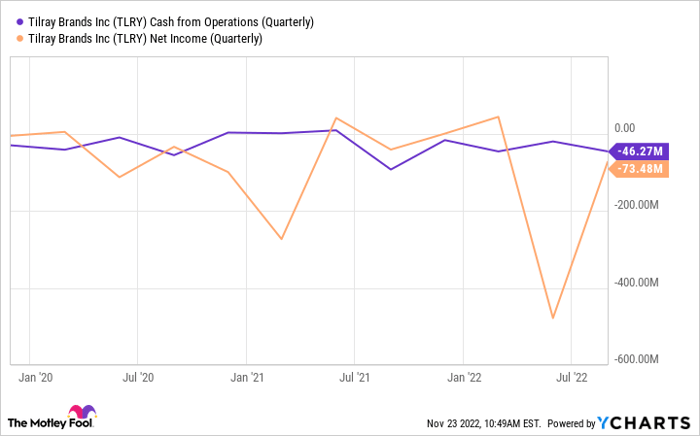
    Investors would have been better off focusing on the company’s fundamentals, which remain problematic. Tilray has consistently reported operating losses and negative cash flow from its day-to-day operations, two things that should have served as significant red flags for investors.   

    TLRY Cash from Operations (Quarterly) Chart
    Data by YCharts.

    This should have served as a reason to be wary of the pot stock, as opposed to hoping that favorable election results would make up for the company’s shortcomings and poor financials. After all, while a president can help create new opportunities, a company still has to be in a good position to take advantage of them should they come up, and Tilray certainly isn’t.

    Another example of where fears haven’t lived up to reality is in the tech world, where many tech investors were concerned that a Democratic win in 2020 could have meant the breakup of companies, including Meta Platforms (NASDAQ: META), which owns Instagram, WhatsApp, and Facebook. Meta still owns all of those businesses despite what may have seemed like an unfavorable election result. While that doesn’t mean a breakup won’t happen in the future, it’s yet another reminder of why investors shouldn’t read too much into elections.

    Although Meta’s stock hasn’t performed all that well of late and is down 60% since 2021, those losses are primarily due to the current bear market and macro conditions in the tech industry that are weighing down many stocks. But with strong fundamentals that include $26 billion in free cash flow over the trailing 12 months and a profit margin of 24%, Meta remains in good shape and may be an attractive stock for long-term investors to add to their portfolios today.  

    This article was originally published on Fool.com. All figures quoted in US dollars unless otherwise stated.

    The post Why Warren Buffett doesn’t worry about election results appeared first on The Motley Fool Australia.

    Wondering where you should invest $1,000 right now?

    When investing expert Scott Phillips has a stock tip, it can pay to listen. After all, the flagship Motley Fool Share Advisor newsletter he has run for over ten years has provided thousands of paying members with stock picks that have doubled, tripled or even more.* Scott just revealed what he believes could be the “five best ASX stocks” for investors to buy right now. These stocks are trading at near dirt-cheap prices and Scott thinks they could be great buys right now

    See The 5 Stocks
    *Returns as of November 1 2022

    (function() {
    function setButtonColorDefaults(param, property, defaultValue) {
    if( !param || !param.includes(‘#’)) {
    var button = document.getElementsByClassName(“pitch-snippet”)[0].getElementsByClassName(“pitch-button”)[0];
    button.style[property] = defaultValue;
    }
    }

    setButtonColorDefaults(“#43B02A”, ‘background’, ‘#5FA85D’);
    setButtonColorDefaults(“#43B02A”, ‘border-color’, ‘#43A24A’);
    setButtonColorDefaults(“#fff”, ‘color’, ‘#fff’);
    })()

    More reading

    David Jagielski has positions in Meta Platforms, Inc. Randi Zuckerberg, a former director of market development and spokeswoman for Facebook and sister to Meta Platforms CEO Mark Zuckerberg, is a member of The Motley Fool’s board of directors. The Motley Fool Australia’s parent company Motley Fool Holdings Inc. has positions in and has recommended Meta Platforms, Inc. The Motley Fool Australia has recommended Meta Platforms, Inc. The Motley Fool has a disclosure policy. This article contains general investment advice only (under AFSL 400691). Authorised by Scott Phillips.

    This article was originally published on Fool.com. All figures quoted in US dollars unless otherwise stated.

    from The Motley Fool Australia https://ift.tt/U1YopJ9

  • 5 of the craziest things making news on the ASX this week

    A woman is excited as she reads the latest rumour on her phone.A woman is excited as she reads the latest rumour on her phone.

    It’s been a good week for ASX fans, and there’s been plenty of news to catch their eye.

    The S&P/ASX 200 Index (ASX: XJO) has lifted 1.34% so far this week. Meanwhile, the All Ordinaries Index (ASX: XAO) is up 1.2% week-on-week right now. Both indices are currently trading at near-six-month highs.

    So, which stocks have been helping to bolster the market? Keep reading to find out.

    5 ASX shares making big news this week

    Qantas posts shock guidance

    Is it a bird? Is it a plane? No, it’s a flying kangaroo. The Qantas Airways Limited (ASX: QAN) share price soared 5% on Wednesday after the company surprised the market with a guidance upgrade just months after tipping its first post-COVID profit.

    The ASX airline share now expects to reveal between $1.35 billion and $1.45 billion of underlying profit before tax for the first half of financial year 2023. That’s $150 million higher than its previous projection.

    Kogan eyes historic recovery

    Continuing this week’s good news, Kogan.com Ltd (ASX: KGN) shares launched 8% yesterday after the company’s CEO tipped it to post “historical operating margins during the second half.”

    That probably had long-term investors jumping for joy. The online retailer’s stock has dumped a whopping 85% since its 2020 high.

    BWX flags return to trade after 3-month freeze

    Recent times haven’t been so kind to skin and hair care company BWX Ltd (ASX: BWX), however. Its share price hasn’t gone anywhere since August amid confusion over its recent earnings.

    But BWX this week flagged its audited earnings will likely drop on Monday, with its share price expected to thaw on Tuesday.

    BrainChip surges amid Amazon appointment

    Meanwhile, the share price of ASX 200 artificial intelligence company BrainChip Holdings Ltd (ASX: BRN) has rocketed 16% this week.

    Its gains came amid news of the company’s new chief marketing officer, former Amazon.com Inc (NASDAQ: AMZN) face Nandan Nayampally.

    Coal stocks pop, then drop

    Finally, the week was also good to ASX 200 coal shares, until it wasn’t.

    Stock in Whitehaven Coal Ltd (ASX: WHC), for instance, lifted 17% between Monday’s open and Wednesday’s close. However, Thursday saw it tumble 7%.

    That came despite no price-sensitive news from the energy giant. However, coal prices likely played their part.

    Additionally, word that Whitehaven managing director and CEO Paul Flynn offloaded $7.9 million of the company’s stock might have weighed on its share price yesterday.

    The post 5 of the craziest things making news on the ASX this week appeared first on The Motley Fool Australia.

    Wondering where you should invest $1,000 right now?

    When investing expert Scott Phillips has a stock tip, it can pay to listen. After all, the flagship Motley Fool Share Advisor newsletter he has run for over ten years has provided thousands of paying members with stock picks that have doubled, tripled or even more.* Scott just revealed what he believes could be the “five best ASX stocks” for investors to buy right now. These stocks are trading at near dirt-cheap prices and Scott thinks they could be great buys right now

    See The 5 Stocks
    *Returns as of November 1 2022

    (function() {
    function setButtonColorDefaults(param, property, defaultValue) {
    if( !param || !param.includes(‘#’)) {
    var button = document.getElementsByClassName(“pitch-snippet”)[0].getElementsByClassName(“pitch-button”)[0];
    button.style[property] = defaultValue;
    }
    }

    setButtonColorDefaults(“#43B02A”, ‘background’, ‘#5FA85D’);
    setButtonColorDefaults(“#43B02A”, ‘border-color’, ‘#43A24A’);
    setButtonColorDefaults(“#fff”, ‘color’, ‘#fff’);
    })()

    More reading

    John Mackey, CEO of Whole Foods Market, an Amazon subsidiary, is a member of The Motley Fool’s board of directors. Motley Fool contributor Brooke Cooper has no position in any of the stocks mentioned. The Motley Fool Australia’s parent company Motley Fool Holdings Inc. has positions in and has recommended Amazon and Kogan.com ltd. The Motley Fool Australia has positions in and has recommended Kogan.com ltd. The Motley Fool Australia has recommended Amazon and BWX Limited. The Motley Fool has a disclosure policy. This article contains general investment advice only (under AFSL 400691). Authorised by Scott Phillips.

    from The Motley Fool Australia https://ift.tt/BhO0iUt

  • What is driving the City Chic share price 21% lower on Friday?

    Close up of a sad young woman reading about declining share price on her phone.

    Close up of a sad young woman reading about declining share price on her phone.

    The City Chic Collective Ltd (ASX: CCX) share price is having a day to forget.

    In morning trade, the plus sized fashion retailer’s shares are down 24% to a 52-week low of $1.05.

    Why is the City Chic share price crashing?

    Investors have been hitting the sell button in a hurry this morning after the retailer released a trading update at its annual general meeting.

    According to the release, City Chic’s revenue is down 2% financial year to date to $128.6 million. While ANZ sales are up 10%, this has been offset by a worrying decline in Americas sales. The latter segment posted a 12% decline in revenue despite the significant weakness in the Australian dollar over the last 12 months.

    Management commented:

    Demand has been volatile, and the consumer is looking for promotion as a reason to buy. The competitive landscape, especially in the Northern Hemisphere, has intensified as all businesses promote aggressively to capture the limited dollars she is prepared to spend.

    At a regional level there have been very contrasting results. The Southern Hemisphere, with stores open has shown growth and the Northern Hemisphere, which is facing much greater economic pressures, delivered a decline in revenue.

    What else?

    Another area of concern that could be weighing on the City Chic share price is the company’s inventory position.

    Management expects its inventory to be in the range of $168 million to $174 million at the end of the first half. As a comparison, City Chic currently has a market capitalisation of just over $250 million. This appears to indicate that investors have major doubts that the company will be able to successfully shift these items.

    Another negative from today’s update was management’s commentary on margins. While no details were provided on its profits, its margin commentary appears to indicate that City Chic’s earnings could be down sharply during the first half. It said:

    The real issue for us to deal with in FY2023 is temporary margin compression driven by competition for reduced demand, together with transitory logistics costs in the Northern Hemisphere.

    Given this bleak outlook, you may not be surprised to learn that the City Chic share price is now down over 80% since the start of the year.

    The post What is driving the City Chic share price 21% lower on Friday? appeared first on The Motley Fool Australia.

    Tech Stock That’s Changing Streaming

    Streaming TV Shocker: One stock we think could set to profit as people ditch free-to-air for streaming TV (Hint It’s not Netflix, Disney+, or even Amazon Prime)

    Learn more about our Tripledown report
    *Returns as of November 1 2022

    (function() {
    function setButtonColorDefaults(param, property, defaultValue) {
    if( !param || !param.includes(‘#’)) {
    var button = document.getElementsByClassName(“pitch-snippet”)[0].getElementsByClassName(“pitch-button”)[0];
    button.style[property] = defaultValue;
    }
    }

    setButtonColorDefaults(“#0095C8”, ‘background’, ‘#5FA85D’);
    setButtonColorDefaults(“#0095C8”, ‘border-color’, ‘#43A24A’);
    setButtonColorDefaults(“#fff”, ‘color’, ‘#fff’);
    })()

    More reading

    Motley Fool contributor James Mickleboro has no position in any of the stocks mentioned. The Motley Fool Australia’s parent company Motley Fool Holdings Inc. has no position in any of the stocks mentioned. The Motley Fool Australia has no position in any of the stocks mentioned. The Motley Fool has a disclosure policy. This article contains general investment advice only (under AFSL 400691). Authorised by Scott Phillips.

    from The Motley Fool Australia https://ift.tt/0HI5C3F

  • 3 reasons this fundie is still bullish on ASX mining shares

    Three miners wearing hard hats and high vis vests take a break on site at a mine as the Fortescue share price drops in FY22Three miners wearing hard hats and high vis vests take a break on site at a mine as the Fortescue share price drops in FY22

    One fund manager believes ASX mining shares could see the demand for their output soar in the near future.

    In a Livewire article, VanEck portfolio manager Cameron McCormack suggested China’s projected reopening and its pivot away from harsh zero-COVID policies would be the main value drivers for Australian commodity exporters.

    So let’s peel back the layers of McCormack’s thesis to uncover the three ways he expects this change in China to benefit ASX mining shares.

    China’s infrastructure spending is poised to return

    It’s anticipated that China will have a renewed focus on spurring economic growth after relaxing its strict measures to eliminate COVID-19.

    This could be accomplished through a strong return to infrastructure spending in the country, McCormack said.

    Framing this is that Chinese President Xi Jinping made comments in April that an “all-out” focus must be made to increase construction projects in the country, per Bloomberg.

    McCormack notes that China made a similar play that kept its economy moving near the end of the global financial crisis in 2009.

    A surge in Chinese infrastructure spending was also described as being the “saviour” of Australia’s economy that stopped it from slipping into a recession during this time, with Australian commodity producers being the main beneficiaries due to soaring export prices.

    China remains reliant on Australian mining resources

    Despite a growing geopolitical rivalry between the countries, Australia and China remain tethered by trade due to a mutual reliance on each other’s imports and exports.

    McCormack notes that “19% of Australian mining revenue is attributed to China”.

    Iron ore comprises an overwhelming majority of that 19%, which will be vital to sustaining a renewed construction boom in China. Lloyd’s List noted last year that “China accounts for more than 70% of global iron ore trade and two-thirds of its imports [of iron ore] currently come from Australia”.

    McCormack then used a graph provided by Factset showing that some ASX mining shares have far greater exposure to the Chinese market than others.

    In order, Fortescue Metals Group Limited (ASX: FMG) sourced most of its revenues from China, with sales to the country making around an 87 per cent contribution to its top line. This was then followed by BHP Group Ltd (ASX: BHP) and Rio Tinto Ltd (ASX: RIO).

    Valuations of ASX mining shares improve

    McCormack underlined his thesis by noting that Australian mining shares are trading at record lows, relative to their forward cash flow projections.

    This may provide investors with an entry point to scoop them up while they’re still cheap.

    McCormack said:

    The recent downturn in global markets and economic weakness in China has improved the valuation profile of Australian resources. Price to 12-month forward cash flow is at a historic low and iron ore prices have dropped to 2018 levels.

    The post 3 reasons this fundie is still bullish on ASX mining shares appeared first on The Motley Fool Australia.

    FREE Investing Guide for Beginners

    Despite what some people may say – we believe investing in shares doesn’t have to be overwhelming or complicated…

    For over a decade, we’ve been helping everyday Aussies get started on their journey.

    And to help even more people cut through some of the confusion “experts” seem to want to perpetuate – we’ve created a brand-new “how to” guide.

    Yes, Claim my FREE copy!
    *Returns as of November 7 2022

    (function() {
    function setButtonColorDefaults(param, property, defaultValue) {
    if( !param || !param.includes(‘#’)) {
    var button = document.getElementsByClassName(“pitch-snippet”)[0].getElementsByClassName(“pitch-button”)[0];
    button.style[property] = defaultValue;
    }
    }

    setButtonColorDefaults(“#0095C8”, ‘background’, ‘#5FA85D’);
    setButtonColorDefaults(“#0095C8”, ‘border-color’, ‘#43A24A’);
    setButtonColorDefaults(“#fff”, ‘color’, ‘#fff’);
    })()

    More reading

    Motley Fool contributor Matthew Farley has no position in any of the stocks mentioned. The Motley Fool Australia’s parent company Motley Fool Holdings Inc. has no position in any of the stocks mentioned. The Motley Fool Australia has no position in any of the stocks mentioned. The Motley Fool has a disclosure policy. This article contains general investment advice only (under AFSL 400691). Authorised by Scott Phillips.

    from The Motley Fool Australia https://ift.tt/OSY2E0W

  • Is Amazon stock really a cheap buy? Here’s what the charts say

    This article was originally published on Fool.com. All figures quoted in US dollars unless otherwise stated.

    a man smiles widely as he opens a large brown box and examines the contents in his home.

    This article was originally published on Fool.com. All figures quoted in US dollars unless otherwise stated.

    Amazon (NASDAQ: AMZN) is one of the best-performing stocks of the past generation, but 2022 has mostly been a disaster for the tech giant. The stock is down 47% year to date, revenue growth has slowed to all-time lows, it’s closed dozens of warehouses after overestimating demand, shuttered once-promising projects like Amazon Care, and just reported that it’s laying off 10,000 corporate employees.

    While it’s clear Amazon has struggled this year, those challenges seem well-reflected in Amazon’s stock price. Plenty of investors seem to think the stock could be a bargain right now, but is it really cheap? Let’s investigate.

    How to value Amazon

    Amazon isn’t an easy company to value. It’s a combination of several businesses, including direct online retail, third-party e-commerce, advertising, cloud infrastructure, hardware and devices, a supermarket chain, and its Prime membership program that ties many of those segments together.

    The stock has long traded at a high price-to-earnings valuation because investors have assumed it could be more profitable if it stopped investing so aggressively in future growth. Amazon’s international business, for example, has historically been unprofitable, but that’s because the company is investing in emerging growth markets like India. Its mature international markets, like the U.K. and Japan, are profitable.  

    Since Amazon’s earnings are volatile and not entirely reflective of the business’s strength, valuing the business based on its price-to-sales (P/S) ratio may make more sense.           

    AMZN PS Ratio data by YCharts. PS = price to sales.

    As you can see from the chart above, Amazon is as cheap as it’s been since 2015. Before then, the P/S ratio mostly ranged between 1.5 and three. But there’s a reason it began to surge that year. That was when Amazon reported Amazon Web Services (AWS) as a separate business segment.

    Investors bid Amazon stock higher in response, recognizing the potential of the cloud infrastructure. The stock more than doubled that year and nearly quadrupled over the following three years.

    AMZN data by YCharts.

    Since the first time it was reported as a separate business segment, AWS has grown from $1.56 billion in quarterly revenue with a 17% operating margin in Q1 2015 to $20.5 billion in revenue with an operating margin of 26.3%.

    The sum of the parts

    Since Amazon is primarily made up of an e-commerce business with high revenue and thin margins and a cloud infrastructure business with less revenue but wide margins, separately valuing the two businesses may make the most sense.

    AWS is on track to bring in $80 billion in revenue and $23 billion in operating income this year, and sales grew 27% in its most recent quarter. AWS doesn’t have pure-play peers, so there’s no precise way to value it. Still, with that kind of growth rate and evident competitive advantages, a multiple of at least 30 times operating income, if not closer to 50, seems appropriate. That would value AWS between $690 billion and $1.15 billion.

    Another way to value AWS is based on the P/S ratio. Cloud software stocks with similar top-line growth rates tend to trade at P/S multiples in the high single digits. At a P/S ratio between five and 10, AWS would be worth between $400 billion and $800 billion.

    Now, let’s look at Amazon’s e-commerce business, which we can compare to other e-commerce companies. Since these businesses can vary from direct sales to third-party marketplaces to hybrids like Amazon, it’s best to look at the gross merchandise volume (GMV), or total value of goods sold on the platform. The chart below shows how a few e-commerce stocks trade as a multiple of GMV for 2021.

    Company Market Cap 2021 GMV Price/GMV
    Etsy $14.3 billion $13.5 billion 1.06
    Wayfair $3.6 billion $13.7 billion 0.26
    Chewy $17.3 billion $8.9 billion 1.94
    Farfetch 3.1 billion $4.2 billion 0.74

    Data source: Yahoo! Finance and company filings. GMV = gross market value.

    There’s a fairly wide range among Amazon’s e-commerce peers, and investors should keep in mind that e-commerce valuations are down right now since growth in the sector has slowed. Amazon doesn’t report GMV, but Statista estimates it at $610 billion.

    Considering that Amazon’s e-commerce segment includes advertising, which is on track to bring in close to $40 billion in high-margin revenue this year, a price-to-GMV ratio of one (similar to Etsy) seems fair. That would value the e-commerce business at $610 billion. Or to be more conservative, we could measure this business based on a P/S multiple of one. That would give it a valuation of $400 billion since the e-commerce business is expected to bring in roughly $400 billion in revenue this year.

    Is Amazon stock a good buy?

    Based on the numbers above, Amazon’s fair valuation is anywhere from $800 billion to $1.76 trillion. (For comparison, Amazon’s current market capitalization is around $1 trillion.) Additionally, Amazon’s valuation multiples are likely to expand if its growth rate improves or its e-commerce business returns to profitability.      

    The good news for investors is that most of Amazon’s challenges are temporary. Macro headwinds will eventually dissipate, e-commerce growth will resume, and the company will likely improve its cost structure. While a comeback in the stock may not be immediate, the shares look well-priced, and Amazon still has plenty of opportunity ahead to ramp up profit.

    This article was originally published on Fool.com. All figures quoted in US dollars unless otherwise stated.

    The post Is Amazon stock really a cheap buy? Here’s what the charts say appeared first on The Motley Fool Australia.

    Wondering where you should invest $1,000 right now?

    When investing expert Scott Phillips has a stock tip, it can pay to listen. After all, the flagship Motley Fool Share Advisor newsletter he has run for over ten years has provided thousands of paying members with stock picks that have doubled, tripled or even more.* Scott just revealed what he believes could be the “five best ASX stocks” for investors to buy right now. These stocks are trading at near dirt-cheap prices and Scott thinks they could be great buys right now

    See The 5 Stocks
    *Returns as of November 1 2022

    (function() {
    function setButtonColorDefaults(param, property, defaultValue) {
    if( !param || !param.includes(‘#’)) {
    var button = document.getElementsByClassName(“pitch-snippet”)[0].getElementsByClassName(“pitch-button”)[0];
    button.style[property] = defaultValue;
    }
    }

    setButtonColorDefaults(“#43B02A”, ‘background’, ‘#5FA85D’);
    setButtonColorDefaults(“#43B02A”, ‘border-color’, ‘#43A24A’);
    setButtonColorDefaults(“#fff”, ‘color’, ‘#fff’);
    })()

    More reading

    Jeremy Bowman has positions in Amazon and Etsy. John Mackey, CEO of Whole Foods Market, an Amazon subsidiary, is a member of The Motley Fool’s board of directors. The Motley Fool Australia’s parent company Motley Fool Holdings Inc. has positions in and has recommended Amazon. The Motley Fool Australia has recommended Amazon. The Motley Fool has a disclosure policy. This article contains general investment advice only (under AFSL 400691). Authorised by Scott Phillips.

    This article was originally published on Fool.com. All figures quoted in US dollars unless otherwise stated.

    from The Motley Fool Australia https://ift.tt/GiQM8Tg

  • If I’d bought $5,000 of Core Lithium shares at the start of this financial year, guess how much I’d have now?

    Two smiling men in high visibility vests and yellow hardhats stand side by side with a large mound of earth and mining equipment behind them smiling as the Carnaby Resources share price rises today

    Two smiling men in high visibility vests and yellow hardhats stand side by side with a large mound of earth and mining equipment behind them smiling as the Carnaby Resources share price rises today

    Core Lithium Ltd (ASX: CXO) shares kicked off the new financial year (1 July) trading for 94 cents apiece.

    In early morning trade today, shares in the S&P/ASX 200 Index (ASX: XJO) lithium stock are swapping hands for $1.42 apiece.

    The company doesn’t, as yet, pay any dividends as it works towards first lithium production.

    Meaning if I’d bought $5,000 of Core Lithium shares at the start of FY23 I’d be sitting on $7,553 and change today.

    A handy $2,553 in less than five months.

    That’s a heck of a lot better than the slightly improved interest I’ve been earning from my cash deposit account. Though investing in shares does come with significantly more risk, as shares can certainly post losses as well as gains.

    So, how have Core Lithium shares managed to march 51% higher with more than half the new financial year yet to go?

    What’s driving ASX 200 investor interest in the lithium stock?

    Core Lithium has been a major beneficiary of soaring demand for lithium.

    Prices for lithium carbonate have more than doubled over the calendar year as EV makers scramble to secure supplies of the lightweight, conductive metal, a critical component in the batteries that power their vehicles.

    Investors have been snapping up Core Lithium shares with an eye on the company’s Finniss Project, located near port of Darwin in the Northern Territory. That project is expected to deliver its first lithium production within the coming months.

    The Australian federal government has already awarded Finnis with Major Project Status. And, according to Core Lithium, Finnis is one of the most capital efficient lithium projects and the most advanced lithium project on the ASX.

    How have Core Lithium shares been tracking longer-term?

    We know investors who bought Core Lithium shares on the first day of the new financial year are sitting on gains of 51% today.

    But investors with telescopic foresight who bought shares five years ago will have bagged a gain of… wait for it…1,186%.

    The post If I’d bought $5,000 of Core Lithium shares at the start of this financial year, guess how much I’d have now? appeared first on The Motley Fool Australia.

    FREE Guide for New Investors

    Despite what some people may say – we believe investing in shares doesn’t have to be overwhelming or complicated…

    For over a decade, we’ve been helping everyday Aussies get started on their journey.

    And to help even more people cut through some of the confusion “experts” seem to want to perpetuate – we’ve created a brand-new “how to” guide.

    Yes, Claim my FREE copy!
    *Returns as of November 7 2022

    (function() {
    function setButtonColorDefaults(param, property, defaultValue) {
    if( !param || !param.includes(‘#’)) {
    var button = document.getElementsByClassName(“pitch-snippet”)[0].getElementsByClassName(“pitch-button”)[0];
    button.style[property] = defaultValue;
    }
    }

    setButtonColorDefaults(“#0095C8”, ‘background’, ‘#5FA85D’);
    setButtonColorDefaults(“#0095C8”, ‘border-color’, ‘#43A24A’);
    setButtonColorDefaults(“#fff”, ‘color’, ‘#fff’);
    })()

    More reading

    Motley Fool contributor Bernd Struben has no position in any of the stocks mentioned. The Motley Fool Australia’s parent company Motley Fool Holdings Inc. has no position in any of the stocks mentioned. The Motley Fool Australia has no position in any of the stocks mentioned. The Motley Fool has a disclosure policy. This article contains general investment advice only (under AFSL 400691). Authorised by Scott Phillips.

    from The Motley Fool Australia https://ift.tt/MyUcrQA

  • 8%+ dividend yields! 3 ASX 200 shares I’d snap up to beat inflation

    Happy woman holding $50 Australian notes

    Happy woman holding $50 Australian notes

    Many of Australia’s largest companies are members of the S&P/ASX 200 Index (ASX: XJO) index. Some of these blue-chip shares have large dividend yields right now.

    Here are three ASX 200 shares with yields north of 8% that I would consider buying for my portfolio if I had spare money to invest and wanted to beat inflation.

    Harvey Norman Holdings Limited (ASX: HVN)

    The first high-yielding ASX 200 share to consider is Harvey Norman. Due to concerns over rising living costs and the housing market downturn, this retail giant’s shares have taken a tumble in 2022 and are down 17% year to date.

    While this is disappointing, it has made the dividend yield on offer with its shares very attractive now. According to a note from Goldman Sachs, its analysts expect a fully franked 37.6 cents per share dividend in FY 2023. This represents an 8.9% dividend yield.

    Goldman also sees a decent upside for its shares with its buy rating and $4.80 price target. It highlights that Harvey Norman’s exposure to older consumers and regional markets gives it some protection from online competition.

    New Hope Corporation Limited (ASX: NHC)

    With coal prices continuing to trade at sky-high levels, this ASX 200 coal miner could be a great option for income investors right now.

    You only need to look at its first quarter update from this week to see just how much the company is benefiting from these high prices. For the three months, New Hope reported a 167% increase in underlying earnings before interest, tax, depreciation, and amortisation (EBITDA) to $648.1 million. For reference, it reported EBITDA of $293.1 million for the whole of FY 2021.

    And while coal prices will inevitably come back down to earth and put pressure on its dividend payments, New Hope remains confident that this is still some way off. At its annual general meeting, the company’s CEO, Robert Bishop, stated: “Looking ahead, we expect that coal prices will remain well above historical averages, as uncertainty remains about security of global energy supply.”

    A note out of Morgans reveals that its analysts believe New Hope is on course to pay a $1.20 per share fully franked dividend in FY 2023. This equates to a massive 22% yield for investors. The broker has an add rating and $7.00 price target on its shares.

    For the same reasons, I would consider rival coal miner Whitehaven Coal Ltd (ASX: WHC), which Morgans is forecasting to pay a fully franked $1.20 per share dividend in FY 2023. This represents a 14.5% dividend yield at current prices. Morgans has an add rating and $11.50 price target on its shares.

    The post 8%+ dividend yields! 3 ASX 200 shares I’d snap up to beat inflation appeared first on The Motley Fool Australia.

    Where should you invest $1,000 right now? 3 Dividend Stocks To Help Beat Inflation

    This FREE report reveals three stocks not only boasting sustainable dividends but also have strong potential for massive long term returns…

    Yes, Claim my FREE copy!
    *Returns as of November 1 2022

    (function() {
    function setButtonColorDefaults(param, property, defaultValue) {
    if( !param || !param.includes(‘#’)) {
    var button = document.getElementsByClassName(“pitch-snippet”)[0].getElementsByClassName(“pitch-button”)[0];
    button.style[property] = defaultValue;
    }
    }

    setButtonColorDefaults(“#0095C8”, ‘background’, ‘#5FA85D’);
    setButtonColorDefaults(“#0095C8”, ‘border-color’, ‘#43A24A’);
    setButtonColorDefaults(“#fff”, ‘color’, ‘#fff’);
    })()

    More reading

    Motley Fool contributor James Mickleboro has no position in any of the stocks mentioned. The Motley Fool Australia’s parent company Motley Fool Holdings Inc. has positions in and has recommended Harvey Norman Holdings Ltd. The Motley Fool Australia has positions in and has recommended Harvey Norman Holdings Ltd. The Motley Fool has a disclosure policy. This article contains general investment advice only (under AFSL 400691). Authorised by Scott Phillips.

    from The Motley Fool Australia https://ift.tt/4paXOz2

  • Don’t miss out on these top ASX dividend shares: analysts

    A man in suit and tie is smug about his suitcase bursting with cash.

    A man in suit and tie is smug about his suitcase bursting with cash.

    Looking for dividend shares to buy? Listed below are two ASX dividend shares that analysts rate as buys.

    Here’s why they are bullish on these dividend shares:

    Elders Ltd (ASX: ELD)

    The first ASX dividend share that has been rated as a buy is Elders. It is a leading agribusiness company offering a range of services to rural and regional customers across the ANZ region.

    Goldman Sachs is very positive on the company and believes recent weakness since its full year results release has created an excellent buying opportunity.

    Although heavy rainfall poses a short term headwind, the broker remains positive on the future and believes “ELD is very well positioned to grow through the cycle.”

    Its analysts expect this to underpin fully franked dividends per share of 53 cents in FY 2023 and 57 cents in FY 2024. Based on the current Elders share price of $10.22, this will mean yields of 5.2% and 5.6%, respectively.

    Goldman Sachs currently has a conviction buy rating and $18.40 price target on its shares.

    Macquarie Group Ltd (ASX: MQG)

    Another ASX dividend share that could be in the buy zone is investment bank Macquarie.

    Morgans is a fan of Macquarie due to its exposure to long-term structural growth areas such as infrastructure and renewables.

    The broker also sees opportunities for the bank to “benefit from recent market volatility through its trading businesses, while it continues to gain market share in Australian mortgages.”

    All in all, Morgans is expecting this to underpin partially franked dividends of $7.07 per share in FY 2023 and $7.47 per share in FY 2024. Based on the current Macquarie share price of $178.06, this will mean yields of 4% and 4.2%, respectively.

    Morgans has an add rating and $215.00 price target on the company’s shares.

    The post Don’t miss out on these top ASX dividend shares: analysts appeared first on The Motley Fool Australia.

    Where should you invest $1,000 right now? 3 Dividend Stocks To Help Beat Inflation

    This FREE report reveals three stocks not only boasting sustainable dividends but also have strong potential for massive long term returns…

    See the 3 stocks
    *Returns as of November 1 2022

    (function() {
    function setButtonColorDefaults(param, property, defaultValue) {
    if( !param || !param.includes(‘#’)) {
    var button = document.getElementsByClassName(“pitch-snippet”)[0].getElementsByClassName(“pitch-button”)[0];
    button.style[property] = defaultValue;
    }
    }

    setButtonColorDefaults(“#0095C8”, ‘background’, ‘#5FA85D’);
    setButtonColorDefaults(“#0095C8”, ‘border-color’, ‘#43A24A’);
    setButtonColorDefaults(“#fff”, ‘color’, ‘#fff’);
    })()

    More reading

    Motley Fool contributor James Mickleboro has no position in any of the stocks mentioned. The Motley Fool Australia’s parent company Motley Fool Holdings Inc. has no position in any of the stocks mentioned. The Motley Fool Australia has recommended Elders Limited and Macquarie Group Limited. The Motley Fool has a disclosure policy. This article contains general investment advice only (under AFSL 400691). Authorised by Scott Phillips.

    from The Motley Fool Australia https://ift.tt/rwgiuQF