Tag: Motley Fool

  • The 10-year treasury yield just topped 4%: what it means for you

    This article was originally published on Fool.com. All figures quoted in US dollars unless otherwise stated.

    This article was originally published on Fool.com. All figures quoted in US dollars unless otherwise stated.

    The bear market in stocks has made portfolio values drop sharply so far in 2022. But for many investors, the bigger surprise this year has come from the terrible performance of the bond market, which has seen its worst losses in decades. Many had turned to bonds as a more conservative investment than stocks, and so the steep declines even in what are considered to be ultra-safe Treasury bonds have been especially painful.

    Inflation has prompted the Federal Reserve to boost short-term interest rates aggressively, and that has had an impact on many longer-term bonds as well. On Wednesday morning, the yield on the 10-year Treasury briefly moved above 4% for the first time since 2008. That has significant implications for both stocks and bonds that investors need to consider in making investment decisions.

    The big rise in Treasury rates

    The most difficult aspect of what’s happened in the bond market is that the rise in rates has come so fast. Near the beginning of the COVID-19 pandemic in early 2020, the Fed sharply cut interest rates, sending 10-year Treasury yields down to around 0.5%. Even as the economy started to rebound, yields remained below 2% for a prolonged period of time. Just a year ago, the yield was at 1.5%.
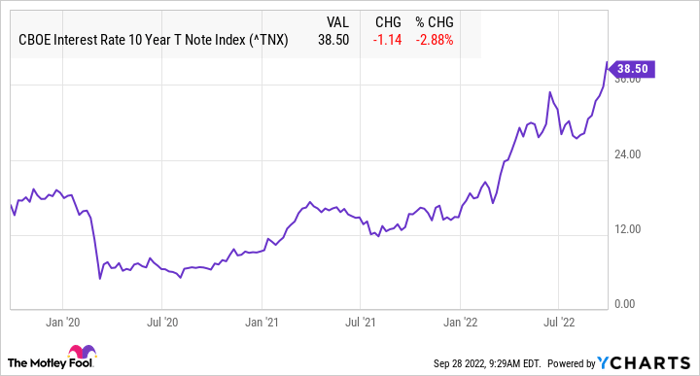
    ^TNX Chart

    ^TNX data by YCharts. NOTE WELL: Index values represent the yield in percentage points multiplied by 10.

    It was only once inflation reared up in early 2022 that bond investors started to lose their nerve, and the brief move above 4% represented yields that were 2.5 times where they started the year.

    Rising yields mean falling prices for bonds, and the damage has been severe. Even ordinary bond index ETFs have seen massive losses, with the popular iShares Core U.S. Aggregate Bond (NYSEMKT: AGG) and Vanguard Total Bond Market (NASDAQ: BND) both down 15% year to date. Bond funds with a bias toward longer-maturity bonds have seen even bigger declines, with iShares 20+ Year Treasury (NASDAQ: TLT) down nearly 30%. Even bonds that were supposed to protect against inflationary pressures have seen price declines, with iShares TIPS Bond (NYSEMKT: TIP) down 18% from where it started 2022.

    What consumers and investors should expect

    Already, the impact of higher Treasury yields is working its way through the broader economy. Mortgage rates tend to correlate with 10-year yields, so rates on 30-year mortgages have also hit new highs above 6.5% recently. That is making homes less affordable for would-be homebuyers, as monthly payments on new mortgages for a given amount of debt are far higher than they were earlier this year.

    Nor can stock investors entirely ignore the impact of yield increases. Many companies raised their debt levels when interest rates were lower, taking advantage of cheap financing to bolster their growth efforts. Those companies that can pay back that debt as it matures should be in good shape, but those that had hoped to refinance their debt to delay having to pay it back face the prospect of sharply higher interest payments in the future. Given that the companies most likely to want to refinance are also often the ones that are least able to afford higher financing costs, investors need to watch closely to ensure that the companies whose stocks they own aren’t facing potential problems.

    Higher rates do have a silver lining, though. For those with cash who want to lock in a certain return, buying individual Treasury bonds now will give them interest payments at a level they haven’t been able to get in years. Admittedly, 4% isn’t enough to make a wholesale shift out of stocks. But for those who have found that the stock market volatility of the past year has made them uncomfortable with their asset allocation strategy, higher yields make now a better opportunity to invest in bonds than investors have seen in a long time.

    This article was originally published on Fool.com. All figures quoted in US dollars unless otherwise stated.

    The post The 10-year treasury yield just topped 4%: what it means for you appeared first on The Motley Fool Australia.

    .

    More reading

    Dan Caplinger has no position in any of the stocks mentioned. The Motley Fool Australia’s parent company Motley Fool Holdings Inc. has positions in and has recommended Vanguard Total Bond Market ETF. The Motley Fool Australia has no position in any of the stocks mentioned. The Motley Fool has a disclosure policy. This article contains general investment advice only (under AFSL 400691). Authorised by Scott Phillips.

    This article was originally published on Fool.com. All figures quoted in US dollars unless otherwise stated.


    from The Motley Fool Australia https://ift.tt/bwRIfZ5

  • Why is the Woodside share price on the rise today?

    A woman sits on sofa pondering a question.A woman sits on sofa pondering a question.

    The Woodside Energy Group Ltd (ASX: WDS) share price is steaming ahead today.

    The energy producer’s shares are rising 3.67% and are currently trading for $31.84, having reached $32.35 soon after open. For perspective, the S&P/ASX 200 Index (ASX: XJO) is lifting 1.52% today.

    So why is the Woodside share price having such a good day?

    Woodside lifts as oil and gas prices rise

    Woodside shares are rising today, but they are not alone among oil and gas producers. The Santos Ltd (ASX: STO) share price is lifting 2.55% today, while Beach Energy Ltd (ASX: BPT) shares are climbing 1.74%.

    The benchmark S&P/ASX 200 Energy Index (ASX: XEJ) is rising 2.79% today.

    Oil prices rose overnight following an unexpected decline in US crude and fuel reserves and a slightly weaker US dollar. Brent crude futures jumped 3.5%, while WTI crude futures leapt 4.65% higher. One analyst quoted by Reuters suggested the oil price will continue to be volatile.

    CIBC Private Wealth US senior energy trader Rebecca Babin said:

    I do think we are bottoming, but it is going to continue to be exceptionally volatile, and continue to be keeping easy speculative money away from this market.

    Meanwhile, European natural gas also made gains overnight amid supply risk. ANZ analyst Madeline Dunk, in a research note, said the energy market was rattled after damage to the Nord Stream pipelines.

    “The threat of disruptions to pipeline gas puts more reliance on LNG imports,” she said.

    Woodside recently signed a flexible sale and purchase agreement with German energy supply Uniper amid the European energy crisis. Woodside will apply 12 cargoes of LNG per year to Europe from January 2023 for a term up to 2039.

    Woodside CEO Meg O’Neill said the deal would “provide a new source of LNG for consumers in Europe seeking alternatives to Russian gas”.

    Woodside share price snapshot

    The Woodside share price has soared 45% in the year to date, while it has risen 35% in the last year.

    In contrast, the ASX 200 has shed 12% in the year to date and 9% in the past year.

    Woodside has a market capitalisation of about $60.7 billion based on the current share price.

    The post Why is the Woodside share price on the rise today? appeared first on The Motley Fool Australia.

    .

    More reading

    Motley Fool contributor Monica O’Shea has no position in any of the stocks mentioned. The Motley Fool Australia’s parent company Motley Fool Holdings Inc. has no position in any of the stocks mentioned. The Motley Fool Australia has no position in any of the stocks mentioned. The Motley Fool has a disclosure policy. This article contains general investment advice only (under AFSL 400691). Authorised by Scott Phillips.

    from The Motley Fool Australia https://ift.tt/lt2QCTo

  • Own Medibank shares? You’re getting paid today

    A man smiles as he holds bank notes in front of a laptop.A man smiles as he holds bank notes in front of a laptop.

    The Medibank Private Ltd (ASX: MPL) share price is sitting pretty today as the S&P/ASX 200 Index (ASX: XJO) lights up green.

    At the time of writing, Medibank shares have climbed 0.29% to trade at $3.50 apiece.

    But there’s more good news for Medibank shareholders. Today is dividend payday.

    It’s payday for Medibank shareholders

    Last month, Medibank pulled back the curtain on its FY22 results. In doing so, the ASX 200 private health insurer declared a fully franked final dividend of 7.3 cents.

    Medibank shares went ex-dividend for this payment back on 7 September. So, any Medibank shares bought on or after this date won’t be able to claim today’s payout.

    Since the company doesn’t have a dividend reinvestment plan (DRP), shareholders will be receiving this dividend in cash.

    Medibank declared a final dividend of 6.9 cents in FY21. So, today’s payment represents a 6% uplift from the prior year.

    This dividend hike was supported by a 9% growth in underlying net profit after tax (NPAT), which came in at $435 million.

    Announcing the company’s full-year results, CEO David Koczkar said:

    Today we have delivered another strong result driven by continued policyholder growth, double-digit growth in Medibank Health and remaining disciplined in how we grow and run our business.

    Medibank highlighted its customer growth as a standout during the year. The number of resident policyholders grew by 3% or nearly 61,000 over the 12-month period. What’s more, the company’s customer retention over the past two years is higher than at any point in the prior decade.

    Across the financial year, Medibank declared total dividends of 13.4 cents, fully franked. Based on current prices, Medibank shares have a trailing dividend yield of 3.8%. Including franking credits, this yield dials up to 5.4%.

    Looking ahead, broker Citi is forecasting Medibank to raise its dividends by 19% in FY23 to 15.9 cents per share. At the moment, this implies a prospective forward dividend yield of 4.5%.

    Medibank share price snapshot

    Medibank is one of the rare ASX 200 shares to sit in the green this year.

    In fact, Medibank shares have gained an impressive 14% over the last six months. Meanwhile, the ASX 200 index has backpedalled by a similar amount.

    Fellow ASX 200 health insurer NIB Holdings Limited (ASX: NHF) has matched Medibank with similar share price gains this year.

    ASX insurance shares can outperform in periods where inflation and interest rates are on the rise.

    As explained by the team at Wilsons, insurers “benefit from higher premiums due to the rising inflation environment and higher interest income on policyholders’ funds.”

    It seems health insurance companies, in particular, have been the pick of the bunch so far in 2022.

    Other ASX 200 insurance shares, such as QBE Insurance Group Ltd (ASX: QBE) and Insurance Australia Group Ltd (ASX: IAG), have outperformed the market. But not by nearly as much as Medibank and NIB.

    Both IAG shares and QBE shares are relatively flat over the last six months.

    The post Own Medibank shares? You’re getting paid today appeared first on The Motley Fool Australia.

    .

    More reading

    Motley Fool contributor Cathryn Goh has no position in any of the stocks mentioned. The Motley Fool Australia’s parent company Motley Fool Holdings Inc. has no position in any of the stocks mentioned. The Motley Fool Australia has positions in and has recommended Insurance Australia Group Limited. The Motley Fool Australia has recommended NIB Holdings Limited. The Motley Fool has a disclosure policy. This article contains general investment advice only (under AFSL 400691). Authorised by Scott Phillips.

    from The Motley Fool Australia https://ift.tt/KyLOawg

  • 3 ASX lithium shares having a stellar run on Thursday

    three young children weariing business suits, helmets and old fashioned aviator goggles wear aeroplane wings on their backs and jump with one arm outstretched into the air in an arid, sandy landscape.three young children weariing business suits, helmets and old fashioned aviator goggles wear aeroplane wings on their backs and jump with one arm outstretched into the air in an arid, sandy landscape.

    ASX lithium shares have been among the top performers over the past year. This comes as the booming growth in global EV markets has seen demand for the battery-critical metal surge.

    While most lithium stocks are enjoying another good run today, these three are leading the pack.

    So, without further ado, here’s what investors are considering today.

    What’s piquing ASX investor interest?

    The first ASX lithium share shooting higher today is Anson Resources Ltd (ASX: ASN).

    The Anson Resources share price is up 12.28% in early afternoon trade.

    Shares are surging after the company reported the discovery of “multiple new lithium-rich zones” at its Paradox Lithium Project in the US state of Utah. The lithium intersections were hit in its recently completed resource definition drilling at the Cane Creek 32-1 well.

    The miner said that drilling is now complete at Cane Creek, with multiple assays pending that it expects will deliver a “significant further JORC Resource upgrade”.

    The second ASX lithium share rocketing higher today is Global Lithium Resources Ltd (ASX: GL1). The Global Lithium share price is up 6.98%.

    Investors are bidding up shares after the company reported it had signed a non-binding memorandum of understanding (MOU) with Korean battery manufacturer SK On Co., Ltd (SKO) “to explore a range of future business opportunities”.

    Commenting on the MOU, Global Lithium’s managing director Ron Mitchell said:

    The scope of this partnership has the potential to strengthen and diversify the future of Global Lithium’s projects in Western Australia both in the near term and in the years ahead… The lithium and EV markets have experienced significant growth over the past two years and this expansion is only set to accelerate as demand for lithium-ion batteries increases.

    This brings us to the third ASX lithium share leaping higher, De Grey Mining Limited (ASX: DEG). The De Grey Mining share price is up 6.36% today.

    With no fresh price-sensitive news out today, De Grey looks to be cashing in on the broader bullishness surrounding the lithium market.

    How have these ASX lithium shares been tracking?

    All three of these ASX lithium shares have beaten the 10% loss posted by the All Ordinaries Index (ASX: XAO) over the past 12 months.

    The De Grey share price has gained 12%, the Anson Resources share price is up 250%, and the Global Lithium share price has surged almost 500% since this time last year.

    The post 3 ASX lithium shares having a stellar run on Thursday appeared first on The Motley Fool Australia.

    .

    More reading

    Motley Fool contributor Bernd Struben has no position in any of the stocks mentioned. The Motley Fool Australia’s parent company Motley Fool Holdings Inc. has no position in any of the stocks mentioned. The Motley Fool Australia has no position in any of the stocks mentioned. The Motley Fool has a disclosure policy. This article contains general investment advice only (under AFSL 400691). Authorised by Scott Phillips.

    from The Motley Fool Australia https://ift.tt/uw2knFH

  • Could this prevent Santos shares from cashing in on gas demand?

    Oil miner holding a laptop and mobile phone looks at his phone and sees the falling oil price and falling Woodside share price

    Oil miner holding a laptop and mobile phone looks at his phone and sees the falling oil price and falling Woodside share price

    Santos Ltd (ASX: STO) shares have received some healthy tailwinds over the past year amid the sharpening global energy crisis.

    Energy supplies were already tight heading into 2022 as nations re-opened from their pandemic shutdowns, following years of underinvestment in exploration and development of new energy projects.

    Russia’s invasion of Ukraine exacerbated the budding crisis, underlined by this week’s likely sabotage of the Nord Stream gas pipeline.

    As European nations scrambled to secure alternative energy sources, Santos shares marched 11% higher since the closing bell on 31 December. That’s atop paying out 22.7 cents in partially franked dividends this calendar year.

    Santos shareholders were hoping the company’s $4.7 billion Barossa gas project would help Santos cash in on the strong global gas demand for years to come.

    But those plans are now in jeopardy.

    Legal setback post FID

    Santos, along with its Japanese and Korean joint venture partners, made its final investment decision (FID) for Barossa, located in the Timor Sea north of Darwin, in March 2021.

    And the project was greenlighted by the National Offshore Petroleum and Safety Environmental Management Authority (NOPSEMA).

    But a federal court threw cold water on that call yesterday, ruling in favour of Tiwi Islands’ traditional owners, who claim they had not been properly consulted before the project won approval.

    As ABC News reported, the Environment Defenders Office said the NOPSEMA approval was unlawful, adding that traditional owners are concerned about environmental impacts and potential damage to culturally significant sites.

    Santos halted work on the project when the court challenge was filed. That pause will now continue. Santos is appealing the decision.

    Commenting on the court’s ruling, Santos stated:

    As a result of the decision, the drilling activities will be suspended pending a favourable appeal outcome or the approval of a fresh Environment Plan. Given the significance of this decision to us, our international joint venture partners and customers, and the industry more broadly, we consider that it should be reviewed by the Full Federal Court on appeal.

    Investors don’t appear overly concerned with the legal setback at this stage, with Santos shares up 3.06% in Thursday morning trade.

    How have Santos shares been tracking longer-term?

    Though still down from their pre-pandemic levels, Santos shares have notched a 75% gain (exclusive of dividends) over the past five years. That far outpaces the 16% gains posted by the S&P/ASX 200 Index (ASX: XJO) over that same period.

    The post Could this prevent Santos shares from cashing in on gas demand? appeared first on The Motley Fool Australia.

    .

    More reading

    Motley Fool contributor Bernd Struben has no position in any of the stocks mentioned. The Motley Fool Australia’s parent company Motley Fool Holdings Inc. has no position in any of the stocks mentioned. The Motley Fool Australia has no position in any of the stocks mentioned. The Motley Fool has a disclosure policy. This article contains general investment advice only (under AFSL 400691). Authorised by Scott Phillips.

    from The Motley Fool Australia https://ift.tt/gte3aYT

  • Iress share price freefalls 15% on profit downgrade

    A man in a business suit plunges down a big square hole lit up in blue.A man in a business suit plunges down a big square hole lit up in blue.

    The Iress Ltd (ASX: IRE) share price is plummeting this morning after the company announced a profit downgrade.

    At the time of writing, the financial software company’s shares are down a mammoth 15.21% to $8.92, having earlier been as low as $8.43.

    This makes it by far the worst performer on the ASX, with Bell Financial Group Ltd (ASX: BFG) shares coming in second place at a 6.54% drop.

    Let’s take a look and see what Iress provided in today’s market release.

    Iress suffers setback amid ‘challenging macro conditions’

    Investors are heading for the hills, sending the Iress share price lower following the company’s dismal outlook.

    According to its release, Iress is experiencing some timing delays in the conversion of new sales opportunities due to challenging market conditions.

    While it didn’t say exactly what those factors were, Iress said the setback is “expected to impact FY 2022 guidance”.

    Furthermore, unfavourable currency exchange movements and US dollar pricing have led to higher than anticipated supplier costs.

    Consequently, Iress is projecting full-year segment profit for 2022 to be in the range of $166 million and $170 million on a constant currency basis.

    This compares to the company’s previous guidance in August, in which it forecasted segment profit to be at the bottom of the range of $177 million and $183 million.

    As a result, net profit after tax (NPAT) is estimated to be between $54 million and $58 million, down from $63 million to $72 million.

    Iress CEO Andrew Walsh commented on the company’s performance, saying:

    Profit expectations for the second-half of this year have been impacted primarily by delays in the timing of new client opportunities. In addition, some costs are higher than we previously expected, including US dollar priced technology and software. While external macro conditions are volatile, we are making good progress in executing on our long-term strategies to build a more profitable and efficient Iress.

    Iress share price summary

    Adding in today’s losses, the Iress share price has fallen 32% in 2022.

    When looking at the last 12 months, its shares are down 23%.

    Based on today’s price, Iress presides a market capitalisation of approximately $1.96 billion.

    The post Iress share price freefalls 15% on profit downgrade appeared first on The Motley Fool Australia.

    .

    More reading

    Motley Fool contributor Aaron Teboneras has no position in any of the stocks mentioned. The Motley Fool Australia’s parent company Motley Fool Holdings Inc. has no position in any of the stocks mentioned. The Motley Fool Australia has no position in any of the stocks mentioned. The Motley Fool has a disclosure policy. This article contains general investment advice only (under AFSL 400691). Authorised by Scott Phillips.

    from The Motley Fool Australia https://ift.tt/IOqRk5g

  • The Cogstate share price is rocketing again, up another 27% on Thursday

    A man sees some good news on his phone and gives a little cheer.

    A man sees some good news on his phone and gives a little cheer.

    The Cogstate Limited (ASX: CGS) share price has continued its ascent on Thursday.

    In morning trade, the neuroscience technology company’s shares are up a further 17% to $2.24.

    Though, it is worth noting that the Cogstate share price was up as much as 27% to $2.42 at one stage. The latter brought its two-day gain to an incredible 73%.

    Why is the Cogstate share price surging higher?

    As we covered here yesterday, investors were scrambling to buy the company’s shares yesterday despite there being no news out of it.

    However, as we pointed out, the gain was likely due to its partner and shareholder, Japan’s Eisai, revealing that its experimental drug for Alzheimer’s disease has helped slow cognitive decline in patients in the early stages of the illness.

    A phase 3 clinical trial of lecanemab revealed cognitive decline was slowed by 27% after 18 months based on 1,795 patients, who were randomly assigned to receive either the drug or a placebo every two weeks over the months.

    Cogstate’s response

    Yesterday afternoon, Cogstate responded to a request from the Australian stock exchange to explain the recent trading in its securities.

    While the company advised that it will not benefit directly from Eisai’s news because its partnership excludes clinical trials, it does see potential for it to benefit indirectly.

    The company explained:

    In respect of Cogstate’s business in Clinical Trials, when commenting on its FY23 outlook on 30 August 2022, the Company noted that the release of positive phase 3 clinical trial data from Eisai (and others) may be expected to lead to a general increase in research and development expenditure in respect of Alzheimer’s disease, which may provide additional sales opportunities for Cogstate in its Clinical Trials business and may also impact Cogstate’s Healthcare business.

    Cogstate has also consistently stated that the upside revenue opportunity for the Healthcare business, beyond the contracted minimum payments from Eisai, is expected to be dependent upon the release, reimbursement, and availability of proven Alzheimer’s therapeutics.

    In addition, the company sees these developments as a potential positive for its Cognigram offering. It said:

    Since executing the agreement in October 2020, Eisai (which is also a substantial holder in the Company) and Cogstate have progressed commercial plans for launching digital brain health assessment solutions using Cogstate technologies, including both a direct-to-consumer self-check as well as a medical device, Cognigram, to aid healthcare professionals in clinical diagnosis decisions. It may be expected that such digital cognitive assessments could play an important role in supporting the type of large-scale cognitive assessment that will be necessary in the launch of disease modifying therapies for Alzheimer’s disease.

    All in all, these are exciting times for Cogstate and its technology.

    The post The Cogstate share price is rocketing again, up another 27% on Thursday appeared first on The Motley Fool Australia.

    .

    More reading

    Motley Fool contributor James Mickleboro has no position in any of the stocks mentioned. The Motley Fool Australia’s parent company Motley Fool Holdings Inc. has positions in and has recommended CogState Limited. The Motley Fool Australia has positions in and has recommended CogState Limited. The Motley Fool has a disclosure policy. This article contains general investment advice only (under AFSL 400691). Authorised by Scott Phillips.

    from The Motley Fool Australia https://ift.tt/yCmbsMF

  • Own CBA shares? Dividends are coming your way today

    A woman looks excited as she fans out a wad of Aussie $100 notes.A woman looks excited as she fans out a wad of Aussie $100 notes.

    The day has finally come where Commonwealth Bank of Australia (ASX: CBA) shareholders will become a little richer.

    After the bank’s shares tumbled more than 5% in the past month, the company is paying out its latest dividend.

    At the time of writing, the CBA share price is 1.34% higher to $93.78.

    For context, the S&P/ASX 200 Index (ASX: XJO) is also rising by 1.7% following strong gains on Wall Street overnight.

    Let’s take a look below at the details regarding the company’s dividend.

    What are the details of the CBA dividend?

    During mid-August, CBA reported growth across key metrics in its full-year results of the 2022 financial year.

    In summary, revenue improved by 3% to $25,143 million over the prior corresponding period. The robust performance was underpinned by an increase in lending and deposits in both home and business portfolios.

    This led to the bank achieving an 11% boost in cash earnings to $9,595 million.

    Subsequently, the board elected to increase its final dividend by 5% to $2.10 per share. This brings the full-year dividend to $3.85 per share, up from the $3.50 declared in FY 2021.

    The dividend is fully franked which means those who receive it, will get some form of tax credits.

    Based on today’s price, CBA has a dividend yield of 4.11% which is slightly lower than the rest of the big four.

    CBA share price snapshot

    Over the past 12 months, the CBA share price has moved in circles to register a loss of around 10%.

    Its shares hit a 52-week low of $86.98 on 17 June before climbing on in the following months.

    CBA has a price-to-earnings (P/E) ratio of 17.24 and commands a market capitalisation of approximately $157.27 billion.

    The post Own CBA shares? Dividends are coming your way today appeared first on The Motley Fool Australia.

    .

    More reading

    Motley Fool contributor Aaron Teboneras has no position in any of the stocks mentioned. The Motley Fool Australia’s parent company Motley Fool Holdings Inc. has no position in any of the stocks mentioned. The Motley Fool Australia has no position in any of the stocks mentioned. The Motley Fool has a disclosure policy. This article contains general investment advice only (under AFSL 400691). Authorised by Scott Phillips.

    from The Motley Fool Australia https://ift.tt/R6xpuy9

  • This US growth stock could double, according to Wall Street

    This article was originally published on Fool.com. All figures quoted in US dollars unless otherwise stated.

    woman looking at her clothing package

    This article was originally published on Fool.com. All figures quoted in US dollars unless otherwise stated.

    It’s been a painful year for Shopify Inc. (NYSE: SHOP) and its shareholders. The company’s coronavirus tailwind came to a screeching halt, leading to financial results that haven’t been up to par. The e-commerce specialist’s 10-for-1 stock split did little to improve its stock market performance; as things stand, Shopify is currently hovering near its 52-week low.

    However, Wall Street has faith in the tech giant, and analysts’ average price target of $79.45 is close to triple its $27.85 share price as of this writing. Is the Street right about Shopify?

    What’s wrong with Shopify?

    Shopify has been the victim of various market-wide headwinds. Among these are interest rate increases that can impact the value of corporations. In an environment with higher interest rates, borrowing — one of the main ways companies raise money — becomes more expensive, and businesses tend to do less of it, leading to reduced investments and lower future earnings. 

    Knowing this, investors are less likely to invest in stocks, especially those speculative growth stocks with high valuation metrics that aren’t consistently profitable. That description fits Shopify to a T. Its net loss in the second quarter came in at $1.20 billion, compared to the net income of $0.88 billion reported during the year-ago period.

    The company’s current forward price-to-earnings (P/E) ratio is 220.5. Even given the premium growth stocks often enjoy, that seems too high. The S&P 500‘s forward P/E is just under 17. In that context, Shopify’s performance on the market over the past year isn’t too surprising, especially when you factor in company-specific issues. Notably, Shopify’s revenue growth rates have slowed as well.

    SHOP Revenue (Quarterly YoY Growth) Chart

    Data by YCharts.

    Perhaps that isn’t a “problem” — at least not in a vacuum. Shopify benefited from the accelerated switch to e-commerce in the early days of the pandemic, and year-over-year comparisons were always going to be difficult as those tailwinds subsided. Still, when added to the overall challenging macroeconomic environment, that’s not what investors want to see. 

    Moreover, Shopify will likely continue to struggle, at least for a little while. There will probably be more interest rate increases in the near future. Shopify’s stock performed exceptionally well between its initial public offering in May 2015 and the end of last year — an environment marked by historically low interest rates. Moving forward, it will be harder for the tech giant. 

    Are there any reasons to be optimistic?

    Solid long-term prospects

    There is more context to Shopify’s relatively disappointing second-quarter financial results. As already mentioned, the slower top-line growth was partly a product of the company’s abnormally strong performance in 2020 and 2021, when people were stuck at home and practically forced to shop online. This activity decreased somewhat once pandemic restrictions eased.

    There is also more color to Shopify’s red ink on the bottom line. For instance, in the second quarter, much of the tech company’s net loss was due to unrealized losses in various equity investments. That includes Shopify’s holdings in Affirm Holdings, Inc.(NASDAQ: AFRM) and Global-e Online Ltd. (NASDAQ: GLBE). That’s not ideal, but at the very least, it reflects less poorly on Shopify’s day-to-day operations.

    The company’s adjusted net loss during the second quarter — which ignores the impact of unrealized losses and other items — came in at $38.5 million, down from an adjusted net profit of $284.6 million in the year-ago period.

    Importantly, Shopify’s long-term prospects remain strong. There is still plenty of room for e-commerce to grow; as long as it does, merchants will look to open online storefronts. Some analysts see the industry expanding at a compound annual growth rate of 14.7% through 2027. It won’t stop there. E-commerce penetration in many developing countries lags what it is in the U.S.

    In my view, online shopping will continue growing for decades. Shopify’s strength is that it gives merchants all the essential tools they need to run an online store. As a result, the company benefits from high switching costs. Building and customizing an online storefront is hard enough, and attracting loyal customers to it is even more challenging.

    But having to restart the entire process from scratch is not something anyone wants to do unless necessary. That’s why Shopify’s merchants won’t want to jump ship. As of last year, Shopify was No. 2 among companies with the highest retail e-commerce market share in the U.S. That, coupled with an estimated $160 billion addressable market and its solid competitive advantages, strongly suggests Shopify can turn things around.

    Don’t lose perspective 

    Will Shopify meet Wall Street’s expectations within the next 12 months? Probably not. But more importantly, the company still has solid prospects, especially when you put its recent struggles in context. For those focused on the long game, Shopify is worth holding onto. The company will likely deliver solid returns in the next decade and beyond.

    This article was originally published on Fool.com. All figures quoted in US dollars unless otherwise stated.

    The post This US growth stock could double, according to Wall Street appeared first on The Motley Fool Australia.

    .

    More reading

    Prosper Junior Bakiny has positions in Shopify. The Motley Fool Australia’s parent company Motley Fool Holdings Inc. has positions in and has recommended Affirm Holdings, Inc., Global-e Online Ltd., and Shopify. The Motley Fool Australia’s parent company Motley Fool Holdings Inc. has recommended the following options: long January 2023 $1,140 calls on Shopify and short January 2023 $1,160 calls on Shopify. The Motley Fool Australia has no position in any of the stocks mentioned. The Motley Fool has a disclosure policy. This article contains general investment advice only (under AFSL 400691). Authorised by Scott Phillips.

    This article was originally published on Fool.com. All figures quoted in US dollars unless otherwise stated.


    from The Motley Fool Australia https://ift.tt/uX0Pg5e
  • ASX cannabis share Cronos has soared 80% in a month. What’s going on?

    Back view of a man lifting hish hands high in front of hemp plants grown for cannabis.

    Back view of a man lifting hish hands high in front of hemp plants grown for cannabis.

    It has been a stunning few weeks for the Cronos Australia Ltd (ASX: CAU) share price.

    Since this time last month, the medicinal cannabis company’s shares have risen over 80%.

    This led to the Cronos Australia share price reaching a record high of 75 cents earlier today.

    Why is the Cronos Australia share price on fire this month?

    While the company released a positive update last week which boosted its shares, the majority of the gains were made earlier in the month.

    The catalyst for that appears to have been a bullish broker note out of Bell Potter.

    According to the note from 5 September, the broker initiated coverage on the company’s shares with a buy rating and 60 cents price target.

    At the time, the Cronos Australia share price was fetching 46 cents, so this implied potential upside of 30% for investors.

    Why is Bell Potter bullish?

    Bell Potter explained that its bullish view was based largely on the company’s leadership position in medicinal cannabis distribution. It commented:

    Cronos Australia is a medicinal cannabis company that is the market leader in distribution to pharmacies and provides patient consulting services through its clinic business. The key driver for the impressive growth in the past 24 months has been the CanView platform which provides the widest range of medicinal cannabis products compared to competitors (Anspec, Health House).

    In addition, Bell Potter points out that Cronos Australia is profitable and even pays a dividend. That makes it the only one of its kind in the Australian cannabis industry. It explained:

    We initiate coverage on Cronos with a Buy recommendation. We expect the momentum observed in FY22 to continue into FY23 and translate into strong revenue and earnings growth. Cronos is currently the only profitable dividend paying medicinal cannabis company on the ASX and the valuation does not appear demanding relative to the expected growth.

    Though, with the Cronos Australia share price now trading higher than Bell Potter’s valuation, it’s worth considering that it could have peaked for the time being.

    The post ASX cannabis share Cronos has soared 80% in a month. What’s going on? appeared first on The Motley Fool Australia.

    .

    More reading

    Motley Fool contributor James Mickleboro has no position in any of the stocks mentioned. The Motley Fool Australia’s parent company Motley Fool Holdings Inc. has no position in any of the stocks mentioned. The Motley Fool Australia has no position in any of the stocks mentioned. The Motley Fool has a disclosure policy. This article contains general investment advice only (under AFSL 400691). Authorised by Scott Phillips.

    from The Motley Fool Australia https://ift.tt/EWZnBgD