Tag: Motley Fool

  • The A2 Milk share price has smashed the ASX 200 over the past month. What’s going on?

    a cute young girl with curly hair sips a glass of milk through a straw with a smile on her face.

    a cute young girl with curly hair sips a glass of milk through a straw with a smile on her face.

    The A2 Milk Company Ltd (ASX: A2M) share price is down 0.93% so far today.

    A2 Milk shares closed yesterday trading for $5.35 and are currently trading for $5.30 apiece.

    That’s today’s price action.

    Now, why has the A2 Milk share price smashed the S&P/ASX 200 Index (ASX: XJO) over this past month’s trading?

    Why is the A2 Milk share price outperforming over the month?

    On 26 August, the fresh milk and infant formula company closed the session at $4.91 per share. That puts the A2 Milk share price up 8% over the past 22 trading days. A feat that’s particularly noteworthy given ASX 200 has lost 8% over that same period,

    So, what’s been stoking ASX investor interest?

    As you’re likely aware, the A2 Milk share price hasn’t exactly been a stellar performer over the past two years.

    The company managed to shrug off the worst of the pandemic-fuelled sell-off in February and March 2020. But it came under heavy pressure commencing in August 2020, in part because border lockdowns brought a virtual end to its lucrative Daigou buying segment. Shares are down more than 72% since then.

    But the company’s FY22 results, released on 29 August, look to have buoyed analyst and investor sentiment alike.

    Among the highlights, the company reported a 19.8% increase in revenue to NZ$1.45 billion, some 5% above consensus expectations.

    Net profit after tax (NPAT) also leapt 42.3% to NZ$114.7 million.

    Meanwhile, management reported plans for a NZ$150 million on-market share buyback.

    And if that wasn’t enough to boost interest in A2 Milk, the company offered some positive guidance for FY23, forecasting high single-digit revenue growth.

    What are the experts saying?

    Some positive analyst coverage since reporting its FY22 results has also likely helped lift the A2 Milk share price.

    Perpetual Equity Investment Company (ASX: PIC) was particularly impressed by the 40% revenue growth of the company’s China Label infant formula business.

    Perpetual noted that A2 Milk “is one of the only international brands to deliver growth during this period”, adding that the strong sales lift from “in-country marketing demonstrates the strength of the brand”. Perpetual also lauded the company for “shifting volumes away from the volatile Daigou distribution channel”.

    Wilson Asset Management’s senior equity analyst Shaun Weick is also bullish, noting A2 Milk’s single-digit revenue growth guidance “looks very achievable”.

    Weick also pointed to the company’s strong financial position alongside the share buyback as positives:

    They’ve got a billion dollars in net cash on the balance sheet. They’ve initiated a $150 million buyback… So that’s sort of the next catalyst we’re looking for there.

    A2 Milk share price snapshot

    With the past month’s strong run behind it, the A2 Milk share price is down 5.0% in 2022. That compares to a calendar year loss of 14.3% posted by the ASX 200.

    The post The A2 Milk share price has smashed the ASX 200 over the past month. What’s going on? appeared first on The Motley Fool Australia.

    More reading

    Motley Fool contributor Bernd Struben has no position in any of the stocks mentioned. The Motley Fool Australia’s parent company Motley Fool Holdings Inc. has no position in any of the stocks mentioned. The Motley Fool Australia has recommended A2 Milk. The Motley Fool has a disclosure policy. This article contains general investment advice only (under AFSL 400691). Authorised by Scott Phillips.

    from The Motley Fool Australia https://ift.tt/SQx82q4

  • Up 165% so far in 2022, is the party just kicking off for New Hope shares?

    An elderly retiree holds her wine glass up while dancing at a party feeling happy about her ASX shares investments especially Brickworks for its dividendsAn elderly retiree holds her wine glass up while dancing at a party feeling happy about her ASX shares investments especially Brickworks for its dividends

    The New Hope Corporation Limited (ASX: NHC) share price is up 6.63% to $6.11 this morning as energy stocks soar.

    The S&P/ASX 200 Energy Index (ASX: XEJ) is leading the 11 sectors of the ASX today, up 2.6% at the time of writing.

    New Hope shares have shot the lights out this year. In the year to date, they’re up a staggering 165%.

    And top broker Macquarie thinks there’s more green to come.

    According to reporting in The Australian, Macquarie has upgraded its outlook for the value of thermal coal. In turn, it has raised its 12-month share price targets on four energy stocks, including New Hope.

    What’s next for the New Hope share price?

    Thermal coal is used to create electricity. Macquarie says developed economies are exhibiting a “willingness to pay a premium to secure energy supply” given current global constraints.

    The supply/demand imbalance is largely due to the war in Ukraine.

    Macquarie has raised its outlook for the thermal coal price by 38% to 114% over CY23 to CY27.

    The broker reckons the thermal coal price will lift by 25% to $US410 per tonne in the second half of CY22.

    The forecast for 2023 is a bit lower at $US367.50 per tonne but still sky-high by historical measures.

    The price of coal reached US$437.65 overnight. It hit a record of US$460 earlier this month, according to Trading Economics data. The value of the commodity has more than doubled over the past 12 months.

    Let’s get this party started

    As a result, Macquarie has increased its forecast earnings per share (EPS) for New Hope. Its expectations are up 34% for FY23 and 163% for FY24. But wait for the FY25 prediction — up by more than 400%.

    So yeah, the party is pretty much just kicking off for New Hope shares.

    Macquarie predicts the New Hope share price will gain 17% to reach $7 by this time next year.

    The post Up 165% so far in 2022, is the party just kicking off for New Hope shares? appeared first on The Motley Fool Australia.

    More reading

    Motley Fool contributor Bronwyn Allen has positions in Macquarie Group Limited. The Motley Fool Australia’s parent company Motley Fool Holdings Inc. has no position in any of the stocks mentioned. The Motley Fool Australia has recommended Macquarie Group Limited. The Motley Fool has a disclosure policy. This article contains general investment advice only (under AFSL 400691). Authorised by Scott Phillips.

    from The Motley Fool Australia https://ift.tt/Im3xQfK

  • When might the CSL share price top $300 again?

    a nurse wearing a medical mask prepares a patient for a blood donation in a surgical setting.a nurse wearing a medical mask prepares a patient for a blood donation in a surgical setting.

    Threats of a global recession and heightened market volatility may not be enough to stop the CSL Limited (ASX: CSL) share price from topping $300 again.

    Shares in the biotech tried repeatedly and failed to break above this elusive target since July.

    But several experts believe this will happen within the next 12 months, if not sooner. This is despite the S&P/ASX 200 Index (ASX: XJO) and global markets being roiled by aggressive rate hikes, geopolitical tensions and a sputtering economy.

    Can the CSL share price break its record high?

    Citigroup is one that’s tipping the CSL share price to not only race above $300, but to break its record high of $336.40 that was hit in February 2020.

    The broker is recommending investors buy CSL and has a 12-month price target of $340 a share. This reflects around a 20% upside to CSL’s closing price yesterday.

    Citi isn’t the only one that’s bullish on the company. The analysts at Macquarie Group Ltd (ASX: MQG) have set a target of $329.50 on the CSL share price.

    Upside from potential new drug

    Macquarie reiterated its outperform call on the shares following the successful Phase 3 trial of garadacimab. This is a factor XIIa-inhibiting monoclonal antibody for the prevention of hereditary angioedema (HAE).

    Macquarie believes the drug can take market shares (if approved). This is because of its higher efficacy and favourable dosing when compared to current treatments.

    The broker said in its note, which was released two weeks ago:

    We also assume pricing in line with Haegarda on an annual cost per patient basis, but with a slightly higher gross margin.

    In aggregate, these assumptions imply increased HAE product revenue for CSL to FY27 (ahead of our current assumptions i.e. Haegarda and Berinert only), with solid gross profit and earnings upside (incremental EPS of ~9% by FY27).

    Product portfolio and favourable court ruling

    Another broker that’s upbeat on CSL’s growth outlook is Morgans. The broker noted that CSL’s world-leading businesses are well placed for growth due to its superior drug portfolios, significant investment in research and development, and strong demand.

    Morgans’ 12-month price target on the CSL share price is $321.30 a share.

    Meanwhile, a court ruling in the US is adding an extra tailwind for the company. A US District Court issued a preliminary injunction stopping US border officials from preventing Mexicans from entering the US on USB1/B2non-immigrant visas to receive cash for blood donations.

    What is the CSL share price worth?

    Morgan Stanley noted this is a clear positive for CSL. The company has 304 centres in the US with around 16 near the US-Mexican border.

    Morgan Stanley has an overweight rating on the CSL share price with a 12-month price target of $323 a share.

    The post When might the CSL share price top $300 again? appeared first on The Motley Fool Australia.

    More reading

    Motley Fool contributor Brendon Lau has positions in CSL Ltd. and Macquarie Group Limited. The Motley Fool Australia’s parent company Motley Fool Holdings Inc. has positions in and has recommended CSL Ltd. The Motley Fool Australia has recommended Macquarie Group Limited. The Motley Fool has a disclosure policy. This article contains general investment advice only (under AFSL 400691). Authorised by Scott Phillips.

    from The Motley Fool Australia https://ift.tt/Wo7BZPM

  • How has the BetaShares Global Cybersecurity ETF performed since the Optus hack?

    A girl studies remotely at home on a tablet while cybersecurity icons float in the air around her.A girl studies remotely at home on a tablet while cybersecurity icons float in the air around her.

    The BetaShares Global Cybersecurity ETF (ASX: HACK) is in focus for Aussies after the Optus hack.

    Whether it was a hack or a cybersecurity malfunction, Optus’ security breach has put the concept of cybersecurity in front of Australians.

    There are plenty of reasons to want businesses and organisations to have top-notch security systems set up. A key reason is the fact that they have so many of our details, such as the typical ones like name, date of birth, address, phone number and email address. It could cause problems if those details were to get into the wrong hands.

    How has the BetaShares Global Cybersecurity ETF performed?

    Optus told customers about the attack on Thursday 22 September. That was on the public holiday to honour the Queen.

    So, since market close on Wednesday 21 September, the ETF has fallen by around 2%.

    But, there are a few different things to keep in mind with this decline.

    First, it comes at a time when the global share market is seeing significant volatility.

    Over the same period – since Wednesday last week – the Vanguard MSCI Index International Shares ETF (ASX: VGS) has fallen by an almost-identical amount of around 2% as well.

    The global share market is contending with a number of issues including high inflation and higher interest rates, and a sell-off of the British pound within the last week.

    Changes in how investors value businesses in this economic environment have hurt the share prices of many businesses. The Betashares Global Cybersecurity ETF has fallen in value by nearly 24% since the start of 2022.

    It’d be understandable for investors to think that demand for cybersecurity services will increase in light of a major cybersecurity issue. But, keep in mind that many of the cybersecurity businesses inside this ETF earn their profit from across the world. What happens to an Australian telco isn’t likely to spur huge demand globally, in my opinion.

    What shares are in the portfolio?

    Each business within this portfolio offers different services.

    Investors may have heard of some of the 37 holdings including Broadcom, Cisco Systems, Infosys, Crowdstrike, Palo Alto Networks, Cyberark, Zscaler, Fortinet, Booz Allen Hamilton, Science Applications, F5 Networks, SentinelOne and Verisign.

    Whilst it can be hard to identify which specific business will be the winner for a long-term trend, like the growth of cybersecurity, buying a basket of them allows us to capture the overall growth of the sector.

    As outlined by fund provider BetaShares, according to Statista, the global cybersecurity market is expected to grow from $137.6 billion in 2017 to $248.3 billion in 2023.

    Why could this ETF work in some investor portfolios? BetaShares says:

    Australian investors currently have few local options for gaining exposure to the fast-growing cybersecurity sector.

    There are very few pure-play cybersecurity firms listed on the Australian share market, and the overall technology sector accounts for less than 2% of Australian equity market capitalisation.

    The post How has the BetaShares Global Cybersecurity ETF performed since the Optus hack? appeared first on The Motley Fool Australia.

    More reading

    Motley Fool contributor Tristan Harrison has no position in any of the stocks mentioned. The Motley Fool Australia’s parent company Motley Fool Holdings Inc. has positions in and has recommended BETA CYBER ETF UNITS, Cisco Systems, CrowdStrike Holdings, Inc., Fortinet, Palo Alto Networks, Vanguard MSCI Index International Shares ETF, VeriSign, and Zscaler. The Motley Fool Australia’s parent company Motley Fool Holdings Inc. has recommended Broadcom Ltd. The Motley Fool Australia has positions in and has recommended BETA CYBER ETF UNITS. The Motley Fool Australia has recommended CrowdStrike Holdings, Inc. and Vanguard MSCI Index International Shares ETF. The Motley Fool has a disclosure policy. This article contains general investment advice only (under AFSL 400691). Authorised by Scott Phillips.

    from The Motley Fool Australia https://ift.tt/5jg0ixh

  • 3 stocks I’m buying during the NASDAQ bear market

    This article was originally published on Fool.com. All figures quoted in US dollars unless otherwise stated.

    A large brown grizzly bear follows a male hiker who walks along a path littered with leaves in the woodest forest.

    This article was originally published on Fool.com. All figures quoted in US dollars unless otherwise stated.

    It’s been a rough year for the NASDAQ Composite Index (NASDAQINDEX: ^IXIC), plunging nearly 30% this year. While part of this sell-off was certainly warranted (as 2021’s valuations couldn’t be sustained), some stocks have sold off too much.

    Here are three stocks I’m looking at buying as their long-term opportunities are still intact while their share prices are well off their highs: Alphabet Inc. (NASDAQ: GOOG), MercadoLibre, Inc. (NASDAQ: MELI), and CrowdStrike Holdings, Inc. (NASDAQ: CRWD). Stick around to find out why.

    Alphabet

    Alphabet (formerly known as Google) is a huge conglomerate of businesses, but its primary focus is advertising. In good times, this business shines. Unfortunately, in bad times, advertising can be a rough business to be in.

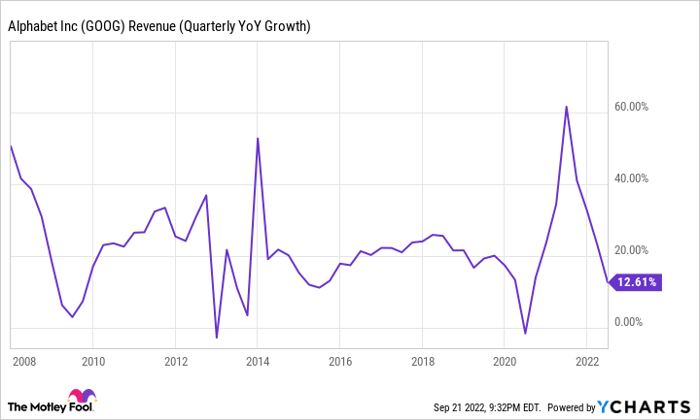
    When companies are forced to cut costs to maintain profits, advertising budgets are often the first thing to go. It’s an easy cut compared to laying off workers or canceling projects, so many companies do it pre-emptively if they see signs of a slowing economy. This line of thinking harmed Alphabet in the second quarter, but it still managed to grow revenue by 13% year over year.

    That resiliency shows how vital it is for businesses to advertise on Alphabet’s family of businesses (like the Google search engine, Android operating system, or YouTube).

    Despite rising expenses (which caused Alphabet’s profitability to drop), Alphabet trades at a historically low 18.6 times earnings. That’s dirt cheap for a company whose revenue has always recovered after economic downturns.

    GOOG Revenue (Quarterly YoY Growth) Chart

    GOOG Revenue (Quarterly YoY Growth) data by YCharts.

    I’m confident that this slowdown will be like the rest, and Alphabet’s revenue growth will recover to higher levels, bringing its strong cash flows higher with it.

    MercadoLibre

    Another internet powerhouse, MercadoLibre, is based in Latin America. Serving 18 countries — home to about 650 million people — MercadoLibre brings many facets of e-commerce that Americans take for granted to Latin America.

    With fintech and commerce platforms, consumers can shop on Mercado Libre (the commerce site) and pay with Mercado Pago (its payment platform) while using the credit card they got through Mercado Credito (its credit division). Then, the package may arrive on the customer’s doorstep in less than 48 hours after being delivered by Mercado Envios (its logistics division). Nearly 80% of packages it handled were delivered in under 48 hours in Q2.  

    MercadoLibre is the e-commerce site in Latin America, and for good reason. Backing up its market dominance are its results, which were fantastic in Q2.

    Revenue rose 57% year over year to $2.6 billion, driven by strength in fintech, which grew revenue 107% to $1.2 billion. Commerce is facing tougher comparisons (thanks to a COVID-affected 2021 Q2) but still grew revenue by 23% year over year while its gross merchandise volume rose 26%. While not massively profitable, MercadoLibre still posted a 4.7% profit margin in Q2.

    With those results, you might expect the stock to be up significantly this year or to at least break even. However, the shares are down 34%, and the valuation sits at five times sales. The last time MercadoLibre was this cheap was at the depth of the Great Recession in 2009.

    MercadoLibre has traded around 12 times sales for nearly all of the past decade, so this stock is incredibly cheap. As a result, I believe MercadoLibre is one of the strongest no-brainer buys in the market today.

    CrowdStrike

    While the first two stocks are cheaply valued, CrowdStrike is not. Instead, it trades for a hefty 21 times sales.  Still, I think it’s an excellent buy today because of its market opportunity and sustained, strong execution.

    CrowdStrike is a cybersecurity company, and with the cost of cyberattacks expected to grow 15% annually through 2025, it’s an area that businesses can’t afford to cut corners on now. With its cloud-based platform, CrowdStrike’s software can quickly deploy to network endpoints (like phones or laptops). Its software uses artificial intelligence and machine learning to evolve the program continuously, so when one customer experiences an attack, the entire customer base’s defense is strengthened through that information.

    While many companies have slowed their enterprise software spending, CrowdStrike managed to grow its customer base by 51% in Q2 (ended July 31) to 19,686. Among these customers are 69 of the Fortune 100 and 537 of the Global 2000, showing that CrowdStrike still has many customers to capture, especially smaller businesses worldwide.

    Annually recurring revenue (ARR) also rapidly increased in Q2, rising 59% year over year to $2.14 billion. Still, this is a drop in the bucket compared to CrowdStrike’s projected $126 billion market opportunity in 2025.

    While CrowdStrike may be an expensive stock, its massive market opportunity and strong growth are the culprits of this valuation. Unfortunately, the best companies don’t often come cheap, so investors sometimes pay a premium to own a specific business. However, if CrowdStrike’s growth continues on its strong trajectory (management projects ARR will be $5 billion by January 2026), the price that investors are paying today will seem much cheaper.

    The NASDAQ has multiple great investment opportunities available now; investors just need the confidence to step in and buy stocks when everything seems to be looking grim.

    This article was originally published on Fool.com. All figures quoted in US dollars unless otherwise stated.

    The post 3 stocks I’m buying during the NASDAQ bear market appeared first on The Motley Fool Australia.

    More reading

    Suzanne Frey, an executive at Alphabet, is a member of The Motley Fool’s board of directors. Keithen Drury has positions in Alphabet (C shares), CrowdStrike Holdings, Inc., and MercadoLibre. The Motley Fool Australia’s parent company Motley Fool Holdings Inc. has positions in and has recommended Alphabet (A shares), Alphabet (C shares), CrowdStrike Holdings, Inc., and MercadoLibre. The Motley Fool Australia has recommended Alphabet (A shares), Alphabet (C shares), and CrowdStrike Holdings, Inc. The Motley Fool has a disclosure policy. This article contains general investment advice only (under AFSL 400691). Authorised by Scott Phillips.

    This article was originally published on Fool.com. All figures quoted in US dollars unless otherwise stated.


    from The Motley Fool Australia https://ift.tt/k3bZxr8
  • Why is the CogState share price rocketing 61% higher today?

    A man wearing a white coat holds his hands up and mouth open with joy.

    A man wearing a white coat holds his hands up and mouth open with joy.

    The CogState Limited (ASX: CGS) share price is having a sensational day.

    In morning trade, the neuroscience technology company’s shares were up as much as 61% to $2.26 before being halted.

    Why is the CogState share price rocketing higher?

    Investors have been bidding the CogState share price higher today despite there being no news out of the company.

    However, it is worth noting that its partner, Japan’s Eisai, has released some very big news today.

    According to NBC, the Japanese drugmaker’s experimental drug for Alzheimer’s disease has helped slow cognitive decline in patients in the early stages of the illness.

    The company said that in a phase 3 clinical trial of lecanemab, cognitive decline was slowed by 27% after 18 months. These results were based on 1,795 patients, who were randomly assigned to receive either the drug or a placebo every two weeks over the months.

    Though, it is worth noting that these results have not yet been peer-reviewed.

    What does this have to do with CogState?

    This could be very good news for CogState.

    In August 2019, Cogstate entered into an exclusive licensing agreement with Eisai. This agreement saw Eisai market Cogstate technologies as digital cognitive assessment tools in the Japanese market.

    In October 2020, the two parties then extended the agreement to the rest of the world in a US$45 million deal.

    Trading halt

    Investors won’t have to wait long for an explanation for the rampant rise today. It appears as though the high flying CogState share price has caught the attention of the Australian stock exchange.

    As a result, the company’s shares have been paused pending the release of a further announcement.

    The post Why is the CogState share price rocketing 61% higher today? appeared first on The Motley Fool Australia.

    More reading

    Motley Fool contributor James Mickleboro has no position in any of the stocks mentioned. The Motley Fool Australia’s parent company Motley Fool Holdings Inc. has positions in and has recommended CogState Limited. The Motley Fool Australia has positions in and has recommended CogState Limited. The Motley Fool has a disclosure policy. This article contains general investment advice only (under AFSL 400691). Authorised by Scott Phillips.

    from The Motley Fool Australia https://ift.tt/JKAhOvt

  • The Coles dividend is hitting bank accounts today. Here’s what you need to know

    A young woman wearing an Islamic tradition headscarf and jeans sits in an urban environment with an apple in one hand and her phone in the other with a smile on her face.A young woman wearing an Islamic tradition headscarf and jeans sits in an urban environment with an apple in one hand and her phone in the other with a smile on her face.

    The time has come for Coles Group Ltd (ASX: COL) shareholders to check their bank accounts today.

    The supermarket giant is paying out its latest dividend to those who scooped up its shares before 2 September.

    Coles is rewarding eligible shareholders with a fully franked dividend of 30 cents per share.

    At the time of writing, the Coles share price is $16.51, down 1.02%. For context, the S&P/ASX 200 Index (ASX: XJO) is up 0.2% to 6,509 points.

    Let’s take a look at all the details regarding the company’s dividend.

    Coles pays out its latest dividend

    Coles reported a relatively resilient performance in its full-year results despite being impacted by inflationary pressures.

    In summary, sales revenue lifted by 2% to $39.4 billion over the prior corresponding period. This was driven by the strong sales growth of its Supermarkets segment (+12%), Liquor (+18%), and Express (+8.1%).

    Management noted that “domestic product availability is steadily improving whilst the international supply chain remains more volatile due to the ongoing shipping disruptions and the conflict in Ukraine”.

    On the bottom line, Coles achieved a net profit after tax (NPAT) of around $1.05 billion, up 4.3%.

    Subsequently, the board elected to increase its final dividend by 7.1% from the 28 cents per share in FY 2021.

    Based on today’s price, Coles has a current dividend yield of 3.83%.

    Coles share price snapshot

    The Coles share price is down 8% in 2022, but flat when factoring in the last 12 months.

    Its shares hit a 52-week high of $19.65 last month before plummeting 15% on the back of its 2022 financial results.

    Coles has a price-to-earnings (P/E) ratio of 21.19 and commands a market capitalisation of roughly $22.31 billion.

    The post The Coles dividend is hitting bank accounts today. Here’s what you need to know appeared first on The Motley Fool Australia.

    More reading

    Motley Fool contributor Aaron Teboneras has no position in any of the stocks mentioned. The Motley Fool Australia’s parent company Motley Fool Holdings Inc. has no position in any of the stocks mentioned. The Motley Fool Australia has positions in and has recommended COLESGROUP DEF SET. The Motley Fool has a disclosure policy. This article contains general investment advice only (under AFSL 400691). Authorised by Scott Phillips.

    from The Motley Fool Australia https://ift.tt/zak2uGV

  • Why is AMP doing a share buyback but not paying dividends?

    Four investors stand in a line holding cash fanned in their hands with thoughtful looks on their faces.Four investors stand in a line holding cash fanned in their hands with thoughtful looks on their faces.

    AMP Ltd (ASX: AMP) might present a curious case for investors. On the one hand, it has committed to return capital to shareholders through share buybacks, but it did not declare a dividend in 1H FY22.

    So why did the financial services company decide on this course of action?

    One explanation is that AMP had other priorities. A focus for the first half of FY22 was to pay down debt on its balance sheet. It allocated $400 million for this purpose from the $1.5 billion total surplus capital for the reported period.

    However, some analysts have forecast changes to AMP’s capital position. Bloomberg analysts Matt Ingram and Jack Baxter believe AMP will successfully sell off some of its assets and then reroute the funds back to investors in the form of dividends later this year.

    An AMP dividend still might be a possibility for FY22

    The Bloomberg analysts believe AMP will not only resume paying dividends, but its dividend yield will be considerably higher than previous forecasts.

    The pair said:

    AMP may achieve 15% dividend yield this year vs. consensus’ 3%, despite stating it’s not in a position to resume regular payouts to ‘hold a strong capital position’. This curbs our expected A$1 billion 2022 payout and more than 20% yield. Yet yield will get a boost on its plan to return a majority of proceeds from the sale of Collimate Capital businesses, which we think could top A$500 million.

    While this prediction did not come to fruition in 1H FY22, we have the rest of the year to go, so its final results may surprise investors.

    In the meantime, AMP will continue to buy back its shares from the market until June 2023. Last month, the company announced it will buy $350 million worth of its shares as part of a $1.1 billion capital return package.

    AMP share price snapshot

    The AMP share price is up more than 10% year to date. Meanwhile, the S&P/ASX 200 Index (ASX: XJO) is down around 13% over the same period.

    Shares in the company are currently trading for $1.1025 apiece, down 1.12%, while the benchmark index is up 0.2% in early morning trading.

    AMP has a market capitalisation of around $3.61 billion.

    The post Why is AMP doing a share buyback but not paying dividends? appeared first on The Motley Fool Australia.

    More reading

    Motley Fool contributor Matthew Farley has no position in any of the stocks mentioned. The Motley Fool Australia’s parent company Motley Fool Holdings Inc. has no position in any of the stocks mentioned. The Motley Fool Australia has no position in any of the stocks mentioned. The Motley Fool has a disclosure policy. This article contains general investment advice only (under AFSL 400691). Authorised by Scott Phillips.

    from The Motley Fool Australia https://ift.tt/edETYQv

  • September living up to its ‘worst month of the year’ reputation as ASX 200 finally cracks

    falling ASX share price represented by person trying to step over a crackfalling ASX share price represented by person trying to step over a crack

    1) Overnight, the S&P 500 Index (SP: .INX) fell for the sixth session in a row, the longest losing streak since February 2020. It has fallen 7.8% so far in September, living up to its “worst month of the year” reputation. 

    There’s nothing more that markets hate than uncertainty, and with interest rates across the globe rising at some of the fastest rates in decades in order to tame inflation, we’ve got it in spades.

    “Right now there’s a lot of variables up in the air and we’re not going back and forth between optimism and pessimism — there’s a legitimate repricing and re-evaluation going on at the moment,” said Shawn Cruz, head trading strategist at TD Ameritrade, on Bloomberg

    2) Here in Australia, the S&P/ASX 200 Index (ASX: XJO) is finally showing signs of cracking, having lost 6.7% so far in September, bringing its year to date losses to a chunky 12.7%.

    Big losers so far this year include popular tech stocks Megaport Ltd (ASX: MP1), Block Inc (ASX: SQ2) and Xero Limited (ASX: XRO), down 57%, 52% and 44% respectively.

    Although the ASX 200 is having a tough year, it has got nothing on the falls seen in US markets, with the S&P 500 down 23.5% so far in 2022 and the NASDAQ-100 Index (NASDAQ: NDX) off 30.8% in the same period.

    Huge gains in coal stocks – with Whitehaven Coal (ASX: WHC) and New Hope Corporation Limited (ASX: NHC) up 224% and 157% respectively this year – have saved the day for the ASX 200, with hot lithium stocks Core Lithium Ltd (ASX: CXO) and Sayona Mining Ltd (ASX: SYA) not far behind, up 102% and 77% respectively so far in 2022.

    3) Speaking of coal stocks, writing on Livewire, Steve Johnson of Forager Funds says, using current spot prices, some coal companies “are generating almost their whole market cap every year in cash flow.” 

    Coal companies mentioned in this category include Yancoal Australia Ltd (ASX: YAL) and Coronado Global Resources Inc (ASX: CRN). 

    The market is of course assuming coal prices won’t stay this high forever, but in the meantime, investors can pocket some very juicy dividends. As ever, there are no free lunches in investing, and the old saying “if it looks too good to be true it usually is” rings true. Whilst the trailing dividends are very attractive, given the coal price is likely to fall over time, the risk of capital loss is elevated.

    4) Whilst many investors are in a world of hurt in this tough year, ASX lithium stocks are partying like supply for the battery-making material will never catch up to demand as the transition to electric vehicles rolls inexorably onwards.

    Broker JP Morgan recently said it expected a lithium supply shortfall to last until 2025, whilst Piedmont Lithium (ASX: PLL) CEO Keith Phillips effectively said he expects the shortfall to last until 2035.

    That said, not everyone shares in the enthusiasm for lithium stocks. 

    Writing in its August monthly update, the Spheria Australian Microcap Fund said it feels the risk-reward equation for Sayona Mining investors is unfavorable, given the company’s near $3 billion (at the time) market capitalisation, considering first spodumene production is expected in 2023 and first refined product is planned by 2025.

    The fund also noted fellow lithium stock Liontown Resources Limited (ASX: LTR) – with a market capitalisation (at the time) of close to $4 billion – has no revenue with first production expected in late FY24.

    “We feel the lithium price is trading well ahead of fundamentals and there are risks with investing in this kind of project given the timeline to production and large valuation already ascribed by the market,” said the fund.

    The Liontown Resources share price has actually fallen 9% so far in 2022.

    The post September living up to its ‘worst month of the year’ reputation as ASX 200 finally cracks appeared first on The Motley Fool Australia.

    More reading

    Motley Fool contributor Bruce Jackson has positions in Xero and Block. The Motley Fool Australia’s parent company Motley Fool Holdings Inc. has positions in and has recommended MEGAPORT FPO and Xero. The Motley Fool Australia has positions in and has recommended Xero. The Motley Fool Australia has recommended MEGAPORT FPO. The Motley Fool has a disclosure policy. This article contains general investment advice only (under AFSL 400691). Authorised by Scott Phillips.

    from The Motley Fool Australia https://ift.tt/bmEorsT

  • Move over gold: Could ASX 200 healthcare shares be the new ‘safe-haven’ investments?

    Health workers shake hands and congratulate each other on good news.Health workers shake hands and congratulate each other on good news.

    When markets turn sour, investors tend to flock towards ‘safe-haven’ assets in an attempt to preserve wealth. In the past, gold has been the go-to during these times of instability.

    Yet, if the past year has been anything to go by, perhaps healthcare shares included in the S&P/ASX 200 Index (ASX: XJO) are the new ‘gold standard’.

    Seeking out healthier returns than the ASX 200

    Historically, the eye-catching yellow metal has delivered superior returns throughout periods of high inflation.

    According to a recent article from Australian Resources and Investment, the price of gold rose an average of 14% when inflation was above 3%. Similarly, the precious metal achieved returns of almost 25% (on average) during bouts of inflation averaging above 5%.

    That would lead investors to believe that gold exposure would be ideal amid the highest annual inflation we have seen in decades.

    However, the price of gold per ounce has moved nearly 7% downward compared to a year ago.

    Furthermore, the lack of protection extends over to ASX-listed gold mining shares. Even the biggest of the big have suffered tremendously in the last 12 months.

    As shown below, the likes of Northern Star Resources Ltd (ASX: NST), Newcrest Mining Ltd (ASX: NCM), and Evolution Mining Ltd (ASX: EVN) have cratered 28.5%, 37.8%, and 55.6%, respectively. Whereas, a handful of ASX 200 healthcare shares have managed to hold up better and, in some cases, outperform.

    TradingView Chart

    While the returns might still be negative, the point is the reduced downside. Investments in Cochlear Limited (ASX: COH), ResMed Inc (ASX: RMD), and CSL Limited (ASX: CSL) have resulted in more modest falls of 18.6%, 6.3%, and 2.8%, respectively.

    Yesterday, Janus Henderson portfolio manager Andy Acker highlighted some attractive traits of healthcare companies.

    With interest rates expected to keep rising and economic growth potentially slowing, the pricing power and non-cyclicality of areas such as pharmaceuticals and managed care could continue to stand out.

    Is there still value in gold as a hedge?

    Despite the lacklustre performance of gold and gold mining shares, could there still be a case for holding these ‘traditionally’ inflation-hedged assets?

    Firstly, the precious metal may have yielded a negative return in the last year. However, as demonstrated in the chart below, it has still outperformed the ASX 200 index. That alone could be justification that gold still has its protective properties.

    TradingView Chart

    For now, investors of gold mining shares will be hoping their luck soon turns. These companies are currently struggling with a double whammy. Simultaneously, gold prices are falling while input costs — such as labour and materials — are increasing.

    The post Move over gold: Could ASX 200 healthcare shares be the new ‘safe-haven’ investments? appeared first on The Motley Fool Australia.

    More reading

    Motley Fool contributor Mitchell Lawler has no position in any of the stocks mentioned. The Motley Fool Australia’s parent company Motley Fool Holdings Inc. has positions in and has recommended CSL Ltd., Cochlear Ltd., and ResMed Inc. The Motley Fool Australia’s parent company Motley Fool Holdings Inc. has recommended ResMed. The Motley Fool Australia has positions in and has recommended ResMed Inc. The Motley Fool Australia has recommended Cochlear Ltd. The Motley Fool has a disclosure policy. This article contains general investment advice only (under AFSL 400691). Authorised by Scott Phillips.

    from The Motley Fool Australia https://ift.tt/JzZFXkn