Tag: Motley Fool

  • Which of these Warren Buffett stocks is the better buy?

    This article was originally published on Fool.com. All figures quoted in US dollars unless otherwise stated.

    A woman sits at her computer with her hand to her mouth and a contemplative smile on her face as she reads about the performance of Allkem shares on her computer

    This article was originally published on Fool.com. All figures quoted in US dollars unless otherwise stated.

    Warren Buffett’s Berkshire Hathaway Inc. (NYSE: BRKB) has long taken an interest in retail stocks and has often succeeded in the sector. One example is Costco Wholesale Corporation (NASDAQ: COST), which he bought more than 20 years ago and sold last year for a massive gain.

    Today, Buffett holds positions in retailers such as Amazon.com, Inc. (NASDAQ: AMZN) and RH (NYSE: RH), formerly Restoration Hardware. Still, given the state of the companies and current conditions, only one of these Warren Buffett investments is likely to be more suitable for new buyers.

    The state of Amazon

    Amazon pioneered the e-commerce industry, eventually developing a reputation for “selling everything.” However, with the development of Amazon Web Services (AWS), it also established the cloud computing industry, making this company a conglomerate.

    Buffett took an interest in Amazon in 2019, buying roughly 10.6 million shares in two different lots. Soon after, the company prospered during the pandemic. Locked-down consumers preferred shopping online, while more remote business activity increased the demand for cloud services. But its retail operations experienced slower growth as consumers returned to more offline activities.

    Amazon reported $222 billion in revenue in the first half of 2022, a gain of 7% versus the same time frame in 2021. It made modest gains in North America, though international revenue fell. Still, AWS continued to prosper as its revenue surged 35% over the same time frame to $38 billion, about 16% of Amazon’s total.

    Also, AWS was the only segment to report positive operating income. It earned $12 billion in operating income in the first two quarters of 2022 versus $7 billion for the company. Higher operating expenses led to a combined operating loss of $5 billion for the North America and international segments. Such results could partly explain why Amazon stock has fallen by nearly one-third from its 52-week high.

    However, its price-to-sales (P/S) ratio is less than 3. While it is still pricier than Wal-mart Stores, Inc. (NYSE: WMT)at 0.6 times sales, it is near multiyear lows for the company, which could still make Amazon a buy.

    How RH fares

    Buffett began buying RH stock in November 2019. He started with about 1.2 million shares. The stock surged amid the pandemic, and early in 2022, he added another 1 million shares.

    Unlike Amazon, RH is primarily a luxury retailer, selling furnishings and décor. In many respects, this looks more like a traditional Buffett investment than Amazon. He tends to like products that are always in demand, and his ownership of NFM (once known as the Nebraska Furniture Mart) gives him direct experience in that business.

    Still, luxury furnishings might not hold as much appeal in a time of high inflation and sluggish economic growth. RH’s recent performance seems to reflect that softness.

    Revenue of about $1.95 billion in the first half of the year rose 5% compared to the same period last year. Still, most of that gain came in the first quarter as second-quarter revenue grew by under 1% year over year. Net income fell 10% during that time frame to $323 million. Higher selling, general, and administrative expenses, as well as losses on the extinguishment of debt, lowered profitability.

    Investors have also heavily sold off RH. It has fallen by more than 60% since peaking in August 2021. Nonetheless, Buffett still holds a profit on his original positions in RH. Also, its P/E ratio of 9 is down from more than 75 early last year. That gives it a valuation that could draw the Oracle of Omaha to buy more shares.

    Amazon or RH?

    In the current environment, Amazon seems like a more profitable choice for investors. It is a more expensive stock by any measure and has not fallen by as much as RH. These two factors might make it seem like less of a Buffett stock.

    However, unlike RH, it sells items that tend to appeal to consumers in a struggling economy. Moreover, its fast-growing AWS could still perform well since it cuts costs for its clients. That diversity and appeal in a variety of economic circumstances make it a more suitable choice.

    This article was originally published on Fool.com. All figures quoted in US dollars unless otherwise stated.

    The post Which of these Warren Buffett stocks is the better buy? appeared first on The Motley Fool Australia.

    Wondering where you should invest $1,000 right now?

    When investing expert Scott Phillips has a stock tip, it can pay to listen. After all, the flagship Motley Fool Share Advisor newsletter he has run for over ten years has provided thousands of paying members with stock picks that have doubled, tripled or even more.* Scott just revealed what he believes could be the “five best ASX stocks” for investors to buy right now. These stocks are trading at near dirt-cheap prices and Scott thinks they could be great buys right now

    See The 5 Stocks *Returns as of September 1 2022

    (function() { function setButtonColorDefaults(param, property, defaultValue) { if( !param || !param.includes(‘#’)) { var button = document.getElementsByClassName(“pitch-snippet”)[0].getElementsByClassName(“pitch-button”)[0]; button.style[property] = defaultValue; } } setButtonColorDefaults(“#0095C8”, ‘background’, ‘#5FA85D’); setButtonColorDefaults(“#0095C8”, ‘border-color’, ‘#43A24A’); setButtonColorDefaults(“#fff”, ‘color’, ‘#fff’); })()

    More reading

    John Mackey, CEO of Whole Foods Market, an Amazon subsidiary, is a member of The Motley Fool’s board of directors. Will Healy has positions in Berkshire Hathaway (B shares). The Motley Fool Australia’s parent company Motley Fool Holdings Inc. has positions in and has recommended Amazon, Costco Wholesale, RH, and Walmart Inc. The Motley Fool Australia has recommended Amazon. The Motley Fool has a disclosure policy. This article contains general investment advice only (under AFSL 400691). Authorised by Scott Phillips.

    This article was originally published on Fool.com. All figures quoted in US dollars unless otherwise stated.


    from The Motley Fool Australia https://ift.tt/mFtgJVe

  • Here’s why this ASX 200 retail share is on my buy radar

    Three happy shoppers.Three happy shoppers.

    Lovisa Holdings Ltd (ASX: LOV) shares are among the newest additions to the S&P/ASX 200 Index (ASX: XJO) today.

    For me, Lovisa has been an ASX share that got away. And it could very well continue to do so.

    After tumbling to $3.31 in the depths of the COVID crash, Lovisa shares have catapulted 580% to currently sit at $22.51 each.

    It’s also one of the few ASX 200 shares sitting comfortably in the green this year. Despite concerns of soaring inflation and rising interest rates, the Lovisa share price has raced 14% higher since the start of the year.

    It’s left other ASX 200 shares in the dust, with the broader market printing an 11% fall across the same period.

    As Lovisa shares continue to soar to new heights, here are a couple of reasons why I like this ASX 200 retail share.

    Terrific economics

    Lovisa has great business economics, which are made all the more impressive given the industry it operates in.

    Retailing is traditionally a low-margin industry, but Lovisa’s vertically-integrated business model and small store footprint spin up superb margins.

    In terms of vertical integration, Lovisa develops, designs, sources, and manufactures all of its products in-house.

    This allows the company to quickly respond to changing consumer trends and double down on what’s working. But perhaps even more impressively for investors, it gives the company cost advantages that underpin juicy gross margins.

    In FY22, Lovisa boasted gross margins of 79%, enough to even make some ASX 200 tech shares envious. In other words, for every pair of $10 earrings flying off the shelves, it paid suppliers on average just $2.10.

    Another beauty of Lovisa is its small store footprint. Being a fast-fashion jewellery retailer, it doesn’t need much space to display, nor stock, its products. Plus, its stores are relatively inexpensive and easy to fit out.

    Once up and running, these stores are highly productive, ushering in customers in high-foot-traffic areas looking to indulge on a budget.

    As a result, new stores become profitable very quickly, typically paying for themselves within a year.

    This helps Lovisa to flaunt strong operating margins, which sat at 18% in FY22.

    A global growth story

    Lovisa opened its very first store in Chermside, Queensland in 2010. Within a few months, it expanded into New Zealand. And the following year, it entered the South African market.

    Fast forward a decade or so and Lovisa is truly a global force, with a store network spanning nearly 20 countries across the globe.

    Prior to COVID, around half of Lovisa’s revenue came from its local Australian and New Zealand markets. 

    A few years on, international revenue made up 62% of Lovisa’s sales in FY22, growing 118% from the prior year.

    Underpinning this growth were 85 net new stores opened during the year, all in international markets but particularly the US. This takes the company’s current total to 629 stores, a number that is only set to continue heading north.

    Given the terrific economics we discussed above, it makes sense for Lovisa to be expanding its store network at pace.

    It doesn’t always get it right, exiting the Spanish market in 2020, but management has shown its prowess to date. 

    The savviness of management was on full display when it swooped on a very opportunistic deal during COVID.

    Amid the chaos, Lovisa bought 84 store locations from European jewellery and accessories distributor Beeline. The company then converted these stores to its own format and brand, suddenly commanding a significant presence in Europe in one fell swoop. 

    The acquisition came with nearly €10 million and no debt aside from lease liabilities.

    All this for a grand purchase price of… €60. Yes, just 60 euros! Plus, Lovisa also received the option to acquire Beeline’s 30 stores in France for an extra €10, which it later went through with.

    Beeline was motivated to keep its workforce employed, so Lovisa inherited the staff of these stores along with the leases.

    Lovisa share price snapshot

    In my eyes, Lovisa is a high-quality ASX retail share with an impressive track record and a healthy pipeline for growth in new and existing markets.

    What’s more, against a backdrop of rising interest rates and inflation, Lovisa’s younger customer base and low price point could see it being more resilient than other ASX retail shares in a downturn.

    The market reacted positively to Lovisa’s FY22 results, bidding up the company’s shares by almost 20% in the last month.

    Lovisa currently commands a market capitalisation of roughly $2.5 billion.

    And after doubling its net profit after tax (NPAT) to $58.4 million, Lovisa shares are trading on a trailing price-to-earnings (P/E) ratio of around 42 times.

    The post Here’s why this ASX 200 retail share is on my buy radar appeared first on The Motley Fool Australia.

    Wondering where you should invest $1,000 right now?

    When investing expert Scott Phillips has a stock tip, it can pay to listen. After all, the flagship Motley Fool Share Advisor newsletter he has run for over ten years has provided thousands of paying members with stock picks that have doubled, tripled or even more.* Scott just revealed what he believes could be the “five best ASX stocks” for investors to buy right now. These stocks are trading at near dirt-cheap prices and Scott thinks they could be great buys right now

    See The 5 Stocks
    *Returns as of September 1 2022

    (function() {
    function setButtonColorDefaults(param, property, defaultValue) {
    if( !param || !param.includes(‘#’)) {
    var button = document.getElementsByClassName(“pitch-snippet”)[0].getElementsByClassName(“pitch-button”)[0];
    button.style[property] = defaultValue;
    }
    }

    setButtonColorDefaults(“#0095C8”, ‘background’, ‘#5FA85D’);
    setButtonColorDefaults(“#0095C8”, ‘border-color’, ‘#43A24A’);
    setButtonColorDefaults(“#fff”, ‘color’, ‘#fff’);
    })()

    More reading

    Motley Fool contributor Cathryn Goh has no position in any of the stocks mentioned. The Motley Fool Australia’s parent company Motley Fool Holdings Inc. has no position in any of the stocks mentioned. The Motley Fool Australia has recommended Lovisa Holdings Ltd. The Motley Fool has a disclosure policy. This article contains general investment advice only (under AFSL 400691). Authorised by Scott Phillips.

    from The Motley Fool Australia https://ift.tt/P4ND08p

  • Why China’s slowdown isn’t as bad as it looks for ASX 200 mining shares

    Workers at the port joyfully jump high in the air with shipping containers in the background.Workers at the port joyfully jump high in the air with shipping containers in the background.

    S&P/ASX 200 Index (ASX: XJO) mining shares are under the spotlight as China goes through a bumpy ride.

    As Reuters reported today:

    China’s ‘zero-COVID‘ policy – including stringent lockdowns, travel restrictions and mass testing – has taken a heavy toll on the country’s economy. The government’s crackdown on big technology companies has also had an outsized effect on the young workforce.

    Unemployment among people aged 16 to 24 stands at almost 19%, after hitting a record 20% in July, according to government data. Some young people have been forced to take pay cuts… Almost 60% of people are now inclined to save more, rather than consume or invest more, according to the most recent quarterly survey by the People’s Bank of China (PBOC), China’s central bank. That figure was 45% three years ago.

    Why ASX 200 mining shares could be okay

    Wealth manager Ken Fisher writes in The Australian that some market commentators are suggesting Australia could suffer because China buys so much of Australia’s resources. That demand could reduce if China’s economy grows at a slower price.

    He did acknowledge that 40% of exports went to China in 2021. Compared to 27% in 2011 and 6% in 2001.

    But there’s a question worth asking. How come Australian exports to China are down 11.3%, yet Australian exports are up 30.3%?

    The answer is that exports to Japan, Europe and India have all more than doubled. Exports to South Korea are up 64.7%. Natural gas is one factor that can help Australia, with energy demand rising. Metals that help electrification can also “support metal prices and expand export markets”.

    His main point is that “Australia simply isn’t China-reliant”.

    But, even with all the uncertainty and volatility, he notes that headlines are focused on recession fears, yet “very little suggests a deep downturn”. This could be positive news for ASX 200 mining shares.

    Manufacturing indicators suggest growth for both the world as a whole and Australia. The manufacturing new orders index reportedly expanded as well, which Fisher said was “great news, given today’s orders are tomorrow’s production”.

    Optimistic outlook

    In concluding his thoughts about China, Fisher writes:

    Inflated China fears have stalked Australian stocks for years. But remember: False fears are bullish, always and everywhere. So is depressed sentiment. Don’t let today’s gloomy headlines scare you from the coming recovery.

    ASX 200 mining share snapshot

    At the time of writing, the Fortescue Metals Group Limited (ASX: FMG) share price is up 0.99% today, the BHP Group Ltd (ASX: BHP) share price is up 0.63% and the Rio Tinto Limited (ASX: RIO) share price is up 0.89%.

    The post Why China’s slowdown isn’t as bad as it looks for ASX 200 mining shares appeared first on The Motley Fool Australia.

    Wondering where you should invest $1,000 right now?

    When investing expert Scott Phillips has a stock tip, it can pay to listen. After all, the flagship Motley Fool Share Advisor newsletter he has run for over ten years has provided thousands of paying members with stock picks that have doubled, tripled or even more.* Scott just revealed what he believes could be the “five best ASX stocks” for investors to buy right now. These stocks are trading at near dirt-cheap prices and Scott thinks they could be great buys right now

    See The 5 Stocks
    *Returns as of September 1 2022

    (function() {
    function setButtonColorDefaults(param, property, defaultValue) {
    if( !param || !param.includes(‘#’)) {
    var button = document.getElementsByClassName(“pitch-snippet”)[0].getElementsByClassName(“pitch-button”)[0];
    button.style[property] = defaultValue;
    }
    }

    setButtonColorDefaults(“#43B02A”, ‘background’, ‘#5FA85D’);
    setButtonColorDefaults(“#43B02A”, ‘border-color’, ‘#43A24A’);
    setButtonColorDefaults(“#fff”, ‘color’, ‘#fff’);
    })()

    More reading

    Motley Fool contributor Tristan Harrison has positions in Fortescue Metals Group Limited. The Motley Fool Australia’s parent company Motley Fool Holdings Inc. has no position in any of the stocks mentioned. The Motley Fool Australia has no position in any of the stocks mentioned. The Motley Fool has a disclosure policy. This article contains general investment advice only (under AFSL 400691). Authorised by Scott Phillips.

    from The Motley Fool Australia https://ift.tt/D5KGh8t

  • Here’s why the Liontown share price is up 4% and could keep rising

    a man looks down at his phone with a look of happy surprise on his face as though he is thrilled with good news.

    a man looks down at his phone with a look of happy surprise on his face as though he is thrilled with good news.The Liontown Resources Limited (ASX: LTR) share price is starting the week strongly.

    In morning trade, the lithium developer’s shares are up 4% to $1.70.

    Why is the Liontown share price pushing higher?

    The Liontown share price is pushing higher on Monday despite there being no news out of the company.

    However, it is worth noting that there are a number of lithium shares pushing higher today after investor sentiment in the industry rebounded following a tough week.

    Here’s a quick summary of some of the movers and shakers in the industry today:

    • The Allkem Ltd (ASX: AKE) share price is up 3%
    • The Core Lithium Ltd (ASX: CXO) share price is up 4.5%
    • The Pilbara Minerals Ltd (ASX: PLS) share price is up 5.5%

    Where next for Liontown’s shares?

    The good news for investors is that one leading broker believes the Liontown share price still has huge upside potential.

    A recent note out of Bell Potter reveals that its analysts have a speculative buy rating and $2.87 price target on its shares. Based on the current Liontown share price, this implies potential upside of almost 70% over the next 12 months.

    The broker commented:

    LTR is fully funded to develop Kathleen Valley and has binding lithium offtake agreements in place with Ford, Tesla and LG Energy Solution covering around 90% of initial production. With construction underway, we expect LTR to award further development contracts with a focus building the asset’s best in class ESG credentials. Studies into lithium refining are underway and could bring further strategic partnerships from major lithium groups. Optimisation of this downstream project will complement Kathleen Valley development news flow.

    The post Here’s why the Liontown share price is up 4% and could keep rising appeared first on The Motley Fool Australia.

    Wondering where you should invest $1,000 right now?

    When investing expert Scott Phillips has a stock tip, it can pay to listen. After all, the flagship Motley Fool Share Advisor newsletter he has run for over ten years has provided thousands of paying members with stock picks that have doubled, tripled or even more.* Scott just revealed what he believes could be the “five best ASX stocks” for investors to buy right now. These stocks are trading at near dirt-cheap prices and Scott thinks they could be great buys right now

    See The 5 Stocks
    *Returns as of September 1 2022

    (function() {
    function setButtonColorDefaults(param, property, defaultValue) {
    if( !param || !param.includes(‘#’)) {
    var button = document.getElementsByClassName(“pitch-snippet”)[0].getElementsByClassName(“pitch-button”)[0];
    button.style[property] = defaultValue;
    }
    }

    setButtonColorDefaults(“#43B02A”, ‘background’, ‘#5FA85D’);
    setButtonColorDefaults(“#43B02A”, ‘border-color’, ‘#43A24A’);
    setButtonColorDefaults(“#fff”, ‘color’, ‘#fff’);
    })()

    More reading

    Motley Fool contributor James Mickleboro has positions in Allkem Limited. The Motley Fool Australia’s parent company Motley Fool Holdings Inc. has no position in any of the stocks mentioned. The Motley Fool Australia has no position in any of the stocks mentioned. The Motley Fool has a disclosure policy. This article contains general investment advice only (under AFSL 400691). Authorised by Scott Phillips.

    from The Motley Fool Australia https://ift.tt/dQjJphP

  • Imugene share price leaps 5% on trial news

    Group of Imugene scientists cheering in the lab after the company received another patent for HER-VaxxGroup of Imugene scientists cheering in the lab after the company received another patent for HER-Vaxx

    The Imugene Limited (ASX: IMU) share price is shooting higher on Monday morning.

    At the time of writing, Imugene shares are up 4.54% to 23 cents.

    What’s driving Imugene shares higher?

    Investors are bidding up the Imugene share price after the company advised it received a DIR licence for its novel cancer-killing virus, CF33-hNIS (Vaxinia).

    Granted by the Australian Government’s Office of the Gene Technology Regulator (OGTR), the licence allows Imugene to expand its Vaxinia phase 1 clinical trial within Australia.

    A DIR is a dealing involving the intentional release of genetically modified organisms (GMOs). The regulator sets out the conditions under which such dealings must be undertaken when a DIR licence is approved.

    In May 2022, Imugene’s Vaxinia trial commenced across the US, delivering a low dose of CF33-hNIS to patients with metastatic or advanced solid tumours and who had at least two prior lines of standard of care treatment.

    The oncolytic virus, developed by City of Hope, has shown to shrink solid tumours in preclinical laboratory and animal trials.

    These tumours include colon, lung, breast, ovarian and pancreatic cancers.

    City of Hope is one of the largest cancer research and treatment organizations in the United States.

    The study aims to recruit 100 patients across approximately 10 sites in the United States and Australia.

    The trial is anticipated to run for approximately 24 months and will be funded from Imugene’s existing cash reserves.

    Commenting on being granted the licence, Imugene managing director and CEO, Leslie Chong said:

    We’re pleased to see this regulatory hurdle cleared on schedule which will allow the smooth progression of our VAXINIA Phase 1 trial as planned.

    Imugene share price summary

    Despite today’s gain, it has been a disappointing 12 months for Imugene investors, with the company’s share price falling more than 50%.

    Imugene presides a market capitalisation of approximately $1.29 billion.

    The post Imugene share price leaps 5% on trial news appeared first on The Motley Fool Australia.

    Wondering where you should invest $1,000 right now?

    When investing expert Scott Phillips has a stock tip, it can pay to listen. After all, the flagship Motley Fool Share Advisor newsletter he has run for over ten years has provided thousands of paying members with stock picks that have doubled, tripled or even more.* Scott just revealed what he believes could be the “five best ASX stocks” for investors to buy right now. These stocks are trading at near dirt-cheap prices and Scott thinks they could be great buys right now

    See The 5 Stocks
    *Returns as of September 1 2022

    (function() {
    function setButtonColorDefaults(param, property, defaultValue) {
    if( !param || !param.includes(‘#’)) {
    var button = document.getElementsByClassName(“pitch-snippet”)[0].getElementsByClassName(“pitch-button”)[0];
    button.style[property] = defaultValue;
    }
    }

    setButtonColorDefaults(“#0095C8”, ‘background’, ‘#5FA85D’);
    setButtonColorDefaults(“#0095C8”, ‘border-color’, ‘#43A24A’);
    setButtonColorDefaults(“#fff”, ‘color’, ‘#fff’);
    })()

    More reading

    Motley Fool contributor Aaron Teboneras has no position in any of the stocks mentioned. The Motley Fool Australia’s parent company Motley Fool Holdings Inc. has no position in any of the stocks mentioned. The Motley Fool Australia has no position in any of the stocks mentioned. The Motley Fool has a disclosure policy. This article contains general investment advice only (under AFSL 400691). Authorised by Scott Phillips.

    from The Motley Fool Australia https://ift.tt/Qu1CX4U

  • Down 19% since June, where to next for the Rio Tinto share price?

    The Rio Tinto Limited (ASX: RIO) share price has taken a plunge over the past few months, losing almost 19% since 1 June.

    Rio shares started June at $114.91 apiece and are currently trading for $93.24 a share.

    Meantime, the S&P/ASX 200 Materials Index (ASX: XMJ) has also taken a hit over the same timeframe, losing around 13%.

    But there are some perspectives and new developments to consider that may put this performance in a new light. Let’s take a look.

    What’s happening in China?

    There is a glimmer of optimism that China’s property crisis woes could be beginning to ease, as reported by my Fool colleague Monica.

    It’s been reported China is stepping up its support for its housing industry and easing some restrictions in its ongoing zero-COVID policies.

    In a research note on Friday, ANZ head of Australian economics David Plank said easing curfews in the city of Chengdu have aided the demand outlook for iron ore.

    On the same day, Morgan Stanley also sharpened its outlook for aluminium. The broker lifted its forecast for the aluminium price by 17% to US$2,525 per tonne.

    This followed speculation of widespread cuts to aluminium production in China due to the nation’s soaring energy costs.

    The importance of the Chinese market?

    However, one analyst says that Australia’s — and Rio Tinto’s — dependence on China could be an artefact of our biases and memories rather than fact.

    Fisher Investments founder Ken Fisher notes that Australia’s exports to China are down 11.3% year over year despite Australia’s net exports growing 30.3%.

    He largely attributes this to the growth in Australian exports to developed and emerging economies such as South Korea and India, as reported by The Australian.

    Fisher also provided further analysis on Australia’s perceived over-reliance on China.

    What did Fisher say?

    Fisher noted that China’s explosive growth over the past decades may have reached a point of diminishing returns, with towns and cities now more interconnected than at any time before.

    He argued that laying down the provisional infrastructure allowed the Chinese economy to boom by unifying conduits of its industry. However, now that phase of meteoric growth is over, he expects it to taper off to levels seen by more developed economies.

    China’s gross domestic product (GDP) is expected to grow by 3.9% in 2022 — a far cry from its peak of 14.2% in 2007.

    Fisher noted that ongoing China slowdown fears could be overblown, stating “Australia isn’t a one-trick export pony dependent on Chinese commodity binge”.

    He said part of why people assume China is central to the health of the Australian economy and exporters is that during the Global Financial Crisis, China was still developing rapidly and its demand for raw materials is what kept Australia’s head above water while other economies floundered.

    But, Fisher said, times have changed and there has been a long-term correlation between China’s GDP falling and the S&P/ASX 200 Index (ASX: XJO) rising:

    History shows slowing Chinese growth itself doesn’t doom the ASX. After China’s GDP growth peaked at 14.2 per cent in 2007, it slowed in 10 of the next 12 years before the ensuing Covid-19 skew. The ASX 200 rose in nine of those 12 years, climbing 150.5 per cent – topping world stocks’ 132.8 per cent.

    Driving the point home, Fisher concluded:

    Inflated China fears have stalked Australian stocks for years. But remember: False fears are bullish, always and everywhere. So is depressed sentiment. Don’t let today’s gloomy headlines scare you from the coming recovery.

    Rio Tinto share price snapshot

    The Rio Tinto share price is down 6.9% year to date and 5.7% over the last 12 months.

    This compares with the ASX 200’s near 10% drop in 2022 so far and 9% loss in the past year.

    Rio’s current market capitalisation is roughly $34.6 billion.

    The post Down 19% since June, where to next for the Rio Tinto share price? appeared first on The Motley Fool Australia.

    Wondering where you should invest $1,000 right now?

    When investing expert Scott Phillips has a stock tip, it can pay to listen. After all, the flagship Motley Fool Share Advisor newsletter he has run for over ten years has provided thousands of paying members with stock picks that have doubled, tripled or even more.* Scott just revealed what he believes could be the “five best ASX stocks” for investors to buy right now. These stocks are trading at near dirt-cheap prices and Scott thinks they could be great buys right now

    See The 5 Stocks
    *Returns as of September 1 2022

    (function() {
    function setButtonColorDefaults(param, property, defaultValue) {
    if( !param || !param.includes(‘#’)) {
    var button = document.getElementsByClassName(“pitch-snippet”)[0].getElementsByClassName(“pitch-button”)[0];
    button.style[property] = defaultValue;
    }
    }

    setButtonColorDefaults(“#0095C8”, ‘background’, ‘#5FA85D’);
    setButtonColorDefaults(“#0095C8”, ‘border-color’, ‘#43A24A’);
    setButtonColorDefaults(“#fff”, ‘color’, ‘#fff’);
    })()

    More reading

    Motley Fool contributor Matthew Farley has no position in any of the stocks mentioned. The Motley Fool Australia’s parent company Motley Fool Holdings Inc. has no position in any of the stocks mentioned. The Motley Fool Australia has no position in any of the stocks mentioned. The Motley Fool has a disclosure policy. This article contains general investment advice only (under AFSL 400691). Authorised by Scott Phillips.

    from The Motley Fool Australia https://ift.tt/Zmts8oi

  • Should you invest in Tesla shares right now?

    This article was originally published on Fool.com. All figures quoted in US dollars unless otherwise stated.

    red Tesla car

    This article was originally published on Fool.com. All figures quoted in US dollars unless otherwise stated.

    Many investors may feel they have missed the boat with Tesla (NASDAQ: TSLA). While the stock has been up over 1,800% in the last three years, it has dropped more than 25% since early January. That shouldn’t be too much of a surprise, however, with the stock valued for much success coming into this year. 

    But investments should be made looking forward, not back. Tesla, and the EV sector in general, is entering a new phase, and the company is positioning itself to continue to lead the way forward. While returns over the coming years may not match prior results, Tesla has a lot of irons in the fire. It’s worth looking closely at whether now is a good time to invest. 

    Expanding product lineup

    The second quarter was a challenging one for Tesla. Global supply chain snarls and rising raw material costs particularly impacted its two new factories that are in the midst of ramping up in Texas and Germany. Production at its Shanghai factory, as well as consumer demand, was hindered by lockdowns as China continued to implement its zero-COVID policy. 

    But with all those headwinds, Tesla still grew second-quarter sales by 42% year over year and generated $621 million in free cash flow. That’s not bad for what constituted a tough quarter. And the company is making headway in growing its product portfolio. CEO Elon Musk said the Tesla Semi truck would begin deliveries as soon as this year, and the Cybertruck pickup model should still be on track to launch next year, too. Beyond that, a lower-priced EV is expected to be added to its product portfolio as it reduces costs. 

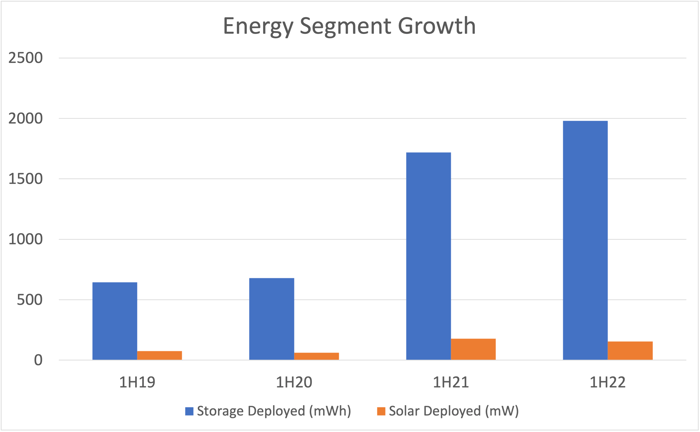
    Tesla’s energy segment is also ramping up production. Its gigafactories haven’t just increased battery production to support Tesla’s vehicle manufacturing growth. The company has been increasing production of battery storage and solar systems that it sells separately to customers. The below chart shows the comparable growth in the first six-month periods of the years since 2019. In its second-quarter report, the company said it continues to ramp up Megapack storage production as customer interest “remains strong and well above our production rate.”

    bar graph showing battery storage and solar deployments for the first six month periods of 2019 through 2022.


    Data source: Tesla. Chart by author.

    Roadway ahead

    One crucial negative for investors has always been the company’s valuation. If, as analysts believe on average, one assumes earnings in the back half of 2022 are 50% higher than the first half, Tesla stock is trading at a price-to-earnings (P/E) ratio of about 75 based on this year’s earnings. 

    But the company is working to bring costs down. In a recent investor conference, Tesla head of investor relations Martin Viecha said Tesla’s cost per vehicle was $84,000 in 2017 and has dropped to $36,000 per vehicle more recently. Continuing that trend will allow Tesla to get into the lower-priced EV market that should help create mass penetration for the EV sector. 

    The company recently filed documents saying it is evaluating the potential to build a lithium hydroxide refining facility on the gulf coast of Texas. That would be another way to streamline its supply chain and control costs. The company said commercial operations could begin by the fourth quarter of 2024 if the project moves forward. 

    That could also help Tesla benefit from incentives included in the Inflation Reduction Act. The new law already gave Tesla a boost, as it resumes some tax credits that had expired for consumers buying new EVs. Tesla was well past the previous limitation that ended those credits after a manufacturer sold more than 200,000 vehicles. Lower-priced vehicle models and more of its supply chain based in the U.S. will also help it meet eligibility requirements. 

    The future certainly looks bright for Tesla. While a P/E above 70 is an extremely high valuation, if the company continues to grow at or near 50% for several more years, that won’t seem so rich. For investors looking years or decades down the road, buying Tesla right now could make good sense. 

    This article was originally published on Fool.com. All figures quoted in US dollars unless otherwise stated.

    The post Should you invest in Tesla shares right now? appeared first on The Motley Fool Australia.

    Wondering where you should invest $1,000 right now?

    When investing expert Scott Phillips has a stock tip, it can pay to listen. After all, the flagship Motley Fool Share Advisor newsletter he has run for over ten years has provided thousands of paying members with stock picks that have doubled, tripled or even more.* Scott just revealed what he believes could be the “five best ASX stocks” for investors to buy right now. These stocks are trading at near dirt-cheap prices and Scott thinks they could be great buys right now

    See The 5 Stocks *Returns as of September 1 2022

    (function() { function setButtonColorDefaults(param, property, defaultValue) { if( !param || !param.includes(‘#’)) { var button = document.getElementsByClassName(“pitch-snippet”)[0].getElementsByClassName(“pitch-button”)[0]; button.style[property] = defaultValue; } } setButtonColorDefaults(“#43B02A”, ‘background’, ‘#5FA85D’); setButtonColorDefaults(“#43B02A”, ‘border-color’, ‘#43A24A’); setButtonColorDefaults(“#fff”, ‘color’, ‘#fff’); })()

    More reading

    Howard Smith has no position in any of the stocks mentioned. The Motley Fool Australia’s parent company Motley Fool Holdings Inc. has positions in and has recommended Tesla. The Motley Fool Australia has no position in any of the stocks mentioned. The Motley Fool has a disclosure policy. This article contains general investment advice only (under AFSL 400691). Authorised by Scott Phillips.

    This article was originally published on Fool.com. All figures quoted in US dollars unless otherwise stated.


    from The Motley Fool Australia https://ift.tt/pjz9TmR
  • Link share price down 4% with takeover close to hitting the rocks

    A male investor wearing a blue shirt looks off to the side with a miffed look on his face as the Electro Optic Systems share price declines today on news the CEO has resigned

    A male investor wearing a blue shirt looks off to the side with a miffed look on his face as the Electro Optic Systems share price declines today on news the CEO has resigned

    The Link Administration Holdings Ltd (ASX: LNK) share price has taken a tumble on Monday.

    In morning trade, the administration services company’s shares are down 4% to $3.32.

    Why is the Link share price falling?

    Investors have been selling down the Link share price this morning after the company revealed that its takeover by Dye & Durham is close to hitting the rocks.

    Last week, Link advised that the UK Financial Conduct Authority (FCA) would only approve the acquisition if Dye & Durham commits funds to meet any shortfall in the amount available to cover the redress payments for the now-collapsed Woodford Equity Income Fund that Link Fund Solutions Limited (LFSL) managed.

    The FCA’s view was that the redress payment in relation to the Woodford matters may be for an amount up to 306 million pounds (approximately A$519 million).

    What’s the latest?

    According to today’s release, Dye & Durham has come to the view that it cannot accept the FCA conditions.

    However, Link has received a revised proposal from Dye & Durham which is structured as an upfront cash payment of $3.81 per Link share plus a contingent payment.

    The latter includes an additional $1.00 per share if within 24 months the FCA decides that LFSL is not liable for restitution or redress payments.

    Shareholders would also receive an amount if the FCA decides LFSL is liable and the redress amount is less than 306 million pounds. In this scenario, shareholders would receive 306 million pounds less the redress amount and then divided by its total shares outstanding at the transaction completion.

    Finally, shareholders would still be entitled to receive net consideration of up to $0.13 per Link share from the sale of the Banking and Credit Management (BCM) business if it is sold and proceeds are received up to 12 months after the implementation of the scheme.

    Offer rejected

    Given the uncertainty of this revised offer, the Link board revealed that it is unable to recommend the new proposal.

    So, unless Dye & Durham comes back with a better offer, it looks likely that this takeover won’t be happening.

    But that won’t necessarily be the end of the story. Management advised that if the scheme does not proceed, it intends to evaluate alternatives for the business. This includes an in specie distribution of a minimum of 80% of Link’s shareholding in PEXA Group Ltd (ASX: PXA), in order to maximise value for shareholders.

    The post Link share price down 4% with takeover close to hitting the rocks appeared first on The Motley Fool Australia.

    Wondering where you should invest $1,000 right now?

    When investing expert Scott Phillips has a stock tip, it can pay to listen. After all, the flagship Motley Fool Share Advisor newsletter he has run for over ten years has provided thousands of paying members with stock picks that have doubled, tripled or even more.* Scott just revealed what he believes could be the “five best ASX stocks” for investors to buy right now. These stocks are trading at near dirt-cheap prices and Scott thinks they could be great buys right now

    See The 5 Stocks
    *Returns as of September 1 2022

    (function() {
    function setButtonColorDefaults(param, property, defaultValue) {
    if( !param || !param.includes(‘#’)) {
    var button = document.getElementsByClassName(“pitch-snippet”)[0].getElementsByClassName(“pitch-button”)[0];
    button.style[property] = defaultValue;
    }
    }

    setButtonColorDefaults(“#0095C8”, ‘background’, ‘#5FA85D’);
    setButtonColorDefaults(“#0095C8”, ‘border-color’, ‘#43A24A’);
    setButtonColorDefaults(“#fff”, ‘color’, ‘#fff’);
    })()

    More reading

    Motley Fool contributor James Mickleboro has no position in any of the stocks mentioned. The Motley Fool Australia’s parent company Motley Fool Holdings Inc. has positions in and has recommended Link Administration Holdings Ltd. The Motley Fool Australia has no position in any of the stocks mentioned. The Motley Fool has a disclosure policy. This article contains general investment advice only (under AFSL 400691). Authorised by Scott Phillips.

    from The Motley Fool Australia https://ift.tt/CDsfA37

  • Why is the Block share price slumping 4% today?

    Woman looking sad while paying.

    Woman looking sad while paying.

    The Block Inc (ASX: SQ2) share price is taking a tumble in morning trade, down 3.8%.

    Block shares closed on Friday trading for $101 and are currently trading for $97.13.

    The ASX buy now, pay later (BNPL) share is slipping despite a moderately positive start from the broader market, which sees the S&P/ASX 200 Index (ASX: XJO) up 0.1%.

    So, what’s pressuring the Block share price?

    What are ASX BNPL share investors considering?

    The Block share price is again finding itself under pressure on Monday amid speculations of an outsized interest rate hike from the US Federal Reserve this Wednesday.

    The August inflation figures in the United States came in 0.1% higher than the numbers in July. While that may not sound like much, analysts had broadly forecast that inflation in the world’s top economy would show signs of slowing.

    But it isn’t.

    That has upped the odds that the Fed will continue with a series of aggressive interest rate hikes. A growing number of analysts forecast the world’s most influential central bank may even raise the benchmark interest rate by a full 1% later this week.

    These concerns saw the dual-listed Block shares slide 6.2% on the NYSE on Friday (overnight Aussie time) and are driving the fall in the Block share price on the ASX today.

    The higher inflation and interest rate environment hasn’t been kind to BNPL stocks in 2022. Among other tailwinds, analysts fear that higher rates will see more of their customers struggle to make their interest free instalment repayments, increasing the companies’ already rather alarming levels of bad debts.

    Block share price snapshot

    Block shares began trading on the ASX on 20 January, after the company completed its acquisition of Afterpay.

    Since listing, the Block share price has fallen a painful 45%. That compares to an 8% drop in the ASX 200 over that same period.

    The post Why is the Block share price slumping 4% today? appeared first on The Motley Fool Australia.

    Wondering where you should invest $1,000 right now?

    When investing expert Scott Phillips has a stock tip, it can pay to listen. After all, the flagship Motley Fool Share Advisor newsletter he has run for over ten years has provided thousands of paying members with stock picks that have doubled, tripled or even more.* Scott just revealed what he believes could be the “five best ASX stocks” for investors to buy right now. These stocks are trading at near dirt-cheap prices and Scott thinks they could be great buys right now

    See The 5 Stocks
    *Returns as of September 1 2022

    (function() {
    function setButtonColorDefaults(param, property, defaultValue) {
    if( !param || !param.includes(‘#’)) {
    var button = document.getElementsByClassName(“pitch-snippet”)[0].getElementsByClassName(“pitch-button”)[0];
    button.style[property] = defaultValue;
    }
    }

    setButtonColorDefaults(“#0095C8”, ‘background’, ‘#5FA85D’);
    setButtonColorDefaults(“#0095C8”, ‘border-color’, ‘#43A24A’);
    setButtonColorDefaults(“#fff”, ‘color’, ‘#fff’);
    })()

    More reading

    Motley Fool contributor Bernd Struben has no position in any of the stocks mentioned. The Motley Fool Australia’s parent company Motley Fool Holdings Inc. has positions in and has recommended Block, Inc. The Motley Fool Australia has positions in and has recommended Block, Inc. The Motley Fool has a disclosure policy. This article contains general investment advice only (under AFSL 400691). Authorised by Scott Phillips.

    from The Motley Fool Australia https://ift.tt/uHQYtcv

  • ASX lithium mania: Is the ‘incredible amount of interest’ sustainable?

    A young man in a blue suit sits on his desk cross-legged with his phone in his hand looking slightly crazed.A young man in a blue suit sits on his desk cross-legged with his phone in his hand looking slightly crazed.

    ASX lithium shares continue the charge higher in 2022 as the price of the battery metal extends its upward trajectory.

    Prices for lithium carbonate are now rallying back to all-time highs of AU$105,860 per tonne. It’s no wonder we see a corresponding uptick in the level of lithium exploration and production.

    Australian lithium players are front and centre considering their advanced stages of production and the large availability of lithium resource on our shores.

    Recent lithium price history

    For energy in particular, 2022 has been the year of commodities. However, the market observed most of the upside in the price of lithium carbonate across the previous 12 months.

    After declining rapidly from 2018 to late 2021, the price of lithium carbonate thrust to record highs from August last year.

    This saw prices reach record highs of AU$105,860 per tonne back in March. Levels that have now been achieved once more in the most recent of rallies.

    Chief to the upside has been demand-supply mechanics. Surging demand from the electric vehicle (EV) sector has resulted in a huge upswing in exploration, production and delivery of the battery metal in its various forms.

    Geographically, the demand for EVs has stemmed from three major zones, that being Europe, the United States and China.

    In fact, by 2025, its projected these three zones will be the largest markets by electric vehicle sales volume.

    Estimates are that by 2025, sales will reach an annual 5.7 million EVs in China and 4.05 million in Europe. And another 1.44 million EVs are expected to sell in the US.

    Although, most forward estimates are yet to include the US Government’s recent Inflation Reduction Act. The Act offers tax incentives on new EV purchases.

    Meanwhile, the China Passenger Car Association lifted its forecasts for EV sales to pass a record 6 million in 2022. This is a doubling of last year’s volume.

    Are these trends sustainable?

    And if company-specific trends are anything to go by – taking a closer look at the major auto-makers in the US and Europe – each has made the pivot to produce only battery-powered vehicles at some point in the future.

    Market participants that engage in the trade, hedging and delivery of various commodities around the world echo this sentiment.

    For instance, Albemarle Corporation (NYSE: ALB), the world’s largest public lithium-producing company, noted the reduced investment in internal combustion engines has “created an incredible amount of interest in lithium supply,” The Australian reports.

    Swiss commodity Glencore recently advised its intention to add lithium to its basket of traded commodities, Reuters reports.

    The move would see another opening for company’s, traders and other market participants to gain exposure to the sector.

    Whether the trends are sustainable or not will boil down to the gap between demand and supply narrowing, likely spurred on by greater lithium production.

    Despite this, however, visibility is still murky for the price of lithium when looking ahead. And this will feed into the incentive to explore for lithium as well.

    As much was observed in the period of 2017 to 2019. Exploration dwindled when the price of lithium fell to record lows, only to spike exponentially from 2020 to date alongside the upswing in lithium pricing.

    What about Australian lithium?

    The gain has also been tremendously positive for key ASX lithium players like Pilbara Minerals Ltd (ASX: PLS), Mineral Resources Limited (ASX: MIN), and diversified miner IGO Ltd (ASX: IGO), to name a few.

    See the returns for all three of these ASX lithium shares over the past 12 months on the chart below.

    TradingView Chart

    However, there are two key figures to watch. The price of lithium – in carbonate and spodumene forms – and the price of the finished batteries themselves.

    In the meantime, there’s plenty to think about with the planned transition away from fossil fuels into ‘green’ energy sources.

    The post ASX lithium mania: Is the ‘incredible amount of interest’ sustainable? appeared first on The Motley Fool Australia.

    Wondering where you should invest $1,000 right now?

    When investing expert Scott Phillips has a stock tip, it can pay to listen. After all, the flagship Motley Fool Share Advisor newsletter he has run for over ten years has provided thousands of paying members with stock picks that have doubled, tripled or even more.* Scott just revealed what he believes could be the “five best ASX stocks” for investors to buy right now. These stocks are trading at near dirt-cheap prices and Scott thinks they could be great buys right now

    See The 5 Stocks
    *Returns as of September 1 2022

    (function() {
    function setButtonColorDefaults(param, property, defaultValue) {
    if( !param || !param.includes(‘#’)) {
    var button = document.getElementsByClassName(“pitch-snippet”)[0].getElementsByClassName(“pitch-button”)[0];
    button.style[property] = defaultValue;
    }
    }

    setButtonColorDefaults(“#43B02A”, ‘background’, ‘#5FA85D’);
    setButtonColorDefaults(“#43B02A”, ‘border-color’, ‘#43A24A’);
    setButtonColorDefaults(“#fff”, ‘color’, ‘#fff’);
    })()

    More reading

    Motley Fool contributor Zach Bristow has no position in any of the stocks mentioned. The Motley Fool Australia’s parent company Motley Fool Holdings Inc. has no position in any of the stocks mentioned. The Motley Fool Australia has no position in any of the stocks mentioned. The Motley Fool has a disclosure policy. This article contains general investment advice only (under AFSL 400691). Authorised by Scott Phillips.

    from The Motley Fool Australia https://ift.tt/UaDedJf