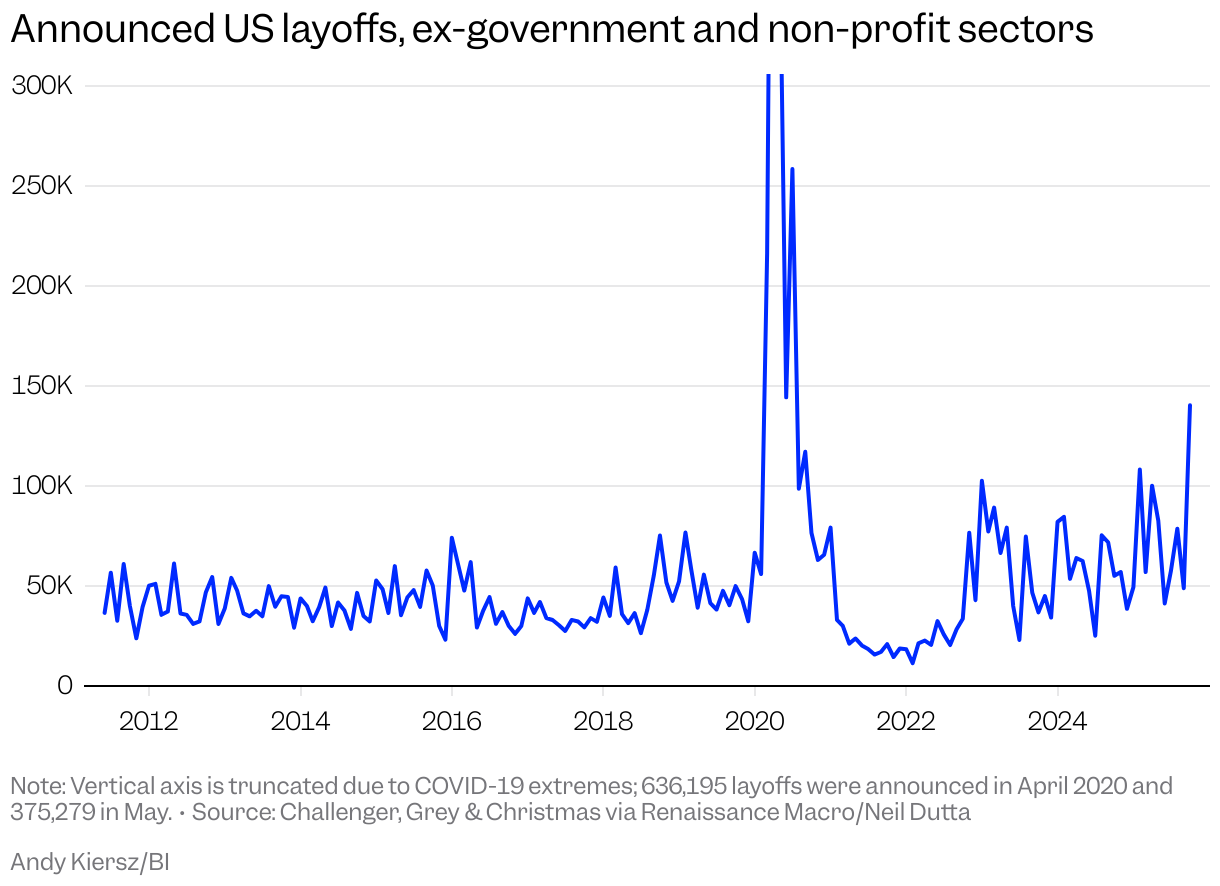
When describing the health of the US economy, there is a temptation among economists, market analysts, and politicians to argue that the only true picture of our current situation is a sweeping portrait — only by looking at the broadest of aggregate statistics can you determine the state of play, they argue. But the wide view can ignore important developments unfolding under the surface. Sometimes, even the healthiest-looking person might have high cholesterol.
Right now, the economy seems OK on the surface. GDP growth has been running north of 3% for the last two quarters. In the labor market, the boilerplate appears to be that conditions are gradually cooling, but nothing more, nothing less. For example, despite the slowdown in new hiring, the unemployment rate of 4.4% is still low by historical standards. But there are serious dangers lurking beneath the surface of our economy, and it is better to clearly identify them than to ignore them in favor of broad aggregate measures.
Major employers in industries like homebuilding and restaurants are looking shaky, and they offer ominous signs about the direction of the overall economy. By getting a sense of what sectors and industries are struggling, you can get a forward-looking sense of the economy's trajectory and a clearer-eyed view of the possibility of recession.
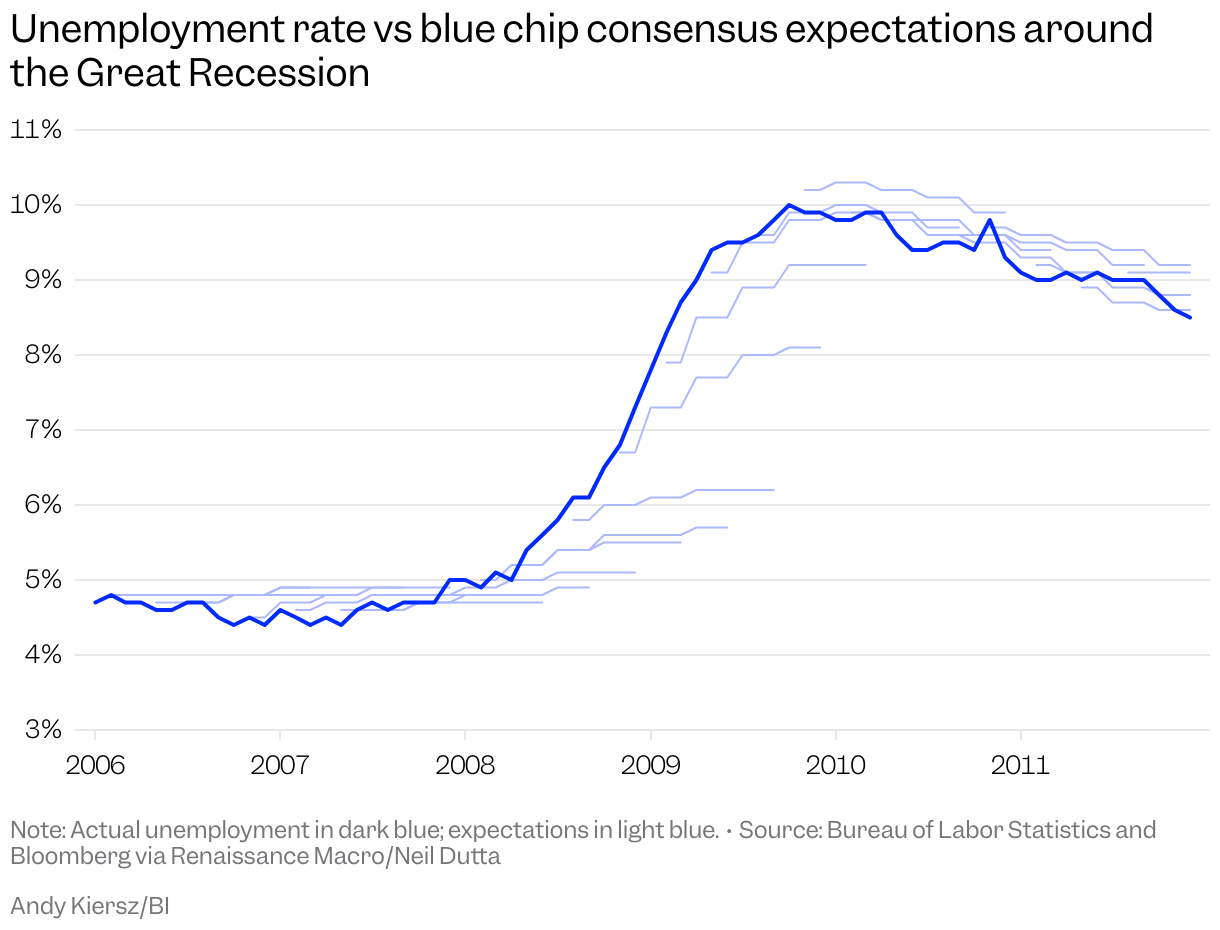
The problem with relying on broad bundles of data is that things typically appear placid on an aggregate level right up until things go wrong. Take the turning of the job market tide. In a genuine downturn, the consensus typically assumes a gradual, linear increase in unemployment, similar to the slow, steady grind we are currently experiencing. In reality, however, the risk is nonlinear. When things truly turn south, it usually comes as an abrupt shift that results in a negative self-reinforcing feedback loop. Instead of a slow increase in the unemployment rate of 0.1 percentage points a month, you begin to see a jump of 0.2 points one month and another 0.3 points the next. The ranks of the jobless swell at an ever-increasing pace. There is no real way of knowing when labor market conditions will transition from linear to nonlinear. Historically, the consensus never sees the shift until well after it has arrived. That things seem to be evolving in a stable fashion now doesn't negate the possibility of an unstable move later.
This is why, when making predictions about the future path of the economy, it is essential to get under the hood. And right now, the closer you look, the more worrying things become. Don't just take my word for it, Treasury Secretary Scott Bessent recently acknowledged that sectors of the economy are already in serious downturn territory.
"I think we are in good shape, but I think that there are sectors of the economy that are in recession," Bessent told CNN in an early November interview.
While Bessent didn't go into much detail about the parts of the American economy that concern him, a close read reveals the most worrying signals are coming from four major sources of employment:
Residential housing: There are several signs that employment in home construction is about to hit the skids. The elevated stock of unsold homes means homebuilders will need to throttle back on breaking new ground and focus on selling the inventory they have on hand. Building permits also indicate a potential weakness in future construction activity. Add this up, and it's clear that the industry is likely holding onto too many workers relative to its current activity levels.
Commercial real estate: Investment in structures for business has been declining for the last six quarters, per the latest GDP data, even accounting for the massive buildout of AI data centers. Architectural billings, an index that tracks nonresidential construction, released by the American Institute of Architects, remain sluggish. Given that a building first has to be drawn up before it can be built, weakness at this planning stage suggests there is no coming boom in commercial real estate construction. Based on the latest release, it appears that soft conditions are likely to persist next year.
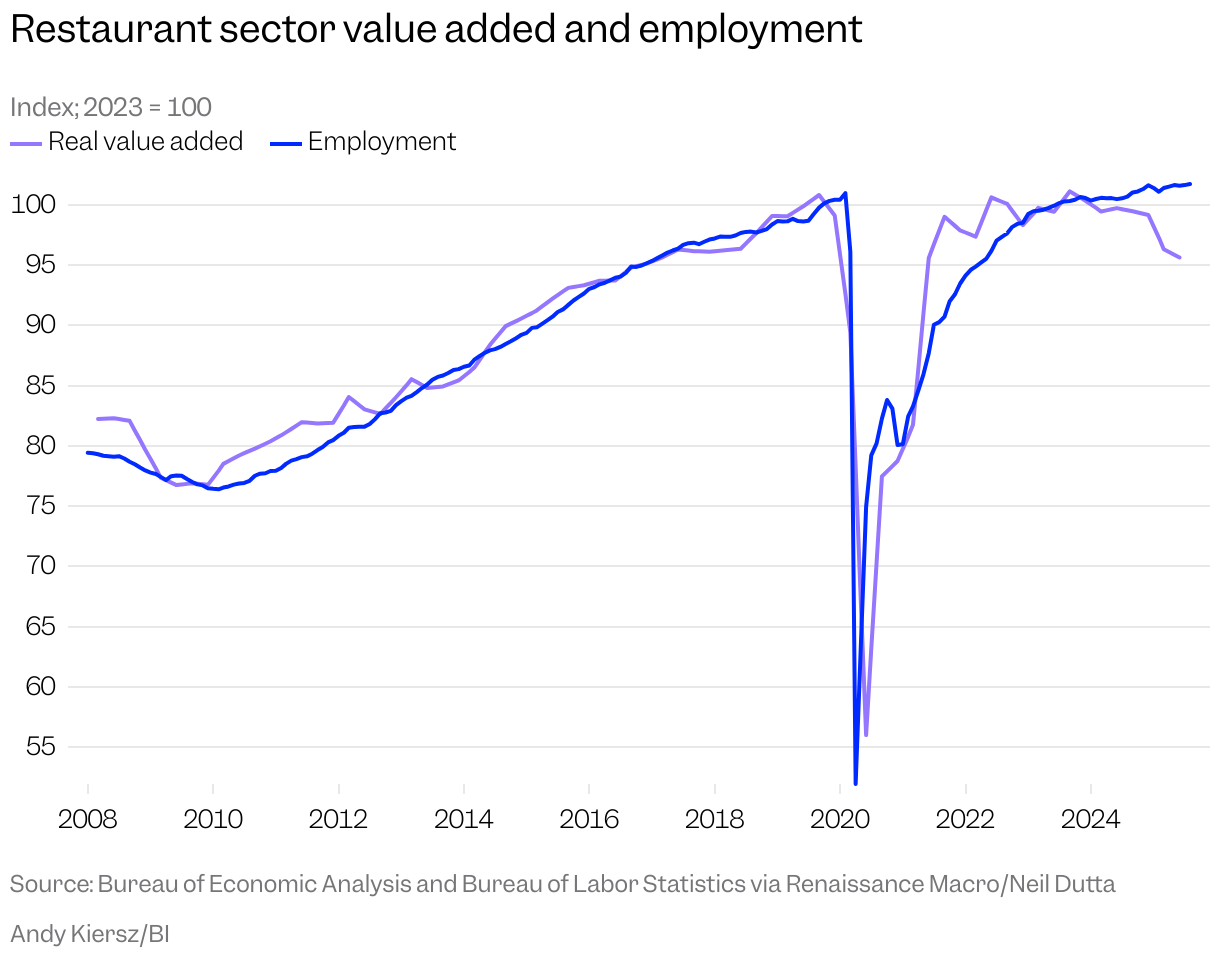
Restaurants: We've seen major casual dining establishments, such as Chipotle and Sweetgreen, post weaker sales growth in recent quarters, largely due to weakness in certain consumer cohorts, including 25-34 year olds. Despite this, many chains have said they plan to absorb higher food input prices caused by supply shocks, thereby squeezing their margins. Slower sales and slimmer profits are not a recipe for more hiring. In fact, declining measures of productivity per worker in food services & drinking places suggest that many of these restaurants are overstaffed and may be a signal that layoffs are on the horizon.
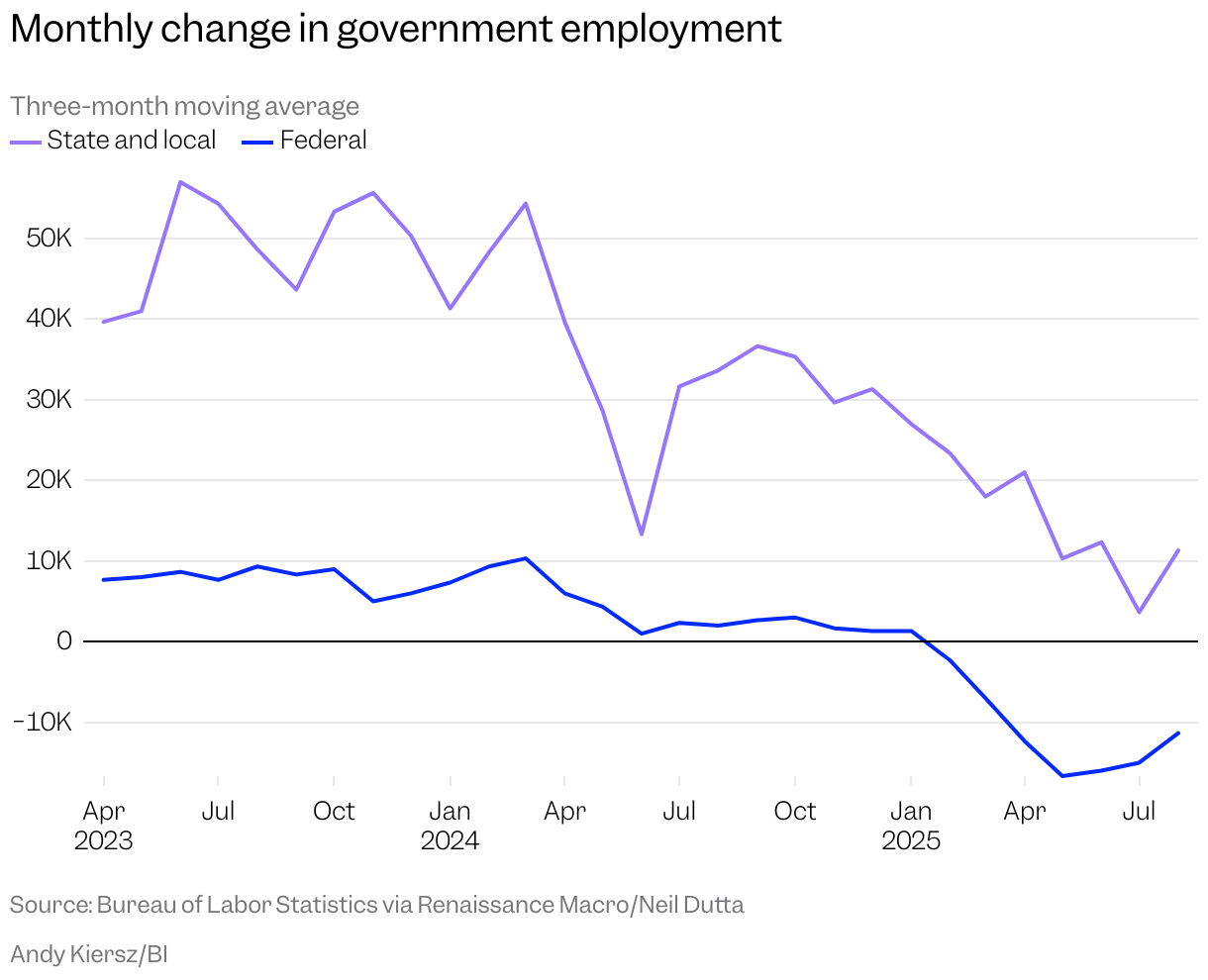
Government: Until now, most of the pressure on public sector employment has been at the federal government level. However, state and local governments are facing pressures as they exhaust COVID-era funding. Given these tough decisions, job losses in state and local governments are a reasonable baseline.
Beyond these big four, there are industries with a smaller employment footprint that also appear to be softening:
Freight: There are not as many goods moving around the country. Ship counts from Asia to the US are down roughly 30% from last year. Railcar loadings are down roughly 6% against last year. The trucking industry also continues to see shrinking capacity. If there are fewer things to move around the country, then the industry will likewise need fewer drivers, loaders, and various workers. Idle trains and empty containers don't need a lot of people to mind them.
Mining:Crude oil prices are somewhat below the level needed to profitably invest in new drilling wells, so energy companies are unlikely to hire new staff in this area. The same is true for wood products. Lumber prices are below the levels at which most sawmills can turn a profit. Mining and logging are a relatively small part of private employment, but they're decreasing, not increasing.
Higher education: Declining enrollment, budget cuts, and reduced federal research funding are taxing the higher education sector. Not surprisingly, more colleges and universities are turning to staffing cuts. Employment across colleges and universities has remained flat so far in 2025 compared to last year, but given the budget shrinkage, it's hard to see how this resilience persists.
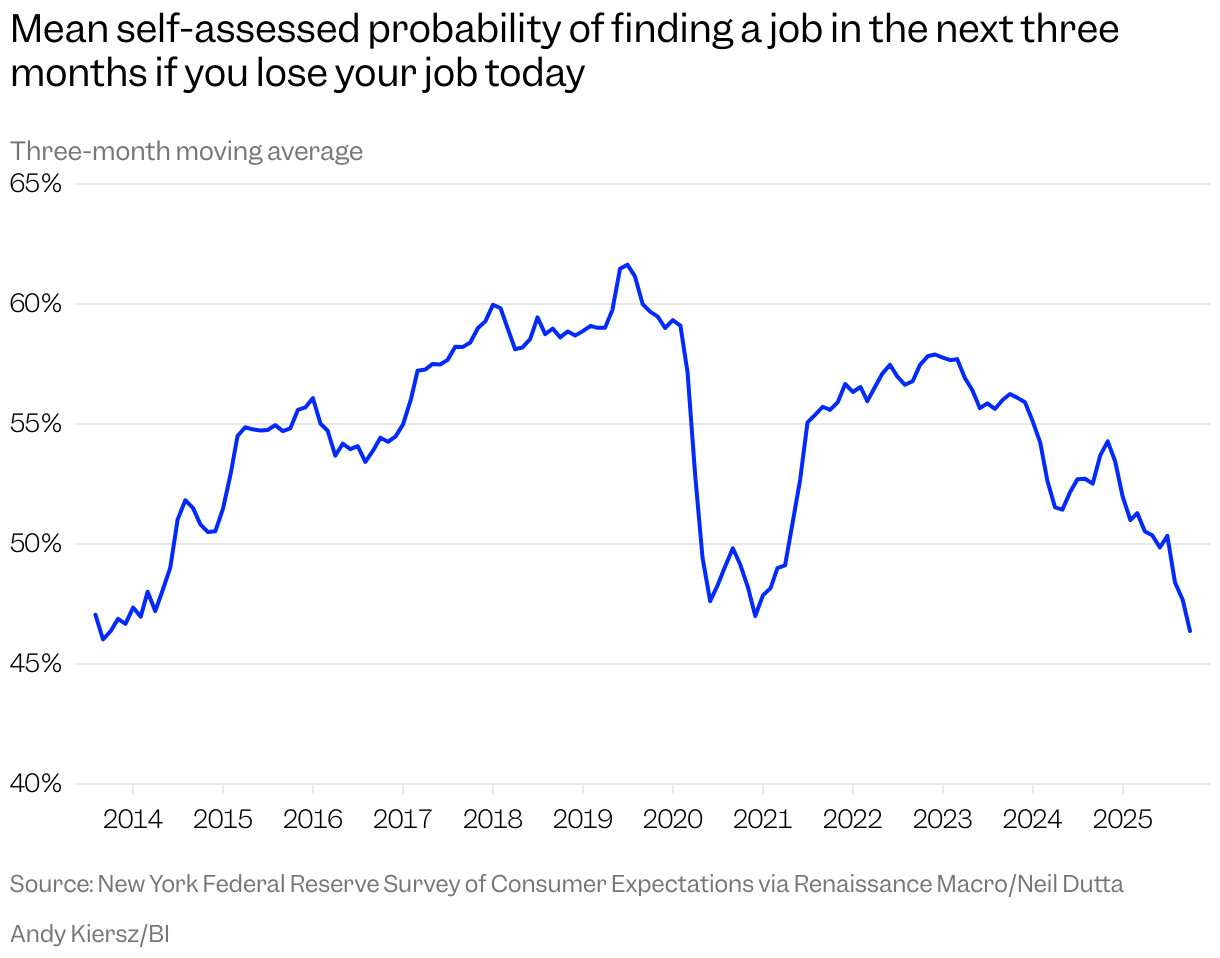
It's taken a while to unfold, but the labor slowdown has played out in a standard way: job openings have declined, hiring rates have cooled as companies have slowed their pace of recruiting, and we're now beginning to see an increase in layoffs from historically low levels. The workers at the margins — like younger people and Black Americans — have felt it more than those in more secure positions, which is also not unusual.
Recession-like dynamics across several different industries increase the risk of additional layoffs in those same key sectors in the quarters ahead. Because the hiring rate is low, a small increase in layoffs may have a disproportionately large effect on unemployment. Just because conditions seem to be gradually cooling today does not close the door on a more abrupt shift in labor market conditions later.
The labor market remains a source of downside risk for the broader economy. Because consumption has been a source of support for the economy, a deeper slowdown in the jobs market would create a nasty downward spiral: People cut back on their spending as they lose their jobs, which dries up sources of revenue for businesses that then lay off more workers in response, which further shrinks the amount of household spending, and so on.
Where all this ends up is still up for debate. But while America's economic ocean appears placid at 30,000 feet, beneath the surface, several riptides are brewing.
Neil Dutta is head of economics at Renaissance Macro Research.
The author prefers to invite as many friends as possible to celebrate the holidays at her home.
Jane Ridley
Both sides of our family live thousands of miles away, making it difficult for us to get together.
It was usually just the four of us celebrating Thanksgiving and Christmas in our home each year.
We opened up the holidays to friends and friends of friends, and wouldn't go back to the way things were.
A 28-year-old international college student lives in our home in the suburbs of New York City. He's smart, fun, hilarious, and very low-maintenance.
So, when he made a big deal of asking me a favor last month, I was surprised to see his face looking so serious. He seemed to choose his words carefully, "Would it be OK if one of my friends came for Thanksgiving?"
"Of course," I said, without hesitation. Then I gently scolded him for thinking, even for a second, that I might say "no." I assumed he'd been around me long enough to know that I not only love having non-family members visit for the holidays, but I live for it.
I live far away from my family
I've only spent Christmas with my family 3 times in the past 20 years. There are complex reasons for this, which other immigrants like me to the US might find easier to understand.
First, there has been a 3,000-mile distance between my father, mother, sister, and brother-in-law and me ever since I moved to the US from my native UK in May of 2005. During those 20 years, we've spent Christmas together only three times — twice in Northern England, and once in Stowe, Vermont, when we combined the festivities with a skiing trip.
The jollity could feel a bit forced
My husband's side of the family lives on the West Coast — almost as far away as mine — so we've celebrated very few holidays with my in-laws as well.
For years, our Thanksgiving and Christmas tables were set for just four — my husband, our daughter, our son, and me. While I was grateful that we had each other, these intimate occasions sometimes felt too, well, intimate. The conversation was run-of-the-mill, and the jollity felt a bit forced.
As time went on, after the initial burst of good food aor gift-giving, both the third Thursday of November and December 25 became less distinguishable from other days.
Thanksgiving was extra special because of the party games, which had more than the usual number of players.
Courtesy of the author.
The kids would get bored and bicker. I'd complain because my husband wanted to watch American football — never my thing — on the TV. It made me feel homesick in New York and left me feeling alienated.
Then 2020 changed everything. COVID was a terrible ordeal, but it created opportunities I hadn't anticipated.
By then, our immediate family had grown to five members because we had a new au pair from Chile. At last, we had someone else to celebrate the holidays with. It was made all the more special because we went all out on the decorations and traditions to show her the true essence of the American holidays.
The dynamics changed with more people around
But, to my delight, there were a total of seven place settings for Thanksgiving that November. Our au pair invited her best friend, and I invited a colleague who was unable to be with his family due to COVID-19 restrictions.
After the meal, we were joined by a second colleague and the son of a friend who made a last-minute train journey from Brooklyn to visit on a whim.
The dynamics changed. Each of the nine people at the gathering brought something special along with them. The conversation was full of anecdotes and stories we'd never heard before; the kids were fascinated by the company and didn't even think to whine; we even played English parlor games like charades. I didn't feel homesick at all.
I want to invite as many friends and friends of friends as possible
It was the best Thanksgiving of my life — an experience I wanted us to repeat on subsequent holidays. Ever since, we've made a point of inviting as many friends and friends of friends as we can possibly manage.
I'll never go back to hosting "just us," and I look forward to welcoming our brand-new guest next week.
There's a new set of consulting firms leveraging AI to compete with the giants.
Shannon Fagan/Getty Images
Smaller, boutique consulting firms are leveraging AI to compete with established players.
Many of these firms have a narrow focus, like helping companies with pricing or cost-cutting.
Their methods aim to make consulting accessible to a broader range of clients.
Two sets of players have long ruled the consulting world.
There is MBB, which is McKinsey & Company, Bain & Company, and Boston Consulting Group. And then there is the Big Four: PwC, Deloitte, KPMG, and Ernst & Young.
Now, a new wave of AI-driven startups is challenging that dominance, trying to make consulting services more accessible.
Many of the founders of these new firms come from the traditional consulting realm. They told Business Insider their experiences not only give them marketable skills but have also helped them identify new opportunities in the industry.
They are boutique firms. They are much smaller than the established ones, often run by teams ranging from just a few people to a few hundred. They're also more specialized, focusing on areas like pricing strategy, cost reduction, or refining slide decks.
And, importantly, they are all in on AI.
Many of them said their methods help them reduce old-school bureaucracy, offer more competitive rates, and make the human side of consulting work easier.
Here are the boutique firms that, to varying degrees, are challenging the classic consulting model.
Xavier AI
Xavier AIdescribes itself as the world's first AI strategy consultant.
According to Joao Filipe, cofounder of Xavier and a former McKinsey consultant, the Xavier AI chatbot can provide clear, actionable business knowledge and deliverables, like a 60-page business plan, a sales presentation, or a detailed marketing strategy.
Filipe said Xavier AI has its own proprietary reasoning engine that is tailor-made for business use cases and can provide detailed sources without the hallucination you might find with other chatbots. He said Xavier can provide both strategy recommendations and actionable plans for implementation.
"99.9% of businesses could really never afford McKinsey or any of the MBBs," Filipe told BI. "We created Xavier AI so that anyone could have the power of a consulting firm at their hands when they need it."
Xavier AI officially launched in April, but Filipe said he's been piloting it with different clients, including an international bank using it to research potential clients and better understand their needs.
Since its launch, Filipe says business has been booming. He said the company's revenue has doubled month over month, and he expects that growth to continue through the rest of 2025.
NextStrat
Nexstrat.ai positions its product as a multifunctional agent that can automate many of the typical tasks of a consultant.
Nexstrat's cofounder and CEO, Arda Ecevit, who spent years at Bain & Company and Deloitte before founding the company in 2024, said the platform mirrors the "hypothesis-based problem solving" typically used by consulting firms.
Behind the scenes, the platform leverages multiple agents to fulfill the functions of a project manager, a chief strategy officer, and an AI advisor, to help teams make better decisions and solve business issues, Ecevit told Business Insider.
Ecevit said the platform has already worked with some leading companies, including some among the Fortune 500, and even some major consulting firms, which he said have been testing his firm's technology on things like data analysis, research, and action planning.
Consulting IQ
Consulting IQ was born out of the pandemic as an antidote to the number of small and midsize businesses failing.
"We saw so many small and midsize businesses collapsing for reasons beyond their control," Diego Medone, the founder and CEO of Consulting IQ, told Business Insider.
There are an estimated 400 million companies around the world, 99% of which belong in the micro, small, or midsize category, Medone said. But, he said, 65% of small and midsize businesses fade away before year five.
"That's 260 million companies worldwide," he said.
Medone, a longtime management consultant who rose to partner at KPMG, began conducting research.
He said he and his team of former McKinsey, BCG, and Bain consultants conducted 10,000 interviews with small and midsize companies in the United States, Canada, Latin America, Europe, and the Pacific. The aim was to learn firsthand from business owners the challenges and risks they face each day.
They used that information to officially launch Consulting IQ in 2024. The platform positions itself as an AI-powered boutique consultant dedicated to the needs of small and medium-sized businesses.
Once a user registers on the platform, they provide a few basic details about their business — who they are, where they operate, and their challenges. Then they'll see a list of over 5,000 preloaded prompts in topics ranging from branding to business strategy to sales. Users can converse with the tool for insights on how to optimize their operations.
The team's consultants are always refining the AI platform, Medone said. "The consultants aren't doing anything manually during interactions — that's 100% AI," he said. "What they are doing is permanently fine-tuning the algorithms, filtering what's important and what's not, to avoid hallucinations and ensure relevance."
Consulting IQ runs on a subscription model starting at $99 a month. The Miami-based company has partnered with Visa and Mastercard.
Perceptis
Alibek Dostiyarov, a former McKinsey consultant, and Yersultan Sapar, a former engineer at Apple, cofounded Perceptis.
The company aims to help smaller and midsize firms compete with bigger industry players by using AI to streamline some of the more tedious processes in consulting, like proposal writing.
Perceptis is now focused on the business development side of consulting. Its AI-powered operating system can do industry research, identify opportunities that align with their client's skillset and background, and create detailed, custom proposals that the client can use to win a job.
Dostiyarov told BI earlier this year that a lot of the internal processes completed at consulting firms are heavy with manual labor and "lend themselves almost perfectly to what GenAI is capable of doing."
He also said Perceptis could make smaller firms, which don't typically have internal AI tools, more competitive in the market.
The company told BI this week that while initially serving boutique management consultancies, it's now quickly expanding to serve IT services, system integrators, software developers, financial services, design firms, and real estate agencies.
Perceptis had raised $3.6 million in funding as of January.
Genpact
Genpact, a professional services company that expects to generate $5 billion in revenue this year, has made a major push over the past year to position itself as a leader in AI strategy.
Sanjeev Vohra, the company's chief technology officer — who spent more than two decades at Accenture — said AI transformations have to begin internally.
Last year, Genpact launched "Client Zero," an initiative to design, test, and refine AI solutions in-house before rolling them out to its 800-plus clients.
One example is "Amber," an AI-powered chief listening officer that has handled more than 500,000 employee interactions in the past year.
"She's dynamic. She works 24/7. She doesn't rest, and she's talking to people," Vohra said. Genpact has also deployed a suite of AI finance tools that it says can cut invoice processing from weeks to hours.
Since launching Client Zero, Vohra said, Genpact has trimmed nearly $40 million from its operating expenses.Now, the company is piloting those same solutions with clients.
Vohra said clients want to see the value they are getting from investing in this technology.
"Let's assume you're spending $100 right now for a certain process — can it happen in $80? Can it happen in $70 in the next one or two years?" He said. "That's what the C-suite is looking for."
SIB
SIB specializes in helping clients like restaurant groups, hospitals, universities, and government agencies find savings in fixed costs — expenses that remain static regardless of how much a company produces.
SIB CEO Shannon Copeland told BI that these are often found in areas that "escape scrutiny," like fees for telecommunications, utilities, waste removal, shipping, and software licenses. According to his LinkedIn profile, Copeland is an alum of Accenture and Deloitte.
SIB has grown since its 2008 launch in Charleston, South Carolina. It's now a national firm serving hundreds of clients, ranging from Kroger and Marriott to governments like San Diego County. It recently added over a dozen Fortune 500 companies and private equity firms. Since its launch, SIB says it has identified more than $8 billion in cost savings.
Copeland said that, unlike traditional consulting firms, SIB operates under a contingency model. "If we don't find savings, we don't get paid," he said, adding that the firm doesn't charge fees upfront.
SIBuses AI agents to monitor invoices, vendor contracts, and billing patterns. The firm's consultants use the resulting insights to negotiate better contract terms or restructure their vendor relationships.
"You could think of us as part AI, part old-school operator," Copeland said.
In addition to cost-cutting, the firm also focuses on strengthening relationships, a cornerstone of traditional consulting.
"We actually encourage vendors and clients to return to high-trust, high-accountability partnerships by using data as the starting point for better collaboration," Copeland said. "Working with robots actually makes humans listen to each other more. It's ironic, but it works."
Monevate
Monevate's motto is simple — focus on one thing and do it well.
The firm focuses on pricing strategy for software-as-a-serviceand high-growth tech companies. It also works with private equity firms to assess the commercial viability of potential investments.
According to his LinkedIn profile, James Wilton, an alum of McKinsey, Kearney, and ZS Associates, founded Monevate in 2021. Wilton now serves as the Firm's managing partner. The firm has 16 full-time consultants and has helped over 50 SaaS, tech, and AI companies in the past three years.
"Most of our clients are backed by venture capital or private equity, and increasingly, we're working with teams building AI products and features," Wilton told BI by email.
Wilton said clients usually turn to Monevate when they've hit a wall with their current strategy because their product has changed or the market has evolved. "We design and implement fully-baked pricing strategies, including packaging, price architecture, and price levels," he said.
Wilton said the impetus to launch the firm came from the gaps he saw in traditional consulting. "Clients often complained about recommendations that never went anywhere, high fees that only the largest companies could afford, no skin in the game, inflexible delivery models, and highly variable service quality depending on the team," he said.
Monevate keeps its focus narrow, but that's allowed even its most junior consultants to become "deep pricing experts," Wilton said.
He added that the firm's work is "narrow by consulting standards, and it means walking away from other kinds of work, but it allows us to be truly great at what we do."
Keystone
Keystone is a strategy consulting firm that advises technology companies, life science companies, governments, and law firms. Its clients include major corporations like Amazon, Microsoft, Meta, Oracle, Intel, Novartis, and Amgen.
The firm was founded in 2003 by Greg Richards, a mechanical engineer by training and an alum of Microsoft and Hewlett-Packard, who now serves as an advisor to Harvard Business School, and Marco Iansiti, a physicist and professor at Harvard Business School.
Iansiti told BI that Keystone tends to be more "geeky and nerdy" than traditional consulting firms. "We love to kind of get deep on the tech side of things," he said. The team includes data scientists, AI experts, and academics.
While many consulting firms are embracing generative AI, which is often used to automate day-to-day work like writing emails or reviewing documents and contracts, Iansiti said Keystone is focusing more on operational AI.
Operational AI is used to transform core business functions like managing supply chains, inventory, pricing, and forecasting. In 2023, the firm launched "CoreAI," a team dedicated to using AI to automate and improve these areas.
"We get excited about the term deep enterprise on this," Iansiti said. "Deep enterprise is really the idea of using deep learning models that are embedded around crucial operating processes in the enterprise."
The firm's "value add," he said, lies in building this kind of "pretty unique operational AI" for its clients.
Fusion Collective
Fusion Collective is an IT consulting firm that offers a range of consulting services to clients, including strategy and management advice, cloud transformation, and AI alignment.
The firm was founded by Blake Crawford, who worked on enterprise architecture at MTV Networks and Viacom, and Yvette Schmitter, an alum of Deloitte, PwC, and Amazon Web Services, where she led three cloud migrations, including the largest in the company's history.
Schmitter said that in her experience, clients are seeking AI advice from consulting firms before they're ready.
"We have organizations who are running at 99 miles an hour, hiring these firms to build these AI strategy documents, 165 pages of beautiful PowerPoints, right?" she said. But these companies still can't "operationalize" AI, she said. "Why? Because the basic infrastructure isn't there. Any type of vulnerability that they have in security, their cloud infrastructure, is just exacerbated by AI."
In the end, clients chose consultants based on trust, their networks, and existing business relationships, she said.
"I really believe that a true partner is one who's going to tell you the truth. Tell it like it is even if it hurts right?" Schmitter said. To that end, she said she asks clients who come to her about AI strategy to have a solid grasp of their infrastructure footprint, data governance policies, and security before they accelerate adoption.
The bottom line is that Fusion Collective likes to keep its advice real. "If companies have not mastered the fundamentals, you're not ready for AI, and you're not ready for an army of consultants to come in to do stuff," Schmitter said.
Slideworks
Slideworks isn't necessarily going after consulting firms' business, though it focuses on something many of the big guys are known for: making powerful slides.
Slideworks offers what it calls "high-end" PowerPoint templates and "toolkits" created by former consultants for Bain, BCG, and McKinsey.
When you work as a consultant at a top-tier firm, "you are schooled every day in best practice presentations and slide design," the company says on its website. The idea is to offer access to a library of slides and spreadsheets for areas including strategy, supply chain management, and "digital transformation."
In a February blog post, Alexandra Hazard Kampmann, a Slideworks partner, wrote that "management consultants are often made fun of as 'slide monkeys.'" Yet, she added, the slide is a "crucial reason" why McKinsey and BCG consultants have so many Fortune 500 companies as clients.
Slideworks offers a "consulting toolkit," which contains 205 slides and costs $129. It also offers a "consulting proposal," which has 242 slides plus an Excel model and costs $149.
There are also operations, mergers and acquisitions, business strategy, and product strategy templates.
Slideworks says it has more than 4,500 customers globally, including Coca-Cola, Pfizer, and the professional-services firms Deloitte and EY.
Unity Advisory
Some top UK executives from Ernst & Young and PwC are joining forces to launch a new firm called Unity Advisory in June, the Financial Times reported. The firm will be chaired by Steve Varley, who spent nearly 19 years at EY, and led by CEO Marissa Thomas, who worked at PwC for over 30 years, according to their LinkedIn profiles.
It is backed by up to $300 million from Warburg Pincus, a private equity firm, and willfocus on tax and accounting services, technology consulting, and mergers and acquisitions.
"CFOs are open to a new proposition," Varley told the FT. "The Big Four are a classy bunch of service providers, but people are looking for a proposition that is super client-centric, has really low administrative cost, is AI-led rather than based on legacy infrastructure and, crucially, has no conflicts."
Correction: An earlier version of this article misstated the monthly pricing for Consulting IQ. It starts at $99 per month, not $9. It also misstated the firm's partnership with JP Morgan, which is its primary operating bank.
Cook County in Illinois, which includes Chicago, has approved a permanent basic income program.
Mensent Photography/Getty Images
Cook County, which includes Chicago, ran a two-year basic income experiment in 2022.
During the pilot, thousands of residents received $500 a month to spend however they wanted.
The county has now made that basic income program permanent in its 2026 budget.
Many American cities and counties have been experimenting with a novel concept: Giving financially vulnerable residents free money every month without expecting anything in return.
The goal is to let those people decide for themselves how best to spend the extra cash, rather than requiring them to spend it on certain kinds of food or other necessities.
When those programs end, many report largely positive results. Few, however, are ever made permanent.
Cook County in Illinois, which includes Chicago, is now an exception.
The Cook County Board of Commissioners unanimously approved its 2026 budget proposal on Thursday, and it includes $7.5 million for a guaranteed basic income program.
Cook County had earlier run a basic income experiment for two years. It provided $500 a month to 3,200 households during that time. The last payment went out in January.
"The County will invest $7.5 million to continue supporting the Guaranteed Income program, providing direct unconditional monetary support to help residents live healthier and more stable lives," the county's now-approved budget proposal says.
A guaranteed basic income is a social safety net program in which a government provides certain residents with recurring, no-strings-attached cash payments for a set period. Often, the eligible recipients fit specific criteria, such as having a household income near the poverty line.
A guaranteed basic income differs from a universal basic income, which is when a government provides all individuals in a population with recurring, no-strings-attached cash payments, regardless of their socioeconomic status.
AI leaders, such as Elon Musk and OpenAI CEO Sam Altman, have publicly advocated for basic income programs to mitigate the potential impact of AI on human jobs.
Governments worldwide have toyed with basic income programs. Ireland recently made its basic income for artists permanent, and South Korea is poised to launch one of the world's largest programs.
Cook County released survey findings based on responses from those who received cash payments between 2022 and 2025. The majority said the payments made them more financially secure, reduced their stress, and improved their mental health.
The top reported uses for the payments were food, rent, utilities, and transportation.
The author became a stepmom when she married her husband.
Courtesy of the author
I've been a stepmom for 20 years and am the second in three generations of stepmoms.
My mom taught me to let my stepchildren guide the role they need me to play in their lives.
For 20 years, I've tried to be a trusted adult and am now watching my stepdaughter do the same.
The first stepmother I remember was Lady Tremaine — the wicked stepmother, brought to us by Disney in the film "Cinderella."
Today, I'm the second in three generations of stepmoms. I'm a stepmom of three. My mom became a stepmom when I was in my teens. My youngest stepdaughter is now a stepmom, and I have a stepmom.
Throughout my teens and early 20s, I watched my mom as she navigated being a stepparent. This year, I've officially been a stepmom for 20 years. Now I'm watching my stepdaughter as she navigates her own stepparent journey.
Becoming a not-so-evil stepmom in the most magical place on Earth
Funny enough, I became a stepmom at a Disney World wedding. At the time, my stepson was 16, my stepdaughters were 13 and 8, and my son was 5.
Being a stepmom inspired the author's book about Disney World, "The Not-So-Evil Stepmother in the Most Magical Place on Earth."
Courtesy of the author
The kids all joked that the second we said "I do," I was going to turn wicked and lock them in a tower.
My husband and I had dated for a few years before we got married. I had gotten to know the kids pretty well. My son was almost 3 when we met, and my future stepchildren knew me not just as Dad's girlfriend, but also Austin's mom.
I think being a mom myself helped my stepchildren see me in a different light. I wasn't their mom, but I was someone else's mom, and they liked that kid.
Our blended family grew to yours, mine, and ours
In 2008, our family grew from yours and mine. We added "ours," and now my stepchildren have a stepsibling (no shared parent) and a half-sibling (shares one parent).
Spouses, siblings, and three generations of stepmoms at my youngest's high school musical debut.
Courtesy of the author
One thing I learned from my mom is that siblings fight. When the kids would argue about whose turn it was to unload the dishwasher or fight over a special cup, my husband and I would smile. We both had similar arguments with our own siblings. It's what families do.
My favorite moments were being crammed around the table during dinner. The noise was deafening — everyone sharing stories, grabbing food, laughing. We couldn't do it often, but made it a priority when it was possible.
Despite a large age difference, the kids have relationships. They all dance together at weddings. The youngest, now 17, and the oldest play video games together. My son regularly goes to my stepdaughter for advice.
Being a trusted adult, not another parent
The role of a stepparent isn't usually the same as being a parent. I learned this from watching my mom. My stepsister had a mom, a very involved mom, and that wasn't the role my mom was going to play in her life.
My stepchildren have a wonderful, caring, engaged mom. I've tried to take the lead from my stepchildren on the role they need me to play.
The author is part of three generations of stepmoms.
Courtesy of the author
That role was finding a great deal on a teenager's first car. To take them for their first pedicure. To know where to find cute prom dresses for petite girls. To offer advice, ideas, and another point of view. To be a break from their parents. Be the person on the phone when they didn't want to call mom or dad. To be there when life is harsh.
My stepmom came into my life in adulthood. She's kind, caring, a friend, and an adult I can rely on. My youngest stepdaughter, now a stepmom herself, said it best. The role of a stepparent is that of a trusted adult.
Like parenting, stepparenting is a mix of emotions
When my husband and I were still dating, we took my son and youngest stepdaughter to see "March of the Penguins." During a traumatizing scene involving a shark, she climbed into my lap to be comforted.
The author's stepdaughter officially became a stepmom in 2023.
Courtesy of the author
I had this mix of emotions: happy, sad, and guilt. Happy we had grown close enough that I was a comfort for her. Sad that it was so scary, and I couldn't fix it. And guilt because I know how I would feel if another mom were comforting my kid. This mix of feelings was telling for life as a stepparent.
I would see them do something amazing, but I'm not the first person they hug. They're sick, but the school didn't call me. On Mother's Day, I get a text, but I'm not the priority for brunch. I see them struggle with tough decisions; I'm there to listen and offer a perspective, but the final choice is one I don't have a say in.
Rationally, I know they have amazing parents, but emotionally, it was hard.
I am lucky to have these three caring, clever, funny people to love. To be there for birthdays, weddings, becoming parents, and just those occasional loud dinners full of laughter.
To this day, my youngest stepdaughter and I are close. We share a love of fashion, gymnastics, incredibly long, rapid-fire texts, and being not-so-evil stepmoms. Now I get to see her use her experience to help her stepchildren. To listen, understand, and be that trusted adult.
The author was surprised by the apple pie-flavored mac and cheese.
Courtesy of the author
Kraft's apple pie-flavored Mac & Cheese offers a surprisingly tasty twist on comfort food.
The author recalls past unusual food pairings, like cheddar on apple pie, that exceeded expectations.
Trying new, unconventional flavors can lead to delightful surprises and memorable experiences.
If you'd told me years ago that cheese and apple pie could go together, like Kraft's new limited-edition apple pie mac and cheese, I would've laughed.
I've never been the most adventurous eater, but over the years I've grown more curious about odd flavor pairings — the ones that sound ridiculous until you try them. So when I heard Kraft was releasing an apple pie-flavored mac and cheese for the Thanksgiving season, I knew I had to track it down.
I'm glad I did, because surprisingly, I loved it.
I bought it online at Walmart
Unlike when I drove around to multiple Taco Bells trying to find the Baja Blast pie without success, it was much easier to get a hold of the mac and cheese.
We were thankfully able to find it without having to hunt too much in stores. Kraft's apple pie-flavored mac and cheese is currently available via Walmart online. My friend found it, and we got six boxes delivered to his apartment the next day. We were both excited about trying it.
The author bought the Kraft mac and cheese from Walmart online.
Courtesy of the author
I also looked online about ways to make boxed mac and cheese better than simply the out-of-the-box standard. I bought a couple of apples, Greek yogurt, and some cinnamon sugar pretzel sticks. My plan was to try the mac and cheese as it said on the side of the box, and then try a second version with some of the additional ingredients.
It looked like regular mac and cheese
Opening the box, it looked the same. It was a box of dried noodles with a spice packet that looked nearly identical to the original packets. The apple one, however, smelled great. I was hopeful that it would taste as apple cinnamony as it smelled from the packet.
I started with the basic version, following the box directions exactly — boil the noodles, stir in the sauce packet, and wait. When I tore open the seasoning packet, the smell hit me immediately: it had tones of warm cinnamon and sweet apple.
The author said she followed the instructions and that at first, it looked just like regular mac and cheese.
Courtesy of the author
Once it was mixed together, though, the flavor was far more subtle than the aroma promised. The cinnamon and apple were there, but just barely. If anything, it made the mac and cheese taste brighter and more layered, almost like what the regular version should be all along.
My friend and I kept taking bites, trying to decide if we actually liked it or if the novelty was just talking. We both agreed that we liked it and that if this were available all year round, we'd buy it over the regular Kraft mac and cheese. By the time we finished the bowl, we were already talking about ordering more.
We then experimented with new recipes
We then decided to try a different version with the extra boxes the web had.
The author decided to experiment by adding pretzels into the mix.
Courtesy of the author
We started with plain Greek yogurt, which completely elevated the flavor of the mac and cheese for us. The yogurt made the dish creamy and slightly tangy. The cinnamon pretzels, crushed a bit on top, gave the mac and cheese an additional crunchy and sweet texture to balance things out. This had tangy, sweet, and savory all in one meal that felt more filling than the bowl without it.
In the end, the whole experience reminded me why I love stepping outside my comfort zone — especially when it comes to food. What started as a silly experiment turned into something genuinely fun and surprisingly delicious.
Gabriela Isler of Venezuela wins Miss Universe 2013.
Pavel Golovkin/AP
The Miss Universe competition was launched in 1952 to celebrate and empower women.
The US has the highest number of competition wins at nine.
Fátima Bosch won the 74th annual Miss Universe in November 2025, marking Mexico's fourth victory.
Miss Mexico has won the 74th annual Miss Universe pageant. Fátima Bosch, 25, took the crown after competing against 120 women from around the globe.
The Miss Universe competition has been a global event since 1952 and aims to "empower and inspire women to shape a better world," according to its website.
Many countries, of course, vie for the crown, but certain ones have produced more winners than others throughout the competition's history.
Here are the countries with the most Miss Universe wins.
The United States: 9
TIMOTHY A. CLARY/AFP via Getty Images
1954: Miriam Stevenson
1956: Carol Morris
1960: Linda Bement
1967: Sylvia Louise Hitchcock
1980: Shawn Weatherly
1995: Chelsi Smith
1997: Brook Lee
2012: Olivia Culpo
2022: R'Bonney Gabriel
Venezuela: 7
Dayana Mendoza winning Miss Universe 2008.
Vincent Yu/AP
1979: Maritza Sayalero
1981: Irene Sáez
1986: Bárbara Palacios
1996: Alicia Machado
2008: Dayana Mendoza
2009: Stefanía Fernández
2013: Gabriela Isler
Puerto Rico: 5
Miss Puerto Rico Dayanara Torres after winning Miss Universe 1993.
Jeff Robbins/AP
1970: Marisol Malaret
1985: Deborah Carthy-Deu
1993: Dayanara Torres
2001: Denise M. Quiñones
2006: Zuleyka Rivera
Mexico: 4
Arnun Chonmahatrakool/Thai News Pix/LightRocket via Getty Images
1991: Lupita Jones
2010: Ximena Navarrete
2020: Andrea Meza
2025: Fátima Bosch
The Philippines: 4
Miss Philippines 2015 Pia Wurtzbach wins the title.
Ethan Miller/Getty Images
1969: Gloria Diaz
1973: Margarita Moran
2015: Pia Wurtzbach
2018: Catriona Gray
Sweden: 3
Miss Universe 1984, Sweden's Yvonne Ryding.
PL Gould/Getty Images
1955: Hillevi Rombin
1966: Margareta Arvidsson
1984: Yvonne Ryding
South Africa: 3
Zozibini Tunzi was crowned Miss Universe in 2019.
VALERIE MACON/Getty Images
1978: Margaret Gardiner
2017: Demi-Leigh Nel-Peters
2019: Zozibini Tunzi
India: 3
Miss India Harnaaz Sandhu is crowned Miss Universe in Eilat, Israel on December 13, 2021.
Matcha has become one of the most sought-after teas in the world, with the US now importing over 2,000 tons from Japan a year.
As more Western consumers demand ceremonial-grade matcha — the highest-quality and most expensive kind — Japanese farmers are struggling to keep up. Extreme weather, aging tea farmers, and labor-intensive production methods have all contributed to global shortages and record-high prices.
Meanwhile, the rise of cafes like Aoko Matcha in New York City and social media trends like #matchatok have fueled even more demand.
Everyone knows that when it comes to Thanksgiving food, the sides are the best dishes.
However, when your oven is busy cooking the turkey for hours on end, it can be challenging to determine exactly when and where to cook your side dishes.
Slow cookers can help you prepare classic Thanksgiving side dishes, including stuffing, cranberry sauce, and dips.
"Making a side dish in a slow cooker saves room in the oven (which usually has the turkey or ham in it)," Sarah Olson, the blogger behind "The Magical Slow Cooker," told Business Insider. "Also, if you are traveling to another house for the holidays, the slow cooker will keep your dish warm at the party."
Here are 15 Thanksgiving sides you can make in a slow cooker.
Sweet-potato casserole with marshmallows can easily be made in a slow cooker.
Sweet potatoes with cinnamon and marshmallows.
Sara Seaberry/Getty Images
Sweet-potato casserole topped with marshmallows is a Thanksgiving favorite, and numerous recipes are available that show how to make it in a slow cooker.
One recipe by Damn Delicious explains that the residual heat from the slow cooker is the perfect method for achieving gooey, melted marshmallows on top of your casserole.
You might be surprised to learn you can make mashed potatoes in a slow cooker.
The mashed potatoes after adding the cheese.
Erin McDowell/Business Insider
Mashed potatoes are a Thanksgiving staple — the meal simply wouldn't be complete without them. However, mashed potatoes can be a hassle, from parboiling them to mashing and finding a space on the stove for them.
"Mashed potatoes are great in the slow cooker, though it does take a bit of time for the potatoes to soften, so plan ahead," Olson said.
The potatoes can take about four hours to soften, so give yourself plenty of time.
Try making your stuffing in a slow cooker, rather than in the oven or inside the turkey.
Stuffing.
Elena Veselova/Shutterstock
Everyone has their preferred method of making stuffing for Thanksgiving. While some might opt for oven-baked stuffing or stuffing cooked inside the turkey, it's also possible to make it in a slow cooker.
Olson said you can use either store-bought boxed stuffing in the slow cooker or homemade stuffing, depending on your preference.
Some people swear by mac and cheese on Thanksgiving.
Mac and cheese also easily be made in a slow cooker.
Sarah Olson/The Magical Slow Cooker
While Olson's recipe for slow-cooker mac and cheese can be made on the regular, it lends itself perfectly for Thanksgiving. She uses cream cheese, milk, sharp cheddar, and white sharp cheddar to make her noodles creamy and flavorful.
Candied yams are an easy Thanksgiving recipe to make in a slow cooker.
Candied yams.
sasaken/Shutterstock
"My husband adores southern-style candied yams, and I finally took the time to make them from fresh yams, from scratch," Olson wrote in her recipe.
For Olson's Southern-inspired candied yams, you'll need peeled thick-sliced red garnet yams, cornstarch, melted butter, cinnamon, cloves, salt, brown sugar, and molasses, among other ingredients.
Turkey chili is an easy slow-cooker recipe to make on Thanksgiving or the next day with leftovers.
Turkey chili.
vm2002/Shutterstock
If you're looking to use your turkey leftovers the day after or simply want a hearty appetizer for the Thanksgiving football game, look no further than a delicious turkey chili.
Turkey chili, like this chipotle turkey chili by The Magical Slow Cooker, is easy to cook up in a slow cooker and leave simmering all day until you're ready to dig in.
Slow-cooked glazed carrots are delicious and unbelievably easy to make in a slow cooker.
Glazed carrots.
Elena Shashkina/Shutterstock
The best part of this recipe is how easy they are to make. Toss the carrots into the slow cooker with a little salt, brown sugar or honey, and butter, and let sit for four to six hours, until tender.
Green-bean casserole is another Thanksgiving side dish that can be made in a slow cooker.
Green bean casserole.
Elizaveta Korobkova/Shutterstock
"My family can not go without the green-bean casserole. It's pretty much the best side dish for Thanksgiving or Christmas," Olson said.
Dinner rolls can also be made in a slow cooker or Crock-Pot.
Dinner rolls.
AnnSal/Shutterstock
You might be shocked to discover you can actually make warm, fluffy dinner rolls in a slow cooker. One recipe from I Heart Eating teaches you how to make the perfect dinner roll dough, then bake the rolls only using a slow cooker.
Another one of Olson's favorite slow-cooker dishes around the holidays is cranberry sauce.
Cranberry sauce.
EBMarketa/Getty Images
Cranberry sauce in a can is undeniably nostalgic, but slow-cooked homemade cranberry sauce is just as easy to make. Olson's recipe for slow-cooked cranberry sauce requires only a few ingredients: fresh cranberries, marmalade, and brown sugar to taste.
Olson said that being prepared is one thing slow-cooker beginners should know if they're using their pot for the first time this holiday season.
"Plan ahead and stay on schedule. Slow cooker recipes need to be prepped and set to cook early in the day," she said. "Don't wake up late and forget to start the recipe or you'll have to cook said recipe on the stove or in the oven."
Meatballs make a great appetizer for guests while you're busy cooking on the stove.
Meatballs.
anewlifephotostudio/Getty Images
There's nothing worse than having hungry guests hanging around the kitchen waiting for dinner to be ready. Meatballs are the perfect appetizer for parties of all sizes, and they are easy to make in a slow cooker.
Place your seasoned, raw meatballs into the slow cooker, top with sauce, and let the slow cooker finish them off, says one recipe by Spend With Pennies.
Butternut-squash soup is a festive soup you can make in a slow cooker.
Butternut squash soup.
Ekaterina Kondratova/Shutterstock
This butternut-squash soup recipe from Delish advises you to buy pre-cut butternut squash cubes, sautée your vegetables first, and use a low-sodium broth. The soup should take around four hours to cook, so make sure you start early so you can have it done by the first course.
Buffalo-chicken dip is a quick crowd-pleaser.
Buffalo chicken dip.
AS Food studio/Shutterstock
One of the benefits of making a slow-cooker Buffalo-chicken dip — or any other side dish in a slow cooker — is that it can be prepared well ahead of time and reheated when you're ready to eat.
Queso is another appetizer that can easily be made in a Crock-Pot.
Erin McDowell/Business Insider
Like a lot of other Martha Stewart slow-cooker recipes, this dip only required a few ingredients, which comes in handy if you're braving the grocery store during Thanksgiving week. Martha Stewart's recipe for slow-cooker queso includes pepper jack and American cheeses, red onion, and jalapeño.
You can make pumpkin pie in a slow cooker for a tasty side dish or dessert after the meal.
Tetra Images/Getty Images
What Thanksgiving table would be complete without pumpkin pie? Olson's recipe for slow-cooked crustless brown sugar pumpkin pie is made using pumpkin puree, evaporated milk, eggs, brown sugar, and spices like cinnamon, nutmeg, cloves, and cardamom.
Olson suggests either scooping the pie out of the slow cooker and serving it warm with ice cream, or chilling the pie after it's done cooking and serving it in slices with whipped cream.
The author took her sister on a trip to thank her for caring for her.
Courtesy of the author
I had surgery earlier this year and needed help from one of my siblings.
To show my gratitude, I took her on a cruise to Alaska.
We chose different activities, and we both enjoyed our time during the trip.
In January of this year, I had to have cervical spine surgery. Ironically, I wasn't worried as much about the surgery as I was about the post-surgery fallout.
For several weeks post-op, I wouldn't be able to drive (due to not being able to turn my neck), so I was trying to figure out how to get my kids to school, sports, clubs, and their various activities. Plus, my doctor warned me that it would be a good idea to get help with cooking, laundry, and any other activities that involved turning my neck (turns out that's just about everything).
Fortunately, I'm one of six children, and I turned to my sister, Rose, for help. She willingly flew from Chicago to New York to take care of me and my family for three weeks. It turns out that having her stay with me was incredible. Not only was she super helpful, but getting the chance to see her every day, when we rarely got to catch up outside holidays, was a treat.
I wanted to do something special with her to express my gratitude. My favorite thing to do is travel — specifically, adventure travel — and gifting her a trip to Alaska on an expedition cruise was something I figured we'd both enjoy.
We chose what to do
Hiking, kayaking, and exploring the great outdoors were activities I often enjoyed when traveling. The more active, the better. My sister, however, was prone to more relaxing vacations. So when we showed up in Juneau on our first day aboard Uncruise's Wild, Wooly and Wow with Glacier Bay itinerary, I think we were both wondering how this trip would work.
What's great about Uncruise is it's a choose-your-own adventure — each day we would be able to pick two activities for that day, and there was no obligation to stick together.
The first day, we were going to get up close to glaciers and icebergs. I immediately thought kayaking was the activity for us; Rose wasn't so sure. I convinced her to try it, and off we went. The scenery was amazing — giant icebergs floated around us — as our guide pointed to a spot in the far distance as our turnaround point. I was loving it. As the wind picked up and the rain started, Rose told me that she was glad she had done this, but she wanted me to know that it was a one-and-done type of activity. Her back hurt, and she was tired.
The author and her sister went on a kayak adventure.
Courtesy of the author
The next day, when the activity options were given, I immediately jumped at the chance to bushwhack. Bushwhacking was basically hiking up the Alaskan terrain without any paths, so literally bushwhacking our way through — climbing over roots, under fallen trees, and into some pretty muddy spots (I got stuck — and almost lost my knee-high boots — in several swampy areas).
We went off to do what we liked
I asked Rose what option appealed to her, and she said the skiff tour — a boat ride that gets close to shore and promises to see plenty of animals (no exercise required). That activity was at the bottom of my list. At first, I tried to convince her to go bushwhacking with me, but then I realized that this was her vacation, too. Yes, we were traveling together, but we also had very different interests and ideas of what constitutes a good vacation.
Rose went on her skiff tour and came back super excited — she saw tons of grizzly bears, humpback whales, otters, and even orcas. While I had not seen any animals, I was flying high on adrenaline from hiking up a mountain without a trail and taking in the most magical views from the top.
Rose quickly made friends with the other skiff riders, and I became good friends with my hiking and kayaking buddies. Each day, Rose and I did our own thing — no pressure on the other person to join. And it worked out beautifully. She saw tons of wildlife, and I got my active adventure.
Unlike when we were younger and felt strongly that we needed to do the same things, getting older allowed me to realize that accepting my sister and her choices — and not pressuring her to do what I thought was best — was the key to a happy relationship.