Tag: News

  • Nvidia staffer called Microsoft’s cooling system for Blackwell GPUs ‘wasteful,’ internal email shows

    Jensen Huang
    Nvidia CEO Jensen Huang.

    • An Nvidia staffer said Microsoft's cooling approach for a Blackwell deployment seemed "wasteful."
    • The setup also offered "a lot of flexibility and fault tolerance," per an internal email.
    • Microsoft said its system promotes efficient heat dissipation and optimizes power delivery.

    As Nvidia works to install some of its newest chips in Microsoft data centers, an employee at the GPU giant observed in early fall that Microsoft's cooling approach at one facility seemed "wasteful."

    Nvidia has been deploying its GB200 Blackwell architecture at Microsoft and other tech giants as demand for compute to train and run AI models surges.

    Blackwell, announced in March 2024, is roughly twice as powerful as its predecessor, Hopper, Nvidia CEO Jensen Huang said at launch. GB200 is part of an earlier wave of Blackwell deployments, with the GB300 generation now available.

    In early fall, an internal email sent by a staffer on the Nvidia Infrastructure Specialists (NVIS) team described one Blackwell installation of server racks for OpenAI, which Microsoft supports as its cloud partner and largest investor.

    The email described the setup of two GB200 NVL72 racks, each of which houses 72 Nvidia GPUs. The setup uses liquid cooling technology, given the heat generated by multiple GPUs operating closely in tandem.

    The staffer wrote that Microsoft's "cooling system and data center cooling approach for their GB200 deployment seems wasteful due to the size and lack of facility water use, but does provide a lot of flexibility and fault tolerance," according to the memo.

    While liquid cooling is used for the servers, data centers also use a second, building-level system to expel heat from the facility, according to Shaolei Ren, an associate professor of electrical and computer engineering at the University of California.

    The Nvidia employee may have been referring to a building-level system that uses air-cooling instead of water, explained Ren, who studies how data centers use water and other resources.

    "This type of cooling system tends to be using more energy," he said, "but it doesn't use water."

    A Microsoft spokesperson described a cooling setup consistent with Ren's two-phase explanation.

    "Microsoft's liquid cooling heat exchanger unit is a closed-loop system that we deploy in existing air-cooled data centers to enhance cooling capacity on first and third-party platforms," the Microsoft spokesperson told Business Insider in a statement.

    "These systems ensure we maximize our existing global data center footprint for scale while promoting efficient heat dissipation and optimizing power delivery to meet the demands of AI and hyperscale systems," the spokesperson added.

    "A trade-off" between resources

    As AI infrastructure expands, energy and water use in data-center cooling have become flashpoints globally, prompting pushback in some regions where new facilities are being built.

    Ren noted that because data centers can use air cooling, water cooling, or a hybrid system at the building level, "there's a trade-off" between resources.

    Air cooling requires more energy, but can "address some of the public concerns with water consumption — because water is something people can really see," he said.

    "These companies are profit-driven," he added, "they weigh in the water cost, the energy cost, and also the publicity cost."

    Microsoft, for its part, said it intends to be "carbon negative, water positive, and zero waste" by 2030.

    "We've also announced a zero water cooling design for our next-generation data centers and breakthroughs in on-chip cooling," the spokesperson said.

    Inside the Blackwell installation

    The internal email from the Nvidia staffer described some logistical hiccups that occurred during the Blackwell installation in early fall, which can be typical in the early deployment of new data center hardware.

    "Onsite support for this activity was a necessity," the staffer wrote. "Many hours were spent creating the validation process documentation as well as vetting the steps worked and made sense to those less familiar with how cluster and system validation is usually performed."

    Additionally, the handover processes between Nvidia and Microsoft "required a lot more solidification than what was performed before arrival."

    Still, the memo suggested Blackwell's production hardware quality had improved compared to early samples.

    The email said GB200 NVL72 production hardware "has good quality" compared to the qualified samples sent to customers for early testing. Both racks had a 100% pass rate on certain compute performance tests.

    An Nvidia spokesperson told Business Insider that its Blackwell systems "deliver exceptional performance, reliability, and energy efficiency for a wide variety of computing applications."

    "Our customers, including Microsoft, have successfully deployed hundreds of thousands of Blackwell GB200 and GB300 NVL72 systems to meet the world's growing need for artificial intelligence," the spokesperson said.
    Read the original article on Business Insider
  • Ex-Meta staffer nicknamed ‘coding machine’ says the best engineers aren’t on LinkedIn — but they’re special cases

    Meta headquarters are pictured.
    Michael Novati got the nickname "coding machine" at Meta. He said the top tier engineers are off LinkedIn, but that doesn't mean engineers should delete their profiles and expect offers to roll in.

    • Michael Novati, a former Meta principal software engineer, said that the best engineers' names are "nowhere" online.
    • "The $100 million engineer is not on LinkedIn with a tagline that's like, #100millionengineer," Novati said on "A Life Engineered."
    • The strategy is intended for top-tier Big Tech engineers, Novati said, and not for everyday coders.

    LinkedIn is full of corporate braggarts. But don't expect the best engineers to flaunt their success on the platform — or even have an account, according one former Meta employee.

    Michael Novati spent almost eight years at Meta, back when it was still called Facebook and hadn't yet doubled down on AI. He reached the rank of principal software engineer and earned the nickname "coding machine."

    On the "A Life Engineered" podcast, host Steve Huynh asked Novati about his claim that the top five engineers aren't on LinkedIn. Novati stood by it.

    "When I was at Facebook, the top engineers were like, 'If you had a LinkedIn account, people would be wondering if you're job hunting,'" he said.

    Novati said these engineers don't need to publicly job hunt because of tech's extensive recruiting arm, which he called the "secrets of the industry."

    "There are very senior, very highly paid recruiters that work at the top companies who have very strong long-term social relationships with a lot of top engineers," he said.

    How do these engineers and recruiters meet? Novati gave the example of an engineer who spends a week doing campus recruiting at Stanford, bonding with the company's recruiter in the process.

    He referred to these as the "secret backroom dealings of Silicon Valley."

    "These engineers' names are nowhere, but they are the ones that are the most desirable by these recruiters," he said. "The $100 million engineer is not on LinkedIn with a tagline that's like, #100millionengineer."

    Tech recruiting has long been a large, lucrative industry. Big Tech companies both employ in-house recruiters and outside agencies to stay close to key talent.

    Meanwhile, talent is becoming increasingly competitive, particularly in the field of AI. Meta shelled out large contracts for its Superintelligence Labs, poaching engineers from its competitors.

    Sometimes CEOs even get involved. Mark Zuckerberg reportedly made a list of the top AI talent to poach. OpenAI's chief research officer said that Zuckerberg hand-delivered soup to an employee he was trying to recruit.

    One AI worker told Business Insider they got a personal call from OpenAI CEO Sam Altman, pitching them to join the company. They accepted.

    Being offline may not be the golden key to tech recruiting, though. These top-tier engineers are a "specific case," Novati said on the podcast.

    "It doesn't mean that your strategy should be: delete LinkedIn and all the offers will come," he said.

    It's a rarified class, Novati said, but one that stays away from all semblances of personal branding.

    "I don't know any of those top engineers, who get special equity grants and special dinners with Bezos or whatever stuff like that, who have big personal brands," he said.

    Read the original article on Business Insider
  • An AI agent spent 16 hours hacking Stanford’s network. It outperformed human pros for much less than their six-figure salaries.

    Hackers
    An AI agent hacked Stanford's network for 16 hours and outperformed human pros, all while costing far less than their six-figure pay.

    • An AI agent hacked Stanford's computer science networks for 16 hours in a new study.
    • The AI agent outperformed nine out of 10 human participants, said the study by Stanford researchers.
    • It also cost a fraction of the six-figure salary for a "professional penetration tester."

    For 16 hours, an AI agent crawled Stanford's public and private computer science networks, digging up security flaws across thousands of devices.

    By the end of the test, it had outperformed professional human hackers — and at a fraction of the cost.

    A study published Wednesday by Stanford researchers found that their AI agent, ARTERMIS, placed second in an experiment with 10 selected cybersecurity professionals. The researchers said the agent could uncover weaknesses that humans missed and investigate several vulnerabilities at once.

    Running ARTEMIS costs about $18 an hour, far below the average salary of about $125,000 a year for a "professional penetration tester," the study said. A more advanced version of the agent costs $59 an hour and still comes in cheaper than hiring a top human expert.

    The study was led by three Stanford researchers — Justin Lin, Eliot Jones, and Donovan Jasper — whose work focuses on AI agents, cybersecurity, and machine-learning safety. The team created ARTEMIS after finding that existing AI tools struggled with long, complex security tasks.

    The researchers gave ARTEMIS access to the university's network, consisting of about 8,000 devices, including servers, computers, and smart devices. Human testers were asked to put in at least 10 hours of work while ARTEMIS ran 16 hours across two workdays. The comparison with human testers was limited to the AI's first 10 hours.

    The study also tested existing agents, which lagged behind most human participants, while ARTEMIS performed "comparable to the strongest participants," the researchers said.

    Within the 10-hour window, the agent discovered "nine valid vulnerabilities with an 82% valid submission rate," outperforming nine of 10 human participants, the study said.

    Some of the flaws had gone unnoticed by humans, including a weakness on an older server that testers could not access because their browsers refused to load it. ARTEMIS bypassed the issue and broke in using a command-line request.

    The AI worked in a way humans could not, the researchers said. Whenever ARTEMIS spotted something "noteworthy" in a scan, it spun up additional "sub-agents" to investigate in the background, allowing it to examine multiple targets simultaneously. Human testers had to do this work one step at a time.

    But the AI isn't flawless. ARTEMIS struggled with tasks that required clicking through graphical screens, causing it to overlook a critical vulnerability. It is also more prone to false alarms, mistaking harmless network messages for signs of a successful break-in.

    "Because ARTEMIS parses code-like input and output well, it performs better when graphical user interfaces are unavailable," the researchers said.

    AI is making hacking easier

    Advances in AI have lowered the barrier to hacking and disinformation operations, allowing malicious actors to enhance their attacks.

    In September, a North Korean hacking group used ChatGPT to generate fake military IDs for phishing emails. A report from Anthropic in August found that North Korean operatives used its Claude model to obtain fraudulent remote jobs at US Fortune 500 tech companies — a tactic that gave them insider access to corporate systems.

    The same report also said a Chinese threat actor used Claude to run cyberattacks on Vietnamese telecom, agricultural, and government systems.

    "We are seeing many, many attacks," Yuval Fernbach, the chief technology officer of machine learning operations at software supply chain company JFrog, told Business Insider in a report published in April. He added that hackers have been using AI models to extract data, shut systems down, or manipulate a website or tools.

    Read the original article on Business Insider
  • The year the Big Tech job market cracked

    Oversized mouse cursor crashed on the laptop screen.
    • Tech job seekers faced a tough market in 2025 amid layoffs and slow hiring.
    • Cuts at Big Tech firms like Amazon and Microsoft helped fuel fierce competition.
    • Business Insider asked tech job seekers about their challenges — and how some overcame them.

    When Mody Khan lost his job at Microsoft last December, he was hopeful he'd bounce back quickly. But the tech job market had other ideas.

    Now, a year later, he's still looking. Despite a five-year run at Microsoft as a cloud solution architect, he said, even landing interviews has been a struggle.

    "I've been constantly applying, and I've had interviews, but I've been turned down everywhere," said Khan, who is in his 50s and lives in Texas. In the meantime, he's exhausted his rainy day fund and fallen behind on his mortgage payments. He's now worried he could lose his home.

    "I had savings, and I've depleted almost all of it," he said. "I'm in a very tight spot."

    Over the past year, I've spoken with more than 20 tech professionals for Business Insider stories who, like Khan, were struggling to find work. Many were affected by layoffs intended to right-size overhiring during the pandemic and streamline operations. US tech companies have announced roughly 154,000 layoffs through November, according to Challenger, a 17% increase from the prior year and the most of any sector. Big Tech giants like Amazon, Microsoft, Meta, Google, and Tesla each announced plans in recent years to cut at least 10,000 employees.

    While much of the broader labor market has been marked by slow hiring, it's been cushioned by low levels of firing — but not in tech. The job market has been particularly challenging for tech professionals, who are competing not only with a growing pool of laid-off workers but also with recent college graduates and employed tech professionals looking to switch roles. At the same time, the rise of AI tools like ChatGPT and application bots has made it easier for candidates to submit hundreds of applications, overwhelming some employers and making it harder for top applicants to stand out from the crowd.

    This surge in demand for tech roles has coincided with a decline in the supply of available openings. After peaking in 2022 following a pandemic-era hiring spree, tech job postings on Indeed are down 33% from their levels in early 2020. The roles that remain are taking longer for companies to fill, and, amid economic uncertainty and the early effects of AI adoption, US businesses are now hiring at one of the slowest rates since 2013.

    window.addEventListener(“message”,function(a){if(void 0!==a.data[“datawrapper-height”]){var e=document.querySelectorAll(“iframe”);for(var t in a.data[“datawrapper-height”])for(var r,i=0;r=e[i];i++)if(r.contentWindow===a.source){var d=a.data[“datawrapper-height”][t]+”px”;r.style.height=d}}});

    To succeed in the 2025 tech job market, some candidates believe they need to be close to the perfect candidate. As Khan put it, "It feels like recruiters are looking for Superman."

    Laid-off tech workers fear the job market that awaits them

    As the hiring slowdown drags on, some tech professionals are bracing for what might await them in today's job market.

    In October, Amazon announced plans to cut 14,000 corporate jobs, a move CEO Andy Jassy said was intended to reshape the company's culture. Business Insider spoke with six affected employees about how they were coping with the news.

    Most began searching for new roles soon after they learned they'd been laid off, in part because they felt the tech job market could be very challenging.

    John Paul Martinez, formerly a technical support engineer at Amazon, said the prospect of competing with thousands of other laid-off tech workers — from Amazon and beyond — has left him anxious about the search ahead.

    "I am extremely fearful of the competition," said the 35-year-old, who lives in Orlando.

    Since 2022, Big Tech giants Microsoft, Amazon, Apple, Alphabet, Meta, and Tesla have collectively announced layoffs of more than 125,000 workers, according to data from the online tracker Layoffs.fyi. The roughly 34,000 layoffs from these companies so far this year — most of them tied to cuts at Amazon and Microsoft — mark a 65% increase over 2024.

    This influx of job seekers has helped fuel intense competition for roles across the economy. Last quarter, the average job opening received 242 applications — nearly triple the number in 2017, according to data from Greenhouse, a hiring software provider.

    James Hwang, a former Amazon IT support engineer, said the hiring landscape has been just as tough as advertised.

    "The current job market has been crazy hard," said the 27-year-old, who lives in Michigan. "I've already applied to 100 jobs and haven't gotten any interviews yet."

    How some workers are competing — or leaving Big Tech behind

    For many tech professionals, landing a Big Tech job is the ultimate goal. But in today's market, some have decided to broaden their horizons.

    After losing his contract role as an engineering program manager at Apple in September 2024, Lee Givens Jr. struggled to find work. Given his prior experience in Big Tech at Microsoft, Meta, and Apple, he initially focused his search on similar companies — but was unable to gain traction.

    That changed when he stopped limiting his search to Big Tech. In April, he landed a product manager role at a Toyota subsidiary. Givens said his total compensation is significantly higher than it was at Apple — and that he feels he's making more of an impact than he could at a larger tech corporation.

    After 17 years at Microsoft, Eduardo Noriega was laid off from his senior software engineering role in May. Instead of looking for another Big Tech job, he pivoted full-time to the staffing firm he'd spent nearly a decade building — a business he'd started partly as a cushion in case a layoff ever came.

    "I never dared to quit," he said. "And then Microsoft presented the layoff, and for me, that was like an exit."

    However, some workers are still finding ways to land roles at Big Tech companies. After 14 years at Microsoft, Deborah Hendersen was laid off in May from her user researcher role. By October, she was working at Meta as a user experience researcher — a position she landed after receiving a referral from a connection.

    In June, shortly before graduation, Andrew Chen landed a software engineering role at Amazon. He said posting about his interview prep journey on TikTok helped keep him accountable — and opened the door to advice from others who'd been through the process.

    While some tech job seekers have managed to break through, many told Business Insider they're still searching for work — both in and outside Big Tech. For those still struggling, the challenge isn't just refining their job search strategy — it's also figuring out how to soften the financial blow of losing a paycheck.

    After being laid off from his technical program manager position at Microsoft, Ian Carter struggled to find a new job. He drew on savings for several months to cover expenses — crossing his fingers that he'd land something soon. But he never did. In late October, he put his belongings in storage and moved to Florida to live with family, hoping to save money while continuing his search.

    "Rent is expensive," he said, "but rent without income coming in is doubly expensive."

    Read the original article on Business Insider
  • British Airways passengers from London to Mexico had a 9-hour flight to nowhere when their plane U-turned 150 miles off the coast of Canada

    British Airways Boeing 787 Dreamliner aircraft as seen on final approach flying over the houses of Myrtle avenue in London a famous location for plane spotting, for landing at London Heathrow Airport LHR
    A British Airways Boeing 787 Dreamliner.

    • A British Airways flight to Mexico returned to London on Wednesday.
    • It turned around over the Atlantic Ocean, five hours into the journey.
    • Passengers were on the plane for nine hours before landing back at Heathrow Airport.

    British Airways passengers spent more than nine hours on a transatlantic flight that ended up back where it started.

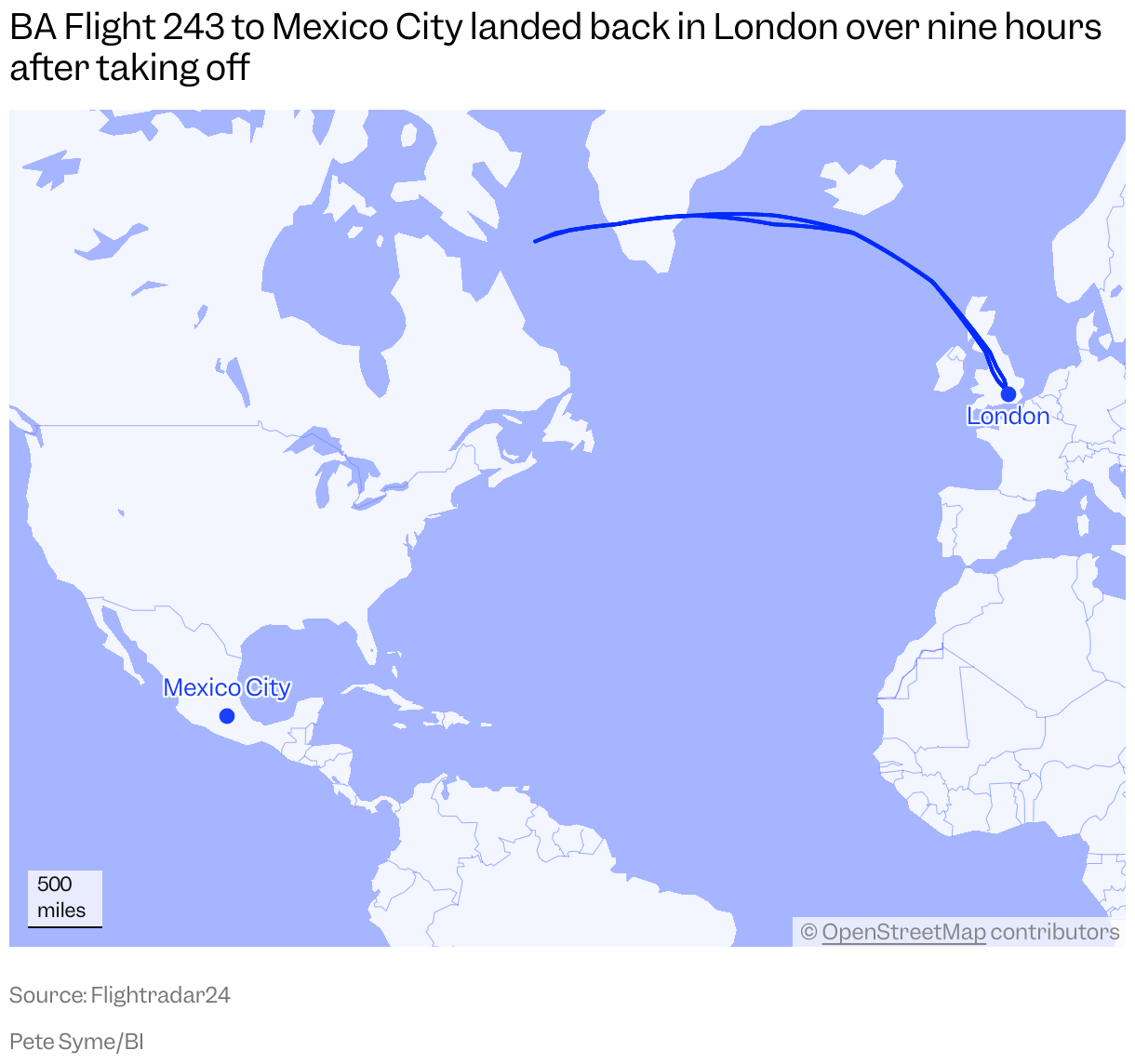
    Wednesday's Flight 243 took off from London Heathrow Airport at 1:22 p.m. and was supposed to land in Mexico City around 11 hours later.

    However, five hours into the journey, the Boeing 787 Dreamliner turned around over the Atlantic Ocean.

    It had already passed Greenland and was only about 150 miles off the coast of Canada's Nunavut territory, according to data from Flightradar24.

    The plane then headed back across the ocean, arriving in London just after 10 p.m.

    A map of the world showing the path of British Airways Flight 243 fron London to Mexico City on 10 December 2025, which diverted over the Atlantic Ocean and returned to Heathrow

    The airline said in a statement that the diversion was due to an unspecified technical issue.

    "The flight landed safely and customers disembarked normally following reports of a technical issue with the aircraft. We've apologised to our customers for the delay, and our teams are working to get their journeys back on track," the statement said.

    It can be frustrating for passengers when they're diverted to their origin — a so-called flight to nowhere — but often it's the best course of action.

    Returning to Heathrow, BA's main hub, makes it easier for the airline to rebook passengers on alternative flights and fix any problems with the aircraft.

    Diverting elsewhere might have also left the plane and crew out of place, disrupting the airline's schedule. Plus, a stopover in Canada or the US may have caused the crew to reach their maximum working hours.

    When BA Flight 243 turned around, its closest airport was Iqaluit in northern Canada, less than 300 miles away.

    Some flights have diverted to this remote town in the past, but it can ultimately be more disruptive.

    Last year, an Air France flight diverted to Iqaluit after a burning smell was detected in the cabin.

    The pilots declared an emergency, and a different plane was rerouted to rescue the passengers. It was originally scheduled for another flight, so that had to be canceled. Passengers were then taken to New York, where they were rebooked onto other flights to reach their intended destination of Seattle.

    Ultimately, it depends on how urgent the diversion is, since safety is the top concern.

    However, if possible, returning to the flight's origin can be the simplest option for both passengers and the airline.

    Read the original article on Business Insider
  • Russia’s wartime consumer boom is cracking as shoppers tighten their wallets

    People spend time at the GUM Shopping Mall in Red Square, Moscow, Russia.
    Russia's consumer boom after the Ukraine invasion is cracking under economic strain.

    • Russian shoppers are slamming the brakes, a warning sign for the wartime economy.
    • The central bank reports fading demand, slowing wage growth, and increasingly nervous households.
    • With oil and gas revenues sliding and the labor market cooling, Russia's economic engine is sputtering.

    After years of wartime splurging, Russian shoppers are tightening their grip on their wallets — a shift that hints at growing stress in the country's economy.

    Growth in consumer spending has weakened across most regions, the Central Bank of Russia said in a report published Wednesday.

    In October and November, demand softened even as unemployment remained near historic lows and inflation expectations ticked higher.

    "According to retailers across the country, an increasing share of products are being purchased during promotions, sales, and discounts. Household behavior has become more frugal," according to the central bank report.

    Retailers in many regions report weakening demand for big-ticket and nonessential goods, marking a clear cooling after the post-2022 consumer boom.

    "More subdued consumption may indicate a gradual reduction in labor market overheating and more moderate expectations for future income dynamics," wrote Russia's central bank.

    Russia's wartime boom is losing momentum

    It's a notable shift for an economy that witnessed a boom in consumer spending after Russia's full-scale invasion of Ukraine in February 2022, even amid sweeping sanctions against Moscow.

    That boom was fueled by surging defense spending and intense competition for scarce workers. Wages jumped, and many households went on spending sprees.

    Now, that momentum appears to be fading.

    Wage growth has slowed, and firms across multiple regions report reduced manpower demand and less urgency to hire, reflecting a cooling labor market, according to the central bank report.

    Many firms told the central bank they expect even more modest wage increases in 2026, suggesting that households may be bracing for leaner times.

    The central bank's latest report arrives as Russia's full-scale war in Ukraine approaches its fifth year, and the limits of wartime economic stimulus become more apparent.

    Oil and gas revenues — the backbone of Russia's budget — dropped 34% year-over-year in November.

    Even before this, analysts had warned that Russia's economy was being sustained largely by defense spending, subsidies, and emergency policy interventions.

    Top officials had sounded alarms. In December 2023, Elvira Nabiullina, Russia's central bank governor, warned that the economy was at risk of overheating.

    Last June, the head of Russia's largest bank said the economy was "definitely and strongly overheated."

    Meanwhile, a deepening demographic crisis and ongoing competition for labor between the military and industry continue to weigh on Russia's growth prospects, both now and in the years ahead.

    Read the original article on Business Insider
  • What smart people are saying about Disney’s licensing deal with OpenAI

    Minnie and Mickey Mouse at Disneyland
    What analysts and media experts are saying about the Disney-OpenAI licensing agreement.

    • OpenAI announced Thursday it had struck a deal to license Disney's characters and other IP.
    • It's a major shift for Disney, which has historically been deeply protective of its IP.
    • One media expert said that Disney was solving two big problems with this partnership.

    It's likely just a matter of time before we see the wisened duo of Rafiki and Jiminy Cricket weilding lightsabers on the icy plains of Arendelle.

    That's courtesy of artificial intelligence, of course, and a new deal between Disney and OpenAI.

    OpenAI said Thursday it had struck a licensing agreement to use Disney's characters and other intellectual property. Disney will also invest $1 billion in OpenAI and will purchase ChatGPT Enterprise for its employees.

    It's a major shift for Disney, which has historically been deeply protective of its intellectual property. And it's a big win for OpenAI, which is on a quest for more content to feed its AI models.

    For users, the deal will enable them to recreate Disney characters on Sora, OpenAI's short-form video generation app, and to create images of Disney characters using ChatGPT.

    Beyond the limitless possibilities for creative content, the deal reveals a lot about Disney's strategy in the AI age and the impact of artificial intelligence on the future of entertainment.

    Here's what some smart people in media, tech, and business are saying about the deal.

    Nick Cicero, entrepreneur and digital strategist

    For Nick Cicero, the founder of Delmondo, a social media video analytics company that was acquired by Conviva in 2018, Disney's deal with OpenAI is less about AI and more about revenue.

    Cicero argued in an X post on Thursday that Disney was aiming to solve two "existential" problems: creators using unauthorized Disney content and kids watching YouTube instead of Disney+.

    "Sora gives Disney its first scalable way to pull creator-made content into its own premium ecosystem — brand-safe, trackable, legal, and ready for CTV monetization," he said, referring to the practice of delivering targeted advertising to internet-connected televisions.

    "This move isn't about tech," he added. "It's about revenue physics."

    Peter Csathy, media consultant

    Chatbots like ChatGPT rely on data to power their outputs, and when it comes to collecting that data, AI companies are insatiable.

    The drive to collect data often pits AI companies against content creators. Numerous media companies have sued OpenAI, Anthropic, Perplexity, and other leading AI outfits for using their copyrighted content without permission. Other media companies, like Business Insider's parent company, Axel Springer, have struck deals with AI companies to license their content.

    Peter Csathy, a longtime media consultant and analyst, said Disney's deal with OpenAI is a "watershed" moment for AI and media licensing.

    "Now THIS is a generative AI use that makes sense to me and I support," Csathy wrote on LinkedIn. "Fully licensed characters, thereby respecting copyright and embracing partnership with the creative community (rather than theft of IP). New revenue streams for IP rights-holders. And overall delight by fans of those beloved characters."

    Caroline Giegerich, AI and marketing strategist

    There are just so many cease-and-desist letters a media lawyer can send.

    Carline Giegerich, a vice president at the Interactive Advertising Bureau who once led emerging tech at HBO, says Disney's deal with OpenAI feels like a "can't beat 'em, join 'em" moment.

    "When I was at HBO from '05 – '09, I marveled at the sheer volume of cease and desists from the legal team when mobile video was up and coming," she wrote on LinkedIn. "I thought it seemed difficult to fight against the entire internet, and it turns out it was. And AI presents a similar challenge."

    She also said the deal presents a valuable marketing opportunity for Disney.

    "Important to note that a selection of these fan-created videos will be available to stream on Disney+. What that means to me is that Disney sees this also as a marketing and content opportunity, which it is," she said.

    James Miller, head of business development at Amazon

    Disney's pivot from aggressively defending its IP at every turn to giving it over to the world's leading AI startup might be strategic for another reason.

    James Miller, the head of business development at Amazon for media, entertainment, and Amazon Creators, said he suspects it's a matter of "controlling the inevitable."

    Any IP eventually enters the public domain. In 2024, the copyright for Mickey Mouse himself — at least the sans white gloves version of the 1930s — expired, allowing anyone to use his likeness. Winnie the Pooh, Snow White, Cinderella, and a handful of other Disney characters also entered the public domain at the same time.

    "By officially licensing these characters now, Disney does three things," Miller wrote on LinkedIn. "1. Monetizes the AI trend rather than just fighting it in court. 2. Sets the quality standard for how their characters appear in AI video (likely drowning out lower-quality unauthorized versions). 3. Captures data on how fans want to use their IP before they lose exclusive rights."

    Karl Haller, partner and Consumer Center of Competency leader at IBM

    One consumer expert said that Disney might have gotten the short end of the stick in this partnership.

    "Looks like OpenAI used the #jedimindwarp on The Walt Disney Company, not the other way around," Karl Haller, an IBM partner and the leader of the firm's Consumer Center of Competency, said in a post on LinkedIn.

    He said he was "more than a bit surprised" to see that Disney is letting OpenAI license its IP for Sora and other AI tools, with some of the videos being made available to stream on Disney+.

    "And what does Disney receive for this? Negative $1 billion," he wrote. "Rather than receiving a heftly license fee, Disney is instead investing $1B in OpenAI and receiving warrants to buy more in the future."

    Simon Pullman, entertainment co-chair at Pryor Cashman

    One entertainment lawyer pointed out that the deal comes with a lot of unanswered questions.

    "This is a fairly stunning story all round with many questions," Simon Pullman, a partner at law firm Pryor Cashman, wrote on LinkedIn on Thursday.

    "Will audiences want/accept 'AI UGC' on Disney Plus," he wrote, referring to user-generated content. "Will it be possible for Disney to unring the bell after three years and not extend the license? How will they protect against misuse and brand damage?"

    Mike Walsh, technological change consultant and author

    Disney's $1 billion bet on AI is the right move for the media giant, according to Mike Walsh, the CEO of consulting firm Tomorrow.

    "By partnering with OpenAI while suing Midjourney and warning Google, Disney is drawing a clear line," Walsh wrote on LinkedIn on Thursday. "Remix culture isn't going away, but it will be licensed, governed, and designed on its terms."

    He added that Disney has always survived new media eras with this strategy.

    "The future of entertainment belongs to companies that shape participation instead of fighting it," he wrote.

    Read the original article on Business Insider
  • Uber CEO says robotaxis are a ‘trillion-dollar-plus’ business — and one market will drive the boom

    uber ceo Dara Khosrowshahi
    Uber CEO Dara Khosrowshahi says robotaxis are a "trillion-dollar-plus" market and expects Asia to drive the wave of autonomous expansion.

    • Uber CEO says one market will lead the robotaxi boom.
    • Dara Khosrowshahi said robotaxis are a "trillion-dollar-plus" industry and Asia has major potential.
    • The ride-hailing giant has been leaning hard into autonomous driving.

    Uber is preparing for a robotaxi surge, and its CEO says one market will drive it.

    Dara Khosrowshahi said in an interview with Bloomberg Television published Friday that robotaxis are a "trillion-dollar-plus" opportunity and Asia is a huge growth market for the ride-hailing giant.

    "I expect to be in 10-plus markets by next year. And we want those markets to be in the Asia-Pacific region as well," Khosrowshahi said. Uber has self-driving vehicles in the US and the Middle East.

    Analysts have long touted autonomous mobility as one of the biggest bets in the transportation industry. In 2023, McKinsey estimated that if robotaxis and roboshuttles scale, the shared-mobility market could reach $1 trillion by 2030.

    Khosrowshahi said Japan has "great potential" for its robotaxi push, despite being behind in regulation.

    "With an aging population, there's a real need for transportation, not just in the large cities but in the rural areas," he added. He also pointed to Hong Kong and Australia as potential key markets for its robotaxi services.

    Khosrowshahi said Uber now works with more than 20 autonomous-vehicle partners — including China's Baidu, WeRide, and Pony.ai, as well as Waymo in the US.

    "We will have access to autonomous technologies in the large cities and markets that really count," he added.

    With a market that large, Khosrowshahi said autonomous driving is unlikely to be a "winner-take-all" industry.

    "It's an exciting technology, but there are many players getting to the finish line," he said.

    "We just have to make sure that the players that we work with are safe and that again, we're working with the regulators in a constructive manner," he added.

    The hype around robotaxis

    Uber has been leaning hard into autonomous driving. During its third-quarter earnings call in November, Khosrowshahi said the company is already seeing signs that robotaxis can boost demand.

    "The biggest scale operations that we've got are with Waymo in Austin and Atlanta," Khosrowshahi said. "And what we are seeing is that those markets are growing faster than other US markets," he added.

    Other industry leaders have also been hyping the sector.

    Tesla CEO Elon Musk has repeatedly said that robotaxis will power the company's growth. In May, Musk said in an interview with CNBC that Tesla would hit one million self-driving cars by the end of next year, a claim he also made in 2019 that did not materialize.

    The path to profitability remains murky. HSBC analysts warned in July that the robotaxi market has been "widely overestimated," and said it could be years before fleets make real money.

    Even the most advanced players are burning cash. Alphabet's "Other Bets" division — which includes Waymo, as well as other subsidiaries — lost $1.42 billion in the third quarter.

    The cost of an autonomous driving vehicle is steep. Analysts estimate that each Waymo vehicle costs about $150,000 to produce. The high costs have squeezed some companies out of the robotaxi market, including Ford and General Motors.

    Read the original article on Business Insider
  • Canada is figuring out what to do with its stockpiles of US alcohol

    B.C. liquor stores remove U.S. alcohol in tariff retaliation
    Canadian provinces removed American liquor from store shelves earlier this year.

    • Most Canadian provinces pulled US booze off their shelves in March to protest Trump's tariffs.
    • Now, some are selling their stockpiles to raise money for food banks and charities ahead of the holidays.
    • Manitoba, Nova Scotia, Prince Edward Island, and Newfoundland are four such provinces.

    Canada is coming up with ways to put its stockpiled American liquor to good use.

    Several provinces in the country halted imports of US booze and removed it from store shelves in March in response to President Donald Trump's tariffs.

    Now, at least four provinces are planning to sell the remaining inventory and donate proceeds to food banks.

    Canada's far eastern province, Prince Edward Island, told Business Insider that its government will put its stock of American booze, which it had pulled off the shelves, back in stores starting on December 11.

    A representative for the province's finance department said the government anticipates profits of $600,000 Canadian dollars, or about $434,000, from the sale. The proceeds will be distributed to food banks across the island. The province says it does not intend to place any further orders for American alcohol.

    The finance office of Newfoundland and Labrador told Business Insider it had made an upfront payment of $500,000 on Tuesday to 60 provincial food banks before the sales of any liquors, a move that will help more than 15,400 people. After the liquor is sold, more donations will go to the food banks for a total sum of up to $1 million.

    Manitoba and Nova Scotia have similar plans.

    Manitoba said it will sell its inventory through private retailers and restaurants, with the estimated $500,000 in net revenue going to food banks, holiday charities, children's organizations, and an advocacy group for First Nations.

    As for Nova Scotia, the province is making a $4 million upfront payment to groups that provide food access, and the money will be recouped when the $14 million worth of liquor is eventually sold.

    "We will not be ordering any more from the United States once this inventory is gone," the province's premier, Tim Houston, said in a statement. "But Nova Scotians have already paid for this product."

    He added, "We don't want it to go to waste. That's why we're selling it and using the proceeds to help those in need."

    In Canada, the sale of alcohol is mainly controlled by provincial governments, each of which establishes a board to oversee the matter. Only Alberta has a completely privatized alcohol retail system, while Saskatchewan has a partially privatized system.

    Canada mainly imports whiskey and bourbon, alongside beer and other spirits, from the US.

    Other provinces have different plans

    The provinces are not taking a one-size-fits-all approach to dealing with their stockpiles of American booze. Some are still undecided about what to do, while others have already sold off their inventory earlier in the year after ceasing imports.

    A spokesperson for Ontario's finance ministry told Business Insider that the province had no plans to put the booze on store shelves soon.

    "US alcohol will remain off shelves and is being held in storage until further notice," said the spokesperson. "We are currently exploring options for the products."

    Ontario did not disclose how much inventory it still has, but the province said the inventory it had pulled off the shelves in March was worth around C$80 million.

    A government representative from the Northwest Territories and a spokesperson of the British Columbia Liquor Distribution Branch both told Business Insider that they ceased US liquor imports in March, but will continue selling the stockpiled products until they are depleted.

    A Yukon government cabinet representative said Yukon has the same plan.

    However, the mountainous province of Alberta continues to import and sell American booze.

    "In June this year, Alberta lifted restrictions on the purchase of US alcohol from American companies, signalling a renewed commitment to open and fair trade with our largest partner," a spokesperson of Service Alberta and Red Tape Reduction told Business Insider.

    American distillers are hurting

    The matter of US booze has been fueling the trade tension between the two neighbors.

    The animosity started when Trump imposed a 25% tariff on Canada in March and commented that Canada should become a state of the US.

    Despite later walking back some of his broader tariffs and upholding a previous agreement that ensured most goods remain tariff-free, Trump's moves have drawn the ire of Canadians, who have canceled travel plans and boycotted American goods in stores.

    According to the Distilled Spirits Council, US spirits exports to Canada plummeted 85% in the second quarter of 2025, falling below $10 million in export value.

    "We hope both the US and Canada can address their respective concerns," said Chris Swonger, the CEO of the council. "And that our products can return to Canadian retail shelves as soon as possible."

    In March, Kentucky's bourbon makers said Canada's ban on American alcohol would hurt them.

    Eric Gregory, the president of the Kentucky Distillers' Association, said in March that retaliatory tariffs would have "far-reaching consequences across Kentucky, home to 95% of the world's bourbon."

    Read the original article on Business Insider
  • Lululemon is dialing back the in-store clutter

    Items are displayed in a Lululemon store on April 03, 2025 in Miami Beach, Florida.
    Lululemon's executives said the company would be improving its in-store experience.

    • Lululemon is making changes to its inventory-packed stores.
    • Company executives said they would reduce the number of products in stores and highlight specific items.
    • In recent months, analysts have criticized Lululemon's bad store experience and fragmented assortment.

    Lululemon knows it's got a store layout problem, and it's rolling out a fix.

    During a Thursday earnings call, company executives announced plans to enhance the athleisure giant's in-store experience by reducing clutter and curating pieces better.

    "We plan to reduce the density of our assortment on a local basis to better highlight styles that are most relevant," Meghan Frank, Lululemon's finance chief, said.

    "This will enable improved visual merchandising for the styles we know are most important to the guest in each local market," she added.

    CEO Calvin McDonald added that the company was testing the new store experience in Los Angeles and Miami, working on "curating the stores, desorting, taking product out, so that we could put focus on the newness."

    Representatives for Lululemon did not respond to a query from Business Insider regarding when the changes will be implemented across all stores.

    The plan to improve store experience comes after analysts have criticized it for months.

    Jefferies analysts said in a November note that Lululemon's store layout "appeared disjointed, with an inconsistent color palette and lack of design cohesion."

    In an October note, they said the collection was "fragmented" and featured many "logo-heavy designs" that are not resonating with its core audience. An August note said that store inventory was "very high" as the brand tried to clear aged stock.

    A July Jefferies note, analysts said some of the stores they visited were missing critical stock, like the brand's yoga leggings without front seams.

    Lululemon reported a third-quarter revenue of $2.6 billion, a 7% increase from the same period last year. Its net revenue in the Americas decreased 2%, while its international sales increased 33%, buoyed by strong sales in China.

    McDonald announced in the call that he would be stepping down at the end of January. Frank, as well as the CCO, André Maestrini, will serve as interim co-CEOs until the company finds a replacement for McDonald.

    Its stock rose more than 10% in after-hours trading on Thursday after earnings and the announcement of McDonald's resignation. However, it's down about 50% since the start of the year.

    Read the original article on Business Insider