Shoppers line up in front of an Amazon Fresh store
David Crane/MediaNews Group/Los Angeles Daily News via Getty Images
Amazon is working on a new "rush" pickup service for one-hour in-store collection.
The service aims to boost rapid delivery and leverage Amazon-owned stores such as Whole Foods.
Amazon faces tough competition in click-and-collect sales from Walmart and Target.
Amazon wants more shoppers to get orders within an hour. A new kind of in-store pickup could be its next move to make that happen.
Amazon is developing a "rush" pickup service that will let shoppers collect their orders at Amazon-owned stores within an hour, according to an internal document and a person familiar with the matter.
Shoppers will be able to place a "unified" order from both Amazon's online marketplace and items stocked in Amazon-owned stores, the document explained. The company operates several physical retail formats, including Whole Foods, Fresh grocery stores, and Go convenience stores.
The tech giant plans to pilot-launch the new program in at least one metro area by the first quarter of 2026, according to this document. The initiative is tracked by Amazon's SVPs, the most senior group of leaders at the company, it noted. However, it's uncertain whether that timeline is still in effect, said the person familiar, who spoke on the condition of anonymity because they were not authorized to speak to the press.
Just last week, the company launched Amazon Now, a new 30-minute delivery service in parts of Seattle and Philadelphia. It has also been testing similarly quick delivery offerings in countries such as the UK, India, and Mexico.
For those who want to pick up in-store, Amazon currently offers next-day pickup on some US online orders. Grocery subscribers can also collect select items in as little as 30 minutes.
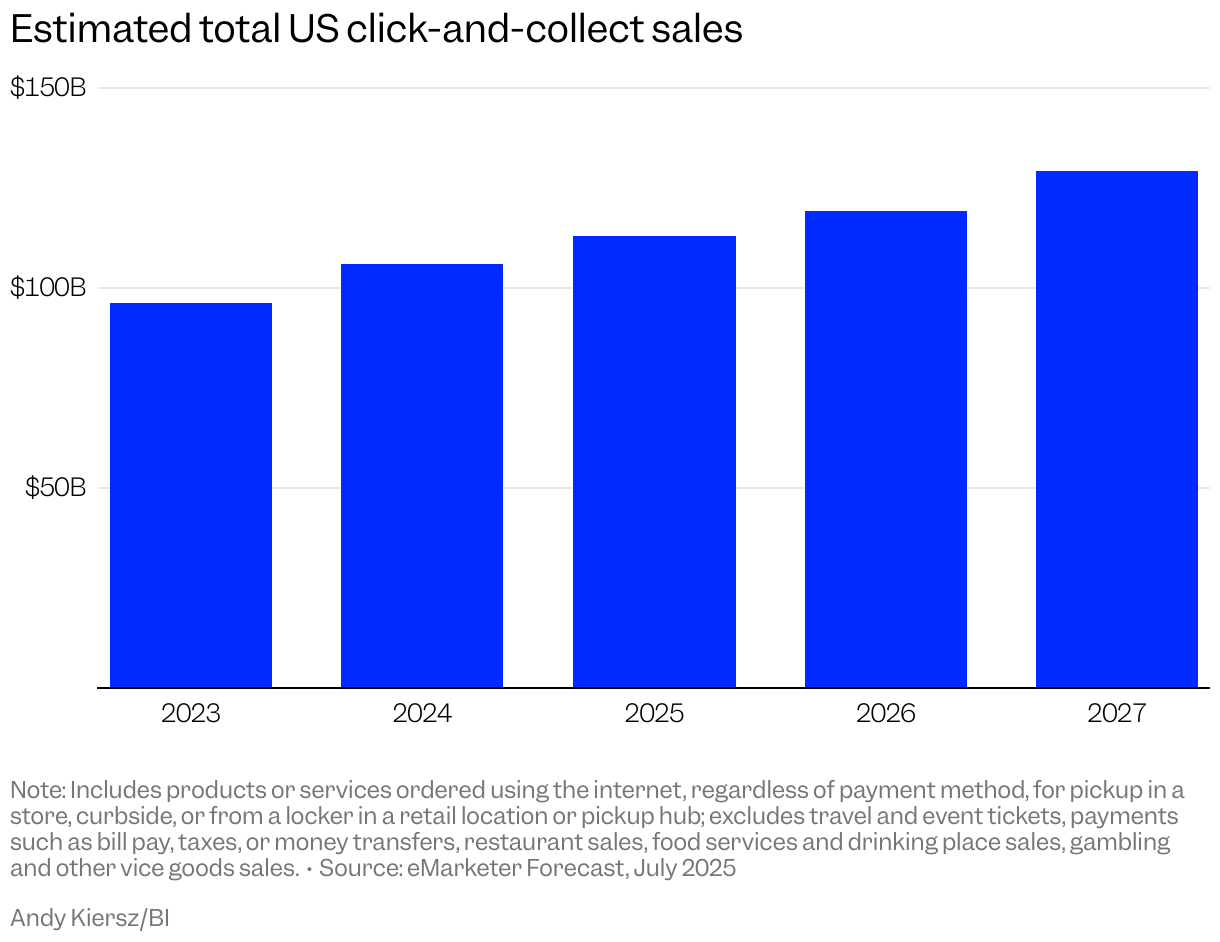
In-store pickup, often referred to as "click-and-collect," is surging in e-commerce. Total US sales from click-and-collect services are expected to hit $112.96 billion this year, up 17% from 2023, and grow to $129.33 billion by 2027, according to eMarketer. The research firm projects roughly 152.9 million Americans, or 68% of digital buyers, will use click-and-collect in 2025.
Amazon leads e-commerce by total sales, but Walmart may have an advantage when it comes to delivery speed. Thanks to its network of more than 4,600 US stores, Walmart can reach roughly 95% of American households within three hours. Walmart is the leader in click-and-collect services with a projected $38.50 billion in sales this year, eMarketer data shows.
According to the internal document, Amazon expects the new "rush" pickup service to meet "a key customer need for faster, more convenient access" to its full product selection, while making better use of its physical store network and logistics infrastructure.
"By piloting this capability, we can validate customer demand for rapid pickup while learning how to effectively combine our physical and digital offerings," the document stated.
Tim Chonacas co-founded Gold Tree Studios in Hollywood.
Jordan Naylor/Getty Images for SXSW; Patrick T. Fallon / AFP via Getty Images
Gold Tree Studios, a Hollywood post-production company, filed for Chapter 11 bankruptcy.
The move comes after the firm's parent company said it obtained $1 billion in financing to grow.
The firm provided post-production services for the coming film, "Lear Rex," starring Al Pacino.
A Hollywood post-production company tied to the upcoming film "Lear Rex" starring Al Pacino and Jessica Chastain filed for bankruptcy protection on Tuesday.
Gold Tree Studios, a three-year-old firm offering post-production rental suites, editing, sound mixing, color grading, and more, filed for Chapter 11 reorganization just months after its parent company announced a $1 billion financing deal intended, in part, to grow the studio.
"This investment expands our studio footprint & production slate, bringing more jobs & opportunities to LA and beyond," Gold Tree Studios wrote in a March X post about the lump sum its parent company, Gold Tree, secured from the global investment firm Malka Group.
Gold Tree Studios filed for bankruptcy as a small business seeking protection under Subchapter V of Chapter 11.
The filing, submitted in federal California bankruptcy court, shows that the firm — one of several subsidiaries that make up Gold Tree — holds between $100,000 and $500,000 in assets and between $1 million and $10 million in liabilities. The company also listed between 1 and 49 creditors.
It was not clear from the bankruptcy court filings what led to Gold Tree Studios' financial troubles.
Representatives for the company, as well as its bankruptcy attorney, did not immediately return requests for comment by Business Insider on Wednesday. Representatives for Malka Group also did not immediately return a request for comment.
Gold Tree was founded by entrepreneur Tim Chonacas, who also serves as the company's CEO, and late veteran Hollywood executive William Immerman.
The pair launched the company's film production arm, Gold Tree Films, in 2018 and Gold Tree Studios in 2022, with its flagship location on the Sunset Strip in West Hollywood. Gold Tree's other subsidiaries include Gold Tree TV and Gold Tree Podcasts.
"The cutting edge facility set a new standard for post-production services," the company's website says about Gold Tree Studios. "Despite industry strikes, Chonacas kept the studio afloat and expanded to Buffalo, NY, and Vancouver Island, Canada."
The facility provided post-production services for the forthcoming Bernard Rose-directed flick "Lear Rex," an adaptation of William Shakespeare's "King Lear," Deadline previously reported.
In the film, which does not yet have a release date, Pacino stars as King Lear. The cast also includes Ariana DeBose, Peter Dinklage, Rachel Brosnahan, Stephen Dorff, and Danny Huston.
Sima Sistani starts her day with a daily affirmation and ends it with a fantasy romance read.
Kate Medley for BI
This as-told-to essay is based on a conversation with Sima Sistani, an entrepreneur, adjunct professor at Duke University, and former CEO of WeightWatchers. Before that, she joined the senior leadership team at Epic Games after selling her startup, Houseparty, to the video game company. She lives in Durham, North Carolina, with her husband and two children. The following has been edited for length and clarity.
After I parted ways as CEO of WeightWatchers, I called Oprah for advice. She was no longer involved with the company, and she's a friend.
She told me, "Give yourself a year to say no to everything. Take this time to be with yourself and your loved ones."
And so I did that.
It was really good advice because it would have been easy when the calls started — "Hey, do you want to think about this role or that role?" — to move on to the next thing. Then I could answer the question, "What do you do?"
Sima Sistani teaches a course on women's leadership at Duke University.
Kate Medley for BI
One year later, I'm now an adjunct professor at Duke University, my alma mater, teaching a new course on women's leadership. I sit on the board of Best Buy. I invest in startups and funds.
My husband likes to say I'm the busiest unemployed person he knows.
Here's what my day looks like.
I wake up at 6 a.m. to an alarm clock
When I was at WeightWatchers, I got into the habit of using an alarm clock. It's a way for me to set boundaries.
I realized I was chained to my phone. My instinct is to get on top of things. So when my alarm went off, I would look at my phone and get sucked in.
I read a daily affirmation. I'm reading from "The Book of Awakening" by Mark Nepo.
Once I get out of bed, I put on my Beyond Yoga athleisure and Goop under-eye patches and tie my hair into a ponytail. Then I go downstairs and pour the coffee.
I take mine with half-and-half, cinnamon, collagen powder, and a couple of Brazil nuts to mitigate the acidity on an empty stomach.
My mom cooks breakfast for her grandchildren
I wake up my youngest child with a song, usually a pop diva track. Right now it's "Fate of Ophelia" by Taylor Swift.
Then it's pandemonium for an hour.
My parents live four houses down, and so most mornings, my mom short-order cooks for the kids. They'll have French toast, eggs, popovers, or something pretty exciting compared to my Cinnamon Toast Crunch when I was growing up. I know. It's amazing.
My husband, Alex, takes the kids to school on his way to work.
Sima Sistani lives in Durham, North Carolina, with her husband and two children.
Kate Medley for BI
I read an actual newspaper
I drink my coffee and read, usually sitting outside on the patio.
I get The New York Times delivered because that was another mental health hack. I no longer let the algorithms decide what I should be reading.
This past year, I completed my 200-hour yoga teacher training and certification.
I don't want to be dramatic, but it was a life-changing experience. I didn't grow up in a religious home, and so yoga has given me a spiritual framework.
When, suddenly, you no longer have a way of saying what you do for work — "I'm the CEO" or "I'm the founder" — you have to figure out who you are and what your identity is outside work.
Thankfully, I've reached a point of financial security where I can take the time to think about what I want to do — and make sure I do it in a way that is good for me and good for others.
I prepare my talking points for class
I eat a breakfast of yogurt topped with granola and berries, and tackle some work at my computer in the kitchen.
Some days I have a board call or meetings with founders. I'm incubating some new brand ideas in the consumer packaged goods space, which is a departure from my comfort zone of 0s and 1s.
Wednesdays are dedicated to preparing my talking points for class.
She eats yogurt with granola and berries for breakfast.
Kate Medley for BI
Last year, I spoke to a group of students in Duke's Innovation and Entrepreneurship program. I noticed there were a lot of guys.
Professor Jamie Jones, who runs the program, asked if I would be willing to teach a class. I said yes, if I could teach one that was geared toward women.
I wanted to show students that entrepreneurship can look a lot of different ways and doesn't just mean that you're coding and eating ramen in a studio apartment somewhere.
Entrepreneurship means writing new rules, and we need the next generation of women to write the new rules.
I take my guest speaker on a campus tour
Each week, I bring in a guest speaker. They're peers in my life who I've learned from, who have amazing stories.
Kat Cole is the CEO of AG1, but she dropped out of college and rose through the ranks of Hooters. Jeni Britton built an ice cream business, Jeni's Splendid Ice Creams, after being an art major and living out of her car. Hannah Chody was a Goldman Sachs vice president who left to join her family business, then fell into becoming a social media influencer.
Around 2 p.m., I usually meet the guest, or sometimes the person stays with me. It's about a 12-minute drive through the Duke Forest from my house to campus.
I usually give the guest speaker a campus tour. Duke Chapel is a highlight.
Sima Sistani walks her guest speaker, Jeni Britton, around campus before class.
Kate Medley for BI
I teach from 3 p.m. to 5:30 p.m.
The class meets for two and a half hours every Wednesday. The first half is a discussion of what we learned the week before, and the other half is a Q&A with the guest. Students ask questions, too.
I bring a portable speaker to play the guest walkout music. I was inspired by Jennifer Hudson's "spirit tunnel."
Most of it is the stuff that they won't say on a podcast. It's a moment for them to really engage with these 44 women.
I ask them, "What do you wish you knew when you were 20?"
After class, I take the guest to dinner, usually Little Bull or M Sushi in Durham.
I escape with fantasy romance books
When I get home, I snuggle up with the kids and hear about their day.
I used to escape my day with TV, and then I would stay up late. I'm watching less TV now that I don't work. When you're feeling pretty chill throughout your day, you don't need to wind down.
I'm in my bed by 10:30 p.m. I'll grab my Kindle and escape into a good book.
Actually, Jenni and I talked about our enjoyment of romantic fantasy books. I just finished "A Court of Thorns and Roses" series and started "Fourth Wing."
It's too bad that out in the world we call it 'smut,' but when it's "Game of Thrones," it's fine for everybody.
Leslie Snipes secured approval from her manager to work remotely after struggling with her LA commute.
She said she made the case for why working from home would benefit her personally and professionally.
Working remotely has been a game changer for her, even though she misses some parts of office life.
This 'as-told-to' essay is based on a conversation with Leslie Snipes, a 34-year-old director of marketing at a Los Angeles-based creative agency who lives in Reseda, California. Her words been edited for length and clarity.
When I started my director of marketing job in January 2024, the expectation was that I'd work from the office at least once a week. But because I was in a director-level role, I felt a bit more obligated to show face.
For the first few months, I made the 30-mile, 60- to 90-minute commute to our Los Angeles office a couple of days a week. Over time, the commute began to take a toll on me. I was wasting hours a day sitting in LA traffic.
In April 2024, after weighing my options, I decided to speak with my manager and ask if I could work mostly from home — coming into the office only as needed, along with any travel obligations. My request was approved in less than a day.
How I made the case for work-from-home flexibility
I started the conversation with my manager by being transparent about my commute and the challenges it was creating for me. I would often arrive home feeling mentally drained, frustrated, or short-tempered after commuting, which affected my energy and overall well-being in the evenings. Additionally, the wear and tear on my car, along with the gas costs, were becoming outrageously expensive.
I also shared that I believed I'd be a better worker without the strain of the commute, because I could spend more time actually working rather than sitting in traffic. Most of the company's clients were based on the East Coast — rather than LA — so most of my work could be done remotely from my computer and through Zoom calls.
I emphasized my performance
From a team camaraderie perspective, some of our strongest bonding happened during travel and off-site projects, rather than in the office, so I noted that working remotely wouldn't take away from that sense of connection.
Overall, I emphasized that working from home would allow me to deliver my best work without compromising collaboration or team culture — and I think that approach was effective.
After speaking with my manager and another manager, they were very understanding and accommodating. Since my role involves some travel, the managers said they considered that to be a form of in-office time, as I'm still interacting with colleagues in person.
More than anything, they recognized that work-from-home flexibility would help me perform at a higher level — and they trusted me to deliver on that.
WFH has been a game changer — I'm glad I asked for it
The biggest perk of my work-from-home flexibility is that I feel much more efficient with my time — both personally and professionally. It gives me greater autonomy over my schedule, which helps me manage my workload more effectively and leaves me more energized and present when meeting with the team.
I'm also a bit of an introvert, and I find it harder to focus when I'm surrounded by a lot of people. I tend to get more distracted in the office than when I'm working alone. Now, instead of showing up to be "a body in the room," I can focus my energy on strategy, creative work, and client engagement.
Working from home has also reduced my stress, since I'm no longer spending hours in traffic just trying to get to work on time.
There are some things I miss about working in the office
Despite these benefits, I sometimes miss grabbing lunch and coffee with coworkers and talking about non-work-related things. When I'm working from home, I mostly interact on an as-needed basis, and there's less spontaneity with coworkers outside work.
I typically make the commute to the office once or twice a month to connect in person with my colleagues, in addition to whenever circumstances warrant it.
Overall, the shift has been a game changer for me — and it's a setup I wouldn't have if I hadn't asked.
Dominick DiBartolomeo, the owner of the Cheese Store of Beverly Hills, says going viral on social media has helped reinvigorate his business.
Courtesy of Dominick DiBartolomeo
Dominick DiBartolomeo said TikTok virality drew in waves of younger customers to his cheese store.
The Cheese Store of Beverly Hills has repeatedly pivoted due to the pandemic and tariff uncertainty.
Appealing to younger customers has helped reinvigorate the store, which has been open since 1967.
This as-told-to essay is based on a conversation with Dominick DiBartolomeo, owner of the Cheese Store of Beverly Hills. It has been edited for length and clarity.
When I bought the Cheese Store of Beverly Hills, my goal was to honor its legacy while making it feel fresh and relevant.
The shop has been around since 1967 and already had decades of goodwill, but I wanted to create something familiar and new, so we added sandwiches, salads, cheese boards, and wines by the glass.
I didn't expect the flood of teenagers.
My daughter is 16, and I like to say her generation arrived armed with Instagram. They started filming everything — and some of those videos went viral.
Suddenly, we had crowds of teens lining up for a place that had historically catered to adults, chefs, and longtime Beverly Hills locals. It completely changed the energy of the shop.
This year has been one of our toughest
People know our products are premium, but they don't see how volatile the economics have become.
We import directly from Europe, mainly Italy. At the beginning of the year, tariffs were 10%, and we absorbed as much of that as we could. However, the Euro then jumped from around $1.04 to about $1.17 or $1.18 — a 13% swing. As a result, the same products suddenly cost 23% more before they even reach our shores.
Then there are the Chinese tariffs, which people rarely think about, but almost all takeout packaging comes from China. Between packaging tariffs and ingredient tariffs, some costs have risen 50%, 60%, and even 70%. When that happens across your entire supply chain, the math stops making sense.
We tried everything before raising prices, from asking suppliers to share some of the tariff load to switching products, and eventually accepting lower margins. However, at a certain point, you can't absorb the costs.
Our sales are up this year, but our margins are down because our costs are so much higher. That's the reality for a lot of small specialty food businesses right now.
Our customers are still buying, but the middle is getting squeezed. The under-$25 customer remains rock solid, and diners spending $100 or more are also doing fine. It's the middle that's struggling, and that's where a lot of restaurants and gifting budgets live.
The next generation is extending the life cycle of my business
When we moved into our new location a couple of years back, I knew I had to take care of the older clientele who built this brand — but I also believed that if the shop didn't evolve, it would die.
Adding sandwiches and salads wasn't just about giving people something to eat while they browsed. It was a way to create a full experience. While customers wait for their sandwiches, they can try different cheeses in line. The whole place feels alive.
Then the influencers started showing up.
I didn't know who most of them were — I had to ask my daughter who people were after they left — but our Instagram following grew from 6,000 to around 280,000 in about a year and a half.
People now walk in and say, "I came here because you showed up on my feed." We even had a couple from Australia tell us this was their first stop off the plane for their honeymoon because we popped up on their TikTok feed.
The most exciting part is that the virality around the sandwiches has turned into virality around the cheese, too. Because of the way our line bends through the store, people waiting for sandwiches are sampling cheeses the whole time — and they film that. Now, young customers come in for a buzzy sandwich, discover a type of cheese they've never tried, and suddenly they're coming back for parties, holidays, or simply because they want something special.
We even launched a merch line because we noticed how many younger customers wanted something to take home. Seeing a longtime customer who's been coming in for 40 or 50 years standing next to a teenager in a Cheese Store hoodie is one of the coolest things I've ever experienced. It feels like we've made cheese buying cool again.
The Cheese Store of Beverly Hills serves more than 500 different cheeses, many of which were imported from Italy.
Courtesy of Dominick DiBartolomeo
What's happened is that this new generation has completely renewed the life cycle of the business. At the same time, our longtime loyal customers remain the backbone of who we are. Now the two groups stand shoulder to shoulder in the shop. It's a full-circle moment — we've managed to grow without losing our core.
I met my wife at the Cheese Store, where I was working while I couldn't afford a phone and was taking the bus to work. She supported me through everything — from raising money to buying the business and surviving the pandemic. Now we have 40 to 50 employees. All of their families rely on us.
That responsibility changes you. So does the joy of seeing the store full, watching our products show up in incredible restaurants, and witnessing teens discover a 57-year-old Beverly Hills cheese shop on social media.
OpenAI's head of business products flagged 3 jobs that could be automated in the next few years.
JULIEN DE ROSA/AFP via Getty Images
Three industries are going to look very different in some years, says an OpenAI head of product.
He said that life sciences would see a lot of automation, because admin can be automated.
AI leaders are flagging white-collar jobs that can be easily automated by newer models.
Three industries are going to look very different in the next few years, according to an OpenAI executive.
On an episode of the "Unsupervised Learning" podcast, Olivier Godement, the head of product for business products at the ChatGPT maker, shared why he thinks a trio of jobs — in life sciences, customer service, and computer engineering — is on the cusp of automation.
"My bet is often on life sciences, pharma companies," he said, about his first pick for industries on the brink of change because of AI.
Godement said that the goal of pharmaceutical companies like Amgen, with which he works, is to design new drugs. This has two components: actual research and experimentation, and admin, a time-consuming process that could be automated, he said.
"The time it takes from once you lock the recipe of a drug to having that drug on the market is months, sometimes years," he said. "Turns out like the models are pretty good at that. They're pretty good at aggregating, consolidating tons of structured, unstructured data, spotting the different changes in documents."
Godement joined OpenAI in 2023. He previously worked on products for Stripe for eight years.
On the podcast, Godement said that while we haven't reached a stage where "any white collar job" can be automated in just a day, he is starting to see strong use cases in fields such as coding and customer service.
"The automation is probably not yet at the level of automating completely the job of a software engineer,but I think we have a line of sight essentially to get there," he said.
The future of software engineering has been one of the most heated tech debates of the year, as AI-assisted coding enters most companies' workflow.
An Indeed study from October found that software engineers, quality assurance engineers, product managers, and project managers were the four tech jobs that have been axed the most during layoffs and reorgs.
Lastly, Godement said that customer-oriented roles like sales and customer experience may be automated soon.
"I've been working a bunch with the folks at T-Mobile, the telecom company in the US, to essentially provide a better experience to their customers, and we're starting to achieve fairly good results in terms of quality at a meaningful scale," he said. "My sense is we'll probably be surprised in the next year or two on the amount of tasks that can be automated reliably."
Across the board, AI leaders are flagging white-collar jobs that can be easily automated by newer large language models.
In a June podcast, Geoffrey Hinton, who is recognized as the "Godfather of AI," said that eventually, technology will "get to be better than us at everything," but some fields are safer than others in the interim.
"I'd say it's going to be a long time before it's as good at physical manipulation," Hinton said. "So a good bet would be to be a plumber."
The legal tech market is too big for one winner, says Harvey's CEO.
Winston Weinberg said Harvey serves only a small slice of the 10 million global legal professionals.
The legal tech startup announced last week that it has reached a valuation of $8 billion.
The legal tech market is only just beginning, and it's huge, says Harvey's CEO.
Winston Weinberg said during a Reddit "Ask Me Anything" session on Wednesday that the opportunity ahead for the legal tech industry is so massive that no single company — including his — could own it.
"I don't think a single player is going to capture all of the pretty enormous amount of value that will be created in the next 10 years in this space," said the CEO of the $8 billion legal tech startup.
Harvey announced last week that it raised $160 million in a round led by a16z, pushing the startup's valuation to $8 billion.
Despite being one of the most closely watched startups in the sector, Weinberg said Harvey is barely scratching the surface of who AI tools can reach.
"There are around 10 million global legal professionals, and Harvey serves just single-digit percentage points of them," he said.
He also said the legal tech sector represents only a tiny slice of the overall legal economy. The global legal market is worth an estimated $1 trillion, but only about $30 billion of that is spent on technology today, Weinberg said.
"Long term, it seems clear that technology penetration in the legal market will grow significantly," he said.
"If we build a great product, we hopefully capture some of that very large upside," Weinberg said, adding that there is "clearly" room for other legal AI startups.
Weinberg said the startup needs to "earn that valuation every day."
The share of monthly users who return daily is up 81% since the company launched in 2023, and lawyers using multiple features show engagement patterns "similar to Slack or email," said Weinberg.
"We have a long way to go with building out a full platform of use cases for lawyers," he added.
AI is coming for law firms
Weinberg said many legal tasks will be absorbed by technology.
"That doesn't mean the entire job of a lawyer gets consumed; it'll evolve," he added.
Weinberg told Business Insider in September that AI is already reshaping the industry, creating new practice areas while reducing the size of some in-house teams.
Some law firms are rethinking their staffing models entirely, flattening their traditional pyramid structures by relying more on associates and fewer partners, he said in an interview on the sidelines of TechLaw Fest in Singapore.
Younger lawyers who grew up using AI tools may gain an edge over senior partners when it comes to fluency, speed, and adaptability, he added.
AI has become an unavoidable part of lawyers' work. Five of the 10 largest US law firms by revenue told Business Insider in July they were already embedding AI into their workflows — including document review, legal research, and spotting compliance risks.
Investor enthusiasm has also surged alongside the transformation. Legal-tech funding reached $3.2 billion this year, according to Business Insider's December analysis of Crunchbase data and recent deals.
New footage of a ground-based drone firing an M2 Browning in combat shows how such platforms are increasingly being used in the war.
5th Separate Assault Brigade
Ukrainian forces said they used a fighting robot with an M2 Browning to take down a Russian MT-LB.
Footage shows the UGV firing .50 caliber rounds at its target on a road at night.
Such drones are increasingly appearing on the battlefield as a replacement for human soldiers.
A Ukrainian brigade has released footage of one of its uncrewed ground vehicles opening fire on a Russian armored personnel carrier, offering a rare glimpse at the emerging technology in action.
The 5th Separate Assault Brigade said on Wednesday that it deployed a Droid TW 12.7 — a remotely operated tracked system developed by a Ukrainian defense tech company — on a road deemed likely to be a route for advancing Russian troops.
The brigade said that the ground-based drone later encountered a Russian MT-LB, a lightly armored fighting vehicle often used to transport infantry.
Thermal footage filmed at night from the uncrewed ground vehicle, or UGV, shows it opening fire on the vehicle, its operator swerving a targeting reticle across the MT-LB's front.
Business Insider could neither independently verify when nor where the footage was filmed.
The Droid TW 12.7 is equipped with an M2 Browning machine gun that fires .50 caliber rounds, which would typically pierce an MT-LB's armor.
The 5th Brigade said it used armor-piercing incendiary rounds for the mission.
Sparks fly from the armored vehicle's chassis as it slows to a crawl and drifts in front of the UGV, which continues firing point-blank.
"The 12.7 mm bullets punch through the MT-LB's side, striking the crew and onboard systems," a narrator said in the 5th Brigade's video, referring to the metric measurement for .50 caliber bullets.
The MT-LB appears to be aimlessly crawling past the drone, indicating that its driver is incapacitated or its controls are damaged.
The UGV then pivots and begins firing on the rear of the MT-LB, "killing the infantry in the troop compartment," the narrator said.
The 5th Brigade said that it found in the morning that the MT-LB crew and their passengers were "completely wiped out," publishing short clips of the aftermath shot by a first-person-view aerial drone.
Wednesday's published footage provides insight into how UGVs are increasingly used on the battlefield in Ukraine, where troops on both sides are experimenting with ground drones to perform missions that human soldiers must otherwise conduct.
While official statistics show that uncrewed aerial vehicles still dominated the drone warfare space last month, the spread of UGVs offers a possible future where Kyiv can rely on remotely operated systems for ground operations instead of risking its troops.
This year, Ukraine said that it aims to manufacture and deploy at least 15,000 UGVs across the battlefield.
Ukrainian and Russian teams have developed hundreds of such systems, ranging from buggies that can ferry provisions near the front lines to trucks outfitted with remotely operated machine guns.
The 5th brigade and DevDroid, the company that makes the Droid TW 12.7, did not respond to requests for comment sent outside regular business hours by Business Insider.
David Ellison told WBD shareholders that it's "not too late" to switch teams from Netflix to Paramount.
PATRICK T. FALLON/AFP via Getty Images
Paramount CEO David Ellison wrote a letter to WBD shareholders to win them over.
He urged WBD shareholders to tender their shares and switch teams from Paramount to Netflix.
He said WBD had not given equal treatment to Paramount during its sale process.
The media war between Warner Bros. Discovery, Netflix, and Paramount is raging on.
Paramount Skydance's CEO, David Ellison, sent a letter to WBD shareholders on Wednesday, urging them to tender their shares in support of Paramount's bid for WBD.
"It is not too late to realize the benefits of Paramount's proposal if you choose to act now and tender your shares," Ellison said in the letter.
On Friday, Netflix announced that it would acquire WBD for $72 billion, after WBD rejected Paramount Skydance's offers and proceeded with a sale to Netflix. But on Monday, Paramount launched a hostile bid for WBD, for $30 per share.
In the letter, Ellison also slammed WBD's advisors for not giving equal weight to Paramount's offer, compared to Netflix's, and described the sales process as being "opaque."
"To suggest that we are not 'good for the money' (or might commit fraud to try to escape our obligations), as certain reports have speculated, is absurd," he said.
He said that WBD advisors "never picked up the phone or typed out a responsive text or email to raise any question or concern or to seek any clarification about either the trust or our equity commitment papers."
Ellison added that WBD did not grant Paramount a "single 'real time' negotiating session," and had "sprinted towards a deal with Netflix." He said WDB ignored texts from him and his advisors in which they said their $30-per-share offer was not their best and final one.
Representatives for WBD did not respond to a request for comment from Business Insider about Ellison's accusations in the letter.
After Paramount launched the hostile bid, Ellison pitched the deal to his own staff in an internal memo on Monday, as seen by Business Insider. He told his staff that the combination of Paramount and WBD would be a "powerful opportunity to strengthen both companies and the entertainment industry as a whole."
Business Insider previously reported that Ellison said at a Tuesday UBS event that he knew why WBD could not accept his latest offer.
"If they accept the offer exactly as it is today, right, then they're admitting breach of fiduciary duty, so I don't think they can just take that," Ellison said.
The bid is partially financed by the wealth funds from Saudi Arabia, Qatar, and Abu Dhabi.
The media war has not escaped the notice of President Donald Trump, who said he would be involved in the deal. He said on Sunday that the combined market share of Netflix and WBD "could be a problem."
WASHINGTON, DC – JANUARY 20: Google CEO Sundar Pichai (L) talks with Tesla and SpaceX CEO Elon Musk at the inauguration of President Donald Trump at the U.S. Capitol Rotunda on January 20, 2025 in Washington, DC. Donald Trump takes office for his second term as the 47th president of the United States.
Julia Demaree Nikhinson – Pool/Getty Images
In 2015, Google invested around $900 million in SpaceX for a stake of around 7%.
SpaceX is reportedly planning to go public next year at a valuation of $1.5 trillion.
That would make Google's stake worth around $111 billion.
Talk about the rich getting richer.
Alphabet, parent company of Google, has been one of the best-performing stocks of the year, up nearly 70%, and now has a market capitalization of $3.8 trillion.
The company also happened to make what could turn out to be one of the most lucrative startup investments of all time, which could finally bear fruit next year.
In 2015, Google invested around $900 million in SpaceX for a stake of around 7% in Elon Musk's space company, which was then valued at $12 billion.
Even for a company as big as Google, SpaceX's success has already had a material impact on earnings.
Earlier this year, Google reported an $8 billion gain from "non-marketable equity securities," which Bloomberg identified as SpaceX. That gain represented 25% of Google's net income for the first quarter of 2025.
Google is one of the largest outside investors in SpaceX, along with VC firm Founders Fund and Fidelity.
Google and SpaceX did not respond to requests for comment.
Google's 2015 investment, which was focused on Starlink, now looks certain to be a towering success, but at that time, it was met with considerable skepticism.
"One big technical and financial challenge facing the proposed venture is the cost installing ground-based antennas and computer terminals to receive the satellite signals," The Wall Street Journal wrote about Google's investment at the time. "Another unanswered question is how SpaceX plans to transmit Internet signals to Earth. The company isn't believed to control rights to radio spectrum."
Most of those questions have been answered with Starlink, now used by everyone from the Ukrainian army to United Airlines.