A market watchdog files a complaint with the federal energy regulator for PJM to prioritize grid reliability over serving more big data centers.
Jonathan Ernst/REUTERS
A market watchdog files a complaint for PJM to prioritize grid reliability over data centers.
The complaint filed with federal regulators comes as the grid operator takes on more data centers.
The complaint highlights risks of blackouts and rising energy costs from data center expansion.
The nation's largest grid operator is facing a choice — between serving more data centers or keeping the lights on for all its existing customers.
In a complaint filed on November 25 with the Federal Energy Regulatory Commission, Monitoring Analytics, LLC, an independent market monitor for PJM, requested that the regulator mandate that the energy wholesaler only add large data centers to its system if all customers can be reliably served.
"PJM is currently proposing to allow the interconnection of large new data center loads that it cannot serve reliably and that will require load curtailments (black outs) of the data centers or of other customers at times," the complaint read.
"That result is not consistent with the basic responsibility of PJM to maintain a reliable grid and is therefore not just and reasonable," the complaint added.
PJM serves over 65 million people, including households and other consumers, across all or parts of 13 states and the District of Columbia. While it is not a utility provider, it helps move electricity across a service area of about 369,000 square miles.
According to the complaint, large data centers are responsible for higher transmission costs, as well as energy and capacity prices. Monitoring Analytics added that existing and expected data center loads already increased PJM's capacity revenues in its last two capacity auctions by $16.6 billion, and the figure would only "continue to grow."
The complaint also described a "Critical Issues" meeting among PJM's Board of Managers to address the issue of data centers, but the board ultimately could not come to an agreement since "most stakeholders simply assume that PJM must agree to add large loads to the system."
The purpose of the complaint, wrote Monitoring Analytics, is to make the board's job "significantly more manageable" if a regulator could clarify that PJM does have the authority to "require that the loads can be served reliably before allowing the loads to be added to the system."
A spokesperson of PJM told Business Insider that the company is still "going through the complaint" and would not comment at this time. The spokesperson added that the Board of Managers is "expected to act on the large load issues raised" in the meeting and "should provide an indication of its next steps over the next few weeks."
Large data centers have been driving up utility costs nationwide, particularly in states like Virginia, where the "data center alley" is located. The North American Electric Reliability Corporation wrote in a November report that data centers are one of the leading causes of a rise in energy demand this winter, which increases the risk of blackouts.
The Trump administration plans to invest $500 billion to build AI infrastructure in collaboration with OpenAI, Oracle, and Softbank. OpenAI CEO Sam Altman told the White House Office of Science and Technology Policy in a letter in October that the US should add 100 gigawatts of new power capacity annually to stay competitive in the AI race.
Steve Carroll and his family are chasing Mosaic status and 350,000 points as part of JetBlue's "25 for 25" flight challenge.
Courtesy of Steve Carroll
Steve Carroll and his son need to visit 25 unique JetBlue cities to lock Mosaic status for 25 years.
He is spending about $7,000 on the adventure and is set to finish it in Fort Myers on December 8.
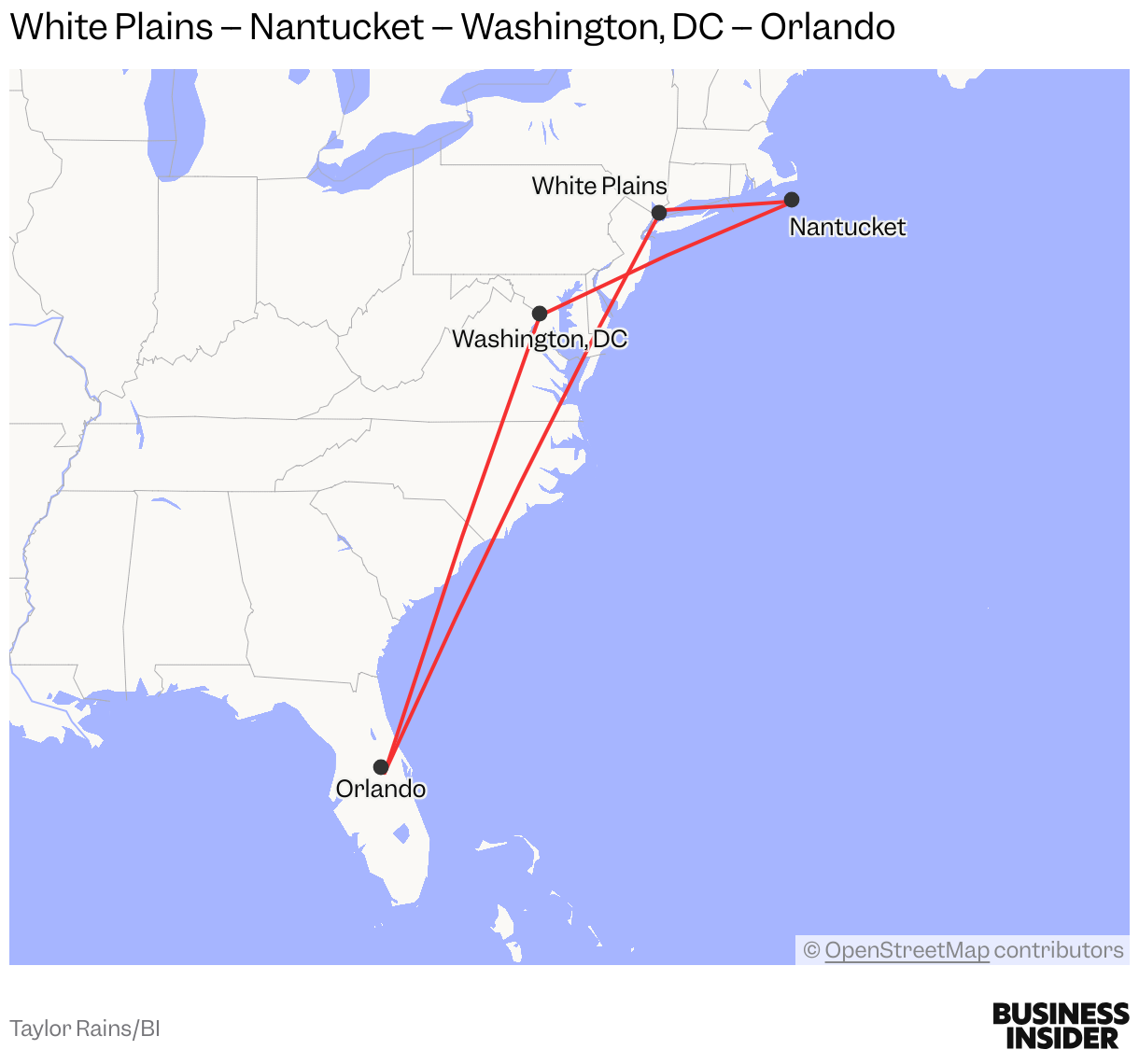
He blazed creative routes, flying to Nantucket for breakfast, DC for lunch, and Orlando for dinner.
This is an as-told-to essay based on a conversation with Steve Carroll, a New York-based nurse practitioner who chased JetBlue's "25 for 25" challenge to earn 350,000 points and Mosaic status for 25 years by flying to 25 unique cities by December 31. It has been edited for length and clarity.
Breakfast in Massachusetts, lunch in DC, dinner in Orlando, and back home by midnight. That was one of the epic days that my 10-year-old son and I recently flew — all for JetBlue Airways' "25 for 25" challenge.
It's been thrilling to plan and execute these trips, with layovers so tight we sometimes barely had time for a bathroom break. Finding a flourishing community chasing this challenge has been one of the best parts.
The promotion, created for JetBlue's 25th anniversary, is simple: Fly to 25 unique cities in the airline's network between June 25 and December 31, and you'll earn Mosaic 1 status for 25 years plus a lump sum of 350,000 points.
There are some rules: You must connect your loyalty number to each flight; basic fares don't qualify; flights must be operated by JetBlue (not its partners, such as Cape Air); and only arrival airports count.
Still, I realized it could be an unforgettable experience for my son Jackson and I. He already loves JetBlue (I think the TV screens do it for him), and his 100th flight ever was on JetBlue; we celebrated with cookies on the plane.
Jackson's 100th flight was on JetBlue.
Courtesy of Steve Carroll
Plus, Mosaic status until age 35 means he and his friends could enjoy the perks — like free bags, complimentary drinks, dedicated security and check-in, early boarding, and seat upgrades — on future spring break or summer trips in college. (Editor's note: You must be a Mosaic 3 member or higher to receive complimentary Mint upgrades and a Mosaic 4 for lounge access when JetBlue's open in late 2025.)
The math also checked out. Completing the challenge would earn each of us a reward of 350,000 points, at least $3,500 in travel apiece, plus the additional points earned from our flights.
Combining the cash I'd have to pay plus the 100,000 JetBlue points I already had, the whole challenge would cost around $7,000, but I'd essentially be reimbursed in points.
I started the challenge already holding Mosaic, but securing long-term status gives me more freedom to put everyday spending on other cards and build points with brands like Hyatt via Chase.
JetBlue's new partnership with United Airlines also means I can tap into reciprocal benefits on United — an attractive perk since we live close to the airline's Newark, New Jersey, base.
To maximize our time, we mostly fly on weekends and sometimes take up to five flights across a Saturday or Sunday. We'll end up taking closer to 35 flights overall because of the overlap at some departure and connecting airports.
Our flights so far stretch west to Los Angeles, north to Portland, Maine, and south to Fort Lauderdale. We've also checked off airports like Cleveland, Norfolk, Detroit, Pittsburgh, Manchester in New Hampshire, Raleigh in North Carolina, and Buffalo in New York.
Jackson and Steve will visit their 25th destination on Thanksgiving.
Courtesy of Steve Carroll
Our most ambitious weekend was over Veterans Day in November, when we planned 18 flights and 11 new cities. The government shutdown, however, canceled five of them, but we managed to rebook and still add several new destinations.
Aside from those cancellations and a huge delay that forced us to postpone a trip, the challenge has been remarkably smooth. And we've met a great community of people also clamoring for 25 years of Mosaic status.
We recently flew in Mint business class to Los Angeles as our 23rd city and plan to complete the challenge on December 8 in Fort Myers, with about three weeks to spare.
Piecing together itineraries is like a game of Tetris
I already had a few JetBlue trips on my calendar to start, but then I created a master list of airports in the Northeast along with their city pairs. I live just north of New York City.
The goal is to create snaking routes that efficiently hopscotch across the US; we're trying to avoid international flying. I'd sit up in bed when I couldn't sleep and just map out my options.
Over time, I've figured out a few tricks: book one-ways, sit near the front, and choose the first and last flights of the day. Most fares average about $100 per person.
I have lounge access to make longer layovers easier, though I occasionally book "illegal" itineraries with very tight connections. Connecting airports, regardless of the time spent there, count as unique destinations.
Jackson in the cockpit with a JetBlue crew.
Courtesy of Steve Carroll
But, before I risk it, I check the historical arrival times. One trip I planned included a 12-minute layover at New York-JFK, but we still made it because our flight from Hyannis, Massachusetts, landed half an hour early, as expected.
Weather-tracking helps, too. I adjust my flight if I anticipate a disruption, which my status allows me to do for free. An unofficial tool called "25for25.ai" has also been helpful; you can plug in your starting point and block destinations you've already hit.
Living in the New York area makes the challenge far more doable. Airports, like White Plains, LaGuardia, Newark, New York-JFK, and Islip on Long Island, are all considered separate, unique cities.
New York-JFK and Newark are especially useful since they offer so many connections. There's also Hartford, Connecticut, and Philadelphia nearby. That's seven of the 25 we could just drive to.
Smaller airports like Nantucket and Martha's Vineyard in Massachusetts require more creativity because they offer limited frequencies.
One of our biggest travel days began in White Plains, New York, where we flew to Nantucket and had breakfast in town. We then headed to DC for lunch at the airport, and finally to Orlando for dinner, also at the airport.
My partner joined us on that trip, making it a family day in the skies. We crossed paths with about 15 other challengers on our legs to DC.
There is camaraderie in the challenge
What has been extremely helpful is the dedicated Mosaic Facebook group, where other participants in the challenge share routes and road warrior stories. It's not hosted by JetBlue.
The challenge has fostered a vibrant and supportive community. (Editor's note: JetBlue told Business Insider that over 500 people have completed the promotion so far.)
My son and I sometimes see other challengers on our flights and will eat lunch together in the airport between legs. We helped a family of four explore the town during our layover in Nantucket.
We exchange numbers with almost every person we meet so we can stay in touch. I didn't expect to find such a large and enthusiastic community, but it's become one of the best parts of the challenge.
I have a little tag on my bag that somebody made for me that says 'JetBlue 25 for 25.' When people see it, they're like, 'Oh, you're doing the challenge.'
It's been nice getting help along the way, and I appreciate being able to help others, too, cheering them on as everyone scrambles to finish by the holidays.
Anthropic CEO Dario Amodei says the company is betting on enterprise, which he says sets it apart from OpenAI and Google.
David Dee Delgado/Getty Images for The New York Times
Anthropic CEO Dario Amodei took a shot at OpenAI and Google.
OpenAI and Google have both declared "code reds" in reaction to rival product releases.
Amodei says Anthropic is avoiding the fray by focusing on enterprise AI instead of consumer AI.
Anthropic CEO Dario Amodei just roasted OpenAI and Google on low heat — with a sprinkle of salt.
OpenAI CEO Sam Altman this week declared a "code red" at his company after Google, one of its chief rivals in the AI race, released Gemini 3 to much fanfare. Google had earlier announced its own "code red" when ChatGPT launched three years ago.
Amodei, however, told Andrew Ross Sorkin at The New York Times Dealbook Summit on Wednesday that his company has felt no need to proclaim such emergencies.
"We have a little bit of a privileged position where we can just keep growing and just keep developing our models," he said,adding that Anthropic has issued no "code reds."
Amodei said Anthropic is maybe feeling a little less heat in part because it is tailoring its products more for companies than consumers. "We've optimized our models more and more for the needs of businesses," he said.
Building models for enterprises is different than building consumer-focused ones, he said.
"You just focus on different things," he said. "You focus less on engagement, you focus more on coding, high intellectual activities, scientific ability."
The company may have found a sweet spot in enterprise coding, but Amodei said it's starting to look beyond that to finance, biomedical, retail, and energy.
Anthropic last month released Claude Opus 4.5, which it says is its most advanced AI model yet. It comes with improved features for generating computer code and workplace documents.
Anthropic is not without serious competition, however. Both Google and OpenAI, among others, offer workplace and enterprise products. Google, of course, is one of the biggest tech companies on Earth. And OpenAI has a lot more resources at its disposal, too.
Amodei, however, is skeptical about the huge amounts companies like Google, OpenAI, and Meta are spending as they jockey for the top position in the AI race.
"There's a real dilemma, deriving from uncertainty, in how quickly the economic value is going to grow," he said. Anthropic, he said, is trying to "manage as responsibility as we can."
"There are some players who are YOLO, who pull the wrist dial too far," he said.
Anthropic did not immediately respond to a request for comment from Business Insider.
Dario Amodei, the CEO of Anthropic, discussed the possibility of an AI bubble at the DealBook Summit on Wednesday.
David Dee Delgado/Getty Images for The New York Times
AI was among the most talked-about industries at the annual DealBook Summit.
Politicians and business leaders agreed that the massive investments in AI will lead to casualties.
Their comments came as concerns over an "AI bubble" have increased on Wall Street.
Some of the world's most powerful and well-connected leaders converged in Manhattan on Wednesday, and one subject dominated the room: artificial intelligence.
Three years after ChatGPT launched, revolutionizing the way the world thinks about and uses AI, the arms race is bigger than ever — perhaps too big.
At the annual New York Times DealBook Summit, leaders from BlackRock's Larry Fink to Lai Ching-te, the President of Taiwan, were asked about the state of the AI industry and the potential for an AI bubble, a hot topic in Silicon Valley and on Wall Street over the past few months.
Tech giants like Meta, Alphabet, and Microsoft are spending tens of billions of dollars in capital expenditures — largely AI infrastructure — this year. So far, 49 US AI startups have raised at least $100 million this year, TechCrunch reportedin November.
While the big names at DealBook agreed that AI is here and growing, they also said the boom would likely leave casualties in its wake.
"There are going to be some huge winners and huge failures," Fink said to DealBook founder Andrew Ross Sorkin. "I'm not here to suggest there's not going to be some headline blow-ups."
That said, the financial bigwig said he's confident that the demand will be there and that the "hyperscalers" — companies like Amazon, Google, and Microsoft that provide the resources that keep AI running — who he has spoken to are short on compute.
It was an opinion parroted by other leaders speaking at the event, those with and without a stake in the industry.
Dario Amodei, the CEO of AI company Anthropic, said the industry is inherently risky given the large amount of capital needed to build thedata centers that power AI,
"Even if the technology fulfills all its promises, I think there are players in the ecosystem who, if they just make a timing error, they just get it off by a little bit, bad things could happen," he said.
Amodei said Anthropic is managing its risk by working with large enterprise clients and investing in compute in a conservative way. He suggested some of his competitors haven't been as cautious.
"There are some players who are YOLOing," Amodei said.
He wouldn't name names, but took a veiled jab at his former employer, OpenAI, and boss, Sam Altman, later in the conversation: "We don't have to do any code reds," he said, referring to OpenAI's recent memo about the threat of Google's AI model.
Those that do fail will be a necessary part of creating the best technology, which ideally would not only make money but also surpass that of other countries, many of the leaders said Wednesday.
"If we don't spend enough faster in AI, in digitization, and in tokenization, other countries are going to beat us," Fink said, endorsing the investment in the industry.
Amodei said the government would be pivotal to that. He argued for a more proactive approach to regulation and that Nvidia chips should not be sold in China.
If the best model is "plopped down in an authoritarian country, I feel like they can outsmart us in every way: intelligence, defense, economic value, R&D," he said
Lai, for his part, agrees that work must be done to prevent any sort of AI calamity.
"Leaders around the world, especially those from countries with AI-related industries, should work together and take necessary measures to ensure AI develops sustainably and has a soft landing so that it can drive long-term global growth," he said.
Of course, like the rest of those who spoke about an AI bubble on Wednesday, Lai has skin in the game. Taiwan leads the world in making the chips necessary for AI — and fueling the very potential bubble of which he spoke.
Meta hired Alan Dye, vice president of human interface design at Apple.
Stefanie Keenan/Getty Images for GQ
Meta hired longtime Apple design leader Alan Dye to run a new Reality Labs creative studio
The studio will bring together design, fashion, and technology.
Meta CEO Mark Zuckerberg said the company will treat intelligence as a "new design material."
Meta has hired longtime Apple design leader Alan Dye to run a new creative studio inside its Reality Labs division, CEO Mark Zuckerberg announced in a series of posts on Threads on Tuesday.
"Today we're establishing a new creative studio in Reality Labs led by Alan Dye, who has spent nearly 20 years leading design at Apple," Zuckerberg wrote on Threads, saying the group will help define "the next generation of our products and experiences."
Zuckerberg said the studio will bring together "design, fashion, and technology" and that Meta wants to "treat intelligence as a new design material and imagine what becomes possible when it is abundant, capable, and human-centered."
The goal, he added, is to "elevate design within Meta" by assembling a team with "craft, creative vision, systems thinking, and deep experience building iconic products that bridge hardware and software."
Dye will work alongside several high-profile design leaders. He will report to Meta's chief technology officer and Reality Labs head Andrew Bosworth.
Dye is one of the most prominent figures in Apple's modern design history. He has led Apple's design studio since 2015 and has played a key role in shaping the company's software and the look and feel of many of its devices, including the interfaces for products such as the Apple Watch, iPhone X, and Vision Pro headset.
Most recently, Dye was responsible for Liquid Glass, Apple's new design across its devices that makes elements of the user interface look transparent.
His team has also worked on a slate of new smart home hardware, according to Bloomberg, which first reported his move to Meta.
Zuckerberg said that Dye will be joined by "another acclaimed design lead from Apple," Billy Sorrentino, as well as Joshua To, who leads interface design across Reality Labs; industrial design lead Pete Bristol; and metaverse design and art teams led by Jason Rubin.
Salvador Plasencia, a former physician, was found guilty of illegally prescribing actor Matthew Perry ketamine.
Robyn Beck/AFP via Getty Images
"Friends" actor Matthew Perry died from "acute effects of ketamine," a coroner ruled in 2023.
Perry wrote in his 2022 memoir of his experiences with ketamine and how it made him "dissociate."
The doctor who prescribed Perry the drug was found guilty in July of ketamine distribution.
A physician, who was found guilty of prescribing Matthew Perry ketamine in the month leading up to the "Friends" actor's death in October 2023, was sentenced to 2 ½ years in prison.
Salvador Plasencia, 44, was a physician who ran a clinic in Calabasas, California, when he was introduced to Perry on September 30, 2023, by one of his patients, according to a press release from the US Attorney's Office for the Central District of California.
Plasencia, also known as Dr. P, pleaded guilty to four counts of ketamine distribution in July. As part of his plea agreement, he surrendered his medical license.
He is the first of five defendants to be sentenced.
In the weeks since their first meeting, Plasencia gave Perry and the actor's assistant, Kenneth Iwamasa, "20 vials and multiple tablets of ketamine and syringes."
Perry, who had documented his personal struggle with drug addiction in his 2022 memoir "Friends, Lovers, and the Big Terrible Thing," died on October 28, 2023. His death was caused by the "acute effects of ketamine," a coroner ruled. Perry was 54.
David Dee Delgado/Getty Images for The New York Times
Palantir CEO Alex Karp defended the company's ethics and praised Trump's immigration policies at DealBook.
Karp said Palantir is not building a surveillance database.
Tech leaders, including Karp, are increasingly aligning themselves with the Trump administration.
Alex Karp, the chief executive of software company Palantir Technologies, doesn't need you to think the company he cofounded is ethical.
"We are highly ethical, but don't believe us on that," Karp said on Wednesday at The New York Times' DealBook Summit. Palantir — a company notoriously secretive about its products and customers, and whose flagship tools remain largely mysterious to outsiders — is "obviously not building a database," the executive said, denouncing the claim that Palantir makes surveillance tech.
Karp did say, "If you're legally surveilled … Could you put it in our product? Yes."
At the summit, the data analytics executive backed his company's work with ICE and the Trump administration's immigration policies. He also said he cares about two political causes: immigration and "reestablishing the deterrent capacity of America."
"On those two issues, this president has performed," Karp added.
His praise for Trump departs from his previous political support. In 2024, the CEO told The New York Times that he was supporting former Vice President Kamala Harris in the election and had donated $360,000 to former President Joe Biden's campaign.
When asked about his change in tune at Wednesday's summit, Karp asserted that political parties have vacillated, not him.
Karp, a self-proclaimed progressive who wrote his college thesis on fascism, told The New York Times at Wednesday's summit that insinuating Trump is a fascist was "stupid."
Palantir's chief executive is by no means alone in rushing to Trump's side. Over the past year, tech CEOs have aligned themselves with some of the priorities of the president's second administration. Mark Zuckerberg changed Meta's content-moderation policies just days before Trump took office in January. Apple's Tim Cook gifted the president a 24-karat gold and glass statue — made in the US — to commemorate the company's $600 billion commitment to revivifying American manufacturing, a major objective for the administration. At a dinner at the White House in September, OpenAI's Sam Altman called Trump "a very refreshing change."
When asked whether he thinks Trump's immigration policy is constitutional, Karp said: "The more constitutional you want to make it, the more precise you want to make it, the more you're going to need my product."
Defense Secretary Pete Hegseth defended his role directing military attacks on suspected drug-runners during a Cabinet meeting at the White House on Tuesday.
Chip Somodevilla/Getty Images
The Pentagon's law of war manual calls attacking a shipwrecked enemy an "illegal" act.
Reports allege a US drone strike targeted survivors of a drug-smuggling vessel in the Caribbean.
The White House and Pentagon have denied news reports saying Hegseth ordered the strike on survivors.
The Pentagon's manual on the law of war doesn't list every possible illegal order, but on some points, it's explicit.
"Orders to fire upon the shipwrecked," it says, "would be clearly illegal."
The 1,200-page manual repeatedly stresses that a combatant who is unable to continue fighting is entitled to fundamental protections. It uses shipwreck survivors as a key example — which is why a September 2 counter-narcotics strike in the Caribbean is drawing intense scrutiny.
During the mission, which Secretary of Defense Pete Hegseth has said he watched live, the US military struck a suspected drug-smuggling vessel twice. The first strike appeared to kill nine people on the vessel; then the US military launched a second strike on the stricken boat that killed the two remaining survivors, The Washington Post reported last week, citing seven people with knowledge of the strike.
Hegseth called the Post report, which said the secretary had ordered a military leader to kill everyone onboard, "fake news."
"Our current operations in the Caribbean are lawful under both US and international law, with all actions in compliance with the law of armed conflict — and approved by the best military and civilian lawyers, up and down the chain of command," Hegseth said Friday.
The White House attributed the decision to conduct a second strike on the stricken vessel, executed "to ensure the boat was destroyed and the threat to the United States of America was eliminated," to Adm. Frank Bradley, who now oversees Special Operations Command, instead of Hegseth.
Bradley has been summoned to a closed-door briefing with Congress on Thursday.
His oversight of the strike mission marks a departure from normal military operations, typically overseen by a geographic "combatant commander." In this case, that would be the head of Southern Command, Adm. Alvin Holsey, whose retirement Hegseth unexpectedly announced last month; the admiral had been on the job for a year.
The Trump administration has said that the actions taken were legal. Pentagon Press Secretary Kingsley Wilson said Tuesday that "Bradley made the right call."
When asked by Business Insider for comment on the follow-up strike, public affairs officials referred Business Insider to Hegseth's "X" post voicing support for Bradley.
The Defense Department released a video of a November 10 attack on a vessel in the Caribbean Sea that it said killed "4 male narco-terrorists."
Defense Department
President Donald Trump has distanced himself from the strike, saying he "wouldn't have wanted" a second strike, while also defending Hegseth, whom the White House said authorized Bradley to strike suspected drug-smugglers. "I'm going to find out about it, but Pete said he did not order the death of those two men," Trump said.
Legal experts say that if survivors were targeted after their boat was destroyed, it would represent a clear violation of long-standing US military law governing the treatment of wounded, incapacitated, or shipwrecked combatants.
Killing an enemy combatant or, in this case, a suspected drug trafficker who has been shipwrecked is a "patent violation" of military law that would be obvious to everyone in the chain of command, said Dan Maurer, a retired Army judge advocate general who now teaches at Ohio Northern University's law school.
"No one who is at all trained on the law of war would think that that's OK," Maurer told Business Insider on a phone call. "Whether they're wounded or sick or a POW or shipwrecked at sea, unless they're shooting at you, they are not a threat, and they cannot be attacked."
"There's actually an affirmative duty to pick them up, to rescue them, so they don't drown," he said.
The law of war manual says one of its core purposes is to protect people from unnecessary suffering, including the wounded, the sick, and the shipwrecked. The manual is based on international law, including the Geneva Conventions, which the US helped draft after World War II, Maurer said. Under those rules, combatants who cannot fight must be treated humanely, and in the case of those surviving at sea, rescued.
A person engaged in a suspected criminal act, but who is not an enemy fighter involved in war, is considered to be a "noncombatant" — force against such civilians is usually only authorized when they present an imminent risk to US forces.
Normally, maritime drug interdiction missions are conducted by the Coast Guard with occasional Navy support. While crews may use force in such operations, once a vessel has effectively been disabled and no longer presents a threat to personnel, Coast Guard crews shift to either rescue or detainment.
The Pentagon has described boat operators suspected of drug-smuggling as "narco-terrorists." In January, the White House designated drug cartels and "other organizations" as Foreign Terrorist Organizations, unlocking additional military authorities.
Congress has not approved authorization for the use of military force for these operations. The legality of strikes on suspected smugglers is in question, with the latest reporting on the killing of survivors raising fresh concerns.
The US military has carried out dozens of strikes on suspected drug-trafficking vessels in the Caribbean and Eastern Pacific since September, killing over 80 people. Two suspected drug-traffickers survived a separate strike in October. They were picked up by American forces and returned to their home countries.
MrBeast, whose real name is Jimmy Donaldson, center, is planning a move into a creator-marketer platform as he expands beyond YouTube in search of new revenue streams.
David Dee Delgado/Getty Images for The New York Times
MrBeast is developing a platform to connect creators with major brand marketers.
The idea is to help Fortune 1,000 companies access the creator economy.
His company is also expanding into financial services and mobile phones.
MrBeast is building out a platform to match creators and marketers, the CEO of the top YouTuber's company said at The New York Times' DealBook Summit on Wednesday.
Jeffrey Housenbold, CEO of Beast Industries, said the company was "building a two-sided marketplace in a global creator platform, matching creators with Fortune 1,000 marketers who want to be able to access the creator influencer economy in an efficient way to be able to build demand for their products and services."
A spokesperson for the company said the marketplace was in the general-discussion phase and that there were no specifics to share yet.
An early 2025 fundraising pitch deck viewed by Business Insider said the company was exploring a creator marketplace. It described the marketplace as identifying creators that fit brands' campaign goals, facilitating creator campaigns across platforms, and helping creators with monetization, viewership growth, and product launches.
MrBeast, whose real name is Jimmy Donaldson, has been expanding beyond his YouTube channel — which has over 450 million subscribers — and into other business lines for some time. He's already in consumer products through his Feastables chocolate line, and has action figures and an Amazon show, "Beast Games."
Beast Industries took in over $400 million in revenue last year, according to investor materials viewed by Business Insider. The company lost money last year, mainly because of high costs in its media business, and has been on a push to cut costs as well as expand to new revenue lines.
As YouTube's biggest creator, MrBeast could bring his clout to the creator-marketer matchmaking space, which has been growing as advertisers shift spending from traditional media to social media creators.
Ad spending on creators in the US is expected to hit $37 billion this year, growing four times as fast as the overall media industry, a November Interactive Advertising Bureau report found.
YouTuber MrBeast (Jimmy Donaldson) and his company's CEO Jeffrey Housenbold.
David Dee Delgado/Getty Images for The New York Times
YouTuber MrBeast has plans to launch a mobile phone service called Beast Mobile.
The service is likely to operate as an MVNO, or mobile virtual network operator, according to an investor deck.
Other celebrities, such as Ryan Reynolds and the "SmartLess" podcasters, have taken a similar approach.
YouTube's top creator, MrBeast, wants to do more than just appear in videos on your phone. He wants to power your mobile phone service, too.
The content creator, who has over 450 million subscribers, is planning to launch a phone business called "Beast Mobile" as one of his company's next ventures, Beast Industries CEO Jeffrey Housenbold said on Wednesday, speaking at The New York Times' DealBook Summit.
MrBeast, whose real name is Jimmy Donaldson, is unlikely to try to build a mobile network from scratch. Instead, he may launch Beast Mobile via a business model known as a mobile virtual network operator, or MVNO, according to an investor deck from early 2025 that Business Insider reported on earlier this year.
An MVNO phone service typically utilizes the built-in infrastructure of a major carrier, such as T-Mobile or Verizon, allowing the virtual network operator to focus on branding and marketing the service to customers. The strategy has been in vogue among celebrities like the "SmartLess" podcasters, President Donald Trump, and Ryan Reynolds, who sold his Mint Mobile business to T-Mobile in 2023.
"The ultimate objective is to focus on the marketing and sales and outsource everything to a third party," Alex Besen, an MVNO consultant and founder and CEO of The Besen Group, told Business Insider earlier this year.
MrBeast's ambition to sell wireless plans taps into a broader push at his company to diversify the business beyond YouTube and media.
Over the past few years, the company has expanded into a variety of business lines, including its chocolate-bar brand Feastables and lunch-food brand Lunchly.
The company is also planning to get into financial services, Housenbold said on Wednesday.