This article was originally published on Fool.com. All figures quoted in US dollars unless otherwise stated.

This article was originally published on Fool.com. All figures quoted in US dollars unless otherwise stated.
Investors don’t need to panic when a market downturn hits. It’s important to figure out the best strategy for navigating a rough patch. As always, there will be winners and losers in this volatile period.
You can transform your long-term performance by adopting winning strategies and avoiding losing ones right now. Here’s how.
Winner 1: Investors with “dry powder”
It hurts to look at your portfolio value during a market downturn, but it’s not time to bury your head in the sand. Corrections are huge opportunities for investors who have cash to deploy, known as “dry powder” in the financial industry. Stocks have become much cheaper relative to the underlying companies’ sales, cash flows, and dividends. The downturn is like stocks have gone on sale, and it’s the best time to buy.
Of course, it takes a combination of luck and foresight to develop that pile of cash. Most asset managers keep some portion of their portfolio in cash. The amount of cash tends to rise and fall with the manager’s opinion on investment viability. Warren Buffett is holding an enormous amount of cash at Berkshire Hathaway because he determined stocks have been overvalued relative to their fundamentals.
Investors shouldn’t have been out of the market completely going into this latest downturn. However, those who kept themselves from getting caught up in the fervor should have some cash on hand to take advantage of more attractive pricing.
Winner 2: Dividend stocks
Dividend stocks aren’t immune from market downturns, but they tend to shine relative to other equities during tough times. Corrections and bear markets are signals that investor risk appetite has declined. Uncertain conditions cause capital to flow away from stocks and into other asset classes such as bonds and cash.
Those same forces are at work within the stock market as well. Growth stocks tend to take a beating, while dividend stocks hold up a bit better. Companies that pay dividends also tend to have more stable cash flows, and they often avoid catastrophic disruptions during economic turmoil. Importantly, dividend stocks still provide returns in the form of quarterly distributions, even if their share prices are temporarily down.
This is playing out as we speak. The Vanguard High Yield Dividend ETF is up about 2% year to date, while major stock indexes slumped. Growth stock valuations got a bit out of control, and investors are seeking safety as pricing falls back toward historically normal levels.
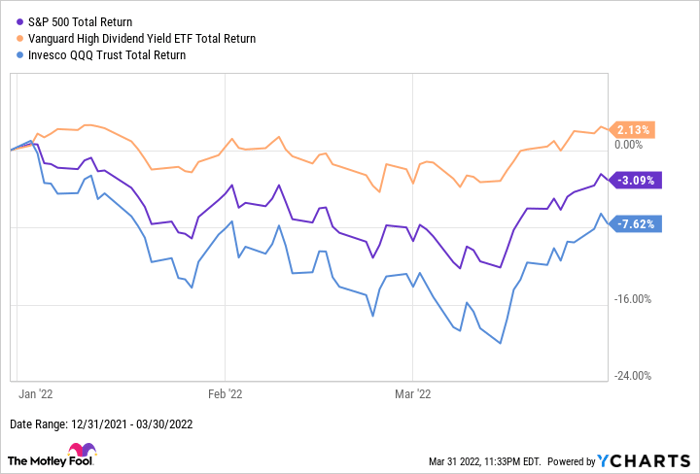
Data by YCharts.
Loser 1: Investors who sell
The only people who truly lose during a stock market downturn are investors who sell their stocks. Gains and losses are unrealized until they’re locked in through a sale. Any position with positive returns can still swing to a loss until that position is closed — the same is true for positions that are down.
In the history of the stock market, every single downturn has just been a temporary divergence from a long-term growth trend. If you sell during a downturn, you’re buying high and selling low. You’re losing your chance to capitalize on growth when the market recovers in the future.
But investors sell for all sorts of reasons. Some stocks are sold to cover distributions from retirement accounts. Sometimes, circumstances change in a financial plan, and assets have to be liquidated to meet cash needs. Or a portfolio has to be rebalanced to achieve a better mix of growth and volatility.
Too often, however, investors make fear-based decisions and exit the market due to the risk that losses grow even steeper. Selling in a downturn can help you avoid the impact of a full-blown bear market if it goes that far, but that’s nothing compared to the opportunity cost of missing out on all future gains.
The best investors understand volatility is inevitable, and they don’t throw out their whole investment plan when the market hits a rough patch.
Loser 2: Growth stocks
Growth stocks are usually great tools for long-term returns, but they come with extra volatility. They outperform when the market is up, and they underperform when the market falls.
Stock prices are theoretically based on expected future cash flows, and growth stocks have more uncertainty around those cash flows. It requires a bigger leap of faith to forecast the future earnings of a company that’s rapidly expanding but doesn’t produce any net profits today. The rewards are great if the story comes to fruition, but the risks are greater too.
Valuations peak at the top of market cycles, and growth stocks tend to have the most aggressive valuations when investor risk appetite is high. That leaves more room to fall when the market drops.
This doesn’t mean investors should avoid growth stocks. Instead, it suggests they shouldn’t be overexposed to this category, and they need to make sure they’re ready to ride out volatility when it inevitably comes up.
This article was originally published on Fool.com. All figures quoted in US dollars unless otherwise stated.
The post 2 winners and 2 losers during stock market downturns appeared first on The Motley Fool Australia.
Wondering where you should invest $1,000 right now?
When investing expert Scott Phillips has a stock tip, it can pay to listen. After all, the flagship Motley Fool Share Advisor newsletter he has run for over ten years has provided thousands of paying members with stock picks that have doubled, tripled or even more.*
Scott just revealed what he believes could be the five best ASX stocks for investors to buy right now. These stocks are trading at near dirt-cheap prices and Scott thinks they could be great buys right now.
*Returns as of January 12th 2022
More reading
- What are the tailwinds behind BHP shares in April?
- Why is the Newcrest (ASX:NCM) share price having such a strong start to the week?
- Here are the 5 worst-performing ASX ETFs over the March quarter
- Why Allkem, Iluka, Pendal, and Sayona Mining shares are charging higher
- ASX lithium shares set to deliver next positive surprise to investors
Ryan Downie has no position in any of the stocks mentioned. The Motley Fool owns and recommends Berkshire Hathaway (B shares) and Vanguard High Dividend Yield ETF. The Motley Fool recommends the following options: long January 2023 $200 calls on Berkshire Hathaway (B shares), short January 2023 $200 puts on Berkshire Hathaway (B shares), and short January 2023 $265 calls on Berkshire Hathaway (B shares). The Motley Fool Australia has recommended Berkshire Hathaway (B shares). The Motley Fool has a disclosure policy. This article contains general investment advice only (under AFSL 400691). Authorised by Bruce Jackson.
This article was originally published on Fool.com. All figures quoted in US dollars unless otherwise stated.
from The Motley Fool Australia https://ift.tt/1i6ZwdN
Leave a Reply