Nik Oiko/SOPA Images/LightRocket via Getty Images
- A JetBlue plane had a close call with a US Air Force plane near Venezuela on Friday.
- The pilot told air traffic controllers he nearly had a midair collision, a recording shows.
- "They don't have their transponder on," he said. "It's outrageous."
A JetBlue pilot said he nearly had a midair collision with a US Air Force plane on Friday.
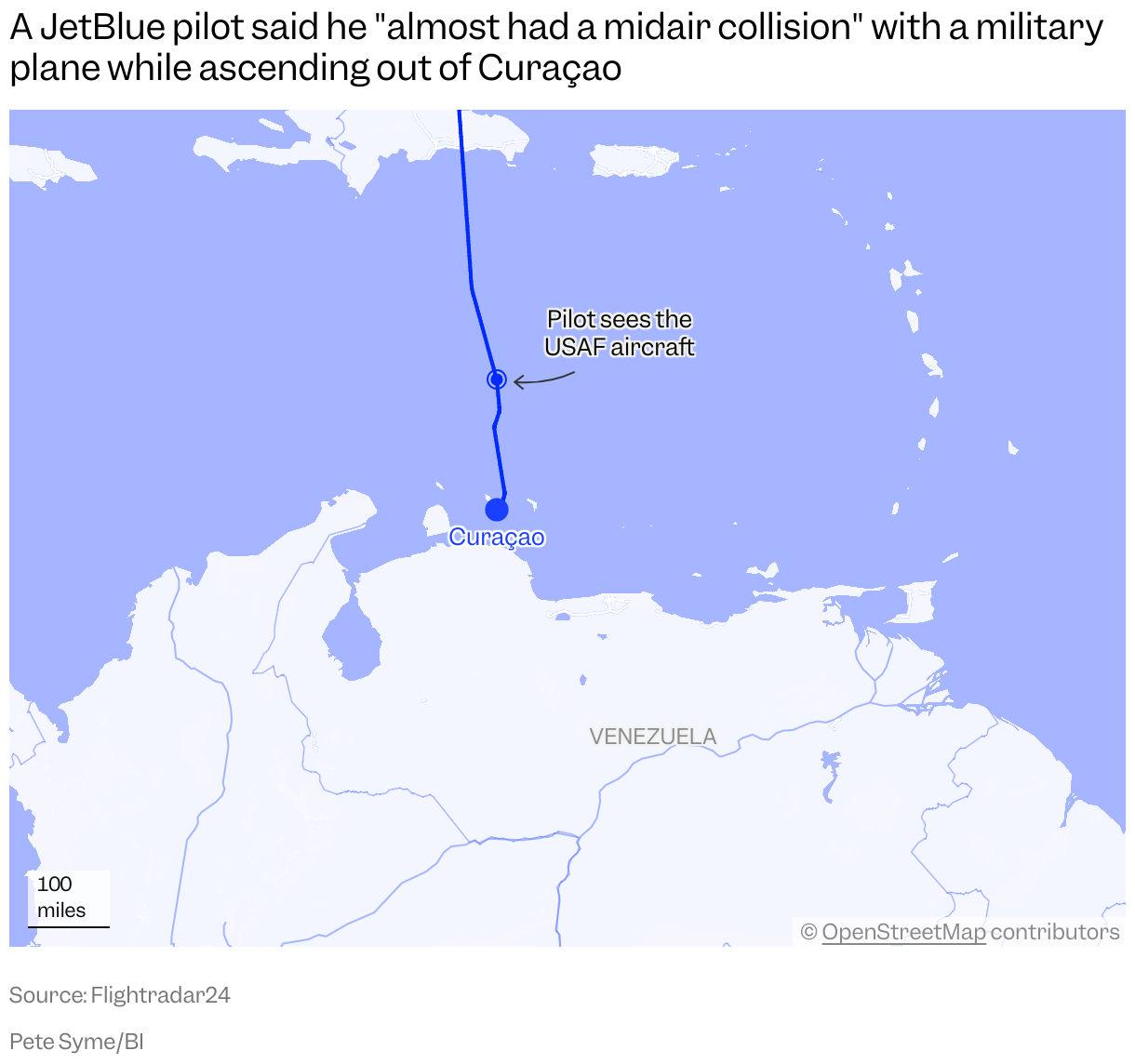
Flight 1112 was flying from Curaçao to New York. The island country, which is part of the Netherlands, is about 40 miles off the coast of Venezuela.
About 20 minutes after takeoff, the JetBlue pilot contacted Curaçao's air traffic control center.
"We just had traffic pass directly in front of us, within 5 miles, maybe 2 or 3 miles," he said in a recording published by LiveATC.net. He added that it was an Air Force air-to-air refueller.
The JetBlue Airbus A320 was also only about 600 feet below the military aircraft. The pilot said the latter was at 34,000 feet while the JetBlue plane was passing through 33,400 feet and ascending to 35,000 feet.
"So we had to stop our climb and actually just descend to avoid hitting them," the pilot said.
While the distance between the two aircraft gave the plane enough time to maneuver, the pilot was evidently shocked.
"They don't have their transponder on," he said. "It's outrageous."
"I don't have anything on my scope," the controller replied. "You are totally right, sir."
The pilot then asked the controller to make a note of it, adding: "We almost had a midair collision up here."
Transponders are a vital piece of aircraft equipment, as they send signals to air traffic control centers and to other nearby planes.
The Traffic Alert and Collision Avoidance System, or TCAS, relies on active nearby transponders to warn both aircraft and, if necessary, provide instructions for them to avoid each other.
However, military aircraft may turn off their transponders to remain undetected during sensitive missions.
The US military has launched air strikes against suspected drug traffickers in the Caribbean Sea amid escalating tensions with Venezuela. It has also deployed thousands of troops and the USS Gerald R. Ford, the world's largest aircraft carrier.
On November 21, a Notice to Airmen (NOTAM) was put in place until the end of December, warning pilots to "exercise extreme caution" around Curaçao due to the "presence of non-identified aircraft operations."
Later in November, President Donald Trump posted on Truth Social, saying that pilots should consider the airspace around Venezuela "to be closed in its entirety."
US Southern Command, which is responsible for military operations in the area, said in a statement shared with Business Insider: "We are aware of the recent reporting regarding US military aircraft operations in the Caribbean and are currently reviewing the matter."
"Military aircrews are highly trained professionals who operate in accordance with established procedures and applicable airspace requirements," it added. "Safety remains a top priority, and we are working through the appropriate channels to assess the facts surrounding the situation."
JetBlue didn't immediately respond to a request for comment sent by Business Insider outside US working hours.
Leave a Reply