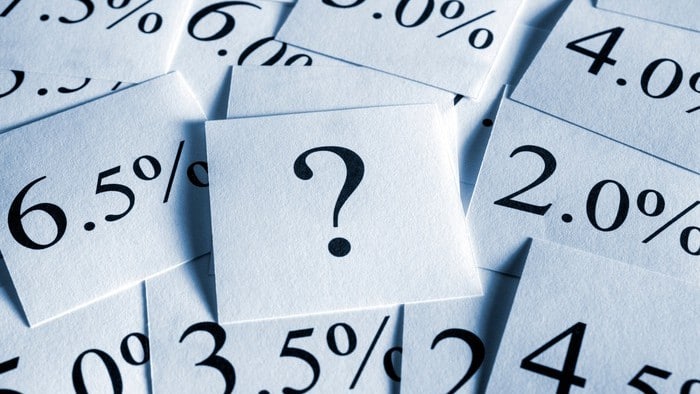
Today is Rates Day.
We’ll find out if the RBA is going to raise the official cash rate to fight inflation, or leave it on hold, hoping that the expected spike is temporary, rather than becoming endemic.
Cue the forecasters, making their guesses.
Why?
Well, according to John Kenneth Galbraith â who was right â ‘Pundits forecast not because they know, but because they are asked’.
Now, some people have to make educated guesses â the RBA is one such institution that needs to make rates decisions based on how they see the future turning out.
They’ll be wrong in their specificity, but I suspect â I hope! â they already know that. I think their job is to be directionally right; adding support when the economy needs it and removing excess demand when the economy is running too hot.
I suspect they know that they have no idea exactly what rate will eventually be high enough, any more than we target a specific speed on our speedos when we come into a corner.
We don’t decide, ahead of time, to take an upcoming corner at 52km/h, or 43km/h, or 35km/h. We brake until it feels like we’ve slowed enough to take the corner safely, then accelerate when we feel it’s appropriate. I think that’s the best way to think about interest rates.
The forecasters?
Apparently the bond market reckons there’s a 72% chance of a rate increase today.
Apparently a Finder survey reckons 38% of economists surveyed think rates will rise.
That means there’ll be a lot of people who’ll be wrong at 2.30pm, Sydney time.
And, I hope it’s clear to you that it makes the whole guessing game just a little⦠silly?
What the RBA should do is a worthy discussion, largely because it lets us work through the inputs into such a decision, and also to understand the potential consequences of the different courses of action.
But what it will do? No-one knows, so the guessing thing is just a parlour game.
Don’t get me wrong â the outcomes are consequential for those paying a mortgage or a business loan⦠but that doesn’t mean those outcomes are knowable, in advance!
Humans want certainty, though. It’s why tarot readers exist, despite the clear nonsense of being able to ascertain the future (those tarot readers knew I was about to say that!). Ditto those in centuries past who ‘read’ animal entrails and other ‘omens’.
We just really want to know, and would rather suspend disbelief than accept uncertainty.
So, let me puncture that balloon for you. (Sorry, not sorry).
Here’s what we don’t, and can’t, know:
â What the RBA will do at 2.30pm today.
â What they’ll do when they meet again in May.
â Where interest rates will be next year… and in 2030.
â How fast the economy will grow this year.
â When the next recession will arrive (because it will).
â How long it’ll last, and how bad it’ll get before it’s over.
â How quickly AI will disrupt jobs, and the broader economy.
â How significantly it’ll do the same.
â What ‘next big thing’ will fizzle out, instead.
â Where the stock market will be by Christmas.
â What Donald Trump will say next.
â What Donald Trump will do next.
â Whether Donald Trump will see it through, or reverse course.
â What ‘black swans‘ are lurking just over the horizon.
â What predictions of doom just won’t come true.
â Which company will be the most valuable in 2030.
â ⦠and 2035. And 2040
â Which startup founder, currently working in her garage, will be a billionaire
â Which company will be the next Kodak. Or Blockbuster.
â Which industry will change the world
â ⦠and who wins from those changes (remember, airline travel boomed, but profits tanked).
Oh, we’d love to know those things. We just can’t. At least not with any certainty.
What, then, should we do?
Three Ps. Two ‘to do’, and one to ‘not do’.
Let’s start with the latter.
Don’t:
Predict.
Predictions invite us to think about specifics. The more specific you try to be, the greater the chance of being ‘precisely⦠wrong’.
Do:
Prepare.
There are a range of potential outcomes for each of the things I listed above. The solution is not to throw our hands up in the air and abandon ourselves to fate. It is to position ourselves, emotionally and financially, for that range of outcomes, so that we’re not wiped out by a bad roll of the dice and are positioned to gain from a good roll.
Think in Probabilities
I’m an investor. I buy shares in companies (and units in ETFs) that I think are likely to gain in value. I think that’s likely overall â human ingenuity isn’t done yet â so I expect the market to go upâ¦Â on average and over time. And I think that understanding business and how to think about valuation means that I try to choose those investments that I think have the greatest potential to outperformâ¦Â on average and over time.
Importantly, I know I’ll be wrong sometimes, because perfection only exists in frauds and Ponzi schemes.
Bottom line: I try to be roughly right, not precisely wrong.
What do I think?
I think the market is likely to be higher, probably meaningfully so, in a decade. How much? No idea. Exactly a decade? No. With a guarantee? Hell no. Just likely, because capitalism, harnessing innovation, tends to create value for society and that value tends to be reflected in share prices.
I think interest rates probably go higher from here, and perhaps for a while, given the RBA’s mandate on inflation, and the fact it seems stuck in the high 3% range and might go higher. When will rates go up? No idea. I could guess, but it’d be just that. If I was right, would I be clever or lucky? Ego says ‘clever’. Rational thought says ‘lucky’. But the RBA might take a different view. Inflation may fall more quickly than I suspect. So making a specific prediction on rates â what level, when, and for how long â is not that different from reading animal entrails.
I think AI is likely to be seriously disruptive. But it might not be. I think there’s a decent risk that the pace of adoption is faster than our ability to create new jobs to replace those that are lost. A certainty? No. The progress of AI could stall. Adoption could stall. The ability for companies to replace workers with AI might be overblown. But I do think individuals across a broad range of industries should prepare for the risk that they lose their jobs. Governments should prepare a range of scenarios, so that they’re ready, whatever the outcome. They â and we â should prepare, not predict.
We’ll have a recession at some point. I just don’t know when. It might be this year, if the oil price stays high, and crimps global economic activity. But the oil price might fall on Friday and be back at the level of three weeks ago by April. The recession might be prompted by some unknown or unexpected X Factor. Trying to predict it is a folly. Preparing for its inevitability is smart.
Speaking of falls, the market will fall at some point. Maybe by a lot. Maybe for a long time. The COVID fall was sharp and deep. But the recovery was swift. The GFC roiled markets for over 18 months. It was slow and grinding and brutal. The next one might look like COVID. Or the GFC. Or something else entirely. But two things:
One: Peter Lynch is credited with the observation that “far more money has been lost by investors trying to anticipate corrections, than lost in the corrections themselves”.
And two: The investor who adds to their portfolios, buying quality companies during these downturns often (almost always) ends up better off, having taken the opportunity to buy more at cheaper prices.
I think those things will continue to be true.
And I think predictions, borne of ego, will continue to be made â sometimes they’ll even be right. The irony? We can’t know which ones will be right in advance.
Which, as I’ve said, kinda makes the whole thing silly.
Instead? Don’t predict. Prepare. And think in probabilities.
Lastly⦠stay humble. As humans, our egos write cheques our abilities can’t cash.
Learning that might just be the beginning of economic and investing wisdom.
Fool on!
The post Rates Day! Cue the breathless predictions appeared first on The Motley Fool Australia.
Wondering where you should invest $1,000 right now?
When investing expert Scott Phillips has a stock tip, it can pay to listen. After all, the flagship Motley Fool Share Advisor newsletter he has run for over ten years has provided thousands of paying members with stock picks that have doubled, tripled or even more.*
Scott just revealed what he believes could be the ‘five best ASX stocks’ for investors to buy right now. We believe these stocks are trading at attractive prices and Scott thinks they could be great buys right nowâ¦
* Returns as of 20 Feb 2026
.custom-cta-button p {
margin-bottom: 0 !important;
}
More reading
- Guess which ASX gold share is rocketing 24% on an ‘unexpected bonus’
- This ASX gold company has pulled the trigger on a new mining project in Western Australia
- Morgans names 3 ASX mining stocks to buy
- Why this beaten down $9 billion ASX 200 share is now a buy
- Buy, hold, sell: Collins Foods, Liontown, and Northern Star shares
Motley Fool contributor Scott Phillips has no position in any of the stocks mentioned. The Motley Fool Australia’s parent company Motley Fool Holdings Inc. has no position in any of the stocks mentioned. The Motley Fool Australia has no position in any of the stocks mentioned. The Motley Fool has a disclosure policy. This article contains general investment advice only (under AFSL 400691). Authorised by Scott Phillips.