Author: openjargon

  • Elon Musk axed the entire Tesla Supercharger team after their division chief defied orders and said no to more layoffs

    Tesla CEO Elon Musk said he was dissolving the company's Supercharger team last month.
    Tesla CEO Elon Musk said he was dissolving the company's Supercharger team last month.

    • Tesla's Supercharger team was decimated after charging chief Rebecca Tinucci said no to more layoffs.
    • Elon Musk wanted more job cuts after Tinucci had already laid off around 15% to 20% of her team.
    • Musk has since backtracked on his decision and rehired some members of the charging team.

    Tesla CEO Elon Musk made the snap decision to fire the entire Supercharger team after its division chief refused to make further layoffs happen, Reuters reported on Wednesday.

    The billionaire said in an email to staff on April 29 that he was dissolving the entire team behind Tesla's charging infrastructure, per The Information. Musk has since walked back this decision and rehired some of the workers, per Bloomberg.

    Musk did a one-on-one meeting with Supercharger chief Rebecca Tinucci the day before the email went out, Reuters reported, citing four individuals familiar with the matter.

    According to the outlet, Musk axed Tinucci's entire team because she didn't want to lay off more employees. Tinucci had already laid off around 15% to 20% of her team before meeting Musk, per Reuters.

    Representatives for Tesla, Musk, and Tinucci didn't respond to Reuters' request for comment.

    Last month, Musk announced Tesla's first round of mass layoffs for the year, telling staff in a memo that he was laying off more than 10% of employees. Tesla employed more than 140,000 staff before the layoffs.

    The widespread job cuts came as the company grapples with poor sales and increased competition from Chinese automakers like BYD.

    At one point, Musk was considering culling Tesla's workforce by 20% to match the most recent reduction in quarterly vehicle deliveries, Bloomberg reported on April 21, citing a person familiar with the matter.

    When Musk announced the Supercharger team's dissolution last month, he added that he would start asking Tesla executives who retain "more than three people who don't obviously pass the excellent, necessary and trustworthy test" to resign, per an email obtained by The Information.

    "Hopefully these actions are making it clear that we need to be absolutely hard core about headcount and cost reduction," Musk wrote.

    But that "hard core" move resulted in some immediate problems.

    Major automakers who adopted Tesla's charging tech, such as General Motors, Ford, and Mercedes Benz, were left hanging with the sudden elimination of the Supercharger division.

    Tesla's investors and partners also criticized the sudden move, upset with the company's radio silence following the Supercharger team's dismissal.

    "There's no one remaining from the team that we worked with. In terms of formal communication from Tesla, we haven't received anything," Aaron Luque, the CEO EnviroSpark, which installs Tesla chargers, told BI.

    The ensuing backlash might have been crucial in changing Musk's mind. The Tesla chief moved quickly to assuage concerns, and assured investors that Tesla's Supercharger network isn't going anywhere.

    "Tesla still plans to grow the Supercharger network, just at a slower pace for new locations and more focus on 100% uptime and expansion of existing locations," he wrote in an X post on April 30.

    Musk's about-turn could also have been influenced by Tesla's commitments to the US government.

    The company won almost 13% of all EV charging awards from President Joe Biden's bipartisan infrastructure law, Politico reported in February, citing data it reviewed. A slowdown in the rollout of Tesla's charging infrastructure would thus be a setback for Biden's clean-energy agenda.

    "Just to reiterate: Tesla will spend well over $500M expanding our Supercharger network to create thousands of NEW chargers this year," Musk said in an X post on Friday.

    Representatives for Tesla didn't immediately respond to a request for comment from BI sent outside regular business hours.


    Read the original article on Business Insider
  • Neither Russia nor China wants the Ukraine war to end, but for different reasons

    Russian President Vladimir Putin meets Chinese leader Xi Jinping in Beijing on May 16, 2024.
    Russian President Vladimir Putin meets Chinese leader Xi Jinping in Beijing on May 16, 2024.

    • Russian President Vladimir Putin is visiting China, seeking support amid Western sanctions.
    • Russia's economy now relies on wartime activities and trade with China.
    • Putin is looking to rebalance Russia's relationship with China. But time is on Beijing's side.

    Russian President Vladimir Putin is on a two-day visit to China, and he's bringing along a large trade delegation. It's his first official trip overseas following his reelection for a fifth term, and it comes days after he appointed a civilian economist to helm Russia's defense ministry, showing his country's wartime economy is here to stay.

    But while China is Russia's most important market, Putin is not just courting his Xi — who has called Putin his "old friend" — for economic support. The Russian leader is also forging a strategic relationship.

    "The two states are allies not because they share any particular cultural or ideological affinity; rather, they have come together on account of the old adage that the 'enemy of my enemy is my friend,'" Chels Michta, a non-resident fellow at the Center for European Policy Analysis, or CEPA, wrote on Wednesday.

    "Their partnership is largely practical — anchored in hard power principles bereft of ideological pretense or posturing," added Michta.

    It's realpolitik — "both parties believe they have more to gain from continuing to work together than they risk losing," wrote Michta.

    Putin needs to balance out China's hold over Russia's economy

    Russia's economy has remained resilient in the face of more than two years of Western sanctions, partly thanks to boosts from state subsidies and wartime production.

    An economist went as far as to say that Russia's economy is so driven by the war that it cannot afford to win or lose in the conflict.

    But Russia has also become increasingly reliant on China since it started the war in Ukraine. Bilateral trade reached a record level of $240 billion last year — a 26% jump from $190 billion a year earlier.

    "It is fair to say that without China's economic support, Russia would not have been able to brave the economic sanctions imposed on it by the West in the wake of Putin's all-out invasion of Ukraine," wrote Michta.

    However, the boom in trade has served China's interests more than Russia's, putting Moscow in an increasingly subordinate position. For instance, Russia is now "exporting raw materials to China while China sends finished goods, especially cars, to Russia — the latter at the expense of Russia's indigenous auto industry," she added.

    So, a key item on Putin's agenda in China would be to get the Chinese to endorse a proposed new natural gas pipeline from Siberia to China, since Russia has lost its market to Europe — previously its single largest market — due to sanctions.

    "By selling large volumes of cheap gas to China, Russia can potentially tie Beijing into a closer geopolitical alliance," analysts at the Center on Global Energy Policy at Columbia University wrote on Wednesday.

    "Convincing China to commit to such a large project during the war would be a geopolitical coup for Moscow, demonstrating to the West and the Global South that it is able to deepen its energy relationship with China despite the war," the energy analysts added.

    But China doesn't actually need more gas before the mid-2030s, so time is on Beijing's side.

    China says it wants peace, but has more to gain from continued war

    Beijing has called for peace in Ukraine and put forth a proposal — which some analysts say is vague — to that end last year.

    However, some analysts say China has more to gain from a continuing war.

    "America's continued support for Kyiv — and hence Russia's inability to secure its gains in short order — is actually in Beijing's interest," wrote CEPA's Michta.

    "The termination of US aid would work against China since the implosion of Ukraine would halt — or at least slow — Moscow's slide toward vassal-like dependency on Beijing," she added.

    Beijing appears to have decided that backing Russia is worth any retaliation from the West, added Michta, who is also a military intelligence officer serving in the US Army.  

    This is because an increasingly dependent Russia may be able to offer Beijing key military technology it has developed in the post-Soviet era, thus helping China make huge strides in the sector.

    Moscow and Beijing want to upend the West's dominance in the global order

    Despite their attempts to one-up each other, Russia and China's ever-closer relationship is a problem for the West.

    "Currently, a unity of purpose between the autocratic powers has created the closest relationship in decades. China and Russia are forging a partnership increasingly reminiscent of a great power alliance," wrote Michta.

    In particular, Beijing has set its sights further than Russia — which is more interested in changing power relationships in Europe.

    "Beijing is pursuing a far more ambitious project aimed at changing the foundations of the global order, ending once and for all the era of worldwide Western dominion," she added.

    Read the original article on Business Insider
  • Here are the top 10 ASX 200 shares today

    A neon sign says 'Top Ten'.

    It was another successful session for the S&P/ASX 200 Index (ASX: XJO) this Thursday, building on the momentum ASX shares saw yesterday.

    By the time trading wrapped up, the ASX 200 had enjoyed a 1.65% surge, perhaps buoyed by the latest unemployment figures that we saw today. That leaves the index at 7,881.3 points after we saw it break above 7,900 earlier this afternoon.

    This rampant Thursday for ASX shares follows a stellar night over on the US markets last night and this morning (our time).

    The Dow Jones Industrial Average Index (DJX: .DJI) was on fire, shooting up 0.88% overnight.

    The tech-heavy Nasdaq Composite Index (NASDAQ: .IXIC) did one better again, surging by a healthy 1.4%.

    But let’s return to the ASX now and check out how the different ASX sectors celebrated investors’ good mood today.

    Winners and losers

    Given today’s surging markets, it won’t come as too much of a surprise to see that we only had one sector in the red.

    That unlucky sector was energy stocks. The S&P/ASX 200 Energy Index (ASX: XEJ) was left out in the cold today, suffering a fall of 0.29%.

    But it was all smiles across the rest of the ASX.

    Today’s gains were led by real estate investment trusts (REITs). The S&P/ASX 200 A-REIT Index (ASX: XPJ) was burning hot, rocketing by 3.48%.

    Tech shares also had a day to remember. The S&P/ASX 200 Information Technology Index (ASX: XIJ) enjoyed a 3.32% surge this Thursday.

    Consumer discretionary stocks were high in demand, with the S&P/ASX 200 Consumer Discretionary Index (ASX: XDJ) recording a rise of 2.45%.

    Gold shares joined in the party too, as you can see from the All Ordinaries Gold Index (ASX: XGD)’s 241% gallop higher.

    ASX financial stocks were another bright spot. The S&P/ASX 200 Financials Index (ASX: XFJ) banked a gain of 1.85% today.

    Then we had the healthcare space. The S&P/ASX 200 Healthcare Index (ASX: XHJ) got a 1.5% booster from investors.

    Consumer staples stocks got an invite to the ASX party as well, evident from the S&P/ASX 200 Consumer Staples Index (ASX: XSJ)’s 1.48% bounce.

    Mining shares were just behind that. The S&P/ASX 200 Materials Index (ASX: XMJ) was upgraded by 1.28% by the end of trading.

    Communications shares got some love too. The S&P/ASX 200 Communication Services Index (ASX: XTJ) was given a 0.97% raise by the markets.

    Industrial stocks also had some buyers. The S&P/ASX 200 Industrials Index (ASX: XNJ) was lifted 0.93% higher this session.

    Finally, utilities shares were making their investors happy. The S&P/ASX 200 Utilities Index (ASX: XUJ) managed a 0.61% markup.

    Top 10 ASX 200 shares countdown

    Today’s index winner came in as gaming company Aristocrat Leisure Ltd (ASX: ALL).

    Aristocrat stock ended up rising by a huge 12.3% up to $45.75 today. This leap followed the company releasing its latest half-yearly earnings, which investors clearly loved.

    Here are the rest of today’s winning ASX shares:

    ASX-listed company Share price Price change
    Aristocrat Leisure Ltd (ASX: ALL) $45.75 12.30%
    Charter Hall Group (ASX: CHC) $12.97 6.66%
    Netwealth Group Ltd (ASX: NWL) $20.77 5.49%
    Incitec Pivot Ltd (ASX: IPL) $2.97 5.32%
    A2 Milk Company Ltd (ASX: A2M) $6.55 4.97%
    Silver Lake Resources Ltd (ASX: SLR) $1.60 4.92%
    Xero Ltd (ASX: XRO) $127.54 4.79%
    Perseus Mining Ltd (ASX: PRU) $2.42 4.76%
    Star Entertainment Group Ltd (ASX: SGR) $0.46 4.55%
    Gold Road Resources Ltd (ASX: GOR) $4.45 4.46%

    Our top 10 shares countdown is a recurring end-of-day summary to let you know which companies were making big moves on the day. Check in at Fool.com.au after the weekday market closes to see which stocks make the countdown.

    The post Here are the top 10 ASX 200 shares today appeared first on The Motley Fool Australia.

    Should you invest $1,000 in The A2 Milk Company Limited right now?

    Before you buy The A2 Milk Company Limited shares, consider this:

    Motley Fool investing expert Scott Phillips just revealed what he believes are the 5 best stocks for investors to buy right now… and The A2 Milk Company Limited wasn’t one of them.

    The online investing service he’s run for over a decade, Motley Fool Share Advisor, has provided thousands of paying members with stock picks that have doubled, tripled or even more.*

    And right now, Scott thinks there are 5 stocks that may be better buys…

    See The 5 Stocks
    *Returns as of 5 May 2024

    More reading

    Motley Fool contributor Sebastian Bowen has positions in A2 Milk. The Motley Fool Australia’s parent company Motley Fool Holdings Inc. has positions in and has recommended Netwealth Group and Xero. The Motley Fool Australia has positions in and has recommended Netwealth Group and Xero. The Motley Fool Australia has recommended A2 Milk. The Motley Fool has a disclosure policy. This article contains general investment advice only (under AFSL 400691). Authorised by Scott Phillips.

  • ASX 300 fallen star down 62% in a year hits new 52-week low: Time to buy?

    A man looking at his laptop and thinking.

    There’s an ASX 300 stock on the markets today that one could accurately describe as a fallen star. This particular ASX 300 stock had an incredible runup over the last few months of 2022 and into 2023, rising from around $2 a share to a high of almost $9.

    But ever since, it has been down, down and down for this company. Today, its shares finished trading at $2.43, a drop of 1.25% for the day. That’s after the company hit a new 52-week low of just $2.16 a share this morning. At that price, the ASX 300 stock was down 62% from where it was 12 months ago.

    This fallen star share is none other than ASX 300 tech stock Weebit Nano Ltd (ASX: WBT). Check out its dramatic rises and falls over the past few years below:

    Given where this ASX 300 stock has been in the recent past, and where it is now, many investors might be wondering whether this steep fall from grace represents a buying opportunity for Weebit Nano shares. After all, if the company can get back even close to where it was just a year ago, investors would be in line for some healthy profits.

    Is this fallen star ASX 300 stock a buy today?

    Well, unfortunately for Weebit Nano investors, I can’t say that I think it is. Weebit’s recent share price drop hasn’t come out of nothing. Back in February, the company revealed some pretty dire numbers in its half-year results. For the six months to 31 December, Weebit Nano announced that it pulled in just $153,000 in revenues, which led the company to an overall loss of $25.2 million for the period.

    Bear in mind that this is a company that still has a market capitalisation of $452.66 million today. In a quarterly market update last month, the company stated that it had $67.8 million in cash as of 31 March. If Weebit continues to bleed money at the rate that it did over the six months to 31 December, this implies that it has less than 18 months until it runs out of money.

    Sure, the company is making some interesting inroads in developing its ReRAM chips, which it hopes will have automotive applications.

    However, even though I’m no semiconductor expert, it’s hard to see an investment in Weebit Nano as anything other than a moonshot.

    A lot would have to go right for Weebit to get to a place of financial strength. But not much has to go wrong to make this a potentially money-losing investment from here. So no, I won’t be buying Weebit Nano shares today, despite its steep falls over the past year or two.

    The post ASX 300 fallen star down 62% in a year hits new 52-week low: Time to buy? appeared first on The Motley Fool Australia.

    Should you invest $1,000 in Weebit Nano Limited right now?

    Before you buy Weebit Nano Limited shares, consider this:

    Motley Fool investing expert Scott Phillips just revealed what he believes are the 5 best stocks for investors to buy right now… and Weebit Nano Limited wasn’t one of them.

    The online investing service he’s run for over a decade, Motley Fool Share Advisor, has provided thousands of paying members with stock picks that have doubled, tripled or even more.*

    And right now, Scott thinks there are 5 stocks that may be better buys…

    See The 5 Stocks
    *Returns as of 5 May 2024

    More reading

    Motley Fool contributor Sebastian Bowen has no position in any of the stocks mentioned. The Motley Fool Australia’s parent company Motley Fool Holdings Inc. has no position in any of the stocks mentioned. The Motley Fool Australia has no position in any of the stocks mentioned. The Motley Fool has a disclosure policy. This article contains general investment advice only (under AFSL 400691). Authorised by Scott Phillips.

  • Why is the CBA share price setting a new all-time high today?

    A woman in a bright yellow jumper looks happily at her yellow piggy bank representing bank dividends and in particular the CBA dividend

    The Commonwealth Bank of Australia (ASX: CBA) share price is the only Big Four bank solidifying a fresh all-time high today of $122.55, up 2.1%. That’s despite other banking majors outpacing the return on CommBank shares.

    While many analysts have repeatedly labelled Australia’s largest bank as ‘overvalued‘ or ‘extremely expensive,’ the rally continues — a rally that began in November last year and tracked along a largely uninterrupted trend until last month.

    Undeterred, CBA shares have bounced back, reaching this new price milestone.

    However, the Aussie bank reported a 5% slump in its unaudited statutory net profit after tax only a week ago. So, how does the CBA share price set a record high soon after that dreary news?

    Budget keeps the good times rolling

    The Commonwealth Bank of Australia has not made a price-sensitive announcement since its March quarter trading update. Hence, there is no new information to instigate increased buying of CBA shares today.

    Lacking any company releases, we must broaden our search on what might influence investors’ appetite.

    On Tuesday, the Government released the 2024-25 Australian Federal Budget. How the Federal Government plans to spend its money can have meaningful implications for the economy and Australian businesses.

    Perhaps investors believe some planned budgetary expenditures will benefit CommBank and its peers. After all, banks tend to perform better throughout economic growth than retraction. As such, the $300 energy bill relief for every household might be seen as oil for the economic wheel.

    Likewise, additional tax relief for low and middle-income earners suggests less economic pressure. Less pressure could mean CBA won’t be whacked with a substantial rise in arrears, a common side effect of increased unemployment due to a softening economy.

    In CBA’s trading update last week, cost-of-living pressures were highlighted as a cause of increasing arrears. At that time, management noted its expectation of further worsening arrears during the coming months.

    Post-budget, those fears may be somewhat allayed for shareholders.

    Inflation and the CBA share price

    Nearly everyone wants a well-coordinated ‘soft landing’ as interest rates stifle inflation. The danger for the economy — and banks — is an overly restrictive monetary policy that tightens too far. That’s why investors welcome recent news about inflation in Australia and the United States.

    Last night, US monthly inflation was 3.4%, down from the 3.5% reported for March. Likewise, Australia’s treasurer, Jim Chalmers, forecasts Australia’s inflation rate will fall below 3% before the year ends.

    It paints a rosy picture of the future.

    Bank share investors might be seeing the dark clouds lift. As a result, improved optimism is likely flowing through to the CBA share price.

    Shares in the Aussie bank have risen 25% over the past year. It currently trades at a price-to-earnings (P/E) ratio of 20 times earnings.

    The post Why is the CBA share price setting a new all-time high today? appeared first on The Motley Fool Australia.

    Should you invest $1,000 in Commonwealth Bank Of Australia right now?

    Before you buy Commonwealth Bank Of Australia shares, consider this:

    Motley Fool investing expert Scott Phillips just revealed what he believes are the 5 best stocks for investors to buy right now… and Commonwealth Bank Of Australia wasn’t one of them.

    The online investing service he’s run for over a decade, Motley Fool Share Advisor, has provided thousands of paying members with stock picks that have doubled, tripled or even more.*

    And right now, Scott thinks there are 5 stocks that may be better buys…

    See The 5 Stocks
    *Returns as of 5 May 2024

    More reading

    Motley Fool contributor Mitchell Lawler has positions in Commonwealth Bank Of Australia. The Motley Fool Australia’s parent company Motley Fool Holdings Inc. has no position in any of the stocks mentioned. The Motley Fool Australia has no position in any of the stocks mentioned. The Motley Fool has a disclosure policy. This article contains general investment advice only (under AFSL 400691). Authorised by Scott Phillips.

  • Why is this ASX 200 stock surging despite a $500 million writedown?

    The Incitec Pivot Ltd (ASX: IPL) share price has certainly caught the eye of investors on Thursday.

    In afternoon trade, the ASX 200 stock is up almost 6% to $2.99.

    Why is this ASX 200 stock surging?

    Investors have been bidding the fertiliser and commercial explosives company’s shares higher today following the release of its half year results.

    For the six months ended 31 March, Incitec Pivot posted a net loss after tax including individually material items (IMIs) of $148 million. This is down from a $354 million profit in the prior corresponding period.

    The ASX 200 stock advised that this includes IMIs totalling $312 million after tax. This relates primarily to a $498 million non-cash impairment of the fertilisers business, which was partially offset by a gain on the sale of IPL’s ammonia manufacturing facility in Waggaman, Louisiana.

    However, investors appear to be focusing more on the company’s underlying performance during the half, which was actually very strong despite its loss.

    Incitec Pivot revealed that it delivered underlying EBIT growth of 18% compared to the prior corresponding period after adjusting for re-basing items. Management advised that this reflects growth in all customer-facing businesses, including record first half EBIT for the Dyno Nobel Asia Pacific business and the Fertilisers Distribution business.

    Pleasingly for shareholders, the loss after tax didn’t stop the company from declaring an unfranked interim dividend of 4.3 cents per share.

    Management commentary

    The ASX 200 stock’s CEO and managing director, Mauro Neves, was pleased with the half. He commented:

    Our Dyno Nobel and Incitec Pivot Fertilisers businesses have delivered strong underlying earnings performances across the first half, with record first half results in Dyno Nobel Asia Pacific and our Fertilisers Distribution businesses.

    Our headline result reflects major restructuring in our asset portfolio across both the Dyno Nobel and Incitec Pivot Fertilisers businesses. After re-basing for these items, and movements in commodities and foreign exchange rates, underlying earnings were up 18%, with growth in all customer-facing businesses. This is a testament to the hard work of our teams across our businesses and reflects a solid platform for future growth.

    Outlook

    Management advised that it is focused on delivering continued earnings momentum in its customer-facing businesses in the second half of FY 2024. It is also progressing its strategy of transforming the global explosives business to unlock its full potential and deliver improved returns to shareholders.

    However, no guidance has been provided for the full year with today’s results.

    The post Why is this ASX 200 stock surging despite a $500 million writedown? appeared first on The Motley Fool Australia.

    Should you invest $1,000 in Incitec Pivot Limited right now?

    Before you buy Incitec Pivot Limited shares, consider this:

    Motley Fool investing expert Scott Phillips just revealed what he believes are the 5 best stocks for investors to buy right now… and Incitec Pivot Limited wasn’t one of them.

    The online investing service he’s run for over a decade, Motley Fool Share Advisor, has provided thousands of paying members with stock picks that have doubled, tripled or even more.*

    And right now, Scott thinks there are 5 stocks that may be better buys…

    See The 5 Stocks
    *Returns as of 5 May 2024

    More reading

    Motley Fool contributor James Mickleboro has no position in any of the stocks mentioned. The Motley Fool Australia’s parent company Motley Fool Holdings Inc. has no position in any of the stocks mentioned. The Motley Fool Australia has no position in any of the stocks mentioned. The Motley Fool has a disclosure policy. This article contains general investment advice only (under AFSL 400691). Authorised by Scott Phillips.

  • Macquarie ups the ante on fees with new ASX ETFs

    The conventional wisdom on the ASX exchange-traded fund (ETF) landscape is that index funds offer investors the lowest fees. Amongst all ETFs on the Australian markets, the lowest charging are all index funds that cover either ASX or American indexes.

    Of course, not all ASX ETFs are passive index funds. However, actively managed ETFs that offer exposure to concentrated, thematic portfolios or curated selections of shares tend to charge far higher annual management fees.

    This logically makes sense. After all, all index funds have to do is mirror the benchmark index they happen to track – a process that is now almost entirely automated. Actively managed funds, however, need to employ analysts, portfolio managers and other expensive outlays.

    Well, this week, that conventional wisdom is out the window. That’s thanks to a new suite of ETFs from Macquarie Group Ltd (ASX: MQG).

    Macquarie has just launched two new actively managed ETFs on the Australian share market. However, you wouldn’t know it from the fees these new funds are charging.

    Macquarie introduces new, low-fee ASX ETFs

    First up is the Macquarie Core Australian Equity Active ETF (ASX: MQAE). This new fund draws “around” 200 investments from the S&P/ASX 300 Index (ASX: XKO). These stocks are chosen after all eligible investments are “continually assessed for the most robust and least correlated sources of return”.

    Macquarie uses a mix of data, risk and fundamental analysis to actively “fine-tune” its portfolio of stocks to deliver a return above an ASX index fund ideally.

    Here’s how the company described this approach:

    The Macquarie Systematic Investments machine is constantly scanning the market with one eye on the future, with inputs continuously being updated and the signals utilised fine-tuned to seek potential trades.

    Macquarie’s dedicated in-house quantitative team are continually analysing the market in search of new ways to identify attractive stock characteristics, which are distilled into specific signals. Currently, the signal set is over 60 signals, and all are applied to the 300 ASX stocks and around 1,400 global equities for these active ETFs.

    The centrepiece of these investments is the ultra-low management fee of 0.03% per annum. That’s well below other actively managed ASX ETFs. For example, the BetaShares Australian Quality ETF (ASX: QLTY) charges a management fee of 0.35% per annum.

    It’s even below what most passive ASX index funds charge. The most popular index fund on the ASX is the Vanguard Australian Shares Index ETF (ASX: VAS). It asks investors to pay a fee of 0.07% per annum.

    It’s a similar story with Macquarie’s other new ETF – the Macquarie Core Global Equity Active ETF (ASX: MQEG). This fund works similarly to MQAE but draws 400-500 stocks from the global arena, specifically from the MSCI World ex-Australia ex-Tobacco Index.

    This ETF charges an annual management fee of 0.08%. This fee is lower than that of a comparable fund, the Vanguard MSCI Index International Shares ETF (ASX: VGS), which asks 0.18% per annum.

    A caveat, though: Both of these actively managed ASX ETFs also charge performance fees. If either ETF outperforms its benchmark index in any given period, investors will pay a 20% performance fee on any returns above the index’s return, subject to a high watermark.

    With all of this in mind, it will be interesting to see what kinds of returns these new ETFs generate going forward.

    The post Macquarie ups the ante on fees with new ASX ETFs appeared first on The Motley Fool Australia.

    Should you invest $1,000 in Macquarie Group Limited right now?

    Before you buy Macquarie Group Limited shares, consider this:

    Motley Fool investing expert Scott Phillips just revealed what he believes are the 5 best stocks for investors to buy right now… and Macquarie Group Limited wasn’t one of them.

    The online investing service he’s run for over a decade, Motley Fool Share Advisor, has provided thousands of paying members with stock picks that have doubled, tripled or even more.*

    And right now, Scott thinks there are 5 stocks that may be better buys…

    See The 5 Stocks
    *Returns as of 5 May 2024

    More reading

    Motley Fool contributor Sebastian Bowen has positions in Vanguard Australian Shares Index ETF. The Motley Fool Australia’s parent company Motley Fool Holdings Inc. has positions in and has recommended Macquarie Group. The Motley Fool Australia has positions in and has recommended Macquarie Group. The Motley Fool Australia has recommended Vanguard Msci Index International Shares ETF. The Motley Fool has a disclosure policy. This article contains general investment advice only (under AFSL 400691). Authorised by Scott Phillips.

  • Up 73% in a year, this surging ASX 200 stock just hit another all-time high

    A man and a woman stand on an external balcony in a dense city environment filled with high rise buildings and commercial properties. The man is pointing up at a high rise building and the woman is looking on.

    ASX 200 property stock Goodman Group (ASX: GMG) is trading 4.35% higher on Thursday at $34.82.

    In earlier trading, the industrial real estate giant hit a new 52-week high of $35.09, up 5.15%.

    With no news out of Australia’s biggest real estate investment trust (REIT) today, it is likely Goodman shares are just riding the wave of a buoyant market, with the S&P/ASX 200 Index (ASX: XJO) up 1.64%.

    The industrial property specialist has ripped up the charts over the past 12 months, gaining 73% in new value. This compares to its peers in the S&P/ASX 200 A-REIT Index (ASX: XPJ), which is up 21%.

    What’s got this ASX 200 stock screaming higher?

    Goodman Group is a property development and management behemoth with a $63.37 billion market capitalisation. Last year, it was among the top five most profitable large-cap ASX 200 stocks.

    What’s got the Goodman share price shooting the lights out?

    Well, first of all, the business appears to be in great shape.

    Last week, the company’s third-quarter operational update revealed $800 million of completed developments during the quarter, with 96% of year-to-date completions committed.

    Its total property portfolio is worth $80.5 billion and it’s got 98% occupancy. The 12-month rolling like-for-like net property income (NPI) growth is 4.9%.

    There is $12.9 billion of development work in progress (WIP) across 82 projects, with 59% committed. The yield on cost is 6.8% and 74% of the WIP is either pre-sold or being built for third parties or partners.

    All of this resulted in the company upgrading its guidance for FY24 for a second time. Management now expects operating earnings per share (EPS) growth of 13% in FY24. 

    The ASX 200 property stock dipped 0.26% on the day the update was released.

    What did management say?

    CEO Greg Goodman said:

    Our active asset management continues to optimise returns for our investors as we deliver essential infrastructure for the expanding digital economy.

    The location and quality of our properties enables increased productivity, driving demand as our logistics customers are seeking to improve their supply chain efficiency using automation and offering faster transit times.

    What makes Goodman different to other REITs?

    A second factor likely prompting excited investors to plough more funds into this ASX 200 stock is Goodman’s industrial property specialisation and its exposure to the artificial intelligence (AI) megatrend.

    Goodman is actively positioning itself to take advantage of the AI boom by building the data centres needed to make it all work.

    Currently, data centres under construction represent approximately 40% of Goodman Group’s $12.9 billion WIP pipeline.

    The company said it was progressing its data centre strategy and reviewing additional sites for potential data centre use now.

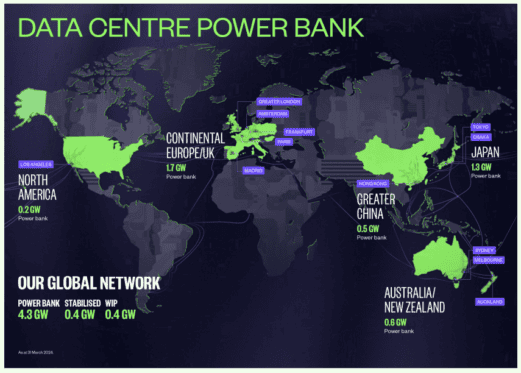
    Goodman’s global power bank totals 4.3GW across 12 major cities, following a 0.3GW addition during the third quarter.

    Source: Goodman Group third quarter update

    The bank comprises 2.1GW of secured power, including 0.4GW that is stabilised and owned, and 0.4GW that is under development, and 2.2GW of power in the advanced stages of procurement.

    Goodman says it has the proven development capabilities and strong balance sheet to continue buying and developing high-tier data centres in popular, supply-constrained locations.

    Goodman said:

    We continue to develop large-scale, high value, data centres, and expand our global power bank to address growing data centre demand as AI usage and cloud computing expands.

    ASX 200 stock price snapshot

    This ASX 200 property stock has gained 153.5% in market cap over the past five years.

    This compares to 9.3% for the S&P/ASX 200 A-REIT Index.

    The post Up 73% in a year, this surging ASX 200 stock just hit another all-time high appeared first on The Motley Fool Australia.

    Should you invest $1,000 in Goodman Group right now?

    Before you buy Goodman Group shares, consider this:

    Motley Fool investing expert Scott Phillips just revealed what he believes are the 5 best stocks for investors to buy right now… and Goodman Group wasn’t one of them.

    The online investing service he’s run for over a decade, Motley Fool Share Advisor, has provided thousands of paying members with stock picks that have doubled, tripled or even more.*

    And right now, Scott thinks there are 5 stocks that may be better buys…

    See The 5 Stocks
    *Returns as of 5 May 2024

    More reading

    Motley Fool contributor Bronwyn Allen has positions in Goodman Group. The Motley Fool Australia’s parent company Motley Fool Holdings Inc. has positions in and has recommended Goodman Group. The Motley Fool Australia has recommended Goodman Group. The Motley Fool has a disclosure policy. This article contains general investment advice only (under AFSL 400691). Authorised by Scott Phillips.

  • 2 cheap ASX All Ords shares to buy for growth and dividends

    If you are on the lookout for the dream combination of growth and attractive dividend yields, then you may want to check out the two ASX All Ords shares listed below.

    These shares have been tipped to grow their earnings and dividends strongly in the coming years. And the even better news is that they could be cheap according to analysts. Let’s see what they are saying about them:

    Treasury Wine Estates Ltd (ASX: TWE)

    Morgans thinks that this wine giant’s shares could be undervalued at present. The broker has an add rating and $14.03 price target on the ASX All Ords share. This implies potential upside of almost 22% for investors over the next 12 months.

    It is feeling very positive about its acquisition in the United States. It said:

    It may take some time for the market to digest TWE’s acquisition of Paso Robles luxury wine business, DAOU Vineyards (DAOU) for US$900m (A$1.4bn) given it required a large capital raising. The acquisition is in line with TWE’s premiumisation and growth strategy and will strengthen a key gap in Treasury Americas (TA) portfolio. Importantly, DAOU has generated solid earnings growth and is a high margin business. It consequently allowed TWE to upgrade its margins targets. While not without risk given the size of this transaction, if TWE delivers on its investment case, there is material upside to our valuation.

    As for dividends, the broker expects fully franked dividends of 36.4 cents in FY 2024 and then 44.8 cents in FY 2025. This will mean dividend yields of 3.15% and 3.9%, respectively.

    Woolworths Group Ltd (ASX: WOW)

    Goldman Sachs thinks that this ASX All Ords share could be cheap at current levels.

    The broker has a buy rating and $39.40 price target on the supermarket giant’s shares. This suggests that they could rise 24% from current levels.

    Goldman highlights that Woolworths’ shares are trading on lower than normal multiples despite having a positive outlook. It said:

    WOW is the largest supermarket chain in Australia with an additional presence in NZ, as well as selling general merchandise retail via Big W. We are Buy rated on the stock as we believe the business has among the highest consumer stickiness and loyalty among peers, and hence has strong ability to drive market share gains via its omni-channel advantage, as well as its ability to pass through any cost inflation to protect its margins, beyond market expectations. The stock is trading below its historical average (since 2018), and we see this as a value entry level for a high-quality and defensive stock.

    In respect to dividends, the broker has pencilled in fully franked dividends of $1.08 per share in FY 2024 and then $1.14 per share in FY 2025. This represents yields of 3.4% and 3.6%, respectively.

    The post 2 cheap ASX All Ords shares to buy for growth and dividends appeared first on The Motley Fool Australia.

    Should you invest $1,000 in Treasury Wine Estates Limited right now?

    Before you buy Treasury Wine Estates Limited shares, consider this:

    Motley Fool investing expert Scott Phillips just revealed what he believes are the 5 best stocks for investors to buy right now… and Treasury Wine Estates Limited wasn’t one of them.

    The online investing service he’s run for over a decade, Motley Fool Share Advisor, has provided thousands of paying members with stock picks that have doubled, tripled or even more.*

    And right now, Scott thinks there are 5 stocks that may be better buys…

    See The 5 Stocks
    *Returns as of 5 May 2024

    More reading

    Motley Fool contributor James Mickleboro has positions in Treasury Wine Estates. The Motley Fool Australia’s parent company Motley Fool Holdings Inc. has positions in and has recommended Goldman Sachs Group. The Motley Fool Australia has recommended Treasury Wine Estates. The Motley Fool has a disclosure policy. This article contains general investment advice only (under AFSL 400691). Authorised by Scott Phillips.

  • Billionaire real estate investor Frank McCourt wants to buy TikTok — but he’s not interested in the algorithm

    Frank McCourt Marseille
    Frank McCourt.

    • Frank McCourt is organizing a group to acquire TikTok's US business through Project Liberty.
    • US lawmakers voted to ban the Chinese-owned app unless the US arm sold within a year.
    • McCourt's group aims to change TikTok's infrastructure and reclaim digital identities and data.

    Real estate mogul Frank McCourt is the latest person to raise his hand to try to acquire TikTok's US business.

    McCourt said on Wednesday that he is assembling a group of specialists, including investment bank Guggenheim Securities and law firm Kirkland & Ellis, as well as technology experts, academics, and parents, to consult on buying the US division of the viral social media app.

    The announcement follows a decision by US lawmakers last month to ban Chinese-owned TikTok from US app stores unless it is sold within a year. TikTok's parent company ByteDance, sued the federal government over the ban last week. TikTok has already said it has no plans to sell the platform.

    "We thought this was a really fantastic opportunity to accelerate the creation of an alternative internet," McCourt told the Associated Press. The 70-year-old is worth $1.4 billion, per Forbes, and made his wealth through real estate and sports investments.

    The potential purchase would be made through Project Liberty, an internet advocacy group founded by McCourt in 2021 that focuses on data privacy, among other issues. Several high-profile technologists support the bid, including Tim Berners-Lee, according to the project's website.

    McCourt wants to change TikTok's basic business to an open-source model that allows users and creators more control over their data.

    The announcement did not share details of how much money is being raised or whether the group is in already in talks with TikTok.

    McCourt, who previously owned the Los Angeles Dodgers, is on the short list of investors who have shown interest in buying the platform. Former Google CEO Eric Schmidt said he thought about buying the platform but decided against it. Former Treasury Secretary Steven Mnuchin said he's eyeing a purchase, but he may not have the funds to do it. Big Tech companies are almost sure to face antitrust concerns if they want in.

    There is very little consensus on the app's price tag — one valuation pegs the US business at $100 billion, but another says it is immaterial to ByteDance's revenue. The platform may also be less attractive if it is sold without its "For You Page" algorithm, which has been credited for its success.

    McCourt told the New York Times that he doesn't want the algorithm.

    "We doubt very much that China would sell TikTok with the algorithm," McCourt told the Times. "We're the one bidder that doesn't want the algorithm because we're talking about a different architecture, a different way of thinking about the internet and how it operates."

    TikTok and representatives for McCourt did not immediately respond to Business Insider's request for comment.

    Read the original article on Business Insider