Jake Stauch and Tatiana Birgisson co-lead the AI startup Serval.
Serval
Tatiana Birgisson and Jake Stauch are the COO and CEO of Serval, an AI startup that recently raised $47 million.
They're also married and live together in Oakland with their 2-year-old daughter.
"There's no 'off limits' time," Birgisson told Business Insider. Stauch said the couple has always talked about work 'non-stop.'
This as-told-to essay is based on a conversation with Tatiana Birgisson and Jake Stauch, the COO and CEO of Serval, which integrates AI agents in IT service management. Before joining Serval, Birgisson was VP of Growth at Rippling. Birgisson and Stauch are married and live in Oakland. It's been edited for length and clarity.
Jake Stauch: There was this entrepreneurship living group at Duke that was not able to get funding because there were no women in the group.
Tatiana Birgisson: 18 guys. Not a good look.
JS: Certainly, you could find somebody, and so they did find Tatiana. We were dating different people. Then we ended up not dating other people.
TB: Our relationships fell apart within a few weeks of each other. We were sad together in college.
JS: Very lonely, drunk college students. We got into this summer program together, so we were basically living in the same group, but instead of 18 of us, now there were three. That's how it happened.
In the early days of our relationship, we were working very closely on each other's companies. Tatiana was on the board of NeuroPlus, my company. I was on the board at Mati, her company. Even though we were solo founders, we kind of acted as each other's cofounders. We always worked really well together.
We had a baby right around the time I was starting my company, and it was not going to make sense for us to be unemployed while we're new parents. But Tatiana still wanted to start a company, and here I am running Serval, and things are starting to work, and we're about to raise our Series A. It was like: You could do your own company, or I need you here.
This is a best-case scenario, because Tatiana wanted to be a founder, but also didn't have a team or an idea…
TB: Or the technical chops. It's not a great recipe for success for a great VC to invest in you.
JS: It was missing some ingredients, and we had a company that was really taking off.
"We were always people that talked about work non-stop," Stauch said. "It was 95% of our conversation."
Serval
TB: It needed a lot of sales and marketing. Everybody around us was like, "This is the most obvious thing in the world." To me, it was the most non-obvious thing. I was very sure I would never work for my husband. I would start a company with him, never for. It took a lot to be ready for that.
It can be done. We've seen it with a couple of friends. An entrepreneur hired his wife as an EA/office manager. In that case, it worked really beautifully for them because she loved being in service of an organization and liked helping her husband with his dream.
JS: Melissa and Doug were at our wedding. The toy company founders. Great couple. They're a big inspiration for us, and we saw it work for them as equal counterparts.
TB: With six or seven kids, too. We're not doing that.
JS: We were always people that talked about work non-stop. It was 95% of our conversation.
TB: Even when we were rock climbing or out skiing together on vacation, we'd still be brainstorming ideas. It's just intellectual stimulation that you don't want to turn off or compartmentalize. That just feels wrong for us.
JS: But we were working at different places. I'd talk about my startup, and that whole cast of characters. Maybe it's mildly interesting to Tatiana, but it's not the most exciting thing because she's not living it. Then she tells me about what's going on at Rippling, and it's mildly interesting. I don't know who these people are. I don't really care about HR software. It's like watching a TV show that you don't care that much about.
TB: It's like Jake watching a rom-com. He'll put up with it to watch it with me.
JS: But now, it's very engaging. We're on the same team, and everything is super relevant. We don't work together over the course of the day, and so when we talk about work at home, it's like catching up on things that are super relevant and meaningful.
"I do try to spend some time in the evenings with our daughter," Birgisson said. "Then we get back online after bedtime."
Serval
TB: By the time we hit the pillow, we're pretty done with the day. Any kind of talking has ceased by that point. But there's no "off limits" time.
I do try to spend some time in the evenings with our daughter, who's a 2-year-old. We try to carve out family time with her and focusing on her development, reading her books, and helping her learn how to climb on the wall(?) she has in her room.
Then we get back online after bedtime.
JS: We try to carve out Saturdays as family days, but I think that we're mildly successful at that. Sunday's just a regular workday for us.
TB: We've started bringing our daughter with us to trips that we're both going on. When we were in Orlando for a conference, she got to go to Disney World and meet Rapunzel.
JS: Getting back from a long day at a conference and she's just…
TB: …So happy to see us. It's so beautiful and so much fun.
President Donald Trump's administration is placing new student-loan borrowing caps on graduate and professional degrees.
Anna Moneymaker/Getty Images
Trump's student-loan repayment overhaul includes new borrowing caps for graduate and professional students.
It also reclassifies which programs are considered "professional" and eligible for a higher loan cap.
Advocates expressed concerns that the changes could strain those in healthcare professions.
This year, there's a new topic to argue about at the Thanksgiving table: What is a professional degree?
It's a question that President Donald Trump's Department of Education recently addressed in its overhaul ofstudent-loan repayment. That's led to criticism from groups that are not included in the department's narrower degree definition.
The crux of the issue is new borrowing limits. Trump's "big beautiful" spending legislation that he signed into law in July included new borrowing caps on professional and graduate student loans, aiming to curb excessive borrowing: $20,500 a year for graduate students or $100,000 over a lifetime, and $50,000 a year for professional students or $200,000 over a lifetime.
In addition to the caps, the department also reclassified what constitutes a professional degree, narrowing it down to 10 programs, including dentistry, medicine, and law.
Some advocates said the department's professional degree definition could strain student-loan borrowing access to those in the healthcare profession seeking post-graduate training, like nurses, although the changes won't affect undergraduate borrowing.
"At a time when healthcare in our country faces a historic nurse shortage and rising demands, limiting nurses' access to funding for graduate education threatens the very foundation of patient care," Jennifer Mensik Kennedy, president of the American Nurses Association, said in a statement.
The Department of Education said that the new definitions only reflect which programs qualify for higher loan limits and are "not a value judgement about the importance of programs. It has no bearing on whether a program is professional in nature or not."
Student-loan changes to professional degree programs
The Department of Education said 10 post-graduate programs will be counted as professional degrees and will be eligible for the higher student-loan cap: pharmacy, dentistry, veterinary medicine, chiropractic, law, medicine, optometry, osteopathic medicine, podiatry, and theology.
Preston Cooper, a senior fellow at the conservative think-tank the American Enterprise Institute, wrote in a Monday blog post that Congress "legislated only broad guidelines as to how graduate programs should be classified," and the distinction between professional and non-professional programs was left to the discretion of the Education Department.
When it comes to nursing programs, Cooper said that the "new caps will affect only a small number of programs charging exorbitant prices."
The Department of Education said that, based on its data, 95% of nursing students borrow below the new student-loan cap. The average cost of a master's degree in nursing in 2020 ranged from $15,030 to nearly $43,000, per the National Center for Education Statistics.
The borrowing caps could strain other professions and cause some students to either forgo their advanced degrees or turn to the riskier, private lending market. For example, the Association of American Medical Colleges found that the median cost for four years of public medical school was $286,454 for the class of 2024. For law school, the average total cost was just over $217,000. The $200,000 lifetime cap would be insufficient to cover those tuition amounts.
While negotiations on the changes have concluded, the public will have an opportunity to comment on the proposals early next year before the department moves toward final implementation. The department said that it "may make changes in response to public comments."
Mel Williams, a partner and cofounder at TrueBridge Capital Partners, says the AI frenzy will mint a few giants while many overhyped startups collapse.
GREG BAKER/AFP via Getty Images
A VC investor said AI will create a handful of winners while overhyped startups may fail.
Early-stage AI companies are commanding soaring valuations despite lacking clear product-market fit.
VC in AI is overheated, he said, setting the stage for a harsh market correction.
The AI boom is only just beginning — and it may prove the most lucrative cycle in venture-capital history, even as it also leaves behind a wave of startups.
That's according to Mel Williams, cofounder and partner at TrueBridge Capital Partners, a fund-of-funds manager with $8 billion under management that has backed firms such as Founders Fund, Thrive, and Sequoia.
While VCs pick startups, Williams' job is to pick the VCs — giving him a rare, ecosystem-wide view of what's coming.
"We think we're at the leading stages of an AI wave," Williams said during an interview on Jack Altman's "Uncapped" podcast released on Tuesday.
"We're going to see a lot of carnage over the next 10 years. And we will see more value created over the next 10 years than we've seen in the venture industry," he said.
A 'frothy' market — especially at the earliest stages
Williams described the early-stage AI environment as overheated.
Founders with the right résumés — often with experience at OpenAI or top labs — can raise massive rounds at lofty valuations with little proof their product works.
"At the earlier stages of the formation stages, where there's less evidence of a product market fit, you do see founders with credibility, founders who could check a couple boxes raising large pools of capital at very high valuations," he said.
Growth-stage deals, he added, look more reasonable, with valuations closer to public-market levels as investors focus more on real revenue.
AI will amplify the venture's power-law dynamics
Williams believes AI is accelerating the power-law pattern that already defines venture capital: a tiny handful of companies drive nearly all the returns.
"The magnitude of the winners is even greater today than it has been in prior cycles," he said. It "is going to be outsized in this market."
He pointed to three forces intensifying that trend:
AI software scales instantly, with near-zero marginal cost.
Enterprises are aggressively adopting AI tools, with explicit budgets allocated for them.
Consumers jump in immediately, as seen with ChatGPT's explosive growth.
The result: companies that get product-market fit could become market leaders quickly, while those that miss may stumble.
Outside AI, the venture market looks surprisingly healthy — but the fallout will still be brutal
Williams said the frenzy is largely confined to the field of AI. Outside of this, valuations remain reasonable, and capital still moves around milestones and revenue, he said.
The broader venture market, in his view, looks attractive compared to the overheated AI landscape.
But AI now accounts for 50% to 60% of all venture activity, he said — and that imbalance is setting the stage for a harsh correction.
Even if non-AI categories stay rational, Williams believes the sheer amount of capital flooding into AI will create a long trail of "carnage" as companies miss product-market fit or fail to justify their sky-high valuations.
"We're in the early stages of that. There's evidence that it's working," he said, but he added, "at the same time, it feels like a very frothy investment environment."
British Airways announced a deal with Starlink in November.
Courtesy of British Airways
Emirates is the latest airline to sign up for Elon Musk's Starlink WiFi.
17 other carriers have also announced deals for the ultra-high-speed internet.
It's already available on some airlines — here's the full list.
Elon Musk's Starlink has gained yet another airline customer as the ultra-high-speed WiFi service continues to gain popularity.
On the first day of this month's Dubai Airshow, Emirates announced that Starlink will be available for free, starting November 23.
Business Insider previously tested Starlink on Qatar Airways' first flight with it last October. The connection speed peaked at 215 megabits per second, more than enough for a lag-free video call, and faster than many cable-based internet services.
Starlink functions thanks to a constellation of over 7,000 satellites, which allows internet connections in remote locations, such as flying over an ocean. The satellites are in low-earth orbit, which means faster internet speeds — but also disrupts astronomers.
Starlink isn't the only game in town, however.
JetBlue has signed up for Amazon Leo, which functions similarly, but has only launched 150 satellites so far.
Another in-flight WiFi rival is Viasat, which is used by Delta Air Lines and American Airlines. It only has a handful of satellites in a geostationary orbit, which have a longer time delay.
While it has rivals, Starlink wants to cement its dominance. As Starlink grows in popularity, it could be that more carriers sign up to Starlink to keep up with competitors. All airlines with Starlink offer it free of charge, although some require passengers to sign up for their loyalty programs.
As of the Emirates announcement, here are all the airlines that have publicly announced plans to launch Starlink:
Aer Lingus
An Aer Lingus Airbus A330.
Nicolas Economou/NurPhoto/Getty
The Irish flag carrier is part of International Airlines Group, which announced its Starlink deal in early November. It's set to roll out Starlink from early 2026, but plans are still being finalized across the conglomerate.
Air Baltic
An Air Baltic Airbus A220.
Jakub Porzycki/NurPhoto via Getty Images
Latvia's airBaltic flies around Europe and the Middle East only using Airbus A220 jets. It was the first European airline to adopt Starlink, and hopes to complete installation on all its planes by the end of the year.
Air France
An Air France Boeing 777.
AaronP/Bauer-Griffin/GC Images
The French flag carrier announced its Starlink deal last September, available to Flying Blue loyalty members. Installation began across its fleet, including regional planes, this summer.
Air New Zealand
An Air New Zealand flight arrives at Sydney Airport in Sydney, Australia.
Bai Xuefei/Xinhua via Getty Images
Air New Zealand first said it was working with Starlink two years ago. It then rolled it out on two domestic aircraft in June, saying that it was "currently in the test phase."
Alaska Airlines
An Alaska Airlines Embraer E175.
Kevin Carter/Getty Images
After merging with Hawaiian Airlines — the first major carrier to offer Starlink — Alaska Airlines announced its deal in August. It says it will first be available next year and will be rolled out across the fleet by 2027.
British Airways
A British Airways Boeing 787.
Kevin Carter/Getty Images
The UK flag carrier is also part of IAG. BA said it would start rolling out Starlink next year and that it would be available free of charge to all its passengers.
Emirates
An Emirates Airbus A380.
Nicolas Economou/NurPhoto via Getty Images
Dubai's airline is starting to roll out Starlink this month and plans to add it to all 232 in-service aircraft by mid-2027. It's also set to operate the first double-decker Airbus A380 with the service.
FlyDubai
A FlyDubai Boeing 737.
Fabrizio Gandolfo/SOPA Images/LightRocket via Getty Images
The Emirati budget airline also announced its Starlink deal during this month's Dubai Airshow. It only operates Boeing 737s and plans to install Starlink on 100 of them from next year.
Iberia
Mitsubishi CRJ-200ER for Iberia Air Nostrum.
adolf martinez soler/Shutterstock
The Spanish flag carrier is also part of IAG. The conglomerate said it would roll out Starlink across its fleets from 2026.
JSX
A JSX plane.
AaronP/Bauer-Griffin/GC Images
JSX is a charter airline and was the first carrier to equip Starlink back in 2023. Its fleet is mostly made up of regional Embraer jets.
Level
A Level Airlines plane at Barcelona Airport.
Joan Valls/Urbanandsport/NurPhoto via Getty Images
Level is a budget airline based in Barcelona and is part of IAG. The airline's parent company said it would roll out Starlink from 2026.
Qatar Airways
A Qatar Airways Boeing 777 at Athens International Airport.
Nicolas Economou/NurPhoto via Getty Images
Qatar Airways outpaced its regional rival, Emirates, by announcing Starlink back in May 2024. As of November, it operates the most wide-body aircraft with the service, numbering over 100. Starlink is installed on all Qatar's Boeing 777s and is being rolled out to its Airbus A350s.
SAS
Mark Harkin/Flickr
Scandinavian Airlines, or SAS, is the flag carrier for Sweden, Denmark, and Norway. It announced Starlink in January and said the rollout would begin at the end of the year. Passengers would need to sign up for its EuroBonus loyalty program for free access.
United Airlines
United Airlines planes at Newark on Saturday.
Gary Hershorn/Getty Images
United Airlines was the second US airline to announce a Starlink deal, but the first of the Big Three. It has installed the service on over half of its regional planes, and is continuing to roll it out across its whole fleet. The airline says customers will get a notification before their flight if it is equipped with Starlink. Passengers need to sign up for its MileagePlus loyalty program for free access.
Virgin Atlantic
A Virgin Atlantic Airbus A350.
NurPhoto/NurPhoto/Getty Images
Virgin Atlantic was the first UK airline to announce its deal with Starlink, which it did in July. Installation is planned to start in the second half of next year. Passengers will need to sign up for the airline's Flying Club loyalty program to use it.
Vueling
Flickr/Eric Salard
Another IAG subsidiary, Vueling is a Spanish budget airline. Its parent company said it would roll out Starlink from 2026.
WestJet
Flickr/Lord of the Wings
Canada's WestJet started installing Starlink in February, and it's now equipped on over 100 of its Boeing 737 jets. It plans for all its 737-800 and 737 Max 8s to have Starlink by the end of the year. Free access requires signing up for its loyalty program.
Zipair
ZipAir Boeing 787-8 takes off from Tokyo Narita International Airport.
Kittikun Yoksap/Shutterstock
Zipair is a Japanese budget airline and a subsidiary of Japan Airlines. It was an early adopter of Starlink, announcing its deal in early 2023, but doesn't appear to have yet launched the service.
Ralph Scott, who died in 2022, worked at East Carolina University's Joyner Library for 52 years.
Cornell Watson for BI; Courtesy of Jonathan Dembo
Ralph Scott was walking to his office at East Carolina University when he fell. He was shaken, and a groundsman helped him up. He had scrapes on his knee and elbow, but no obvious head injury. The next morning, he felt stiff and achy. His headaches worsened over the next few days.
Ralph drove himself to the hospital, where his condition slowly worsened. He died two weeks after his fall. Doctors said he had congestive heart failure, blood clots, and various hemorrhages and hematomas. He was 80.
Before the fall in 2022, Ralph had seemed healthy and full of energy, his wife, Nancy, recalled. The couple, who married in 1988, spent their free time on wine tours, obsessing over maps, and relaxing. He had long-term cardiac problems and a pacemaker, but he kept his diet in check and often walked five miles a day.
Ralph Scott (left) and his longtime coworker Jonathan Dembo (right), a retired special collections curator, at the library.
Courtesy of Jonathan Dembo
"He was a wonderful and interesting man," Nancy said. "The only problem he had was that he had so many interests he couldn't do everything he wanted to do."
Ralph enjoyed taking strolls with his camera, playing the double bass, and digging into a research project on World War II. He had just celebrated 52 years at the university, where he had long worked as a rare books curator.
"Ralph was doing what he loved," Nancy said. "If he were still here today and was healthy, I'm sure he would still be going over to his office every day."
Nearly three years after his death, and after a complicated legal process, Nancy said she received a payout of workers' compensation. An OSHA filing after his death revealed ECU was initially fined $8,000. ECU did not respond to a request for comment.
Ralph Scott, a rare books curator at the library, died after falling on the job in 2022.
Cornell Watson for Business Insider
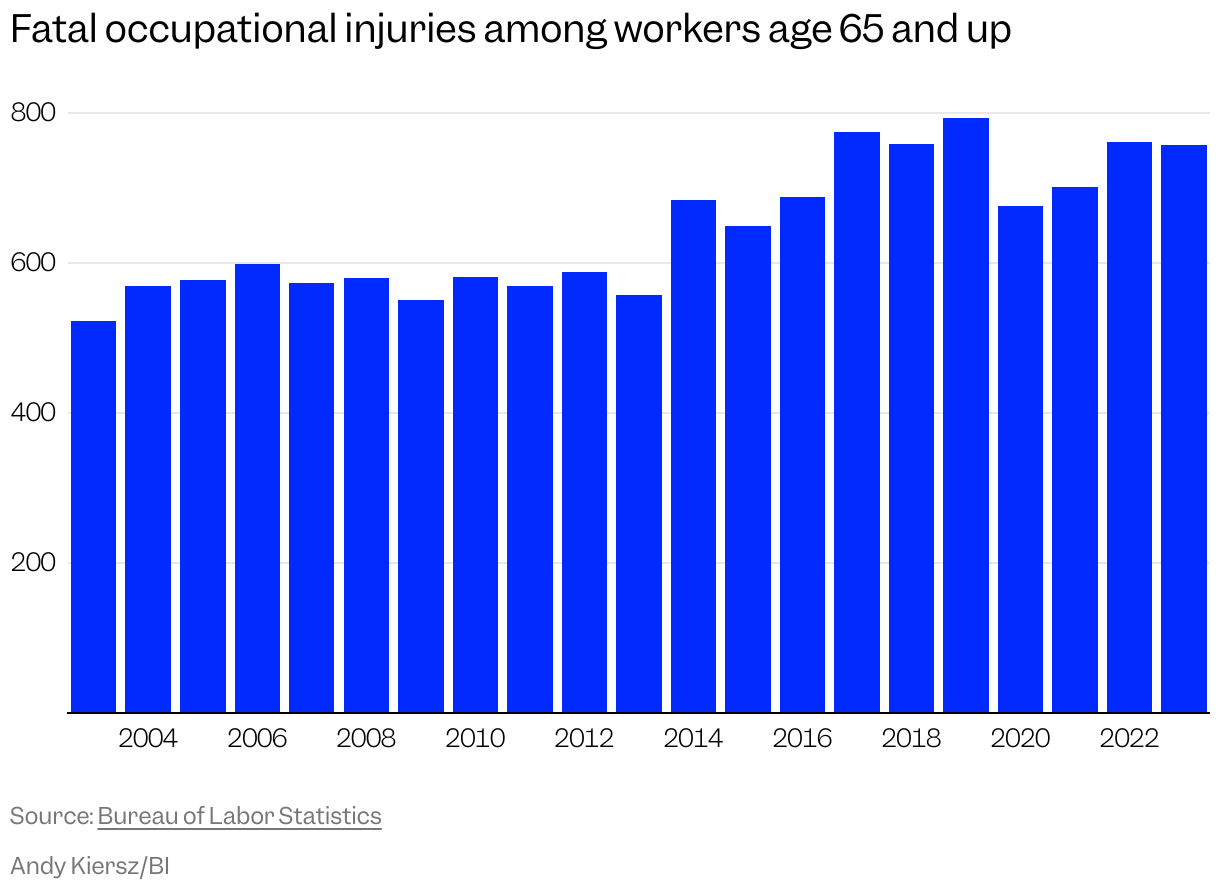
While workplace fatalities overall have declined over the last decade, the share of those involving older workers has increased. Safety and management researchers said this could be because Americans are working later in life, while the workforce is also aging. Within a decade, the US's over-65 population is expected to be larger than the under-18 cohort.
Business Insider has spent the past year reporting on the experiences of Americans over the age of 80 who work. Census Bureau data show that there are about 550,000 of them in the US. We spoke to nearly 200 and heard stories of financial regret, work passions, and desires to stay active. For this story, Business Insider spoke with a dozen family members, friends, and colleagues of eight workers over 80 who died doing what they loved — or trying to pay the bills.
Reported workplace fatalities are rare for those over 80. The Occupational Safety and Health Administration has records of 67 workers in that age group who have died since 2020 from an injury or illness traced to their workplace. In the previous decade, OSHA reported 40. The OSHA database includes only fatalities that were reported within 30 days of the incident, but it does not track incidents that occurred en route to work or happened at a workplace and are not linked to hazards.
Expanding the age range shows that in 2003, 9.4% of those who died at work were 65 or older; two decades later, the share rose to 14.3%, data from the Bureau of Labor Statistics' Census of Fatal Occupational Injuries shows.
The CDC notes that older workers are less likely to be injured compared to younger workers, but older workers' injuries tend to be more severe.
Most families of deceased workers told Business Insider that age wasn't necessarily the main factor. Still, with age, the stakes of an injury — particularly from falls — are often higher, and injuries are more likely to occur to those with physically active jobs.
Geoffrey Hoffman, an assistant professor at the University of Michigan School of Nursing who studies injury among older adults, said he doesn't want slip-and-fall stats to discourage older folks from working.
"You do want people still to be active when they're older and do the things they love doing," Hoffman said. "If the only goal is to prevent falls, you might have people getting out of sort of independence-enhancing or quality of life-enhancing activities."
Work-related deaths are on the rise for America's oldest workers
Shawn Galloway, CEO of the safety consulting firm ProAct Safety, works with companies to prevent employee harm. He said there hasn't been enough done to address workplace fatalities, especially among older workers.
Galloway said older workers may be more susceptible to injury from repetitive tasks, such as lifting or driving, or fall victim to the "success trap," in which someone working for 60 years without an injury mistakenly thinks they are safe.
"We have been calling out the need for a focus on serious injury and fatality prevention for over a decade. Yet, if you look at the overall fatality rates on the job in America, they flatlined, and in some years, have actually gone up," Galloway said. He said it's concerning that more organizations haven't embraced possible solutions, such as retraining leadership to oversee workforce safety measures.
Construction, maintenance, and medicine were common fields for the 67 workers in their 80s and 90s whose job-related deaths have been reported to OSHA since 2020. The incidents often resulted in employer fines of a few thousand dollars. Many died from falls — from ladders, stairs, or a loading dock — or after slipping on black ice. In some cases, injuries were made worse by other health conditions. Eleven were struck by vehicles, including trucks and forklifts.
Some deaths were particularly gruesome. One 87-year-old man in Colorado was killed in a trench wall collapse. An 86-year-old woman in Tennessee was crushed by a dolly at a transportation company. An 86-year-old man in Texas died from blunt trauma when he was pinned between a rack and an oven door. An 84-year-old in Florida was ejected from and run over by a bulldozer. An 81-year-old man in Florida was stabbed at a front desk while working as a security guard.
Karina Johnson founded her nonprofit because of Richard Gadbois.
Courtesy of Karina Johnson
In January 2024, 80-year-old Richard "Dickie" Gadbois died after his ATV fell through ice in Minnesota while he was checking conditions for the safety of lakegoers. He couldn't climb back onto the surface and drowned. Gadbois owned and operated a year-round fishing business for over 40 years, his obituary reads. He led ice fishing trips throughout his life and owned a sewer business, a fencing company, and a resort.
His friend Karina Johnson, who runs the nonprofit Wheel House Warriors for owners of houses on wheels, told Business Insider that she founded the nonprofit because she wanted to help business owners like Gadbois, as well as veterans, active military members, and first responders.
"Since his passing, I have struggled emotionally to keep going," Johnson said, adding that ice conditions have also been riskier than in previous years, slowing down business.
Johnson said Gadbois "was like a papa" to her children and carried photos of them in his wallet. She hopes he is remembered for his selfless acts — he did not have much, but he would give whatever he had.
"He was a funny guy, and his laugh reminded me of Santa Claus, just jolly with a giggle," Johnson said, adding that she hasn't been on the ice since his death.
The wrong place at the wrong time
Jack Hohwald, who was 85 when he died, worked as a bus driver for the Maple Shade School District in New Jersey for 23 years.
In January 2025, Hohwald was fatally struck by another bus driver backing into a parking space. The school district canceled classes, and students honored his life with signs and bouquets.
His daughter, Diane Gumpper, 59, said Hohwald was a hard worker and lived a healthy lifestyle until his death. She said he kept working because it made him feel fulfilled to give back to the community, adding that he "didn't want to die in his rocking chair." She said that a few lawyers have rejected the case.
"He was a little kid at heart," Gumpper said, adding that her father had stuffed animals in his bus. "He always had a smile on his face."
Jay Renwick, 55, has many memories from Hohwald's three decades working for the local police department and planning Memorial Day and Veterans Day ceremonies with him.
Jack Hohwald and his wife were married for over 60 years.
Courtesy of Diane Gumpper
"He was very well-liked by all the students, and everybody knew him as Mr. Jack," Renwick said. "My kids knew him. He didn't have to work. He just wanted to."
"It was a very tragic way to die," Renwick added.
Natalie Schwatka is an associate professor at the Colorado School of Public Health and has researched the Total Worker Health approach, which was developed by the National Institute for Occupational Safety and Health. It encourages employers to think more holistically about why injuries occur instead of blaming the worker or focusing on a Band-Aid-like solution to the most immediate cause, she said. Prevention efforts should also encompass mental health and compensation, and consider risk factors like cardiovascular disease and sleep disorders that don't arise from work but are affected by it.
Some examples might include posting traffic guards on job sites that employ drivers or conducting ergonomic assessments at factories to redesign workstations.
Thurmon Lockhart, a professor of biomedical engineering at Arizona State University, developed the Slip Simulator, in which people are trained to walk on a slippery surface and fall while wearing a harness, which allows them to experience realistic tumbles and react safely to them. He also created a monitor that assesses gait and posture stability.
Lockhart said there is much to be done to protect older adults; most safety data is based on younger workers. Companies can provide appropriate training for individuals with impairments, he said. They can implement flexible scheduling, job assignments tailored to physical abilities, and other adjustments based on each worker's unique circumstances.
A June report from the Centers for Disease Control and Prevention found that between 2003 and 2023, the rate of deaths from falls in and out of work rose by over 75% among people aged 75 to 84 and more than doubled for those aged 85 and older. Some researchers suspect that this is partly due to improved ability to pinpoint the cause of a death or serious injury. People living longer and leading more independent lives could be driving the rate up.
Regardless, the University of Michigan's Hoffman said this uptick comes despite federal and state-level campaigns to raise awareness and education about fall prevention. He said some companies have started to integrate physical and occupational therapy into workflows or provide more benefits to those seeking health resources.
Managing, three years later
Three years later, Nancy Scott is still processing what had happened after her husband, Ralph, died.
She spent the first year grieving the loss of her husband. Then came the legal fight to prove she was eligible for Ralph's workers' compensation.
"It prolonged the grieving process considerably, and I sometimes look at it and wonder whether the value of the suit was worth it," Nancy said. "Ralph was a rabble-rouser. He would have been pleased to sue them."
Ralph Scott was healthy and active before his fall.
Courtesy of Nancy Scott
Jonathan Dembo, 77, who was previously ECU's head of manuscripts and archives, worked with Ralph for 22 years and considered him his "closest friend in the department." He said they would often walk across campus and have lunch together. Outside of his job, Ralph helped dozens of faculty members who were embroiled in internal university disputes.
"He was a very gregarious, friendly, and outgoing person. He knew everybody on campus and knew their histories," Dembo said.
Ralph was also not afraid to showcase his vibrant personality, Dembo said. He loved to "make fun of himself" at Christmas parties, wearing a hat with antlers and displaying a Big Mouth Billy Bass plaque that sang Christmas carols. He wore bow ties and said they made people more approachable — though Nancy had to tie them.
"I told him we were both lifers, that one day, they would find us slumped over our desk the next morning, or the housekeeper would find us at our desks dead in the middle of the night, and we would get hauled out on gurneys," Dembo said.
At 74, Nancy said she's tired of taking care of the house alone, so she plans to move into a retirement community. She's still active in her church and has friends nearby, but she said she's "too darned old to deal with some of the basics."
"We spent so much time together that in some ways, I'm still not adjusted to the idea that he is gone," Nancy said.
OpenAI's head of forward-deployed engineering, Colin Jarvis, talked on a podcast about how his team works inside companies to turn AI into real deployments.
Matthias Balk/picture alliance via Getty Images
OpenAI's head of forward-deployed engineering spoke on a podcast about how his team helps companies deploy AI.
Colin Jarvis' team works on high-value projects in the "tens of millions to sometimes the low billions."
The forward-deployed engineering model has gained traction in the tech world in recent months.
A team at OpenAI embeds itself inside some of the world's biggest companies to turn AI models into real-world deployments.
Colin Jarvis, who leads OpenAI's forward-deployed engineering team, explained in an episode of the "Altimeter Capital" podcast published Thursday how his team helps companies generate "tens of millions to sometimes the low billions" in value.
The team is still small: 39 engineers, with plans to grow to 52 by year-end, Jarvis said. OpenAI lists 24 openings for the forward-deployed engineering team in the US, Europe, and Japan, with salaries in the US topping out at $345,000, plus equity, according to the job postings.
When ChatGPT came out in 2022, the model sparked "tons of hype." "People were really excited, but it was also, like, kind of hard to get value from the models," Jarvis said.
Early enterprise customers struggled to translate that excitement into usable systems. Jarvis said the only consistently successful approach was to embed directly with clients, learn their workflows, and work alongside their staff. This led OpenAI to set up a forward-deployed model.
One of the team's major projects was with Morgan Stanley, which became one of OpenAI's first enterprise customers to deploy GPT-4.
The technical scaffolding took six to eight weeks, but convincing financial advisors to trust the tech took far longer, Jarvis said. The team had to spend another four months running pilots, collecting evaluations, and iterating with wealth advisors.
"In the end, about 98% of them adopted it," he said.
The team also worked with a semiconductor company in Europe to build a "debug investigation and triage agent" that could examine failures and fix bugs. They looked across the company's value chain and realized engineers were spending 70% to 80% of their time debugging chips, Jarvis said.
Jarvis said that forward-deployed engineering teams have to be clear about their purpose. His team avoids "services revenue" and is focused on creating product playbooks, he added.
Forward-deployed engineering model
Earlier this year, Jarvis announced in a LinkedIn post that he would be leading OpenAI's new forward-deployed engineering function.
"Our focus is getting our customers to production, whether it's through a zero-to-one novel application of our tech or helping you to scale proven cases," he wrote in January.
Since then, OpenAI has been hiring forward-deployed engineers around the world, including San Francisco, New York, Dublin, London, Paris, Munich, and Singapore.
In July, OpenAI's international managing director, Oliver Jay, said that the forward-deployed engineering model is a "really specific way to advance the acceleration of advanced AI into scale production cases."
"This is where we solve the latest gap between companies," Jay said in Singapore at the Fortune Brainstorm AI 2025 conference.
Venture investors have also noticed the value the model delivers.
YC partner Diana Hu said in an episode of the "Y Combinator" podcast published in June that she and her team have seen founders close "six, seven-figure deals" with major companies by being forward-deployed engineers.
YC CEO Garry Tan also said on the podcast that the model gives AI startups an edge, helping them beat out giants like Salesforce, Oracle, and Booz Allen.
Hub24 Ltd (ASX: HUB) shares have been in focus this week after the investment platform provider held its investor day event.
Bell Potter has been busy running the rule over the update and has given its verdict on the ASX 200 stock.
What did the broker say about this ASX 200 stock?
Bell Potter was pleased with what it heard at the event and highlights the upside risk to funds under administration (FUA) guidance from new initiatives. It said:
We attended the Investor Day, with the biggest take out being early upside risk to FUA guidance as the company continues to broaden its offering and uplift volumes. Mention of continued strong inflows, more advanced than expected and positive clarification for the trustee licence which runs distinct to its custodian. This has been a deliberate and flexible approach, with an embedded option to purchase the business.
On the negative side, the broker notes that the ASX 200 tech stock is expecting its expenses to grow more than originally expected in FY 2026. However, it points out that this is due to management’s plan to outpace rivals, and its EBITDA margin is still expected to improve year on year. It adds:
Outlook for expense growth has been dialled up to +18-20% with the step change primarily in first half. This reflects a deliberate move to outpace peers and bring forward investment. We believe around half relates to variable cost. So, expect to see this mitigated by operational leverage.
Underlying EBITDA margins are still placed to improve YOY. Fixed costs are basically new solutions and revealed myhub, a recent one user login and app switcher with prompts. We got some efficiency metrics such as halving the time taken to produce advice documents vs. industry average. Like an ERP software but prototyping with co-production and beta testing FY26. Production FY27.
Should you invest?
According to the note, the broker has retained its buy rating on the ASX 200 stock with a trimmed price target of $125.00 (from $135.00).
Based on its current share price of $103.70, this implies potential upside of 20% for investors over the next 12 months.
Commenting on its buy recommendation, Bell Potter said:
Negative surprise in the expense guidance, but we left confident in the growth outlook and cadence over peers. More than mitigated from scale and entrenches customers in line with our initial thesis. Adviser efficiency has historically benefitted flows/valuation.
Should you invest $1,000 in HUB24 Limited right now?
Before you buy HUB24 Limited shares, consider this:
Motley Fool investing expert Scott Phillips just revealed what he believes are the 5 best stocks for investors to buy right now… and HUB24 Limited wasn’t one of them.
The online investing service he’s run for over a decade, Motley Fool Share Advisor, has provided thousands of paying members with stock picks that have doubled, tripled or even more.*
And right now, Scott thinks there are 5 stocks that may be better buys…
Motley Fool contributor James Mickleboro has no position in any of the stocks mentioned. The Motley Fool Australia’s parent company Motley Fool Holdings Inc. has positions in and has recommended Hub24. The Motley Fool Australia has recommended Hub24. The Motley Fool has a disclosure policy. This article contains general investment advice only (under AFSL 400691). Authorised by Scott Phillips.
The S&P/ASX 200 Index (ASX: XJO) ended the week on a bit of a sombre note this Friday after what has been a bumper trading week. After a session that saw the market explore both positive and negative territory, the ASX 200 ended up slipping by 0.037% by the closing bell.
That leaves the index at 8,614.1 points as we head into the weekend.
Wall Street was closed this morning in honour of the American Thanksgiving holiday, so its positive Wednesday morning still stands as the latest data we have.
So let’s dig into today’s market data and check out what the different ASX sectors were doing.
Winners and losers
Leading today’s losers were financial shares, which we can probably blame for the market’s overall loss. The S&P/ASX 200 Financials Index (ASX: XFJ) ended up tanking 0.72% this session.
The only other red sector this Friday was energy stocks. The S&P/ASX 200 Energy Index (ASX: XEJ) couldn’t quite stick the landing, slipping by 0.01%.
Let’s get to the winners now. In first place were gold shares, illustrated by the All Ordinaries Gold Index (ASX: XGD)’s 1.27% vault higher.
Consumer staples stocks were in demand as well. The S&P/ASX 200 Consumer Staples Index (ASX: XSJ) saw its value soar 1.26%.
Utilities shares ran hot too, with the S&P/ASX 200 Utilities Index (ASX: XUJ) surging 0.99%.
Tech stocks were in a similar boat. The S&P/ASX 200 Information Technology Index (ASX: XIJ) galloped 0.91% higher.
Mining shares were a little less enthusiastic, though, evidenced by the S&P/ASX 200 Materials Index (ASX: XMJ)’s 0.43% bump.
Consumer discretionary stocks experienced something similar. The S&P/ASX 200 Consumer Discretionary Index (ASX: XDJ) lifted 0.37% this Friday.
Healthcare shares only just kept their heads above water, with the S&P/ASX 200 Healthcare Index (ASX: XHJ) increasing by 0.11%.
We could say the same for industrial stocks. The S&P/ASX 200 Industrials Index (ASX: XNJ) bounced 0.1% higher this session.
Finally, communications shares managed to only just slide in with a rise, as you can see by the S&P/ASX 200 Communication Services Index (ASX: XTJ)’s 0.02% bump.
Top 10 ASX 200 shares countdown
Again, topping the charts today was investment share HMC Capital Ltd (ASX: HMC). HMC shares rocketed another 9.01% this session to close at $3.87 each.
Our top 10 shares countdown is a recurring end-of-day summary that shows which companies made big moves on the day. Check in at Fool.com.au after the weekday market closes to see which stocks make the countdown.
Should you invest $1,000 in HMC Capital right now?
Before you buy HMC Capital shares, consider this:
Motley Fool investing expert Scott Phillips just revealed what he believes are the 5 best stocks for investors to buy right now… and HMC Capital wasn’t one of them.
The online investing service he’s run for over a decade, Motley Fool Share Advisor, has provided thousands of paying members with stock picks that have doubled, tripled or even more.*
And right now, Scott thinks there are 5 stocks that may be better buys…
Motley Fool contributor Sebastian Bowen has no position in any of the stocks mentioned. The Motley Fool Australia’s parent company Motley Fool Holdings Inc. has positions in and has recommended HMC Capital, Temple & Webster Group, and WiseTech Global. The Motley Fool Australia has positions in and has recommended WiseTech Global. The Motley Fool Australia has recommended Flight Centre Travel Group, HMC Capital, and Temple & Webster Group. The Motley Fool has a disclosure policy. This article contains general investment advice only (under AFSL 400691). Authorised by Scott Phillips.
"Universities don't have, like, a monopoly on foundational knowledge anymore," he said. "You can just get any foundational knowledge from ChatGPT."
"You start with a problem, you recursively go down," he added.
Petersson joined OpenAI's Sora team in December, according to his LinkedIn profile. Before that, he worked as a software engineer at Midjourney and Dataland. He dropped out of high school in 2019.
Petersson said on the podcast that he left high school in Sweden to join a small startup and had to learn how to code out of necessity. "We had to build things, and we have to make product recommendation systems, scraping, integrations," he said.
"The good thing with just working is that you always have a real problem," Petersson said, adding that people learn the fastest with a "top-down approach."
He applied the same top-down approach to understanding machine learning from scratch. He would ask ChatGPT which project to build, then have it generate the code. When it ran into bugs, he would fix them with the model's help. From there, he drilled into specific components of the system until the underlying ideas clicked.
"Suddenly, you have all the foundational knowledge, like, it doesn't need to go bottom up anymore," he said.
Petersson also said people should focus on results, not credentials, to prove their worth. "Companies just want to make money. You show them how to make money, that you can code, and they'll hire you."
Dropouts are the rising stars in tech
College dropouts have become rising stars in the tech industry thanks to AI.
OpenAI CEO Sam Altman — a Stanford dropout himself — said last month that he's "envious of the current generation of 20-year-old dropouts."
"Because the amount of stuff you can build, the opportunity in this space is so incredibly wide," he said in an interview with Rowan Cheung at the DevDay conference in October.
Venture firm Andreessen Horowitz wrote in a March blog post that "the playing field has leveled for younger founders," adding that it is "the best time in a decade for dropouts and recent graduates to start a company."
Some CEOs have gone even further, openly questioning the value of higher education.
Palantir CEO Alex Karp said on CNBC in February that "everything you learned at your school and college about how the world works is intellectually incorrect." His company launched a Meritocracy Fellowship in April, a four-month paid internship for high school graduates not enrolled in college.
If you’re building a portfolio designed to deliver steady, long-lasting passive income, the best approach is to focus on companies with robust business models, durable earnings and management teams that consistently prioritise shareholder returns.
These aren’t the headline-grabbing tech names, they are the quiet compounders that keep paying through booms, busts, and everything in between.
Right now, three ASX shares stand out as true dividend machines. They offer stability, defensive cash flows, and the kind of long-term reliability income-focused investors value most.
APA Group could be one of the most dependable income stocks on the Australian market. It owns and operates Australia’s largest network of gas pipelines along with electricity transmission, renewable energy, and remote power assets. These are essential infrastructure assets that underpin the nation’s energy system, making APA’s earnings highly predictable.
These assets have allowed APA to deliver over a decade of consecutive dividend increases, which is something only a handful of ASX shares can claim. And with its distributions backed by long-term, inflation-linked contracts that provide excellent visibility on future cash flows, it seems quite likely that this run could continue well into the next decade.
At present, APA Group trades with an estimated forward dividend yield of 6.25%.
Another ASX dividend share that could be a great long-term income pick is Macquarie.
It is an investment bank that has a unique global business model spanning asset management, commodities, banking, and green energy investments. This diversification allows it to generate income from multiple sources, reducing reliance on any single segment.
Macquarie arguably has one of the strongest capital positions in the financial sector, supporting its long history of paying meaningful dividends. The company also benefits from long-term structural trends such as the energy transition, infrastructure investment, and global asset management flows. This bodes well for its dividends over the next decade.
It currently trades with an estimated forward dividend yield of 3.55%.
Toll-road operator Transurban is another reliable income generator worth considering.
Its network of roads across Sydney, Melbourne, Brisbane and North America generates steady, inflation-linked revenue.
Transurban appears well-placed for steady and predictable growth over the next decade thanks to population growth, traffic congestion, and development projects.
This is expected to support further increases in its dividend. For example, the market expects an increase to 69 cents per share in FY 2026 (from 65 cents in FY 2025), which equates to a forward dividend yield of 4.6%.
Motley Fool investing expert Scott Phillips just revealed what he believes are the 5 best stocks for investors to buy right now… and APA Group wasn’t one of them.
The online investing service he’s run for over a decade, Motley Fool Share Advisor, has provided thousands of paying members with stock picks that have doubled, tripled or even more.*
And right now, Scott thinks there are 5 stocks that may be better buys…
Motley Fool contributor James Mickleboro has no position in any of the stocks mentioned. The Motley Fool Australia’s parent company Motley Fool Holdings Inc. has positions in and has recommended Macquarie Group and Transurban Group. The Motley Fool Australia has positions in and has recommended Apa Group, Macquarie Group, and Transurban Group. The Motley Fool has a disclosure policy. This article contains general investment advice only (under AFSL 400691). Authorised by Scott Phillips.