The world's largest passenger was first announced in 1990 and entered service in 2007 with Singapore Airlines.
It was the European planemaker's answer to the Boeing 747, as it expected a big demand for aircraft with a huge capacity.
However, production ended in 2021, as many airlines preferred the flexibility of typical wide-body jets like the Boeing 777 and Airbus A350.
The four-engine jet's high operating costs also prompted carriers like Air France and Malaysia Airlines to retire their fleets during the pandemic.
However, many airlines seem to have fallen back in love with the superjumbo.
Lufthansa retired all 14 of its A380s during the pandemic but has brought back eight of them since 2022. Etihad has reactivated six jets and launched new routes to Paris and Singapore.
Meanwhile, Australia's Qantas restarted A380 flights between Sydney and Dallas in August — the first time since before the pandemic.
Based on route data from Cirium, Business Insider has compiled a list of every airline regularly operating the A380 and the routes they're planning to fly in December 2025.
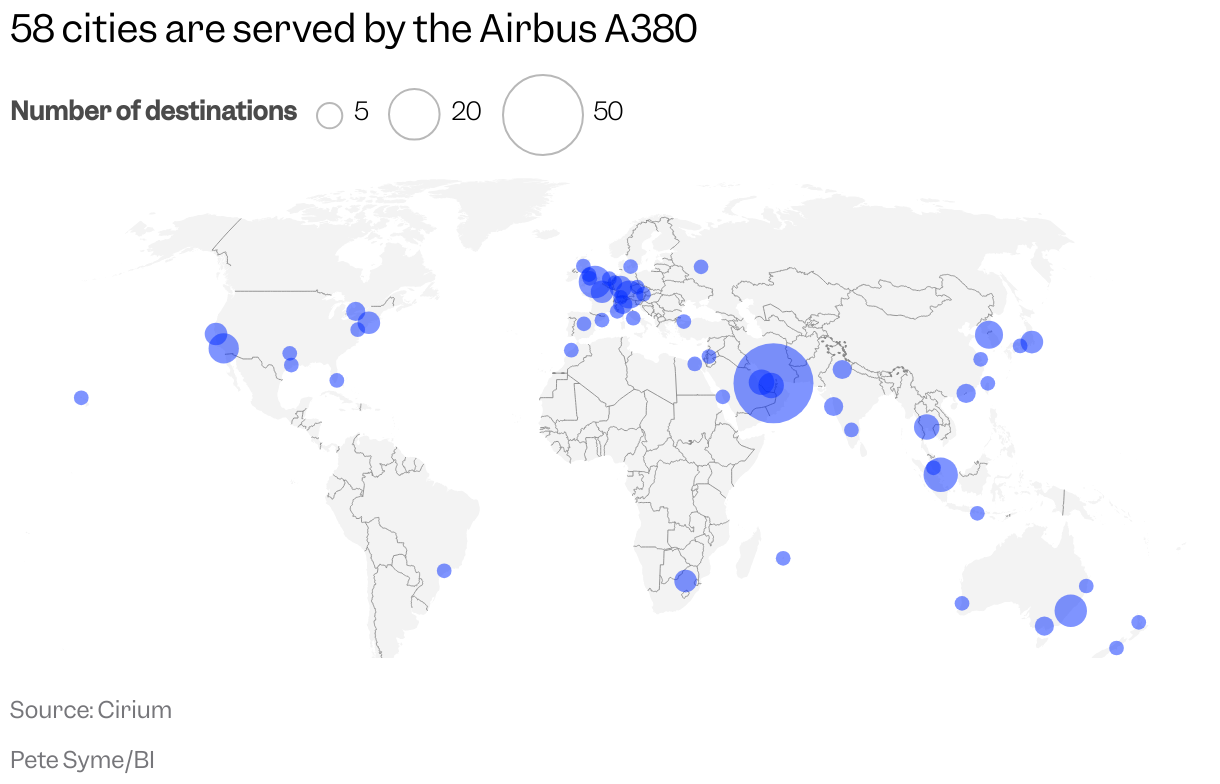
Here's what all 89 Airbus A380 routes look like on the map.
Pete Syme/BI
More than 7,500 flights are scheduled with the Airbus A380 during December, with capacity for almost 4 million passengers, per Cirium.
If you're looking for the routes closest to you, then try this interactive map.
You can hover over each icon to view the destinations available from that location.
1. Emirates
Pete Syme/Business Insider
Dubai's airline is by far the world's largest operator of the A380. Emirates has a total of 116, with 95 of them active.
Like its rival Middle Eastern airlines, Emirates' A380 is highly luxurious — with business-class passengers able to visit the bar or even book a shower.
The airline's president, Tim Clark, told Business Insider earlier this year that he'd like Airbus to build a new version of the A380 with more fuel-efficient engines.
Emirates' plethora of planes comes with a similarly broad route map. Brace yourself for an extensive list.
Emirates flies the A380 between Dubai and Amman, Jordan; Amsterdam; Auckland, New Zealand; Bangkok; Barcelona; Bengaluru, India; Birmingham, England; Brisbane, Australia; Cairo; Casablanca, Morocco; Copenhagen, Denmark; Denpasar, Indonesia; Düsseldorf, Germany; Frankfurt, Germany; Glasgow, Scotland; Hong Kong; Houston; Istanbul; Jeddah, Saudi Arabia; Johannesburg; Kuala Lumpur, Malaysia; London Gatwick; London Heathrow; Los Angeles; Madrid; Manchester, England; Mauritius; Melbourne, Australia; Milan; Moscow; Mumbai, India; Munich; New York; Nice, France; Osaka, Japan; Paris; Perth, Australia; Prague; Rome; San Francisco; São Paulo; Seoul; Shangahi; Singapore; Sydney; Taipei; Tokyo Narita; Toronto; Vienna; Washington, DC; and Zurich.
Emirates also operates three fifth-freedom flights with the A380, between Christchurch, New Zealand and Sydney; Bangkok and Hong Kong; and Milan and New York.
2. British Airways
A British Airways Airbus A380 arriving in Los Angeles.
Skytrax ranked the airline's first class 10th this year. However, BA has also launched a $9 billion "transformation program," which includes retrofitting its A380s with an upgraded first class that is expected to debut next year.
"The A380 is an important part of our fleet and rightfully, incredibly popular with our customers," Neil Chernoff, BA's chief planning and strategy officer, previously told Business Insider.
Behind Emirates, BA offers the second-highest number of destinations, most of which are in the US.
BA flies the A380 between London Heathrow and Dubai, Johannesburg, Los Angeles, Miami, and San Francisco.
3. Singapore Airlines
A first-class suite on a Singapore Airlines A380.
ROSLAN RAHMAN/AFP via Getty Images
Singapore Airlines also has a fleet of 12 double-decker jets, having retired seven due to the pandemic.
The carrier is one of just 10 to receive a five-star rating from Skytrax. It named Singapore Airlines' business class the second-best behind Qatar Airways, but top for first-class.
The airline offers enormous suites on its A380s, which have both an armchair and a bed. Two of these can also be uniquely combined to create a double bed.
Singapore flies the A380 between Singapore Changi Airport and Frankfurt, London, Mumbai, New Delhi, and Sydney.
4. Qatar Airways
A Qatar Airways Airbus A380.
Nicolas Economou/NurPhoto via Getty Images
Qatar Airways cleaned up at this year's Skytrax awards, winning both best airline and best business class.
Like Emirates, the airline's A380 includes a bar for business-class passengers. It also has huge bathrooms, but lacks showers.
Qatar's A380s, perhaps surprisingly, don't feature its flagship business-class product, the QSuite, which you'll find on the A350 and Boeing 777 and 787.
Following delays to the Boeing 777X, Qatar reversed plans to retire the A380.
Its former CEO, Akbar Al-Bakar, said in 2021 that buying the planes was a "big mistake," given their high operating costs.
However, on the sidelines of last year's Farnborough Airshow, current CEO Badr Mohammed Al-Meer said the quad-engine was getting a new lease of life.
Qatar has eight A380s, which it operates between Doha and Bangkok, London, Paris, and Sydney.
It flies them from Sydney to Dallas/Fort Worth, Johannesburg, Los Angeles, and Singapore, where it also continues to London.
Plus, the A380 is sometimes used on flights from Melbourne to Los Angeles.
A severe storm warning and "incredibly high" demand during Taylor Swift's Australian tour last year saw Qantas use a spare A380 to fly Swifties from Melbourne to Sydney.
6. Etihad
The Residence's bedroom on board an Etihad A380.
Etihad Airways via Getty Images
Abu Dhabi's Etihad Airways is the third-most prominent operator in the Middle East, often overshadowed by Emirates and Qatar.
However, its A380s are unique as they offer the most extravagant ticket in commercial aviation: The Residence.
For $24,000, you can book the only three-room suite on an airliner, complete with a bedroom and shower.
Etihad has 9 A380s. It flies them from Abu Dhabi to London, Paris, Singapore, and Toronto.
7. Lufthansa
A Lufthansa Airbus A380 taxiing in Munich.
Peter Kneffel/picture alliance via Getty Images
The German flag carrier has a fleet of eight A380s.
It appears to prefer the only other double-decker jet, as Lufthansa operates the most Boeing 747 jets of any passenger airline.
Lufthansa initially retired all 14 of its A380s during the pandemic before changing its mind as travel demand bounced back. The other six were sold back to Airbus, Airways Magazine reported in 2023.
Lufthansa's A380s go between Munich and Bangkok, Los Angeles, New Delhi, and San Francisco.
8. Korean Air
A Korean Air Airbus A380.
Matej Divizna/Getty Images
Korean Air is one of four airlines on this list, and 11 around the world, to be rated five stars by Skytrax.
It has six A380s, which it flies from Seoul's Incheon Airport to Frankfurt, New York, and Tokyo.
But four-engined jets appear to be falling out of favor here. In 2021, CEO Walter Cho told FlightGlobal that its A380s would be retired by 2026 and its Boeing 747s by 2031.
9. Asiana Airlines
An Asiana Airlines Airbus A380.
Joan Valls/Urbanandsport /NurPhoto via Getty Images
The second Seoul-based carrier on this list, Asiana has merged with Korean Air. For now, it's operated as a subsidiary but will use the same name from 2027.
The combined entity could have 12 A380s, depending on Korean's plans to retire its A380s.
Until then, Asiana regularly flies these jets from Seoul to Frankfurt, Los Angeles, and Sydney.
10. ANA
A ceremony celebrated the delivery of ANA's first A380 in 2019.
The Japanese airline has three in total, which it flies between Tokyo Narita and Honolulu.
ANA is another five-star airline, with an impressive business-class product. But you'll need to fly on a Boeing 777 to experience "The Room" — or in first class, "The Suite," which includes a 43-inch TV.
CloudKitchens CTO Brian Atwell said the startup's accounting team already uses IQ tests in its interview process.
Tetra Images/Getty Images/Tetra images RF
CloudKitchens CTO Brian Atwell said testing for intelligence is necessary for some tech roles.
He said that Uber cofounder Travis Kalanick's startup is considering using IQ tests for more roles.
Atwell said such tests would "help weed out people very early."
CloudKitchens CTO Brian Atwell said he has considered a way to shake up the startup's hiring process by implementing one of the oldest kinds of tests.
"It probably wouldn't hurt if you slapped an IQ test in front of the PM in your process," Atwell told podcaster Ryan Peterman during a recent episode.
Atwell said it's difficult to design a perfect interview process, particularly one that can't be gamed. He said that CloudKitchens, Uber cofounder Travis Kalanick's $15 billion ghost kitchen startup, is conducting 20 experiments at any given time to improve its interview process.
"The reason that companies don't do it is, it just takes a ton of work to build a good process," he said. "Like in a tech org, you have dozens of different roles and each one needs different interviews, so the leadership team needs to be really, really dedicated to it."
In particular, Atwell said hiring project managers is more difficult than hiring software engineers, because some of the tasks a PM performs are "generally less well-defined than the engineering role."
Adding an IQ test wouldn't solve everything, but Atwell said such intelligence tests can help cull the initial field of applicants. He said that CloudKitchen's accounting team already uses IQ tests in its hiring process.
"It wouldn't help differentiate between the excellent and super excellent, but it would help weed out people very early, and then you could spend more time differentiating between the good versus excellent and the rest of your process," he said.
Companies like CloudKitchens need such a rigorous process, Atwell said, to make sure they're hiring quality engineers.
"Like an interview that tests your ability to recall things, your experience, or just your mindsets, does not build a strong engineering team," he said. "An interview that anyone can pass regardless of IQ, if they can practice enough that does not build a strong engineering team."
OpenAI said that the company's systems had not been breached.
Samuel Boivin/NurPhoto via Getty Images
OpenAI said hackers stole data from Mixpanel, its analytics partner.
The AI startup said no ChatGPT users were affected but warned devs to be wary of suspicious emails.
OpenAI's rapid rise to one of the world's most valuable companies has made it a target for hackers.
OpenAI is warning developers to be wary of phishing attacks after hackers stole data from its analytics partner.
The ChatGPT maker said on Thursday that a security breach earlier this month at Mixpanel, a web analytics platform, may have included profile information for users of OpenAI's developer platform.
OpenAI said the data affected could include "limited analytics data" such as names, email addresses, and approximate location for some API users.
The company said that OpenAI's systems had not been breached and that users of ChatGPT were unaffected, adding that passwords, payment details, and chat or API requests had not been compromised.
However, OpenAI said that the leaked data could be used to target developers with phishing attacks, and warned them to "treat unexpected emails or messages with caution."
Jake Moore, global cybersecurity advisor for internet security firm ESET, told Business Insider that while the exposed data was of "low sensitivity," it could be combined to "craft convincing fraudulent messages."
A Mixpanel spokesperson directed Business Insider to a separate statement from the company's CEO, Jen Taylor, who said Mixpanel is communicating with all affected customers and has engaged with law enforcement regarding the attack.
Mixpanel, which is based in San Francisco and says it has over 11,000 corporate users, said the breach on its systems originated from a "smishing" attack detected on November 8.
Smishing attacks use fake text messages to trick targets into revealing personal information or downloading malware.
The companies did not disclose how many people were affected by the data theft.
OpenAI's rapid rise to become one of the world's most valuable companies has made it a target for hackers.
Last year, The New York Times reported that a hacker gained access to the company's internal messaging systems and stole data related to advanced AI technology, and in June 2024, one former OpenAI researcher said he was fired after raising concerns about the AI startup's security and the threat of potential Chinese espionage.
OpenAI did not respond to a request for comment, sent outside normal working hours.
Stefanie Keenan/Getty Images for Vacheron Constantin
Luxury watch brands like Omega, Tudor, and more offer alternatives to Rolex.
Many brands provide Swiss craftsmanship and unique features at varying price points.
Watch sellers and stylists recommend brands such as Longines and Tissot for quality timepieces.
Rolex is one of the first names people think of when it comes to luxury watches, but there are plenty of other brands with high-quality options to start or build your collection.
Entry-level Rolex watches start at about $6,000. The Swiss-made timepieces have an automatic dial that allows their hands to sweep instead of tick, which Bob's Watches, a marketplace for pre-owned watches, says is a true sign of luxury.
With Rolex's historical pattern of raising prices at the start of each year, those looking for similar functionality and quality can look to several brands for cheaper or equal alternatives, watch sellers and a stylist told Business Insider.
For those with a budget of five to six figures, there are brands with more complications — features other than telling time — and rich histories that span centuries, longtime collector Vincent Mistretta said.
Whether you're looking for a modern, classic, or sporty look, it's more important to consider your own personal style than buy from recognizable names, said Reginald Ferguson, the stylist behind New York Fashion Geek.
Here are eight brands to check out if you're hunting for a luxury watch, according to those who know wristwear well.
Grand Seiko
Romain Maurice/Getty Images for Haute Living
Grand Seiko, founded in 1960, is a Japanese brand known among watch enthusiasts for its durability and precision. It applies its own polishing technique, known as Zaratsu, to the watch's case. This technique is done by hand and gives the watch a mirror-like finish.
"Unlike Rolex, which leans heavily into brand recognition and prestige, GS is all about obsessive craftsmanship," Ferguson said.
The prices range from $2,600 to over $15,000 for a brand that Ferguson calls a "true flex."
Longines
Courtesy of Bob's Watches
Longines' history dates back to the 19th century. Like many Swiss-based watchmakers, it's known for its craftsmanship and innovation. Longines is credited with creating the first wristwatch with a rotatable bezel.
Longines' entry-level price point is below that of its fellow Swiss brands, Rolex and Omega, starting at less than $1,000 as of November. The Master collection, which Ferguson hailed as "excellent," starts at $2,250 on its website.
"With nearly two centuries of heritage, Longines strikes the perfect balance between timeless elegance and everyday wearability. It's a smart entry point into Swiss luxury," Paul Altieri, the founder and CEO of Bob's Watches, told Business Insider.
Tissot
Tissot
With more than 160 years in the business, Tissot offers Swiss-made quality and style at a fraction of the cost of ultra-luxury brands, Bob's Watches said.
While many high-end brands require secondhand shopping to get a deal under four figures, Tissot's inventory offers a wider range, with watches for less than $500.
"Tissot proves you don't need to spend five figures to get a well-crafted Swiss timepiece. The PRX, in particular, has redefined affordable luxury with its sleek, integrated design," Altieri said.
Omega
Omega
Omega, a Swiss company, has been manufacturing luxury watches since 1848. It has been involved in historical moments, such as the 1970 Apollo 13 mission, which relied on the Omega Speedmaster watch to help the astronauts leave Earth and return safely.
Ferguson recommends the Omega Seamaster Aqua Terra, which starts at about $3,500 for smaller models but can cost more than $73,000 for the priciest options. However, there are plenty of watches for less than $10,000.
He described Omega as a "classic brand that can go toe to toe with Rolex." It's been spotted on the wrists of several prominent figures, including Amazon cofounder Jeff Bezos and the fictional spy James Bond.
Oris
Courtesy of Bob's Watches
Oris, an independent Swiss luxury watch brand, sells mechanical-only watches built for durability.
The brand's watches feel "aspirational yet remain practical for a bonus-budget treat," Bob's Watches says. Oris has timepieces available on its website for as low as $2,200.
"Oris is one of the best-kept secrets in Swiss watchmaking — an independent brand that delivers exceptional mechanical watches at a fraction of the cost of luxury giants," Altieri said.
Tudor
Tudor
The Rolex sister brand offers "Swiss craftsmanship at a discount," Ferguson said. You can expect similar toughness to its older counterpart, at a lower price point.
"On the modern side, Tudor and its famed Black Bay line are a no-brainer," said Linden Lazarus, a cofounder of the watch service brand WatchCheck.
The Black Bay models at Tudor range in price from $4,750 to $6,800, capping at about the price that brand-new Rolexes start at. It's hard to go wrong with a Tudor watch as there's a model for many people's styles, Lazarus said, but his go-to choice is the smaller-sized Black Bay 54 or 58.
Vacheron Constantin
Zhe Ji/Getty Images
Vacheron Constantin was founded in 1755, making it one of the world's oldest watch manufacturers still operating. The Swiss-made watches are for individuals who are prepared to splurge on a new timepiece.
Entry-level Vacheron Constantin watches cost between $12,000 and $15,000, with more complex pieces reaching over $100,000 in some instances.
"They make some absolutely gorgeous pieces of art that every high-end collector wants," Mistretta said.
F.P. Journe
Steven Ferdman/Getty Images
F.P. Journe is a newer brand compared to others on this list. It was founded in 1999 by designer François-Paul Journe, who Mistretta said is considered "the current Michelangelo of watchmaking."
It has attracted the attention of Mark Zuckerberg and famous investor Kevin O'Leary. Its watches are "very, very exclusive" with extended waiting lists as its fan base grows and the number of watches made remains limited, Mistretta said.
Zuckerberg's F.P. Journe Chronomètre Bleu Byblos is one of 99 of that model made in 2014 to celebrate the opening of the watchmaker's 10th boutique in Beirut, for example.
An iteration of the same model sold at auction for $254,000 in April, Sotheby's said.
Priya Anand, creator and host of the podcast "We Are Spiraling," says curly hair is
Sinchan Banerjee
Research shows women with curly hair may face bias in professional settings.
Former journalist Priya Anand has a new podcast about curly hair, including its perception in the workplace.
Do you think having curly hair has affected your career? Business Insider wants to know.
Having curly hair in the workplace can be fraught. Just ask Rep. Debbie Wasserman Schultz.
The Florida Congresswoman's wavy locks were the subject of a recent Business Insider article about how pressure to straighten them has followed her throughout her career. It was based on her appearance on "We Are Spiraling," a new podcast about curly hair by former journalist Priya Anand, who has ringlets, too.
Anand launched the show earlier this month along with a Substack to complement her forthcoming hair care product line, Mayura. She told Business Insider she could relate to her high-profile political guest.
"In high school, other girls would tell me I'd look so much better if I straightened my hair," Anand said in an email, adding that over time she learned not to let critics bother her. "At some point, I started tuning out noise around how I should reshape my appearance based on other people's commentary."
Research shows women with curly hair — especially those who are Black — can face bias in professional settings, which is why Anand says many intentionally hide their curls. Lawmakers have sought to address the problem through legislation, such as the 2019 CROWN Act, which bans race-based hair discrimination.
If you're a curly-haired professional, Business Insider would love to hear from you. How has it affected your career? Tell us your story below.
Some struggling job seekers are taking on part-time gigs to make ends meet — and weighing whether to include them in applications for full-time roles.
Dimensions/Getty Images
Struggling job seekers are taking part-time gigs outside their fields to make ends meet.
Some say they're unsure whether to include these roles in applications for full-time jobs.
They say it's uncertain whether employers will view their temporary gigs in a positive light.
Kevin Hannegan is proud of the string of part-time gigs he has taken on while looking for full-time work. He's just not sure they belong on his résumé.
Since being laid off from his director role at a publishing company in January 2024, Hannegan has driven for DoorDash, worked on the changeover crew at the Lenovo Center in Raleigh — helping convert the arena between concerts and sporting events — and taken on odd jobs for friends, including fixing deck boards and replacing ceiling fans.
He said he asked several people in his life whether it's wise to include gigs like these on his résumé when applying for full-time roles in his field, and the feedback was roughly split. Half said he should, since it showed he was still working; the other half said listing roles that weren't full-time or relevant to his field probably wouldn't be helpful.
Regardless of what he includes, he knows employers will likely have questions about the past two years.
"Being unemployed from full-time work for this long will definitely require some explanation during an interview — whether the information is on a résumé or not," said Hannegan, who's in his 50s.
Kevin Hannegan
Kevin Hannegan
Hanneganis one of several job seekers Business Insider has spoken with over the past year who have taken part-time jobs outside their field to earn income while continuing to search for work. Many said they've grappled with whether to include temporary roles on their applications — fearing that a résumé gap could hurt their chances, butthat listing a job significantly different from their desired role might do the same.
In a challenging job market, some candidates say even small résumé choices are worth agonizing over.
Whether to hide work experience on your résumé
A San Francisco-based millennial has worked contract positions at Microsoft and Amazon in recent years, earning about $120,000 annually. When the latter ended in December 2023, he struggled to find another role.
At first, he wasn't interested in the job postings recruiters sent him that offered as little as $75,000 a year. But after a year of struggling to find work — and relying on unemployment benefits and food stamps to stay afloat — his perspective shifted.
"By the end of 2024, I would have loved to make $75,000," he said.
After a year of unemployment, he began applying for any gig he could find, and eventually securedworkas a ghost tour guide for $30 an hour and a US Postal Servicemail carrier for $24 hourly. He estimated that he'll earn about $55,000 this year across the two jobs.
While hehasn't stopped applying for communications roles, you won't find either of his current gigs on his résumé. He believes many companies are biased against candidates who are unemployed or working outside their field.
It's unclear how much job seekers stand to gain by leaving certain gigs off their applications. Priya Rathod, workplace trends editor at Indeed, said it's generally wise to include any work experience — even if it's temporary or outside one's field — and to highlight the skills gained from those roles.
"It's not a surprise to employers right now that a lot of people are struggling in the job market," she said, "And I think it shows initiative that you've continued to stay in the workforce in some capacity."
Hannegan said he considered adding his changeover crew job to his résumé because it's a unique role that might catch an employer's attention — and signals that he's willing to do whatever it takes to support his family.
However, Hannegan isn't optimistic that tweaking his résumé would make a difference. He said he recently decided to pause his search for a full-time role and focus on part-time gigs.
"It's exhausting to put in the work and get no response," he said.
Finding ways to avoid a résumé gap
Some job seekers aren't just being selective about which gigs they include in applications — they're also trying to avoid a résumé gap. The key, some say, is finding any relevant experience they can frame as their current role.
In addition to leaving his mailman and ghost tour gigs off his résumé, theSan Francisco-based millennial lists his current employment as an independent communications consulting business. He said the business is barely active and brings in little income, but he includes it to avoid showing an employment gap — and to maintain the appearance that he's still working in his field.
"I have to keep this charade up that my independent communications business is healthy and successful and that I'm not hustling as a letter carrier," he said.
Miles Bradley has been searching for work since losing his contract software engineering role at AT&T in 2022. He said he's the chief technology officer of a startup, but the company is still securing funding and isn't yet providing any income. Still, he keeps it on his résumé to signal that he remainsactive in the tech industry.
"The industry has become addicted to finding the 'Goldilocks' candidates," said Bradley, who's in his 50s and lives in New York. "They want to have somebody that exactly fits what they're looking for."
Miles Bradley
Miles Bradley
Lisa Rangel, CEO of Chameleon Resumes, an executive job search firm, said job seekers have good reason to keep a current position on their résumés — and especially on their LinkedIn profiles.Some recruiters, she said, are more likely to search for candidates who are currently employed — in part because they're perceived as a "safer" hire than someone who isn't working.
To improve their chances of being discovered, Rangel recommends job seekers add a current position to their LinkedIn profile if they're not formally employed. This could be a personal consulting or freelance role — if they've done relevant work — or a placeholder title such as "Seeking marketing manager role," with the "company" field reflecting their target industry.
"You need a 'current position' that outlines what you are doing during your unemployment period," Rangel said.
At a minimum, Indeed's Rathod recommends that job seekers address résumé gaps in their résumé and cover letters, as well as during interviews.
Juan Pelaez said he's been fortunate not to have an employment gap on his résumé, despite being laid off in 2023. That's because he's continued doing part-time work for his former employer while searching for full-time marketing and project management roles.
Juan Pelaez
Juan Pelaez
Pelaez, who's in his 40s, also has a side gig that he has debated including in his applications. To earn some income during his job search, he's worked as a background actor on a few films — including "Happy Gilmore 2." He hasn't listed the acting work on his résumé, but said he's now reconsidering.
"Not having it on there hasn't yielded positive results, so maybe putting it in there would help," he said.
Dr. Christine Hall grew up in the UK but spent the summers in South Korea with her Korean family.
Hind Abib
Dr. Christine Hall uses three skincare ingredients daily to help prevent her skin from aging.
The 44-year-old, who's British-Korean, mixes Korean and Western approaches to skincare.
Hall uses a prescription retinol, but there are lots of over-the-counter versions.
Dr. Christine Hall grew up in the UK but spent most of her summers in South Korea, which gave her an appreciation of both Western and Korean skincare cultures.
The qualified physician and pharmacist-turned "glass skin" specialist told Business Insider that she combines West and Korean skincare products and techniques to keep her skin looking radiant and aging healthily.
"Ideally, I would want that kind of flawless, dewy, glowy skin," she said, but is also realistic, adding: "If you had poreless skin, your skin wouldn't be healthy. Your pores are normal anatomy, they're there for a reason."
In the West, potent active ingredients like retinol and salicylic acid, which address concerns such as inflammation, pimples, or fine lines, are the focus. The Korean approach prioritizes strengthening the skin barrier, the outermost layer that protects us from pathogens and toxins.
"In Korea, your skincare routine is almost like a ritual," Hall said. "They like their steps."
Hall's 13-step daily skincare routine often sees her smoothing hydrating creams and silky serums onto her face while watching TV with her Korean mother.
Not all of it is strictly necessary, she said, but there are steps she never misses: "They're the three things that we have the most evidence for that are proven to be antiaging."
Vitamin C
Vitamin C is an antioxidant.
South_agency/Getty Images
Hall uses a vitamin C serum in the mornings. Vitamin C is an antioxidant, meaning it helps prevent cells from being damaged through oxidative stress, a process that is linked to aging and disease.
Research suggests that applying vitamin C to the skin might have antiaging effects, as it is thought to promote collagen production, the primary building block of skin that we naturally make less of as we age. There is also some evidence that vitamin C can reduce the appearance of dark spots associated with aging and help protect against sun damage.
Hall uses the brand SkinCeutical's Silymarin CF Serum for blemish-prone skin, because she had acne in the past. Hall has worked with and has an ongoing contract with SkinCeuticals.
Sunscreen
Every morning, without fail, Hall puts on sunscreen. She uses an SPF 50+ cream for oily skin.
UV damage can prematurely age the skin, resulting in wrinkles, liver spots, and decreased elasticity. Research shows that SPF prevents UV rays from reaching and penetrating the skin when applied regularly.
It's important to use what's known as a broad-spectrum sunscreen that protects against both UVB rays, which cause sunburn, and UVA rays, which cause tanning and premature aging, according to the Skin Cancer Foundation.
Retinol
Retinol is used for many common skin concerns, including acne and fine lines.
vitapix/Getty Images
Originally a treatment for acne, retinol is now used for most common skin concerns, including dark spots, enlarged pores, fine lines, and wrinkles.
Retinol speeds up the turnover of skin cells, helps unclog pores, and increase collagen production, all of which help to make the skin look smoother and more youthful.
Hall uses a retinol called tretinoin, which requires a prescription in the UK, but there are also plenty of over-the-counter retinol products. She added retinol to her skincare routine at the age of 35.
She uses it at night and puts a Korean moisturizer on top, because retinol can cause dryness and potentially damage the skin barrier due to its potency, she said. Hall is a fan of the K-beauty brand Centellian 24's Madeca Cream, which contains ceramides.
"It's a balance of both that really worked," she said, of mixing Korean and Western products. "I think both cultures are seeing the value in each other."
Jennifer Van Buskirk said she discovered two key interview questions when hiring for her startup.
AT&T
AT&T's head of business operations, Jennifer Van Buskirk, asks two questions to assess candidates.
The executive said she is looking to identify risk-takers who are willing to make bold moves.
Van Buskirk said small-picture, risk-averse answers are dealbreakers in the hiring process.
AT&T's Jennifer Van Buskirk has been with the telecom giant for over 25 years and leads a team of roughly 20,000 people. So she's no stranger to hiring.
A few years ago, the head of business operations launched a startup, now operating as Cricket Wireless, a subsidiary of AT&T. Cricket Wireless is now worth over $6 billion and has more than 13 million customers, a spokesperson for AT&T said.
During that process, she had the opportunity to build her dream team — and her goal was to find employees who were willing to think big. Through trial and error, Van Buskirk discovered two interview questions that she still uses to help her identify the right candidates.
"I'm a bit of an adrenaline junkie, probably professionally and personally," Van Buskirk told Business Insider.
Van Buskirk's first big question is: What's the greatest risk you've ever taken and why?
"When you're driving change or starting something new, it's really important to get people that can thrive in that kind of environment," Van Buskirk said.
She said she's open to responses about both personal and professional risks, but in general, she's looking for a "big, bold move," and she's looking to hear how comfortable the candidate is with getting uncomfortable. She said she's heard responses about people moving to a new country or making a pivot into a new industry.
Van Buskirk said she herself has done plenty of risk-taking activities, including skydiving and launching a business, and she's looking for others who can also take big leaps.
"Those that didn't have that experience, I found, weren't as proficient or successful in these different environments where that was required," Van Buskirk said. "You have to be okay living in that land of uncertainty."
Van Buskirk said that one person who didn't get hired said their biggest risk was getting married.
"I thought they might have either bad judgment or were really risk-averse — one of those two things," Van Buskirk said.
What would you change
Van Buskirk's second question is: If you started all over again, what would you do differently and why?
The executive said this question helps reveal "how big and bold" the candidate is willing to go with their ideas. The bolder the response, the better, Van Buskirk said. That could even mean saying they wouldn't do the job at all, or that they would cut down half of their responsibilities.
While the executive asked these questions when she launched her startup over a decade ago, she said with AI transforming the workforce, people will only be limited by their "ability to dream big enough."
Van Buskirk said if a candidate responded with an answer about how they would change a small, singularaspect of their career, that would indicate they're not thinking broadly enough.
"That's a fail, because there's always some improvement that can be had, if you can think big enough," Van Buskirk said.
Being good at your job still matters — but the importance of being likable can be underestimated.
Getty Images; Rebecca Zisser/BI
Being well-liked is an asset at work. When cutbacks become routine, it can make a difference.
That's especially true in industries like tech, where layoffs and AI-driven change have made likability extra valuable.
Likability matters most in roles requiring collaboration, but technical skills remain essential.
Survival for some tech workers could come down to something more than code quality or shipping speed: likability.
There is an increased focus in the industry on pleasing the boss as well as "upper upper management," said Soubhik Dawn, who has worked in tech for nearly two decades.
Of course, being well-liked is important if you want to get ahead in any career, but it's become an especially relevant topic in tech as layoffs and AI transform the industry.
"There is a little bit of showmanship that is going on. That's what I'm hearing from my circle," said Dawn, founder of Upplai, which uses AI to help job seekers with résumés and cover letters.
Competence still matters, yet at a time when some tech companies are demanding more of workers, being well-liked can be the thing that keeps you in your job.
'The most important skill'
Being likable is a "more important skill than computer programming, or system design, or algorithms," said another tech worker who spoke to Business Insider on the condition of anonymity because his employer doesn't permit staffers to speak to the press.
Getting along well, especially with the higher-ups, has become "the most important skill to survive," he said.
It's a lesson that's taken him a little while to learn, he said. He once tried to take on too many tasks to try to please his boss and skip-level managers. That led to him falling behind. Instead, he said that he should have spent more time cultivating relationships with those in management.
Dawn, from Upplai, said he had seen likability at work take several forms. Over the years, he's watched as some colleagues seemed to prioritize hanging out with VPs or senior VPs and offered to add a bit of polish to a slide deck or run errands.
Those workers, Dawn said, could then go on to complete some small project and "get recognition like crazy."
In some cases, becoming likable in the eyes of the boss comes from simply getting a lot done or doing what you say you'll do — and flagging any issues before they balloon into bigger problems.
"That kind of leads to likability," Dawn said. "Likability is more like dependability."
Warmth before competence
In the workplace and elsewhere, we often judge people first on warmth — which includes traits like trustworthiness — and only afterward on competence or skill, said Amy Cuddy, a social psychologist and former professor at Harvard Business School.
In moments of uncertainty, warmth dominates, she told Business Insider. Cuddy has researched perceptions of warmth versus competence in the workplace for more than two decades.
"What people are calling likability right now is actually a proxy for trustworthiness, and trust is historically low," she said.
Cuddy said that when people feel uncertain, they start to read each other differently. When trust is low, people tend to rely heavily on trust cues as the most effective way to assess someone, she said.
So, while being capable is still important, if your colleagues don't like you, it can hold you back. Your competence can even become a threat if you're not trustworthy, Cuddy said.
She said that the desire for trust is why "likability suddenly sounds more important than the technical skill."
It's less about whether your colleague wants to have a beer with you after work, Cuddy said. "It's about feeling safe," she said.
"Trust is the conduit of influence," Cuddy said. "You could have a million great ideas, but if you don't have a medium through which those ideas can travel, it doesn't matter."
Likability matters more in some roles
Still, pure likability has its limits, said Tom Chi, who has worked at Google, Microsoft, and Yahoo, and who is a founding partner of At One Ventures, a Silicon Valley VC firm.
That's because, for many roles, there are "real, quantitative performance metrics" — things like how many lines of code someone has checked in, he said.
"It's actually relatively straightforward to tell whether you're adding a lot to the team," Chi said.
The tech world has plenty of examples of the "brilliant jerk" — that talented colleague who rubs others the wrong way, but gets away with it because of their skills or smarts.
"That's a deep part of tech culture," he said.
Where likability might play a more significant role, Chi said, is in roles such as product management or design, which center on coordinating with colleagues, building consensus, or working with customers. In those cases, he said, likability and friendliness tend to matter more, he said. Because amiable traits are ultimately demonstrations of competence.
"That's what merit looks like in that type of role," he said.
At the same time, Chi said, workers who focus too much on being likable are at risk.
"If one wanted to prioritize that over developing merit, then I think you're in for a bad ride," he said.
That hasn't deterred the anonymous coder.
"Does everyone like you?" he said. "That's how you survive in Big Tech right now."
Electronics retailer Newegg was an early adopter of TikTok Shop.
Business Wire/AP
TikTok Shop is winning over big-name brands like Samsung, Disney, and Ralph Lauren this holiday season.
As it signs up more sellers, competition for attention is fierce, and ad buys are more important.
Influencer commission rates are going down for some brands as ad spending increases.
'Tis the season for big brands to start selling on TikTok Shop.
After largely struggling to onboard blue-chip brands during previous Black Friday and Cyber Monday campaigns, TikTok is seeing a wave of household names join its US e-commerce platform this year.
Among the new entrants are Samsung US, Ralph Lauren, and the Disney Store, which on November 20 began listing Mickey Mouse T-shirts and "Frozen" plush toys on TikTok.
To boost sales on the app, the companies are offering a mix of Black Friday flash deals, holiday gift options, and livestream sell-a-thons tied to the November shopping rush.
While some global brands were early adopters of TikTok Shop, including clothing retailer PacSun and electronics retailer Newegg, much of the platform's early growth came from working with small and midsize businesses that sold viral products like a detangling brush or pickle-jar sweatshirts.
Now, a growing group of multinational companies is ready to give the platform a shot.
"The bigger brands don't care about their first mover advantage, so they wait until it's more mature to move in," said William August, founder of the social-commerce agency Outlandish.
TikTok Shop, which launched in the US in 2023, has been one of the fastest-growing brands among US consumers this year, according to a recent Morning Consult report. It's not unusual for a single Shop livestream to drive six-figure sales, as measured by gross merchandise value (GMV), two Shop agency partners said.
Social commerce is broadly heating up this holiday season, with purchases driven by social media up 29% this November compared to a year ago, according to an Adobe analysis of direct consumer transactions online. Shopping platform LTK said over 200 brands had created dedicated profiles in its app in the past week.
The category has been growing all year as more Americans become accustomed to buying products via influencers or social apps. Live-selling app Whatnot nearly doubled its valuation this year to $11.5 billion during its recent $225 million Series F round, according to the company.
"You've got players like Whatnot who are doing big streams and attracting meaningful brands and sellers and livestream hosts onto the platform," said Max Benator, CEO of the social-commerce platform Orca. "It's an exciting time."
TikTok Shop has faced unique challenges when onboarding household-name brands. Some companies didn't want to invest in a platform that was facing a possible ban, for example.
Other large companies were hesitant to experiment with a nascent platform that sold dupe versions of their products, one current and two former TikTok staffers told Business Insider. Amazon dealt with similar marketplace quality challenges when recruiting well-known brands.
But with the threat of a TikTok ban fading, and a variety of signals that the platform is sticky with consumers, including over $100 million in single-day Black Friday sales in the US last year, the big brands are now trickling in.
"We all know big brands generally are a bit slower and they need a lot of sign-offs," said Jasper Knitel, founder of the social-commerce agency Social Army.
More brands, more competition
As more companies sign on to TikTok Shop, the battle for attention is heating up.
Brands are offering steep discounts on their products, which is forcing other companies to follow suit, one TikTok Shop staffer told Business Insider.
L'Oréal Paris is listing 60% discounts for some products, while Shark Ninja is offering up to 45% off products like its vacuums and Ninja Slushi maker, for instance.
TikTok also runs its own set of Black Friday promotions that favor certain companies, including its "Super Brand Day" campaign. When the company pushes traffic to a particular e-commerce livestream, it can make views spike and really drive up sales, two of the Shop agency partners said.
That kind of platform-driven promotion isn't available to all sellers, and many brands are buying ads to help drive up video views as the ability to score organic traffic becomes more difficult, the two Shop partners said.
Brands are turning to TikTok Shop's ad product, GMV Max, to ensure their videos get enough reach. As they spend more on ads, some are lowering their commission rates for creators to distribute their marketing costs, the agency partners said.
Influencers with a strong track record of driving sales can still negotiate better commission rates.
Brands are forming a "more intimate relationship with a smaller group of creators that will do what you ask them to do and that you are willing to spend ads behind," Knitel said.