
Author: openjargon

  • 2 ASX gold shares making big news today (one up 300%!)

    St Barbara share price Minder underground looks excited a he holds a nugget of gold he has discovered.

    It’s been a fairly lacklustre day for most ASX shares this Wednesday. At the close of trading, the All Ordinaries Index (ASX: XAO) had clawed back some ground to end the day 0.14% higher.

    But there were two ASX gold shares that sat out of trading this morning. Oh, and one of them clocked a 135% gain just before it was halted.

    But first, let’s talk about De Grey Mining Ltd (ASX: DEG). This ASX gold share last traded yesterday, and its share price is currently frozen at yesterday’s close of $1.26.

    Just before market open this morning, De Grey revealed it would conduct a capital raising program to finance its Hemi Gold Project.

    De Grey will raise an estimated $600 million from this capital raise. Of that figure, approximately $343.9 million will be raised from an institutional share placement, with the remaining $256.1 million coming from an entitlement offer for existing shareholders.

    De Grey plans to issue 545.5 million new shares to fund this program, which represents around 29.5% of the company’s current share count. These new ASX gold shares will be issued at a price of $1.10 each.

    It will be interesting to see what the market makes of these plans when De Grey shares eventually return to trading.

    But let’s get to the 135% share price spike.

    How is this ASX gold share up 300%?

    That’s precisely what occurred with the shares of Iceni Gold Ltd (ASX: ICL) this morning. Iceni shares closed at 2.3 cents each yesterday but opened at 3.9 cents this morning before a trading halt took effect just before 11am. By that time, this ASX gold share was trading at 5.4 cents.

    After the shares were halted, Iceni revealed that the company had struck gold… literally. Iceni has made a major discovery at the gold explorer’s 14 Mile Well Project in Western Australia.

    In a subsequent release, Iceni confirmed that fieldwork at the site had resulted in the discovery of “multiple spectacular gold-bearing quartz veinlets” within a small area. Iceno was able to produce a 9.5-ounce gold dore bar from just one sample at the site.

    Here’s some of what Iceni managing director Wade Johnson had to say on this development:

    The shallow excavation and sampling activities at Christmas Gift [within the 14 Mile Well Project]  exposing the rich gold-bearing quartz veinlets within the shear zone is an exciting development for the company.

    The additional fieldwork has improved our knowledge of the host structure… but also provides a geological model that we can apply elsewhere in the Everleigh Well area.

    The strike length of the structure is open, drill sites have been prepared and we are looking forward to commencing drilling shortly to evaluate the down dip extent of the structure and rapidly advance this priority target.

    This afternoon, Iceni shares returned to trading, and investors haven’t been mucking around. The company exploded to a high of 11 cents before retreating to 9.2 cents on the close of trade. That’s still a whopping 300% higher than when it started the day

    It’s a pretty good day to be an Iceni shareholder.

    The post 2 ASX gold shares making big news today (one up 300%!) appeared first on The Motley Fool Australia.

    Wondering where you should invest $1,000 right now?

    When investing expert Scott Phillips has a stock tip, it can pay to listen. After all, the flagship Motley Fool Share Advisor newsletter he has run for over ten years has provided thousands of paying members with stock picks that have doubled, tripled or even more.*

    Scott just revealed what he believes could be the ‘five best ASX stocks’ for investors to buy right now. We believe these stocks are trading at attractive prices and Scott thinks they could be great buys right now…

    See The 5 Stocks
    *Returns as of 5 May 2024

    (function() {
    function setButtonColorDefaults(param, property, defaultValue) {
    if( !param || !param.includes(‘#’)) {
    var button = document.getElementsByClassName(“pitch-snippet”)[0].getElementsByClassName(“pitch-button”)[0];
    button.style[property] = defaultValue;
    }
    }

    setButtonColorDefaults(“#0095C8”, ‘background’, ‘#5FA85D’);
    setButtonColorDefaults(“#0095C8”, ‘border-color’, ‘#43A24A’);
    setButtonColorDefaults(“#fff”, ‘color’, ‘#fff’);
    })()

    More reading

    Motley Fool contributor Sebastian Bowen has no position in any of the stocks mentioned. The Motley Fool Australia’s parent company Motley Fool Holdings Inc. has no position in any of the stocks mentioned. The Motley Fool Australia has no position in any of the stocks mentioned. The Motley Fool has a disclosure policy. This article contains general investment advice only (under AFSL 400691). Authorised by Scott Phillips.


  • The FDIC is a ‘boys club’ where some senior execs pursued romantic relationships with their staff, says new report

    An FDIC supervisor invited his staff to a strip club, according to a recent report from The Wall Street Journal.
    An FDIC supervisor invited his staff to a strip club, according to a recent report from The Wall Street Journal.

    • The Federal Deposit Insurance Corporation, or FDIC, has a "patriarchal" culture, according to an independent report.
    • The bank regulator took no action on dozens of harassment complaints and moved wrongdoers around.
    • Investigators raised doubts about the FDIC chairman's ability to lead a cultural transformation.

    A key US bank regulator has a "patriarchal" and "insular" culture and is led by a chairman with a reputation for a strong temper, according to an independent report released on Tuesday.

    The 234-page summary of the months-long investigation, led by the external law firm Cleary Gottlieb Steen & Hamilton, highlighted longstanding and recent issues at the Federal Deposit Insurance Corporation, or FDIC. The report said the FDIC has dismissed myriad harassment complaints and that wrongdoers are moved around internally or promoted.

    The law firm's report builds on a damning November story from The Wall Street Journal about the FDIC's toxic work culture and comes as the FDIC faces a probe from the House of Representatives.

    Investigators said they set up a hotline in mid-January and received more than 500 complaints — largely from current employees — about sexual harassment, discrimination, and other issues. The FDIC has about 6,000 employees.

    Tuesday's report characterized the FDIC's culture as "'misogynistic,' 'patriarchal,' 'insular,' and 'outdated'—a 'good ol' boys' club where favoritism is common, wagons are circled around managers, and senior executives with well-known reputations for pursuing romantic relations with subordinates enjoy long careers without any apparent consequence."

    While the FDIC operates an anti-harassment program, the report said it is ineffective. Of the 92 complaints the FDIC received from 2015 through 2023, none resulted in more serious discipline than a suspension — and only two warranted suspensions, while 78 led to no discipline. Investigators said many employees did not report issues because they feared retaliation.

    Investigators spoke with one employee who said she "feared deeply for her physical safety" after her colleague, who was stalking her, kept texting her sexually explicit messages, even after she made a complaint against him. Staff from underrepresented groups said they were told they were "token" employees meant to fill quotas.

    Tuesday's investigation builds on a 2020 report from the FDIC's inspector general that found the regulator had not created an "adequate" sexual harassment reporting and prevention program. The earlier report also noted widespread fear of retaliation.

    The independent investigators spent nine pages discussing FDIC chairman Martin Gruenberg's conduct. Investigators wrote that they heard "credible reports" of Gruenberg's temper, including in meetings as recently as May 2023.

    "As the FDIC faces a crisis relating to its workplace culture, Chairman Gruenberg's reputation raises questions about the credibility of the leadership's response to the crisis and the 'moral authority' to lead a cultural transformation," the report said.

    Gruenberg said in a statement on Tuesday to employees, released to the public, that he took responsibility for the agency, including its culture. The 71-year-old Democrat has spent nearly a decade in the role under multiple presidential administrations.

    "I also want to apologize for any shortcomings on my part," he said.

    After the report's publication, some lawmakers from both parties called for Gruenberg's exit. His departure would put vice chairman Travis Hill, a Republican, in the interim seat.

    On Tuesday, White House press secretary Karine Jean-Pierre didn't say whether the president still has confidence in Gruenberg.

    She said Gruenberg "apologized and has committed to the recommendations" from the law firm.

    The FDIC did not immediately respond to a request for comment from Business Insider sent outside standard hours. The agency has not issued a statement beyond Gruenberg's Tuesday message to employees.

    Read the original article on Business Insider
  • Is it too late to buy surging ASX copper shares like Sandfire?

    A boy is about to rocket from a copper-coloured field of hay into the sky.

    ASX copper shares have been lighting up the boards this year amid the red metal’s bull run towards new record highs.

    With demand growth outpacing supply growth, the copper price has surged from US$8,197 per tonne on 15 February to US$10,030 per tonne today.

    As you’d expect, that’s offered some heady tailwinds for miners with a strong copper focus.

    The Aeris Resources Ltd (ASX: AIS) share price, for example, has rocketed 189% since 15 February.

    And S&P/ASX 200 Index (ASX: XJO) copper share Sandfire Resources Ltd (ASX: SFR) is up 39% over that same period. This is a company with a market cap of almost $4.5 billion.

    The booming global demand for copper also saw now dual-listed, Canadian-based Capstone Copper Corp (ASX: CSC) begin trading on the ASX on 8 April. Since then, the ASX copper share has gained 12%.

    Then there’s BHP Group Ltd (ASX: BHP).

    While iron ore brings in the biggest slice of BHP’s revenue, copper comes in at number two. And BHP is actively looking to increase its copper exposure, lobbing a roughly $60 billion takeover bid for copper-focused Anglo American (LSE: AAL) last month.

    That offer was rejected by Anglo American’s board. The market is now waiting to see if BHP comes back with a better offer.

    Why ASX copper shares are enjoying near-record prices

    Looming interest rate cuts from the US Federal Reserve, supply disruptions at various mines across the world, and strong demand growth have all worked to send the copper price — and ASX copper shares — skywards.

    These dynamics have seen Goldman Sachs boost its year-end price target for copper to US$12,000 per tonne, up from the prior forecast of US$10,000 per tonne.

    According to Goldman analyst Nicholas Snowdon (quoted by Bloomberg), “We continue to forecast a shift into open-ended and mounting metal deficits from 2024 onwards.”

    Snowdon noted the possibility that global inventories could dip to very low levels in the fourth quarter of 2024.

    AIs, EVs, and the great energy transition

    In late April, Nick Pashias, head of Equities and portfolio manager of Antares’ High Growth Shares Fund, highlighted the range of factors driving rising global copper demand and, in turn, supporting ASX copper shares.

    According to Pashias:

    In an era where the world is increasingly reliant on electricity, copper emerges as a critical component in meeting the surging demand.

    As the backbone of power infrastructure and a key enabler of technological advancements such as EVs, AI, and data centres, copper stands at the forefront of the energy revolution.

    Highly conductive copper has benefited from the rapid increase in electricity consumption.

    Addressing this unprecedented surge in electricity use, Pashias said:

    Data centres, fuelled by the AI boom, have become the fastest-growing consumers of power. As AI applications continue to evolve, the demand for data processing and storage escalates, placing significant strain on power grids worldwide.

    With data centres increasingly adopting AI technologies, the need for robust power infrastructure, including copper-based systems, becomes indispensable.

    He noted that data centres currently consumed around 1% to 2% of total electricity production, with median forecasts suggesting “data centre energy usage will grow at 11%” every year through 2030.

    And this booming demand growth comes amid limited new supplies.

    “Factors such as geopolitics, production halts, delays, and aging mines contribute to a tightening supply-demand imbalance, amplifying the attractiveness of copper as an investment opportunity,” Pashias said.

    So, is it too late to buy ASX copper shares like Sandfire Resources?

    Putting the pieces together, I think not.

    The post Is it too late to buy surging ASX copper shares like Sandfire? appeared first on The Motley Fool Australia.

    Wondering where you should invest $1,000 right now?

    When investing expert Scott Phillips has a stock tip, it can pay to listen. After all, the flagship Motley Fool Share Advisor newsletter he has run for over ten years has provided thousands of paying members with stock picks that have doubled, tripled or even more.*

    Scott just revealed what he believes could be the ‘five best ASX stocks’ for investors to buy right now. We believe these stocks are trading at attractive prices and Scott thinks they could be great buys right now…

    See The 5 Stocks
    *Returns as of 5 May 2024

    (function() {
    function setButtonColorDefaults(param, property, defaultValue) {
    if( !param || !param.includes(‘#’)) {
    var button = document.getElementsByClassName(“pitch-snippet”)[0].getElementsByClassName(“pitch-button”)[0];
    button.style[property] = defaultValue;
    }
    }

    setButtonColorDefaults(“#0095C8”, ‘background’, ‘#5FA85D’);
    setButtonColorDefaults(“#0095C8”, ‘border-color’, ‘#43A24A’);
    setButtonColorDefaults(“#fff”, ‘color’, ‘#fff’);
    })()

    More reading

    Motley Fool contributor Bernd Struben has no position in any of the stocks mentioned. The Motley Fool Australia’s parent company Motley Fool Holdings Inc. has no position in any of the stocks mentioned. The Motley Fool Australia has no position in any of the stocks mentioned. The Motley Fool has a disclosure policy. This article contains general investment advice only (under AFSL 400691). Authorised by Scott Phillips.

  • Would I still buy Wesfarmers shares as they hit all-time highs?

    A smiling man at a shop counter takes payment from a female customer, with racks of plants in the background.

    The Wesfarmers Ltd (ASX: WES) share price reached another all-time high today, marking an impressive rise of more than 20% since the start of 2024. As we can see on the chart below, the last six months has been a period of strong growth for shareholders.

    The owner of Bunnings, Kmart and Officeworks is benefiting from the overall economy remaining stronger than feared. Some households are doing it tough, so this is where the value on offer from the Kmart and Bunnings products can shine through.

    However, no ASX share is a buy at any price, so investors should be cautious about paying at an increasingly high price.

    Time to be cautious?

    As the share price rises, it pushes up the price/earnings (P/E) ratio, making it seem more expensive (if the earnings projections aren’t also increasing).

    If we look at the projections on Commsec, Wesfarmers is projected to see profit growth in each of the next three annual results. It’s predicted to grow earnings per share (EPS) to $2.26 in FY24, $2.44 in FY25 and $2.71 in FY26.

    This would put the Wesfarmers share price at 31x FY24’s estimated earnings and 29x FY25’s estimated earnings. This is fairly elevated considering Wesfarmers is only projected to grow its EPS by 8% in FY25 and 11% in FY26. Ideally, an attractive investment will see the P/E ratio and earnings growth at a fairly similar number.

    This comes at a time when the Reserve Bank of Australia (RBA) is expecting inflation (and the interest rate) to remain elevated for a while yet. We may not have seen the last of the volatility of the stock market this year.

    Is the Wesfarmers share price still a buy?

    I’d be less excited to buy Wesfarmers shares today than in December or January 2024.

    However, it’s important to keep in mind that this business has been generally growing for decades. And what happens in 2024 is unlikely, in my mind, to disrupt the company’s long-term earnings trajectory.

    Wesfarmers’ Kmart and Bunnings businesses have plenty of potential to keep growing, particularly if the Australian population keeps increasing at a good pace. More people means more potential customers and more houses required (which need construction materials).

    The business is growing into other sectors such as lithium and healthcare. I think healthcare is very promising for the company – not only is it a huge market, with multiple areas of growth (eg digital healthcare, and the wellness category), but Wesfarmers can bring some of its expertise and scale to its subsidiaries in the healthcare space, such as Priceline.

    While I wouldn’t call it cheap, this is the sort of quality business that could keep growing profit for a long time to come.

    I’d be happy enough to start a position today and then buy more if the Wesfarmers share price falls or if the earnings can grow to reduce the P/E ratio.

    The post Would I still buy Wesfarmers shares as they hit all-time highs? appeared first on The Motley Fool Australia.

    Wondering where you should invest $1,000 right now?

    When investing expert Scott Phillips has a stock tip, it can pay to listen. After all, the flagship Motley Fool Share Advisor newsletter he has run for over ten years has provided thousands of paying members with stock picks that have doubled, tripled or even more.*

    Scott just revealed what he believes could be the ‘five best ASX stocks’ for investors to buy right now. We believe these stocks are trading at attractive prices and Scott thinks they could be great buys right now…

    See The 5 Stocks
    *Returns as of 5 May 2024

    (function() {
    function setButtonColorDefaults(param, property, defaultValue) {
    if( !param || !param.includes(‘#’)) {
    var button = document.getElementsByClassName(“pitch-snippet”)[0].getElementsByClassName(“pitch-button”)[0];
    button.style[property] = defaultValue;
    }
    }

    setButtonColorDefaults(“#0095C8”, ‘background’, ‘#5FA85D’);
    setButtonColorDefaults(“#0095C8”, ‘border-color’, ‘#43A24A’);
    setButtonColorDefaults(“#fff”, ‘color’, ‘#fff’);
    })()

    More reading

    Motley Fool contributor Tristan Harrison has no position in any of the stocks mentioned. The Motley Fool Australia’s parent company Motley Fool Holdings Inc. has positions in and has recommended Wesfarmers. The Motley Fool Australia has positions in and has recommended Wesfarmers. The Motley Fool has a disclosure policy. This article contains general investment advice only (under AFSL 400691). Authorised by Scott Phillips.

  • Here’s the current ASX dividend yield on Woolworths shares

    businessman handing $100 note to another in supermarket aisle representing woolworths share price

    It hasn’t been a very pleasant few months for Woolworths Group Ltd (ASX: WOW) shares and the investors who own them on the ASX.

    This time last year, Woolworths shares were flying high above $38 each. But today, those same shares are going for just $30.96 at the time of writing, up 0.16% for the day thus far.

    Not only is that down 19.9% from where those shares were 12 months ago, but it also puts Woolies down around 17.5% over 2024 to date.

    Investors have also had to watch as Woolworths has retreated more than 26% from the company’s last all-time high of roughly $42 that we saw back in mid-2021.

    Check that all out for yourself below:

    However, as all dividend investors know, a falling share price in addition to a stable dividend produces something rather desirable – a rising dividend yield.

    Falling Woolworths shares but a rising dividend yield

    A company’s dividend yield is a function of two metrics. The first is the raw dividends per share that a company forks out, every six months in this case. The second is the company’s share price.

    If a company’s dividend payments remain the same, but its share price drops, the dividend yield that investors enjoy on any additional share purchases rises.

    To illustrate, Woolworths has paid out two dividends over the past 12 months. The first was the September final dividend worth 58 cents per share. The second was the interim dividend of 47 cents per share that investors enjoyed just last month. Both of these dividends came with full franking credits attached. They were also both increases over the previous corresponding dividend payments.

    Woolworths’ last 52-week high was achieved back in June last year and saw the company hit $40.35 a share. At this share price, Woolies’ last two dividend payments would give the company’s shares a dividend yield of 2.6%.

    Instead, at today’s current pricing of $30.96, Woolworths is trading on a dividend yield of 3.39%. Quite an improvement, one could argue.

    So the sharp drop that Woolworths investors have endured over the past year or two has a clear silver lining for income investors who have enough capital to buy more shares at these reduced prices.

    These share price drops still haven’t been enough to close the dividend yield gap that exists between Woolworths shares and those of the company’s arch-rival, Coles Group Ltd (ASX: COL). Coles shares are currently trading with a dividend yield of 4.05%. But the gap is closer today than it has been for a long time.

    The post Here’s the current ASX dividend yield on Woolworths shares appeared first on The Motley Fool Australia.

    Wondering where you should invest $1,000 right now?

    When investing expert Scott Phillips has a stock tip, it can pay to listen. After all, the flagship Motley Fool Share Advisor newsletter he has run for over ten years has provided thousands of paying members with stock picks that have doubled, tripled or even more.*

    Scott just revealed what he believes could be the ‘five best ASX stocks’ for investors to buy right now. We believe these stocks are trading at attractive prices and Scott thinks they could be great buys right now…

    See The 5 Stocks
    *Returns as of 5 May 2024

    (function() {
    function setButtonColorDefaults(param, property, defaultValue) {
    if( !param || !param.includes(‘#’)) {
    var button = document.getElementsByClassName(“pitch-snippet”)[0].getElementsByClassName(“pitch-button”)[0];
    button.style[property] = defaultValue;
    }
    }

    setButtonColorDefaults(“#0095C8”, ‘background’, ‘#5FA85D’);
    setButtonColorDefaults(“#0095C8”, ‘border-color’, ‘#43A24A’);
    setButtonColorDefaults(“#fff”, ‘color’, ‘#fff’);
    })()

    More reading

    Motley Fool contributor Sebastian Bowen has no position in any of the stocks mentioned. The Motley Fool Australia’s parent company Motley Fool Holdings Inc. has no position in any of the stocks mentioned. The Motley Fool Australia has positions in and has recommended Coles Group. The Motley Fool has a disclosure policy. This article contains general investment advice only (under AFSL 400691). Authorised by Scott Phillips.

  • Elon Musk is looking to deploy Tesla’s robotaxis in China, state media reports say

    A Tesla car charging up at a Tesla Supercharger.
    A Tesla car charging up at a Tesla Supercharger.

    • Tesla is planning to rollout its robotaxis in China, state-owned newspaper China Daily reported.
    • Elon Musk suggested implementing Tesla's Full Self-Driving technology in China's taxi services.
    • The EV giant said it would unveil its long-awaited robotaxis on August 8.

    Tesla CEO Elon Musk is looking to to deploy his company's Full Self-Driving (FSD) technology in China's taxi services, Chinese state-owned newspaper China Daily reported on Tuesday.

    The Tesla chief made a surprise visit to China last month, where he met the country's second-highest-ranking politician, Premier Li Qiang.

    Musk, whose company is grappling with sluggish sales, received a critical lifeline when Chinese officials gave their in-principle approval for Tesla to roll out its FSD technology in the country, per Bloomberg.

    But, according to China Daily's report, that wasn't the only thing that was discussed.

    The Chinese government also gave their partial support to Musk's proposal to implement Tesla's FSD technology in the country's taxi services, the outlet reported, citing people familiar with the matter.

    Representatives for Tesla didn't immediately respond to a request for comment from BI sent outside regular business hours.

    Musk's bet on fully autonomous vehicles isn't that surprising considering the recent changes he's introduced to reposition the automaker as a software company.

    On April 5, Musk said in an X post that Tesla would be unveiling its long-awaited robotaxi on August 8. The date was apparently chosen because the number eight is seen as an auspicious digit in Chinese culture, Musk said in a subsequent X post on April 29.

    The company also seems to be paring back on its infrastructure spending as well.

    Last week, Musk said he was dissolving the team behind Tesla's Supercharger charging-station network, per The Information. Tesla, Musk said, would still be growing its charger network, albeit "at a slower pace."

    "We should be thought of as an AI or robotics company," Musk said in an earnings call on April 23. "If you value Tesla as just like an auto company, fundamentally, it's just the wrong framework, and if you ask the wrong question, then the right answer is impossible"

    Read the original article on Business Insider
  • Top brokers name 3 ASX shares to buy today

    Investor sitting in front of multiple screens watching share prices

    Many of Australia’s top brokers have been busy adjusting their financial models and recommendations again. This has led to the release of a number of broker notes this week.

    Three ASX shares that brokers have named as buys this week are listed below. Here’s why their analysts are feeling bullish on them right now:

    Lovisa Holdings Ltd (ASX: LOV)

    According to a note out of Bell Potter, its analysts have retained their buy rating on this fashion jewellery retailer’s shares with an improved price target of $36.00. The broker has been looking at the retail sector and is feeling very bullish on Lovisa’s outlook. Particularly after revisiting its store network growth assumptions for new markets after taking into account some recent data points from markets such as Netherlands, Ireland, Canada, and Peru. Bell Potter estimates that Lovisa can grow its store network by 10% per annum between FY 2023 and FY 2034. In addition, it notes that there have been some encouraging trends out of the e-commerce platforms in both Australia and the US compared to its key rival. All in all, this has led to the broker boosting its earnings estimates and valuation accordingly. The Lovisa share price is trading at $31.46 on Wednesday.

    Regis Resources Ltd (ASX: RRL)

    A note out of Macquarie reveals that its analysts have retained their overweight rating and $2.60 price target on this gold miner’s shares. This follows news that the company has approved the development of two new underground projects at Duketon in support of its underground growth strategy. These two underground mines are expected to deliver a steady state annualised gold production target of between 100,000 ounces to 120,000 ounces from FY 2027. Macquarie was pleased with the news and the longer than expected mine life they provide. And while it has trimmed its near term earnings slightly, the longer mine life offsets this. As a result, there are no changes to its valuation. The Regis Resources share price is fetching $2.13 this afternoon.

    Telstra Group Ltd (ASX: TLS)

    Analysts at Goldman Sachs have retained their buy rating and $4.55 price target on this telco giant’s shares. The broker has been looking at its earnings estimates for Telstra in response to recent share price weakness and a guidance downgrade from Spark New Zealand Ltd (ASX: SPK). The good news is that Goldman remains confident in its forecast for EBITDA of $8.61 billion in FY 2025. This represents a $351 million increase on Goldman’s FY 2024 estimate. In light of this, it feels that recent share price weakness has created a buying opportunity. The Telstra share price is trading at $3.64 today.

    The post Top brokers name 3 ASX shares to buy today appeared first on The Motley Fool Australia.

    Wondering where you should invest $1,000 right now?

    When investing expert Scott Phillips has a stock tip, it can pay to listen. After all, the flagship Motley Fool Share Advisor newsletter he has run for over ten years has provided thousands of paying members with stock picks that have doubled, tripled or even more.*

    Scott just revealed what he believes could be the ‘five best ASX stocks’ for investors to buy right now. We believe these stocks are trading at attractive prices and Scott thinks they could be great buys right now…

    See The 5 Stocks
    *Returns as of 5 May 2024

    (function() {
    function setButtonColorDefaults(param, property, defaultValue) {
    if( !param || !param.includes(‘#’)) {
    var button = document.getElementsByClassName(“pitch-snippet”)[0].getElementsByClassName(“pitch-button”)[0];
    button.style[property] = defaultValue;
    }
    }

    setButtonColorDefaults(“#0095C8”, ‘background’, ‘#5FA85D’);
    setButtonColorDefaults(“#0095C8”, ‘border-color’, ‘#43A24A’);
    setButtonColorDefaults(“#fff”, ‘color’, ‘#fff’);
    })()

    More reading

    Motley Fool contributor James Mickleboro has positions in Lovisa. The Motley Fool Australia’s parent company Motley Fool Holdings Inc. has positions in and has recommended Goldman Sachs Group, Lovisa, and Macquarie Group. The Motley Fool Australia has positions in and has recommended Macquarie Group and Telstra Group. The Motley Fool Australia has recommended Lovisa. The Motley Fool has a disclosure policy. This article contains general investment advice only (under AFSL 400691). Authorised by Scott Phillips.
  • Why this ASX 200 stock is making front-page news across the country

    Two men and woman sitting in subway train side by side, reading newspaper

    If you’ve picked up a paper today or scrolled through a newsfeed, this ASX 200 stock has probably journeyed into your view.

    Today, the spotlight is on Perpetual Ltd (ASX: PPT) as details of its talks with Kohlberg Kravis Roberts & Co, known as KKR & Co Inc (NYSE: KKR), boil to the surface.

    After much speculation, the Australian investment group revealed the outcome of its strategic review this morning.

    The review, which sought to ‘unlock additional value for shareholders’, has yielded a few notable changes, including arguably the biggest change for the company in its more than century-long existence.

    In response, the Perpetual share price is tumbling 7% to $22.35.

    Historic change for 138-year-old Australian brand

    At the end of Perpetual’s review, the decision has been made to sell the wealth management and corporate trust businesses. The Sydney-based firm will focus solely on being a global multi-boutique asset manager.

    It’s a verdict that will see Perpetual depart from its 138-year-old roots. The company was originally formed as a trustee company in 1885, managing the estates of many Australians before getting started in the fund management game in the 1980s.

    Asset management powerhouse KKR has agreed to acquire the businesses from the ASX 200 stock via a scheme of arrangement. Perpetual will receive a total cash consideration of A$2.175 billion in return, valuing the businesses at 13.7 times the last 12 months’ earnings before interest, taxes, depreciation, and amortisation (EBITDA).

    Commenting on the outcome of Perpetual’s review, group chair Tony D’Aloisio said:

    […] The Board has concluded that becoming a standalone asset management business, rather than a complex diversified financial services conglomerate which is difficult for the market to value, will provide better long-term value for Perpetual shareholders.

    The board unanimously recommends the proposal to shareholders, labelling it as a ‘positive and compelling outcome’.

    What will become of the ASX 200 stock?

    Perpetual will continue to exist on the ASX if the deal goes forward — but the company will look a little different.

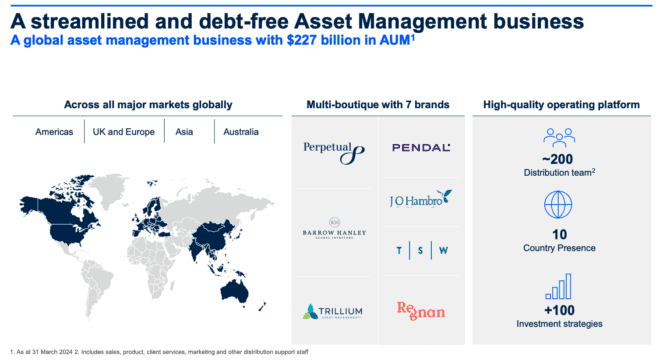
    Management describes the remaining operations as a debt-free asset manager with scale. As shown below, Perpetual will hold $227 billion in assets under management post-sale via its brands: Perpetual, Pendal, Barrow Hanley, Trillium, etc.

    Source: Perpetual Investor Presentation Strategic Review

    However, the Perpetual brand will be owned by KKR. A licensing agreement will allow the company to continue using the label for up to seven years, although the plan is to rebrand by the end of 2025.

    The deal is slated to be completed by February next year.

    Lastly, another blow for the ASX 200 stock today could relate to a management change. Today’s release also revealed CEO and managing director Rob Adams will retire at the end of a transition period. A global search has commenced to find a replacement.

    The post Why this ASX 200 stock is making front-page news across the country appeared first on The Motley Fool Australia.

    Wondering where you should invest $1,000 right now?

    When investing expert Scott Phillips has a stock tip, it can pay to listen. After all, the flagship Motley Fool Share Advisor newsletter he has run for over ten years has provided thousands of paying members with stock picks that have doubled, tripled or even more.*

    Scott just revealed what he believes could be the ‘five best ASX stocks’ for investors to buy right now. We believe these stocks are trading at attractive prices and Scott thinks they could be great buys right now…

    See The 5 Stocks
    *Returns as of 5 May 2024

    (function() {
    function setButtonColorDefaults(param, property, defaultValue) {
    if( !param || !param.includes(‘#’)) {
    var button = document.getElementsByClassName(“pitch-snippet”)[0].getElementsByClassName(“pitch-button”)[0];
    button.style[property] = defaultValue;
    }
    }

    setButtonColorDefaults(“#0095C8”, ‘background’, ‘#5FA85D’);
    setButtonColorDefaults(“#0095C8”, ‘border-color’, ‘#43A24A’);
    setButtonColorDefaults(“#fff”, ‘color’, ‘#fff’);
    })()

    More reading

    Motley Fool contributor Mitchell Lawler has no position in any of the stocks mentioned. The Motley Fool Australia’s parent company Motley Fool Holdings Inc. has positions in and has recommended KKR. The Motley Fool Australia has no position in any of the stocks mentioned. The Motley Fool has a disclosure policy. This article contains general investment advice only (under AFSL 400691). Authorised by Scott Phillips.

  • Is right now a good time to buy ASX shares or should I wait?

    Woman and man calculating a dividend yield.

    Sitting on some extra cash and wondering if now is the right time to buy ASX shares.

    You’re not alone.

    The All Ordinaries Index (ASX: XAO) has underperformed the stellar run we’ve witnessed on the S&P 500 Index (SP: .INX). But investors buying a diversified basket of stocks a year ago should have handily outpaced inflation as well as the returns they might have earned from a cash term deposit.

    Over the past year, the All Ords has gained 8.0%. So far in 2024, the index is up 2.6%.

    That compares to a 25.4% 12-month gain posted by the S&P 500, which is up 9.4% in 2024.

    With those gains in mind, is right now a good time to buy ASX shares? Or should investors bear in mind the old adage to ‘sell in May and go away’?

    Here’s what the experts are saying.

    The case to wait

    Making the case not to rush out and buy ASX shares just yet is Will Hamilton, managing partner of Hamilton Wealth Partners.

    Hamilton points out that the strong run enjoyed by the markets has been driven by expectations of multiple interest rate cuts from the US Federal Reserve.

    Now, he notes, “The odds of no easing in 2024 [are] rising, but also the once-unthinkable prospect of the Fed having to raise rates again is possible.”

    According to Hamilton:

    I feel we are entering a classic ‘sell in May and go away’ as traders square their books for the northern summer and market expectations drift lower. After the extreme optimism this is not a bad thing and can set the remainder of 2024 up for a reason to remain optimistic.

    If Hamilton has it right, you may wish to hold onto your investment cash and buy ASX shares a little later in the year.

    The case to buy ASX shares now

    Nucleus Wealth’s Damien Klassen quotes legendary investor Warren Buffett in his case that now is a great time to buy ASX shares.

    “In the short run, the market is a voting machine, but in the long run, it is a weighing machine,” Warren Buffett famously said.

    “So in the short term, anything can happen but over the long term, the returns that tend to show up are very likely to be positive and reflective of business growth,” Klassen says.

    And investors buying ASX shares now who have longer investment horizons should enjoy lower risks than short-term investors.

    According to Klassen:

    The longer your time horizons are and the longer you hold your investment for, the lower your true risk of capital loss is because you have time to ride out any short-term corrections. There is also more chance that your investment will increase over time with the natural appreciation of markets and therefore your risk will reduce.

    And he cautions on the dangers of trying to time the market and waiting to buy stocks at their lows.

    “Many people are waiting for the market to fall and then they will invest,” he said.

    He continued:

    However, this can be a risky strategy that leaves many investors on the sidelines for years not knowing when to get into the market (or back into the market). With capital sitting in cash in the current climate you are receiving a negative real return after inflation is taken into account which is not a great strategy.

    And he believes investors shouldn’t let uncertainty over what may happen over the weeks ahead hold them back from buying ASX shares.

    “Uncertainty is nothing new and it needs to be expected and embraced,” he said.

    Klassen concluded:

    My bet is that history will likely repeat itself, and we will look back at this time in the future and wonder what everyone was worrying about and were very glad we invested for the long-term when we did.

    The post Is right now a good time to buy ASX shares or should I wait? appeared first on The Motley Fool Australia.

    Wondering where you should invest $1,000 right now?

    When investing expert Scott Phillips has a stock tip, it can pay to listen. After all, the flagship Motley Fool Share Advisor newsletter he has run for over ten years has provided thousands of paying members with stock picks that have doubled, tripled or even more.*

    Scott just revealed what he believes could be the ‘five best ASX stocks’ for investors to buy right now. We believe these stocks are trading at attractive prices and Scott thinks they could be great buys right now…

    See The 5 Stocks
    *Returns as of 5 May 2024

    (function() {
    function setButtonColorDefaults(param, property, defaultValue) {
    if( !param || !param.includes(‘#’)) {
    var button = document.getElementsByClassName(“pitch-snippet”)[0].getElementsByClassName(“pitch-button”)[0];
    button.style[property] = defaultValue;
    }
    }

    setButtonColorDefaults(“#0095C8”, ‘background’, ‘#5FA85D’);
    setButtonColorDefaults(“#0095C8”, ‘border-color’, ‘#43A24A’);
    setButtonColorDefaults(“#fff”, ‘color’, ‘#fff’);
    })()

    More reading

    Motley Fool contributor Bernd Struben has no position in any of the stocks mentioned. The Motley Fool Australia’s parent company Motley Fool Holdings Inc. has no position in any of the stocks mentioned. The Motley Fool Australia has no position in any of the stocks mentioned. The Motley Fool has a disclosure policy. This article contains general investment advice only (under AFSL 400691). Authorised by Scott Phillips.

  • Why Judo Capital, NAB, Paladin Energy, and Perpetual shares are falling today

    A male investor wearing a blue shirt looks off to the side with a miffed look on his face as the share price declines.

    The S&P/ASX 200 Index (ASX: XJO) is having a subdued session on Wednesday. In afternoon trade, the ASX 200 index is on course to record the smallest of gains and is up a fraction to 7,793.8 points.

    Four ASX shares that are acting as a drag on the market today are listed below. Here’s why they are falling:

    Judo Capital Holdings Ltd (ASX: JDO)

    The Judo Capital share price is down over 2% to $1.37. This may have been driven by a broker note out of Morgan Stanley. Its analysts have retained their equal weight rating and $1.25 price target on the company’s shares. This implies potential downside of approximately 9% for investors from current levels. Judo Capital will be releasing its third quarter update in the coming days.

    National Australia Bank Ltd (ASX: NAB)

    The NAB share price is down 1% to $33.81. Investors may be taking a bit of profit off the table following strong gains over the last 12 months. During this time, the banking giant’s shares have risen approximately 25%. This compares to a 7% gain by the ASX 200 index over the same period. In addition, last week the team at Citi responded to NAB’s half-year results by reiterating its sell rating with a $26.50 price target. This suggests potential downside of over 20% is possible over the next 12 months.

    Paladin Energy Ltd (ASX: PDN)

    The Paladin Energy share price is down 2.5% to $16.52. This could also have been driven by profit taking from some investors. After all, the uranium miner’s shares hit a 12-year high on Tuesday. Investors have been fighting to get hold of the company’s shares over the past year thanks to booming uranium prices. This is being underpinned by supply shortages and increasing demand for the chemical element as countries embrace nuclear power.

    Perpetual Ltd (ASX: PPT)

    The Perpetual share price is down 7% to $22.38. This follows the conclusion of the fund manager’s strategic review. That review was seeking to unlock additional value for shareholders. However, judging by its share price performance on Wednesday, the market doesn’t appear to believe its plans will achieve this goal. Perpetual has decided to sell its wealth management and corporate trust businesses and focus solely on being a global multi-boutique asset manager. The company has signed an agreement to sell those businesses to private equity giant KKR for a total cash consideration of $2.175 billion.

    The post Why Judo Capital, NAB, Paladin Energy, and Perpetual shares are falling today appeared first on The Motley Fool Australia.

    Wondering where you should invest $1,000 right now?

    When investing expert Scott Phillips has a stock tip, it can pay to listen. After all, the flagship Motley Fool Share Advisor newsletter he has run for over ten years has provided thousands of paying members with stock picks that have doubled, tripled or even more.*

    Scott just revealed what he believes could be the ‘five best ASX stocks’ for investors to buy right now. We believe these stocks are trading at attractive prices and Scott thinks they could be great buys right now…

    See The 5 Stocks
    *Returns as of 5 May 2024

    (function() {
    function setButtonColorDefaults(param, property, defaultValue) {
    if( !param || !param.includes(‘#’)) {
    var button = document.getElementsByClassName(“pitch-snippet”)[0].getElementsByClassName(“pitch-button”)[0];
    button.style[property] = defaultValue;
    }
    }

    setButtonColorDefaults(“#0095C8”, ‘background’, ‘#5FA85D’);
    setButtonColorDefaults(“#0095C8”, ‘border-color’, ‘#43A24A’);
    setButtonColorDefaults(“#fff”, ‘color’, ‘#fff’);
    })()

    More reading

    Citigroup is an advertising partner of The Ascent, a Motley Fool company. Motley Fool contributor James Mickleboro has no position in any of the stocks mentioned. The Motley Fool Australia’s parent company Motley Fool Holdings Inc. has no position in any of the stocks mentioned. The Motley Fool Australia has no position in any of the stocks mentioned. The Motley Fool has a disclosure policy. This article contains general investment advice only (under AFSL 400691). Authorised by Scott Phillips.