
Author: openjargon

  • The US and Pacific ally Japan are teaming up to defeat new hypersonic missiles that right now are basically unstoppable

    A Sabre short-range ballistic missile launches in June 2017 at White Sands Missile Range, New Mexico, for a test of the Patriot Advanced Capability-3 (PAC-3) Missile Segment Enhancement, an advanced missile defense system. Hypersonic missiles might be able to penetrate PAC-3 and similar systems.
    A Sabre short-range ballistic missile launches in June 2017 at White Sands Missile Range, New Mexico, for a test of the Patriot Advanced Capability-3 (PAC-3) Missile Segment Enhancement, an advanced missile defense system. Hypersonic missiles might be able to penetrate PAC-3 and similar systems.

    • The US and Japan have agreed to jointly develop a hypersonic missile defense system.
    • Hypersonic weapons are outside the threat envelope of current missile defenses.
    • The move is a major step for the allies toward defending against new missile threats from China and others.

    The US and Japan have agreed to work together to develop a defense system to defeat hypersonic missiles, according to the US Department of Defense.

    Hypersonic missiles are a daunting challenge and nearly impossible for current missile-defense systems to stop because they can fly low and maneuver along unpredictable flight paths, making the new project the US and Japan are working on significant as the two allies face emerging Russian and Chinese missile threats.

    On Wednesday, the US and Japan "finalized a formal agreement for a Glide Phase Interceptor (GPI) Cooperative Development (GCD) Project Arrangement," which aims to develop a missile defense system that can effectively intercept hypersonic weapons in the glide phase of their flight.

    The new bilateral agreement is the culmination of over a year of talks between the two countries. Plans for the co-development of a GPI were originally announced in August 2023 during a Japan-US summit. The US Missile Defense Agency will lead the development of the GPI, while Japan will contribute specific components.

    In their joint statement, the allies said that the coming "GPI will deliver a regional defensive capability over time as part of a holistic layered defensive architecture. The GPI co-development will build upon long-standing U.S.-Japan missile defense cooperation and strengthen the Alliance deterrence posture."

    Russian navy frigate Admiral Gorshkov and a Zircon hypersonic missile in White Sea
    Russian navy frigate Admiral Gorshkov launching a Zircon hypersonic missile in White Sea, Russia, on July 19, 2021.

    The development of the planned GPI could be a game-changer against hypersonic threats, which neither country currently has the ability to defeat.

    Though US weaponry has defeated adjacent threats like Russia's Kinzhal air-launched ballistic missile, current missile defenses would likely struggle against actual hypersonic weapons like China's DF-17 equipped with a hypersonic glide vehicle or Russia's Zircon scramjet-powered hypersonic cruise missile.

    Cooperation on the GPI comes as the US and Japan face an expanding Chinese missile force capable of targeting US bases in Japan, as well as other positions in the Pacific region, and increasing cooperation between Moscow and Beijing that has American intelligence re-evaluating its defenses. Notably, Pyongyang is also attempting to develop what it says are hypersonic missiles.

    Current and former US military leaders have expressed concerns about China's missiles, and US lawmakers and experts have said that the US lacks sufficient active and passive defenses to defend against a bombardment that could include hypersonic weapons.

    A Chinese soldier stands at attention during a military parade, as trucks display hypersonic missiles in the backgorund.
    DF-17 medium-range ballistic missiles equipped with a DF-ZF hypersonic glide vehicle in a military parade to mark the 70th anniversary of the Chinese People's Republic.

    The GPI project is not the first time the US and Japan have worked together on missile defenses.

    The allies successfully tested the jointly developed Standard Missile 3 (SM-3) Block IIA interceptor in a February 2017 intercept of a ballistic missile target. The SM-3, part of the Aegis Ballistic Missile Defense system, was used in combat for the first time in April during Iran's missile and drone strike against Israel.

    At the time, the launch of the SM-3 was significant not only because of its unprecedented use in combat, but also due to its unique capability to eliminate targets outside of the Earth's atmosphere, or exo-atmospherically.

    Read the original article on Business Insider
  • China’s BYD just unleashed a hybrid pickup truck that has no rival in America — see the Shark

    A blue BYD Shark pick-up truck parked on the breach.
    A BYD Shark hybrid pickup truck.

    • China's BYD Auto launched its all-new Shark plug-in hybrid pickup truck in Mexico on Tuesday.
    • The BYD Shark's hybrid drive system puts out 430 horsepower and has 62 miles of all-electric range.
    • The Shark starts at $54,000 in Mexico but is not for sale in the US.

    BYD introduced its new Shark plug-in hybrid pickup truck in Mexico on Tuesday. It's the company's first truck and the first product launched outside its home market, China.

    Mexico is growing in importance for BYD's global strategy as it aims to gain a foothold in North America — even as the company has made clear in recent months that it does not plan to enter the US market any time soon.

    As a result, the Shark will not be available in the US but will go on sale in Mexico with a starting price of roughly $54,000 USD, or 899,980 pesos.

    Therefore, the midsize Shark hybrid will be aimed squarely at major global players like the Toyota Hilux and Nissan Navarra.

    In the US, the BYD Shark would have competed against midsize pickup stalwarts like the Toyota Tacoma, Chevrolet Colorado, Nissan Frontier, and Ford Ranger.

    However, there are no plug-in hybrid midsize pickup trucks on sale in the US. The Tacoma does offer a hybrid but does not have the ability to be plugged in.

    The Shark is built on BYD's Super Hybrid Off-road Platform.
    The BYD Shark pickup truck's hybrid system.
    The BYD Shark's hybrid system.

    The BYD Sharks' power comes from a longitudinally mounted 1.5-liter, turbocharged four-cylinder engine and two electric drive motors. Together, they produce a total system output of 430hp.

    According to BYD, the Shark can make the run from 0-62 mph in just 5.7 seconds

    As a result of the hybrid system, the Shark does not have a traditional mechanical all-wheel-drive system.
    A man is standing next to a blue BYD Shark hybrid pickup truck parked on the grass in front of a house.
    A BYD Shark

    Instead, it sends power to the rear axle via an electric drive motor.

    The Shark comes with a 29.6 kWh battery pack.
    A blue BYD Shark hybrid pickup truck parked before an electric charger.
    A BYD Shark hybrid pickup truck.

    According to BYD, the Shark has an all-electric range of 62 miles. The company also claims the pickup has a maximum combined range of 522 miles with the battery fully charged and a full tank of gas.

    According to BYD, the Shark can tow up to 2,500 kg or 5,512 lbs.
    A blue BYD Shark hybrid pickup truck is parked in the desert.
    A BYD Shark hybrid pickup truck.

    Don't expect to do much towing with just the battery, though.

    Aesthetically, the Shark's aggressive looks are the work of BYD's design team led by Wolfgang Egger.
    A black BYD Shark Hybrid pickup truck during a product demonstration drive at the BYD launch event in Mexico.
    A BYD Shark doing a product demonstration drive at the launch event.

    According to BYD, Egger, the former chief designer at Audi and Alfa Romeo, sought inspiration from the aquatic predator for which the truck is named. In fact, the front grille was inspired by the open mouth of a shark.

    At 215 inches in length, the Shark is a few inches longer than the Ford Ranger SuperCrew and the standard-wheelbase Nissan Frontier. However, it's about a foot shorter than the extended-length versions of the Frontier and the long-bed Toyota Tacoma.

    Inside, the Shark's cabin is highlighted by a head-up display, a 10.25 LCD digital instrument display, and an impressive 12.8-inch central infotainment screen.
    The front dash of a BYD Shark hybrid pickup truck.
    The BYD Shark's cabin.

    The 12.8-inch screen can change orientation from portrait and landscape. It's also equipped with Apple CarPlay and Android Auto as well as built-in apps for navigation, karaoke and music streaming.

    The Shark is also equipped with a 540-degree panoramic view camera.
    The 12.8-inch infotainment screen in a BYD Shark hybrid pickup truck.
    The BYD Shark's 12.8-inch infotainment screen

    BYD's 540-degree panoramic camera system is a 360-degree camera coupled with a 180-degree undercarriage view camera. The undercarriage camera is designed to help drivers get a better view of the terrain while offroading.

    The Shark comes with a suite of advanced safety features, including adaptive cruise control, lane keep assist, and automatic emergency braking.

    Like Tesla's Cybertruck, the Shark's features can be controlled via smartphone which can also serve as a key.
    A smartphone acting as a digital key being held next to the rearview mirror of a blue BYD Shark hybrid pickup truck.
    The BYD Shark's digital key

    Tesla has long pioneered the use of its mobile app as an NFC key for vehicles.

    The Shark's hybrid system can be used to power campsites or worksites.
    A blue BYD Shark hybrid pickup truck parked next to an RV.
    The BYD Shark hybrid powers a video projector.

    Most electric trucks these days are rife with electrical outlets for the job site or campsite.

    Read the original article on Business Insider
  • Here’s what Wilsons is saying about ANZ, CBA, NAB, and Westpac shares

    Bank building with the word bank in gold.

    It has been a busy period for the banking sector, with ANZ Group Holdings Ltd (ASX: ANZ), Commonwealth Bank of Australia (ASX: CBA), National Australia Bank Ltd (ASX: NAB), and Westpac Banking Corp (ASX: WBC) all releasing their latest updates this month.

    The market reaction to the results has been overwhelmingly positive, with CBA and the other big four banks seeing their shares charge higher (before some traded ex-dividend).

    Let’s now see what analysts at Wilsons are saying about the banks after it ran the rule over their results and outlooks.

    What is Wilsons saying about ANZ, CBA, NAB, and Westpac shares?

    Unfortunately, the broker hasn’t seen anything in the results to change its view on the banks. It revealed that its “sector view remains unchanged with the Focus Portfolio retaining an underweight exposure to sector.”

    Wilsons acknowledges that the “banks reported sound results for 1H24, which were generally a touch ahead of consensus expectations across key line items.” However, this doesn’t hide the fact that “the sector’s medium-term earnings outlook still remains challenged.”

    It also feels that CBA shares (and the rest of the big four) look overvalued based on current multiples and this challenging outlook. The broker said:

    Following modest forward upgrades, consensus forecasts still point to negative EPS growth for the ASX 200 Banks Index in both FY24e and FY25e. In this context, the sector’s valuation premium relative to history remains excessive and unjustified at the headline level, albeit with pockets of relative value within the sector.

    What else did the broker say?

    Wilsons notes that the banks are returning capital with share buybacks. However, it has described this as a “temporary sugar hit.” It also believes it “fails to address the still lacklustre medium and long-term EPS growth outlook facing the sector.”

    The broker then summaries its view on CBA and the rest of the banks’ shares. It said:

    In the context of a weak earnings growth outlook, on the whole bank valuations remain highly uncompelling. The ASX 200 Banks Index trades on a forward PE multiple of 16x (skewed by CBA where we have zero weight), representing a ~13% premium to the 5-year average, and a forward price to book (PB) ratio of 1.6x, which is 14% above the 5-year average.

    The current sector valuation (forward PE of 16x) implies the market is pricing in ~20% EPS growth in FY25 (if we assume a mean reversion to the 10-year avg PE of ~13x occurs) , compared to consensus of -1%. This is highly unlikely to eventuate in our view without a dramatic shift in RBA policy rate expectations and the economic outlook, demonstrating the extent of the sector’s current valuation excesses at current levels.

    The post Here’s what Wilsons is saying about ANZ, CBA, NAB, and Westpac shares appeared first on The Motley Fool Australia.

    Should you invest $1,000 in Australia And New Zealand Banking Group right now?

    Before you buy Australia And New Zealand Banking Group shares, consider this:

    Motley Fool investing expert Scott Phillips just revealed what he believes are the 5 best stocks for investors to buy right now… and Australia And New Zealand Banking Group wasn’t one of them.

    The online investing service he’s run for over a decade, Motley Fool Share Advisor, has provided thousands of paying members with stock picks that have doubled, tripled or even more.*

    And right now, Scott thinks there are 5 stocks that may be better buys…

    See The 5 Stocks
    *Returns as of 5 May 2024

    More reading

    Motley Fool contributor James Mickleboro has positions in Westpac Banking Corporation. The Motley Fool Australia’s parent company Motley Fool Holdings Inc. has no position in any of the stocks mentioned. The Motley Fool Australia has no position in any of the stocks mentioned. The Motley Fool has a disclosure policy. This article contains general investment advice only (under AFSL 400691). Authorised by Scott Phillips.

  • This ASX 200 healthcare stock just hit an all-time high: Is it too late to buy?

    two doctors smile as they sit together at a desk looking at a patient's Xray.

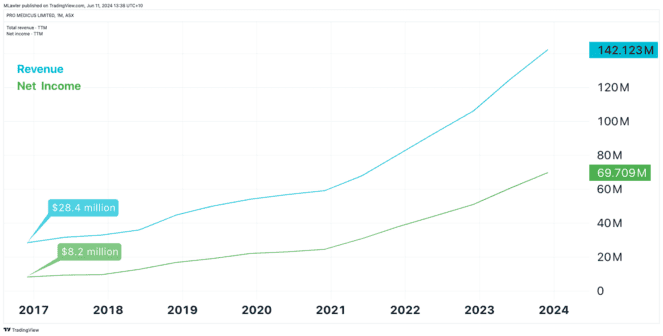
    The S&P/ASX 200 Index (ASX: XJO) healthcare stock Pro Medicus Ltd (ASX: PME) have performed incredibly well. It’s up more than 90% in 12 months, and over 480% in five years, as we can see on the chart below. It hit a new all-time high of $119.09 during Wednesday’s trading, rising by around 3% by the end of the day.

    After such an incredible performance, investors may be wondering if this IT healthcare stock is a buy or not.

    Why is the ASX 200 healthcare stock soaring?

    The business continues to deliver on its strategy.

    Pro Medicus is one of the most profitable businesses on the ASX, with an earnings before interest and tax (EBIT) margin of 66%. That means around two-thirds of revenue is turning into EBIT. The net profit after tax (NPAT) margin was 49% in the FY24 first-half result, so around half of the new revenue is turning into NPAT.

    Impressively, margins are continuing to climb as the company’s footprint increases. Pro Medicus says it has a highly scalable offering, with a contained cost base.

    It’s delivering excellent revenue growth as it wins more contracts in Europe and North America.

    I’ll mention its biggest contract won in FY24 to date – in September 2023; it won a $140 million contract (over 10 years) from BaylorScott&White Health. It has also won a $24 million contract over seven years, a $16 million contract over eight years and a $20 million contract over eight years.

    When you add those new contracts to the ASX 200 healthcare stock’s previously-announced revenue, at the margins it’s earning, the company is clearly on track for strong profits over the rest of this decade.

    Is it too late to buy?

    Pro Medicus is clearly one of the best businesses on the ASX.

    The company’s service offers several benefits to its clients, including “significant IT and infrastructure savings, improved physician engagement, unparalleled increase in radiologist efficiency, delivers superior value proposition and greater clinical accuracy.”

    It’s aiming to grow in a number of different ways including winning new clients, seeing transaction growth from existing clients, delivering new product offerings, extending to new geographical markets and leveraging its research and development capability to introduce the next generation of products.

    Management says there is a very significant addressable runway, and its pipeline is strong.

    The question is – what valuation makes sense for the ASX 200 healthcare stock? According to the forecasts on Commsec, the Pro Medicus share price is valued at 154x FY24’s estimated earnings and 93x FY26’s estimated earnings. That’s a very high earnings multiple, particularly when interest rates are still so high.

    Profit is growing strongly, but it’s difficult to say what the right price is. I’d be exceptionally happy if I were a long-term shareholder. I’m just not sure what a fair earnings multiple is for the business.

    According to Commsec, the business currently has four sell ratings, five holds, and six buys. The average rating is a hold, but there are a range of views.

    The post This ASX 200 healthcare stock just hit an all-time high: Is it too late to buy? appeared first on The Motley Fool Australia.

    Should you invest $1,000 in Pro Medicus Limited right now?

    Before you buy Pro Medicus Limited shares, consider this:

    Motley Fool investing expert Scott Phillips just revealed what he believes are the 5 best stocks for investors to buy right now… and Pro Medicus Limited wasn’t one of them.

    The online investing service he’s run for over a decade, Motley Fool Share Advisor, has provided thousands of paying members with stock picks that have doubled, tripled or even more.*

    And right now, Scott thinks there are 5 stocks that may be better buys…

    See The 5 Stocks
    *Returns as of 5 May 2024

    More reading

    Motley Fool contributor Tristan Harrison has no position in any of the stocks mentioned. The Motley Fool Australia’s parent company Motley Fool Holdings Inc. has positions in and has recommended Pro Medicus. The Motley Fool Australia has recommended Pro Medicus. The Motley Fool has a disclosure policy. This article contains general investment advice only (under AFSL 400691). Authorised by Scott Phillips.
  • 5 things to watch on the ASX 200 on Thursday

    On Wednesday, the S&P/ASX 200 Index (ASX: XJO) returned to form and pushed higher. The benchmark index rose 0.35% to 7,753.7 points.

    Will the market be able to build on this on Thursday? Here are five things to watch:

    ASX 200 expected to rise again

    The Australian share market looks set for another good session on Thursday following a strong night on Wall Street after US inflation came in lower than expected. According to the latest SPI futures, the ASX 200 is expected to open the day 42 points or 0.55% higher this morning. In the United States, the Dow Jones was up 0.9%, the S&P 500 rose 1.2%, and the Nasdaq jumped 1.4%. The S&P 500 closed at a record high.

    Oil prices charge higher

    ASX 200 energy shares such as Beach Energy Ltd (ASX: BPT) and Woodside Energy Group Ltd (ASX: WDS) could have a good session after oil prices stormed higher overnight. According to Bloomberg, the WTI crude oil price is up 1.1% to US$78.88 a barrel and the Brent crude oil price is up 0.7% to US$82.95 a barrel. Oil prices pushed higher amid news that US stockpiles have fallen.

    Aristocrat Leisure results

    The Aristocrat Leisure Limited (ASX: ALL) share price will be one to watch on Thursday when the gaming technology company releases its half-year results. According to a note out of Macquarie, its analysts are expecting Aristocrat Leisure to achieve consensus estimates. This will mean earnings growth of approximately 6% year on year.

    Gold price jump

    It looks set to be a very good session for ASX 200 gold shares such as Newmont Corporation (ASX: NEM) and Northern Star Resources Ltd (ASX: NST) after the gold price charged higher again overnight. According to CNBC, the spot gold price is up 1.4% to US$2,392.7 an ounce. Traders were bidding the precious metal higher after softer than expected inflation in the United States bolstered the prospect of rate cuts from the US Federal Reserve.

    JB Hi-Fi shares downgraded

    The JB Hi-Fi Ltd (ASX: JBH) share price could be overvalued according to analysts at Goldman Sachs. This morning, the broker has downgraded the retail giant’s shares to a sell rating with a new $50.00 price target (from $56.50). This implies potential downside of approximately 14% from current levels. Goldman notes that the company is facing “stronger competition on JBH AU from several fronts including expanding range at Amazon, recovery of execution from HVN, and intensifying competition from Officeworks.”

    The post 5 things to watch on the ASX 200 on Thursday appeared first on The Motley Fool Australia.

    Should you invest $1,000 in Aristocrat Leisure Limited right now?

    Before you buy Aristocrat Leisure Limited shares, consider this:

    Motley Fool investing expert Scott Phillips just revealed what he believes are the 5 best stocks for investors to buy right now… and Aristocrat Leisure Limited wasn’t one of them.

    The online investing service he’s run for over a decade, Motley Fool Share Advisor, has provided thousands of paying members with stock picks that have doubled, tripled or even more.*

    And right now, Scott thinks there are 5 stocks that may be better buys…

    See The 5 Stocks
    *Returns as of 5 May 2024

    More reading

    John Mackey, former CEO of Whole Foods Market, an Amazon subsidiary, is a member of The Motley Fool’s board of directors. Motley Fool contributor James Mickleboro has positions in Woodside Energy Group. The Motley Fool Australia’s parent company Motley Fool Holdings Inc. has positions in and has recommended Amazon, Goldman Sachs Group, and Macquarie Group. The Motley Fool Australia has positions in and has recommended Macquarie Group. The Motley Fool Australia has recommended Amazon and Jb Hi-Fi. The Motley Fool has a disclosure policy. This article contains general investment advice only (under AFSL 400691). Authorised by Scott Phillips.
  • Could Liontown shares roar 30%+ higher?

    Liontown Resources Ltd (ASX: LTR) shares have been having a rough time of late.

    So much so, on a 12-month basis, the lithium developer’s shares have halved in value.

    While this is disappointing for shareholders, could it be a buying opportunity for the rest of us?

    The team at Bell Potter appears to believe this is the case and is tipping the company’s shares to roar materially higher from current levels.

    Where are Liontown shares heading?

    According to a recent note out of Bell Potter, its analysts have a speculative buy rating and $1.85 price target on its shares.

    Based on the latest Liontown share price of $1.40, this implies potential upside of 32% for investors over the next 12 months.

    To put that into context, a $20,000 investment would grow to be worth approximately $26,400 if Bell Potter is on the money with its recommendation. Though, it is worth highlighting that the broker’s speculative rating means it is a high risk, high reward option. This makes it unsuitable for investors with a low to normal risk tolerance.

    Why is the broker positive?

    Bell Potter thinks very highly of the company’s wholly owned Kathleen Valley (KV) lithium project in Western Australia.

    This project, which is due to commence production in the middle of the year, has been optimised for an initial 3 Mtpa, producing approximately 500,000 tpa of spodumene concentrate. It also has a 4Mtpa expansion planned in year six, which aims to deliver approximately 700,000 tpa spodumene concentrate.

    The broker notes that the project is highly strategic and should be fully funded through to free cash flow generation. It said:

    LTR’s 100% owned KV lithium project remains highly strategic in terms of its stage of development, long mine life and location. LTR has offtake contracts with top tier EV and battery OEMs (Ford, LG Energy Solution and Tesla). Hancock Prospecting has a 19.9% interest in LTR. Under our modelled assumptions which includes the drawdown of the $550m debt package and repayment of Ford debt, and under a more conservative spot price scenario, we expect that LTR is fully funded to free cash flow. LTR is an asset development company; our Speculative risk rating recognises this higher level of risk.

    All in all, Bell Potter appears to believe this makes Liontown shares a good option for investors (with a high risk tolerance) that are looking for exposure to the lithium industry before it rebounds.

    The post Could Liontown shares roar 30%+ higher? appeared first on The Motley Fool Australia.

    Should you invest $1,000 in Liontown Resources right now?

    Before you buy Liontown Resources shares, consider this:

    Motley Fool investing expert Scott Phillips just revealed what he believes are the 5 best stocks for investors to buy right now… and Liontown Resources wasn’t one of them.

    The online investing service he’s run for over a decade, Motley Fool Share Advisor, has provided thousands of paying members with stock picks that have doubled, tripled or even more.*

    And right now, Scott thinks there are 5 stocks that may be better buys…

    See The 5 Stocks
    *Returns as of 5 May 2024

    More reading

    Motley Fool contributor James Mickleboro has no position in any of the stocks mentioned. The Motley Fool Australia’s parent company Motley Fool Holdings Inc. has no position in any of the stocks mentioned. The Motley Fool Australia has no position in any of the stocks mentioned. The Motley Fool has a disclosure policy. This article contains general investment advice only (under AFSL 400691). Authorised by Scott Phillips.

  • DC just got serious about taking on China in the AI arms race

    Chuck Schumer
    Senate Majority Leader Chuck Schumer helms a bipartisan group that wants to dedicate billions in federal spending on AI.

    • A bipartisan Senate group is calling for $32 billion in annual federal AI spending.
    • The group wants to ensure the US stays ahead of China — which is also spending big on AI.
    • Group leader Sen. Chuck Schumer said the money will "cement America's dominance in AI."

    A bipartisan group of US Senators wants to spend billions of dollars on a game plan to dominate artificial intelligence.

    Senate Majority Leader Chuck Schumer and three other senators who assembled an AI Working Group released their initial report on Wednesday.

    It's a policy road map that calls for $32 billion in annual federal spending on AI for nonmilitary purposes. That money, they said, would go toward research and development, reducing AI's potential harm, managing its potential impact on elections and jobs, and ensuring AI systems adhere to existing laws.

    They also said it would help the United States compete with China in the AI arms race.

    Schumer said in the press conference on Wednesday that the cash influx would "keep our companies, our universities, our workers at the cutting edge and cement America's dominance in AI."

    GOP Sen. Mike Rounds, a working group member, said at the press conference that the Chinese government is now spending far more on AI than the US government. According to China Daily, China's investment in AI is expected to surpass $38 billion by 2027. China also significantly outpaces the United States in AI patents, according to the Stanford Institute for Human-Centered Artificial Intelligence.

    President Joe Biden has also pushed the United States to lead the development of the revolutionary technology. "The rest of the world is looking to us to lead the way," he said at a meeting in October.

    Later that month, Biden signed a sweeping executive order that established new standards for AI safety and security and called for greater transparency from major tech companies.

    In April, the US Department of Homeland Security also established a federal advisory board of tech industry leaders, including OpenAI's Sam Altman, Nvidia's Jensen Huang, and Microsoft's Satya Nadella, to oversee AI deployment in infrastructure.

    Read the original article on Business Insider
  • AOC says Bernie Sanders’ 2016 presidential campaign ‘broke my brain’

    Rep. Alexandria Ocasio-Cortez of New York and Sen. Bernie Sanders of Vermont
    Rep. Alexandria Ocasio-Cortez and Sen. Bernie Sanders outside the Capitol earlier this year.

    • AOC and Bernie Sanders are two of the most influential figures on the American left.
    • It wasn't always that way. When Sanders ran for president in 2016, AOC was bartending.
    • In a new podcast, she described how the Vermont senator's first presidential bid radicalized her.

    When Rep. Alexandria Ocasio-Cortez first heard Sen. Bernie Sanders's presidential campaign message in 2016, she was radicalized.

    "It was the first time that I heard an elected leader say everybody deserves healthcare in this country by the fact that they are born a human being," the New York Democratic said on an episode of the Vermont senator's podcast released on Wednesday. "It broke my brain a little bit."

    Ocasio-Cortez described the indignities of bartending and working in restaurants in New York City at the time, including not being able to afford healthcare and receiving a weekly paycheck with just 50 cents in it due to tipped wage laws.

    "We normalize this to ourselves, we accept it," Ocasio-Cortez said of being working class. "I think really deep down, the unconscious rationale that we give ourselves to accept this is: This is what I deserve…this is my lot. This is what I get."

    "I didn't even realize that I didn't think I deserved healthcare until I heard someone say that I did," Ocasio-Cortez said. "And then hearing that, I was like, why don't we have these things?"

    Two years later, Ocasio-Cortez ran for Congress and defeated Rep. Joe Crowley — a local party boss and a likely successor to Nancy Pelosi, then the House Minority Leader — in a stunning upset.

    She's since become an influential leader in her own right, working with Sanders and other progressive Democrats to push policies like Medicare for All and a Green New Deal.

    Both Ocasio-Cortez and Sanders have become strong advocates for President Joe Biden's reelection despite their political differences with him.

    "It is unequivocal that mass movements have been able to be more effective under Joe Biden's presidency than a Donald Trump presidency," Ocasio-Cortez said.

    Sanders recently announced he would seek a fourth term in the US Senate this fall.

    Read the original article on Business Insider
  • Google has an idea to prevent phone scams, but it’ll mean allowing its AI to listen in on your calls

    Google logo displayed on a smartphone.
    Google is testing new features allowing its AI to listen to your phone calls.

    • Google is testing its Gemini AI to detect and alert users of potential scams during phone calls.
    • The AI alerts users of scam patterns like urgent payment demands.
    • Google promised to keep data from the phone calls private.

    Google is playing around with AI tech that would listen to your calls and warn you of potential scams.

    Google announced on X on Tuesday that it's testing a new Gemini AI feature that "provides real-time alerts during a call if it detects conversation patterns commonly associated with scams."

    "This protection all happens on-device so your conversation stays private to you," the company said.

    The announcement is part of Google's expansion of the Gemini Nano, the company's AI model that was added to the Pixel 9 smartphone.

    Google says the new feature would alert users for things like a bank representative pressuring you for an urgent payment, or demanding transactions through gift cards.

    The FTC estimates Americans lost up to $10 billion to scams last year alone. Scams often take place online or over the phone. In December, an executive for Mandiant, a cyber-security company owned by Google, said the company expects to see increased activity by scammers this year.

    Read the original article on Business Insider
  • Biden and Trump just killed off a decades-long tradition

    Biden Trump Presidential Debate
    Joe Biden and Donald Trump debating in 2020. They've agreed to two new debates in 2024 — ones that will sideline decades of tradition.

    • The Commission on Presidential Debates has set the showdowns for 37 years. 
    • But this year, Biden and Trump are doing their own thing.
    • The commission told BI it could still host its planned debates, but Biden and Trump seem to have had enough.

    The non-partisan body that's set the locations, moderators, and formats for presidential debates for the past 37 years is suddenly looking obsolete.

    Presumptive presidential candidates Joe Biden and Donald Trump went around the Commission on Presidential Debates (CPD) to plan their own debate schedule — starting on June 27 with what will be the earliest general election debate in US history.

    That showdown in Atlanta will be unprecedented in other ways. It's the first debate in decades without a studio audience, and appears set to run exclusively on CNN platforms as opposed to multiple major networks.

    The CPD told Business Insider in a statement that it was established to ensure debates "reliably take place and reach the widest television, radio, and streaming audience."

    "Our 2024 sites, all locations of higher learning, are prepared to host debates on dates chosen to accommodate early voters," the commission continued. "We will continue to be ready to execute this plan."

    But Biden and Trump don't seem ready to keep the tradition alive.

    In addition to the CNN debate that spurned the commission, the two also agreed to a September 10 debate on ABC, and the Trump campaign suggested two additional showdowns in July and August.

    (The CPD traditionally holds three debates beginning in the fall — not four.)

    The reworked schedule has materialized as both sides have blasted the CPD. The RNC pulled out of the organization in 2022, claiming it was biased, and the Biden campaign confirmed he would not participate in its scheduled debates this year.

    In a letter, Biden campaign chair Jen O'Malley Dillon criticized the commission for "building huge spectacles with large audiences at great expense" and inviting "raucous or disruptive partisans and donors, who consume valuable debate time with noisy spectacles of approval or jeering."

    It's a surprising fall from grace for an organization that has, until this cycle, largely worked without complaint from major party candidates — though third-party candidates have complained that the commission's rules box them out.

    According to nonprofit tax information filed to the IRS in 2022, the CPD reported having over $7.6 million in assets.

    Read the original article on Business Insider