Contactless payments at Walmart are limited to the company's own apps.
Jeffrey Greenberg/Universal Images Group via Getty Images
Walmart has maintained its stance on avoiding NFC-based payments, such as Apple Pay and Google Pay.
Other major retailers have increasingly accepted the tech as the norm.
Walmart, meanwhile, offers its own contactless payment options that give it some key advantages.
You can find almost anything in a Walmart Supercenter, but there's one thing you won't see: a tap-to-pay option at checkout.
The retail giant has maintained its longstanding position of avoiding NFC-based payments, such as Apple Pay and Google Pay, as well as certain contactless credit cards, despite other major retailers increasingly accepting the technology.
But that's not to say there aren't any contactless payment options for shoppers to use.
Walmart has previously pointed to its Walmart Pay app, its own touchless payment option, as well as the Scan and Go feature within its app that lets Walmart Plus and Sam's Club members skip the checkout lane, as convenient alternatives to NFC payments.
The strategy has left no shortage of customers confused over the years when they've tried to whip out their iPhone to pay at checkout — even YouTuber MrBeast was flummoxed by the lack of a tap option.
"Younger consumers in particular are so used to using Apple Pay and tap-to-pay with their phones that they're coming to expect it," EMARKETER principal retail analyst Sky Canaves told Business Insider. (EMARKETER is owned by Axel Springer, Business Insider's parent company.)
More and more, shoppers are frustrated when a retailer doesn't have a digital payment option for situations when they've left their cash or cards behind, she said.
For one thing, while tap-to-pay doesn't incur additional fees beyond the standard processing charges, there is a cost to upgrading the hardware to accept NFC-based transactions. That can add up fast when a company has more than 5,200 clubs and stores in the US, with dozens of payment terminals per location.
GlobalData retail analyst Neil Saunders also said Walmart doesn't typically do things that add cost without delivering a significant benefit for customers.
If the company is providing a good contactless alternative through its own apps, it doesn't really need to offer NFC-based payments, Saunders said.
But Canaves said that what may have started as a cost-savings decision has since evolved into a revenue-driving opportunity.
For instance, digital devices like Apple Pay often anonymize credit card numbers in a way that can make it harder for retailers to link purchases with a particular shopper.
That means there's a larger advantage for Walmart to prefer its own tools: data.
When Walmart shoppers use its in-house apps and credit cards to complete purchases, it helps the company build a more detailed picture of their habits and trends than it would otherwise have.
That's not unique to Walmart, of course — Amazon, Target, Costco, and almost every other retailer are gathering intel about their shoppers through apps, credit cards, and memberships as well.
It's possible that Walmart could change its mind in the future, but for now, the company seems to be doing just fine by bucking the trend.
Damilola Olaleye began building an Amazon reselling business during her maternity leave in 2023.
She scaled up using data-driven strategies and generated $560,000 in revenue in 2024.
Olaleye now diversifies sales across other platforms and is on track for a seven-figure revenue year.
In August 2023, I was on maternity leave with my second child and dreading returning to my software engineering job at a large tech company. I knew other people were burning out, too, but it still surprised me when it happened to me.
I had spent years building my career, yet I couldn't ignore the burnout. I wanted a different rhythm to my days, and a path that didn't put a ceiling on my earnings.
My parents flew in from Nigeria to help with the baby. That gift of time gave me enough mental bandwidth to explore plan B.
My husband and I owned short-, mid-, and long-term rentals, but the post-COVID-19 interest rate environment had squeezed our cash flow. I needed a business with healthier margins, fast turns, and room to scale.
I was targeting a replacement for my $120,000 W-2 income, not a cute little side hustle.
The nudge that changed everything
Opeoluwa Fatunmbi, a senior business analytics engineer in Nigeria and a business mentor of mine, told me about Amazon's Fulfilled by Amazon program, also called FBA, which he'd heard about and thought could be a good fit for me.
It checked every box in my head: scalable operations, the ability to start lean, and a marketplace where data matters as much as hustle.
The first $200 and the power of Q4
I started small while still on maternity leave. My first shipment to FBA was just 12 bottles of sunscreen, worth about $200. I started in late summer, just ahead of the retail industry's busiest stretch.
If you sell on Amazon, the fourth quarter puts your systems to the test and rewards good decisions. I registered an LLC, opened a business checking account, and spent mornings sourcing products from Nike Factory Stores, Walmart, Ross, Ollie's, and T.J. Maxx. This is retail arbitrage in practice: find discounted products, verify that Amazon allows you to sell them, run the numbers, and ship them in.
My phone was my best employee. Using the Amazon Seller app, I scanned items to confirm brand and category approvals, then checked the expected selling price and fees. As my account gained history, Amazon unlocked more categories and brands. Those quiet unlocks felt like promotions.
Fueling growth without draining savings
Within the first five months, I did $60,000 in sales on roughly $20,000 of my own capital. Since my software engineering job was fully remote, it provided me with some flexibility. For a little over a year, I juggled that full-time role and my Amazon business on the side.
I woke up around 4 a.m. to scout online arbitrage deals and prepped FBM orders so my husband could drop them off at the UPS store on his way to work. In the evenings, I either made discount purchases online or went in-store to do retail arbitrage. I used 0% APR business credit cards tied to my new business account.
Since I still had a well-paying W-2 job, I easily got approved to open four accounts, with a combined limit of about $60,000. That buffer allowed me to buy deeper on winners and build consistent in-stock positions.
Build the machine early
I contracted with a prep center that was familiar with Amazon's packaging and labeling rules and could ship directly to Amazon's fulfillment centers. That removed a bottleneck without hiring a full warehouse team.
I also hired a full-time virtual assistant overseas to perform tasks similar to those I handled in stores, but online. He wasn't guessing. He had a sourcing checklist, a margin target, and a daily cadence.
Later, I added a second full-time VA to chase brand-direct opportunities for exclusivity and to reduce exposure to intellectual property flags. We routed most online purchases to a prep center in Delaware, which helped our margins by avoiding sales tax.
The layoff that pushed me all in
A curveball arrived in November 2024 when my team was laid off. I hadn't planned to leave tech yet, but the layoff forced me to make the decision. I had a five-month severance package, and the timing coincided perfectly with Black Friday and the holiday season.
I leaned into it and bought aggressively on the best discounts I had seen all year. By the end of 2024, my Amazon store generated about $560,000 in sales with a 20% average profit margin. Those numbers felt both surreal and completely earned.
I expanded my product offerings
I started out with beauty products, then moved into apparel and shoes from brands like Nike, Adidas, New Balance, and Under Armour because the heavy outlet and clearance discounts gave me much higher profit margins and faster sales.
At one point, shoes and clothing accounted for about 70% of my revenue, but the high return rates and the risk that Amazon could suddenly restrict those brands prompted me to diversify. Now, most of my sales come from toys, board and card games, shelf-stable groceries, and everyday beauty staples, such as body wash, body oil, shampoo, and supplements.
I've diversified channels, adding Walmart, TikTok Shop, and eBay. Amazon still accounts for roughly 90% of my revenue, but the other channels protect my pipeline and sharpen my pricing instincts.
Tools that turn guesswork into decisions
Amazon is emotional if you let it be. I do my best to keep it analytical.
I rely on Seller Central for approvals and profitability estimates, but I always go deeper with Keepa to study historical price trends, the number of competing sellers, and the buy box behavior over time.
I use Aura (GoAura) as my repricer, so my listings adjust automatically to stay buy-box competitive without breaking my minimum margins.
I use Sellerboard for P&L, fee visibility, and error catching. It provides me with the numbers I need for tax season and day-to-day decision-making.
Returns happen. Sometimes the buyer damages the item and sends it back anyway. Early on, that used to rattle me. Now I treat it like the weather.
What I would tell my earlier self
If I could talk to the August 2023 version of me holding that first $200 shipment, I would say three things.
First, start lean but act like a real business from day one.The LLC, business banking, a business website, and a clear operating rhythm let you scale without chaos. A clean foundation also matters when you interact with banks, vendors, and, eventually, brands for direct relationships.
Second, buy your time back quickly.A great prep center and a reliable VA are force multipliers. They protect your energy and give you the capacity to think, plan, and negotiate.
Third, respect the data.Great products often have boring charts. Keepa, your repricer, and your P&L tools will keep you honest. If the data indicates that a product is noisy or marginally profitable, let it go.
The road to seven figures
I pay myself $3,200 a month, about half of my old net paycheck, while reinvesting the rest to scale. Now, in the fourth quarter of 2025, I'm pacing to reach $1 million in sales by the end of the year.
The growth is not magic. It's the product of constant, small improvements and a willingness to pull the right levers at the right time.
This is the best job I've ever had
People ask if I miss my old title. The honest answer is no. I miss some colleagues and the rhythm of shipping software, but I don't miss asking permission to grow.
This business has given me flexibility, upside, and a sense of direct cause and effect. When I make a good decision, I can see it in my dashboard the very next week. When I make a mistake, I can fix it just as quickly.
Australia has barred children under 16 from creating social media accounts.
FG Trade Latin/Getty Images
Australia's social media ban for children under 16 took effect this week.
Australian lawmakers say the ban will help protect young children from harm on social media.
A group of US lawmakers introduced a similar bill earlier this year.
A law in Australia banning children under 16 from creating social media accounts took effect this week. It was the latest move in a growing global effort to protect young people fromthe harmful effects of social media.
A group of American senators is hoping the US will do the same.
"Australia is stepping up to protect kids from the addictive and harmful content being constantly fed to them on social media. It's now time for Congress to do the same and pass the Kids Off Social Media Act," Sen. Brian Schatz of Hawaii, a Democrat, said in a statement to Business Insider.
Australia's ban, which was first approved in 2024, requires social media apps like TikTok, Instagram, X, Snapchat, YouTube, and others to find ways to prevent young Australian children and teenagers from opening accounts.
"The onus will be on social media companies to ensure no child under 16 is on their platforms. If they have not taken reasonable steps to remove them, they will have broken Australian law and be subject to substantial fines," Australia's Prime Minister Anthony Albanese wrote in an op-ed in a local newspaper on Sunday. "Social media companies have a social responsibility. That responsibility starts with the protection of Australian children."
Lawmakers in Norway and Denmark have also proposed laws that would bar social media platforms from offering services to children under 15. In Malaysia, a ban on children under 16 creating social media accounts will take effect in 2026.
These kinds of preventive measures come on the heels of recent research showing social media can negatively impact a child's mental health, resulting in depression, anxiety, addiction, or other concerning behaviors.
Social media can have a negative impact on some children.
Oscar Wong/Getty Images
The World Health Organization surveyed nearly 280,000 young teens across 44 countries in 2024 and reported that 11% of respondents showed "signs of problematic social media behaviour, struggling to control their use and experiencing negative consequences." That same year, former US Surgeon General Vivek Murthy compared the addictiveness of social media to cigarettes and argued the apps should come with a warning to combat a mental health "emergency."
Albanese said the ban in Australia will help parents have conversations with their children about the realities of using social media and combat peer pressure. "This will be one of the biggest social and cultural changes our nation has faced," he wrote in the op-ed.
The US Senate introduces the Kids Off Social Media Act
The US Senate Commerce, Science, and Transportation Committee introduced the Kids Off Social Media Act earlier this year. A version of the bill was first introduced in 2024, but it did not advance.
The bill, sponsored by a bipartisan group of senators, would bar social media platforms from allowing children under 13 years old to create or maintain accounts. It would also prohibit companies from using algorithms to target children under 17.
Schatz, along with his Senate colleagues Ted Cruz of Texas, Chris Murphy of Connecticut, and Katie Britt of Alabama, authored the bill.
"Legislation like the Kids Off Social Media Act takes tangible steps to rein in Big Tech and help save children's lives," Britt told Business Insider in a statement. "The grip these companies have on Congress and our lack of action is inexcusable."
The bill will be debated before a vote in the Senate. If it passes, the bill will also have to go through the House of Representatives and ultimately be signed by the president.
In the meantime, American legislators have also taken legal action against social media companies, including Meta, the parent company of Facebook and Instagram. In 2023, 33 US states filed a lawsuit accusing the company of knowingly creating addictive social media features that can be harmful to children.
This October, New York City filed a lawsuit against Meta, Alphabet, Snap, and ByteDance, the parent company of TikTok, accusing the companies of creating a "youth mental health crisis."
"Social media use by teens has recently been implicated in alarming increases in dangerous and even deadly off-campus activity in New York City," the lawsuit says.
Almost 20 states have also enacted "bell-to-bell" cellphone bans for children in school. And some US states now require age verification and parental consent for teens to open a social media account.
In his statement to Business Insider, Schatz said there's "no good reason for an 8- or 9-year-old to be on Instagram or TikTok. And until companies are mandated by law to enforce some basic rules and stop profiting off of children, they will continue padding their bottom lines."
Shoppers line up in front of an Amazon Fresh store
David Crane/MediaNews Group/Los Angeles Daily News via Getty Images
Amazon is working on a new "rush" pickup service for one-hour in-store collection.
The service aims to boost rapid delivery and leverage Amazon-owned stores such as Whole Foods.
Amazon faces tough competition in click-and-collect sales from Walmart and Target.
Amazon wants more shoppers to get orders within an hour. A new kind of in-store pickup could be its next move to make that happen.
Amazon is developing a "rush" pickup service that will let shoppers collect their orders at Amazon-owned stores within an hour, according to an internal document and a person familiar with the matter.
Shoppers will be able to place a "unified" order from both Amazon's online marketplace and items stocked in Amazon-owned stores, the document explained. The company operates several physical retail formats, including Whole Foods, Fresh grocery stores, and Go convenience stores.
The tech giant plans to pilot-launch the new program in at least one metro area by the first quarter of 2026, according to this document. The initiative is tracked by Amazon's SVPs, the most senior group of leaders at the company, it noted. However, it's uncertain whether that timeline is still in effect, said the person familiar, who spoke on the condition of anonymity because they were not authorized to speak to the press.
Just last week, the company launched Amazon Now, a new 30-minute delivery service in parts of Seattle and Philadelphia. It has also been testing similarly quick delivery offerings in countries such as the UK, India, and Mexico.
For those who want to pick up in-store, Amazon currently offers next-day pickup on some US online orders. Grocery subscribers can also collect select items in as little as 30 minutes.
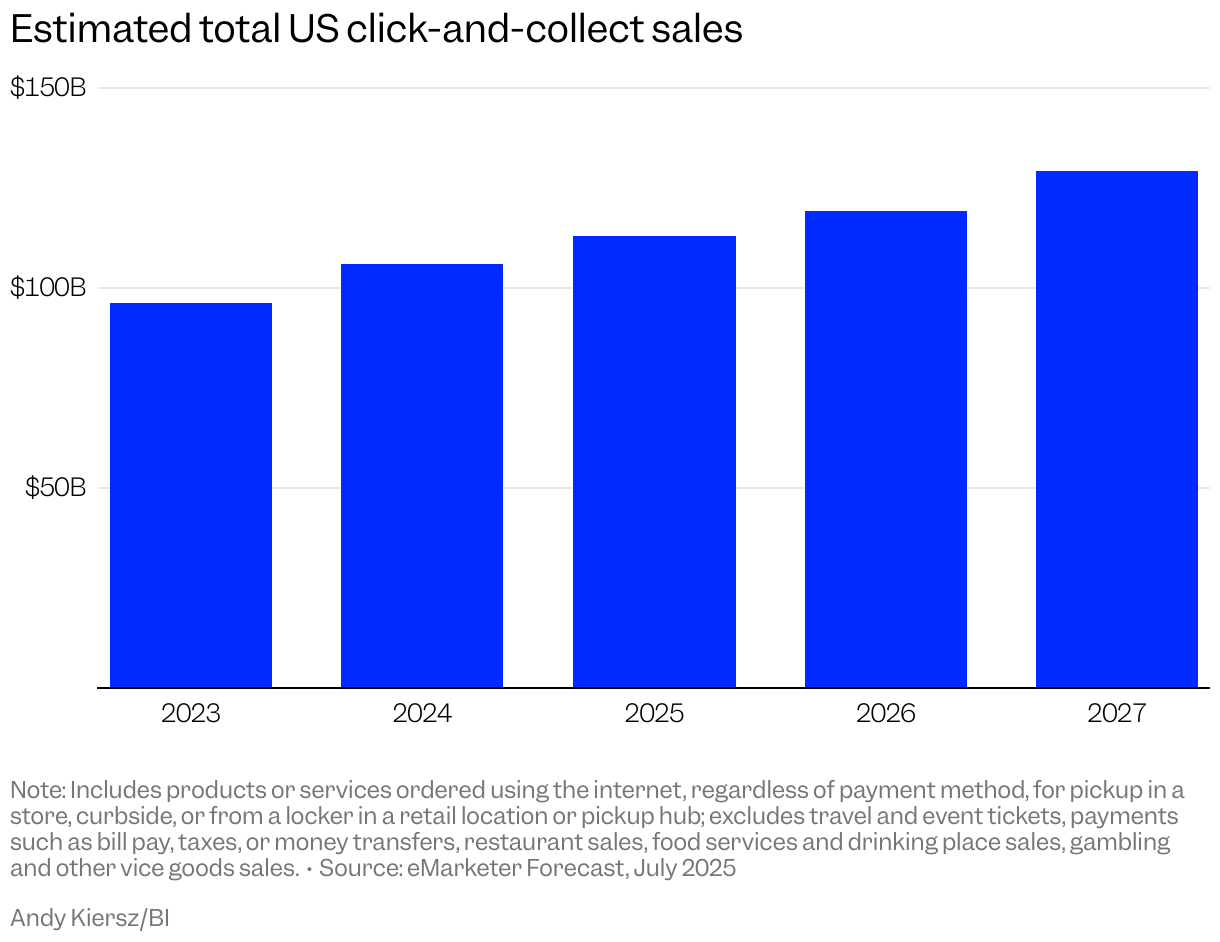
In-store pickup, often referred to as "click-and-collect," is surging in e-commerce. Total US sales from click-and-collect services are expected to hit $112.96 billion this year, up 17% from 2023, and grow to $129.33 billion by 2027, according to eMarketer. The research firm projects roughly 152.9 million Americans, or 68% of digital buyers, will use click-and-collect in 2025.
Amazon leads e-commerce by total sales, but Walmart may have an advantage when it comes to delivery speed. Thanks to its network of more than 4,600 US stores, Walmart can reach roughly 95% of American households within three hours. Walmart is the leader in click-and-collect services with a projected $38.50 billion in sales this year, eMarketer data shows.
According to the internal document, Amazon expects the new "rush" pickup service to meet "a key customer need for faster, more convenient access" to its full product selection, while making better use of its physical store network and logistics infrastructure.
"By piloting this capability, we can validate customer demand for rapid pickup while learning how to effectively combine our physical and digital offerings," the document stated.
Tim Chonacas co-founded Gold Tree Studios in Hollywood.
Jordan Naylor/Getty Images for SXSW; Patrick T. Fallon / AFP via Getty Images
Gold Tree Studios, a Hollywood post-production company, filed for Chapter 11 bankruptcy.
The move comes after the firm's parent company said it obtained $1 billion in financing to grow.
The firm provided post-production services for the coming film, "Lear Rex," starring Al Pacino.
A Hollywood post-production company tied to the upcoming film "Lear Rex" starring Al Pacino and Jessica Chastain filed for bankruptcy protection on Tuesday.
Gold Tree Studios, a three-year-old firm offering post-production rental suites, editing, sound mixing, color grading, and more, filed for Chapter 11 reorganization just months after its parent company announced a $1 billion financing deal intended, in part, to grow the studio.
"This investment expands our studio footprint & production slate, bringing more jobs & opportunities to LA and beyond," Gold Tree Studios wrote in a March X post about the lump sum its parent company, Gold Tree, secured from the global investment firm Malka Group.
Gold Tree Studios filed for bankruptcy as a small business seeking protection under Subchapter V of Chapter 11.
The filing, submitted in federal California bankruptcy court, shows that the firm — one of several subsidiaries that make up Gold Tree — holds between $100,000 and $500,000 in assets and between $1 million and $10 million in liabilities. The company also listed between 1 and 49 creditors.
It was not clear from the bankruptcy court filings what led to Gold Tree Studios' financial troubles.
Representatives for the company, as well as its bankruptcy attorney, did not immediately return requests for comment by Business Insider on Wednesday. Representatives for Malka Group also did not immediately return a request for comment.
Gold Tree was founded by entrepreneur Tim Chonacas, who also serves as the company's CEO, and late veteran Hollywood executive William Immerman.
The pair launched the company's film production arm, Gold Tree Films, in 2018 and Gold Tree Studios in 2022, with its flagship location on the Sunset Strip in West Hollywood. Gold Tree's other subsidiaries include Gold Tree TV and Gold Tree Podcasts.
"The cutting edge facility set a new standard for post-production services," the company's website says about Gold Tree Studios. "Despite industry strikes, Chonacas kept the studio afloat and expanded to Buffalo, NY, and Vancouver Island, Canada."
The facility provided post-production services for the forthcoming Bernard Rose-directed flick "Lear Rex," an adaptation of William Shakespeare's "King Lear," Deadline previously reported.
In the film, which does not yet have a release date, Pacino stars as King Lear. The cast also includes Ariana DeBose, Peter Dinklage, Rachel Brosnahan, Stephen Dorff, and Danny Huston.
Sima Sistani starts her day with a daily affirmation and ends it with a fantasy romance read.
Kate Medley for BI
This as-told-to essay is based on a conversation with Sima Sistani, an entrepreneur, adjunct professor at Duke University, and former CEO of WeightWatchers. Before that, she joined the senior leadership team at Epic Games after selling her startup, Houseparty, to the video game company. She lives in Durham, North Carolina, with her husband and two children. The following has been edited for length and clarity.
After I parted ways as CEO of WeightWatchers, I called Oprah for advice. She was no longer involved with the company, and she's a friend.
She told me, "Give yourself a year to say no to everything. Take this time to be with yourself and your loved ones."
And so I did that.
It was really good advice because it would have been easy when the calls started — "Hey, do you want to think about this role or that role?" — to move on to the next thing. Then I could answer the question, "What do you do?"
Sima Sistani teaches a course on women's leadership at Duke University.
Kate Medley for BI
One year later, I'm now an adjunct professor at Duke University, my alma mater, teaching a new course on women's leadership. I sit on the board of Best Buy. I invest in startups and funds.
My husband likes to say I'm the busiest unemployed person he knows.
Here's what my day looks like.
I wake up at 6 a.m. to an alarm clock
When I was at WeightWatchers, I got into the habit of using an alarm clock. It's a way for me to set boundaries.
I realized I was chained to my phone. My instinct is to get on top of things. So when my alarm went off, I would look at my phone and get sucked in.
I read a daily affirmation. I'm reading from "The Book of Awakening" by Mark Nepo.
Once I get out of bed, I put on my Beyond Yoga athleisure and Goop under-eye patches and tie my hair into a ponytail. Then I go downstairs and pour the coffee.
I take mine with half-and-half, cinnamon, collagen powder, and a couple of Brazil nuts to mitigate the acidity on an empty stomach.
My mom cooks breakfast for her grandchildren
I wake up my youngest child with a song, usually a pop diva track. Right now it's "Fate of Ophelia" by Taylor Swift.
Then it's pandemonium for an hour.
My parents live four houses down, and so most mornings, my mom short-order cooks for the kids. They'll have French toast, eggs, popovers, or something pretty exciting compared to my Cinnamon Toast Crunch when I was growing up. I know. It's amazing.
My husband, Alex, takes the kids to school on his way to work.
Sima Sistani lives in Durham, North Carolina, with her husband and two children.
Kate Medley for BI
I read an actual newspaper
I drink my coffee and read, usually sitting outside on the patio.
I get The New York Times delivered because that was another mental health hack. I no longer let the algorithms decide what I should be reading.
This past year, I completed my 200-hour yoga teacher training and certification.
I don't want to be dramatic, but it was a life-changing experience. I didn't grow up in a religious home, and so yoga has given me a spiritual framework.
When, suddenly, you no longer have a way of saying what you do for work — "I'm the CEO" or "I'm the founder" — you have to figure out who you are and what your identity is outside work.
Thankfully, I've reached a point of financial security where I can take the time to think about what I want to do — and make sure I do it in a way that is good for me and good for others.
I prepare my talking points for class
I eat a breakfast of yogurt topped with granola and berries, and tackle some work at my computer in the kitchen.
Some days I have a board call or meetings with founders. I'm incubating some new brand ideas in the consumer packaged goods space, which is a departure from my comfort zone of 0s and 1s.
Wednesdays are dedicated to preparing my talking points for class.
She eats yogurt with granola and berries for breakfast.
Kate Medley for BI
Last year, I spoke to a group of students in Duke's Innovation and Entrepreneurship program. I noticed there were a lot of guys.
Professor Jamie Jones, who runs the program, asked if I would be willing to teach a class. I said yes, if I could teach one that was geared toward women.
I wanted to show students that entrepreneurship can look a lot of different ways and doesn't just mean that you're coding and eating ramen in a studio apartment somewhere.
Entrepreneurship means writing new rules, and we need the next generation of women to write the new rules.
I take my guest speaker on a campus tour
Each week, I bring in a guest speaker. They're peers in my life who I've learned from, who have amazing stories.
Kat Cole is the CEO of AG1, but she dropped out of college and rose through the ranks of Hooters. Jeni Britton built an ice cream business, Jeni's Splendid Ice Creams, after being an art major and living out of her car. Hannah Chody was a Goldman Sachs vice president who left to join her family business, then fell into becoming a social media influencer.
Around 2 p.m., I usually meet the guest, or sometimes the person stays with me. It's about a 12-minute drive through the Duke Forest from my house to campus.
I usually give the guest speaker a campus tour. Duke Chapel is a highlight.
Sima Sistani walks her guest speaker, Jeni Britton, around campus before class.
Kate Medley for BI
I teach from 3 p.m. to 5:30 p.m.
The class meets for two and a half hours every Wednesday. The first half is a discussion of what we learned the week before, and the other half is a Q&A with the guest. Students ask questions, too.
I bring a portable speaker to play the guest walkout music. I was inspired by Jennifer Hudson's "spirit tunnel."
Most of it is the stuff that they won't say on a podcast. It's a moment for them to really engage with these 44 women.
I ask them, "What do you wish you knew when you were 20?"
After class, I take the guest to dinner, usually Little Bull or M Sushi in Durham.
I escape with fantasy romance books
When I get home, I snuggle up with the kids and hear about their day.
I used to escape my day with TV, and then I would stay up late. I'm watching less TV now that I don't work. When you're feeling pretty chill throughout your day, you don't need to wind down.
I'm in my bed by 10:30 p.m. I'll grab my Kindle and escape into a good book.
Actually, Jenni and I talked about our enjoyment of romantic fantasy books. I just finished "A Court of Thorns and Roses" series and started "Fourth Wing."
It's too bad that out in the world we call it 'smut,' but when it's "Game of Thrones," it's fine for everybody.
Leslie Snipes secured approval from her manager to work remotely after struggling with her LA commute.
She said she made the case for why working from home would benefit her personally and professionally.
Working remotely has been a game changer for her, even though she misses some parts of office life.
This 'as-told-to' essay is based on a conversation with Leslie Snipes, a 34-year-old director of marketing at a Los Angeles-based creative agency who lives in Reseda, California. Her words been edited for length and clarity.
When I started my director of marketing job in January 2024, the expectation was that I'd work from the office at least once a week. But because I was in a director-level role, I felt a bit more obligated to show face.
For the first few months, I made the 30-mile, 60- to 90-minute commute to our Los Angeles office a couple of days a week. Over time, the commute began to take a toll on me. I was wasting hours a day sitting in LA traffic.
In April 2024, after weighing my options, I decided to speak with my manager and ask if I could work mostly from home — coming into the office only as needed, along with any travel obligations. My request was approved in less than a day.
How I made the case for work-from-home flexibility
I started the conversation with my manager by being transparent about my commute and the challenges it was creating for me. I would often arrive home feeling mentally drained, frustrated, or short-tempered after commuting, which affected my energy and overall well-being in the evenings. Additionally, the wear and tear on my car, along with the gas costs, were becoming outrageously expensive.
I also shared that I believed I'd be a better worker without the strain of the commute, because I could spend more time actually working rather than sitting in traffic. Most of the company's clients were based on the East Coast — rather than LA — so most of my work could be done remotely from my computer and through Zoom calls.
I emphasized my performance
From a team camaraderie perspective, some of our strongest bonding happened during travel and off-site projects, rather than in the office, so I noted that working remotely wouldn't take away from that sense of connection.
Overall, I emphasized that working from home would allow me to deliver my best work without compromising collaboration or team culture — and I think that approach was effective.
After speaking with my manager and another manager, they were very understanding and accommodating. Since my role involves some travel, the managers said they considered that to be a form of in-office time, as I'm still interacting with colleagues in person.
More than anything, they recognized that work-from-home flexibility would help me perform at a higher level — and they trusted me to deliver on that.
WFH has been a game changer — I'm glad I asked for it
The biggest perk of my work-from-home flexibility is that I feel much more efficient with my time — both personally and professionally. It gives me greater autonomy over my schedule, which helps me manage my workload more effectively and leaves me more energized and present when meeting with the team.
I'm also a bit of an introvert, and I find it harder to focus when I'm surrounded by a lot of people. I tend to get more distracted in the office than when I'm working alone. Now, instead of showing up to be "a body in the room," I can focus my energy on strategy, creative work, and client engagement.
Working from home has also reduced my stress, since I'm no longer spending hours in traffic just trying to get to work on time.
There are some things I miss about working in the office
Despite these benefits, I sometimes miss grabbing lunch and coffee with coworkers and talking about non-work-related things. When I'm working from home, I mostly interact on an as-needed basis, and there's less spontaneity with coworkers outside work.
I typically make the commute to the office once or twice a month to connect in person with my colleagues, in addition to whenever circumstances warrant it.
Overall, the shift has been a game changer for me — and it's a setup I wouldn't have if I hadn't asked.
Dominick DiBartolomeo, the owner of the Cheese Store of Beverly Hills, says going viral on social media has helped reinvigorate his business.
Courtesy of Dominick DiBartolomeo
Dominick DiBartolomeo said TikTok virality drew in waves of younger customers to his cheese store.
The Cheese Store of Beverly Hills has repeatedly pivoted due to the pandemic and tariff uncertainty.
Appealing to younger customers has helped reinvigorate the store, which has been open since 1967.
This as-told-to essay is based on a conversation with Dominick DiBartolomeo, owner of the Cheese Store of Beverly Hills. It has been edited for length and clarity.
When I bought the Cheese Store of Beverly Hills, my goal was to honor its legacy while making it feel fresh and relevant.
The shop has been around since 1967 and already had decades of goodwill, but I wanted to create something familiar and new, so we added sandwiches, salads, cheese boards, and wines by the glass.
I didn't expect the flood of teenagers.
My daughter is 16, and I like to say her generation arrived armed with Instagram. They started filming everything — and some of those videos went viral.
Suddenly, we had crowds of teens lining up for a place that had historically catered to adults, chefs, and longtime Beverly Hills locals. It completely changed the energy of the shop.
This year has been one of our toughest
People know our products are premium, but they don't see how volatile the economics have become.
We import directly from Europe, mainly Italy. At the beginning of the year, tariffs were 10%, and we absorbed as much of that as we could. However, the Euro then jumped from around $1.04 to about $1.17 or $1.18 — a 13% swing. As a result, the same products suddenly cost 23% more before they even reach our shores.
Then there are the Chinese tariffs, which people rarely think about, but almost all takeout packaging comes from China. Between packaging tariffs and ingredient tariffs, some costs have risen 50%, 60%, and even 70%. When that happens across your entire supply chain, the math stops making sense.
We tried everything before raising prices, from asking suppliers to share some of the tariff load to switching products, and eventually accepting lower margins. However, at a certain point, you can't absorb the costs.
Our sales are up this year, but our margins are down because our costs are so much higher. That's the reality for a lot of small specialty food businesses right now.
Our customers are still buying, but the middle is getting squeezed. The under-$25 customer remains rock solid, and diners spending $100 or more are also doing fine. It's the middle that's struggling, and that's where a lot of restaurants and gifting budgets live.
The next generation is extending the life cycle of my business
When we moved into our new location a couple of years back, I knew I had to take care of the older clientele who built this brand — but I also believed that if the shop didn't evolve, it would die.
Adding sandwiches and salads wasn't just about giving people something to eat while they browsed. It was a way to create a full experience. While customers wait for their sandwiches, they can try different cheeses in line. The whole place feels alive.
Then the influencers started showing up.
I didn't know who most of them were — I had to ask my daughter who people were after they left — but our Instagram following grew from 6,000 to around 280,000 in about a year and a half.
People now walk in and say, "I came here because you showed up on my feed." We even had a couple from Australia tell us this was their first stop off the plane for their honeymoon because we popped up on their TikTok feed.
The most exciting part is that the virality around the sandwiches has turned into virality around the cheese, too. Because of the way our line bends through the store, people waiting for sandwiches are sampling cheeses the whole time — and they film that. Now, young customers come in for a buzzy sandwich, discover a type of cheese they've never tried, and suddenly they're coming back for parties, holidays, or simply because they want something special.
We even launched a merch line because we noticed how many younger customers wanted something to take home. Seeing a longtime customer who's been coming in for 40 or 50 years standing next to a teenager in a Cheese Store hoodie is one of the coolest things I've ever experienced. It feels like we've made cheese buying cool again.
The Cheese Store of Beverly Hills serves more than 500 different cheeses, many of which were imported from Italy.
Courtesy of Dominick DiBartolomeo
What's happened is that this new generation has completely renewed the life cycle of the business. At the same time, our longtime loyal customers remain the backbone of who we are. Now the two groups stand shoulder to shoulder in the shop. It's a full-circle moment — we've managed to grow without losing our core.
I met my wife at the Cheese Store, where I was working while I couldn't afford a phone and was taking the bus to work. She supported me through everything — from raising money to buying the business and surviving the pandemic. Now we have 40 to 50 employees. All of their families rely on us.
That responsibility changes you. So does the joy of seeing the store full, watching our products show up in incredible restaurants, and witnessing teens discover a 57-year-old Beverly Hills cheese shop on social media.
OpenAI's head of business products flagged 3 jobs that could be automated in the next few years.
JULIEN DE ROSA/AFP via Getty Images
Three industries are going to look very different in some years, says an OpenAI head of product.
He said that life sciences would see a lot of automation, because admin can be automated.
AI leaders are flagging white-collar jobs that can be easily automated by newer models.
Three industries are going to look very different in the next few years, according to an OpenAI executive.
On an episode of the "Unsupervised Learning" podcast, Olivier Godement, the head of product for business products at the ChatGPT maker, shared why he thinks a trio of jobs — in life sciences, customer service, and computer engineering — is on the cusp of automation.
"My bet is often on life sciences, pharma companies," he said, about his first pick for industries on the brink of change because of AI.
Godement said that the goal of pharmaceutical companies like Amgen, with which he works, is to design new drugs. This has two components: actual research and experimentation, and admin, a time-consuming process that could be automated, he said.
"The time it takes from once you lock the recipe of a drug to having that drug on the market is months, sometimes years," he said. "Turns out like the models are pretty good at that. They're pretty good at aggregating, consolidating tons of structured, unstructured data, spotting the different changes in documents."
Godement joined OpenAI in 2023. He previously worked on products for Stripe for eight years.
On the podcast, Godement said that while we haven't reached a stage where "any white collar job" can be automated in just a day, he is starting to see strong use cases in fields such as coding and customer service.
"The automation is probably not yet at the level of automating completely the job of a software engineer,but I think we have a line of sight essentially to get there," he said.
The future of software engineering has been one of the most heated tech debates of the year, as AI-assisted coding enters most companies' workflow.
An Indeed study from October found that software engineers, quality assurance engineers, product managers, and project managers were the four tech jobs that have been axed the most during layoffs and reorgs.
Lastly, Godement said that customer-oriented roles like sales and customer experience may be automated soon.
"I've been working a bunch with the folks at T-Mobile, the telecom company in the US, to essentially provide a better experience to their customers, and we're starting to achieve fairly good results in terms of quality at a meaningful scale," he said. "My sense is we'll probably be surprised in the next year or two on the amount of tasks that can be automated reliably."
Across the board, AI leaders are flagging white-collar jobs that can be easily automated by newer large language models.
In a June podcast, Geoffrey Hinton, who is recognized as the "Godfather of AI," said that eventually, technology will "get to be better than us at everything," but some fields are safer than others in the interim.
"I'd say it's going to be a long time before it's as good at physical manipulation," Hinton said. "So a good bet would be to be a plumber."
It was a bumpy, but tentatively positive Thursday session for the S&P/ASX 200 Index (ASX: XJO) today. The ASX 200 briefly dipped into negative territory this afternoon upon the latest unemployment figures, but ended up recovering to post a 0.15% gain for the day. That leaves the index at a flat 8,592 points.
This decent session for the Australian markets follows a far more optimistic morning over on the American market.
The Dow Jones Industrial Average Index (DJX: .DJI) was on fire, shooting 1.05% higher.
The tech-heavy Nasdaq Composite Index (NASDAQ: .IXIC) wasn’t quite as enthusiastic, but still managed a gain of 0.33%.
But let’s return to ASX shares and take a look at what the various ASX sectors were up to this Thursday.
Winners and losers
Despite the rise of the broader market, we still had quite a few red sectors.
At the front of those red sectors were again tech stocks. The S&P/ASX 200 Information Technology Index (ASX: XIJ) continued to fall, plunging 1.48% today.
Healthcare shares were punished too, with the S&P/ASX 200 Healthcare Index (ASX: XHJ) tanking 1.07%.
Communications stocks didn’t have a fun time either. The S&P/ASX 200 Communication Services Index (ASX: XTJ) cratered by 0.7%.
Consumer discretionary shares weren’t popular, illustrated by the S&P/ASX 200 Consumer Discretionary Index (ASX: XDJ)’s 0.55% dive.
Industrial stocks missed out as well. The S&P/ASX 200 Industrials Index (ASX: XNJ) took a 0.29% hit this session.
Our last losers were consumer staples shares, with the S&P/ASX 200 Consumer Staples Index (ASX: XSJ) retreating 0.14%.
Turning to the green sectors now, mining stocks led the charge. The S&P/ASX 200 Materials Index (ASX: XMJ) galloped 0.89% higher by the closing bell.
Energy shares were right behind that. The S&P/ASX 200 Energy Index (ASX: XEJ) ended up recording a 0.58% rise.
Financial stocks were a little more subdued, though, with the S&P/ASX 200 Financials Index (ASX: XFJ) adding 0.29% to its total.
Gold shares were in the same ballpark. The All Ordinaries Gold Index (ASX: XGD) got a 0.26% upgrade today.
Finally, utilities stocks scraped home with a win, as you can see from the S&P/ASX 200 Utilities Index (ASX: XUJ)’s 0.2% lift.
Top 10 ASX 200 shares countdown
Coming out on top this Thursday was ASX building materials manufacturer James Hardie Industries plc (ASX: JHX). James Hardie shares shot up 7.13% today to close at $30.51 each.
This gain came despite no obvious catalysts out from the company itself.
Here’s how the other top shares landed the plane today:
Our top 10 shares countdown is a recurring end-of-day summary that shows which companies made big moves on the day. Check in at Fool.com.au after the weekday market closes to see which stocks make the countdown.
Should you invest $1,000 in James Hardie Industries plc right now?
Before you buy James Hardie Industries plc shares, consider this:
Motley Fool investing expert Scott Phillips just revealed what he believes are the 5 best stocks for investors to buy right now… and James Hardie Industries plc wasn’t one of them.
The online investing service he’s run for over a decade, Motley Fool Share Advisor, has provided thousands of paying members with stock picks that have doubled, tripled or even more.*
And right now, Scott thinks there are 5 stocks that may be better buys…
Motley Fool contributor Sebastian Bowen has no position in any of the stocks mentioned. The Motley Fool Australia’s parent company Motley Fool Holdings Inc. has no position in any of the stocks mentioned. The Motley Fool Australia has recommended Flight Centre Travel Group. The Motley Fool has a disclosure policy. This article contains general investment advice only (under AFSL 400691). Authorised by Scott Phillips.