Author: openjargon

  • These 3 charts show how the biggest private equity funds keep winning in a fundraising slowdown

    Sign outside the Blackstone headquarters.
    Sign outside the Blackstone headquarters.

    • There may be more private equity funds than McDonald's in the US, but there are signs of consolidation.
    • Nearly half of PE cash raised in 2025 so far has gone to the 10 largest funds, per a report.
    • It was also the lowest year on record for new funds closed, at just 41, per Pitchbook.

    In private equity, consolidation is now the name of the game.

    After a burst of new fund launches — enough for one KKR executive to joke last month that the US now has more private equity funds than McDonald's — more funding than ever is flowing into the biggest names.

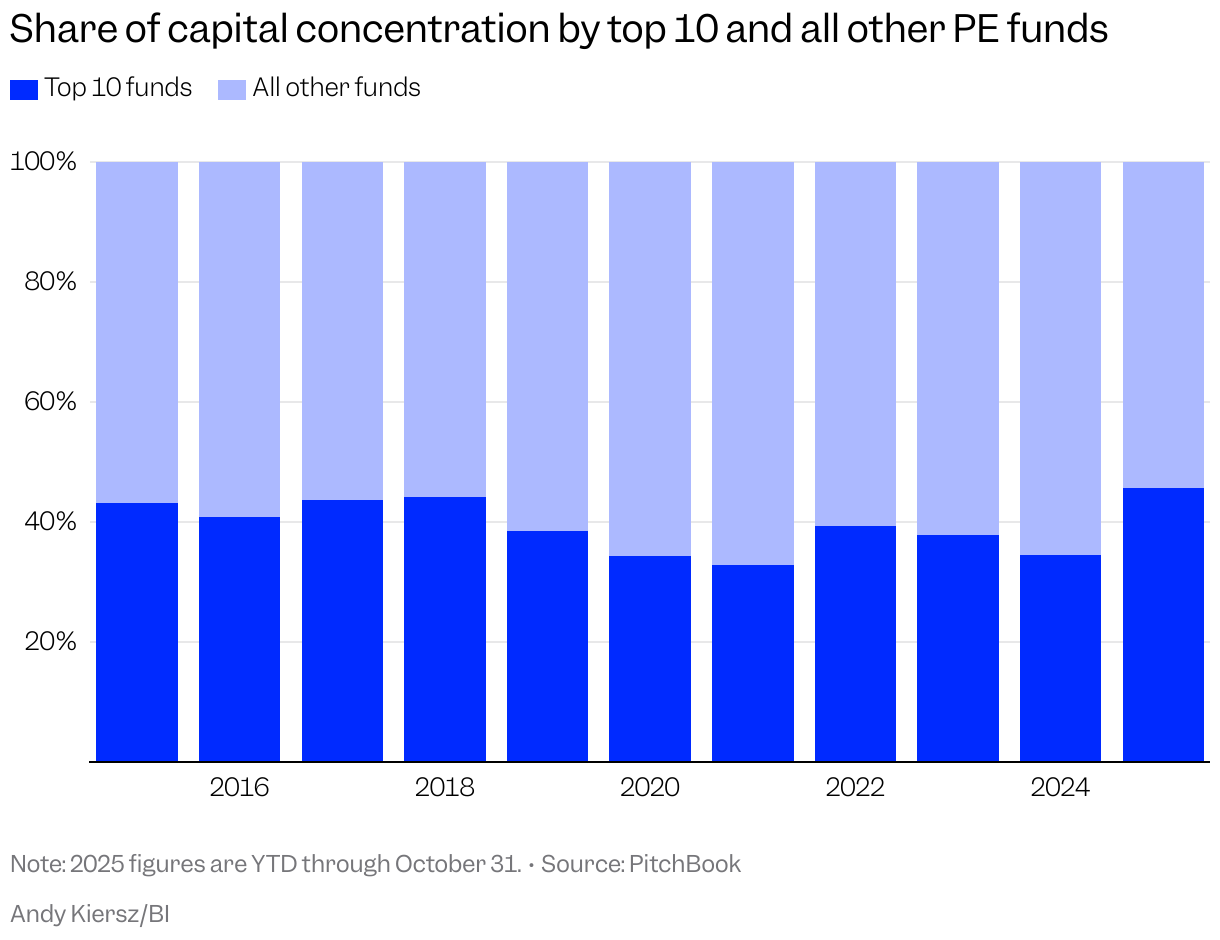
    So far this year, nearly 46% of all private equity capital raised in 2025 has been secured by the 10 largest funds, up from 34.5% in 2024, according to PitchBook's private equity outlook report. PitchBook predicts that more than 40% will go to the largest funds in 2026 as well.

    This fundraising consolidation happens while fundraising is down substantially, with only $259 billion raised so far this year compared to $372.6 billion last year. But even as the absolute amount raised by the top funds has dropped 8% year-over-year to $118.3 billion, their overall share of the pie went up.

    Here are three charts from PitchBook's report that show how the biggest funds in private equity are likely to get even bigger.

    The top 10 funds are taking more of the fundraising haul than they have in the last 10 years
    Stacked column chart

    This chart breaks down the percentage of US private equity (and not credit) fundraising that went to the 10 largest funds. This year, the top 10 largest funds include two Blackstone funds and two Thoma Bravo funds, a Bain Capital fund, as well as funds from lesser-known names like Great Hill Partners.

    After five years, with the 10 largest funds making up an average of 35.8% of funds raised — and a 10-year average of 39% — the number jumped to 45.7% so far this year.

    10 biggest funds Capital committed (billions)
    Thoma Bravo Fund XVI $24.3
    Blackstone Capital Partners IX $21
    Veritas Capital Fund IX $14.4
    Bain Capital XIV $14
    Trident X Fund $11.5
    Thoma Bravo Discover Fund V $8.1
    Great Hill Equity Partners IX $7
    Providence Strategic Growth VI $6
    Blackstone Energy Transition Partners IV $5.6
    Linden Capital Partners $5.2

    With times tight for fundraising, asset allocators are choosing to go to the biggest players with their remaining capital. Even the biggest players are having a harder time fundraising compared to years past, but they're clearly doing better than their competitors.

    The consolidation story is even more striking when you examine the fundraising picture for the top three largest funds. The three largest raised $60.4 billion so far this year, accounting for 23.3% of the total amount raised, compared to $55.9 billion last year, which represented just 15% of the total amount raised.

    Forget flight to quality, there's a flight to experience
    Stacked column chart

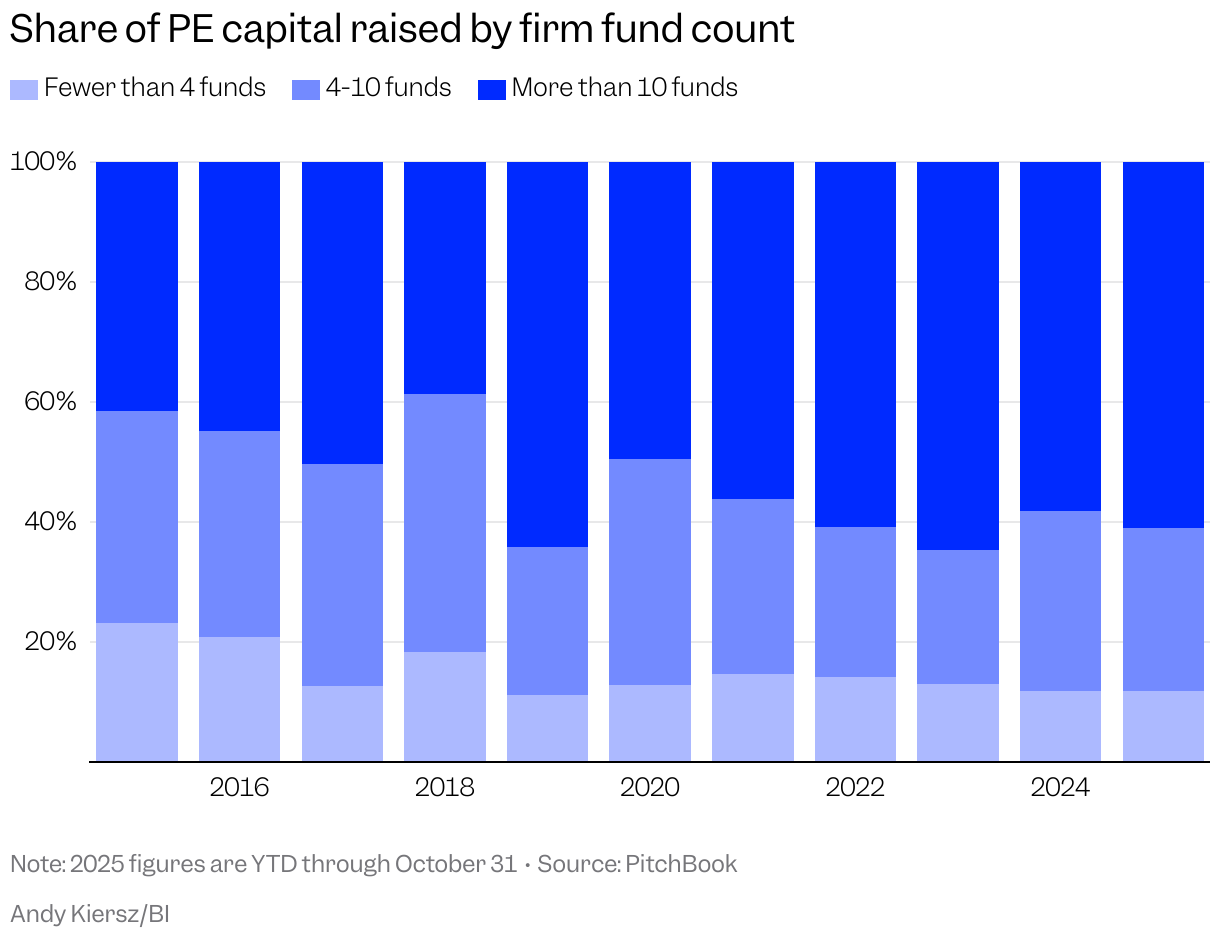
    Capital may be flowing to the biggest players in large numbers, but it's also flowing to the most experienced firms. So far this year, 61% of capital raised has come from firms that have more than 10 funds in total. That's above the five-year average of 58%.

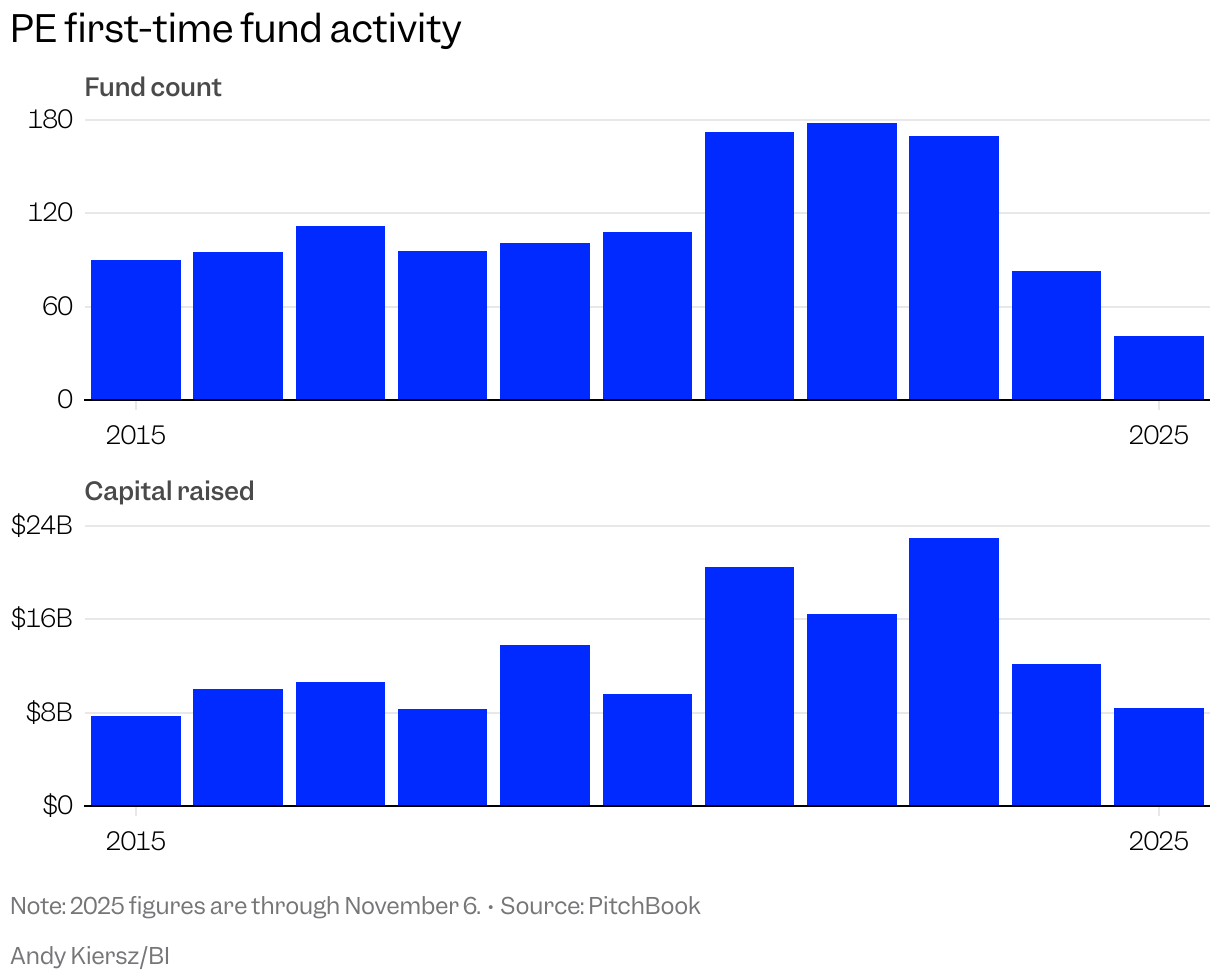
    So far this year, only 41 first-time funds have closed their fundraising this year, a record low number. The total amount of capital in these closed funds, $8.4 billion, is also near record lows, though 2015 saw only $7.7 billion closed across 90 funds.
    Small multiple column chart

    It's even harder than it was last year, when the industry closed 83 first-time funds, the previous record low. With asset allocators flocking to established, large investors, it's no surprise that the new launches are anemic.


    Read the original article on Business Insider
  • $3,000 invested in this ASX silver share in July is now worth $6,577

    A little boy holds up a barbell with big silver weights at each end.

    ASX silver share Broken Hill Mines Ltd (ASX: BHM) is 91 cents apiece on Thursday, down 6.19%.

    Broken Hill Mines used to be Coolabah Metals, a company that first began trading on the ASX in 2022.

    The company requested and was granted a suspension in August last year pending a material acquisition and re-compliance transaction.

    After completing a reverse-acquisition and capital raise, Broken Hill Mines shares began trading on 21 July, opening at 41.5 cents.

    Had you put just $3,000 into this ASX small-cap silver share then, your shareholding would be worth $6,577 today.

    Let’s find out more about why this stock has skyrocketed in recent months.

    Why is this ASX silver share on fire?

    The reverse acquisition fundamentally changed the nature of the company, with new assets giving it more investment appeal.

    At the same time, the silver price has more than doubled this year to record highs. Today, silver is worth US$58 per ounce.

    Broken Hill Mines has two historical silver, lead, and zinc mines.

    It owns 100% of Rasp and 70% of Pinnacles, and is further developing both.

    The company reckons Rasp is the world’s largest silver, lead, and zinc deposit with a Mineral Resource Estimate (MRE) of 10.1Mt at 9.4% ZnEq (5.7% Zn, 3.2% Pb, and 49g/t Ag).

    The mine is currently operational and producing approximately 30,000 tonnes of silver-lead-zinc ore per month.

    The on-site concentrator can process up to 750,000 dry metric tonnes of silver-lead-zinc ore per annum.

    Pinnacles was placed into care and maintenance in 2020 due to the pandemic and is not operational as yet.

    However, ongoing drilling is designed to grow the MRE, which is currently 6Mt at 10.9% ZnEq (4.7% Zn, 3.3% Pb, & 132g/t Ag).

    The exploration target is up to 15Mt at 2%-4% Zn, 3%-6% Pb, and 40-125g/t Ag.

    This year, the silver commodity price has ripped due to higher demand for silver for defence systems and clean energy technologies.

    Billionaire metals investor Eric Sprott told Kitco News in March that the silver price could go to US$250-US$500 over the next 10 years.

    Last month, the US Geological Survey (USGS) added silver to the nation’s critical minerals list, demonstrating its growing importance.

    The Silver Institute says 2025 has been “a dramatic year for the silver market”.

    What’s the latest news from Broken Hill Mines?

    Today, Broken Hill Mines announced a mining and processing ramp-up at Rasp.

    The explorer also released new assay results from drilling of Rasp’s main ore lode, specifically in the Blackwoods zone.

    As stated earlier, Rasp has a total MRE of 10.1Mt at 9.4% ZnEq (5.7% Zn, 3.2% Pb, and 49g/t Ag).

    To date, the Blackwoods zone’s contribution is 490kt at 18.3% ZnEq (8.3% Zn, 7.5% Pb, & 156g/t Ag).

    The new drilling results include significant high grade mineralisation of 3m at 1,426g/t AgEq and thick intercepts up to 37.2m at 314g/t AgEq.

    These results come from outside the existing MRE for Blackwoods, indicating the total MRE for Blackwoods and Rasp will likely rise.

    Broken Hill Mines said:

    BHM remains on target to launch an expanded 17,000m drilling program at the Rasp Mine in 2026, focused on further resource extensions of the Main Lode ore body.

    The company also intends to begin first mining activities at Pinnacles in 2026.

    The miner hopes its Rasp and Pinnacles operations next year will enable full utilisation of Rasp’s 750,000tpa capacity processing plant.

    The post $3,000 invested in this ASX silver share in July is now worth $6,577 appeared first on The Motley Fool Australia.

    Wondering where you should invest $1,000 right now?

    When investing expert Scott Phillips has a stock tip, it can pay to listen. After all, the flagship Motley Fool Share Advisor newsletter he has run for over ten years has provided thousands of paying members with stock picks that have doubled, tripled or even more.*

    Scott just revealed what he believes could be the ‘five best ASX stocks’ for investors to buy right now. We believe these stocks are trading at attractive prices and Scott thinks they could be great buys right now…

    * Returns as of 18 November 2025

    .custom-cta-button p {
    margin-bottom: 0 !important;
    }

    More reading

    Motley Fool contributor Bronwyn Allen has no position in any of the stocks mentioned. The Motley Fool Australia’s parent company Motley Fool Holdings Inc. has no position in any of the stocks mentioned. The Motley Fool Australia has no position in any of the stocks mentioned. The Motley Fool has a disclosure policy. This article contains general investment advice only (under AFSL 400691). Authorised by Scott Phillips.

  • Why are BetMakers shares charging higher today?

    3 men at bar betting on sports online 16.9

    Shares in BetMakers Technology Group Ltd (ASX: BET) were trading more than 10% higher on Thursday after the company announced a major deal with CrownBet.

    The company said in a statement to the ASX that it had signed an exclusive five-year technology and services agreement with Betfair, “to deliver a full wagering stack for the development of CrownBet”.

    As the company said in its statement:

    Under the agreement, BetMakers will deliver its full wagering stack for CrownBet, including a fully customised deployment of the Company’s Apollo wagering platform, trading and risk management, content engine, and core platform technology. The end-to-end solution positions BetMakers as the technology and operational backbone of the CrownBet offering from launch.

    More wins on the board

    BetMakers said it was the most significant commercial milestone for its Apollo platform to date, “and further validates BetMakers’ strategy to provide a complete, vertically integrated B2B wagering solution to Tier-1 operators globally”.

    The agreement also establishes a landmark alignment with Betfair and its parent company, Crown Resorts – one of Australia’s most recognised entertainment and hospitality groups.

    BetMakers Chief Operating Officer Martin Tripp said it was a major endorsement of the Apollo platform.

    To be selected by Betfair to power the return of CrownBet demonstrates the scalability, performance and commercial flexibility of our technology stack. By combining our Apollo platform with deep industry expertise and talent within Betfair, we are confident we can deliver a market-leading wagering experience and help to position CrownBet as a formidable player in the Australian market.

    BetMakers shares traded as high as 19.5 cents on the news before settling back to be changing hands for 19 cents, up 8.5% by mid-afternoon.

    Building on early gains

    BetMakers also this week said it had signed a three-year agreement with Penn Entertainment (NASDAQ: PENN) for the distribution of Penn’s racing content.

    The company said, in a broader market update, that it was “experiencing strong digital momentum with eight digital customers launched in the second quarter of FY26 and eight scheduled for the balance of FY26, supported by a further pipeline of additional growth opportunities globally”.

    BetMakers said the Penn deal was expected to increase the company’s EBITDA by about $1.2 million per year over the term of the contract.

    BetMakers Chief Executive Jake Henson said the Penn deal, which expanded on an existing arrangement, was “a positive step for both parties, and we look forward to a successful and profitable partnership”.

    BetMakers was valued at $195.7 million at the close of trade on Wednesday.

    The post Why are BetMakers shares charging higher today? appeared first on The Motley Fool Australia.

    Should you invest $1,000 in Betmakers Technology Group Ltd right now?

    Before you buy Betmakers Technology Group Ltd shares, consider this:

    Motley Fool investing expert Scott Phillips just revealed what he believes are the 5 best stocks for investors to buy right now… and Betmakers Technology Group Ltd wasn’t one of them.

    The online investing service he’s run for over a decade, Motley Fool Share Advisor, has provided thousands of paying members with stock picks that have doubled, tripled or even more.*

    And right now, Scott thinks there are 5 stocks that may be better buys…

    * Returns as of 18 November 2025

    .custom-cta-button p {
    margin-bottom: 0 !important;
    }

    More reading

    Motley Fool contributor Cameron England has no position in any of the stocks mentioned. The Motley Fool Australia’s parent company Motley Fool Holdings Inc. has positions in and has recommended Betmakers Technology Group. The Motley Fool Australia has no position in any of the stocks mentioned. The Motley Fool has a disclosure policy. This article contains general investment advice only (under AFSL 400691). Authorised by Scott Phillips.

  • Best ASX retail stock to buy right now: Wesfarmers or Woolworths?

    A woman sits on sofa pondering a question.

    They’re two of the biggest retail stocks on the S&P/ASX 200 Index (ASX: XJO) right now. Wesfarmers Ltd (ASX: WES) is a very diversified company with broad retail operations in a broad range of industries. It is also the owner of popular household retail names like Bunnings, Kmart, Officeworks, and Priceline. Woolworths Group Ltd (ASX: WOW) is one of Australia’s supermarket giants and the owner of major brands such as Big W, BWS, and Dan Murphy’s.

    So when it comes to these two ASX retail powerhouses, which stock is the better buy for investors right now?

    Are Wesfarmers shares a buy?

    At the time of writing on Thursday afternoon, Wesfarmers shares have dropped 0.4% to $81.39 a piece. Over the past month, the shares have fallen 2.58% but they’re still 14% higher for the year to date.

    The share price was pretty stable between April and October this year. But then the retail company’s annual general meeting (AGM) in late October slashed investor confidence and caused a sharp 15% sell-off. While some areas of the business saw year-to-date sales growth, management said that challenging trading conditions have affected its Industrial and Safety division.

    The good news is that Wesfarmers shares have long been considered a good buy for passive income. The board of directors raised its fully-franked full-year dividend 4% year-over-year for FY25.

    It hasn’t done enough to convince analysts, though, and their verdict on the shares is still split between whether the stock is a buy or a hold. Data shows that the average target price is currently $81.25, implying a 0.38% downside at the time of writing. Although some analysts think the shares could fall another 22.02% to $63.60 over the next 12 months.

    Are Woolworths shares a buy?

    The supermarket chain’s share price is 0.32% lower at the time of writing, at $29.32. Over the past month, the shares have climbed 4.47% but they’re still 3.77% lower for the year to date, thanks to a sharp sell-off after the company posted a disappointing FY25 result in late August. 

    The company’s first-quarter sales update in late October was much more positive, though, and I think there is a good chance the company’s share price has reached the bottom and could soon rebound.

    Again, the shares are a good buy for passive income. In FY25, the supermarket business handed out a total of 85 cents per share, fully franked. Bell Potter expects the ASX retail stock to pay a boosted fully-franked dividend of 91 cents per share in FY26 and then 100 cents per share in FY27. 

    Analysts are more bullish on the shares, too. Data shows that analyst sentiment is also turning, with 7 out of 17 holding a buy or strong buy rating on the shares. The remaining 10 have a hold rating. The average target price is $30.34; however, some expect this could be as high as $33. This implies a potential 3.4% to 12.5% upside for investors over the next 12 months, at the time of writing.

    Which is the better ASX retail stock to buy?

    My vote is that Woolworths shares are a better buy than Wesfarmers stock right now. While both powerhouses offer an attractive passive income for investors, it looks like the latest sell-off of Woolworths shares has created a great buying opportunity for a good quality stock. Whereas Wesfarmers shares have peaked this year and are set to tumble.

    The post Best ASX retail stock to buy right now: Wesfarmers or Woolworths? appeared first on The Motley Fool Australia.

    Should you invest $1,000 in Woolworths Group Limited right now?

    Before you buy Woolworths Group Limited shares, consider this:

    Motley Fool investing expert Scott Phillips just revealed what he believes are the 5 best stocks for investors to buy right now… and Woolworths Group Limited wasn’t one of them.

    The online investing service he’s run for over a decade, Motley Fool Share Advisor, has provided thousands of paying members with stock picks that have doubled, tripled or even more.*

    And right now, Scott thinks there are 5 stocks that may be better buys…

    * Returns as of 18 November 2025

    .custom-cta-button p {
    margin-bottom: 0 !important;
    }

    More reading

    Motley Fool contributor Samantha Menzies has no position in any of the stocks mentioned. The Motley Fool Australia’s parent company Motley Fool Holdings Inc. has positions in and has recommended Wesfarmers. The Motley Fool Australia has positions in and has recommended Woolworths Group. The Motley Fool Australia has recommended Wesfarmers. The Motley Fool has a disclosure policy. This article contains general investment advice only (under AFSL 400691). Authorised by Scott Phillips.

  • Up 76% in less than a year and this ASX mining stock just revealed some “exceptional” gold news

    Gold bars on top of gold coins.

    Santana Minerals Ltd (ASX: SMI) is not a household name amongst ASX mining stocks.

    But the aspiring gold producer is starting to turn heads thanks to its Bendigo-Ophir gold project in New Zealand.

    In essence, the project hosts a resource base containing more than 2.3 million ounces of gold scattered across four deposits.

    However, the jewel in the crown is the flagship Rise and Shine (RAS) deposit with nearly 2.1 million ounces of gold.

    Santana plans to build a mine Rise and Shine and become a significant ASX gold producer.

    The ASX mining stock has already outlined a robust economic profile for a potential gold mine.

    Here, an economic evaluation envisaged 1.25 million ounces of total gold sales from an initial mine life of 13.8 years.

    However, today’s “exceptional” drilling results from Rise and Shine could give the project another shot in the arm.

    What happened?

    The ASX mining stock has been conducting drilling to test for northern extensions of Rise and Shine.

    And today’s results returned “outstanding” high-grade intercepts, confirming the continuation of the high-grade core of the deposit known as the HG1 domain.

    Notably, one hole named MDD487 returned a “bonanza” result of 8.7 metres grading 30.6 grams per tonne gold.

    This intercept ranks amongst the top ten holes drilled to date at Rise and Shine. It includes consistent grades above 15g/t gold, with two assays exceeding 100g/t gold.

    Management noted that this intercept highlights the strength of the HG1 domain when compared with the broader mineralised system.

    Other significant hits from the drilling include 27.6m at 3.5g/t gold and 12.6m at 4.2g/t gold.

    Management believes these results point to the potential for a larger underground operation than previously envisaged.

    Santana Minerals chief executive officer, Damian Spring, commented:

    Today’s results reinforce the continuity of high-grade mineralisation within the HG1 zone. The MDD487 interval returned a pre-top-cut grade of 40.2g/t, highlighting the strength of the system even before standard capping is applied. Intervals of this calibre, repeatedly observed across RAS, continue to strengthen our confidence in the geological model and the consistency of the high-grade domains.

    Share price in focus

    Despite the upbeat news, shares in the ASX mining stock have seen little movement in today’s session.

    More specifically, its shares are changing hands at $0.81 each at the time of writing, down by 0.6% from yesterday’s close.

    That said, Santana investors have enjoyed a fruitful year in 2025, with the company’s shares rocketing by 76% since the start of January.

    This performance has far outpaced the broader market, with the S&P/ASX All Ordinaries Index (ASX: XAO) up by 5% during the same period.

    The post Up 76% in less than a year and this ASX mining stock just revealed some “exceptional” gold news appeared first on The Motley Fool Australia.

    Should you invest $1,000 in Santana Minerals Limited right now?

    Before you buy Santana Minerals Limited shares, consider this:

    Motley Fool investing expert Scott Phillips just revealed what he believes are the 5 best stocks for investors to buy right now… and Santana Minerals Limited wasn’t one of them.

    The online investing service he’s run for over a decade, Motley Fool Share Advisor, has provided thousands of paying members with stock picks that have doubled, tripled or even more.*

    And right now, Scott thinks there are 5 stocks that may be better buys…

    * Returns as of 18 November 2025

    .custom-cta-button p {
    margin-bottom: 0 !important;
    }

    More reading

    Motley Fool contributor Bart Bogacz has no position in any of the stocks mentioned. The Motley Fool Australia’s parent company Motley Fool Holdings Inc. has no position in any of the stocks mentioned. The Motley Fool Australia has no position in any of the stocks mentioned. The Motley Fool has a disclosure policy. This article contains general investment advice only (under AFSL 400691). Authorised by Scott Phillips.

  • Amazon is expanding its AI chip ambitions. Should Nvidia investors be worried?

    Woman on her laptop thinking to herself.

    This article was originally published on Fool.com. All figures quoted in US dollars unless otherwise stated.

    Key Points

    • Amazon unveiled its Trainium3 chip this week at the company’s annual re:Invent conference.
    • The chips can perform some AI tasks at lower prices than Nvidia GPUs.
    • Are Nvidia GPUs worth the premium price?

    Amazon (NASDAQ: AMZN) is a leading artificial intelligence company that incorporates AI into its vast e-commerce and advertising platforms, as well as being the world’s largest cloud computing company. However, it is now taking a key step in expanding its AI empire by rolling out a new AI chip that could significantly challenge the dominant position held by chipmaker Nvidia (NASDAQ: NVDA).

    Amazon’s Trainium3 chip is the latest movement in the company’s efforts to scale up its custom AI hardware offerings. The company unveiled the chip Dec. 2 at its annual re:Invent conference in Las Vegas. 

    “Trainium already represents a multibillion-dollar business today and continues to grow really rapidly,” Amazon Web Services CEO Matt Garman said.

    Should Nvidia investors be worried about Amazon’s latest offering?

    Amazon has compelling reasons to develop its own chips — Nvidia’s powerful graphics processing units (GPUs) are state-of-the-art, handling both the training and inference of the most advanced AI applications. But they’re also extremely expensive. The Blackwell chips are reportedly priced between $30,000 and $40,000 each, and companies must cluster thousands of them in data centers to run AI programs.

    The Trainium3 chips can handle some AI tasks at lower prices. Dave Brown, a vice president at Amazon Web Services, told Yahoo! Finance that developers can save 30% to 40% by using Amazon chips instead of Nvidia’s.

    And of course, the more work that Amazon does with its in-house chips, the less money it will need to spend with Nvidia. Amazon accounts for 7.5% of Nvidia’s revenue, Bloomberg reports.

    Will this hurt Nvidia?

    On its own, probably not. Amazon won’t completely stop buying Nvidia products, and Nvidia has no shortage of customers that it can replace Amazon with, if needed. Nvidia CEO Jensen Huang has said that the company sold out of cloud GPUs and that its Blackwell sales are “off the charts.” Revenue in the company’s fiscal third quarter of 2026 (ending Oct. 26, 2025) was $57 billion, up 62% from a year ago. The company also reported data center revenue of $51.2 billion, representing a 66% increase from the same period in the previous year.

    Nvidia’s guidance calls for revenue this fiscal year of $212.8 billion, followed by fiscal 2027 revenue of $316 billion as it begins selling its next-generation Rubin architecture.

    The company recently announced a deal with OpenAI, the maker of ChatGPT, for 10 gigawatts of computing power, and has also recently secured deals with Anthropic, Intel, Palantir Technologies, Alphabet, Microsoft, Oracle, and xAI.

    But the market’s response to Amazon’s new chip is worth watching — especially in the wake of Meta Platforms‘ reported negotiations to buy data center chips from Alphabet’s Google. It was only a matter of time before Nvidia started facing growing competition from some of its biggest customers, and it will be up to Huang’s leadership team to prove to customers that its GPUs are worth the premium price.

    This article was originally published on Fool.com. All figures quoted in US dollars unless otherwise stated.

    The post Amazon is expanding its AI chip ambitions. Should Nvidia investors be worried? appeared first on The Motley Fool Australia.

    This article was originally published on Fool.com. All figures quoted in US dollars unless otherwise stated.

    Should you invest $1,000 in Amazon right now?

    Before you buy Amazon shares, consider this:

    Motley Fool investing expert Scott Phillips just revealed what he believes are the 5 best stocks for investors to buy right now… and Amazon wasn’t one of them.

    The online investing service he’s run for over a decade, Motley Fool Share Advisor, has provided thousands of paying members with stock picks that have doubled, tripled or even more.*

    And right now, Scott thinks there are 5 stocks that may be better buys…

    * Returns as of 18 November 2025

    .custom-cta-button p { margin-bottom: 0 !important; }

    This article was originally published on Fool.com. All figures quoted in US dollars unless otherwise stated.

    More reading

    Patrick Sanders has positions in Nvidia and Palantir Technologies. The Motley Fool Australia’s parent company Motley Fool Holdings Inc. has positions in and has recommended Alphabet, Amazon, Intel, Meta Platforms, Microsoft, Nvidia, Oracle, and Palantir Technologies. The Motley Fool Australia’s parent company Motley Fool Holdings Inc. has recommended the following options: long January 2026 $395 calls on Microsoft and short January 2026 $405 calls on Microsoft. The Motley Fool Australia has recommended Alphabet, Amazon, Meta Platforms, Microsoft, and Nvidia. The Motley Fool has a disclosure policy. This article contains general investment advice only (under AFSL 400691). Authorised by Scott Phillips.

  • BWP Group announces December 2025 half-year dividend: distribution details and DRP

    Woman and man calculating a dividend yield.

    The BWP Group (ASX: BWP) share price is in focus following the trust’s latest dividend announcement, with the Board declaring a distribution of 9.58 cents per security for the six months to 31 December 2025.

    What did BWP Group report?

    • Interim distribution: 9.58 cents per stapled security, unfranked
    • Ex-dividend date: 30 December 2025
    • Record date: 31 December 2025
    • Payment date: 27 February 2026
    • Dividend reinvestment plan (DRP) available, with election date closing 2 January 2026

    What else do investors need to know?

    This interim distribution is unfranked, with 100% paid as unfranked income. BWP’s DRP allows eligible investors to reinvest their distribution into additional units, with the price set by the average security price between 6 and 19 January 2026. Investors should note tax component details will be confirmed in a separate ASX release on 13 February 2026.

    According to BWP Group, information and DRP rules are available via their investor centre or through the share registry at Computershare.

    What’s next for BWP Group?

    Looking ahead, BWP Group investors can expect further details on the distribution’s tax components before the payment is made in February. The trust continues to offer its DRP without discount for eligible securityholders, supporting reinvestment opportunities.

    BWP Group remains focused on delivering steady distributions to its unitholders and providing regular updates as further financial results are released.

    BWP Group share price snapshot

    Over the past 12 months, BWP Group shares have risen 13%, outperforming the S&P/ASX 200 Index (ASX: XJO) which has risen around 2% over the same period.

    View Original Announcement

    The post BWP Group announces December 2025 half-year dividend: distribution details and DRP appeared first on The Motley Fool Australia.

    Should you invest $1,000 in BWP Trust right now?

    Before you buy BWP Trust shares, consider this:

    Motley Fool investing expert Scott Phillips just revealed what he believes are the 5 best stocks for investors to buy right now… and BWP Trust wasn’t one of them.

    The online investing service he’s run for over a decade, Motley Fool Share Advisor, has provided thousands of paying members with stock picks that have doubled, tripled or even more.*

    And right now, Scott thinks there are 5 stocks that may be better buys…

    * Returns as of 18 November 2025

    .custom-cta-button p {
    margin-bottom: 0 !important;
    }

    More reading

    Motley Fool contributor Laura Stewart has no position in any of the stocks mentioned. The Motley Fool Australia’s parent company Motley Fool Holdings Inc. has no position in any of the stocks mentioned. The Motley Fool Australia has no position in any of the stocks mentioned. The Motley Fool has a disclosure policy. This article contains general investment advice only (under AFSL 400691). Authorised by Scott Phillips. This article was prepared with the assistance of Large Language Model (LLM) tools for the initial summary of the company announcement. Any content assisted by AI is subject to our robust human-in-the-loop quality control framework, involving thorough review, substantial editing, and fact-checking by our experienced writers and editors holding appropriate credentials. The Motley Fool Australia stands behind the work of our editorial team and takes ultimate responsibility for the content published by The Motley Fool Australia.

  • Why CSL shares now look ‘massively oversold’

    Red buy button on an apple keyboard with a finger on it representing asx tech shares to buy today

    CSL Ltd (ASX: CSL) shares are marching higher today.

    Shares in the S&P/ASX 200 Index (ASX: XJO) biotech stock closed yesterday trading for $182.30. In early afternoon trade on Thursday, shares are changing hands for $183.49 apiece, up 0.7%.

    For some context, the ASX 200 is just about flat at this same time.

    Unfortunately for longer-term stockholders, CSL shares remain down 35.2% over the past 12 months. Losses that will have only been modestly eased by CSL’s two dividend payouts over the year. At the current share price, the ASX 200 stock trades on an unfranked 2.5% trailing dividend yield.

    As you may be aware, most of the selling has occurred since market close on 18 August. On 19 August, shares closed down a sharp 16.9% following the release of CSL’s full-year FY 2025 results.

    Atop revealing sluggish influenza vaccine uptakes in the United States, one of the biggest concerns investors appeared to have was CSL’s announcement that it intended to spin off one of its Seqirus segment – one of the world’s largest influenza vaccine businesses – into a separate ASX-listed company.

    Management has since temporarily mothballed the Seqirus spin-off plans as they wait for conditions in the US influenza vaccine market to improve.

    With all that said, having reviewed the recent carnage, Red Leaf Securities’ John Athanasiou believes investors have way oversold CSL shares (courtesy of The Bull).

    A rare opportunity to buy CSL shares

    “This biotechnology company is massively oversold, in our view,” said Athanasiou. “CSL offers a rare chance to buy a global plasma therapy powerhouse at a discount.”

    Digging into the strengths CSL shares offer, Athanasiou said:

    Its $1.5 billion US investment strengthens the core Behring business and secures long term immunoglobulin supply. Its planned transformational restructuring is expected to unlock between $500 million and $550 million over three years, turbocharging cash flow.

    Looking ahead, Athanasiou concluded, “Share buy-backs, a rising dividend and secular demand tailwinds for chronic therapies point to significant upside if management can successfully execute its strategy.”

    Is the ASX 200 stock already on the comeback trail?

    CSL shares hit a five-year-plus closing low of $170.77 on 29 October. The stock has now gained 7.5% from that low.

    The biotech company looks to have helped boost investor sentiment following its Capital Markets Day on 5 November.

    Management used the opportunity to highlight that CSL Seqirus had a 42% share of the global influenza vaccine market in 2025.

    They also noted that, should the world see another pandemic outbreak, CSL would be able to pump out 500 million pandemic doses within four months.

    In that scenario, CSL said it would expect to earn more than $3.5 billion in pandemic revenue.

    The post Why CSL shares now look ‘massively oversold’ appeared first on The Motley Fool Australia.

    Should you invest $1,000 in CSL right now?

    Before you buy CSL shares, consider this:

    Motley Fool investing expert Scott Phillips just revealed what he believes are the 5 best stocks for investors to buy right now… and CSL wasn’t one of them.

    The online investing service he’s run for over a decade, Motley Fool Share Advisor, has provided thousands of paying members with stock picks that have doubled, tripled or even more.*

    And right now, Scott thinks there are 5 stocks that may be better buys…

    * Returns as of 18 November 2025

    .custom-cta-button p {
    margin-bottom: 0 !important;
    }

    More reading

    Motley Fool contributor Bernd Struben has no position in any of the stocks mentioned. The Motley Fool Australia’s parent company Motley Fool Holdings Inc. has positions in and has recommended CSL. The Motley Fool Australia has recommended CSL. The Motley Fool has a disclosure policy. This article contains general investment advice only (under AFSL 400691). Authorised by Scott Phillips.

  • Own CBA shares? Here are the dividend dates for 2026

    Man holding out Australian dollar notes, symbolising dividends.

    Commonwealth Bank of Australia (ASX: CBA) shares are $152.48 apiece, up 0.28% on Thursday.

    Meanwhile, the S&P/ASX 200 Index (ASX: XJO) is 0.047% higher.

    It’s been an interesting year for CBA shares in 2025. To date, the market’s largest stock has decreased in value by 0.74%.

    In 2024, the CBA share price soared by almost 40%.

    The momentum continued this year until late June, when CBA shares peaked at a historical high of $192 apiece.

    It’s been downhill ever since.

    Meanwhile, the other three major bank shares have risen strongly to reach new all-time highs last month.

    The ANZ Group Holdings Ltd (ASX: ANZ) share price reached a new record of $38.93.

    Westpac Banking Corp (ASX: WBC) shares went to a record $41, and National Australia Bank Ltd (ASX: NAB) reached a high of $45.25.

    Looking ahead to 2026

    CBA has released its corporate calendar for 2026. Here are the dates to note in your diary.

    CBA will release its 1H FY26 results and announce its interim dividend on 11 February.

    The ex-dividend date for the interim dividend will be 18 February.

    The record date will be 19 February.

    If you’d like to reinvest your dividends automatically via dividend reinvestment plan (DRP), you must enrol by 20 February.

    CBA will pay the dividend on or about 30 March.

    The company will announce its FY26 full-year results and final dividend on 12 August.

    The ex-dividend date for the final dividend will be 19 August.

    The record date will be 20 August, and the DRP election deadline will be 21 August.

    CBA shares will pay the dividend on or about 29 September.

    The annual general meeting is scheduled for 14 October.

    What’s next for CBA shares?

    Morgans does not mince words on CBA shares, recommending that clients “aggressively reduce overweight positions”.

    The broker has a sell rating on CBA shares with a price target of $96.07.

    That suggests a potential 37% downside over the next 12 months.

    In a recent note, Morgans said:

    We remain SELL rated on CBA, recommending clients aggressively reduce overweight positions given the risk of poor future investment returns arising from the even-now overvalued share price and low-to-mid single digit EPS/DPS growth outlook.

    In terms of dividends, CBA paid an annual fully franked dividend for FY25 of $4.85 per share.

    The consensus expectation for FY26 among analysts on the CommSec platform is $5.25 per share.

    Based on today’s share price, that gives CBA a trailing dividend yield of 3.2% and a forward dividend yield of 3.4%.

    The post Own CBA shares? Here are the dividend dates for 2026 appeared first on The Motley Fool Australia.

    Should you invest $1,000 in Commonwealth Bank of Australia right now?

    Before you buy Commonwealth Bank of Australia shares, consider this:

    Motley Fool investing expert Scott Phillips just revealed what he believes are the 5 best stocks for investors to buy right now… and Commonwealth Bank of Australia wasn’t one of them.

    The online investing service he’s run for over a decade, Motley Fool Share Advisor, has provided thousands of paying members with stock picks that have doubled, tripled or even more.*

    And right now, Scott thinks there are 5 stocks that may be better buys…

    * Returns as of 18 November 2025

    .custom-cta-button p {
    margin-bottom: 0 !important;
    }

    More reading

    Motley Fool contributor Bronwyn Allen has no position in any of the stocks mentioned. The Motley Fool Australia’s parent company Motley Fool Holdings Inc. has no position in any of the stocks mentioned. The Motley Fool Australia has no position in any of the stocks mentioned. The Motley Fool has a disclosure policy. This article contains general investment advice only (under AFSL 400691). Authorised by Scott Phillips.

  • Guess which ASX tech stock could rise 40% in 2026

    A bearded man holds both arms up diagonally and points with his index fingers to the sky with a thrilled look on his face over these rising Tassal share price

    If you are looking for exposure to the tech sector and have a high tolerance for risk, then it could be worth checking out 4DMedical Ltd (ASX: 4DX) shares.

    That’s the recommendation of analysts at Bell Potter, which believe this high-flying ASX tech stock could rise strongly from current levels.

    What is the broker saying?

    Bell Potter was pleased to see the lung imaging technology provider announce a significant expansion of its distribution agreement with Koninklijke Philips NV (NYSE: PHG) this week.

    This for its FDA-cleared, non-contrast computed tomography (CT) ventilation and perfusion imaging solution, CT:VQ.

    It highlights that Philips will expand its commitment via a dedicated sales force, incentivised to chase new business for CT:VQ. This is being funded by Philips and is in addition to a US$10 million minimum sales commitment.

    Commenting on the deal, Bell Potter said:

    The deal represents a significant win for 4DX at a time when numerous developers of AI based medical diagnostics have withered on the vine. 4D Medical has never promoted its products as self-learning, rather they are cloud deployed algorithms for diagnosis of various pulmonary defects where the data input is the images from conventional CT. The 4DX technology requires no additional hardware and fits in seamlessly with radiology workflows.

    The revenue commitment by Philips relates only to the CTVQ product, nevertheless, the securing of a minimum contract value by a tier one distribution partner is a rarity and represents a further validation of the 4DX CTVQ technology and the intent by Philips to embrace the technology for the long term.

    Time to buy this ASX tech stock

    In response to the news, Bell Potter has reaffirmed its speculative buy rating with an improved price target of $2.50 (from $2.25).

    Based on its current share price of $1.79, this implies potential upside of approximately 40% for investors over the next 12 months.

    Commenting on its buy recommendation, the broker concludes:

    We retain our Buy (Speculative) rating. Price target is raised to $2.50 from $2.25. Short terms catalysts include the first major new client signing under the Philips banner now anticipated in 1H26. We expect further wins from the 4D Medical sales team being mainly expansion of existing license arrangement to include fee for service revenues for CTVQ.

    Overall, this could make this exciting ASX tech stock one to consider if it fits your risk profile.

    The post Guess which ASX tech stock could rise 40% in 2026 appeared first on The Motley Fool Australia.

    Should you invest $1,000 in 4DMedical Limited right now?

    Before you buy 4DMedical Limited shares, consider this:

    Motley Fool investing expert Scott Phillips just revealed what he believes are the 5 best stocks for investors to buy right now… and 4DMedical Limited wasn’t one of them.

    The online investing service he’s run for over a decade, Motley Fool Share Advisor, has provided thousands of paying members with stock picks that have doubled, tripled or even more.*

    And right now, Scott thinks there are 5 stocks that may be better buys…

    * Returns as of 18 November 2025

    .custom-cta-button p {
    margin-bottom: 0 !important;
    }

    More reading

    Motley Fool contributor James Mickleboro has no position in any of the stocks mentioned. The Motley Fool Australia’s parent company Motley Fool Holdings Inc. has no position in any of the stocks mentioned. The Motley Fool Australia has no position in any of the stocks mentioned. The Motley Fool has a disclosure policy. This article contains general investment advice only (under AFSL 400691). Authorised by Scott Phillips.