Nvidia CEO Jensen Huang has overseen a rocky month for the company.
Lee Jin-man/AP
Nvidia tried to tamp down fears of Google coming for its chip business.
A report of Google talking with Meta about chips for its data center sent Nvidia shares falling.
"NVIDIA is a generation ahead of the industry," the company said in a statement.
Nvidia brushed off concerns that Google is coming for its crown.
"NVIDIA is a generation ahead of the industry — it's the only platform that runs every AI model and does it everywhere computing is done," the company said in a statement posted on X.
The chipmaker's comments followed a report that Meta is discussing plans with Google to potentially spend billions on the tech giant's chips to power Meta's data centers. Shares of Nvidia went tumbling after The Information report. As of early Tuesday afternoon, Nvidia was trading down over 3% on the day.
We’re delighted by Google’s success — they’ve made great advances in AI and we continue to supply to Google.
NVIDIA is a generation ahead of the industry — it’s the only platform that runs every AI model and does it everywhere computing is done.
"We're delighted by Google's success — they've made great advances in AI and we continue to supply to Google," Nvidia said in the statement.
In response, Google said it was committed to supporting both chips.
"We are experiencing accelerating demand for both our custom TPUs and Nvidia GPUs; we are committed to supporting both, as we have for years," a Google spokesperson said in a statement.
Google continues to make strides in the AI race. The recent launch of Gemini 3 drew some positive reviews. Unlike many of its rivals, Google has a "full-stack" advantage, which enables it to control the entire process, from AI research to its cloud, which hosts its models.
In contrast, Nvidia has experienced a rocky couple of weeks. The world's largest company by market cap reported blockbuster earnings for the third quarter, which initially calmed market-wide fears of an AI bubble, only for those lingering doubts to creep back in.
Despite early predictions that shoppers would cut spending as they bought gifts this year, a PwC report released Tuesday shows that consumers have upped their spending plans by 7% since June.
PwC's Holiday Sentiment survey, conducted by the Big Four firm in October, shows that shoppers plan to spend an average of $770 on gifts this year. In PwC's June Holiday Outlook survey, that amount was $721.
The increase contrasts with predictions earlier this year from some analysts and retailers that shoppers would hold back on spending, potentially making this one of the slowest holiday shopping seasons in years.
"This is the tension defining the 2025 holiday season: consumers said they were holding back — but their actual spend since we conducted our Holiday Outlook survey suggests otherwise," the report reads.
"In other words, we're seeing a classic 'say-do gap,'" it says.
The oldest and youngest shoppers appear to be powering the increase. Baby boomer respondents said that they plan to spend an average of $858 this holiday season, up from $671 in June, while Gen Z shoppers upped their planned spending to $622 from $586.
Millennials plan to spend less — $843 versus $921 in June — while Gen X respondents had averaged $679 in the latest survey, down from $705.
Going into the holiday shopping season, the National Retail Federation said that this holiday season would be the first holiday season with $1 trillion in spending. At the same time, the trade group said it expects sales growth to be below last year's 4.3% rate. EMARKETER, meanwhile, expects holiday retail sales to grow 3.6% this year. (EMARKETER is a sister company to Business Insider.)
As the holidays approach, chains from McDonald's to Home Depot have warned that middle-income consumers are cutting back on spending.
Yet other retailers have expressed optimism about holiday spending at their stores.
Walmart executives have pointed to strong results from smaller shopping events, such as the back-to-school season and Halloween, as evidence that shoppers are still willing to spend on special occasions — as long as they can get decent value for their money.
And Dollar General has said that it is focusing on low-priced items, including many that cost $1, going into the holidays.
If shoppers do indeed spend more this holiday season, the report said it could come at the expense of their spending in the first quarter of the new year, which is historically a slow time for retail sales.
"When it comes to the holidays, people are willing to stretch their budgets, even if it means cutting back in January," the report reads.
Sundar Pichai has completed a major turnaround in the AI race.
CAMILLE COHEN/AFP via Getty Images
Google's Gemini 3 AI model has helped fuel a major turnaround for the company.
But it's not the only thing that has put the company and its stock on an absolute tear.
Its custom chips, antitrust win, and backing from Warren Buffett have all strengthened its position.
Google is on a tear right now — but its success in the AI race wasn't always guaranteed.
In late 2022, OpenAI captured the moment with the release of ChatGPT. After a number of fumbles as Google struggled to get its own chatbot out the door, some of the closest Google watchers were calling for CEO Sundar Pichai to step down.
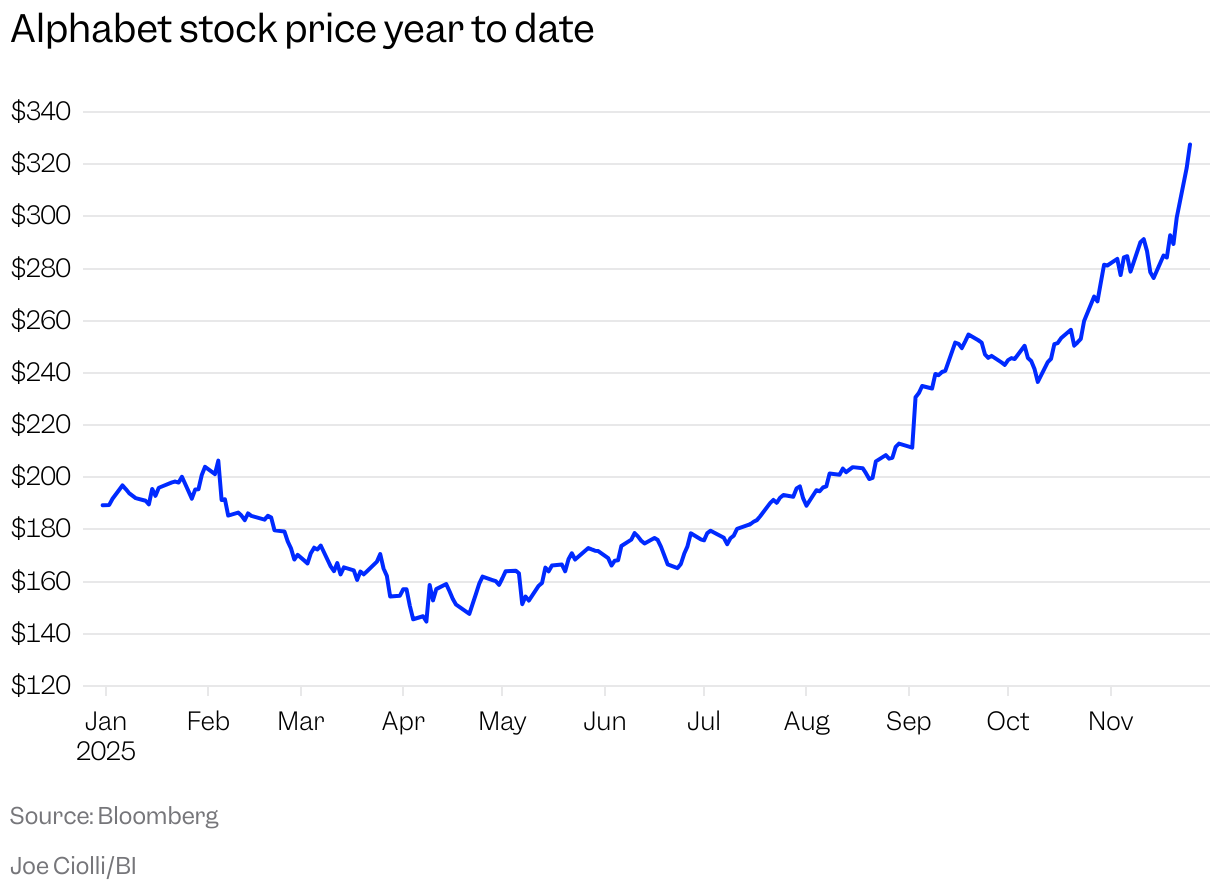
Nearly three years later, Google has performed a miraculous turnaround. Its new AI model, Gemini 3, is proving such a win that Marc Benioff said he's switching from ChatGPT. Google has just surpassed Microsoft's market cap and is on its way to a $4 trillion status. Its stock price is up nearly 70% this year.
It's a signal that Google — which has always held the various pieces to compete — has finally got everything working in harmony, all the way from the models up to the platforms like Search that put them in users' hands.
In the fast-moving AI race, no victory is secure — but Google has never looked stronger. Here's why.
1. Gemini 3 is a hit
Google DeepMind CEO Demis Hassabis.
CAMILLE COHEN/AFP via Getty Images
Gemini 3 rolled out to the public last week with rave reviews. It outperforms its predecessor in coding, design, and analysis, and surpasses competing models in benchmark tests. As we at Business Insider discovered, it's highly adept at designing websites and basic video games, giving it broader use beyond coding.
The new model has allayed some fears that Google was too far behind rivals and that scaling laws — rules that say AI models improve with more data and compute — were slowing down. The company's stock price has increased by more than 12% since the rollout of Gemini 3 on November 18.
2. When the chips are up
Joan Cros/NurPhoto via Getty Images
Google has spent over a decade developing its own chips for internal use. Known as Tensor Processing Units (TPUs), Google has used these chips to train its Gemini models. That's a great advertisement as Google hopes more companies will adopt the chips for their own models.
Google sells access to its TPUs through its cloud business and has made a significant internal push in recent months to attract more customers. That could pose a long-term threat to Nvidia's business. Google is currently in discussions for a blockbuster deal with Meta worth billions of dollars, which would potentially host some of Google's chips in one of Meta's own data centers, according to a person familiar with the discussions. The Information first reported on the arrangement, which sent the shares of chip companies like AMD and Nvidia tumbling on Tuesday.
3. Google's monopoly win
Drew Angerer/Getty Images
In September, a federal judge handed down penalties for an antitrust lawsuit brought against Google's search business in 2020. Those penalties, which threatened to tear up Google's lucrative search empire, amounted to little more than a slap on the wrist. Google was told it could continue making payments to partners such as Apple for default status, but could not do so exclusively. It was also ordered to share some search data with rivals.
At one point, Google's Chrome browser was on the chopping block, which could have severed a crucial part of Google's search-advertising flywheel. Despite the judge ruling that Google had acted as a monopoly, the company came away relatively unscathed.
4. Warren Buffett takes a stake
Warren Buffett, the CEO of Berkshire Hathaway.
Nati Harnik/AP
Warren Buffett's Berkshire Hathaway built a $4.3 billion stake in Google parent company Alphabet last quarter, a regulatory filing revealed. That's notable for two reasons. Other than Apple, Buffett has tended to avoid tech stocks. He has also historically avoided expensive, high-growth companies.
As Buffett prepares to step back as CEO, the decision to finally bet on Google — something he said he wished he'd done long ago — suggests strong confidence in the search giant.
5. Search is surviving its AI makeover… so far
CAMILLE COHEN/AFP via Getty Images
Google's core moneymaker is still search advertising, and one of the big investor fears has been how Google's self-disruption might hurt its cash cow. Not a lot, apparently: Search revenues jumped 15% in the third quarter, suggesting that even if AI is hurting some websites' traffic, it's not harming Google's business.
In fact, Google says generative AI is causing people to search more than ever. The company is currently testing ads in AI Mode, its chatbot-like version of search that is gradually feeling like less of an experiment and more like Google's vision for how search will eventually work.
A 55-year-old health business founder marked his 55th birthday by sharing 55 reasons he feels healthy.
Kevin Dahlstrom's viral X post promoted quality sleep and strong social connections.
Dahlstrom told Business Insider his health has been his priority since he fell ill in his 20s.
A health founder marked his 55th birthday by sharing 55 reasons he believes he's his "fittest, sharpest, and happiest" — but you probably only need to follow five to improve your health.
Kevin Dahlstrom, the founder of Bolt. Health, an online testosterone replacement therapy clinic based in Colorado, shared his advice in an X post on Monday. It amassed 4.1 million views and was reposted by Bill Ackman.
In the post, Dahlstrom said that his vitality wasn't down to a secret formula or winning the DNA lottery, but "a million tiny choices, compounded over decades."
While factors such as our genetics and environment play a role in how long we live, research suggests lifestyle factors are also hugely important.
Stacy L. Andersen, co-director of the New England Centenarian Study and an associate professor at Boston University Chobanian and Avedisian School of Medicine, boiled Dahlstrom's tips into five must-follows.
She told Business Insider via email: "These tips point to what has been seen in many scientific studies — healthy behaviors such as maintaining an ideal body weight, keeping moving, eating a high-quality diet, getting enough sleep, and keeping your brain active are the best ways to optimize your aging.
"Moreover, evidence shows that doing all of these together can add 10 years to your life!"
Dahlstrom told Business Insider via email Tuesday that his health and fitness have been a priority since his 20s, when he experienced chronic illness, and the list is a result of what he's learned over time.
"Birthdays (especially after the age of 50) are a good time to reflect on life," he said.
Here are five of Dahlstrom's tips that are science-backed.
1. Walk around 5,000 steps a day
Dahlstrom walks upward of 15,000 miles a week, or approximately 2.5 miles a day. "It's critical to longevity," he said.
If you break it down, that adds up to around 5,000 steps a day, half the famous, and arbitrary, 10,000 steps recommendation that originated in a Japanese marketing campaign.
But research does link walking daily to healthy aging. One study published October in the American Journal of Preventive Medicine found that people who walked for 15 minutes a day at a fast pace were 20% less likely to die early.
2. Take exercise and mobility seriously
While Dahlstrom's recommendation to get "hardcore" about mobility and exercise may not work for everyone, being active is crucial to aging well.
One 2022 study published in the British Journal of Sports Medicine found that of the 99,713 participants aged 55 to 74, those who did regular aerobic exercise and strength training were 41% less likely to die from any cause a decade later.
Business Insider previously reported that making a workout routine fun and talking to close friends and family about it helped people stay consistent for three years in a study.
3. Find your purpose
Andersen said the New England Centenarian Study has shown that longevity is associated with greater feelings of purpose in life, while other studies have found that it is also related to a lower risk of dementia and resilience to Alzheimer's disease.
"Filling your day with activities that are meaningful to you and having things that you want to accomplish keep you invigorated and engaged in life," she said. Referring to Dahlstrom's list she added: "Finding hobbies (#21) and being a lifelong learner (#41) are great ways to also find purpose!"
Keeping active is linked to longevity.
mixetto/Getty Images
4. Get 8 hours of quality sleep each night
Getting enough sleep is crucial for our health. Adults should aim to sleep for between 7 and 9 hours per night, according to the Centers for Disease Control and Prevention.
Anything less can have a negative impact on health over time. In one 2022 study published in PLOS Medicine involving over 10,000 British civil servants, those who reported getting less than five hours of sleep a night at the age of 50 had a higher risk of developing chronic diseases, such as cardiovascular disease and cancer, and dying from long-term health conditions.
5. Stop drinking alcohol
Drinking alcohol regularly increases your risk of chronic disease and impacts almost every organ in the body. Experts increasingly agree there is no safe amount to drink.
The previous US Surgeon General, Dr. Vivek Murthy, published a report in January 2025 warning of the links between alcohol and cancer risk.
Don't blindly follow health advice online
Some of Dahlstrom's tips aren't in line with evidence-based health advice, for instance: "avoid mainstream medicine except as a last resort" and "don't take antibiotics except in emergency situations."
Dr. Kurt Hong, a professor of clinical medicine at the University of Southern California, told Business Insider via email that while antibiotic overuse is "very real" and can impact the gut microbiome, patients only using them in situations they deem an "emergency" is "dangerous."
Hong added that while functional and integrative health can be helpful, one should not avoid mainstream medical practices such as preventive care, cancer screenings, and vaccinations. "This is a dangerous recommendation by the author," he said.
And while research indicates psychedelic drugs could be used to treat chronic mental illness in a controlled, clinical setting, Hong said Dahlstrom's recommendation to "try psychedelics" is dangerous, particularly for patients with mental health issues, which can be worsened with psychedelics, such as PTSD, depression, and bipolar.
Dahlstrom's said: "I believe that everyone should take responsibility for their own health and make their own decisions. The mainstream medical system is fantastic for acute illness and injury, but equally bad at chronic illness."
Reaching your mid-50s with little or no savings can feel like you’ve run out of time.
But the truth is that it is not too late, not even close.
Even at 55, you still have a decade or more of working life ahead of you, and that is more than enough time to build a meaningful passive income stream. With the right approach, sensible risk management and a focus on quality investments, it is entirely possible to retire with real financial breathing room.
Here’s how a late-start investment plan can come together.
Start by growing your capital base
Many people reaching their mid-50s assume they should immediately chase high-yielding stocks. But that can be a trap, especially if your portfolio is still small.
Early on, the focus should be on growth, not income. Bigger capital leads to bigger future income, and the fastest path to growing that capital is by investing in high-quality ASX growth shares and broad-based ETFs.
Companies like TechnologyOne Ltd (ASX: TNE), ResMed Inc (ASX: RMD) or NextDC Ltd (ASX: NXT) have delivered years of compounding growth. And global ETFs such as the Betashares Nasdaq 100 ETF (ASX: NDQ) and the Vanguard MSCI Index International Shares ETF (ASX: VGS) have done the same by providing exposure to some of the world’s biggest companies.
Even modest weekly contributions in shares and funds like these could add up quickly when your money compounds at an average of 10% per year over a decade.
For example, $1,000 a month would turn into $270,000 in 12 years, and $2,500 a month would become $675,000 over the same period.
Transition toward high-quality income
Once your portfolio has gained real size, you can start shifting the focus toward income-producing assets. This is the stage where reliable ASX dividend shares and income ETFs earn their place.
Businesses like Coles Group Ltd (ASX: COL), Transurban Group (ASX: TCL) and APA Group (ASX: APA) have long histories of delivering sustainable, growing income streams. At a 5% average dividend yield, a $270,000 portfolio can generate around $13,500 a year before franking credits and a $675,000 portfolio would pull in passive income of $33,750 a year.
Foolish takeaway
Having no savings at 55 isn’t a dead end, it is a starting line. With 12 years of smart investing, a focus on high-quality growth first, and a gradual shift toward dividend income, you can still build a portfolio that supports a comfortable retirement.
It won’t happen overnight, but with consistency and patience, passive income is absolutely within reach, no matter when you begin.
Motley Fool investing expert Scott Phillips just revealed what he believes are the 5 best stocks for investors to buy right now… and APA Group wasn’t one of them.
The online investing service he’s run for over a decade, Motley Fool Share Advisor, has provided thousands of paying members with stock picks that have doubled, tripled or even more.*
And right now, Scott thinks there are 5 stocks that may be better buys…
Motley Fool contributor James Mickleboro has positions in BetaShares Nasdaq 100 ETF, Nextdc, ResMed, and Technology One. The Motley Fool Australia’s parent company Motley Fool Holdings Inc. has positions in and has recommended BetaShares Nasdaq 100 ETF, ResMed, Technology One, and Transurban Group. The Motley Fool Australia has positions in and has recommended Apa Group, BetaShares Nasdaq 100 ETF, ResMed, and Transurban Group. The Motley Fool Australia has recommended Technology One and Vanguard Msci Index International Shares ETF. The Motley Fool has a disclosure policy. This article contains general investment advice only (under AFSL 400691). Authorised by Scott Phillips.
This article was originally published on Fool.com. All figures quoted in US dollars unless otherwise stated.
Key Points
Waymo has long posted steady and safe driving records although with slower expansion rates.
Now Waymo is gearing up to rapidly enter five new cities in the U.S. market.
Tesla hopes to remove its safety monitor and go full driverless by year-end.
Tesla(NASDAQ: TSLA) shares have been on a wild ride in 2025 with investors engaged in a tug of war of sorts, between bears and bulls. The bears base their position in reality, a reality where Tesla sales and profits are in decline and its vehicle lineup is aging. The bulls base their position in a potentially lucrative future based around artificial intelligence (AI), robotics, and robotaxis. Right now, the bulls are winning with Tesla stock up 28% over the past three months, but here’s why investors might want to pump the brakes a bit.
Coming to a city near you
“Safe, routine, ready: Autonomous driving in new cities” are the words that should have Tesla investors pumping the brakes on the potentially lucrative future they envisioned for the electric vehicle (EV) maker. That’s because direct competitor Waymo is shifting its expansion into a higher gear: “We’ve built a generalizable Driver, powered by Waymo’s demonstrably safe AI, and an operational playbook to reliably achieve this milestone,” said Tekedra Mawakana, Waymo’s co-CEO, on the expansion, according to Electrek.
This week, Waymo announced fully autonomous driving in five new cities: Miami, Dallas, Houston, San Antonio, and Orlando. Operations started in Miami this week and will begin in the remaining four cities in the coming weeks, although it’s important to note that doors for riders won’t open until next year. This goes with Waymo’s recent playbook to test for a few months before opening the app to the public.
Playing catch up
It’s also important for investors to grasp the lead that Waymo may have developed over the past few years. For instance, Tesla is currently testing its initial robotaxi operations in Austin, Texas, with roughly 30 robotaxis in operation and plans to expand the fleet to about 500 by the end of the year. Tesla is still using a safety monitor, which Waymo removed in 2020, but has plans to transition to fully driverless operation by the end of the year.Â
The five new cities that Waymo is entering will bring its total city count to 10 at a time when Tesla just announced it obtained a permit to operate a ride-hailing service in Arizona. It’s definitely a step forward for Tesla, although additional permits will be required before the automaker can operate a full robotaxi service in the state. When Tesla enters the Phoenix, Arizona market next year, it will already trail Waymo’s operations in the city, which boasts at least 400 autonomous vehicles. In fact, Waymo said it has already surpassed 10 million driverless trips served to riders across its U.S. operations.
Despite Tesla playing catch up to rival Waymo, Tesla investors have some reason to be optimistic. Tesla could very well develop a competitive advantage in scaling a robotaxi business thanks to access to a plethora of Tesla vehicles on the road and its production capacity. Furthermore, Tesla’s strategic rollout could be more scalable as the company is relying on a camera-based system rather than LiDAR and radar, which competitors are using.
What it all means
Tesla shareholders also made it clear where they want CEO Elon Musk’s focus. Musk’s new compensation package, worth up to $1 trillion, was approved by 75% of voters but with milestones tied to future endeavors. Musk will still have to build cars for some of his rewards, have 1 million robotaxis in commercial operation, 1 million Optimus robots, and 10 million Full Self-Driving subscriptions. These goals suggest the company is pivoting its core business from automotive manufacturer to a more tech-centric company.
Tesla’s best days may very well be ahead of it. It’s already proven many naysayers wrong by making it this far, but it’s important for investors to pump the brakes on robotaxi hype, because not only is Tesla playing catch up to Waymo; the future of robotaxis is more uncertain thanks to evolving regulations, lawsuits, and safety concerns. Investors need to understand what company they’re investing in moving forward, given Tesla’s lofty valuation and price-to-earnings (P/E) ratio approaching 300 times, and a market capitalization more than 10 times Ford and GM combined.
This article was originally published on Fool.com. All figures quoted in US dollars unless otherwise stated.
This article was originally published on Fool.com. All figures quoted in US dollars unless otherwise stated.
Should you invest $1,000 in Tesla right now?
Before you buy Tesla shares, consider this:
Motley Fool investing expert Scott Phillips just revealed what he believes are the 5 best stocks for investors to buy right now… and Tesla wasn’t one of them.
The online investing service heâs run for over a decade, Motley Fool Share Advisor, has provided thousands of paying members with stock picks that have doubled, tripled or even more.*
And right now, Scott thinks there are 5 stocks that may be better buys…
Daniel Miller has positions in Ford Motor Company and General Motors. The Motley Fool Australia’s parent company Motley Fool Holdings Inc. has positions in and has recommended Tesla. The Motley Fool Australia’s parent company Motley Fool Holdings Inc. has recommended General Motors. The Motley Fool Australia has no position in any of the stocks mentioned. The Motley Fool has a disclosure policy. This article contains general investment advice only (under AFSL 400691). Authorised by Scott Phillips.
Comacchio offers Venice-like canals and charm without the crowds or overtourism issues.
The town features tranquil lagoons, pink flamingos, and eel cuisine.
This article is part of "Undiscovered Europe," a series exploring overlooked travel gems.
Roughly 20 million tourists visit Venice, Italy, each year, shuffling shoulder to shoulder over tired bridges, crowding alleyways lined with souvenir shops, and snapping selfies from gondolas in congested canals.
Enter Comacchio — an Italian city less than two hours away with a similar landscape and vibe that most tourists have yet to discover.
Comacchio
Max Cavallari for BI
Like Venice, Comacchio is made up of islands, where you'll find canals rather than streets and historic, colorful buildings lining the waterways. But unlike Venice, this floating city is a hidden gem.
"It's a very relaxed, frozen-in-time atmosphere," Bologna-based blogger Andrea Chierici told Business Insider. "It's a place that is calm with no crowds, no noise, and no big groups with the umbrellas."
Historic lagoons home to pink flamingos
A flamingo in Delta po Park
Max Cavallari for BI
The proximity to Po Delta Park — which includes the Comacchio Lagoons, one of Italy's largest wetland complexes, according to Po Delta Tourism — is one of many reasons to visit Comacchio. The park is part of a protected biosphere reserve and a UNESCO World Heritage site. A representative of the locally owned tour company, Comacchio Experience, said it's a must-see for visitors.
"You can imagine the lagoon like a big lake, so you cannot see the horizon on the other side of this lagoon, but it's not totally water," the representative told Business Insider. "Inside the water, we have a lot of banks and houses of ancient fishermen."
Delta po Park
Max Cavallari for BI
You'll find many waterbird species in Po Delta Park, including the pink flamingo. Both experts recommend taking a walk, bike ride, or boat tour of the lagoons.
The representative of Comacchio Experience also recommends relaxing at the area's wild beaches, which haven't been taken over by tourists.
"This is a very different experience because in Italy, we have a lot of beaches, but there are umbrellas everywhere and loud music," he told Business Insider. "But here, you can find a quiet and very free place."
Eels are a seasonal delicacy
Stewed eel and marinated anchovies: the three dishes that characterize Comacchio's cuisine.
Max Cavallari for Bi
"If you like food, the main reason to go to Comacchio is the eel," Chierici said.
The eel is a historic delicacy in Comacchio, celebrated with annual festivals.
"The original food of Comacchio, the eel, is a prehistoric fish that comes here naturally, and we've fished for 1,000 years," the Comacchio Experience rep said. "This fish is so important because it was the only economy here until the last 70 years."
Interior of Al Cantinon restaurant
Max Cavallari for BI
The eel is a seasonal food that's fresh in the fall but is preserved to eat all year long. Chierici said that the town has a fishing system that allows all of the smaller eels to go free.
"We keep the life cycle of the eel alive, which is very important because they make a long trip to come to Comacchio," he told Business Insider. "They come from the Sargasso Sea to the unique landscape of the Po Delta Valley, especially near Comacchio, to reproduce."
Chierici said that restaurants around town serve eel in various ways — from grilled entrées to sandwiches and risottos.
Nearby places
Comacchio
Max Cavallari for BI
Comacchio is conveniently located about an hour away from many other historical cities, like Ravenna, Bologna, and Ferrara, making it a great base for a longer trip to Northern Italy, the Comacchio Experience representative said.
Within a half-hour drive, Chierici also suggests visiting Pomposa and Tresigallo for entrancing architecture.
6 things to do in Comacchio
Take a sunset boat tour. Both experts say the best way to explore Comacchio is by boat. According to the Comacchio Experience representative, sunset is the best time to go.
Go bird watching at Po Delta Park. Chierici suggests taking a bird-watching tour to find pink flamingos in the lagoon.
Tour the eel factory. Chierici suggests touring theManifattura dei Marinati to see how eel is marinated and preserved.
Try eel in all its forms. Eel is prepared various ways in Comacchio. Try it at one of Chierici's favorite restaurants: Vasco e Giulia, La Barcaccia, and Al Cantinon.
Attend the fall food festival. Both experts suggest visiting in the fall to attend the annual Sagra dell'Anguilla, a food festival celebrating the eel.
Visit nearby cities and towns. Both sources say it's worth visiting nearby places like Tresigallo, Pomposa, Ravenna, Bologna, and Ferrara.
And if you must go to Venice, it's just an hour and a half away.
/* .insider-raw-embed + p { display: none; } */
// Undiscovered Europe
const seriesTitle = “Undiscovered Europe”;
// Presented by
const text = “Presented by”;
// 68f1320ccc993f9955d055e9
const sponsorLogoID = “68f1320ccc993f9955d055e9”;
// Swiss transparent logo
const altText = “Swiss transparent logo”;
//https://www.businessinsider.com/category/undiscovered-europe
const hubOrCatURL = “https://www.businessinsider.com/category/undiscovered-europe”;
The 27-year-old fashion merchandiser is known among her friends and family for having a unique fashion sense — but jewelry plays only a small role. It's not something she wears every day.
Still, she realized a few years ago that when it came time to get engaged, she'd go big.
"I was never going to have something that everyone else had," she said.
Speaking with Business Insider, Bucco shared her proposal story, the background of her vintage ring, and a response to online critics who say they hate it.
Abby Bucco met her partner, Chris, in college through mutual friends.
Abby Bucco and her fiancé Chris after getting engaged.
Abby Bucco
Although Bucco attended Fordham University in New York City, she grew up in Philadelphia and had friends who attended Penn State University.
Through them, she met Chris. He liked her immediately, but Bucco was dating someone else.
Still, the stars were aligned. In 2020, they'd both graduated from college, and Chris had moved to New York City, where a newly single Bucco was still living.
They reconnected and began dating in June 2021.
The couple got engaged in November, and Bucco was shocked.
Abby Bucco gets engaged to her partner, Chris, in New York City
Abby Bucco
Bucco said she and Chris, a 28-year-old working in tech sales, would regularly talk about getting engaged. Still, she had no idea a proposal was actually coming.
"We just signed our fourth lease together, so I'm always making jokes, like, 'When are you going to propose?'" she said.
The answer turned out to be an unexpected one: his birthday on November 8. Bucco was under the impression that they'd be getting drinks with friends that afternoon before going to a birthday dinner with his siblings.
"I was running late as always, and he kept trying to rush me out of the apartment," Bucco said. "Then we started walking, and I made him take pictures of me multiple times because I do influencing on the side. He was freaking out the entire time, but I had no idea what was going on."
She realized, though, when he suddenly stopped walking and got down on one knee.
"I was so in shock that I said, 'No, no, not today,'" Bucco said.
Friends and family gathered secretly to celebrate the couple's special day.
Abby Bucco
Her fiancé's sisters were hiding in a patch of bushes to take photos of the couple, while two of Bucco's closest friends stood nearby, and her parents waited a little farther away.
Together, the newly engaged couple and their loved ones attended a celebratory dinner.
Abby Bucco and her fiancé, Chris, at dinner after getting engaged.
Abby Bucco
"His parents came as well to surprise me," Bucco said.
Together, they celebrated the couple's engagement and, of course, Chris' birthday.
Bucco's fiancé had one more celebration up his sleeve.
Abby Bucco and her friends at a bar after her engagement.
Abby Bucco
"After dinner, we went to a bar, which was another surprise," Bucco said. "Chris had most of my friends who live in New York waiting there to surprise me."
Everyone dressed in chic black outfits, and the couple drank from custom bride and groom glasses.
The star of the night was Bucco's engagement ring.
Abby Bucco
As Bucco told Business Insider, she'd never been super excited about getting engaged because she didn't like most engagement rings.
Her mind changed a few years ago, though, when her father bought her mother an anniversary piece from Wilson's Estate Jewelry in Philadelphia.
She became enamored with the store's diamond cocktail jewelry and even found her dream ring. It sold long before Bucco was thinking about getting engaged, and she was devastated.
This past summer, though, a new piece caught her eye.
"I was at dinner with Chris and my mom, and I got an ad on Instagram for a new ring at Wilson's," Bucco said. "I showed them and was like, 'Oh my God, this is amazing.'"
"They were freaking out because they had already talked to Wilson's about buying that exact ring," she added. "My mom had found it a few days before."
The vintage, 1950s piece features numerous diamonds in the shape of two intertwined flowers.
Abby Bucco
Wilson's Estate Jewelry, which sold the ring to Bucco's fiancé, states on its website that the piece features numerous diamonds, including center stones that weigh about 1.45 and 1.70 carats, a platinum band, and a coiled bypass shape.
When her fiancé proposed with it, Bucco said she was thrilled.
"Once I saw that ring [online], I didn't want anything else. That was the ring," she said. "I loved it even more in person. The pictures honestly don't do it justice."
Bucco's dad didn't initially love the ring, but he came around.
Abby Bucco and her fiancé, Chris, after getting engaged in New York City.
Abby Bucco
When Bucco's mom first came across the engagement ring online, she sent her husband to check it out at the store.
"My dad did not like it at all," Bucco said. "He thought it was ridiculous and would be way too big for my hand. He didn't want to get it."
So he didn't. The store instead held onto the ring so that Bucco's mom could see it herself.
She loved it, and so did Bucco's fiancé.
"He knows I have a really particular taste," Bucco said about her fiancé. "He said that if I think it's cool, then it's cool. And he knows that my mom knows me well."
The same goes for the rest of her friends and family.
"They all love it," Bucco said. "And if any of them don't love the ring, they love it for me."
Online, critics have been harsh — but Bucco doesn't care.
Abby Bucco
When Bucco first posted photos of her engagement ring online, the reactions from friends and strangers alike were positive.
After a day, though, Bucco had been inundated with harsh criticisms. Some said the piece looked like a fidget spinner or a can opener. Others questioned if it was even her real engagement ring.
"Some of the comments are so weird," Bucco said. "They'll be like, 'Good luck changing diapers in this!' and I'm like, 'OK. I wasn't planning on changing a diaper anytime soon, or wearing a ring while changing one.'"
In fact, Bucco doesn't even plan to wear her ring every day.
"People are very concerned that it's a cocktail ring," she said, "But it's just not a concern of mine. Any ring, even a plain band, I wouldn't wear every day. I don't like having jewelry on that much."
Bucco's most viral posts about her engagement ring have between 3.4 and 6.1 million views each on TikTok. Bucco said the virality — good and bad — has been fun to experience.
"Even when there are 10 negative comments, there are also 10 positive comments and 10 super nice girls in my DMs on Instagram," she said.
It also helps that she now has the ring (and man) of her dreams.
Campbell Company denied claims apparently made by an executive that its chicken is 3D-printed.
Scott Olson/Getty Images
Campbell placed an executive on leave after a lawsuit alleged he badmouthed the company privately.
An audio recording shows an apparent Campbell VP saying its products are for "poor people."
Campbell denied the person's claims that its meat is 3D-printed.
Campbell Soup Company put an executive on leave while investigating claims made in a lawsuit that he trashed the company behind closed doors, including mocking its "poor" customers and saying the company's meat "came from a 3D printer."
In a statement Tuesday, the company said the alleged comments by Martin Bally, Campbell's vice president of information technology, were "unacceptable."
"Such language does not reflect our values and the culture of our company," the company said. "We do not tolerate that kind of language under any circumstances."
The move follows a lawsuit filed Thursday in a Michigan court by Robert Garza, a former cybersecurity analyst at the company who said he was fired after complaining about Bally.
According to the lawsuit, Garza recorded a meeting with Bally where the executive insulted the intelligence of his Indian colleagues and said the company's products were for "poor people."
The law firm representing Garza provided Business Insider with an apparent recording of the meeting. The recording was not included as an exhibit in the lawsuit, and Business Insider hasn't independently authenticated it.
The recordingfeatures a conversation where a person belittles Campbell and its products.
"If you look at our fucking pantry — we have shit for fucking poor people, right?" the person said.
"I don't buy fucking Campbell's products barely anymore," the person continues in the tirade. "It's unhealthy."
At one point in the recording of the meeting, which appears to take place at a restaurant, the person refers to Campbell's food as "bioengineered."
"Even in a can of soup — I look at it, and look at bioengineered meat," the person said. "I don't want to eat a fucking piece of chicken that came from a 3D printer, do you?"
Elsewhere in the recorded conversation, the person recounts an instance where he tried to help a colleague with a tech issue. He blamed "Indians" for not resolving it without him.
"Fucking Indians, they don't know a mother-fucking thing," the person said. "They couldn't think for their fucking selves."
Bally didn't immediately respond to requests for comment.
In its statement Tuesday, Campbell said the remarks about its food were "patently absurd" and that the chicken meat in its soups "comes from long-trusted, USDA approved U.S. suppliers."
"Keep in mind, the alleged comments heard on the audio were made by a person in IT, who has nothing to do with how we make our food," the company said.
The audio has become a public relations nightmare for the soup-maker. Despite Campbell's denials, the remarks about bioengineered and 3D-printed chicken have bounced around social media and drawn the attention of Florida Attorney General James Uthmeier, who said he would investigate the company.
"Florida law bans lab-grown meat," Uthmeier posted on X. "Our Consumer Protection division is launching an investigation and will demand answers from Campbell's."
The person in the recorded meeting had other criticisms for Campbell.
He bemoaned the lack of innovation in the food industry and said the company overpaid for its 2023 acquisition of Sovos Brands, which makes Rao's pasta sauce, for $2.7 billion.
"It's a fucking recipe and a brand," the person said. "We don't own a plant. Somebody else manufactures it for us. We're buying, we're getting tomatoes from the fucking family that does the recipe out of Italy. It's a fucking smoke and mirrors."
The author, shown with her daughter, sees having a will as an act of love and responsibility.
Courtesy of Bridget Shirvell
Regularly updating my will is an act of love and responsibility for my daughter.
My parents modeled practical estate planning, making death a normalized topic in our family.
I think having open conversations about wills and decluttering can ease future burdens.
When I was growing up, every time my parents left to go on a vacation without the kids, they would post their itinerary on the fridge, remind us to behave for whichever relative was in charge that week, and then, almost as an afterthought, say, "The wills are in the cabinet."
Whether they were flying to Greece for three weeks or driving to New Hampshire for a long weekend, the simple yet jarring reminder was always the same. The wills are in the cabinet.
My siblings and I didn't take them too seriously. I recall more than a few eye rolls, but we knew what cabinet they meant. The metal one in the basement that held all sorts of documents, from schoolwork my mother chose to save to savings bonds that hadn't yet matured — and the wills.
My parents weren't morbid, they were practical
Their actions set a tone. One that I didn't really appreciate until I had my own family.
The writer, shown while on a trip to Italy, has made sure to have her will in order before she travels.
Courtesy of Bridget Shirvell
Talking about death and estate planning can feel uncomfortable, especially in American culture, where we tend to avoid the topic. For my parents, though, death wasn't a taboo topic; it was simply part of the logistics of life. Until we were in our twenties, they would also often add, "Aunt Debbie is in charge if anything happens."
They weren't morbid about it; they were practical. They still are. As we got older, they started talking more openly about what was in their wills.
When I got pregnant, I made my own will
When I found out I was pregnant, one of the first things I did, along with daydreaming about names and browsing nursery furniture, was create a will.
I update it periodically, for instance, when I bought a house, and when we got a dog. Not because I am pessimistic, but because I was raised for it to just be a part of life.
My parents modeled that type of planning for me in countless ways. They've always believed in preparing for the inevitable, not out of fear, but out of kindness.
My mom is a big fan of Swedish death cleaning — the Scandinavian concept of decluttering one's life so that loved ones don't have to deal with piles of stuff after they're gone. Annoyingly, this often results in her showing up at my house with a box of things she's saved from my school years, but I do appreciate the effort she's made to declutter the house they've lived in for nearly four decades.
It's a little dark, sure, but also deeply caring. When families normalize these conversations, they remove the uncertainty that often exacerbates the difficulty of grief. My siblings and I will never have to guess what our parents would have wanted, or fight over who's in charge. We already know. The wills are in the cabinet.
The habits of my parents have stuck with me
Now, as I plan trips with my own family, I catch myself channeling my mom. Before we leave, I make sure our documents are in order. I check my guardianship designations.
Because, as strange as it sounds, that simple phrase — the wills are in the cabinet — has come to mean something bigger. It's not about expecting the worst. It's about loving the people who will be left behind enough to make things easier for them.