
Category: Stock Market

  • If I invest $5,000 in Yancoal shares today, how much income will I receive in 2025?

    A female coal miner wearing a white hardhat and orange high-vis vest holds a lump of coal and smiles as the Whitehaven Coal share price rises today

    Investing in Yancoal Australia Ltd (ASX: YAL) shares could be an appealing option for Australian investors looking for returns and passive income.

    At the market close on Thursday, Yancoal shares were trading at $6.18 apiece, with a trailing dividend yield of 11.3%. This follows a strong three-year period of dividend payouts from the ASX coal miner.

    But what kind of income could you expect by May 2025 if you invested $5,000 in Yancoal shares now? Let’s break it down.

    How much passive income could you generate from Yancoal shares?

    If you invest $5,000 in Yancoal stock at the current price of $6.18, you would own approximately 809 shares.

    With Yancoal’s trailing dividend yield of 11.3%, these shares could generate a notable amount of passive income.

    Over the next 12 months, you could expect around $565 in annual dividends from a $5,000 investment at that yield — assuming the dividend and share price remained steady, of course (and excluding any franking credits). If the dividend drops, however, so too will the payment.

    So how can we be sure it will remain steady?

    Yancoal’s financial performance

    Firstly, we can never be 100% sure of the future. But three standouts from Yancoal’s first quarter results indicate to me the company is primed to continue its mouth-watering dividends going forward.

    One, it has maintained a solid cash balance of $1.66 billion – a $266 million quarterly increase – despite realising lower average coal prices over the last three consecutive years.

    Yancoal reported 11.3 million tonnes of saleable coal production and 14.0 million tonnes run of mine (ROM) coal production with in the first quarter of CY 2024, at an average realised coal price of $180 per tonne. This is down from the $232/tonne reported in its 2023 annual results, and $378/tonne in 2022.

    Two, Yancoal’s board approved a 32.5 cents per share dividend in February this year after finishing 2023 in such a strong cash position. As I’ve mentioned previously, this latest dividend isn’t out of sync with recent payments either.

    Three, Yancoal has a history of strong dividend payments even in times of weak coal pricing. In 2019, when coal prices fell as low as US$71/tonne, the company still paid annual dividends of 39 cents per share. For context, coal currently trades at US$144.90 per tonne as I write.

    So, despite fluctuations in coal prices, Yancoal’s quarterly update last month added confidence for its dividend into 2025, in my view.

    Why invest in Yancoal shares?

    Yancoal shares offer exposure to both thermal and metallurgical coal markets. There is a strong demand for these commodities out of China and India, according to Trading Economics.

    Even as coal prices have experienced ups and downs, Yancoal has maintained a consistent dividend payout, which is attractive for those seeking dependable passive income.

    In my opinion, the company’s stable financial position and reliable cash flow also make it an appealing choice for income-focused investors.

    Foolish takeaway

    A $5,000 investment in Yancoal shares today could yield noteworthy returns by the end of 2025, provided the company maintains its current dividend stream.

    This would change if Yancoal were to reduce its quarterly payouts. But, the company’s strong cash balance and recent financial results add a layer of confidence to my outlook on this.

    But always remember one critical thing: past performance never guarantees future results.

    The post If I invest $5,000 in Yancoal shares today, how much income will I receive in 2025? appeared first on The Motley Fool Australia.

    Should you invest $1,000 in Yancoal Australia Ltd right now?

    Before you buy Yancoal Australia Ltd shares, consider this:

    Motley Fool investing expert Scott Phillips just revealed what he believes are the 5 best stocks for investors to buy right now… and Yancoal Australia Ltd wasn’t one of them.

    The online investing service he’s run for over a decade, Motley Fool Share Advisor, has provided thousands of paying members with stock picks that have doubled, tripled or even more.*

    And right now, Scott thinks there are 5 stocks that may be better buys…

    See The 5 Stocks
    *Returns as of 5 May 2024

    More reading

    Motley Fool contributor Zach Bristow has no position in any of the stocks mentioned. The Motley Fool Australia’s parent company Motley Fool Holdings Inc. has no position in any of the stocks mentioned. The Motley Fool Australia has no position in any of the stocks mentioned. The Motley Fool has a disclosure policy. This article contains general investment advice only (under AFSL 400691). Authorised by Scott Phillips.


  • This little ASX AI stock is soaring 10% today. Here’s why

    chip and tech stocks represented by two computer chips side by side

    The All Ordinaries Index (ASX: XAO) is down 1.0% on Friday morning, but that’s not holding back ASX AI stock Appen Ltd (ASX: APX).

    Appen shares closed yesterday trading for 59 cents and soared 10.2% to 65 cents apiece in earlier trade.

    After some likely profit-taking, shares in the ASX AI stock are swapping hands for 63.5 cents apiece at the time of writing, up 7.6%.

    Here’s what’s happening.

    ASX AI stock lifts on stabilising revenue

    Investors are bidding up the Appen share price on the back of today’s annual general meeting (AGM).

    Ryan Kolln, who took over as Appen CEO in February, addressed shareholders along with Richard Freudenstein, chairman of the ASX AI stock.

    Kolln didn’t hold back any punches when it came to Appen’s FY 2023 performance. As you can see on the above chart, the Appen share price crashed 71% in 2023 and has only recently begun to stabilise.

    In FY 2023 Appen’s revenue fell 30% year on year to $273.0 million, which Kolln admitted was “a disappointing result”.

    “Excluding the impact of foreign exchange, we recorded an [underlying earnings before interest, taxes, depreciation and amortisation] EBITDA loss of negative $20.4 million dollars, compared to $13.6 million dollars in FY22,” he said.

    In response to the falling revenue, the company cut its costs by $60 million in 2023. But the first full year benefit of those cost reductions was only realised in FY 2024. In December, this saw the company exit 2023 cash EBITDA positive.

    As for 2024, Kolln noted the decline in revenue this year was driven by the termination of the Google [Alphabet Inc Class A (NASDAQ: GOOGL)] contract, which ended on 19 March.

    In FY 2023, Appen’s revenue from Google was approximately $83 million, or 30% of the total revenue the ASX AI stock earned over the year. This saw Appen slash its cost base by another $13.5 billion.

    Likely spurring investor interest today, Kolln said:

    Revenue excluding Google shows a continuation of the stabilisation that we saw in the second half of 2023. We are pleased to see revenue levels in March and April that are well above the non-Google revenue in Q3 2023.

    Riding the generative AI wave

    Kolln went on to note how generative AI, driven by tech giants like Nvidia Corporation (NASDAQ: NVDA), is fuelling the next wave of AI growth.

    He noted that Bloomberg and IDC forecast the generative AI market to reach US$1.3 trillion by 2032, growing at a 42% compound annual growth rate (CAGR).

    “We are very bullish on the impact of generative AI, and our strategy is strongly focused on capturing value from the market,” Kolln said. “The impact of generative AI has a significant impact on Appen’s total addressable market (TAM).”

    Indeed, the ASX AI stock forecasts that new generative AI opportunities will increase its TAM by $4 billion to $8 billion by 2030.

    Looking to the year ahead, Kolln concluded:

    Our cash balance at 30 April 2024 was $36.4 million, and we are confident in our cash position. We remain highly focused on ongoing cash positivity, and our target is to reach cash EBITDA positive on a run-rate basis in the early second half of FY24.

    The post This little ASX AI stock is soaring 10% today. Here’s why appeared first on The Motley Fool Australia.

    Should you invest $1,000 in Appen Limited right now?

    Before you buy Appen Limited shares, consider this:

    Motley Fool investing expert Scott Phillips just revealed what he believes are the 5 best stocks for investors to buy right now… and Appen Limited wasn’t one of them.

    The online investing service he’s run for over a decade, Motley Fool Share Advisor, has provided thousands of paying members with stock picks that have doubled, tripled or even more.*

    And right now, Scott thinks there are 5 stocks that may be better buys…

    See The 5 Stocks
    *Returns as of 5 May 2024

    More reading

    Suzanne Frey, an executive at Alphabet, is a member of The Motley Fool’s board of directors. Motley Fool contributor Bernd Struben has no position in any of the stocks mentioned. The Motley Fool Australia’s parent company Motley Fool Holdings Inc. has positions in and has recommended Alphabet, Appen, and Nvidia. The Motley Fool Australia has recommended Alphabet and Nvidia. The Motley Fool has a disclosure policy. This article contains general investment advice only (under AFSL 400691). Authorised by Scott Phillips.

  • Is the Telstra share price too cheap?

    The Telstra Group Ltd (ASX: TLS) share price has dropped 20% over the past 12 months and 13% since the start of the year, as shown in the chart below.

    When a large ASX blue-chip share falls, it can be worth a closer look to determine whether it’s now better value to buy.

    This week’s 6% dip was likely triggered by a recent Telstra update on mobile prices and cost-cutting at its enterprise business.

    Wilson Asset Management (WAM) senior investment analyst Anna Milne recently spoke about her views on the ASX telco share, which she’s bullish on for several reasons.

    But first, a recap on Telstra’s recent news

    On Tuesday, the telco stock announced it was working on measures to reset the enterprise business and improve productivity, including the bombshell news it may cut up to 2,800 jobs from that division.

    Telstra also advised it would wind up its postpaid mobile plans to remove the CPI inflation-linked annual price review. This would provide “greater flexibility to adjust prices at different times and across different plans”. However, some investors fear it may mean price increases will stop.

    Even so, Telstra revealed its mobile business “continued to perform strongly, with growth in subscriber numbers for the first four months” of the FY24 second half.

    The company also revealed guidance that FY25 underlying earnings before interest, tax, depreciation and amortisation (EBITDA) would be between $8.4 billion to $8.7 billion.

    Long-term data demand

    On the same day, WAM analyst Milne identified Telstra’s connectivity as a major positive, saying it would ensure the company would benefit from the growth in artificial intelligence (AI).

    She noted there was “no point in having the data and having the artificial intelligence if you don’t have the infrastructure to connect data centres” with households and businesses.

    To this end, Telstra is developing an intercity fibre project to “deliver next-generation digital infrastructure for the country as demand for connectivity continued to soar.”

    Telstra CEO Vicki Brady explained these fibre cables would build resiliency and “support data centres that facilitate cloud and AI”, as well as many other sectors. It’s working on a number of routes, including connecting into Darwin from Adelaide. This route unlocks pathways to sub-sea cable infrastructure and provides new options for data centre locations, including to service Asia.

    The intercity fibre and ‘Viasat’ projects are on track to deliver an internal rate of return (IRR) in the “mid-teens or better” and around $200 million in additional annuity income once all routes become ready for service and contributing.  

    Lower Telstra share price

    The WAM analyst is also attracted to Telstra’s lower share price, which now has dropped even more.

    Milne noted that the company’s enterprise division in the FY24 first-half update had not impressed the market, suggesting this was an opportunity for Telstra to look at that business and “cut costs”, which the telco is now doing.

    She had this to say about the Telstra share price:

    … 70% of their earnings come from the mobile division and the mobile division is in the best place it’s been in years. Prices are increasing, subscribers are increasing and the industry is rational. We see the current share price as an opportunity to enter one of the best businesses in Australia at a discount.

    Time will tell if the market is too pessimistic about Telstra’s prospects.

    The post Is the Telstra share price too cheap? appeared first on The Motley Fool Australia.

    Should you invest $1,000 in Telstra Corporation Limited right now?

    Before you buy Telstra Corporation Limited shares, consider this:

    Motley Fool investing expert Scott Phillips just revealed what he believes are the 5 best stocks for investors to buy right now… and Telstra Corporation Limited wasn’t one of them.

    The online investing service he’s run for over a decade, Motley Fool Share Advisor, has provided thousands of paying members with stock picks that have doubled, tripled or even more.*

    And right now, Scott thinks there are 5 stocks that may be better buys…

    See The 5 Stocks
    *Returns as of 5 May 2024

    More reading

    Motley Fool contributor Tristan Harrison has no position in any of the stocks mentioned. The Motley Fool Australia’s parent company Motley Fool Holdings Inc. has no position in any of the stocks mentioned. The Motley Fool Australia has positions in and has recommended Telstra Group. The Motley Fool has a disclosure policy. This article contains general investment advice only (under AFSL 400691). Authorised by Scott Phillips.

  • Global companies just paid a record $512 billion in Q1 dividends. Here’s how ASX 200 shares stacked up

    Excited woman holding out $100 notes, symbolising dividends.

    Aussie investors are lucky in that we have a lot of quality S&P/ASX 200 Index (ASX: XJO) shares to tap for passive income.

    Unlike many international markets, many ASX 200 shares also pay out fully franked dividends. That means most investors should be able to hold onto more of that welcome cash when it comes time to pay the ATO their dues.

    And there’s a lot of passive income on the table.

    How much?

    According to the latest Global Dividend Index from Janus Henderson, global companies paid a whopping US$339.2 billion (AU$512 billion) in the first quarter of 2024 (Q1 2024).

    That’s up 2.4% from Q1 2023 on a headline basis, driven by underlying growth of 6.8%.

    In a promising sign, the report also notes that 93% of companies across the world that paid a dividend in the first quarter either maintained or increased their payouts.

    Bank stocks were the star players (and payers). With elevated interest rates across most of the developed world, the dividends paid by banks leapt 12.0% year on year in Q1,

    So, how did ASX 200 shares stack up?

    Q1 dividend growth for ASX 200 shares

    Janus Henderson reported that Australian companies continued to dominate Asia Pacific dividend payments, making up 75% of the total. And I should note here that it’s not just ASX 200 shares that pay dividends. A number of smaller ASX stocks also contribute to the passive income pile.

    The dividends paid by Aussie companies increased by 2.0% in Q1, trailing the 2.4% global growth figure.

    That lag is largely due to a 20% interim dividend cut by the biggest ASX 200 share, BHP Group Ltd (ASX: BHP).

    Janus Henderson noted that excluding BHP, ASX dividends would have enjoyed double-digit growth.

    As with the global banks, the second biggest ASX 200 share, Commonwealth Bank of Australia (ASX: CBA), was a star dividend performer. CBA reached ninth place in the world for its dividend payouts in the first quarter. CBA was the only big four bank to make the top 20 global dividend payer list.

    Commenting on the dividend growth, Matt Gaden, head of Australia at Janus Henderson Investors said, “The resilience of the Australian share market was evident over the quarter as it recorded healthy dividend growth despite the pressures on commodity prices and the mining sector.”

    Gaden added:

    The big four banks remain dividend darlings, showcasing the important role that they play for Australian investors.

    Overall, global economies continue to face inflationary headwinds and the cost of capital is tipped to stay higher for longer.

    But with a wave of government money coming into renewable energies and new opportunities are unlocked by AI technology, dividend investors are urged to remain aware of how these forces will impact global dividends over the medium to long term.

    Now what?

    As to what kind of passive income investors can expect from global and ASX 200 shares, Janus Henderson continues to forecast underlying growth of 5.0% for 2024.

    That will see global companies shell out an eye-watering US$1.72 trillion (AU$2.6 trillion) in dividends over the year.

    The report noted that lower special dividends mean the headline increase is set to be 3.9% year-on-year, equivalent to a rise of 5.0% on an underlying basis.

    The post Global companies just paid a record $512 billion in Q1 dividends. Here’s how ASX 200 shares stacked up appeared first on The Motley Fool Australia.

    Should you invest $1,000 in Bhp Group right now?

    Before you buy Bhp Group shares, consider this:

    Motley Fool investing expert Scott Phillips just revealed what he believes are the 5 best stocks for investors to buy right now… and Bhp Group wasn’t one of them.

    The online investing service he’s run for over a decade, Motley Fool Share Advisor, has provided thousands of paying members with stock picks that have doubled, tripled or even more.*

    And right now, Scott thinks there are 5 stocks that may be better buys…

    See The 5 Stocks
    *Returns as of 5 May 2024

    More reading

    Motley Fool contributor Bernd Struben has no position in any of the stocks mentioned. The Motley Fool Australia’s parent company Motley Fool Holdings Inc. has no position in any of the stocks mentioned. The Motley Fool Australia has no position in any of the stocks mentioned. The Motley Fool has a disclosure policy. This article contains general investment advice only (under AFSL 400691). Authorised by Scott Phillips.

  • Should you buy Coles shares for that hefty 6% dividend yield?

    shopping trolley filled with coins representing asx retail share price.ce

    Coles Group Ltd (ASX: COL) shares have provided investors with a growing stream of dividends over the last few years. The Coles share price has fallen 10% in the past year, as seen on the chart below, making the dividend yield more compelling.

    When a share price drops, it boosts the yield. For example, if a business with a 5% dividend yield suffers a 10% share price fall, the dividend yield becomes 5.5%. As a bonus, the lower Coles share price results in a more appealing price/earnings (P/E) ratio.

    Firstly, let’s look at the passive income potential.

    Is the Coles dividend yield appealing enough?

    The ASX supermarket share has grown its annual payout every year since it started paying dividends in 2019. There aren’t too many S&P/ASX 200 Index (ASX: XJO) shares that have grown their payouts through the COVID-impacted year of 2020 and during the inflation-hit years of FY23 and FY24.

    According to the estimate on Commsec, Coles shareholders are forecast to receive a dividend per share of 67 cents. This translates into a fully franked dividend yield of 4.1%, or around 6% grossed-up with franking credits.

    As a comparison, the Vanguard Australian Shares Index ETF (ASX: VAS) has a partially franked dividend yield of 3.7%, according to Vanguard.

    In my opinion, Coles shares offer a dividend yield that’s stronger than the market.

    But, there’s more to shares than just the passive income – earnings growth and capital growth are also important factors.

    Earnings growth is forecast

    I believe earnings growth is the crucial driver of share prices over the long term.

    The most recent update from the company showed the business is going in the right direction.

    In the third quarter of FY24, Coles reported supermarket sales growth of 5.1% and total sales growth of 3.4%. Revenue is usually a key input for profit growth, so it’s pleasing to see the supermarket segment’s revenue still growing at a solid pace despite the reduction in inflation. Coles reported third-quarter inflation of 2.2%, compared to 6.2% inflation in the third quarter of FY23.

    While Coles is facing higher costs, particularly wages, it’s still forecast by analysts to generate earnings growth in the next few years.

    According to Commsec, Coles’ continuing operations earnings per share (EPS) are forecast to grow 3.7% in FY24 to 81 cents. FY25 EPS is predicted to rise another 4.4% to 84.6 cents, and FY26 EPS is forecast to grow 12.8% to 95.4 cents.

    These numbers put the Coles share price at 20x FY24’s estimated earnings and 17x FY26’s estimated earnings. Profit is predicted to go in the right direction.

    I think there are a number of positives for Coles’ earnings in the medium term, so I’ll mention two. The Australian population keeps growing, which means more potential customers. The new Coles distribution warehouses are getting closer to completion, which will help margins and efficiencies once operational.

    Coles shares are a buy, in my opinion, for both the pleasing dividend and the prospect of growing profit in the years ahead.

    The post Should you buy Coles shares for that hefty 6% dividend yield? appeared first on The Motley Fool Australia.

    Should you invest $1,000 in Coles Group Limited right now?

    Before you buy Coles Group Limited shares, consider this:

    Motley Fool investing expert Scott Phillips just revealed what he believes are the 5 best stocks for investors to buy right now… and Coles Group Limited wasn’t one of them.

    The online investing service he’s run for over a decade, Motley Fool Share Advisor, has provided thousands of paying members with stock picks that have doubled, tripled or even more.*

    And right now, Scott thinks there are 5 stocks that may be better buys…

    See The 5 Stocks
    *Returns as of 5 May 2024

    More reading

    Motley Fool contributor Tristan Harrison has no position in any of the stocks mentioned. The Motley Fool Australia’s parent company Motley Fool Holdings Inc. has no position in any of the stocks mentioned. The Motley Fool Australia has positions in and has recommended Coles Group. The Motley Fool has a disclosure policy. This article contains general investment advice only (under AFSL 400691). Authorised by Scott Phillips.

  • Here are 2 changes to superannuation in the Federal Budget

    woman holding her baby and looking at her phone happy at the rising share price

    There were two changes to superannuation in the recent Federal Budget that are worth noting, says Kym O’Brien, a partner at financial advisory firm Findex.

    Ms O’Brien commented:

    The changes announced generally relate to making superannuation savings more equitable and boosting retirement savings.

    Firstly, eligible parents will soon receive a 12% contribution of their government-funded paid parental leave towards their superannuation.

    Secondly, starting July 2026, employers will be obligated to pay superannuation alongside salaries and wages, intending to enhance retirement savings and address issues like unpaid superannuation.

    Let’s take a closer look at the details.

    Superannuation for workers on paid parental leave

    Eligible workers will receive Superannuation Guarantee contributions while on government-funded paid parental leave to look after their babies.

    Parents of babies born or adopted on or after 1 July 2025 will receive the super payments.

    From 1 July this year, the Superannuation Guarantee paid by employers to eligible workers will increase from 11% to 11.5%.

    On 1 July 2025, it will increase again to 12%. This is what parents on paid government-funded leave will receive.

    Ms O’Brien said this was designed to reduce the impact of career breaks to care for children on retirement savings.

    She said:

    The ATO will make payments directly to superannuation accounts on an annual basis from 1 July 2026. Contributions will count towards the concessional contributions cap and be taxed within the superannuation fund at the super tax rate of 15%.

    This increase in superannuation contributions for eligible parents can bolster their retirement savings while still caring for their young children, potentially reducing financial strain during their retirement years.

    Workers to receive super payments with salary and wages

    Ms O’Brien said 4 million Australians currently receive their Superannuation Guarantee payments from their employers on a quarterly basis, rather than at the same time as their salary or wages.

    Ms O’Brien said the recent Federal Budget includes a plan to change this from 1 July 2026.

    She explained:

    In an effort to boost retirement savings and improve workplace productivity, from 1 July 2026, employers will be required to pay their employees’ superannuation at the same time as their salary and wages.

    This is designed to address an estimated $5 billion a year in unpaid superannuation by making it easier for workers to keep track of payments, reduce the risk of businesses building up large superannuation balances and for the Australian Taxation Office to monitor compliance.

    A couple more things to note…

    From 1 July this year, the superannuation concessional contributions cap will increase from $27,500 to $30,000 per annum.

    The concessional contributions cap is the maximum amount of money you can have paid into your superannuation each year.

    It combines your employer’s compulsory Superannuation Guarantee payments, any salary sacrifice amounts you have organised with your employer, and any extra personal contributions that you make.

    Concessional contributions are taxed at 15% instead of your marginal tax rate.

    So, if you deposit $5,000 of after-tax dollars into your superannuation as a personal contribution, you can claim a $5,000 tax deduction on your tax return for that financial year.

    With the end of FY24 approaching, Vanguard Australia provides five easy ways to get more money into your super by 30 June.

    By the way, here is how much superannuation you need to retire comfortably in 2024.

    The post Here are 2 changes to superannuation in the Federal Budget appeared first on The Motley Fool Australia.

    Wondering where you should invest $1,000 right now?

    When investing expert Scott Phillips has a stock tip, it can pay to listen. After all, the flagship Motley Fool Share Advisor newsletter he has run for over ten years has provided thousands of paying members with stock picks that have doubled, tripled or even more.*

    Scott just revealed what he believes could be the ‘five best ASX stocks’ for investors to buy right now. We believe these stocks are trading at attractive prices and Scott thinks they could be great buys right now…

    See The 5 Stocks
    *Returns as of 5 May 2024

    More reading

    Motley Fool contributor Bronwyn Allen has no position in any of the stocks mentioned. The Motley Fool Australia’s parent company Motley Fool Holdings Inc. has no position in any of the stocks mentioned. The Motley Fool Australia has no position in any of the stocks mentioned. The Motley Fool has a disclosure policy. This article contains general investment advice only (under AFSL 400691). Authorised by Scott Phillips.
  • ASX 200 bank shares: How dividends offset poor capital growth over 10 years

    Calculator on top of Australian 4100 notes and next to Australian gold coins.

    ASX 200 bank shares have had a stellar run since the 2023 Santa Rally began in early November, as the following chart shows.

    If you prefer the hard numbers, here’s a summary of the share price growth among the seven biggest ASX 200 bank shares since 1 November 2023:

    • The Westpac Banking Corp (ASX: WBC) share price has soared 30.44%
    • The Bendigo and Adelaide Bank Ltd (ASX: BEN) share price has risen 26.32%
    • The Commonwealth Bank of Australia (ASX: CBA) share price has lifted 25.03%
    • The National Australia Bank Ltd (ASX: NAB) share price has ascended 22.64%
    • The Macquarie Group Ltd (ASX: MQG) share price has increased 20.35%
    • The Australia and New Zealand Banking Group Ltd (ASX: ANZ) share price has lifted 14.85%
    • The Bank of Queensland Ltd (ASX: BOQ) share price has risen 14.71%

    By comparison, the S&P/ASX 200 Index (ASX: XJO) has lifted 15.21% and the S&P/ASX 200 Financials Index (ASX: XFJ) has increased 21.68% since 1 November.

    Why have ASX 200 bank shares had such a good run?

    The Motley Fool’s chief investment officer, Scott Phillips, says it probably reflects expectations that interest rates will come down soon and that the banks will suffer fewer mortgage defaults as a result.

    Plus, as interest rates stagnate, and then fall, bank dividends will look more appealing to income investors.

    Regardless of the reasons, this sort of strong capital growth among ASX 200 bank shares is unusual.

    Historically, ASX 200 bank shares have typically been better income investments than growth investments.

    At the ASX Investor Day in Sydney this month, attendees were reminded of this during a presentation by investment strategist Marc Jocum from exchange-traded fund (ETF) provider Global X.

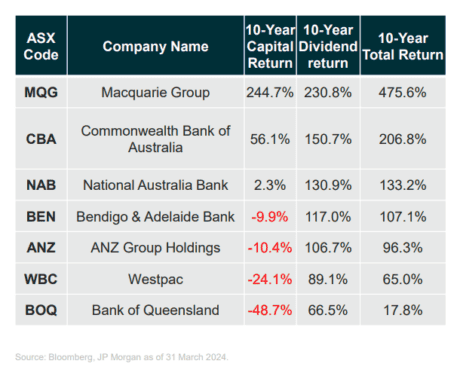
    Jocum showed a table documenting the 10-year history of both capital growth and dividend returns for each of the seven biggest ASX 200 bank shares. That table is shown below.

    Source: Global X investor presentation, ASX Investor Day, Sydney

    Jocum was discussing how to optimise an investment portfolio for income, and emphasised the importance of a ‘total returns approach’ that takes annual dividend returns into account.

    According to his presentation:

    Most of the largest Australian banks have had negative capital returns. Dividends can add as an important source of returns and help cushion drawdowns.

    As the table shows, only one ASX 200 bank share delivered more capital growth than dividends over the past 10 years to 31 March 2024, and that was Macquarie.

    The other ASX 200 banks delivered more in dividend returns than capital growth. In fact, some delivered negative capital growth.

    But when you combined the growth and dividends, investors in every bank stock were in the green.

    The three best ASX 200 bank shares for total returns were Macquarie, CBA and National Australia Bank.

    The numbers demonstrate how important dividend returns are when selecting any type of ASX share or ASX ETF to buy.

    For example, CBA shares delivered just 56.1% capital growth but 150.7% in dividends over the period.

    Should you buy bank stocks?

    After such strong share price gains over the past seven months, many brokers currently have sell or hold ratings on the banks.

    Ray David, Portfolio Manager and Partner at Blackwattle Investment Partners, says bank shares “look like they’ve overstretched on valuations” and ASX 200 mining stocks are better value.

    After the recent round of updates from the ASX 200 banks, Wilsons says it is retaining an underweight exposure and noted a “lacklustre medium and long-term EPS growth outlook facing the sector.”

    In a new note this week, Goldman Sachs said bank fundamentals are weak and valuations are extreme, with bank stocks trading at “close to record expensive” levels.

    Goldman said:

    … while the deterioration in earnings appears to now be finished, we see very limited upside risk, and therefore, with valuations skewed asymmetrically to the downside, we now think a more negative view on the banks is appropriate …

    The post ASX 200 bank shares: How dividends offset poor capital growth over 10 years appeared first on The Motley Fool Australia.

    Should you invest $1,000 in Australia And New Zealand Banking Group right now?

    Before you buy Australia And New Zealand Banking Group shares, consider this:

    Motley Fool investing expert Scott Phillips just revealed what he believes are the 5 best stocks for investors to buy right now… and Australia And New Zealand Banking Group wasn’t one of them.

    The online investing service he’s run for over a decade, Motley Fool Share Advisor, has provided thousands of paying members with stock picks that have doubled, tripled or even more.*

    And right now, Scott thinks there are 5 stocks that may be better buys…

    See The 5 Stocks
    *Returns as of 5 May 2024

    More reading

    Motley Fool contributor Bronwyn Allen has positions in Anz Group, Commonwealth Bank Of Australia, and Macquarie Group. The Motley Fool Australia’s parent company Motley Fool Holdings Inc. has positions in and has recommended Goldman Sachs Group and Macquarie Group. The Motley Fool Australia has positions in and has recommended Bendigo And Adelaide Bank and Macquarie Group. The Motley Fool has a disclosure policy. This article contains general investment advice only (under AFSL 400691). Authorised by Scott Phillips.

  • Nvidia did it again. Is the AI stock a buy after another round of record profits?

    Digital rocket on a laptop.

    This article was originally published on Fool.com. All figures quoted in US dollars unless otherwise stated.

    Coming into Nvidia’s (NASDAQ: NVDA) fiscal 2025 first-quarter earnings report, expectations were sky-high.  

    Nvidia stock has been the flag-bearer for the generative artificial intelligence (AI) revolution. The company makes the technological components — graphics processing units (GPUs) and related superchips — that form the backbone of AI infrastructure, allowing companies like OpenAI to run models like ChatGPT.

    With the explosion in AI demand, Nvidia’s revenue has skyrocketed, more than tripling over the last few quarters. And that pattern continued in fiscal 2025’s first quarter.

    According to the report released Wednesday afternoon, revenue jumped 262% year over year to $26 billion, topping estimates at $24.7 billion and growing 18% sequentially. Revenue in the data center, where the AI revolution is happening, soared 427% year over year to $22.6 billion.

    Margins expanded again, a testament to Nvidia’s pricing power in the data center market, as it has an estimated 98% share of the data center GPU market. On a generally accepted accounting principles (GAAP) basis, gross margin jumped from 64.6% to 78.4%, driving operating income up 690% to $16.9 billion, giving the company an operating margin of 64.9%. On an adjusted basis, earnings per share jumped from $1.09 to $6.12, beating the consensus analyst estimate of $5.59.

    Nvidia enters a new stage

    The first-quarter earnings report also marks something of a milestone for Nvidia, as the company’s year-over-year comparisons will get harder from here. In other words, the initial explosion in demand driven by the launch of ChatGPT and other AI applications will start to fade.

    However, the business still looks well-positioned for continued growth. The company is forecasting revenue of $28 billion in fiscal 2025’s second quarter, suggesting 107% year-over-year growth and 7.5% sequential growth. It also expects gross margin to moderate slightly over the rest of the year, calling for a full-year gross margin in the mid-70% range. Second-quarter guidance indicates GAAP operating income will be essentially flat on a sequential basis, though the company has a pattern of topping its own guidance.

    Despite its moderating growth, CEO Jensen Huang and Nvidia’s management team shared several anecdotes on the earnings call that show that demand for Nvidia’s products is still heating up. For example, management said that inference drove 40% of data center revenue over the last quarter, implying that training represented the majority of data center revenue as training and inference are the two primary functions needed to run AI models.

    Demand for inference is expected to be much larger than training as generative AI matures, so that data point indicates that the development of these models is still in a very early stage. The company also noted large purchases from customers like Tesla and Meta Platforms, which implies growing demand for inference from Nvidia later.

    Additionally, Huang said that demand for its Hopper platform is still strong and growing, even though it announced the next iteration, Blackwell, at its GTC conference in March. Huang elaborated:

    We … expect demand to outstrip supply for some time as we now transition to H200, as we transition to Blackwell. Everybody is anxious to get their infrastructure online. And the reason for that is because [customers are] saving money and making money, and they would like to do that as soon as possible.

    The fact that customers aren’t waiting for the newer model to drop shows how high demand is for Nvidia’s products, and that should continue to provide a tailwind over the coming quarters.

    Is Nvidia stock a buy?

    Some billionaire investors, like Stanley Druckenmiller and David Tepper, have begun selling off their stakes in Nvidia following the chip stock’s dramatic surge over the last year or so. However, there’s still room for the stock to move higher as the business keeps delivering incredible results.

    Investors shouldn’t expect the triple-digit revenue growth in the business to continue, and the stock’s blowout gains are also likely in the past as its market cap approaches $3 trillion. However, the business looks even stronger than it did three months ago, and there’s no sign of any competitive pressure despite recent product launches from Advanced Micro Devices and Intel.

    Huang sees the company building “AI factories” and driving the “next industrial revolution.” Those are bold statements, but the numbers back them up, and if the opportunity is that big, Nvidia will have a lot of growth in front of it.

    Investors sent Nvidia stock up 7% in pre-market trading on Thursday, a sign that the company has more upside potential. If the company can keep executing like this, the stock will continue to be a winner. 

    This article was originally published on Fool.com. All figures quoted in US dollars unless otherwise stated.

    The post Nvidia did it again. Is the AI stock a buy after another round of record profits? appeared first on The Motley Fool Australia.

    Should you invest $1,000 in Nvidia right now?

    Before you buy Nvidia shares, consider this:

    Motley Fool investing expert Scott Phillips just revealed what he believes are the 5 best stocks for investors to buy right now… and Nvidia wasn’t one of them.

    The online investing service he’s run for over a decade, Motley Fool Share Advisor, has provided thousands of paying members with stock picks that have doubled, tripled or even more.*

    And right now, Scott thinks there are 5 stocks that may be better buys…

    See The 5 Stocks
    *Returns as of 5 May 2024

    More reading

    Randi Zuckerberg, a former director of market development and spokeswoman for Facebook and sister to Meta Platforms CEO Mark Zuckerberg, is a member of The Motley Fool’s board of directors. Motley Fool contributor Jeremy Bowman has no position in any of the stocks mentioned. The Motley Fool Australia’s parent company Motley Fool Holdings Inc. has positions in and recommends Advanced Micro Devices, Meta Platforms, Nvidia, and Tesla. The Motley Fool recommends Intel and recommends the following options: long January 2025 $45 calls on Intel and short May 2024 $47 calls on Intel. The Motley Fool has a disclosure policy. This article contains general investment advice only (under AFSL 400691). Authorised by Scott Phillips.

  • 3 of the best ASX 200 shares to buy for your retirement portfolio

    Are you on the hunt for some ASX 200 shares to add to your retirement portfolio?

    If you are, then the three ASX 200 shares listed below could be top options right now. Here’s what analysts are saying about them:

    CSL Limited (ASX: CSL)

    CSL could be a great option for a retirement portfolio. The ASX 200 biotech share is arguably one of Australia’s highest quality companies.

    This is thanks to its collection of industry-leading therapies, which includes Privigen, Hizentra, Idelvion, and Afstyla. In addition, the company invests around US$1 billion (and growing) into its research and development activities each year. This ensures that CSL has a pipeline filled to the brim with potentially lucrative and life-saving drug candidates.

    Macquarie is a big fan of CSL and has an outperform rating and $330.00 price target on its shares. It also sees scope for its shares to rise beyond $500 in the next three years.

    Transurban Group (ASX: TCL)

    Another ASX 200 share that could be worth considering for a retirement portfolio is Transurban.

    It owns a portfolio of roads in Australia and North America, as well as a significant project pipeline.

    As these roads are always in demand with drivers, particularly given population growth and urbanisation, Transurban has defensive qualities that could make it attractive for retirees.

    The team at Citi sees a lot of value in Transurban’s shares at current levels. It has a buy rating and $15.50 price target on them.

    Another positive is that the broker expects some attractive dividend yields from its shares in the near term. It is forecasting yields of 5% in FY 2024 and 5.1% in FY 2025.

    Woolworths Limited (ASX: WOW)

    A final ASX 200 share that could be a good option for a retirement portfolio is Woolworths. It is Australia’s largest supermarket chain, as well as the owner of Big W and a growing pet care business.

    Woolworths could be a good option for a retirement portfolio due to its defensive qualities, strong market position, and positive growth outlook. Goldman Sachs notes that the latter is being underpinned by its omni-channel advantage and sticky loyalty program.

    It is for this reason that the broker is tipping Woolworths as a buy with a $39.40 price target on its shares.

    In addition, Goldman is expecting attractive dividend yields from its shares in the coming years. It is forecasting yields of 3.4%, 3.6%, and 3.9%, respectively, over the next three financial years.

    The post 3 of the best ASX 200 shares to buy for your retirement portfolio appeared first on The Motley Fool Australia.

    Should you invest $1,000 in CSL right now?

    Before you buy CSL shares, consider this:

    Motley Fool investing expert Scott Phillips just revealed what he believes are the 5 best stocks for investors to buy right now… and CSL wasn’t one of them.

    The online investing service he’s run for over a decade, Motley Fool Share Advisor, has provided thousands of paying members with stock picks that have doubled, tripled or even more.*

    And right now, Scott thinks there are 5 stocks that may be better buys…

    See The 5 Stocks
    *Returns as of 5 May 2024

    More reading

    Citigroup is an advertising partner of The Ascent, a Motley Fool company. Motley Fool contributor James Mickleboro has positions in CSL. The Motley Fool Australia’s parent company Motley Fool Holdings Inc. has positions in and has recommended CSL, Goldman Sachs Group, Macquarie Group, and Transurban Group. The Motley Fool Australia has positions in and has recommended Macquarie Group. The Motley Fool Australia has recommended CSL. The Motley Fool has a disclosure policy. This article contains general investment advice only (under AFSL 400691). Authorised by Scott Phillips.

  • Why Goldman Sachs just downgraded Westpac shares to a sell rating

    A man slumps crankily over his morning coffee as it pours with rain outside.

    Westpac Banking Corp (ASX: WBC) shares were out of form on Thursday.

    The banking giant’s shares ended the day almost 1% lower at $26.87.

    Why did Westpac shares fall?

    Investors were hitting the sell button after analysts at Goldman Sachs downgraded the bank following a review of the sector.

    According to the note, the broker believes bank valuations “are at extremes” at present. It said:

    Australian bank valuations are at extremes, with absolute 12-month forward PERs at the 99th percentile, our DCF valuations are, on average, 175% below current share prices, and the spread between bank fully-franked yields and the 10-year bond yield is currently at its lowest level in nearly 15 years.

    The broker concedes that versus industrials the bank’s don’t look expensive. It adds:

    However, the one metric where valuation support for the banks still exists is how their PER trades against the non-bank industrials’. On this basis, while the sector has re-rated significantly over the past 12 months, it continues to trade nearly 5% below longer-run historic averages.

    Though, it feels this approach to valuing the banks is flawed. Goldman explains:

    However, the above analysis is overly simplistic and takes no account of how relative fundamentals between the banks and non-bank industrials may have evolved over time. On this front, the recent reporting season did show that the pace of deterioration in bank fundamentals does appear to be slowing. However, our analysis suggests we should not be expecting a material improvement in fundamentals from here.

    So, while the deterioration in earnings appears to now be finished, we see very limited upside risk, and therefore, with valuations skewed asymmetrically to the downside, we now think a more negative view on the banks is appropriate.

    Westpac downgraded

    In light of the above, the broker has downgraded Westpac shares to a sell rating (from neutral) with an unchanged price target of $24.10.

    Based on its current share price of $26,87, this implies potential downside of over 10% for investors over the next 12 months. It concludes:

    WBC to Sell from Neutral, given i) execution, cost and timing risks relating to its technology simplification, ii) of the major banks, WBC’s balance sheet is the most overweight domestic housing, which we expect will be more growth constrained than commercial lending over the medium term, iii) NIM has been supported by a shorter duration replicating portfolio but this will give them less longevity, and d) WBC’s 14.2x 12-mo fwd PER is more than one standard deviation expensive vs. its 12.7x historic average.

    The post Why Goldman Sachs just downgraded Westpac shares to a sell rating appeared first on The Motley Fool Australia.

    Should you invest $1,000 in Westpac Banking Corporation right now?

    Before you buy Westpac Banking Corporation shares, consider this:

    Motley Fool investing expert Scott Phillips just revealed what he believes are the 5 best stocks for investors to buy right now… and Westpac Banking Corporation wasn’t one of them.

    The online investing service he’s run for over a decade, Motley Fool Share Advisor, has provided thousands of paying members with stock picks that have doubled, tripled or even more.*

    And right now, Scott thinks there are 5 stocks that may be better buys…

    See The 5 Stocks
    *Returns as of 5 May 2024

    More reading

    Motley Fool contributor James Mickleboro has positions in Westpac Banking Corporation. The Motley Fool Australia’s parent company Motley Fool Holdings Inc. has positions in and has recommended Goldman Sachs Group. The Motley Fool Australia has no position in any of the stocks mentioned. The Motley Fool has a disclosure policy. This article contains general investment advice only (under AFSL 400691). Authorised by Scott Phillips.