• Everything to know about season 4 of ‘Bridgerton’ — including whose love story is up next

    The Bridgerton family (L-R): Gregory Bridgerton (Will Tilston), Anthony Bridgerton (Jonathan Bailey), Hyacinth Bridgerton (Florence Hunt), Lady Violet Bridgerton (Ruth Gemmell),  Kate Sharma (Simone Ashley), Francesca Bridgerton (Hannah Dodd), Colin Bridgerton (Luke Newton), Eloise Bridgerton (Claudia Jessie) and Benedict Bridgerton (Luke Thompson).
    The Bridgerton family.

    • Season four of "Bridgerton" is in the works.
    • The next season will focus on Benedict Bridgerton's (Luke Thompson) love story. 
    • Luke Newton and Nicola Coughlan will reprise their roles as Colin and Penelope.

    Warning: There are major spoilers ahead for season three of "Bridgerton."

    "Bridgerton" fans have been patiently waiting, and Benedict Bridgerton's season is finally coming.

    Season three of the Netflix series, centered on Colin Bridgerton (Luke Newton) and Penelope Featherington's (Nicola Coughlan) relationship, concluded with the release of part two on Thursday.

    In giving Polin a happy ending, "Bridgerton" also heavily teased that Benedict, the second-eldest sibling, will get the main character treatment next season.

    Here's everything we know about season four, so far.

    Benedict's love story will be the focus of season 4

    Luke Thompson as Benedict Bridgerton on season three, episode one of "Bridgerton."
    Luke Thompson as Benedict Bridgerton on season three, episode one of "Bridgerton."

    On the season finale, as Eloise Bridgerton (Claudia Jessie) prepares to head off to Scotland with Francesca Bridgerton (Hannah Dodd), John Stirling (Victor Alli), and Michaela (Masali Baduza), she tells Benedict that she'll only be gone until next year.

    "Do you think Mama would ever let me miss her Masquerade Ball?" she says.

    Benedict, still not ready to settle down, replies: "I will be there, hiding out behind a mask, avoiding eligible ladies like the plague."

    That not-so-subtle moment was a nod to Benedict's novel "An Offer From a Gentleman," which is part of Julia Quinn's "Bridgerton" book series.

    In the third, "Cinderella"-inspired book, Benedict meets a woman named Sophie Beckett at a masquerade ball. Unbeknownst to him, Sophie is a servant to a rude stepmother named Araminta Gunningworth. By the end of the book, they express their love for each other and get married.

    Luke Newton and Nicola Coughlan will reprise their roles as Colin and Penelope Bridgerton in season 4

    colin bridgerton and penelope featherington standing together at a ball, each holding goblets in their hands and wearing formal clothing
    Luke Newton and Nicola Coughlan on season three of "Bridgerton."

    Coughlan told TheWrap that she and Newton will return on season four, but they "don't know anything about it." Meanwhile, showrunner Jess Brownell told the publication that she'd like the pair to continue on the show beyond season four.

    "We will definitely hope to bring them back in future seasons because I think there's more story there," she said.

    Newton similarly told Teen Vogue that he's committed to being on the show indefinitely.

    "I feel very invested in the show… like I said before, I just love the people," he said. "I love my job. I love my role in the show, so I can't see myself going anywhere. I just want to finish the stories off. I would say there's still stuff to get sorted in season four, so yeah, that's why I'm there."

    The 'Bridgerton' season 4 release date hasn't been announced yet

    Martins Imhangbe as Will Mondrich and Luke Thompson as Benedict Bridgerton on season three, episode two of "Bridgerton."
    Martins Imhangbe as Will Mondrich and Luke Thompson as Benedict Bridgerton on season three, episode two of "Bridgerton."

    In an interview published by Town & Country in mid-May, showrunner Jess Brownell said that she was working on season four.

    "We've broken out the whole season and are finalizing the scripts, and I'm super excited about where we're headed," she said.

    Brownell also told Refinery29 that she didn't have an anticipated release date yet for the new episodes.

    "We're still making sure that we write the best possible script that we can before we start production," she said.

    In a season three finale post-mortem interview with Business Insider, Lady Danbury actor Adjoa Andoh said that filming for the new season is set to begin "sometime in the autumn."

    That means "Bridgerton" will probably not return until 2025 at the earliest.

    All episodes of season three of "Bridgerton" are now streaming on Netflix.

    Read the original article on Business Insider
  • Here are the top 10 ASX 200 shares today

    Fancy font saying top ten surrounded by gold leaf set against a dark background of glittering stars.

    The S&P/ASX 200 Index (ASX: XJO) seemed to turn a corner this Thursday, ending the brutal two-day losing streak that the Australian share market had been on this short trading week.

    By the close of trading today, the ASX 200 had added a healthy 0.44%. That leaves the index at 7,749.7 points.

    This much-needed recovery for the ASX comes after a decent session over on the US markets overnight.

    The Dow Jones Industrial Average Index (DJX: DJI) had a stingy session, slipping by 0.091%.

    However, the Nasdaq Composite Index (NASDAQ: .IXIC) was in fine form, galloping 1.53% higher.

    But time now to return to the ASX and have a gander at what the various ASX sectors were doing this Thursday.

    Winners and losers

    It was almost all smiles on the stock market today, with only two sectors recording a red session.

    The worst of those was the energy sector. The S&P/ASX 200 Energy Index (ASX: XEJ) was left out in the cold, shedding 0.64% of its value.

    Mining shares also had a rough time. The S&P/ASX 200 Materials Index (ASX: XMJ) was sent down by 0.48% by the time trading wrapped up.

    But all other sectors had a great time of it.

    Most of all, tech stocks. The S&P/ASX 200 Information Technology Index (ASX: XIJ) was on fire, surging by 2.14%.

    Healthcare shares were high in demand as well, with the S&P/ASX 200 Healthcare Index (ASX: XHJ) soaring 1.6%.

    Real estate investment trusts (REITs) weren’t too far off that. The S&P/ASX 200 A-REIT Index (ASX: XPJ) sprinted 1.28% higher this Thursday.

    Communications stocks performed similarly, with the S&P/ASX 200 Communication Services Index (ASX: XTJ) banked a gain of 1.03%.

    Consumer discretionary shares were running hot too, as you can see from the S&P/ASX 200 Consumer Discretionary Index (ASX: XDJ)’s 0.94% rise

    Utilities stocks had a fantastic time of it as well. The S&P/ASX 200 Utilities Index (ASX: XUJ) received a 0.66% upgrade from the markets.

    The same could be said of industrial shares, going off the S&P/ASX 200 Industrials Index (ASX: XNJ)’s 0.51% lift.

    Financial stocks weren’t left out. The S&P/ASX 200 Financials Index (ASX: XFJ) enjoyed a bounce worth 0.37%.

    Gold shares recovered slightly from Tuesday’s carnage, with the All Ordinaries Gold Index (ASX: XGD) eking out a 0.34% improvement.

    Finally, consumer staples stocks also counted themselves lucky. The S&P/ASX 200 Consumer Staples Index (ASX: XSJ) ended up inching 0.33% higher.

    Top 10 ASX 200 shares countdown

    Today’s top stock was healthcare company Nanosonics Ltd (ASX: NAN). Nanosonics shares were bid up by a compelling 4.56% today, up to $2.98 each.

    That was despite no clear catalysts, news, or announcements from Nanosonics that might explain this move.

    Here’s how today’s other winners pulled up:

    ASX-listed company Share price Price change
    Nanosonics Ltd (ASX: NAN) $2.98 4.56%
    Polynovo Ltd (ASX: PNV) $2.36 3.96%
    Life360 Inc (ASX: 360) $14.29 3.70%
    NextDC Ltd (ASX: NXT) $18.34 3.56%
    A2 Milk Company Ltd (ASX: A2M) $7.10 3.35%
    Nine Entertainment Co Holdings Ltd (ASX: NEC) $1.40 3.32%
    James Hardie Industries plc (ASX: JHX) $48.22 3.19%
    REA Group Ltd (ASX: REA) $192.11 3.17%
    National Storage REIT (ASX: NSR) $2.30 3.14%
    JB Hi-Fi Ltd (ASX: JBH) $62.69 3.02%

    Our top 10 shares countdown is a recurring end-of-day summary to let you know which companies were making big moves on the day. Check in at Fool.com.au after the weekday market closes to see which stocks make the countdown.

    The post Here are the top 10 ASX 200 shares today appeared first on The Motley Fool Australia.

    Should you invest $1,000 in Life360 right now?

    Before you buy Life360 shares, consider this:

    Motley Fool investing expert Scott Phillips just revealed what he believes are the 5 best stocks for investors to buy right now… and Life360 wasn’t one of them.

    The online investing service he’s run for over a decade, Motley Fool Share Advisor, has provided thousands of paying members with stock picks that have doubled, tripled or even more.*

    And right now, Scott thinks there are 5 stocks that may be better buys…

    See The 5 Stocks
    *Returns as of 5 May 2024

    More reading

    Motley Fool contributor Sebastian Bowen has positions in A2 Milk. The Motley Fool Australia’s parent company Motley Fool Holdings Inc. has positions in and has recommended Life360, Nanosonics, PolyNovo, and REA Group. The Motley Fool Australia has positions in and has recommended Nanosonics. The Motley Fool Australia has recommended A2 Milk, Jb Hi-Fi, Nine Entertainment, PolyNovo, and REA Group. The Motley Fool has a disclosure policy. This article contains general investment advice only (under AFSL 400691). Authorised by Scott Phillips.

  • Guess which ASX 200 stock crashed 8% on Thursday

    a group of business people sit dejectedly around a table, each expressing desolation, sadness and disappointment by holding their head in their hands, casting their gazes down and looking very glum.

    Whilst the S&P/ASX 200 Index (ASX: XJO) spent all day in the green today before closing 4.4% higher, one ASX 200 stock has been sold off sharply.

    ASX Ltd (ASX: ASX) shares took a significant hit, plummeting 8% to $58.14 at the close of trading.

    This sharp decline follows the company’s investor forum held on Thursday, where it outlined its financial guidance for FY 2025. Investors appeared less than impressed with some of the projections. Here’s a look.

    Why did this ASX 200 stock drop 8%?

    At its investor forum, the company revealed that it expected its total expense growth rate to be between 6% and 9% for FY 2025. This comes on top of an anticipated 15% increase in FY 2024.

    The primary driver for this cost escalation is ongoing investment in technology, including software licensing, equipment costs, and depreciation and amortisation.

    Depreciation and amortisation are said to be ‘non-cash expenses’ in finance, related to business assets. While this is technically true – we don’t physically pay depreciation, for example – they do represent the implied cost of maintaining these assets. The ‘wear and tear’, so to speak.

    ASX managing director and CEO Helen Lofthouse provided an update on the company’s five-year strategy, focusing on technology modernisation and regulatory commitments.

    “Our five-year strategy builds on a high-quality portfolio of businesses that deliver resilient revenue performance throughout market cycles,” Lofthouse said.

    She added that data demand and Australia’s pension system – the fifth largest in the world – were two structural tailwinds behind the ASX 200 stock.

    But Lofthouse was less optimistic about the expenditure side. ASX is projecting an “expense growth rate” of 6–9%, which is not something many were expecting. She had this to say:

    This growth is primarily driven by ongoing technology related costs related to Horizon One of our five year strategy including software licencing and equipment costs.

    Operating expense growth is partially offset by the annualised saving of $11m as a result of the targeted restructure announced at our interim results in February, and the expected further reduction in one-off regulatory costs following the completion of special reports and other activities last year.

    It’s also worth noting the ASX 200 stock is making strides with its CHESS replacement project, partnering with Tata Consultancy Services for a product-based solution.

    What else did ASX mention?

    Other highlights from the investor day include the launch of the first ASX corporate bond, raising $275 million, and exploratory work with the Clean Energy Regulator to develop an Australian Carbon Exchange.

    However, these ambitious projects have come at a cost. The company forecasts capital expenditure for FY 2024 to be around $135 million, with FY 2025 technology capital expenditure expected to be between $160 million and $180 million.

    These are up from $50 million in the second half of FY 2024. Lofthouse added:

    [W]e expect our capex spend to remain elevated through to FY27 to support our technology roadmap, before starting to reduce beyond this period.

    We also expect the average depreciation and amortisation schedule of seven to ten years for these major projects, once they go live.

    How will this affect ASX shareholders?

    The projected expense growth and capital expenditure might have caused concern among investors of this ASX 200 stock today, leading to today’s 8% drop in the share price. Despite this, the company plans to maintain a dividend payout ratio of 80% to 90% of underlying net profit after tax (NPAT).

    ASX’s significant investment in technology and regulatory commitments are also crucial for its long-term strategy. Investors would be wise to keep a close eye on how these investments play out over the coming years.

    The post Guess which ASX 200 stock crashed 8% on Thursday appeared first on The Motley Fool Australia.

    Should you invest $1,000 in Asx Limited right now?

    Before you buy Asx Limited shares, consider this:

    Motley Fool investing expert Scott Phillips just revealed what he believes are the 5 best stocks for investors to buy right now… and Asx Limited wasn’t one of them.

    The online investing service he’s run for over a decade, Motley Fool Share Advisor, has provided thousands of paying members with stock picks that have doubled, tripled or even more.*

    And right now, Scott thinks there are 5 stocks that may be better buys…

    See The 5 Stocks
    *Returns as of 5 May 2024

    More reading

    Motley Fool contributor Zach Bristow has no position in any of the stocks mentioned. The Motley Fool Australia’s parent company Motley Fool Holdings Inc. has no position in any of the stocks mentioned. The Motley Fool Australia has no position in any of the stocks mentioned. The Motley Fool has a disclosure policy. This article contains general investment advice only (under AFSL 400691). Authorised by Scott Phillips.

  • Why these 2 ASX 200 shares just scored broker upgrades

    Happy man working on his laptop.

    Two well-known S&P/ASX 200 Index (ASX: XJO) shares were just upgraded by leading brokers.

    Both stand to potentially benefit from the rapid advancement of artificial intelligence (AI). And both have already handed their shareholders some sizeable one-year gains.

    Which ASX 200 shares are we talking about?

    Read on!

    (Broker data courtesy of The Australian.)

    Two ASX 200 shares earning broker upgrades

    The first ASX 200 share earning a broker upgrade is WiseTech Global Ltd (ASX: WTC).

    Shares in the logistics software provider are up 2.3% at the time of writing, trading for $99.12 apiece. That sees shares in the tech stock up more than 24% in a year.

    WiseTech shares also trade on a slender, fully franked dividend yield of 0.2%.

    And Bell Potter foresees some modest further gains ahead.

    The broker raised its price target for WiseTech by 8% to $100.00 a share.

    WiseTech shares could get a boost during the final week of the month. On 24 June the company joins the acclaimed S&P/ASX 50 Index. That’s part of  the S&P Dow Jones Indices June quarterly rebalance.

    Which brings us to the second ASX 200 share getting a broker upgrade today, Seek Ltd (ASX: SEK), which owns and operates Australia’s biggest online jobs classified website.

    The Seek share price is up 3.0% at the time of writing, with shares trading for $23.51 apiece. That puts the Seek share price up 8% in a year.

    Seek shares also trade on a fully franked trailing dividend yield of 1.8%.

    And JP Morgan expects some sizeable potential gains over the year ahead.

    The broker raised Seek to an overweight rating with a $26.50 share price target. That’s almost 13% above current levels.

    Last week, 5 June, the ASX 200 share grabbed investors’ attention when management announced the company had entered into a binding agreement to sell 98.2% of its stake in OCC Mexico and all of its stake in Catho Online to Red Arbor Holding.

    Seek will receive US$85 million (AU$128 million) for these assets. The company expects the transaction to be complete by the end of the month and intends to use the funds to pay down some debt.

    The Seek share price closed up 4.9% on the day, despite the company forecasting a $15 million to $35 million net loss on sale after tax from the divestment.

    That’s likely because the ASX 200 share reported it does not expect the sale of OCC Mexico and Catho Online will result in any material changes to its FY 2024 earnings guidance.

    The post Why these 2 ASX 200 shares just scored broker upgrades appeared first on The Motley Fool Australia.

    Should you invest $1,000 in Seek Limited right now?

    Before you buy Seek Limited shares, consider this:

    Motley Fool investing expert Scott Phillips just revealed what he believes are the 5 best stocks for investors to buy right now… and Seek Limited wasn’t one of them.

    The online investing service he’s run for over a decade, Motley Fool Share Advisor, has provided thousands of paying members with stock picks that have doubled, tripled or even more.*

    And right now, Scott thinks there are 5 stocks that may be better buys…

    See The 5 Stocks
    *Returns as of 5 May 2024

    More reading

    JPMorgan Chase is an advertising partner of The Ascent, a Motley Fool company. Motley Fool contributor Bernd Struben has no position in any of the stocks mentioned. The Motley Fool Australia’s parent company Motley Fool Holdings Inc. has positions in and has recommended JPMorgan Chase and WiseTech Global. The Motley Fool Australia has positions in and has recommended WiseTech Global. The Motley Fool Australia has recommended Seek. The Motley Fool has a disclosure policy. This article contains general investment advice only (under AFSL 400691). Authorised by Scott Phillips.

  • China became the world’s factory by selling cheap goods. This strategy won’t work for EVs.

    A large number of Chinese-made cars and construction machinery are gathering at the port of Yantai, waiting to be loaded for export, in Yantai, China, on April 1, 2024.
    A large number of Chinese-made cars and construction machinery are gathering at the port of Yantai, waiting to be loaded for export.

    • China, the world's factory, is known for producing affordable goods quickly.
    • But China EV makers shouldn't leverage on their price advantage in the long run as it's not sustainable, said a Bain consultant.
    • The EU will impose up to 48.1% tariffs on Chinese EV imports next month to protect European economies.

    China has been the world's factory floor for the last 40 years, propelling it into the position of the world's second-largest economy.

    This ability to make affordable products quickly is one of China's key advantages in many product categories.

    However, this isn't what Chinese electric makers should be leveraging in the long run, a management consultant said on Wednesday.

    "The pricing advantage will eventually run out of steam. It is product quality, technology, and brand awareness that holds the key to Chinese carmakers' success," Helen Liu, a partner at consultancy firm Bain told reporters, per the South China Morning Post.

    Liu's assessment came as the European Commission announced it will impose tariffs of up to 38.1% on Chinese EV imports from next month — on top of the existing 10%.

    The move follows a monthslong probe into Chinese subsidies for Chinese EV makers.

    The European Commission said in its announcement that the EV value chain in China benefits from unfair subsidization that causes a "threat of economic injury" to the EU's EV makers.

    The latest blow to Chinese EV makers came after President Joe Biden announced a sweeping set of tariffs in May on $18 billion worth of Chinese imports — including a 100% tax on Chinese vehicles.

    Chinese EVs have nearly no presence in the US, but account for 8% of the EV market share in auto powerhouse Europe, making the industry a geopolitical hot potato.

    The West hits out over China's overcapacity

    In recent months, Western countries have been lining up to criticize China for its barrage of cheap exports flooding the world's markets. They say China's dumping and unfair trade practices has hurt their economies.

    However, Beijing has consistently pushed back on the West's criticism that it is dumping cheap goods on the world market. Chinese authorities say the West's accusations are protectionist and aimed at containing China's economic growth.

    One contentious sector of dispute between the two sides is the hot new energy sector.

    China is producing a lot of new energy products as the country navigates a painful economic transition, from one reliant on real estate and low-cost manufacturing to the hot "new three" sectors of electric vehicles, lithium batteries, and solar panels.

    However, the West is also eyeing these fast-rising industries.

    Philip Nothard, insight and strategy director at automotive services company Cox Automotive told Business Insider's Tom Carter on Wednesday that the EU's tariff hike will not be enough to keep Chinese EV companies away from Europe.

    This is because big Chinese EV players like BYD have "highly efficient" manufacturing supply chains and are very quick to adjust their strategies.

    "Chinese companies have the potential to redefine electric cars so that they can convince global customers of their products' competitiveness in performance and technology," said Bain's Liu, per SCMP.

    Read the original article on Business Insider
  • Céline Dion says she always brings special photos when she goes to the doctor for treatments

    Singer Celine Dion performs onstage during the 2017 Billboard Music Awards at T-Mobile Arena on May 21, 2017 in Las Vegas, Nevada
    Céline Dion carries photos of her late husband when she goes to the doctor for treatment for stiff-person syndrome.

    • Céline Dion carries photos of her late husband to the doctor's whenever she goes for medical treatment.
    • "I'm still married to René. He's still my husband," Dion told People.
    • René Angélil, Dion's husband and longtime manager, died in 2016 after a battle with throat cancer.

    Céline Dion still keeps her late husband and longtime manager, René Angélil, close to her heart — she even carries his photo around to feel supported at the doctor's.

    "I'm still married to René. He's still my husband. When we have to travel to my treatments to see my doctors, I always bring pictures," Dion told People in an interview published on Wednesday. "And we have pictures, of course, all over the place in the house."

    Dion and Angélil tied the knot in December 1994 and share three kids: René-Charles, 23, and twins Nelson and Eddy, 13. Angélil died in 2016 at 73 after a battle with throat cancer.

    The singer also shared that her children will always remind her to bring photos of Angélil along whenever she packs for a trip.

    "My kids are always asking, 'Did you bring Papa's pictures?' And I'm like, 'Yes, I have Papa's pictures!'" Dion said. "He's their dad, and he's my husband, and he will always be."

    Dion first announced that she had been diagnosed with stiff-person syndrome in December 2022.

    Stiff-person syndrome is a rare, progressive neurological disorder that can cause symptoms such as muscle stiffness and spasms.

    There is no cure for the condition, although it can be managed through medication, immune therapies, as well as physical therapy.

    In April, Dion told Vogue France that she goes to therapy five days a week and trains "like an athlete" as part of her treatment plan.

    Although stiff-person syndrome is very rare — affecting one in a million, according to one estimate — there are an estimated 129 million people in the US who have at least one major chronic illness, per the CDC.

    While stress is a part of everyday life, those who are dealing with chronic illnesses may experience even more stress due to pain and the unpredictability of their symptoms.

    According to the Cleveland Clinic, one way to manage the stress of having a chronic condition is to find support through family and friends. It can also be helpful to let go of unnecessary obligations and spend time more meaningfully, such as engaging in hobbies or other activities that spark joy.

    Eating healthy, sleeping regularly, as well as reducing caffeine intake are also ways to manage anxiety and stress.

    Read the original article on Business Insider
  • Is this ASX small-cap stock an overlooked beneficiary of the AI boom?

    woman consoles robot

    Artificial intelligence (AI) is no longer just for tech behemoths — it’s sprinkling its magic dust across a myriad of industries, creating unexpected winners in the stock market.

    Just as we need to eat to survive and function, advanced AI systems require substantial electricity to operate. From this background, the reliability of the electricity supply is increasingly highlighted as a critical vulnerability within the AI ecosystem.

    One ASX-listed company that could benefit from this trend is IPD Group Ltd (ASX: IPG), a distributor of electronic and automation systems and solutions across Australia.

    Could this under-the-radar ASX small-cap stock be the surprise superstar of the AI revolution? Let’s dive into the potential of IPD Group.

    Power shortages

    We often hear about semiconductor chip shortages driven by the AI boom and how it is benefitting the likes of Nvidia Corp, Taiwan Semiconductor Manufacturing Co Ltd, and equipment maker ASML Holding NV.

    However, Tesla Inc (NASDAQ: TSLA) boss Elon Musk believes power shortages are likely to be the next wave ahead of us. In an interview in March 2024, as part of the Bosch Connected World conference, he said:

    The constraints on AI compute are very predictable… A year ago, the shortage was chips, neural net chips. Then, it was very easy to predict that the next shortage will be voltage step-down transformers.

    Then, the next shortage will be electricity. They won’t be able to find enough electricity to run all the chips. I think next year, you’ll see they just can’t find enough electricity to run all the chips.

    To make things worse, the developed world is already suffering from an inadequate supply of electricity due to ever-increasing energy demand and a slow transition to environmentally friendly energy sources.

    The Australian Energy Market Operator (AEMO) warned of the potential risk of blackouts in NSW and Victoria in its May 2024 report, as highlighted by The Australian.

    How is IPD Group’s business going?

    IPD Group — founded more than 70 years ago — specialises in distributing electrical and automation solutions in Australia. It leverages renowned global brands like ABB Ltd and General Electric Co.

    Its services encompass power distribution, industrial control, renewable energy solutions, and testing. More recently, the company expanded into solar energy, aiming to become a one-stop shop for all photovoltaic (PV) system needs ranging from PV equipment and services through the acquisition of Addelec.

    In May, IPD Group provided a bright outlook for FY24, as summarised by my colleague James.

    The company expects to report earnings before interest, tax, depreciation, and amortisation (EBITDA) between $39 million and $39.5 million, implying a 42% growth from a year ago at the midpoint. These projections exclude costs from the acquisitions of EX engineering and CMI Operations.

    IPD Group CEO Michael Sainsbury believes FY24 has been a transformative year for the company, including major acquisitions. He said:

    It has been a transformative year for IPD with the completion of two strategic acquisitions, EX Engineering and CMI Operations.

    Merging our Addelec and Gemtek businesses has significantly enhanced our EV infrastructure team and we are capitalising on the growth in the market by securing a number of major projects during the year, including the electrification of Australia’s largest bus depot.

    How cheap is this ASX small-cap stock today?

    The IPD Group share price dropped by approximately 20% from the 52-week high of $5.42 in February this year. As the chart below shows, the IPG Group share price has been hovering between $4 and $5 for the last 12 months after more than quadrupling since its initial public offering in December 2021.

    IPD Group shares are trading at a price-to-earnings ratio of 21x based on its reported earnings for the last 12 months to December 2023.

    I think IPD Group has the potential to benefit from anticipated power shortages caused by the ongoing AI revolution, as well as electric vehicles and green energy initiatives.

    The post Is this ASX small-cap stock an overlooked beneficiary of the AI boom? appeared first on The Motley Fool Australia.

    Should you invest $1,000 in Ipd Group Limited right now?

    Before you buy Ipd Group Limited shares, consider this:

    Motley Fool investing expert Scott Phillips just revealed what he believes are the 5 best stocks for investors to buy right now… and Ipd Group Limited wasn’t one of them.

    The online investing service he’s run for over a decade, Motley Fool Share Advisor, has provided thousands of paying members with stock picks that have doubled, tripled or even more.*

    And right now, Scott thinks there are 5 stocks that may be better buys…

    See The 5 Stocks
    *Returns as of 5 May 2024

    More reading

    Motley Fool contributor Kate Lee has positions in ASML and Nvidia. The Motley Fool Australia’s parent company Motley Fool Holdings Inc. has positions in and has recommended ASML, Ipd Group, Nvidia, and Tesla. The Motley Fool Australia has positions in and has recommended Ipd Group. The Motley Fool Australia has recommended ASML and Nvidia. The Motley Fool has a disclosure policy. This article contains general investment advice only (under AFSL 400691). Authorised by Scott Phillips.

  • Should you pay down your mortgage or add to superannuation?

    A young couple sits at their kitchen table looking at documents with a laptop open in front of them while they consider the state of their investments.

    This is a common question among homeowners, and according to Damien Klassen from Nucleus Wealth, the answer depends on your income level, age, and mortgage interest rates at the time of your decision.

    In a blog, Klassen offers advice for people considering what’s best to do with a spare $10,000 in income.

    Let’s look into his findings.

    Superannuation or the home loan?

    Let’s look at some obvious factors first.

    The biggest benefit of using a spare $10,000 in income to pay down your home loan is the guaranteed annual interest savings. The downside is you’ll have to pay full tax on that income if you use it in this way.

    The biggest benefit of contributing a spare $10,000 in income into superannuation is the substantial tax saving on the way in (as long as you’re under the concessional contributions cap) and the ongoing earnings on your investments (bearing in mind that investments sometimes result in losses, too).

    Just to remind you, concessional superannuation contributions are taxed at 15%, which is lower than most individual income tax rates.

    A case study…

    Klassen has run the numbers using a fictitious case study of an Australian earning $100,000 per year.

    They have a mortgage with an annual home loan interest rate of 6%. They also have a superannuation fund returning an average of 6% per year.

    He looks at the different outcomes over a 10-year period of using that spare $10,000 to either pay down the home loan or bump up superannuation this year.

    Here’s what he finds:

    At $100k, your marginal tax rate (in 2025) is 30% + Medicare levy = 32%.

    So, your $10k becomes $6,800 off your mortgage after tax or $8,500 invested in super. i.e., you are $1,700 better off on day 1 in super.

    If you save 6% on your $6,800 mortgage reduction over 10 years = $5,378 in interest avoided, tax-free.

    If you made 6% in your $8,500 in superannuation and then paid tax on it = $5,155 after tax = $223 worse off in superannuation.

    Net effect = $1,477 better off in super.

    Klassen emphasises that the outcomes can be different depending on income levels and interest rates.

    He says higher interest rates make using the money to pay off your home loan more attractive. Conversely, lower interest rates may make investing the money into superannuation a better option.

    Klassen says people on higher incomes will “almost always” come out in front by contributing to superannuation.

    Those earning less than $50,000 would likely be worse off if they put their spare $10,000 into superannuation vs. paying down their property loan, he says.

    A few caveats…

    While putting money into superannuation makes sense for a lot of people, they generally can’t access the funds until they reach preservation age.

    Klassen says having inaccessible savings helps some Australians keep their spending in check.

    However, there is some risk involved because once your superannuation money is invested, there is no guarantee of positive returns every year.

    Klassen comments:

    Investment returns within super can fluctuate with market conditions.

    While younger individuals have time to recover from downturns, older individuals, such as those around 65, face more immediate risks.

    The post Should you pay down your mortgage or add to superannuation? appeared first on The Motley Fool Australia.

    Urgent Message from Motley Fool General Manager, Adam Surplice

    If you’ve ever felt “boxed in” by traditional super funds, or thought SMSFs were beyond reach, this Investment Mastery video series will open your eyes.…

    As you’ll see, I’ve discovered a unique strategy that’s completely changed my approach to superannuation… in fact, I’m personally investing $200,000 of my own retirement savings into it.

    Unlock FREE Investment Mastery video series
    *Returns 28 May 2024

    More reading

    Motley Fool contributor Bronwyn Allen has no position in any of the stocks mentioned. The Motley Fool Australia’s parent company Motley Fool Holdings Inc. has no position in any of the stocks mentioned. The Motley Fool Australia has no position in any of the stocks mentioned. The Motley Fool has a disclosure policy. This article contains general investment advice only (under AFSL 400691). Authorised by Scott Phillips.

  • Prediction: This will be Nvidia’s next big move

    A woman holds a soldering tool as she sits in front of a computer screen while working on the manufacturing of technology equipment in a laboratory environment.

    This article was originally published on Fool.com. All figures quoted in US dollars unless otherwise stated.

    Nvidia‘s (NASDAQ: NVDA) performance has been nothing short of remarkable of late. I’m talking about Nvidia the stock and Nvidia the company. The stock’s performance speaks for itself. Shares have exploded higher by about 725% since January 2023. 

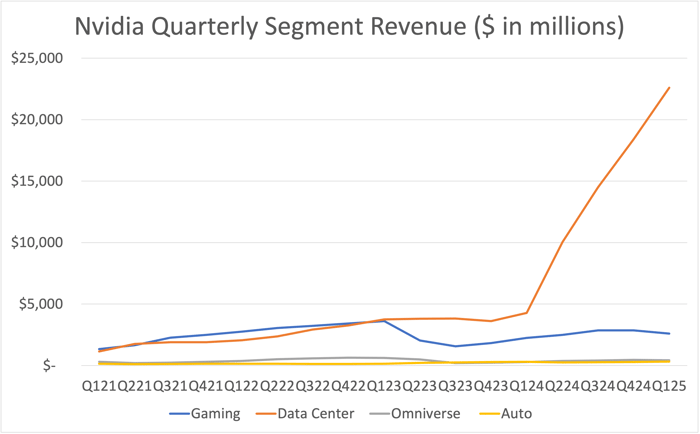
    But that surge in price wasn’t just driven by overexuberant investors. Nvidia’s business itself has exploded — and its data center business, in particular. Revenue from that segment has more than quintupled in the past year, helping to drive Nvidia’s net income up by more than 600%. Growth from sales of the company’s artificial intelligence (AI) chips to data centers hasn’t yet peaked, but there are already indications of what could drive Nvidia stock’s next big move higher.

    Explosive growth in data center sales

    Nvidia’s recent good fortune didn’t come by chance. Many years of research and development allowed it to create the most technologically advanced graphics processing units (GPUs) in the industry, and have them available for customers just when the need for that type of computing power skyrocketed. Now, even as it works to accelerate its manufacturing to catch up with current demand, Nvidia already has its next-generation Blackwell chip series in production.

    Beyond that, CEO Jensen Huang has also unveiled a new AI chip that it intends to bring to market in 2026. The Rubin platform will succeed the Blackwell, and will include GPUs as well as a new central processing unit (CPU). That will offer customers a more complete data center server system. The already-massive volume of data center spending is reflected in Nvidia’s quarterly segment revenue.

    line graph of Nvidia quarterly revenue by segment from fiscal Q121 through Q125.

    Data source: Nvidia.

    But while data center revenue has gone parabolic, another Nvidia business segment is operating under investors’ radar right now. After all, it wasn’t just Nvidia’s R&D advancements that led to the growing uses of generative AI and other artificial intelligence applications.

    There are now multiple companies that are working to put self-driving cars on the road or use computing power to improve existing vehicles’ performance. And there are signs that Nvidia’s automotive business could be its next big revenue driver.

    Nvidia’s next major catalyst

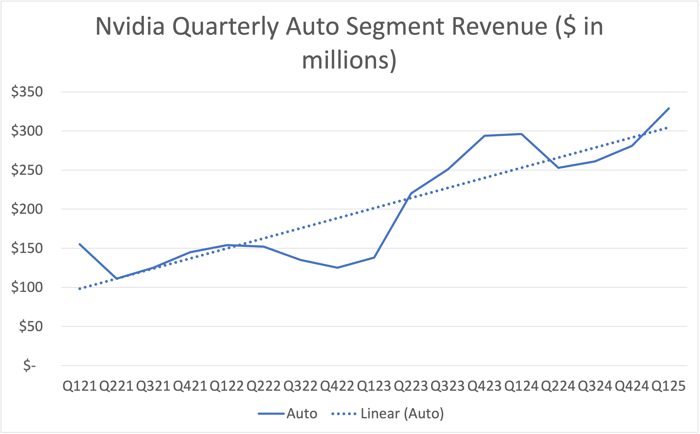
    While its auto segment numbers pale in comparison to data center sales right now, there’s a trending increase in revenue there as well. Sales growth is already coming as automakers work to improve their vehicles’ performance. Electric vehicle (EV) maker Rivian Automotive just announced it would be using Nvidia chips to enhance computing power and improve the range and performance of its R1 platform vehicles.

    Line graph of Nvidia's auto segment revenue since fiscal Q121.

    Data source: Nvidia.

    Rivian says it will have 10 times more computing power using Nvidia’s DRIVE Orin processors. Nvidia calls its Orin system on a chip the central computer for intelligent vehicles. Other automotive companies partnering with Nvidia include Chinese EV makers BYD, Nio, and XPeng. In addition, Volvo, its subsidiary Polestar, and Mercedes-Benz are among the global automakers that use Nvidia’s autonomous driving system.

    Nvidia’s DRIVE Orin system on a chip is being used by more and more automakers.

    Self-driving cars could be Nvidia’s next bonanza

    That helps explain the recent sales growth for Nvidia’s automotive segment. However, consider what might come next as more and more self-driving vehicles are being launched. Much attention is given to Tesla and its plans for robotaxi fleets. It has said it will update investors in August on the progress of its self-driving vehicle efforts. But other companies are a step ahead of the EV leader in autonomous driving, and already have vehicles on the road.

    Alphabet‘s Waymo is expanding its operations as it trains its systems. In May, the company said it was performing 50,000 rides per week in San Francisco, Los Angeles, and Phoenix. Amazon owns self-driving car company Zoox, and it has plans to test vehicles in Austin and Miami.

    To be sure, regulatory hurdles remain, and data will be needed to prove that the technology is safe and advantageous for consumers. But investors who can be patient for that data collection and process to play out could do well by being in Nvidia stock before that sector takes off. 

    This article was originally published on Fool.com. All figures quoted in US dollars unless otherwise stated.

    The post Prediction: This will be Nvidia’s next big move appeared first on The Motley Fool Australia.

    Should you invest $1,000 in Nvidia right now?

    Before you buy Nvidia shares, consider this:

    Motley Fool investing expert Scott Phillips just revealed what he believes are the 5 best stocks for investors to buy right now… and Nvidia wasn’t one of them.

    The online investing service he’s run for over a decade, Motley Fool Share Advisor, has provided thousands of paying members with stock picks that have doubled, tripled or even more.*

    And right now, Scott thinks there are 5 stocks that may be better buys…

    See The 5 Stocks
    *Returns as of 5 May 2024

    More reading

    Suzanne Frey, an executive at Alphabet, is a member of The Motley Fool’s board of directors. John Mackey, former CEO of Whole Foods Market, an Amazon subsidiary, is a member of The Motley Fool’s board of directors. Howard Smith has positions in Alphabet, Amazon, BYD Company, Nio, Nvidia, Rivian Automotive, Tesla, and XPeng. The Motley Fool Australia’s parent company Motley Fool Holdings Inc. has positions in and has recommended Alphabet, Amazon, BYD Company, Nio, Nvidia, and Tesla. The Motley Fool Australia has recommended Alphabet, Amazon, and Nvidia. The Motley Fool has a disclosure policy. This article contains general investment advice only (under AFSL 400691). Authorised by Scott Phillips.

  • Gen Zers are obsessed with Aritzia’s $148 Effortless Pant. Uniqlo’s ‘work uniforms’ are Asia’s budget answer to it — at a fraction of the price.

    People stand outside a UNIQLO shop in Beijing, August 24, 2013. REUTERS/Petar Kujundzic
    People stand outside a UNIQLO shop in Beijing.

    • Aritzia's Effortless Pant, at $148 apiece, has attained cult status for working women. 
    • But Southeast Asian workers have a much more affordable local answer to it: Uniqlo. 
    • Uniqlo basics have become the unofficial "work uniform" in parts of Asia.

    Aritzia's Effortless Pant has made its rounds on social media as the work staple that stylish corporate girlies need to have in their wardrobe.

    The pleated, wide-leg pant costs $148 a pop and is offered in a variety of colors, lengths, and materials. It has been touted on TikTok, with some users on the platform calling it "unmatched," and describing it as having a "choke-hold" on them.

    So the Effortless Pant may have become 2024's work uniform for young working women in North America. But over in Asia, office-goers have found a regional answer to the Aritzia corporate uniform at Japanese fast-fashion retailer Uniqlo.

    Take, for example, Uniqlo's $36 pleated pants and $30 linen button-downs. That means that for the price of one Aritzia Effortless Pant, a Uniqlo shopper over in Asia can purchase an entire work outfit.

    In Singapore, particularly, the Uniqlo fit has been dubbed as the country's unofficial uniform or the "SG uniform."

    The retailer has leaned into the Uniqlo-mania, turning it into a brand strategy.

    "One AIRism Cotton Oversized T-shirt is sold almost every minute in Singapore," one of the company's advertisements on its Instagram proclaims.

    It even used the term "SG uniform" on its Instagram, in a video that is captioned: "Styling the SG Uniform: Our AIRism Cotton Oversized Crew Neck tee is the essential T-shirt redefined."

    Other popular pieces from the brand also include its various "Bra Tops," which essentially are tanks and tube tops with padded underwear built into them.

    Uniqlo's other offerings — like its "Round Mini" crossbody bag — are also popular.

    The bag went viral on TikTok in 2022, and was named the hottest product of the year by the fashion search platform Lyst in April 2023 — partly because of how much one can fit in it.

    Lyst named it the cheapest item to ever be featured on The Lyst Index. The other items on the index include the $625 Rick Owens Kriester sunglasses and the $1,290 Alaïa Le Coeur Bag. For comparison the "Round Mini" now goes for around $15 on Uniqlo's Singapore site, and comes in 15 colors.

    Young corporate women are seeking out work uniforms, and brands are answering the call

    There is a reason why women are adopting work uniforms, experts say.

    Richard Thompson Ford, a Stanford professor and author of "Dress Codes: How the Laws of Fashion Made History," told the Wall Street Journal that the Effortless Pant is like a female equivalent of the "'Midtown uniform' for men, consisting of slacks, button-downs and fleece vests."

    Forbes listed the Aritzia Effortless Pant as one of its five best wide-leg pants of 2024, and the best in the market for office wear.

    Additionally, the comfort that the wide-leg pant offers is what makes it appealing as workwear. After years of remote work in activewear and pajamas, the idea of constricting oneself in tight skinny jeans or tailored trousers isn't all that appealing to the Gen Z office worker.

    But there is one common denominator in Uniqlo and the Effortless Pant's success — that they create a timeless, classic silhouette, and lean into the simplicity the quiet luxury trend has made popular.

    Of course, not all Asian Gen Zers have embraced quiet luxury and minimalism.

    Young office workers in China, for instance, are ditching the work uniform entirely to rebel against low pay and grueling working hours. The trend — which surfaced on Chinese social media under the hashtag "gross outfits at work" — involved young Chinese workers recording their fits for the day, which ranged from shabby loungewear to oversized puffer jackets and fluffy slippers.

    Representatives for Uniqlo and Aritzia didn't immediately respond to a request for comment from Business Insider.

    Read the original article on Business Insider