• Is Trump going to jail? Ex-president’s odds of lockup over his felony convictions are slim to none, legal experts say

    Donald Trump speaks
    Former President Donald Trump.

    • Trump's odds of going to jail for his 'hush-money' conviction are slim to none, experts said.
    • "I do not see a scenario where Donald Trump spends one minute in jail," one defense attorney told Business Insider.
    • It's more possible Trump could face a fine, community service, or probation, experts said.

    The chances of Donald Trump spending any time behind bars after a jury found Trump guilty on all counts in his New York hush-money trial are slim to none, legal experts told Business Insider. 

    The jury in Trump's historic trial found him guilty on Thursday of 34 felony counts of falsifying business records to cover up a $130,000 hush-money payment to adult film actor Stormy Daniels. A sentencing hearing is expected in July, and the president can still appeal the verdict.

    Manhattan District Attorney Alvin Bragg could technically seek to lock up Trump during sentencing, given that felony falsifying of business records allows a sentence of anywhere from zero jail time up to a maximum of four years in prison.

    But first-time offenders virtually never go to jail for these kinds of non-violent, low-level felonies. Prosecutors can also ask for other penalties — including a hefty fine, community service, and probation.

    "I can't say for absolute 100% certainty there can't be jail because on the books, he can go to jail," said high-profile defense attorney and former Brooklyn prosecutor Arthur Aidala.

    But, Aidala said, "I do not see a scenario where Donald Trump spends one minute in jail."

    Aidala and other defense attorneys told Business Insider that it is beyond rare for a defendant in New York to get locked up on a non-violent, first-offense, E-level felony. 

    "In New York State and in particular New York County, it is extraordinarily rare for a 70-something-year-old man, first arrest, who was convicted of a low-level non-violent felony to be incarcerated," said Mark Bederow, a defense attorney and former prosecutor for the Manhattan district attorney's office.

    But Bederow noted that there is "no comparison" to this "unprecedented" case as Trump — a frontrunner in the 2024 presidential election.

    "If there was anyone who would be incarcerated over this type of crime, it would be an elected official," said former Manhattan prosecutor, Jeremy Saland, now a lawyer in private practice. "That said, to think for a moment that Trump is going to be incarcerated? That would shock me, for practical reasons and for reasons of allowing anger and divisiveness to fester."

    Aidala said that Bragg — a Democrat who has instructed prosecutors in his office to only seek jail or prison time for the most serious of crimes — "would lose all credibility in the entire legal community" if his prosecutors sought to put Trump behind bars. 

    "It would be so beyond normal," Aidala said. "It would fly in the face of everything that [Bragg's] doing in that office, which is to try and keep people out of jail."

    Bederow predicted there would even be  Trump detractors who would speak out to say incarcerating him is "dangerous" and a "bad precedent."

    Defense attorneys told Business Insider that besides jail time, prosecutors could try to impose a large fine, community service, or probation on the former president.

    Aidala said if prosecutors "really want to embarrass" the former president "they may ask for community service."

    Any kind of community service would likely be "private," so Trump couldn't be "out there cleaning a park or picking up garbage," Aidala said. 

    Read the original article on Business Insider
  • Trump immediately fundraises off of historic felony conviction

    Donald Trump.
    Former President Donald Trump.

    • Donald Trump's campaign quickly fundraised off of his status as a convicted felon.
    • "I'm a political prisoner," a graphic on Trump's campaign website read.
    • President Joe Biden's campaign also fundraised shortly after the verdict was announced.

    Former Donald Trump's campaign sought to immediately capitalize on the fact that he is now a convicted felon.

    "I'm a political prisoner," a graphic on Trump's campaign site read after a Manhattan jury found him guilty on all 34 counts of falsifying business records to cover up hush money payments to porn star Stormy Daniels before the 2016 election.

    Trump is not a prisoner yet. Justice Juan Merchan has set sentencing for July 11. It is possible the former president could avoid prison time, though he could also be sentenced to time behind bars.

    "I was just convicted in a RIGGED political Witch Hunt trial: I DID NOTHING WRONG," the graphic continued.

    President Joe Biden's campaign, which mostly avoided commenting on the proceedings, also jumped at the opportunity.

    "There's only one way to keep Donald Trump out of the Oval Office: At the ballot box," Biden's political account posted on X. "Donate to our campaign today:"

    In the past, Trump's legal struggles have juiced his fundraising. The former president's campaign turned his mugshot into merchandise and now offers signs showcasing it at his rally.

    Before Thursday, no former president had ever been convicted of a crime. Trump is also the first former president to face a criminal indictment.

    Polling has shown that some voters may been influenced by the verdict, but that was all theoretical until the verdict came in.

    This is a breaking news story. Stay with Business Insider for more updates.

    Read the original article on Business Insider
  • Trump, now a convicted felon, insists he’s a ‘very innocent man’ after landmark verdict

    Former President Donald Trump at his criminal hush-money trial in New York.
    Former President Donald Trump at his criminal hush-money trial in New York.

    • Donald Trump has reacted to the verdict in his criminal New York hush-money trial. 
    • A jury found Trump guilty of criminal charges related to a hush-money payment made to a porn star.
    • Prosecutors alleged Trump falsified 34 documents to cover up the $130,000 payment.

    Former President Donald Trump, now a convicted felon, fumed over the verdict in his historic New York hush-money trial on Thursday, insisting that he's "a very innocent man."

    A Manhattan jury on Thursday found the 77-year-old presumptive Republican presidential nominee guilty on criminal charges related to a hush-money payment made to porn star Stormy Daniels.

    "This was a disgrace. This was a rigged trial by a conflicted judge that was corrupt," Trump told reporters in the Manhattan courtroom hallway after a jury found him guilty on all 34 felony counts of falsifying business records.

    "We didn't do a thing wrong. I'm a very innocent man," said Trump, who added that the "real verdict is going to be November 5 by the people."

    Trump continued, "This is long from over."

    Since Trump was indicted in the case more than a year ago, he has relentlessly slammed the prosecution as a political "witch hunt."

    Nearly every day of the five-week trial, Trump publicly criticized the Manhattan district attorney office's case against him as well as the presiding judge, New York Supreme Court Justice Juan Merchan.

    Shortly before the hush-money jury began its deliberations on Wednesday, Trump, in a post on his social media platform, Truth Social, railed, "KANGAROO COURT! A CORRUPT AND CONFLICTED JUDGE," and again insisted, "THERE WAS NO CRIME."

    In another post on Wednesday, Trump blasted prosecutors' closing statements, saying, "THE D.A.'s OFFICE WAS ALLOWED TO GO ON WITH 5 HOURS OF BULL…. YESTERDAY. I have no rights against this Crooked Judge's Gag Order!"

    Moments after jurors started weighing a verdict, Trump told reporters in the courtroom hallway that the case against him was so "rigged" that not even "Mother Teresa" could get acquitted.

    "These charges are rigged. The whole thing is rigged. The whole country's a mess between the borders and the fake elections. And we have a trial like this where the judge is so conflicted he can't breathe," Trump said.

    The former president added, "Mother Teresa could not beat those charges. But we'll see. We'll see how we do. It's a very disgraceful situation."

    The verdict in the case follows the first-ever criminal trial of a former American president.

    Jurors heard testimony from 20 prosecution witnesses, including Daniels and Trump's attorney-turned-nemesis Michael Cohen.

    Prosecutors alleged that Trump falsified 34 business documents throughout 2017, including in his first week as president, when they say he reimbursed Cohen for paying Daniels the hush money.

    Trump, according to prosecutors, orchestrated the payment to Daniels as part of an illegal conspiracy to influence the 2016 election.

    The payment was meant to buy Daniels' silence over a sexual encounter the porn star says she had with Trump at a Lake Tahoe hotel suite in 2006 during a celebrity golf tournament, prosecutors said. Trump has denied having sex with Daniels.

    Read the original article on Business Insider
  • Photos show the final cruise of the USS Leyte Gulf as the US Navy phases out its cruiser fleet

    Starboard view of the guided missile cruiser USS Leyte Gulf.
    Starboard view of the cruiser USS Leyte Gulf.

    • USS Leyte Gulf returned home after its last deployment, concluding nearly four decades of service.
    • The guided-missile cruiser patrolled the South Atlantic to counter drug trafficking in the region.
    • The ship is set to be decommissioned in 2027 as the Navy retires its aging Ticonderoga-class fleet.

    USS Leyte Gulf completed its final deployment earlier this month, concluding nearly 40 decades of service.

    The guided-missile cruiser returned to its homeport in Norfolk, Virginia, on May 17 after three-and-a-half months in the South Atlantic on security operations and counter drug trafficking in the region.

    Photos of the Leyte Gulf's final deployment captured its port visits to Cuba and Brazil, its debut in the inaugural Fleet Week Miami, and the massive drug busts by the ship's crew.

    Norfolk, Virginia
    The guided-missile cruiser USS Leyte Gulf departs Naval Station Norfolk
    The Leyte Gulf departs Naval Station Norfolk for a deployment to the US 4th Fleet area of operations.

    On January 28, the Leyte Gulf departed from Naval Station Norfolk to "maintain maritime security and interoperability" in the Caribbean and South America.

    The ship was crewed by more than 40 officers and nearly 350 sailors who "continued to display a high level of proficiency and readiness" while the Leyte Gulf spent the fall of 2023 in the Western Atlantic preparing for its last deployment, according to the Navy.

    "I admire the resiliency of the crew aboard Leyte Gulf," Vice Adm. Doug Perry, the commander of US 2nd Fleet, said in a statement. "Their commitment to the mission in the South Atlantic enhances maritime security through sustained naval presence."

    One final deployment
    Sailors wearing lifevests hold their hands behind their backs as they observe the guided-missile cruiser USS Leyte Gulf depart Naval Station Norfolk.
    Sailors wearing lifevests watch the guided-missile cruiser USS Leyte Gulf depart Naval Station Norfolk.

    The ship was named after the Battle of Leyte Gulf, the largest naval battle of World War II, in which the US Navy defeated the Japanese navy off the coast of Leyte Island in the Philippines.

    Built by Ingalls Shipbuilding, the Ticonderoga-class cruiser was delivered and commissioned in 1987. Propelled by four gas turbine engines, the ship can reach speeds of up to 32 knots and has a displacement of about 9,600 tons.

    The Leyte Gulf can carry more than 100 missiles for surface attacks, air defense, and anti-submarine warfare. It is also armed with deck guns, machine guns, and radar-guided air defense guns.

    The 567-foot vessel can also accommodate two MH-60R Seahawk helicopters.

    Guantánamo Bay, Cuba
    Sailors aboard USS Leyte Gulf reel in the mooring lines
    Sailors aboard the Leyte Gulf reel in the mooring lines as the ship departs US Naval Base Guantánamo Bay, Cuba.

    On its way to the South Atlantic, the Leyte Gulf made a scheduled port visit to the US naval base in Guantánamo Bay, Cuba, in mid-March.

    Sea-and-anchor evolution
    The commanding officer of USS Leyte Gulf navigates the  Ticonderoga-class guided-missile cruiser alongside a navigator
    The commanding officer of USS Leyte Gulf, right, navigates the cruiser alongside the navigator as the ship arrives at US Naval Base Guantánamo Bay, Cuba.

    Photos showed the crew aboard USS Leyte Gulf conducting a sea-and-anchor evolution, navigating and maneuvering the ship safely into Naval Station Guantánamo Bay.

    South Atlantic
    The Ticonderoga-class guided-missile cruiser USS Leyte Gulf is seen in the distance behind a self-propelled semi-submersible drug smuggling vessel
    The Leyte Gulf is seen in the distance as sailors intercept a self-propelled semi-submersible drug smuggling vessel in the Atlantic Ocean.

    One of the main objectives of the Leyte Gulf's deployment to the South Atlantic was to keep "illegal drugs from reaching the shores of the US and its regional partner nations," according to a statement from the Naval Surface Force Atlantic.

    Patrolling the Caribbean
    US Coast Guard crew members patrol the Caribbean in a rigid hull inflatable boat
    US Coast Guard crew members patrol the Caribbean near USS Leyte Gulf.

    With assistance from Helicopter Maritime Strike Squadron 50, known as the "Valkyries," and the US Coast Guard Law Enforcement Detachment team, the cruiser intercepted three vessels in the Caribbean Sea less than a month after it deployed.

    Nearly 1,720 kilograms of cocaine were seized in the three interdictions throughout February, worth a total of more than $42 million, according to a Navy statement.

    On February 6, the Coast Guard boarding team and the Leyte Gulf's helicopter aircrew recovered 520 kilograms of cocaine. On February 15, they seized 600 kilograms of cocaine and another 600 kilograms of cocaine was recovered less than two weeks later.

    "Our Leyte Gulf team was ready when called upon to execute all three interdictions," Capt. Nathan Diaz, the ship's commanding officer, said in a statement. "The successful seizure of more than $42 million in illicit drugs is a testament to the interoperability of our partner nations, the Coast Guard and the Leyte Gulf team."

    A massive maritime drug bust
    US Coast Guard and US Navy sailors work together to intercept a self-propelled semi-submersible drug smuggling vessel
    US Coast Guard and US Navy sailors work together to intercept a narco-sub in the Atlantic Ocean.

    While patrolling in the Atlantic in late March, a Navy helicopter detected a 55-foot semi-submersible vessel likely smuggling narcotics about 132 miles off the coast of Trinidad and Tobago, according to court documents. The Coast Guard commandeered the boat and detained four individuals aboard.

    "Spotting this vessel was like finding a needle in the haystack," Lt. Cmdr. Travis Lee, Leyte Gulf's senior aviator, said in a statement. "I've been doing this for seven years and not once been able to find and acquire such an asset until now."

    In its largest drug bust of the Leyte Gulf's deployment, Navy and Coast Guard crews seized about 2,370 kilograms of cocaine — more than 5,000 pounds — in about 100 brick-shaped packages aboard the drug-smuggling boat, which was later used as a target for live-fire training.

    The four men — three Colombian nationals and one dual French-Columbian — were indicted on drug trafficking charges by a federal grand jury in Puerto Rico.

    Testing its unmanned fleet
    A small boat sails near guided-missile cruiser USS Leyte Gulf
    USS Leyte Gulf runs small boat operations with manned and unmanned vessels in the Caribbean during Operation Windward Stack.

    USS Leyte Gulf ran small boat operations in support of the US Fourth Fleet's ongoing campaign to integrate unmanned surface vehicles (USVs) into the US Navy's manned fleet.

    Operation Windward Stack aims to achieve the US Navy's long-term vision of building a reliable hybrid fleet consisting of manned and unmanned vessels working together to conduct maritime operations.

    Last September, California-based drone company Saildrone first deployed 10 unmanned robotic boats, known as "Voyagers," off the coast of Key West, Florida, to test and refine the unmanned systems.

    It is difficult to spot drug-runners across the breadth of the Caribbean Ocean, especially when they are narco-subs whose bulk largely rides beneath the waves. More eyes, the thinking goes, will allow manned ships to detect more suspected drug runners and dispatch ships to intercept them.

    The Navy plans to use ocean drones to improve maritime domain awareness "by detecting and quantifying targets that pass within range of the Saildrones' sensors," according to a press release.

    The American Bureau of Shipping classifies the 33-foot Voyager as a light warship, which typically operates in riverine, coastal, or littoral environments.

    Aside from the Voyager, Saildrone operates two other ocean drone variants called the Explorer and the Surveyor.

    Rio de Janeiro, Brazil
    Brazilian sailors from Frigate BNS União take a photo aboard USS Leyte Gulf holding a Brazilian flag
    Brazilian sailors from Frigate BNS União tour USS Leyte Gulf following a passing exercise at sea in the South Atlantic.

    While sailing through the South Atlantic, the Leyte Gulf made a scheduled port visit to Rio de Janeiro, where US and Brazilian sailors participated in joint training exercises.

    Moored at Base Naval do Rio de Janeiro for a four-day liberty port visit, US sailors worked with the Brazilian navy to "increase interoperability between the two Marines, enhance the level of training and readiness of their ships, and contribute to strengthening cooperation ties between the participating countries," according to the Brazilian navy.

    https://platform.twitter.com/widgets.js

    https://platform.twitter.com/widgets.js

    Crews from the Leyte Gulf and Brazilian frigate União conducted several operational exercises, such as "rapid response to the actual use of armaments; interrogation and approach with the ships' Visit and Inspection Groups; and flag communication," according to the Brazilian navy.

    The AH-11B Super Lynx, a Brazilian multi-role military helicopter, also ran landing drills aboard the Leyte Gulf.

    Miami, Florida
    USS Leyte Gulf arriving for Fleet Week Miami.
    USS Leyte Gulf arriving for Fleet Week Miami.

    The Leyte Gulf returned stateside to make a debut at the inaugural Fleet Week Miami, which previously took place in Fort Lauderdale for over three decades.

    For a week in early May, the vessel docked at Port Miami alongside the Nimitz-class aircraft carrier USS Harry S. Truman, the Wasp-class amphibious assault ship USS Bataan, and fellow Ticonderoga-class cruiser USS Normandy. The Coast Guard's medium endurance cutter, USCGC Seneca, also made an appearance.

    A display of US naval power
    A US Navy Master Chief stands in formation with other sailors assigned to Ticonderoga-class guided-missile cruiser USS Leyte Gulf
    US Navy Master Chief Jason Kutsch, the Leyte Gulf's command master chief, stands in formation during a reenlistment ceremony at a Miami Marlins game.

    More than 7,000 sailors and Marines participated in the Fleet Week festivities.

    "We've come through, flooding the zone, so that we can engage with the folks of Miami and let them understand what it's like to be part of the sea services," Navy Adm. Daryl Caudle, commander of the US Fleet Forces Command, said in public remarks.

    Norfolk, Virginia
    A formation of sailors standby to assist the guided-missile cruiser USS Leyte Gulf in the distance
    Sailors standby to assist the Leyte Gulf's return to Naval Station Norfolk.

    After three and a half months at sea, the Leyte Gulf returned to a warm yet bittersweet homecoming at Naval Station Norfolk on May 17.

    "I admire the resiliency of the crew aboard Leyte Gulf," Vice Adm. Doug Perry, commander of the US 2nd Fleet, said in a statement. "Their commitment to the mission in the South Atlantic enhances maritime security through sustained naval presence."

    'A model for maritime teamwork'
    LTJG Alescia Austin greets her family
    Lt. j.g. Alescia Austin greets her family as USS Leyte Gulf returns to Naval Station Norfolk.

    Perry commended sailors aboard the Leyte Gulf for completing the vessel's final deployment, calling the crew "a model for maritime teamwork" after conducting multiple drug interdictions alongside the Valkyries helicopter squadron and the Coast Guard.

    "This is a profound final chapter for one of the Navy's finest ships, and their crew should be proud of all they accomplished," Perry said.

    Diaz, the commanding officer of Leyte Gulf, echoed the sentiment, recalling the "generations of sailors who have manned the helm" of the storied warship.

    "This ship is full of history. Each period brings its own far-off journeys, along with generations of Sailors who have manned the helm," Diaz said in a statement. "Our last deployment was full of Sailors who made their own mark on the story of this great warship."

    "Though our namesake comes from a battle long ago, the US is still performing with a level of combat expertise and professionalism that we've always had as we protect the homeland," he added.

    Yorktown, Virginia
    USS Leyte Gulf sails past another boat while arriving in Yorktown, Virginia.
    USS Leyte Gulf arriving in Yorktown, Virginia.

    The Leyte Gulf briefly moored at Naval Weapons Station Yorktown for two days to offload ammo before returning home on May 22.

    Modernizing its cruiser fleet
    USS Leyte Gulf returns to Naval Station Norfolk,
    USS Leyte Gulf returns to Naval Station Norfolk, marking their final deployment.

    The Leyte Gulf is scheduled to be decommissioned in 2027 as the Navy retires its aging and costly Ticonderoga-class cruiser fleet.

    The Navy proposed retiring its aging and costly ships, like the Leyte Gulf, to grow its unmanned fleet and build more modern ships. The proposal drew some early opposition after Congress blocked attempts to retire ships ahead of schedule.

    The Navy faces yearslong delays on some of its highly anticipated shipbuilding projects due to supply chain issues and labor shortages.

    Lawmakers argued the aging yet operational ships should be kept in active service to prevent a capability gap in coming years, as adversaries like China and Russia grow their own naval fleets, threatening the US' global undersea dominance.

    China has already outpaced American shipbuilding, and the US Department of Defense said the country now has the largest navy in the world —comprised of nearly 400 vessels and counting.

    Read the original article on Business Insider
  • Why the Swedish and Finnish Air Forces are a powerful add to NATO

    Three Swedish Saab JAS-39 Gripen fighter jets escort a B-52H Stratofortress in a 2022 flight.
    Three Swedish Saab JAS-39 Gripen fighter jets escort a B-52H Stratofortress in a 2022 flight.

    • Finland and Sweden bring a fighter force roughly the size of the UK's to the NATO alliance.
    • Finland flies F/A-18 Hornets and has order a large number of F-35 stealth fighters.
    • Their forces and bases would complicate any Russian effort to conquer the Baltic states in NATO.

    Russia's decision to invade Ukraine has had an unintended consequence: a boost to NATO airpower.

    Fearful of being Russia's next target, Finland joined NATO in 2023, followed by Sweden this March. This means the alliance will be augmented by their advanced aircraft and strategically located airbases.

    "Finland and Sweden increase NATO's high-end airpower capacity," wrote RAND. Corp researchers Paul Cormarie and John Hoehn in a recent essay for the Modern War Institute at West Point.

    In terms of numbers of aircraft, the new Nordic members would bring a considerable addition to NATO airpower in a conflict with Russia. Sweden currently has about a hundred Gripen jet fighters, while Finland has 62 American-made F/A-18 Hornets. That makes the combined Finnish/Swedish fighter contingent roughly equal to the combat jets of the UK's Royal Air Force and about is only one-third less than the roughly 200 fighter jets apiece flown by France and Germany.

    The new allies bring numerous other advantages to European defense. When former Warsaw Pact states such as Poland joined NATO in the late 1990s, they were equipped with older Soviet jets, such as the MiG-29, that were of limited utility and interoperability to Western air forces. However, Sweden's JAS-39 Gripen is a capable fourth-generation fighter — roughly on a par with models like the F-16 — that fits comfortably with NATO technical standards and doctrine. The rugged Gripen is designed to take off and land from highways if airfields are knocked out and "has modern electric warfare capabilities and high readiness that can perform expeditionary operations — limiting Russia's ability to target aircraft on the ground," the essay said.

    Finland's F/A-18 Hornets — which used to be the US Navy's standard fighter — are already compatible with NATO air forces. But Finland will soon field an extraordinarily potent air force for a nation of less than 6 million people. It has ordered 64 American-made F-35 stealth fighters, the second-largest F-35 acquisition in Europe, after Britain's. This puts several squadrons of stealth fighters on Russia's northern border, with the potential to penetrate and suppress Russian air defenses, and hit vital targets.

    A Finnish Air Force F/A-18 Fighter Jet performs a fly-by near Rovaniemi, Finland, May 23, 2024.
    A Finnish Air Force F/A-18 Fighter Jet performs a fly-by near Rovaniemi, Finland, May 23, 2024.

    Sweden and Finland also help NATO simply by the existing. They border Russia and are close to the Baltic States, the small countries likely under the greatest Russian threat. Sweden is also on the Baltic Sea, while Norway borders the Barents, Norwegian and North Seas.

    "Geography matters," Cormarie and Hoehn wrote. "Both Finland's and Sweden's proximity allows NATO air forces to stage closer to the Baltics. This reduces logistical constraints and better enables the alliance to sustain air operations, while also increasing aircraft persistence."

    Sweden also possesses a defense-industrial base that can build sophisticated jets. With American and European defense firms struggling to meet surging demand, Sweden's additional manufacturing capacity is a significant boost to NATO's ability to replace losses. "Few other NATO nations have active production lines capable of producing modern fighter aircraft," the essay said.

    "Of course, this industrial infrastructure is potentially vulnerable to Russian attack in the event of a conflict. But from a Russian perspective, that poses an enhanced dilemma, as commanders must select from a wider range of targets in any initial salvo."

    Cormarie and Hoehn contrast NATO's situation today with a 2016 RAND wargame — before Sweden and Finland joined the alliance — that concluded Russia could conquer the Baltic States in less than three days. There are questions about whether the game overestimated the Russian military in light of its poor performance in Ukraine. But the simulation did illustrate the difficulty that NATO would face in assembling enough troops and aircraft to defeat an invasion of Estonia, Latvia and Lithuania, which are NATO members.

    Sweden and Finland's NATO status complicates a Russian effort to conquer the Balitcs. "Finland's accession imposes a dilemma on Russian military planners, forcing them to consider balancing offensive plans in, say, Estonia while considering defensive operations to protect their own borders," Cormarie and Hoehn wrote. Similarly, Sweden's Gotland island — located almost midway in the Baltic, about 60 miles from the Swedish mainland and 80 miles from the Baltic States — provides NATO with an advanced outpost.

    Interestingly, Cormarie and Hoehn see the benefits of Swedish and Finnish airpower as helping to alleviate the strain on U.S. resources now split between the European and Pacific theaters. "The United States would not have to flow its own airpower capabilities — many of which are based back in the United States — into theater as quickly and enables it to deter aggression elsewhere in the world."

    "Less ambiguity in the Baltic region allows US air forces to commit some capability to deter adversaries from aggression in other theaters—like an opportunistic invasion of Taiwan," the essay said.

    The new northern European members also allow NATO to project more power into the Arctic, a region that has become increasingly coveted as melting polar icecaps uncover mineral riches and new shipping routes. "This might be an opportunity for NATO to be looking more into the Arctic," Cormarie told Business Insider. "Both Sweden and Finland have forces capable of sustaining the very harsh conditions and maintainers adapted to the weather. Their air forces are vital for this Nordic push, and will become very useful to further deter and defend the increasingly contested arctic space with Russia."

    Ultimately, Swedish and Finnish airpower give NATO a lot more flexibility to handle a variety of looming scenarios, from a Russian invasion of the Baltic states, to Western intervention in the Ukraine war, to NATO's biggest member — the United States — confronting China over Taiwan.

    "In what matters the most in a coalition fighting a contingency, Finland plus Sweden bring together a lot of fighting capability," Cormarie said.

    Michael Peck is a defense writer whose work has appeared in Forbes, Defense News, Foreign Policy magazine, and other publications. He holds an MA in political science from Rutgers Univ. Follow him on Twitter and LinkedIn.

    Read the original article on Business Insider
  • The US Navy botched the design of its new $1 billion frigates: report

    Navy guided-missile frigate USS Underwood
    US Navy guided-missile frigate USS Underwood in the Pacific Ocean in May 2012.

    • US Navy's guided missile frigate project faces delays due to a flawed design.
    • The $22 billion project started construction before completing the design, causing issues.
    • GAO recommends prioritizing design quality and testing systems on land to mitigate risks.

    A congressional report published Wednesday found that the US Navy's designs for its guided missile frigate project are flawed, stalling construction and delaying the delivery of the first frigate.

    "The Navy had good reason to be optimistic that the frigate program was positioned to deliver capabilities on the schedule it promised," the report said. "Subsequent missteps, however, have jeopardized the Navy's ability to achieve these goals."

    In order to accomplish its ambitious goal of acquiring and delivering up to 20 Constellationclass guided missile frigates over the course of 20 years — an endeavor projected to cost over $22 billion — the US Navy began building the first frigate before its design was complete. But that was a big mistake, a congressional watchdog found.

    The US Government Accountability Office reported that this misstep resulted in design challenges that paused construction on the first ship, which began in August 2022, and will cause the frigate to be delivered to the service three years late.

    "To reduce technical risk, the Navy and its shipbuilder modified an existing design to incorporate Navy specifications and weapon systems," the report said. "However, the Navy's decision to begin construction before the design was complete is inconsistent with leading ship design practices and jeopardized this approach."

    In addition to scheduling delays and the halting of ship construction, the Navy has yet to demonstrate frigate propulsion and machinery control systems.

    However, the report suggests that scheduling delays coupled with changes made to the frigate testing process may allow the Navy to test these two unproven systems on land. By doing this testing, there may be fewer problems once the ship is at sea.

    The future frigate was designed to be a multimission workhorse that carries air defense and strike missiles, as well as torpedoes to attack submarines. It is being built by Fincantieri Marinette Marine in Wisconsin.

    The report proposed five recommendations including that the Navy prioritize measuring the quality of ship designs over the quantity of design deliverables as well as complete and assess the design before moving on to building the second frigate.

    The Navy agreed to accept four of the recommendations and one of them partially, which involved updating testing.

    Read the original article on Business Insider
  • Trump hush money trial: Jury reaches verdict on Day 2 of deliberations

    Donald Trump walking off a gavel platform
    • The Manhattan jury in Donald Trump's hush-money trial has reached a verdict.
    • The jurors gave a note to the judge at 4:20 p.m. It'll be announced shortly.
    • The verdict follows the first-ever criminal trial of a former American president.

    The jury in former President Donald Trump's criminal hush-money trial has reached a verdict.

    Trump, the 77-year-old presumptive Republican presidential nominee, may soon be found guilty — or acquitted — of criminal charges related to a hush-money payment made to a porn star.

    The Manhattan jury in Trump's historic trial deliberated over whether to find him guilty of 34 felony counts of falsifying business records to cover up a $130,000 hush-money payment to adult film actor Stormy Daniels just 11 days before the 2016 election. They deliberated for less than 10 hours over two days, telling the judge that they had reached a verdict on Thursday afternoon.

    At the heart of the criminal case against Trump was a payment prosecutors said was designed to influence the 2016 election.

    Michael Cohen, Trump's longtime personal lawyer and fixer, bought Daniels' silence over a sexual encounter the porn star says she had with Trump at a Lake Tahoe hotel suite in 2006 during a celebrity golf tournament, according to prosecutors. Trump repaid Cohen with a series of checks in 2017, once he was already president, prosecutors alleged.

    Trump has denied having sex with Daniels and has attacked the Manhattan district attorney office's case against him as a political "witch hunt" and a "scam."

    The former president has also repeatedly slammed New York Supreme Court Justice Juan Merchan, who presided over the trial, as "totally conflicted" and "corrupt."

    If convicted, Trump faces a sentence of anywhere from zero jail time up to a maximum of four years in prison.

    Merchan would sentence Trump at a later date. Over the course of the trial, he has held Trump in contempt of court 10 times for violating his gag order, which may become a factor in the sentence. But the odds of Trump spending any time behind bars are still low, with probation a more likely outcome.

    The verdict follows the first-ever criminal trial of a former American president.

    It comes after a marathon 11-hour day of closing arguments, where lawyers from each side presented their competing versions of events to the jury.

    Jurors heard testimony from 20 prosecution witnesses — including Daniels and Cohen — for more than five weeks in a packed and chilly 15th-floor downtown Manhattan courtroom.

    Cohen, the prosecution's star witness, testified how Trump was the one who directed him to make the hush-money payment to Daniels just before the 2016 election.

    And Daniels, in graphic detail, told jurors about the sex she says she had with the then-"Apprentice" star.

    Trump's lawyers presented a brief — but tumultuous — defense case. They put Robert Costello, a criminal defense lawyer who had previous dealings with Cohen, on the witness stand. Costello called Cohen untrustworthy, but his testimony may have backfired after the judge erupted at him for scoffing at his rulings.

    Prosecutors alleged that Trump falsified 34 business documents throughout 2017, including in his first week as president, when they say he reimbursed Cohen for paying Daniels the hush money.

    Trump paid Cohen back, prosecutors said, in a series of 11 checks, nine of them bearing Trump's handwritten signature — and the jury got to see those records at trial.

    Much of Cohen's most damning testimony in the trial came when he quoted what he described as Trump's own words.

    "Just take care of it," Cohen said Trump told him in ordering him to quash Daniels' sex story.

    Trump "wasn't thinking about Melania — this was all about the campaign," Cohen told jurors.

    In opening statements at the trial, prosecutor Matthew Colangelo described the case against Trump as being about a "criminal conspiracy," while Trump's lead defense attorney, Todd Blanche, likened hush money to "democracy."

    While Merchan kept the inside of his courtroom moving briskly and professionally, Trump and protesters politicized the atmosphere on the outside. In almost-daily hallway press conferences and Truth Social posts, he attacked the proceedings as unfair and alleged without evidence that the case was orchestrated by President Joe Biden.

    In the park across the street from the courthouse, the tone occasionally veered into delirium, with his political allies hosting press conferences that were pranked by protesters, supporters floating vulgar balloons into the air, and a press conference from Biden supporter Robert De Niro during closing arguments.

    Trump still has three remaining criminal cases. Two of them — in Washington, DC and Georgia — are over his efforts to overturn the results of the 2020 presidential election. The other, in Florida, concerns him taking classified government documents to Mar-a-Lago after leaving the presidency.

    None of those other cases are expected to go to trial before the 2024 election.

    Read the original article on Business Insider
  • If you were born in the 1970s or later, your superannuation is delivering the best returns

    A mother and her two adult daughters embrace outdoors.

    Australians born in the 1970s or later who have chosen lifecycle superannuation products have achieved the best annual rates of return over the past decade, according to a new report.

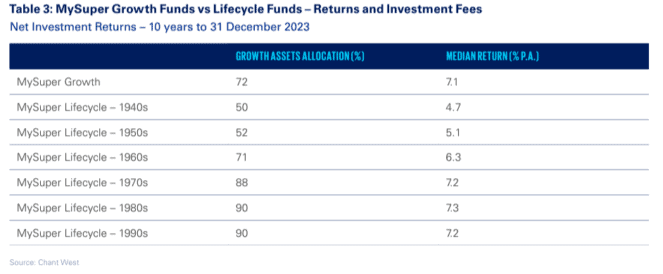
    The KPMG report compared the median annual return of the traditional single-diversified MySuper Growth fund with the returns of different age groups typical of lifecycle superannuation accounts.

    If you have a lifecycle superannuation account, your fund manager will automatically arrange your asset allocations in an age-appropriate way as time goes on.

    The moneysmart.gov.au website explains: “With this option, your fund will typically move your money from growth investments when you’re young to more conservative investments when you’re older.”

    Single diversified MySuper funds are low-fee default funds selected by employers if an employee does not nominate a preferred fund.

    Better returns for those born in the ’70s or later

    The following table published in the KPMG report uses Chant West data showing net investment returns per annum over the 10 years to 31 December 2023.

    Source: Super Insights 2024

    As you can see, lifecycle products suited to those born in the 1970s or later performed better. They had higher median returns per annum at either 7.2% or 7.3%.

    KPMG says these higher returns reflected these lifecycle products containing a higher asset allocation in growth investments. This is because account holders were younger.

    Growth investments typically include ASX shares and international equities.

    Older account holders received lower median returns. They ranged from 4.7% among those born in the 1940s to 5.1% for those born in the 1950s and 6.3% for those born in the 1960s.

    The returns were lower because the account holders were older and closer to retirement.

    Therefore, their lifecycle funds allocated more of their money to conservative or defensive assets, such as cash and bonds, to try to achieve more capital preservation.

    KPMG commented:

    The older lifestyle cohorts missed out on some of the performance as they reduced risk over a period where there were generally strong returns, although they did have greater downside protection in the Covid-induced downturn in 2020 – important if they needed access to their super at that time or soon after.

    Your choice of superannuation fund REALLY matters

    The importance of choosing your superannuation fund carefully was apparent in the data.

    Many Australians do not understand that some retail superannuation funds routinely fail to beat the market’s annual benchmark returns (i.e., those of indexes like the S&P/ASX 200 Index (ASX: XJO)).

    This means many super account holders pay hefty management fees in the belief they are benefitting from their fund’s superior stock-picking services when, in fact, many funds fail to outdo or match benchmark returns. And once fees are paid, account holders’ returns are reduced even further.

    KPMG commented that the superior 10-year returns of the 1970s, 1980s, and 1990s lifecycle products barely exceeded the single-option MySuper Growth Fund.

    The 10-year period saw relatively strong returns from growth assets so we would expect the younger lifecycle portfolios with higher growth assets to do much better, but they were only slightly ahead of the median single option MySuper Growth fund.

    This was due to the underlying assets of these lifecycle products (mainly from retail funds) not performing as well as the underlying assets of the single option MySuper products.

    Compare the performance of your current super fund

    Retail funds are usually run by banks or investment firms. The Federal Government provides a comparison tool so you can compare your current super fund’s performance against others.

    This tool is designed to help you select a superannuation fund, with funds forced to disclose their returns.

    At the time of writing, HostPlus MySuper is the top-performing fund among MySuper products with balances over $50,000. It has a 7.96% average annual return net of fees over a 9-year investment period.

    The worst performer was returning 5.25%, with the Federal Government rating it ‘underperforming’.

    KPMG noted that lifecycle superannuation asset allocations today were different from those in the original models dating back to 2014, “some of which were far more conservative at older ages”.

    Superannuation outflows grow amid wave of retiring boomers

    As we recently reported, new figures from the Australian Prudential Regulation Authority (APRA) out this week showed greater growth in superannuation outflows than inflows over the year to 31 March 2024.

    This was largely due to more benefit payments going out as more baby boomers entered retirement.

    Baby Boomers were born between 1945 and 1964, making the youngest Aussies in this cohort 60 years of age this year.

    This means every baby boomer has now reached preservation age. That’s the age at which we can all begin accessing our superannuation savings.

    The data shows $112.9 billion was paid out, up 18.1% annually. Inflows totalled $177 billion, up 11.3%.

    APRA said the increased outflows were directly linked to more lump sum and pension payments:

    This increase was the result of lump sum payments rising by 18.4 per cent to $63.0 billion and pension payments increasing by 17.7 per cent to $49.8 billion.

    The post If you were born in the 1970s or later, your superannuation is delivering the best returns appeared first on The Motley Fool Australia.

    Maximise Your Super before June 30: Uncover 5 Strategies Most Aussies Overlook!

    With the end of the financial year almost upon us, there are some strategies that you may be able to take advantage of right now to save some tax and boost your savings…

    Download our latest free report discover 5 super strategies that most Aussies miss today!

    Download Free Report
    *Returns 28 May 2024

    More reading

    Motley Fool contributor Bronwyn Allen has no position in any of the stocks mentioned. The Motley Fool Australia’s parent company Motley Fool Holdings Inc. has no position in any of the stocks mentioned. The Motley Fool Australia has no position in any of the stocks mentioned. The Motley Fool has a disclosure policy. This article contains general investment advice only (under AFSL 400691). Authorised by Scott Phillips.

  • Is this ASX 200 energy stock a buy at a P/E of 4.5?

    A woman holds her finger to the side of her lips in contemplation as she looks upwards to an array of graphic images of light bulbs above her head, one of which is on and glowing.

    It’s not too often that an ASX share, even an ASX 200 energy stock, trades on a price-to-earnings (P/E) ratio of 4.5. After all, the average P/E ratio on the ASX right now is closer to 20. 

    A company that is asking an earnings multiple of 4.5 is effectively asking investors to pay $4.50 for every $1 of earnings it brings in. That’s a compelling equation for any value investor to contemplate.

    So today, let’s take a look at this ASX 200 energy stock in question and see if there’s anything to like.

    The stock is none other than AGL Energy Ltd (ASX: AGL). AGL is one of the oldest names on the ASX and one of the most famous energy stocks on the market. It has had a rough trot in recent years, falling from over $21 a share in early 2020 to a multi-decade low of under $4 a share in late 2021.

    Today, AGL shares have recovered substantially, but are still trading at half of what they were just four years ago – asking $10.20. Check all of that out for yourself below:

    Yet despite this recovery, this ASX 200 energy stock remains at an arguably cheap share price. For some ASX shares, including some energy stocks, low earnings multiples are the norm. But for others, it could indicate that a company might be trading at a bargain price. So which is it for AGL?

    Is this ASX 200 energy stock a buy at 4.5 times earnings?

    Well, one ASX expert thinks it’s the latter.

    Rafi Lamm is the co-founder of fund manager L1 Capital. Speaking to the Australian Financial Review (AFR) this week, Lamm noted AGL’s quality and future-proof nature, noting that the company was “well positioned to benefit from strong long-term electricity demand with the lowest cost baseload generation in NSW and Victoria”.

    Lamm also views the current AGL share price as cheap, noting that its “multiple of 4.5 times earnings before interest and tax” is “well below its historic multiple of six times”.

    The fund manager argued that AGL is set for “a solid recovery” in terms of earnings from FY2026 onwards thanks to rising wholesale electricity futures pricing:

    Strong medium term free cash flow will enable solid dividends as well as a substantial investment in the energy transition, for example, in high returning battery storage.

    No doubt this opinion will delight shareholders of this ASX 200 energy stock. But let’s see if Lamm’s call proves accurate.

    At the current AGL share price, this ASX 200 energy stock has a market capitalisation of $6.86 billion, with a dividend yield of 4.80%.

    The post Is this ASX 200 energy stock a buy at a P/E of 4.5? appeared first on The Motley Fool Australia.

    Should you invest $1,000 in Agl Energy Limited right now?

    Before you buy Agl Energy Limited shares, consider this:

    Motley Fool investing expert Scott Phillips just revealed what he believes are the 5 best stocks for investors to buy right now… and Agl Energy Limited wasn’t one of them.

    The online investing service he’s run for over a decade, Motley Fool Share Advisor, has provided thousands of paying members with stock picks that have doubled, tripled or even more.*

    And right now, Scott thinks there are 5 stocks that may be better buys…

    See The 5 Stocks
    *Returns as of 5 May 2024

    More reading

    Motley Fool contributor Sebastian Bowen has no position in any of the stocks mentioned. The Motley Fool Australia’s parent company Motley Fool Holdings Inc. has no position in any of the stocks mentioned. The Motley Fool Australia has no position in any of the stocks mentioned. The Motley Fool has a disclosure policy. This article contains general investment advice only (under AFSL 400691). Authorised by Scott Phillips.

  • 5 things to watch on the ASX 200 on Friday

    On Thursday, the S&P/ASX 200 Index (ASX: XJO) had another poor session and dropped into the red. The benchmark index fell 0.5% to 7,628.2 points.

    Will the market be able to bounce back from this on Friday and end the week on a high? Here are five things to watch:

    ASX 200 poised to rebound

    The Australian share market looks set to end the week on a positive note despite a poor session on Wall Street. According to the latest SPI futures, the ASX 200 is expected to open 50 points or 0.65% higher this morning. On Wall Street, the Dow Jones was down 0.85%, the S&P 500 fell 0.6%, and the NASDAQ was 1.1% lower.

    Oil prices fall

    ASX 200 energy shares Beach Energy Ltd (ASX: BPT) and Karoon Energy Ltd (ASX: KAR) could have a tough finish to the week after oil prices tumbled overnight. According to Bloomberg, the WTI crude oil price is down 1.7% to US$77.87 a barrel and the Brent crude oil price is down 2% to US$81.97 a barrel. Traders were selling oil in response to weak gasoline demand.

    Buy Xero shares

    The Xero Ltd (ASX: XRO) share price could be good value according to analysts at Goldman Sachs. In response to price increases in the UK, the broker has reiterated its conviction buy rating and $164.00 price target on the cloud accounting platform provider’s shares. It said: “Although we believe this pricing update was somewhat expected following the Australian plan announcement, we view it as another incremental positive for Xero and very supportive of our FY25/26 revenue forecasts.”

    Gold price softens

    ASX 200 gold shares including Evolution Mining Ltd (ASX: EVN) and Northern Star Resources Ltd (ASX: NST) could have a subdued finish to the week after the gold price edged lower overnight. According to CNBC, the spot gold price is down 0.1% to US$2,362.8 an ounce. The precious metal appears to be in a holding pattern ahead of the release of US inflation data.

    Pro Medicus shares rated hold

    Analysts at Bell Potter have been impressed with the contract wins announced by Pro Medicus Limited (ASX: PME) this week. As a result, the broker has upgraded the health imaging technology company’s shares to a hold rating with an improved price target of $115.00 (from sell and $75.00). It said: “The announcement of recent contract wins provides a heightened degree of certainty for FY25 revenues and earnings, accordingly there is minimal risk of downgrades to consensus for FY25 following the FY24 earnings announcement.”

    The post 5 things to watch on the ASX 200 on Friday appeared first on The Motley Fool Australia.

    Should you invest $1,000 in Beach Energy Limited right now?

    Before you buy Beach Energy Limited shares, consider this:

    Motley Fool investing expert Scott Phillips just revealed what he believes are the 5 best stocks for investors to buy right now… and Beach Energy Limited wasn’t one of them.

    The online investing service he’s run for over a decade, Motley Fool Share Advisor, has provided thousands of paying members with stock picks that have doubled, tripled or even more.*

    And right now, Scott thinks there are 5 stocks that may be better buys…

    See The 5 Stocks
    *Returns as of 5 May 2024

    More reading

    Motley Fool contributor James Mickleboro has positions in Pro Medicus and Xero. The Motley Fool Australia’s parent company Motley Fool Holdings Inc. has positions in and has recommended Goldman Sachs Group, Pro Medicus, and Xero. The Motley Fool Australia has positions in and has recommended Xero. The Motley Fool Australia has recommended Pro Medicus. The Motley Fool has a disclosure policy. This article contains general investment advice only (under AFSL 400691). Authorised by Scott Phillips.