
• Global companies just paid a record $512 billion in Q1 dividends. Here’s how ASX 200 shares stacked up

    Excited woman holding out $100 notes, symbolising dividends.

    Aussie investors are lucky in that we have a lot of quality S&P/ASX 200 Index (ASX: XJO) shares to tap for passive income.

    Unlike many international markets, many ASX 200 shares also pay out fully franked dividends. That means most investors should be able to hold onto more of that welcome cash when it comes time to pay the ATO their dues.

    And there’s a lot of passive income on the table.

    How much?

    According to the latest Global Dividend Index from Janus Henderson, global companies paid a whopping US$339.2 billion (AU$512 billion) in the first quarter of 2024 (Q1 2024).

    That’s up 2.4% from Q1 2023 on a headline basis, driven by underlying growth of 6.8%.

    In a promising sign, the report also notes that 93% of companies across the world that paid a dividend in the first quarter either maintained or increased their payouts.

    Bank stocks were the star players (and payers). With elevated interest rates across most of the developed world, the dividends paid by banks leapt 12.0% year on year in Q1,

    So, how did ASX 200 shares stack up?

    Q1 dividend growth for ASX 200 shares

    Janus Henderson reported that Australian companies continued to dominate Asia Pacific dividend payments, making up 75% of the total. And I should note here that it’s not just ASX 200 shares that pay dividends. A number of smaller ASX stocks also contribute to the passive income pile.

    The dividends paid by Aussie companies increased by 2.0% in Q1, trailing the 2.4% global growth figure.

    That lag is largely due to a 20% interim dividend cut by the biggest ASX 200 share, BHP Group Ltd (ASX: BHP).

    Janus Henderson noted that excluding BHP, ASX dividends would have enjoyed double-digit growth.

    As with the global banks, the second biggest ASX 200 share, Commonwealth Bank of Australia (ASX: CBA), was a star dividend performer. CBA reached ninth place in the world for its dividend payouts in the first quarter. CBA was the only big four bank to make the top 20 global dividend payer list.

    Commenting on the dividend growth, Matt Gaden, head of Australia at Janus Henderson Investors said, “The resilience of the Australian share market was evident over the quarter as it recorded healthy dividend growth despite the pressures on commodity prices and the mining sector.”

    Gaden added:

    The big four banks remain dividend darlings, showcasing the important role that they play for Australian investors.

    Overall, global economies continue to face inflationary headwinds and the cost of capital is tipped to stay higher for longer.

    But with a wave of government money coming into renewable energies and new opportunities are unlocked by AI technology, dividend investors are urged to remain aware of how these forces will impact global dividends over the medium to long term.

    Now what?

    As to what kind of passive income investors can expect from global and ASX 200 shares, Janus Henderson continues to forecast underlying growth of 5.0% for 2024.

    That will see global companies shell out an eye-watering US$1.72 trillion (AU$2.6 trillion) in dividends over the year.

    The report noted that lower special dividends mean the headline increase is set to be 3.9% year-on-year, equivalent to a rise of 5.0% on an underlying basis.

    The post Global companies just paid a record $512 billion in Q1 dividends. Here’s how ASX 200 shares stacked up appeared first on The Motley Fool Australia.

    Should you invest $1,000 in Bhp Group right now?

    Before you buy Bhp Group shares, consider this:

    Motley Fool investing expert Scott Phillips just revealed what he believes are the 5 best stocks for investors to buy right now… and Bhp Group wasn’t one of them.

    The online investing service he’s run for over a decade, Motley Fool Share Advisor, has provided thousands of paying members with stock picks that have doubled, tripled or even more.*

    And right now, Scott thinks there are 5 stocks that may be better buys…

    See The 5 Stocks
    *Returns as of 5 May 2024

    More reading

    Motley Fool contributor Bernd Struben has no position in any of the stocks mentioned. The Motley Fool Australia’s parent company Motley Fool Holdings Inc. has no position in any of the stocks mentioned. The Motley Fool Australia has no position in any of the stocks mentioned. The Motley Fool has a disclosure policy. This article contains general investment advice only (under AFSL 400691). Authorised by Scott Phillips.


  • Should you buy Coles shares for that hefty 6% dividend yield?

    shopping trolley filled with coins representing asx retail share price.ce

    Coles Group Ltd (ASX: COL) shares have provided investors with a growing stream of dividends over the last few years. The Coles share price has fallen 10% in the past year, as seen on the chart below, making the dividend yield more compelling.

    When a share price drops, it boosts the yield. For example, if a business with a 5% dividend yield suffers a 10% share price fall, the dividend yield becomes 5.5%. As a bonus, the lower Coles share price results in a more appealing price/earnings (P/E) ratio.

    Firstly, let’s look at the passive income potential.

    Is the Coles dividend yield appealing enough?

    The ASX supermarket share has grown its annual payout every year since it started paying dividends in 2019. There aren’t too many S&P/ASX 200 Index (ASX: XJO) shares that have grown their payouts through the COVID-impacted year of 2020 and during the inflation-hit years of FY23 and FY24.

    According to the estimate on Commsec, Coles shareholders are forecast to receive a dividend per share of 67 cents. This translates into a fully franked dividend yield of 4.1%, or around 6% grossed-up with franking credits.

    As a comparison, the Vanguard Australian Shares Index ETF (ASX: VAS) has a partially franked dividend yield of 3.7%, according to Vanguard.

    In my opinion, Coles shares offer a dividend yield that’s stronger than the market.

    But, there’s more to shares than just the passive income – earnings growth and capital growth are also important factors.

    Earnings growth is forecast

    I believe earnings growth is the crucial driver of share prices over the long term.

    The most recent update from the company showed the business is going in the right direction.

    In the third quarter of FY24, Coles reported supermarket sales growth of 5.1% and total sales growth of 3.4%. Revenue is usually a key input for profit growth, so it’s pleasing to see the supermarket segment’s revenue still growing at a solid pace despite the reduction in inflation. Coles reported third-quarter inflation of 2.2%, compared to 6.2% inflation in the third quarter of FY23.

    While Coles is facing higher costs, particularly wages, it’s still forecast by analysts to generate earnings growth in the next few years.

    According to Commsec, Coles’ continuing operations earnings per share (EPS) are forecast to grow 3.7% in FY24 to 81 cents. FY25 EPS is predicted to rise another 4.4% to 84.6 cents, and FY26 EPS is forecast to grow 12.8% to 95.4 cents.

    These numbers put the Coles share price at 20x FY24’s estimated earnings and 17x FY26’s estimated earnings. Profit is predicted to go in the right direction.

    I think there are a number of positives for Coles’ earnings in the medium term, so I’ll mention two. The Australian population keeps growing, which means more potential customers. The new Coles distribution warehouses are getting closer to completion, which will help margins and efficiencies once operational.

    Coles shares are a buy, in my opinion, for both the pleasing dividend and the prospect of growing profit in the years ahead.

    The post Should you buy Coles shares for that hefty 6% dividend yield? appeared first on The Motley Fool Australia.

    Should you invest $1,000 in Coles Group Limited right now?

    Before you buy Coles Group Limited shares, consider this:

    Motley Fool investing expert Scott Phillips just revealed what he believes are the 5 best stocks for investors to buy right now… and Coles Group Limited wasn’t one of them.

    The online investing service he’s run for over a decade, Motley Fool Share Advisor, has provided thousands of paying members with stock picks that have doubled, tripled or even more.*

    And right now, Scott thinks there are 5 stocks that may be better buys…

    See The 5 Stocks
    *Returns as of 5 May 2024

    More reading

    Motley Fool contributor Tristan Harrison has no position in any of the stocks mentioned. The Motley Fool Australia’s parent company Motley Fool Holdings Inc. has no position in any of the stocks mentioned. The Motley Fool Australia has positions in and has recommended Coles Group. The Motley Fool has a disclosure policy. This article contains general investment advice only (under AFSL 400691). Authorised by Scott Phillips.

  • China’s $10,000 EV is coming to Europe. Sorry, America.

    The yellow BYD Seagull electric hatchback.
    The BYD Seagull.

    • Chinese EV company BYD plans to introduce its bargain hatchback Seagull to Europe in 2025.
    • The car's base model sells for less than $10,000 in China.
    • Meanwhile, automakers operating in the US are still slow to provide a more affordable EV option. 

    As some US drivers pine for more affordable electric vehicle options, America is left to watch the rest of the world get access to some of the cheapest EVs on the market.

    Chinese automaker BYD, Tesla's largest rival in China, announced last month that it will bring its affordable electric hatchback, the Seagull, to Europe as soon as 2025, Bloomberg reported.

    The Seagull's base model sells for less than $10,000 in China.

    While European consumers won't see that same price due to tariffs and local standards, according to Bloomberg, BYD executives have said that the car is expected to sell for less than 20,000 euros or $21,500.

    BYD's Seagull already went overseas when it was introduced in smaller EV markets like Mexico, where the car is sold as the Dolphin Mini for about $21,000. And its plans to expand into European territory only increase BYD's position as a dominant global force in the EV auto sector.

    Meanwhile, US drivers are becoming increasingly isolated when it comes to access to cheaper alternatives from the Chinese brand.

    The chances of BYD coming to America have already been slim to none due to a combination of demand and geopolitical tensions, Business Insider reported in March. The Biden Administration said in February that it would be investigating Chinese automakers out of national security concerns that they are collecting sensitive data from consumers.

    But a study on US demand for electric cars from earlier this year by analytics firm GBK collective showed that half of US drivers would consider going electric or hybrid if there were cheaper alternatives, and Biden just further nixed any opportunity for a Chinese company to enter the US market.

    The White House announced Thursday that it will be applying a 100% tax on electric vehicles coming from Chinese brands, citing unfair trade practices and threats to US businesses.

    This means that US consumers just have to hope that automakers free to operate in America will provide an affordable option under $30,000.

    So far, big brands like Tesla or Ford have been slow to deliver.

    Tesla CEO Elon Musk has for years teased the idea of an under-$30,000 EV.

    After Reuters reported in April that Tesla was shifting its focus on robotaxis, analysts said that a cheaper model is more important if the company is looking for a turnaround amid slumping sales. Musk announced in an earnings call in late April that a cheap Tesla is coming.

    Days after Musk's assurance, Ford CEO Jim Farley also confirmed in an earnings call that the company is working on EVs that will cost as low as $25,000 to $30,000.

    "Increasingly, our bet will be on our new small affordable platform developed by our team on the West Coast," he said.

    Spokespeople for BYD, Tesla, and Ford did not respond to a request for comment.

    Read the original article on Business Insider
  • Former Facebook engineer says coding with an AI copilot is like working with a ‘demigod’

    Copilot library Microsoft Build
    Microsoft's Copilot tool.

    • A former Facebook executive says coding alongside an AI copilot is a "mind meld."
    • Aditya Agarwal described the copilot coding experience in a Thursday post on X.
    • "The lines between the creator and the tool will blur," he wrote.

    A former Facebook director is praising AI's prowess, likening the technology's co-pilot coding ability to a religious experience.

    In a Thursday post on X, Aditya Agarwal attempted to describe the feeling of coding alongside a large language model co-pilot.

    "It's like someone has jacked up your own abilities by an order of magnitude, while achieving a complete mind meld with what you're trying to do," he wrote.

    https://platform.twitter.com/widgets.js

    Agarwal was one of Facebook's first engineers, serving as director of product engineering at the company from 2005 to 2010. He was instrumental in the development of several Facebook staples, including search, news feed, and messenger, according to his LinkedIn.

    After leaving Facebook, Agarwal cofounded the collaboration startup Cove and later spent more than six years as chief technology officer at file-sharing and storage startup Dropbox. He's a current partner at South Park Commons, an entrepreneurial firm that funds seed-stage startups.

    In his Thursday post, Agarwal said he found it difficult to explain the feeling of coding alongside an AI co-pilot but compared the experience to working with a "demigod" that "amplifies your abilities and anticipates your every move."

    "It's a level of all-encompassing synergy that's hard to fathom until you've experienced it firsthand," he wrote.

    Several technology companies that are developing artificial intelligence have created copilot tools, which essentially act as AI assistants helping users with various tasks. Microsoft's Copilot tool is one such productivity device that relies on OpenAI's GPT-4.

    Agarwal said the tool's power goes beyond simple auto-complete. Relying on a large language model, like GPT-4, an AI copilot is able to "predict your actual intent, presaging what you aim to build," he added.

    "Coding is clearly the tip of the spear here, as it's the creative activity we've most clearly plugged into LLMs," Agarwal wrote. "But this is the direction many creative pursuits are headed."

    The future of AI assistant tools, Agarwal said, is about "co-creation."

    "The lines between the creator and the tool will blur," he added.

    Agarwal didn't immediately respond to Business Insider's request for further comment.

    The introduction of AI tools into professional settings has increased anxiety about the future of work in industries across the board. BI's Aki Ito reported last year that the transition for programmers could be especially difficult as coders are inevitably displaced and forced to adapt to a new normal.

    But artificial intelligence will also make programmers' jobs easier, allowing them to focus on higher-level tasks, BI previously reported

    Read the original article on Business Insider
  • Here are 2 changes to superannuation in the Federal Budget

    woman holding her baby and looking at her phone happy at the rising share price

    There were two changes to superannuation in the recent Federal Budget that are worth noting, says Kym O’Brien, a partner at financial advisory firm Findex.

    Ms O’Brien commented:

    The changes announced generally relate to making superannuation savings more equitable and boosting retirement savings.

    Firstly, eligible parents will soon receive a 12% contribution of their government-funded paid parental leave towards their superannuation.

    Secondly, starting July 2026, employers will be obligated to pay superannuation alongside salaries and wages, intending to enhance retirement savings and address issues like unpaid superannuation.

    Let’s take a closer look at the details.

    Superannuation for workers on paid parental leave

    Eligible workers will receive Superannuation Guarantee contributions while on government-funded paid parental leave to look after their babies.

    Parents of babies born or adopted on or after 1 July 2025 will receive the super payments.

    From 1 July this year, the Superannuation Guarantee paid by employers to eligible workers will increase from 11% to 11.5%.

    On 1 July 2025, it will increase again to 12%. This is what parents on paid government-funded leave will receive.

    Ms O’Brien said this was designed to reduce the impact of career breaks to care for children on retirement savings.

    She said:

    The ATO will make payments directly to superannuation accounts on an annual basis from 1 July 2026. Contributions will count towards the concessional contributions cap and be taxed within the superannuation fund at the super tax rate of 15%.

    This increase in superannuation contributions for eligible parents can bolster their retirement savings while still caring for their young children, potentially reducing financial strain during their retirement years.

    Workers to receive super payments with salary and wages

    Ms O’Brien said 4 million Australians currently receive their Superannuation Guarantee payments from their employers on a quarterly basis, rather than at the same time as their salary or wages.

    Ms O’Brien said the recent Federal Budget includes a plan to change this from 1 July 2026.

    She explained:

    In an effort to boost retirement savings and improve workplace productivity, from 1 July 2026, employers will be required to pay their employees’ superannuation at the same time as their salary and wages.

    This is designed to address an estimated $5 billion a year in unpaid superannuation by making it easier for workers to keep track of payments, reduce the risk of businesses building up large superannuation balances and for the Australian Taxation Office to monitor compliance.

    A couple more things to note…

    From 1 July this year, the superannuation concessional contributions cap will increase from $27,500 to $30,000 per annum.

    The concessional contributions cap is the maximum amount of money you can have paid into your superannuation each year.

    It combines your employer’s compulsory Superannuation Guarantee payments, any salary sacrifice amounts you have organised with your employer, and any extra personal contributions that you make.

    Concessional contributions are taxed at 15% instead of your marginal tax rate.

    So, if you deposit $5,000 of after-tax dollars into your superannuation as a personal contribution, you can claim a $5,000 tax deduction on your tax return for that financial year.

    With the end of FY24 approaching, Vanguard Australia provides five easy ways to get more money into your super by 30 June.

    By the way, here is how much superannuation you need to retire comfortably in 2024.

    The post Here are 2 changes to superannuation in the Federal Budget appeared first on The Motley Fool Australia.

    Wondering where you should invest $1,000 right now?

    When investing expert Scott Phillips has a stock tip, it can pay to listen. After all, the flagship Motley Fool Share Advisor newsletter he has run for over ten years has provided thousands of paying members with stock picks that have doubled, tripled or even more.*

    Scott just revealed what he believes could be the ‘five best ASX stocks’ for investors to buy right now. We believe these stocks are trading at attractive prices and Scott thinks they could be great buys right now…

    See The 5 Stocks
    *Returns as of 5 May 2024

    More reading

    Motley Fool contributor Bronwyn Allen has no position in any of the stocks mentioned. The Motley Fool Australia’s parent company Motley Fool Holdings Inc. has no position in any of the stocks mentioned. The Motley Fool Australia has no position in any of the stocks mentioned. The Motley Fool has a disclosure policy. This article contains general investment advice only (under AFSL 400691). Authorised by Scott Phillips.
  • ASX 200 bank shares: How dividends offset poor capital growth over 10 years

    Calculator on top of Australian 4100 notes and next to Australian gold coins.

    ASX 200 bank shares have had a stellar run since the 2023 Santa Rally began in early November, as the following chart shows.

    If you prefer the hard numbers, here’s a summary of the share price growth among the seven biggest ASX 200 bank shares since 1 November 2023:

    • The Westpac Banking Corp (ASX: WBC) share price has soared 30.44%
    • The Bendigo and Adelaide Bank Ltd (ASX: BEN) share price has risen 26.32%
    • The Commonwealth Bank of Australia (ASX: CBA) share price has lifted 25.03%
    • The National Australia Bank Ltd (ASX: NAB) share price has ascended 22.64%
    • The Macquarie Group Ltd (ASX: MQG) share price has increased 20.35%
    • The Australia and New Zealand Banking Group Ltd (ASX: ANZ) share price has lifted 14.85%
    • The Bank of Queensland Ltd (ASX: BOQ) share price has risen 14.71%

    By comparison, the S&P/ASX 200 Index (ASX: XJO) has lifted 15.21% and the S&P/ASX 200 Financials Index (ASX: XFJ) has increased 21.68% since 1 November.

    Why have ASX 200 bank shares had such a good run?

    The Motley Fool’s chief investment officer, Scott Phillips, says it probably reflects expectations that interest rates will come down soon and that the banks will suffer fewer mortgage defaults as a result.

    Plus, as interest rates stagnate, and then fall, bank dividends will look more appealing to income investors.

    Regardless of the reasons, this sort of strong capital growth among ASX 200 bank shares is unusual.

    Historically, ASX 200 bank shares have typically been better income investments than growth investments.

    At the ASX Investor Day in Sydney this month, attendees were reminded of this during a presentation by investment strategist Marc Jocum from exchange-traded fund (ETF) provider Global X.

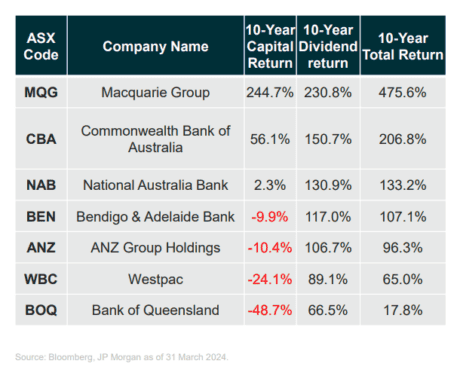
    Jocum showed a table documenting the 10-year history of both capital growth and dividend returns for each of the seven biggest ASX 200 bank shares. That table is shown below.

    Source: Global X investor presentation, ASX Investor Day, Sydney

    Jocum was discussing how to optimise an investment portfolio for income, and emphasised the importance of a ‘total returns approach’ that takes annual dividend returns into account.

    According to his presentation:

    Most of the largest Australian banks have had negative capital returns. Dividends can add as an important source of returns and help cushion drawdowns.

    As the table shows, only one ASX 200 bank share delivered more capital growth than dividends over the past 10 years to 31 March 2024, and that was Macquarie.

    The other ASX 200 banks delivered more in dividend returns than capital growth. In fact, some delivered negative capital growth.

    But when you combined the growth and dividends, investors in every bank stock were in the green.

    The three best ASX 200 bank shares for total returns were Macquarie, CBA and National Australia Bank.

    The numbers demonstrate how important dividend returns are when selecting any type of ASX share or ASX ETF to buy.

    For example, CBA shares delivered just 56.1% capital growth but 150.7% in dividends over the period.

    Should you buy bank stocks?

    After such strong share price gains over the past seven months, many brokers currently have sell or hold ratings on the banks.

    Ray David, Portfolio Manager and Partner at Blackwattle Investment Partners, says bank shares “look like they’ve overstretched on valuations” and ASX 200 mining stocks are better value.

    After the recent round of updates from the ASX 200 banks, Wilsons says it is retaining an underweight exposure and noted a “lacklustre medium and long-term EPS growth outlook facing the sector.”

    In a new note this week, Goldman Sachs said bank fundamentals are weak and valuations are extreme, with bank stocks trading at “close to record expensive” levels.

    Goldman said:

    … while the deterioration in earnings appears to now be finished, we see very limited upside risk, and therefore, with valuations skewed asymmetrically to the downside, we now think a more negative view on the banks is appropriate …

    The post ASX 200 bank shares: How dividends offset poor capital growth over 10 years appeared first on The Motley Fool Australia.

    Should you invest $1,000 in Australia And New Zealand Banking Group right now?

    Before you buy Australia And New Zealand Banking Group shares, consider this:

    Motley Fool investing expert Scott Phillips just revealed what he believes are the 5 best stocks for investors to buy right now… and Australia And New Zealand Banking Group wasn’t one of them.

    The online investing service he’s run for over a decade, Motley Fool Share Advisor, has provided thousands of paying members with stock picks that have doubled, tripled or even more.*

    And right now, Scott thinks there are 5 stocks that may be better buys…

    See The 5 Stocks
    *Returns as of 5 May 2024

    More reading

    Motley Fool contributor Bronwyn Allen has positions in Anz Group, Commonwealth Bank Of Australia, and Macquarie Group. The Motley Fool Australia’s parent company Motley Fool Holdings Inc. has positions in and has recommended Goldman Sachs Group and Macquarie Group. The Motley Fool Australia has positions in and has recommended Bendigo And Adelaide Bank and Macquarie Group. The Motley Fool has a disclosure policy. This article contains general investment advice only (under AFSL 400691). Authorised by Scott Phillips.

  • Nvidia did it again. Is the AI stock a buy after another round of record profits?

    Digital rocket on a laptop.

    This article was originally published on Fool.com. All figures quoted in US dollars unless otherwise stated.

    Coming into Nvidia’s (NASDAQ: NVDA) fiscal 2025 first-quarter earnings report, expectations were sky-high.  

    Nvidia stock has been the flag-bearer for the generative artificial intelligence (AI) revolution. The company makes the technological components — graphics processing units (GPUs) and related superchips — that form the backbone of AI infrastructure, allowing companies like OpenAI to run models like ChatGPT.

    With the explosion in AI demand, Nvidia’s revenue has skyrocketed, more than tripling over the last few quarters. And that pattern continued in fiscal 2025’s first quarter.

    According to the report released Wednesday afternoon, revenue jumped 262% year over year to $26 billion, topping estimates at $24.7 billion and growing 18% sequentially. Revenue in the data center, where the AI revolution is happening, soared 427% year over year to $22.6 billion.

    Margins expanded again, a testament to Nvidia’s pricing power in the data center market, as it has an estimated 98% share of the data center GPU market. On a generally accepted accounting principles (GAAP) basis, gross margin jumped from 64.6% to 78.4%, driving operating income up 690% to $16.9 billion, giving the company an operating margin of 64.9%. On an adjusted basis, earnings per share jumped from $1.09 to $6.12, beating the consensus analyst estimate of $5.59.

    Nvidia enters a new stage

    The first-quarter earnings report also marks something of a milestone for Nvidia, as the company’s year-over-year comparisons will get harder from here. In other words, the initial explosion in demand driven by the launch of ChatGPT and other AI applications will start to fade.

    However, the business still looks well-positioned for continued growth. The company is forecasting revenue of $28 billion in fiscal 2025’s second quarter, suggesting 107% year-over-year growth and 7.5% sequential growth. It also expects gross margin to moderate slightly over the rest of the year, calling for a full-year gross margin in the mid-70% range. Second-quarter guidance indicates GAAP operating income will be essentially flat on a sequential basis, though the company has a pattern of topping its own guidance.

    Despite its moderating growth, CEO Jensen Huang and Nvidia’s management team shared several anecdotes on the earnings call that show that demand for Nvidia’s products is still heating up. For example, management said that inference drove 40% of data center revenue over the last quarter, implying that training represented the majority of data center revenue as training and inference are the two primary functions needed to run AI models.

    Demand for inference is expected to be much larger than training as generative AI matures, so that data point indicates that the development of these models is still in a very early stage. The company also noted large purchases from customers like Tesla and Meta Platforms, which implies growing demand for inference from Nvidia later.

    Additionally, Huang said that demand for its Hopper platform is still strong and growing, even though it announced the next iteration, Blackwell, at its GTC conference in March. Huang elaborated:

    We … expect demand to outstrip supply for some time as we now transition to H200, as we transition to Blackwell. Everybody is anxious to get their infrastructure online. And the reason for that is because [customers are] saving money and making money, and they would like to do that as soon as possible.

    The fact that customers aren’t waiting for the newer model to drop shows how high demand is for Nvidia’s products, and that should continue to provide a tailwind over the coming quarters.

    Is Nvidia stock a buy?

    Some billionaire investors, like Stanley Druckenmiller and David Tepper, have begun selling off their stakes in Nvidia following the chip stock’s dramatic surge over the last year or so. However, there’s still room for the stock to move higher as the business keeps delivering incredible results.

    Investors shouldn’t expect the triple-digit revenue growth in the business to continue, and the stock’s blowout gains are also likely in the past as its market cap approaches $3 trillion. However, the business looks even stronger than it did three months ago, and there’s no sign of any competitive pressure despite recent product launches from Advanced Micro Devices and Intel.

    Huang sees the company building “AI factories” and driving the “next industrial revolution.” Those are bold statements, but the numbers back them up, and if the opportunity is that big, Nvidia will have a lot of growth in front of it.

    Investors sent Nvidia stock up 7% in pre-market trading on Thursday, a sign that the company has more upside potential. If the company can keep executing like this, the stock will continue to be a winner. 

    This article was originally published on Fool.com. All figures quoted in US dollars unless otherwise stated.

    The post Nvidia did it again. Is the AI stock a buy after another round of record profits? appeared first on The Motley Fool Australia.

    Should you invest $1,000 in Nvidia right now?

    Before you buy Nvidia shares, consider this:

    Motley Fool investing expert Scott Phillips just revealed what he believes are the 5 best stocks for investors to buy right now… and Nvidia wasn’t one of them.

    The online investing service he’s run for over a decade, Motley Fool Share Advisor, has provided thousands of paying members with stock picks that have doubled, tripled or even more.*

    And right now, Scott thinks there are 5 stocks that may be better buys…

    See The 5 Stocks
    *Returns as of 5 May 2024

    More reading

    Randi Zuckerberg, a former director of market development and spokeswoman for Facebook and sister to Meta Platforms CEO Mark Zuckerberg, is a member of The Motley Fool’s board of directors. Motley Fool contributor Jeremy Bowman has no position in any of the stocks mentioned. The Motley Fool Australia’s parent company Motley Fool Holdings Inc. has positions in and recommends Advanced Micro Devices, Meta Platforms, Nvidia, and Tesla. The Motley Fool recommends Intel and recommends the following options: long January 2025 $45 calls on Intel and short May 2024 $47 calls on Intel. The Motley Fool has a disclosure policy. This article contains general investment advice only (under AFSL 400691). Authorised by Scott Phillips.

  • 3 of the best ASX 200 shares to buy for your retirement portfolio

    Are you on the hunt for some ASX 200 shares to add to your retirement portfolio?

    If you are, then the three ASX 200 shares listed below could be top options right now. Here’s what analysts are saying about them:

    CSL Limited (ASX: CSL)

    CSL could be a great option for a retirement portfolio. The ASX 200 biotech share is arguably one of Australia’s highest quality companies.

    This is thanks to its collection of industry-leading therapies, which includes Privigen, Hizentra, Idelvion, and Afstyla. In addition, the company invests around US$1 billion (and growing) into its research and development activities each year. This ensures that CSL has a pipeline filled to the brim with potentially lucrative and life-saving drug candidates.

    Macquarie is a big fan of CSL and has an outperform rating and $330.00 price target on its shares. It also sees scope for its shares to rise beyond $500 in the next three years.

    Transurban Group (ASX: TCL)

    Another ASX 200 share that could be worth considering for a retirement portfolio is Transurban.

    It owns a portfolio of roads in Australia and North America, as well as a significant project pipeline.

    As these roads are always in demand with drivers, particularly given population growth and urbanisation, Transurban has defensive qualities that could make it attractive for retirees.

    The team at Citi sees a lot of value in Transurban’s shares at current levels. It has a buy rating and $15.50 price target on them.

    Another positive is that the broker expects some attractive dividend yields from its shares in the near term. It is forecasting yields of 5% in FY 2024 and 5.1% in FY 2025.

    Woolworths Limited (ASX: WOW)

    A final ASX 200 share that could be a good option for a retirement portfolio is Woolworths. It is Australia’s largest supermarket chain, as well as the owner of Big W and a growing pet care business.

    Woolworths could be a good option for a retirement portfolio due to its defensive qualities, strong market position, and positive growth outlook. Goldman Sachs notes that the latter is being underpinned by its omni-channel advantage and sticky loyalty program.

    It is for this reason that the broker is tipping Woolworths as a buy with a $39.40 price target on its shares.

    In addition, Goldman is expecting attractive dividend yields from its shares in the coming years. It is forecasting yields of 3.4%, 3.6%, and 3.9%, respectively, over the next three financial years.

    The post 3 of the best ASX 200 shares to buy for your retirement portfolio appeared first on The Motley Fool Australia.

    Should you invest $1,000 in CSL right now?

    Before you buy CSL shares, consider this:

    Motley Fool investing expert Scott Phillips just revealed what he believes are the 5 best stocks for investors to buy right now… and CSL wasn’t one of them.

    The online investing service he’s run for over a decade, Motley Fool Share Advisor, has provided thousands of paying members with stock picks that have doubled, tripled or even more.*

    And right now, Scott thinks there are 5 stocks that may be better buys…

    See The 5 Stocks
    *Returns as of 5 May 2024

    More reading

    Citigroup is an advertising partner of The Ascent, a Motley Fool company. Motley Fool contributor James Mickleboro has positions in CSL. The Motley Fool Australia’s parent company Motley Fool Holdings Inc. has positions in and has recommended CSL, Goldman Sachs Group, Macquarie Group, and Transurban Group. The Motley Fool Australia has positions in and has recommended Macquarie Group. The Motley Fool Australia has recommended CSL. The Motley Fool has a disclosure policy. This article contains general investment advice only (under AFSL 400691). Authorised by Scott Phillips.

  • 2 teens won $50,000 for inventing a device that can filter toxic microplastics from water

    Victoria Ou and Justin Huang stand on stage in blue suits holding their award
    Victoria Ou (right) and Justin Huang (middle) won first place in their category and also snagged one of the top $50,000 prizes for their invention.

    • Victoria Ou and Justin Huang, both 17, won $50,000 for their microplastic filtration device.
    • It's the first filtration system to successfully use ultrasound to filter microplastics from water.
    • They hope to scale their device for water treatment plants to reduce microplastic pollution worldwide.

    Two teenagers from Woodlands, Texas invented a device that could help address one of the most pervasive and challenging forms of pollution on Earth: microplastics.

    These microscopic plastic particles show up in the deepest parts of the ocean, at the top of Mount Everest, and are in everything from the dust in your home to your food and water.

    By some estimates, we each inhale and ingest a credit card's worth of plastic per week. Then it can end up in our lungs, blood, breastmilk, and testicles.

    Victoria Ou and Justin Huang, both 17, hope to prevent that one day with their award-winning device that removes microplastics from water using ultrasonic — or high-frequency — sound waves. Their device is the first to use this method successfully.

    Ou and Huang presented their work at last week's Regeneron International Science and Engineering Fair (ISEF) in Los Angeles, where top competitors from science fairs worldwide congregated to share their projects and compete for $9 million in prizes.

    The Texas duo received first place in their Google-sponsored category, Earth and Environmental Sciences, and they also snagged the $50,000 prize from the Gordon E. Moore Award for Positive Outcomes for Future Generations.

    Victoria Ou and Justin Huang stand with their arms raised wearing giant gold medals around their necks
    It's gotta feel good to win two prizes in one day.

    Though the ultrasonic technique is in its very early stages, the high schoolers hope that one day it could filter the plastic out of your drinking water and from the industrial and wastewater that humans dump into the environment.

    "This is the first year we've done this," Huang told Business Insider backstage after receiving their award. "If we could refine this — maybe use more professional equipment, maybe go to a lab instead of testing from our home — we could really improve our device and get it ready for large-scale manufacturing."

    While it's unclear how microplastics affect human health, many common chemicals in plastic have been linked to increased risk of cancer, fertility and development issues, and hormone disruption. And we're still a long way from getting rid of microplastics.

    The challenge of filtering microplastics

    White microplastic beads inside a black container under a microscope
    Microplastics have been found in everything from human blood to snow on Mt. Everest.

    Last fall, while brainstorming ideas for their ISEF project, Ou and Huang visited a water treatment plant. They wanted to find out whether this type of facility already had tools that could remove microplastics from wastewater.

    The answer, they discovered, was no. The EPA doesn't regulate microplastics, the employees told Huang and Ou, so they don't remove them from wastewater.

    "We knew, from then, to focus on this issue," Huang told BI.

    Even if the EPA began regulating these pernicious plastic particles tomorrow, existing removal methods have problems, Huang said.

    One solution is to use chemical coagulants, such as aluminum hydroxide, that — when added to water — clump microplastics together into larger, more easily filtered chunks. However, chemical coagulants can also pollute the environment and mess with the PH of purified water. Plus, they're expensive.

    There are also some physical filters available, but they clog easily. And biological solutions, like using enzymes to break down plastics, aren't efficient enough to tackle this problem at scale.

    "We wanted to find a solution to this because current solutions aren't really effective," Huang said.

    So, Ou and Huang — who have been friends since elementary school and connected over their shared interest in the environment — set out to invent their own environmentally friendly, inexpensive, and efficient solution.

    How it works

    Victoria Ou and Justin Huang stand in front of their science fair poster holding a small device in their hands that they invented
    The device Victoria Ou (left) and Justin Huang (right) invented is small but they hope to scale it up.

    Huang and Ou's device is remarkably small, about the size of a pen. It's essentially a long tube with two stations of electric transducers that use ultrasound to act as a two-step filter.

    As water flows through the device, the ultrasound waves generate pressure, which pushes microplastics back while allowing the water to continue flowing forward, Ou explained. What comes out the other end is clean, microplastic-free water.

    The two teens tested their device on three common types of microplastics: polyurethane, polystyrene, and polyethylene. In a single pass, their device can remove between 84% and 94% of microplastics in water, according to a press release.

    Future work

    Victoria Ou and Justin Huang stand back to back wearing a black and blue suit
    Victoria Ou and Justin Huang didn't expect to win at ISEF. "I'm still pinching myself trying to figure out if this is real or not," Huang said.

    Ou and Huang believe their technology could be used in wastewater treatment plants, industrial textile plants, sewage treatment plants, and rural water sources. On a smaller scale, it could filter microplastics in laundry machines and even fish tanks.

    But first, there's more work to be done. "To reach that stage, I think we need a lot more processing," Ou said. "This is a pretty new approach. We only found one study that was trying to use ultrasound to predict the flow of particles in water, but it didn't completely filter them out yet."

    Huang agrees. "I hope we just are able to be able to scale this up, but first we have to refine it because this technology is still at its infancy," he said.

    Their $50,000 prize could help them get there. In the meantime, though, they're enjoying the moment.

    "We were just happy being able to go to ISEF. Originally, we weren't expecting too much, but getting first place and the top award is much more than we ever expected," Ou said.

    "This is something that I've been dreaming of my whole life, so I'm still pinching myself trying to figure out if this is real or not," Huang said.

    Read the original article on Business Insider
  • The unconventional ways Jeff Bezos, Elon Musk, and other tech leaders like to run their companies

    Mark Zuckerberg, Elon Musk, and Tim Cook against a yellow background.
    L-R: Elon Musk, Tim Cook, Mark Zuckerberg, who each have some interesting management practices.

    • Tech titans like Elon Musk and Tim Cook run some of the world's biggest companies.
    • In so doing, they've employed some outright strange management practices.
    • From banning PowerPoints to having 50 direct reports, here are tech leaders' most unconventional management habits.

    They're some of the best-known CEOs in the world. But while we may know more about their flashy real estate buys and jet-setting habits, we don't have as good a glimpse into how they run their companies behind closed doors.

    Here are some of the most notable management quirks from tech's biggest names:

    Jeff Bezos
    Amazon CEO Jeff Bezos
    Amazon cofounder Jeff Bezos had some special rules for meetings.

    When he was still CEO of Amazon, Bezos employed the "two-pizza rule" to limit teams to only as many people as could be fed with two pizzas.

    He also famously banned PowerPoints, instead telling employees to write six-page memos for meetings, which began with attendees silently reading the document.

    Elon Musk
    Elon Musk
    Elon Musk isn't a big fan of people being in meetings if they're not contributing value.

    Musk, the CEO of companies including Tesla and X, formerly Twitter, has described himself as a "nanomanager." Consistent with that style, Musk doesn't like delegating and last year told Tesla staff he wanted to personally approve all new hires.

    Musk also encourages people to leave meetings rather than stay in some cases. In a 2018 email to Tesla staff, he said there should generally be fewer, shorter meetings and wrote, "Walk out of a meeting or drop off a call as soon as it is obvious you aren't adding value."

    He's also said employees can feel free to buck the chain of command to get things done.

    "Anyone at Tesla can and should email/talk to anyone else according to what they think is the fastest way to solve a problem for the benefit of the whole company," he wrote in an email to Tesla staff a few years back. "You can talk to your manager's manager without his permission, you can talk directly to a VP in another dept, you can talk to me, you can talk to anyone without anyone else's permission."

    Mark Zuckerberg
    Mark Zuckerberg standing in front of a graphic that says, "AI imagined with AI."
    Mark Zuckerberg made Meta a flatter organization after the pandemic.

    Meta's chief executive also doesn't like to delegate, saying leaders should "make as many decisions and get involved in as many things as you can."

    Zuckerberg has also tried to cut back on bloat and made the company flatter during his famous "Year of Efficiency," saying he doesn't like a structure of "managers managing managers."

    Zuckerberg also famously likes to wear the same outfit every day to save brainpower for more important decisions.

    Jensen Huang
    Jensen Huang in front of the Nvidia logo.
    Nvidia CEO Jensen Huang has an incredibly large number of direct reports.

    Huang believes CEOs should have the most direct reports of anyone, and it shows.

    The Nvidia CEO has a lot of direct reports — 50 to be exact.

    And as Nvidia enjoys a boom time as its share price soars amid the AI era, Business Insider first reported that its CEO also awarded employees with a "Jensen special grant" that boosted their stock awards by 25% this year.

    Tim Cook
    Tim Cook
    You'd better be ready for a question from Tim Cook — and plenty of follow-ups.

    Cook grills employees in meetings to make sure they know their stuff.

    As a former Apple employee told Cult of Mac editor Leander Kahney for his 2019 book on Cook, "He'll ask you ten questions. If you answer them right, he'll ask you ten more. If you do this for a year, he'll start asking you nine questions. Get one wrong, and he'll ask you 20 and then 30."

    Larry Page and Sergey Brin
    Larry Page Sergey Brin
    Google's cofounders attribute their "20% time" policy with spawning AdSense and Google News.

    Google's cofounders implemented the "20% time" policy encouraging employees "to spend 20 percent of their time working on what they think will most benefit Google," like a side project besides their usual work, they wrote in 2004.

    Page and Brin, in fact, credit the rule with the creation of AdSense and Google News.

    Read the original article on Business Insider