Google's headquarters, known as the Googleplex, spans some 12 acres of land and has over 2 million square feet of office space.
Brooks Kraft LLC/Corbis via Getty Images
Googleplex is the global headquarters for Google and Alphabet, located in Mountain View, California.
Google recently expanded Googleplex's campus to add more amenities for employees.
Googleplex is one of dozens of US-based offices; Google has another headquarters in New York City.
The Googleplex, the global headquarters for Google and its parent company Alphabet, is located in Mountain View, California.
The name Googleplex has two meanings. First, it's a portmanteau of "Google" and "complex." But it has an additional significance that connects to the origin of Google's name.
A "googol" is a totally massive number, and the source of the tech giant's name. A googolplex is equal to 10 to the googol power.
The Googleplex campus spans about 12 acres of land with over 3 million square feet of office space. It is Google's largest headquarters, closely rivaled by its nearly 3-million-square-foot office building in Manhattan.
Google co-founders Sergey Brin and Larry Page rented out their friend Susan Wojcicki's garage to use as office space when the company was first incorporated in 1998. Just a few years later, in 2006, Google purchased the Googleplex for $319 million.
The company's headquarters, where Google CEO Sundar Pichai spends his work days, has since undertaken a number of expansions, including one in 2019 that added over 30,000 square feet of new space. The Googleplex expansion included multiple cafes, fitness facilities, and lounge areas. The design theme is based on the historical salt production that took place in the local marshes.
How many Google headquarters are there in the US?
Google's latest office expansion includes a new building in New York City next to the Hudson River. The building was once a train terminal.
Michael M Santiago/Getty Images
There are more than 70 offices in 50 countries around the world, according to the company's website.
In the United States, Google's footprint covers well over two dozen cities, including Miami, Detroit, Pittsburgh, Boulder, Chicago, and Portland.
Google's office sites are often unique buildings that reflect the history of the cities where they're located.
For instance, the Pittsburgh office is located in a former Nabisco factory, its Chicago office is a converted cold storage facility, and its LA office is located in a historic airplane hangar. Google DeepMind is located in an 11-storey building in Kings Cross, London.
Google's New York headquarters, located in an old train terminal next to the Hudson River, opened in February 2024. The new HQ features rooftop solar panels, multiple terraces and gardens, an event space, and communal workspaces and lounges.
It's unclear exactly how many employees work at the Googleplex in California. But altogether, Alphabet, Google's parent company, employed some 182,500 workers as of 2023.
The Googleplex's famous amenities — including gardens, fitness classes, and "MicroKitchens" — have long drawn tech workers to seek out prestigious Google jobs.
While you can't enter the buildings without being accompanied by an authorized employee, you are free to walk the grounds of the complex. You can check out the tyrannosaurus rex statue that's meant to remind employees to stay on the cutting edge and avoid becoming dinosaurs, the Android sculpture park, the gardens that grow food for the campus restaurants, sports fields, and more.
If you're looking for more than self-guided wandering, you can head next door to Google's Gradient Canopy office, which is home to the Google Visitor Experience. You can attend workshops and other events at the Huddle, check out local goods at Google's pop-up shop, visit cafes and the Google Store, and take in interesting outdoor art installations on the Plaza.
The AI may not let you get away with your snarky remarks any longer.
Getty Images
OpenAI may unveil a new multimodal AI assistant on Monday, The Information reported.
This technology could, in theory, help automated customer service agents detect sarcasm.
The new model could also be integrated into OpenAI's chatbot ChatGPT.
Wannabe stand-up comedians and frustrated customers, beware: The robot phone operators may not find your deadpan insults amusing in the future.
The Information reported that machine learning company OpenAI could unveil a voice assistant with both audio and visual capabilities that could, in theory, detect sarcasm.
Finally.
According to one person with knowledge of the new tech who spoke with The Information, the mystery assistant could improve on the automated customer service agent technology the company already offers.
TheAI assistant— which can talk to users and recognize objects and images — could have many other features, of course, the outlet reported, citing two people who have seen it themselves. These features include "a better understanding of image and audio" and "better logical reasoning," per the report.
The technology could berevealed as soon as Monday during OpenAI's planned livestream announcing updates on their GPTtechnology.
"The assistant could theoretically do a range of things not possible today, such as acting as a tutor for a student working on a paper or on math problems, or giving people information about their surroundings when they ask for it, like translating signs or explaining how to fix car troubles," the report said.
The new multimodal model is still prone to AI hallucinations — a phenomenon where models spit out answers that have no basis in reality — a person familiar with it told The Information.
This new tech could eventually be integrated into the publicly available and free version of OpenAI's popular chatbot ChatGPT.
The Information reports the tech will move CEO Sam Altmanone step closer to creating a more useful AI assistant similar to the virtual Samantha, played by Scarlett Johansson in the movie "Her" — though hopefully, no one falls in love with it. (That was not sarcasm.)
Representatives for OpenAI did not immediately respond to a request for comment.
Student protesters, like their predecessors, are being met with a heavy police presence.
Jeremy Hogan/SOPA Images/LightRocket via Getty Images // Howard Ruffner/Getty Images
Students and their professors are asking universities to divest from Israel.
At Indiana University, protesters say they've been met with a militarized response from police.
Professors say the current protests share stark differences and chilling similarities to past ones.
On April 25, a day after Indiana University made a controversial change to its protest policies, students built an encampment on the school's Dunn Meadow.
The meadow had been designated a free speech lawn since 1969, when the school experienced increased student protests over tuition hikes, anti-Black racism, and the Vietnam War.
Multiple generations of activists are now gathered on that same ground to protest Israel's war on Gaza — though the police presence was much different than what protesters before had known or experienced, per people who spoke to Business Insider.
The decision made on April 24 required that the "temporary or permanent installation of structures in Dunn Meadow (including, but not limited to posters, tents, etc.) at any time must be approved in advance by the university and, if approved, adhere to the guidelines provided by the university," according to a statement from Indiana University President Pamela Whitten.
The university enforced its policy against the encampments by calling police to arrest demonstrators who did not comply with the rule against "unapproved temporary or permanent structures," it said in a press release.
A statement from Whitten shared with Business Insider said the policy change was made to "balance free speech and safety in the context of similar protests occurring nationally."
The change resulted in what Barbara Dennis, a 64-year-oldprofessor at Indiana University's School of Education and self-described "longtime peace activist," called a "militarized" police response.
A Palestinian flag waves over the Indiana University Liberated Zone.
Isabella Volmert/AP Photo
She joined the campus protests on April 25 alongside her husband, an IU staff member. Within hours, Dennis was detained — and is now appealing a one-year ban from entering the university campus.
Dennis said the response was unlike anything she had witnessed on campus since she began teaching there in 2001 and went against everything she knew beforehand about the university's history.
From Vietnam to the Israel-Hamas War
When Dunn Meadow was established in 1969, official university policy dictated that overnight encampments were not allowed. Despite this, Dennis said the policy had never been enforced until now.
She said that during the Vietnam War era, South African Apartheid in the 1980s, and the first Gulf War, protest tents were left up in the meadow, sometimes for months.
Dennis described similar scenes while on campus witnessing the Iraq War protests and the Occupy Wall Street movement. She said a kitchen was erected during protests, and people slept there overnight.
"It's not just that the militarization is new," Dennis told BI, "IU had previously allowed people to camp in the meadow in peaceful protests without invoking its own policy on overnight tents."
IU did not respond to questions about enforcing its overnight tent policy in the past and pointed Business Insider to public statements from Whitten.
'We know this kind of thing has happened on college campuses'
Videos and images from college campuses across the nation over the past weeks show a mass police presence and dozens or hundreds of demonstrators being detained. In the US, over 2,000 demonstrators have been arrested so far, The New York Times reported.
At Columbia and City College of New York, 300 protesters were arrested in one night on April 30.
As students face university and police responses to their protests, school faculty and staff are also taking a stand and, in some cases, protecting students by getting in front of the police or forming human chains.
Pro-Palestinian protesters lock arms at the entrance to Hamilton Hall on the campus of Columbia University in New York City.
Jia Wu/AFP via Getty Images
Dennis said that when she was arrested, she and three other faculty members tried to stand between students and police. Though she said that none of the protests on college campuses that she's ever participated in or witnessed have required professors to protect students similarly, she said that college campuses have sometimes experienced worse violence.
"We just passed that anniversary of the Kent State massacre," Dennis told BI. "We know this kind of thing has happened on college campuses. College protests haven't been completely free of this kind of military police response."
On May 4, 1970, four unarmed students at Kent State University were killed and nine others were injured when the Ohio National Guard opened fire on protesters opposed to the expansion of the Vietnam War. None of the guardsmen received criminal convictions for their actions.
The Indiana University Police Department did not immediately respond to a request for comment from BI.
Passing the torch to Gen Z
Bryce Greene, a Gen Z graduate student at IU who helped found the school's Palestine Solidarity Committee, helped to launch the encampment to "protest the genocide and, precisely, of our school's complicity in it," he told Business Insider.
The main goals of the encampments, Greene said, are to get the university to disclose any investments in Israeli companies or weapons manufacturers and divest from them.
Some students demand the school cut ties with the Naval Surface Warfare Center in Crane, Indiana. IU's STEM departments have researchpartnerships with the facility, which helps in the research and development of warship and submarine systems. The University also announced late last year that it had invested $111 million in partnership with the NSWC to advance "strategic initiatives focused on advancements in microelectronics, nanotechnology, artificial intelligence, machine learning and cybersecurity" for defense purposes.
Greene is also appealing a five-year ban on campus after his own arrest on April 27.
Representatives for IU did not immediately respond to questions asking why there were discrepancies in bans, but they pointed Business Insider to statements about campus safety made by Whitten. The ACLU of Indiana is suing the campus, claiming these bans violate free speech rights.
All the arrested protesters, including professors, have been banned from Indiana University's campus for a year.
Jeremy Hogan/SOPA Images/LightRocket via Getty Images
While on campus, however, Greene said he and other students witnessed faculty shielding students from police and offering help to students who lost housing due to school suspensions.
Dennis said that in her holding cell during her arrest, she sang "old hippie songs and freedom ballads" as she comforted young students.
"I knew things were going to be OK, Dennis said. "I was the oldest person arrested that day."
Greene said many faculty members feel similarly to students and have some institutional power to help advance the cause.
"Faculty are typically more permanent fixtures of the institution. If they are upset, well, that causes long-term problems that can't be swept under the rug for a year or two," Greene said.
'How can we ignore what's going on and consider ourselves educators?'
Greene and Dennis are both supporting the student encampment following their arrests. Dennis still returns to the encampment — she received a stay on her ban as part of her appeal — and encourages other educators to participate in the student-led movement.
"I'm unsupportive of war as an answer to any sort of human or ecological problem, I think we need to push our moral and intellectual capabilities to really solve our problems in peaceful ways," Dennis told BI.
The current student protests have the fixtures of something from the Vietnam War era: student conversations on blankets, an outdoor library, and teach-ins by university faculty. At the IU encampment, Dennis is participating in a teach-in herself.
"UNICEF has said that Palestine is the worst place in the world to be a child," Dennis said. "I mean, how can we ignore that and consider ourselves educators? That just doesn't seem fathomable to me."
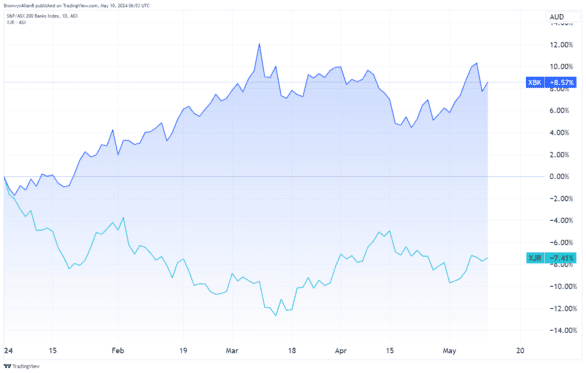
Take a look at this chart below comparing the S&P/ASX 200 Banks Index (ASX: XBK) and the S&P/ASX 200 Resources Index (ASX: XJR) in the year to date.
ASX 200 bank stocks have risen 8.57% whilst ASX 200 resources stocks have lost 7.41% of their value.
This is an interesting situation, given the mining and banking stocks comprise a huge proportion of the ASX 200’s total market capitalisation.
With one going up and one going down, is it any wonder the S&P/ASX 200 Index (ASX: XJO) is virtually flat in the year to date at 7,749 points, up just 1.59%?
So, what’s going on?
Ray David, Portfolio Manager and Partner at Blackwattle Investment Partners discussed the divergent performance between the two stock types in a recent interview with ausbiz.
Why are ASX 200 mining stocks underperforming bank stocks?
In terms of ASX 200 mining stocks, David explained that the market is concerned about the iron ore price amid weakness in China’s property market.
This has weighed on the performance of mega iron ore sharesBHP Group Ltd (ASX: BHP), down 15% in the year to date, and Rio Tinto Ltd (ASX: RIO), down 4.8% in the year to date.
David says there’s an opportunity for investors to snap up weakened BHP and Rio Tinto shares while commodity prices are rising.
He said:
So you’ve seen softer property sales, softer property prices, and a lack of stimulus [in China]. So that’s really weighed on Rio and BHP. But if you actually look at underlying commodities for RIO and BHP, iron ore is up about 12% over one year, and copper — which is about 25 to 30% of earnings — is up by about 17%, so we think there’s a real opportunity for investors …
In terms of ASX 200 bank stocks, David said the banks “look like they’ve overstretched on valuations”.
… so banks are trading about … 16x earnings. Markets have gotten excited that bad debts really won’t tick up but we still think there’ll be some pressure there.
In terms of deciding between ASX 200 mining stocks vs. bank stocks, David sums it up:
… the concerns around demand for iron ore and copper in our view are probably too cautious, and so there’s an opportunity for investors to be overweight materials because the valuation multiples are a lot cheaper than the banks. They’re trading on 11x, 12x cash earnings.
Which other miners are a buy?
David said Blackwattle looks for mining stocks that tick four boxes:
One of his ASX 200 mining stock picks is lithium producer IGO Ltd (ASX: IGO).
He describes decarbonisation as “a theme for the next century”. It will mean the adoption of much more electrification and a reduction in fossil fuels and emissions.
He says there are four commodities that stand to benefit most from decarbonisation. They are lithium, copper, rare earths and aluminium.
David said:
So the way we’re playing decarbonisation is through our ownership in … IGO.
IGO owns a 25% interest in the lowest-cost spodumene producer in the world. So, the Greenbushes mine, it’s producing under US$400 dollars a tonne, that’s well below the current spodumene lithium price of US$1,100 a tonne.
And again, it’s long reserve life, so a mine life out to 2040; it’s got no debt so the balance sheet will see you get through the volatility of commodity prices, and also there’s a management team that’s now in place that’s focusing on improving shareholder outcomes because the previous management team did destroy some value through some poor acquisitions in nickel.
David admits “the market hates lithium at the moment” following a 52% decline in commodity prices over 12 months.
But he said Blackwattle sees the demand profile for lithium in the future as quite strong.
… and if you’re producing at the lowest cost, you’ll be able to produce lots of cash flow for shareholders, which IGO should, and again the valuation is attractive, with no debt on the balance sheet.
IGO shares finished the session on Friday at $7.92 apiece, down 0.25%. The ASX 200 lithium mining stock has fallen 13% in the year to date.
Wondering where you should invest $1,000 right now?
When investing expert Scott Phillips has a stock tip, it can pay to listen. After all, the flagship Motley Fool Share Advisor newsletter he has run for over ten years has provided thousands of paying members with stock picks that have doubled, tripled or even more.*
Scott just revealed what he believes could be the ‘five best ASX stocks’ for investors to buy right now. We believe these stocks are trading at attractive prices and Scott thinks they could be great buys right now…
Motley Fool contributor Bronwyn Allen has positions in BHP Group. The Motley Fool Australia’s parent company Motley Fool Holdings Inc. has no position in any of the stocks mentioned. The Motley Fool Australia has no position in any of the stocks mentioned. The Motley Fool has a disclosure policy. This article contains general investment advice only (under AFSL 400691). Authorised by Scott Phillips.
If you have room for some new exchange-traded funds (ETFs) in your portfolio, then read on!
Listed below are five ASX ETFs that are highly rated right now and could be good options for investors when the market reopens next week.
Here’s what you need to know about them:
BetaShares Asia Technology Tigers ETFÂ (ASX: ASIA)
The first ASX ETF to look at is the BetaShares Asia Technology Tigers ETF. It could be a great option if you’re feeling positive on the long term Asian economic outlook. That’s because it provides investors with super-easy access to many of the best tech stocks from China and the rest of Asia (but not Japan). Many of these are the region’s equivalents of the West’s biggest and best tech companies and appear well-positioned for long-term growth.
Another ASX ETF to consider buying next week is the BetaShares Global Cybersecurity ETF. It provides investors with access to the global cybersecurity sector. And this could be a great place to be right now. That’s because the sector has been tipped to grow materially over the next decade or two due to the rising threat of cybercrime and the shift to the cloud. It invests in the leaders in the sector and emerging players.
Another ASX ETF for investors to look at next week is the Betashares Global Uranium ETF. It could be a good option if you believe that nuclear power is the key to decarbonising the planet. As its name implies, this fund provides investors with exposure to a portfolio of leading companies in the global uranium industry. These companies stand to benefit greatly from increasing demand for the chemical element.
A fourth ASX ETF to look at next week is the very popular VanEck Vectors Morningstar Wide Moat ETF. Much to the delight of its unitholders, the MOAT ETF has delivered very strong returns for investors in recent years. This has been underpinned by its focus on investing in high-quality companies with fair valuations and sustainable competitive advantages. These are the qualities that legendary investor Warren Buffett looks for when making investments. And it is never a bad idea to follow the Oracle of Omaha’s lead.
Vanguard MSCI Index International Shares ETFÂ (ASX: VGS)
A final ASX ETF for investors to consider buying next week is the Vanguard MSCI Index International Shares ETF. This popular ETF gives investors access to more than 1,000 of the world’s largest listed companies. This means that you are left owning a very diverse group of quality companies. Many of which are absolute behemoths and household names.
Wondering where you should invest $1,000 right now?
When investing expert Scott Phillips has a stock tip, it can pay to listen. After all, the flagship Motley Fool Share Advisor newsletter he has run for over ten years has provided thousands of paying members with stock picks that have doubled, tripled or even more.*
Scott just revealed what he believes could be the ‘five best ASX stocks’ for investors to buy right now. We believe these stocks are trading at attractive prices and Scott thinks they could be great buys right now…
Motley Fool contributor James Mickleboro has no position in any of the stocks mentioned. The Motley Fool Australia’s parent company Motley Fool Holdings Inc. has positions in and has recommended BetaShares Global Cybersecurity ETF. The Motley Fool Australia has positions in and has recommended BetaShares Global Cybersecurity ETF. The Motley Fool Australia has recommended Betashares Capital – Asia Technology Tigers Etf, Betashares Global Uranium Etf, VanEck Morningstar Wide Moat ETF, and Vanguard Msci Index International Shares ETF. The Motley Fool has a disclosure policy. This article contains general investment advice only (under AFSL 400691). Authorised by Scott Phillips.
According to a note out of Bell Potter, its analysts have retained their buy rating on this fashion jewellery retailer’s shares with an improved price target of $36.00. Bell Potter has been reviewing the retail sector and continues to feel very bullish about Lovisa. In fact, the broker believes that the company’s store network can grow even quicker in new markets than first thought after taking into account some recent data points from markets such as Netherlands, Ireland, Canada, and Peru. Bell Potter now estimates that Lovisa can grow its store network by 10% per annum between FY 2023 and FY 2034. In addition, its analysts highlight encouraging trends out of the ecommerce platforms in both Australia and the US compared to its key rival. Combined, this has led to the broker boosting its earnings estimates and valuation accordingly. The Lovisa share price ended the week at $31.77.
A note out of Goldman Sachs reveals that its analysts have retained their buy rating on this logistics solutions company’s shares with an improved price target of $3.95. This follows Qube’s investor day event, which went down well with the broker. Goldman notes that the company’s Patrick operation is unmatched and has an advantage at Port Botany via automation, its 1,400m quay line, and efficiencies. In addition, the broker was pleased to see that trading conditions are improving and execution risks at Moorebank are reducing. Overall, this has led to the broker lifting its earnings estimates for the coming years and boosting its valuation. The Qube share price was fetching $3.58 at Friday’s close.
Analysts at Morgan Stanley have reaffirmed their overweight rating and $210.00 price target on this property listings company’s shares. This follows the release of REA Group’s quarterly update, which revealed very strong sales and earnings growth from the realestate.com.au operator. Morgan Stanley notes that the company slightly outperformed analyst expectations but significantly outperformed its closest rival. This is cementing its market leadership position further, which bodes well for the future and appears to support Morgan Stanley’s forecast for further strong growth in the coming years. The REA share price ended the week at $187.32.
Wondering where you should invest $1,000 right now?
When investing expert Scott Phillips has a stock tip, it can pay to listen. After all, the flagship Motley Fool Share Advisor newsletter he has run for over ten years has provided thousands of paying members with stock picks that have doubled, tripled or even more.*
Scott just revealed what he believes could be the ‘five best ASX stocks’ for investors to buy right now. We believe these stocks are trading at attractive prices and Scott thinks they could be great buys right now…
Motley Fool contributor James Mickleboro has positions in Lovisa. The Motley Fool Australia’s parent company Motley Fool Holdings Inc. has positions in and has recommended Goldman Sachs Group, Lovisa, and REA Group. The Motley Fool Australia has recommended Lovisa and REA Group. The Motley Fool has a disclosure policy. This article contains general investment advice only (under AFSL 400691). Authorised by Scott Phillips.
JB Hi-Fi Ltd (ASX: JBH) shares have soundly beaten the market, rising by 23% in the past year (seen on the chart below), compared to a 7% rise for the S&P/ASX 200 Index (ASX: XJO). However, sales growth is now challenging amid the high cost of living situation.
Investors got a look at the latest quarter‘s performance earlier this week. The sales numbers in Australia weren’t inspiring.
Sales recap
JB Hi-Fi reported that for the three months to 31 March 2024, JB Hi-Fi Australia’s total sales decreased by 0.1%, JB Hi-Fi New Zealand’s total sales improved by 16.8%, and The Good Guy’s sales dropped by 0.8%.
Added to the first two-quarters of FY24, total JB Hi-Fi Australia sales were up 0.5%, JB Hi-Fi New Zealand sales rose 8.5%, and The Good Guys sales dropped 7.3%.
The ASX share described these sales as “resilient” and in line with the group’s expectations.
Is the JB Hi-Fi share price a buy?
Brokers seem mixed on the business after seeing that update.
According to reporting by The Australian, the broker JPMorgan decided to increase its rating on JB Hi-Fi shares to overweight, meaning buy. The price target is where the broker thinks the share price will be trading in 12 months from now. JPMorgan’s price target on JB Hi-Fi shares is $63, which is more than 11.92% higher than where it is now.
However, the broker Macquarie decided to reduce its price target on JB Hi-Fi shares by 5% to $61. That represents a potential rise of more than 8%, even though Macquarie’s rating was reduced to neutral.
The broker UBS has a neutral rating and price target of $59 on the business, which would be a rise of less than 5%.
UBS said it’s cautious on the FY24 fourth quarter because JB Hi-Fi is cycling against a strong final quarter of the prior financial year, particularly JB Hi-Fi Australia.
Another issue is there is a potential downside risk to the earnings before interest and tax (EBIT) margin because of rising costs, including wages and rent (which are being driven higher by inflation). UBS suggested that saving costs is difficult because the company already has a “lean cost base,” especially with JB Hi-Fi Australia.
UBS thinks operating Âde-Âleverage is likely in the third quarter because of the sales decline and the cycling against a strong quarter ending 30 June 2023 for the FY24 fourth quarter.
Based on UBS’ estimates, the JB Hi-Fi share price is valued at 15x FY24’s estimated earnings and 15x FY25’s estimated earnings. It could pay a grossed-up dividend yield of 6.2% in FY24 and 6.1% in FY25.
It seems some brokers think the JB Hi-Fi share price is capable of rebounding, but it faces challenges to profitability in the last few months of the 2024 financial year.
Should you invest $1,000 in Jb Hi-fi Limited right now?
Before you buy Jb Hi-fi Limited shares, consider this:
Motley Fool investing expert Scott Phillips just revealed what he believes are the 5 best stocks for investors to buy right now… and Jb Hi-fi Limited wasn’t one of them.
The online investing service heâs run for over a decade, Motley Fool Share Advisor, has provided thousands of paying members with stock picks that have doubled, tripled or even more.*
And right now, Scott thinks there are 5 stocks that may be better buys…
JPMorgan Chase is an advertising partner of The Ascent, a Motley Fool company. Motley Fool contributor Tristan Harrison has no position in any of the stocks mentioned. The Motley Fool Australia’s parent company Motley Fool Holdings Inc. has positions in and has recommended JPMorgan Chase and Macquarie Group. The Motley Fool Australia has positions in and has recommended Macquarie Group. The Motley Fool Australia has recommended Jb Hi-Fi. The Motley Fool has a disclosure policy. This article contains general investment advice only (under AFSL 400691). Authorised by Scott Phillips.
The Coles Group Ltd (ASX: COL) share price has held firm in 2024, while the Woolworths Group Ltd (ASX: WOW) share price has tanked.
Coles shares finished the session on Friday at $16.24 and are up 0.5% in the year to date.
The company’s chief competitor and Australia’s supermarket sector leader, Woolworths, closed at $30.72 on Friday with the share price down 18% in the year to date.
Let’s canvas the views of a few top brokers to see if they think Coles shares are a good buy at today’s price.
Stable Coles share price vs. Woolworths wash-out in 2024
Bell Potter has a buy rating on Coles and a 12-month price target of $19.
The broker notes moderating costs, supply chain improvements, and a positive long-term outlook for the company, commenting:
Costs are expected to remain elevated but should moderate through FY24 and FY25 as general inflation tapers off.
In the medium term, 1) higher immigration should support grocery spending, and 2) Coles is entering a period of elevated capex intensity as it reinvests to modernise its supply chain and to catch up to competitors on online and digital offerings, which should help Coles maintain its market position.
Morgans has an add rating on Coles with a 12-month share price target of $18.95.
Equities strategist Andrew Tang explains why they like Coles shares:
In our view, the ongoing scrutiny on the supermarkets has affected short term sentiment in the sector, which we believe creates a good buying opportunity in COL.
While Liquor sales remain soft, we expect the core Supermarkets division (~92% of earnings) to continue to be supported by further improvement in product availability, reduction in total loss, greater in-home consumption due to cost-of-living pressures, and population growth.
UBS also has a buy rating on Coles with a share price target of $18.25.
The broker says there are tailwinds for the business. These include a potential expansion of gross profit margins in 2024 and various cost savings that are helping it deliver “improved earnings momentum”.
Then there’s the outlier…
Goldman Sachs has a completely different view. The top broker says Coles shares are a sell and has a 12-month price target of $15.40 on the stock.
In a recent note, analysts Lisa Deng and James Leigh said Coles had under-invested in its digital transformation and omnichannel strategy, which is “the primary reason for structural market share loss”.
They explained:
Even though the company is stepping up its investments in supply chain, we would like to see the company better illustrate its end-to-end digital strategy including sourcing, warehouse/distribution, merchandising, consumer data/analytics and loyalty to ultimately drive ARPU and market share gains together with cost efficiencies.
Deng and Leigh expect Coles to report lower comps sales and EBIT margin growth in FY25/FY26 compared to Woolworths.
They are also concerned about potential further delays with the Witron/Ocado project.
Wondering where you should invest $1,000 right now?
When investing expert Scott Phillips has a stock tip, it can pay to listen. After all, the flagship Motley Fool Share Advisor newsletter he has run for over ten years has provided thousands of paying members with stock picks that have doubled, tripled or even more.*
Scott just revealed what he believes could be the ‘five best ASX stocks’ for investors to buy right now. We believe these stocks are trading at attractive prices and Scott thinks they could be great buys right now…
Motley Fool contributor Bronwyn Allen has no position in any of the stocks mentioned. The Motley Fool Australia’s parent company Motley Fool Holdings Inc. has positions in and has recommended Goldman Sachs Group. The Motley Fool Australia has positions in and has recommended Coles Group. The Motley Fool has a disclosure policy. This article contains general investment advice only (under AFSL 400691). Authorised by Scott Phillips.
My endless hunt for wealth creation has led me to ASX retail shares more recently.
Investors decimated the industry yesterday, slicing 2.5% off the consumer discretionary sector. Disappointing sales updates from a handful of listed retailers, such as JB H-Fi Ltd (ASX: JBH) and Super Retail Group Ltd (ASX: SUL), spooked the market following weak retail trade data last month.
There’s a wise Japanese proverb I reflect on in uneasy times: “Fear is often greater than the danger itself”. Humans are wired to amplify a perceived threat so that we might live another day. This innate response can lead to overreactions in the stock market.
Those rare moments of disproportional distress are where transformative investments can be made.
3 ASX retail shares ready for rough times
Suppose we fall on hard times in the near future. Some companies will be positioned better than others. However, there’s every chance investors will sell indiscriminately, overcome with fear.
That’s why it is valuable to prepare for the storm. Know which companies are likely to withstand the catastrophic forces ahead of time. Doing so gives you an edge over others who will be paralysed by panic.
Batten down the balance sheet
Recessions can destroy businesses. When sales dry up quicker than expenses can be reduced, a company can be caught with insufficient cash to fund its operations. That’s where a pile of cash and little debt can be a game-changer.
I think Premier Investments Limited (ASX: PMV) is an ASX retail share in tip-top financial shape. The owner of Peter Alexander, Just Jeans, and Portmans — among others — recorded $492 million in cash and $69 million in debt at the end of the first half.
A strong balance sheet paired with above-industry average profit margins gives me confidence Premier Investments would make for an opportune investment amid a sell-off.
Staying on budget
People will often trade down in a weaker economy rather than go completely without. Savvy shoppers begin looking for the best bang for their buck, giving the right retailers a boost.
I believe Lovisa Holdings Ltd (ASX: LOV) is a prime candidate for a more frugal shopper. The jewellery seller is a more affordable option without compromising on the desired look. Furthermore, the company is now in a net cash position, reducing its debt from its previously lofty level.
Making it last
Buying a brand-new car is the last thing someone wants to do when money is tight. For this reason, automotive retailers are often dubbed ‘recession-resilient’, as people choose to repair rather than replace.
Super Retail Group Ltd (ASX: SUL) reported mixed sales growth yesterday in its second-half trading update. Some analysts are labelling the owner of Supercheap Auto, BCF, Macpac, and Rebel as overvalued after these figures.
Meanwhile, I’m prepping my account to buy this ASX retail share if the market punishes it further. The Supercheap Auto business is best-in-class, in my opinion. Additionally, Super Retail Group is now sitting on $321 million in cash (and no debt), giving it plenty of financial headroom for hard times.
Wondering where you should invest $1,000 right now?
When investing expert Scott Phillips has a stock tip, it can pay to listen. After all, the flagship Motley Fool Share Advisor newsletter he has run for over ten years has provided thousands of paying members with stock picks that have doubled, tripled or even more.*
Scott just revealed what he believes could be the ‘five best ASX stocks’ for investors to buy right now. We believe these stocks are trading at attractive prices and Scott thinks they could be great buys right now…
Motley Fool contributor Mitchell Lawler has positions in Lovisa. The Motley Fool Australia’s parent company Motley Fool Holdings Inc. has positions in and has recommended Lovisa. The Motley Fool Australia has positions in and has recommended Super Retail Group. The Motley Fool Australia has recommended Jb Hi-Fi, Lovisa, and Premier Investments. The Motley Fool has a disclosure policy. This article contains general investment advice only (under AFSL 400691). Authorised by Scott Phillips.
Donald Trump appeared to close the door on Nikki Haley as a potential vice president.
"Nikki Haley is not under consideration for the V.P. slot, but I wish her well!" he said.
Trump's remark came after an earlier report that Haley was in the mix for VP.
Former President Donald Trump on Saturday threw cold water on any speculation that he was considering ex-presidential rival Nikki Haley as his running mate, saying she was "not under consideration."
Trump made the remarks on his Truth Social platform following an earlier Axios report, which cited unnamed sources, that the ex-president would consider Haley if he felt she could help him win the general election and cover his legal fees should he lose.
Just hours after the article was published, Trump went online to set the record straight on his vice presidential search.
"Nikki Haley is not under consideration for the V.P. slot, but I wish her well!" the former president wrote.
Haley, a former South Carolina governor and onetime UN ambassador under Trump, exited the GOP primary after the former president won multiple primaries and caucuses across the country on Super Tuesday.
As a candidate, Haley sought to nudge Republican voters toward a future without Trump, making a case that she'd be the face of GOP generational change while also looking to appeal to conservatives, moderates, and independents who were leery of the former president.
But Haley, similar to former fellow challengers like Florida Gov. Ron DeSantis and former New Jersey Gov. Chris Christie, was unable to break through Trump's hold on the GOP electorate.
Earlier in Haley's campaign, she largely steered clear of direct attacks on Trump. But as the primary contests neared, she took on the former president directly, noting that his legal troubles could endanger the GOP in the fall. She also brought up his advanced age.
When Haley left the race, she did not throw her support behind Trump's reelection bid and gave no timeline for a potential endorsement. Biden, who praised Haley after she ended her campaign, has sought to appeal to her former supporters.
And despite her departure from the GOP race, Haley continues to win thousands of primary votes, particularly in critical suburban and exurban counties where Democrats have made considerable inroads in recent election cycles.