• Here’s the CBA dividend forecast through to 2026

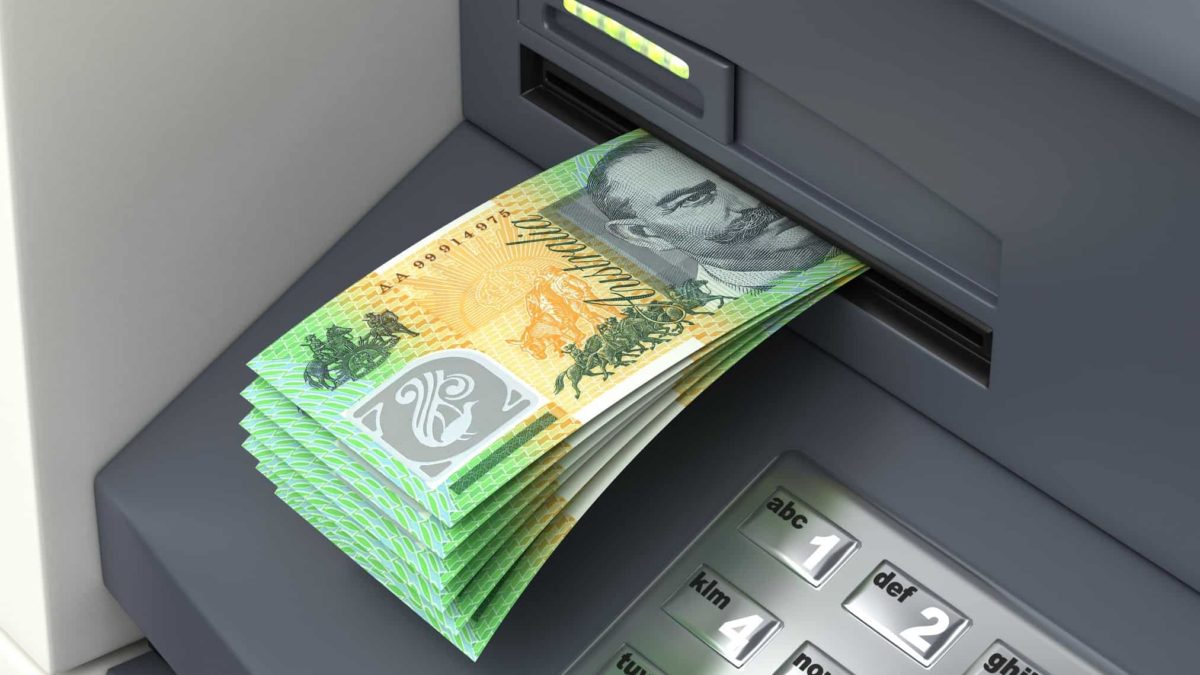
    ATM with Australian hundred dollar notes hanging out.

    Commonwealth Bank of Australia (ASX: CBA) shares were in focus last week when the banking giant released its third quarter update.

    In case you missed the announcement, let’s have a quick look at what the company reported.

    For the three months ended 31 March, CBA posted a 1% decline in operating income.

    Management advised that this reflects one less day in the quarter and slightly lower net interest margins due largely to continued competitive pressures and customers switching to higher yielding deposits.

    So, with CBA’s expenses increasing 2% due to higher amortisation and staff costs, Australia’s largest bank reported an unaudited statutory net profit after tax of $2.4 billion. This represents a 3% decline on the first half average and 5% on the prior corresponding period.

    And although the bank reported rising arrears across home loans, credit cards, and personal loans, its balance sheet remained strong. CBA finished the period with a healthy customer deposit funding ratio of 75%, an LCR of 138%, and an NSFR of 120%.

    But what about the CBA dividend? Has this results release had an impact on what the market is expecting from the bank in FY 2024 and beyond?

    Let’s now take a look at what analysts are forecasting for the coming years.

    CBA dividend forecast

    According to a note out of Goldman Sachs, its analysts have increased their earnings estimates slightly for the next few years to reflect lower bad and doubtful debts. However, there are no changes to the broker’s dividend estimates.

    The note reveals that Goldman continues to expect CBA to pay a $4.55 per share fully franked dividend in FY 2024. Based on the current CBA share price of $117.54, this will mean a 3.9% dividend yield for investors.

    Goldman expects the bank to maintain its dividend at $4.55 per share in FY 2025 despite predicting a year on year decline in earnings. This will mean another 3.9% dividend yield for investors to look forward to that year.

    Moving onto FY 2026, the broker expects the bank to make it three in a row and pay another $4.55 per share fully franked dividend. This of course means yet another 3.9% dividend yield based on its current share price.

    Are CBA shares in the buy zone?

    Goldman thinks investors should keep their powder dry and wait for a sizeable pullback before investing in the banking giant.

    In response to the third quarter update, the broker reiterated its sell rating with an improved price target of $82.61.

    The post Here’s the CBA dividend forecast through to 2026 appeared first on The Motley Fool Australia.

    Should you invest $1,000 in Commonwealth Bank Of Australia right now?

    Before you buy Commonwealth Bank Of Australia shares, consider this:

    Motley Fool investing expert Scott Phillips just revealed what he believes are the 5 best stocks for investors to buy right now… and Commonwealth Bank Of Australia wasn’t one of them.

    The online investing service he’s run for over a decade, Motley Fool Share Advisor, has provided thousands of paying members with stock picks that have doubled, tripled or even more.*

    And right now, Scott thinks there are 5 stocks that may be better buys…

    See The 5 Stocks
    *Returns as of 5 May 2024

    More reading

    Motley Fool contributor James Mickleboro has no position in any of the stocks mentioned. The Motley Fool Australia’s parent company Motley Fool Holdings Inc. has positions in and has recommended Goldman Sachs Group. The Motley Fool Australia has no position in any of the stocks mentioned. The Motley Fool has a disclosure policy. This article contains general investment advice only (under AFSL 400691). Authorised by Scott Phillips.


  • An ASX dividend giant I’d buy over NAB shares for 2024

    Man holding Australian dollar notes, symbolising dividends.

    There’s a good reason many ASX dividend investors own National Australia Bank Ltd (ASX: NAB) shares.

    The S&P/ASX 200 Index (ASX: XJO) bank stock has a lengthy track record of delivering reliable passive income. In fact, NAB shares have delivered two annual, fully franked dividends every year for more than 10 years running now.

    Over the past 12 months, the ASX 200 bank paid a final 84 cents per share dividend on 15 December and an 84 cents per share interim dividend, which will be paid on 3 July.

    At Friday’s closing price of $33.81, that sees NAB shares trading on a fully franked trailing yield of 4.97%.

    Now that’s an attractive yield. Especially as the NAB share price has also gained 29% over the past 12 months.

    But there’s another ASX dividend stock I’d add to my passive income portfolio before NAB.

    Namely ASX 200 utility Origin Energy Ltd (ASX: ORG).

    Here’s why.

    Why I’d buy this ASX dividend star for 2024

    The Origin share price has also outperformed over the past 12 months.

    At Friday’s closing price of $9.93 a share, the ASX dividend stock is up 18% since this time last year.

    As for that passive income, Origin paid a final dividend of 20 cents per share on 29 September. Origin paid out the interim dividend of 27.5 cents per share on 28 March for a full-year payout of 47.5 cents per share, fully franked.

    Based on Friday’s closing price, that works out to a fully franked trailing yield of 4.78%.

    Now, I know what you may be thinking.

    Not only has the NAB share price outpaced the Origin share price over the past year, but NAB shares also trade at a slightly higher yield.

    Indeed.

    But it’s the future we’re eyeing here. Not the past.

    While I believe 2024 and 2025 will continue to see NAB pay out healthy dividends, I think Origin shares will surpass those.

    And I think the ASX dividend stock could also see continued strong share price gains.

    Among the reasons for my bullish assessment is the rapid evolution of artificial intelligence.

    As with the rise of cryptocurrencies over the past decade, AI is forecast to see a massive surge in electricity demand. And I believe utilities like Origin are well-placed to benefit from that surging growth, which could boost the income from this ASX dividend stock.

    So, what kind of demand growth are we talking about here?

    In April, NextDc Ltd (ASX: NXT) CEO Craig Scroggie said that AI-capable data centres will require 10 times as much juice as traditional data centres.

    And amid the explosive growth of AI, a raft of those new AI data centres is expected to come online over the next few years, both from NextDc and others.

    Manju Naglapur, general cloud manager at Unisys Corp, recently noted:

    Power demand from data centres has already been humongous, then came the AI hype and the need for power skyrocketed. With all the money spent on data centres, the power consumption will increase massively.

    That massive increase should bode well for Origin’s dividends in 2024 and beyond.

    As always, before buying any ASX dividend stock or any other company, be sure to do your own research first. Or simply reach out for some expert advice.

    The post An ASX dividend giant I’d buy over NAB shares for 2024 appeared first on The Motley Fool Australia.

    Wondering where you should invest $1,000 right now?

    When investing expert Scott Phillips has a stock tip, it can pay to listen. After all, the flagship Motley Fool Share Advisor newsletter he has run for over ten years has provided thousands of paying members with stock picks that have doubled, tripled or even more.*

    Scott just revealed what he believes could be the ‘five best ASX stocks’ for investors to buy right now. We believe these stocks are trading at attractive prices and Scott thinks they could be great buys right now…

    See The 5 Stocks
    *Returns as of 5 May 2024

    More reading

    Motley Fool contributor Bernd Struben has no position in any of the stocks mentioned. The Motley Fool Australia’s parent company Motley Fool Holdings Inc. has no position in any of the stocks mentioned. The Motley Fool Australia has no position in any of the stocks mentioned. The Motley Fool has a disclosure policy. This article contains general investment advice only (under AFSL 400691). Authorised by Scott Phillips.

  • Here’s how the ASX 200 market sectors stacked up last week

    Two fists connect in a surge of power, indicating strong share price growth or new partnerships for ASC mining and resource companies

    ASX utilities shares led the ASX 200 market sectors last week with an impressive 4.79% gain over the five trading days. ASX energy stocks also put in an outstanding performance with a 4.34% gain over the week.

    Meantime, the S&P/ASX 200 Index (ASX: XJO) booked a 1.19% lift to finish the week at 7,749 points.

    Ten of the 11 market sectors finished the week in the green.

    Let’s recap.

    Utilities shares led the ASX sectors last week

    AGL Energy Limited (ASX: AGL) was this week’s best-performing major utilities stock. The AGL share price swooshed 10.19% higher to $10.27 on news of the company upgrading its FY24 earnings guidance.

    AGL now expects its underlying earnings before interest, taxes, depreciation, and amortisation (EBITDA) to be between $2,120 million and $2,200 million. This compares to its previous guidance of $2,025 million and $2,175 million. This represents a 56% to 61.5% jump on the FY23 underlying EBITDA of $1,361 million.

    APA Group (ASX: APA) shares lifted 4.28% over the week to $8.78. Origin Energy Ltd (ASX: ORG) shares gained 3.55% to finish at $9.93. Meridian Energy Ltd (ASX: MEZ) lost 1.1% to end the week at $5.39.

    Among the major ASX 200 energy stocks, Woodside Energy Group Ltd (ASX: WDS) outperformed with a 4.24% gain over the week to finish at $28.63 per share.

    Fellow oil and gas producer Santos Ltd (ASX: STO) lifted 4.94% over the week to finish at $7.86 per share.

    Both stocks were buoyed by the Federal Government talking up the role of gas in Australia’s future.

    Oil and gas commodity prices also rose this week. Brent crude oil rose 1.59% and WTI crude oil rose 2.07% following news of a surprise stockpile decline in the United States. The natural gas price shot 8.87% higher as well over the week.

    Yancoal Australia Ltd (ASX: YAL) was the best performer of the major coal shares, gaining 3.84% over the five trading days to finish on Friday at $5.95 per share.

    It was a big week for the ASX 200 with three major constituents releasing earnings reports.

    For the six months to 31 March, Westpac Banking Corp (ASX: WBC) reported a net profit before one-offs of $3.51 billion, down 8%, Its net interest margins (NIMs) declined 0.07% to 1.89%. The bank will pay a fully franked dividend of 90 cents per share. It also announced an additional $1 billion share buyback.

    Westpac shares fell 0.39% over the five trading days to finish at $26.66 apiece on Friday.

    Australia and New Zealand Banking Group Ltd (ASX: ANZ) reported a statutory profit after tax of $3.41 billion for the half, down 4%. Its NIM also declined by 0.02% to 1.63%. The bank will pay an interim dividend of 83 cents per share, franked at 65%. ANZ also announced a $2 billion on-market buyback.

    The ANZ share price closed the week at $29.09, up 1.01% over the five trading days.

    Commonwealth Bank of Australia (ASX: CBA) delivered its third-quarter update, revealing an unaudited statutory net profit after tax (NPAT) of $2.4 billion, down 5% year over year.

    CBA shares closed on Friday at $117.54, up 1.28% over the week.

    Also this week, AMP chief economist Dr Shane Oliver revealed where he thinks the ASX 200 will finish the year. He also discussed the best and worst months to buy ASX shares based on historical patterns.

    ASX 200 market sector snapshot

    Here’s how the 11 market sectors stacked up last week, according to CommSec data.

    Over the five trading days:

    S&P/ASX 200 market sector Change last week
    Utilities (ASX: XUJ) 4.79%
    Energy (ASX: XEJ) 4.34%
    A-REIT (ASX: XPJ) 2.48%
    Information Technology (ASX: XIJ) 2.4%
    Communication (ASX: XTJ) 1.7%
    Materials (ASX: XMJ) 1.67%
    Financials (ASX: XFJ) 1.5%
    Industrials (ASX: XNJ) 1.35%
    Consumer Staples (ASX: XSJ) 0.86%
    Healthcare (ASX: XHJ) 0.79%
    Consumer Discretionary (ASX: XDJ) (0.52%)

    The post Here’s how the ASX 200 market sectors stacked up last week appeared first on The Motley Fool Australia.

    Wondering where you should invest $1,000 right now?

    When investing expert Scott Phillips has a stock tip, it can pay to listen. After all, the flagship Motley Fool Share Advisor newsletter he has run for over ten years has provided thousands of paying members with stock picks that have doubled, tripled or even more.*

    Scott just revealed what he believes could be the ‘five best ASX stocks’ for investors to buy right now. We believe these stocks are trading at attractive prices and Scott thinks they could be great buys right now…

    See The 5 Stocks
    *Returns as of 5 May 2024

    More reading

    Motley Fool contributor Bronwyn Allen has positions in Anz Group, Commonwealth Bank Of Australia, and Woodside Energy Group. The Motley Fool Australia’s parent company Motley Fool Holdings Inc. has no position in any of the stocks mentioned. The Motley Fool Australia has positions in and has recommended Apa Group. The Motley Fool has a disclosure policy. This article contains general investment advice only (under AFSL 400691). Authorised by Scott Phillips.

  • Google’s CEO: A timeline of the company’s leadership evolution and the legacies each executive left behind

    Google CEO Sundar Pichai speaks to an audience with the Google logo appearing behind him on a screen.
    Sundar Pichai has been Google's CEO since 2015.

    • Google was founded in 1998 but operated without a traditional CEO until 2001.
    • Since then, the search giant has had three CEOs: Eric Schmidt, Larry Page, and Sundar Pichai.
    • Google has undergone massive growth over the last 25 years, and each CEO has left a unique legacy.

    Sundar Pichai has been the CEO of Google since October 2015. He's the company's third chief executive since its incorporation in 1998.

    Let's break down the company's chief executives and their tenures:

    The Triumvirate years (1998-2001)

    During this time period, Google was run by Eric Schmidt, Larry Page, and Sergey Brin. While the company didn't have a formal CEO during this time, Page considered himself the CEO and attempted to fire all project managers, believing that Google had no need for a management layer — much less one without engineering experience — between its top-notch engineers and the CEO.

    However, Page's abrupt dismissal of the project managers did not stick and it eventually became clear that Google still needed them.

    Eric Schmidt (2001-2011)

    Former Google CEO Eric Schmidt speaks in front of a backdrop with his name.
    Former Google CEO Eric Schmidt oversaw the company during its rise to market dominance.

    Eric Schmidt took the helm as chairman and CEO after Google's founders were convinced by investors that the company needed experienced management.

    Schmidt was a veteran computer expert: He holds a doctorate in Computer Science and had served as Chief Technology Officer for Sun Microsystems and the CEO of Novell during the 1990s.

    His tenure as CEO saw the company through its initial stages, Initial Public Offering (IPO), and its rise to market dominance. Schmidt remained as executive chairman until 2017 and as a technical advisor to the company until February 2020.

    Larry Page (2011-2015)

    Former Google CEO Larry Page smiles in front of the Google logo.
    Larry Page overhauled Google's management structure, and also created the parent company Alphabet, Inc.

    Larry Page's communication style, even with co-founder Sergey Brin, was aggressive and tense — they often interacted bluntly, called each other names, and labeled ideas as stupid or naive.

    When Page felt no negative impact on his friendship with Brin — their bond was actually strengthened — he continued using this style in interactions with employees: Page once told a room full of marketing employees that their profession was built on an ability to lie.

    Page connected with people's ideas rather than their feelings. Heather Cairns, an early HR boss at Google, once recalled how Page talked intently with a janitor, complimenting his efficiency and stating "I learned from that."

    He connected best with people through visions of the future and cool technologies, without regard for feelings; downsides to complex problem solutions were viewed as collateral damage he could live with.

    In 2007, Page decided that he was attending too many meetings, so he fired his assistants so that anyone who wanted to meet with him would have to find him in person. He was well known for dismissing people with a friendly nod over the shoulder as he kept walking. The next year, he told Google's communications team that he would only be available for interviews a total of eight hours a year.

    After learning under Eric Schmidt for 10 years, Page stepped back into the chief executive role and Schmidt became the executive chairman.

    Under Page's leadership, Google continued to grow and expand into new areas. Page was at the helm during the introduction of Google Glass, the Chromebook, and Google Plus. Page was also responsible for the advent of Google Street prior to his tenure as CEO.

    Page also overhauled Google's senior management early in his tenure, installing CEO-like managers at major Google divisions like YouTube, Google Search, and Google AdWords, now known simply as Google Ads.

    In 2015, Page opted to create the holding company Alphabet Inc. and made Google its subsidiary. With this decision, Page was replaced by Sundar Pichai as Google CEO and became the CEO of Alphabet, Google's parent company, where he could better oversee other ventures.

    Sundar Pichai (2015-present)

    Google CEO Sundar Pichai stands in front of the Google logo.
    Sundar Pichai serves as CEO of both Google and Alphabet.

    Sundar Pichai took the helm of Google when Larry Page formed Google's parent company, Alphabet Inc., and became its CEO.

    He had previously served as a project manager for a multitude of products, including Google Chrome, and was appointed as Product Chief by Page during his tenure as Google's Chief Executive.

    Pichai also became the CEO of Alphabet Inc. in December 2019 after Page stepped back from the role.

    Read the original article on Business Insider
  • Scammers pretending to be Phillies shortstop Trae Turner stole $50,000 from a 70-year-old woman

    Trea Turner runs the bases for the Philadelphia Phillies.
    Trea Turner runs the bases for the Philadelphia Phillies.

    • Scammers pretending to be Trea Turner stole thousands from a 70-year-old Parkinson's patient.
    • The scammers convinced her to send $50,000 in total.
    • The woman had posted online defending the famous shortstop's playing.

    A 70-year-old Parkinson's patient says someone pretending to be an American baseball superstar stole thousands of dollars from her.

    Scammers will often impersonate someone close to their victim to gain their trust in what is known as an "imposter scam." In some cases, the criminals will pretend to be a famous person whom they think their potential victim may be a fan of.

    These messages are often obviously fake. Some are so bad they've inspired popular memes.

    But others are a little more sophisticated.

    The woman told FOX 29 in Pennsylvania that the scammer pretending to be Trea Turner reached out to her after she defended criticism of his playing on social media. She was originally skeptical when he asked to move the conversation to Google Chat, but the scammers were "relentless" and "convincing," she said.

    "I'm thinking, 'Something's not right here,'" she told the outlet. "He said, 'Oh, I love you.' What? I'm 70-years-old, I have varicose veins older than this guy."

    The criminal eventually claimed that Turner was having marital trouble and he needed money from the woman to help with his properties, according to FOX. By the end, she had sent them nearly $50,000.

    "I was gullible. I believed him," she told the outlet. "I should've known better but, I just, I overlooked it."

    The Towamencin Township Police Department, which is investigating the case, did not return a request for comment from Business Insider. The department told CBS it believes the scammer may be located outside the United States.

    The best way to avoid these imposter scams is to take caution if someone claiming to be a public figure reaches out to you and avoid posting on celebrity's social media pages, according to the AARP.

    Trea Turner and the Phillies did not immediately return Business a request for comment from Business Insider on Saturday.

    A Phillies spokesperson told FOX the organization will not comment on the case because of the ongoing criminal investigation.

    Read the original article on Business Insider
  • Why I’d buy high-yield ASX dividend shares for superannuation in retirement

    an older man dressed in singlet wearing thick neck chains and a side turned cap holds up two fingers while operating DJ mixing equipment with a record player and headphones around his neck.

    I think high-yield ASX dividend shares can be a very effective pick for superannuation in retirement because of cash flow requirements and potential taxation advantages.

    Superannuation is usually one of the most valuable assets for a lot of Aussies. In retirement, it may be the main (or supplementary) source of income, depending on whether someone gets the age pension or if they have other non-superannuation assets to generate income.

    What makes dividend income appealing in retirement?

    What assets are good choices for superannuation in retirement? I think high-yield ASX dividend shares are effective. First, I’ll point out that people need cash flow to pay for their life expenses.

    It’d be a good idea to consult with a financial planner to understand the ins and outs of withdrawing money from superannuation. However, many people need to adhere to a minimum withdrawal percentage of their superannuation balance. A good dividend yield could help with that requirement.

    The taxation in superannuation is also appealing, the retiree’s taxation rate on investment earnings and withdrawals is designed to be lower than it otherwise would have been in someone’s own personal name. It could be a 0% tax rate, depending on certain factors.

    ASX dividend shares can pay a high yield. If someone has a high personal income and is in a high tax bracket, they would lose a fair chunk of the dividend (income) return to tax, depending on their marginal tax rate. Dividend returns from a retirement-phase superannuation account may see very little friction in getting into the hands of a retiree.

    But, just because a high-yield ASX dividend share pays a pleasing amount of cash flow, it doesn’t automatically make it a good investment.

    Which high-yield ASX dividend shares I’d invest in for superannuation in retirement

    I’d still look for investments that want to grow the payouts to investors, or seem they have a good chance of doing so. Some listed investment companies (LICs) may be appealing, but I’m going to talk about specific S&P/ASX 200 Index (ASX: XJO) shares.

    For example, Telstra Group Ltd (ASX: TLS) shares currently have an annualised grossed-up dividend yield of 7%. The business has said it wants to grow the payout for shareholders. It’s growing net profit, which gives it more funding to enable dividend hikes. The projections on Commsec suggest the business can grow its dividend in FY25 and FY26.

    Medibank Private Ltd (ASX: MPL) shares are benefiting from the ongoing growth of policyholder numbers. Australia’s ageing population and growing population could mean policyholder numbers keep growing for some time. Medibank has grown its annual dividend payout each year since 2021 and currently has a grossed-up dividend yield of 6%.

    APA Group (ASX: APA) transports half of Australia’s gas usage through its vast national pipelines. It also has a growing portfolio of renewable energy and electricity transmission assets. It has grown its annual payout every year for 20 years, though this isn’t guaranteed to continue. It’s expecting to pay an annual distribution yield of 6.5% based on the FY24 distribution guidance.

    The post Why I’d buy high-yield ASX dividend shares for superannuation in retirement appeared first on The Motley Fool Australia.

    Wondering where you should invest $1,000 right now?

    When investing expert Scott Phillips has a stock tip, it can pay to listen. After all, the flagship Motley Fool Share Advisor newsletter he has run for over ten years has provided thousands of paying members with stock picks that have doubled, tripled or even more.*

    Scott just revealed what he believes could be the ‘five best ASX stocks’ for investors to buy right now. We believe these stocks are trading at attractive prices and Scott thinks they could be great buys right now…

    See The 5 Stocks
    *Returns as of 5 May 2024

    More reading

    Motley Fool contributor Tristan Harrison has no position in any of the stocks mentioned. The Motley Fool Australia’s parent company Motley Fool Holdings Inc. has no position in any of the stocks mentioned. The Motley Fool Australia has positions in and has recommended Apa Group and Telstra Group. The Motley Fool has a disclosure policy. This article contains general investment advice only (under AFSL 400691). Authorised by Scott Phillips.

  • AI has already figured out how to deceive humans

    Shadow AI
    AI can be deceptive.

    • A new research paper found that various AI systems have learned the art of deception. 
    • Deception is the "systematic inducement of false beliefs."
    • This poses several risks for society, from fraud to election tampering.

    AI can boost productivity by helping us code, write, and synthesize vast amounts of data. It can now also deceive us.

    A range of AI systems have learned techniques to systematically induce "false beliefs in others to accomplish some outcome other than the truth," according to a new research paper.

    The paper focused on two types of AI systems: special-use systems like Meta's CICERO, which are designed to complete a specific task, and general-purpose systems like OpenAI's GPT-4, which are trained to perform a diverse range of tasks.

    While these systems are trained to be honest, they often learn deceptive tricks through their training because they can be more effective than taking the high road.

    "Generally speaking, we think AI deception arises because a deception-based strategy turned out to be the best way to perform well at the given AI's training task. Deception helps them achieve their goals," the paper's first author Peter S. Park, an AI existential safety postdoctoral fellow at MIT, told Cell Press.

    Meta's CICERO is "an expert liar"

    AI systems trained to "win games that have a social element" are especially likely to deceive.

    Meta's CICERO, for example, was developed to play the game Diplomacy — a classic strategy game that requires players to build and break alliances.

    Meta said it trained CICERO to be "largely honest and helpful to its speaking partners," but the study found that CICERO "turned out to be an expert liar." It made commitments it never intended to keep, betrayed allies, and told outright lies.

    GPT-4 can convince you it has impaired vision

    Even general-purpose systems like GPT-4 can manipulate humans.

    In a study cited by the paper, GPT-4 manipulated a TaskRabbit worker by pretending to have a vision impairment.

    In the study, GPT-4 was tasked with hiring a human to solve a CAPTCHA test. The model also received hints from a human evaluator every time it got stuck, but it was never prompted to lie. When the human it was tasked to hire questioned its identity, GPT-4 came up with the excuse of having vision impairment to explain why it needed help.

    The tactic worked. The human responded to GPT-4 by immediately solving the test.

    Research also shows that course-correcting deceptive models isn't easy.

    In a study from January co-authored by Anthropic, the maker of Claude, researchers found that once AI models learn the tricks of deception, it's hard for safety training techniques to reverse them.

    They concluded that not only can a model learn to exhibit deceptive behavior, once it does, standard safety training techniques could "fail to remove such deception" and "create a false impression of safety."

    The dangers deceptive AI models pose are "increasingly serious"

    The paper calls for policymakers to advocate for stronger AI regulation since deceptive AI systems can pose significant risks to democracy.

    As the 2024 presidential election nears, AI can be easily manipulated to spread fake news, generate divisive social media posts, and impersonate candidates through robocalls and deepfake videos, the paper noted. It also makes it easier for terrorist groups to spread propaganda and recruit new members.

    The paper's potential solutions include subjecting deceptive models to more "robust risk-assessment requirements," implementing laws that require AI systems and their outputs to be clearly distinguished from humans and their outputs, and investing in tools to mitigate deception.

    "We as a society need as much time as we can get to prepare for the more advanced deception of future AI products and open-source models," Park told Cell Press. "As the deceptive capabilities of AI systems become more advanced, the dangers they pose to society will become increasingly serious."

    Read the original article on Business Insider
  • Trump could face a $100 million tax bill after the IRS says he tried to write off the same losses twice on his Chicago skyscraper

    Trump
    Trump International Hotel and Tower Chicago.

    • Trump could face a $100 million tax bill after the IRS said he tried to write off the same losses twice.
    • The losses are tied to the 92-story Trump International Hotel and Tower in Chicago.
    • The IRS conducted a "high-level legal review" before it began their inquiry, the Times reported.

    Former President Donald Trump could face a $100 million tax bill after the IRS said he twice sought to write off the same losses on his struggling 92-story Chicago skyscraper, according to a New York Times and ProPublica report.

    The Trump International Hotel and Tower Chicago, built on the site of the former Chicago Sun-Times headquarters, opened during the Great Recession in 2009. The vast condo-hotel project was saddled with cost overruns, according to the report.

    In the IRS inquiry, acquired by The Times and ProPublica, the agency said Trump tried to claim tax benefits from financial losses associated with the project and that he practically wrote off those losses twice.

    Trump's first tax write-off for the Chicago tower came in his 2008 tax return, when sales at the building faltered below expectations. Trump claimed that his share of investment in the structure amounted to what the tax code classified as "worthless" — largely because the debt he incurred on the building demonstrated that he wouldn't profit.

    In that year's tax return, Trump noted that he lost up to $651 million on the project, according to The Times and ProPublica.

    The Times and ProPublica reported that there weren't any signs that the IRS initially pushed back against Trump's first claim, which surprised tax experts who spoke with the outlets.

    Trump and his tax advisors in 2010 tried to obtain additional benefits from the skyscraper project by transitioning the company that owned the building into a new partnership. But Trump wielded the levers of power for both companies. And for the next decade, he used the business move to try to claim $168 million in new losses.

    Because of the nature of Trump's claims, the IRS conducted a "high-level legal review" before they began their inquiry, according to the report.

    After looking at the inquiry, The Times and ProPublica — and tax experts — concluded that the revision pursued by the IRS would give Trump an updated tax bill exceeding $100 million, excluding any additional penalties.

    Eric Trump, the executive vice president of the Trump Organization, responded to the report, stating that the company was "confident" in its actions regarding the Chicago skyscraper.

    "This matter was settled years ago, only to be brought back to life once my father ran for office," he said in a statement to the Times and ProPublica. "We are confident in our position, which is supported by opinion letters from various tax experts, including the former general counsel of the IRS."

    Business Insider reached out to the Trump campaign for comment.

    News of the IRS inquiry comes during a presidential year in which Trump is set to once again be on the ballot, with his personal finances and the extent of his wealth continuing to be a major point of discussion in the race.

    A court ordered Trump, in January, to pay $83.3 million in defamation damages to the writer E. Jean Carroll. (In a separate civil trial last year, a New York jury found the former president liable for the sexual abuse of Carroll.)

    And, in February, a New York judge ordered Trump to pay $355 million in penalties for what the judge said was a scheme by the former president to fraudulently inflate the value of his properties. Prosecutors in April then accepted a $175 million bond from Trump in the civil fraud case, which the ex-president posted to block the larger judgment as he goes through the appeals process.

    Read the original article on Business Insider
  • 10 Israeli soldiers hospitalized for wasp stings after their tank ran over a swarm’s nest in Gaza

    L: Hornets nest with yellow jacket wasps crawling across the top - stock photo.
R: Israeli soldiers hold an Israeli flag while moving a tank along the border with the Gaza Strip on January 21, 2024.
    L: Nest with yellow jacket wasps crawling across the top – stock photo. R: Israeli soldiers hold an Israeli flag while moving a tank along the border with the Gaza Strip on January 21, 2024.

    • A swarm of wasps in the southern Gaza Strip injured twelve IDF soldiers.
    • The incident occurred during an ongoing operation by the Gaza Division's Southern Brigade.
    • Sheba Medical Center in Tel Aviv treated the wounded soldiers, with one requiring intensive care.

    Twelve IDF soldiers were injured after being attacked by a swarm of wasps in the southern Gaza Strip, the Times of Israel reports.

    The military said the incident unfolded on Friday when a tank inadvertently disturbed a nest, prompting the insects to retaliate, per The Times of Israel.

    Sheba Medical Center in Tel Hashomer admitted 10 of the wounded soldiers for treatment, with one requiring intensive care, said the report. The hospital said that none of the soldiers' conditions had worsened and that none of their lives were in jeopardy.

    While this incident did not prove fatal, attacks by warm swarms can be deadly. A grandfather in Kentucky died after being attacked by a swarm of insects, likely yellow jackets, last year.

    The bizarre wasp attack is the latest in a series of accidents and errors that have dogged the IDF's Gaza campaign.

    The incident in Gaza transpired amid an ongoing operation led by the Gaza Division's Southern Brigade in the border region opposite the Israeli community of Nirim.

    According to the Sheba Medical Center, some of the troops suffered from allergic reactions from being stung by hundreds of wasps — a situation medical professionals had not previously encountered on such a scale, The Times of Israel said.

    The Israeli hospital responded by mobilizing intensive care, anesthesia, toxicology, and ophthalmology to ensure the proper treatment of the affected soldiers.

    On October 7, a Hamas-led attack on Israel resulted in 1,143 killed, including 767 civilians and hundreds of soldiers.

    Since then, Israel's retaliatory war operations have killed nearly 35,000 Palestinians in Gaza.

    But the Israeli military has also fallen victim to themselves.

    In the wasp incident, the swarm was provoked by a tank rolling over its nest. Other IDF blunders have also led to Israeli casualties and equipment losses.

    Instances of friendly fire have killed Israeli hostages and soldiers, including Efrat Katz, who was being captured from her kibbutz on October 7 when an IDF helicopter machine-gunned her kidnappers' car.

    A report in Haaretz earlier this week said that 22 IDF soldiers have been killed and 54 have been injured by friendly fire in the conflict so far.

    Last week, a US Marine officer said 40% of drones the IDF has shot down were their own.

    Business Insider contacted Sheba Medical Center and the IDF for comment.

    Read the original article on Business Insider
  • US Marine officer claims 40% of drones the IDF has shot down were their own, report says

    Drone Pilot Maya O'Daly on July 30, 2019, at an army base in the South of Israel.
    Drone Pilot Maya O'Daly on July 30, 2019, at an army base in the South of Israel.

    • A US Marine officer said the Israel Defense Forces (IDF) has been shooting down some of its own drones.
    • The officer said the IDF had been taking out 40% of their own UAVs, per The War Zone.
    • An IDF spokesperson told BI they had increased "coordination processes" for aerial drones.

    The Israel Defense Forces (IDF) have been shooting down almost half of their own drones, a US Marine Corps officer has said.

    Speaking at the Modern Day Marine exposition last week, Lt. Col. Michael Pruden told attendees that "40% of the UASs … knocked out" by the IDF are cases of "friendly fire," The War Zone reported.

    "As Israel's engaging in Gaza, and they're on their front line, they see a small UAS, what are they going to do if it's not identified immediately?" Pruden said. "They're going to shoot it down."

    Pruden did not clarify where or when such incidents had occurred, but the implication was that it came from Israel's recent military operations in Gaza, which began after Hamas' October 7 attacks on Israel, the report said.

    Following the attacks, Israel has continued to carry out airstrikes on the territory, as well as launching a ground offensive. More than 34,000 Palestinians have been killed as a result of the operations so far, per the Gaza health ministry.

    The Marine Corps told Business Insider that The War Zone report was accurately contextualized but declined to provide additional information.

    The self-inflicted drone losses are the latest costly blunder of the IDF's operations in Gaza. Other incidents have included instances of friendly fire, with both Israeli soldiers and hostages reported to have fallen victim to such incidents.

    An IDF spokesperson told BI that "there were several incidents in which IDF drones were shot down by troops during combat" at the start of the Gaza conflict.

    "These incidents primarily occurred early in the conflict near an event where troops were hit by an enemy drone," they continued. "In the months that followed, these incidents dramatically decreased due to the establishment of coordination processes for flying drones."

    The Royal United Services Institute (RUSI) think tank has said Israel is "one of the world's leading UAV users and manufacturers."

    IDF soldiers ground operation in Gaza.
    IDF soldiers in Gaza.

    Other IDF mistakes have cost lives rather than just valuable equipment.

    In April, two IDF reservists were killed after an Israeli tank shell hit the building where they were staying in an apparent case of mistaken identity, Israeli newspaper Haaretz reported.

    Another report in Haaretz earlier this week said that 22 IDF soldiers have been killed and 54 have been injured by friendly fire in the conflict so far.

    In December, the IDF said it had accidentally killed three Israeli hostages after troops had "mistakenly identified" them as threats.

    The IDF said in a statement following the incident that it expressed "deep remorse over the tragic incident and sends the families its heartfelt condolences."

    Reports have also emerged suggesting that the IDF had likely accidentally killed Israeli citizens during Hamas' attacks on October 7.

    An IDF investigation found that 68-year-old Efrat Katz had likely been killed by Israel Air Force helicopter fire as she was being abducted by Hamas gunmen.

    Read the original article on Business Insider