The company announced better-than-expected profits and only a slight revenue miss, raised its full-year earnings growth guidance to 25% from 20%, and communicated to investors that its streaming division would be profitable by its fiscal fourth-quarter.
But that wasn't enough for Wall Street, with the stock diving as much as 11% following the earnings report, its worst daily decline in 18 months. The main focus of investors ended up being Disney's light forecast for streaming growth.
Although Disney+ added 6.3 million new subscribers in the quarter, its total number of streaming subscribers at 153.6 million was below Wall Street estimates by about 2 million. The company's CFO also said in the earnings call that the current quarter is pacing towards flat growth.
The sharp move lower highlights the high standard Wall Street has set for Disney's streaming portfolio, which includes Disney+, Hulu, ESPN, and Hotstar in India.
Disney investors would like the media giant to obtain a Netflix-like valuation multiple given its growing streaming business. But in order for that to happen, Disney would have to deliver incredible Netflix-like execution that's capable of shaking off investor fears about its shrinking legacy TV business.
So far, that doesn't appear to be happening, at least not at a quick enough pace that Wall Street demands.
And while Disney's streaming business is moving in the right direction overall, it will still be a bumpy ride ahead for the unit to deliver consistent profits.
"We are pleased with the progress we're making in streaming although, as we said before, the path to long-term profitability is not a linear one," Disney CFO Hugh Johnston said on the company's earnings call.
Those comments came right before Disney disclosed that it expects further streaming losses in its fiscal third-quarter due to a seasonal slowdown in Disney+ subscriber additions and added expenses related to its cricket rights in India.
Despite the sour day for Disney on Tuesday, many Wall Street analysts defended the company and said the bullish thesis on the company transitioning to a streaming-focused company simply needs more time.
"With Disney's streaming segment turning profitable for the very first time in its history, the stage is set for an earnings inflection," Bloomberg Intelligence analysts Geetha Ranaganathan and Kevin Near said in a Tuesday note.
Declan Rhodes said his last day at Foxtrot felt like the horror movie "The Purge."
Courtesy of Declan Rhodes
Foxtrot, an upscale convenience-store chain, shuttered its 33 locations on April 23.
Declan Rhodes, 25, was one of hundreds of employees laid off while on shift.
He said the last day was like "The Purge," as workers kicked out customers and locked up for good.
This as-told-to essay is based on a conversation with Declan Rhodes, a 25-year-old former employee of Foxtrot, an upscale convenience store chain that was based in Chicago. On April 23, the company announced it had laid off its entire staff and shuttered operations across its 30-plus locations in Chicago, Austin, Dallas, and Washington DC. Business Insider verified Rhodes' employment history. The following has been edited for length and clarity.
In August 2022, I moved from Springfield, Missouri, where I got a degree in musical theater, to pursue artistic endeavors in Chicago.
I've worked all the "survival jobs" in the customer service and food industries. Little Caesars was my first job. But I landed a job at Foxtrot in January 2023. I was like, "OK, I'll do this. This will be a nice little survival job while I'm auditioning."
Foxtrot was a convenience store and coffee shop, similar to an upscale 7-Eleven. We sold and made different drinks as well as grab-and-go food, a lot of healthy alternatives, and gluten-free snacks.
Foxtrot shuttered operations across all of its locations on April 23.
John J. Kim/Chicago Tribune/Tribune News Service via Getty Images
I worked at the biggest location in Chicago. We had a wide range of clients — from older clientele, who I could smell old money on, to younger clientele, who either would come and study in the morning or work remotely.
I was brought in as a shift lead, a step below the assistant manager. It was not a salaried position, but I was doing full-time hours.
The silver lining was the queer-friendly environment and accepting atmosphere that I had with my coworkers.
But there was a disconnect from the corporate side.
A great example of this: We had a wonderful coworker who was in his 60s, maybe early 70s, one of the sweetest humans I've ever met. He was our main receiver. He would receive all of the products we would get. We used to have a working elevator that made it easier to load stuff onto a cart. Eventually, that elevator ended up breaking down. It was never fixed, never made a priority. We had several people young strapping people who would help him out. But eventually, this wonderful human ended up leaving.
The next day, one of the corporate people comes in and says, "Oh, I guess we've really got to get that elevator fixed now."
They had a facade of caring for their workers, but it felt like a lot of us were expendable.
There were red flags before the company went bust
Looking back, the biggest red flag was an eviction notice we'd gotten a week before the company closed.
It was explained by my assistant manager, who was told by his district manager, that there was some turnover at the corporate level, and it would be taken care of.
We had also gotten a message in our work group chat from my general manager the weekend before saying that we were having supply-chain issues.
On April 23, I got up at my usual time, 4:45 a.m., to get there at 5:30 a.m. We opened the store as normal and started making lattes. At 8 a.m., my manager instructed us to stop selling gift cards. At 9 a.m., my manager attended an emergency company meeting. Every manager across every Foxtrot was on this Zoom call, I believe. They didn't know what it was about.
Rhodes worked for Foxtrot for over a year.
Courtesy of Declan Rhodes
After the fact, I was informed by my manager that the phone call quite literally lasted 10 minutes. It was just: "Kick everyone out of the store, take out the trash, lock doors, and close the store officially." There was no "good luck" or "sorry" or well wishes in the next chapter. They were just as blindsided as we were.
At about 10:10 a.m., on a Google Hangout organized by my manager, we were instructed to close the store and leave the premises with all our personal belongings by 12 p.m. Not everyone who worked at my store was on that call. It's possible people did not realize they were losing their jobs until the companywide email was officially sent out at 11:38 a.m.
We were not given any clear direction. I'd probably say we had 20, 30 people in the store. It was pretty busy. Two guys looked like they were having a business meeting. My manager said, "Sorry, guys, we are closing forever."
It felt like "The Purge." My manager ended up taping two notices to our glass doors that said something along the lines of, "Thank you for letting us serve you. We are closing our doors for the final time."
A mob of people started collecting outside. I could see them taking videos and pictures of the sign.
Foxtrot employees are trying to hold the company to account
If I could talk directly to the CEO, I would say, "First and foremost, thank you for instilling an environment that felt accepting and tended to be warm and welcoming to new workers. On the flip side, a caveat: Shame on you for the way that you handled this, and absolutely shame on every single person who had an inkling that this was coming and did nothing."
The next day, my former coworkers and I went to my manager's boyfriend's restaurant. One of my other former coworkers is a teacher, but works on the weekends as a barista. He put his teacher cap on and printed out full documents with the WARN Act.
Rhodes filed for unemployment and is pursuing his creative endeavors.
Courtesy of Declan Rhodes
It is Illinois state law that for mass layoffs, you are to provide 30 to 60 days' notice of termination. Clearly, they didn't do that. We are full force taking part in a class-action lawsuit. It's surreal.
My next move after Foxtrot
It's back to square one in terms of finding a survival job.
I was trying to manifest — not the closure of the entire company, but a career shift in that I could be making an income doing fully creative projects. But the universe works in mysterious ways.
I have comfortable-enough savings. I should be OK for at least a few months. I might pick up some side hustles or gigs.
I'll donate plasma twice a week, and that's a nice little check there.
I tend to be a pretty optimistic person. I feel I will find another job. I'm just really trying to adapt and shift direction.
Investors that are looking to add some gold exposure to their investment portfolio might want to consider the ASX 200 gold stock in this article.
That’s because if the team at Bell Potter are on the money with their recommendation, there could be some very big returns on the cards for investors.
Which ASX 200 gold stock is the broker bullish on?
According to a note from last week, the broker is tipping Regis Resources Ltd (ASX: RRL) as a top buy right now.
The note reveals that its analysts have reiterated their buy rating with an improved price target of $2.80.
Based on its current share price of $2.12, this implies potential upside of 32% for this ASX 200 stock over the next 12 months.
To put that into context, a $10,000 investment would become $13,200 by this time next year if Bell Potter’s recommendation proves accurate.
The broker also sees potential for further gains, noting that the gold miner could be an attractive takeover option for a larger player.
What did the broker say?
Firstly, let’s take a look at what the broker was saying about the ASX 200 gold stock’s recent quarterly update.
Its analysts note that production was softer than expected due to heavy rainfall. However, it is happy to overlook this as management has reaffirmed its FY 2024 guidance and the company is now benefitting from unhedged gold sales. It said:
RRL released its March 2024 quarterly report, which came in below our expectations as a result of the impacts of severe rainfall events during the quarter. RRL achieved production of 90.6koz at AISC of A$2,735/oz, vs BPe 104.1koz at AISC of A$2,081/oz and FY24 guidance 108.8koz at AISC of A$2,155/oz (midpoint basis). Tropicana was particularly hard hit, with attributable production dropping 40% from 38.8koz to 23.2koz qoq, as processing was forced to be suspended from 22 March to 1 April.
Despite this, FY24 guidance has been maintained at for production of 415koz â 455koz at AISC of between A$1,995/oz and A$2,315/oz. RRL enjoyed its first full quarter of unhedged gold sales and at quarter-end held cash and bullion of $186m (from $155m qoq) and drawn debt of $300m.
Why is it a buy?
Bell Potter believes the ASX 200 gold stock is undervalued at current levels. This is thanks to its unhedged gold sales, local operations, strong cash flow generation, and takeover appeal. It explains:
Earnings changes in this report are: FY24: +28%; FY25: +20% and FY26: +7% as our increased gold price forecast offsets the weaker than expected March 2024 quarter performance. RRL is the 5th largest ASX gold producer and the largest with an all-Australian asset portfolio. RRL offers unhedged exposure to the gold price and strong free cash flow growth over FY24 and FY25. These attributes also make RRL an appealing corporate target in the current M&A environment. Our NPV-based valuation is up 8% to $2.80/sh and we retain our Buy recommendation.
Wondering where you should invest $1,000 right now?
When investing expert Scott Phillips has a stock tip, it can pay to listen. After all, the flagship Motley Fool Share Advisor newsletter he has run for over ten years has provided thousands of paying members with stock picks that have doubled, tripled or even more.*
Scott just revealed what he believes could be the ‘five best ASX stocks’ for investors to buy right now. We believe these stocks are trading at attractive prices and Scott thinks they could be great buys right now…
Motley Fool contributor James Mickleboro has no position in any of the stocks mentioned. The Motley Fool Australia’s parent company Motley Fool Holdings Inc. has no position in any of the stocks mentioned. The Motley Fool Australia has no position in any of the stocks mentioned. The Motley Fool has a disclosure policy. This article contains general investment advice only (under AFSL 400691). Authorised by Scott Phillips.
Minneapolis Fed President Neel Kashkari speaks during an interview at Reuters in New York
Thomson Reuters
Minneapolis Fed President Neel Kashkari suggested interest rates are likely to stay put for an extended period.
Resilient housing inflation shows that Fed policy may still not be restrictive enough, he said.
Strong housing demand suggests the neutral rate for the housing market may have risen since the pandemic.
There are signs that the Federal Reserve's inflation crusade may still not have restricted policy enough to bring down high prices, Minneapolis Fed President Neel Kashkari said Tuesday.
Kashkari said in a note released on Tuesday that the housing market is surprisingly resilient in the face of tighter monetary policy, raising doubts about whether policymakers and the market are misjudging what the neutral rate may be in the near-term.
"My colleagues and I are of course very happy that the labor market has proven resilient, but, with inflation in the most recent quarter moving sideways, it raises questions about how restrictive policy really is," he wrote in the note released on the bank's website.
The Minneapolis Fed chief pointed out that since the 2008 Financial Crisis, the US has built fewer homes than needed to match population growth, resulting in a prolonged housing supply shortage.
Furthermore, COVID-19 spurred a rise in remote work, fueling higher demand for housing in many markets, while recent immigration influxes have added to the pressures on supply, Kashkari said.
Meanwhile, Fed policy has helped push 30-year mortgage rates higher by approximately 3.5 percentage points, climbing from about 4% prior to the pandemic to roughly 7.5% today.
"Perhaps that level of mortgage rates is not as contractionary for residential investment as it would have been absent these unique factors which are driving housing demand higher," he said, adding that the neutral rate for the housing market might have increased since the pandemic.
Kashkari said at the Milken Institute Global Conference on Tuesday that the most probable scenario for the US economy involves interest rates remaining high "for an extended period of time," while mentioning that a rate cut would be necessary if inflation dips or the labor market weakens significantly.
"Or if we get convinced eventually that inflation is embedded or entrenched now at 3% and that we need to go higher, we would do that if we needed to," he said during the conference.
When you buy through our links, Business Insider may earn an affiliate commission. Learn more
Apple unveiled a new lineup of iPad Pro and Air models with upgraded accessories.
Apple / arranged by Business Insider
Apple launched new iPad Air and iPad Pro models, as well as new iPad accessories, during its video-streamed online event on May 7.
The iPad Air and iPad Pros got significant updates, including a brand new iPad Air with a larger display, and iPad Pros with a brand new Apple processor, a focus on AI, OLED display panels, and a thinner design.
Apple also revealed a new Apple Pencil Pro that can register squeezes and rolls to enable customizable functions, as well as a new Magic Keyboard for the iPad Pros with a sturdier design and laptop-like controls.
New iPad Pros with AI and OLED displays
The iPad Pros feature OLED displays for the first time.
Apple
The new iPad Pros come with several significant updates. Of them, the most notable is a previously unreleased Apple M4 processor and a focus on AI for creative work with updates of the Final Cut Pro and Logic Pro apps, as well as third-party apps.
Almost as exciting are the OLED 11-inch and 13-inch displays for the Pro models. Apple is using its own "Tandem OLED" panels, which the company says are essentially two OLED panels layered together to achieve a high brightness level that a single panel couldn't. Apple calls its new OLED iPad display "Ultra Retina XDR." There's also a nano-textured glass option designed to reduce glare.
We haven't yet tried the OLED displays on the new iPad Pros, but they have the potential to bring dramatic improvements to viewing videos and whatever you do on an iPad that uses the display.
An unfortunate consequence of the superior displays is even higher price tags than the previous iPad Pro series, which started at $799 and were already the most expensive devices among the best iPads. The new 2024 iPad Pros start at $999 for the 11-inch model and $1,299 for the 13-inch model.
Specs for the iPad Pro models.
Apple
Beyond a totally new display, the new iPad Pros have noticeably thinner designs at 5.3mm for the 11-inch iPad Pro, and an even thinner 5.1mm for the 13-inch iPad Pro. Apple says the 2024 iPad Pros are their "thinnest" products to date, and they're just as strong despite their new thin design.
The front-facing cameras have also been moved to the horizontal long edge for a more centered video of yourself while on a video call.
As mentioned above, the 11-inch iPad Pro starts at $999, and the 13-inch iPad Pro at $1,299. Both are available to order now from Apple, with full availability on May 15.
New iPad Airs and a first-ever large model
Apple introduced its first 13-inch iPad Air.
Apple
Apple announced not one but two new iPad Airs, including a fairly typical 11-inch model and a brand new 13-inch model with 30% more screen space. Anyone who's wanted a larger iPad but couldn't justify the 12.9-inch iPad Pro's previous $1,100 price should rejoice at the news.
Like the 2024 iPad Pros, Apple also moved the front-facing camera to the horizontal long edge on the new iPad Airs for a more frontal and centered video calling experience. The new iPad Airs also feature landscape stereo speakers, and the 13-inch iPad Air has twice the bass as the 11-inch model.
The 2024 iPad Air models are upgraded from Apple's M1 processor to Apple's M2 processor, which was introduced in 2022 for various Mac laptops, like the 2022 MacBook Air and 2022 13-inch MacBook Pro. It's a welcome upgrade for professionals using the iPad Air for creative visual work, but it's unlikely to make much of a difference for basic iPad use, like video streaming, social media scrolling, web browsing, emailing, or even playing games.
Specs for the iPad Air models.
Apple
Base storage for the iPad Airs also starts at 128GB — double the 64GB storage of the previous iPad Air.
The 11-inch iPad Air starts at the same $599 price as the previous generation, and the 13-inch iPad Air starts at $799. You can order both now, with availability on May 15.
An Apple Pencil 'Pro' you can squeeze
The Apple Pencil Pro's "squeeze" function is one of several new features.
Apple
The brand new Apple Pencil Pro contains a new squeeze sensor for novel interactions with the 2024 iPad Pro and Air models, like bringing up a new tool palette while drawing.
The Apple Pencil Pro delivers a haptic response when you squeeze it to give you control and feedback while using the feature. Third-party app developers will be able to add squeeze controls to their apps to offer various functions for their apps, too.
The Apple Pencil Pro's suite of features.
Apple
The Apple Pencil Pro also supports Find My tracking and a new control feature called Barrel Roll that uses a gyroscope to let you roll the Pencil for more control, like changing the angle of the Pencil's input on the iPad display.
The Apple Pencil Pro starts at $129. It's available to order now, with full availability on May 15.
An upgraded Magic Keyboard
The new Magic Keyboard makes the iPad Pro more laptop-like.
Apple
The new Magic Keyboard designed for the 2024 iPad Pros has an aluminum palm rest and a larger trackpad. It also features a new function row for controls similar to what you'd find on a Mac laptop, like screen brightness and playback.
The Magic Keyboard for the 11-inch iPad Pro starts at $299, and $349 for the 13-inch iPad Pro. You can order both now, and they'll be available on May 15.
President Biden is banking that his environmental record will sway young voters to his side.
But many voters aged 30 or younger have little knowledge of his administration's climate policies.
Biden's climate actions could be the key to him unlocking the votes of many undecided young voters.
President Joe Biden has sought to use his pro-environment policies to boost his support among young voters, but most of them have little to no knowledge of his administration's actions to tackle climate change, according to a recent survey.
Meanwhile, 33 percent of respondents had some knowledge of Biden's policies, while only 7 percent said they had seen or read "a lot" about his administration's work.
The survey also showed that 52 percent of respondents under 30 believed that climate change was an issue that needed to be dealt with "right now," with 20 percent stating it was an issue to tackle over the next few years and 13 percent indicating it was an issue to be handled in the more distant future.
On his first day in White House, Biden rejoined the Paris climate accord, bringing the United States back into fold among nearly 200 countries that have pledged to cut greenhouse gas emissions.
The Inflation Reduction Act, which was passed by congressional Democrats and signed into law by Biden in 2022, made significant investments in the expansion of clean energy tax credits and included nearly $10 billion for rural electric cooperatives to purchase or deploy clean energy, among other measures.
And many of the administration's climate policies are seemingly popular with the American public.
When respondents in the CBS News/YouGov survey were asked if they favored tax credits to boost the energy efficiency of homes, 63 percent agreed, while only 17 percent were opposed to the policy.
Seventy percent of respondents in the survey indicated that they backed regulations that would reduce the amount of toxic chemicals in drinking water, while only 9 percent opposed such efforts.
The most polarizing Biden policy in the survey was the allowance of tax credits for electric vehicles, but even it had a plurality of support (43 percent) among respondents. Meanwhile, 35 percent of respondents opposed such credits, and 21 percent of respondents indicated they hadn't heard about it.
In Germany, employees get about 30 days of paid time off, and some can take up to two years of paid parental leave.
Jake Wyman/Getty Images
I moved from the US to Germany 12 years ago and gave birth to my three kids here.
Germany has a more generous paid parental leave, which allows up to two years of leave.
Work relationships are more hierarchical which comes with more boundaries.
I grew up in the US and moved to Germany over a decade ago, where I've been a working mom has made me realize some notable amount of differences between work-life balance in the US and Germany.
Some of the differences vary due to cultural, policy, or geographical reasons, but it's certainly fascinating to view the contrast between the two locations.
I've had more PTO in Germany from the start
German employers must give their full and part time employees between 20 and 30 days a year of paid vacation, depending on how many days a week the employees put in.
In terms of preventing burnout and optimizing productivity, taking vacation days has been proven to be helpful. It also can make life easier for working parents like myself, with school-aged children who have many weeks of school vacation every year.
In contrast, the average amount of annual paid vacation days in the US is 11 days, but employers aren't legally obligated to grant PTO to their employees. As a result, nearly a third of American employees do not get paid vacation days at all, according to Forbes.
I had a generous parental leave
Germany offers fairly generous parental leave — fathers can also theoretically take nearly all of the parental leave — with several fully paid weeks before and after birth and up to about two years of reduced-pay leave. This contrasts with the US, where parents, especially mothers, often only have a few months or weeks off from work after birth, and generally, it is unpaid.
I found that having longer, paid parental leave was very helpful for me. I had enough time to recover from birth and not be as concerned about how my babies were going to be fed.
My work relationships are more formal in Germany
In many American workplaces, the hierarchy levels can be blurry at times, with a lot of emphasis on collaboration and creativity. I see that many of my American friends spend a fair amount of time outside work with their colleagues.
Work relationships in Germany, unlike the US, tend to be more formal and hierarchical. Although this can have its cons, one benefit I see of work-life balance in Germany that comes out of this cultural aspect is that there can be greater respect for boundaries. I generally don't feel pressured, for instance, to look at my work emails when I'm on vacation or off the clock.
I commute by bike and get a workout while at it
While both Germans and Americans log into fairly long commutes to work, the means of transportation to work does differ greatly between the two.
For Germans, about 32% of them commute either by public transport, biking or walking. That leaves about 68% who commute by car to work.
For quality of life in the work commute, this does make a significant difference. Over a third of Germans don't sit in traffic on their work commute. Biking and walking to work promote exercise and fresh air, and those who commute on public transit can opt to listen to music or simply relax while someone else does the driving.
For me, this means that my commute is more pleasant and refreshing, especially since I don't have to sit in traffic like many Americans do every morning. It also allows me to build in more exercise organically into a necessary commute.
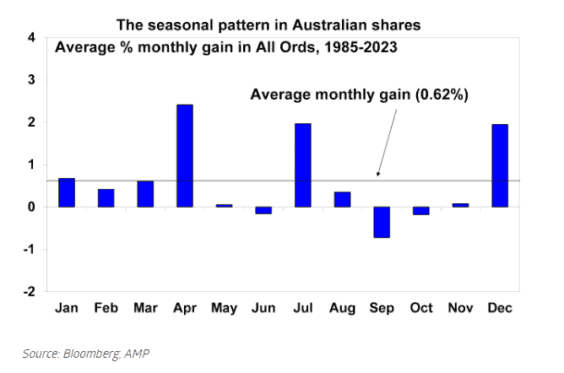
April, July and December have tended to be the strongest months of the year for price growth among ASX shares, according to analysis by AMP.
Since 1985, Australian share price gains have averaged 2.4% in April, 2% in July, and 1.9% in December.
This compares to an average monthly gain for all months of 0.62%.
September is typically the weakest month for ASX shares, according to the analysis.
In a blog published on asx.com.au, AMP chief economist Dr Shane Oliver explains that share market seasonality is due to ebbs and flows in demand for ASX shares at different times of the year.
The typical pattern is for ASX shares to strengthen from about October or November through to July the following year, followed by weakness through to September.
Relative weakness is often seen in May and June, which AMP interprets as representative of tax-loss selling.
That’s when investors sell poor-performing ASX shares before the end of the financial year so they can offset those capital losses against any capital gains made in the same financial year.
Do ASX shares follow the same pattern as US shares?
Dr Oliver says ASX shares perform in similar patterns to US shares.
Here is a chart documenting share price movements for ASX All Ords shares per month since 1985.
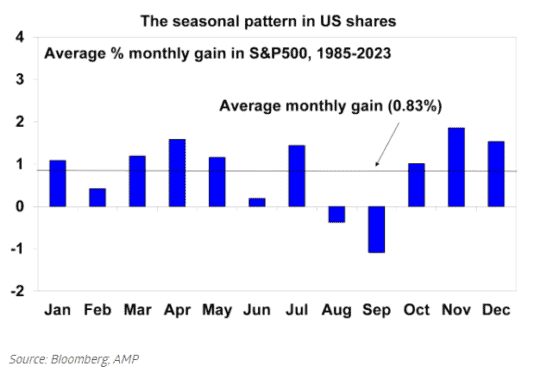
Here is the same information pertaining to S&P 500 Index (SP: .INX) shares in the US.
US share markets have historically been relatively weak around the September quarter, which is when the financial year finishes. So, this is when US investors would be doing most of their tax-loss selling.
Investors then start buying back into the market in the last quarter of the year.
There is a phenomenon called the ‘January effect’, when US shares have historically performed well on the back of new year optimism and a tendency for executives to invest their bonuses in more US stocks.
In recent years, anticipation of the ‘January effect’ has brought buying momentum forward to November and December.
US stocks tend to perform well between January and May, by which time new year optimism has faded.
Since 1985, November and April have been the strongest months for US shares, with average monthly gains of 1.9% and 1.6% respectively, according to AMP’s analysis.
This compares to an average monthly gain across all months of 0.83%.
August and September have historically been the weakest months for US shares.
Is ‘sell in May and go away’ still relevant in 2024?
Since 1985, the average total return (i.e, price rises and dividends) from US shares from the end of November to the end of May has been 90% higher than the return from the end of May to the end of November.
Globally, and in Australia and Asia, it has been three or more times bigger, according to AMP’s analysis.
Which ASX shares gained the most value in April?
As we said earlier, April tends to be a strong month for ASX shares, but not this year.
The S&P/ASX 200 Index (ASX: XJO) fell by 3% last month due to fears of delayed interest rate cuts.
But some ASX shares made spectacular gains.
Below are the top five risers of the month, according to CommSec data.
Dr Oliver says “it’s not always reliable, but don’t ignore the time of the year”.
He says:
Seasonal influences can also be overwhelmed when contrary fundamental influences [such as market or company factors] are strong, so they don’t apply in all years.
Seasonal patterns certainly shouldn’t dominate an investor’s strategy.
However, they nevertheless provide a reasonable guide to the monthly rhythm of markets that investors should ideally be aware of.
Wondering where you should invest $1,000 right now?
When investing expert Scott Phillips has a stock tip, it can pay to listen. After all, the flagship Motley Fool Share Advisor newsletter he has run for over ten years has provided thousands of paying members with stock picks that have doubled, tripled or even more.*
Scott just revealed what he believes could be the ‘five best ASX stocks’ for investors to buy right now. We believe these stocks are trading at attractive prices and Scott thinks they could be great buys right now…
Motley Fool contributor Bronwyn Allen has positions in South32. The Motley Fool Australia’s parent company Motley Fool Holdings Inc. has no position in any of the stocks mentioned. The Motley Fool Australia has no position in any of the stocks mentioned. The Motley Fool has a disclosure policy. This article contains general investment advice only (under AFSL 400691). Authorised by Scott Phillips.
The Nimitz-class aircraft carrier USS Dwight D. Eisenhower and the French aircraft carrier FS Charles De Gaulle participate in a photo exercise in the Mediterranean Sea on May 2.
US Navy photo by Mass Communication Specialist 2nd Class Eric Edinger/Released
Two US Navy warships on the front lines of the Houthi battle are back in the Red Sea.
The USS Dwight D. Eisenhower and USS Gravely made a recent port visit in Greece.
A Navy spokesperson confirmed that the two ships were resupplied and rearmed there.
The US Navy aircraft carrier that spent months battling the Houthis in the Red Sea is rearmed and back in the waterway after a short break. The warship's return comes as American intelligence officials warn the conflict may go on for a while.
The USS Dwight D. Eisenhower and Arleigh Burke-class guided-missile destroyer USS Gravely are back in the Red Sea to continue their maritime security mission after a recent port visit in Souda Bay, Greece, a Navy spokesperson confirmed to Business Insider on Tuesday.
US Naval Support Activity Souda Bay, located on the Mediterranean island of Crete, is a decades-old forward-operating station where American and NATO vessels can receive maintenance, cargo, food, fuel, supplies, and ammunition.
During the brief port visit, the two ships were resupplied and rearmed while their sailors enjoyed some relaxing downtime, the spokesperson said. It marked their first stop since their ongoing deployment began in mid-October.
The Nimitz-class aircraft carrier USS Dwight D. Eisenhower prepares to port in Souda Bay, Greece on April 28.
US Navy by Mass Communication Specialist Seaman Mercy Crowe/Released
Since it first arrived in the region, a high-tempo combat environment, the Navy's Dwight D. Eisenhower Carrier Strike Group — which consists of the Ike, the Gravely, and several other warships — has defended shipping lanes in the Red Sea and Gulf of Aden from relentless Houthi missile and drone attacks.
Rear Adm. Marc Miguez, commander of the carrier strike group, said the sailors "have worked tirelessly for six months straight to keep us operating on station in the most challenging, dynamic combat environment the Navy has seen in decades."
"This port visit is well-deserved," Miguez said in a Navy statement after the Ike and Gravely left Souda Bay last week.
The Navy has expended nearly $1 billion in missiles to counter the Houthi threats. Beyond intercepting attacks in the air, US forces have also conducted strikes in Yemen, hammering the Iran-backed rebels before they have a chance to launch their weapons.
An F/A-18F Super Hornet, attached to the "Fighting Swordsmen" of Strike Fighter Squadron 32, aboard the Nimitz-class aircraft carrier USS Dwight D. Eisenhower launches from the flight deck during an airborne change of command ceremony in the Red Sea on April 16.
US Navy photo
That figure, disclosed by Secretary of the Navy Carlos Del Toro in mid-April, underscored the growing financial cost of the Houthi fight and the need for US Navy vessels to replenish their munitions so they can remain in the fight, which presently shows no signs of slowing down.
Last week, the US intelligence chief warned lawmakers that the Houthis are "going to remain active for some time," partly because they are domestically producing a lot of weaponry while also continuing to receive support from Iran.
"Neither of those things are likely to change in the near future," Director of National Intelligence Avril Haines told the Senate Committee on Armed Services during a hearing on global threats.
"That doesn't mean that the strikes that the Department of Defense and the coalition‚ with our allies, have taken haven't had impact," she said, referring to unilateral US strikes and joint strikes with the UK in Yemen. "They have," she added, "but it's been insufficient to really stop the Houthis from going down this road."
The Arleigh Burke-class guided-missile destroyer USS Gravely arrives in Souda Bay, Crete on April 28.
US Navy photo by Mass Communication Specialist 3rd Class Nicholas Rodriguez/Released
The Houthis have claimed that their attacks are directly related to Israel's ground offensive in the Gaza Strip, triggered by Hamas' Oct. 7 massacre, but US officials have pushed back on this, citing the wide range of nationalities that have been targeted at sea by the rebels.
Haines told lawmakers that it's unclear whether a cease-fire between Israel and Hamas would lead to a drop in Houthi activity.
While there may be no immediate end in sight to the Red Sea conflict, US officials have routinely stressed that American forces will continue to engage the Houthis.
Pentagon Press Secretary Air Force Maj. Gen. Pat Ryder told reporters last month that "as long as there continues to be a threat to international shipping and to the lives and safety of mariners transiting the Red Sea, we'll continue to work with international partners to degrade and disrupt Houthi capability."
Instructors from the Norwegian Home Guard participate in a blank fire exercise, together with Ukrainian soldiers, as part of training with NATO-standard combat methods to enhance Ukrainian military capabilities, on August 25, 2023, north of Trondheim, Norway.
Jonathan Nackstrand /AFP via Getty Images
Despite US aid, Ukraine struggles to maintain sufficient manpower on the front lines.
Ukraine's dwindling soldier numbers are a problem that could get worse, a war analyst warned.
Ukraine is also facing other challenges, like the diminished effectiveness of precision weapons.
Ukraine is having trouble maintaining a sufficient force size in its fight against Russia, which could lead to more problems down the road, war analyst Michael Kofman said.
The embattled northeastern Ukrainian city of "Kharkiv is pretty well-entrenched and defended I think at this point, but nonetheless, there's a danger there because it will take some a months for Ukraine to address its manning situation," Kofman, a senior fellow at the Carnegie Endowment for International Peace, said during the War on The Rocks podcast that aired Monday.
As Russia makes slow gains in eastern Ukraine, Kharkiv, one of Ukraine's largest cities, stands in its path. The question is whether Ukraine will be able to stabilize its lines before Russia potentially pushes toward the city this summer.
Kofman predicts that Ukraine's "manning situation is the kind of thing that's probably going to get worse before it gets better."
Although Ukraine will receive $61 billion in aid from the US over the coming months, the country has continuously struggled to increase and maintain its manpower on the front lines — a critical capability the aid package doesn't fix.
"Ammunition may come in two weeks, but manpower won't," Kofman said. Ukraine has long struggled with manpower issues, but the situation has worsened.
Earlier this year, a Ukrainian service member told The Washington Post that the companies in his battalion were staffed at 35% of normal levels.
Ukrainian military officials have sought as many as 500,000 more soldiers to fight. More recently, new mobilization laws are going into effect, and Ukrainian lawmakers took steps last month to advance a bill that would allow certain individuals in prison to serve in the country's military.
In addition to the ongoing manpower woes, Kofman said that Ukraine is also struggling with the declining effectiveness of some of its precision capabilities.
Kofman said Russia has been able to adapt to how Ukraine uses these capabilities through "electronic warfare and reorganization of Russian command and control and logistics."
Manpower shortages are still a key problem for the Ukrainians, though. "In general, Ukrainian force is still performing rather well on the defense," he said. "The challenge is that they are significantly outnumbered."