• ASX expert: Buy Lynas shares now

    Female miner in hard hat and safety vest on laptop with mining drill in background.

    Lynas Rare Earths Ltd (ASX: LYC) shares are up 2.52% to $6.11 per share on Thursday.

    The ASX rare earths stock appears to be pulling itself out of a share price dip at the moment.

    Lynas shares hit a 52-week low of $5.49 on 27 March before rebounding 11% to where they are today.

    The current valuation is one of the reasons why top broker Goldman Sachs is recommending that investors buy Lynas shares today.

    But before we get into the reasons why, let’s recap what Lynas is all about.

    Who is Lynas?

    This ASX miner is the only significant producer of separated rare earths outside of China.

    Lynas owns the Mt Weld mine in Western Australia, which is one of the world’s premier rare earths deposits. This is where Lynas digs up a bunch of rare earths, like neodymium and praseodymium (NdPr), before processing them at facilities in Kalgoorlie, Western Australia and Kuantan, Malaysia. 

    Rare earths are used in electronics, wind turbines, and hybrid and electric vehicles (EVs).

    ASX expert tells investors to buy Lynas shares

    In a new note to clients, Goldman Sachs has maintained its conviction buy rating on Lynas shares.

    The broker has a 12-month price target of $7.50 on the ASX rare earths share. This implies a potential upside of 22.75% for investors who buy Lynas shares today.

    The broker explains its rating:

    LYC: Buy rated (on the APAC Conviction List) on: (1) Undervalued, trading at ~0.7x NAV (~A$8/sh) on our estimates, with a strong balance sheet (net cash of ~A$210mn), (2) NdPr market balanced over medium term but deficits over long run on higher Chinese supply, (3) Doubling NdPr production, LYNAS 2025 target (12ktpa NdPr) likely delivered in 2026 but could be upsized to >12ktpa NdPr (not in base case) based on the Mt Weld resource, possible third party feed, and ongoing supportive global government policy.

    What’s the latest news from Lynas?

    The company’s most recent price-sensitive news announcement was its 1H FY24 report in February.

    Although the miner revealed a 74% half-year profit decline due to weaker commodity prices, investors were still pleased to see a profitable first half and rewarded Lynas with a 1.03% share price bump.

    For the six months ended 31 December, Lynas reported a 36.5% revenue fall to $234.8 million.

    Cost of sales declined 14% year over year to $159 million, and interest earnings on its generous cash balance helped the company deliver a net profit after tax (NPAT) of $39.5 million.

    Looking ahead, Lynas CEO Amanda Lacaze said:

    The rare earths market is important to many industries and we continue to see strong customer demand for Lynas’ products.

    Lynas has a proven track record of managing costs and operations to ensure that we can be successful in all market conditions, and across all stages of the market cycle.

    Optimising our industrial footprint through operating efficiencies and capital growth projects will ensure Lynas is well positioned to benefit from forecast market growth and any improvement in market pricing conditions.

    The post ASX expert: Buy Lynas shares now appeared first on The Motley Fool Australia.

    Wondering where you should invest $1,000 right now?

    When investing expert Scott Phillips has a stock tip, it can pay to listen. After all, the flagship Motley Fool Share Advisor newsletter he has run for over ten years has provided thousands of paying members with stock picks that have doubled, tripled or even more.*

    Scott just revealed what he believes could be the ‘five best ASX stocks’ for investors to buy right now. We believe these stocks are trading at attractive prices and Scott thinks they could be great buys right now…

    See The 5 Stocks
    *Returns as of 1 February 2024

    (function() {
    function setButtonColorDefaults(param, property, defaultValue) {
    if( !param || !param.includes(‘#’)) {
    var button = document.getElementsByClassName(“pitch-snippet”)[0].getElementsByClassName(“pitch-button”)[0];
    button.style[property] = defaultValue;
    }
    }

    setButtonColorDefaults(“#0095C8”, ‘background’, ‘#5FA85D’);
    setButtonColorDefaults(“#0095C8”, ‘border-color’, ‘#43A24A’);
    setButtonColorDefaults(“#fff”, ‘color’, ‘#fff’);
    })()

    More reading

    Motley Fool contributor Bronwyn Allen has no position in any of the stocks mentioned. The Motley Fool Australia’s parent company Motley Fool Holdings Inc. has positions in and has recommended Goldman Sachs Group. The Motley Fool Australia has no position in any of the stocks mentioned. The Motley Fool has a disclosure policy. This article contains general investment advice only (under AFSL 400691). Authorised by Scott Phillips.

    from The Motley Fool Australia https://ift.tt/PUgepu7

  • This 7% yield ASX 200 stock trades ex-dividend next week. Should you buy?

    A woman has a thoughtful look on her face as she studies a fan of Australian 20 dollar bills she is holding on one hand while he rest her other hand on her chin in thought.

    If you’re on the lookout for some big dividends, then you may want to have a look at New Hope Corporation Ltd (ASX: NHC).

    Particularly given that the ASX 200 stock will be trading ex-dividend next week. When this happens, it means the rights to the coal miner’s next dividend will be settled.

    The New Hope dividend

    As a reminder, last month the ASX 200 stock released its half year results.

    For the six months ended 31 January, New Hope reported a 45.9% decline in revenue to $856.6 million and a 59% reduction in EBITDA to $424.8 million.

    This reflects a 58% decline in its average realised price to A$197 per tonne and an 11% increase in cash costs, which was partially offset by hedging and 28% lift in saleable coal production.

    Unsurprisingly, this forced the New Hope board to take an axe to its dividend. It cut its fully franked interim dividend by 57% to 17 cents per share.

    And while a dividend cut is always disappointing, this payout still equates to a very generous dividend yield. Particularly for just an interim dividend.

    Based on the current New Hope share price of $4.86, this dividend represents a 3.5% yield for income investors buying shares today.

    If you want to receive this dividend when it is paid on 1 May, you will need to own its shares before they trade ex-dividend. That is scheduled to be next week on Monday 15 April.

    More to come

    But that won’t be the only dividend that the ASX 200 stock pays this year. There’s also likely to be a fully franked final dividend paid to shareholders in approximately six months.

    According to a recent note out of Morgans, its analysts expect a final dividend of 18 cents per share later this year.

    This will bring its total dividends to 35 cents per share in FY 2024. This would be a 50% reduction on the dividends it paid a year earlier.

    Nevertheless, this still represents a sizeable 7.2% dividend yield based on its current share price.

    Should you buy this ASX 200 stock?

    Morgans thinks that New Hope’s shares are largely fully valued now.

    The broker currently has a hold rating and $4.80 price target on the coal miner’s shares. This implies modest downside of 1.4% from current levels.

    Interestingly, the team at Ord Minnett see a lot more value in this ASX 200 stock.

    Although its analysts only have a hold rating on New Hope’s shares, they have a lofty $5.90 price target on them. This suggests that potential upside of over 20% is possible over the next 12 months.

    The post This 7% yield ASX 200 stock trades ex-dividend next week. Should you buy? appeared first on The Motley Fool Australia.

    Wondering where you should invest $1,000 right now?

    When investing expert Scott Phillips has a stock tip, it can pay to listen. After all, the flagship Motley Fool Share Advisor newsletter he has run for over ten years has provided thousands of paying members with stock picks that have doubled, tripled or even more.*

    Scott just revealed what he believes could be the ‘five best ASX stocks’ for investors to buy right now. We believe these stocks are trading at attractive prices and Scott thinks they could be great buys right now…

    See The 5 Stocks
    *Returns as of 1 February 2024

    (function() {
    function setButtonColorDefaults(param, property, defaultValue) {
    if( !param || !param.includes(‘#’)) {
    var button = document.getElementsByClassName(“pitch-snippet”)[0].getElementsByClassName(“pitch-button”)[0];
    button.style[property] = defaultValue;
    }
    }

    setButtonColorDefaults(“#0095C8”, ‘background’, ‘#5FA85D’);
    setButtonColorDefaults(“#0095C8”, ‘border-color’, ‘#43A24A’);
    setButtonColorDefaults(“#fff”, ‘color’, ‘#fff’);
    })()

    More reading

    Motley Fool contributor James Mickleboro has no position in any of the stocks mentioned. The Motley Fool Australia’s parent company Motley Fool Holdings Inc. has no position in any of the stocks mentioned. The Motley Fool Australia has no position in any of the stocks mentioned. The Motley Fool has a disclosure policy. This article contains general investment advice only (under AFSL 400691). Authorised by Scott Phillips.

    from The Motley Fool Australia https://ift.tt/j91YxwX

  • Up 16% in 2024! Are ASX tech shares now overvalued?

    A young man talks tech on his phone while looking at a laptop. A financial graph is superimposed across the image.

    ASX tech shares have been the frontrunner during the share market’s rally to new heights. On a year-to-date basis, the Australian information technology sector is up 16%, nearly twice the return of the runner-up.

    It’s a similar scene over in the United States. A surge in appetite for artificial intelligence (AI) has boosted US tech stocks. This is apparent from AI chip makers Nvidia Corp (NASDAQ: NVDA) and Super Micro Computer Inc (NASDAQ: SMCI) being the two best-performing stocks in the S&P500 in 2024.

    However, one broker believes the best of times for tech is now at a temporary high.

    Finding better value elsewhere

    Some like to apply a sector rotation strategy when specific sectors are soaring beyond others. By selling into strength and rotating into weakness, investors hope to maximise returns while reducing downside risk.

    The hedge fund behind Goldman Sachs (aka Goldman Sachs Asset Management) is taking this approach to tech. In an interview with Bloomberg, Alexandra Wilson-Elizondo, co-chief investment officer of multi-asset solutions, shared a view that now is the time to take some profits in the sector.

    Elaborating on the fund’s current stance, Wilson-Elizondo said:

    We like taking profits on technology and moving toward other sectors. the risk-reward profile is skewed to the downside. While we still believe in being long equities and having them in the portfolio, we think that there are some more attractive opportunities to access.

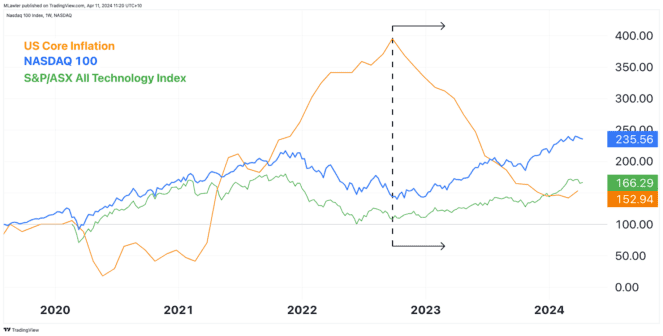
    The comments coincide with a recent re-acceleration in US inflation. Year-over-year US inflation for March came in hot at 3.8% overnight. The figure poured cold water on the hopes of an interest rate cut happening soon.

    Data by Trading View

    Wilson-Elzondo’s point also speaks to a bigger concern. What if inflation rages back with a vengeance?

    As shown above, the strength in US and ASX tech shares is inversely aligned with the fall of inflation. With the NASDAQ-100 Index (NASDAQ: NDX) up 64% since inflation began falling, one wonders what might happen to the tech sector if the recent inversion continues.

    Are ASX tech shares the same?

    Goldman Sachs Asset Management is explicitly talking about US tech shares. But aren’t ASX tech shares guilty of the same success? It’s the valuation that Wilson-Elizondo points out as a worrying factor on Wall Street.

    Let’s look at a valuation comparison between Aussie and US tech giants:

    US tech companies (Magnificent 7) P/E Ratio ASX tech shares P/E Ratio
    Microsoft Corp (NASDAQ: MSFT) 38 Wisetech Global Ltd (ASX: WTC) 133
    Apple Inc (NASDAQ: AAPL) 26 Xero Ltd (ASX: XRO) N/A
    Nvidia Corp (NASDAQ: NVDA) 73 NextDC Ltd (ASX: NXT) N/A
    Amazon.com Inc (NASDAQ: AMZN) 64 TechnologyOne Ltd (ASX: TNE) 51
    Alphabet Inc (NASDAQ: GOOG) 29 Life360 Inc (ASX: 360) N/A
    Meta Platforms (NASDAQ: META) 34 Megaport Ltd (ASX: MP1) 261
    Tesla Inc (NASDAQ: TSLA) 40 Codan Ltd (ASX: CDA) 26
    Data as of 11:00 am AEST 11 April 2024

    Like our US counterparts, some of our largest tech companies are trading on high price-to-earnings (P/E) ratios.

    Future growth can excuse a premium P/E ratio. However, the risk lies in the company living up to those expectations — expectations that could be made harder by a resurgence of inflation.

    The post Up 16% in 2024! Are ASX tech shares now overvalued? appeared first on The Motley Fool Australia.

    Wondering where you should invest $1,000 right now?

    When investing expert Scott Phillips has a stock tip, it can pay to listen. After all, the flagship Motley Fool Share Advisor newsletter he has run for over ten years has provided thousands of paying members with stock picks that have doubled, tripled or even more.*

    Scott just revealed what he believes could be the ‘five best ASX stocks’ for investors to buy right now. We believe these stocks are trading at attractive prices and Scott thinks they could be great buys right now…

    See The 5 Stocks
    *Returns as of 1 February 2024

    (function() {
    function setButtonColorDefaults(param, property, defaultValue) {
    if( !param || !param.includes(‘#’)) {
    var button = document.getElementsByClassName(“pitch-snippet”)[0].getElementsByClassName(“pitch-button”)[0];
    button.style[property] = defaultValue;
    }
    }

    setButtonColorDefaults(“#0095C8”, ‘background’, ‘#5FA85D’);
    setButtonColorDefaults(“#0095C8”, ‘border-color’, ‘#43A24A’);
    setButtonColorDefaults(“#fff”, ‘color’, ‘#fff’);
    })()

    More reading

    Suzanne Frey, an executive at Alphabet, is a member of The Motley Fool’s board of directors. Randi Zuckerberg, a former director of market development and spokeswoman for Facebook and sister to Meta Platforms CEO Mark Zuckerberg, is a member of The Motley Fool’s board of directors. John Mackey, former CEO of Whole Foods Market, an Amazon subsidiary, is a member of The Motley Fool’s board of directors. Motley Fool contributor Mitchell Lawler has positions in Apple, Meta Platforms, and Tesla and has the following options: long June 2025 $510 calls on Tesla. The Motley Fool Australia’s parent company Motley Fool Holdings Inc. has positions in and has recommended Alphabet, Amazon, Apple, Life360, Megaport, Meta Platforms, Microsoft, Nvidia, Technology One, Tesla, WiseTech Global, and Xero. The Motley Fool Australia’s parent company Motley Fool Holdings Inc. has recommended the following options: long January 2026 $395 calls on Microsoft and short January 2026 $405 calls on Microsoft. The Motley Fool Australia has positions in and has recommended WiseTech Global and Xero. The Motley Fool Australia has recommended Alphabet, Amazon, Apple, Megaport, Meta Platforms, Nvidia, and Technology One. The Motley Fool has a disclosure policy. This article contains general investment advice only (under AFSL 400691). Authorised by Scott Phillips.

    from The Motley Fool Australia https://ift.tt/SunP5Ef

  • Why is the ASX 200 tumbling on the latest US inflation print?

    A man with arms spread yells as he plunges into a swimming pool.

    The S&P/ASX 200 Index (ASX: XJO) is taking a beating today.

    After closing higher on Monday, Tuesday, and Wednesday this week, the benchmark index is down 0.57% around Thursday lunchtime.

    The ASX 200 is following the lead of United States markets, which all closed sharply lower overnight after the latest US inflation readings through to the end of March.

    Here’s what’s happening.

    ASX 200 catching US inflationary headwinds

    Following on the inflation data released by the US Labor Department, the S&P 500 Index (INDEXSP: .INX) closed down 1.0% while the tech-heavy Nasdaq Composite Index (INDEXNASDAQ: .IXIC) ended the day down 0.8%.

    This came after hotter than expected inflation readings pushed back investor expectations of when we can expect an interest rate cut from the US Federal Reserve. Those revised expectations also look to be pressuring the ASX 200 today.

    The US core consumer price index, which takes out volatile food and energy prices, was up 0.4% from February. Year-on-year core CPI remained unchanged at 3.8%, against consensus expectations of a pullback.

    Headline inflation increased 0.4% in March with inflation now running at 3.5% on an annual basis, up from 3.2% last month.

    That’s well above the Federal Reserve’s 2% target. And it could see the official US cash rate stay at the current 5.25% to 5.5% for considerably longer than ASX 200 investors have been hoping.

    Former Obama administration economist Jason Furman noted that the core inflation figures in the US are picking up at a historical pace.

    According to Furman (quoted by The Australian Financial Review):

    Over the last three months core CPI has risen at a 4.6% annual rate. That is faster than any three-month period from August 1991 to 2020. Over the last twelve months core CPI has risen 3.5%. That is faster than any twelve-month period from February 1993 to 2020.

    What are the experts saying about rate cuts now?

    Commenting on the sticky inflation in the world’s top economy, David Kelly, chief global strategist at JPMorgan Asset Management said (quoted by Bloomberg), “The sound you heard there was the door slamming on a June rate cut. That’s gone,”

    As for when ASX 200 investors might expect the Fed to begin easing now, Bloomberg Economics Anna Wong and Stuart Paul said:

    The Fed is likely to take a stronger signal that disinflation momentum is slowing from this report. We push back our expectation for a first rate cut to July, from our previous baseline of June.

    Closer to home, the economists at National Australia Bank Ltd (ASX: NAB) are also dialling back rate cut forecasts (courtesy of the AFR).

    According to NAB:

    The market now has between one and two Fed rate cuts priced for year-end, from between two and three. [The inflation data] reduced the implied odds of a June rate cut to less than 20% from around 50% heading into the release.

    “The modest overshoot in US March CPI inflation was sufficient to force a fragile market to reprice the first full 25bp rate cut from the Fed back to November from July,” ANZ Group Holdings Ltd (ASX: ANZ) economists added.

    Could ASX 200 investors see interest rates actually go higher now?

    While most analysts are still confident that the path for interest rates from the Fed, along with other leading central banks like the RBA, is lower, former US Treasury Secretary Lawrence Summers cautioned that a rate hike isn’t off the table.

    Saying, “We do not need rate cuts right now,” he forecast the odds of a rate hike from the Fed were in the range of 15% to 25%.

    Summers noted (quoted by Bloomberg):

    You have to take seriously the possibility that the next rate move will be upwards rather than downwards. On current facts, a rate cut in June it seems to me would be a dangerous and egregious error comparable to the errors the Fed was making in the summer of 2021.

    A likely delayed rate cut from the Fed is already sending the ASX 200 sharply lower today.

    An unexpected rate increase would be most unwelcome.

    The post Why is the ASX 200 tumbling on the latest US inflation print? appeared first on The Motley Fool Australia.

    Wondering where you should invest $1,000 right now?

    When investing expert Scott Phillips has a stock tip, it can pay to listen. After all, the flagship Motley Fool Share Advisor newsletter he has run for over ten years has provided thousands of paying members with stock picks that have doubled, tripled or even more.*

    Scott just revealed what he believes could be the ‘five best ASX stocks’ for investors to buy right now. We believe these stocks are trading at attractive prices and Scott thinks they could be great buys right now…

    See The 5 Stocks
    *Returns as of 1 February 2024

    (function() {
    function setButtonColorDefaults(param, property, defaultValue) {
    if( !param || !param.includes(‘#’)) {
    var button = document.getElementsByClassName(“pitch-snippet”)[0].getElementsByClassName(“pitch-button”)[0];
    button.style[property] = defaultValue;
    }
    }

    setButtonColorDefaults(“#0095C8”, ‘background’, ‘#5FA85D’);
    setButtonColorDefaults(“#0095C8”, ‘border-color’, ‘#43A24A’);
    setButtonColorDefaults(“#fff”, ‘color’, ‘#fff’);
    })()

    More reading

    Motley Fool contributor Bernd Struben has no position in any of the stocks mentioned. The Motley Fool Australia’s parent company Motley Fool Holdings Inc. has no position in any of the stocks mentioned. The Motley Fool Australia has no position in any of the stocks mentioned. The Motley Fool has a disclosure policy. This article contains general investment advice only (under AFSL 400691). Authorised by Scott Phillips.

    from The Motley Fool Australia https://ift.tt/dgOnFl0

  • How much do you need to invest in the Vanguard Australian Shares Index ETF (VAS) for $10,000 in annual dividends?

    Man on computer looking at graphs

    The Vanguard Australian Shares Index ETF (ASX: VAS) is a popular way to invest passively in ASX shares. But can we consider this exchange-traded fund (ETF) a good option for dividends?

    The job of an index fund like VAS is to match the returns of its underlying index. In this case, it’s the S&P/ASX 300 Index (ASX: XKO) – 300 of the biggest businesses on the ASX.

    In terms of dividends, the VAS ETF passes on to its unitholders the dividend income (or distributions) it receives from its holdings.

    How large is the VAS ETF dividend yield?

    The biggest holdings in the Vanguard Australian Shares Index ETF portfolio also have some of the ASX’s biggest dividend yields.

    We’re talking about ASX blue-chip shares like Rio Tinto Ltd (ASX: RIO), Fortescue Ltd (ASX: FMG), Westpac Banking Corp (ASX: WBC), ANZ Group Holdings Ltd (ASX: ANZ) and Telstra Group Ltd (ASX: TLS).

    This means the VAS ETF as a whole has a generous dividend yield as well.

    According to Vanguard, the VAS ETF had a partially franked dividend yield of 3.9% at the end of February 2024. Franking credits are a bonus that adds more to the after-tax returns – they either offset some of the tax owed, or the franking credits can be refundable.

    However, everyone’s tax position is different, so I’ll just use the regular dividend yield when calculating.

    How much to invest for $10,000 of annual dividends?

    We’re talking about a sizeable investment in the ETF to receive $10,000 of annual dividends, as it’s a large amount of cash flow. Based on a 3.9% dividend yield, we’d need to invest around $256,000 in VAS ETF units to receive $10,000 of yearly dividends.

    Looking at more realistic numbers, a $25,641 investment would generate $1,000 per year of cash dividends. And if we had $10,000 to invest in Vanguard Australian Shares Index ETF units, this would create $390 of annual cash dividends.

    Another option

    Focusing on building a portfolio of individual ASX dividend shares might be a more efficient strategy for investors who want a higher yield.

    For example, Commsec estimates suggest that in FY24, Telstra could pay a cash dividend yield of 4.7%, diversified property owner Charter Hall Long WALE REIT (ASX: CLW) could pay a distribution yield of 7% and IGA supplier and hardware business Metcash Ltd (ASX: MTS) could pay a cash dividend yield of 5.1%.

    There are plenty of other ASX shares with appealing dividend yields to look at as well.

    The post How much do you need to invest in the Vanguard Australian Shares Index ETF (VAS) for $10,000 in annual dividends? appeared first on The Motley Fool Australia.

    Wondering where you should invest $1,000 right now?

    When investing expert Scott Phillips has a stock tip, it can pay to listen. After all, the flagship Motley Fool Share Advisor newsletter he has run for over ten years has provided thousands of paying members with stock picks that have doubled, tripled or even more.*

    Scott just revealed what he believes could be the ‘five best ASX stocks’ for investors to buy right now. We believe these stocks are trading at attractive prices and Scott thinks they could be great buys right now…

    See The 5 Stocks
    *Returns as of 1 February 2024

    (function() {
    function setButtonColorDefaults(param, property, defaultValue) {
    if( !param || !param.includes(‘#’)) {
    var button = document.getElementsByClassName(“pitch-snippet”)[0].getElementsByClassName(“pitch-button”)[0];
    button.style[property] = defaultValue;
    }
    }

    setButtonColorDefaults(“#0095C8”, ‘background’, ‘#5FA85D’);
    setButtonColorDefaults(“#0095C8”, ‘border-color’, ‘#43A24A’);
    setButtonColorDefaults(“#fff”, ‘color’, ‘#fff’);
    })()

    More reading

    Motley Fool contributor Tristan Harrison has positions in Fortescue and Metcash. The Motley Fool Australia’s parent company Motley Fool Holdings Inc. has no position in any of the stocks mentioned. The Motley Fool Australia has positions in and has recommended Telstra Group. The Motley Fool Australia has recommended Metcash. The Motley Fool has a disclosure policy. This article contains general investment advice only (under AFSL 400691). Authorised by Scott Phillips.

    from The Motley Fool Australia https://ift.tt/xmSXCjQ

  • How does the VanEck Wide Moat ETF return 17% per annum?

    Businessman at the beach building a wall around his sandcastle, signifying protecting his business.

    Enjoying a return of around 17% per annum over a number of years is something that most ASX investors aren’t used to. But that’s what investors of the VanEck Morningstar Wide Moat ETF (ASX: MOAT) have been served up for many years.

    Conventional wisdom would dictate that one would have to be a pretty savvy stock picker to consistently bang out a 17% per annum return. Anyone who sticks to ASX index funds, like the Vanguard Australian Shares Index ETF (ASX: VAS), certainly wouldn’t be used to getting 17% on their money every year.

    And yet this is the norm for MOAT investors.

    If you look at the latest figures from VanEck, it’s evident that this is no pipedream. As of 31 March, MOAT units have returned an average of 17.16% per annum over the last five years. That’s inclusive of this exchange-traded fund (ETF)‘s dividend distribution returns.

    Those investors have also enjoyed a 15.9% per annum return over the past three years. And a whopping 25.78% over just the past 12 months.

    The VanEck Wide Moat ETF hasn’t been on the ASX for an entire decade just yet, with an ASX inception date of June 2015. However, the index that it tracks has returned an average of 17.74% per annum over the ten years to 31 March.

    In contrast, the Vanguard Australian Shares ETF has returned an average of 8.2% per annum over the ten years to 31 March.

    So how does the VanEck Wide Moat ETF do it? How can it generate such lucrative returns for investors? After all, a 17.12% return over 10 years is enough to turn every $1,000 invested into roughly $5,000 over a ten-year span.

    How can the VanEck Wide Moat ETF consistently return 17% per annum to ASX investors?

    Well, I think this ETF’s stellar returns can be broken down into two parts for investors to understand.

    Firstly, the quality of the underlying shares in this ETF’s portfolio undoubtedly helped it achieve these stunning numbers. The Wide Moat ETF isn’t really an index fund in the traditional sense. It functions more like an actively managed fund.

    MOAT’s portfolio is constructed by analysing large companies in the US markets and only selecting those that demonstrate the possession of what’s known as a wide economic moat. This is a concept first coined by legendary investor Warren Buffett. It refers to an inherent competitive advantage that a company can possess. This helps it keep customers in the face of attacks from competitors.

    There are many kinds of moats a company can have. But the most common include a strong brand (perhaps Apple or Toyota), offering products or services at the lowest prices (Amazon or Coles Group Ltd (ASX: COL), or possessing an asset that customers find difficult to avoid (maybe one of Transurban Group (ASX: TCL)’s toll roads).

    Buffett loves these kinds of companies because they tend to be amongst the highest-returning investments on the market.

    These are the only companies that the VanEck Wide Moat ETF houses in its portfolio.

    Right now, you’ll find names like Campbell Soup Co, Alphabet, Altria, Pfizer, Nike and Disney in the Wide Moat ETF. Most of those names are famous around the world, and for good reason.

    This Buffett-like investing methodology clearly pays off for the Wide Moat ETF and its investors.

    Dollars and dollars

    The second reason is the current currency environment. Over the past decade, the Australian dollar has weakened considerably against the US dollar. Back in April 2014, one Aussie dollar was buying around 92 US cents. Today, that same dollar will get you just 65 US cents.

    This might be bad news for motorists and any other consumers of imported goods or services. But it’s great news for anyone who owns assets that are priced in US dollars. As it happens, MOAT’s entire portfolio is US dollar-denominated.

    So it’s a combination of these two factors that seem to have turbo-charged the returns of the VanEck Wide Moat ETF over the past ten years. Let’s see if investors will continue to enjoy a 17% per annum return over the next ten years.

    The post How does the VanEck Wide Moat ETF return 17% per annum? appeared first on The Motley Fool Australia.

    Wondering where you should invest $1,000 right now?

    When investing expert Scott Phillips has a stock tip, it can pay to listen. After all, the flagship Motley Fool Share Advisor newsletter he has run for over ten years has provided thousands of paying members with stock picks that have doubled, tripled or even more.*

    Scott just revealed what he believes could be the ‘five best ASX stocks’ for investors to buy right now. We believe these stocks are trading at attractive prices and Scott thinks they could be great buys right now…

    See The 5 Stocks
    *Returns as of 1 February 2024

    (function() {
    function setButtonColorDefaults(param, property, defaultValue) {
    if( !param || !param.includes(‘#’)) {
    var button = document.getElementsByClassName(“pitch-snippet”)[0].getElementsByClassName(“pitch-button”)[0];
    button.style[property] = defaultValue;
    }
    }

    setButtonColorDefaults(“#0095C8”, ‘background’, ‘#5FA85D’);
    setButtonColorDefaults(“#0095C8”, ‘border-color’, ‘#43A24A’);
    setButtonColorDefaults(“#fff”, ‘color’, ‘#fff’);
    })()

    More reading

    Suzanne Frey, an executive at Alphabet, is a member of The Motley Fool’s board of directors. John Mackey, former CEO of Whole Foods Market, an Amazon subsidiary, is a member of The Motley Fool’s board of directors. Motley Fool contributor Sebastian Bowen has positions in Alphabet, Altria Group, Amazon, Apple, Nike, VanEck Morningstar Wide Moat ETF, Vanguard Australian Shares Index ETF, and Walt Disney. The Motley Fool Australia’s parent company Motley Fool Holdings Inc. has positions in and has recommended Alphabet, Amazon, Apple, Nike, Pfizer, Transurban Group, and Walt Disney. The Motley Fool Australia’s parent company Motley Fool Holdings Inc. has recommended the following options: long January 2025 $47.50 calls on Nike. The Motley Fool Australia has positions in and has recommended Coles Group. The Motley Fool Australia has recommended Alphabet, Amazon, Apple, Nike, VanEck Morningstar Wide Moat ETF, and Walt Disney. The Motley Fool has a disclosure policy. This article contains general investment advice only (under AFSL 400691). Authorised by Scott Phillips.

    from The Motley Fool Australia https://ift.tt/z7lZEcv

  • Why is this ASX lithium stock racing 15% higher today?

    A young male ASX investor raises his clenched fists in excitement because of rising ASX share prices today

    Vulcan Energy Resources Ltd (ASX: VUL) shares are avoiding the market weakness on Thursday.

    In morning trade, the ASX lithium stock is up almost 15% to $3.28.

    Why is this ASX lithium stock jumping?

    Investors have been buying the lithium developer’s shares after it released an update on its Lithium Extraction Optimisation Plant (LEOP) in Landau, Germany.

    According to the release, the company has started production of the first Lithium Chloride (LiCl) product at the LEOP.

    Management notes that this represents the first lithium chemicals domestically produced from a local source in Europe for the European market.

    The good news is that LEOP is showing strong early results with consistently over 90% (up to 95%) lithium extraction efficiency from its Adsorption-type Direct Lithium Extraction (A-DLE) unit. This replicates what the ASX lithium stock saw in its lab and pilot plant operations. Importantly, it is in line with its commercial plant expectations and financing model.

    What is the LEOP?

    Vulcan has spent 40 million euros on LEOP. It is an optimisation, operational training, and product qualification testing facility. Its aim is to enable operational readiness for when the Phase One commercial facility is completed.

    The next step will be its conversion to a battery-grade lithium chemical in Vulcan’s downstream optimisation plant. The LiCl product produced from LEOP will be transported to Höchst Industrial Park Frankfurt, where Vulcan is currently completing its Central LEOP. This facility will convert the LiCl into battery grade Lithium Hydroxide Monohydrate (LHM).

    Looking further ahead, once Phase One commercial production commences, Vulcan estimates that its integrated renewable energy and Zero Carbon Lithium business will produce enough lithium for approximately 500,000 electric vehicles.

    ‘Significant milestone’

    The ASX lithium stock’s CEO, Cris Moreno, was very pleased with the news. He commented:

    This significant milestone marks a pivotal moment in Vulcan’s journey towards revolutionising domestic lithium raw material supply for Europe’s Battery industry. Vulcan’s LEOP facility is equipped with world-leading technology designed to showcase the efficiency of our A-DLE process and environmental benefits, whilst training our commercial production team in a pre-commercial environment as we build the Phase One commercial plant.

    It is encouraging to see LEOP deliver extraction efficiency in line with our expectations. I would like to thank our determined project execution and operations team for getting us to this landmark. We look forward to providing further updates on our Central Lithium Electrolysis Optimisation Plant (CLEOP) as we aim to produce Europe’s first fully integrated lithium battery chemicals from our own domestic resource, and also to providing updates on Phase One of the Zero Carbon Lithium Project, including financing, in the coming months.

    The post Why is this ASX lithium stock racing 15% higher today? appeared first on The Motley Fool Australia.

    Wondering where you should invest $1,000 right now?

    When investing expert Scott Phillips has a stock tip, it can pay to listen. After all, the flagship Motley Fool Share Advisor newsletter he has run for over ten years has provided thousands of paying members with stock picks that have doubled, tripled or even more.*

    Scott just revealed what he believes could be the ‘five best ASX stocks’ for investors to buy right now. We believe these stocks are trading at attractive prices and Scott thinks they could be great buys right now…

    See The 5 Stocks
    *Returns as of 1 February 2024

    (function() {
    function setButtonColorDefaults(param, property, defaultValue) {
    if( !param || !param.includes(‘#’)) {
    var button = document.getElementsByClassName(“pitch-snippet”)[0].getElementsByClassName(“pitch-button”)[0];
    button.style[property] = defaultValue;
    }
    }

    setButtonColorDefaults(“#0095C8”, ‘background’, ‘#5FA85D’);
    setButtonColorDefaults(“#0095C8”, ‘border-color’, ‘#43A24A’);
    setButtonColorDefaults(“#fff”, ‘color’, ‘#fff’);
    })()

    More reading

    Motley Fool contributor James Mickleboro has no position in any of the stocks mentioned. The Motley Fool Australia’s parent company Motley Fool Holdings Inc. has no position in any of the stocks mentioned. The Motley Fool Australia has no position in any of the stocks mentioned. The Motley Fool has a disclosure policy. This article contains general investment advice only (under AFSL 400691). Authorised by Scott Phillips.

    from The Motley Fool Australia https://ift.tt/ZPUy403

  • Why did this ASX All Ords stock just crash 16%?

    Scientist looking at a laptop thinking about the share price performance.

    The All Ordinaries Index (ASX: XAO) is down 0.8% in morning trade, and it’s certainly not being helped by this tumbling ASX All Ords stock.

    The company in question is ASX healthcare stock Avita Medical Inc (ASX: AVH).

    The Avita Medical share price closed yesterday trading for $4.50. In early morning trade on Thursday, shares crashed to $3.77, down a precipitous 16.3%.

    Following some potential bargain hunting, shares have since recouped some of those losses.

    At the time of writing, shares in the ASX All Ords stock are trading for $4.00 apiece, down 11.1%.

    Here’s what’s happening.

    ASX All Ords stock tumbles on missed guidance

    Avita Medical is a commercial-stage regenerative medicine company focused on devices for wound care management and skin restoration.

    And the ASX All Ords stock is under heavy selling pressure today after reaffirming management’s expectations for full-year 2024 revenue to come in at the lower end of Avita’s previously provided guidance of US$78.5 million to US$84.5 million.

    The company also announced an update to its expected commercial revenue for the first quarter of 2024.

    For the March quarter, Avita Medical said it now expects commercial revenue to be in the range of US$11.0 million to US$11.3 million. That’s significantly lower than the company’s prior revenue guidance of US$14.8 million to US$15.6 million for the three-month period.

    Management pointed to a slower-than-expected conversion rate of new accounts for Avita’s expanded label of full-thickness skin defects for the downward revision.

    Commenting on the results putting the ASX All Ords stock under the gun today, Avita Medical CEO Jim Corbett said, “In light of the challenges encountered in the first quarter of 2024, we are intensifying our efforts to drive growth.”

    Corbett added:

    While our account conversion rate impacted our quarterly revenue, we remain optimistic for the full year.

    With the recent launch of PermeaDerm in March and the upcoming launch of RECELL GO, along with our deeper understanding of the VAC processes and timelines, we believe that we will meet the lower end of our previously provided annual revenue guidance range of US$78.5 million to US$84.5 million.

    Corbett said that Avita remains committed to delivering value and making a positive impact on the lives of its patients.

    The company is expected to report its financial results for the first quarter of 2024 after the close of the US financial markets on 13 May, meaning we should have them here at market open on 14 May.

    Avita Medical share price snapshot

    Despite today’s big fall, shares in the ASX All Ords stock remain up 8% over six months.

    The post Why did this ASX All Ords stock just crash 16%? appeared first on The Motley Fool Australia.

    Wondering where you should invest $1,000 right now?

    When investing expert Scott Phillips has a stock tip, it can pay to listen. After all, the flagship Motley Fool Share Advisor newsletter he has run for over ten years has provided thousands of paying members with stock picks that have doubled, tripled or even more.*

    Scott just revealed what he believes could be the ‘five best ASX stocks’ for investors to buy right now. We believe these stocks are trading at attractive prices and Scott thinks they could be great buys right now…

    See The 5 Stocks
    *Returns as of 1 February 2024

    (function() {
    function setButtonColorDefaults(param, property, defaultValue) {
    if( !param || !param.includes(‘#’)) {
    var button = document.getElementsByClassName(“pitch-snippet”)[0].getElementsByClassName(“pitch-button”)[0];
    button.style[property] = defaultValue;
    }
    }

    setButtonColorDefaults(“#0095C8”, ‘background’, ‘#5FA85D’);
    setButtonColorDefaults(“#0095C8”, ‘border-color’, ‘#43A24A’);
    setButtonColorDefaults(“#fff”, ‘color’, ‘#fff’);
    })()

    More reading

    Motley Fool contributor Bernd Struben has no position in any of the stocks mentioned. The Motley Fool Australia’s parent company Motley Fool Holdings Inc. has positions in and has recommended Avita Medical. The Motley Fool Australia has recommended Avita Medical. The Motley Fool has a disclosure policy. This article contains general investment advice only (under AFSL 400691). Authorised by Scott Phillips.

    from The Motley Fool Australia https://ift.tt/9fDjVYF

  • 2 ASX betting shares making big news this week

    A group of men in the office celebrate after winning big.

    There has been some big news in the Australian betting industry this week involving Bluebet Holdings Ltd (ASX: BBT) and Betmakers Technology Group Ltd (ASX: BET).

    This has led to both ASX shares rising strongly this week.

    Big news from these betting ASX shares

    BlueBet shares rocketed 30% on Wednesday before being slammed into a trading halt.

    The company acknowledges that this was likely due to the leaking of its merger plans with rival Betr. In its response to a price query request from the Australian stock exchange, BlueBet said:

    Yes. BBT confirms that, at the time of receipt of the price and volume query from ASX, BBT was aware of information concerning it that had not been announced to the market which, if known by some in the market, could explain the recent trading in its securities referred to in the ASX letter. This information related to BBT’s proposed acquisition of NTD Pty Ltd’s (ACN 658 859 262) (betr) wagering business and the associated equity capital raising proposed to be conducted by BBT.

    The official details of the merger plans have now been released.

    BlueBet has agreed to acquire Betr’s wagering business in an all-scrip deal, which it believes will create a leading Australian online wagering company.

    It notes that its larger and more competitive combined business is expected to reach monthly EBITDA profitability in first half of FY 2025 and be EBITDA profitable for the full year.

    BlueBet will acquire Betr by way of an asset purchase that will see the issue of approximately 265.4 million fully paid ordinary shares, equating to ~56.9% of its shares on issue.

    Though, this is before taking into account the issuance of shares under a $20 million placement that has just been announced. It aims to raise those funds at 21 cents per new share.

    The proceeds will be used to fund operational and strategic growth initiatives of the combined business and one-off synergy realisation and transaction costs.

    What about Betmakers?

    Betmakers is also impacted by this ASX merger news.

    According to a separate announcement, in light of its proposed takeover, Betr has agreed to pay outstanding amounts owed to Betmakers.

    BetMakers’ CEO, Jake Henson, said:

    BetMakers is pleased with the agreed outcome between the parties. We are satisfied with the terms to recover outstanding amounts owed to BetMakers by betr. In addition, we are content with the agreement on the ongoing terms that are a result of betr entering into a new transaction. We wish the betr team all the best in its new venture (should it proceed) and will continue to be supportive wherever we can along that path.

    Henson also believes that the agreement leaves the company better placed for the future. He adds:

    The executed agreement places BetMakers on a much stronger footing going forward, strengthening our cash position, and relieving the Company of a significant resource commitment, both now and into the future. This provides the ability to further reduce our overall cost base and the opportunity to redeploy key technology and development personnel to expedite the NextGen roll-out for clients globally, which will unlock additional efficiencies, significant savings and an improved product offering for BetMakers’ customers.

    The post 2 ASX betting shares making big news this week appeared first on The Motley Fool Australia.

    Wondering where you should invest $1,000 right now?

    When investing expert Scott Phillips has a stock tip, it can pay to listen. After all, the flagship Motley Fool Share Advisor newsletter he has run for over ten years has provided thousands of paying members with stock picks that have doubled, tripled or even more.*

    Scott just revealed what he believes could be the ‘five best ASX stocks’ for investors to buy right now. We believe these stocks are trading at attractive prices and Scott thinks they could be great buys right now…

    See The 5 Stocks
    *Returns as of 1 February 2024

    (function() {
    function setButtonColorDefaults(param, property, defaultValue) {
    if( !param || !param.includes(‘#’)) {
    var button = document.getElementsByClassName(“pitch-snippet”)[0].getElementsByClassName(“pitch-button”)[0];
    button.style[property] = defaultValue;
    }
    }

    setButtonColorDefaults(“#0095C8”, ‘background’, ‘#5FA85D’);
    setButtonColorDefaults(“#0095C8”, ‘border-color’, ‘#43A24A’);
    setButtonColorDefaults(“#fff”, ‘color’, ‘#fff’);
    })()

    More reading

    Motley Fool contributor James Mickleboro has no position in any of the stocks mentioned. The Motley Fool Australia’s parent company Motley Fool Holdings Inc. has positions in and has recommended Betmakers Technology Group. The Motley Fool Australia has no position in any of the stocks mentioned. The Motley Fool has a disclosure policy. This article contains general investment advice only (under AFSL 400691). Authorised by Scott Phillips.

    from The Motley Fool Australia https://ift.tt/VKRJqFW

  • Are Paladin Energy shares really surging 900% today?

    A young man stands facing the camera and scratching his head with the other hand held upwards wondering if he should buy Whitehaven Coal shares

    Paladin Energy Ltd (ASX: PDN) shares certainly are catching the eye of investors on Thursday.

    Depending on where you look, you may see the uranium miner’s shares rising as much as 900%.

    But is this really the case? Have its shares almost become a ten-bagger within the first hour of trade this morning?

    Unfortunately for shareholders, the short answer is no. But what is actually going on?

    What’s going on with Paladin Energy shares?

    Earlier this week, Paladin Energy shareholders were invited to vote on a reverse split.

    This is what happens when a company reduces the number of shares on issue through the act of consolidation.

    It is important to note that this is not the same as a share buyback. No shares are bought back through a reverse split. They are merely consolidated.

    So, in the case of a 2-1 reverse split, if you owned 100 shares of a company with a $10 share price, after the split you would own 50 shares with a $20 share price. The value of your investment is unchanged at $1,000.

    Paladin Energy’s reverse spilt

    On Tuesday, shareholders voted overwhelmingly in favour of a 10-1 reverse spilt. A total of 99.84% votes were cast in favour of the move.

    This saw its total number of shares reduce from 2,984,656,146 units to 298,465,615 units this morning.

    So, with Paladin Energy shares closing yesterday’s session at $1.52, it meant that they opened today’s session at $15.20.

    Why the split?

    The uranium miner’s management revealed that the split was undertaken in order to give the company a share price more befitting of its status as an ASX 200 stock. It recently explained to shareholders:

    The Consolidation is proposed to reduce Paladin’s shares on issue to a level that better reflects the Company’s position as an ASX 200 company and provides a share price that is more appealing to a wider range of international investors. The Consolidation applies equally to all shareholders and as such the shareholders proportional interest in the Company’s issued capital will remain unchanged (other than minor variations resulting from the rounding of fractional shareholdings).

    Prior to today, Paladin Energy shares had absolutely smashed the market with a stunning gain of almost 150% over the last 12 months.

    This has been driven by the soaring uranium price which has been caused by optimism over nuclear power adoption and supply shortages of the chemical element.

    The post Are Paladin Energy shares really surging 900% today? appeared first on The Motley Fool Australia.

    Wondering where you should invest $1,000 right now?

    When investing expert Scott Phillips has a stock tip, it can pay to listen. After all, the flagship Motley Fool Share Advisor newsletter he has run for over ten years has provided thousands of paying members with stock picks that have doubled, tripled or even more.*

    Scott just revealed what he believes could be the ‘five best ASX stocks’ for investors to buy right now. We believe these stocks are trading at attractive prices and Scott thinks they could be great buys right now…

    See The 5 Stocks
    *Returns as of 1 February 2024

    (function() {
    function setButtonColorDefaults(param, property, defaultValue) {
    if( !param || !param.includes(‘#’)) {
    var button = document.getElementsByClassName(“pitch-snippet”)[0].getElementsByClassName(“pitch-button”)[0];
    button.style[property] = defaultValue;
    }
    }

    setButtonColorDefaults(“#0095C8”, ‘background’, ‘#5FA85D’);
    setButtonColorDefaults(“#0095C8”, ‘border-color’, ‘#43A24A’);
    setButtonColorDefaults(“#fff”, ‘color’, ‘#fff’);
    })()

    More reading

    Motley Fool contributor James Mickleboro has no position in any of the stocks mentioned. The Motley Fool Australia’s parent company Motley Fool Holdings Inc. has no position in any of the stocks mentioned. The Motley Fool Australia has no position in any of the stocks mentioned. The Motley Fool has a disclosure policy. This article contains general investment advice only (under AFSL 400691). Authorised by Scott Phillips.

    from The Motley Fool Australia https://ift.tt/mWNF0Ei