• With its 7% yield, is this recovering ASX 200 stock a passive income earner’s dream?

    a shiba inu dog looks happily at eh camera with his tongue out while his owner hods him on his chest as he sleeps on a hammock.

    S&P/ASX 200 Index (ASX: XJO) stock Charter Hall Long WALE REIT (ASX: CLW) looks to me like a compelling ASX dividend share paying excellent passive income.

    High interest rates have hurt the share prices of the real estate investment trust (REIT) sector. Most REITs carry a lot of debt on their balance sheets, so higher rates translate into heightened interest costs.

    Here’s why this particular property business could be worth owning to build investment cash flow.

    Diversified

    Most REITs focus on one type of commercial property, such as retail, office or industrial.

    A big positive about this ASX 200 stock’s portfolio is how diversified it is. Charter Hall Long WALE REIT owns landmark city offices, well-connected industrial and logistics facilities, service stations, Bunnings Warehouse properties and so on.

    What links them together is the long-term rental contracts, resulting in a weighted average lease expiry (WALE) of more than 10 years. This gives a lot of visibility (and stability) of the rental income.

    In the FY24 first-half result, it achieved a 4.3% weighted average rent review, which is a pleasing rate of rental growth in the current economic circumstances.

    Big dividend yield

    The ASX 200 stock typically pays out 100% of its rental profit each year as a distribution, creating a large distribution yield.

    With the contracted rental growth (fixed or inflation-linked annual increases, depending on the property), it doesn’t need to retain earnings to deliver growth for investors.

    For FY24, it has guided operating earnings per security (EPS) and a distribution per security of 26 cents. At the current Charter Hall Long WALE REIT share price, that represents a distribution yield of 7%.

    Large discount?

    It’s challenging to say what the ASX 200 stock’s property portfolio is actually worth today amid the high interest rates. The only way to truly know would be to try to sell all of its properties, which is not likely to happen.

    Interestingly, the Charter Hall Long WALE REIT share price has risen 17% in the past six months, as the chart below shows, despite the high interest rates.

    At 31 December 2023, the business had 94% of its portfolio independently valued, resulting in a $306 million, or 4.5%, decrease compared to the prior balance sheet values. In other words, it has accounted for a slight reduction in its property values.

    With that reduction, the net tangible assets (NTA) came to $5.14 at December 2023. The Charter Hall Long WALE REIT share price is at a discount of close to 30% to the NTA figure.

    If interest rates start coming down sooner rather than later, this ASX 200 stock may be able to provide a mixture of a good passive income yield and capital growth.

    The post With its 7% yield, is this recovering ASX 200 stock a passive income earner’s dream? appeared first on The Motley Fool Australia.

    Wondering where you should invest $1,000 right now?

    When investing expert Scott Phillips has a stock tip, it can pay to listen. After all, the flagship Motley Fool Share Advisor newsletter he has run for over ten years has provided thousands of paying members with stock picks that have doubled, tripled or even more.*

    Scott just revealed what he believes could be the ‘five best ASX stocks’ for investors to buy right now. We believe these stocks are trading at attractive prices and Scott thinks they could be great buys right now…

    See The 5 Stocks
    *Returns as of 1 February 2024

    (function() {
    function setButtonColorDefaults(param, property, defaultValue) {
    if( !param || !param.includes(‘#’)) {
    var button = document.getElementsByClassName(“pitch-snippet”)[0].getElementsByClassName(“pitch-button”)[0];
    button.style[property] = defaultValue;
    }
    }

    setButtonColorDefaults(“#0095C8”, ‘background’, ‘#5FA85D’);
    setButtonColorDefaults(“#0095C8”, ‘border-color’, ‘#43A24A’);
    setButtonColorDefaults(“#fff”, ‘color’, ‘#fff’);
    })()

    More reading

    Motley Fool contributor Tristan Harrison has no position in any of the stocks mentioned. The Motley Fool Australia’s parent company Motley Fool Holdings Inc. has no position in any of the stocks mentioned. The Motley Fool Australia has no position in any of the stocks mentioned. The Motley Fool has a disclosure policy. This article contains general investment advice only (under AFSL 400691). Authorised by Scott Phillips.

    from The Motley Fool Australia https://ift.tt/9uI7P1L

  • Why I’d confidently buy these 3 ASX blue-chips while others grow fearful

    Confident male executive dressed in a dark blue suit leans against a doorway with his arms crossed in the corporate office

    A little fear in the markets can be a good thing when you’re buying ASX blue-chip shares.

    As legendary investor Warren Buffett famously said, “Be greedy when others are fearful.”

    Indeed, while investors aren’t close to the point of bunkering down in fright, the CBOE Volatility Index has leapt to highs not seen since early November 2023.

    You may have heard this referred to as the VIX. Commonly used to gauge the level of fear in the markets, the VIX measures the expected volatility of the S&P 500 Index (INDEXSP: .INX). It’s currently sitting at 16.03 points, the highest level of market fear since 1 November.

    But that wouldn’t put me off from confidently buying these three ASX blue-chip shares.

    All three of these companies have existed for many years, offering a long historical performance track record to study. And their large size provides various benefits, including the ability to often secure financing at lower rates than small-cap stocks.

    With that said …

    Three ASX blue-chips to buy when others are fearful

    Starting with the biggest company on the ASX, we have iron ore miner BHP Group Ltd (ASX: BHP). The mining giant has a portfolio of high-quality mines in production and under development in Australia, North America, and South America.

    Although this ASX blue-chip derives the bulk of its revenue from iron ore, its earnings are diversified among other resources, including copper, coal, nickel, and uranium.

    The BHP share price is down some 13% in 2024 amid a sizeable slump in iron ore prices, while a global oversupply of nickel has seen the miner temporarily shutter its nickel operations.

    While these woes won’t disappear overnight, I believe the year-to-date retrace in the BHP share price offers an excellent long-term entry point.

    Atop potential share price gains in the year ahead, BHP shares trade on a fully franked trailing dividend yield of 5.3%.

    The next ASX blue-chip share I’d buy with confidence despite rising market fear is bank stock Commonwealth Bank of Australia (ASX: CBA).

    Australia’s biggest bank, and the second biggest stock listed on the ASX, provides a diversified range of integrated financial services.

    Some analysts believe CBA is overvalued compared to its peers. But the big bank continues to perform strongly, reporting a 0.2% uptick in its half year operating income to $13.65 billion.

    The CBA share price is up around 4% in 2024 and up 18% over six months. Despite that big share price surge, the ASX 200 bank stock still trades at a solid, fully franked dividend yield of 3.9%.

    Which brings us to the third ASX blue-chip share I’d buy as others grow fearful: Biotech juggernaut CSL Ltd (ASX: CSL). The company’s operating arms include CSL Behring, CSL Vifor, and its Seqirus businesses.

    The CSL share price is down 2% in 2022, with shares up 11% over the past six months.

    There’s much to like about CSL, including its growth trajectory.

    The third biggest stock on the ASX reported an 11% increase in half-year revenue (in constant currency) to US$8.05 billion.

    And net profit after tax (in constant currency) leapt 20% year on year for the six-month period to US$1.94 billion. This saw the interim dividend boosted by 12% to AU $1.81 per share.

    While this ASX blue-chip is not one to buy just for the dividends, CSL shares trade on a partly franked yield of 1.3%.

    The post Why I’d confidently buy these 3 ASX blue-chips while others grow fearful appeared first on The Motley Fool Australia.

    Wondering where you should invest $1,000 right now?

    When investing expert Scott Phillips has a stock tip, it can pay to listen. After all, the flagship Motley Fool Share Advisor newsletter he has run for over ten years has provided thousands of paying members with stock picks that have doubled, tripled or even more.*

    Scott just revealed what he believes could be the ‘five best ASX stocks’ for investors to buy right now. We believe these stocks are trading at attractive prices and Scott thinks they could be great buys right now…

    See The 5 Stocks
    *Returns as of 1 February 2024

    (function() {
    function setButtonColorDefaults(param, property, defaultValue) {
    if( !param || !param.includes(‘#’)) {
    var button = document.getElementsByClassName(“pitch-snippet”)[0].getElementsByClassName(“pitch-button”)[0];
    button.style[property] = defaultValue;
    }
    }

    setButtonColorDefaults(“#0095C8”, ‘background’, ‘#5FA85D’);
    setButtonColorDefaults(“#0095C8”, ‘border-color’, ‘#43A24A’);
    setButtonColorDefaults(“#fff”, ‘color’, ‘#fff’);
    })()

    More reading

    Motley Fool contributor Bernd Struben has no position in any of the stocks mentioned. The Motley Fool Australia’s parent company Motley Fool Holdings Inc. has positions in and has recommended CSL. The Motley Fool Australia has recommended CSL. The Motley Fool has a disclosure policy. This article contains general investment advice only (under AFSL 400691). Authorised by Scott Phillips.

    from The Motley Fool Australia https://ift.tt/i83pkXI

  • The best ASX shares to buy with $1,000 right now

    Man holding out Australian dollar notes, symbolising dividends.

    If you have $1,000 burning a hole in your pocket, then it could be worth putting it to work in the share market.

    But which ASX shares could be a good destination for these funds? Let’s take a look at three shares to buy according to analysts:

    Nextdc Ltd (ASX: NXT)

    The first ASX share to buy according to analysts is data centre operator NextDC.

    Goldman Sachs is a big fan of the company and believes it is well-placed to deliver strong long-term earnings growth thanks to the increasing demand for data centre capacity.

    It has a buy rating and $18.80 price target on the company’s shares. The broker said:

    We believe the company has a compelling growth profile and a proven and profitable business model, noting it trades on a growth-adjusted discount vs. peers, which we view as unjustified.

    Pilbara Minerals Ltd (ASX: PLS)

    Analysts at Morgans think that Pilbara Minerals would be a great option for investors looking for exposure to the lithium industry.

    The broker currently has an add rating and $4.30 price target on the lithium miner’s shares. It said:

    We view PLS as a fundamentally strong and globally significant hard-rock lithium miner. The company has successfully executed on ramping up the expansion of Pilgangoora, while progressing plans to expand output (P680 and P1000). Supported by a strong balance sheet, with net cash at ~A$2.1bn at the end of December, PLS’ expansion plans remain uniquely undeterred by the significant weakness in lithium prices. For PLS, the best form of defence against lithium prices is to stay on the attack, with its medium-term plans to continue expanding its production aimed primarily at building greater economies of scale and a more defensive margin.

    Regis Resources Ltd (ASX: RRL)

    If you would prefer to invest in the booming gold sector, then Regis Resources could be the ASX share to buy with your $1,000. Bell Potter is feeling very positive about the gold miner due to its all-Australian asset base and takeover appeal.

    It has a buy rating and $2.60 price target on the company’s shares. The broker explains:

    As one of the largest ASX listed gold producers, we are attracted to its allAustralian asset portfolio and organic growth options which are unique at this scale. Furthermore, we see key opportunities in the fundamental, medium-term outlook and, in our view, these may also make RRL an appealing corporate target in the current conducive M&A environment.

    The post The best ASX shares to buy with $1,000 right now appeared first on The Motley Fool Australia.

    Wondering where you should invest $1,000 right now?

    When investing expert Scott Phillips has a stock tip, it can pay to listen. After all, the flagship Motley Fool Share Advisor newsletter he has run for over ten years has provided thousands of paying members with stock picks that have doubled, tripled or even more.*

    Scott just revealed what he believes could be the ‘five best ASX stocks’ for investors to buy right now. We believe these stocks are trading at attractive prices and Scott thinks they could be great buys right now…

    See The 5 Stocks
    *Returns as of 1 February 2024

    (function() {
    function setButtonColorDefaults(param, property, defaultValue) {
    if( !param || !param.includes(‘#’)) {
    var button = document.getElementsByClassName(“pitch-snippet”)[0].getElementsByClassName(“pitch-button”)[0];
    button.style[property] = defaultValue;
    }
    }

    setButtonColorDefaults(“#0095C8”, ‘background’, ‘#5FA85D’);
    setButtonColorDefaults(“#0095C8”, ‘border-color’, ‘#43A24A’);
    setButtonColorDefaults(“#fff”, ‘color’, ‘#fff’);
    })()

    More reading

    Motley Fool contributor James Mickleboro has positions in Nextdc. The Motley Fool Australia’s parent company Motley Fool Holdings Inc. has positions in and has recommended Goldman Sachs Group. The Motley Fool Australia has no position in any of the stocks mentioned. The Motley Fool has a disclosure policy. This article contains general investment advice only (under AFSL 400691). Authorised by Scott Phillips.

    from The Motley Fool Australia https://ift.tt/Bn4qDcX

  • 3 things smart investors know about Coles stock

    a woman smiles widely as she leans on her trolley while making her way down a supermarket grocery aisle while holding her mobile telephone.

    Coles Group Ltd (ASX: COL) stock represents one of the largest companies on the ASX, with a market capitalisation of around $22 billion. But there’s more to the supermarket giant’s investment case than that it simply sells food and drink staples.

    Don’t get me wrong, being a defensive ASX share is one of the main reasons to like the business. The fact that the Coles share price has risen 33% over the past five years (see below) – through all the difficult times – is a sign of its ability to perform over time.

    In my view, there are some underrated reasons why Coles stock can make a good investment right now, including the following three.

    Excellent dividend record

    Many variables outside the company help decide what happens with the Coles share price. However, the board of directors has a lot of decision-making power regarding shareholder payouts.

    And many retirees may be counting on Coles to deliver a resilient form of passive income.

    The supermarket business has grown its annual dividend every year since it was separated from Wesfarmers Ltd (ASX: WES) in late 2018.

    There’s a chance it may maintain its annual dividend in FY24, seeing as the HY24 dividend was maintained, but having a record of no cuts is admirable for people wanting income stability.

    If it does pay 66 cents per share for FY24, that’s a grossed-up dividend yield of around 5.75%.

    The estimates on Commsec suggest it could pay a grossed-up dividend yield of 6.1% in FY25 and 7% in FY26.

    Outperforming Woolworths Group Ltd (ASX: WOW)

    Coles’ main rival is Woolworths Group Ltd (ASX: WOW). Knowing how each of them is performing and who is taking market share can be very useful.

    Over the last several years, Woolworths has won most performance metrics, but the latest numbers show that Coles may be winning the battle to offer customers more choices, more sustainability, and perhaps better value. For whatever reason, Coles’ recent trading update was stronger than Woolworths’.

    When Coles reported its FY24 first-half result, it revealed that in the first eight weeks of the third quarter, its supermarket sales revenue grew by 4.9%, underpinned by “volume growth from strong execution” of its “value campaigns and improvements in availability compared to this time last year.”

    The Woolworths update said its Woolworths food retail sales increased 1.5% for the first seven weeks of the second half of FY24, and it was impacted by “a further moderation in inflation and lower item growth”.

    The significant outperformance could help Coles stock in the coming periods if outperformance can continue compared to Woolworths.

    Strong e-commerce performance

    The world is becoming increasingly digital and Coles is doing a great job of tapping into that trend.

    In the first half of FY24, Coles’ e-commerce sales increased by 29.2% to $1.8 billion (with a 33.5% rise in the second quarter), resulting in e-commerce penetration of 9.1% of the total sales. Woolworths’ e-commerce sales increased 21.3%.

    Coles attributed the strong online sales growth to a strong performance in seasonal events, particularly Christmas and Black Friday, improvements in availability, enhancements to the customer experience and continued network expansion.

    A range of artificial intelligence and technology automotive initiatives were also successfully implemented in customer call centres, while pick optimisation initiatives improved efficiency, according to Coles.

    Coles stock valuation snapshot

    According to the estimates on Commsec, Coles stock is valued at less than 21x FY24’s estimated earnings and at around 17x FY26’s estimated earnings.

    The post 3 things smart investors know about Coles stock appeared first on The Motley Fool Australia.

    Wondering where you should invest $1,000 right now?

    When investing expert Scott Phillips has a stock tip, it can pay to listen. After all, the flagship Motley Fool Share Advisor newsletter he has run for over ten years has provided thousands of paying members with stock picks that have doubled, tripled or even more.*

    Scott just revealed what he believes could be the ‘five best ASX stocks’ for investors to buy right now. We believe these stocks are trading at attractive prices and Scott thinks they could be great buys right now…

    See The 5 Stocks
    *Returns as of 1 February 2024

    (function() {
    function setButtonColorDefaults(param, property, defaultValue) {
    if( !param || !param.includes(‘#’)) {
    var button = document.getElementsByClassName(“pitch-snippet”)[0].getElementsByClassName(“pitch-button”)[0];
    button.style[property] = defaultValue;
    }
    }

    setButtonColorDefaults(“#0095C8”, ‘background’, ‘#5FA85D’);
    setButtonColorDefaults(“#0095C8”, ‘border-color’, ‘#43A24A’);
    setButtonColorDefaults(“#fff”, ‘color’, ‘#fff’);
    })()

    More reading

    Motley Fool contributor Tristan Harrison has no position in any of the stocks mentioned. The Motley Fool Australia’s parent company Motley Fool Holdings Inc. has positions in and has recommended Wesfarmers. The Motley Fool Australia has positions in and has recommended Coles Group and Wesfarmers. The Motley Fool has a disclosure policy. This article contains general investment advice only (under AFSL 400691). Authorised by Scott Phillips.

    from The Motley Fool Australia https://ift.tt/Q7sZVre

  • Forget gold! I’d buy these top ASX shares to beat inflation

    A businessman keeps calm in the face of inflation

    Inflation is an insidious, wealth-devouring monster that can erode fortunes if left unchecked. Some will turn to gold to ward off this threat, but I’d opt for top-quality ASX shares.

    Gold has long been seen as a store of value. The precious metal’s scarcity and appealing physical traits make it a go-to among many for wealth preservation. Its gradually growing supply makes it a popular asset for those hedging against inflation.

    Yet, if beating inflation is the goal, I’d argue investing in shares is a much better choice.

    Going for ‘better than’ gold

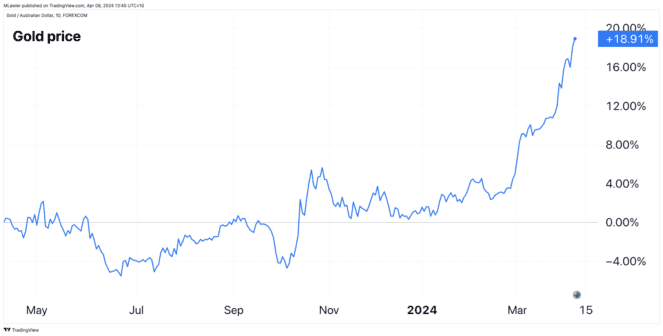
    The price of gold — in Aussie dollars — is up 18.9% over the past year, as depicted below. Yes, that’s 12.4% more than what the S&P/ASX 200 Index (ASX: XJO) has increased. However, a single year of performance is hardly definitive.

    Data by Trading View

    To maintain your money’s purchasing power between 1 July 1993 and 30 June 2023, it would have needed to grow in value by 120%. Put simply, $10,000 in 1993 had to become $21,979 — otherwise, your wealth went backwards.

    The gold bugs out there can breathe a sigh of relief AS gold has indeed outpaced inflation over the last 30 years. A $10,000 hoard of gold in 1993 is now worth about $29,150 based on today’s price. But that’s only a ‘real return’ of about 1% per annum above inflation.

    Comparatively, Australian shares have generated a real return of 6.5% per annum above inflation. In dollar terms, that’s the difference between having $29,150 (gold) or $138,778 (Australian shares) left at the end of investing for 30 years.

    My top ASX shares to fight inflation

    Simply buying the Aussie index with an exchange-traded fund (ETF) is where I’d start to give inflation the boot — either the BetaShares Australia 200 ETF (ASX: A200) or the Vanguard Australian Shares Index ETF (ASX: VAS) are my preferences for diversification.

    From there, I’d sprinkle in quality businesses that I believe will perform even better than the index.

    Right now, several Australian companies come to mind. The first two are ASX retail shares, Accent Group Ltd (ASX: AX1) and Super Retail Group Ltd (ASX: SUL).

    Accent is known for its extensive footwear store presence, including Athletes Foot, Platypus, and Hype DC. Super Retail Group’s familiar faces are Supercheap Auto, BCF, Rebel, and Macpac. Both companies have a long history of successfully executing their growth ambitions, and neither looks at all expensive at their price-to-earnings (P/E) ratios of 15 and 13.

    My other top ASX shares to give inflation the flick are NIB Holdings Limited (ASX: NHF) and Deterra Royalties Ltd (ASX: DRR). In my opinion, both companies are insulated from inflation to a certain extent.

    NIB, a private health insurer, can increase its premiums on what is a fairly sticky product. Meanwhile, Deterra, a collector of iron ore royalties, has minimal expenses that could rise from inflation.

    The post Forget gold! I’d buy these top ASX shares to beat inflation appeared first on The Motley Fool Australia.

    Wondering where you should invest $1,000 right now?

    When investing expert Scott Phillips has a stock tip, it can pay to listen. After all, the flagship Motley Fool Share Advisor newsletter he has run for over ten years has provided thousands of paying members with stock picks that have doubled, tripled or even more.*

    Scott just revealed what he believes could be the ‘five best ASX stocks’ for investors to buy right now. We believe these stocks are trading at attractive prices and Scott thinks they could be great buys right now…

    See The 5 Stocks
    *Returns as of 1 February 2024

    (function() {
    function setButtonColorDefaults(param, property, defaultValue) {
    if( !param || !param.includes(‘#’)) {
    var button = document.getElementsByClassName(“pitch-snippet”)[0].getElementsByClassName(“pitch-button”)[0];
    button.style[property] = defaultValue;
    }
    }

    setButtonColorDefaults(“#0095C8”, ‘background’, ‘#5FA85D’);
    setButtonColorDefaults(“#0095C8”, ‘border-color’, ‘#43A24A’);
    setButtonColorDefaults(“#fff”, ‘color’, ‘#fff’);
    })()

    More reading

    Motley Fool contributor Mitchell Lawler has no position in any of the stocks mentioned. The Motley Fool Australia’s parent company Motley Fool Holdings Inc. has no position in any of the stocks mentioned. The Motley Fool Australia has positions in and has recommended NIB Holdings and Super Retail Group. The Motley Fool Australia has recommended Accent Group. The Motley Fool has a disclosure policy. This article contains general investment advice only (under AFSL 400691). Authorised by Scott Phillips.

    from The Motley Fool Australia https://ift.tt/3Jsamh8

  • Here are the top 10 ASX 200 shares today

    Ten smiling business people wave to the camera after receiving some winning company news.

    It was a decent, if shaky, start to the trading week for the S&P/ASX 200 Index (ASX: XJO) and most ASX shares this Monday, in what is the first five-day week for a while.

    By the time the stock market’s closing bell rang, the ASX 200 had added a mild 0.2%, pushing the index up to 7,789.1 points.

    This encouraging start to the week for ASX investors comes after a hot Friday night over on the American markets last week.

    The Dow Jones Industrial Average Index (DJX: .DJI) sent the American week off in syle, rising by a strong 0.8%.

    The Nasdaq Composite Index (NASDAQ: .IXIC) did even better, shooting up 1.24%.

    But let’s get back to this week and the ASX, with a look at how the various ASX sectors fared this Monday.

    Winners and losers

    It was a fairly happy day for the Australian stock market, with only two sectors going backwards.

    The first of those was energy shares. The S&P/ASX 200 Energy Index (ASX: XEJ) had an awful day, tanking by 1.24%.

    The other losers were consumer staples stocks. The S&P/ASX 200 Consumer Staples Index (ASX: XSJ) was also on the nose, sliding by 0.98%.

    But that was it for the red sectors.

    Leading today’s winners was the gold sector. The All Ordinaries Gold Index (ASX: XGD) had a cracker, rocketing up 2.74% today.

    Tech stocks had a pleasant time too, with the S&P/ASX 200 Information Technology Index (ASX: XIJ) enjoying a 1.19% boom.

    Utilities shares got the bronze medal, with the S&P/ASX 200 Utilities Index (ASX: XUJ) enjoying a 0.83% lift.

    Industrial stocks came in hot as well. The S&P/ASX 200 Industrials Index (ASX: XNJ) got a 0.66% lift from investors today.

    Healthcare shares weren’t too far behind that, as you can see from the S&P/ASX 200 Healthcare Index (ASX: XHJ)’s 0.56% rise.

    Mining stocks followed right behind. The S&P/ASX 200 Materials Index (ASX: XMJ) saw its valeu increase by 0.38%.

    Consumer discretionary shares were another bright spot, evidenced by the S&P/ASX 200 Consumer Discretionary Index (ASX: XDJ)’s 0.23% gain.

    Communication stocks were next. The S&P/ASX 200 Communication Services Index (ASX: XTJ) climbed by 0.18% today.

    Financial stocks were in demand as well, with the S&P/ASX 200 Financials Index (ASX: XFJ) inching 0.13% higher.

    That was a dead heat with real estate investment trusts (REITs) with the S&P/ASX 200 A-REIT Index (ASX: XPJ) also bagging a 0.13% move upwards.

    Top 10 ASX 200 shares countdown

    Today’s winner (by a mile) turned out to be tech share Life360 Inc (ASX: 360).

    Life360 shares surged by a massive 16.8% all the way up to $14.18 each today after hitting a new record high to boot. This was spurred by an extremely well-received market update from the company.

    Here’s how the rest of today’s winners pulled up:

    ASX-listed company Share price Price change
    Life360 Inc (ASX: 360) $14.18 16.80%
    Paladin Energy Ltd (ASX: PDN) $1.515 6.69%
    Newmont Corporation (ASX: NEM) $60.41 6.56%
    Nanosonics Ltd (ASX: NAN) $2.82 5.62%
    Genesis Minerals Ltd (ASX: GMD) $1.945 4.85%
    IRESS Ltd (ASX: IRE) $8.40 4.87%
    Qantas Airways Ltd (ASX: QAN) $5.69 4.79%
    Megaport Ltd (ASX: MP1) $14.21 4.41%
    De Gray Mining Ltd (ASX: DEG) $1.34 4.28%
    Silver Lake Resources Ltd (ASX: SLR) $1.32 3.53%

    Our top 10 shares countdown is a recurring end-of-day summary to let you know which companies were making big moves on the day. Check in at Fool.com.au after the weekday market closes to see which stocks make the countdown.

    The post Here are the top 10 ASX 200 shares today appeared first on The Motley Fool Australia.

    Wondering where you should invest $1,000 right now?

    When investing expert Scott Phillips has a stock tip, it can pay to listen. After all, the flagship Motley Fool Share Advisor newsletter he has run for over ten years has provided thousands of paying members with stock picks that have doubled, tripled or even more.*

    Scott just revealed what he believes could be the ‘five best ASX stocks’ for investors to buy right now. We believe these stocks are trading at attractive prices and Scott thinks they could be great buys right now…

    See The 5 Stocks
    *Returns as of 1 February 2024

    (function() {
    function setButtonColorDefaults(param, property, defaultValue) {
    if( !param || !param.includes(‘#’)) {
    var button = document.getElementsByClassName(“pitch-snippet”)[0].getElementsByClassName(“pitch-button”)[0];
    button.style[property] = defaultValue;
    }
    }

    setButtonColorDefaults(“#0095C8”, ‘background’, ‘#5FA85D’);
    setButtonColorDefaults(“#0095C8”, ‘border-color’, ‘#43A24A’);
    setButtonColorDefaults(“#fff”, ‘color’, ‘#fff’);
    })()

    More reading

    Motley Fool contributor Sebastian Bowen has positions in Newmont. The Motley Fool Australia’s parent company Motley Fool Holdings Inc. has positions in and has recommended Life360, Megaport, and Nanosonics. The Motley Fool Australia has positions in and has recommended Nanosonics. The Motley Fool Australia has recommended Megaport. The Motley Fool has a disclosure policy. This article contains general investment advice only (under AFSL 400691). Authorised by Scott Phillips.

    from The Motley Fool Australia https://ift.tt/cg97VEH

  • Do Westpac dividends still beat money in a term deposit?

    Modern accountant woman in a light business suit in modern green office with documents and laptop.

    It might be easy to forget in 2024, but until relatively recently, it was common for savings accounts and term deposits from banks to offer laughably low rates of return. Especially compared to the dividends available from ASX banks like Westpac Banking Corp (ASX: WBC).

    Between 2012 and 2022, interest rates were at historic lows. That definition was redefined between 2020 and 2022 when rates were reduced to just 0.1% in light of the global pandemic.

    But 2022 saw inflation take off, and, as a result, the Reserve Bank of Australia (RBA) raised interest rates at the sharpest trajectory in history. That saw the cash rate rise from 0.1% in April of 2022 to 4.35% by December last year.

    Whilst this might be unpleasant for most Australians, particularly mortgage holders, it also heralded a new era for cash savers.

    When interest rates rise, so do the interest rates investors enjoy on term deposits, savings accounts and government bonds.

    Back in 2021, a saver would be lucky to get an interest rate of 1% on a multi-year term deposit. In contrast, the dividend yields from bank shares like Westpac were still well above 5%. Those dividends usually come with full franking credits attached too, making the choice between the two an easy one for all but for the most conservative, risk-averse investors.

    But what about today, with interest rates at decade highs? Are ASX bank dividends from the likes of Westpac still a better investment for yield hunters?

    Are Westpac’s dividends better than its term deposits?

    Well, let’s start at the start. Right now, Westpac shares are trading on a dividend yield of 5.46%. That comes from the bank’s last two dividend payments, which consisted of December’s final dividend of 72 cents per share, as well as last June’s interim payment of 70 cents per share. Both dividends came with full franking credits.

    Plugging those dividends into the current Westpac share price of $25.99, and we get that 5.46% trailing yield. If we include the value of those franking credits, we get a grossed-up yield of 7.8%.

    So how do term deposits compare?

    Well, we’ll look at Westpac’s offerings to start with. Right now, the top term deposit interest rate one can bag from Westpac is 4.8%. That’s reportedly a special offer valid for 11-month term deposits. Other lengths will attract an interest rate of between 3.75% and 4.25%.

    Other banks are offering similar rates. The highest available for a term deposit right now from an Australian financial institution is around 5.15%.

    So the Westpac dividend is incontrovertibly the superior investment for income seekers if maximising returns is your goal. Particularly taking those franking credits into account.

    However, that of course assumes Westpac will continue to pay out the same or higher rates of income over the next 12 months as it did over the last 12. That’s not an assumption any investor can or should make. Dividends are never guaranteed, even from ASX bank shares.

    As such, investors who rely on dividends and interest income to pay their bills might prefer the safety of a term deposit, or even splitting their funds between dividend shares and cash. That safety does have a price in the form of that lower interest rate. But that’s how the financial world usually works.

    The post Do Westpac dividends still beat money in a term deposit? appeared first on The Motley Fool Australia.

    Wondering where you should invest $1,000 right now?

    When investing expert Scott Phillips has a stock tip, it can pay to listen. After all, the flagship Motley Fool Share Advisor newsletter he has run for over ten years has provided thousands of paying members with stock picks that have doubled, tripled or even more.*

    Scott just revealed what he believes could be the ‘five best ASX stocks’ for investors to buy right now. We believe these stocks are trading at attractive prices and Scott thinks they could be great buys right now…

    See The 5 Stocks
    *Returns as of 1 February 2024

    (function() {
    function setButtonColorDefaults(param, property, defaultValue) {
    if( !param || !param.includes(‘#’)) {
    var button = document.getElementsByClassName(“pitch-snippet”)[0].getElementsByClassName(“pitch-button”)[0];
    button.style[property] = defaultValue;
    }
    }

    setButtonColorDefaults(“#0095C8”, ‘background’, ‘#5FA85D’);
    setButtonColorDefaults(“#0095C8”, ‘border-color’, ‘#43A24A’);
    setButtonColorDefaults(“#fff”, ‘color’, ‘#fff’);
    })()

    More reading

    Motley Fool contributor Sebastian Bowen has no position in any of the stocks mentioned. The Motley Fool Australia’s parent company Motley Fool Holdings Inc. has no position in any of the stocks mentioned. The Motley Fool Australia has no position in any of the stocks mentioned. The Motley Fool has a disclosure policy. This article contains general investment advice only (under AFSL 400691). Authorised by Scott Phillips.

    from The Motley Fool Australia https://ift.tt/Ins9Z5u

  • Afterpay increasing credit limits… what could go wrong?

    surprised shopper, unexpected news, person at computer with payment card,

    If you were in front of a television this morning just before 8am, and tuned to Channel Nine, you might have seen me chatting with Karl and Sarah about credit cards.

    As I said on air, until I did some research over the weekend, I had no idea that interest rates on some cards had reached 28%.

    Twenty. Eight. Per. Cent. Bloody hell.

    More than a quarter of your yearly balance, in interest, each year.

    It is, quite simply, usurious.

    I’ve been critical, I think completely reasonably, about the buy-now-pay-later craze of people finding new and inventive ways of mortgaging their future cashflows, but credit cards still take the cake, in terms of sheer financial impact.

    (By the way, Afterpay has announced it’s increasing credit limits for its customers. Because, you know, what we need is more consumer credit. Again… bloody hell…)

    The easy answer, of course, is not to use them. Or to use them, but pay them off in the interest free period.

    Easy answer. Hard to do, for many people.

    Some didn’t have a choice, needing to replace a fridge, or get a car fixed.

    Some had a choice, but made a bad one, unaware or unprepared for the financial burden it would entail.

    Whatever the cause, surely an almost-30% interest rate is unconscionable.

    I spend a lot of time preaching about the benefits of compounding.

    But compounding works in both directions – on savings and on debts.

    This morning, I was asked what people could do.

    The sad reality is that no-one voluntarily pays 28% (or 25%, or 20%, or 15%) unless they have to.

    That is, once the money is spent, and the debt incurred, you have to pay the piper.

    But if you can’t pay the piper up front? Then the piper demands an increasing pound of flesh, as time goes on.

    And as the debt snowballs – especially at rates that make standover men look generous – the bill gets harder and harder to pay, requiring more and more of each paycheque.

    There’s a reason it’s called a ‘debt spiral’.

    And, by the way, you may have noticed (or probably didn’t, because they’ve kept it very quiet) that the banks are also starting to shorten their interest-free periods for many cards.

    You might have guessed by now that, other than in cases of emergency, I hate consumer debt (i.e. debt used for consumption, rather than purchasing an asset).

    It is a cancer on your finances. At the risk of being called Grandpa, I’m from the ‘spend what you can afford or have already saved’ camp.

    It’s better for your financial health, and it helps develop financial discipline. Without it, you run the very real risk of being sucked into a debt spiral… or just running your financial life too close to the wind.

    The fitness influencers suggest that ‘nothing tastes as good as thin feels’.

    I can’t say I’d know… But I do know that, in my experience and from much of the research, there is a very high correlation between financial health and emotional and physical wellbeing, thanks to far lower levels of stress and worry about finances.

    Sure, you might have to readjust your financial expectations, and maybe forgo a little spending in the short term.

    But the dopamine hit from retail spending pales into insignificance compared to the feeling of financial comfort, knowing that you are prepared for whatever life has to throw at you, without paying stupidly high interest bills for the privilege.

    —

    And speaking of unstable finances, the longish drive to and from the Channel Nine studios gave me a chance to catch up on some audiobook listening.

    Michael Lewis is always an engaging and fascinating author, and I started listening to Boomerang, covering some of the global fallout of (and contributing to) the Global Financial Crisis of 2008/9.

    In the early chapters he covers Iceland’s incredibly rapid ascent from small, regional economy, to massive financial player.

    You might know that the whole thing went – unsurprisingly – badly.

    But, of course, Lewis tells the story as it unfolds, so we get to see how it got that bad in the first place.

    It’s a story of unbridled greed, as most of these things are.

    It’s also a story of convenient explanations: people telling themselves and each other what they want to believe: Iceland was special. Other people didn’t understand. Or they were just jealous. It was different this time…

    Of course, it wasn’t different that time. Or the time before. Or the time after.

    But that doesn’t mean people weren’t sucked in. In large numbers.

    Other people were getting rich. The stories seemed plausible, if you suspended just enough disbelief.

    The true believers were all in. How bad could it really be? And hey, I’ll get out before it goes really bad.

    And so, unfortunately, it goes.

    And why am I telling you all this?

    Because it won’t be different the next time, either.

    Otherwise smart people will be offering plausible explanations.

    Asset prices – specific assets, or assets in general – will be rising.

    Your next door neighbour will be getting rich.

    Even though it won’t make any sense, you’ll start to wonder if, perhaps, they’re right. Perhaps it’s different this time after all?

    Remember, back at the time of the dot.com boom, business magazine Barron’s famously published an article titled ‘What’s Wrong, Warren?’. The inference was that Warren (Buffett, of course) had lost the plot and just wasn’t keeping up with the ‘new economy’ of dot.com superstars.

    We know how that ended. The NASDAQ lost 80%-plus of its value, and Buffett was vindicated.

    But – and this is important – Buffett didn’t try to time the market. He didn’t try to make money by short-selling tech stocks (making money when prices fell). He didn’t do anything different at all.

    He just refused to be pushed off his line. He knew where he was going, how he was going to invest, and what he thought would generate long-term compound returns.

    And he just kept doing it, no matter what others thought, said, or did.

    See, success comes from finding what works, over the long term, then… just doing it.

    You don’t have to react to every boom and bust. Indeed, trying to do that is a dangerous pursuit. Just ask Iceland. Or US real estate speculators. Or dot.com investors in 1999. Or NFT buyers (NFTs were those ‘digital originals’; monkeys and other stuff that apparently people were going to pay millions for. And did… for a while, before they didn’t). Or those who invested in various crypto tokens themselves.

    —

    And that’s kinda what draws these two seemingly different stories together: the reality that getting ahead of ourselves is probably going to see things end badly. And that, even if they don’t, it was a bad bet, regardless.

    It’s possible to win a round of poker with a bad hand. But not likely.

    It’s possible to make money with a ‘this time it’s different’ thesis. But that’s not likely, either.

    And it’s possible to use credit card debt wisely. But the evidence is that many, many people don’t, and end up being financially crippled as a result.

    Deep down, I think we all know the right thing to do, financially. Sometimes circumstances cruel our chances. Other times, our innate humanity: greed, envy and an inability to correctly envisage long term (positive and negative) consequences, tears us assunder.

    Sometimes it’s relatively easy to think you can spot a bubble. Other times you get caught up in it, and it’s much harder.

    Icelanders tried to become the exception. So did crypto speculators. Others before. Others, again, in the future. Because that’s the nature of things.

    The superpower to nurture might just be the ability to stay the course, while others fly higher. Because they’ll very likely end up too close to the sun.

    To mix my myths and fables, as I tweeted the other day, if I was to produce a bumper sticker, it would simply read:

    “Investing: Aesop was right. The tortoise wins.”

    I hope you’ll keep that in mind.

    Fool on!

    The post Afterpay increasing credit limits… what could go wrong? appeared first on The Motley Fool Australia.

    Wondering where you should invest $1,000 right now?

    When investing expert Scott Phillips has a stock tip, it can pay to listen. After all, the flagship Motley Fool Share Advisor newsletter he has run for over ten years has provided thousands of paying members with stock picks that have doubled, tripled or even more.*

    Scott just revealed what he believes could be the ‘five best ASX stocks’ for investors to buy right now. We believe these stocks are trading at attractive prices and Scott thinks they could be great buys right now…

    See The 5 Stocks
    *Returns as of 1 February 2024

    (function() {
    function setButtonColorDefaults(param, property, defaultValue) {
    if( !param || !param.includes(‘#’)) {
    var button = document.getElementsByClassName(“pitch-snippet”)[0].getElementsByClassName(“pitch-button”)[0];
    button.style[property] = defaultValue;
    }
    }

    setButtonColorDefaults(“#0095C8”, ‘background’, ‘#5FA85D’);
    setButtonColorDefaults(“#0095C8”, ‘border-color’, ‘#43A24A’);
    setButtonColorDefaults(“#fff”, ‘color’, ‘#fff’);
    })()

    More reading

    Motley Fool contributor Scott Phillips has no position in any of the stocks mentioned. The Motley Fool Australia’s parent company Motley Fool Holdings Inc. has positions in and has recommended Block. The Motley Fool Australia has positions in and has recommended Block. The Motley Fool has a disclosure policy. This article contains general investment advice only (under AFSL 400691). Authorised by Scott Phillips.

    from The Motley Fool Australia https://ift.tt/Yj45aKT

  • 3 ASX 300 dividend shares that analysts love

    A businessman hugs his computer and smiles.

    Luckily for income investors, there are a good number of ASX dividend shares to choose from on the ASX 300 index.

    But which ones could be buys right now?

    Three that come from different sides of the market and have been named as buys are listed below.

    Here’s what you need to know about these income options:

    Baby Bunting Group Ltd (ASX: BBN)

    The team at Morgan Stanley thinks that this baby products retailer could be an ASX 300 dividend share to buy.

    Last month, the broker upgraded its shares to an overweight rating on the belief that headwinds are now easing and its outlook is becoming increasingly positive. This is expected to lead to a big improvement in earnings and dividends next year.

    For example, the broker is forecasting fully franked dividends per share of 6 cents in FY 2024 and then 9 cents in FY 2025. Based on the current Baby Bunting share price of $1.92, this will mean dividend yields of 3.1% and 4.7%, respectively.

    Morgan Stanley has an overweight rating and $2.20 price target on the company’s shares.

    HomeCo Daily Needs REIT (ASX: HDN)

    Over at Morgans, its analysts think that HomeCo Daily Needs could be an ASX 300 dividend share to buy. It is a property company with a focus on neighbourhood retail, large format retail, and health and services.

    The broker has been pleased with management’s shift in focus from large format retail to daily needs. It appears to believe this sets it up nicely for growth over the coming years.

    Morgans also expects it to underpin the payment of dividends per share of 8 cents in FY 2024 and then 9 cents in FY 2025. Based on the current HomeCo Daily Needs share price of $1.24, this will mean yields of 6.5% and 7.3%, respectively.

    Morgans has an add rating and $1.37 price target on its shares.

    Rural Funds Group (ASX: RFF)

    A final ASX 300 dividend share that could be a buy this week is Rural Funds. It is an agricultural property company that owns a collection of assets such as orchards, vineyards, and cattle ranches.

    Bell Potter is a fan of the company. Its analysts see a lot of value in its shares at current levels and expect some attractive yields.

    For example, the broker is forecasting dividends per share of 11.7 cents in both FY 2024 and FY 2025. Based on the current Rural Funds share price of $2.05, this will mean yields of 5.7% for investors in both years.

    Bell Potter has a buy rating and $2.40 price target on its shares.

    The post 3 ASX 300 dividend shares that analysts love appeared first on The Motley Fool Australia.

    Wondering where you should invest $1,000 right now?

    When investing expert Scott Phillips has a stock tip, it can pay to listen. After all, the flagship Motley Fool Share Advisor newsletter he has run for over ten years has provided thousands of paying members with stock picks that have doubled, tripled or even more.*

    Scott just revealed what he believes could be the ‘five best ASX stocks’ for investors to buy right now. We believe these stocks are trading at attractive prices and Scott thinks they could be great buys right now…

    See The 5 Stocks
    *Returns as of 1 February 2024

    (function() {
    function setButtonColorDefaults(param, property, defaultValue) {
    if( !param || !param.includes(‘#’)) {
    var button = document.getElementsByClassName(“pitch-snippet”)[0].getElementsByClassName(“pitch-button”)[0];
    button.style[property] = defaultValue;
    }
    }

    setButtonColorDefaults(“#0095C8”, ‘background’, ‘#5FA85D’);
    setButtonColorDefaults(“#0095C8”, ‘border-color’, ‘#43A24A’);
    setButtonColorDefaults(“#fff”, ‘color’, ‘#fff’);
    })()

    More reading

    Motley Fool contributor James Mickleboro has no position in any of the stocks mentioned. The Motley Fool Australia’s parent company Motley Fool Holdings Inc. has no position in any of the stocks mentioned. The Motley Fool Australia has positions in and has recommended Rural Funds Group. The Motley Fool Australia has recommended HomeCo Daily Needs REIT. The Motley Fool has a disclosure policy. This article contains general investment advice only (under AFSL 400691). Authorised by Scott Phillips.

    from The Motley Fool Australia https://ift.tt/cBzj49w

  • Have Woolworths and Coles shares been spared a break-up?

    a woman pushes a man standing in a shopping trolley pointing ahead far off into the distance.

    Both Woolworths Group Ltd (ASX: WOW) and Coles Group Ltd (ASX: COL) have arguably been some of the go-to punching bags for Australian consumers over the past year or two as the cost of living crunch we’re all enduring started to bite.

    Buying life’s essentials has only become harder for many Australian families since 2021. That’s thanks to rising interest rates and stubbornly high inflation taking a sizeable chunk out of the average household budget.

    Much of the inflation swirling around the economy has been evident on supermarket shelves. As such, it’s probably fair to say that both Coles and Woolies have taken a bit of a hit in the court of public opinion.

    So it was not too surprising to see the Federal Government act on some of these concerns earlier this year. In January, the government announced that former minister Dr Craig Emerson would lead a review of the Food and Grocery Code of Conduct.

    Thanks to comments and opinions across the political spectrum in recent months, some investors may have started to worry that this review might recommend drastic changes to how Coles and Woolworths are allowed to operate in the Australian grocery space. Members of the Liberal, National and Greens political parties have all called for Coles and Woolworths to be ‘broken up’ in various ways.

    Well, those investors can breathe a sigh of relief today.

    Woolworths and Coles shares safe from breakup

    Dr Emerson’s review has just released an interim report detailing its initial findings in the grocery sector.

    The interim report makes several strong recommendations to the government on how to change supermarket regulations. These include making the now-voluntary Food and Grocery Code of Conduct mandatory for all grocery companies with more than $5 billion in annual revenues.

    It also recommends significant penalties for any company that breaches the code. It noted that the current environment allows “no penalties for breaches”.

    However, the report also comes out strongly against the idea of divestiture of a supermarket ‘break up’:

    The review does not support a forced divestiture power to address market power issues in the
    supermarket industry…

    If forced divestiture resulted in a supermarket selling some of its stores to another large incumbent
    supermarket chain, the result could easily be greater market concentration.

    If large incumbent supermarket chains were prohibited from buying the divested stores, that would
    leave only smaller supermarket chains and foreign supermarkets as potential buyers. Further, if these
    smaller chains were not interested, or were not in a position to buy, these stores would be forced to
    close…

    This review’s recommendations to make the Code mandatory, with heavy penalties for major
    breaches will, alongside effective enforcement of the existing competition laws, constitute a far more
    credible deterrent to anti-competitive behaviour than forced divesture laws.

    Foolish takeaway

    So it seems that Coles and Woolworths will likely keep their present corporate structures, based on the findings of this review.

    Owners of Coles and Woolworths shares will undoubtedly be pleased with this outcome — not that you’d know it from their stock prices today. At present, Woolworths shares are down 0.12%, while Coles stock has lost 1.28%.

    The post Have Woolworths and Coles shares been spared a break-up? appeared first on The Motley Fool Australia.

    Wondering where you should invest $1,000 right now?

    When investing expert Scott Phillips has a stock tip, it can pay to listen. After all, the flagship Motley Fool Share Advisor newsletter he has run for over ten years has provided thousands of paying members with stock picks that have doubled, tripled or even more.*

    Scott just revealed what he believes could be the ‘five best ASX stocks’ for investors to buy right now. We believe these stocks are trading at attractive prices and Scott thinks they could be great buys right now…

    See The 5 Stocks
    *Returns as of 1 February 2024

    (function() {
    function setButtonColorDefaults(param, property, defaultValue) {
    if( !param || !param.includes(‘#’)) {
    var button = document.getElementsByClassName(“pitch-snippet”)[0].getElementsByClassName(“pitch-button”)[0];
    button.style[property] = defaultValue;
    }
    }

    setButtonColorDefaults(“#0095C8”, ‘background’, ‘#5FA85D’);
    setButtonColorDefaults(“#0095C8”, ‘border-color’, ‘#43A24A’);
    setButtonColorDefaults(“#fff”, ‘color’, ‘#fff’);
    })()

    More reading

    Motley Fool contributor Sebastian Bowen has no position in any of the stocks mentioned. The Motley Fool Australia’s parent company Motley Fool Holdings Inc. has no position in any of the stocks mentioned. The Motley Fool Australia has positions in and has recommended Coles Group. The Motley Fool has a disclosure policy. This article contains general investment advice only (under AFSL 400691). Authorised by Scott Phillips.

    from The Motley Fool Australia https://ift.tt/pxjDWmT