• 1 ASX 200 stock I’m buying hand over fist despite the market’s pessimism

    A woman shows her phone screen and points up.

    The S&P/ASX 200 Index (ASX: XJO) stock Johns Lyng Group Ltd (ASX: JLG) has been my most frequent investment so far in 2024.

    I took advantage of the Johns Lyng share price dip — which you can see in the graph below — after the company reported its earnings results in February.  

    One of my main investment strategies is to buy growing businesses with compelling long-term futures when the share price has fallen.

    I like it when the market offers a business at a cheaper price. It’s just like loading up at the supermarket when our favourite products go on special – the product is the same, but the value is better.

    I wouldn’t buy something just because it has fallen. A business that can grow its earnings is appealing because of the lower price/earnings (P/E) ratio. I’m going to talk about three reasons why I think the ASX 200 stock can keep growing profit and why I have invested multiple times in 2024.

    Solid core growth

    Johns Lyng prides itself on rebuilding and restoring various properties and continues after damage caused by insured events, including impact, weather, and fire.

    No business is guaranteed to grow its profit every year, but Johns Lyng is doing a great job at continually growing the core operations’ earnings.

    In the company’s FY24 first-half result, it reported that its insurance building and restoration services (IB & RS) revenue rose 13.7% to $426.1 million, and the IB & RS ‘business as usual’ (BaU) earnings before interest, tax, depreciation and amortisation (EBITDA) grew 28.1% to $55 million.

    During HY24, the ASX 200 stock secured new contract wins with Tower Ltd (ASX: TWR), Safety Culture Care and RAA, along with contract extensions with Hollard and Suncorp Group Ltd (ASX: SUN).

    Johns Lyng managing director Scott Didier said:

    Our IB&RS BaU work constitutes the cornerstone of JLG’s earnings. With an annuity style profile, these earnings instil a confidence in our sustained revenue streams, and we anticipate substantial growth as we continue to enhance our market presence and capitalise on our diversified service portfolio, notably within our burgeoning strata business.

    Expanding operations

    The company continues to expand its footprint in Australia and the United States, which I think can help it increase earnings in the long term.

    For example, it announced a couple of months ago that it had entered into an agreement with Allstate, which is one of the largest insurance companies in the US.

    The ASX 200 stock has joined its emergency response and mitigation panel. There are 16 million Allstate policyholders throughout the US, and it covers the provision of “emergency response make-safe and water mitigation.”

    In Australia, the ASX 200 stock is making acquisitions in strata management and essential home services (such as gas, fire, and electrical compliance and safety checks), unlocking additional and diversified earnings.

    The company’s catastrophe response earnings fell in HY24, but that’s understandable – catastrophes do not occur like clockwork. There seems to be a growing number of expensive storms, which may mean more work for Johns Lyng in the future.   

    Future international growth?

    There’s no guarantee that the ASX 200 stock will expand beyond the countries it’s currently in. Its relatively recent move into New Zealand is beneficial for its total addressable market.

    The US is a huge market and represents a very large opportunity for the company to tap into for years to come.

    I’m particularly intrigued by management’s comments that may indicate further geographic expansion in the future.

    Johns Lyng Group Australia CEO Nick Carnell had this to say at the time of the Tower agreement win:

    We are delighted to work with one of New Zealand’s premier insurance brands and this is a further demonstration that our business model can be implemented seamlessly across the Tasman and beyond.

    John Lyng’s interest in growing into the US and New Zealand gives me hope the ASX 200 stock could expand into other countries, such as Canada, in the future.

    The post 1 ASX 200 stock I’m buying hand over fist despite the market’s pessimism appeared first on The Motley Fool Australia.

    Wondering where you should invest $1,000 right now?

    When investing expert Scott Phillips has a stock tip, it can pay to listen. After all, the flagship Motley Fool Share Advisor newsletter he has run for over ten years has provided thousands of paying members with stock picks that have doubled, tripled or even more.*

    Scott just revealed what he believes could be the ‘five best ASX stocks’ for investors to buy right now. We believe these stocks are trading at attractive prices and Scott thinks they could be great buys right now…

    See The 5 Stocks
    *Returns as of 1 February 2024

    (function() {
    function setButtonColorDefaults(param, property, defaultValue) {
    if( !param || !param.includes(‘#’)) {
    var button = document.getElementsByClassName(“pitch-snippet”)[0].getElementsByClassName(“pitch-button”)[0];
    button.style[property] = defaultValue;
    }
    }

    setButtonColorDefaults(“#0095C8”, ‘background’, ‘#5FA85D’);
    setButtonColorDefaults(“#0095C8”, ‘border-color’, ‘#43A24A’);
    setButtonColorDefaults(“#fff”, ‘color’, ‘#fff’);
    })()

    More reading

    Motley Fool contributor Tristan Harrison has positions in Johns Lyng Group. The Motley Fool Australia’s parent company Motley Fool Holdings Inc. has positions in and has recommended Johns Lyng Group. The Motley Fool Australia has recommended Johns Lyng Group. The Motley Fool has a disclosure policy. This article contains general investment advice only (under AFSL 400691). Authorised by Scott Phillips.

    from The Motley Fool Australia https://ift.tt/zar5Fsf

  • 3 compelling ASX shares I’d buy if the ASX crashes again

    Three rock climbers hang precariously off a steep cliff face, each connected to the other with the higher person holding on and the two below them connected by their arms and rope but not making contact with the cliff face.

    Stock market crashes can be harrowing, but they can also be a good time to buy ASX shares that may be trading at great value.

    Sometimes, an unexpected event can occur that causes investors to become fearful. In recent times, we’ve seen a pandemic cause a bear market, while rampant inflation has resulted in a number of sell-offs over the last couple of years.

    We don’t know when the next bear market, crash or correction will occur, but if or when one does, I’ll have my eyes on the following businesses.

    Centuria Capital Group (ASX: CNI)

    This ASX share is a funds management outfit focused on property. As we can see on the chart below, the business is capable of experiencing large volatility during market gyrations.

    When a share price falls heavily, there is potential for good returns if it recovers. For example, if a share price falls 33% from $1.50 to $1, going back to just $1.33 would be a rise of 33% from the low.

    Centuria has an impressive property portfolio. It includes Australia’s largest pure-play industrial real estate investment trust (REIT), which benefits from strong rental growth due to tenant demand.

    The business has a significant property development pipeline that can unlock further rental profits and hopefully grow Centuria’s underlying value.

    If the Centuria share price were to fall in an ASX share market crash, I’d be very likely to buy some shares again.  

    Nick Scali Limited (ASX: NCK)

    Nick Scali is a fairly large furniture retailer in Australia with its Nick Scali and Plush furniture stores.

    The Nick Scali share price has recovered impressively from the lows seen in 2023 and 2022 (as we can see below). I’d happily buy some Nick Scali shares at a lower price if an opportunity presented itself.

    It’s understandable why a discretionary ASX share can fall hard in a bear market. Investors could be worried that households may close their wallets if the economy worsens.

    However, I view discretionary retailers as attractive in a recession because downturns don’t last forever. A sell-off can be a great opportunity if the weak conditions are only temporary. We just don’t know when things will improve.

    In my eyes, Nick Scali is an effective retailer with great management. The company has one of the highest returns on equity (ROE) out of all the ASX shares on the market.

    Lovisa Holdings Ltd (ASX: LOV)

    Lovisa is another ASX retail share. It sells affordable jewellery with the target market being younger shoppers.

    As the chart above shows, the Lovisa share price has been very volatile over the last few years. We don’t know when future volatility will occur, but I’ll definitely buy more Lovisa shares and add to my position if it experiences a significant decline.

    The company earns good margins and it is rapidly rolling out stores across the world.

    It’s the global expansion progress that makes me excited about this ASX share. During the six months of the FY24 first half, Lovisa added another 53 net new stores, taking the total to 854. The store growth helped net profit after tax (NPAT) grow by 12% in the result.

    At the end of HY24, it had 175 stores in Australia, but it has only just expanded to several other countries with much bigger populations than Australia, such as Mexico, Canada, Italy, Spain, Vietnam, and China.

    I think the ASX share can grow its store count and profit considerably over the next few years.

    The post 3 compelling ASX shares I’d buy if the ASX crashes again appeared first on The Motley Fool Australia.

    Wondering where you should invest $1,000 right now?

    When investing expert Scott Phillips has a stock tip, it can pay to listen. After all, the flagship Motley Fool Share Advisor newsletter he has run for over ten years has provided thousands of paying members with stock picks that have doubled, tripled or even more.*

    Scott just revealed what he believes could be the ‘five best ASX stocks’ for investors to buy right now. We believe these stocks are trading at attractive prices and Scott thinks they could be great buys right now…

    See The 5 Stocks
    *Returns as of 1 February 2024

    (function() {
    function setButtonColorDefaults(param, property, defaultValue) {
    if( !param || !param.includes(‘#’)) {
    var button = document.getElementsByClassName(“pitch-snippet”)[0].getElementsByClassName(“pitch-button”)[0];
    button.style[property] = defaultValue;
    }
    }

    setButtonColorDefaults(“#0095C8”, ‘background’, ‘#5FA85D’);
    setButtonColorDefaults(“#0095C8”, ‘border-color’, ‘#43A24A’);
    setButtonColorDefaults(“#fff”, ‘color’, ‘#fff’);
    })()

    More reading

    from The Motley Fool Australia https://ift.tt/EmC42PU

  • 4 ASX ETFs to supercharge your returns in 2024 and beyond

    ETF written with a blue digital background.

    If you’re looking for an effortless way to invest your hard-earned money, then exchange-traded funds (ETFs) could be the answer.

    That’s because they provide investors with access to a large number of shares in one investment. This arguably makes them a great option if you don’t like stock picking.

    But which ASX ETFs should investors look at buying when the market reopens?

    Listed below are four excellent ASX ETFs that could be worth getting better acquainted with this month. Here’s what you need to know about them:

    BetaShares Asia Technology Tigers ETF (ASX: ASIA)

    The BetaShares Asia Technology Tigers ETF could be a top ASX ETF to buy. Especially if you’re feeling positive on the long-term outlook of the Asian economy. That’s because this ETF gives investors easy access to the tigers (best tech stocks) in the region. This means you’ll be investing in companies such as e-commerce giant Alibaba, search engine leader Baidu, iPhone manufacturer Taiwan Semiconductor Manufacturing Company, Temu owner, Pinduoduo, and WeChat owner Tencent.

    BetaShares Global Cybersecurity ETF (ASX: HACK)

    Another ASX ETF that could be a top option for investors is the BetaShares Global Cybersecurity ETF. As its name suggests, this ETF provides investors with access to the cybersecurity sector, which has been tipped to grow strongly over the coming decades as cybercrime becomes even more prevalent. This bodes well for the companies included in the fund, such as Accenture, Cisco, Crowdstrike, and Palo Alto Networks.

    Betashares Global Uranium ETF (ASX: URNM)

    A third ASX ETF to look at is the Betashares Global Uranium ETF. As you might have guessed from its name, this fund provides exposure to a portfolio of leading companies in the global uranium industry. And with nuclear power increasingly being accepted as a safe, reliable, low-carbon energy source, demand for uranium is expected to increase materially in the future as the world decarbonises. This bodes well for the companies held by the fund. This includes locally listed uranium developers Boss Energy Ltd (ASX: BOE) and Paladin Energy Ltd (ASX: PDN).

    ETFS Battery Tech & Lithium ETF (ASX: ACDC)

    A final ASX ETF for investors to consider buying is the ETFS Battery Tech & Lithium ETF. Much like the Betashares Global Uranium ETF, it looks well-placed to benefit from the decarbonisation megatrend. That’s because it gives investors easy access to companies throughout the lithium cycle. Among its holdings are miners Mineral Resources Limited (ASX: MIN) and Pilbara Minerals Ltd (ASX: PLS), and auto manufacturers Nissan, Renault, and Tesla.

    The post 4 ASX ETFs to supercharge your returns in 2024 and beyond appeared first on The Motley Fool Australia.

    Wondering where you should invest $1,000 right now?

    When investing expert Scott Phillips has a stock tip, it can pay to listen. After all, the flagship Motley Fool Share Advisor newsletter he has run for over ten years has provided thousands of paying members with stock picks that have doubled, tripled or even more.*

    Scott just revealed what he believes could be the ‘five best ASX stocks’ for investors to buy right now. We believe these stocks are trading at attractive prices and Scott thinks they could be great buys right now…

    See The 5 Stocks
    *Returns as of 1 February 2024

    (function() {
    function setButtonColorDefaults(param, property, defaultValue) {
    if( !param || !param.includes(‘#’)) {
    var button = document.getElementsByClassName(“pitch-snippet”)[0].getElementsByClassName(“pitch-button”)[0];
    button.style[property] = defaultValue;
    }
    }

    setButtonColorDefaults(“#0095C8”, ‘background’, ‘#5FA85D’);
    setButtonColorDefaults(“#0095C8”, ‘border-color’, ‘#43A24A’);
    setButtonColorDefaults(“#fff”, ‘color’, ‘#fff’);
    })()

    More reading

    Motley Fool contributor James Mickleboro has no position in any of the stocks mentioned. The Motley Fool Australia’s parent company Motley Fool Holdings Inc. has positions in and has recommended Accenture Plc, Baidu, BetaShares Global Cybersecurity ETF, Cisco Systems, CrowdStrike, Global X Battery Tech & Lithium ETF, Palo Alto Networks, Taiwan Semiconductor Manufacturing, and Tesla. The Motley Fool Australia’s parent company Motley Fool Holdings Inc. has recommended Alibaba Group and has recommended the following options: long January 2025 $290 calls on Accenture Plc and short January 2025 $310 calls on Accenture Plc. The Motley Fool Australia has positions in and has recommended BetaShares Global Cybersecurity ETF. The Motley Fool Australia has recommended Betashares Capital – Asia Technology Tigers Etf, Betashares Global Uranium Etf, CrowdStrike, and Global X Battery Tech & Lithium ETF. The Motley Fool has a disclosure policy. This article contains general investment advice only (under AFSL 400691). Authorised by Scott Phillips.

    from The Motley Fool Australia https://ift.tt/XmIysxO

  • Is Lovisa stock a good ASX investment in April?

    A young woman holds onto her crown as another moves to take it, indicating rival ASX shares

    The Lovisa Holdings Ltd (ASX: LOV) stock price is at one of those age-old junctions in the investment world. Shares in the jewellery chain have moved like a bat out of hell these past six months, giving investors some pause for thought.

    Ultimately, the dilemma sits within the million-dollar question… can a company’s shares still be worth buying after a massive rally? It’s a question that toys with the human psyche, breathing life into the psychological bias known as the ‘anchoring effect’. And, of course, no one wants to be caught buying at the top.

    Six months ago, Lovisa shares could be purchased for under $18.50. Fast forward to today, Lovisa stock is now perched at $31.23 apiece, rising 70% in half a year.

    Does the recent rally prevent Lovisa from being added to my shopping cart? Or is there an argument for buying Lovisa stock in April?

    Let’s dive in.

    It looks fundamentally expensive

    Studying the fundamentals is a good place to start when deciding whether to invest in a company.

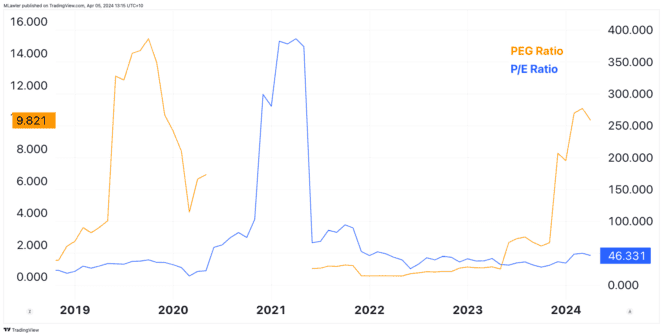
    When I check Lovisa, there’s no denying it appears expensive. The company’s profits have grown, but not as much as the share price. As such, the price-to-earnings (P/E) ratio has expanded to around 47 times earnings — its highest multiple since March 2022.

    Lovisa’s PEG ratio is also at a 52-month high (four years and four months). Essentially, this means investors are paying a hefty premium for a relatively modest expected earnings per share (EPS) growth rate, as shown below.

    Data by Trading View

    There’s also the risk of consumer spending taking a whack. February’s retail trade data showed a 4.2% increase month-on-month for the ‘clothing, footwear, and personal accessory retailing’ segment.

    However, the strength of the economy is leading some economists to believe interest rate cuts will be delayed until next year. That could mean greater financial pressure on Aussie households towards the end of the year as cash surpluses run dry.

    I’d still buy Lovisa stock for its long-term potential

    A lot of time and effort is poured into trying to work out when a company’s shares are ‘cheap’ or ‘expensive’. Too much time, in my honest opinion.

    And yes, valuation is important to an extent. There is such a thing as paying too much for a stock. But, its importance arguably pales in comparison to the quality of the business and its management. This is a point that legendary investor Terry Smith has made before, stating:

    People spend almost their entire effort thinking about whether something’s cheap or expensive or highly rated or lowly rated, which I guess is a better way of expressing it, and far too little deciding whether it’s a high-grade business that they really want to own that can compound in value.

    Perhaps Lovisa stock is a little ‘expensive’ right now. At a higher level, though, it remains a quality business with great growth potential as it expands internationally. Whether I buy Lovisa stock at $31, $40, or $20 seems trivial to me when applying a long-term investing lens.

    The post Is Lovisa stock a good ASX investment in April? appeared first on The Motley Fool Australia.

    Wondering where you should invest $1,000 right now?

    When investing expert Scott Phillips has a stock tip, it can pay to listen. After all, the flagship Motley Fool Share Advisor newsletter he has run for over ten years has provided thousands of paying members with stock picks that have doubled, tripled or even more.*

    Scott just revealed what he believes could be the ‘five best ASX stocks’ for investors to buy right now. We believe these stocks are trading at attractive prices and Scott thinks they could be great buys right now…

    See The 5 Stocks
    *Returns as of 1 February 2024

    (function() {
    function setButtonColorDefaults(param, property, defaultValue) {
    if( !param || !param.includes(‘#’)) {
    var button = document.getElementsByClassName(“pitch-snippet”)[0].getElementsByClassName(“pitch-button”)[0];
    button.style[property] = defaultValue;
    }
    }

    setButtonColorDefaults(“#0095C8”, ‘background’, ‘#5FA85D’);
    setButtonColorDefaults(“#0095C8”, ‘border-color’, ‘#43A24A’);
    setButtonColorDefaults(“#fff”, ‘color’, ‘#fff’);
    })()

    More reading

    Motley Fool contributor Mitchell Lawler has positions in Lovisa. The Motley Fool Australia’s parent company Motley Fool Holdings Inc. has positions in and has recommended Lovisa. The Motley Fool Australia has recommended Lovisa. The Motley Fool has a disclosure policy. This article contains general investment advice only (under AFSL 400691). Authorised by Scott Phillips.

    from The Motley Fool Australia https://ift.tt/2GdbNHQ

  • How I would generate $20,000 of passive income from ASX shares each year

    Australian dollar notes inside the pocket on jeans, symbolising dividends.

    The Australian share market is a great place to generate passive income.

    And while pulling in $20,000 of passive income each year from ASX shares may seem out of reach, with a combination of time, patience, and capital, it could be possible. In fact, history shows that it has been achievable in the past.

    But how would I go about generating this sort of passive income?

    How to make $20,000 in passive income with ASX shares

    The first step is to put my capital to work with ASX shares.

    If I can invest $500 a month into the share market, I could build a substantial portfolio over time.

    To begin with, I would focus on growing my portfolio before even considering the passive income side of things.

    After all, money in the market will compound over time, growing my portfolio and wealth. Whereas if I take out money in the form of dividends, I’m holding back my portfolio’s growth potential.

    With that in mind, I would focus on investing in high-quality companies with long track records, positive growth outlooks and competitive advantages. Any dividends I receive, I would reinvest back into the market.

    Many ASX shares offer dividend reinvestment plans (DRPs). These allow shareholders to automatically reinvest their dividends in additional shares, often at a discounted price.

    Compounding returns

    The next step is to let compounding work its magic and grow my wealth.

    Historically, the share market has generated a return of approximately 10% per annum.

    It is important to note that there’s no guarantee that this will happen in the future, but I’m going to base my calculations on this figure.

    If my portfolio achieved a 10% annual return and I invested $500 a month into ASX shares, in 10 years I would have grown my portfolio to just over $100,000.

    It may still be a little too soon for me to start thinking of passive income. Instead, I would carry on doing what I’m doing and continue to build wealth.

    For example, if I were to continue investing $500 a month into my portfolio and achieved a 10% per annum return, my portfolio would grow to be worth approximately $400,000 after a further 11 years.

    At this point, I can now start thinking about passive income.

    Pay day

    If I were to rebalance my $400,000 portfolio with a focus on dividends and averaged a yield of 5% across it, then I would pull in $20,000 in passive income each year (and growing).

    Overall, I believe this demonstrates that a significant passive income is possible from even relatively modest investments. It just takes a combination of patience, diversification, investing in quality, and consistent reinvestment of dividends.

    The post How I would generate $20,000 of passive income from ASX shares each year appeared first on The Motley Fool Australia.

    Wondering where you should invest $1,000 right now?

    When investing expert Scott Phillips has a stock tip, it can pay to listen. After all, the flagship Motley Fool Share Advisor newsletter he has run for over ten years has provided thousands of paying members with stock picks that have doubled, tripled or even more.*

    Scott just revealed what he believes could be the ‘five best ASX stocks’ for investors to buy right now. We believe these stocks are trading at attractive prices and Scott thinks they could be great buys right now…

    See The 5 Stocks
    *Returns as of 1 February 2024

    (function() {
    function setButtonColorDefaults(param, property, defaultValue) {
    if( !param || !param.includes(‘#’)) {
    var button = document.getElementsByClassName(“pitch-snippet”)[0].getElementsByClassName(“pitch-button”)[0];
    button.style[property] = defaultValue;
    }
    }

    setButtonColorDefaults(“#0095C8”, ‘background’, ‘#5FA85D’);
    setButtonColorDefaults(“#0095C8”, ‘border-color’, ‘#43A24A’);
    setButtonColorDefaults(“#fff”, ‘color’, ‘#fff’);
    })()

    More reading

    Motley Fool contributor James Mickleboro has no position in any of the stocks mentioned. The Motley Fool Australia’s parent company Motley Fool Holdings Inc. has no position in any of the stocks mentioned. The Motley Fool Australia has no position in any of the stocks mentioned. The Motley Fool has a disclosure policy. This article contains general investment advice only (under AFSL 400691). Authorised by Scott Phillips.

    from The Motley Fool Australia https://ift.tt/iwXEfWz

  • 3 ‘forever’ ASX dividend shares to build your wealth

    Three generations of male family members enjoy the company as they plan future financial goals together on a trek outdoors.

    Recommending high-quality ASX dividend shares that investors can use to reliably build wealth is difficult enough. But putting forward income stocks that investors can conceivably hold ‘forever’ is a formidable task indeed.

    But that won’t stop us from discussing this very topic today. So without further ado, here are three ASX dividend shares that I think any investor can hold forever (or at least for the foreseeable future) for relatively consistent dividends and perhaps a bit of growth on the side.

    3 ASX dividend shares you can use to build wealth for life

    Telstra Group Ltd (ASX: TLS)

    Telstra is a company most of us would know and may or may not love. This ASX 200 telco has been on the ASX for decades. I have been impressed with Telstra’s ability to change with the times though.

    When it made its ASX debut in the 1990s, Telstra’s primary business was facilitating landline telephony services. But today, Telstra is the largest provider of mobile phone connections in the country with indisputably the best network coverage. It is also the nation’s favourite provider of fixed-line broadband connections.

    Whatever communications technology we use in 50 or 100 years time, I’d be willing to bet Telstra will remain the first choice of most Australians. As such, I think Telstra is a great pick for a dividend investment right now. At recent pricing, you can expect a fully franked dividend yield of more than 4.5%.

    National Australia Bank Ltd (ASX: NAB)

    Next up, we have ASX 200 bank stock NAB. Banks are arguably the most important businesses in the entire economy. And thanks to Australia’s ‘four pillars’ policy, NAB enjoys an entrenched position as one of the largest in the country. Given this has been the status quo for all readers’ lifetimes, I don’t see this changing anytime soon.

    As such, I think you can happily buy NAB shares today and hold them for a very long time indeed. Sure, there will be ups and downs, given banks’ inherent cyclicality. But I’d still be happy to ride this out and collect those fat dividends.

    Speaking of dividends, like most ASX bank shares, NAB offers substantial dividend income today. At recent pricing, NAB was trading with a fully franked dividend yield of around 4.9%.

    Woolworths Group Ltd (ASX: WOW)

    Finally, let’s talk about ASX 200 supermarket giant Woolworths. Like Telstra and NAB, Woolies is a household name. Chances are many readers visit a store regularly. Woolworths has enjoyed the lion’s share of the supermarket and grocery market for many years. Given this company’s entrenched presence, I don’t see this changing anytime soon either.

    One of the most compelling reasons to own Woolworths shares as a dividend investment is its consumer staples nature. We all need to eat, drink and stock our households regularly.

    I don’t see Woolies’ role in helping us do so being disrupted or meaningfully challenged within my lifetime at least. Based on this assessment, I think investors would do well to buy Woolworths shares today if they intend on holding them for life.

    Thanks to recent share price drops, the Woolworths share price recently put up a fully-franked dividend yield of around 3.25%.

    The post 3 ‘forever’ ASX dividend shares to build your wealth appeared first on The Motley Fool Australia.

    Wondering where you should invest $1,000 right now?

    When investing expert Scott Phillips has a stock tip, it can pay to listen. After all, the flagship Motley Fool Share Advisor newsletter he has run for over ten years has provided thousands of paying members with stock picks that have doubled, tripled or even more.*

    Scott just revealed what he believes could be the ‘five best ASX stocks’ for investors to buy right now. We believe these stocks are trading at attractive prices and Scott thinks they could be great buys right now…

    See The 5 Stocks
    *Returns as of 1 February 2024

    (function() {
    function setButtonColorDefaults(param, property, defaultValue) {
    if( !param || !param.includes(‘#’)) {
    var button = document.getElementsByClassName(“pitch-snippet”)[0].getElementsByClassName(“pitch-button”)[0];
    button.style[property] = defaultValue;
    }
    }

    setButtonColorDefaults(“#0095C8”, ‘background’, ‘#5FA85D’);
    setButtonColorDefaults(“#0095C8”, ‘border-color’, ‘#43A24A’);
    setButtonColorDefaults(“#fff”, ‘color’, ‘#fff’);
    })()

    More reading

    Motley Fool contributor Sebastian Bowen has positions in National Australia Bank and Telstra Group. The Motley Fool Australia’s parent company Motley Fool Holdings Inc. has no position in any of the stocks mentioned. The Motley Fool Australia has positions in and has recommended Telstra Group. The Motley Fool has a disclosure policy. This article contains general investment advice only (under AFSL 400691). Authorised by Scott Phillips.

    from The Motley Fool Australia https://ift.tt/vnlZRu8

  • 5 ASX 200 shares for trying to build wealth after 50

    A businessman stacks building blocks.

    If you want to build wealth, then buy and hold investing with ASX 200 shares could be the answer.

    That’s because the longer you are holding shares, the more time you have to benefit from compounding. This is where you generate returns on top of returns, which supercharges your wealth creation.

    But which ASX 200 shares could be good options for investors looking to build wealth after 50? Let’s have a look at five options to consider.

    ASX 200 shares to buy to build wealth

    Firstly, when making buy and hold investments, you will want to look for companies with strong business models and sustainable competitive advantages.

    Nothing is guaranteed in investing or business, but generally speaking these companies are the ones that are most likely to not only survive over the long term, but also thrive.

    Warren Buffett has had a career of building wealth by investing in companies exhibiting these qualities, so it could pay literally to follow in his footsteps.

    ASX 200 shares like biotherapeutics giant CSL Ltd (ASX: CSL), sleep disorder treatment company ResMed Inc (ASX: RMD), and cloud accounting platform provider Xero Ltd (ASX: XRO) are three great options.

    All three are leaders in their fields, have talented management teams, operate in markets with high barriers of entry, and spend significant sums on research and development activities to maintain their market leadership.

    At present, UBS has a buy rating and $330.00 price target on CSL’s shares, Citi has a buy rating and $34.00 price target on ResMed shares, and Macquarie has an outperform rating and $152.60 price target on Xero’s shares.

    Two more shares to consider

    A couple more great long-term options to build wealth with could be data centre operator NextDC Ltd (ASX: NXT) and property listings company REA Group Ltd (ASX: REA).

    They both appear very well-placed to continue growing at a solid rate long into the future. For NextDC, this is being underpinned by the incredible and growing demand for data centre capacity due to the cloud computing boom.

    Whereas for REA Group, its realestate.com.au platform continues to dominate the Australian market. It is now attempting to do the same in other international markets, as well as expand into other areas of the real estate market.

    At present, UBS has a buy rating and $20.10 price target on NextDC’s shares, and Morgan Stanley has an overweight rating and $210.00 price target on REA Group’s shares.

    The post 5 ASX 200 shares for trying to build wealth after 50 appeared first on The Motley Fool Australia.

    Wondering where you should invest $1,000 right now?

    When investing expert Scott Phillips has a stock tip, it can pay to listen. After all, the flagship Motley Fool Share Advisor newsletter he has run for over ten years has provided thousands of paying members with stock picks that have doubled, tripled or even more.*

    Scott just revealed what he believes could be the ‘five best ASX stocks’ for investors to buy right now. We believe these stocks are trading at attractive prices and Scott thinks they could be great buys right now…

    See The 5 Stocks
    *Returns as of 1 February 2024

    (function() {
    function setButtonColorDefaults(param, property, defaultValue) {
    if( !param || !param.includes(‘#’)) {
    var button = document.getElementsByClassName(“pitch-snippet”)[0].getElementsByClassName(“pitch-button”)[0];
    button.style[property] = defaultValue;
    }
    }

    setButtonColorDefaults(“#0095C8”, ‘background’, ‘#5FA85D’);
    setButtonColorDefaults(“#0095C8”, ‘border-color’, ‘#43A24A’);
    setButtonColorDefaults(“#fff”, ‘color’, ‘#fff’);
    })()

    More reading

    Citigroup is an advertising partner of The Ascent, a Motley Fool company. Motley Fool contributor James Mickleboro has positions in CSL, Nextdc, ResMed, and Xero. The Motley Fool Australia’s parent company Motley Fool Holdings Inc. has positions in and has recommended CSL, Macquarie Group, REA Group, ResMed, and Xero. The Motley Fool Australia has positions in and has recommended Macquarie Group, ResMed, and Xero. The Motley Fool Australia has recommended CSL and REA Group. The Motley Fool has a disclosure policy. This article contains general investment advice only (under AFSL 400691). Authorised by Scott Phillips.

    from The Motley Fool Australia https://ift.tt/1JGdgAf

  • Does a 6.5% yield with relative stability sound good? Consider this ASX energy giant

    A businessman holds a bolt of energy in both hands, indicating a share price rise in ASX energy companies

    ASX energy giant APA Group (ASX: APA) continues to build its reputation as an ASX dividend share that can provide a stable level of passive income.

    APA owns a large portfolio of energy assets around Australia, including a large national gas pipeline that transports around half of the country’s gas usage.

    The company has stakes in several other energy-related assets, including gas storage facilities, gas-fired power stations, and renewable energy generation (solar and wind farms). The business also owns a growing number of electricity transmission assets.

    When it comes to the ASX energy giant’s payouts, there are two main things I want to tell you about.

    Solid distribution yield from the ASX energy giant

    APA has one of the most impressive records when it comes to passive income.

    Amazingly, the company has grown its distribution every year since 2004. In other words, it has boosted its payout in every annual result across two decades. There’s only one business on the ASX with a longer growth streak than APA.

    The company expects to increase its distribution again in FY24 — by 1.8% to 56 cents per security.

    Based on the APA share price of $8.53 at the close of trade on Friday, the forecast payout for FY24 equates to a forward distribution yield of 6.5%. That’s comfortably more than a generous term deposit rate from the big ASX bank shares.

    Ongoing investments for growth

    APA is benefiting from revenue growth largely linked to inflation, so the elevated CPI numbers of the last couple of years have helped boost its revenue.

    With its FY24 forecast payout of 56 cents per security, the 1.8% growth reflects “the desire to balance distribution growth with the funding” of its growth ambitions.

    The ASX energy giant continues to deploy capital investment in the first half of FY24 to drive longer-term growth and ensure the reliability of its assets. Some of its current growth projects include the East Coast grid expansion, the Kurri Kurri lateral, the Northern Goldfields interconnect, and the western outer ring main (WORM).

    On the renewable energy efforts, the construction of the Port Hedland solar farm and BESS (battery energy storage system) project is on track and scheduled for completion in the fourth quarter of the 2024 calendar year.

    As a bonus, APA is working on the idea that its pipelines may be able to transport hydrogen in the future, which could future-proof the business if it’s successful with those tests and initiatives.

    The post Does a 6.5% yield with relative stability sound good? Consider this ASX energy giant appeared first on The Motley Fool Australia.

    Wondering where you should invest $1,000 right now?

    When investing expert Scott Phillips has a stock tip, it can pay to listen. After all, the flagship Motley Fool Share Advisor newsletter he has run for over ten years has provided thousands of paying members with stock picks that have doubled, tripled or even more.*

    Scott just revealed what he believes could be the ‘five best ASX stocks’ for investors to buy right now. We believe these stocks are trading at attractive prices and Scott thinks they could be great buys right now…

    See The 5 Stocks
    *Returns as of 1 February 2024

    (function() {
    function setButtonColorDefaults(param, property, defaultValue) {
    if( !param || !param.includes(‘#’)) {
    var button = document.getElementsByClassName(“pitch-snippet”)[0].getElementsByClassName(“pitch-button”)[0];
    button.style[property] = defaultValue;
    }
    }

    setButtonColorDefaults(“#0095C8”, ‘background’, ‘#5FA85D’);
    setButtonColorDefaults(“#0095C8”, ‘border-color’, ‘#43A24A’);
    setButtonColorDefaults(“#fff”, ‘color’, ‘#fff’);
    })()

    More reading

    Motley Fool contributor Tristan Harrison has no position in any of the stocks mentioned. The Motley Fool Australia’s parent company Motley Fool Holdings Inc. has no position in any of the stocks mentioned. The Motley Fool Australia has positions in and has recommended Apa Group. The Motley Fool has a disclosure policy. This article contains general investment advice only (under AFSL 400691). Authorised by Scott Phillips.

    from The Motley Fool Australia https://ift.tt/UiKaVzY

  • The best ASX shares to invest $10,000 in right now

    Three shareholders climbing ladders up into the clouds

    Choosing the right ASX shares can lead to pleasing capital growth over the long term, as well as a bit of passive income.

    Share prices change every day, so the market presents us with different opportunities to buy (or sell). When I look for my next investment, I’m seeking a company that looks undervalued today and has the potential to grow its operations/profit for a long time to come.

    The three investments below are among my top ASX share ideas right now, with a five-year timeframe in mind.

    Brickworks Limited (ASX: BKW)

    Brickworks is a leading Australian building products business, with brands like Austral Bricks, Austral Masonry and Bristle Roofing. Australia’s strong population growth could help drive demand for building products over the rest of the decade.

    What excites me the most about this ASX share is its asset base, which was worth $5.6 billion as of 31 January 2024, compared to Brickworks’ current market capitalisation of roughly $4.25 billion.

    A majority of that $5.6 billion is substantial ownership of the diversified investment house Washington H. Soul Pattinson and Co. Ltd (ASX: SOL). This has provided Brickworks with dividend growth and a rising share price over the decades (albeit with volatility).

    Brickworks also owns a lot of land assets, including a 50% share of an industrial property trust. There is significant demand for logistics buildings in metropolitan locations, which is helping encourage Brickworks and its joint venture partner to build multiple industrial estates and plan for more. The large tenant demand for large warehouses can help drive organic rental increases in the coming years.

    In my opinion, the market is undervaluing the potential cash flow growth of Brickworks’ assets.

    VanEck Morningstar Wide Moat ETF (ASX: MOAT)

    This is an exchange-traded fund (ETF), not an individual company, but it trades on the ASX and I think it’s great, so I’m including it in my ‘best ASX shares’ list.

    This ETF invests in United States businesses that it thinks have wide economic moats. What’s a moat? In the investing world, it means having competitive advantages compared to other businesses that want to ‘invade’ your company’s castle. Moats that stop competitors can be things like brand power, cost advantages, patents and switching costs for customers.

    The investment analysts at Morningstar have judged that the businesses within the MOAT ETF’s portfolio have competitive advantages that are almost certain to endure for the next 10 years and more likely than not to endure for the next 20 years.

    On the valuation side, shares are only bought for the portfolio if the analysts think the business is priced attractively compared to what they think it’s actually worth.

    Thanks to the investment strategy, this ETF’s net returns have been pleasing over the long term, though past performance is not a reliable indicator of future returns, particularly in the short term (such as the next 12 months).

    Johns Lyng Group Ltd (ASX: JLG)

    Johns Lyng is an ASX share that specialises in building and restoring properties and contents after an insured event, such as a fire, storm or flooding.

    The core business is growing strongly — the FY24 half-year result saw its normalised ‘business as usual’ (BAU) net profit after tax (NPAT) grow by 15.8% to $25 million. I think that’s a good growth rate that can help send the Johns Lyng share price higher if underlying profit keeps rising in the double digits.

    It also has growing exposure to catastrophe events. The company said catastrophes in the US and Australia were “growing in size and duration”, giving the company work that is multi-year in nature. In its HY24 result, the ASX share outlined the potential of its catastrophe earnings to keep growing:            

    While CAT events are innately unpredictable, JLG’s strong relationships with insurers and Governments, along with its growing geographical footprint, means it expects this segment to continue to expand in future periods.

    The post The best ASX shares to invest $10,000 in right now appeared first on The Motley Fool Australia.

    Wondering where you should invest $1,000 right now?

    When investing expert Scott Phillips has a stock tip, it can pay to listen. After all, the flagship Motley Fool Share Advisor newsletter he has run for over ten years has provided thousands of paying members with stock picks that have doubled, tripled or even more.*

    Scott just revealed what he believes could be the ‘five best ASX stocks’ for investors to buy right now. We believe these stocks are trading at attractive prices and Scott thinks they could be great buys right now…

    See The 5 Stocks
    *Returns as of 1 February 2024

    (function() {
    function setButtonColorDefaults(param, property, defaultValue) {
    if( !param || !param.includes(‘#’)) {
    var button = document.getElementsByClassName(“pitch-snippet”)[0].getElementsByClassName(“pitch-button”)[0];
    button.style[property] = defaultValue;
    }
    }

    setButtonColorDefaults(“#0095C8”, ‘background’, ‘#5FA85D’);
    setButtonColorDefaults(“#0095C8”, ‘border-color’, ‘#43A24A’);
    setButtonColorDefaults(“#fff”, ‘color’, ‘#fff’);
    })()

    More reading

    Motley Fool contributor Tristan Harrison has positions in Brickworks, Johns Lyng Group, and Washington H. Soul Pattinson and Company Limited. The Motley Fool Australia’s parent company Motley Fool Holdings Inc. has positions in and has recommended Brickworks, Johns Lyng Group, and Washington H. Soul Pattinson and Company Limited. The Motley Fool Australia has positions in and has recommended Brickworks and Washington H. Soul Pattinson and Company Limited. The Motley Fool Australia has recommended Johns Lyng Group and VanEck Morningstar Wide Moat ETF. The Motley Fool has a disclosure policy. This article contains general investment advice only (under AFSL 400691). Authorised by Scott Phillips.

    from The Motley Fool Australia https://ift.tt/jnskO1h

  • Why is everyone talking about Mesoblast shares?

    Doctor doing a telemedicine using laptop at a medical clinic

    Mesoblast Ltd (ASX: MSB) shares have certainly been garnering plenty of attention of late.

    That’s come amid some astonishing recent daily share price moves for the ASX biotech company.

    How astonishing?

    I’m glad you asked!

    On 26 March Mesoblast shares closed the day up an eye-popping 45.5% to close at 48 cents apiece, having reached intraday highs of 52 cents.

    But ASX investors weren’t done yet.

    The next day the biotech stock gained 3.1% followed by a 12.1% gain on 28 March, to close out last month on a bang.

    And if you think those are some big moves, then you must not have been watching the boards on Tuesday, 2 April, when the ASX re-opened following the four-day Easter holiday break.

    Any guesses on how much Mesoblast shares gained on Tuesday?

    I won’t leave you hanging.

    The biotech stock rocketed an astounding 71.2% on the first trading day of April, closing the day at 95 cents apiece, with intraday prices as high as 96 cents!

    I told you the moves were astonishing.

    Now Mesoblast has since given back some of those gains, with the stock closing Friday trading for 86.5 cents a share.

    Still, it was only back on 21 March that shares were trading for 33 cents.

    Here’s what’s been stoking ASX investor enthusiasm.

    Mesoblast shares draw major attention

    The initial 45.5% blast-off for Mesoblast shares on 26 March came after the company announced some promising communications with the US Food and Drug Administration (FDA).

    The communications in question involved the company’s remestemcel-L treatment. This medicine is being developed to treat inflammatory diseases in children and adults. That includes steroid-refractory acute graft versus host disease and biologic-resistant inflammatory bowel disease.

    ASX investors were clearly enthused after learning the FDA had examined the additional clinical data from Mesoblast’s phase 3 study. The FDA said the clinical results appeared to be sufficient to support the submission of the company’s proposed Biologics License Application (BLA) remestemcel-L medicine to treat paediatric patients with steroid-refractory acute graft versus host disease.

    CEO Silviu Itescu was clearly pleased with the development that was sending Mesoblast shares through the roof.

    “We thank the agency for their collaborative approach,” he said on the day.

    Itescu added, “The responses and guidance from FDA are clear and provide us with a high level of confidence to refile our BLA for remestemcel-L in children with SR-aGVHD.”

    With the company saying it intends to file the resubmission in the next quarter, enthusiasm appears to have lifted off again following the Easter break, with investors piling back into Mesoblast shares on Tuesday.

    Stay tuned!

    The post Why is everyone talking about Mesoblast shares? appeared first on The Motley Fool Australia.

    Wondering where you should invest $1,000 right now?

    When investing expert Scott Phillips has a stock tip, it can pay to listen. After all, the flagship Motley Fool Share Advisor newsletter he has run for over ten years has provided thousands of paying members with stock picks that have doubled, tripled or even more.*

    Scott just revealed what he believes could be the ‘five best ASX stocks’ for investors to buy right now. We believe these stocks are trading at attractive prices and Scott thinks they could be great buys right now…

    See The 5 Stocks
    *Returns as of 1 February 2024

    (function() {
    function setButtonColorDefaults(param, property, defaultValue) {
    if( !param || !param.includes(‘#’)) {
    var button = document.getElementsByClassName(“pitch-snippet”)[0].getElementsByClassName(“pitch-button”)[0];
    button.style[property] = defaultValue;
    }
    }

    setButtonColorDefaults(“#0095C8”, ‘background’, ‘#5FA85D’);
    setButtonColorDefaults(“#0095C8”, ‘border-color’, ‘#43A24A’);
    setButtonColorDefaults(“#fff”, ‘color’, ‘#fff’);
    })()

    More reading

    Motley Fool contributor Bernd Struben has no position in any of the stocks mentioned. The Motley Fool Australia’s parent company Motley Fool Holdings Inc. has no position in any of the stocks mentioned. The Motley Fool Australia has no position in any of the stocks mentioned. The Motley Fool has a disclosure policy. This article contains general investment advice only (under AFSL 400691). Authorised by Scott Phillips.

    from The Motley Fool Australia https://ift.tt/S6KvEO4